

Key Takeaways
- Growing demand for clinical AI software is helping healthcare providers improve patient care by automating workflows, reducing documentation, and supporting faster clinical decisions.
- Modern platforms combine clinical NLP, ambient AI, predictive analytics, FHIR interoperability, and EHR integrations to fit seamlessly into existing healthcare systems.
- Key capabilities include AI documentation, clinical decision support, patient risk prediction, medical record summarization, and intelligent care coordination across healthcare specialties.
- Building enterprise-ready clinical AI requires secure architecture, regulatory compliance, healthcare interoperability, validated AI models, and scalable cloud infrastructure.
- How Idea Usher can help businesses build clinical AI software with FHIR integration, predictive AI, secure healthcare infrastructure, and enterprise-grade AI solutions.
Healthcare has invested heavily in digital patient records over the years, yet many providers still find it difficult to use that information effectively during patient care. Clinical AI software is changing that by helping doctors access relevant clinical insights when they need them most. Instead of adding another layer of technology, it makes existing healthcare systems smarter, improves everyday workflows, and gives clinicians more time to focus on treating patients.
We’ve developed several clinical AI software solutions that combine clinical NLP with FHIR-based healthcare interoperability to improve clinical workflows. As we have this expertise, we’re writing this blog to discuss how to build clinical AI software for healthcare providers. Let’s start!
Market Potential for Clinical AI Softwares
According to NextMsc, the healthcare AI software market is growing at an exceptional pace, rising from USD 16.55 billion in 2023 to an expected USD 216.73 billion by 2030, with a remarkable 43.1% CAGR. This growth is being driven by hospitals and healthcare organizations that are actively investing in AI to improve patient care and streamline clinical operations. For startups and software companies, it is a strong signal that demand for practical, specialized clinical AI solutions will continue to rise in the years ahead.
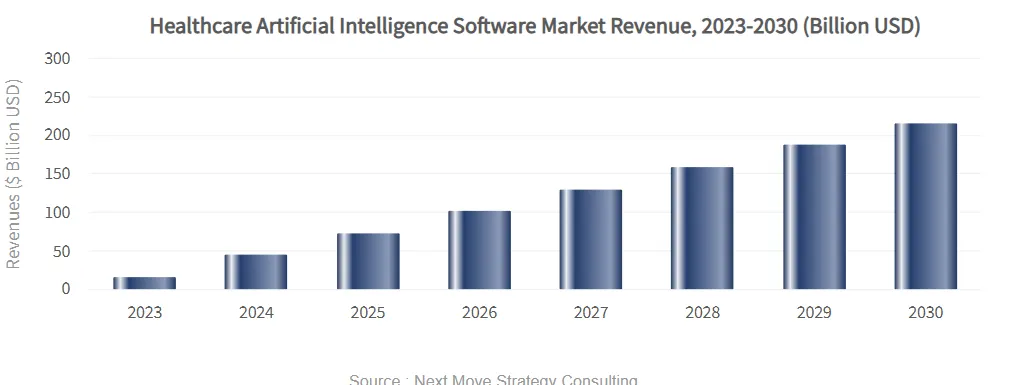
Source: NextMsc
A prime example of this technology in action is Nuance DAX, an ambient clinical intelligence platform owned by Microsoft. The software listens to doctor-patient conversations and automatically builds structured medical notes. Driven by urgent enterprise demand, this platform has scaled dramatically, contributing significantly to Microsoft’s broader healthcare cloud business, which generates billions in recurring revenue.
Market Growth Creates Opportunities
Hospital buyers are actively looking for alternative vendors. Many legacy health systems want to avoid total vendor lock-in with massive tech conglomerates. They are looking for agile, specialized software that solves specific clinical bottlenecks. A new platform that integrates cleanly into existing workflows without requiring a massive infrastructure overhaul can scale rapidly in this high-growth environment.
Consider the success of Viz.ai, a clinical AI platform designed to detect strokes and vascular diseases early by analyzing medical imaging. By filling a specific, critical gap in emergency care coordination, the company scaled its operations to cross an estimated $100 million in annualized recurring revenue. This proves that specialized platforms can capture massive market share even alongside tech giants.
Top Investment Areas
Private capital is flowing heavily into a few proven product categories. Investors looking for predictable returns should target areas where the software directly correlates to hospital cost savings or increased patient volume. The most lucrative development segments include:
- Ambient Documentation Scribes: Voice-to-text platforms that listen to patient visits and instantly draft flawless clinical notes. These tools save doctors over two hours of paperwork every shift.
- Predictive Revenue Analytics: Software that reads patient charts to predict insurance denials before they happen, protecting a hospital’s bottom line.
- Clinical Decision Support Systems: Platforms that cross-reference a patient’s medical history with current medical literature to suggest personalized treatment paths.
- EHR-Integrated Summarizers: Tools that condense thousands of pages of historical medical records into a clean, one-page brief for the treating physician.
How Clinical AI Software Fits into Modern Healthcare Workflows?
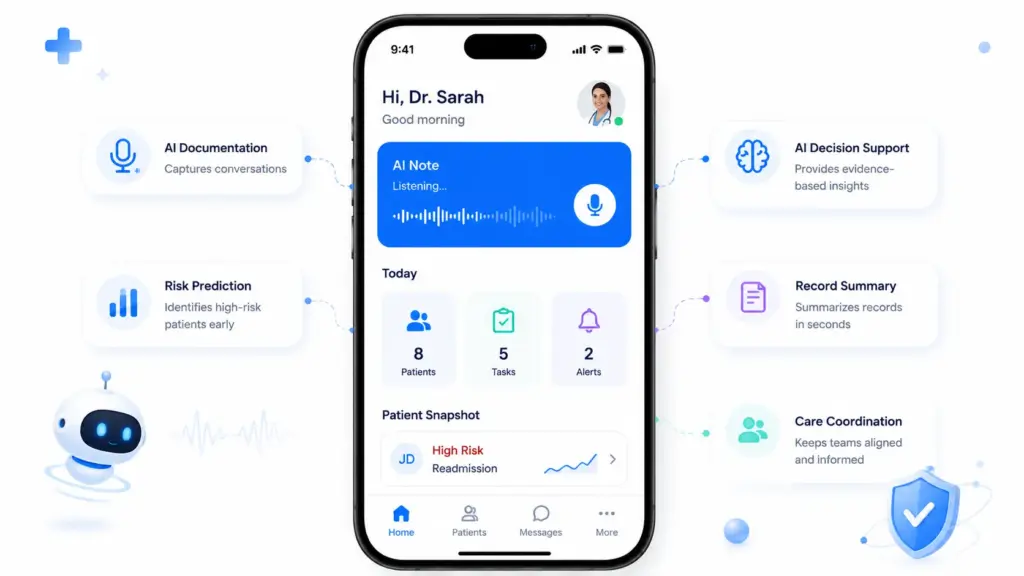
Clinical AI software helps healthcare providers work more efficiently by fitting into the systems they already use. It analyzes patient records, clinical conversations, and medical data to deliver useful insights while reducing documentation and other routine tasks. This gives clinicians more time to focus on patient care instead of paperwork.
1. Automating Documentation
Ambient AI tools remove the computer screen from the doctor-patient relationship. The software listens to natural conversations during an exam, filters out small talk, and instantly creates structured medical notes. It automatically maps the dialogue into standard clinical formats like SOAP notes and queues them up for a doctor to review and sign off.
Large healthcare organizations are using this to salvage clinical hours. For example, the University of Michigan Health deployed ambient AI scribes across its primary care network. The system automatically populates patient charts, saving their physicians multiple hours every day and allowing them to book more appointments without extending their shifts.
2. Supporting Diagnosis
Diagnostic AI serves as an instantaneous second opinion for complex cases. The software cross-references a patient’s historical lab data, active symptoms, and recent imaging against massive databases of medical literature. This allows the system to flag subtle anomalies or rare drug interactions that require immediate attention.
- Image Recognition: Algorithms scan X-rays and MRIs to highlight potential micro-fractures or early-stage tumors.
- Risk Triaging: The system bumps critical patient files to the top of the specialist queue based on the severity of the findings.
- Evidence Mapping: Doctors receive direct links to clinical guidelines that justify the suggested diagnostic paths.
Mayo Clinic actively utilizes specialized diagnostic AI algorithms within its cardiology department. The software analyzes standard EKG results to detect hidden heart risks that traditionally require expensive, invasive testing, letting doctors intervene much faster.
3. Improving Care Coordination
When a patient moves between emergency rooms, intensive care units, and outpatient clinics, critical data often gets lost. Clinical AI bridges these gaps by synthesizing long medical records into actionable briefs. The platform surfaces crucial changes in a patient’s status and automatically alerts the care team.
Operational Impact: Nurses, specialists, and care managers all view the same real-time summary. This eliminates redundant testing and prevents conflicting treatment orders.
Mass General Brigham relies on integrated AI coordination tools to manage complex patient transitions. Their system automatically tracks patient progress across different departments and flags the care team the moment a patient requires a specific follow-up specialist, reducing communication errors.
4. Optimizing Operations
Hospital profitability depends heavily on resource allocation and bed availability. Operational AI analyzes historical admission trends and real-time emergency room traffic to forecast bed demand days in advance. This helps administrators staff units accurately and prevent severe bottlenecking at discharge.
| Operational Bottleneck | AI Solution | Financial Result |
| Unexpected ER Surges | Predictive staffing models | Reduced overtime costs |
| Delayed Discharges | Automated checklist tracking | Faster bed turnover rates |
| Unplanned Readmissions | Post-discharge risk scoring | Avoided insurance penalties |
HCA Healthcare uses predictive AI software across dozens of its hospitals to streamline daily throughput. The platform monitors real-time patient data to predict exactly which individuals are at high risk for intensive care admission, allowing staff to allocate rooms and life-saving equipment before a crisis occurs.
Key Features of a Clinical AI Software for Healthcare Providers
Clinical AI software is becoming an essential part of modern healthcare because it helps providers work more efficiently while improving patient care. The right platform can reduce routine administrative work, support faster clinical decisions, and fit naturally into existing workflows. Below are some of the key features that make a clinical AI solution valuable for healthcare organizations.
1. Ambient AI Clinical Documentation
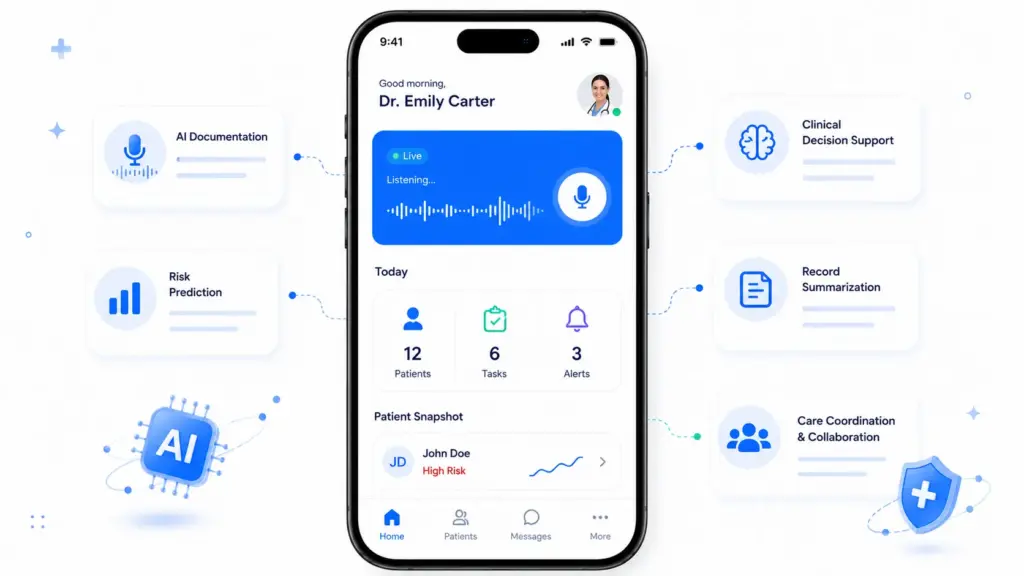
Healthcare providers use ambient AI to automatically capture doctor-patient conversations, generate structured clinical notes, and update EHRs in real time. This significantly reduces documentation workload, minimizes after-hours charting, and allows clinicians to spend more time engaging with patients instead of typing notes. A strong ambient documentation system also improves note consistency and supports better coding accuracy.
For example, Mayo Clinic has collaborated with Abridge and Epic to develop AI-powered ambient documentation workflows that help nurses and physicians streamline clinical documentation within existing workflows.
2. AI-Powered Clinical Decision Support
Clinical AI analyzes patient history, lab results, medications, imaging reports, and medical guidelines to help healthcare providers make faster, evidence-based decisions. Instead of replacing physicians, it surfaces relevant insights, highlights potential risks, and recommends next steps, allowing clinicians to validate recommendations before making treatment decisions.
For instance, Cedars-Sinai uses AI within its virtual care platform to summarize patient information, assist with symptom assessment, and support physicians during clinical decision-making.
3. Intelligent Patient Risk Prediction
Healthcare providers use predictive AI to identify patients who are at higher risk of readmission, disease progression, sepsis, cardiac events, or other complications before symptoms worsen. These predictive insights help care teams prioritize interventions, allocate resources efficiently, and improve patient outcomes through earlier treatment.
A well-known example is Kaiser Permanente, which has expanded the use of AI technologies across its health system to improve proactive patient care and clinician efficiency through AI-assisted workflows.
4. AI Medical Record Summarization
Clinicians often spend valuable time reviewing years of patient history before every consultation. AI-powered summarization automatically condenses lengthy medical records into concise clinical overviews, helping providers quickly understand diagnoses, medications, allergies, recent tests, and previous treatments. This enables faster consultations without missing important clinical information.
For example, Johns Hopkins Medicine has deployed Abridge’s AI platform to improve clinical documentation and provide clinicians with faster access to patient information.
5. AI Care Coordination and Team Collaboration
Modern healthcare involves physicians, specialists, nurses, pharmacists, and care managers working together. Clinical AI helps coordinate care by automatically sharing patient updates, assigning follow-up tasks, summarizing encounters, and notifying teams about critical events. This improves communication while reducing delays in treatment.
For example, Duke Health uses Abridge’s AI platform to improve clinician efficiency and strengthen coordinated care across its healthcare teams.
6. AI Medical Coding and Compliance
Healthcare providers use AI to automatically identify diagnosis codes, procedure codes, and documentation gaps while ensuring regulatory compliance. By suggesting accurate ICD-10, CPT, or HCC codes directly from clinical notes, AI reduces manual coding errors, speeds up billing, and supports better reimbursement without increasing administrative workload.
As an example, Riverside Health reported improved documentation quality and increased HCC diagnosis capture after implementing AI-assisted clinical documentation workflows.
7. AI Clinical Search and Knowledge Assistant
Healthcare providers frequently need quick access to treatment guidelines, previous patient encounters, research evidence, and medication information during consultations. An AI-powered clinical assistant retrieves relevant information from EHRs, medical literature, and institutional knowledge in seconds, helping clinicians make informed decisions without interrupting their workflow.
For example, Emory Healthcare has implemented Abridge’s AI platform across thousands of physicians to enhance documentation and support real-time clinical workflows.
How Can You Build Clinical AI Software for Healthcare Providers?
Building enterprise-grade clinical AI software takes more than strong AI models. It requires secure architecture, healthcare expertise, and seamless integration with clinical workflows. At IdeaUsher, we help healthcare organizations turn innovative ideas into scalable AI platforms that providers can rely on every day.
1. Define The Problem
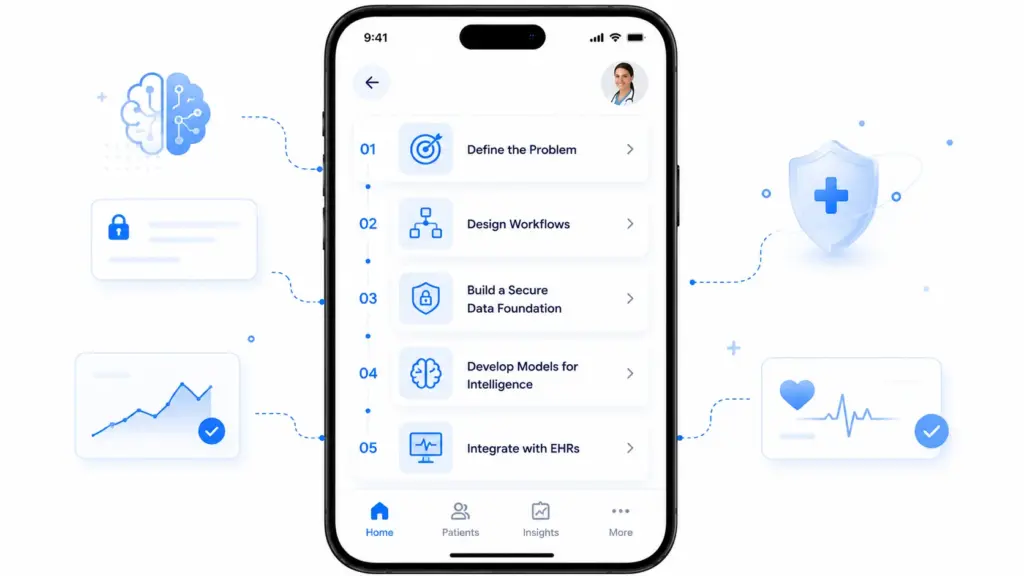
We start by isolating a single operational bottleneck where AI can drive measurable financial returns. Launching a generic healthcare platform rarely works because hospital procurement teams buy solutions for explicit pain points. We help you target high-value problems like extreme documentation delays or high diagnostic error rates in specialty clinics. Focusing on one clear problem ensures your initial product delivers immediate ROI to enterprise buyers.
2. Design Workflows Around Providers
A platform will fail if it adds extra steps to a doctor’s day. We design intuitive AI interactions that fit smoothly into existing clinical habits. Physicians should never have to open a separate app just to view an AI insight. Instead, the right information appears within the tools they already use, making adoption easier and everyday workflows more efficient.
3. Build A Secure Data Foundation
Healthcare software requires an incredibly secure data pipeline. We engineer compliant backend systems that securely aggregate data from various sources like lab databases, imaging files, and patient monitors. By building on modern interoperability standards like FHIR and HL7 protocols, we ensure your platform can securely communicate with complex hospital servers without risking data leaks.
4. Develop Models For Intelligence
We build and train the specialized AI models that power your platform’s core logic. Depending on your business goals, we implement medical natural language processing for automated charting, or predictive analytics to identify high-risk patients. We focus on training these models using clean data sets to eliminate hallucinations and ensure clinical accuracy.
5. Integrate With EHRs
Hospitals run on monolithic electronic health record systems like Epic or Cerner. If your software does not connect with them, hospital boards will not buy it. We build deep integrations that push AI recommendations and automated notes directly into the institution’s existing core software. This allows clinicians to access your tools without ever switching tabs.
6. Validate Performance Before Deployment
Before any software goes live, we run extensive simulations with practicing medical professionals to verify model accuracy and detect algorithmic bias. We establish a rigorous human-in-the-loop review process. This setup ensures doctors can easily audit and sign off on any AI-generated insight before it enters an official patient record.
7. Launch, Monitor, And Improve
Launching the software is just the beginning of the product lifecycle. Once your platform is live in a hospital network, we continuously track its performance and gather feedback directly from the nursing and medical staff. We use this real-world performance data to retrain the underlying models, fix system bugs, and ship seamless feature updates that protect your software’s long-term enterprise market value.
Cost to Build a Clinical AI Software for Healthcare Providers
A well-planned budget is essential for building clinical AI software that is secure, scalable, and compliant with healthcare regulations. At IdeaUsher, we define the right development scope early so you know exactly where your investment goes. This approach helps reduce unnecessary costs, speeds up development, and ensures your platform is built for long-term growth.
MVP Development Cost
An MVP allows you to test your clinical AI software with real healthcare providers before committing to a larger investment. By focusing on the features that deliver the most value, you can launch faster, gather practical feedback, and refine the product based on actual clinical needs.
Depending on the scope and medical specialty, an MVP typically costs between $40,000 and $100,000, making it a cost-effective way to validate both the technology and the business opportunity.
Factors That Influence Development Cost
The final capital requirement for your healthcare platform depends on several structural moving parts. We work with you to map out these technical elements early, helping your team avoid scope creep and unexpected infrastructure bills. The primary financial levers include:
- Algorithmic Logic and Model Choice: Using pre-trained foundation models via secure medical APIs keeps initial engineering costs lower. If your platform requires custom machine learning models trained on proprietary medical data, your development budget will scale due to higher compute power demands.
- Systems Interoperability: Connecting securely with legacy electronic health record software often requires custom API pipelines. A standard integration using modern protocols like FHIR will be significantly more affordable than building bespoke data bridges for older hospital frameworks.
- Regulatory Compliance Frameworks: Patient data requires total security. Building built-in audit trails, role-based user access controls, and absolute data encryption to meet regional healthcare privacy laws requires dedicated security engineering that influences the total investment.
Estimated Cost By Platform Complexity
To help you align your investment with your long-term commercial goals, we categorize development tiers into three distinct technical levels. Partnering with us means your capital is used efficiently across these tiers. We specialize in engineering lean, scalable architectures that allow you to start at the MVP phase and scale your technical infrastructure smoothly as your enterprise client list grows
| Platform Tier | Target Features | Estimated Cost Range | Development Timeline |
| Minimum Viable Product | Basic ambient scribe, standard provider portal, essential compliance | $40,000 – $100,000 | 2 – 5 Months |
| Mid-Market Platform | Predictive risk scoring, multi-system EHR sync, advanced clinical decision tools | $100,000 – $400,000 | 6 – 12 Months |
| Enterprise AI Engine | Custom-trained models, hospital-wide automation pipelines, deep legacy integrations | $400,000 – $1,000,000+ | 12 – 24 Months |
Major Use Cases of Clinical AI Across Healthcare Specialties
Clinical AI software operates across multiple medical specialties to optimize daily clinical operations. By processing high volumes of patient data instantly, these specialized platforms allow medical teams to deliver faster, highly targeted care while drastically reducing administrative friction.
1. Primary Care and Family Medicine
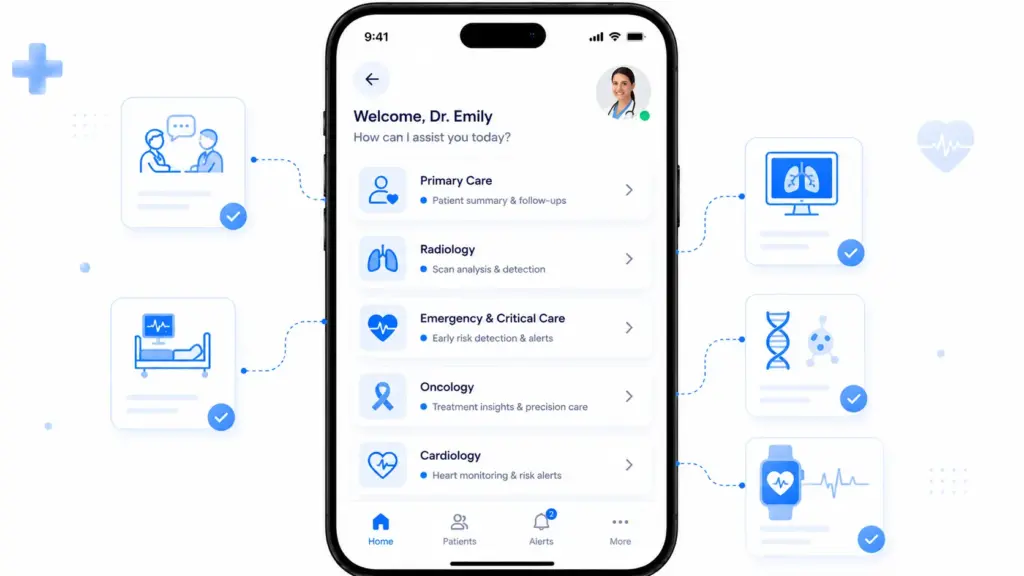
Primary care clinicians manage a massive volume of diverse patient files every day. AI software serves as an intelligent assistant during routine checkups by instantly extracting critical clinical notes from doctor-patient dialogue. The system automatically cross-references these notes with universal guidelines to flag overdue immunizations or routine screenings, keeping preventive care at the forefront without slowing down the appointment.
Jefferson Health successfully deployed ambient AI tools throughout its family medicine clinics to streamline routine appointments. Their primary care doctors use the software to automatically draft visit summaries, which gives them more face-to-face time with patients and simplifies the post-visit instructions process.
2. Radiology and Medical Imaging
Radiology platforms use advanced deep learning models to analyze complex medical scans within seconds. Instead of replacing the human expert, the software flags anomalies, potential micro-fractures, or small pulmonary nodules that require immediate verification. This instant triage system ensures that critical, life-threatening cases move straight to the top of the radiologist’s review queue.
- Fast Triage: The platform spots urgent vascular blockages on scans and alerts the on-call medical team immediately.
- Pixel Analysis: Advanced software measures changes in tissue density that are difficult to evaluate with the naked eye.
- Error Reduction: It acts as a permanent backup reviewer to minimize the risk of oversight during long night shifts.
RadNet, a massive outpatient imaging network, integrates specialized AI algorithms across its clinics to optimize breast cancer screenings. The software analyzes mammograms alongside radiologists, improving early detection accuracy and cutting down on unnecessary patient callbacks.
3. Emergency and Critical Care
The fast-paced nature of emergency departments requires immediate data processing. Critical care AI platforms continuously monitor live vital signs, lab results, and patient charts to predict sudden physical deterioration before obvious symptoms appear. This predictive capability allows emergency rooms to allocate resources efficiently and intervene before a patient enters a critical state.
Clinical Insight: Early detection models can spot signs of impending sepsis hours before standard physical symptoms show up, giving trauma teams a massive head start on life-saving treatments.
Intermountain Health utilizes predictive AI monitoring tools inside its intensive care units. The platform reads data streaming from patient monitors around the clock, instantly alerting the medical staff if a patient’s physiological patterns indicate a high risk of sudden respiratory failure.
4. Oncology and Precision Medicine
Oncology software utilizes machine learning to process massive genomic datasets and medical records to tailor cancer treatments to the individual patient. The software tracks how similar genetic profiles reacted to specific therapies, which helps oncologists select highly effective chemotherapy combinations and accurately monitor tumor progression over time.
| Clinical Challenge | AI Intervention | Expected Outcome |
| Complex genetic data | Automated mutation mapping | Targeted therapy matching |
| Tracking tumor changes | Volumetric scan comparison | Fast treatment adjustments |
| Monotonous chart reviews | Multi-source data synthesis | Accelerated clinical trial enrollment |
Memorial Sloan Kettering Cancer Center leverages advanced oncology AI tools to assist its medical teams with complex treatment planning. The platform analyzes a patient’s specific tumor genetics against global research databases to suggest highly personalized therapy options for rare cancer cases.
5. Cardiology and Chronic Disease Management
Cardiovascular AI platforms excel at reading electrocardiograms and tracking long-term trends in chronic diseases. By combining data from standard clinical tests with continuous readouts from wearable medical devices, the software spots irregular heart rhythms or worsening heart failure metrics, enabling early intervention outside hospital walls.
Cleveland Clinic integrates specialized AI software into its remote monitoring programs for patients with chronic heart failure. The platform tracks daily weight fluctuations and blood pressure readings from home devices, automatically alerting care managers the moment a patient’s metrics point toward a potential cardiac event.
Top 5 Healthcare Providers That Use Clinical AI Softwares
Many leading healthcare providers in the U.S. are already using Clinical AI software to improve patient care and simplify clinical workflows. We researched some of the best real-world examples to show how these organizations are putting AI into practice and what you can learn from their approach.
1. Mayo Clinic
Mayo Clinic has been a leader in bringing AI into everyday clinical practice. Its teams use AI to help doctors detect diseases earlier, interpret medical tests more accurately, and make better treatment decisions. The organization also invests heavily in AI research, making it a benchmark for healthcare providers looking to adopt intelligent clinical solutions.
2. Mass General Brigham
Mass General Brigham uses AI to simplify the work of clinicians and improve patient care. From assisting radiologists to reducing documentation time with generative AI, the health system focuses on making healthcare more efficient without disrupting existing clinical workflows. Its approach shows how AI can support providers while keeping physicians in control.
3. Cleveland Clinic
Cleveland Clinic applies AI across several specialties to help clinicians make faster decisions and improve patient outcomes. AI is used to support medical imaging, identify high-risk patients, and reduce administrative work. This allows healthcare teams to spend more time delivering care instead of managing paperwork.
4. Kaiser Permanente
Kaiser Permanente has adopted ambient AI technology to make clinical documentation easier for physicians. Instead of spending hours writing notes after appointments, providers can let AI capture conversations and create structured documentation automatically. This helps reduce burnout while giving clinicians more time to focus on their patients.
5. Mount Sinai Health System
Mount Sinai uses AI to improve diagnosis, personalize treatments, and advance medical research. The health system continues to explore new ways AI can support both clinicians and patients across different specialties. Its work demonstrates how AI is becoming an important part of delivering smarter and more proactive healthcare.
Create a Clinical AI Software for Healthcare Providers with IdeaUsher
At IdeaUsher, we simplify the entire development process by managing everything from product planning and design to AI development, testing, and deployment. Having one experienced team handle every stage keeps the project on track, reduces delays, and ensures every part of the platform works together seamlessly. This approach lets you focus on growing your healthcare business while we build a secure, scalable clinical AI solution.
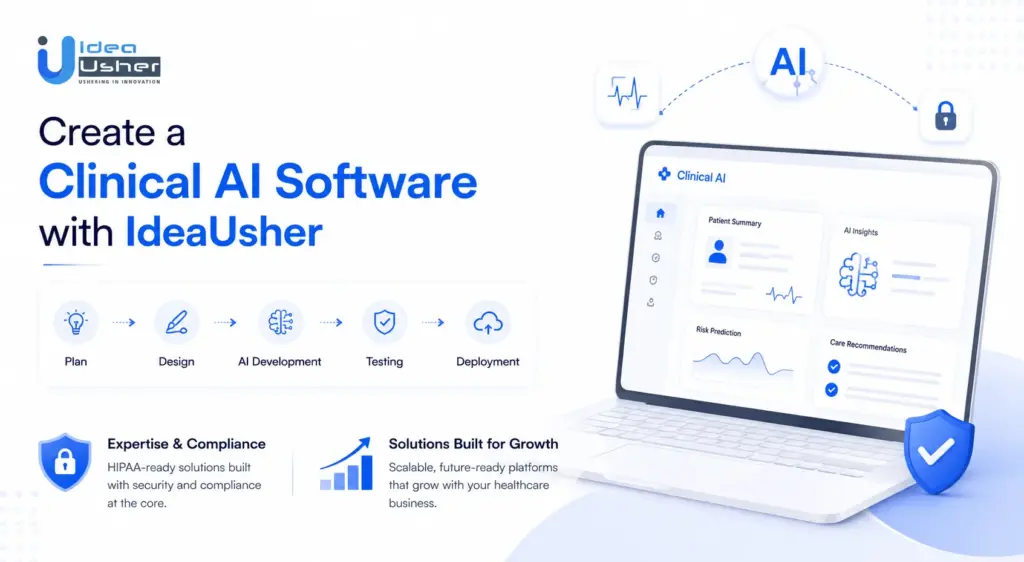
Expertise and Compliance
Medical software must adhere to strict regulatory standards to protect patient data from security breaches. We build core architecture around regional healthcare privacy laws right from the first line of code. Our systems are fully HIPAA-ready and employ advanced data encryption standards to ensure that sensitive patient files remain completely safe whether they are stored on a server or moving across networks.
- FHIR Protocols: We build secure data bridges that let your platform communicate flawlessly with standard hospital databases.
- EHR Integration: Our engineers sync your software directly with massive systems like Epic and Cerner without compromising security.
- Audit Trails: We implement permanent, automated logging systems that record exactly who accesses data and when.
Solutions Built for Growth
Scaling a healthcare platform requires deeply stable code that can handle millions of data points without crashing. Our team draws on elite development backgrounds and over 500,000 hours of coding experience to deliver enterprise-grade software infrastructure. We build your platform using highly modular code bases, meaning your system can handle massive spikes in hospital user traffic without any drop in performance.
Our Engineering Standard: We avoid shortcuts and rigid architectures. As new machine learning breakthroughs emerge, the system we build for you can easily integrate these updated capabilities without needing a costly total rewrite.
Conclusion
Clinical AI software is quickly becoming a key part of modern healthcare because it helps providers work more efficiently while improving patient care. Building the right platform means understanding clinical workflows, choosing the right AI technologies, and ensuring compliance from the beginning. With a thoughtful development approach, you can create a solution that delivers real value today and scales with the future of healthcare.
Things to Know About Clinical AI Softwares
A1: Clinical AI software helps doctors and healthcare teams work more efficiently by handling time-consuming tasks and providing useful clinical insights. It can generate medical notes, review patient records, and highlight important information so providers can make decisions more quickly and spend more time with patients. As healthcare demands continue to grow, these platforms are becoming an essential part of modern clinical practice.
A2: No. Clinical AI is meant to support healthcare professionals, not take their place. It can analyze large amounts of medical information and suggest possible next steps, but every diagnosis and treatment decision is still made by a qualified clinician. AI works best as a tool that improves clinical judgment rather than replacing it. The best outcomes come from combining AI insights with a clinician’s expertise and experience.
A3: Yes. Any platform that stores or processes patient health information must follow healthcare privacy regulations such as HIPAA. Strong security, encrypted data, and controlled access are essential because healthcare organizations need to protect patient information at every stage. Building compliance into the platform from the beginning also helps avoid costly changes later.
A4: Yes. Most Clinical AI platforms are designed to work alongside existing EHR systems instead of replacing them. This allows healthcare providers to use AI features directly within their current workflow, making adoption easier and reducing the need to switch between different applications. A well-integrated solution also improves clinician adoption and overall operational efficiency.