


Key Takeaways
- Learning resource platforms are growing as students seek study materials, AI assistance, and personalized learning experiences.
- Successful platforms scale through user-generated content, resource libraries, expert support, and intelligent search systems.
- Subscription-based models create recurring revenue, while institutional licensing and corporate training provide additional growth opportunities.
- AI-powered features such as homework assistance, flashcard generation, and personalized recommendations improve engagement and retention.
- How Idea Usher can help businesses build learning platforms like Course Hero with AI tools, document indexing, subscription systems, and scalable infrastructure.
One of the most interesting shifts in education is how students are moving beyond traditional textbooks and classroom materials. Many students have started using learning resource platforms because they offer practical study resources created by people who have already taken the same courses and exams. This has helped platforms like Course Hero grow into powerful academic knowledge hubs where valuable insights continue to help future learners instead of disappearing after a semester ends.
We’ve built learning resource platforms powered by AI-powered content discovery and intelligent document indexing that make it easier for users to find relevant study materials and academic resources. Based on that experience, we’re creating this blog to explore how you can build a learning resource platform like Course Hero. Let’s get started!
Market Potential for Learning Resource Platforms
According to Market US, the Global Digital Learning Resources Market was valued at USD 487.2 million in 2025 and is expected to grow rapidly at a CAGR of 18.6% through 2034. This growth reflects a major change in how people learn today. Students increasingly prefer platforms that provide instant help, personalized guidance, and interactive study experiences instead of relying on static learning materials. As AI becomes a core part of education, platforms that can adapt to individual learning needs and deliver real-time support are seeing strong demand across the market.

Source: Market US
Major platforms prove how lucrative this demand is. For instance, Quizlet built its foundation on digital flashcards and smart study tools. By continually adding intelligent learning features, its annual revenue has scaled to over 95 million dollars. This proves that users are highly willing to spend money on tools that optimize their study time.
Subscription Growth
The predictable revenue of SaaS models makes subscription-based education platforms incredibly attractive to investors. Users prefer recurring monthly or annual fees because they get ongoing access to updated libraries and premium features. This model aligns the platform’s financial success with the continuous value it delivers.
Building a subscription business in this space offers several distinct financial advantages:
- Predictable Cash Flow: Monthly recurring revenue simplifies budget planning, marketing spend, and scaling operations.
- Higher Lifetime Value: Continuous product updates keep users subscribed for multiple semesters or years, maximizing the return on your initial acquisition cost.
- Tiered Monetization: You can easily structure your pricing to offer basic access, premium AI features, or enterprise packages for institutions.
The margins in this space are remarkably high once the core technology is built. Unlike physical businesses, serving your next thousand users incurs minimal extra cost. This scalability allows software businesses to grow rapidly and achieve strong profitability early on.
B2B Opportunities
The opportunity for digital learning platforms extends far beyond students. Businesses across industries invest heavily in employee training, certification programs, and workforce development. This creates a large and stable market for platforms that can deliver structured learning experiences at scale. The demand is especially strong in fields where professionals must continuously update their skills or maintain industry certifications.
The success of Coursera highlights this potential. Out of its $757 million total revenue, more than $255 million came from Coursera Enterprise, showing how valuable corporate training can be. By building a flexible learning platform that serves both individual learners and organizations, founders can unlock multiple revenue streams and access higher-value customers with long-term training budgets.
The Evolution of Course Hero Since 2006
Course Hero is a learning resource platform that has grown into a multi-billion dollar educational ecosystem. It functions as a massive, crowdsourced library where students and educators share course-specific study resources, lecture notes, and practice exams. By transforming individual study materials into a scalable, community-driven marketplace, the platform created a highly profitable blueprint for modern digital education ventures.
Launching the Marketplace
The platform started with a simple idea. It allowed students to share their lecture notes, study guides, and practice exams. This crowdsourced model solved a major problem for college students who needed specific study materials for their exact classes. Instead of creating content from scratch, the company built a system where users traded documents. You uploaded your own study notes to unlock resources uploaded by others.
This created a viral growth loop. More users meant more content, which naturally attracted even more users without massive marketing costs.
Expanding Learning Support
Over time, simple document sharing was no longer enough to maintain market dominance. The business shifted from a basic repository into a comprehensive educational ecosystem. They realized students needed deeper help when they got stuck on complex problems. To bridge this gap, the platform integrated a 24/7 expert Q&A service.
If a student could not find an answer in the existing document database, they could submit a photo or text of the problem. A verified tutor would then provide a step-by-step breakdown. This upgrade transformed the site from a passive library into an active learning partner.
Scaling Premium Services
The true monetization breakthrough came with the premium subscription layer. While basic users could still swap documents, power users paid a recurring monthly fee for instant access. This recurring revenue allowed the business to invest heavily in advanced technology and expand its market value.
The platform’s financial trajectory highlights the massive scalability of this model:
- Early Capital: The company proved its core concept through early seed rounds and a 15 million dollar Series A round to build its foundational database.
- Unicorn Valuation: A 10-million-dollar Series B round, later expanded by an additional 70 million dollars from major financial institutional backers, pushed the company past a 1.1-billion-dollar valuation as annual revenues cleared 100 million dollars.
- Massive Series C: The platform secured a massive 380 million dollar Series C funding round led by Wellington Management, driving its peak valuation to 3.6 billion dollars.
The company scaled its operations by focusing on three main pillars:
- Instant Document Processing: Technology quickly categorizes and indexes millions of uploads by university and course code.
- On-Demand Human Experts: A global network of freelance tutors handles specialized, edge-case student questions.
- Smart Recommendations: Machine learning suggests relevant flashcards and study guides based on what the user is currently reading.
By combining human expertise with automated scaling, the platform built a highly profitable business. This history shows investors that you do not need all your features ready on day one. You start by solving a specific user problem and use your growing revenue to build a complete technology ecosystem.
How Course Hero Built a Massive Study Resource Library?
Course Hero scales its platform by turning everyday study materials into reusable educational assets. By building a massive digital library driven directly by students, the company bypassed the traditional, high costs of hiring professional content creators. This crowdsourced content engine forms the core operational foundation that makes the entire platform highly scalable and profitable for investors.
1. Student Upload Incentives
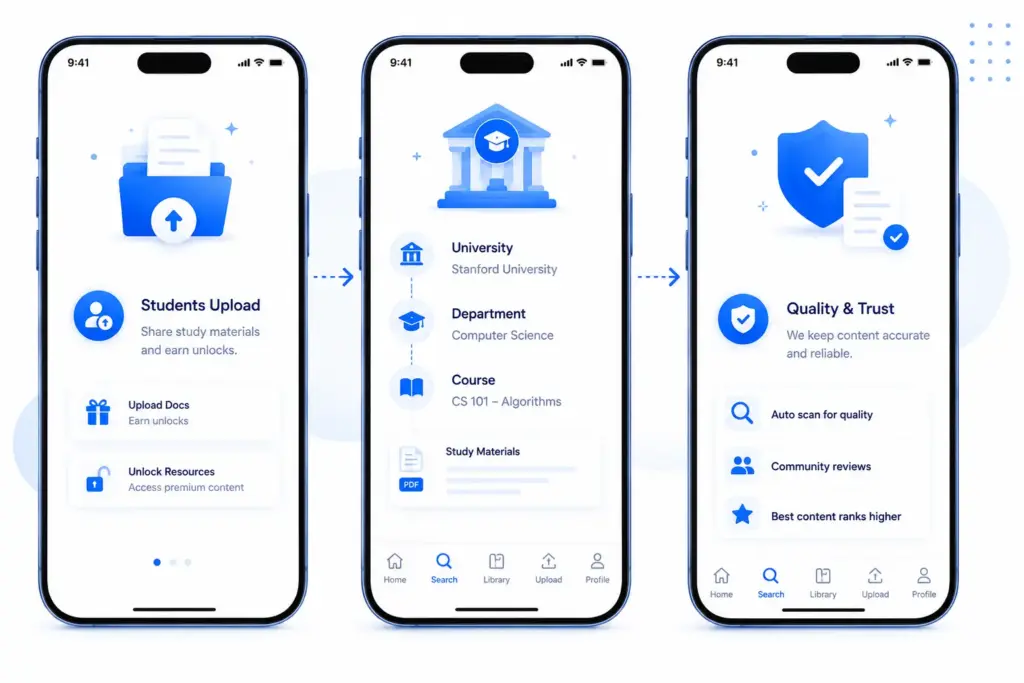
The foundation of Course Hero relies heavily on user-generated content. Instead of paying expensive publishing companies to write textbooks, Course Hero lets its users build the library. This approach relies on a simple trade system that removes any financial friction for the student.
This dynamic encourages continuous participation. Students have an abundance of old notes and study guides but very little cash. Giving them premium access in exchange for their study materials creates a constant stream of new data for Course Hero. This loop expands the repository with zero upfront content acquisition costs.
2. University and Course Structure
A massive library is completely useless if users cannot find exactly what they need in seconds. Students do not search for generic biology topics on Course Hero. They look for specific materials related to their exact class, professor, and university. Course Hero processes and structures incoming data through an organized hierarchy:
- Institution Level: The platform categorizes everything under specific universities or schools.
- Department Level: Materials are grouped into subjects like Chemistry or Finance.
- Course Code Level: Files get tagged with the exact course number, matching the university curriculum perfectly.
This structured taxonomy makes Course Hero highly discoverable on search engines. When a student types their difficult homework question or course code into a search engine, Course Hero appears at the top of the results. This targeted structural design lowers marketing costs by driving organic search traffic directly to the landing pages.
3. Quality Control and Moderation
Allowing users to upload files freely can lead to spam or duplicate content. A premium study platform like Course Hero must protect its integrity to keep subscribers happy. Automated technology handles the heavy lifting here, scanning documents immediately upon upload. This helps maintain content quality, improves search accuracy, and ensures learners can quickly find reliable study materials.
Verification Check: Course Hero scans for clear text, eliminates exact duplicates, and flags potential copyright or academic honor code violations before the file goes live. The community also assists Course Hero in maintaining high standards. Users can rate documents, leave comments, and flag inaccurate answers.
High-performing documents get pushed to the top of search results, while low-quality files are automatically filtered out. This dual approach keeps the platform trustworthy without requiring an army of full-time editors.
Key Features of a Learning Resource Platform Like Course Hero
Course Hero thrives by grouping essential educational features into one unified subscription. Instead of juggling multiple applications, students use the platform as a single destination for all their study needs. For an investor, replicating this comprehensive feature set creates a highly defensible market position and increases individual subscriber value.
1. Course-Specific Resource Library
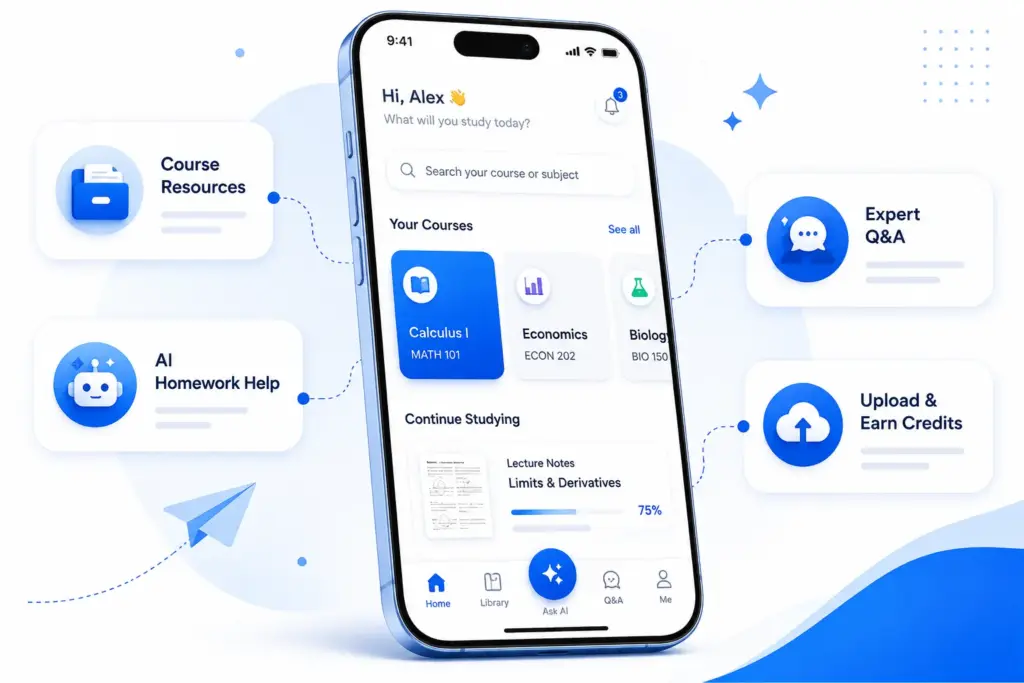
Students use Course Hero to find study materials tailored specifically to their exact classes. They navigate to their university page, select their course code, and view past lecture notes, study guides, and practice exams uploaded by previous students. This hyper-targeted structure saves hours of generic searching.
2. Textbook Explanations
When stuck on complex assignments, users turn to Course Hero for step-by-step textbook solutions. Instead of just giving a final answer, the platform breaks down the underlying methodology. Students interact with these solutions to master the difficult formulas and core concepts required to pass their upcoming exams.
3. AI Homework Help
Course Hero integrates artificial intelligence to provide instant study assistance. Users upload a dense document or take a photo of a problem, and the AI instantly analyzes the text. The assistant provides immediate explanations, answers questions, and summarizes lengthy chapters without making the user wait for a human response.
4. Expert Tutor Q&A
For specialized or advanced topics, students use the 24/7 expert Q&A feature. When automated tools are not enough, users post their specific academic questions to a global network of verified tutors. A human expert responds with a detailed explanation, ensuring students get high-quality support at any hour.
5. Content Upload System
The upload system serves as the primary gateway for community engagement on Course Hero. Users upload their own original study documents to earn credits. They use these earned credits to unlock premium resources contributed by others, driving constant content growth without financial friction.
6. Practice Problems and Exam Prep
To prepare for midterms and finals, students utilize personalized practice tools. They generate custom quizzes and review test-prep materials that match their specific syllabus. This interactive preparation helps users assess their readiness and identify weak areas before test day.
7. Personalized Resource Discovery
Students use the dashboard to track their learning progress and organize their materials. The platform analyzes user behavior to deliver tailored recommendations.
- Saved Libraries: Users bookmark essential documents and answers for quick access later.
- Smart Matching: The system automatically suggests relevant study materials based on the courses the student follows.
- Study Tracking: Digital tools help users monitor their mastery of specific academic topics over time.
How to Create a Learning Resource Platform Like Course Hero?
Building a platform like Course Hero requires balancing complex data engineering, smooth monetization, and advanced machine learning. We approach EdTech development by structuring clear phases that ensure your platform can handle millions of users and high volumes of content seamlessly. Here is how we map out the engineering and strategy for your platform.
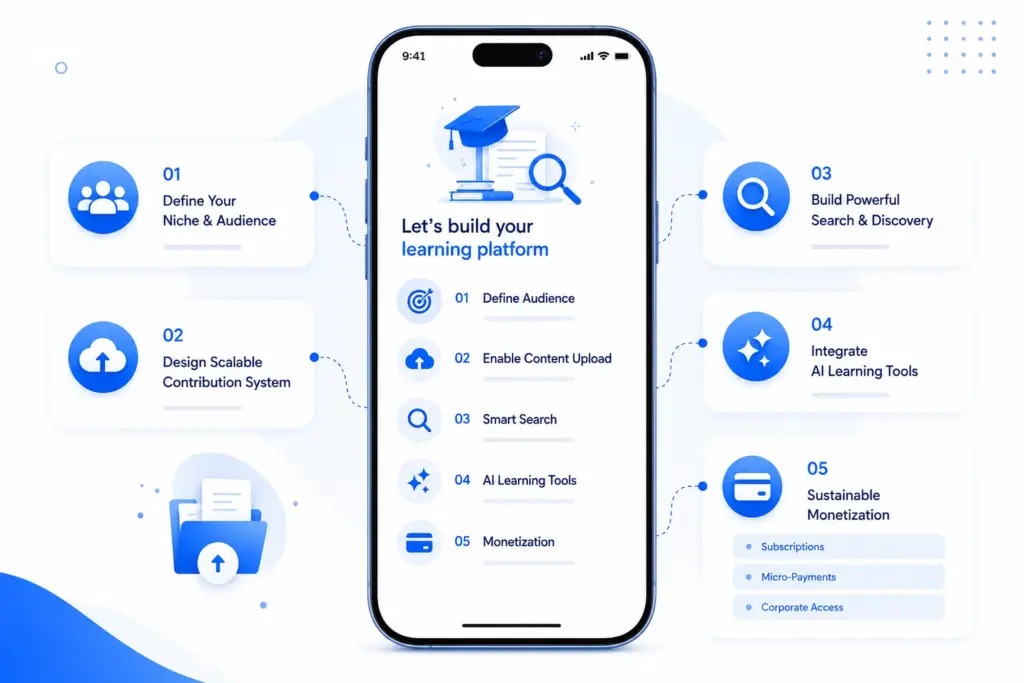
1. Define Your Niche and Audience
Launching a broad platform for every school globally on day one can dilute your marketing resources. We help you target a specific vertical first, such as professional medical licensing, engineering credentials, or local university clusters. This narrow focus allows you to capture a dedicated user base quickly before scaling.
2. Design a Scalable Contribution System
A successful platform needs an intuitive content loop where users can smoothly upload documents in exchange for premium access. We build secure cloud storage architectures and automated text extraction systems. This ensures user uploads are converted into searchable text and credited to their accounts instantly.
3. Build Powerful Search and Discovery
Students visit these sites because they want immediate answers to specific queries. We implement advanced search engines that understand context, misspellings, and exact course numbers. This enables your platform to index millions of files so users find identical study guides in seconds.
4. Integrate AI Learning Tools
Modern EdTech businesses rely on smart automation to lower support costs. We integrate advanced AI models that analyze uploaded documents instantly, generate automatic flashcards, and answer complex questions without requiring a human tutor for every single interaction.
5. Sustainable Monetization Strategy
A predictable cash flow keeps your platform thriving. We engineer multi-tiered payment systems that support flexible subscription billing, pay-per-unlock tiers, and custom corporate packages. This gives you complete control over how you scale your recurring revenue streams. Our technical architecture supports multiple monetization models:
- Recurring Subscriptions: Automated monthly or annual billing for unlimited document access.
- Micro-Transactions: Single-payment options for users who only need one specific study guide.
- Corporate Licensing: B2B portals for companies buying bulk access to train their engineering teams.
6. Quality and Compliance Controls
Protecting the platform from spam and copyright violations is vital for long-term business survival. We design automated moderation filters that scan incoming uploads for plagiary and duplicate content. This system flags questionable documents for admin review before they ever hit the public library.
7. Launch, Measure, and Improve
The final phase centers on strategic deployment and feature iteration based on real-world user activity data. We set up comprehensive telemetry and analytics dashboards. This visibility allows you to monitor exactly which courses are trending, track user churn, and optimize your marketing campaigns for maximum ROI.
Cost to Create a Learning Resource Platform Like Course Hero
Calculating the precise financial commitment required to launch an EdTech platform is the first step toward securing a strong market return. We align your development roadmap with clear financial milestones, breaking costs down by technical complexity and infrastructure demands. This financial transparency ensures your capital goes directly toward building features that drive user adoption and recurring revenue.
MVP for Resource Sharing
An MVP focuses strictly on core features like user profiles, document uploads, and basic search. This initial version allows you to validate your business idea with real users without over-engineering the backend on day one. We engineer these essentials using a scalable framework so your platform remains stable as traffic increases.
A basic functional deployment typically ranges from 30,000 to 50,000 dollars. This covers the essential portal architecture required to get your product into the market and start collecting user data.
| Phase | Timeline | Cost Range |
| Core Architecture & UI Design | 4-6 Weeks | 8,000 – 12,000 dollars |
| Document Upload & Credit System | 6-8 Weeks | 12,000 – 18,000 dollars |
| Basic Search & User Profiles | 4-5 Weeks | 10,000 – 20,000 dollars |
AI and Infrastructure Costs
Moving beyond a basic library requires more sophisticated technology. Integrating automated study tools, AI-powered document analysis, and automated tutoring capabilities adds layers of complexity to your tech stack. We connect your platform to powerful language models and secure cloud networks to handle heavy data processing safely.
Building this advanced, full-scale infrastructure generally requires an additional 40,000 to 90,000 dollars. This expansion moves your product from a standard note-sharing site into a highly competitive, automated EdTech ecosystem.
| Development Phase | Scope | Estimated Cost |
| Phase 1 | Basic MVP Learning Portal | $30K – $50K |
| Phase 2 | Add AI Learning Tools | +$40K – $90K |
| Total Project Cost | MVP + AI-Powered Platform | $70K – $140K+ |
Total Cost Influencers
Your final budget depends directly on the complexity of your business goals and specific feature choices. We work with you to prioritize features that drive immediate revenue while keeping your initial overhead manageable. Several key variables will influence your total engineering investment:
- Team Composition: The mix of specialized developers, cloud architects, and UI designers assigned to your project.
- AI Model Integration: The depth of your automated tools, ranging from basic text summaries to complex, real-time interactive tutoring engines.
- Data Security & Moderation: The sophistication of your automated filters used to scan for copyright issues and prevent platform spam.
Investment Summary: Combining an entry-level MVP with a highly automated, AI-driven infrastructure results in a total development range of 70,000 to 140,000 dollars for a market-ready platform.
By partnering with our engineering team, you gain access to the exact technical expertise needed to balance these development costs. We build your platform cleanly from the ground up, ensuring your capital is spent on features that maximize user retention and recurring revenue.
The Network Effects That Make Learning Platforms Defensible
Building a high-margin learning resource platform requires more than just launching smart software. The most successful brands dominate because they build structural moats that make it nearly impossible for new competitors to steal market share. By understanding how data and user activity feed into each other, you can design an ecosystem that grows more secure and profitable every single day.
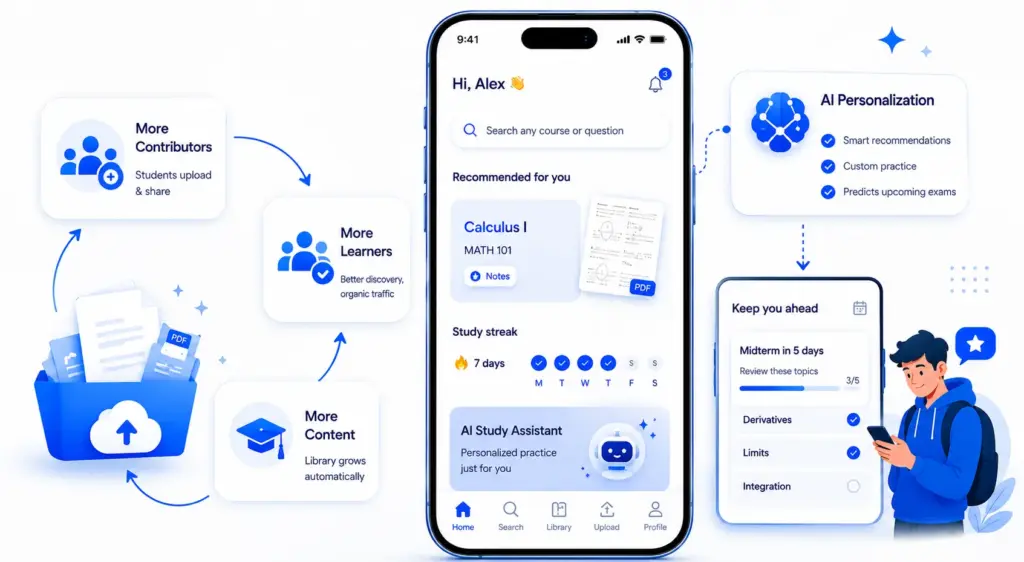
1. More Contributors, More Content
The strength of a learning platform scales directly with its user base. When students upload study guides or homework problems to unlock premium features, they directly expand your database. This crowdsourced loop means your content library grows automatically without requiring heavy operational spending from your corporate budget.
Consider peer-to-peer homework help spaces like Brainly. By building a massive social community where millions of students help each other solve academic problems, they scaled their infrastructure to clear over 50 million dollars in annual revenue. This baseline proof shows that crowdsourced sharing naturally lowers content acquisition costs while building a highly valuable corporate asset.
2. Larger Libraries, More Learners
A massive database naturally transforms into a powerful organic marketing engine. When your infrastructure indexes millions of specific course codes and textbook answers, search engines pick up these pages instantly. Students looking for rapid answers type their questions online and are directed straight to your landing pages, keeping user acquisition costs incredibly low.
Market leader Chegg demonstrates the sheer scale of this dynamic. By building a dominant library of detailed textbook answers and study resources, they grew their subscription engine to generate over 375 million dollars in annual net revenue. Their massive web footprint ensures that whenever a student searches for difficult course concepts, their platform remains the default destination.
3. AI and Retention
As your database grows, machine learning algorithms analyze user interactions to provide highly tailored study streams. The system monitors exactly which classes a student follows, tracks their problem-solving speed, and recommends targeted flashcards to improve performance. This personalized experience makes it highly unlikely for a user to cancel their subscription.
- Frictionless Discovery: Smart algorithms surface relevant study notes the moment a student opens their dashboard.
- Custom Practice Paths: Automated systems generate personalized mock quizzes based on past user mistakes.
- Predictive Tutoring: The platform anticipates upcoming midterms based on university schedules, pushing timely reviews that secure student loyalty.
Why Subscription-Based Learning Resource Platforms Scale Efficiently?
Subscription architectures provide digital education platforms with a highly defensive economic foundation. By transitioning away from one-off transactional sales and toward a recurring billing structure, an enterprise can secure predictable cash flows that fund aggressive software scaling. This operational predictability fundamentally alters how an educational database expands its market footprint.
1. Predictable Revenue Growth
Subscription revenue gives learning platforms a much stronger foundation for growth than one-time purchases. Instead of depending on seasonal spikes during exam periods, businesses can generate predictable income throughout the year. This stability makes it easier to invest in new features, expand infrastructure, and improve the overall user experience.
The growth of Quizlet shows why this model is so effective. By offering premium subscriptions and advanced study tools, the platform grew to generate more than $95 million in annual revenue. Consistent recurring revenue has allowed Quizlet to keep enhancing its product while supporting millions of learners worldwide.
2. Continuous Access and Retention
A flat-rate subscription can significantly increase user engagement because students gain access to a wide range of learning resources under a single plan. Instead of paying for individual documents, they can use study guides, textbook solutions, and other tools whenever they need them. This convenience encourages regular usage and makes the platform a valuable part of their academic workflow.
The success of Scribd demonstrates the effectiveness of this approach. By giving subscribers access to a vast library of documents, books, and educational content through one membership, the company grew its annual revenue run rate to more than $160 million. A unified subscription model helps increase retention while creating a reliable stream of recurring revenue.
3. Higher Lifetime Value
The true value of a subscription engine lies in maximizing consumer lifetime value while keeping customer acquisition spending low. Buyers and venture capital firms pay a premium for platforms that can retain a subscriber for multiple years. This structural loyalty ensures that marketing dollars spent to acquire a user today yield compound returns over time.
- Compounding Valuation Multiples: Strategic buyers pay higher acquisition premiums for recurring subscription revenue compared to transactional sales.
- Low Incremental Costs: Serving an additional study guide to an existing subscriber costs fractions of a cent, driving high profit margins.
- Capital Efficiency: Predictable retention metrics allow an enterprise to reinvest cash directly into advanced search systems and automated database moderation tools.
What Investors Look for in Learning Resource Startups?
Venture capitalists and institutional investors look past surface-level vanity metrics when evaluating digital education startups. They focus heavily on capital efficiency, defensive asset growth, and clear structural advantages that guarantee a strong financial return. Understanding these investor expectations allows founders to align their product development strategy directly with what the market is actively funding.
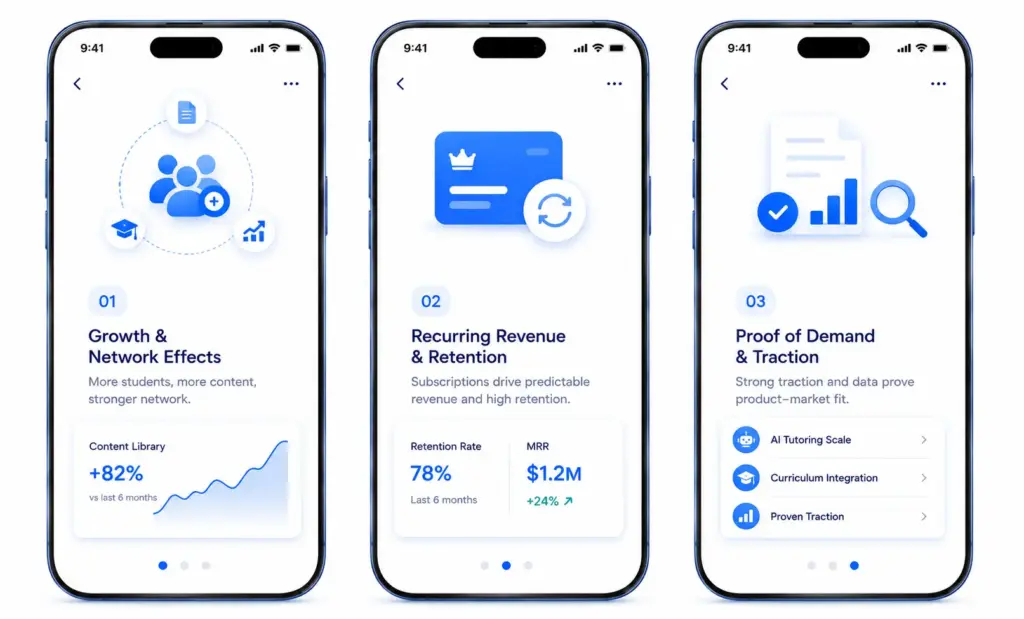
1. Growth and Network Effects
Investors are often drawn to learning platforms that become more valuable as more users join. When students contribute study notes, summaries, or course materials, the platform’s content library grows naturally without requiring constant spending on content creation. This creates a scalable growth model where user activity directly improves the product for everyone else.
The growth of Knowunity demonstrates the strength of this approach. The company built its platform around student-generated learning resources and expanded into multiple international markets. Its success helped secure a €27 million Series B funding round, showing that investors see significant value in platforms powered by strong community-driven content networks.
2. Recurring Revenue and Retention
Investors look closely at how a learning platform generates revenue over time. Subscription-based models are particularly attractive because they create predictable cash flow and make future growth easier to forecast. Strong retention rates are equally important, as they show that users continue finding value in the platform long after signing up.
The success of Gizmo highlights the potential of this model. By helping students turn notes into flashcards and interactive study sessions, the platform encouraged regular engagement and repeat usage. This combination of strong user retention and recurring revenue helped Gizmo secure $22 million in Series A funding to support its global expansion.
3. Proof of Demand and Traction
Recent market activity shows a major influx of institutional capital into platforms that successfully combine large content libraries with automated intelligence. Backers are aggressively funding businesses that use data engines to solve complex consumer demands efficiently. Showing clear transactional traction proves to investors that an enterprise can achieve rapid profitability.
Several specialized platforms highlight these current market trends:
- Automated Tutoring Scale: Venture funds are backing platforms like Arivihan, which raised seed and early-stage capital to deliver fully automated, AI-driven explanations to students at an incredibly low operational cost per user.
- Curriculum Integration Tools: Advanced infrastructure platforms like Flint secured 15 million dollars in Series A funding. This capital was deployed because their technology integrates adaptive lessons, real-time activity generation, and structural support directly into learning systems while keeping educators in control.
Build a Learning Resource Platform with Idea Usher
Building a high-margin learning platform requires deep technical execution and a clear go-to-market strategy. At Idea Usher, we help founders translate their EdTech concepts into scalable digital ecosystems. With over 500,000 hours of coding experience, our team of ex-MAANG/FAANG developers engineers robust platforms capable of handling massive libraries, smart user loops, and heavy data traffic smoothly.
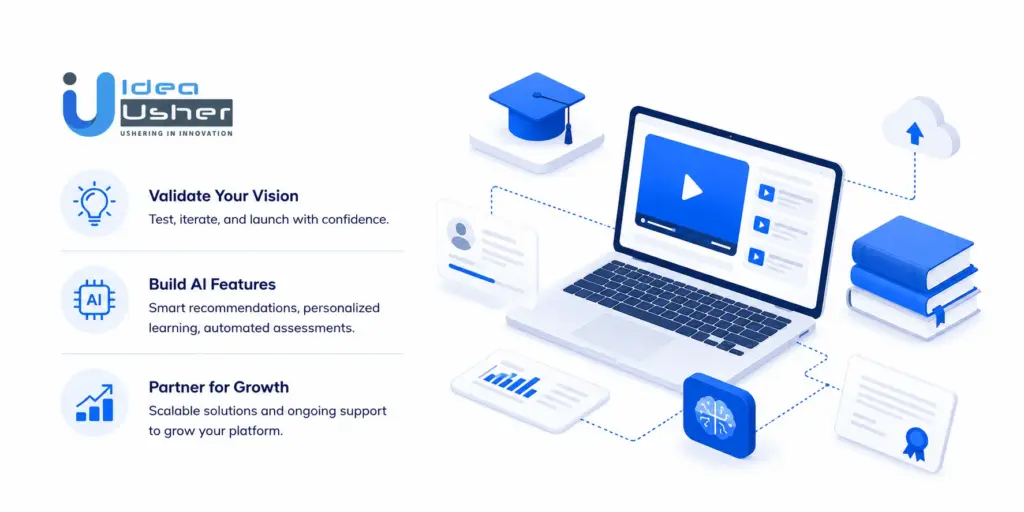
Validate Your Vision Before Development
Launching a massive global database on day one can dilute your marketing resources. We work with you to pinpoint a high-value educational niche, such as specific professional certifications or dense university course networks. By building a precise product blueprint, we ensure you capture an initial, highly active user base before investing heavily in full-scale deployment.
Build AI Features From Day One
Modern users expect automated, instantaneous academic support without waiting hours for human responses. Our engineering team integrates advanced artificial intelligence into your platform architecture to drive automated engagement. Our developer talent designs intelligent logic layers that handle data automation seamlessly:
- Instant Document Processing: Technology that extracts text from messy photos and uploads, sorting files automatically by university curriculum.
- Contextual Automated Answers: Integrated language models that break down complex textbook formulas into step-by-step learning guides automatically.
- Smart Study Recommendation: Predictive algorithms that track user mastery and suggest relevant notes right before major exam windows.
Partner for Long-Term Growth
Building a defensible marketplace requires a data structure that remains fast and secure as millions of new files enter the database. We assemble custom agile engineering teams tailored directly to your platform requirements, eliminating the overhead and friction of hiring in-house technical staff.
The Technical Advantage: Backed by 500,000 combined hours of platform engineering expertise, our developers build secure database roots, clear payment pathways, and automated copyright moderation filters.
Conclusion
Building a learning resource platform like Course Hero requires more than simply hosting study materials online. Success comes from creating a system that helps learners find relevant content quickly while encouraging users to contribute valuable resources. By combining a strong content library with AI-powered study tools, subscriptions, and scalable infrastructure, founders can build a platform that delivers long-term value to both students and educational organizations.
Things to Know About Learning Resource Platforms
Q1: How do learning resource platforms acquire content?
A1: Most platforms use a combination of user-generated content, educator contributions, institutional partnerships, licensed educational materials, and AI-generated study aids. Many also reward students for uploading high-quality resources. A well-designed contribution system creates a self-sustaining content ecosystem where every new upload increases platform value. Over time, this network effect helps build a large and difficult-to-replicate content library.
Q2: Can AI improve a learning resource platform?
A2: Yes. AI can generate summaries, create flashcards, answer questions, recommend study materials, personalize learning paths, and help students understand complex topics faster, making the platform more engaging and scalable. Modern AI tools can also analyze uploaded documents to extract key concepts and generate personalized study recommendations. This enhances learning outcomes while reducing the effort required from students.
Q3: How do learning resource platforms make money?
A3: Common monetization models include subscription plans, premium content access, tutor marketplace commissions, institutional licensing, advertising, certification programs, and AI-powered learning assistant subscriptions. Many successful platforms rely on recurring subscription revenue because it provides predictable cash flow and supports long-term growth. Additional revenue streams further improve profitability and reduce business risk.
Q4: How much does it cost to build a learning resource platform?
A4: Development costs vary based on features, AI integrations, content moderation systems, tutor marketplace functionality, and scalability requirements. A basic MVP typically costs significantly less than a fully featured AI-powered platform. Costs also depend on the complexity of search systems, recommendation engines, analytics, and cloud infrastructure. Planning feature priorities carefully can help founders control initial development expenses.