

Key Takeaways
- An aggregator gives a casino one connection to many game studios, so the operator doesn’t have to build and maintain a link to each studio’s RGS separately.
- Integration usually runs in stages: wallet and API setup, game configuration, testing and certification, then launch.
- Pricing comes from a setup fee, a recurring monthly charge, and a share of the revenue the games earn, and the exact mix differs by provider.
- Timelines and total cost depend mostly on your platform, the jurisdictions you target, and how many studios you want live at launch.
- See how Idea Usher can help operators build their custom casino game infrastructure, from aggregator and RGS integration to wallet and back-office setup.
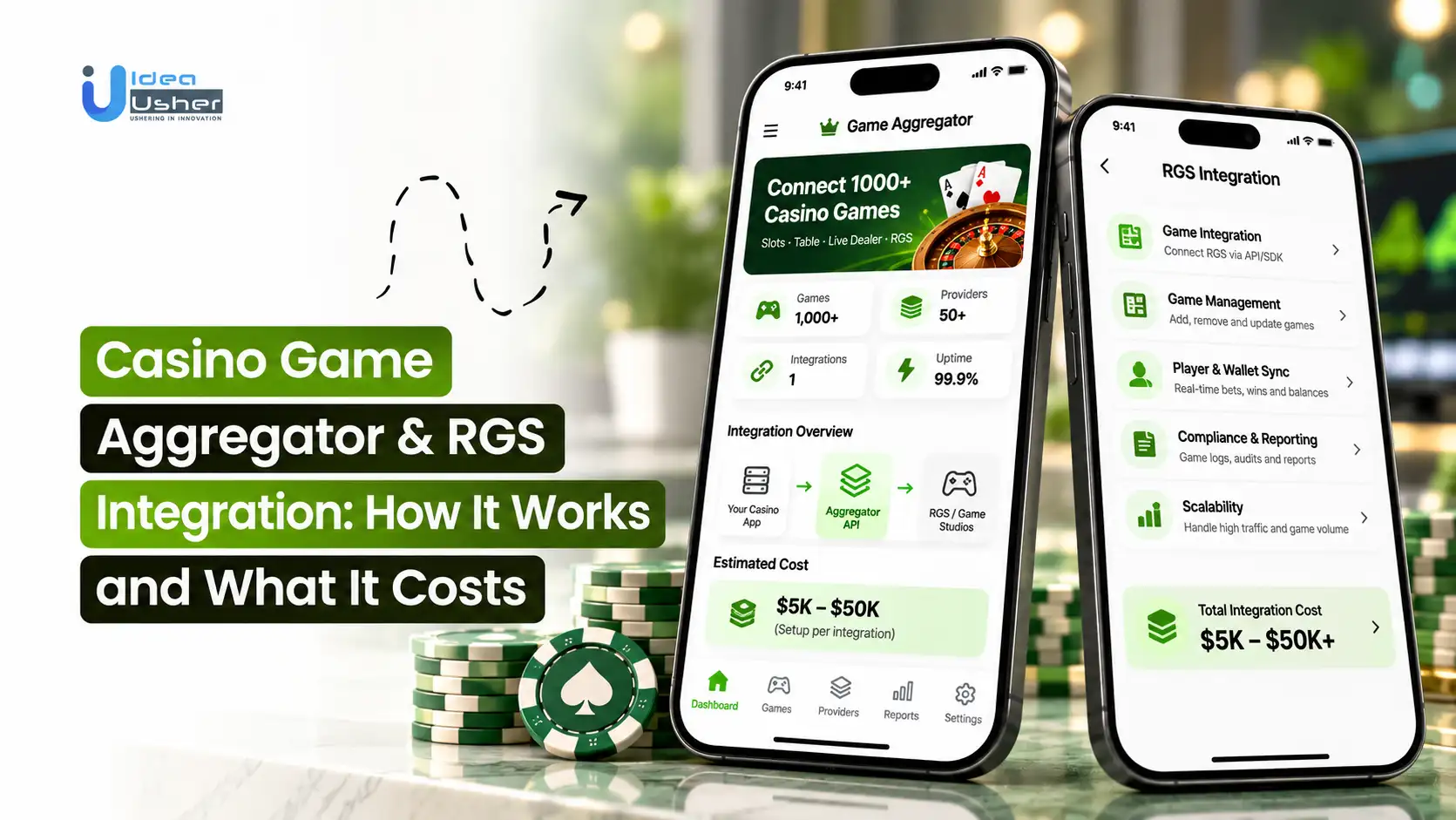
To add a casino game aggregator, an operator makes one technical link between its own wallet and the aggregator’s gateway. The cost is a one-time setup fee of $5,000 to $16,000. After that the aggregator takes 10% to 15% of gross gaming revenue each month and often asks for a monthly minimum of $1,000 to $3,200. Here is what happens during play. A player places a bet and the aggregator passes it to the studio’s remote gaming server.
That server picks the result with a certified random number generator. At the same moment the aggregator takes the bet out of the player’s wallet and pays any win back in, so the result shows up on the screen right away. .
In this blog, we’ll discuss how aggregator and RGS integration works step by step, what drives the price up or down, and how to decide between an aggregator and direct studio integrations.
How Much Does Game Aggregation Reduce Operating Costs?
Game aggregation lowers operating costs because one API connection replaces many separate provider integrations. The operator signs fewer contracts and tests fewer connections. They also talk to one support team instead of many. This matters more as the market grows. According to Research And Markets, the casino gaming market is projected to reach USD 44.52 Billion this year and keep growing at a CAGR of 6.57%. It is expected to hit USD 65.29 Billion by 2032. A bigger market brings more studios and more games. If you go direct, every new studio is one more integration to build and maintain.
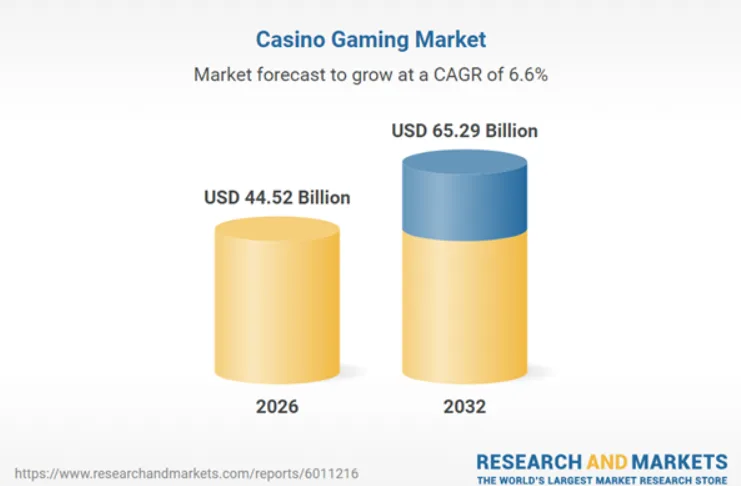
Source: Research And Markets
Aggregator API vs Direct Integrations
With a casino game aggregator, you build one connection and get many studios through it. Altenar says this removes the need for time-consuming individual integrations with numerous providers. SOFTSWISS says operators can reach content from more than 300 studios through a single API, and that it has passed 50,000 titles. Going direct is different. Each studio becomes its own little project.
In Spain, an integration with a studio normally means passing a security audit and getting certified, so every extra provider costs more time and resources. SOFTSWISS says its aggregator is certified across more than 25 regulated markets.
What actually changes for the operator:
- Contracts: many agreements with studios become one agreement with the aggregator.
- Tech work: one API to build and keep working instead of a new one per studio.
- Support: a single point of contact for technical issues.
- Updates: the aggregator handles regular updates and new game additions automatically.
Example: Gates of Olympus
Pragmatic Play keeps adding new versions of this slot. Gates of Olympus Super Scatter came out in April 2025 with a new scatter symbol and wins of up to 50,000 times. Gates of Olympus 2500 leads the studio’s Q4 slot lineup. It brings 2,500x multipliers and four free spin modes. Pragmatic Play also launched its POP sub-brand on 31 July. A direct operator has to plug in and test each of these on their own. An operator on an aggregator that carries the studio gets them through the connection they already have.
Integration and Maintenance Cost Comparison
Here is how the two setups compare on the costs that keep showing up month after month.
| Cost area | Direct integrations | Aggregator |
| Contracts | One per studio | One in total |
| Technical setup | A new build for each studio | One build |
| Certification | Repeated for each studio | Handled once by the aggregator |
| Upkeep | Every API needs its own fixes | One API to maintain |
| Support | Many contacts | One contact |
| Billing | Many invoices to check | One settlement |
Multiple contracts and separate integration processes plus ongoing technical support can be costly and time-consuming. That is the part an aggregator removes. There is also a pricing angle. Aggregators work on volume so they can negotiate better prices with providers and pass some of the savings on. An aggregator is not free though. It charges its own setup fee and monthly fee and a revenue share. So ask for full quotes before you decide.
Calculating Long-Term Operational Savings
The easiest way to see the savings is to do the math for your own casino. Start with the studios you actually want and work from there. Savings grow with every studio you add because each direct integration adds its own work. A few studios may not show a big gap. A big catalog usually does.
- List every studio you need at launch.
- Add build time and testing for each direct integration.
- Add certification work for each market you plan to enter.
- Add yearly upkeep for each API.
- Compare that total with the aggregator’s setup fee, monthly fee, and revenue share.
- Do it again when you add new studios.
Example: Crazy Time
Evolution’s live game show shows why upkeep adds up. Crazy Time launched in 2020 and led to spin-offs like Crazy Coin Flip, Crazy Pachinko, and Red Door Roulette. Evolution rolled it out in New Jersey, Pennsylvania and West Virginia, Michigan, Delaware and then Connecticut. BetConstruct and Evolution also launched FTN Crazy Time, a custom version of the game.
Every new version and every new region is more work for a direct operator. Uptime matters too. SOFTSWISS claims 99.999 per cent uptime for its aggregator. That figure is the company’s own claim so check it in the contract.

Game Studio vs RGS vs Aggregator: Who Does What?
The game studio builds the game and its math and gets it certified. The remote game server or RGS runs the game and decides every result. The main users of an RGS are game studios and providers. The casino game aggregator connects many studios to a casino. It handles the technical and commercial and compliance side of linking each provider’s RGS to the operator’s platform. The casino keeps the player and the wallet.
One RGS project’s docs say the operator owns the wallet and the player identity. So logic sits with the studio and its RGS and wallets sit with the casino. The aggregator takes care of getting games out to many casinos.
What Does a Casino Game Studio Build?
A studio makes the game itself. That means the idea and the math and the art and the sound and the special features. It also has to prove the game is fair before anyone can play it. Independent labs check the RNG and the return-to-player math and the security and the accounting and the responsible gaming features. Without that certification, a slot cannot legally run in licensed markets. Studios also sell their ideas. Some mechanics become big enough to be licensed to other studios.
Example: Bonanza Megaways
Big Time Gaming’s Bonanza is a good one. The studio was founded in Sydney in 2011 by Nik Robinson. It launched the Megaways mechanic on Bonanza in 2016 and then licensed it to other studios. One of those deals was with Blueprint Gaming. The idea kept growing. Extra Chilli Megaways has 6 reels and up to 117,649 ways to win and a Feature Drop that lets players jump straight to free spins in some markets. Max Megaways and Big Bad Bison also made their US debuts in New Jersey and other states. All of that is studio work.
What Does a Remote Gaming Server Execute?
The RGS is the engine that runs the game while the player watches on their screen. It is the backend that runs a casino game away from the player’s device and it has seven core jobs. The casino does not do any of this. It only asks the RGS for a round and shows the result. Here are the main jobs:
- Random result: draws the outcome using random number generation.
- Sessions: keeps track of each player session.
- Bets: processes the bet and works out the win.
- Wallet talk: calls the casino wallet.
- Records: keeps round history and transaction reports.
The main users of an RGS are game studios and providers. So a casino does not usually run one.
How Does a Game Aggregator Connect Providers?
An aggregator sits between the casino and many RGS. It makes lots of different studio connections look like one. The casino game aggregator handles the technical, commercial, and compliance side of connecting each provider’s RGS to the operator’s platform. The operator deals with one API and one contract framework, and one back office. That saves a lot of work. SOFTSWISS says operators can reach content from more than 300 studios through its single API. One guide says a full aggregator integration takes three to six weeks for an experienced team.
Rules are part of the job too. In Spain an integration with a studio normally means passing a security audit and getting certified. An aggregator can do that once for many studios. The casino picks games from one back office instead of ten.
Who Handles Game Logic, Wallets, and Distribution?
This is the table most people want. It shows who owns what.
So the short answer is simple. Logic sits with the studio and its RGS. Wallets sit with the casino. Distribution is the aggregator’s job. One RGS project’s docs put it this way where the operator holds the wallet and the aggregator resells games through one API and the studio builds the game. If a role is missing someone else has to do that work.
How Do These Three Systems Work Together?
They pass the same player through a short chain. Here is one round from start to finish:
- The casino sends a launch request to the aggregator with the player ID and game ID and session token.
- The aggregator checks the session and creates a game session in the provider’s system.
- The RGS plays the round and sends the result back through the aggregator.
- The aggregator triggers the matching wallet transaction on the operator’s side.
- Reports and settlement go back to the operator and the studios.
Example: Mega Moolah
Mega Moolah holds the Guinness World Record for the biggest online slot payout at £13,209,300 in October 2015. Games Global also launched a new jackpot network called Jackpot Madness with six pots, including Mania and Mayhem. Each casino keeps its own wallet, while the studio’s server keeps the jackpot fair.
How a Casino Game Travels Through an Aggregator?
A casino game travels through an aggregator in five steps. First, the aggregator lists the game for the casino. When a player clicks it the aggregator opens a secure session and sends the request to the studio’s game server. Every bet and win then passes through the aggregator to the casino’s wallet. At the end, the results and reports go back to the casino. The player never talks to the studio directly. The casino never talks to ten different studios either.
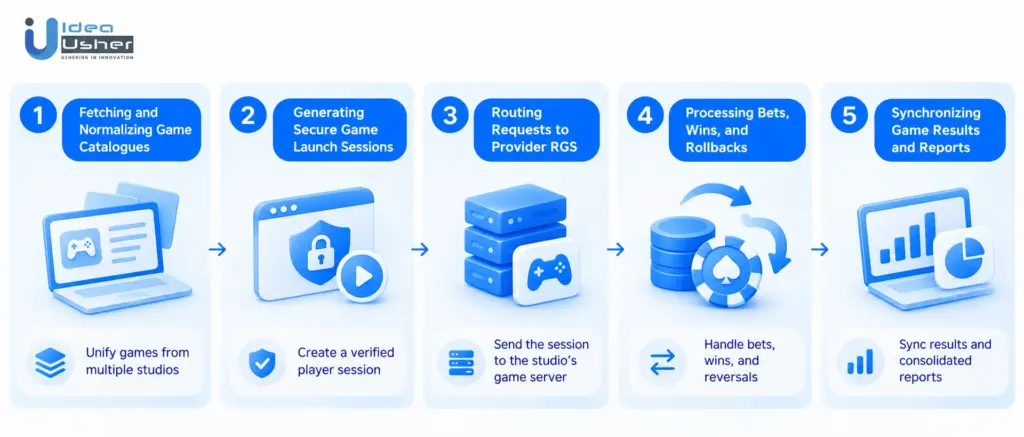
1. Fetching and Normalizing Game Catalogues
Every studio describes its games in its own way. Names and rules and RTP numbers sit in different places. The aggregator turns all of that into one unified game catalogue API, so the casino does not collect game details from each provider on its own. Hub88 for example has a game list endpoint that gives each game a unique code. The casino then picks what shows up. In the aggregator’s back office the operator chooses providers and titles and sets the lobby order.
| What changes | Direct with each studio | Through an aggregator |
| Game launch | Different API call for each provider | One standard launch URL or iframe |
| Sessions | Each provider has its own tokens and timeouts | The aggregator handles the session the same way |
| Wallet calls | Different debit and credit formats | One standard wallet API |
| Game details | Collected from each provider | One catalogue API |
2. Generating Secure Game Launch Sessions
A launch session is a short pass that lets one player into one game. The casino sends a launch request with the player ID and game ID and session token and currency and language and return URL. The aggregator then checks it and builds the game session at the studio. Here is the full trip:
- The casino platform sends the launch request.
- The aggregator validates the session and gets the player’s balance from the casino wallet.
- It creates the game session in the provider’s system and sends back a launch URL.
- The casino loads that URL in an iframe or redirects the player to it.
Security starts before any player shows up. One aggregator’s docs say the operator must request API credentials before integration starts. Hub88 passes a game session token through its game URL request and later calls use that same token. Timing is the other thing people ask about. One guide says a full integration takes three to six weeks for an experienced team with good API docs. SoftGamings says its typical integration takes three days to a week. So always ask your own aggregator for its real number.
3. Routing Requests to Provider RGS
Once the player is in the game the aggregator becomes a traffic cop. Each studio runs its own remote game server and each one talks a bit differently. The aggregator handles the technical and commercial and compliance side of connecting each provider’s RGS to the operator’s platform. The RGS plays the round and sends the result back through the aggregator and the casino game aggregator then triggers the matching wallet transaction on the operator’s side. The casino only sees one clean connection. The messy part stays in the middle.
Example: Money Train 4
The game also reaches casinos through other aggregators. An Octavian Lab aggregation deal put the Money Train series in front of Eurobet players. Same game and different roads to the player.
4. Processing Bets, Wins, and Rollbacks
This is where the money moves. Every round creates small messages between the aggregator and the casino wallet. One aggregator SDK lists the message types as bet and win and rollback and reward and authenticate and balance check. In plain words:
- Bet: take the stake from the player’s balance.
- Win: add the prize back and link it to the bet it came from.
- Rollback: undo a bet that did not finish right.
- Reward: pay out a promo or tournament prize.
Rules keep this safe. An action with the same transaction ID must not be processed more than once. If the casino does not answer with a 200 status the aggregator counts the transaction as failed and creates a rollback so the balance stays clean. The casino is expected to find the old bet and reverse its effect and return the latest balance. So a timeout never leaves a player short.
Example: Aviator
Spribe’s Aviator makes these messages busy. Spribe added Aviator Challenges so operators can run Missions and Races and Tournaments. Operators need to make a small update to their API to switch Challenges on. That update matters because prizes arrive as extra wallet messages. The game also keeps spreading. A partnership with SkillOnNet brought Aviator to PlayOJO and LuckyNiki and SlotsMagic. Games Valley also added it to its aggregation platform.
5. Synchronizing Game Results and Reports
After the round the story is not over. The casino still needs to know what happened across every studio. The casino game aggregator gives combined reporting on bets and wins and GGR and round counts and player sessions. It also settles with each studio and this is usually monthly on a GGR share basis.
SoftSwiss launched a client back office after clients asked for direct access to game provider bet logs and history. One platform in a recent comparison lists real time reporting with a delay under five minutes depending on provider data flow.
Read the fine print here. Aggregator reporting may not be detailed enough for an operator’s own analytics team. The same source says to check how GGR is counted for fees and how studio promotions like free spin campaigns are treated and when settlement reports arrive. A casino that skips this step often finds the mismatch at month end. Ask for a sample report before signing.
What Does RGS Integration Actually Require?
RGS integration needs five things. The server must run the game rules and draw a certified random result. It needs a secure API so the casino can trust who is calling. It must keep track of each player session and each round. It has to talk to the casino’s wallet on every bet and win and handle failures. And it must be hosted so many casinos can use the same game at once. If one of these is weak the whole connection feels shaky for players.
1. Game Logic and RNG Execution
The RGS is where the game actually runs. The remote server processes the game logic and draws the random outcome and calculates the payout. The casino never does this part. RNG certification comes from an independent testing lab and not from the operator that runs the game. The main accredited labs are GLI and BMM Testlabs and eCOGRA and iTech Labs. GLI-19 covers online casino and remote game servers. GLI founded in 1989 issued version 3.0 of GLI-19 in 2020. Labs do not only check the RNG. They look at these things:
- RNG integrity
- Return to player calculations
- Security protections
- Accounting accuracy
- Responsible gaming features
New markets get easier after the first approval. The lab can run a reduced delta test instead of a full re-evaluation.
Example: Razor Shark
Push Gaming’s Razor Shark has high volatility and a 96.70% RTP and features like Razor Reveal and a Free Games feature that scatters trigger. Every reveal and every free game is decided by the studio’s server and not by the casino. The game also keeps growing. Push Gaming’s recent releases include Razor Ways. There is also a sequel called Razor Returns. Each new version needs its own math and its own lab approval before it can go live.
2. RGS API and Authentication Layer
The API is the door between the casino and the studio. Both sides must prove who they are before any money moves. One aggregator says the operator must request API credentials before integration starts. In the Stake Engine docs the authenticate call checks the session ID with the operator and it must happen before any other wallet endpoint. Otherwise those calls fail with an invalid session error. The same docs use only three standard HTTP codes which are 200 and 400 and 500. Here are the message types most RGS and aggregator APIs share.
| Message | What it does |
| Authenticate | Checks the player session |
| Balance check | Reads how much the player has |
| Bet | Takes the stake |
| Win | Pays the prize |
| Rollback | Undoes a failed bet |
| Reward | Pays a promo or tournament prize |
One aggregator SDK lists these same types as authenticate and balance check and bet and win and rollback and reward.
3. Player Session and State Management
A session tells the RGS who is playing and which game they are in. The RGS handles player and session management and also keeps round records and audit trails and game version control. Session services track who is logged in and what game they play and their limits. That is a lot to remember. It is also why a good RGS saves the state on the server and not on the phone. If the player closes the app in the middle of a round the game should still know what happened.
Coming back must be easy too. In the Stake Engine client the authenticate call returns the balance and the game config with bet levels and any active round. So the player can pick up where they stopped. If the session token is wrong or has timed out the RGS answers with an invalid session error. One guide also says to keep session state small so reconnects are fast on mobile. A slow reconnect makes players leave.
4. Wallet Callbacks and Transaction Handling
Wallet callbacks are the part that touches real money. The RGS talks to the wallet to debit stakes and credit wins in real time. The casino owns the wallet so the RGS must call it for every action. Here is the safe order for one round:
- The wallet checks the balance and takes the stake.
- The RGS plays the round and works out the result.
- A win call pays the prize and points to the bet it belongs to.
- If anything breaks a rollback undoes the bet.
Duplicates are the big danger. An action with the same transaction ID must not be processed more than once. If the casino does not answer with a 200 status the transaction counts as failed and a rollback is created so the balance is not hurt. That aggregator also has separate errors for a duplicate transaction and for a bet that cannot be found. So a retry should never charge a player twice.
5. Game Hosting and Multi-Operator Distribution
One game should serve many casinos at once. An RGS gives game developers one central place to host and update and distribute content across multiple operators. Operators and developers can choose cloud or on-premise or hybrid hosting. The player’s device connects to the RGS as a thin client. So the heavy work stays on the server. A good RGS lets you add operators and enter new markets without rebuilding.
Example: San Quentin xWays
Nolimit City’s San Quentin xWays is a good case. It starts as a 5×3 slot with 243 ways to win and can grow to a 5×5 grid with 13,189,257,216 ways. It has a 96.03% return to player. The max win is 150,000x the bet. Its Lockdown Spins round starts when three or more bonus symbols land. Distribution is the real story.
Nolimit City entered South Africa through Evolution’s One Stop Shop integration platform. SkillOnNet also added the studio’s slots for casinos like PlayOJO and SlotsMagic. The game stays the same and the studio’s server serves each casino.
Casino Game Aggregator & RGS Integration: A Stepwise Guide
You integrate a casino game aggregator or RGS one step at a time. First, you decide which games and markets you need. Then you pick a provider and lock down the API. After that you connect the game launch and the wallet, test every kind of bet, and go live while you watch the numbers closely. Skipping a step usually means paying for it later, mostly in wallet bugs and certification delays.
1. Provider and Integration Requirements
Start on paper. Write down where you will operate, because certification is per market. We believe a single game in one jurisdiction costs $5,000 to $15,000 and takes 4 to 8 weeks to certify. Direct integration with 20 to 50 studios can take 6 to 12 months, so knowing your game list early saves a lot of time. Also decide how many studios you really need on day one.
- Markets and licences you will use
- Wallet type: seamless or transfer
- Currencies, including crypto if needed
- Game types: slots, live, crash
2. Select an Aggregator or RGS
Check three things before you sign. Find out if there is a sandbox, which markets are already certified, and what the monthly minimum is. We believe minimums run $2,000 to $10,000 and the aggregator share is 15% to 25% of gross gaming revenue. Most new casinos start with one aggregator and add more later.
| Route | Cost | Time |
| Standard aggregator API | $5,000 to $30,000 | 2 to 6 weeks |
| Direct studio, each | $5,000 to $20,000 | 2 to 8 weeks |
| Full custom casino API | $50,000 to $150,000+ | 3 to 6 months |
3. Configure API Authentication and Security
Every request must prove who sent it. Hub88 validates each signature with a public key tied to the operator ID. Other aggregators sign callbacks with HMAC SHA-256. LuckyStreak’s LuckyConnect uses TLS 1.2 or higher with token login, and asks you to whitelist its production server IPs. Keep your secret keys out of chats and screenshots. In one open-source integration the password was leaked in a screenshot and the note said it had to be rotated before use.
Verify Every Callback
Your callback endpoint should check the signature header on each call. If it does not match, return a 401 error and do nothing.
4. Connect Game Launch and Sessions
A launch starts on your server. Your backend makes a token tied to the player, the game and the currency. The aggregator gives back a game URL that you open in an iframe, a redirect or a new tab. If the player changes currency you must make a new token. With Evolution’s API the player session has to exist before the launch URL is returned. With a seamless wallet your balance endpoint must also answer before the game URL even comes back.
Evolution’s Extra Chilli Epic Spins shows why sessions need care. It merges live game show entertainment with Big Time Gaming’s six-reel Extra Chilli slot. One launch has to open a live video stream and slot logic together under one session. If your session code only expects one kind of game, a hybrid like this will break it.
5. Integrate Wallet APIs and Transaction Callbacks
The big rule is idempotency. The same transaction ID must never move money twice. One provider, Tom Horn Gaming, uses a 10 second wallet timeout and then sends a rollback by itself. Beexar’s platform retries timeouts and server errors for up to 30 seconds using the same ID. Wallet and backend linking work can cost $8,000 to $20,000, so build the callbacks well once.
| Call | What it does | Rule |
| Balance | Reads the player’s money | Must answer fast |
| Bet | Takes money out | Check funds first |
| Win | Puts money in | Win of 0 still arrives |
| Rollback | Gives money back | Store it even if the bet never arrived |
6. Test Bets, Wins, and Refunds
Use a sandbox with fake money first. Beexar’s test game runs 29 scenarios against your wallet. Checks should cover game loading, currency handling, bet limits, transaction accuracy and error handling. Then get mean. Replay the same debit three times, cut the network in the middle of a round, and run the wallet at peak load for an hour. We believe sandbox testing takes 1 to 2 weeks. Watch that a rollback really returns the money and that a win of zero does not break anything.
7. Deploy, Monitor, and Optimize
We believe a good plan runs four weeks. Week 1 is contract and sandbox access. Week 2 is API and wallet work. Week 3 is compliance checks and geo-restrictions. Week 4 is the live launch with monitoring. Reconcile each provider’s own report against your wallet ledger every day so small gaps never grow.
Plan for load spikes. Evolution’s Funky Time is a disco game show that about 100 people helped bring live, and the company called it the most expensive and complex game it ever made. Evolution says its biggest long-running game show can hold 15,000 to 20,000 players at once, while a normal new game sees about 1,000 on day one. A top launch can hit your wallet hard the moment it goes live.
Direct Studio Integration vs Aggregator for Casino: Time and Cost Compared
Direct studio integration is slower and costs more upfront, while a casino game aggregator is faster and cheaper to start. Hub88 puts a direct integration at $5,000 to $20,000 and 2 to 8 weeks for each studio. A single aggregator integration runs $5,000 to $30,000 and 2 to 6 weeks for the whole catalogue. The gap grows with every studio you add.
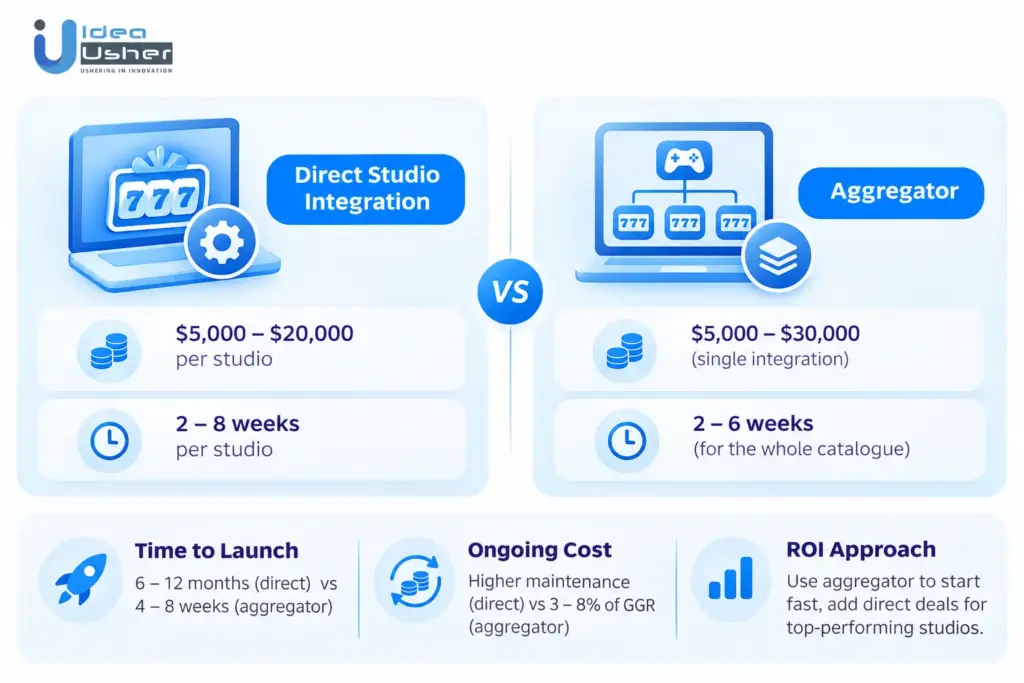
Direct integration with 20 to 50 providers can take six to twelve months while an aggregator takes about four to eight weeks. The aggregator is not free though. It also charges an ongoing fee or revenue share, so compare full quotes before you choose.
1. Initial Setup Costs and Integration Timelines
Setup is where the gap shows first. Direct means a new contract and a new build and a new certification for every studio. An aggregator means one of each. Here is what a few sources say.
The numbers are not the same everywhere so treat them as a rough guide. Still the pattern repeats. Playage says one direct integration can cost $2,000 to $5,000 and that 30 providers could pass $60,000 before the casino even launches. Using Hub88’s per-provider range the same 30 studios would be roughly $150,000 to $600,000. That is simple math and not a quote. Ask for your own numbers before you decide.
Example: Starburst
NetEnt’s Starburst shows what a direct deal looks like. NetEnt signed an agreement to supply its full slot catalogue to Holland Casino Online including Starburst and Starburst XXXtreme. That is a good deal for a big operator. The games also keep changing. Starburst Galaxy has a 7×7 grid and a Feature Generator that unlocks five features and an Elevate Feature that is coming to all NetEnt slots. Operators can even customise their own Starburst slot through Starburst Brandable. A direct operator has to plug in and test each of these on its own.
2. Ongoing API Maintenance and Provider Management
The first launch is only the start. Direct integrations keep costing time every year:
- API upgrades: each studio upgrades its API every year and that creates more engineering tasks.
- Build time: 3 to 4 weeks per provider and with 30 studios that is roughly 2 full-time engineer years.
- Certification: €2,000 to €5,000 per jurisdiction for each provider.
- Who does the work: with a casino game aggregator the certification is managed centrally and with direct integration the operator manages each cycle.
People often forget the people cost. Every studio also means another contract and another contact person. When a game breaks the operator has to chase the right studio. With an aggregator there is one team to call. Some aggregators even offer a smaller option. A few charge a flat technical fee of 1 to 3% of GGR for operators who bring their own direct provider deals.
Example: Sweet Bonanza
Pragmatic Play’s Sweet Bonanza shows how fast one game can multiply. Sweet Bonanza Super Scatter adds new Super Scatter symbols that can award up to 50,000x. Sweet Bonanza POP is a 3-reel version with an instant jackpot up to 25,000x. Sweet Bonanza Xmas 2500 follows in December with the same 25,000x top win. Each version is another title to launch and test and update. A direct operator does that work for every version. An aggregator that carries the studio can handle much of it in one place.
Which Integration Model Offers Better ROI?
The answer changes with size. Aggregator access is cheaper to start but the fee never stops. Source Code Lab puts aggregator access at 3 to 8% of GGR and says at scale it can pass the cost of the platform itself. That is why operators with big game revenue eventually look at direct integrations.
Other sources quote higher fees so always check the contract. One source says direct integrations win back roughly 3 to 5 percentage points of that but each one costs €500 to €5,000 to set up plus the certification and upkeep.
Time matters too. Aggregators usually have a lower upfront cost and a recurring fee while direct integration has a higher upfront cost but more control later. A casino that waits six months to launch loses those months. The best ROI often comes from mixing both. In a hybrid model the operator goes aggregator first and adds direct deals later. That gives full coverage on day one and better margin on the biggest games.
A simple way to choose:
- New casino: start with an aggregator to launch fast.
- Growing casino: track which studios bring the most play.
- Big casino: add direct deals only for those top studios.
If you are not sure which model fits your platform Idea Usher can help you plan and build your casino game infrastructure.
What Does Casino API Integration Cost? A Budget Breakdown
Casino API integration usually costs $5,000 to $40,000 in setup fees, depending on traffic, custom work, and how many providers you connect. After launch you pay $3,000 to $10,000 a month in ongoing fees. Casino game aggregators also take a share of what the games earn, which one guide puts at 15% to 25% of gross gaming revenue. Game testing is a separate bill. One guide puts it at $5,000 to $15,000 for a single game in one jurisdiction.
1. Single vs Multi-Provider Costs
Plugging in one provider is cheap. Plugging in many gets pricey fast. An aggregator gives you lots of studios through one connection. Going direct means a new contract and a new build for every studio.
| Way to connect | Typical cost | Time |
| One aggregator | $2,000 to $10,000+ | 1 to 3 weeks |
| One direct studio | about $2,000 each | 2 to 4 weeks each |
| 30 studios direct | $60,000 or more before launch | Months of work |
Because of this, many operators go direct with only their top five studios. They use an aggregator for everything else. Some aggregators offer a technical-only link for a flat 1% to 3% fee, which works well for this mix.
2. Aggregator Setup and Onboarding Fees
Setup fees are what an aggregator charges to connect you to their system. Some charge a lot. Some charge nothing. One guide says setup is around $5,000 to $15,000 with monthly minimums of $2,000 to $10,000. A few newer aggregators skip both and only take a share per provider. Be careful with “no minimum” promises though. They often cover only technical access, and the studios’ own minimums can still be passed on to you.
- Setup fee: $5,000 to $15,000
- Monthly minimum: $2,000 to $10,000
- Your own API work: $2,000 to $30,000+
3. API, Wallet, and RGS Expenses
The part that surprises most teams is the work on their own side. The wallet is how player money moves between your platform and each game. One guide says linking casino backends and wallets can cost $8,000 to $20,000. A wallet built from scratch is much bigger. One consulting firm says it takes 4 to 7 months of dedicated engineering time, and that mistakes here are the most expensive ones.
Live Games and Crazy Time
Live games cost more to hook up. One guide puts live dealer integration at $50,000 to $200,000+. Evolution’s Crazy Time shows why live content keeps growing. It is a money wheel show with four bonus games. Evolution recently launched Crazy Time Brasil, a version in Brazilian Portuguese streamed from its São Paulo studio.
It also put the game live in Connecticut, and BetConstruct launched a reworked version called FTN Crazy Time. Each new version is one more stream your platform has to handle.
4. Revenue Share and Monthly Fees
This is the cost that lasts. The aggregator takes a share of the game earnings, and the studio takes its own share too.
Minimum Guarantees
A monthly minimum means you pay the floor even when players are slow. That matters most in your first few months. Here is how the split can look. A studio might charge the aggregator about 12%, while the aggregator charges you 15% to 18% and keeps the difference. Going direct can win some of that back. The same source says direct deals usually recover 3 to 5 percentage points. But you then carry every contract and every build yourself.
5. Testing, Certification, and Infrastructure Costs
Every game needs an independent lab check before it goes live in a regulated market. One guide says a single slot or table game in one jurisdiction costs $5,000 to $15,000 and takes 4 to 8 weeks. A full platform check is much bigger. Another source puts platform-level testing at $45,000 to $120,000. The studio usually tests its own games, but you stay responsible for offering only games certified for your market.
- Update to a game that is already certified: $3,000 to $12,000, about 2 to 6 weeks
- Platform or player account system: $50,000 to $150,000 over 3 to 6 months
Updates are where the money keeps leaving. Pragmatic Play keeps building new versions of Gates of Olympus. There was Gates of Olympus 1000, then a Super Scatter edition with a 50,000x max win that also had two bonus buy options in some markets.
The newest is Gates of Olympus 2500, with multipliers up to 2,500x and a bonus wheel that picks one of four bonus games. Each version has its own maths, so labs check it again. If your aggregator carries these games, ask who pays for the re-testing.
6. First-Year Budgets by Casino Model
Your first year depends on what kind of casino you are building. These ranges come from different guides, so treat them as a rough map and not a quote.
Certification and Compliance: GLI-19, RNG Testing and Jurisdiction Requirements
Certification means an independent lab tests your games, your random number generator, and your platform against a technical standard like GLI-19 before a regulator lets you go live. Each country has its own rules, so passing in one place does not carry over to the next. Operators often forget this part when they plan a launch. The lab fees and the waiting time come on top of the integration work, and they can hold up a launch for a long time if nobody plans for them early.
What GLI-19 Requires
GLI-19 is a rulebook for online casino systems from Gaming Laboratories International. It is a technical standard and not a law. Some regulators require it, some accept it as proof, and some use their own rules. The current version is 3.0. Labs use it to check that the whole online setup is fair and safe before players are let in. It covers eight main areas:
- Game functionality
- Financial transactions
- Player accounts
- Security
- Admin controls
- RNG algorithms
- Communication interfaces
- Audit trails
Platforms most often fail on the RNG, on keeping game history and audit logs, and on player protection like session timers and self-exclusion.
RNG Certification and Fairness Testing
The RNG is the part that picks every result in a game. Labs do not just take your word that it works. GLI does source code review, statistical analysis, and software checks. One guide calls this chapter the hardest gate, since all of it happens before any game logic is looked at. Labs also check that the real payout rate matches what the game says it pays. One guide puts a single slot or table game in one jurisdiction at $5,000 to $15,000 and 4 to 8 weeks.
Who Owns the Certificate: This is usually the studio’s job. But if you run your own games or white-labelled content, it becomes yours. Ask for the paperwork before you sign.
RGS and Platform Certification
A certified platform does not make the games certified. A certified game does not make the platform certified either. Each layer needs its own lab visit. Operators get tripped up when they assume the platform is certified without asking for which country and which release. GLI can test RNGs, games, platforms, and remote gaming servers. The bills are bigger at this level. One source puts platform-level testing at $45,000 to $120,000. Another says a player account system under GLI-19 takes 3 to 6 months and costs $50,000 to $150,000.
Spribe’s Aviator shows how this works in real life. BMM Test Lab certified it for Portugal. Spribe later added Aviator Challenges, which lets operators run Missions, Races and Tournaments. Operators had to make a small API update for it to work fully. That is a good reminder that a new feature can touch the link to your platform. Spribe also grew the game through a deal that made Aviator the official crash game of AC Milan and a UFC marketing deal.
Jurisdiction Licensing and Technical Standards
A game that passes in Malta will not automatically pass in Ontario or Italy. Ontario also charges $100,000 a year in regulatory fees per gaming site. Budget for that too.
Games Global’s Mega Moolah is a nice example of local versions. SkillOnNet launched the jackpot network in the UK, Mexico and Sweden, and local versions went live too, like Maple Moolah in Ontario and Carnaval Fortuna in Brazil. In August Games Global also launched Jackpot Madness, an opt-in network that sits next to Mega Moolah and WowPot! and pays out faster. Each new product in a new market is another thing to check.
| Place | What to know |
| Ontario | Only labs registered with the AGCO can issue certificates. Slots need at least 2.5 seconds between games. |
| Great Britain | Remote Technical Standards apply, with annual game audits. |
| New Jersey | Source code review is part of it, and GLI and BMM are common labs. |
| Malta | RNG certification is needed for Type 1 games. |
Compliance Costs, Timelines, and Recertification
One source says GLI testing makes up 35% to 45% of total licensing costs for technology providers. Here is a rough guide from one industry source:
| What you test | Lab cost | Time |
| One game, one jurisdiction | $5,000 to $15,000 | 4 to 8 weeks |
| Several games, one jurisdiction | $15,000 to $40,000 | 8 to 16 weeks |
| One game, several EU markets | $20,000 to $60,000 | 10 to 20 weeks |
| Full platform and game suite | $40,000 to $120,000+ | 16 to 36+ weeks |
| Update to a certified game | $3,000 to $12,000 | 2 to 6 weeks |
A first submission in a market like Ontario usually takes at least 90 to 120 days. Each extra market adds 6 to 12 weeks. Re-work and re-submissions can cost $50,000 to $150,000 in delays.
When a Change Forces Retesting
Ontario says a modification makes the old certification invalid. In Great Britain a major change means any software change that may affect fairness. Changes to game outcomes, payout rates, or player protection tools must be reported and may need recertification before they go live. Plan your update calendar around the lab calendar.
How to Cut Integration From Months to Weeks with Pre-Built Modules?
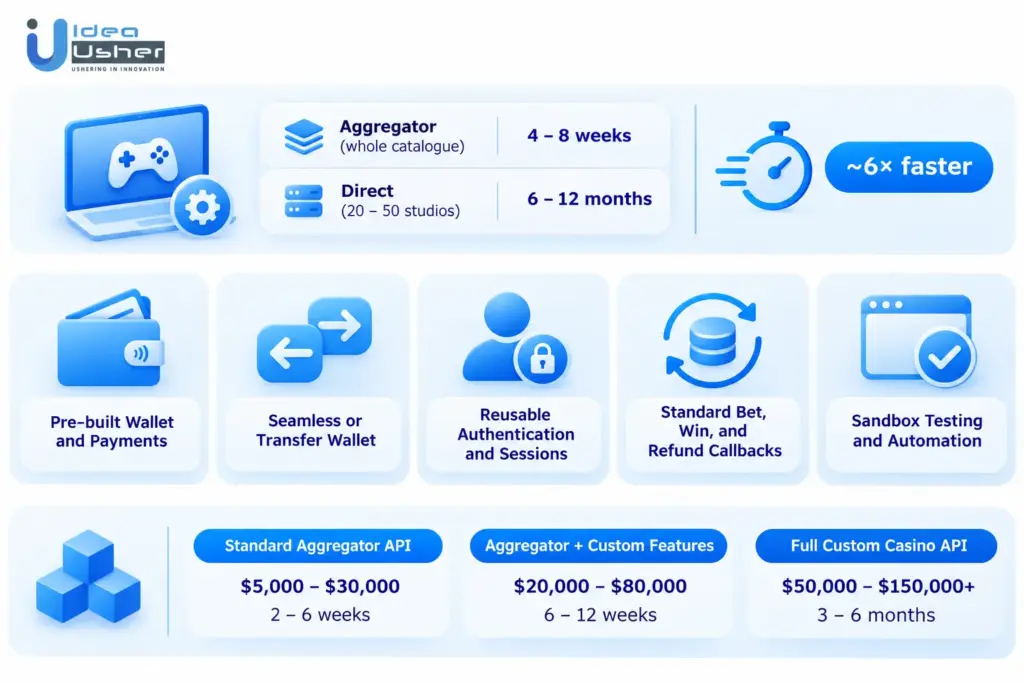
You cut integration from months to weeks by not building the same parts again and again. Use ready-made connectors and wallet modules that already work. Test them in a sandbox before any real money moves. Then plug into one aggregator and let it deal with the many game studios behind it. You only write your own code for the few parts that truly belong to your brand, so your team spends its time on what players see and not on plumbing.
Ready-Made Casino API Connectors
A connector is the piece that links your platform to a game source. If you build one for every studio, you will wait a long time. One guide says direct integration with 20 to 50 studios can take 6 to 12 months once testing and approvals are counted. Through an aggregator, the same work takes about 4 to 8 weeks, and adding a studio later needs no extra development on your side.
| Way to connect | Time |
| Aggregator, whole catalogue | 4 to 8 weeks |
| Direct, 20 to 50 studios | 6 to 12 months |
| Direct, one studio | 2 to 8 weeks each |
Platforms like SOFTSWISS, Digitain and EveryMatrix already have pre-built connectors, and one source says SOFTSWISS integrations finish in 2 to 4 weeks with full certification. Pragmatic Play’s Big Bass Bonanza shows why this helps. The series from Reel Kingdom keeps growing, and the newest is Big Bass Bonanza 1000 with 1,000x money symbols, a 20,000x max win and two bonus buy options in select markets. With a connector in place, a new title like that shows up without a new build.
Pre-Built Wallet and Payment Modules
Payments are slow for a surprising reason. The code is short but the paperwork comes first. One operator guide says a payment integration takes 6 to 14 weeks in total, and underwriting alone takes 1 to 6 of them. A pre-built cashier cuts this a lot. One provider connects a site to 1,000+ payment methods from 160+ payment providers with one integration, and says the whole thing runs 2 to 12 weeks. Another says gaming platforms can go live in 1 to 4 weeks with ready-made links. Doing several gateways by hand can cost $15,000 to $100,000.
- Deposit flow: 1 to 2 weeks
- Payout flow: 1 to 2 weeks
- Sandbox testing: 1 to 2 weeks
Seamless vs Transfer Wallet Compatibility
Seamless is the modern default. Through an aggregator you write the wallet contract once and every new studio arrives behind the same interface. Some aggregators, like Hub88, offer a seamless Wallet API and an optional transfer wallet by request. Moving from transfer to a single wallet later is a big platform project, so pick early.
| Seamless wallet | Transfer wallet | |
| Where the money sits | With you, always | Moved to the provider before play |
| What happens per bet | Provider calls your wallet | Handled on the provider side |
| Main risk | Your wallet must stay up | Stranded balances to reconcile |
Reusable Authentication and Session Management
Every game launch starts with a player session. Your platform creates the session first and then the provider sends back a launch URL. Each provider also has its own token and expiry rules. If you do this one studio at a time your team learns a new login style every time. Good integration layers handle URL-launch, OAuth2 and token passthrough the same way, so the next provider feels like the last one.
Timeouts to Watch: Timeouts matter more than most people think. Tom Horn Gaming’s wallet timeout is 10 seconds. After that a rollback is sent on its own. Your session code needs to expect that.
Standard Bet, Win, and Refund Callbacks
Every round makes the same calls to your wallet. A bet takes money out, a win puts money in, and a rollback gives it back when something fails. The big rule is that the same transaction ID must never take money twice. Hub88 says its wallet requests must be idempotent and signed. Beexar’s platform retries timeouts and server errors for up to 30 seconds using the same ID.
Fast games make this matter most. BGaming’s Plinko 2 is a sequel to a game that arrived in 2019. It adds 3 Buy features, x2 and x4 multiplier balls and vortexes that send balls back for a free respin. Rounds like these send lots of small bets and wins to your wallet, so one repeated call can cause a double charge.
Sandbox Testing and Automated Workflows
A sandbox lets you test with fake money first. Beexar’s Integration Test Game runs 29 scenarios against your wallet. Another guide says to launch a sandbox session and watch every callback land, including a rollback you cause on purpose. Good tests are also a bit mean. Replay the same debit three times, cut the network mid-round, and run the wallet at peak load for an hour.
| Week | What happens |
| 1 | Contract, sandbox access, documents |
| 2 | API work, wallet link, game tests |
| 3 | Compliance checks, geo-restrictions |
| 4 | Live launch and watching |
Custom Modules vs Building From Scratch
Custom code makes sense for the parts players notice, like your lobby or a special bonus. It makes less sense for wallet calls and sessions that every casino needs. Many operators go direct with their top 5 studios and use an aggregator for the long tail. That keeps the speed and still lets you shape what matters most.
| Route | Cost | Time |
| Standard aggregator API | $5,000 to $30,000 | 2 to 6 weeks |
| Aggregator with custom features | $20,000 to $80,000 | 6 to 12 weeks |
| One direct studio | $5,000 to $20,000 each | 2 to 8 weeks each |
| Full custom casino API | $50,000 to $150,000+ | 3 to 6 months |
What Database Architecture Handles Casino Game Transactions?
Most casinos use more than one database. A strict SQL database such as PostgreSQL keeps the money and the bet records, because it can promise that every change either fully happens or does not happen at all. Faster stores like Redis hold live game state. A separate reporting database answers the heavy questions so players never feel the slowdown. Copies of everything sit on other servers, so one failure cannot wipe out a balance or a bet record.
1. Choosing SQL or NoSQL for Casinos
The answer is usually both, but each one gets a different job. One guide says to use MySQL or PostgreSQL for structured, ACID-safe data like accounts and transaction logs. It uses MongoDB or Redis for fast game states and leaderboards, and Kafka for logging huge numbers of events. The big rule is that Redis must never become a second source of truth for balances. If it does, the two can disagree and a player’s money gets wrong.
| Data | Best fit |
| Accounts and the money ledger | PostgreSQL or MySQL |
| Live game state and leaderboards | Redis or MongoDB |
| Bet-by-bet event stream | Kafka |
| Reports and dashboards | ClickHouse or BigQuery |
2. Real-Time Wallet and Transaction Ledgers
The wallet is the heart of the system. Treat it like a bank book where pages are never erased.
- Never change an old ledger row. Add a new one instead.
- Each entry holds a timestamp, transaction ID, player ID, amount, type and the balance after it.
- Store money as whole minor units like cents so rounding errors cannot sneak in.
- Put a unique transaction ID on every entry so a repeated call cannot pay twice.
Some teams go further and never store a balance at all. They add up the ledger entries every time, and the database itself refuses any edit or delete of a ledger row. That makes it very hard for a bug to quietly change what a player owns.
3. ACID Compliance for Bet Transactions
Every action that changes a balance must be ACID. A bet should stay inside one transaction from start to finish, and the wallet row should be locked while it changes so two bets cannot spend the same money. One open-source wallet is tested with 150 threads racing for the same balance and stays correct. Another handles 50 to 100 parallel requests with no overspending and no deadlocks. The idempotency key should live in the same database as the ledger, because the key and the money entry must commit together.
When Several Services Are Involved
A withdrawal can touch the wallet, the payment service and the audit log at once. For that, teams use the SAGA pattern. Each step has an undo step if something later fails.
4. Managing Game Sessions and Player History
The operator issues the session. Every debit, credit and rollback then carries the provider’s own transaction ID. A round should be saved as its own record because it can close after the session ends. Redis Cluster is a good place for live sessions. One guide says it handles thousands of active sessions with steady speed, and active-active setups keep sessions alive during a regional failover. History is a rule too. Ontario’s standards say players must be able to see their game session outcomes and transaction history.
Pragmatic Play’s Sweet Bonanza Candyland shows why rounds need their own record. It is a live mega wheel game from a new studio in Bucharest. The wheel has 6 betting positions, with four numbers and two bonus games. Landing on Sugar Bomb drops a multiplier of up to 10x and triggers a respin. The Sweet Spins bonus awards 10 free spins played live on the big screen. So one round can hold many players’ bets and a bonus on top, and your database has to keep all of it together.
5. Building Reporting and Analytics Databases
Never run big reports on the same database that takes bets. Copy the data out. ClickHouse is built for analytical queries but is slow at updates and deletes. That is fine because reports only read. One guide says the game event stream carries millions of bet-level messages per hour, so it needs change data capture and not nightly dumps. One Ontario guide also says operators must send revenue, player activity and responsible gambling data by the fifth business day of each month, which is easy only when reports are automatic.
| Layer | Tool | Job |
| Live database | PostgreSQL | Takes bets and moves money |
| Event stream | Kafka | Carries every bet event |
| Analytics store | ClickHouse or BigQuery | Dashboards, fraud models, reports |
Launch spikes show why this matters. Play’n GO released Book of Dead GO Collect in late February, ten years after the first Book of Dead. The company said it set records for players and bets within days. A live dashboard on a separate store lets you watch a surge like that without touching the bet database.
6. Audit Trails and Transaction Reconciliation
Regulators want to see old records and they want them fast. Rules differ by place.
| Place | Rule |
| Ontario (AGCO) | Keep compliance logs at least 3 years |
| Malta (MGA) | About 5 years under money laundering rules |
| Alberta | Event and security logs: 1 year online and 7 years in archive |
Ontario platforms must also flag transactions above CAD 10,000 and keep an audit trail for each one. Reconciliation is how you prove the books are right. A daily three-way check compares the wallet ledger with the payment processor and the bank settlement. One wallet project also runs a nightly check of cached balances against the ledger. In its test it seeded 10,000 transfers and then broke three things, and the check found exactly those three.
7. Replication, Backup, and Disaster Recovery
Different data needs different backups. The money ledger needs almost no lost data at all. The event stream needs continuous capture. The analytics store mostly needs cheap long-term storage.
| Data | What it needs |
| Player ledger | Sub-second recovery point |
| Game event stream | Change data capture, not nightly dumps |
| Analytics warehouse | Low-cost cold storage |
One case study makes it real. The crypto casino PhoenixBet moved to a serverless backup pipeline on Spinlab’s platform. Its recovery point dropped from 15 minutes to 25 seconds, and its recovery time dropped from 2 hours to 11 minutes. Backup running costs fell 78%. The pipeline also restores into an isolated test copy every Sunday so the backups are proven to work. Bigger platforms run in many regions and keep core payment and session services active-active, then practice by breaking things on purpose.
Build Custom Casino Game Infrastructure With IdeaUsher
IdeaUsher builds custom casino game infrastructure by designing and coding the main parts around your own platform. That means an aggregation API, a remote gaming server, links to many game studios, and a wallet with a backend that keeps every bet safe. You get one clean system that fits how your casino works. You do not get a pile of parts that were never made to fit together.
Our team has 500,000 hours of coding experience. It also includes ex-MAANG and FAANG developers who have built systems that handle heavy traffic. We use that experience on the hard parts of casino software, like fast wallet calls, safe money records, and game servers that stay up when players flood in.
Custom Casino Aggregation API Development
A casino game aggregatorr puts many studios behind one API. The work starts with signing studios, connecting each studio’s game server, and getting the content certified for each market. Then it hands your platform one clean way to launch games, read the catalogue and send wallet calls.
- One game launch call for every studio
- Standard bet, win and rollback callbacks
- One game catalogue with names, RTP and rules
- Free round support
Remote Gaming Server Architecture
The remote gaming server, or RGS, runs the game itself. It holds the game logic, draws random results and talks to the operator’s wallet for every bet and win. It also keeps session records and round history. Here is what happens on one spin.
- The RGS checks the session
- It draws the outcome
- It works out the payout
- The wallet is updated
- The screen shows the result
Multi-Provider Game Integration
Each studio comes with its own login style, its own wallet calls, and its own quirks. That is why doing this one studio at a time gets slow and costly.
| Route | Time | Cost |
| Direct, 20 to 50 studios | 6 to 12 months | $5,000 to $20,000 per studio |
| Aggregator, whole catalogue | 4 to 8 weeks | One build |
| Hybrid | Mixed | Top studios direct, rest by aggregator |
Even at $2,000 each, 30 studios direct can pass $60,000 before launch. So many operators plug their top 5 studios in directly and use an aggregator for the rest. We build both sides and make them look the same to your platform.
Wallet and Backend Engineering
The wallet is where a casino wins or loses trust. One consulting guide says a custom wallet service takes 4 to 7 months of focused engineering, so it pays to get it right the first time. We build seamless wallets where the money stays in your system and the provider calls you for every bet and win. The backend keeps an append-only ledger, locks the wallet row during each bet, and uses a unique transaction ID so a repeated call can never pay twice.
- PostgreSQL for the money ledger
- Redis for live sessions and game state
- A daily three-way check of the ledger, the payment processor, and bank settlement.
Conclusion
An aggregator links your casino to many game studios through one API. The RGS runs each game and talks to your wallet for every bet and win. Setup usually costs $5,000 to $40,000, plus $3,000 to $10,000 a month in ongoing fees. The aggregator also takes about 15% to 25% of gross gaming revenue. The speed gain is big, since one integration takes 4 to 8 weeks while connecting 20 to 50 studios one by one can take 6 to 12 months. So pick your model early, plan for testing and wallet work, and ask for a written quote before you sign. If you want help scoping your build, talk to our team and we will map out the costs for your platform.
FAQs
A1: Most operators pay a one-time setup fee of about $5,000 to $40,000, depending on traffic, custom work and how many providers they connect. After launch, there are monthly fees of around $3,000 to $10,000. The aggregator also takes a share of game earnings, usually 15% to 25% of gross gaming revenue. Your own API work can add $2,000 to $30,000 or more. The share is a cost that never stops, so check it closely before you sign.
A2: Through an aggregator, a full integration with wallet calls, game launch, and free rounds takes about 3 to 8 weeks for an experienced team. Going direct to a single studio’s RGS takes 2 to 8 weeks each, and some direct API builds run 8 to 12 weeks. Lab testing adds time on top. A single game in one market usually takes 4 to 8 weeks to certify. So plan for the testing wait and not just the coding.
A3: Yes, and that is the main reason aggregators exist. One API gives your casino hundreds or even thousands of games from many studios. It also gives you standard wallet calls and one game catalogue. Connecting 20 to 50 studios one by one can take 6 to 12 months, while an aggregator does the same job in about 4 to 8 weeks. Adding a new studio later needs no extra development on your side, though a few studio-specific quirks may still need handling.
A4: Yes, they do different jobs. An RGS is the server that runs a game. It holds the game logic, draws the random result, keeps the session and calls your wallet for every bet and win. An aggregator sits above many of these servers. It connects many studios’ RGS systems to many casinos through one integration. Think of the RGS as the engine of one game and the aggregator as the delivery service for lots of games.
A5: Yes, many operators do, but most start with one. That keeps the wallet work, testing and contracts simple. Later they add a second aggregator or a few direct studio links to get games the first one lacks or to win back some margin. Each extra connection brings its own contract, its own testing and often its own monthly minimum, which can be $2,000 to $10,000. A common plan is to go direct with your top 5 studios and use an aggregator for the long tail.
A6: Build your own RGS when you plan to make and sell your own games, or when you need full control over game logic, bonus features or random number checks. A new casino that only wants to offer other studios’ games usually does not need one. The cost is real. A single game at MVP size runs about $10,000 to $40,000, and a feature-rich or multiplayer game costs $40,000 to $120,000. You also pay for lab certification, often $5,000 to $15,000 per game for one market.