

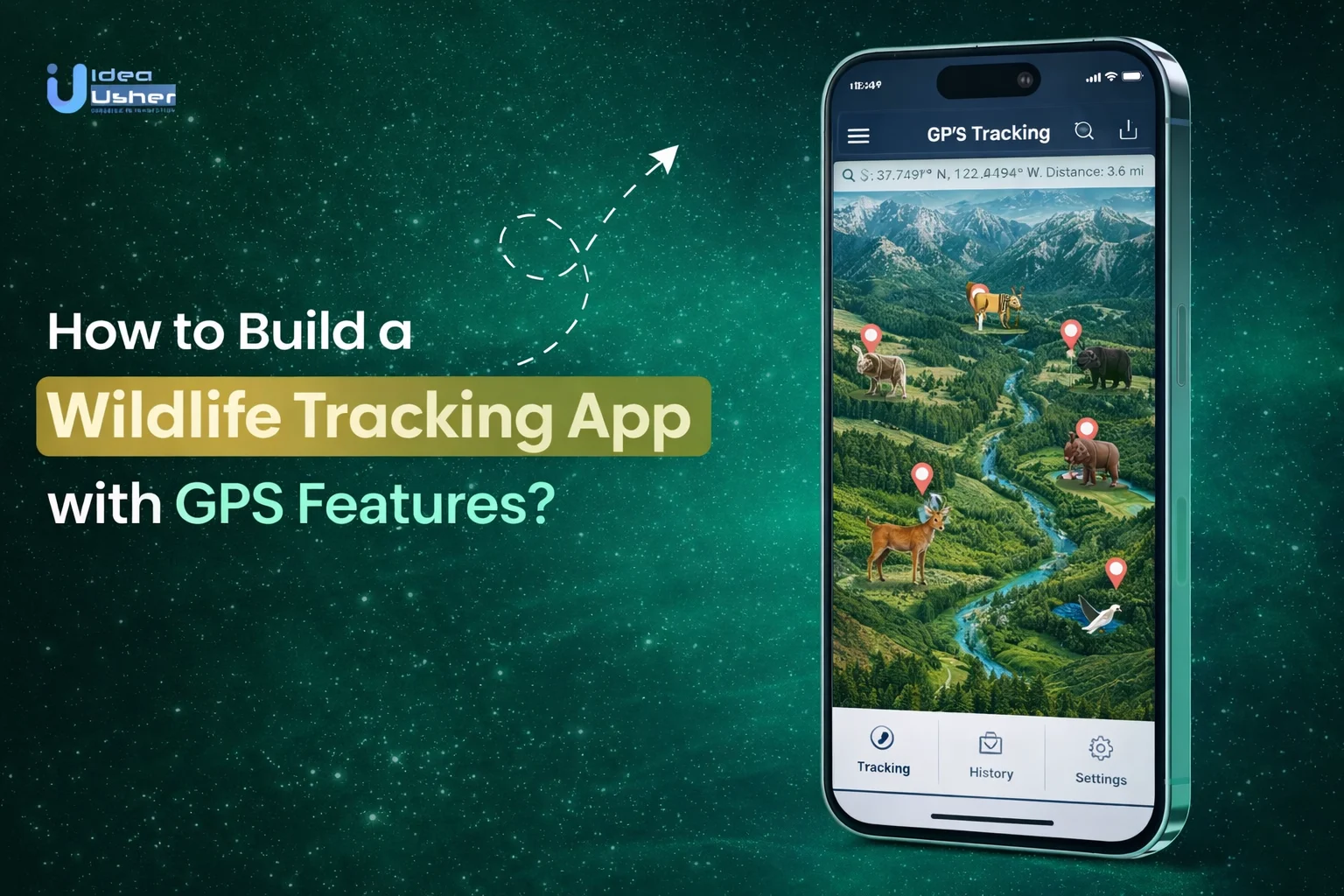
Wildlife encounters usually happen when you are not planning for them, and that can make capturing useful data quite difficult. You might notice something rare, but without a proper system, it often gets lost over time. A wildlife tracking app can help you log these moments in a structured way so the data stays meaningful. The popularity of these apps has started increasing because users now expect accurate location tracking and easy data logging in one place.
It can precisely store location details using GPS, making every observation more reliable. Over time, this data can reveal movement patterns and habitat behavior that you would not easily notice.
Over the years, we’ve developed several GPS-based wildlife-tracking solutions, powered by geospatial intelligence systems and wildlife-telemetry analytics. As we’ve built this expertise, we’re sharing this blog to discuss the steps to develop a wildlife tracking app.
Why Wildlife Tracking Apps Are Gaining Demand?
According to MarketUS, the Global Wildlife Tracking System Market is projected to reach USD 5.09 billion by 2034, growing at a 14.2% CAGR. North America remains the leader, contributing USD 0.49 billion in revenue. For investors, this shift highlights a lucrative transition from academic research to high-growth NatureTech and ESG-driven enterprise solutions.

Source: MarketUS
Rising regulatory pressure and the need for biodiversity transparency are fueling the demand for advanced tracking platforms. Governments and NGOs are replacing manual logging with high-fidelity, automated data streams.
Beyond conservation, conflict mitigation is a major commercial driver. As urban areas expand, platforms that alert farmers or developers to animal movements provide a scalable SaaS revenue model that moves beyond traditional grants.
Need for Real-Time Data
Stale data is a liability in environmental management. Real-time insights allow for immediate intervention during poaching threats or disease outbreaks. This speed is a critical value proposition for any new platform in the space.
EarthRanger serves as a prime example. It integrates collar data and satellite imagery into one interface, allowing wardens to respond to threats instantly. This latency reduction is where modern developers can find a competitive edge.
- Anti-Poaching: Geofencing triggers instant alerts if animals enter high-risk zones.
- Dynamic Management: Authorities can adjust protected boundaries based on actual, live usage patterns.
- Transparency: Investors in rewilding can verify biological results through live dashboards.
GPS and Field Research
Advanced GPS and GNSS integration have revolutionized research economics. Researchers no longer need to physically track animals with antennas, significantly reducing labor costs and human interference.
The Argos System demonstrates this scale, tracking over 300,000 animals globally via satellite. This allows for monitoring in remote regions without cellular coverage, providing data depth that was previously impossible.
- Granularity: High-frequency sampling captures micro-behaviors like social interactions.
- Remote Retrieval: Cloud-based downloads via Iridium or LoRaWAN keep data collection non-invasive.
- Longevity: Solar-assist hardware ensures a single investment yields years of continuous data.
Market Gaps in Solutions
Current software is often fragmented, requiring researchers to use separate tools for ingestion, mapping, and analysis. This creates a massive opening for an all-in-one platform.
Strategic investors should focus on these underserved areas:
- Interoperability: Standardizing data from diverse hardware manufacturers like Telonics or Lotek.
- Edge AI: Using on-device machine learning to identify specific behaviors like illness or mating before transmission.
- Predictability: Shifting from “where is it now” to “where will it be in 12 hours” using historical heatmaps.
The true market gap lies in making complex telemetry data accessible to non-technical decision-makers. Solving this complexity offers high margins and long-term enterprise contracts.

What Is a GPS-Based Wildlife Tracking App?
While the core mission of apps like iNaturalist is often rooted in open science, building a sustainable venture requires a clear monetization strategy. The freemium model is the most effective approach for this vertical, allowing for massive data collection at the top of the funnel while converting power users into a recurring revenue stream.
The key is to keep the basic contribution experience free to ensure the decentralized sensor network remains active, while gating high-utility professional features for those who derive commercial or academic value from the platform.
What Users Will Pay For
Identifying the willingness to pay depends on the user’s persona. While a casual hiker may never subscribe, professional ecologists, researchers, and dedicated life-listers seek tools that enhance their efficiency and depth of insight.
Features that trigger conversion often include:
- Advanced Data Visualization: Heat maps of species distribution and seasonal migration trends.
- Bulk Export Tools: The ability to export clean, formatted datasets for use in external GIS software.
- Smart Filters: Searching by specific taxonomic traits, conservation status, or localized hotspots.
Other platforms like eBird demonstrate this by offering specialized integration with personal record-keeping, showing that users value organized, high-fidelity digital journals of their scientific interactions.
Offline Maps vs Field Tools
In the field, connectivity is the primary pain point. Professional users are willing to pay for pro-grade reliability when they are far from a cell tower. This creates an upsell opportunity for features that transform a smartphone into a dedicated scientific instrument.
Strategic premium tools often include:
- Offline Vector Maps: High-detail topographic maps that function without data for precise geotagging in remote areas.
- Sound ID & Spectral Analysis: Real-time audio processing to identify bird calls or insect sounds, a feature popularized by apps like BirdNet.
- Enhanced Computer Vision: Access to advanced AI models that can identify sub-species or rare varieties with higher confidence scores.
By offering these as premium add-ons, the platform moves from a simple social app to an essential piece of field tech for serious enthusiasts and professionals alike.
Tiers That Convert Users
Conversion in science apps is about moving users from observers to curators. Pricing should reflect the increasing value a user derives from the platform as their expertise and data needs grow.
| Tier | Target Audience | Primary Driver |
| Free | Casual Observers | Basic AI Identification & Community Access |
| Pro (Individual) | Enthusiasts & Students | Offline Maps, Unlimited Species Lists, No Ads |
| Business / Lab | Research Teams | Collaborative Projects, API Access, Data Management |
Successful platforms often use a tiered SaaS model to ensure that the heaviest data users are the ones funding the infrastructure. For instance, Pl@ntNet relies on institutional partnerships, but a commercial venture can thrive by charging for the high-level analytical tools that professional environmental consultants require.
Must-Have Features in a Wildlife Tracking App
To compete in the NatureTech market, wildlife tracking apps must move beyond basic logging. High-value solutions focus on data integrity and operational efficiency in disconnected environments. For investors, the goal is to build an ecosystem that converts raw sensor data into strategic intelligence.
1. Real-Time GPS
High-precision GNSS integration is non-negotiable for enterprise applications, providing the sub-meter accuracy needed to study social interactions. By minimizing latency, these systems allow for immediate tactical responses to environmental shifts.
EarthRanger exemplifies this by aggregating live GPS data from thousands of active collars, enabling rangers to visualize animal movements and security threats in a single interface.
2. Heatmaps and Migration
Visualization tools transform thousands of data points into intuitive heatmaps that reveal core biological corridors. These insights allow stakeholders to prioritize land acquisition based on actual movement density.
The Movebank platform, through its integrated Animal Tracker app, allows researchers to generate these long-term patterns, identifying critical migration bottlenecks that require protection.
3. Geofencing and Alerts
Geofencing acts as a digital perimeter, triggering automated alerts when an animal enters a high-risk zone or approaches agricultural boundaries. This feature moves a platform from passive monitoring to active mitigation.
4. Offline Mapping
Wildlife monitoring often occurs in dead zones where cellular connectivity is nonexistent. By utilizing localized caching and satellite-synced topographic data, field teams maintain situational awareness without an internet connection.
Locus GIS provides this essential offline functionality, allowing researchers to record precise spatial data and navigate rugged terrain using pre-downloaded base maps.
5. Sensor Integration
A comprehensive platform must ingest data from more than just collars, including acoustic sensors, camera traps, and weather stations. This multi-modal approach correlates movement with factors like temperature.
Wildlife Insights is a leader here, using AI to integrate millions of camera trap images with sensor data to provide a holistic view of species health across ecosystems.
6. Research Dashboards
Effective management requires tailored interfaces that present information based on the user’s specific needs. Role-based access ensures data security while streamlining the experience for both scientists and donors.
The Ventana Wildlife Society data tools use this structure to offer biologists granular telemetry views while providing administrators with high-level population KPIs.
Advanced Features That Set Wildlife Apps Apart
The next generation of wildlife tracking apps must move beyond simple data collection and into the realm of autonomous intelligence. These high-tier features reduce human error and provide the predictive capabilities that high-stakes conservation and land management projects demand.
1. AI Pattern Detection
Machine learning algorithms now analyze movement trajectories to identify specific biological behaviors without manual observation. By recognizing the mathematical signatures of foraging, mating, or distress, these systems provide deeper ethological insights.
Movebank utilizes these AI models to help researchers categorize complex behavioral states from raw GPS data automatically.
2. Predictive Behavior Alerts
Moving from reactive to proactive, predictive analytics use historical trends to forecast future movements or potential risks. This is critical for preventing human-wildlife conflict or intercepting poaching before it occurs.
EarthRanger integrates these predictive layers, alerting authorities to “unusual clusters” or speed changes that often precede a security event.
3. Regional Satellite Syncing
In vast, off-grid territories, satellite-to-app synchronization ensures no data is lost when cellular networks fail. This allows for the monitoring of entire transboundary migratory paths in real-time.
The Argos System is the gold standard here, providing global satellite coverage that syncs data from the most remote corners of the planet directly to a centralized dashboard.
4. Interactive Visual Layers
Modern platforms utilize multi-dimensional mapping that overlays telemetry data with environmental variables like vegetation indices, water sources, and topography. This spatial context is vital for understanding why animals move.
Mapotic specializes in these interactive layers, allowing users to toggle between terrain, heatmaps, and live weather overlays for a holistic ecosystem view.
5. Research Tool APIs
Seamless integration with external databases and analytical software is essential for a professional-grade ecosystem. APIs allow tracking data to flow directly into statistical packages or global biodiversity registries.
How GPS Tracking Works in Wildlife Tracking Apps?
Understanding the technical backbone of wildlife tracking apps is essential for any stakeholder looking to invest in this space. It is a sophisticated dance between orbital satellites, terrestrial networks, and ultra-low-power hardware. The goal is to capture high-fidelity biological data without altering natural behavior or requiring constant manual intervention.
1. Telemetry and Data Capture
At its core, wildlife telemetry is the remote measurement and transmission of data. Modern systems have evolved from simple pings to complex data packets. A tracking device (collar, tag, or harness) uses a GNSS receiver to calculate its position by timing signals from multiple satellites.
- The Logged Event: Beyond just coordinates, biologgers now capture ambient light, temperature, and 3D movement via accelerometers.
- The Multi-Sensor Picture: By combining location with these sensors, a platform doesn’t just show where an animal is, but also whether it is sleeping, hunting, or in flight.
2. Data Transmission and Storage
Once a location fix is acquired, the challenge is getting that data from the edge (the animal) to the cloud (your app). This follows a tiered connectivity model:
Local Storage: Data is first saved to internal flash memory. This ensures no data is lost if a connection cannot be established.
The Transmission Path:
- Satellite (Argos/Iridium): Essential for remote regions like oceans or deserts where cellular coverage is nonexistent.
- Cellular (NB-IoT/LTE-M): Used for high-frequency updates in areas with tower coverage; it is more power-efficient than satellite.
- LoRaWAN: A private, long-range radio network often set up at specific pinch points like watering holes to offload large data batches for free.
3. Accuracy in Dense Terrains
GPS is fundamentally a line-of-sight technology. In the non-open environments where wildlife often thrives, accuracy can degrade significantly.
Technical Note: Signal multipathing occurs in deep canyons or under thick tropical canopies. The satellite signal bounces off trees or rocks before reaching the collar, creating GPS drift where the animal appears to be hundreds of meters from its true location.
To combat this, professional-grade apps use Multi-frequency GNSS, which listens to multiple satellite bands simultaneously to filter out reflected signals and provide sub-meter precision even in dense bushland.
4. Battery and Device Performance
Battery life is the single greatest constraint in wildlife tech. Since you cannot recharge a wild leopard, every milliampere counts. Developers use several strategic sleep modes to extend device life from weeks to years:
- Motion-Triggered Fixes: Using the accelerometer, the device stays in a Deep Sleep state while the animal is stationary, waking up only when movement is detected.
- Geofence-Adjusted Sampling: The app can be programmed to take fixes every hour normally, but switch to every 5 minutes if the animal enters a high-risk alert zone.
- Edge Processing: Instead of transmitting every single data point (which is power-intensive), the device summarizes the data on board and only sends the most critical insights.
How to Build a Wildlife Tracking App with GPS Features?
A wildlife tracking app can be built by integrating GPS telemetry that should accurately capture real-time location data and securely store it for analysis, while backend services will process geospatial inputs efficiently. The system can then improve tracking precision through optimized algorithms, and a simple interface may support seamless observation logging.
We have developed several wildlife tracking apps with GPS features, and here is how it is done.

1. Defining Goals and Use Cases
We isolate the specific biological outcomes our clients need. Whether monitoring herd health or tracking transboundary migrations, we map the architecture to environmental pressures. This stage defines data frequency and user personas. We ensure the platform serves both the boots-on-the-ground ranger and the executive stakeholder.
2. Selecting Hardware and Sources
A platform is only as good as the hardware it supports. We guide clients through selecting GNSS receivers, from Iridium collars for remote marine life to NB-IoT tags for urban-fringe wildlife. Our engineers ensure the app is hardware-agnostic. It ingests and normalizes data from manufacturers like Telonics or Lotek into a single, clean stream.
3. Designing Field Researcher Flows
We design for gloves, glare, and limited time. Our UI/UX team builds high-contrast, low-tap interfaces that prioritize essential data and minimize distraction. By streamlining workflows, we allow field teams to check telemetry quickly. We reduce cognitive load so researchers stay focused on the environment, not the screen.
4. Real-Time Tracking and Alerts
We deploy cloud-native backends optimized for the irregular nature of satellite telemetry. Our real-time engines process incoming packets instantly to trigger automated responses. If an animal exhibits stationary behavior or high-stress movement, our systems push instant notifications via SMS or satellite. This provides the immediate situational awareness our clients demand.
5. Maps, Geofencing, and Analytics
Data without context is noise. We integrate high-resolution mapping that overlays movement with vegetation indices, water points, and topography. Our geofencing modules allow clients to draw digital perimeters as active security boundaries. We also translate raw coordinates into social cluster analysis and time-in-area metrics.
6. Testing and Scalability
Before an app reaches the field, it undergoes rigorous simulation in “disconnection scenarios.” We test for offline data persistence so that once an animal is tagged, the data is never lost. As our clients scale from ten animals to ten thousand, our infrastructure scales with them. We use automated load balancing to maintain performance and control long-term storage costs.
Cost to Build a Wildlife Tracking App
Investing in wildlife tracking apps requires balancing high-tech software with rugged field reality. The total cost is a strategic allocation across hardware, cloud infrastructure, and data security. For any entrepreneur, the goal is to manage the high costs of satellite telemetry while securing long-term ROI from proprietary data.

Factors Affecting Development Cost
Several variables dictate the final price tag. These systems handle specialized data packets in extreme conditions, which naturally drives up engineering hours.
- Connectivity: Integrating satellite networks (Iridium/Argos) is more expensive than standard cellular (LTE-M).
- Interoperability: Working with multiple collar brands requires custom middleware, increasing initial investment.
- Data Density: High-frequency pings require robust backend scaling and higher cloud storage costs.
- Offline Functionality: Building a seamless “offline-first” experience adds 20% to 30% to development time.
Cost Breakdown by Complexity
We categorize the investment into three tiers based on feature depth and technical sophistication.
| Complexity Level | Estimated Cost (USD) | Key Deliverables |
| Basic (MVP) | $40,000 – $80,000 | GPS logging, simple dashboard, cellular connectivity. |
| Moderate | $80,000 – $180,000 | Multi-sensor integration, geofencing, offline maps. |
| Advanced | $180,000 – $450,000+ | AI detection, satellite syncing, predictive analytics. |
Pro-Tip: Most successful investors start with an MVP of $60,000 – $90,000 to validate the hardware link before scaling.
Ongoing Maintenance and Upgrades
Launch is only the beginning. To keep a platform operational, budget 15% to 20% of the initial cost annually for recurring expenses.
- Cloud Fees: Expect $500 – $3,000+ monthly for hosting and satellite data transmission.
- Firmware Updates: Apps need periodic updates to stay compatible with new collar hardware.
- Security: Regular audits protect sensitive location data from unauthorized access.
- OS Evolution: Annual iOS and Android updates require code refactoring to prevent field crashes.
Building Geofencing That Triggers Instant Alerts
In wildlife tracking apps, geofencing is a digital safety net. These systems bridge the gap between simple location data and real-time intervention. By turning passive pings into active triggers, the technology empowers rangers to act before a crisis occurs.

Dynamic Geofencing Response
Traditional boundaries are static, but habitats are fluid. Dynamic geofencing adapts to seasonal migrations or changing water levels. If an animal approaches a village perimeter, the system initiates a tiered response instead of just logging a point.
- Pre-emptive Warnings: SMS alerts can be sent to farmers as animals enter a “buffer zone.”
- Escalation Logic: If a “hard boundary” is breached, the app triggers a high-priority dispatch to response teams.
- Corridor Management: Automated fences track if migratory paths are blocked by new infrastructure, allowing for real-time strategy adjustments.
Real-Time Boundary Logic
To handle “bursty” satellite data, backends use spatial indexing to calculate boundary crossings in milliseconds.
- Point-in-Polygon: Every incoming GPS fix is instantly compared against custom-drawn perimeters.
- Edge-Triggered Events: Using “State Machine” logic, an alert is triggered only when a status shifts from “Safe” to “In-Risk.”
- Low-Latency WebSockets: Once a breach is detected, the alert is pushed to dashboards immediately, bypassing traditional polling delays.
Reducing False Alerts
In rugged terrain, GPS drift can make an animal appear to “jump” a fence. These “ghost alerts” are eliminated through multi-layered verification.
The Verification Layer: Kalman Filtering smooths out erratic pings. If a single coordinate shows impossible speed across a fence, the system identifies it as a sensor error and suppresses the alert.
- Dwell Time Thresholds: Alerts only trigger if an animal remains outside the fence for multiple consecutive pings.
- Confidence Scoring: GPS is combined with accelerometer data. If the collar says an animal crossed a fence but sensors show it is sleeping, the event is flagged for review.
- Hysteresis Buffers: A secondary “exit” boundary prevents rapid-fire “in-and-out” notifications caused by minor signal fluctuations.
Turning Raw GPS Data Into Actionable Insights
In wildlife tracking apps, raw coordinates are just the beginning. The true value lies in transforming millions of disconnected pings into a narrative of survival. Applying spatial analytics to GPS logs allows stakeholders to move beyond observing where an animal is to understanding why it is there.
1. Converting Logs into Heatmaps
Heatmaps provide an immediate visual summary of habitat utilization. Instead of a cluttered map of thousands of dots, these density layers highlight hotspots where animals spend the most time.
- Kernel Density Estimation (KDE): This statistical method calculates the probability of an animal being in a specific area, smoothing out GPS noise into a clear gradient.
- Time-Weighted Analysis: Not all stops are equal. High-tier apps weight data points by duration; a five-hour grazing stop creates a darker “heat” signature than a five-minute transit. Platforms like Gundi excel here by integrating disparate data streams to create these unified density layers.
- Conflict Mitigation: Overlaying these heatmaps with human infrastructure identifies exactly where wildlife and local communities are most likely to intersect.
2. Identifying Migration Patterns
Migration is a rhythmic, large-scale movement that requires multi-layered data to decode. Advanced platforms integrate environmental variables to reveal the drivers behind these journeys.
| Data Layer | Insight Provided |
| NDVI (Vegetation Index) | Correlates movement with seasonal “green-up” or food availability. |
| Precipitation Logs | Predicts when migratory herds will move toward new water sources. |
| Step Selection Functions | Models the “path of least resistance” taken through rugged terrain. |
Analytic Note: Connectivity Modeling identifies critical bottlenecks, narrow corridors where an animal’s path is constricted by mountains or fences. Protecting these small slivers of land is often more vital than protecting the entire range.
3. Visualizing Territory Shifts
Animal territories are rarely static; they expand, shrink, and drift based on competition and resource availability. Modern visualization tools allow researchers to rewind time to see these shifts in motion.
Using Minimum Convex Polygons or Autocorrelated Kernel Density Estimation, an app can draw a home range boundary that evolves month by month. If a predator’s territory shifts ten miles north over a season, the software flags this as a significant event.
Tools like CyberTracker empower field teams to verify these shifts on the ground, allowing for the investigation of external pressures, such as a new rival pride or a disappearing water hole, before a population reaches a tipping point.
How to Build Offline Maps for Remote Field Use?
In the field, connectivity is a luxury, not a baseline. For wildlife tracking apps, the ability to function entirely disconnected is what separates a professional tool from a consumer toy. Building for “offline-first” ensures that researchers can navigate and log data in the most remote corners of the planet without data loss.

Storing and Rendering Data
Topographical data is heavy, making efficient storage critical. High-performance apps use Vector Tiles instead of raster images, allowing for high-resolution zooming with a fraction of the file size.
- MBTiles Packages: We package map layers into SQLite-based containers, allowing the device to query specific “tiles” of a map without loading the entire dataset into memory.
- On-Device Rendering: Using engines like Mapbox SDK or ArcGIS Runtime, the app renders these tiles locally. This ensures smooth panning and rotation even when the phone is in airplane mode.
- Layer Prioritization: To save space, users can download specific “AOIs” (Areas of Interest), focusing high-detail contours only on active research zones while keeping the surrounding regions low-res.
Syncing Field Data
The challenge isn’t just working offline; it’s returning to the grid without creating data conflicts. A robust sync engine acts as a “buffer” between the field and the cloud.
- Local Queueing: Every observation or GPS fix is timestamped and stored in a local encrypted database (like Realm or SQLite).
- Incremental Sync: Once a signal is detected, the app performs a “delta sync,” sending only the new or modified records rather than the entire database.
- Conflict Resolution: If multiple researchers edit the same record offline, the system uses “Last Write Wins” logic or flags the entry for manual review to prevent data corruption.
Offline-First UX Challenges
Designing for the bush means accounting for physical and environmental constraints. If the UI fails, the data fails.
Field Reality: Researchers often have full hands, are wearing gloves, or are dealing with intense sun glare. The UX must reflect these harsh conditions.
- Feedback Loops: The app provides clear visual cues (like green/red sync icons) so users know exactly which data is safely backed up and which is only on the device.
- Battery Preservation: Offline maps are power-hungry. High-tier apps include a “Power Save” mapping mode that reduces screen refresh rates and dims non-essential UI elements to extend field time.
- Storage Management: Since offline maps can occupy gigabytes, the app includes a “Cleaning” utility. This allows researchers to offload old maps and data once a project phase is complete, freeing up space for the next mission.
Data Architecture for High-Frequency Wildlife Tracking Apps
In high-frequency wildlife tracking apps, the volume of incoming data can overwhelm traditional structures. When sensors record sub-second movements or complex biological bursts, the architecture must prioritize high-throughput ingestion without sacrificing query speed.
A robust system transforms millions of raw coordinates into a synchronized and accessible record of animal behavior.
Handling Millions of Data Points
Managing high-velocity data requires a shift from “store then process” to “process on arrival.” Standard relational databases often struggle with the write-heavy load of thousands of active tags.
- Asynchronous Ingestion: Systems use message brokers like Apache Kafka or RabbitMQ to buffer incoming pings. This prevents backend crashes during data bursts when multiple devices sync simultaneously after being offline.
- Data Normalization: Raw telemetry from different hardware vendors arrives in fragmented formats. Platforms like Movebank provide a blueprint for this, acting as a global repository that normalizes data from hundreds of different tag types.
- Cold vs. Hot Storage: To maintain performance, “Hot” data from the last 30 days stays in high-speed memory for instant access, while “Cold” historical data moves to cost-effective cloud buckets for long-term research.
Structuring Geospatial Databases
Standard tables are not built for the dual-axis complexity of time and space. Modern tracking apps rely on specialized Time-Series Geospatial Databases.
| Database Type | Use Case in Wildlife Tech |
| PostGIS / PostgreSQL | The industry standard for complex spatial queries and Point-in-Polygon geofencing. |
| QuestDB / TimescaleDB | Optimized for time-series data, allowing for fast aggregations of movement over months. |
| NoSQL (MongoDB/DynamoDB) | Best for flexible sensor data like accelerometer or temperature readings that change between models. |
Technical Insight: Using Spatial Indexing, such as GIST or R-Tree, is mandatory. Without it, a query asking which animals were in a park last June would have to scan every single row, causing the app to hang as the dataset grows.
Real-Time Processing at Scale
For anti-poaching and conflict mitigation, latency is the enemy. Real-time processing ensures that an alert reaches a ranger in seconds, not minutes.
- Stream Processing: Engines like Apache Flink analyze data in motion. They can calculate Step Selection Functions or detect Immobility Alerts the moment a coordinate hits the server.
- Distributed SQL: As the project scales to monitor entire regions, distributed databases spread the workload across multiple servers. Systems like WPS Watch utilize this to maintain high responsiveness when managing thousands of active collars across vast conservancies.
- Edge Pre-Filtering: To reduce cloud load, intelligent devices perform basic Edge Computing. This filters out redundant stationary pings before they are transmitted, saving both battery and bandwidth.
Why Choose IdeaUsher for Wildlife Tracking Apps?
Choosing the right partner for wildlife tracking apps impacts both research integrity and animal safety. IdeaUsher delivers high-performance conservation tools built on over 500,000 hours of coding experience. Our team of ex-MAANG/FAANG developers brings Silicon Valley standards to the most rugged environments on earth.
GPS and Geospatial Expertise
IdeaUsher excels in the architecture required for precise location tracking. The team masters GNSS signals, coordinate normalization, and spatial indexing. Advanced mapping SDKs and custom GIS layers deliver the sub-meter accuracy and real-time visualization needed for critical field decisions.
Custom Conservation Solutions
Every species presents unique technical challenges. IdeaUsher avoids one-size-fits-all templates, building bespoke software that integrates specifically with your chosen hardware. Whether requiring low-power Bluetooth tagging or long-range satellite integration, the solution is purpose-built for the task.
End-to-End Field Deployment
The journey from a wireframe to a functioning collar is complex. IdeaUsher provides support through every phase, including hardware stress testing and offline-first UI optimization. This ensures that even in a dead zone, the application performs exactly as promised to protect the mission.
Conclusion
Building a GPS wildlife tracker requires a synergy between rugged hardware, satellite connectivity, and high-performance data architecture. By prioritizing offline-first maps and real-time geofencing, developers transform raw sensor logs into life-saving conservation insights. This technical precision ensures the reliability needed for the most challenging field environments on earth.
FAQs
A1: Building a GPS-based app involves integrating Location Services APIs like Google Maps or Mapbox with a robust backend for data storage. Developers must configure high-frequency location listeners and manage battery consumption through optimized polling intervals. For wildlife use, this often includes custom hardware integration via satellite or cellular IoT protocols.
A2: GPS collars or tags attached to animals record precise coordinates at set intervals. This data is transmitted via satellite or cellular networks to a central server, where researchers visualize movement through mapping dashboards. Beyond simple location, these systems often include accelerometers to monitor health and behavioral patterns.
A3: A basic GPS-based MVP generally starts around $40,000 to $60,000. However, complex platforms involving satellite telemetry, offline GIS mapping, and real-time geofencing can exceed $150,000. The total investment depends on feature complexity, cross-platform requirements, and backend scaling needs.
A4: Commercial wildlife apps often utilize a B2B SaaS model, charging research institutions or NGOs monthly subscription fees for data hosting and analytics. Other revenue streams include hardware markups on custom collars, white-label licensing of the software to government agencies, or fee-based API access for third-party conservation databases.