


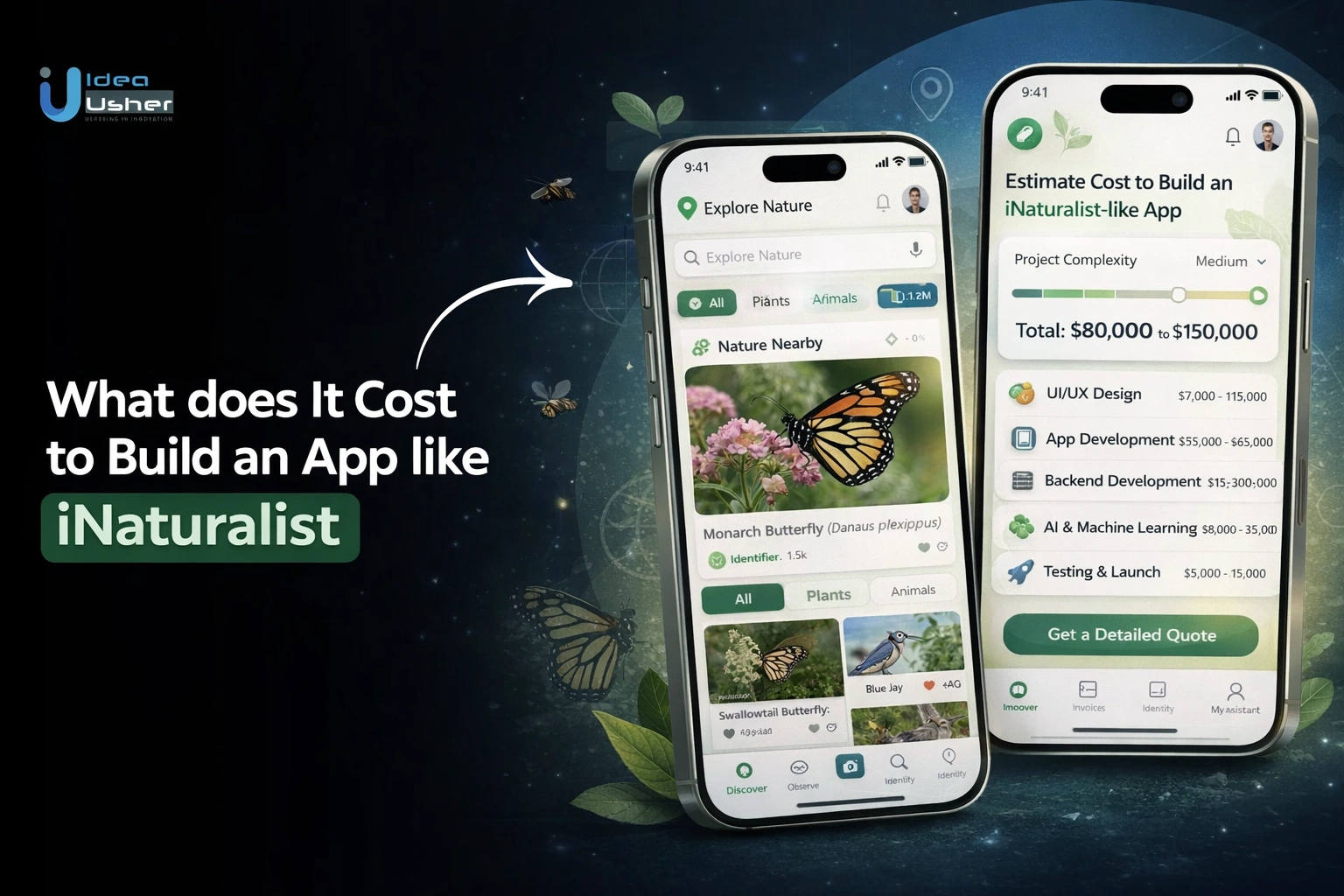
Nature discovery apps are increasingly expected to do more than display information. Users with instant species identification, precise geolocation, and interactive shared datasets creates a seamless experience but introduces a high level of technical complexity behind the scenes that shapes iNaturalist app development cost as features and data systems expand.
The specific cost drivers of expanding functionality include image processing pipelines, geolocation services, species databases, user-generated content management, and moderation systems all contribute to development effort. Infrastructure, scalability, and data accuracy requirements further influence how these costs evolve as the platform grows.
In this blog, we break down what it costs to build an app like iNaturalist by examining key cost drivers, development components, and the practical factors that determine overall investment.
Why Citizen Science Apps Are Attracting Investment?
The intersection of environmental data and advanced technology has created a significant opportunity for platform growth. The focus has shifted toward building digital infrastructures in 2026 that turn casual nature exploration into verifiable scientific records. This evolution from hobbyist tools to enterprise-level data engines is a primary reason why the iNaturalist app development cost is now viewed as a strategic investment in a high-value data asset.
A. Rise Of Biodiversity Tech And Eco Platforms
The global wildlife sighting citizen science app market is expected to expand from USD 0.41 billion in 2024 to USD 1.23 billion by 2033, registering a CAGR of 14.7%, reflecting increasing investment potential and growing demand for wildlife tracking and citizen science applications.

The Global Biodiversity Information Facility (GBIF) now provides access to over 3 billion records, with a rapidly increasing percentage originating from mobile-first observations that undergo community and AI-led peer review.
- Data Accuracy Protocols: Modern platforms utilize multi-layered verification systems to ensure that user-submitted data meets the rigorous standards required by scientific institutions.
- API Ecosystems: Many new eco-platforms are designed to be interoperable, feeding data directly into urban planning tools or agricultural monitoring systems.
- Regulatory Compliance: As environmental reporting becomes mandatory for many organizations, platforms that facilitate biodiversity tracking are becoming essential utility tools.
B. Market Demand For AI-Powered Nature Apps
Consumer and professional expectations have evolved, pushing the demand for sophisticated computer vision and real-time ecological feedback. This demand directly influences the iNaturalist app development cost because of the required backend complexity.
| Feature Type | Market Expectation | Strategic Value |
| Species Identification | Instant, offline-capable recognition of local flora and fauna. | High user retention and immediate utility. |
| Geospatial Mapping | Precise tagging with environmental metadata like soil or weather. | Higher quality data for research partnerships. |
| Predictive Analytics | AI that suggests where to find specific species based on season. | Gamification that drives consistent user engagement. |
C. Why Founders Are Betting On Conservation Tech
Founders are moving into this space to capitalize on the relative lack of competition compared to traditional social networking. The focus is on building “defensible” platforms where the community and the data become harder to replicate over time.
- Proprietary Datasets: Unlike generic apps, these platforms build unique, longitudinal datasets that track environmental changes over decades.
- Community Moats: A dedicated community of experts and scientists provides a level of quality control and engagement that automated systems cannot achieve alone.
- Sustainability Focus: The global shift toward environmental responsibility provides a stable, long-term foundation for platforms that can prove their impact on conservation.
Core Features That Define Development Cost
The financial scope of building a high-fidelity nature platform is determined by the depth of its functional modules. Each core component contributes to the total iNaturalist app development cost, requiring a balance between high-performance engineering and intuitive user experience.

1. User Onboarding And Observation Uploads
Frictionless onboarding combined with high-performance media handling is essential for user retention. This system ensures that high-resolution biological evidence is captured, compressed, and uploaded without losing critical metadata or scientific accuracy.
| Component | Functionality | Estimated Cost |
| Auth Systems | Multi-method registration including Social, Email, and OTP. | $4,000 – $7,000 |
| Media Pipeline | High-res image compression and asynchronous uploading. | $6,000 – $10,000 |
| Profile Logic | User profile management and personal observation history. | $5,000 – $8,000 |
2. AI Image Recognition And Classification
This feature serves as the app’s intellectual core, providing users with instant taxonomic suggestions. Sophisticated computer vision is vital for distinguishing between similar species, which significantly influences the iNaturalist app development cost due to the specialized data labeling required.
| Component | Functionality | Estimated Cost |
| ML Models | Computer vision model integration and fine-tuning. | $25,000 – $50,000 |
| Taxon Engine | Real-time taxonomic suggestion and ranking engine. | $15,000 – $30,000 |
| GPU Ops | Cloud-based GPU infrastructure setup and scaling. | $10,000 – $20,000 |
3. GPS Tracking And Geospatial Mapping
Accurate spatial data is mandatory for turning simple photos into research-grade records. This module maps biodiversity hotspots while protecting endangered species through location masking, a complex requirement that adds to the iNaturalist app development cost in 2026.
| Component | Functionality | Estimated Cost |
| GPS Modules | Precision GPS integration and offline coordinate caching. | $7,000 – $12,000 |
| Map Rendering | Dynamic map rendering with clustering and Hexbins. | $10,000 – $18,000 |
| Privacy Layers | Geoprivacy and location masking for sensitive species. | $5,000 – $9,000 |
4. Community Interaction And Verification System
The social layer facilitates peer review, allowing experts to verify identifications. This consensus-building mechanism is the foundation of scientific credibility and a key driver of the iNaturalist app development cost for platforms aiming for high data integrity.
| Component | Functionality | Estimated Cost |
| Social Logic | Discussion threads and identification voting systems. | $12,000 – $20,000 |
| Reputation | Reputation-based user ranking and badge logic. | $6,000 – $11,000 |
| Consensus | Research Grade consensus algorithm and data status. | $8,000 – $15,000 |
5. Notifications, Feeds, And Activity Tracking
Engagement depends on real-time updates involving a robust pub/sub architecture to manage notifications across a global user base and personalized content feeds.
| Component | Functionality | Estimated Cost |
| Push Engine | Push notification engine and triggered alerts. | $4,000 – $8,000 |
| Social Feeds | Personalized activity feeds and global observation streams. | $10,000 – $18,000 |
| Logic Hooks | User following and project-based subscription logic. | $6,000 – $12,000 |
6. Admin Dashboard And Moderation Tools
Backend control is essential for maintaining data quality and community standards. Admins need powerful tools to manage millions of records and handle user reports.
| Component | Functionality | Estimated Cost |
| User Admin | Role-based access control and user management. | $6,000 – $10,000 |
| Moderation | Content moderation and report handling workflows. | $8,000 – $15,000 |
| Data Sync | Data export and scientific repository syncing tools. | $10,000 – $18,000 |

Advanced Features That Increase App Cost Significantly
Scaling a platform beyond basic functionality requires high-tier technical assets that ensure scientific accuracy and user longevity. These advanced modules represent a significant portion of the development budget due to their architectural complexity.

1. Machine Learning Model Training And Updates
Maintaining high accuracy requires continuous model retraining using expansive, labeled datasets. Integrating automated data pipelines ensures the AI evolves with new observations, while OTA (Over-the-Air) updates deliver refined recognition capabilities without requiring app reinstalls.
Estimated Cost: $30,000 – $60,000, specialized AI talent and cloud compute hours for processing millions of images impact the iNaturalist app development cost.
2. Species Database Integration And APIs
Connecting to global biodiversity repositories like GBIF or IUCN ensures taxonomic data remains current. Using a modular API architecture allows the platform to synchronize scientific metadata, providing users with authoritative and real-time conservation status updates.
Estimated Cost: $12,000 – $25,000, technical overhead involves mapping custom data structures to international standards and managing high-frequency synchronization with external scientific databases.
3. Offline Observation Capabilities
Fieldwork often occurs in remote areas with zero connectivity, necessitating local data caching. Implementing on-device SQLite databases and background sync protocols allows users to capture sightings and GPS coordinates, which auto-sync once a connection is restored.
Estimated Cost: $10,000 – $18,000, complexity arises from handling multi-media conflict resolution and ensuring data integrity, which adds to the iNaturalist app development cost.
4. Gamification And Contributor Ranking
Driving consistent engagement involves reputation-based logic and interactive rewards. Sophisticated systems track user expertise through verified identifications, creating a competitive yet collaborative environment where top contributors earn digital badges and higher ranking within the community.
Estimated Cost: $15,000 – $28,000, developing custom logic for expertise-weighting and real-time leaderboards requires extensive backend engineering to prevent system manipulation and maintain fairness.
5. Multi-Language And Global Scalability
Expanding to a global audience requires localization frameworks and elastic cloud infrastructure. Utilizing Content Delivery Networks (CDNs) and multi-region database replication ensures low-latency performance and a seamless experience for users across different geographic regions and languages.
Estimated Cost: $20,000 – $35,000, internationalization requires regional data compliance and specialized infrastructure, which are key factors in the total iNaturalist app development cost.
Cost Breakdown To Build An App Like iNaturalist
Establishing a budget for a nature-centric platform requires categorizing the project by its intended scale and technical sophistication. The following estimates reflect the market rates in 2026 for specialized talent in AI, geospatial systems, and community-driven architecture.

A. MVP Development Cost Estimate
An Minimum Viable Product (MVP) focuses on the core utility: capturing an observation, basic GPS tagging, and a rudimentary AI identification feature. This stage is designed to validate the concept and build an initial user base without the overhead of complex social systems.
| Development Phase | Key Deliverables | Estimated Cost |
| Discovery & UI/UX | User flows, wireframes, and high-fidelity branding. | $8,000 – $12,000 |
| Core App Development | Basic iOS/Android builds and observation upload. | $25,000 – $35,000 |
| Initial AI Integration | Basic image recognition for a limited species set. | $15,000 – $20,000 |
| Cloud Infrastructure | Essential backend hosting and database setup. | $5,000 – $8,000 |
| Total Estimate | Launch-ready MVP | $53,000 – $75,000 |
B. Mid-Scale App Cost Estimation
A mid-scale version transitions the tool into a community adding social features, more robust AI models, and sophisticated data validation workflows. This phase is typically where the iNaturalist app development cost increases due to the need for higher data integrity.
| System Component | Advanced Functionality | Estimated Cost |
| Enhanced AI Engine | Global species identification and geographical models. | $35,000 – $50,000 |
| Community Logic | Discussion threads, peer review, and voting systems. | $20,000 – $30,000 |
| Offline Modes | Local caching for remote field observations. | $12,000 – $18,000 |
| Advanced Backend | API integrations and automated data backups. | $15,000 – $25,000 |
| Total Estimate | Community-Ready Platform | $82,000 – $123,000 |
C. Enterprise-Grade App Cost Range
At the enterprise level, the platform becomes a scientific powerhouse capable of global scale. This includes “Research Grade” data pipelines, multi-language support, and deep integration with international biodiversity databases.
| Strategic Asset | Enterprise Requirements | Estimated Cost |
| Scientific Pipeline | Darwin Core compliance and GBIF synchronization. | $25,000 – $40,000 |
| Predictive Analytics | AI that predicts species presence based on metadata. | $40,000 – $60,000 |
| Scalability Ops | Multi-region deployment and high-tier security. | $30,000 – $50,000 |
| Admin Ecosystem | Advanced moderation and data visualization tools. | $20,000 – $35,000 |
| Total Estimate | Global Research-Grade App | $115,000 – $185,000+ |
D. Cost Comparison By Feature Complexity
The financial commitment is directly proportional to the “intelligence” and “interconnectivity” of the features. Below is a breakdown of how different levels of complexity impact the investment.
- Basic Functionality: Simple photo uploads and standard GPS tagging represent the lowest cost tier, as these utilize native mobile device capabilities.
- Intermediate Logic: Building the consensus engine for community identification requires custom algorithm development, which is a significant factor in the iNaturalist app development cost.
- High-Level Complexity: On-device machine learning models and real-time geospatial heatmaps require specialized engineering hours and high-performance computing resources.
- Data Interoperability: Building bridges to external scientific repositories adds a layer of technical debt and maintenance that is essential for platforms aiming for scientific credibility.
Hidden Costs Founders Often Overlook
Successful platform ownership requires planning for expenses that exist beyond the initial codebase. These recurring operational costs are critical to the iNaturalist app development cost and directly impact the long-term sustainability of the scientific ecosystem.

1. Data Storage And Biodiversity Dataset Scaling
The volume of high-resolution media and environmental metadata expands exponentially as your community grows. Managing petabyte-scale storage while maintaining rapid retrieval speeds requires a high-performance object storage architecture and tiered data management strategies.
Overlooked Consequence: During development, ignoring storage scaling leads to database bottlenecks. After launch, it results in astronomical monthly cloud bills and sluggish app performance that frustrates your core user base.
2. Third-Party API And Cloud Costs
Integrating external mapping services, weather data, and taxonomic databases often involves usage-based pricing. These costs scale with your user traffic, making the API request volume a significant variable in your ongoing operational budget.
Overlooked Consequence: Failing to cap API usage or optimize calls can lead to sudden, unbudgeted expenses that drain capital. Post-launch, this may force the removal of essential features to stay solvent.
3. Ongoing AI Model Training Expenses
The natural world is dynamic, and your AI must be too. Regular model fine-tuning is necessary to include new species and improve accuracy based on community-verified labels, requiring continuous access to high-tier GPU compute power.
Overlooked Consequence: Without a budget for retraining, the AI’s accuracy will stagnate or “drift,” leading to incorrect identifications. This compromises the scientific integrity of your data and destroys user trust in the platform.
4. Maintenance, Updates, And Bug Fixing
Mobile operating systems and hardware evolve rapidly, necessitating frequent compatibility patches. Continuous security audits and performance monitoring are essential to protect user data and ensure the platform remains stable across all global regions.
Overlooked Consequence: Neglecting maintenance leads to “technical debt” that makes future updates impossible. After launch, an unmaintained app will suffer from crashes, eventually leading to its removal from major app stores.
5. Compliance With Environmental Data Standards
To be scientifically relevant, data must adhere to international standards like Darwin Core. Implementing these protocols involves complex metadata mapping and ensuring your data architecture remains interoperable with global repositories like GBIF.
Overlooked Consequence: Ignoring these standards during development makes your data “dark” and unusable by the scientific community. Post-launch, this prevents prestigious research partnerships and limits the platform’s impact on global conservation.
Timeline To Build An App Like iNaturalist
The speed of delivery for a biodiversity platform depends on the complexity of its features and the maturity of its AI models. Strategically planning the development stages is essential to manage the total iNaturalist app development cost effectively.
A. MVP Development Timeline (3–6 Months)
The Minimum Viable Product focuses on core identification and data collection features to enter the market quickly. This stage prioritizes stability and essential user flows over advanced social or gamification modules.
| Development Stage | Duration | Primary Focus | Estimated Cost |
| Discovery & Design | 3–5 Weeks | UX research, wireframing, and taxonomic data mapping. | $8,000 – $12,000 |
| Core Development | 8–12 Weeks | Native app builds, media uploads, and basic GPS. | $25,000 – $35,000 |
| AI Integration | 4–6 Weeks | Integrating pre-trained vision models for identification. | $15,000 – $20,000 |
| Testing & QA | 3–4 Weeks | Field testing, bug fixing, and cloud deployment. | $5,000 – $8,000 |
| Total Estimate | 3–6 Months | Launch-ready MVP | $53,000 – $75,000 |
B. Full-Scale Product Timeline (6–12 Months)
A full-scale launch transforms the app into a global scientific community. This timeline accounts for the deep engineering required for complex data verification engines and advanced geospatial visualization tools.
| Development Stage | Duration | Primary Focus | Estimated Cost |
| Community Systems | 10–14 Weeks | Building consensus logic and peer-review workflows. | $30,000 – $45,000 |
| Custom AI Training | 12–16 Weeks | Training proprietary models on niche biodiversity data. | $40,000 – $60,000 |
| Offline & Geospatial | 6–10 Weeks | Advanced mapping, hexbins, and offline sync logic. | $25,000 – $40,000 |
| Global Scaling | 4–8 Weeks | Multi-language support and multi-region cloud ops. | $20,000 – $40,000 |
| Total Estimate | 6–12 Months | Global Research-Grade App | $115,000 – $185,000+ |
C. Factors That Can Delay Development
Several variables can extend the production schedule, often leading to increased overhead. Identifying these early is key to maintaining the project’s financial health.
- Taxonomic Data Complexity: Integrating and cleaning massive datasets of plant or animal species can take significantly longer than anticipated if the data sources are unorganized.
- AI Model Accuracy Tunnels: Achieving a high percentage of accuracy for similar subspecies often requires multiple rounds of retraining and manual data labeling.
- Geospatial Privacy Compliance: Implementing varying regional privacy laws regarding protected species or user location data adds layers of legal and technical scrutiny.
- Third-Party API Instability: Dependence on external biodiversity databases can cause delays if those services undergo maintenance or change their data structures during your build.
- Scaling Synchronization Logic: Ensuring that complex offline observations sync perfectly with the cloud without data loss is a common bottleneck in the final testing phases.
Real-World Cost Factors Based On Our Experience
Drawing from our extensive background in building community-driven and AI-integrated platforms, we have identified that the most significant cost drivers are often intangible. Beyond the lines of code, the architectural decisions made during the early phases of development dictate whether a project scales efficiently or requires a costly complete overhaul later.
A. Case Insights From Similar Apps Built
Our experience with high-impact mobility and community projects provides a benchmark for specialized platform development. For instance, in our development of GetOn Scooters, we implemented a meticulously designed ecosystem that simplifies complex user interactions like QR code scanning and subscription models. Additionally, our work on Albportal involved creating a location-based community app that connects users with nearby services using advanced geolocation technology.
- Key Factor: Platforms like these share a “precision DNA” with biodiversity apps, where the seamless integration of GPS and user verification is essential for system reliability.
- Strategic Insight: Building a “trust layer” where users interact with real-world assets or locations involves complex backend logic that typically accounts for 20-25% of the iNaturalist app development cost.
B. Budget Variations Across Different Industries
While the core technology may seem similar, industry-specific requirements drastically shift the investment focus. In our work on EduRev, the priority was a robust Content Management System (CMS) and interactive learning tools for over 1 million users, whereas our Healthcare App (Vezita) demanded automated fee management and strict scheduling logic.
- Eco-Tech Specifics: In conservation tech, the budget is heavily weighted toward geospatial precision and AI identification accuracy rather than the high-frequency transaction security found in fintech.
- Cost Pivot: A shift from a “general nature app” to a “scientific research tool” can double the backend costs due to the need for standardized metadata compliance and scientific repository syncing.
C. Lessons Learned From Scaling Community Apps
Scaling a user base from thousands to millions requires a shift from a monolithic architecture to a modular, cloud-native approach. Through our portfolio of community apps, we have learned that “engagement features” like those in our Hubear sports platform or the Kamelion well-being app require a robust notification and feed architecture to prevent performance lags as the user count grows.
- Infrastructure Wisdom: High-density data clusters like those found in biodiversity hotspots require specialized database indexing to remain performant during peak usage.
- Long-term Value: Investing in a modular architecture early on reduces the iNaturalist app development cost during the scaling phase, as it allows for individual components to be upgraded without taking the entire system offline.
Monetization Strategies For Nature Discovery Apps
Generating revenue from a science-centric platform requires a balance between public utility and sustainable business models. Beyond simple advertisements, the iNaturalist app development cost is often recouped through high-value data partnerships and specialized user features.
1. Freemium Subscriptions For Advanced Tools
Premium tiers offer enhanced features like high-resolution offline maps, advanced species distribution analytics, and personalized field journals while basic identification remains free. This model provides consistent recurring revenue while maintaining the core community’s accessibility.
2. Partnerships With Research Institutions
Universities and NGOs often pay for dedicated project spaces or “BioBlitz” coordination tools. These institutional partnerships provide a stable income stream by allowing organizations to leverage the app’s massive user base for specific ecological studies.
3. Data Licensing And Analytics Services
Anonymized, high-fidelity biodiversity data is a valuable asset for environmental consultants and government agencies. By licensing these datasets or providing custom analytics dashboards, the platform transforms raw observations into a sophisticated, B2B revenue-generating product.
4. Sponsored Conservation Campaigns
Brands looking to fulfill ESG goals can sponsor specific “challenges” or species-tracking campaigns. These sponsorships integrate naturally into the user feed, driving engagement through gamification while funding the platform’s ongoing operational and maintenance expenses.
How To Optimize Development Cost Without Compromise?
Maximizing the efficiency of your investment requires a strategic approach to feature prioritization and architectural choices. By focusing on high-impact core functionalities early on, you can manage the initial iNaturalist app development cost while building a foundation that supports future scientific and community expansion.
A. Start With A Focused MVP Approach
Launching with a lean feature set allows for real-world user testing without the financial risk of building niche secondary tools. Focusing on high-fidelity observation uploads and basic GPS tagging ensures the core value proposition is perfected before adding social or gamification layers.
- Core Utility: Prioritize the “capture-to-upload” pipeline to ensure data quality remains high from day one.
- User Feedback Loops: Use early adopter data to identify which advanced features are truly in demand, preventing wasted development hours on low-utility modules.
- Reduced Time-to-Market: A focused scope allows for a faster launch, enabling earlier opportunities for research partnerships and data validation.
B. Use Pre-Trained AI Models Initially
Leveraging established computer vision frameworks significantly reduces the research and development budget during the first phase. Instead of building a custom neural network from scratch, integrating proven models allows for immediate species identification capabilities with lower upfront costs.
| Optimization Strategy | Practical Implementation | Impact on Cost |
| Transfer Learning | Using models like ResNet or Inception pre-trained on biological datasets. | High reduction in R&D and training time. |
| Cloud-based APIs | Utilizing Google Cloud Vision or specialized biodiversity APIs for ID. | Replaces the need for expensive GPU infrastructure. |
| On-Device Inference | Implementing lightweight TFLite models for basic offline checks. | Reduces server-side processing costs per user. |
C. Choose Scalable Cloud Infrastructure
Utilizing serverless architecture and elastic cloud services ensures that you only pay for the resources you consume. This prevents over-provisioning during the early stages while allowing the platform to handle sudden traffic spikes during global nature events or seasonal migrations.
- Auto-Scaling Groups: Infrastructure that expands or contracts based on real-time user demand protects your operational budget.
- Managed Databases: Using services like AWS RDS or Google Cloud SQL reduces the need for dedicated DevOps personnel to manage database health and backups.
- Content Delivery Networks (CDNs): Implementing CDNs for media storage ensures low-latency image loading globally without taxing the primary origin server.
D. Prioritize Features Based On ROI
Every feature should be evaluated by its ability to drive either user retention or data value. By focusing on “Research Grade” validation logic and high-accuracy mapping, you build a platform that attracts institutional investment and high-value data licensing opportunities.
- High-Value Assets: Features that improve data integrity directly increase the platform’s attractiveness to scientific partners and government agencies.
- Development Efficiency: Avoiding “feature creep” in the social layer allows the team to focus on the technical excellence of the AI identification system.
- Strategic Growth: Aligning feature releases with monetization milestones ensures the iNaturalist app development cost is balanced by consistent revenue generation.
Why Businesses Choose IdeaUsher For App Development?
Our approach combines technical excellence with a deep understanding of market dynamics, ensuring every project is built for long-term scalability. We transform complex environmental concepts into high-performance digital assets through strategic engineering.
A. Proven Expertise In AI-Powered Platforms
We specialize in integrating advanced machine learning models that process complex visual data with high accuracy. Our team ensures that computer vision systems are not just functional but optimized for real-world environmental identification and research.
B. Experience With Scalable Community Apps
Building platforms that support millions of concurrent users requires a modular, cloud-native architecture. We have a track record of developing social ecosystems where data integrity and user engagement remain high even during rapid global expansion.
C. End-to-end Development And Consulting
From initial discovery and taxonomic mapping to post-launch maintenance, we provide comprehensive support. Our consulting services help founders navigate the technical complexities of biodiversity tech, ensuring the iNaturalist app development cost delivers maximum ROI.
D. Client Success Stories And Results
Our portfolio reflects a commitment to delivering measurable business outcomes across various high-tech sectors. By focusing on performance and user-centric design, we have helped numerous partners transition from initial concepts to globally recognized digital platforms.
E. Strategic Geospatial And Mapping Solutions
We excel at implementing precision GPS tracking and custom mapping layers essential for scientific data. Our expertise in geospatial binning and location privacy ensures that sensitive biodiversity records are handled with the highest technical standards.
Estimated Cost Summary At A Glance
Navigating the financial landscape of high-tech development requires a clear understanding of how specific functionalities dictate the total investment. This summary provides a rapid reference to align your project goals with the necessary iNaturalist app development cost for 2026.
A. MVP Vs Advanced App Cost Snapshot
Choosing between a lean market entry and a feature-rich scientific ecosystem is the most critical budgetary decision. An MVP focuses on core identification utility, while an advanced platform invests heavily in proprietary AI and global research standards.
| App Tier | Focus Area | Estimated Cost |
| Minimum Viable Product | Core identification and basic GPS. | $53,000 – $75,000 |
| Mid-Scale Platform | Community verification and offline sync. | $82,000 – $123,000 |
| Enterprise-Grade | Global AI models and GBIF integration. | $115,000 – $185,000+ |
B. Cost Vs Feature Comparison Table
The complexity of individual modules significantly shifts the budget. Below is a breakdown of how specific feature sets contribute to the overall technical debt and development hours.
| Feature Set | Complexity Level | Cost Impact |
| Basic Uploads & GPS | Low | Standard development rates. |
| Consensus Logic (Peer Review) | Medium | Requires custom algorithm engineering. |
| On-Device AI Inference | High | Specialized ML optimization and testing. |
| Multi-Region Cloud Scaling | High | Infrastructure setup and DevOps overhead. |
C. Budget Planning Checklist For Founders
A successful launch depends on accounting for both visible development milestones and recurring operational demands. Use this checklist to ensure your capital allocation covers the entire project lifecycle.
- Initial R&D: Allocate 15% for taxonomic data mapping and AI feasibility studies.
- Core Development: Reserve 50% for frontend, backend, and primary AI integration.
- QA & Field Testing: Dedicate 10% for testing in diverse geographic and connectivity environments.
- Launch & Marketing: Set aside 15% to build the initial community of naturalists and experts.
- Operational Buffer: Maintain a 10% contingency for API scaling and cloud storage growth.
Ready To Build An App Like iNaturalist?
Leverage our elite team of ex-FAANG/MAANG engineers and over 500,000+ hours of development experience to engineer your vision.
We specialize in high-fidelity computer vision and scalable community architectures, ensuring your project achieves technical excellence while optimizing the total iNaturalist app development cost through precision-led, industry-proven development methodologies.
Schedule a session with our strategic consultants to receive a granular technical roadmap and accurate budgetary projections for your platform.
Review our diverse range of successful high-impact projects and see how we deliver performance-driven solutions across global industries and sectors.
Conclusion
The digital transformation of environmental conservation has sparked a massive surge in biodiversity platforms that bridge the gap between citizen science and professional research. The iNaturalist app development cost requires a deep dive into high-fidelity computer vision, precise geospatial mapping, and scalable community architectures. This guide explores the essential investment drivers, from core MVP development to advanced AI integration, helping founders navigate the technical complexities and budgetary requirements of launching a high-impact, research-grade ecological solution in today’s market.


FAQs
A.1. Building a baseline version typically requires $53,000 to $150,000. Final costs depend on the complexity of your species database, the sophistication of AI recognition models, and your specific cloud infrastructure needs.
A.2. Start with a Minimum Viable Product focusing on core identification features. Using pre-trained machine learning models and open-source biological databases allows you to launch quickly while keeping initial development expenses manageable.
A.3. Advanced image recognition and real-time geospatial mapping are the primary cost drivers. High-fidelity AI requires extensive training data and specialized backend processing, which demands significant technical expertise and sophisticated server resources.
A.4. Beyond initial builds, you must budget for ongoing AI model refinement, secure data hosting, and API maintenance. Regular updates are essential to ensure compatibility with new mobile hardware and evolving biodiversity standards.


