

Key Takeaways
- E-procurement platforms automate purchasing, approvals, and vendor management while improving operational efficiency.
- AI-powered procurement systems reduce manual work, strengthen spend control, and prevent financial leakage.
- Modern procurement software relies on ERP integrations, workflow engines, vendor portals, and analytics.
- Building a procurement platform requires secure architecture, intelligent automation, compliance controls, and synchronization.
- How Idea Usher helps businesses develop platforms like Tradogram using pre-vetted developers experienced in ERP integrations and SaaS architecture.
The greatest threat to a company’s fiscal discipline isn’t a lack of policy, but the friction of enforcement. When procurement software is built with the rigidity of a legacy ERP system, it becomes a bottleneck instead of an operational enabler. Employees working under tight deadlines often bypass slow approval workflows, leading to unmanaged Maverick Spend, missed vendor discounts, and budget overruns.
An agile e-procurement platform like Tradogram changes this dynamic by combining consumer-grade transaction speed with enterprise-grade financial controls. Instead of making compliance feel bureaucratic, it turns procurement governance into the path of least resistance.
Over the past decade, we’ve built several enterprise procurement and spend management solutions powered by supplier management, approval automation, and purchasing workflows. In this blog, we’ll explore how to create an e-procurement platform like Tradogram.
Why E-Procurement Platforms Are Growing Fast?
According to Market Reports World, the global e-procurement tools market size in 2026 is estimated to be USD 10386.22 million, with projections to grow to USD 20166.7 million by 2035 at a CAGR of 8.65%. This capital reallocation toward digital supply chain infrastructure highlights a shift in corporate operations. Modern enterprises no longer view procurement as an administrative function, but rather as a critical lever for margin optimization and strategic resilience. For investors, this rapid market expansion represents an opportunity to deploy capital into scalable B2B software ecosystems.
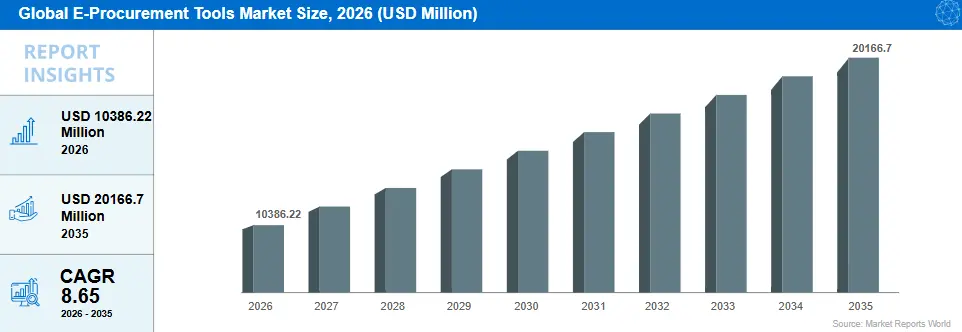
Source: Market Reports World
The macroeconomic catalysts driving this adoption are multifaceted. Rising global inflation, supply chain vulnerabilities, and tightening regulatory compliance requirements have forced enterprise executives to abandon legacy operations. Legacy workflows lack the agility required to handle modern supply networks, leaving organizations exposed to unnecessary risks. Modern e-procurement platforms solve this by offering centralized visibility, predictive data analytics, and seamless integration into existing Enterprise Resource Planning frameworks.
Replacing Email Procurement
For decades, enterprise procurement relied on a fragmented web of emails, spreadsheets, and disconnected PDFs. When requests for quotes, contracts, and approvals are buried inside individual inboxes, leadership loses real-time visibility into financial commitments. This communication breakdown creates data silos and prolonged cycle times, leading to missed vendor discounts, delayed production schedules, and severe compliance or fraud risks due to the lack of a reliable audit trail.
Shifting to a dedicated e-procurement architecture consolidates these interactions into a single system of record. Organizations utilize market-leading tools like SAP Ariba to handle complex supplier networks, replacing the chaos of the inbox with automated RFQ distribution and structured bidding portals. This transition transforms a reactive administrative burden into a proactive operation, allowing decision-makers to track negotiation histories, evaluate vendor responsiveness, and secure competitive pricing with absolute clarity.
Shift to Spend Control
Manual buying processes inherently limit an organization’s financial visibility. When individual departments independently purchase goods and services without centralized oversight, corporate leadership only gains clarity on expenditures long after the capital has left the building, usually when reconciling monthly or quarterly financial statements. This reactive posture makes proactive capital management nearly impossible, leaving organizations vulnerable to maverick spend and budget overruns.
Implementing structured spend control fundamentally alters this dynamic by embedding proactive guardrails into the operational workflow. Modern e-procurement systems enforce pre-approved budget thresholds, category-specific spend limits, and conditional approval workflows before any financial commitments are made. To maximize capital efficiency, platforms utilize systematic authorization mechanics:
- Tier 1 (Automated Approvals): Low-risk, routine purchases under $5,000 that utilize pre-negotiated catalogs are instantly approved, minimizing operational friction.
- Tier 2 (Managerial Intervention): Expenditures ranging from $5,000 to $50,000 trigger automated routing to department heads, requiring a digital signature backed by real-time budget impact visualizations.
- Tier 3 (Executive Oversight): High-capital outlays exceeding $50,000 are automatically escalated to the CFO or procurement committee, complete with vendor comparison data and contract compliance scores.
This systematic approach shifts the organizational culture from arbitrary manual buying to rigid, strategic spend control. It empowers procurement teams to consolidate purchasing power, negotiate advantageous volume discounts, and ensure that every transaction directly advances the company’s broader financial objectives.
Reducing Cost Leakage
Cost leakage kills corporate profitability through unapproved maverick spending, duplicate invoices, and missed volume discounts. In manual environments, tracking these micro-losses is an expensive battle, leaving leaders to discover budget overruns too late. Procurement automation plugs these leaks by enforcing three-way matching, which automatically cross-references the purchase order, receiving log, and vendor invoice before any disbursement occurs.
Platforms like Coupa eliminate these gaps by using data analytics to track savings and catch fraudulent billing patterns. While manually verifying thousands of monthly deliveries for errors is practically impossible, an automated platform instantly flags pricing or tax discrepancies. Pausing the pipeline until resolved eliminates systemic inefficiencies and slashes invoice processing costs to deliver an immediate boost to the bottom line.
What Is an E-Procurement Platform?
An e-procurement platform is a cloud-based software system that digitizes and automates enterprise purchasing operations. Unlike traditional procurement systems that focus only on transaction processing, modern e-procurement platforms function as centralized operational layers connecting finance teams, procurement departments, vendors, employees, and enterprise systems. According to Gartner, procurement software is increasingly evolving from transactional tooling into an intelligent spend orchestration infrastructure.
To visualize its operational footprint, consider how the platform consolidates the core pillars of corporate spend management:
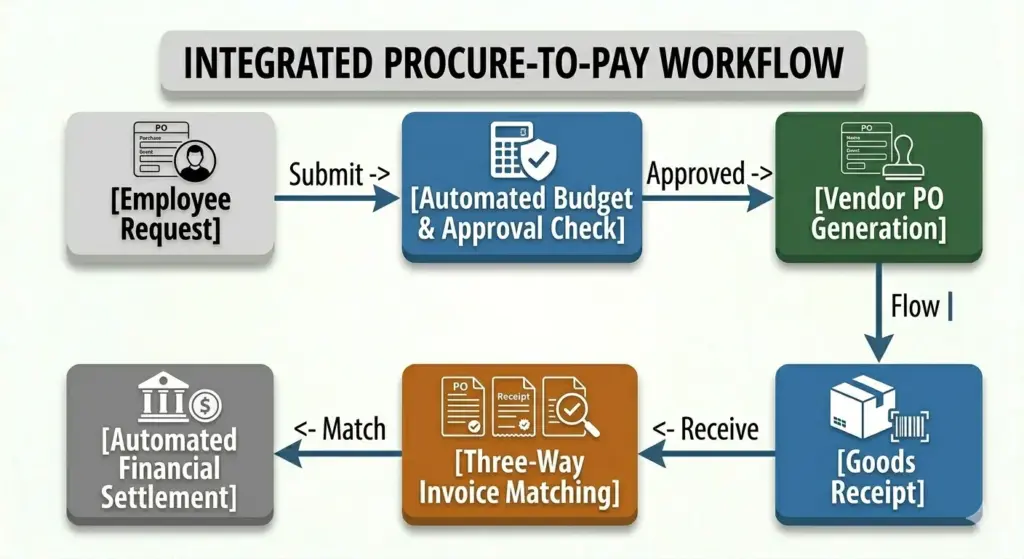
At its core, the architecture acts as an automated governance engine. Instead of relying on manual oversight, the software handles the heavy lifting of corporate commerce through distinct functional modules:
- Sourcing and Vendor Management: Facilitates structured RFQ/RFP sourcing, accelerates supplier onboarding, and hosts dynamic vendor catalogs.
- Transactional Execution: Automates purchase requisitions, generates purchase orders, and orchestrates complex approval workflows.
- Financial Governance: Conducts automated invoice reconciliation, enforces real-time budget management, and delivers granular spend analytics.
Why Enterprises Need Procurement Automation?
Manual procurement systems create severe operational problems that compound as a business scales. When organizations expand across new departments and geographies, manual tracking becomes an active operational bottleneck. The baseline risk profile of unautomated procurement typically includes:
Operational Impact Analysis
- Financial Volatility: Budget leakage, rampant maverick spending, duplicate purchases, and cost inflation from vendor fragmentation.
- Process Friction: Delayed approvals that stall projects, poor real-time financial visibility, and administrative overhead.
- Risk Exposure: Compliance failures, supplier contract breaches, and elevated procurement fraud risks.
Why Tradogram Became Popular in the Procurement Space?
Tradogram positioned itself between lightweight SMB tools and heavyweight enterprise ecosystems like SAP Ariba and Coupa. Its growth accelerated because it simplified procurement digitization for mid-sized and scaling enterprises without requiring massive, disruptive ERP transformation projects.
By providing a balanced middle ground, the platform captured a massive segment of companies that required structured financial governance but demanded modern SaaS usability. Tradogram succeeded by bundling the essential mechanics of spend orchestration into a modular, high-adoption blueprint:
- Procurement Workflow Automation: The engine automates requisition-to-purchase workflows using highly configurable approval routing and real-time procurement tracking.
- Vendor Management: The software centralizes core supplier records, historical purchase data, contract pricing visibility, and vendor performance metrics.
- Budget Tracking & Spend Visibility: Real-time procurement dashboards help organizations monitor live spending, enforce internal procurement policies, reduce off-contract purchases, and optimize supplier relationships.
To ensure frictionless compliance, the operational workflow maps neatly across the organization:
Data Flow Synchronization
Modern procurement platforms rely on continuous data synchronization to maintain operational accuracy across departments. Tradogram streamlines this process by enabling real-time information exchange between employees, procurement teams, suppliers, and finance systems, ensuring every purchasing decision flows through a connected and fully traceable workflow.
- Employee Interface: Generates an accurate, catalog-backed requisition form.
- Governance Engine: Automatically routes the request based on pre-set departmental budgets.
- Supplier Portal: Converts approved requests into binding purchase orders.
Accounting Integrations
An e-procurement ecosystem cannot operate as an operational island. Tradogram eliminates data fragmentation by engineering native, bidirectional sync pipelines into the leading ERP and financial software suites. This integration-first architecture allows procurement, finance, and operations teams to work from a single source of truth across the organization.
| Financial Platform Type | Supported Accounting & ERP Ecosystems |
| Mid-Market / SMB Accounting | QuickBooks Online, QuickBooks Desktop, Xero |
| Enterprise ERP Frameworks | NetSuite, SAP, Sage Intacct, Microsoft Dynamics 365 |
This native integration layer ensures that transactional data automatically syncs with the general ledger. Finance teams eliminate manual cross-referencing, speed up their monthly close processes, and retain precise control over actual cash outlays.
Strategic Positioning
The platform succeeded because it targeted a distinct structural pain point in the market. Many mid-sized businesses desperately needed procurement automation, but they completely lacked the capital, technical resources, or implementation capacity required to deploy heavy enterprise software.
This operational gap created a massive surge in demand for modular, cloud-native procurement platforms capable of delivering five core advantages:
- Rapid Time-to-Value: Deployment timelines are measured in weeks rather than fiscal quarters.
- Frictionless User Onboarding: Intuitive interface design limits internal resistance and stops shadow purchasing.
- Lower Implementation Costs: Minimal upfront professional service fees maximize capital efficiency.
- Simple Workflow Configuration: Non-technical managers can update budget limits and approval routing on the fly.
- Scalable Infrastructure: Companies can start with core purchase order modules and unlock advanced inventory or sourcing features as corporate complexity expands.
Essential Features Required in an E-Procurement Platform
A production-grade procurement platform requires far more than digital purchase forms. To compete effectively with established software like Tradogram, a platform must orchestrate complex interactions between internal corporate employees, finance teams, and external vendor networks. Designing these features requires an engineering strategy that balances simple user design with highly secure, automated backend logic.
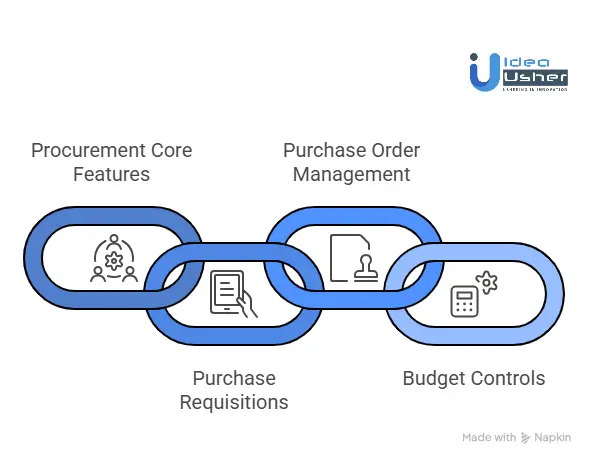
1. Procurement Core Features
The core transactional layer serves as the daily operational environment for corporate buyers. When we develop these modules, we prioritize data integrity and deterministic validation rules to eliminate manual oversight. Every procurement action must process through structured validation checkpoints to ensure operational consistency and financial accuracy at scale.
Purchase Requisitions
Employees need a simple, self-service dashboard to submit procurement requests. The backend structure must capture item categories, preferred vendors, specific project budgets, requested delivery timelines, and supporting documentation (such as technical specifications or localized compliance certs) within a single unified data object.
Purchase Order Management
Once an internal request clears the necessary corporate hurdles, the platform must automatically generate an immutable PO document. The system tracks this document across its entire lifecycle, updating its state from “Issued” to “Acknowledged,” “Partially Fulfilled,” and ultimately “Closed.”
Budget Controls
Waiting for end-of-month accounting audits creates massive financial risk. We build real-time budget enforcement triggers directly into the data submission path. If an employee tries to submit an order that exceeds their department’s remaining quarterly balance, the platform automatically blocks the submission or triggers an immediate escalation protocol.
2. Vendor Management Features
An enterprise platform must extend its interface safely to third-party suppliers. We achieve this by engineering secure, isolated external portals that shift the administrative burden of data maintenance away from your core corporate clients. This architecture improves supplier collaboration while ensuring sensitive enterprise procurement data remains fully protected and access-controlled.
Supplier Onboarding
This module allows vendors to directly manage their own profiles. External suppliers can log into their isolated dashboard to upload necessary tax and compliance documentation, update active product catalogs, modify bulk pricing tiers, and track their outstanding payment statuses.
RFQ and RFP Management
To drive down corporate procurement costs, the software needs competitive sourcing workflows. Buyers can broadcast Requests for Quotes or Requests for Proposals (RFPs) to select vendor groups, while the backend aggregates, normalizes, and compares the incoming supplier bids automatically.
3. Analytics and Reporting Features
Modern executive teams expect highly analytical procurement intelligence dashboards that turn raw transactional histories into clear, actionable corporate strategy. We build these systems out using specialized database indexing to ensure heavy aggregated queries run in milliseconds without locking up active transaction tables.
Our engineering teams focus on surfacing seven critical performance indicators through live data visualization pipelines:
| Procurement KPI | Data Source Variable | Strategic Enterprise Value |
| Spend by Department | Cost center relational IDs | Gives CFOs instant clarity on which divisions are burning capital fastest. |
| Supplier Concentration Risk | Aggregate vendor ledger totals | Flags over-reliance on a single supplier to prevent supply chain bottlenecks. |
| Procurement Cycle Times | Creation-to-fulfillment timestamps | Highlights operational drag by measuring the exact hours an order takes to process. |
| Approval Bottlenecks | Workflow state change duration | Pinpoints the exact managers or departments delaying critical company purchases. |
| Budget Variance | Projected costs vs. final invoiced totals | Exposes structural forecasting errors by comparing planned spend against real cash outlays. |
| Contract Utilization | Active order prices vs. pre-negotiated SLAs | Identifies if employees are ordering outside of pre-negotiated corporate discount terms. |
| Maverick Spend Detection | Uncategorized transaction flags | Automatically isolates unapproved, off-contract spending occurring outside company policy. |
Are Vendors Exploiting Your Procurement Blind Spots?
Without centralized E-procurement platforms, corporate finance teams operate in a state of perpetual information asymmetry. Vendors recognize this data deficit and capitalize on it, turning an organization’s internal administrative gaps into their own profit margins. When purchasing is managed via fragmented email threads, paper receipts, and unmonitored spreadsheets, supplier networks slowly leak capital from the bottom line through subtle, systematic overcharges that pass straight through manual billing reviews unnoticed.
The Three Silent Profit Leaks
Suppliers rarely execute large, obvious price hikes that would trigger immediate corporate alarms. Instead, they leverage tactical blind spots to steadily inflate contract costs over time. These small inconsistencies often remain invisible inside fragmented procurement systems until they accumulate into major financial leakage.
- Invoice Creep: Suppliers frequently apply minor price increases of 2% to 3% on high-volume line items. These micro-adjustments easily slip past manual matching procedures but result in tens of thousands of dollars in unapproved spending by the end of the fiscal year.
- The Auto-Renewal Trap: B2B SaaS vendors and service providers rely heavily on automated renewal deadlines buried deep within multi-year master service agreements. Without an automated alert matrix, these contracts renew silently, locking the business into inflated rates without a competitive sourcing review.
- Duplicate Billing and Fragmented Orders: Vendors often split comprehensive shipments into smaller, separate invoices or issue duplicate billing statements across differing regional subsidiaries. Manual accounting workflows regularly process these as separate transactions, paying the same obligation twice.
The Source of Information Asymmetry
The fundamental problem stems from a lack of real-time transactional visibility. A classic corporate procurement blind spot follows a predictable path of data degradation. As procurement data moves across disconnected departments and systems, financial accountability becomes increasingly difficult to enforce accurately.:
[Contract Signed] ───► [Siloed in Legal Dept] ───► [Invoices Handled by AP] ───► [Zero Rate Verification]
Because the original pricing terms are locked inside a static contract PDF in one department while invoices are processed by a disconnected accounting team, nobody verifies if the live billing actually matches the negotiated discount structure.
Eradicating the Margin Leak
To reclaim leverage, procurement infrastructure must transition from reactive tracking to deterministic data enforcement. Implementing an automated governance layer systematically eliminates supplier exploitation across three technical pillars. This proactive enforcement model ensures procurement decisions are validated continuously instead of being audited only after financial damage occurs.
The Power of Three-Way Matching
True procurement control requires algorithmic verification. The system must automatically lock an invoice the moment it enters the pipeline and block payment execution until the document achieves perfect alignment with two other data points. This real-time validation framework dramatically reduces duplicate billing, pricing discrepancies, and unauthorized financial payouts.
| Enforcement Vector | Legacy Vulnerability | Automated SaaS Safeguard |
| Contract Compliance | Line items are manually reviewed against loose PDF contracts. | AI-driven matching engines instantly flag any invoice variance from negotiated rates. |
| SLA Tracking | Supplier delivery delays and quality issues are forgotten by renewal time. | Algorithmic vendor scorecards compile live data on delivery speed and billing accuracy. |
| Sourcing Leverage | Separate departments buy identical goods from different vendors at varying prices. | Global inventory catalogs aggregate demand, forcing suppliers into volume discount pricing. |
How to Create an E-Procurement Platform like Tradogram?
If you want to build an e-procurement platform that competes with tools like Tradogram, your roadmap must prioritize institutional-grade governance, high-volume data sync, and multi-conditional workflows. At IdeaUsher, we eliminate product development risk by providing pre-vetted engineers and architects who specialize in building enterprise financial software.
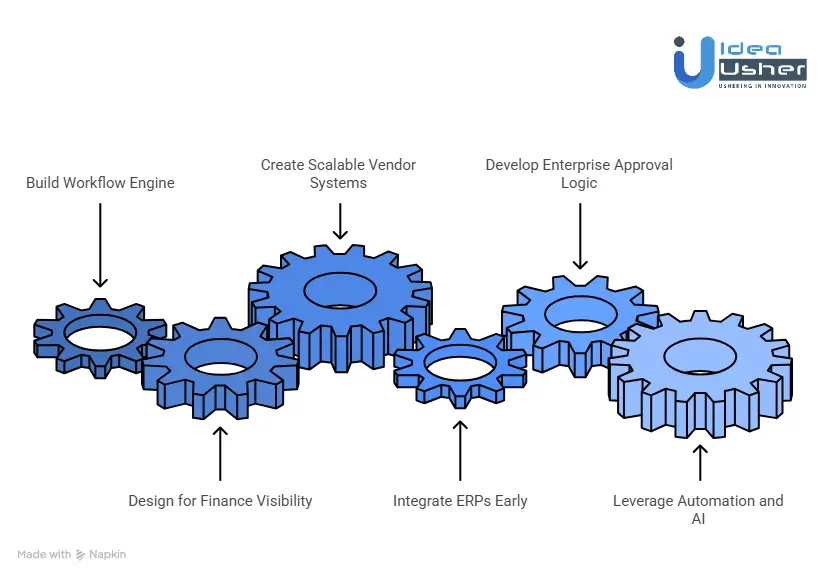
When you hire your development team from us, you get technical professionals who know how to build compliance, deep ERP integrations, and scalable databases from day one.
1. Build the Workflow Engine First
The bedrock of any e-procurement architecture is its core transactional engine. This system must flawlessly manage the complete lifecycle of a corporate dollar, guiding a purchase from an initial internal employee request down to the final supplier settlement. Every procurement action, approval transition, and financial update must flow through this centralized engine with complete transactional accuracy.
[Purchase Requisition] —> [Approval Engine] —> [Purchase Order Generation] —> [Goods Receipt]
To build a reliable platform, we decouple the transaction state from the user interface. Our engineering teams structure the backend data architecture to process and store data deterministically, tracking state transitions such as Draft, Pending Approval, Issued, Partially Received, and Fulfilled. This foundational engine serves as the absolute source of truth for all downstream analytics, supplier auditing, and accounting reconciliations.
2. Design for Finance Visibility
While everyday employees use procurement platforms to order supplies, the actual economic buyers are CFOs and finance directors. If a platform fails to give finance leaders absolute control over cash outflows, it will fail to gain corporate traction. We design the user experience to prioritize real-time spend visibility and automated policy enforcement over everything else.
Real-Time Budget Verification
When a user initiates a requisition, the platform must instantly cross-reference the line-item total against the department’s remaining quarterly budget allocation. If the transaction exceeds the budget pool, the software should flag the variance and block the order before it ever routes to an external supplier.
We engineer platforms to replace historical, reactive accounting with proactive spend control, enabling finance teams to:
- Configure department-specific spend limits on a monthly, quarterly, or annual basis.
- Restrict purchasing rights to pre-approved corporate vendor catalogs.
- Generate automated variance reports identifying cost fluctuations across specific product categories.
3. Create Scalable Vendor Systems
A successful procurement ecosystem requires a dual-sided architecture that serves both internal buyers and external sellers. Building a scalable vendor management system means designing low-friction onboarding mechanisms and secure communication portals that suppliers actually want to use.
We build systems that empower vendors to self-manage their profiles, update product catalogs, log banking information, and upload critical insurance or regulatory compliance documents. Centralizing these records protects the enterprise from supply chain disruption and compliance penalties while minimizing the administrative burden on internal procurement teams.
4. Integrate ERPs Early
Building an e-procurement platform without deep integration capabilities is a critical strategic mistake. Enterprise clients will not adopt software that creates new data silos or forces their accounting teams to manually input transaction records into their primary accounting systems.
To win enterprise clients, we establish seamless, bidirectional data synchronization pipelines across the entire financial ecosystem:
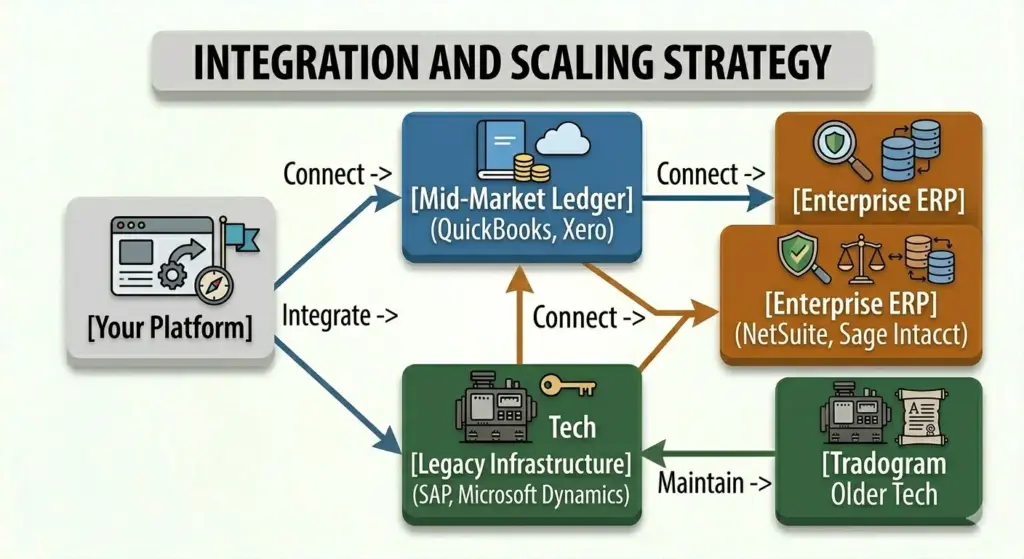
Our developers ensure absolute transactional integrity. When a purchase order is fulfilled, your software needs to automatically push the corresponding invoice and receipt logs straight to the client’s general ledger. This native sync speeds up monthly closes, prevents double-billing, and keeps cash flow reporting accurate.
5. Develop Enterprise Approval Logic
Enterprise purchasing workflows are rarely straightforward. A competitive platform must feature a highly customizable, multi-conditional approval engine capable of handling complex corporate hierarchies. The system should also adapt dynamically to changing procurement policies, departmental structures, and evolving financial controls without disrupting operations.
| Trigger Condition | Approval Routing Path | System Action |
| Spend < $2,000 | Auto-approve against pre-set category budgets | Generate PO instantly |
| Spend $2,000 to $25,000 | Route directly to the Department Head | Require a single digital signature |
| Spend > $25,000 | Escalate to the VP of Finance and the Procurement Committee | Require multi-party authorization |
| Budget Overrun Flag | Divert automatically to CFO queue | Pause pipeline and trigger notification |
We build software to handle these conditional deviations seamlessly. If a requisition contains items split across two different cost centers, our workflow engine automatically parses the request, routes the lines to their respective department managers, and consolidates the approved items into a single, clean purchase order.
6. Leverage Automation and AI
Integrating artificial intelligence into your platform shouldn’t be about adding flashy gimmicks; it is about automating highly repetitive, labor-intensive administrative tasks. AI delivers immense value by streamlining data extraction and tracking spend patterns. It also helps procurement teams reduce human error while accelerating operational decision-making across large purchasing environments.
[Raw Invoice PDF] —> [AI Optical Character Recognition] —> [Automated Three-Way Match Engine]
Our machine learning specialists implement advanced algorithms to scan and extract unstructured data from incoming vendor invoice PDFs, automatically matching them against original purchase orders and warehouse receiving logs. By handling this three-way matching process autonomously, the software instantly flags line-item price discrepancies or volume mismatches.
Core Architecture Needed to Build a Platform Like Tradogram
Most discussions about procurement software focus heavily on visual features and frontend layout. However, the real engineering complexity lies beneath the interface. The actual technical challenge is designing a procurement orchestration engine capable of coordinating asynchronous workflows, multi-tier approvals, financial system integrations, strict compliance logic, and diverse supplier ecosystems under heavy concurrent loads.
Multi-Tenant SaaS Infrastructure
A modern procurement platform must securely support multiple organizations within a shared cloud environment. This requires an architecture that maximizes hardware cost efficiency while guaranteeing absolute corporate data privacy. Our technical architects design multi-tenant systems using a highly specialized, cloud-native technology stack to ensure performance scales predictably alongside your business growth:
- Frontend Frameworks: We use React and Next.js to deploy highly responsive, state-driven user interfaces that load complex data layouts with minimal lag.
- Backend Engines: We implement Node.js, Java Spring Boot, or .NET to construct robust, non-blocking asynchronous business logic engines that handle heavy request traffic smoothly.
- Transactional Database: We utilize PostgreSQL to manage core financial transactions, leveraging its strict relational constraints to guarantee absolute data accuracy.
System Infrastructure Deep Dive: To prevent backend bottlenecks during high-volume purchasing periods, we build automated performance booster systems directly into the application layers:
- Redis Cache Layer: Stores active session states and frequently requested vendor catalogs to dramatically cut down database lookups.
- Elasticsearch Infrastructure: Powers fast, multi-variable catalog searches, allowing employees to filter millions of supplier inventory items instantly.
- RabbitMQ or Kafka Messaging Queues: Manages asynchronous data pipelines, ensuring heavy background processes like ledger synchronization or invoice PDF generation never freeze the user interface.
Why Multi-Tenancy Matters
Enterprise procurement systems require strict isolation of supplier records, custom purchasing policies, financial accounting logs, and internal approval workflows. A single data leak between corporate clients would destroy market trust instantly. We solve this security constraint by implementing rigid tenant-aware database routing protocols and highly granular role-based access controls.
When a user initiates a query, the API gateway intercepts the call, validates their tenant token, and limits database visibility strictly to that specific organization’s schema. This structural isolation guarantees that private vendor contracts, audit trails, and financial records remain perfectly confidential, allowing you to confidently sell your platform to security-conscious enterprise buyers.
The Workflow Engine Is the Real Product in E-Procurement Platforms
The biggest mistake procurement startups make is underestimating workflow complexity. In B2B SaaS, the user interface is just a shell; the true product is the underlying engine that routes decisions. Approval orchestration becomes extremely difficult at enterprise scale because purchasing rules vary across departments, regions, spending thresholds, and regulatory environments.
When you hire your development team from IdeaUsher, our pre-vetted engineers do not just build simple forms. We design a robust, deterministic workflow engine that handles complex business hierarchies out of the box, ensuring your platform never buckles under the weight of enterprise logic.
Enterprise Workflow Complexity
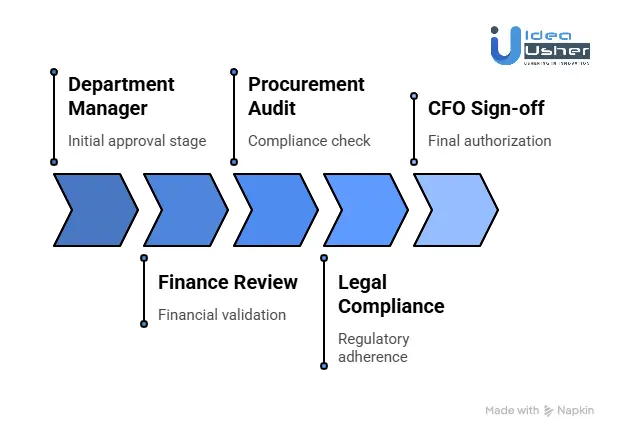
To understand why generic workflow builders fail, look at a standard enterprise purchasing sequence. A single purchase request for factory equipment cannot just route to a single manager. It triggers a cascading chain of validations. Each approval stage introduces unique financial, operational, and compliance checks that must be executed accurately without disrupting procurement velocity.
[Department Manager] ───► [Finance Review] ───► [Procurement Audit] ───► [Legal Compliance] ───► [CFO Sign-off]
Now, multiply this single chain across multiple countries, separate corporate subsidiaries, differing currency conversions, and distinct localized tax structures. If an order contains items split across two different cost centers, the backend must split the transaction data, route the lines to their respective department managers simultaneously, and then merge them back into a single, clean purchase order once approved.
Without a highly sophisticated state machine, the system will inevitably lock up or drop critical transactional logs.
The P.O.L.I.C.Y Architecture
To prevent your software from collapsing into unmaintainable spaghetti code as you scale, our technical architects build your platform around a modular, layered framework called the P.O.L.I.C.Y architecture. This structured engineering model keeps procurement workflows flexible, scalable, and easier to maintain as enterprise complexity grows over time.
- P — Permission Matrix: This foundational security layer controls access rights across the entire enterprise. It ensures that an entry-level employee in one department cannot view the contract rates or purchasing logs of an executive in another division.
- O — Orchestration Logic: The core routing engine that handles dynamic approval paths. It evaluates live transaction data against your conditional rules, automatically escalating high-value orders or diverting anomalies into specific review queues.
- L — Ledger Synchronization: The integration pipeline that connects financial systems. As soon as a workflow passes final authorization, this layer translates the data and pushes a mirroring entry directly into the client’s ERP general ledger to keep books perfectly balanced.
- I — Intelligence Layer: The automated processing brain of the platform. We integrate machine learning modules here to enable AI-driven insights, such as calculating delivery risk scores or automatically running three-way invoice matching against original purchase orders.
- C — Compliance Enforcement: The automated gatekeeper that applies governance rules. It actively monitors real-time corporate spending against predefined budget limits, automatically pausing workflows that threaten to cause a department overrun.
- Y — Yield Analytics: The optimization layer that measures procurement efficiency. It compiles data on bottlenecked approval paths, supplier lead times, and historic cost-per-order metrics, giving executives the raw intelligence needed to continually streamline operations.
Engineering for Longevity
Building procurement software for enterprise environments requires more than solving immediate operational challenges. The system architecture must remain stable, adaptable, and maintainable as transaction volumes, workflow complexity, and global business requirements continue to expand. Engineering for longevity ensures the platform can evolve without requiring costly infrastructure rebuilds every time the organization scales.
| Workflow Component | Hardcoded Architecture Risk | Our Modular P.O.L.I.C.Y Approach |
| Approval Rule Changes | Requires developer hours to rewrite code | No-code drag-and-drop rule modification for admins |
| System Data Errors | Broken sync crashes the user dashboard | Asynchronous queuing via Kafka ensures data eventual consistency |
| Global Expansion | Rewriting database schemas for new countries | Multi-tenant schema routing natively handles localized tax rules |
ERP Integration Is the Most Critical Technical Challenge
Most procurement software discussions focus heavily on user interface aesthetics while vastly underestimating the complexity of ERP synchronization. In reality, ERP integration is the operational backbone of procurement automation. Without deep financial synchronization, frontend procurement workflows become completely disconnected from accounting truth, turning automated purchasing into a liability that creates massive ledger discrepancies.
Systems You Need to Integrate With
A production-grade platform cannot operate as a data island. To deliver true value to an enterprise, your system architecture must establish secure, high-velocity integration pipelines across four distinct operational software layers. These interconnected systems ensure procurement data flows seamlessly across finance, operations, HR, and communication infrastructure without creating synchronization gaps.
- Accounting Platforms: For mid-market clients, your backend must communicate reliably with systems like QuickBooks, Xero, Sage, and FreshBooks to log expenses and reconcile minor accounts.
- Enterprise ERP Systems: To win major corporate contracts, your platform must support bidirectional, transactional sync loops with institutional software giants like SAP, Oracle, Microsoft Dynamics, and NetSuite.
- HR Infrastructure Systems: Your user provisioning and permission matrices must sync continuously with data hubs like Workday, BambooHR, and ADP to instantly map employee departures, promotions, and departmental transfers.
- Communication Infrastructure: To keep approval cycles moving rapidly, the system must push automated alerts out to daily collaboration channels, including Slack, Microsoft Teams, and enterprise email networks.
Why ERP Integrations Become Difficult?
Integrating with a modern web app via clean REST APIs is straightforward, but enterprise ERP environments are notoriously hostile to developers. These legacy financial systems are digital labyrinths filled with inconsistent database schemas, undocumented SOAP APIs, fragmented charts of accounts, and decades of highly customized internal business logic.
The Developer Real-World Block An ERP system used by a Fortune 500 company is never an out-of-the-box installation. It contains heavy customization. If your engineering team does not build an exceptionally adaptable middleware framework, a single change to a client’s custom ERP field will completely break your platform’s synchronization pipeline.
Your proprietary middleware layer must act as a normalization engine, translating your clean database fields into structure-compliant data objects that the target ERP can digest without throwing a 500 error. This normalization framework must perfectly align six core operational data elements in real time:
- Supplier Records: Merging vendor tax IDs, payment terms, and remittance addresses across conflicting systems.
- Cost Centers: Mapping corporate departmental budgets precisely to their matching general ledger account codes.
- Purchase Orders: Translating SaaS-generated orders into legally binding, ERP-validated procurement records.
- Invoices: Processing three-way matches and pushing clean payment-ready records down to Accounts Payable.
- Approval States: Ensuring a transaction marked as “Approved” in the field matches the internal governance records of corporate treasury.
- Ledger Mappings: Routing debit and credit records flawlessly to ensure accounting balances perfectly at the end of every fiscal quarter.
The Real Truth of Procurement Tech
The fatal flaw of many procurement platforms is that they digitize workflows without synchronizing with financial reality. Building a clean interface where employees can easily click “Request Item” solves only half of the enterprise problem. True procurement automation only exists when procurement, accounting, and finance operate on the same operational ledger, ensuring every dollar spent on the front end is tracked, verified, and settled inside the core financial infrastructure instantly.
Building Vendor Collaboration Infrastructure
Supplier collaboration is one of the most overlooked components of procurement software, as most platforms neglect external vendor interactions in favor of internal workflows. At IdeaUsher, we solve this critical bottleneck by engineering dual-sided architectures with secure, independent portals that give suppliers a self-service utility.
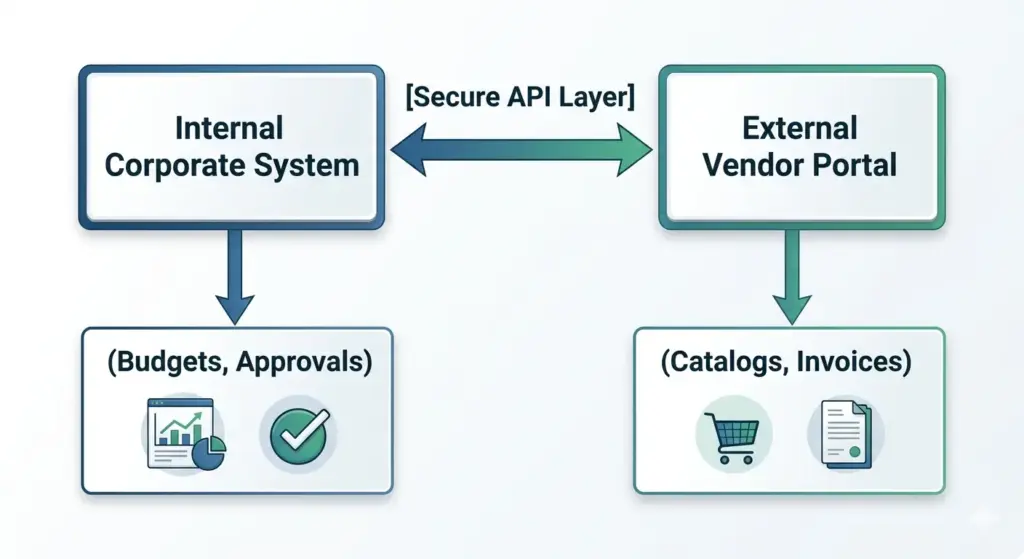
When you hire your development team from us, our pre-vetted engineers design independent supplier layers that eliminate external operational friction while keeping your core enterprise infrastructure perfectly isolated and secure.
1. Vendor Portal Features
To ensure high supplier adoption, a platform must function as a high-utility asset for vendors rather than a tedious administrative requirement. We engineer dynamic portals equipped with comprehensive features designed to streamline the vendor lifecycle. The easier the platform is for suppliers to use, the faster procurement operations move across the entire purchasing ecosystem.
- Supplier Dashboards: Vendors gain a centralized interface to manage their item catalogs, push real-time pricing updates, track incoming purchase orders, and submit electronic invoices.
- Delivery Schedule Tracking: Built-in logistics trackers allow vendors to log fulfillment updates and delivery timelines, which automatically update the internal enterprise tracking system.
2. Operational Impact Analysis
Providing a free, high-utility supplier dashboard directly reduces internal administrative costs. Instead of your procurement team chasing down order status updates via phone or email, vendors proactively log fulfillment data to maintain high supplier performance ratings. This creates a more transparent procurement environment while significantly improving operational responsiveness across the supply chain.
3. Communication Infrastructure
Centralized vendor communication improves procurement transparency, sourcing coordination, and supplier accountability. Misunderstandings regarding order variations or delivery specifications often lead to expensive enterprise project delays. A unified communication layer ensures every procurement stakeholder works with the same real-time operational context.
| System Component | Primary Function |
| Contextual Chat Engine | Binds communication threads directly to individual purchase order records for centralized procurement collaboration. |
| Audit Trail Compiler | Records timestamps, approval changes, and contract revision histories to maintain procurement accountability. |
| Global Notification System | Delivers real-time alerts and workflow updates across webhooks, SMS, push notifications, and email channels. |
We solve this communication fragmentation by embedding a programmatic collaboration engine directly into the transactional layer. Whether negotiating an active RFQ or discussing an invoice discrepancy, all messages are anchored directly to the specific purchase record. This architectural approach guarantees a clean historical audit trail, eliminates finger-pointing during contract disputes, and ensures absolute clarity across the supply network.
4. Document Management
Enterprises carry immense regulatory and financial liabilities based on the compliance health of their supply chains. Vendors routinely need to upload critical certifications, tax forms, insurance documents, and specific industry compliance records before they can safely do business with a corporation.
Our engineering teams construct automated digital document vaults to handle this intake safely and efficiently:
| Document Type | Automated System Validation Action | Risk Mitigation Target |
| Tax Forms (W-9 / W-8BEN) | Instant database logging and cryptographic storage encryption | Financial compliance audit |
| Liability Insurance Policies | Optical Character Recognition scans for policy expiration dates | Corporate liability insurance gap |
| Industry Certifications | Automated warning flags sent to vendor prior to expiration | Supply chain compliance breach |
By automating this document lifecycle, the system prevents unverified or non-compliant suppliers from receiving active corporate capital. If a vendor lets their liability insurance lapse, the platform automatically pauses their catalog access and flags the account for the procurement manager. This proactive risk management protects the enterprise client and proves the platform’s institutional-grade value.
How AI Changes Procurement Product Strategy?
The procurement industry is shifting rapidly from basic workflow automation toward intelligent spend orchestration. Traditional software focused entirely on digitizing analogue processes, simply replacing paper purchase orders with digital forms. Modern, AI-native procurement platforms instead treat data as a strategic infrastructure asset, focusing on predictive operations, autonomous workflows, and real-time market intelligence.
When you hire our team of pre-vetted engineers to build your software, we help you transition your product design away from rigid, input-heavy forms. We build the advanced data layers and agentic frameworks required to turn raw transactional logs into autonomous, high-value corporate actions.
Shift to Intelligent Spend Orchestration
Building a modern procurement platform means shifting your engineering focus from static data storage to dynamic backend intelligence. We implement specialized machine learning models and agentic frameworks to power five core capabilities. This transition enables procurement systems to move beyond passive workflow management and actively participate in operational decision-making.
- Predictive Procurement: Rather than waiting for a department manager to manually log a restock request, the system analyzes historical consumption cycles and automatically drafts a purchase requisition before a stockout occurs.
- Autonomous Sourcing: The software independently structures request-for-proposal documentation based on informal employee inputs, identifies pre-qualified vendors from your database, invites them to bid, and automatically compiles structured comparison sheets as bids arrive.
- Intelligent Vendor Recommendations: When an employee initiates a purchase, the platform uses real-time supplier intelligence to suggest alternative vendors based on active risk scores, historical delivery reliability, and immediate cost benefits.
Operational Impact Study
McKinsey research reveals that enterprises deploying agentic AI within their sourcing and purchasing workflows cut procurement cycle times by up to 40%. The technical objective is to transition human staff away from manual data entry and reposition them into roles centered on system oversight and exception handling.
- Spend Forecasting: The platform continuously pairs internal enterprise transaction metrics with external macro-economic indicators to run complex “what-if” simulations, allowing finance teams to model how sudden market shifts will impact their quarterly cash flows.
- Procurement Anomaly Detection: Instead of relying on manual end-of-month accounting audits, an automated machine learning layer scans every active transaction to instantly flag duplicate vendor invoices, price inflation, or non-compliant maverick spending before capital leaves the corporate account.
The Next Competitive Layer
As basic workflow features become commoditized, the long-term market value of your SaaS product will depend entirely on its advanced algorithmic capabilities. To secure a clear competitive edge over legacy software, we engineer your platform to integrate five next-generation product features:
| Next-Gen Feature | Technical Implementation | Enterprise Value Delivered |
| AI-Driven Negotiations | LLM-powered context engines and automated counteroffer generation | Evaluates supplier bids against historical pricing benchmarks to negotiate contract terms in real time. |
| Supplier Intelligence Networks | Natural Language Processing web-scraping pipelines | Continuously monitors global news feeds and regulatory filings to flag supplier bankruptcy risks or compliance breaches. |
| Predictive Budgeting | Multi-variable regression data modeling | Automatically scales or shifts department-specific budget limits based on live company performance and revenue velocity. |
| Automated Policy Enforcement | Agentic compliance guardrails | Automatically intercepts non-compliant corporate transactions and provides real-time guidance to guide spend back to approved vendor catalogs. |
| Conversational Procurement | Secure GenAI natural language interfaces | Replaces complex, multi-screen purchase forms with a simple chat bar, allowing employees to request supplies via standard text. |
This evolution represents a major strategic shift in procurement technology. By partnering with our engineering team, you ensure your platform bypasses traditional development bottlenecks and launches with the precise, AI-native infrastructure required to capture modern enterprise clients.
Development Cost to Build a Platform Like Tradogram
The investment required to build an e-procurement platform fluctuates based on system complexity, security protocols, and integration depth. At IdeaUsher, we mitigate your budgetary risks by matching your specific product requirements with pre-vetted engineers who optimize capital allocation, helping you avoid over-engineering while building a scalable system.
Whether you are aiming to launch a targeted proof-of-concept or a complex, multi-tenant marketplace, our development teams ensure your engineering budget translates directly into an institutional-grade B2B asset.
Estimated Development Tiers
To build a competitive platform like Tradogram, organizations must map their functional expectations against realistic capital requirements. Our team works across three distinct structural tiers to align development velocity with your target market constraints. This phased approach allows businesses to scale procurement capabilities strategically without overextending their initial development budget.
- Minimum Viable Product (MVP): Priced between $60,000 and $150,000, this tier focuses exclusively on the core transactional loop. It delivers essential purchase requisition forms, standard purchase order generation, basic multi-tier approval paths, and a clean user dashboard to prove market viability.
- Mid-Scale SaaS Platform: Ranging from $150,000 to $400,000, this architecture introduces deep financial utility. It features native mid-market accounting integrations, advanced supplier collaboration portals, customizable item catalogs, and real-time spend analytics tools.
- Enterprise Procurement Ecosystem: Starting at $500,000 and scaling to $2M+, this tier supports complex, cross-border corporate frameworks. It integrates multi-tenant business unit tracking, global regulatory compliance architecture, custom-built rules engines, and multi-region database replication.
Strategic Architecture Advisory
For most platforms, trying to build a heavy enterprise ecosystem immediately leads to major budget overruns. We typically advise clients to deploy a robust Mid-Scale SaaS framework first, validating user adoption before committing high-end capital to custom infrastructure.
Key Cost Drivers
Understanding where development capital is spent prevents unexpected cost overruns mid-build. We actively manage five critical technical variables that dictate the overall cost of your procurement software. Properly planning these infrastructure decisions early helps businesses avoid expensive architectural rework as the platform scales.
| Technical Cost Driver | Engineering Complexity Level | Direct Architectural Impact |
| ERP Integrations | Extreme (Bidirectional) | Developing stable, asynchronous sync pipelines into systems like NetSuite, SAP, or Microsoft Dynamics requires extensive testing to prevent general ledger mismatches. |
| Workflow Complexity | High (Multi-Conditional) | Processing complex edge cases—such as split-funding line items across varying business departments—requires a powerful conditional rules engine. |
| AI Infrastructure | Advanced (Machine Learning) | Implementing optical character recognition (OCR) and automated three-way matching systems to analyze invoices requires specialized machine learning infrastructure. |
| Security & Compliance | Strict (Institutional-Grade) | Achieving enterprise readiness requires a substantial upfront investment in SOC 2 Type II controls, strict role-based access control, and encrypted data vaults. |
| Customization Engines | Moderate to High (Modular) | Large organizations expect white-label capabilities, dynamic workflow routing, and localized compliance configurations tailored to specific operating regions. |
By partnering with our pre-vetted development teams, you gain the precise engineering expertise required to handle these technical hurdles. We ensure every dollar of your development budget goes directly toward building a scalable, secure, high-value procurement platform designed to capture market share.
Expert Perspectives on Procurement Automation
Global research firms consistently emphasize that modern procurement software has evolved from a back-office utility into a core pillar of corporate growth strategy. When you build an e-procurement platform, aligning your product features with these enterprise trends is critical for securing market adoption. Top-tier industry insights show exactly how major software buyers evaluate digital procurement investments.
Deloitte Procurement Research
Deloitte’s global research consistently highlights a deep corporate focus on building supplier resilience, maximizing spend visibility, and accelerating digital transformation. Their procurement data shows that organizations are actively using advanced technology to insulate themselves from market volatility and cost leakage.
Deloitte Global CPO Survey Metrics Top-performing procurement organizations (termed “Digital Masters”) now allocate up to 24% of their total operating budgets purely to advanced procurement technology. Their strategic tech investments deliver significant competitive advantages:
- GenAI Performance: Digital Masters realize an average 3.2x return on investment (ROI) for Generative AI implementations.
- Risk Mitigation Priorities: CPOs rank active alternative sourcing (74%), deep supply chain visibility (64%), and close supplier collaboration (61%) as their absolute top risk-reduction mechanisms.
McKinsey Procurement Insights
McKinsey & Company notes that AI-driven procurement systems can significantly improve sourcing speed and overall operational efficiency. They argue that moving beyond static tracking dashboards to real-time, analytical AI platforms allows organizations to instantly identify value leakage and negotiate better supplier rates.
Their field data quantifies the direct financial impact of embedding AI into enterprise distribution and purchasing workflows. McKinsey’s research reveals that integrating AI-enabled operations directly yields a 20% to 30% reduction in inventory carrying costs, a 5% to 20% reduction in logistics costs, and an immediate 5% to 15% reduction in pure procurement spend. Platforms that seamlessly integrate these predictive insight engines become indispensable tools for modern executive teams.
Our SCALE Procurement Growth Model
Building a sustainable, market-leading software platform requires a framework that addresses both immediate operational headaches and long-term data strategy. To help you navigate this space, we rely on a specific blueprint to guide product development. The SCALE model ensures your platform is engineered to handle the complex layers of modern corporate spend management.
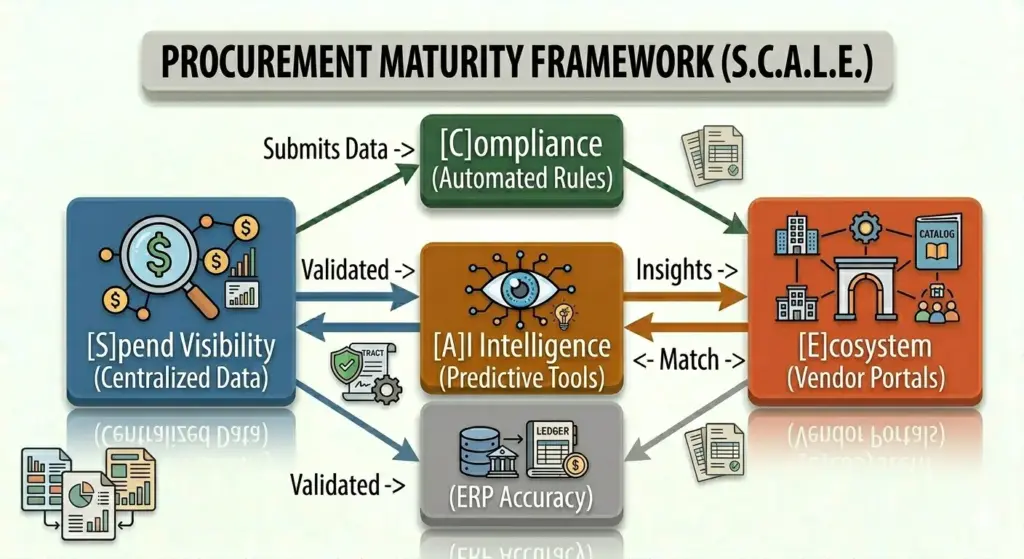
By structuring your development roadmap around these five foundational vectors, your platform will naturally adapt to the evolving demands of enterprise buyers. When you work with our pre-vetted engineers to build your custom software, we translate the SCALE blueprint directly into production-ready application layers:
S — Spend Visibility
The core goal here is to completely centralize procurement intelligence. We design real-time data visualization pipelines that pull fractured purchasing data from every department into a single dashboard, giving executives instant clarity over aggregate corporate spend. This unified visibility helps finance teams identify spending inefficiencies before they escalate into larger budgetary issues.
C — Compliance Automation
Enforcing financial governance should not slow down everyday business operations. We build algorithmic rules engines that automatically check line-item requests against pre-configured departmental budgets, stopping unauthorized spending before it happens. This automated enforcement layer reduces manual oversight while maintaining strict procurement accountability across the organization.
A — AI Intelligence
Modern B2B software relies heavily on automated insights and predictions. We integrate machine learning models that automatically extract text from raw invoice PDFs, flag billing anomalies, and provide smart inventory forecasting to optimize working capital. AI-driven procurement intelligence also helps businesses uncover hidden spending trends and operational inefficiencies in real time.
L — Ledger Synchronization
Maintaining absolute financial accuracy across multiple business units is a non-negotiable requirement for CFOs. Our developers create strict database synchronization protocols to ensure every purchase order, invoice, and receipt pushes flawlessly to the client’s accounting ledger without manual cross-referencing. This synchronization framework minimizes reconciliation errors and accelerates enterprise financial reporting cycles.
E — Ecosystem Connectivity
High-performing systems must integrate external vendors and internal ERPs into a unified platform. We architect scalable, secure supplier portals where vendors can directly manage their product catalogs, update pricing, and track payments under a single dashboard. Strong ecosystem connectivity also improves procurement transparency and enables seamless collaboration across distributed enterprise networks.
Future-Proofing Your Platform
This framework directly reflects where enterprise procurement infrastructure is evolving. Corporate buyers are actively moving away from monolithic, isolated applications in favor of open, connected software ecosystems. By building your platform around the SCALE model, you ensure your software does not just solve today’s purchasing headaches but easily scales into an indispensable corporate asset that businesses can depend on for years to come.
Why Not Just Use ERP Procurement Modules?
Some organizations argue that legacy ERP procurement modules already solve these operational problems. That is partially true on paper. However, standalone procurement platforms continue to experience explosive growth because native ERP purchasing modules often feel like they were designed by accountants for accountants, completely neglecting the front-end user experience.
When you hire our team of pre-vetted engineers to build your custom software, we don’t try to replace the foundational ERP financial infrastructure. Instead, we design a modern, agile procurement layer that bridges the gap between rigid financial systems and everyday corporate users.
The Enterprise Pain Points
The reason companies abandon native ERP procurement modules stems from a predictable set of technical and operational friction points. Over time, these inefficiencies slow down procurement cycles, reduce employee adoption, and create visibility gaps across purchasing operations. As procurement complexity increases, businesses often struggle to adapt rigid ERP workflows to fast-changing operational requirements.
- Poor Usability: Traditional interfaces are notoriously dense and confusing, driving employees back to shadow procurement channels like unapproved credit card spending.
- Rigid Workflows: Altering an approval path or modifying a departmental budget limit often requires writing custom code or calling external consulting teams.
- Slow Deployment: Activating an enterprise ERP procurement module frequently triggers multi-month implementation cycles and carries expensive professional service fees.
The Modern SaaS Advantage
Modern procurement platforms win the market by flipping the traditional software blueprint on its head. We construct agile applications that treat speed, adaptability, and user adoption as core architectural requirements. Instead of forcing employees to adapt to rigid enterprise systems, modern procurement software adapts dynamically to real operational behavior.
The Usability Rule
If a system is too difficult for a regular employee to use when ordering basic office supplies, they will bypass it entirely. High-adoption platforms succeed because they disguise complex corporate compliance rules inside a clean, consumer-style checkout interface. Our development teams ensure your product outpaces rigid legacy systems by focusing on five distinct engineering pillars:
| Product Value Driver | Legacy ERP Capability | Your Specialized SaaS Capability |
| User Experience (UX) | High friction, multi-screen forms | Intuitively designed, consumer-grade search and checkout |
| Deployment Speed | Months or fiscal quarters to launch | Weeks to deploy via modular cloud frameworks |
| System Automation | Manual data entry and validation | AI invoice parsing and automated three-way matching |
| Workflow Flexibility | Hardcoded, rigid approval paths | No-code conditional routing updated on the fly by managers |
| External Collaboration | Siloed emails and fractured tracking | Secure, native vendor portals for real-time catalog syncing |
The Hybrid Future
The procurement space is moving away from a winner-take-all model between software suites. The future belongs to hybrid procurement ecosystems where a specialized, high-adoption procurement layer sits comfortably above the centralized ERP financial infrastructure.
By building a nimble, automated front-end that seamlessly pushes clean transaction logs down to a company’s general ledger, you deliver the exact balance of speed and control that modern enterprise buyers are actively searching for.
Contact Idea Usher for E-Procurement Platforms
Transforming your procurement workflows from a chaotic web of manual emails into an ironclad, enterprise-ready software architecture requires more than generic coding. It demands a development partner who deeply understands B2B transactional logic, multi-tier approval mechanisms, and compliant financial systems.
With over 500,000 hours of custom coding experience, our team of ex-MAANG/FAANG developers and product strategists at IdeaUsher knows exactly how to build secure, high-velocity digital products designed to capture market share.
Talk to Idea Usher About Your Vision
Every enterprise has a unique operational DNA. Whether your goal is to build a highly agile e-sourcing application for mid-market suppliers or to disrupt the procurement space entirely with a modular platform like Tradogram, we start by mapping out your strategic objectives. Our consulting team works closely with you to dissect your target market’s specific pain points.
We dive deep into your requirements, analyzing catalog structures, vendor onboarding flows, and the precise compliance guardrails your clients will demand. By analyzing these core variables upfront, we ensure your software is engineered from day one to deliver clear, undeniable ROI to your future corporate buyers.
Build a Scalable Platform With Our Experts
Engineering a reliable e-procurement platform means building for structural data integrity and absolute security. Our pre-vetted development teams focus on constructing the highly complex backend systems that form the backbone of modern fintech software. Every infrastructure layer must be engineered to support high transaction volumes without compromising compliance, accuracy, or system stability.
- High-Velocity Integration Pipelines: We build secure, bidirectional sync frameworks that push transaction data flawlessly to leading financial systems like NetSuite, SAP, and Sage Intacct without causing general ledger errors.
- Deterministic Workflow Engines: Our engineers construct multi-conditional approval routing paths capable of handling complex corporate hierarchies and automatic split-funding edge cases.
- Automated Governance Tools: We embed intelligent matching engines and secure, self-service vendor portals that isolate critical corporate data while slashing administrative overhead.
Technical Execution Standard Because our engineering pool is built from ex-MAANG/FAANG technical talent, we don’t cut corners on architecture. We implement strict role-based access control, end-to-end data encryption, and optimized database indexing to ensure your platform remains secure, lightning-fast, and completely audit-ready under heavy transactional loads.
Get a Custom Development Roadmap
Launching a successful SaaS product requires a precise, phased execution strategy that aligns your budget with rapid market validation. We don’t believe in abstract timelines or vague development promises. Instead, we provide you with an explicit, milestone-driven technical roadmap tailored entirely to your business goals.
This structured engineering approach guarantees that your capital is deployed with maximum efficiency. We help you build a robust, lean Minimum Viable Product to secure immediate user feedback, while maintaining a modular system architecture that allows you to easily scale up advanced features as your platform grows. Let our half-million hours of engineering experience turn your procurement vision into a powerful, market-leading corporate asset.
Conclusion
Building an e-procurement platform like Tradogram requires engineering a secure, conditional governance system that seamlessly bridges corporate buyers and external vendors. Success depends on high-utility modules: a powerful workflow engine, automated financial controls, and native ERP integrations. Aligning with an expert development team allows you to navigate these complex technical compliance hurdles smoothly and confidently launch a scalable, enterprise-grade B2B asset.
FAQs
Q1: How long does it take to build a procurement platform?
A1: Engineering a Minimum Viable Product focused on core requisition and approval workflows typically takes 4 to 8 months. However, expanding the architecture into a comprehensive, enterprise-grade procurement ecosystem with native ERP sync can extend the timeline to 12 to 24 months, depending on the number of integrations and custom logic requirements.
Q2: What technologies are best for procurement platform development?
A2: To ensure absolute data integrity and high transactional velocity, we build modern procurement architectures using a powerful, cloud-native stack. Our engineering teams utilize React or Next.js for highly responsive front-end user dashboards, Node.js or Java to handle complex multi-conditional backend logic, and PostgreSQL to guarantee ACID-compliant financial database tracking, all containerized via Kubernetes and deployed securely on AWS or Azure.
Q3: Why are ERP integrations difficult?
A3: ERP synchronization is exceptionally complex because legacy financial systems often rely on undocumented, outdated APIs, deeply fragmented account schemas, and rigid business rules. Bridging your platform with an existing ledger requires engineering highly resilient, asynchronous middleware pipelines to map disparate data objects perfectly and prevent catastrophic double-billing or general ledger errors.
Q4: Is AI necessary for procurement software?
A4: Yes, integrating intelligent automation is becoming essential to capture market share from rigid, legacy applications. Modern B2B buyers expect AI layers to handle heavy operational lifting, such as utilizing advanced optical character recognition (OCR) to automate three-way invoice matching, running predictive algorithms for spend forecasting, and automatically parsing complex contract data to flag compliance risks.