


Key Takeaways
- AI-powered fertility insurance platforms replace cycle-based financing with value-based coverage, personalized pricing and financial protection for IVF treatments.
- Core capabilities include AI fertility risk assessment, outcome-based pricing, IVF financing, clinic integrations and care navigation.
- Predictive AI and healthcare data integration reduce financial uncertainty, improve treatment accessibility and support better fertility outcomes.
- Secure fintech infrastructure, healthcare compliance and intelligent underwriting are essential for building scalable fertility insurance platforms.
- How Idea Usher can help you build fertility insurance platforms like Gaia with AI underwriting, value-based financing, healthcare integrations and enterprise-grade security.
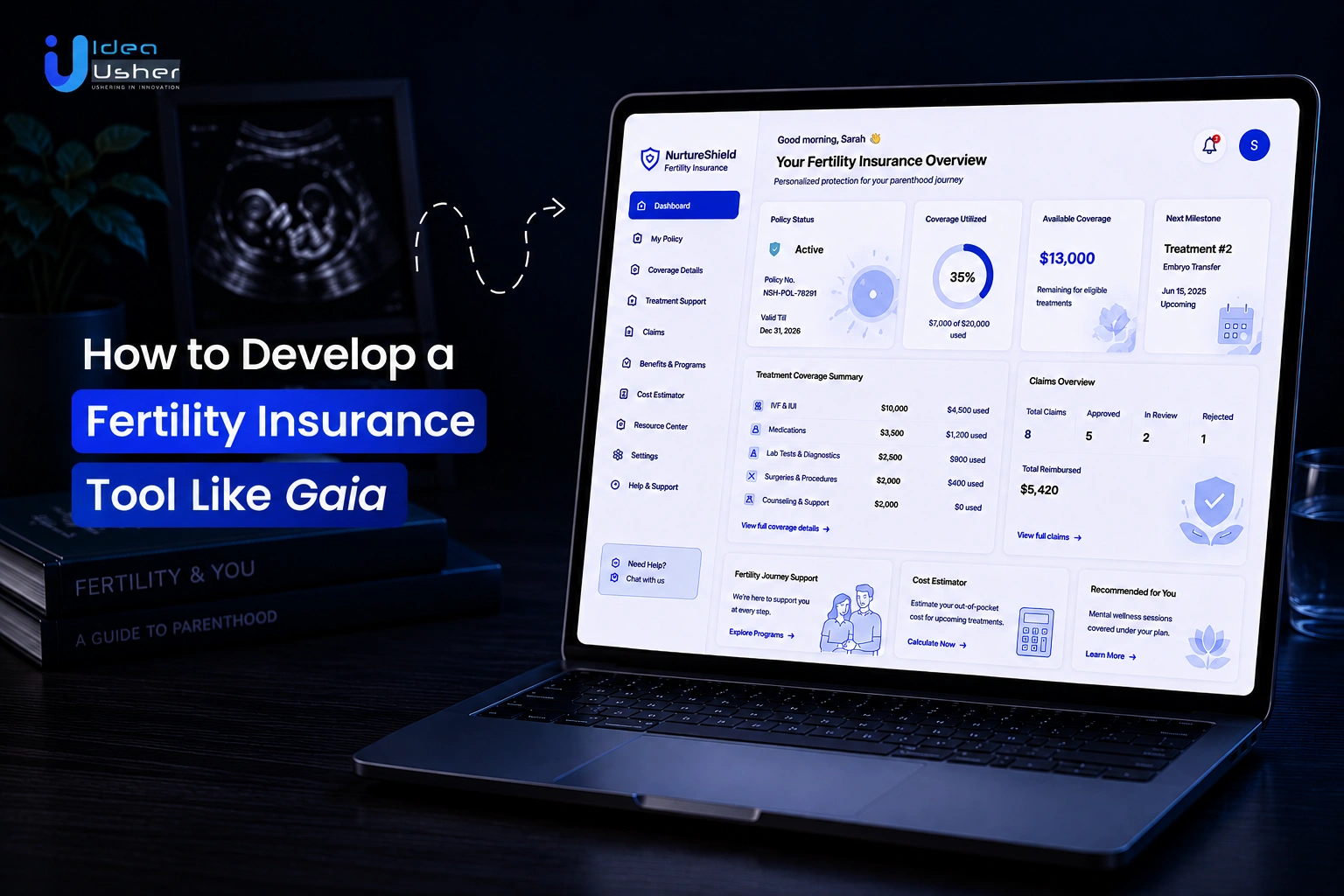
The cost of fertility treatment is increasingly determined by uncertainty rather than the procedure itself. This reality is accelerating demand for the fertility insurance platform like Gaia as healthcare innovators replace pay-per-cycle financing with value-based models that align pricing, clinical outcomes and financial protection around successful family building.
Traditional fertility financing placed most financial risk on patients, creating uncertainty around treatment costs and outcomes. Today, platforms combine AI-powered fertility risk assessment, fixed-price IVF plans, outcome-based financing, fertility insurance, personalized care, payment plans, egg yield protection, embryo transfer coverage, clinic integration, and insurance verification to reduce financial uncertainty and improve treatment access, coordination, and confidence.
In this blog, we explore how to build a fertility insurance platform like Gaia, covering its core features, AI architecture, technology stack, development process, and how IdeaUsher can help build enterprise-grade fertility insurance platforms that combine financial protection with personalized, value-based fertility care.
Why Fertility Financing Needs an AI-First Approach
The financial model supporting modern family building is rapidly evolving as 1 in 6 people worldwide experience infertility. Traditional lending struggles to address the uncertainty of fertility treatment, while the global fertility and IVF market was estimated at US$ 28.31 billion in 2025 and is expected to reach US$ 49.12 billion by 2033, growing at a CAGR of 7.13% during 2025-2033.

Despite rising investment, financial risk remains high. Fewer than 2% of the global infertile population can afford treatment out of pocket, and only 27% of U.S. employers provide fertility benefits.
With a median IVF cycle costing $22,000 and success rates of 25%–40%, repeated attempts can exceed $150,000. These challenges are accelerating demand for AI-first fertility financing and predictive risk-pooling platforms that use data-driven models to deliver fixed-cost, outcome-protected financing.
A. Why Traditional IVF Payment Models Fail Patients
Traditional fertility financing is fundamentally disconnected from the realities of human biology. Treating complex, variable medical pathways as flat retail transactions exposes patients to severe financial and emotional vulnerability:

These challenges highlight why fertility financing requires biologically informed risk assessment instead of fixed payment models that overlook individual treatment complexity.
- The Staggering Financial Toll: A single fresh IVF cycle in the U.S. typically costs $15,000–$20,000, with expenses exceeding $30,000 when PGT or donor materials are included.
- The Multiple-Cycle Financial Trap: Since the first-cycle live birth rate is only 25%–35%, most patients require 2.7–3 IVF cycles. Traditional financing often leads to depleted insurance benefits or $40,000+ in personal debt before treatment succeeds.
- Arbitrary Actuarial Blind Spots: Conventional lenders rely on FICO scores and debt-to-income ratios while ignoring key fertility indicators like AMH levels, antral follicle counts, and paternal factors, resulting in inaccurate risk assessment and poorly priced financing.
B. The Shift Toward Value-Based Fertility Care
To address this misalignment, the fertility ecosystem is shifting toward value-based care (VBC), where payments are tied to outcomes like a live birth rather than individual treatments. Although 15% of the global population needs fertility support, high out-of-pocket costs restrict access to fewer than 2%.

This shift has accelerated the adoption of multi-cycle bundled care programs. Rather than paying separately for additional IVF cycles, which can push total treatment costs beyond $50,000, patients receive multiple egg retrievals and unlimited embryo transfers for a predictable upfront price.
If a live birth is not achieved within the bundle period, the platform absorbs the financial risk by offering a full or partial refund. This outcome-based model aligns the interests of lenders, clinics, and families. By reducing the financial impact of the 60–75% first-cycle failure rate, value-based bundles encourage more patients to pursue treatment with greater confidence.
C. How AI Changes Fertility Risk and Pricing
Transitioning to an outcome-contingent insurance model requires a highly precise data engine. Advanced fintech platforms utilize specialized machine learning algorithms to assess individual clinical records, transforming how fertility risk is evaluated and priced:
- Multimodal Underwriting (100+ Diagnostic Inputs): Instead of relying on age alone, AI analyzes 100+ health indicators, including AMH, antral follicle count, BMI, medical history, and lifestyle factors to predict IVF success across multiple cycles, achieving 81%–92% prediction accuracy.
- Computer Vision Grading (15%–25% Higher Precision): AI evaluates embryo viability and egg quality using time-lapse imaging, analyzing developmental patterns beyond human observation. This improves implantation predictions with 89% precision, enabling more accurate real-time risk assessment.
- Dynamic Premium Calibration ($537M Market): AI links clinical risk directly to insurance pricing, offering personalized premiums and multi-cycle coverage. Lower-risk patients receive reduced upfront costs, while higher-risk profiles are matched with tailored plans, supporting growth in the $537.2 million AI fertility software market with an 11% CAGR.
The Fintech Takeaway: Traditional fertility financing can no longer meet modern healthcare needs. AI-first fertility financing platforms combine predictive modeling and health data integration to reduce upfront costs, improve transparency, lower patient drop-off, and help more families achieve successful treatment outcomes.

What Is a Fertility Insurance Tool Like Gaia?
Gaia is an AI-powered fertility insurance and financing platform that makes IVF and other fertility treatments more accessible through a value-based care model. Rather than charging for each treatment cycle, it combines AI-driven risk assessment, predictable pricing, financial protection, and clinical support into a single plan, reducing the financial uncertainty of fertility care.
The platform provides AI-driven, personalized fixed pricing based on each patient’s fertility profile. Its risk-sharing model features optional monthly payments, access to 180+ fertility clinics across the U.S., unlimited embryo transfers annually, and guaranteed egg yields or extra retrievals on eligible plans. Members also receive guidance from a dedicated Gaia Advocate, fertility nurse, therapist, and nutritionist.
A. Core Platform Overview
Gaia functions as an end-to-end financial orchestration layer that integrates directly into an authorized network of fertility clinics. The core product mechanics replace traditional fee-for-service model vulnerability with an all-inclusive, outcome-guaranteed care framework:
- Upfront Protection Fee: The platform first charges a fixed insurance fee, typically 20%–30% of the expected treatment cost, to initiate coverage.
- Comprehensive Expense Consolidation: Once enrolled, the platform covers 100% of eligible upfront treatment costs, bundling clinical expenses such as embryo storage, anesthesia, monitoring ultrasounds, and up to $6,000 in monthly fertility medications.
- Zero-Liability Remission Loop: If no live birth occurs after up to 3 IVF cycles, the repayment obligation is waived, eliminating outstanding treatment costs and protecting families from significant medical debt.
B. How AI, Insurance, and Financing Work Together
The unique core of Gaia’s framework is its custom predictive underwriting system, driven by Gabi, an advanced machine learning engine trained on millions of anonymized, historical longitudinal fertility data points. Gabi analyzes a patient’s personal health profile (including age, anti-Müllerian hormone levels, body mass index, and historical ovarian responses) to map out their probability of success.
This technology stack coordinates three distinct layers of financial security:
- Data-Driven Predictive Modeling: The AI engine first analyzes clinical variables alongside clinic success data to predict the likely number of IVF cycles required and match patients with the most suitable partner clinics.
- Outcome Protection (Insurance Layer): These AI-generated risk scores then determine insurance coverage. If treatment fails to reach predefined milestones, such as a live birth or target egg retrieval, the platform covers eligible follow-up treatments at no additional cost.
- Flexible Capital Distribution (Financing Layer): Once a successful outcome is achieved, treatment costs are converted into manageable monthly installments over up to five years, replacing large upfront payments with outcome-based financing.
C. Who Uses the Platform and Why
Gaia serves a highly diverse user base across 40 U.S. states and the United Kingdom, spanning over 1,100 active members and 200 clinic locations. The ecosystem caters to distinct user archetypes driven by clear financial and clinical motivators:
| Target User Archetype | Primary Operational Pain Point | Gaia Platform Value Proposition |
| Out-of-Pocket IVF Patients | High upfront costs ($22K+ per round) and fear of “empty-handed debt”. | Built-in retrieval protection and unlimited transfers until a live birth is achieved. |
| Elective Egg Freezers | Yield uncertainty and lack of recourse if extraction count falls short. | Biomarker-calibrated guarantees providing a second free cycle if mature egg targets aren’t met. |
| Under-Insured Corporate Workers | Diagnostics covered, but major pharmacy and treatment lines excluded. | Fixed cost predictability with zero hidden clinic bills or pharmacy markups. |
| Enterprise Employers | Rigid health plans with high churn rates and complex management. | Value-based fertility benefits that reduce financial risk for the workforce. |
The Enterprise Takeaway: Traditional consumer credit and out-of-pocket medical billing can no longer support modern fertility care. AI-powered fertility insurance platforms combine outcome-based financing, intelligent automation, and deep data integration to reduce financial risk, improve transparency, increase compliance, and expand access to treatment.
How a Fertility Insurance Platform Works
Moving past traditional, high-interest personal loans to deploy an outcome-protected model requires a highly synchronized technology infrastructure. An AI-first fertility insurance platform acts as a unified orchestrator connecting the patient, the reproductive clinic, the insurance underwriter, and the flexible lending system.
By analyzing high-dimensional clinical and operational telemetry, the platform tracks a continuous, six-stage lifecycle that turns variable biological odds into financial certainty.
1. AI Fertility Profile and Eligibility Assessment
The workflow begins before any medical stimulation protocols are scheduled at the clinic. Rather than relying entirely on simple credit bureau checks, the platform’s ingest engine constructs a comprehensive digital health profile:
- Multimodal Telemetry Intake: The platform first securely imports EHR data and laboratory results through read-only APIs, capturing key fertility indicators such as AMH levels, follicle tracking, and body mass metrics.
- Predictive Success Modeling: These clinical inputs are then analyzed against millions of historical fertility cases to estimate personalized live-birth probabilities across multiple treatment cycles.
- Broad Demographic Inclusion: Finally, AI-driven risk assessment evaluates individual clinical profiles instead of rigid eligibility rules, enabling broader access across different ages and treatment histories.
2. Personalized Treatment Cost Prediction
Once eligibility is cleared, the platform consolidates the fragmented, multi-vendor invoicing system typical of assisted reproduction into a clear, unified cost matrix:
- All-Inclusive Expense Packaging: The platform first converts the prescribed fertility treatment plan into a single bundled price, covering services typically billed separately, including embryology, anesthesia, and monitoring.
- Specialty Medication Integration: It then forecasts patient-specific medication needs and incorporates fixed-cost fertility medications, protecting against unexpected pharmacy price changes.
- Advanced Laboratory Add-ons: Finally, optional services such as PGT-A genetic testing are built into the financial plan, providing a comprehensive cost projection from the outset.
3. Dynamic Insurance Plan Generation
With the success models and total cost projections calculated, the algorithmic engine builds a personalized insurance package:
The system generates a customized premium matching the user’s unique biological risk profile. For IVF paths, the plan builds built-in cycle protections: if the first collection round fails to produce viable embryos, the insurance covers a second stimulation cycle at no extra cost.
Furthermore, the plan includes unlimited frozen embryo transfers within the contract year, shifting the financial risk away from the user.
4. Financing Approval and Payment Setup
The software coordinates the financial setup by seamlessly connecting insurance coverage with long-term repayment terms:
- Soft-Pull Credit Pre-Approval: The process begins with a soft credit check, allowing applicants to review financing options without affecting their credit scores.
- Embedded Lending Integration: Eligible applicants are then matched with integrated lenders or digital credit marketplaces, converting treatment costs into affordable monthly payments over 5–8 years.
- Upfront Provider Settlement: Once financing is approved, the platform pays the clinical provider upfront, eliminating payment delays and enabling care to begin without financial friction.
5. Treatment Tracking and Clinical Coordination
When medical treatment begins, the platform transitions into a live care management space to support the patient through their journey:
- Concierge Care Navigation: The journey begins by connecting members with a dedicated care advocate who guides them through treatment decisions and administrative processes.
- Integrated Support Ecosystem: The platform then coordinates access to fertility nurses, nutrition counselors, and mental health specialists to provide continuous multidisciplinary support.
- Live Clinical Data Sync: Throughout treatment, the system synchronizes real-time clinical updates, including follicle scans and laboratory results, enabling timely care adjustments and personalized support.
6. Outcome Monitoring and Financial Protection
The final phase of the workflow provides true financial protection by linking payment obligations directly to the success of the treatment:
| Clinical Outcome Matrix | Primary System Action Profile | Long-Term Financial Impact |
| Successful Live Birth | The system confirms the successful birth log and locks in the structured repayment terms. | The member begins their manageable monthly payment schedule over the agreed 5 to 8-year term. |
| Unsuccessful Cycle Attempts | The platform tracks medical outcomes across all covered rounds and embryo transfers. | If treatment is unsuccessful, the platform waives the entire remaining cost obligation, dropping the loan balance to $0. |
Key Features to Include in a Fertility Insurance Platform Like Gaia
Building a fertility insurance platform like Gaia requires more than standard insurance or financing features. The platform should combine several features such as AI-driven risk intelligence, value-based pricing, financial protection, and coordinated fertility care to reduce uncertainty, improve treatment accessibility, and deliver a personalized family-building experience.

1. AI Fertility Risk Assessment
An AI fertility risk assessment engine evaluates medical history, age, fertility biomarkers, IVF history, lifestyle, and clinical data to predict treatment outcomes. This enables personalized pricing, accurate risk profiling, smarter underwriting, and customized fertility plans while helping providers make more informed financial and clinical decisions.
2. Fixed-Price IVF Plan Generation
A fixed-price IVF plan generator creates personalized treatment packages with transparent upfront pricing based on each patient’s fertility profile. Bundling procedures into one predictable plan minimizes unexpected expenses, simplifies financial planning, and gives intended parents greater confidence before starting fertility treatment.
3. Outcome-Based Pricing Engine
An outcome-based pricing engine uses predictive AI models to determine plan costs according to the likelihood of treatment success instead of billing every IVF cycle separately. This value-based approach aligns provider incentives with successful family-building outcomes while reducing financial uncertainty for patients.
4. AI-Powered Financial Protection Plans
AI-powered financial protection plans combine predictive risk modeling with value-based coverage to safeguard patients against uncertain fertility outcomes. By sharing financial risk between the platform and patients, these plans improve affordability, strengthen trust, and create a more sustainable fertility financing ecosystem.
5. Flexible IVF Financing & Monthly Payments
Flexible IVF financing allows patients to spread fertility treatment costs through personalized monthly payment plans based on financial eligibility. This lowers upfront financial barriers, improves treatment accessibility, supports responsible repayment, and helps more families pursue IVF without overwhelming financial pressure.
6. Unlimited Embryo Transfer Coverage
Unlimited embryo transfer coverage allows eligible patients to undergo multiple embryo transfer procedures within their plan period without additional transfer fees. This increases treatment flexibility, supports higher chances of pregnancy, and removes financial concerns associated with repeated embryo transfers.
7. Guaranteed Egg Yield Protection
Guaranteed egg yield protection offers eligible patients assurance of a minimum number of mature eggs after retrieval. If predefined targets are not achieved, additional retrieval support may be provided, reducing treatment uncertainty and improving confidence throughout the fertility preservation journey.
8. Dedicated Fertility Care Navigation
A dedicated fertility care navigation system connects patients with fertility advocates, nurses, financial specialists, and care coordinators throughout their treatment journey. Personalized guidance, insurance assistance, appointment coordination, and educational support improve patient experience while ensuring informed and stress-free fertility care.
How to Develop a Fertility Insurance Platform like Gaia
Building a fertility insurance tool involves integrating healthcare, finance, and technology into a unified platform. From defining strategy to deploying AI-driven insights, each step ensures compliance, personalization, and scalability, enabling organizations to deliver accessible, transparent, and outcome-focused fertility care solutions.
1. Define the Business Model & Regulatory Strategy
Our team begins by defining your target audience, value-based fertility financing model, insurance framework, revenue strategy, and regulatory roadmap. We also identify HIPAA and healthcare compliance requirements to establish a secure, scalable foundation before development starts.
- Market Segmentation Strategy: Identifies target customer groups, fertility needs, and financial behaviors to shape tailored insurance offerings.
- Regulatory Compliance Planning: Establishes adherence to healthcare laws, insurance regulations, and data privacy standards across operating regions.
- Revenue Model Structuring: Defines pricing strategies, subscription models, and revenue streams aligned with value-based fertility care delivery.
- Risk Management Framework: Develops policies to assess, mitigate, and manage financial and clinical risks within fertility insurance operations.
2. Design the Patient & Provider Experience
Next, we design intuitive workflows for patients, fertility clinics, insurers, and financing partners. Every interaction, from onboarding and eligibility checks to treatment tracking, payments, and care navigation, is optimized for a seamless user experience.
- User Journey Mapping: Designs end-to-end experiences for patients and providers, ensuring clarity, accessibility, and seamless interaction across touchpoints.
- Multi-Stakeholder Workflow Design: Aligns processes between patients, clinics, insurers, and partners for efficient coordination and service delivery.
- Personalization Strategy Development: Enables tailored experiences based on patient profiles, treatment stages, and financial preferences for better engagement.
- Accessibility and Usability Optimization: Ensures platform usability across devices with intuitive interfaces, reducing friction and improving user satisfaction.
3. Choose the Right Technology Stack
Our developers carefully select the right technology stack to build a scalable and secure fertility insurance platform. We leverage cloud infrastructure, advanced AI frameworks, secure databases, and robust APIs to ensure compliance, high performance, seamless integrations, and future-ready innovation.
| Technology Layer | Recommended Tech Stack | Purpose in the Platform |
| Patient & Admin Applications | React.js, Next.js, Flutter | Enables seamless onboarding, plan selection, and admin dashboards across responsive web and mobile platforms. |
| Backend & API Services | Node.js (NestJS), Python (FastAPI) | Supports scalable APIs, underwriting workflows, policy management, and integrations with clinics and financial systems. |
| AI & Risk Modeling | Python, Scikit-learn, XGBoost, PyTorch | Powers IVF prediction, risk modeling, pricing strategies, and underwriting decisions essential for insurance products. |
| LLM & AI Orchestration | OpenAI GPT-4.1/5, LangChain | Enhances patient education, insurance guidance, document summarization, and support automation improving user experience. |
| Healthcare Data Interoperability | HL7 FHIR APIs, SMART on FHIR | Enables clinic integration, EHR access, and clinical data exchange for underwriting and claims validation. |
| Cloud & Infrastructure | AWS (HIPAA-eligible services), Kubernetes | Provides secure infrastructure, scalability, and AI workload support for sensitive health and financial data. |
| Payments & Financing | Stripe, Plaid | Enables premium collection, installment plans, financial verification, and payment workflows for insurance offerings. |
| Insurance & Policy Management | Guidewire, Socotra, or Custom Microservices | Supports policy lifecycle, underwriting rules, claims processing, and regulatory compliance operations. |
| Compliance & Data Protection | AWS KMS, Vanta, HIPAA-compliant logging | Maintains HIPAA compliance, data encryption, and audit readiness for sensitive health and financial data. |
Note: Select technologies based on scalability, AI performance, interoperability, security, and compliance instead of a rigid stack. This ensures the femtech platform securely supports AI underwriting, fertility financing, and value-based care.
4. Build the AI Risk Assessment Engine
Our AI engineers develop predictive models that evaluate fertility profiles, treatment history, and clinical indicators to estimate IVF success probability. These insights power personalized pricing, financial risk assessment, and intelligent treatment recommendations for every patient.
These AI models collectively enable intelligent risk assessment, personalized treatment planning, accurate pricing, and data-driven decision-making across fertility insurance operations.
| AI Model | Business Purpose |
| IVF Success Prediction Model | Predicts the probability of successful IVF treatment using patient age, fertility biomarkers, reproductive history, embryo quality, and clinical outcomes to support personalized treatment planning and pricing. |
| Fertility Risk Scoring Model | Generates an AI-driven fertility risk score by evaluating medical, genetic, hormonal, and lifestyle factors, enabling accurate underwriting and individualized financial protection plans. |
| Outcome-Based Pricing Model | Uses predictive analytics to calculate fixed-price fertility plans based on expected treatment success, helping create transparent, value-based pricing instead of cycle-based billing. |
| AI Underwriting & Eligibility Model | Determines plan eligibility, coverage level, and financing options by assessing fertility risk, treatment complexity, and financial exposure in real time, enabling intelligent underwriting decisions. |
| Personalized Treatment Recommendation Model | Recommends the most suitable fertility treatment pathway by analyzing patient profiles, previous treatment outcomes, clinical guidelines, and historical success patterns to improve clinical decision-making. |
| Financial Risk Forecasting Model | Estimates the projected financial liability of fertility treatments by combining clinical outcomes, treatment duration, and reimbursement scenarios to optimize sustainable protection plans. |
| Embryo Transfer Success Prediction Model | Predicts embryo implantation and transfer success using embryo grading, patient health indicators, and historical IVF data to support personalized treatment strategies and coverage decisions. |
Note: These AI models work together to power personalized fertility risk assessment, value-based pricing, intelligent underwriting, financial protection, and data-driven treatment planning, forming the core intelligence layer of a modern fertility insurance platform.
5. Develop the Financing & Protection Platform
We build the platform’s financial infrastructure, including fixed-price IVF plans, flexible financing options, payment processing, underwriting logic, and AI-powered financial protection. This creates transparent, predictable, and outcome-driven fertility financing for intended parents.
- Financial Product Structuring: Designs fixed-price plans, flexible payment options, and protection models aligned with patient affordability and outcomes.
- Payment Infrastructure Integration: Implements secure payment gateways, billing systems, and transaction management for seamless financial operations.
- Underwriting Logic Development: Establishes rules and criteria for evaluating eligibility, pricing, and risk across different fertility treatment scenarios.
- Transparency and Pricing Strategy: Ensures clear communication of costs, coverage, and financial commitments to build trust with intended parents.
6. Integrate Fertility Clinics & Healthcare Systems
Our developers securely integrate partner fertility clinics through APIs, EHR systems, insurance verification services, and treatment data synchronization. This enables real-time clinical collaboration, coordinated patient care, and accurate information exchange across the fertility ecosystem.
- Healthcare System Integration Strategy: Connects clinics, laboratories, and insurance systems to enable seamless data exchange and coordinated care delivery.
- API and Data Synchronization Planning: Ensures real-time updates of patient records, treatment progress, and financial data across integrated platforms.
- Interoperability Standards Implementation: Adopts healthcare data standards to maintain consistency, accuracy, and compliance across multiple systems.
- Partner Ecosystem Enablement: Builds scalable integrations with fertility clinics and service providers to expand platform reach and capabilities.
7. Test, Validate & Launch the Platform
Before launch, we conduct AI validation, security assessments, compliance testing, payment verification, and end-to-end quality assurance. Pilot deployments with fertility partners help optimize platform performance, ensuring reliability, scalability, and regulatory readiness for production.
- Quality Assurance Framework: Establishes comprehensive testing processes to ensure platform reliability, performance, and user experience across all modules.
- Compliance and Security Validation: Verifies adherence to healthcare regulations, data protection standards, and secure system operations before launch.
- Pilot Deployment Strategy: Conducts controlled rollouts with selected partners to gather feedback and refine platform functionality and workflows.
- Performance Monitoring and Optimization: Tracks system performance, user behavior, and operational metrics to continuously improve platform efficiency.
Cost to Build a Fertility Insurance Tool Like Gaia
Building a fertility insurance platform requires investment across strategy, AI development, healthcare integrations, financial infrastructure, and compliance. The overall cost depends on platform complexity, AI sophistication, regulatory requirements, third-party integrations, and the level of automation required.
Developing a production-ready fertility insurance platform involves multiple phases. The updated cost breakdown below ranges from MVP development to enterprise-scale implementation.
| Development Phase | Estimated Cost (MVP → Enterprise) | What the Phase Covers |
| Business Discovery & Compliance Planning | $6,000 – $15,000 | Product strategy, regulatory roadmap, business model, user research, HIPAA planning, technical architecture, and project planning. |
| UI/UX Design | $8,000 – $20,000 | Patient, clinic, insurer, and admin dashboards, user journeys, wireframes, prototypes, responsive interfaces, and design systems. |
| Frontend & Backend Development | $20,000 – $80,000 | Web and mobile applications, APIs, authentication, dashboards, workflow automation, notifications, and scalable platform architecture. |
| AI Risk Assessment Development | $15,000 – $110,000 | IVF prediction models, underwriting AI, pricing intelligence, recommendation engines, model training, validation, and deployment. |
| Payments & Insurance Infrastructure | $10,000 – $60,000 | Financing workflows, payment gateways, underwriting logic, policy management, financial protection, and billing automation. |
| Healthcare & Clinic Integrations | $8,000 – $45,000 | EHR integrations, HL7 FHIR APIs, clinic connectivity, insurance verification, laboratory systems, and secure healthcare data exchange. |
| Security, Compliance & QA Testing | $7,000 – $35,000 | HIPAA compliance, penetration testing, AI validation, performance optimization, quality assurance, and production readiness testing. |
| Deployment & Post-Launch Support | $6,000 – $25,000 | Cloud deployment, monitoring, DevOps, bug fixes, AI optimization, maintenance, and continuous feature improvements. |
| Total Estimated Cost | $80,000 – $500,000+ | Combined cost across all development phases aligned with platform levels. |
Note: These estimates align with platform-level benchmarks. The lower bound reflects MVP development, while the upper bound represents enterprise-scale systems. Actual costs vary based on AI sophistication, regulatory scope, integrations, and scalability requirements.
Development Cost by Platform Level
The fertility insurance platform like Gaia development costs below are directional estimates based on typical industry benchmarks. They are not fixed or universally accurate. Actual costs vary significantly depending on team location, AI sophistication, regulatory scope, and integration complexity.
| Platform Level | Estimated Cost | Features Included |
| MVP | $80,000 – $140,000 | Patient onboarding, AI fertility assessment (basic models), fixed-price IVF plans, financing, payments, limited clinic integration, admin dashboard, and essential compliance features. |
| Mid-Level Platform | $140,000 – $260,000 | Advanced AI underwriting, financial protection features, deeper EHR integrations, analytics dashboards, care navigation, and workflow automation. |
| Enterprise Platform | $260,000 – $500,000+ | Complete value-based fertility ecosystem with highly refined predictive AI, advanced underwriting, multi-clinic and insurer integrations, enterprise-grade security. |
Important Clarification: These ranges are indicative rather than exact. Real-world costs can exceed these estimates, especially for enterprise platforms that require extensive AI training, regulatory approvals, and large-scale healthcare integrations.
Factors That Influence Development Budget
Several technical, regulatory, and business decisions directly affect the overall fertility insurance platform like Gaia development budget. Understanding these cost drivers helps prioritize investments while building a scalable, compliant, AI-powered fertility insurance platform.
- Clinical & Historical Data Availability: High-quality fertility datasets are essential for accurate AI models. Data collection, cleaning, annotation, validation, and synthetic generation can cost $50,000–$300,000, depending on scale and quality.
- Insurance Product Design Complexity: Developing IVF pricing models, underwriting logic, reimbursement rules, and financial safeguards requires significant customization, adding $80,000–$250,000.
- External System Integrations: Integrating clinics, EHRs, labs, payment systems, banks, and insurers increases API and interoperability costs. Each integration costs $10,000–$40,000, totaling $100,000–$300,000.
- AI Model Accuracy & Validation: Ensuring reliable predictions through clinical validation, training, bias testing, and optimization adds $150,000–$500,000.
- Security & Data Privacy: Implementing encryption, access controls, audit logs, and HIPAA/GDPR compliance for sensitive data costs $70,000–$200,000, excluding ongoing maintenance.
Challenges in Building a Fertility Insurance Platform Like Gaia
Developing a fertility insurance platform like Gaia involves combining healthcare, AI, insurance, and financial technologies within a highly regulated environment. From a developer’s perspective, the most critical challenges revolve around managing unreliable data, integrating unstable third-party systems, and ensuring strong data security while maintaining a seamless user experience.
1. Inconsistent and Incomplete Clinical Data
Challenge: Developers face inconsistent, incomplete clinical data from clinics, labs, and legacy systems, causing mismatches, errors, and unreliable processing workflows.
Solution: Our developers implement validation layers, normalization pipelines, schema mapping, and automated cleaning scripts to standardize incoming data, ensuring consistency, accuracy, and reliable processing across integrated healthcare systems.
2. Unreliable Third-Party Integrations
Challenge: Developers struggle with unstable APIs, poor documentation, rate limits, and downtime when integrating EHRs, payment gateways, insurance systems, and lab platforms.
Solution: Our developers build resilient integrations using retries, circuit breakers, caching, and asynchronous queues, combined with monitoring and logging to detect failures early and maintain uninterrupted system performance.
3. Data Security in Real-Time Systems
Challenge: Developers must protect sensitive medical and financial data while supporting real-time operations, where vulnerabilities can lead to severe breaches and compliance risks.
Solution: Our developers implement encryption, secure authentication, role-based access, continuous monitoring, and automated security testing to safeguard data, ensure compliance, and maintain trust across real-time healthcare systems.
Why Choose Idea Usher for a Fertility Insurance Platform
IdeaUsher operates as an elite digital product engineering partner and InsurTech innovator, leveraging 11+ years of technical mastery to launch high-performance platforms across 50+ countries. Driven by a globally distributed network of 250+ niche experts, over 1,000+ completed projects, and a definitive 4.9/5 Clutch credential, we build high-capacity medical-financial systems entirely from scratch.
We skip off-the-shelf templates to handcraft premium, HIPAA-compliant embedded insurance platforms optimized with predictive ML success modeling, automated clinical billing networks, and multi-rail patient financing systems to ensure your platform captures undisputed market dominance.
Why Enterprises Partner With Us
Business leaders choose us to deploy digital health insurance architectures because we successfully transform complex predictive data, clinical risk scoring, and lending compliance into highly automated, empathetic, and zero-error digital platforms.
- Predictive AI Success & Risk Modeling: Our developers build high-throughput ML pipelines that analyze clinical data to predict fertility outcomes, calculate personalized protection fees, and optimize treatment coverage plans.
- Embedded B2B2C Checkout Rails: We develop integrated quote-and-bind modules that streamline clinic workflows by combining treatment, medication, and storage costs into transparent fixed-price plans.
- Bi-Directional Clinic Billing & Clearing: Our systems use automated data bridges to manage clinic payouts, upfront funding, and conditional monthly installment processing throughout the treatment lifecycle.
- Isolated Multi-Tenant Medical Cloud Infrastructure: We design independent cloud containers duringfertility insurance platform like Gaia development that isolate clinical and financial data, ensuring HIPAA, HITECH, and GDPR compliance.
- Zero Vendor Lock-In Asset Delivery: Our developers deliver clean, compliant, and fully documented source code, giving organizations complete software ownership and long-term platform flexibility.
Ready to revolutionize reproductive healthcare with a secure, data-driven fertility financing and insurance engine? Partner with Idea Usher’s principal InsurTech and digital health architects to map out your infrastructure build today.
Conclusion
The future of fertility care is shifting toward AI-driven, value-based platforms that reduce financial uncertainty while improving patient outcomes. A fertility insurance platform like Gaia demonstrates how predictive AI, transparent pricing, personalized financing, and coordinated clinical support can work together within one ecosystem. For businesses entering this space, long-term success depends on combining healthcare expertise, regulatory compliance, scalable technology, and intelligent automation. With the right development partner, you can launch a secure, future-ready platform that delivers meaningful value to both patients and healthcare providers.
FAQs
A.1. The core features of fertility insurance platform like Gaia include AI fertility risk assessment, fixed-price IVF plans, outcome-based pricing, financing options, policy management, clinic integrations, care navigation, secure payments, and analytics for informed decision making.
A.2. AI analyzes fertility profiles, treatment history, and clinical data to estimate IVF success, assess financial risk, personalize pricing, and recommend suitable coverage plans, improving both underwriting accuracy and patient decision making.
A.3. The fertility insurance platform like Gaia development costs vary by AI complexity, integrations, compliance, and scalability, ranging from $80,000–$140,000 for an MVP, $140,000–$260,000 for mid-level, and $260,000–$500,000+ for enterprise solutions.
A.4. Yes. A cloud-native architecture, modular microservices, AI-driven automation, and interoperable healthcare integrations enable fertility insurance platform like Gaia to support growing user bases, multiple clinics, insurers, and expanding geographic markets.


