

Key Takeaways
- AP learning apps are becoming increasingly popular as students seek flexible and effective ways to prepare for high-stakes exams.
- Fiveable’s growth highlights how community-driven learning and structured study resources can create a highly engaged student audience.
- Features like AI-powered feedback, adaptive practice, and progress tracking help students study more efficiently and improve outcomes.
- A well-designed AP platform can generate recurring revenue through subscriptions, premium tools, and personalized learning experiences.
- How IdeaUsher can help businesses build AP learning apps with scalable technology, AI capabilities, and interactive study features tailored to student needs.
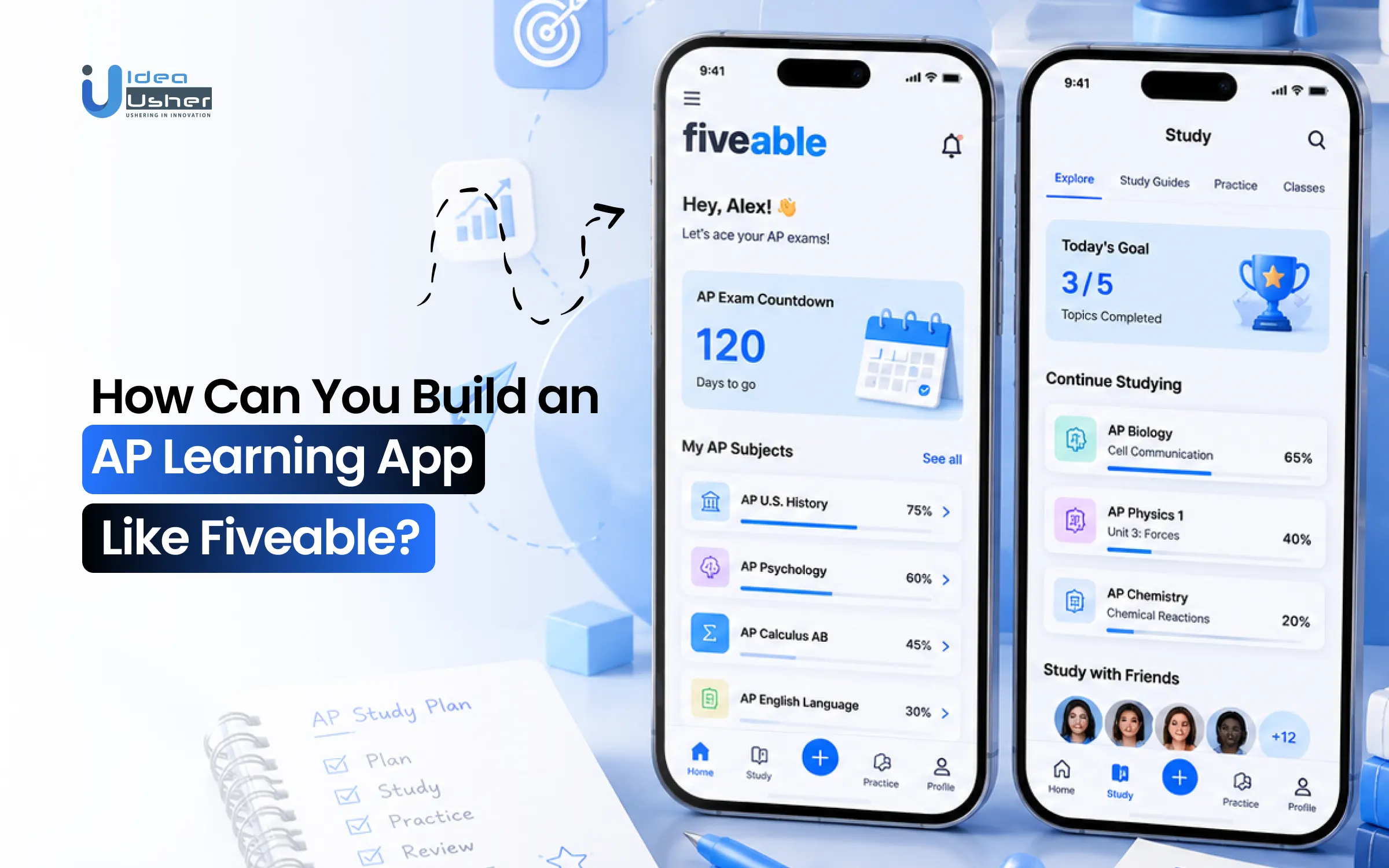
As students look for better ways to prepare for AP exams, AP learning apps are becoming a go-to solution. What attracts students is not just convenience but the ability to get clear guidance exactly when they need it. Apps like Fiveable have proven that students value tools that help them stay on track, build confidence, and make study time more productive. For founders, the opportunity goes beyond creating another exam prep app. The real challenge is building a platform that understands how students learn, keeps them engaged over time, and helps them achieve better outcomes.
We’ve built AP learning solutions powered by adaptive learning technology and AI study tools that help students prepare more effectively for exams. Based on that experience, we’re creating this blog to explore how you can build an AP learning app like Fiveable. Let’s get started!
The Growing AP Student Market Creates Long-Term Demand
According to Technavio, the education apps market is projected to grow by USD 6.81 billion between 2025 and 2030, expanding at a 14.5% CAGR as students increasingly adopt digital learning tools. Within this growth, AP exam preparation has emerged as a particularly strong opportunity. As competition for college admissions continues to rise, more students are looking for effective ways to improve their scores and earn college credit. This growing demand has created a reliable market for platforms that can help students study smarter and achieve better academic outcomes.
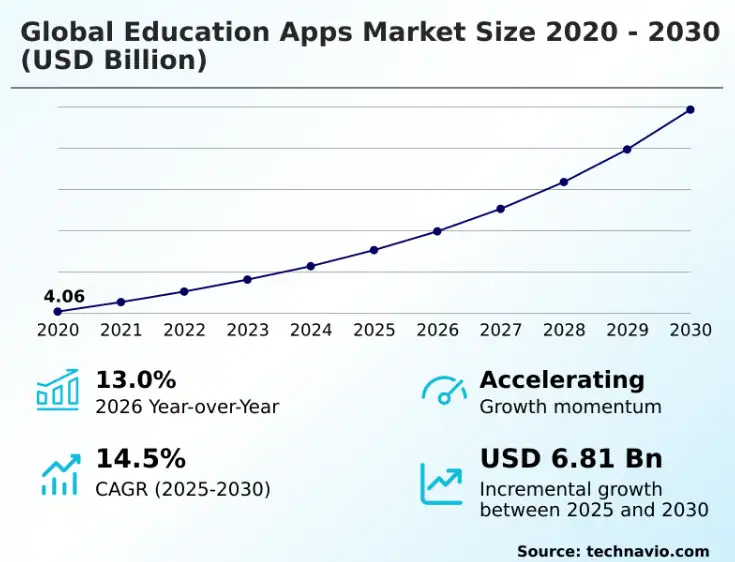
Source: Technavio
Platforms that tap into this community can scale quickly by addressing specific student needs. For example, Fiveable built a massive peer-to-peer social learning community specifically centered around AP test prep. By focusing heavily on student collaboration, study guides, and live community events, they scaled their user base rapidly and successfully generated over $3 million in annual revenue.
Rising Participation
More students are enrolling in AP courses every year as schools encourage participation and families recognize the value of earning college credit before graduation. The AP program has become an important part of the college admissions journey, creating consistent demand for study resources, tutoring, and exam preparation tools.
This growth is not limited to the United States. International schools are increasingly adopting the AP curriculum to help students gain admission to universities in North America and other global markets. For founders, this means access to a continuously expanding audience of motivated learners who actively seek solutions that can improve their exam performance and academic outcomes.
Personalized Support Demand
The fundamental problem with the current AP model is the gap between classroom teaching and the actual exam. Standard school environments rely on a one-size-fits-all approach. Teachers are forced to rush through dense curricula to cover material before the spring test dates, leaving many students behind.
- Diverse Learning Speeds: A classroom teacher cannot easily pause the syllabus for a student struggling with macroeconomics graphs or chemistry equations.
- Inadequate Practice Materials: School-issued textbooks often lack the specific format and rigor of the official College Board exams.
- High Stakes Anxiety: Because a low exam score can void potential college credit, students actively seek external help to secure a top score.
A modern digital platform addresses these exact pain points by offering targeted, adaptive learning. A clear validation of this model is Albert.io, a platform designed specifically to fill classroom gaps with rigorous, interactive practice questions. By charging schools and individual families for deep curriculum alignment and high-quality assessment tools, Albert.io successfully scaled its bootstrapped operations to $12.7 million in annual recurring revenue.
Recurring Revenue Potential
Many people assume AP test preparation is only relevant a few months before exams, but students typically seek help throughout the school year. They start reviewing concepts, completing practice questions, and building study habits from the beginning of their courses. This creates an opportunity for platforms to engage users over several months rather than relying on short-term seasonal demand.
A good example is UWorld, which expanded into AP exam preparation using its subscription-based question bank model. By offering detailed explanations and study resources that students use alongside their coursework, the company benefits from long-term user engagement. This approach has helped support a broader test preparation business that generates more than $50 million in annual revenue.
The Story Behind Fiveable’s Growth in AP Education
Fiveable is a popular social learning platform built specifically for high school students. It began with a simple focus on peer study groups and live streams to tackle stressful advanced placement coursework. Over time, the app evolved into a dominant educational platform by focusing heavily on community rather than traditional, boring textbooks.
For an investor, the company provides a masterclass in organic growth. They transformed a chaotic student community into a highly organized, monetization-ready platform.
1. Student-Led Beginnings
The platform initially launched as a small, reactive community. It solved a massive problem for isolated students who lacked study groups at school. By giving teenagers a digital space to host live streams and chat about complex history or calculus topics, engagement exploded.
Students chose Fiveable because it felt less like homework and more like a shared mission. It bypassed the typical top-down teacher approach. Instead, it leaned into peer-to-peer accountability, which created intense brand loyalty early on.
| Growth Phase | Strategy | Outcome |
| Early Stage | Free live streams and student chat rooms | Rapid, viral user acquisition |
| Middle Stage | Launching student-written study guides | Millions of monthly organic web visits |
This viral footprint quickly converted into financial backing. The platform raised over $14 million in total funding, highlighted by a $10 million Series A round led by Union Square Ventures to further scale its infrastructure.
2. Expanding Resources
As the user base grew into millions of students, the business had to move past simple chat rooms. They started hiring top-tier AP teachers and high-scoring students to build a massive library of structured study guides.
- Curated Study Guides: Breaking down heavy college board units into digestible cheat sheets.
- Practice Cram Sessions: Hosting live, high-yield review marathons right before spring testing.
- Answering the Core Need: Giving students precise tools to boost their scores from a failing 2 to a passing 4 or 5.
This transition turned a casual social network into a premium, indispensable reference site. It proved that a community-first app could successfully transition into a structured educational powerhouse, driving the company to bring in upwards of $3 million in annual revenue.
3. AI Tool Scale
To handle millions of active users without matching human costs, the platform integrated specialized artificial intelligence. They introduced automated study assistants to give students real-time feedback on practice essays and complex prompt breakdowns. This addition allows the company to scale its learning support infinitely.
The AI gives every individual student personalized, instant help at midnight when a human tutor is unavailable. For entrepreneurs looking at this space, AI features lower operating overhead while giving users a powerful reason to pay for a premium membership.
How Fiveable Built a One-Stop AP Learning Ecosystem?
Fiveable succeeded because it stopped treating test prep as a collection of fragmented study guides. Instead, the company recognized that high school students face multiple challenges simultaneously. They struggle with complex content, lack motivation, and experience intense testing anxiety.
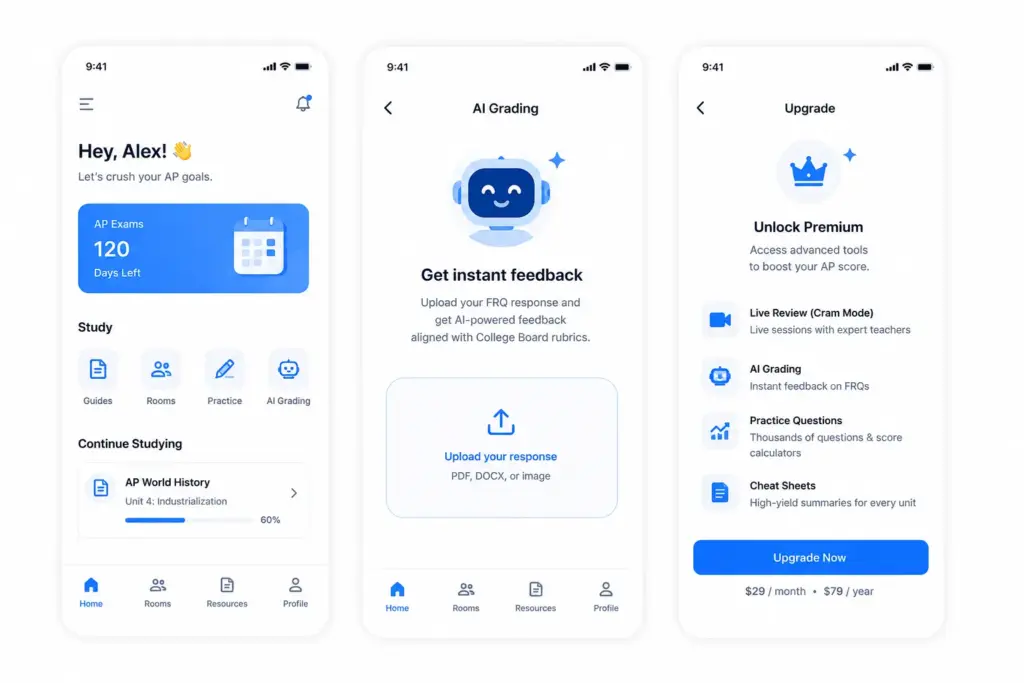
To solve this, Fiveable consolidated several disconnected tools into a single digital environment. They built a comprehensive ecosystem where a student can learn a concept, practice it, and discuss it with peers without ever switching tabs. This central hub design creates immense value for users and provides a sustainable business model for founders.
1. Student Study Community
The foundation of the Fiveable ecosystem is its social layer. Most educational platforms focus entirely on content, but Fiveable prioritized human interaction. They created interactive chat spaces and live-streamed review rooms where students could connect over shared academic challenges.
This community-first model gave the company an immediate competitive edge. Students who felt overwhelmed by their heavy course loads found comfort in studying alongside thousands of other teenagers. By giving users a place to hold each other accountable, Fiveable turned a solitary chore into a shared social experience.
2. Structured Learning Resources
A pure community space can feel disorganized when exam dates approach. To round out the ecosystem, Fiveable expanded heavily into structured, static learning resources. They began cataloging the entire Advanced Placement curriculum by building thousands of study guides, unit breakdowns, and interactive flashcards.
- Bite-Sized Content: Fiveable strips away textbook fluff, condensing massive history chapters and complex biology units into clear cheat sheets.
- Crowdsourced Production: They utilized high-scoring students and veteran educators to produce vast content libraries quickly and cost-effectively.
- Organic Search Influx: These guides rank highly on search engines, meaning millions of students discover the Fiveable ecosystem entirely through organic homework searches.
By layering these highly organized materials over their social spaces, Fiveable transformed from a casual discussion forum into a critical daily academic utility.
3. AI Tools Scale Success
Fiveable strengthened its platform by introducing AI-powered tools that can evaluate student work and provide feedback in real time. Instead of waiting for a teacher or tutor to review assignments, students can receive instant insights on practice essays, writing quality, and areas where they need improvement. This creates a more personalized learning experience and keeps students engaged throughout their exam preparation journey.
For founders and investors, this approach highlights the scalability of modern AP learning platforms. AI can support thousands of students simultaneously without requiring a proportional increase in staffing costs. As the user base grows, automated feedback systems help maintain a high-quality learning experience while improving operational efficiency and long-term profitability.
4. Strategic Monetization & Core Features
Fiveable executes its ecosystem model through specific user-facing capabilities, shifting from a entirely free network to a structured monetization model. The platform utilizes a clear freemium funnel to capture widespread student attention before converting power users into recurring paid accounts.
| Feature Name | Functional Value | Access Tier |
| Fiveable Study Guides | Visually engaging, bite-sized unit breakdowns aligned with the College Board curriculum. | Free Tier |
| Fiveable Rooms | Collaborative virtual workspaces featuring shared timers and group chat capabilities. | Free Tier |
| Cram Mode | High-yield, live review marathons hosted by expert teachers right before spring testing. | Premium Upgrade |
| FRQ Practice with AI Grading | Interactive portal evaluating student Free Response Questions against official rubrics with instant fix suggestions. | Premium Upgrade |
To capture predictable revenue from this feature set, Fiveable relies on a streamlined subscription architecture. Rather than charging per individual advanced placement subject, they offer comprehensive platform-wide access.
- Fiveable Student Plan: Charged at $29 per month or $79 for a full calendar year. This tier unlocks the complete practice question bank, AI-powered grading tools, score calculators, and all exam cheat sheets.
- Fiveable Teacher Plan: Set at $129 per year. This tier allows educators to manage entire classrooms, export study materials to printable PDFs, and automatically port practice questions directly into Google Forms.
Key Features for an AP Learning App Like Fiveable
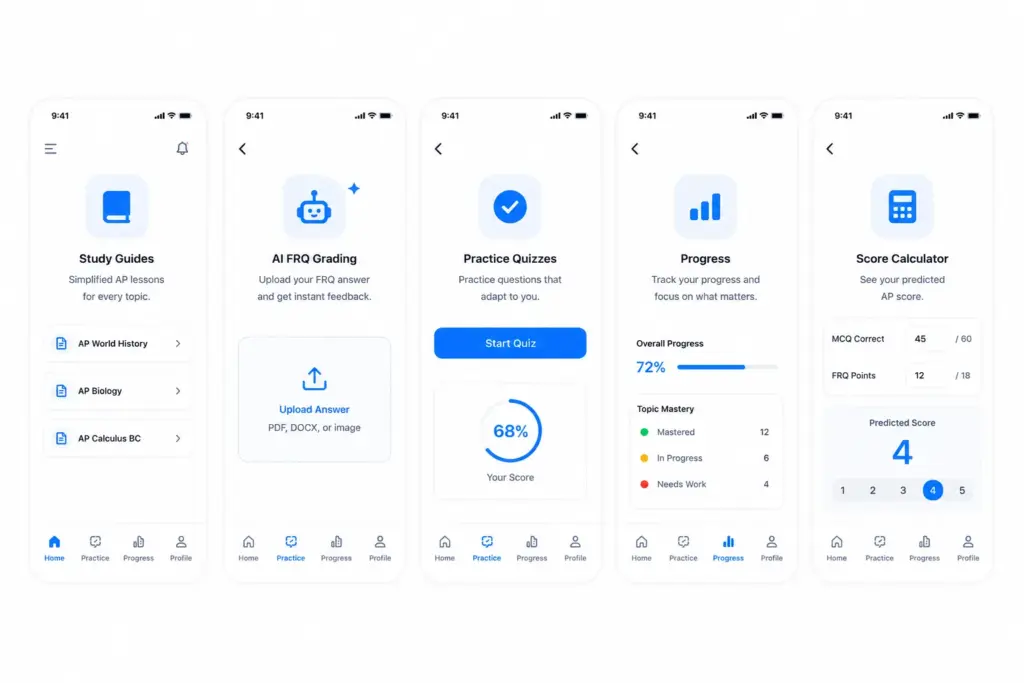
The success of Fiveable shows that today’s students expect more than simple study materials. They want a learning experience that helps them understand concepts, track progress, and receive support when they get stuck. By designing features around real student needs and study habits, Fiveable created a platform that keeps learners engaged throughout the school year.
1. AP Study Guides
One of Fiveable’s most popular features is its study guides, which simplify complex AP topics into easy-to-understand lessons. Rather than spending hours navigating lengthy textbooks, students can quickly review key concepts through structured content that aligns with the AP curriculum. This makes studying more efficient and helps learners grasp difficult subjects faster, whether they are preparing for class, completing homework, or getting ready for exams.
2. AI FRQ Grading
Fiveable helps students prepare for AP free-response questions through an interactive practice system that provides instant, rubric-based feedback. Instead of waiting for a teacher to review their work, students can quickly understand where they lost points and how to improve their answers. This immediate feedback makes practice more effective and helps learners build stronger writing and exam-taking skills before test day.
3. Adaptive Quiz Engine
Fiveable supports AP exam preparation with a large collection of practice questions designed to strengthen test-taking skills and subject knowledge. Students can complete quizzes, identify weak areas, and receive targeted explanations that help them understand concepts more effectively. This personalized approach keeps learners focused on the topics that need the most improvement, making study sessions more productive and helping build confidence before exam day.
4. Progress Tracking
High school students balancing multiple demanding courses rarely know where to direct their limited energy. Inside the Fiveable ecosystem, users constantly monitor their personalized dashboard to visualize their overall curriculum mastery. Every quiz taken and guide read feeds data into a visual progress matrix.
- Color-Coded Topic Boxes: Green indicators signal complete mastery, while red or orange highlights warn students of active conceptual blind spots.
- Auto-Suggested Pathways: The software analyzes past performance data to automatically serve up specific study guides that address the user’s weakest units.
- Coursework Alignment: Students use these diagnostic readouts throughout the ten-month academic calendar to proactively prepare for cumulative school midterms and finals.
5. AP Score Calculators
As spring testing approaches, student anxiety spikes significantly. High schoolers flock to the Fiveable score calculator to run predictive simulations on their final results. Users input hypothetical multiple-choice totals alongside estimated essay points to instantly view a projected final score from 1 to 5.
This interactive tool functions as a powerful motivation mechanic. Students manipulate the point values to determine the exact baseline performance required to pass their exams, helping them prioritize their study goals and build genuine confidence before stepping into the official testing room.
6. Quick Revision Resources
During the final forty-eight hours leading up to an exam, standard comprehensive textbooks become practically useless. Students switch to Fiveable Cheatsheets for high-yield, rapid-fire revision. These ultra-dense, single-page resources compile essential vocabulary, core formulas, historical timelines, and critical unit maps into a single scannable document.
Users download these sheets to their devices for last-minute review sessions on the morning of the test. By stripping away everything except the highest-frequency testing concepts, this feature delivers maximum informational density right when students experience peak time pressure.
7. Live Study Support
The defining characteristic of the Fiveable experience is its deep social infrastructure. High schoolers do not want to study in total isolation. Users join Fiveable Rooms to enter collaborative digital workspaces equipped with shared focus timers, accountability text chats, and ambient background tracks.
| Study Format | User Behavior | Platform Value |
| Fiveable Rooms | Students join virtual spaces to co-work silently with peers globally. | Drives daily app retention through social peer pressure. |
| Cram Sessions | Users attend live stream marathons hosted by expert educators right before exams. | Delivers high-yield interactive review during peak demand. |
How Can You Build an AP Learning App Like Fiveable?
The market for Advanced Placement preparation platforms is expanding rapidly, presenting an exceptional opportunity for entrepreneurs. Building a successful product in this domain requires more than simply uploading educational PDFs. It demands a highly scalable, engaging framework that aligns perfectly with the habits of digital-native students.
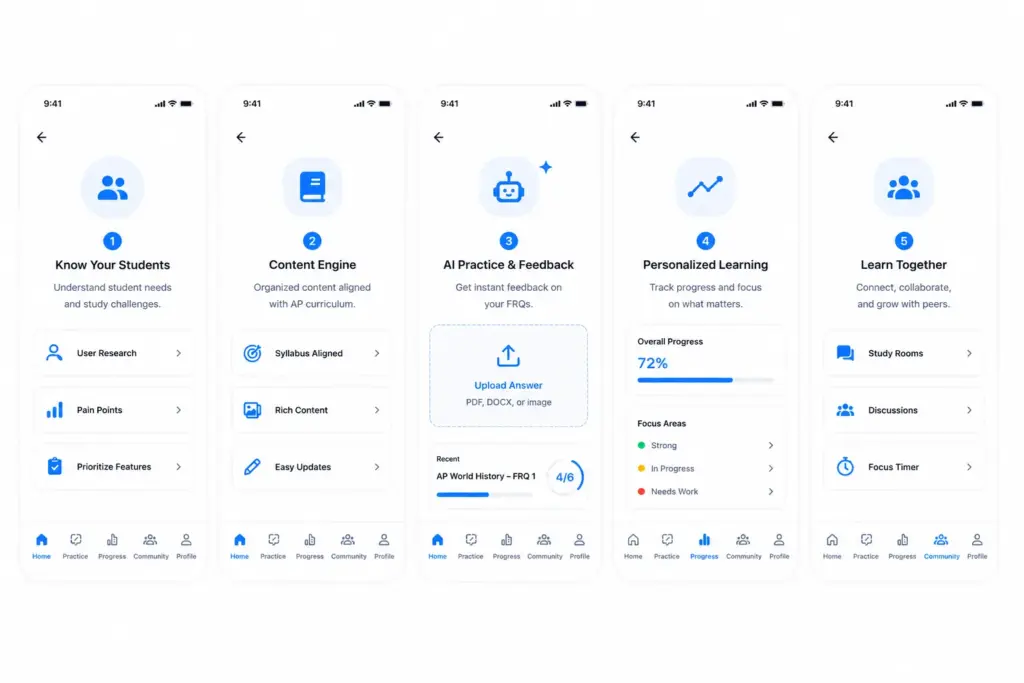
When establishing the infrastructure for a robust EdTech product, we focus on engineering scalable architectures that transform educational material into an interactive ecosystem. By breaking the development lifecycle into distinct structural components, we can systematically translate your commercial vision into a market-ready platform.
1. Student Research Validation
Every successful software build begins with precise market validation. Before writing the first line of code, we work closely with you to map out user workflows and analyze specific student pain points across diverse educational demographics. Advanced Placement students experience intense time management constraints and academic pressure.
By focusing initial discovery on how high schoolers interact with existing coursework, we isolate the exact features that drive immediate user engagement. This upfront research guarantees that the platform solves real-world issues, helping you establish a strong product-market fit prior to full-scale engineering.
2. Curricula Content Engine
An educational app is only as strong as its core material. The underlying database requires a modular content management system capable of structuring complex concepts into clear, scannable units.
- Syllabus Alignment: The framework must map directly to official Course and Exam Descriptions, allowing users to locate exact topics effortlessly.
- Asset Distribution: The system must deliver varied content formats, including text guides, bite-sized summaries, and custom visual graphics, without experiencing layout latency.
- Authoring Portals: We build custom, intuitive backend dashboards that allow your educators and content creators to update study materials instantly as curriculum requirements evolve.
By constructing a highly responsive, organized database, your platform becomes an essential companion for daily homework help and high-yield test review.
3. AI Practice and Feedback
To scale your user base without incurring unsustainable operational costs, integrating advanced automation is a critical requirement. Manual grading of practice essays is labor-intensive and expensive. By implementing machine learning models, your application can provide instant, automated evaluations of complex student responses.
We integrate fine-tuned language processing models that assess Free Response Questions directly against official exam rubrics. This setup evaluates thesis strength, contextualization, and evidence use in real time. Providing an instant feedback loop keeps user engagement exceptionally high while keeping backend employee overhead low.
4. Personalized Learning Paths
A generic, one-size-fits-all digital dashboard often causes frustrated users to abandon an app. To ensure high retention, the underlying platform architecture must adapt dynamically to individual performance data. We design these intelligent data pipelines to track individual progress smoothly across the entire academic calendar. This personalization transforms the app into a vital, custom study assistant, maximizing long-term customer lifetime value.
| System Function | Technical Execution | User Value |
| Diagnostic Analytics | Aggregates data points from every practice quiz and content view. | Identifies specific conceptual blind spots automatically. |
| Adaptive Logic | Adjusts quiz difficulty algorithms based on user accuracy metrics. | Serves targeted questions to reinforce weak subjects. |
| Visual Progress Matrix | Renders clear, color-coded completion tracking on user profiles. | Builds genuine confidence as exam dates approach. |
5. Community Features
The factor that separates leading educational platforms from static revision software is social infrastructure. High schoolers study more effectively when working alongside peers. Integrating collaborative spaces drives high organic retention through natural peer accountability.
We implement real-time communication tools, including shared focus timers, virtual study rooms, and interactive peer forums. This collaborative framework allows advanced students to naturally assist peers facing academic roadblocks. For your business, this social layer significantly lowers content generation costs and creates intense, viral brand loyalty.
6. Launch Core Subjects First
When launching a new platform, attempting to build resources for all Advanced Placement courses simultaneously can exhaust your capital and delay your market entry. The most efficient route to profitability is deploying a streamlined Minimum Viable Product centered on high-enrollment subjects.
- High-Volume Targets: Focus initial development on massive student markets like AP US History, AP English Language, or AP Calculus.
- Core Feature Loops: Ship the platform with essential tools first, such as high-yield study guides, basic quiz engines, and community workspaces.
- Feedback Gathering: Use this early release to capture real-world performance metrics and user feedback from active high school students.
This strategic approach allows you to secure early revenue streams and establish market presence while optimizing development capital.
7. Analytics and Improvement
Post-launch expansion must be guided by concrete user analytics rather than guesswork. Once your app is live in the market, the management dashboard tracks precise operational metrics to drive your ongoing scaling strategy. We build comprehensive data dashboards that track user acquisition costs, feature engagement rates, and subscription conversion funnels.
This continuous flow of analytical insights tells you exactly which subjects to develop next and which product features to optimize. Relying on this structured, data-driven methodology ensures your software platform scales efficiently, handles millions of concurrent users smoothly, and delivers a superb return on your investment.
Cost to Build an AP Learning App Like Fiveable
Building an Advanced Placement learning app like Fiveable requires balancing high-engagement study tools, community features, and modern tech infrastructure. At IdeaUsher, we guide businesses through these technical choices to optimize development budgets while ensuring a high-quality product.
MVP vs Full-Scale Platform
Launching a Minimum Viable Product ets you test the market with essential features like basic flashcards, study guides, and a simple community forum. A full-scale platform scales these up into a comprehensive educational ecosystem featuring live streaming rooms, detailed analytics dashboards, and interactive gamification systems.
| Development Scope | Core Features Included | Average Cost Range |
| Minimum Viable Product | User login, study guides, simple flashcards, basic forum | $25,000 to $45,000 |
| Mid-Tier Application | Cross-platform access, basic progress metrics, text chat, quizzes | $50,000 to $85,000 |
| Full-Scale Platform | Live video streaming rooms, real-time dashboards, community spaces | $90,000 to $160,000+ |
AI and Personalization Expenses
Integrating intelligent grading systems and personalized study pathways significantly changes the architecture and budget. Simple rule-based quiz engines are cost-effective, whereas building adaptive learning systems that analyze student weaknesses requires specialized artificial intelligence engineering.
- Rule-Based System ($5,000 to $12,000): Traditional multiple-choice formats and fixed automated responses.
- AI Chatbots & Study Co-pilots ($15,000 to $30,000): Large language model integration providing instant feedback on free-response AP questions.
- Adaptive Learning Engine ($20,000 to $40,000): Machine learning models that dynamically alter study paths based on historical student performance.
Infrastructure and Maintenance
Beyond initial coding, long-term operational costs keep the software secure and operational. Ongoing server scaling, high-quality content curation, and platform maintenance dictate the monthly budget. High-traffic video streaming during peak exam seasons requires scalable cloud infrastructure like AWS or Google Cloud to handle sharp user spikes seamlessly.
Partnering on the Build
We specialize in assembling dedicated engineering teams to turn educational concepts into structured, scalable platforms. By utilizing cost-efficient cross-platform frameworks like Flutter or React Native, we help reduce upfront development costs by 30% to 40% while preserving a smooth user experience on iOS, Android, and web.
Our engineering team takes care of the technical heavy lifting, from setting up low-latency streaming infrastructure to integrating secure payment systems and advanced analytics dashboards.
Subscription vs Tutoring: Which AP Business Model Scales Better?
Choosing the right monetization architecture is a critical decision when building an Advanced Placement learning platform. Founders generally weigh two different financial frameworks. You can charge a low recurring fee to millions of users or charge a premium hourly rate for direct human support.
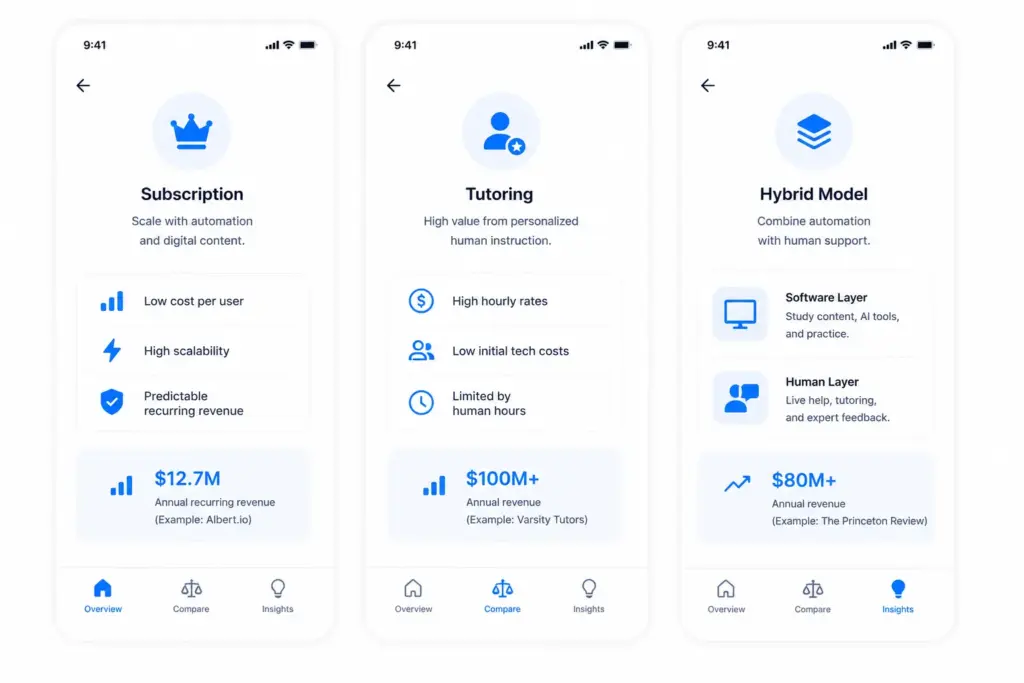
Both methods have unique structural advantages. Evaluating how these models operate in the real-world market helps entrepreneurs deploy a platform designed for maximum profitability and seamless operational growth.
1. Subscription Models
Subscription setups prioritize high-volume customer acquisition and automated delivery loops. Users pay a predictable weekly, monthly, or annual fee to unlock complete access to the software database, quiz banks, and automated AI feedback systems. This framework scales exceptionally well because serving your millionth customer incurs virtually the same digital hosting expense as serving your first.
A highly successful example of this approach is Albert.io, an interactive test prep app built directly around adaptive question banks and curriculum analytics. By locking their premium practice suites behind annual paywalls for families and school districts, Albert.io scales smoothly without hiring armies of educators, pulling in $12.7 million in annual recurring revenue.
2. Tutoring Services
Human-led tutoring services operate on an entirely different economic logic. Instead of focusing on massive user volume, this model extracts maximum transaction value from a smaller pool of high-intent buyers. Parents are frequently willing to pay premium hourly rates to secure direct, customized instruction for their children prior to high-stakes exams.
- Immediate Cash Flow: High hourly rates generate substantial upfront revenue from day one.
- Low Initial Tech Costs: The business relies heavily on human expertise rather than complex, custom software algorithms.
- Operational Limits: Revenue growth is strictly tied to human hours, requiring you to constantly recruit, vet, and manage new educators to scale.
The massive financial potential of private instruction is perfectly illustrated by Varsity Tutors. By building an elite marketplace that connects students with specialized background instructors for live, one-on-one test preparation, they successfully captured top-tier market spend. This highly targeted human-capital model contributes directly to its parent company’s expansive educational portfolio, which generates over $100 million in annual revenues.
3. Hybrid Models
For modern educational startups, the most lucrative pathway is merging both systems into a single, unified platform layer. A hybrid architecture leverages the organic, low-cost user acquisition funnel of a software subscription while offering premium human tutoring upgrades to users who need additional support.
| Monetization Layer | User Experience | Business Value |
| Software Layer | Automated study guides, AI essay grading, and self-paced quiz engines. | Provides highly predictable, passive monthly recurring revenue. |
| Human Layer | On-demand live chat assistance and scheduled deep-dive video reviews. | Maximizes overall customer lifetime value through premium upsells. |
A masterclass in executing this dual-revenue strategy is showcased by The Princeton Review. While historically recognized for physical textbooks and classroom tutoring, they successfully shifted into a comprehensive digital hybrid ecosystem. They capture broad market share through accessible online course subscriptions while upselling intensive, high-margin private tutoring packages. This balanced ecosystem approach stabilizes cash flow and pushes their annual test preparation revenues to over $80 million.
Can AP Learning Apps Compete With Traditional Test Prep Companies?
For years, legacy test prep giants dominated the Advanced Placement market by selling expensive classroom courses and thick physical books. However, modern educational apps are shifting this dynamic entirely. By moving past static study frameworks, agile digital platforms are actively challenging traditional setups.
1. Greater Accessibility
Traditional test prep companies require high schoolers to adapt to rigid schedules and physical locations, creating barriers for busy or low-income students. Digital platforms bypass these limitations by delivering high-yield study resources straight to a smartphone.
A great example of this execution is Marco Learning, which bridges the gap between structured teacher resources and student accessibility. By offering robust online diagnostic materials, free live reviews, and targeted essay grading support, they make professional-grade test prep highly democratic, earning an estimated $7.5 million in annual revenue.
2. AI Personalization
Thick physical textbooks provide the exact same generic practice path to every single reader, regardless of their strengths. Modern educational applications use advanced machine learning algorithms to create hyper-personalized study journeys that constantly adapt to user performance data.
This technical advantage is illustrated perfectly by Knowunity. The fast-growing platform serves over 20 million users globally by pairing student-created content libraries with a smart, personalized AI study tutor. This seamless mix of automated guidance and peer-to-peer accountability has helped Knowunity achieve an estimated $16.5 million in annual revenue.
- Dynamic Adjustments: The software tracks user quiz data to isolate conceptual blind spots automatically.
- Instant Revisions: Automated grading models analyze free-response questions in seconds to give students immediate feedback at midnight.
- Optimized Focus: High schoolers save hundreds of study hours by skipping material they have already mastered.
3. Scalability
Legacy test preparation companies face massive overhead costs, including leasing physical classrooms, printing updated study books, and paying hourly teaching staffs. This heavy financial structure makes it incredibly difficult to scale rapidly without raising customer prices.
| Metric | Traditional Prep Firms | Mobile Learning Apps |
| Overhead Expenses | High real estate lease fees and recurring printing costs. | Minimal server hosting and automated cloud infrastructure. |
| User Acquisition | Relies on expensive local advertising and school partnerships. | Scales organically through viral peer-to-peer sharing. |
| Profit Margins | Lower margins due to continuous human labor demands. | High profit margins that increase with every download. |
Because digital learning applications leverage low-cost cloud architecture, they can absorb millions of concurrent active users during peak spring testing marathons without matching human costs. This structural efficiency keeps operational expenses low while driving superior, repeatable returns for software investors.
Build an AP Learning App with IdeaUsher
The demand for interactive advanced placement platforms is growing incredibly fast. High school students want responsive mobile tools that adapt to their busy schedules rather than heavy textbooks or static websites. At IdeaUsher, we possess the precise technical expertise required to turn your educational vision into a high-performance market reality. With over 500,000 hours of coding experience, our team of ex-MAANG/FAANG developers engineers custom software platforms that capture student interest and scale seamlessly.
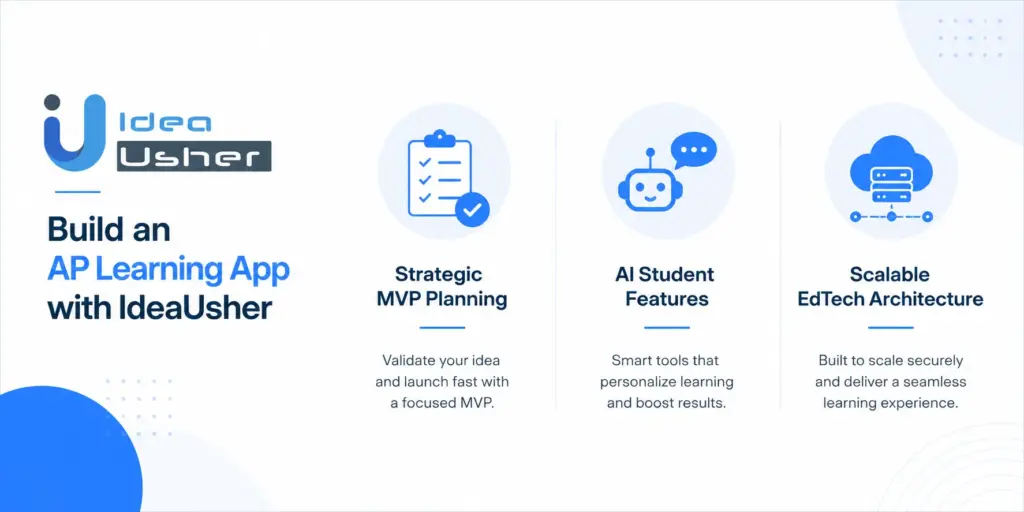
Strategic MVP Planning
Launching a successful EdTech software application requires deep strategic planning. We focus heavily on validating your initial concepts, mapping out typical student workflows, and defining a lean Minimum Viable Product to maximize early market traction. Our development strategy prioritizes launch speed and capital efficiency.
We implement core, high-value feature loops like curated study guides, interactive flashcard decks, and community chat channels using advanced cross-platform frameworks. This specific engineering methodology reduces your overall development timeline, allowing you to secure early revenue from core subjects like AP Calculus or AP History before expanding into niche courses.
AI Student Features
Stressed high schoolers demand immediate feedback when studying late at night. To build a truly competitive application, implementing smart artificial intelligence features is a massive business advantage that eliminates high backend human tutor expenses.
- Instant Essay Grading: We implement advanced language models that score free-response questions directly against official College Board guidelines.
- Personalized Study Paths: Our engineers build smart analytical engines that automatically flag conceptual weak points based on quiz performance.
- Smart Study Assistants: Automated study bots guide users through complex formulas or historical timelines whenever they hit an academic roadblock.
Scalable EdTech Architecture
Advanced placement apps experience extreme traffic surges during spring testing marathons. A weak infrastructure will crash under pressure, driving angry users to delete the platform entirely. We design robust cloud networks engineered specifically to handle millions of simultaneous active connections.
| System Parameter | Our Technical Infrastructure | Business Value |
| Server Framework | Auto-scaling cloud nodes on AWS or Google Cloud. | Zero platform downtime during massive exam-week traffic spikes. |
| Data Safety | Advanced database encryption protocols with total secure user access layers. | Completely protects student profile information and payment records. |
| Real-Time Tools | Low-latency media pipelines and interactive web sockets. | Delivers smooth video playback and lag-free community study chats. |
Our specialized development team handles all the heavy tech lifting, from setting up premium payment subscription integrations to building comprehensive admin management dashboards. Partnering with IdeaUsher ensures your EdTech startup launches with world-class, premium software infrastructure designed to dominate the competitive educational marketplace.
Conclusion
Building an AP learning app like Fiveable requires more than digitizing study materials. The most successful platforms combine structured learning content, practice tools, personalized feedback, and AI-powered support to help students achieve better exam results. As demand for AP preparation continues to grow, founders have an opportunity to create products that deliver real academic value while building a scalable and sustainable education business.
Things to Know About AP Learning Apps
Q1: Can AI improve AP exam preparation?
A1: Yes. AI has become one of the biggest differentiators in modern AP learning platforms. It can evaluate free-response answers against official scoring rubrics, generate personalized study plans, identify knowledge gaps, recommend practice materials, and provide instant tutoring support. These capabilities help students receive customized guidance at scale while reducing the need for one-on-one instructor involvement. Platforms like Fiveable already use AI to provide detailed FRQ feedback and scoring assistance.
Q2: How do AP learning apps generate revenue?
A2: Most AP learning platforms rely on recurring subscription revenue because it provides predictable cash flow and scales efficiently. Additional revenue opportunities include premium study resources, AI grading credits, teacher-focused tools, school licensing programs, district partnerships, and exam-season preparation packages. As the platform grows, founders can also expand into SAT, ACT, college readiness, and other educational products to increase lifetime customer value.
Q3: What makes AP learning apps different from traditional test prep?
A3: Traditional test prep companies often depend on physical classes, tutoring sessions, and fixed schedules. AP learning apps offer a more flexible and scalable experience by providing on-demand access to study resources, practice questions, AI-powered feedback, and progress analytics. Students can learn at their own pace while receiving personalized recommendations based on their performance. This combination of accessibility, personalization, and data-driven learning creates a stronger user experience for today’s digital-native students.
Q4: How long does it take to develop an AP learning app?
A4: Development timelines vary depending on feature complexity. An MVP focused on study content, quizzes, and user management can often be launched within a few months. More sophisticated platforms that include AI grading, adaptive learning engines, community features, analytics dashboards, and large-scale content management systems require additional development and testing time. Most founders begin with a focused launch and expand functionality based on user feedback and engagement data.