


Key Takeaways
- AI medical scribes automate clinical documentation with ambient listening, AI note generation and seamless EHR integration.
- Core capabilities include specialty-aware documentation, AI coding, Chart Chat, CDI assistance and FHIR interoperability.
- Ambient AI reduces clinician burnout, improves coding accuracy and streamlines healthcare workflows while enhancing patient care.
- Healthcare-grade AI, HIPAA compliance and deep EHR integrations are essential for building enterprise medical scribe platforms.
- How Idea Usher can help you build AI medical scribe app like Ambience Healthcare with ambient AI, clinical intelligence and healthcare-compliant infrastructure.
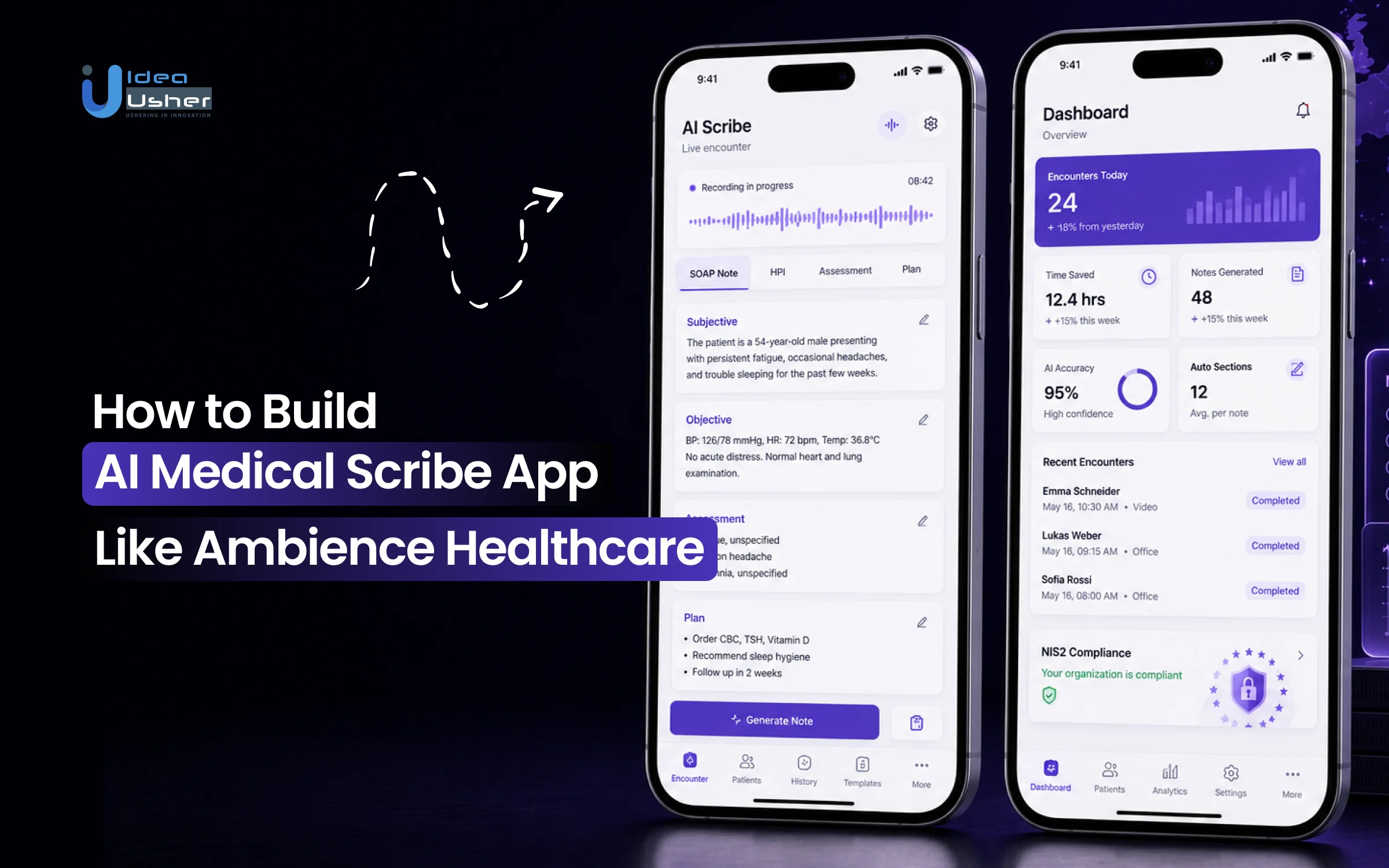
Clinical conversations have become one of healthcare’s most valuable operational assets, yet most documentation systems still treat them as records instead of intelligence. This shift is driving demand for the AI medical scribe app like ambience as healthcare organizations build platforms that automate documentation, coding, clinical guidance and workflow orchestration across every patient encounter.
Traditional medical scribes focused on conversation transcription, leaving clinicians to handle coding, chart reviews, and follow-up manually. Modern healthcare providers increasingly require ambient AI scribing, specialty-specific documentation, AI-powered medical coding, Clinical Documentation Improvement (CDI), real-time clinical guidance, EHR integration, FHIR interoperability, automated ICD-10 coding, medication assistance, and clinician copilots to improve documentation quality, coding accuracy, and care delivery.
In this blog, we’ll explore how to build an AI medical scribe app like Ambience Healthcare, covering its core features, AI architecture, technology stack, development process, and how IdeaUsher can help build enterprise-grade ambient clinical medical documentation platforms that streamline clinician workflows before, during and after every patient interaction.
Why AI Medical Scribes Are Replacing Manual Documentation
The global healthcare delivery network has reached a critical operational breaking point. Clinicians are at an operational breaking point. This crisis has driven the global AI medical scribing market to a $3.37 billion valuation in 2026, heading toward an estimated $14.6 billion by 2034 at a 20.2% CAGR.

This transition delivers measurable operational and clinician benefits. A multi-center study published in JAMA Network Open found that within 30 days of deploying ambient AI scribes, severe physician burnout fell from 51.9% to 38.8%. By eliminating up to 2 hours of daily charting, health systems also report up to a 30% reduction in documentation time.
A. The Hidden Cost of Clinical Documentation
The operational friction draining modern clinical care stems directly from clunky EHR documentation tasks. These manual data entry requirements act as an explicit ceiling on hospital throughput and physician retention:
- The Documentation Burden: Clinicians spend 1.5–2 hours on documentation for every 1 hour of patient care, with primary care providers dedicating 15–20 hours per week to administrative work.
- The Loss of “Pajama Time”: Around 57% of clinicians spend 44+ hours per month on administrative tasks, while 20.9% devote 8+ hours per week to EHR documentation outside normal clinical hours.
- The Cost of Burnout: Administrative overload contributes to 41.9%–45.6% physician burnout. Replacing a physician costs $500,000–$1 million, with burnout costing the U.S. healthcare system $4.6 billion annually.
B. Why Ambient AI Is Replacing Traditional Medical Dictation
Healthcare organizations are rapidly shifting from first-generation speech-to-text tools to ambient AI platforms to improve documentation accuracy and streamline clinical workflows. Traditional dictation systems often struggled with medical terminology, accents, and conversational context, leading to error rates of 7%–11%.

Modern LLM-powered ambient AI has reduced documentation errors to approximately 1%–3%, making AI-assisted clinical documentation significantly more reliable.
This shift is delivering measurable operational benefits:
- Reduced Documentation Time: Ambient AI saves 13–16 minutes per consultation on average. Efficiency improves over time, with documentation time decreasing from an initial 7% to nearly 15% after 150 days of adoption.
- Lower Clinician Burnout: Health systems report a 21%–31% reduction in clinician burnout after implementing ambient documentation.
- Improved Clinical Productivity: Automated note generation saves clinicians one hour or more per day, enabling more patient interaction and increasing capacity by approximately 0.5 additional patient visits per week.
Despite these gains, ambient AI remains a clinical decision support tool, not a replacement for clinicians. Studies report about 2.9 errors per AI-generated note, including omissions and hallucinations. The most effective deployments pair AI with clinician review to maintain quality while freeing providers for more patient care.
C. Why Enterprise Healthcare Is Investing in AI Scribes
For hospitals and health systems, enterprise-grade ambient AI has become a strategic investment that improves both financial performance and clinical efficiency. According to a Microsoft-IDC study, 79% of healthcare organizations have adopted AI, achieving ROI within 14 months and generating $3.20 for every $1.00 invested.
The enterprise value of moving to an integrated ambient documentation framework is clear:
| Hospital Performance Vector | Legacy EHR Manual Documentation | Ambient Enterprise AI Scribe Stack | Direct Systemic & Financial Impact |
| Provider Documentation Time | 44+ hours/month spent on manual charting. | Reduces documentation time by 50%–75%. | Saves 5–7 minutes per patient, eliminating after-hours “pajama time.” |
| Clinician Well-Being | Administrative burden contributes to 42% clinician burnout. | 70% of clinicians report better work-life balance. | Lowers burnout by 21%–31%, reducing recruitment and retention costs. |
| Revenue Cycle | Coding gaps reduce billing efficiency by 21.68%. | Improves coding accuracy by 8%–15% and RVUs by 5.8%. | Increases clean claims with no rise in denials, adding ~$3,044 per physician annually. |
| Patient Experience | Screen-focused documentation disrupts patient interaction. | Enables natural conversations with 46.91/50 note accuracy. | 93% of patients report a more personal care experience. |
The Enterprise Takeaway: Manual clinical documentation can no longer support the demands of modern healthcare. Ambient AI transforms charting into an automated, secure workflow that reduces administrative burden, strengthens revenue cycles, helps prevent physician burnout, and improves long-term patient care quality.

What Is an AI Medical Scribe App Like Ambience Healthcare?
An AI medical scribe app like Ambience Healthcare transforms clinical documentation from basic voice transcription into an enterprise-grade AI operating system for healthcare workflows. Rather than acting as a passive dictation tool, it uses multi-agent AI to automate documentation, coding, and other time-intensive clinical tasks.
Running securely in the background, these platforms help address physician burnout by reducing documentation workloads, contributing to 45% less after-hours charting while tackling an industry burnout rate of 42%. Features such as Ambient Scribe, Chart Chat, Medication Order Assist, and Inpatient CDI Assistant enable clinicians to document encounters, retrieve patient insights, improve coding accuracy, and streamline care delivery from a unified AI platform.
A. How Ambient Clinical Intelligence Works
Ambient Clinical Intelligence transforms patient conversations into structured clinical documentation through an AI-powered workflow. Every stage prioritizes accuracy, automation, clinical efficiency, and seamless integration with existing healthcare systems.

The process follows a structured, real-time pipeline that converts spoken interactions into review-ready clinical notes with minimal clinician effort.
1. Ambient Listening & Capture
The provider initiates the app with one tap on a smartphone or desktop interface at the start of the encounter. The software captures the natural, uninterrupted dialogue between the clinician, patient, and family members.
2. Speaker Attribution & Real-Time Translation
Advanced machine learning models execute speaker diarization to automatically identify and separate distinct voices in the room. Simultaneously, the tool translates conversations spoken in foreign languages directly into English text logs.
3. AI Processing & Structure Generation
Deep AI reasoning engines process the transcript, discarding social pleasantries to map medical details into a customized, structured SOAP note tailored exactly to the clinician’s signature writing style.
4. Clinician Review & EHR Synchronization
The compiled draft appears inside the Electronic Health Record (EHR) interface within seconds. The doctor reviews the text, applies any custom macro changes, and signs off, triggering native FHIR APIs to securely push the note into the patient’s chart.
B. AI Agents That Power Clinical Workflows
Enterprise frameworks like Ambience replace the concept of a single, slow large language model with a specialized ecosystem of dedicated AI agents. These agents run in parallel, communicating over secure database paths to drive different parts of the care workflow:
AI agents work together to automate documentation, coding, clinical decision support, and patient communication, creating a faster, more accurate, and highly efficient healthcare workflow.
- Ambient Scribe (Flagship Note Writer): Listens to patient encounters across 200+ distinct clinical medical specialties, converting unstructured dialogue into custom-formatted documentation.
- Chart Chat (Longitudinal Synthesis): A conversational agent that allows clinicians and inpatient nurses to query the patient’s full chart. It surfaces lab reports, past medical histories, and continuity-of-care updates in seconds, backed by direct source citations.
- Medication Order Assist: Detects when a provider verbally prescribes or adjusts a treatment plan during a visit, automatically preparing matching pending orders within the EHR queue.
- CDI Assistant (Clinical Documentation Integrity): Operating on custom models, this real-time agent analyzes chart details to prompt hospitalists for diagnostic specificity. It ensures documentation supports Hierarchical Condition Categories (HCCs) and meets strict audit rules right at the point of care.
- Coding Intelligence Module: Scans notes as they are generated to automatically recommend appropriate ICD-10 diagnosis codes and CPT evaluation codes, reducing downstream insurance claim rejections.
- Patient Instructions Generator: Converted automatically from the transcript, this engine translates complex medical jargon into plain, patient-friendly summaries outlining clear next steps and medication changes.
C. What Makes It Different From Traditional AI Scribes
Traditional AI scribes function primarily as simple, rules-based audio filters that drop raw transcripts into an open text box. Moving to a fully managed AI operating system delivers a completely different level of operational value:
| Functional Capability | Basic AI Scribes | Advanced Multi-Agent Platforms | Direct Hospital System Value |
| Specialty Personalization | Generic templates for all specialties. | Customized workflows across 200+ medical specialties. | Reduces documentation edits and clinician fatigue. |
| Longitudinal Patient Context | Treats each visit independently. | Uses full EHR history before each encounter. | Improves care continuity and highlights clinical risks. |
| EHR Integration | Requires manual copy-paste between systems. | Embedded within Epic Hyperdrive and Haiku. | Eliminates workflow switching and improves efficiency. |
| Revenue Optimization | No support for coding or billing accuracy. | Tracks HCC and CPT coding at the point of care. | Generates up to $13,000 in annual revenue per clinician. |
| Workflow Automation | Limited to clinical note generation. | Automates referrals, orders, and patient instructions. | Saves 5–7 minutes of administrative work per encounter. |
The Developer Takeaway: Multi-agent ambient AI is transforming medical documentation by going beyond speech-to-text to automate chart review, structured note generation, and coding assistance. With deep EHR automation integration and specialty-specific intelligence, healthcare providers can improve revenue cycles, reduce administrative burden, and give clinicians more time for patient care.
Core Features of an AI Medical Scribe Platform Like Ambience Healthcare
An enterprise AI medical scribe platform delivers far more than automated note-taking. It combines ambient AI, clinical intelligence, coding automation, and seamless EHR automation workflows to reduce administrative burden, improve documentation accuracy, and help clinicians deliver more efficient, patient-focused care.
1. Ambient Scribe for Real-Time Documentation
Ambient Scribe continuously listens to clinician-patient conversations, identifies speakers, and converts discussions into structured clinical notes in real time. This feature minimizes manual documentation, supports multiple note formats, reduces after-hours charting, and allows clinicians to focus more on patient care than paperwork.
2. Specialty-Aware Clinical Documentation
Healthcare specialties require different documentation standards, terminology, and workflows. Specialty-aware AI adapts note generation to specific clinical disciplines, producing accurate, context-rich documentation that aligns with specialty requirements, improves consistency, and reduces the need for extensive manual editing across diverse care settings.
3. Chart Chat for Instant Clinical Insights
Chart Chat enables clinicians to retrieve patient history, summarize previous encounters, review medications, allergies, laboratory results, and other clinical records through natural language queries. This reduces time spent searching electronic health records while providing faster access to relevant patient information during consultations.
4. AI Coding & Revenue Integrity
AI-powered coding automatically analyzes clinical documentation to recommend ICD-10, CPT, and E/M codes while identifying missing coding opportunities. Accurate coding-ready documentation strengthens reimbursement accuracy, minimizes claim denials, improves revenue cycle performance, and reduces administrative effort for clinical and billing teams.
5. Clinical Documentation Improvement (CDI)
Clinical Documentation Improvement (CDI) uses AI to detect incomplete documentation, missing diagnoses, and clinical inconsistencies before records are finalized. By improving documentation quality and coding specificity, healthcare organizations can strengthen compliance, enhance reimbursement accuracy, and maintain complete, high-quality patient records.
6. Medication Order Assistance
Medication Order Assistance streamlines prescribing by helping clinicians generate medication orders, verify dosages, reconcile existing prescriptions, and identify potential drug interactions or allergy risks. Integrating this capability into clinical workflows improves prescribing efficiency while supporting safer and more accurate medication management.
7. EHR & FHIR Integration
Deep integration with leading EHR platforms such as Epic, Cerner, and athenahealth enables seamless data exchange across healthcare systems. FHIR and HL7 interoperability eliminate duplicate data entry, synchronize clinical information automatically, and allow AI workflows to operate directly within existing clinical environments.
8. AI-Driven Patient Instructions
AI-driven patient instructions automatically generate personalized after-visit summaries, medication guidance, follow-up recommendations, and discharge instructions using patient-friendly language. Providing clear, customized instructions improves patient understanding, supports treatment adherence, reduces communication gaps, and enhances the overall healthcare experience beyond the clinical encounter.
How to Build an AI Medical Scribe App Like Ambience Healthcare
Building an enterprise AI medical scribe platform requires a structured development approach that combines healthcare expertise, AI engineering, compliance, and interoperability. Each phase ensures the platform delivers accurate documentation, secure clinical workflows, and seamless integration with existing healthcare systems.
1. Define Clinical Use Cases & Healthcare Workflows
We begin by identifying target users, clinical environments, specialty-specific workflows, documentation requirements, and operational goals. This discovery phase establishes the functional foundation, ensuring the platform aligns with real-world healthcare processes and clinician expectations.
- Workflow Mapping Strategy: Defines end-to-end clinical workflows, identifying key touchpoints, documentation needs, and operational dependencies across healthcare environments.
- Stakeholder Alignment Planning: Engages clinicians, administrators, and IT teams to ensure platform requirements reflect real-world usage and expectations.
- Use Case Prioritization Framework: Identifies high-impact clinical scenarios to focus development efforts on areas delivering maximum operational and financial value.
- Clinical Scenario Simulation: Tests workflows using simulated patient interactions to validate usability and effectiveness before development.
2. Choose the Right AI Models
Our team selects specialized AI models for speech recognition, clinical reasoning, medical NLP, coding assistance, and retrieval instead of relying on one general-purpose model, ensuring higher accuracy, better contextual understanding, and reliable clinical performance.
The table highlights essential AI model categories, their roles, and recommended technologies, ensuring accurate, efficient, and compliant medical scribe platform development.
| AI Model Category | Recommended Models | Purpose in the Platform |
| Speech Recognition Models | OpenAI Whisper, Deepgram Nova, Google Cloud Speech-to-Text Medical, | Convert clinician-patient conversations into real-time medical transcripts with speaker separation and noise reduction. |
| Medical Large Language Models (LLMs) | GPT-4.1, Google MedLM, Claude 4, Llama 3.3, Med-PaLM 2 | Generate clinical notes, chart summaries, patient instructions, and specialty-specific documentation. |
| Clinical NLP Models | BioClinicalBERT, ClinicalBERT, Spark NLP for Healthcare | Extract diagnoses, medications, symptoms, procedures, and clinical entities from unstructured records. |
| Medical Coding AI Models | AWS Comprehend Medical, Google Cloud Healthcare NLP, Custom Medical Coding Models | Recommend ICD-10, CPT, and E/M codes while supporting accurate clinical documentation. |
| Retrieval-Augmented Generation (RAG) | LangChain, LlamaIndex, Pinecone, Weaviate, Milvus, pgvector | Retrieve patient records, clinical guidelines, and institutional knowledge for grounded AI responses. |
| Computer Vision Models (Optional) | GPT-4.1 Vision, Google Gemini 2.5 Pro Vision, Azure AI Vision, LayoutLM | Process scanned documents, prescriptions, diagnostic reports, and other medical images. |
| Model Guardrails & AI Safety | NVIDIA NeMo Guardrails, Azure AI Content Safety, OpenAI Guardrails | Validate AI outputs, protect PHI, reduce hallucinations, and enforce clinical safety policies. |
3. Build Ambient Voice Capture & Speech Recognition
Next, we develop the ambient listening engine using medical-grade speech recognition, speaker diarization, and real-time transcription. This enables the platform to accurately capture clinician-patient conversations in diverse clinical environments with minimal manual intervention.
- Real-Time Audio Processing: Captures and processes live clinical conversations with minimal latency to support seamless documentation workflows.
- Speaker Identification Capability: Differentiates between clinician and patient voices to ensure accurate attribution of medical information during transcription.
- Noise Reduction Optimization: Filters background noise in clinical environments to improve transcription accuracy and overall system reliability.
- Multi-Device Compatibility: Ensures voice capture works seamlessly across various devices such as mobile, desktop, and clinical hardware setups.
4. Develop AI Documentation & Clinical Intelligence
We build AI agents that transform conversations into structured clinical notes, retrieve patient context, summarize charts, generate patient instructions, and deliver specialty-aware documentation that supports clinicians throughout the entire patient encounter.
- Automated Note Generation: Converts clinical conversations into structured, compliant medical notes aligned with specialty-specific documentation standards.
- Contextual Data Retrieval: Pulls relevant patient history and clinical data to enhance documentation accuracy and decision-making support.
- Clinical Insight Generation: Provides actionable insights and summaries that assist clinicians in delivering efficient and informed patient care.
- Specialty Customization Engine: Adapts documentation formats and outputs based on specific medical specialties and clinical requirements.
5. Implement Medical Coding & CDI Intelligence
Our developers integrate AI-powered coding and Clinical Documentation Improvement capabilities that recommend ICD-10, CPT, and E/M codes, identify documentation gaps, and strengthen reimbursement accuracy while reducing manual coding effort for healthcare organizations.
- Automated Code Recommendation: Suggests accurate medical codes based on clinical documentation to streamline billing and reduce manual effort.
- Documentation Gap Identification: Detects missing or incomplete clinical information that may impact coding accuracy and reimbursement outcomes.
- Revenue Optimization Support: Enhances financial performance by improving coding precision and reducing claim denials through better documentation practices.
- Compliance Validation Checks: Ensures coding aligns with regulatory standards and payer requirements to minimize audit risks.
6. Integrate EHR Systems & Healthcare Standards
We seamlessly integrate the platform with leading EHR automation systems using FHIR, HL7, and SMART on FHIR standards, enabling secure data exchange, synchronized workflows, and smooth adoption without disrupting existing clinical operations.
- Interoperability Framework Design: Ensures seamless data exchange between systems using standardized healthcare protocols and integration methods.
- Workflow Synchronization Capability: Aligns AI platform processes with existing EHR automation workflows to minimize disruption and improve user adoption.
- Data Consistency Management: Maintains accurate and synchronized patient data across systems to support reliable clinical decision-making.
- API Integration Layer: Enables flexible and scalable connections with multiple EHR vendors and third-party healthcare applications.
7. Ensure HIPAA Compliance & Enterprise Security
Security is embedded throughout development by implementing HIPAA-compliant architecture, encryption, role-based access controls, audit logging, and secure cloud infrastructure to protect sensitive patient information and meet enterprise healthcare compliance requirements.
- Data Protection Strategy: Implements encryption and secure storage practices to safeguard sensitive patient information across all system components.
- Access Control Management: Defines role-based permissions to ensure only authorized users can access specific clinical and administrative data.
- Compliance Monitoring Framework: Continuously tracks system activities and logs to ensure adherence to regulatory standards and audit requirements.
- Incident Response Planning: Establishes protocols to quickly detect, respond to, and mitigate potential security breaches or vulnerabilities.
8. Test, Deploy & Continuously Optimize AI Models
Before launch, we rigorously validate AI accuracy, documentation quality, coding performance, and system reliability. After deployment, continuous monitoring, model optimization, and infrastructure scaling ensure long-term performance as healthcare requirements evolve.
- Performance Validation Process: Evaluates system accuracy, reliability, and efficiency before deployment to ensure readiness for clinical environments.
- Continuous Improvement Strategy: Monitors system performance and updates AI models to maintain accuracy and adapt to evolving healthcare needs.
- Scalable Deployment Planning: Designs infrastructure to support growing user demand while maintaining consistent performance and system stability.
- Post-Deployment Monitoring: Tracks real-world usage metrics and user feedback to continuously refine system performance and user experience.
Cost to Build an AI Medical Scribe App Like Ambience Healthcare
The development cost of an AI medical scribe platform depends on its AI capabilities, healthcare integrations, compliance requirements, and deployment scale. Enterprise platforms require higher investment due to advanced clinical intelligence, security, interoperability, and ongoing AI optimization.
A phase-wise cost breakdown provides a clearer understanding of where your investment goes throughout the product development lifecycle, helping you estimate budgets more accurately and prioritize critical platform capabilities.
| Development Phase | Estimated Cost (MVP → Enterprise) | What the Phase Covers |
| Discovery & Workflow Planning | $5,000 – $15,000 | Defines clinical workflows, user roles, specialties, business goals, compliance scope, and functional product requirements. |
| AI Model Selection & Architecture | $8,000 – $25,000 | Selects speech, LLM, NLP, coding, retrieval models, AI architecture, evaluation strategy, and deployment approach. |
| Ambient Voice Intelligence Development | $15,000 – $70,000 | Builds ambient listening, speaker diarization, medical speech recognition, real-time transcription, and audio processing pipelines. |
| Clinical Documentation AI Development | $15,000 – $80,000 | Develops AI note generation, chart summarization, patient instructions, and specialty-aware documentation intelligence. |
| Medical Coding & CDI Engine | $10,000 – $60,000 | Implements AI coding, Clinical Documentation Improvement, reimbursement optimization, and revenue integrity workflows. |
| EHR Automation Integration | $10,000 – $50,000 | Integrates Epic, Cerner, athenahealth, FHIR, HL7, SMART on FHIR APIs, and secure healthcare data exchange. |
| Security & HIPAA Compliance | $7,000 – $40,000 | Implements encryption, access controls, audit logs, HIPAA compliance, infrastructure security, and governance policies. |
| Testing, Deployment & Optimization | $5,000 – $30,000 | Performs AI validation, infrastructure deployment, monitoring, performance optimization, scalability testing, and production rollout. |
| Total Estimated Cost | $70,000 – $400,000+ | Combined estimated investment across all development phases (aligned with platform-level ranges). |
Note: These estimates represent typical development investments for custom AI medical scribe platforms. Final costs vary based on AI complexity, healthcare integrations, compliance scope, customization requirements, and infrastructure choices.
A. Should You Keep AI Development Costs Low in MVP?
It is common to keep AI-related development costs lower during the MVP stage by using pre-trained models, third-party APIs, and a limited feature scope. This approach helps validate product-market fit quickly without heavy upfront investment.
However, reducing AI investment in the MVP does not inherently harm the platform, as long as the architecture is designed for future scalability. The key is to build a modular and extensible foundation that allows you to upgrade AI capabilities later without major rework. Here’s how it impacts your platform:
- No Immediate Risk to Growth: A lean MVP allows faster launch and early user feedback, which is critical in healthcare product validation.
- Scalability Depends on Architecture: If you design flexible pipelines (e.g., replaceable AI models, modular services), you can upgrade from basic APIs to advanced proprietary models later.
- Trade-off in Accuracy & Depth: Lower-cost AI may result in reduced transcription accuracy, limited clinical reasoning, or fewer automation features initially.
- Future Investment is Expected: As you scale, you will need to invest in better models, fine-tuning, clinical datasets, and deeper integrations.
- Avoid Technical Debt: Cutting costs is fine, but avoid shortcuts that tightly couple your system to specific APIs or limit customization.
Keeping AI costs low in the MVP phase is a strategic and recommended approach, provided you plan for future upgrades. It will not hamper platform growth if scalability, modularity, and long-term AI evolution are considered from the beginning.
B. Development Cost by Platform Level
The platform-level cost ranges below are directional estimates, not fixed pricing. They are based on typical industry benchmarks for AI healthcare products and can vary significantly depending on scope, team location, AI sophistication, and regulatory requirements.
| Platform Level | Estimated Cost | Features Included |
| MVP | $70,000 – $150,000 | Ambient scribing, basic documentation AI, limited specialty support, essential EHR integration, HIPAA-ready infrastructure, and core clinician workflows. |
| Mid-Level | $150,000 – $240,000 | Advanced AI documentation, Chart Chat, AI coding assistance, multiple specialties, broader EHR automation integrations, analytics, and workflow automation. |
| Enterprise | $250,000 – $400,000+ | Full ambient clinical intelligence, CDI, revenue integrity, medication assistance, advanced AI models, and multi-hospital deployment. |
Important Clarification: These ranges are reasonable but not universally accurate for every project. In real-world scenarios:
- Enterprise-grade AI medical scribe platforms (especially those competing with products like Ambience Healthcare) can exceed $800,000 – $1M+ when including advanced AI training, deep EHR automation integrations, and compliance overhead.
- Costs may be lower if using pre-built AI APIs, limited customization, or offshore development teams.
- Costs may be higher if building proprietary AI models, achieving near-human clinical accuracy, or integrating deeply with hospital systems.
Note: Enterprise healthcare organizations often continue investing after launch for AI model refinement, regulatory updates, cloud infrastructure, monitoring, feature expansion, and long-term maintenance to keep clinical performance and compliance at enterprise standards.
C. Factors That Influence Development Budget
Several technical and business factors directly impact development costs. Understanding these variables helps organizations prioritize investments, define realistic budgets, and balance feature complexity with long-term scalability and regulatory compliance.
- EHR automation Integration & Certification: Access to Epic and Cerner sandboxes, along with certification and interoperability requirements, adds $10,000–$40,000, depending on integration complexity.
- Clinical Data Annotation: Transcript labeling and note validation using clinician-reviewed datasets cost $15,000–$50,000, based on dataset size and annotation depth.
- Real-Time Audio Processing: Development of low-latency pipelines for ambient listening, streaming transcription, and speaker separation adds $20,000–$60,000.
- Deployment Model: Support for on-premise, cloud, or hybrid deployments increases infrastructure and security costs by $25,000–$80,000.
- Legal & Compliance Audits: HIPAA, privacy, and healthcare compliance reviews typically cost $8,000–$25,000 per audit cycle.
- AI Model Monitoring: Ongoing monitoring, retraining, feedback loops, and model optimization require $10,000–$30,000 annually.
Healthcare Regulations for AI Medical Scribe Platforms
AI medical scribe platforms must adhere to strict regulatory and compliance standards to ensure patient data security, interoperability, and operational reliability. Understanding these frameworks is essential for building trust and maintaining legal compliance. The table below highlights the most important regulations.
| Regulation / Compliance | Why It Matters |
| HIPAA | Protects Protected Health Information (PHI) through strict privacy, security, and data management requirements, making it the most critical compliance for AI medical scribe platforms. |
| HITECH Act | Strengthens HIPAA by enforcing secure electronic health record management, breach notifications, and enhanced protection for digital patient information. |
| HL7 FHIR | Standardizes healthcare data exchange, enabling seamless interoperability between the AI medical scribe platform and Electronic Health Record (EHR) systems. |
| SMART on FHIR | Enables secure authentication and embedded integration with leading EHR automation platforms like Epic and Cerner, ensuring streamlined clinical workflows. |
| SOC 2 Type II | Demonstrates enterprise-grade security controls for data protection, system availability, confidentiality, and operational reliability expected by healthcare organizations. |
| EU AI Act | Introduces risk-based requirements for AI systems, including transparency, governance, risk management, and documentation for healthcare AI applications. |
| ISO/IEC 27001 | Establishes a comprehensive information security management framework to protect sensitive healthcare data and reduce cybersecurity risks across the platform. |
Note: Adhering to these regulations ensures patient trust, safeguards sensitive data, enables seamless interoperability, and supports reliable, secure, and compliant deployment of AI medical scribe solutions across healthcare environments.
Challenges in Building an AI Medical Documentation App
Developing an enterprise AI medical scribe app like ambience healthcare involves far more than standard AI integration or healthcare compliance. Developers face deeply technical, real-world challenges tied to clinical variability, system constraints, and unpredictable human interactions. Addressing these complexities is critical to building a reliable, scalable, and clinically trusted solution.
1. Real-Time Multi-Speaker Clinical Conversation Noise
Challenge: Clinical conversations include overlapping speech, accents, interruptions, background noise, and multiple speakers, making accurate real-time transcription and speaker identification extremely difficult.
Solution: Our developers implement advanced speaker diarization, domain-trained ASR models, and real-time streaming pipelines to separate speakers, reduce noise, and preserve context, ensuring accurate transcription across diverse clinical environments.
2. Context Retention in Long Unstructured Conversations
Challenge: Long medical consultations with nonlinear discussions make it difficult for AI systems to retain context and generate complete, coherent clinical documentation.
Solution: Our developers use memory-augmented models, intelligent chunking, and context-aware LLM pipelines to retain key details, ensuring continuity and generating structured, comprehensive clinical notes throughout extended conversations.
3. AI Hallucinations in Clinical Outputs
Challenge: AI models may generate incorrect or fabricated medical information, posing serious risks in clinical documentation and reducing trust in automated systems.
Solution: Our developers implement RAG pipelines, grounding outputs in verified data and transcripts, along with validation layers, rule-based checks, and clinician review workflows to ensure accuracy and reliability.
Why Choose Idea Usher for Your AI Medical Scribe App Development
IdeaUsher operates as an elite product engineering powerhouse and digital transformation catalyst, leveraging 11+ years of hyper-focused industry mastery across 50+ countries. Fueled by an intellectual brain trust of 250+ niche developers, a portfolio of 1,000+ deployed assets, and a top-tier 4.9/5 Clutch credential, we build high-performing digital health systems from scratch.
We skip generic templates to handcraft premium, HIPAA-compliant ambient intelligence platforms optimized with advanced speaker diarization, real-time clinical entity extraction, and automated EHR write-back integrations to maximize workflow efficiency and capture undisputed market dominance.
Why Enterprises Partner With Us
Health systems and digital health innovators choose us to deploy ambient clinical intelligence because we transform unstructured multi-speaker dialogue into highly accurate, compliant, and structured electronic health records.
- Speaker Diarization & Ambient Noise Filtering: Our developers implement high-fidelity audio processing to separate clinician, patient, and caregiver voices while filtering background noise to improve transcript accuracy.
- Specialty-Specific Clinical NLU: We build custom Natural Language Understanding (NLU) models that recognize specialty-specific medical terminology to generate accurate HPI and SOAP notes without rigid dictation.
- Real-Time ICD-10 & CPT Coding Assistance: Our developers design intelligent data extraction systems that suggest ICD-10, CPT, and HCC codes during patient encounters, improving coding accuracy and revenue capture.
- FHIR & EHR automation Integration: We develop secure HL7 FHIR APIs to connect with AI medical scribe app like ambience healthcare that synchronize clinical notes, chart summaries, medication orders, and encounter data directly with Electronic Health Record (EHR) systems.
Ready to eliminate documentation burnout with a state-of-the-art ambient AI medical scribe platform? Partner with Idea Usher’s principal healthcare technology and AI software architects to design your product build today.
Conclusion
AI medical scribe platforms are transforming healthcare by reducing documentation burden, improving coding accuracy, and enabling clinicians to spend more time with patients. Delivering AI medical scribe app like ambience healthcare, requires the right combination of clinical expertise, AI engineering, healthcare interoperability, and regulatory compliance. Whether you’re planning an MVP or an enterprise-grade solution, partnering with an experienced healthcare AI development team, IdeaUsher can help you launch a scalable, secure, and future-ready platform tailored to your business goals and clinical requirements.
FAQs
A.1. The AI medical scribe app like ambience healthcare development cost typically ranges from $70,000 for an MVP to $400,000+ for an enterprise platform, depending on AI capabilities, EHR automation integrations, compliance requirements, security architecture, and clinical workflow complexity.
A.2. An AI medical scribe app like ambience healthcare combines speech recognition models, clinical LLMs, medical NLP, coding AI, Retrieval-Augmented Generation (RAG), and AI guardrails to deliver accurate documentation, coding assistance, and reliable clinical intelligence.
A.3. EHR automation integration enables secure data exchange, eliminates duplicate documentation, synchronizes patient records, and allows clinicians to access AI-powered documentation directly within existing healthcare workflows using FHIR and HL7 standards.
A.4. Yes, modern AI medical scribe app like ambience healthcare can recommend ICD-10, CPT, and E/M codes while identifying documentation gaps, improving coding accuracy, supporting Clinical Documentation Improvement (CDI), and strengthening revenue cycle performance.


