


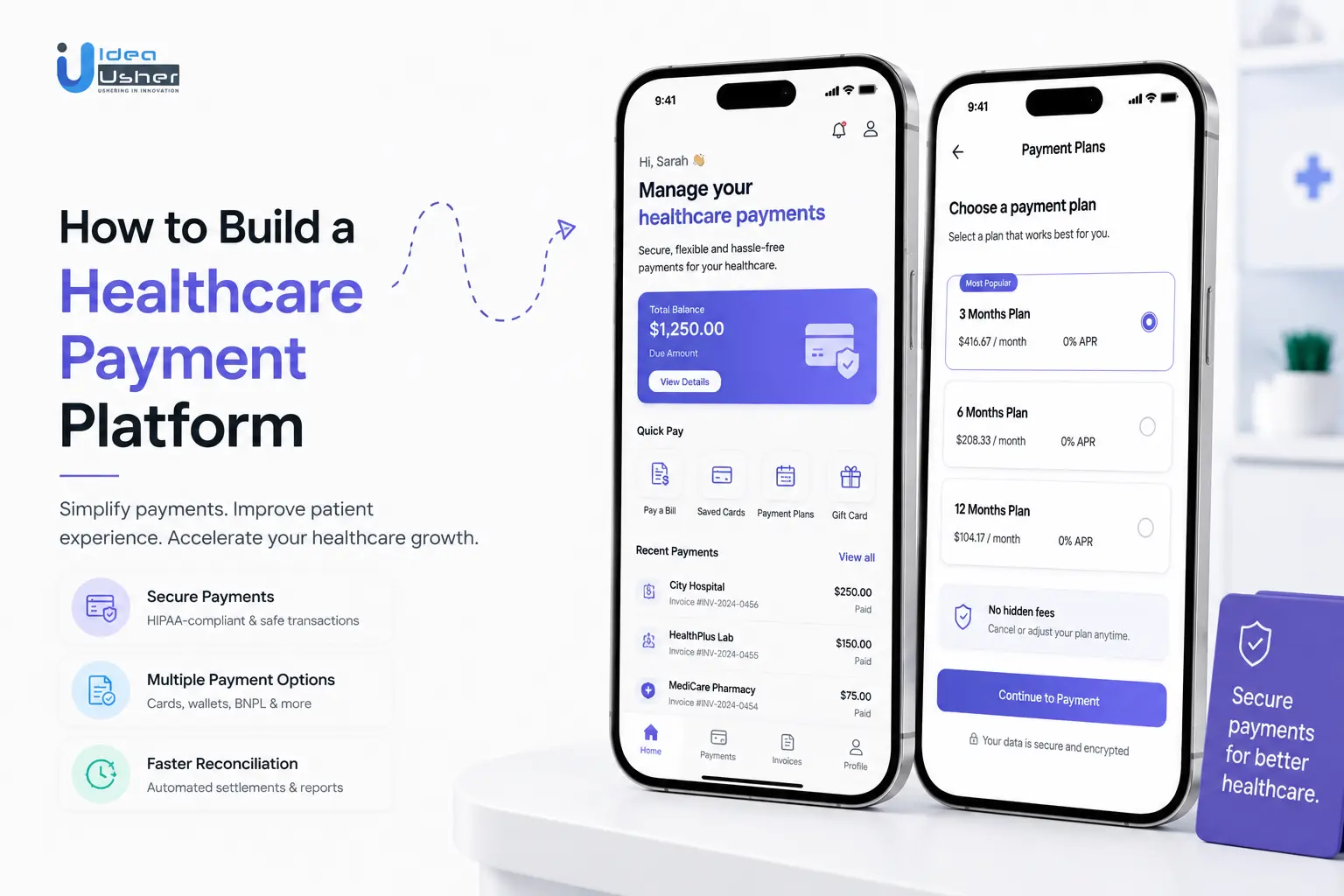
Key Takeaways
- Building a healthcare payment platform requires understanding compliance, integrating with existing systems, and addressing patient needs.
- The healthcare digital payment market is growing rapidly, driven by patients assuming more costs and providers automating workflows.
- Key features of a healthcare payment platform include eligibility verification, claims processing, and unified payment handling.
- Tokenization is crucial for protecting cardholder data and minimizing PCI compliance scope during development.
- A phased approach helps manage risks and allows for quicker market entry, beginning with patient-pay foundations before expanding functionalities.
Healthcare payments are harder to build than almost any other payments product. A single transaction can touch insurance eligibility, coordination of benefits, claims adjudication, patient responsibility calculation, and a card or ACH charge, all while handling protected health information and cardholder data under two separate regulatory regimes. Get the architecture wrong and you are looking at compliance violations, failed audits, or a platform that cannot scale past a handful of provider groups.
This guide walks through what it actually takes to build a healthcare payment platform in 2026: the market forces driving demand, the compliance foundation you cannot skip, the core features providers expect, the integration points that make or break adoption, and the technical decisions that determine whether the platform holds up at scale. It draws on patterns IdeaUsher has used across its healthcare app development engagements, where compliance-first architecture and phased delivery consistently separate the platforms that scale from the ones that stall.
Why Healthcare Payments Are a Growing Market
The numbers explain why so many companies are entering this space. The healthcare digital payment market grew from roughly $23 billion in 2025 to an estimated $28 billion in 2026, a compound annual growth rate above 22%, and it is projected to reach nearly $63 billion by 2030. That growth is being pulled by three forces at once: patients paying a larger share of their own bills, providers automating manual revenue cycle work, and payers pushing toward interoperable, real-time claims processing.

Healthcare digital payment market growth from 2025 to 2030
The patient-pay shift is the biggest driver. High-deductible health plan enrollment has climbed from 29% of covered workers in 2015 to 54% today, and the average individual deductible now sits around $1,735, with family deductibles exceeding $3,400. Patients are effectively becoming a third payer alongside commercial insurance and government programs, and they expect the same payment experience they get everywhere else: tap to pay, click a text link, or use a digital wallet, not a paper statement that arrives six weeks after a visit.
The consequences of not solving this are visible in the collections data. An estimated $220 billion in medical debt is currently working its way through some stage of the collection lifecycle in the United States, and 58% of all collection accounts on consumer credit reports originate from healthcare bills. Patient collections have become the top revenue concern for 71% of providers, average collection timelines run past 30 days, and balances sent to outside collection agencies typically recover only 20 to 30 cents on the dollar. A well-built payment platform is not a nice-to-have feature bolted onto an EHR. For most provider organizations, it is now the difference between healthy cash flow and a growing bad debt problem.
Start With the Compliance Foundation
Every architectural decision in a healthcare payment platform should be filtered through compliance first, because retrofitting compliance into a platform that was not designed for it is far more expensive than building it in from day one.
There is an important distinction worth stating clearly: there is no such thing as a single “HIPAA compliant payment processor.” HIPAA and PCI DSS are two different frameworks covering two different kinds of data, and a platform has to satisfy both simultaneously.
HIPAA governs protected health information, meaning anything that ties a patient’s identity to their health status, treatment, or billing codes. It requires a Business Associate Agreement with every vendor that touches PHI, encryption of data at rest and in transit, strict access controls tied to individual user identity, comprehensive audit logging, and a documented incident response plan.
PCI DSS governs cardholder data specifically: card numbers, expiration dates, and security codes. The scope of PCI requirements depends heavily on how much raw card data your systems actually touch, which is why tokenization is the single most important architectural decision you will make early on.
Tokenization replaces the card number with a non-sensitive token immediately at the point of capture, so the token, not the card number, is what moves through your systems and sits in your database. Done correctly, this removes almost all of your infrastructure from PCI DSS scope, leaving only the capture mechanism itself subject to the strictest requirements. Skip tokenization and every service, every database, and every log file that touches a raw card number becomes part of your compliance boundary, and that boundary only grows as you add features.
Beyond HIPAA and PCI, expect to deal with state-level health privacy laws, which vary by jurisdiction and sometimes impose stricter rules than federal law, and many enterprise buyers will also expect HITRUST certification, since it maps to both HIPAA and PCI controls and gives hospital systems a single audit artifact to point to during procurement. None of these frameworks are optional add-ons. Bake them into the architecture before you write the first line of payment logic. Providers evaluating vendors increasingly benchmark against firms on lists like top healthcare fintech development companies, where this level of compliance depth is treated as a baseline, not a differentiator.
Core Architecture Principles
Most production-grade healthcare payment platforms in 2026 are built around four architectural principles.

A healthcare payment platform data flow from eligibility verification to patient communication
HIPAA-eligible cloud infrastructure. AWS, Microsoft Azure, and Google Cloud all offer HIPAA-eligible services under signed Business Associate Agreements, giving you managed security, high availability, and elastic scalability without having to build your own data center controls from scratch. Building on a non-eligible service, or using an eligible service outside the scope covered by the BAA, is one of the most common and expensive mistakes new entrants make.
Microservices, not a monolith. Eligibility checking, claims submission, payment processing, denial management, and analytics are functionally distinct problems with different scaling needs, different compliance boundaries, and different release cadences. Splitting them into separate services lets you scale the payment processing service independently from the analytics service, deploy fixes to one area without redeploying the whole platform, and contain a security incident to a narrower blast radius. It also makes it much easier to keep your PCI scope small, since only the services that actually handle tokens need to sit inside that boundary.
API-first design. A healthcare payment platform rarely stands alone. It has to talk to EHR systems, practice management software, clearinghouses, and payer systems, often several of each per customer. Designing every core function as a well-documented API from the start, rather than bolting on integrations later, is what makes the platform sellable to provider groups that already have an entrenched EHR they are not going to replace.
Standards-based security. OAuth 2.0 for authorization, SMART on FHIR where clinical data interoperability is involved, mutual TLS for service-to-service authentication, TLS 1.2 or higher for data in transit, and AES-256 for data at rest are close to table stakes at this point. Credentials belong in a managed secrets store, never in configuration files or environment variables checked into source control, and every interface needs audit-grade logging that captures who accessed what data and when.
The Features Providers Actually Expect
A minimum viable healthcare payment platform needs to cover the full patient financial journey, from before a service is rendered to after the balance is collected.
Eligibility verification. Real-time insurance eligibility checks, run before or at the point of service, tell the front desk exactly what a patient owes before they leave the building. This single feature has an outsized impact on denial rates, since a large share of claim denials trace back to eligibility issues that could have been caught upfront.
Claims processing. The platform needs to generate, submit, and track claims automatically, with validation and error checking built into the submission step rather than discovered after a payer rejection. Increasingly this includes AI-assisted claims scrubbing, an approach covered in more depth among top AI health app development companies, which catches coding and formatting errors before submission and meaningfully reduces first-pass denial rates.
Patient estimate and statement generation. Patients respond better to bills that are clear and arrive quickly. Platforms that generate an accurate estimate at the point of service, and a clean, itemized statement shortly after a claim is adjudicated, see materially better pay rates than those relying on the traditional 45-to-60-day billing cycle.
Unified payment processing. A settlement engine that handles card-present, card-not-present, recurring, and ACH transactions through one system, rather than stitching together several disconnected processors, dramatically simplifies reconciliation and reduces the number of places money can get lost or misapplied.
Payment plans. Given that over a third of patients say they would delay care rather than face an unaffordable bill, flexible, automated payment plans are not optional. The platform should be able to set these up with minimal staff intervention and handle recurring charges reliably, including retry logic for failed payments. Some platforms extend this further into medical loan and credit-line products that let patients finance larger balances over time instead of defaulting to a single lump-sum bill.
Denial management. Denied claims need a structured workflow, not a spreadsheet. The platform should track denial reasons, route them to the right resolution path, and surface patterns so billing teams can fix upstream causes instead of reworking the same type of denial every month.
Financial assistance and charity care workflows. For nonprofit and safety-net providers in particular, the platform needs a way to route qualifying patients into assistance programs before their account reaches collections, both because it is the right thing to do and because many nonprofit hospitals have specific regulatory obligations here.
Reconciliation and reporting. Finance teams need to match what was charged, what was collected, and what is still outstanding, across every payment modality and every location, without manual spreadsheet work. This is also where multi-location and multi-provider support becomes important, since a platform that assumes a single-location practice will not survive contact with a health system running dozens of clinics.
Patient communication. Automated reminders by text, email, or portal message, tied to actual balance and due date logic rather than a blanket monthly statement, consistently outperform paper-only billing on both collection rate and patient satisfaction.
Integration Is Where Platforms Succeed or Fail
No provider is going to rip out their EHR to adopt your payment platform, which means integration quality is often the deciding factor in whether a deal closes at all
At minimum, plan for integrations with major EHR and practice management systems such as Epic, and with the widely used payment and revenue cycle vendors your prospective customers likely already touch, including players like Waystar for claims and eligibility, and InstaMed for patient-pay collection. Many teams choose to build against established payment APIs, such as Stripe’s healthcare-focused payment infrastructure, rather than building card processing from scratch, since PCI scope reduction and existing fraud tooling come built in.
The integration layer itself should expose FHIR-based APIs where clinical data interoperability matters, alongside more traditional REST APIs for administrative and financial data. Build a sandbox environment for partner and customer developers early, because a platform that cannot be tested safely before go-live will get stuck in procurement far longer than one that offers a clear integration path.
Build, Buy, or Hybrid
Before writing a line of code, decide honestly whether you are building a full payment platform from the ground up, building on top of an existing payment processor’s infrastructure, or assembling a hybrid of licensed components and custom logic.
Building from scratch gives full control over the product roadmap and margin structure, but it means owning PCI DSS compliance directly, which is a substantial and ongoing cost in audits, penetration testing, and documentation. Building on top of an established processor, using their tokenization, card capture, and settlement infrastructure while you build the healthcare-specific workflow layer on top, is the more common path for new entrants, an approach broken down in detail in what it takes to build a platform like Paytient, since it shrinks your compliance surface dramatically while still letting you differentiate on the claims, eligibility, and patient experience layer. A hybrid approach, licensing a clearinghouse connection for claims while building proprietary patient-pay and communication tools, is common among teams that want to move fast on the differentiated parts of the product without reinventing commodity infrastructure.
There is no universally correct answer here. The right choice depends on your team’s compliance expertise, how much capital you have for the audit and certification work that comes with owning PCI scope directly, and how quickly you need to reach market.
Team, Timeline, and Cost Expectations
The team needed to build a credible healthcare payment platform is larger than most founders expect going in. Beyond core backend and frontend engineers, plan for a dedicated security engineer who owns the PCI DSS and HIPAA control mapping from day one, a compliance or QA specialist who runs internal audits before an external auditor ever sees the system, and an integration engineer whose entire job is EHR and clearinghouse connectivity, since that work does not stop once the initial launch partners are live.
Timelines vary widely depending on scope, but a realistic pattern looks like three to five months to reach a compliant patient-pay minimum viable product, another four to six months to add claims processing and denial management, and ongoing investment after that as integrations, analytics, and enterprise features expand. Teams that try to compress this into a few weeks almost always do so by skipping compliance work, which tends to surface later as a blocked enterprise deal or a failed security review, at a much higher cost than doing it right the first time.
Cost estimates in published industry guidance for a compliant healthcare payment system commonly range from the low six figures for a focused patient-pay product up to seven figures for a full revenue cycle platform with deep EHR integration and enterprise-grade analytics. The variables that move that number the most are how many EHR integrations you commit to at launch, whether you pursue HITRUST certification immediately or defer it, and how much of the payment processing stack you build versus license. None of these are places to cut corners quietly. A platform that wins its first few enterprise customers and then fails a security review during renewal loses far more than it would have cost to build the control correctly at the outset.
A Realistic Build Roadmap
Most successful healthcare payment platforms are not built in one release. A phased roadmap keeps risk manageable and gets a sellable product in front of customers faster, a pattern also laid out in IdeaUsher’s breakdown of the healthcare app development process.
Phase one: patient-pay foundation. Tokenized card and ACH processing, a hosted payment page or embedded checkout, basic statement generation, and eligibility verification. This alone solves a real problem for small and mid-sized practices and gives you a sellable product while the rest of the platform is built out.
Phase two: claims and revenue cycle. Claims submission and tracking, denial management workflows, and clearinghouse integration. This phase is where the platform starts to compete for larger provider groups and health systems rather than solo practices.
Phase three: patient experience layer. Payment plans, automated communication, financial assistance routing, and a self-service patient portal. This is typically where collection rate improvements become measurable and provable in case studies, which matters enormously for sales.
Phase four: analytics and scale features. Multi-location reporting, AI-assisted claims scrubbing, predictive denial risk scoring, and deeper EHR integrations across additional systems beyond your initial launch partners. This phase is what turns a functional platform into one that can serve enterprise health systems.
Each phase should ship as a usable product on its own, not as a partial feature waiting on the next phase to be useful. Provider organizations will not wait a year for a complete platform, and a staged rollout gives you real usage data to correct course before you have over-invested in the wrong features.
Common Pitfalls to Avoid
A few mistakes show up repeatedly in healthcare payment platform builds, and they are worth naming directly.
Treating PCI compliance as an afterthought is the most expensive one. Retrofitting tokenization into a system that was built to store raw card data means re-architecting core services, not just adding a new field to a database table. Design for tokenization from the first commit.
Underestimating integration effort is the second. EHR and practice management vendors often have inconsistent, poorly documented APIs, and some require certification processes that take months. Budget integration timelines generously and get partner agreements moving early, since they are frequently the longest pole in the tent.
Ignoring the patient experience is the third. A platform built purely for the back office, with no attention to how a patient actually receives and pays a bill, will underperform on collections regardless of how sophisticated the claims engine is. The data is clear that patients respond to fast, clear, flexible billing, not just accurate billing.
Finally, underinvesting in reconciliation and reporting tooling tends to surface late and painfully. Finance and billing teams live in these reports daily, and a platform that makes reconciliation harder than the system it replaced will lose renewal conversations no matter how strong the payment processing itself is.
Why Partner With IdeaUsher to Build Your Healthcare Payment Platform
Everything above is a checklist. Executing it under a deadline, with a real compliance audit at the end of it, is a different problem, and it is the one IdeaUsher has been solving for healthcare and fintech clients for more than a decade.
IdeaUsher by the numbers: 11+ years, 250+ experts, 1,000+ projects, 4.9/5 Clutch rating, 12-16 week launches
Deep Fintech and Healthcare Engineering Experience
IdeaUsher has spent 11-plus years building healthcare app development products across 50-plus countries, backed by a 250-plus person team of engineers, architects, and compliance specialists. That team has shipped patient payment portals, insurance billing automation, AI-driven revenue cycle management, and claims processing engines for clients ranging from single-location clinics to multi-facility health systems, which means the architecture decisions covered in this guide are not theoretical for us. They are patterns pulled directly from production platforms.
HIPAA, HITECH, and PCI DSS Compliance Built In From Day One
Every healthcare payment build at IdeaUsher starts with the compliance boundary, not the feature list. Tokenized card capture, HIPAA-eligible cloud infrastructure, encrypted data at rest and in transit, and audit-grade access logging are standard on every engagement, not an upsell added after a client asks about security. That discipline is also what makes it possible to build adjacent products, like the employer-sponsored credit lines and medical loan applications covered earlier in this guide, without reopening the compliance boundary each time.
A Proven, Phased Path From MVP to Enterprise Scale
Rather than promising a finished platform in one release, IdeaUsher scopes healthcare payment builds the same way this guide recommends: a compliant patient-pay foundation first, then claims and revenue cycle, then the patient experience layer, then analytics and scale. That phased approach, combined with a 12-to-16-week track record for compliant MVP launches, is what lets healthcare startups and provider groups start collecting real payments and real usage data long before the full platform is built.
A Track Record Clients Vouch For
A 4.9-out-of-5 average rating on Clutch, more than 1,000 completed projects, and repeat engagements from healthcare and fintech clients are not accidents in a space this regulated. They are the result of treating every payment platform build as a compliance project first and a software project second, which is the same principle this entire guide is built around.
Bringing It Together
A healthcare payment platform sits at the intersection of two of the most heavily regulated domains in software: health data and payment card data. That makes it harder to build than a typical fintech product, but it also makes it defensible once built well, since the compliance and integration work required to compete is exactly what keeps most competitors out.
The platforms that succeed treat compliance as the foundation rather than a checklist item, invest early in tokenization and microservice boundaries that keep PCI scope narrow, build integration quality into the core product rather than treating it as an afterthought, and ship in phases that solve real, sellable problems at every stage. Get those fundamentals right, and the market growth already underway, driven by patients paying more out of pocket and providers automating a revenue cycle that has outgrown manual processes, gives a well-built platform a long runway to grow into.
If you are scoping a build, talk to IdeaUsher’s healthcare engineering team about mapping this roadmap to your own compliance requirements and timeline.
Frequently Asked Questions
Is there such a thing as a HIPAA compliant payment processor?
Not exactly. HIPAA and PCI DSS are two separate frameworks covering two different kinds of data, protected health information and cardholder data. What exists are HIPAA compliant payment architectures, meaning the processor, the surrounding infrastructure, and the Business Associate Agreements are all configured together to satisfy both frameworks at once.
How does tokenization reduce PCI DSS scope?
Tokenization replaces the card number with a non-sensitive token at the point of capture, so the raw card number never touches your databases, logs, or internal services. Since PCI DSS scope is defined by whatever systems store, process, or transmit cardholder data, removing that data from most of your platform removes most of your platform from the audit boundary.
Should a new platform build claims processing in-house or license it?
Most new entrants license claims and clearinghouse connectivity from an established vendor rather than building it from scratch, since eligibility and claims adjudication require deep, constantly changing payer relationships that take years to build directly. Building the patient-pay and experience layer in-house, on top of a licensed clearinghouse connection, is the more common and faster path to market.
What is the biggest technical risk in building a healthcare payment platform?
Treating compliance as something to add later rather than a starting constraint. Retrofitting tokenization, access controls, or audit logging into a system that was not designed for them typically means re-architecting core services rather than adding a feature, which costs far more in time and engineering effort than building it correctly from the first release.
How long does it take to launch a compliant minimum viable product?
A focused patient-pay product, covering tokenized payment processing, a hosted checkout, statements, and eligibility verification, typically takes three to five months for a capable team. Adding claims processing and denial management on top usually adds another four to six months before the platform is ready to compete for larger provider groups.
Which integrations matter most at launch?
EHR and practice management system connectivity matters more than almost any other feature, since providers will not switch systems to adopt a payment platform. Prioritize the EHR platforms your target customers already use, along with a payment processor that offers built-in tokenization, and a clearinghouse connection for claims and eligibility.


