

Key Takeaways
- AI mobile app builders like Newly turn text prompts into production-ready native apps with integrated backend automation and deployment.
- Core capabilities include prompt-to-app generation, React Native development, AI-powered editing and full source code ownership.
- Businesses use these platforms to accelerate MVP launches, reduce development costs and avoid vendor lock-in.
- Success depends on AI automation, scalable cloud infrastructure and seamless deployment workflows.
- How Idea Usher can help you build AI mobile app builder like Newly with autonomous AI workflows, native app generation and enterprise-grade cloud architecture.
The competitive advantage in software is increasingly shifting from who can write code fastest to who can turn ideas into products fastest. This shift is fueling demand for AI app builder like Newly as founders, startups and product teams seek platforms that transform natural language prompts into production-ready native applications.
Traditional app builders relied on templates, drag-and-drop interfaces, and webview-based experiences. Modern AI platforms unify prompt-to-app generation, React Native development, integrated backends, built-in authentication, GitHub code export, full code ownership, AI-powered iterative editing, and one-click deployment. Their value lies in delivering production-ready applications that users can own, extend, and scale independently.
This blog explores the features behind an AI mobile app builder like Newly, covering its core capabilities, AI architecture, development workflow, technology stack, deployment pipeline, and how IdeaUsher builds AI-native app building platform powered by autonomous development workflows that replace fragmented toolchains and manual coding.
What Is an AI Mobile App Builder, Newly?
Newly is an AI-powered native mobile app builder that enables founders, entrepreneurs, and developers to create production-ready iOS and Android applications using natural language prompts. Unlike traditional no-code platforms that rely on templates or webviews, Newly generates true native React Native applications with a complete backend, allowing users to move from idea to deployment without writing code.
Function as “AI-native mobile development ecosystem” that converts plain English descriptions into full-stack apps with automated UI, logic, databases, and deployment. Its key advantage is a full code ownership model, enabling users to export to GitHub to avoid vendor lock-in while using AI for ongoing iterations.
A. The 3 Core Components of Newly
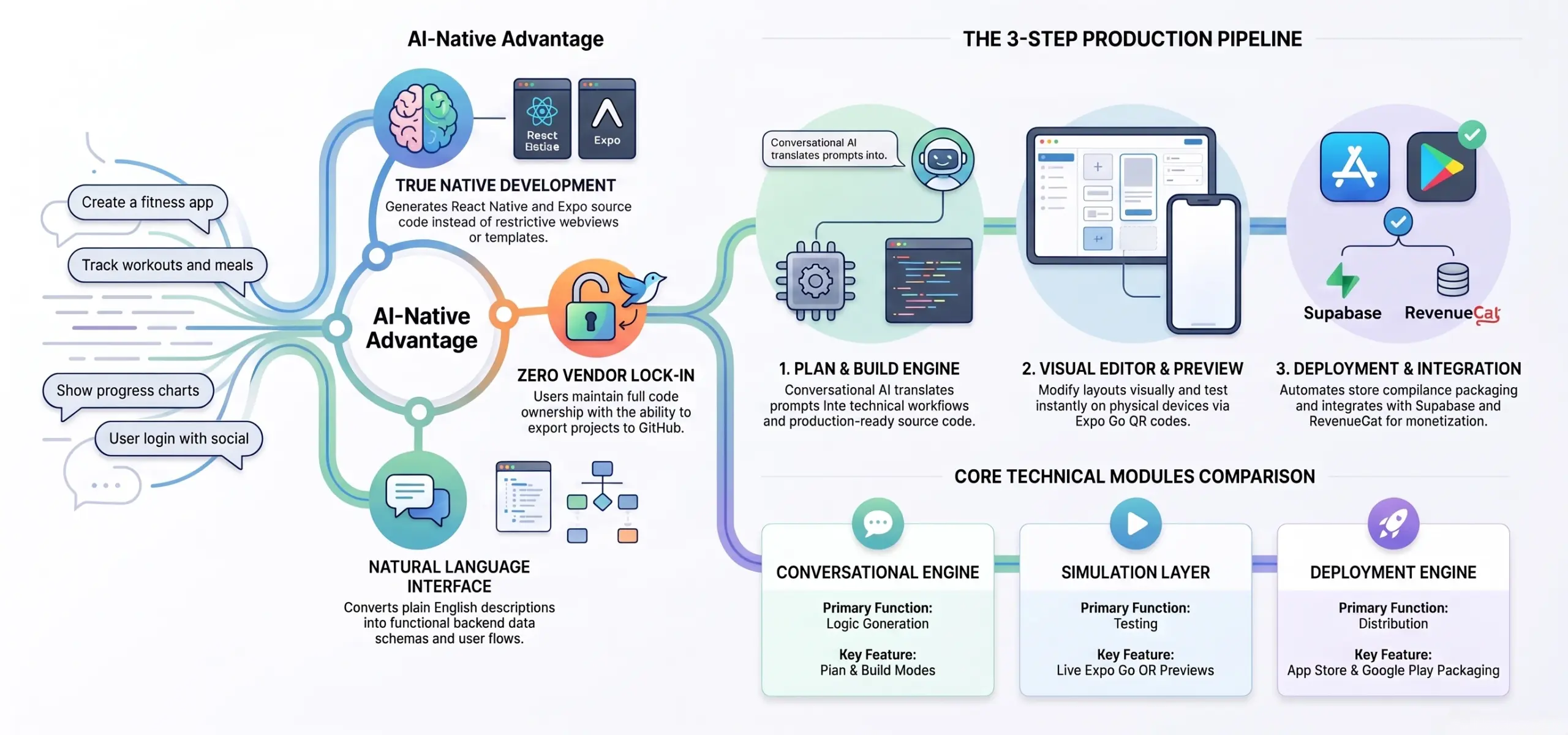
The platform architecture of Newly AI centers on translating text prompts into production-ready software, generating revenue through a usage-based software-as-a-service (SaaS) financial structure. Newly AI works by linking three critical modules together to take an app from an idea to a live store listing:
- The Conversational Engine (Plan & Build Modes): This engine converts natural language into technical workflows. In Plan Mode, it defines backend data schemas and user flows. In Build Mode, it generates the React Native and Expo source code required to build the application.
- The Visual Editor & Simulation Layer: This layer allows users to visually modify layouts, colors, and spacing without rewriting prompts. It also integrates with Expo Go, generating a live QR code so applications can be previewed and tested instantly on physical iOS and Android devices.
- The Deployment and Integration Engine: This engine automates Store Compliance by packaging applications into production builds, generating App Store and Google Play assets, and configuring integrations with services such as Supabase (databases) and RevenueCat (monetization).
B. How AI Mobile App Builder Like Newly Make Money
The structural revenue breakdown below illustrates how AI app builder like Newly AI’s commercial tiers monetize their underlying components:
| Monetization Stream | Pricing / Structure | Core Components Unlocked | Target Audience |
| Starter Subscription | $25 / month | • Conversational Engine (50 base credits)• Live Expo Go simulation layer• Core APK/AAB build exports | Solopreneurs, indie hackers, and early-stage MVP testing. |
| Professional Tier | $60 – $200 / month (Estimated) | • Multiplied monthly prompt credit pool• Advanced continuous GitHub sync• Pre-built data-scaling pipelines | Growing startups and boutique development agencies. |
| Metered Top-ups | Pay-as-you-go | • Raw AI generation compute tokens• Extra iterative code-refining prompts | Active power users who exceed their monthly credit limits. |
| Enterprise / Business | $200 – $500+ / month | • Automatic heavy GDPR/Accessibility checks• Multi-seat team collaboration dashboards• SLA deployment guarantees | Regulated industries, corporate builders, and scaled companies. |
How This Strategy Guarantees Profitability
The AI app builder like Newly’s pricing strategy is designed to balance user accessibility with sustainable revenue generation. By aligning monetization with infrastructure usage instead of feature restrictions, the platform effectively controls operational costs while maximizing long-term profitability.
- Protects Margins Against “Vibe Coding” Spikes: By limiting its base plan to 50 credits, it controls excessive AI token usage and repeated application rewrites. Users with higher AI usage are moved to metered top-up plans, helping manage infrastructure costs.
- Monetizes Infrastructure Over Logic: Instead of charging for features, the platform provides full code generation upfront and monetizes deployment infrastructure, including automated native store compliance, reducing developers’ manual deployment effort.
Why AI-Native Mobile Builders Are Replacing No-Code Apps
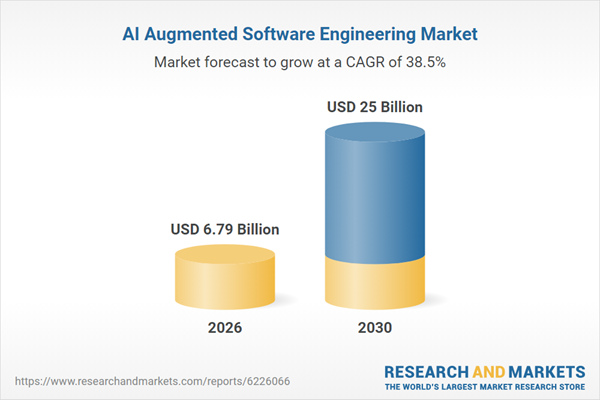
The mobile app development market is shifting from drag-and-drop no-code tools to AI-native, text-driven workspaces. This momentum is reflected in the AI-augmented software engineering market, which is projected to grow from USD 4.64 billion in 2025 to USD 6.79 billion in 2026, at a 46.4% CAGR, driven by increasing adoption of AI-powered software development.
Platforms like Newly are replacing rigid visual builders by using natural language to generate production-grade software. Backed by a 95% requirement-understanding accuracy, the platform automatically writes over 10,000 lines of clean React Native code in seconds while configuring a production-grade Supabase backend.
This shift allows teams to generate initial applications in just 2 to 5 minutes and achieve market-ready deployment in 1 to 3 days, shortening traditional MVP launch timelines by a massive 90% compared to traditional manual development.
A. Why Businesses Are Moving Beyond Drag-and-Drop Builders
While early graphical app builders initially democratized basic web prototyping, they have increasingly become an operational bottleneck for modern enterprise deployment.
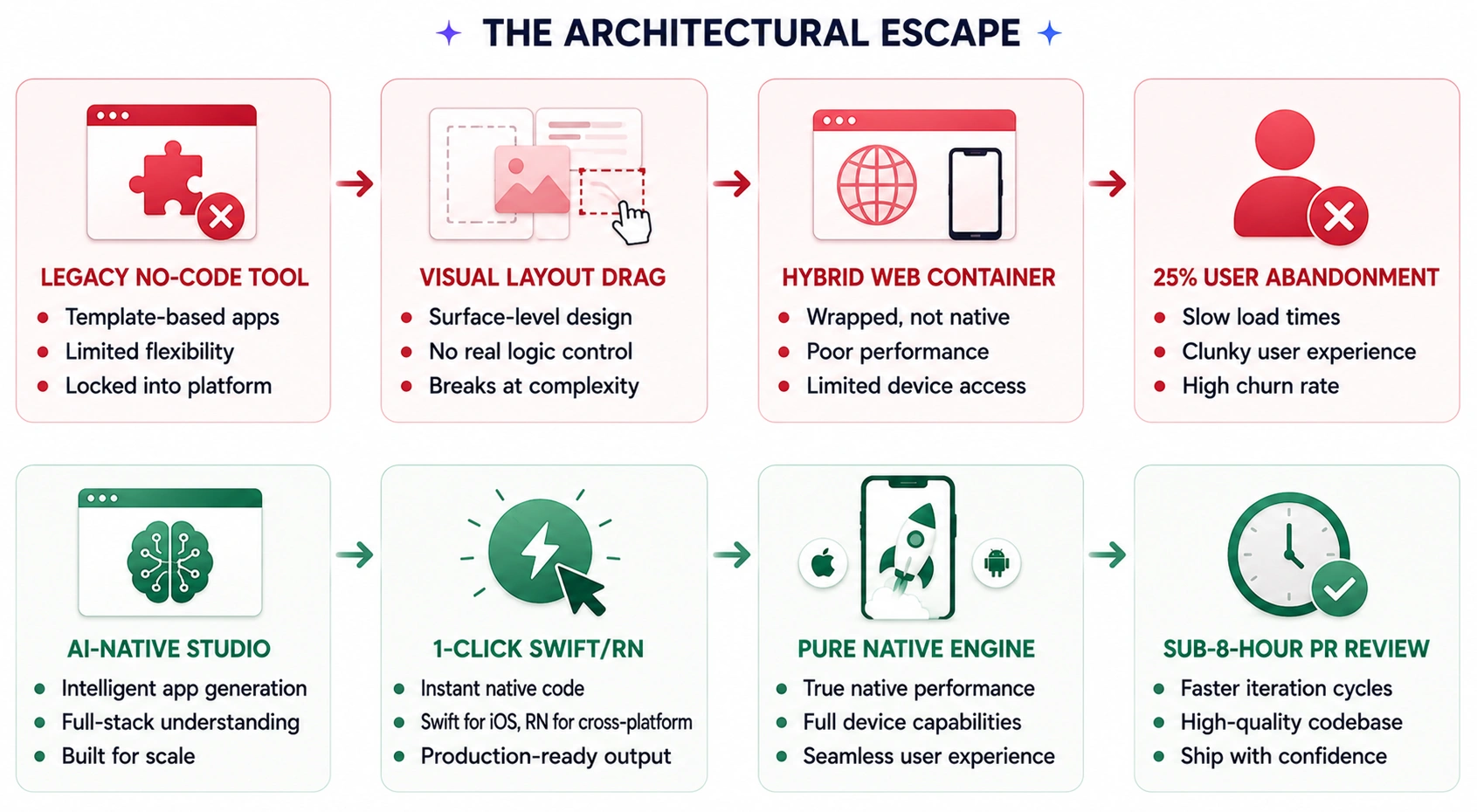
These limitations have accelerated demand for AI-native development platforms that deliver greater flexibility, ownership, and end-to-end automation across application development workflows.
- Breaking Free from the “80% Feature Wall”: Traditional drag-and-drop builders handle simple interfaces but struggle with third-party integrations, complex business logic, and database triggers. AI-native platforms overcome these limitations by generating production-ready code.
- The Nightmare of Proprietary Ecosystem Lock-In: Legacy low-code platforms lock applications into proprietary hosting. AI-native development platforms generate exportable codebases that teams can download, self-host, and audit, ensuring full code ownership.
- Eradicating Disparate Visual Tool Sprawl: Instead of using separate tools for user flow planning, prototyping, backend setup, and competitive research, a unified workspace consolidates these workflows, reducing infrastructure maintenance costs by 30%.
B. Native Apps vs. Webview-Based No-Code Platforms
The underlying technical architecture of a mobile application directly determines its performance, store compliance, and ability to keep users engaged over time. While legacy no-code platforms rely on restrictive web shells, AI workspaces write production-grade frameworks that communicate directly with device operating systems.
The table below contrasts the technical differences between webview containers and native mobile architectures:
| Technical Dimension | Legacy Webview No-Code Platforms | AI-Native App Studios (Swift / React Native) | Commercial & Engineering Impact |
| Rendering Speed & Core Animation | Rely on HTML5 web wrappers that reduce UI performance. | Compile to native UI, delivering 60–120 FPS. | Reduces UI lag and helps lower the 25% first-day user drop-off rate. |
| Hardware & Machine Learning Access | Limited hardware access through web bridges. | Direct access to device hardware via Apple Core ML for on-device AI. | Improves performance while reducing cloud API costs. |
| Code Portability & Data Ownership | Applications remain locked in proprietary platforms. | Generate exportable, modular codebases with full ownership. | Enables IP ownership and independent scaling. |
| App Store Compliance Loops | Higher risk of App Store rejections due to non-native behavior. | Generate code aligned with Apple’s Human Interface Guidelines (HIG). | Supports up to 94% first-time App Store approval rates. |
C. Growing Demand for Production-Ready AI Development
Faced with compressed feature delivery timelines and a shortage of senior mobile engineering talent, modern enterprises are accelerating development with AI mobile app builder platforms while partnering with Elastic Engineering Teams to scale and continuously enhance their products.
- Eliminating Long Corporate IT Queues: Instead of waiting 6–12 months for centralized engineering teams, natural language development platforms enable product managers to build, test, and deploy internal mobile applications 14× faster than traditional development pipelines.
- The Reality of High Initial Compilation Success: Closed-loop agentic environments continuously test, audit, and validate code before execution. When compilation errors occur, Agent Mode autonomously analyzes logs and repairs code, achieving 85% initial compilation success rates.
- Compressing the Code Pull Request Lifecycle: By unifying testing, compilation, and scaffolding in a cloud-native workspace, modern AI agent studios reduce pull request (PR) cycle times to under 8 hours, significantly outperforming traditional multi-day review cycles.
Business Use Cases of an AI Mobile App Builder Like Newly
AI-native mobile app builders are transforming how businesses create and launch digital products. By combining prompt-driven development with production-ready infrastructure, they enable faster development of MVPs and scalable applications, helping organizations innovate quickly, streamline operations, and support diverse business models.
A. Business Apps You Can Build With AI Mobile Builders
Modern AI mobile app builders are designed to support a wide variety of use cases beyond simple prototypes. Their ability to generate native applications, backend infrastructure, authentication, and deployment workflows makes them suitable for building scalable business applications across multiple industries.
| Business App | How AI Mobile App Builders Accelerate Development |
| AI Fitness Apps | Build workout planners, activity tracking, AI coaching, subscriptions, user authentication, and progress dashboards without manually developing every feature from scratch. |
| Healthcare Apps | Create telehealth platforms, appointment booking, patient portals, health records, secure authentication, and healthcare workflows with significantly reduced development effort. |
| Food Delivery Apps | Develop customer ordering systems, restaurant dashboards, delivery tracking, online payments, notifications, and order management through AI-assisted development. |
| Marketplace Apps | Generate buyer-seller marketplaces with product listings, messaging, reviews, payments, admin dashboards, and inventory management using automated workflows. |
| Fintech Apps | Build digital wallets, payment platforms, expense trackers, subscription management, KYC workflows, and financial dashboards while reducing engineering complexity. |
| CRM Apps | Develop customer management platforms featuring lead tracking, sales pipelines, workflow automation, analytics dashboards, and team collaboration tools. |
| Education Apps | Create eLearning platforms with course management, quizzes, certifications, progress tracking, subscriptions, and interactive learning experiences. |
| Employee Apps | Develop HR platforms, attendance management, task tracking, internal communication, document sharing, and employee self-service applications with AI-generated workflows. |
These examples highlight the versatility of AI mobile app builders across industries. Beyond use cases, it’s equally important to understand which businesses and teams gain the most value from adopting this approach.
B: Businesses That Benefit Most From AI Mobile App Builders
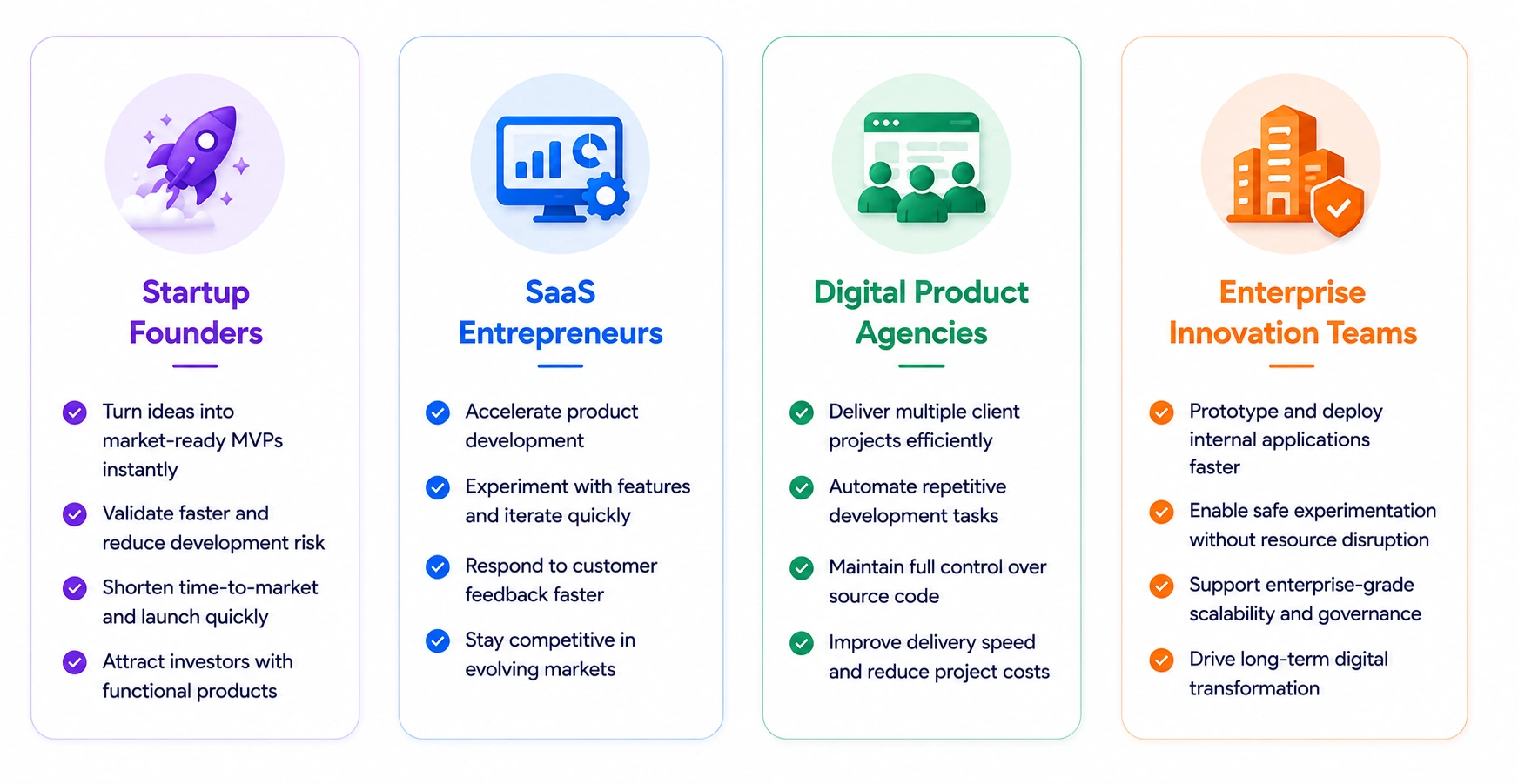
While AI-native mobile app builders simplify software development for anyone, they deliver the greatest value to organizations that need to validate ideas quickly, reduce engineering costs, and launch production-ready mobile applications at scale.
1. Startup Founders
Startup founders can rapidly transform product ideas into market-ready MVPs without assembling a large engineering team. Faster validation helps reduce development risk, shorten launch timelines, and attract investors with functional products instead of prototypes.
2. SaaS Entrepreneurs
SaaS entrepreneurs can accelerate product development, experiment with new features, and iterate continuously using AI-assisted workflows. This allows businesses to launch faster, respond to customer feedback quickly, and remain competitive in rapidly evolving markets.
3. Digital Product Agencies
Agencies can manage multiple client projects more efficiently by automating repetitive development tasks while maintaining full control over the generated source code. This improves delivery speed, reduces project costs, and increases overall development capacity.
4. Enterprise Innovation Teams
Enterprise innovation teams can prototype, validate, and deploy internal applications without disrupting existing engineering resources. AI-powered development enables faster experimentation while supporting enterprise-grade scalability, governance, and long-term digital transformation initiatives.
Core Features That Power AI Mobile App Builders Like Newly
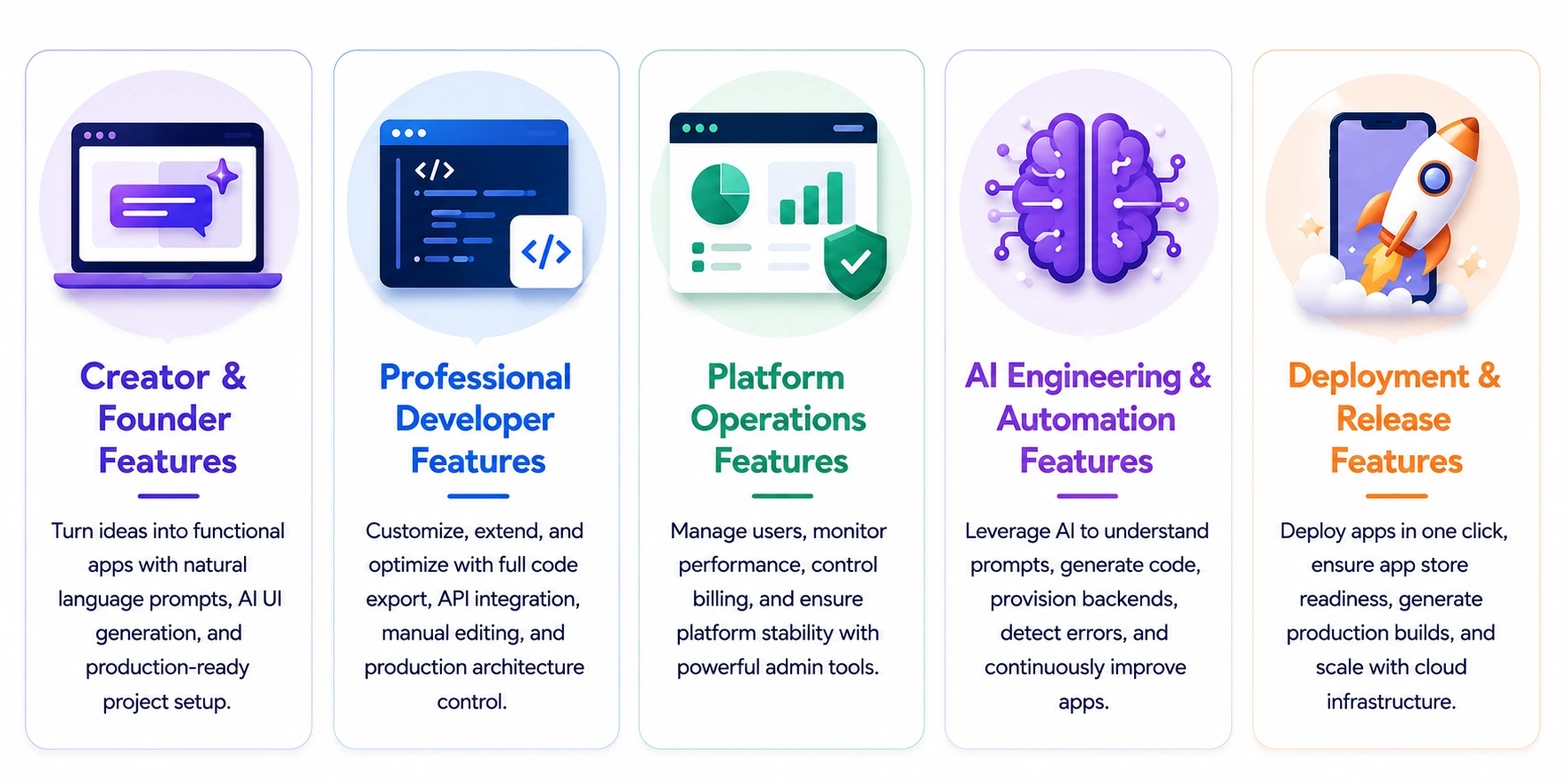
The success of an AI app builder like Newly comes from integrating app creation, backend infrastructure, deployment, and developer flexibility into one intelligent ecosystem. Below are the five feature pillars that enable founders, developers, and teams to build, manage, deploy, and scale production-ready mobile apps faster with AI.
A. Creator & Founder Features (Prompt-to-App Workspace)
The prompt-to-app workspace is the foundation of an AI mobile app builder, giving founders, entrepreneurs, and product teams a simple way to transform ideas into functional applications. By eliminating technical barriers, these features accelerate product validation while ensuring every project starts with a scalable, production-ready architecture.
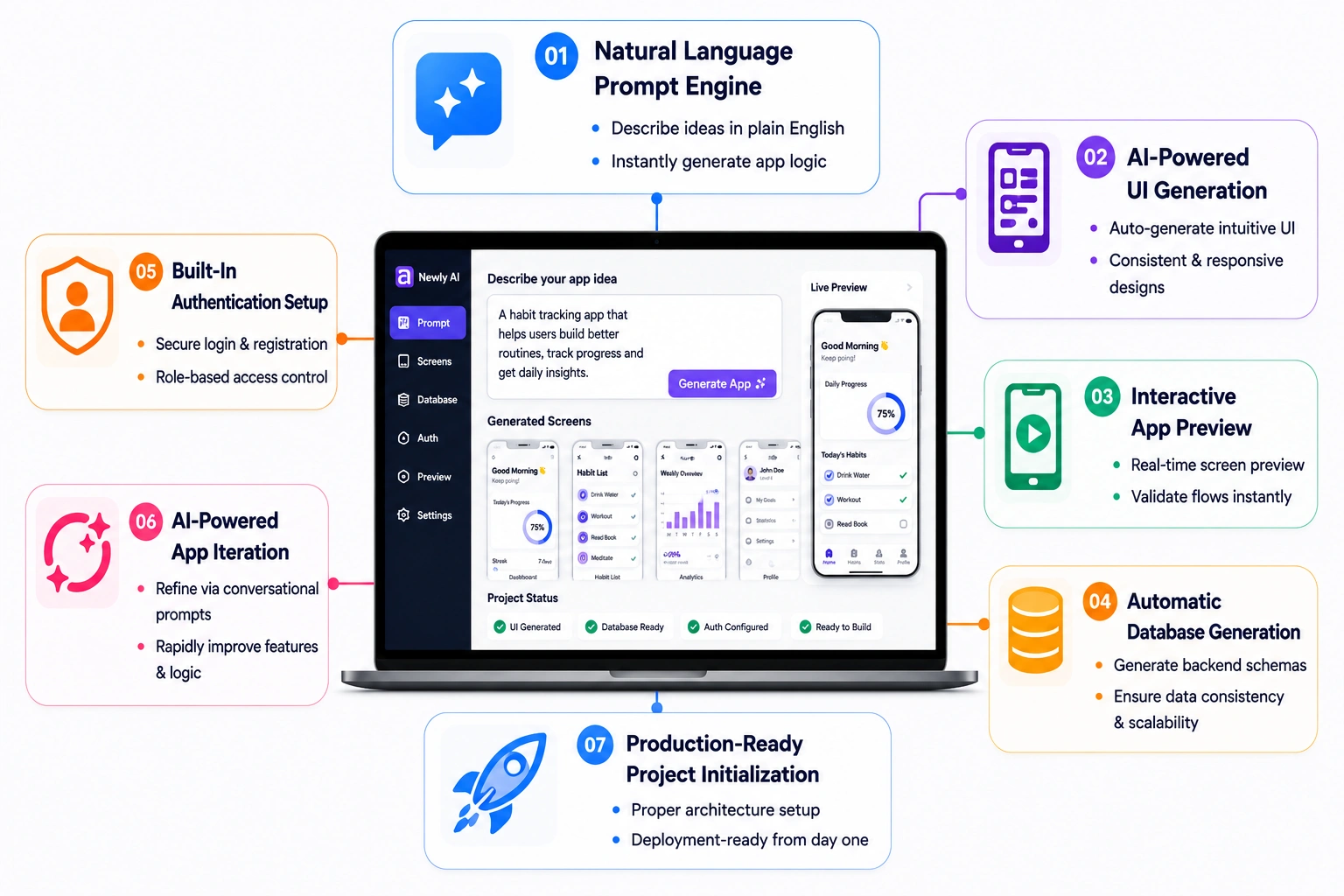
1. Natural Language Prompt Engine
A natural language prompt engine enables users to describe their app idea in plain English and instantly generate application logic. It dramatically reduces development complexity, making rapid product creation accessible while establishing a strong foundation for production-ready software.
2. AI-Powered UI Generation
AI-powered UI generation automatically creates intuitive mobile interfaces based on user requirements, eliminating repetitive design work. This accelerates development, ensures design consistency, and delivers responsive, production-ready user experiences that require significantly fewer manual adjustments.
3. Interactive App Preview
An interactive app preview lets users instantly visualize generated screens and user flows before deployment. Real-time validation speeds decision-making, minimizes costly revisions, and helps businesses refine products early for a polished production-ready application.
4. Automatic Database Generation
Automatic database generation creates structured backend schemas based on app requirements without manual setup. This ensures data consistency, accelerates backend development, and provides a scalable foundation essential for building reliable, production-ready mobile applications.
5. Built-In Authentication Setup
Built-in authentication setup enables secure user login, registration, and access control without complex coding. It ensures compliance with security standards, reduces development time, and provides a critical foundation for production-ready applications handling user data.
6. AI-Powered App Iteration
AI-powered app iteration allows users to refine features, layouts, and logic through conversational prompts. This continuous improvement capability accelerates development cycles and ensures the final product evolves into a polished, production-ready application.
7. Production-Ready Project Initialization
Production-ready project initialization sets up the app with proper architecture, dependencies, and configurations from the start. This eliminates rework, ensures scalability, and prepares the application for seamless transition into development and deployment stages.
As projects mature beyond initial creation, developers require deeper control and customization capabilities, making advanced development tools essential for refining, scaling, and optimizing applications for real-world production environments.
B. Professional Developer Features (Advanced Build Studio)
Professional developer features provide the flexibility and control needed to customize, extend, and optimize AI-generated applications. These capabilities ensure that developers can refine outputs, integrate advanced functionality, and maintain production-grade standards throughout the development lifecycle.
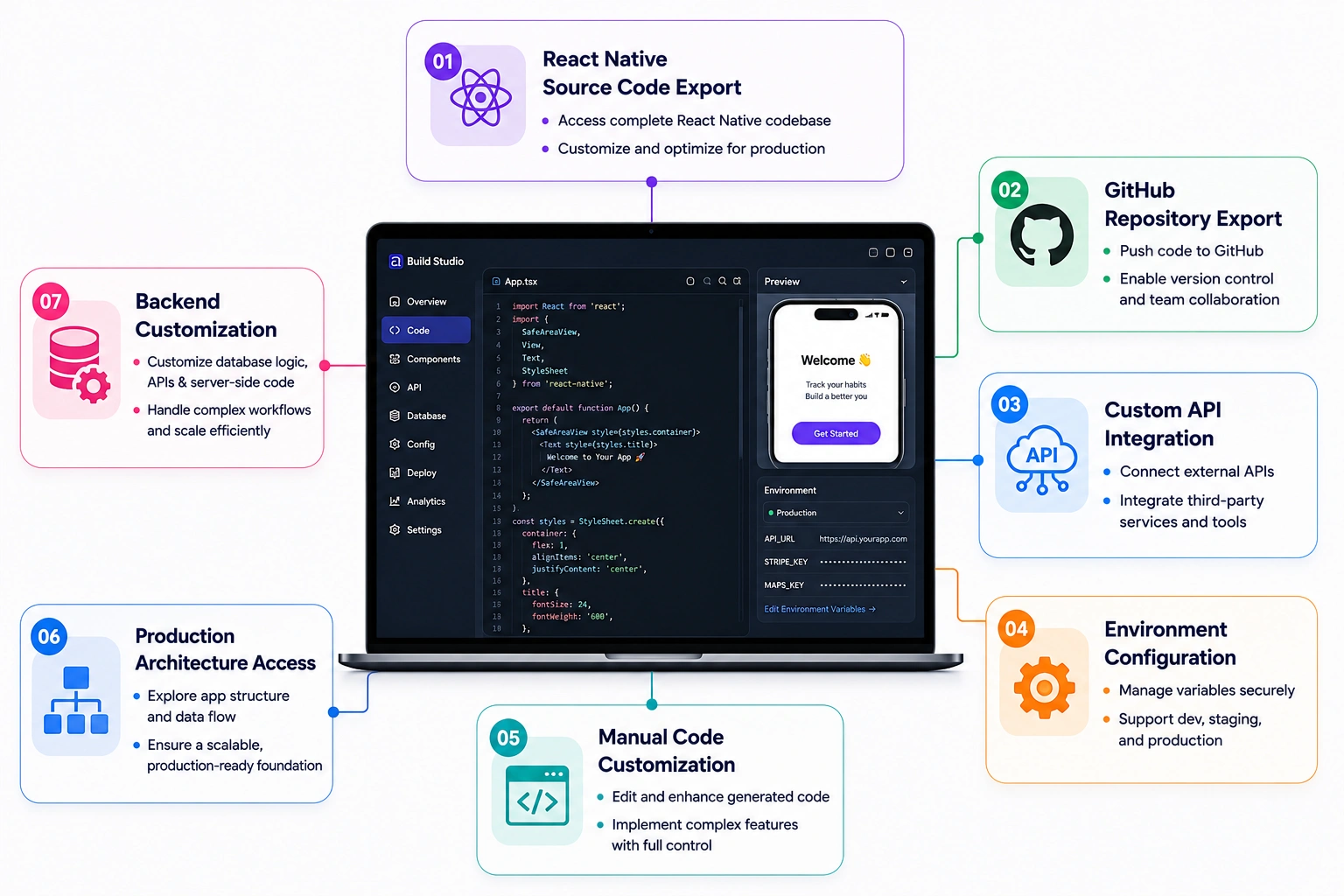
1. React Native Source Code Export
React Native source code export allows developers to access and modify the complete application codebase. This ensures flexibility, enables advanced customization, and guarantees that the app can be optimized for performance and production requirements.
2. GitHub Repository Export
GitHub repository export enables seamless version control and collaboration by pushing generated code to a repository. This supports team workflows, ensures code traceability, and aligns the project with standard production development practices.
3. Custom API Integration
Custom API integration allows developers to connect external services, payment gateways, and third-party tools. This expands application functionality, supports business-specific requirements, and ensures the app is fully equipped for real-world production use.
4. Environment Configuration
Environment configuration enables developers to manage variables, credentials, and deployment settings across development and production environments. This ensures secure operations, reduces errors, and supports smooth transitions between testing and live deployment.
5. Manual Code Customization
Manual code customization provides developers with full control to edit and enhance generated code. This ensures flexibility, supports complex feature implementation, and allows the application to meet specific production-level requirements.
6. Production Architecture Access
Production architecture access gives developers visibility into app structure, backend services, and data flow. This enables optimization, improves maintainability, and ensures the application is built on a scalable, production-ready foundation.
7. Backend Customization
Backend customization allows developers to modify database logic, APIs, and server-side processes. This ensures the application can handle complex workflows, scale efficiently, and meet advanced production requirements.
Beyond development flexibility, managing platform operations becomes critical to ensure scalability, reliability, and seamless user experiences across multiple projects and users within the ecosystem.
C. Platform Operations Features (Admin Control Center)
Platform operations features enable administrators to manage users, monitor system performance, and maintain platform stability. These capabilities are essential for ensuring smooth operations, optimizing resource usage, and delivering a reliable experience for all users.
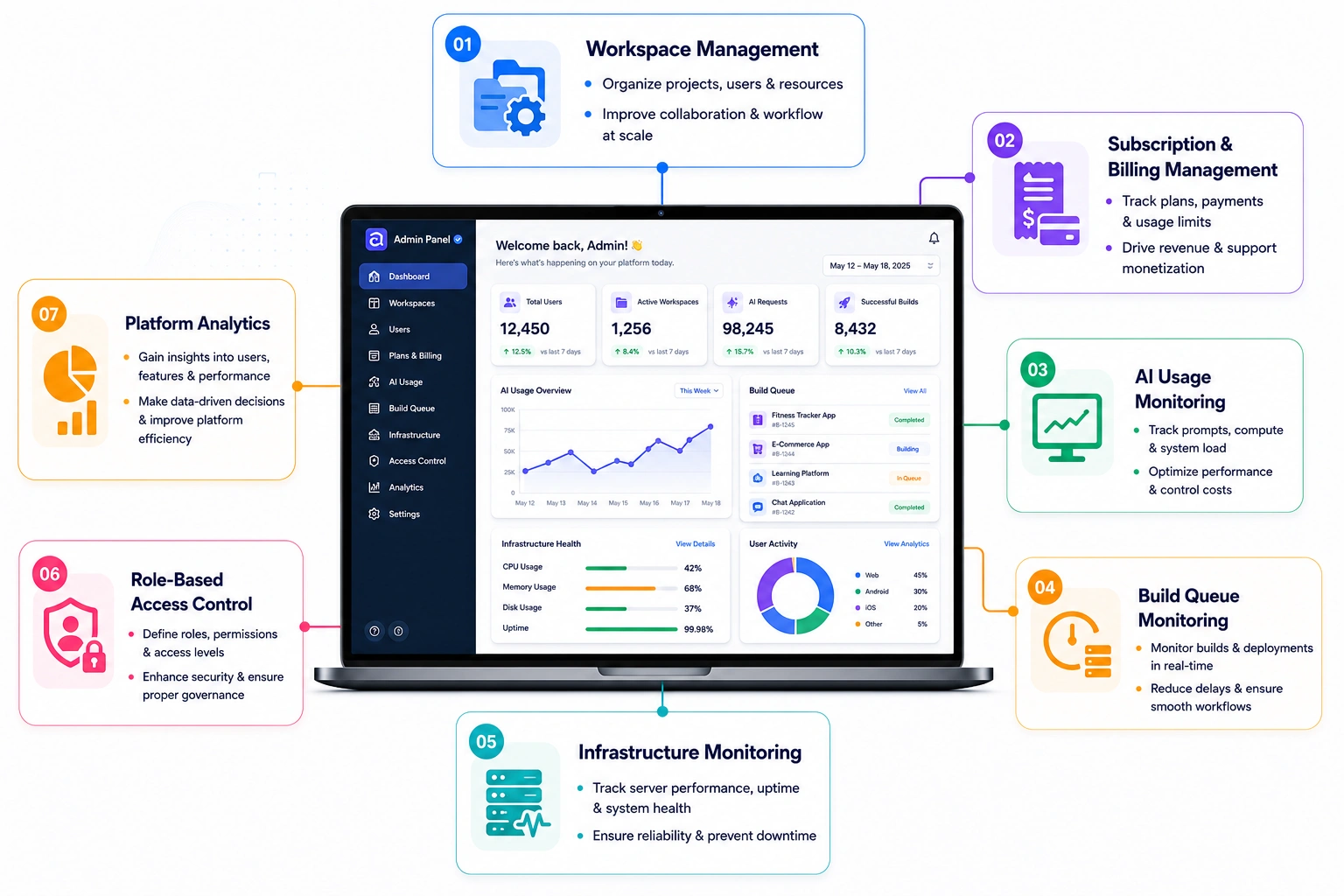
1. Workspace Management
Workspace management allows administrators to organize projects, users, and resources efficiently. This improves collaboration, ensures structured workflows, and supports scalable platform operations for production-level usage.
2. Subscription & Billing Management
Subscription and billing management enables tracking of user plans, payments, and usage limits. This ensures revenue control, supports monetization strategies, and maintains a sustainable production-ready platform.
3. AI Usage Monitoring
AI usage monitoring tracks prompt usage, compute consumption, and system load. This helps optimize performance, control costs, and ensure efficient resource allocation across the platform.
4. Build Queue Monitoring
Build queue monitoring provides visibility into app generation and deployment processes. This ensures timely execution, reduces delays, and maintains a smooth production workflow for users.
5. Infrastructure Monitoring
Infrastructure monitoring tracks server performance, uptime, and system health. This ensures reliability, prevents downtime, and maintains a stable production environment.
6. Role-Based Access Control
Role-based access control enables administrators to define user permissions and access levels. This enhances security, ensures proper governance, and supports enterprise-level platform management.
7. Platform Analytics
Platform analytics provides insights into user behavior, feature usage, and system performance. This helps improve decision-making, optimize features, and enhance overall platform efficiency.
With operational stability in place, the next layer focuses on the intelligence driving the platform, where AI systems automate development processes and continuously enhance application quality.
D. AI Engineering & Automation Features
AI engineering and automation features power the intelligence behind app generation, enabling seamless transformation of ideas into functional applications. These capabilities ensure accuracy, efficiency, and continuous improvement throughout the development lifecycle.
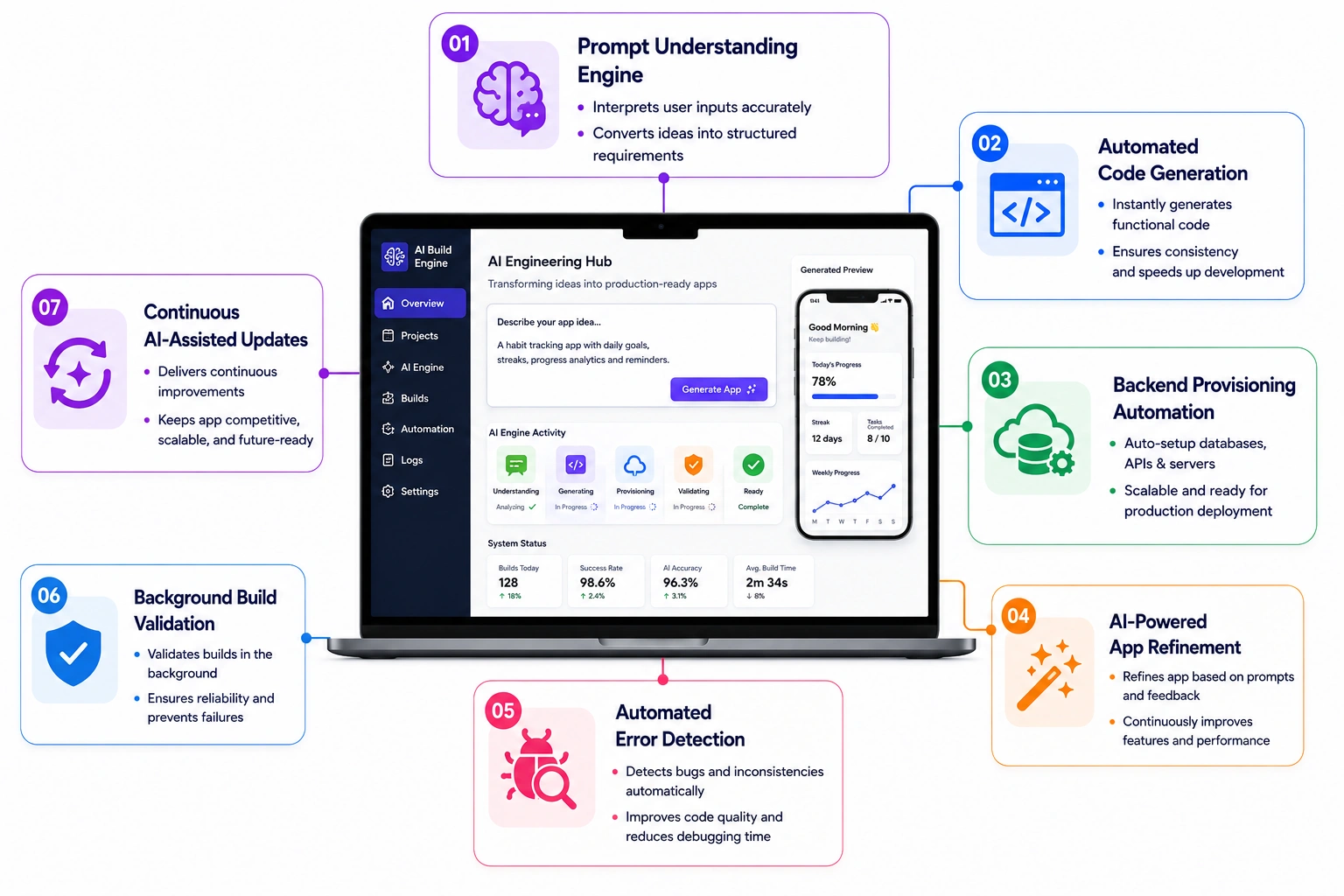
1. Prompt Understanding Engine
The prompt understanding engine interprets user inputs and converts them into structured development requirements. This ensures accurate app generation, reduces errors, and forms the foundation of reliable AI-driven development.
2. Automated Code Generation
Automated code generation transforms requirements into functional application code instantly. This accelerates development, reduces manual effort, and ensures consistency across production-ready applications.
3. Backend Provisioning Automation
Backend provisioning automation sets up databases, APIs, and server configurations automatically. This eliminates manual setup, ensures scalability, and prepares the application for production deployment.
4. AI-Powered App Refinement
AI-powered app refinement continuously improves application features based on user feedback and prompts. This ensures the app evolves efficiently and meets production-level expectations.
5. Automated Error Detection
Automated error detection identifies bugs and inconsistencies during development. This improves code quality, reduces debugging time, and ensures a stable production-ready application.
6. Background Build Validation
Background build validation checks application integrity during generation and updates. This ensures reliability, prevents failures, and maintains production standards.
7. Continuous AI-Assisted Updates
Continuous AI-assisted updates enable ongoing improvements and feature enhancements. This ensures the application remains competitive, scalable, and aligned with evolving production requirements.
Finally, once applications are built and refined, robust deployment and release capabilities ensure they can be launched efficiently, scaled reliably, and maintained effectively in real-world environments.
E. Deployment & Release Features
Deployment and release features ensure that applications built using AI platforms can be launched, distributed, and scaled efficiently. These capabilities are critical for transitioning from development to real-world usage while maintaining performance and reliability.
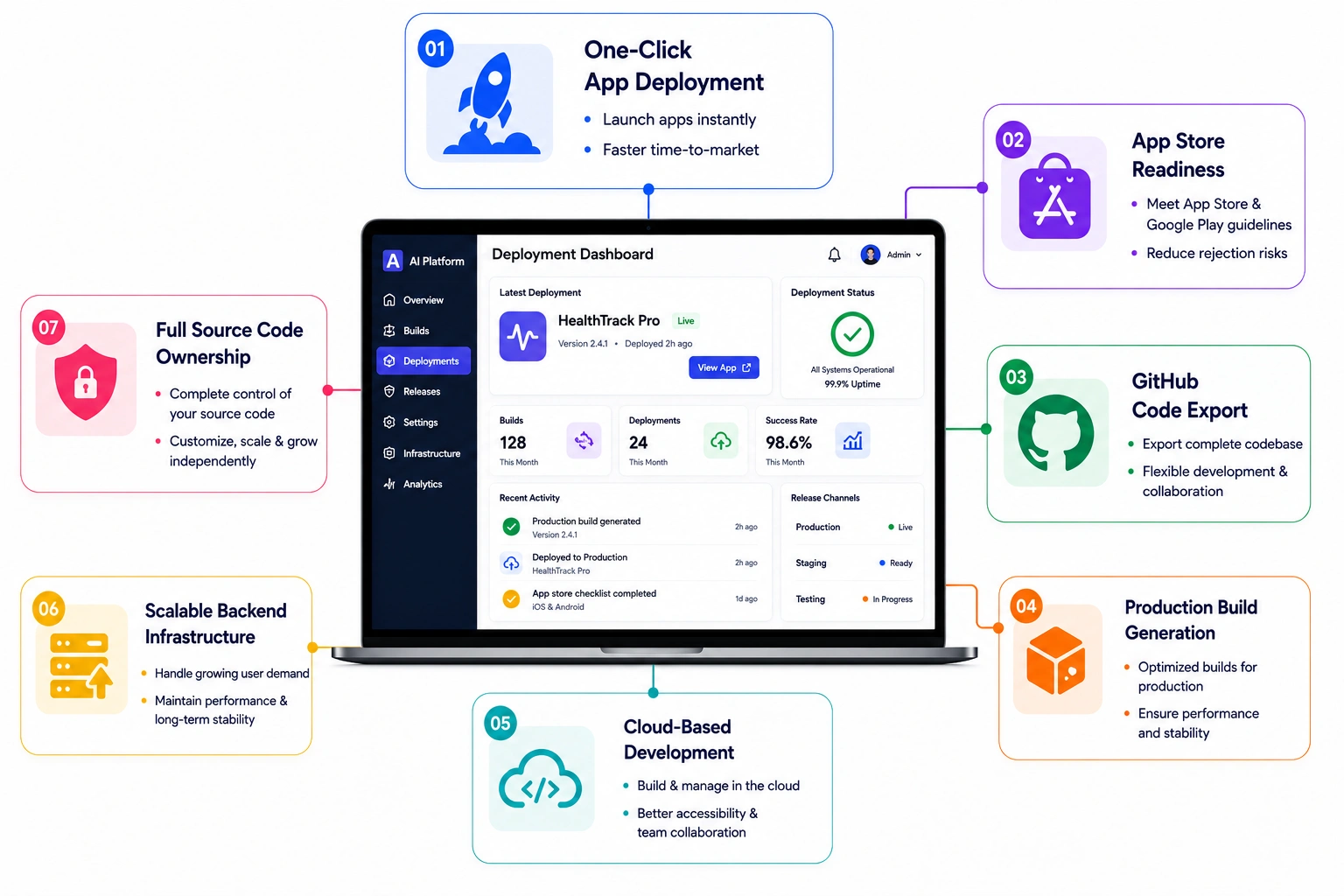
1. One-Click App Deployment
One-click app deployment allows users to launch applications instantly without complex configurations. This accelerates time-to-market and ensures a smooth transition from development to production.
2. App Store Readiness
App store readiness ensures applications meet guidelines for submission to platforms like Apple App Store and Google Play. This reduces rejection risks and speeds up the release process.
3. GitHub Code Export
GitHub code export provides access to the complete codebase for further development and collaboration. This ensures flexibility and aligns with standard production workflows.
4. Production Build Generation
Production build generation creates optimized application builds ready for deployment. This ensures performance, stability, and compatibility with production environments.
5. Cloud-Based Development
Cloud-based development enables users to build and manage applications without local setup. This improves accessibility, supports collaboration, and ensures scalable development workflows.
6. Scalable Backend Infrastructure
Scalable backend infrastructure ensures applications can handle increasing user demand. This supports growth, maintains performance, and ensures long-term production stability.
7. Full Source Code Ownership
Full source code ownership gives users complete control over their applications. This ensures flexibility, supports customization, and allows businesses to scale independently in production environments.
Feature-Wise Cost to Build an AI App Builder Like Newly
The development cost of an AI app maker platform depends largely on the capabilities you choose to build. While core prompt-to-app functionality requires a lower investment, AI code generation, cloud infrastructure, developer tooling, and enterprise-grade automation significantly increase development complexity and the overall project budget.
A. Core MVP Features & Estimated Cost
An MVP focuses on building the essential capabilities required to transform natural language prompts into production-ready mobile applications. These core features help validate your platform, onboard early users, and demonstrate the value of AI-powered app development before investing in advanced automation and enterprise-scale infrastructure.
| Core MVP Feature | Estimated Cost | What the Feature Includes |
| Prompt-to-App Engine | $15,000 – $30,000 | Natural language prompt processing, AI workflow orchestration, application generation, and project initialization. |
| Native UI Generation | $12,000 – $25,000 | AI-generated React Native screens, navigation, layouts, reusable components, and responsive interface creation. |
| Backend Generation | $10,000 – $22,000 | Automatic database setup, API generation, authentication, backend provisioning, and data models. |
| AI Editing Workspace | $10,000 – $20,000 | Conversational app editing, feature refinement, prompt-based updates, and iterative application improvements. |
| Project Management Dashboard | $8,000 – $15,000 | Workspace management, project organization, build history, version tracking, and collaboration tools. |
| Deployment Pipeline | $10,000 – $20,000 | Production builds, App Store and Google Play deployment, release configuration, and publishing automation. |
Estimated MVP Development Cost: $90,000 – $160,000
Note: An MVP enables businesses to validate market demand, launch an AI-powered mobile app builder quickly, and gather user feedback before investing in advanced AI engineering, enterprise infrastructure, and large-scale automation capabilities.
B. Advanced AI Features & Estimated Cost
Once the MVP demonstrates market traction, businesses typically invest in advanced AI capabilities that improve code quality, automate development workflows, enhance developer flexibility, and create a more competitive AI-native mobile app development platform.
| Advanced Feature | Estimated Cost | What the Feature Includes |
| AI Code Generation Engine | $20,000 – $40,000 | Production-ready React Native code generation, business logic creation, and intelligent software engineering workflows. |
| AI Debugging & Error Resolution | $12,000 – $25,000 | Automated bug detection, intelligent debugging, code optimization, and error resolution workflows. |
| GitHub Integration | $8,000 – $15,000 | Repository export, version control, collaborative development, and seamless code synchronization. |
| Custom API Builder | $10,000 – $18,000 | Third-party API integration, custom endpoints, external service connectivity, and workflow automation. |
| Backend Customization | $12,000 – $22,000 | Database modifications, server-side logic, business rules, and advanced backend configuration. |
| AI Prompt Optimization | $8,000 – $18,000 | Enhanced prompt interpretation, contextual understanding, response refinement, and generation accuracy improvements. |
| Build Validation Engine | $10,000 – $20,000 | Automated testing, build verification, quality assurance, and production readiness validation. |
Note: These advanced capabilities improve application quality, reduce manual development effort, and enable businesses to deliver a more intelligent, scalable, and developer-friendly AI mobile app building experience.
C. Enterprise Features & Estimated Cost
Enterprise AI mobile app builders require highly scalable infrastructure, advanced security, operational visibility, and intelligent resource management to support large organizations, thousands of concurrent users, and complex AI-powered development workloads.
| Enterprise Feature | Estimated Cost | What the Feature Includes |
| Multi-Tenant Architecture | $20,000 – $40,000 | Independent workspaces, organization management, tenant isolation, and centralized administration. |
| AI Compute Management | $15,000 – $35,000 | GPU allocation, token usage tracking, workload optimization, and intelligent resource management. |
| Enterprise Security | $15,000 – $30,000 | Role-based access, encryption, audit logs, single sign-on, and enterprise security controls. |
| Infrastructure Monitoring | $12,000 – $25,000 | Server monitoring, uptime tracking, build monitoring, performance optimization, and health reporting. |
| Enterprise Analytics | $10,000 – $20,000 | Platform insights, AI usage analytics, business intelligence dashboards, and operational reporting. |
| CI/CD Automation | $15,000 – $30,000 | Automated build pipelines, deployment workflows, release management, and continuous delivery processes. |
Note: Enterprise investments prepare AI development platforms to support large-scale user adoption, enterprise customers, complex AI workloads, and long-term business growth while maintaining performance, security, and reliability.
D. Factors That Influence Development Cost
Beyond feature selection, several technical and business decisions can significantly influence the overall investment required to build an AI app builder like Newly. Understanding these variables helps businesses prioritize development while planning budgets more effectively.
- AI Model Integration: Integrating large language models, prompt orchestration systems, and AI inference pipelines can add $20,000-$50,000, depending on the complexity of the AI architecture and supported use cases.
- Native Code Generation Engine: Developing reliable AI-powered React Native code generation with production-quality outputs requires $20,000-$45,000, making it one of the most technically demanding components.
- Backend Automation & Infrastructure: Automatically generating databases, APIs, authentication, and backend services adds $15,000-$35,000, depending on customization and scalability requirements.
- Third-Party Integrations: Connecting GitHub, Supabase, Firebase, Stripe, cloud storage, analytics tools, and external APIs typically adds $10,000-$30,000, based on the number and complexity of integrations.
- Cloud Infrastructure & AI Compute: Supporting concurrent AI-generated builds, GPU workloads, scalable cloud infrastructure, and high availability can increase development costs by $15,000-$40,000.
- Security & Code Ownership: Implementing secure authentication, encryption, role-based permissions, source code ownership, and repository management adds $10,000-$30,000 while protecting both users and generated applications.
E. Estimated Budget by Platform Scale
The final investment depends on your platform’s overall scope, AI capabilities, and scalability requirements. Most businesses begin with an AI app builder like Newly MVP before expanding into advanced and enterprise-ready solutions as customer adoption and platform usage continue to grow.
| Platform Level | Estimated Cost | Key Features Included |
| MVP Platform | $90,000 – $160,000 | Prompt-to-app generation, native UI creation, backend automation, deployment pipeline, and project management dashboard. |
| Mid-Level Platform | $160,000 – $300,000 | AI code generation, GitHub integration, backend customization, advanced developer tools, automated testing, and AI optimization. |
| Enterprise Platform | $300,000 – $600,000+ | Multi-tenant architecture, enterprise security, AI compute management, infrastructure monitoring, CI/CD automation, and enterprise analytics. |
Note: The ideal investment depends on your business goals, target audience, AI capabilities, and long-term product roadmap. Many companies launch with an MVP to validate their platform before gradually introducing advanced AI engineering, enterprise infrastructure, and premium developer features as the business scales.
Challenges in Building an AI Mobile App Builder Platform
Building an AI app builder like Newly involves far more than integrating a large language model. Development teams must generate reliable production-ready code, orchestrate complex backend services, maintain native app performance, and support continuous scalability while delivering a seamless experience for both technical and non-technical users.
1. Consistent Production-Ready Code Generation
Challenge: Ensuring clean, scalable, and production-ready React Native code across diverse app requirements while minimizing bugs and maintaining consistent architecture.
Solution: Our developers combine LLM-powered code generation with predefined architecture patterns, validation pipelines, automated testing, and manual engineering reviews to ensure every generated application meets production-quality standards before deployment.
2. Automated Backend Infrastructure Orchestration
Challenge: Provisioning databases, authentication, APIs, storage, and business logic automatically while ensuring secure, reliable, and scalable backend architecture for every application.
Solution: We build intelligent backend orchestration engines that automate infrastructure provisioning, integrate managed backend services, validate configurations, and establish scalable architectures capable of supporting long-term application growth.
3. Native Performance Across Platforms
Challenge: Delivering consistently high performance on both iOS and Android while AI continuously generates, updates, and modifies application code throughout development.
Solution: Our engineers optimize generated React Native code, implement efficient state management, minimize unnecessary rendering, and conduct continuous performance testing to ensure smooth, native-quality user experiences across devices.
4. Scalable AI Workflows and Cloud Infrastructure
Challenge: Managing thousands of simultaneous AI requests, code generation jobs, and deployment pipelines without increasing latency, infrastructure costs, or platform instability.
Solution: We design cloud-native, distributed architectures with intelligent workload orchestration, auto-scaling infrastructure, asynchronous processing, and resource optimization strategies that maintain performance while supporting large-scale platform adoption.
Why Choose Idea Usher for AI Mobile App Builder Platform Development
IdeaUsher is a premier digital product engineering partner with 11+ years of experience building successful software across 50+ countries. Driven by a team of 250+ experts, over 1,000+ completed projects, and a 4.9/5 Clutch rating, we excel at turning big tech ideas into highly profitable SaaS platforms.
Instead of basic templates, we build high-performance, custom engines by combining intuitive drag-and-drop tools with advanced generative AI. We also help you launch a market-leading mobile app builder that gives your organization a clear competitive edge.
Why Enterprises Partner With Us
Business leaders choose us because we make app development completely simple for their users while keeping the underlying system fast, secure, and highly scalable.
- A Simple, Step-by-Step AI Guide: We build the platform to walk your users through a smooth, structured process from planning features to picking a layout, completely replacing confusing code screens with simple questions.
- Safe and Secure App Testing: We build an isolated virtual sandbox into your platform. This allows your users to instantly test and preview their newly generated apps in real time without any risk of slowing down your main servers.
- Smart, Error-Free App Creation: Our system uses advanced semantic filters to feed clean, well-organized instructions to the AI backend. This dramatically speeds up how fast it writes the software and stops it from making coding mistakes.
- Seamless Screen-to-Code Sync: We create a smart two-way bridge between the visual design tool and the actual code. If a user moves a button on the visual screen, the underlying code updates instantly without breaking anything.
Ready to change how mobile software is made with an easy-to-use, AI-powered app builder? Partner with IdeaUsher’s product experts to map out your platform design today.
Conclusion
AI-native mobile app builders are reshaping how businesses create, launch, and scale mobile applications by combining intelligent automation with production-ready development. AI app builder like Newly demonstrate how prompt-driven workflows, native app generation, integrated backend infrastructure, and full code ownership can dramatically accelerate product delivery. For businesses looking to create a similar platform, choosing the right development partner is just as important as selecting the right technology. At IdeaUsher, we help businesses turn ambitious AI product ideas into scalable, enterprise-ready mobile app platforms.
FAQs
A.1. Essential features in AI app builder like Newly include prompt-to-app generation, AI code creation, native app development, backend automation, authentication, GitHub integration, deployment automation, and full source code ownership for long-term flexibility.
A.2. The AI app builder like Newly development costs generally range from $90,000 for an MVP to over $600,000 for an enterprise platform, depending on AI capabilities, automation, infrastructure, integrations, scalability, and security requirements.
A.3. Startup founders, SaaS companies, digital agencies, enterprise innovation teams, and businesses launching custom mobile products benefit most by reducing development time, engineering costs, and accelerating product launches.
A.4. Full source code ownership allows businesses to modify, scale, migrate, and maintain applications independently. It eliminates vendor lock-in while providing complete flexibility for future feature development and technology upgrades.