

Key Takeaways
- Brazil’s new betting restrictions have made the online casino market uncertain for startups, with fixed-odds betting prohibited under a September 2026 measure.
- The previous licensing framework no longer provides a clear path for new operators to enter the market.
- Founders should verify the latest legal and court developments before investing in Brazil-specific products.
- They can still assess adaptable software components for use in other jurisdictions, subject to local rules.
- See how IdeaUsher can help startups plan and build adaptable casino software designed to handle market uncertainty and evolving jurisdictional requirements.
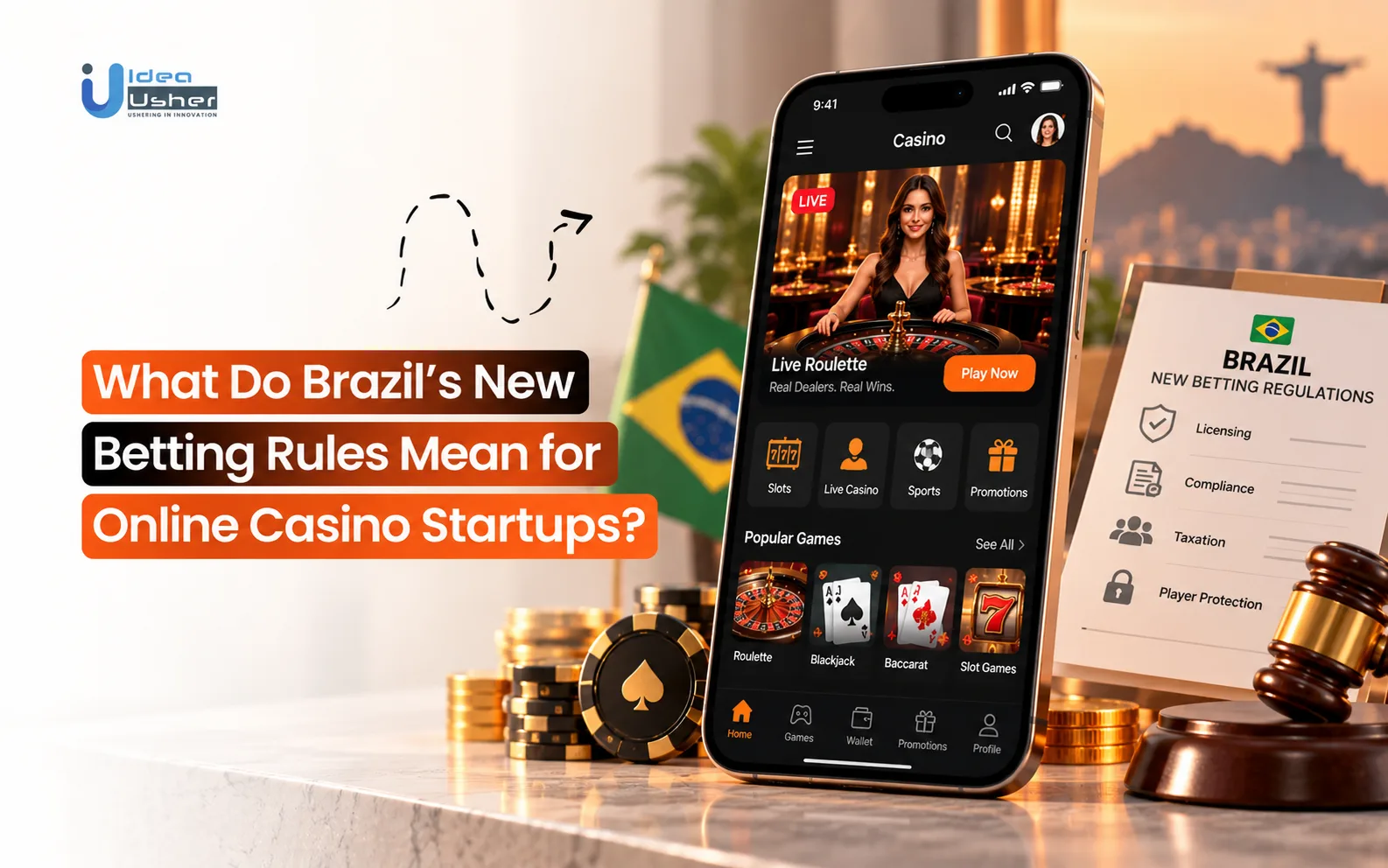
Brazil’s market for new online casino startups has effectively been shut. On September 25, President Luiz Inácio Lula da Silva signed a provisional measure banning fixed-odds betting nationwide, including its operation, intermediation, offering, and advertising. The order disrupts the licensed system created under Law No. 14.790, which had been operating since January 2025. Until the measure is confirmed, amended, or overturned, startups have no clear legal path to launch betting services in Brazil.
For many founders, this news landed hard. Brazil was seen as the big prize of Latin America, and plenty of teams had already spent months on licence plans. Now, those plans are on hold, and Congress must decide the measure’s future.
That leaves startups with a fair question about what to do next. Waiting is one option, but it carries risks. In this blog, we’ll discuss what Brazil’s new betting rules mean for online casino startups and how founders can keep their plans alive.
How Do Regulations Shape Casino Market Demand?
Rules decide where a casino startup can sell and how much money it keeps after taxes and checks. According to Custom Market Insights, the global online casino market was valued at USD 19.7 Bn in 2024 and is projected to reach USD 56.8 Bn by 2033, growing at a CAGR of 12.5%. Europe is the largest regional market and Asia-Pacific is growing fastest. A big market only helps if you have the right licence for that place. So the law shapes which countries you can target, what you pay to run, and which games you can offer.
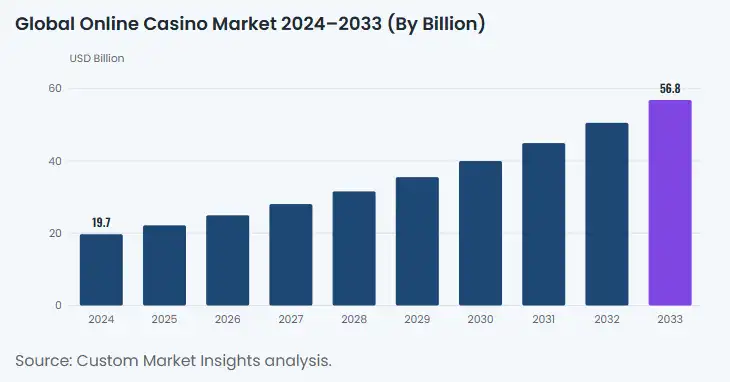
Source: Custom Market Insights
How Licensing Affects Market Entry
A licence is the ticket into a market. In the US each state makes its own rules, so a casino cannot just launch everywhere. Only seven states have live real money online casinos, Maine has approved an eighth, and 43 of 51 US jurisdictions have no legal online casino. Some states also keep the door small. Michigan, for example, has only 15 iGaming licensees. A startup that picks the wrong state can wait a long time or pay a lot for a small audience.
| Route | What it costs | Good to know |
| Malta (MGA) | €5,000 one-time application fee and €25,000 fixed yearly fee for a B2C licence | Usually takes 4 to 6 months |
| US state licence | Different in each state | Each state has its own rules and its own list of approved operators |
Example: Fanatics Casino
Fanatics already ran a sportsbook in the same places, so it could move fast. Fanatics Casino went live in Michigan, New Jersey, Pennsylvania and West Virginia, which are four of the seven live states. The app has FanaticsFire Roulette from its in-house Fanatics Game Studios. It also has live dealer blackjack, roulette and baccarat, plus Evolution’s Lightning Roulette. Later it added more games through Bragg’s remote gaming server, called the Bragg HUB. For the launch it ran a sweepstakes with $2 million in FanCash prizes, and a $10 wager earned one entry.
How Compliance Changes Operating Costs
Rules cost more than licence fees. They also change the product, and changing a product takes developer time and testing. The UK is a good case to look at.
What Changed in the UK
- Online slot bets are capped at £5 for adults and £2 for players aged 18 to 24.
- Non-slot games got a 5 second speed limit.
- Autoplay was banned on all online games.
- Operators cannot offer tools that let a player run more than one game at once.
The government said game teams would need to test and deploy the stake limit on live games. Some industry replies said the lower £2 cap alone could take more than nine months to build. That means a small startup has to plan for these jobs from day one. It is cheaper to build the rules into the product than to add them later.
Example: LeoVegas
LeoVegas shows how hard it gets when you run in many places. The group runs 9 brands in 9 jurisdictions. Every place has its own rules, so one setup for everything does not work. Its partner, OnAir Entertainment, made exclusive tables called LeoVegas Exclusive Roulette and BetMGM Exclusive Roulette. It later added Bellagio Blackjack, MGM Grand Blackjack and New York-New York Blackjack for players in the UK, Sweden, Denmark, Malta, the Netherlands and Ontario. Branded tables like these help a casino stand out even when the rules in each market look alike.
How Regulations Influence Player Demand
Very strict rules can push some players to unlicensed sites. Sweden is the best example. Its regulator says 84% of online play is on licensed sites, down 1% from the year before. For online casino alone, the web traffic method gave only 68%. The regulator says players leave for bigger bonuses, games the licensed market does not have, higher return to player and crypto. A Copenhagen Economics survey found that 58% of players would think about the black market because of bonus rules.
| Market | Play on licensed sites | What to notice |
| Sweden (all online) | 84% | Slipped 1% in a year |
| Sweden (online casino only) | 68% | Web traffic method |
| Netherlands | 93% | Down from 95% |
Tough rules do not always kill demand, though. After the UK stake caps began, monthly active slot accounts stayed at 4.4 million and the number of spins even rose 4%. So most players stayed with licensed sites. A startup should follow the rules but still keep the games fun, because bonuses and game choice are what pull players away.
What Is Brazil’s Bets Law (Law 14.790/2023) and Who Regulates It?
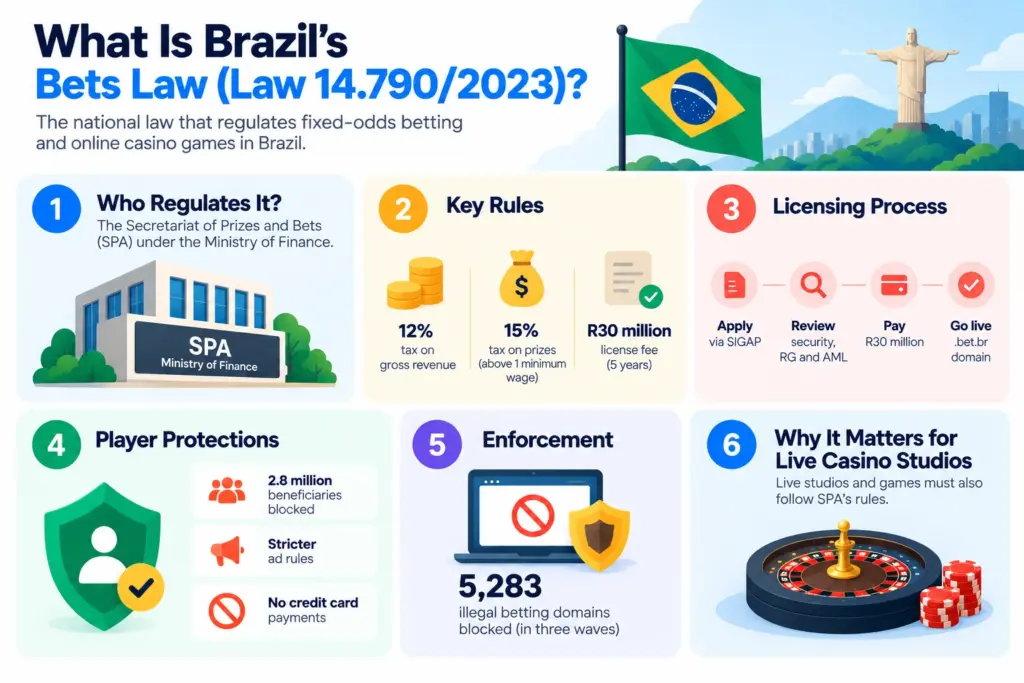
Brazil’s Bets Law is the national law that sets the rules for fixed-odds betting and online casino games. It says who can run a betting site, how they get a license, and what they must do to protect players. A government office called the Secretariat of Prizes and Bets or SPA watches over all of this. The SPA sits inside the Ministry of Finance and has the power to approve companies, make rules and punish anyone who breaks them.
How the Law Built the Framework
Before this law, many betting companies served Brazilian players from other countries with no local approval, so nobody really knew who was in charge. Then President Lula signed the law on 30 December 2023, with some parts vetoed. It gave the Ministry of Finance the job of making the rules, approving companies, and checking that they follow them. The law also covers taxes, how money is shared, and punishments. It finally gave the market a clear home after years of confusion.
The law uses a few simple words that matter a lot. Here is what they mean:
Online casinos count as “online games” under this law. Bets that involve online game events can only be offered through virtual platforms. The law also sets taxes. Companies pay 12% on their gross revenue, and winners pay 15% on prizes above one minimum wage. A company that wants to join the market has to pay R30million(aboutUS5.2 million) for a license that lasts five years.
What Powers Does the SPA Hold?
The SPA is pretty new. A decree that created it came out on 31 January 2024 and made it the eighth secretariat of the Ministry of Finance. It has three sub-secretariats and started with 38 professional positions. That is a small team for such a big market. One of the sub-secretariats judges the sanction cases in the first round, so the SPA can both make the rules and punish people who ignore them.
Here is what the SPA can do:
- Give licenses. It only approves Brazilian companies that have their headquarters and management in Brazil.
- Write the rules. The ordinances cover payments, advertising and responsible gambling.
- Watch the market and check how operators behave.
- Hand out punishments. Running without a license is treated as a serious administrative offence.
Why Live Studios Care About SPA
The SPA’s rule plan did not only look at betting sites. It listed rules for approving the systems used by operators, live gaming studios and games. So the studios that stream the dealers are part of the picture too. Pragmatic Play is a good example. It made Mega Roulette – Brazilian, which has a native Brazilian Portuguese host and a special group of bets called Mega Bets. It also sells a tool called Smart Studio.
With EstrelaBet, Smart Studio went live with localized titles like VIP Blackjack, Lucky 6 Roulette and the Blackjack X series. More recently, it added Smart Studio to its deal with Cactus Gaming across that operator’s brands in Brazil. Studios like this have to follow the same market rules as the sites they work with.
How Licensing and Enforcement Works
Getting a license is a few steps. The first step was applying, and 181 businesses filed their interest through the SIGAP system before the 30 September deadline. Then the SPA checked them and told the good ones to pay. 71 companies were notified and had 30 days to meet the final requirements. The money rolled in quickly, with 16 of them already having paid R480 million (US$79.5 million) in licensing fees. Later the SPA kept approving more. It reached 35 fully licensed operators and 69 in total when provisional ones were counted.
Evolution is a clear example of a live dealer studio inside this system. It was the first licensed supplier under the new rules. Later it opened its first Brazil studio in São Paulo. The studio started with Brazilian Portuguese tables like Blackjack Clássico, Blackjack Illimitado and Brazilian Blackjack, and planned to localize Crazy Time, XXXtreme Lightning Roulette and ICE Fishing. That means a studio can now be built right in the country, with local dealers and local branding.
Keeping Illegal Sites Out
The SPA does not work alone on this part. The telecom regulator Anatel teamed up with the SPA and the Federal Police to shut down 5,283 illegal betting domains in three waves. Blocking sites is only half of it. The SPA also worked on stopping fake taxpayer IDs from being used to open accounts. The plan is simple. Make the legal sites easy to spot and make the illegal ones hard to reach.
What Changed Under the New Restrictions?
The newest rules are mostly about protecting people. The biggest one is for people who get government help. The Ministry of Finance blocked 2.8 million Bolsa Família and BPC recipients who had signed up on betting platforms. The same report says about 27 million people who get those benefits cannot create accounts at all. To make this work, operators had to connect to the SIGAP system. They got 30 days to build it and 45 days to check all their old customers.
Ads also got much stricter. Here is what changed:
- Every betting ad must show a warning like “Betting can cause addiction” or “A bet is not an investment.”
- Ads cannot sell betting as a way to make income or win back lost money.
- Social networks must block betting ads from reaching minors, and app stores must check age before letting people into betting apps.
- Fines can go up to 20% of turnover, and the rules reach platforms, media and influencers too.
- Using a credit card to bet online is not allowed.
The big idea is that the SPA now cares about who sees the ads and who can play. That matters for live dealer studios too, since their games are shown in the same ads and apps.
Is Online Casino Legal in Brazil? What Casino Startups Can and Can’t Offer
Brazil’s online casino and betting market was regulated under Laws 13.756/2018 and 14.790/2023, with operators required to obtain federal authorization from the Secretariat of Prizes and Bets or SPA. Land-based casinos remained prohibited. However, a September 2026 provisional measure prohibited the offering and advertising of fixed-odds betting nationwide, so startups should not assume they can currently launch licensed online betting or casino products in Brazil. The measure’s legal status may evolve.
Which Online Casino Games Were Permitted?
Brazil made online casino legal under Law 14.790/2023. The SPA license covered online casino games and fixed-odds sports betting only, and every game had to be certified as random. That meant the results came from a fair random number system and not from the operator. Players liked the games a lot, and the very popular slot called “Tigrinho” (Fortune Tiger) was part of this market.
The permitted games were:
Superbet’s Live Tables
Superbet is a good example of how far live games went. It made a deal with Avanti Studios just before the ban. The deal brought more than 20 live tables with Brazilian Portuguese dealers and custom studio rooms, and 10 of them were blackjack. The two also made a game called Futevôlei Ao Vivo. In it players bet on a new footvolley match every 15 seconds. They were also building a live game with a famous influencer as the dealer. Superbet also added slots from Spinomenal like Majestic Spirit and Queen Of The Forest. All of this happened in a market that has now been stopped.
Why Was Federal SPA Authorization Needed?
The law placed Brazil’s betting market under a single federal regulator: the Secretariat of Prizes and Bets or SPA, within the Ministry of Finance. To qualify for a federal license, operators had to be Brazilian companies with their headquarters and management based in the country. The authorization fee was R$30 million for five years, covering up to three brands, roughly US$5.2 million. State-level licenses, by contrast, applied only within the issuing state; operators seeking nationwide reach needed federal authorization.
The SPA was also responsible for enforcement. Operating without authorization constituted an administrative violation, and the agency coordinated with the telecommunications regulator to block illegal betting websites. Authorities reportedly took down 5,283 domains in three waves.
Betano as an Example
Betano shows what a licensed casino looked like. Its owner Kaizen Gaming was the first operator to get an online betting license under the new rules. After that it added new content like Konami slots such as China Shores and Fortune Mint. It had also signed a deal with LiveG24 for live casino and live bingo games. Now Betano’s license is due to end on 25 October, the day of the presidential runoff.
Licensed Online vs Land-Based Casinos
Online casinos and land-based casinos are treated very differently in Brazil. This table shows the main gap.
The old ban on gambling was very long. Gambling stayed banned for about 70 years after the 1946 decree. The Bets Law only opened a door for online games. It did not open one for physical casinos. So a person could not walk into a casino in Brazil even when online sites were fully licensed.
What Can Startups Offer Now?
For now startups can offer very little in this area. The measure bans operating, offering, brokering and advertising fixed-odds betting in Brazil, and that includes operators based abroad. It covers online casino too. The ban covers virtual online games where a random number generator decides the result. Licensed sites had to go offline and the licenses end on 25 October. The 85 license holders get no refund of the US$492 million they paid.
What startups can still think about:
- Wait for Congress. The measure must be approved within 120 days or it lapses. Lawmakers filed 99 amendments. One would restore every federal license and others would keep sports betting and ban only online casino.
- Look at other lotteries. Other lottery types authorised by law are not covered by the ban.
- Get ready to come back. Keep checks like identity verification and responsible gambling tools ready in case licenses return.
What startups should not do is go offshore and serve Brazilian players anyway. Platforms can face fines up to 10% of the group’s annual revenue. A separate bill would give operators 4 to 6 years in prison. The fight is still going on. Industry groups asked the Supreme Court to suspend the measure. The Attorney General’s Office asked the court to keep the ban in force. One poll found about 75% of Brazilians support the ban. Industry groups warn that players will move to illegal sites. They say unlicensed operators already hold 41% to 51% of the market.
How to Get a Brazilian Betting License for Online Casinos Startups?
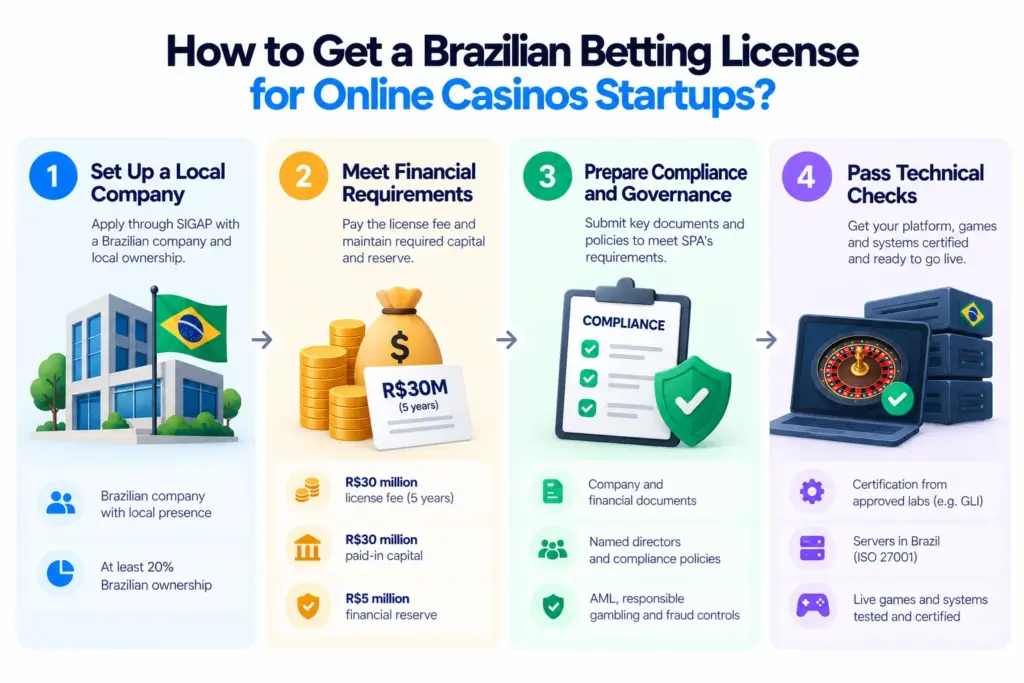
A casino startup needs four things to get a Brazilian online casino license. It needed a company set up in Brazil with a local partner, enough money in the bank, solid compliance rules, and technology checked by an approved lab. All of this went through the SPA, the betting office of the Ministry of Finance. Right now, the SPA is not giving out new licenses because of the government ban, so this is how the process worked and what a startup would have to get ready if it comes back.
1. Local Company and Ownership Rules
The first rule was simple. The company had to be Brazilian. Only a limited liability company or a corporation set up under Brazilian law, with its headquarters and administration in Brazil, could apply. A foreign brand could not just apply from abroad. Foreign operators had to set up a local company that met the same rules. Everything was sent online through the SIGAP system, which is the SPA’s own portal.
There was also a rule about who owns the company. At least 20% of the capital had to be held by Brazilian shareholders, and that could be a person or a company. The idea was to keep some local ownership inside every operator. So a foreign startup needed to find a Brazilian partner before it even filed.
Betnacional as an Example
Betnacional shows how a big foreign group can work inside this rule. Flutter Brazil was created after Flutter bought NSX Group, the company behind Betnacional. So the brand stays a Brazilian company while the owner is global. Betnacional has also kept growing its casino. It went live with RubyPlay titles like Brilliant Gems and Gummy Giga Match, plus Koala Games’ Voltage Blitz Zeus Up. More games from RubyPlay’s Brazilian studio Mad Hat Games were planned too.
2. Capital and Licensing Fees Required
The licensing fee was R$30 million for a five-year authorization covering up to three brands, approximately US$5.2 million. That payment was separate from the financial backing operators had to demonstrate. The SPA also required a dedicated reserve to help ensure players could be paid, even if the operator faced financial difficulties.
| Requirement | Amount |
| Authorization fee | R$30 million for a five-year license covering up to three brands (approximately US$5.2 million) |
| Paid-in share capital | R$30 million, contributed in cash |
| Minimum net worth | R$30 million |
| Financial reserve | R$5 million held in federal bonds through a financial institution (approximately US$850,000) |
| Additional brands | Each additional group of up to three brands required another R$30 million authorization fee, R$5 million reserve, and R$15 million in capital |
The wait was long too. The SPA had 150 days to approve or reject an application. In real life it often took longer. One legal guide says the normal timeline was 8 to 12 months, and missing compliance papers were a common reason for delays. So a startup needed cash ready and patience too.
3. Governance and Compliance Documents Needed
The application was a big pile of papers. It had to prove the company’s legal standing, tax and labor regularity, integrity, finances and technical ability. The SPA also wanted to know exactly who was behind the company. That meant a form identifying controlling shareholders, directors and final beneficiaries.
The main documents were:
- A clearance certificate for bankruptcy and financial statements for the last two years
- Company bylaws, proof of capital and reserve, and criminal and tax clearance certificates
- Named directors for integrity and compliance, for customer service and the ombudsman, and a person for the system’s security
- Policies for anti-money laundering, responsible gambling, and stopping match-fixing and fraud
The rules did not stop after approval. A responsible gambling policy had to be approved by the board and reviewed every year. Records also had to be kept for at least five years. The SPA wanted proof that these policies were working and not just written down.
4. Technical Checks the SPA Required
Before a casino could go live its tech had to pass tests. The betting system had to be certified by a lab the SPA recognised, like GLI or eCOGRA, and it needed a new certification every year. Servers also had to sit in Brazil in ISO 27001 certified data centres. Even live games like Blaze’s Lightning Bac Bo, with its random 2x to 8x multipliers, had to prove they were fair.
Lab Certification
Before a casino could go live its technology had to be tested. The betting system had to be certified by a lab the SPA recognised, like GLI, Trisigma, Quinel, eCOGRA or BMM North America. The rules did not only cover betting sites. GLI was the first lab accredited to certify betting systems, live game studios and online games. The report was also due fast. The assessment report had to be sent within 90 days of the authorization. The checks kept going after that. Systems needed a new certification every year and after any critical update.
Data, Servers and Player Checks
The SPA also cared a lot about where data lived. Betting systems and data had to sit in data centres in Brazil, and those centres needed ISO 27001 certification. Operators also had to use facial recognition, allow one account per bettor, and run geolocation checks every 30 minutes. On top of that operators had to send real-time transaction and player data to SIGAP.
Blaze as an Example
Blaze shows why these checks matter for live games. It got early access to a game called Lightning Bac Bo from Evolution. It swaps baccarat cards for Sic Bo dice and adds random Lightning Multipliers from 2x to 8x. Random multipliers like these are exactly what a certified random system has to prove is fair. Blaze also worked with Spin Gaming on a custom studio. It has Brazilian dealers running blackjack, baccarat and roulette tables 24 hours a day. A studio like that would also need the live studio certification.
The New Licensing Window and Rewritten Authorization Rules
There is no open license window right now, and I could not confirm the reported second window. The government ban bars new authorisations and pending applications lapsed, so any new window depends on Congress and the courts. The SPA did ask for ideas on new rules. The 45-day consultation ran from 27 July to 9 September and will replace Ordinance 827.
One idea that stood out was a ban on investment funds being part of an operator’s controlling group. That could make raising money harder for a startup on top of the old R$30 million fee, which is about US$5.2 million.
When Is the Next License Window?
I could not confirm a second window. What is confirmed is that the ban bars new authorisations and pending applications lapsed. That is a big change from before. Back then the SPA said there was no fixed deadline and applications could be made at any time. Even at the end there were still people waiting. 87 operators held active federal licenses at the end of June, with another 14 applications pending. Now everything depends on Congress. The measure could stay in force until March, because the parliamentary recess pauses the clock.
What Changes Does the SPA Propose?
The SPA wants to replace the old license rulebook. The consultation will guide a new rule that replaces Ordinance 827. The goal was to learn from the first round of licenses. One group of operators said the draft focuses on stronger anti-money laundering papers and faster financial checks. That includes looking at where a company’s capital comes from. The SPA also keeps a close eye on licensed companies. In the first year it reviewed 225 update processes and opened 80 sanction cases.
The ideas that got the most attention were:
- A ban on investment funds being controllers or part of the controlling group of an operator
- Limits on executives who work for a federal licensee and a state-licensed company at the same time
- A separate draft that would make suppliers get recognised by the SPA
How bet365 Fits In
The supplier idea matters for big names like bet365. Its Brazil casino is full of outside content. RubyPlay brought titles from RubyPlay Studio and Koala Games to bet365 players in Brazil. Incentive Studios is also rolling out its real-money games with bet365. If suppliers must be recognised then each of those partners becomes a compliance question for the operator.
How Could New Rules Affect Costs?
The money part of the old rules was already big. A license cost R$30 million for up to three brands and five years, which is about US$5.2 million. On top of that the company needed paid-in capital, net worth and a reserve. The new ideas could add more cost in other ways. Investors are the first group. If the fund ban stays in the final text then it would hit the playbook used by private equity and venture capital to put money into operators. That makes raising money harder for a startup.
Suppliers are another group. Foreign suppliers without a Brazilian presence may need to set up a local subsidiary within 120 days. Those costs would roll down to the operators that use them. There is also a fairness worry. One report says permanent rules tend to favour the well-capitalised, so smaller startups could feel it the most. Money already paid does not come back either. The 85 license holders get no refund of the US$492 million they paid.
What Should Applicants Confirm First?
Before anyone spends money on an application, they should check these things:
- Is the ban still on? Watch Congress and the Supreme Court. Industry groups have asked the court to suspend the measure.
- What does the final ordinance say? The SPA will weigh the responses after 9 September and publish a final ordinance.
- Who owns the company? Check whether funds can still be part of the controlling group.
- Where does the capital come from? Keep proof ready since this is where the SPA wants to look.
- Who are the executives? Make sure none of them also sit at a competitor.
- Are the suppliers recognised? Novibet shows why this matters. It added Incentive Games’ Mega Flight, Kicker and Velocity, and every vendor behind a game like that could need a check.
- What happens to fees? Money paid under the old system was not refunded.
What Happens to a Casino Startup’s Brazil Investment?
A casino startup’s Brazil investment is mostly stuck for now. Money already paid for a license is not coming back. Work built only for Brazil cannot be sold in Brazil while the ban lasts. What can be reused elsewhere depends on the kind of work, and whether any of it pays off depends on Congress and the courts.
Are Brazil-Specific Games Still Usable?
In Brazil they are not usable right now. The ban covers online games where a random number generator decides the result, so that includes slots and table games. Many of those games were also built to fit Brazil’s own checks. The SPA wanted the system, games and random number generator certified by an approved lab, with a certificate made specifically for Brazil. That certificate does not help anywhere else, so it is likely worth little outside Brazil. The game itself can probably still be sold in other markets, but the Brazil paperwork and the local setup around it cannot move.
Esportes da Sorte as an Example
Esportes da Sorte shows how much content was built for this market. EGT Digital gave it more than 200 games, including the Bell Link and Clover Chance jackpots, and EGT holds a GLI certification that meets the SPA’s rules. It also added live tables. Imagine Live brought its full live casino portfolio with native Portuguese-speaking dealers and exclusive game shows. The games themselves may travel to other countries. The Brazilian dealers and the local setup are harder to move.
Ban Effects on Payments and Partnerships
The ban reaches the money system too. Banks, payment institutions and Pix participants can no longer process betting transactions. The only exception is closing accounts and giving money back. That makes a huge job for banks. About R$1.325 billion (around US$255 million) was still owed to roughly 26.5 million bettors. A companion bill would add punishments. Facilitating betting payments would carry two to four years and a fine.
Local Partnerships
Sponsorship deals took a big hit. 14 of the 20 clubs in Brazil’s top league had sponsorship agreements with betting companies. The brands had to be off the shirts by 5 October. Esportes da Sorte was one of them. It was the official sponsor of clubs like Corinthians, Ceará and Náutico Capibaribe. Those deals were a way to reach fans, and now that route is closed too.
Which Development Costs Become Stranded?
Some money is clearly gone and some is only stuck. This table shows the main costs.
Oleybet is a good example of the integration costs. It runs on Sportingtech’s Quantum platform. It also added 24 Evoplay slots to its Brazilian casino through that integration. All of that was built for a market that is now closed. People are affected too. One study says about 15,500 direct and indirect jobs are at risk.
Why New Markets Don’t Guarantee Recovery
Brazil looked like a safe bet and then it flipped fast. The ban came less than two years after the licensed market opened. The timing was political too. The government announced it nine days before the election. A startup could not plan for something like that. Other countries are now watching. Argentina, Colombia, Peru and Chile are rethinking their plans, and some may slow down opening up their markets.
The ban may not last, but nobody knows yet. One lawmaker thinks the most likely path is that Congress lets the measure expire. If it does, a startup still has to pay again. Licenses end on 25 October and new ones would need new fees. Before putting money into a new market a startup should ask:
- How much of this money can I get back if the rules change?
- Can the games and tech be reused in another country?
- Do I depend on one country’s politics?
Where Should Casino Startups Go After Brazil?
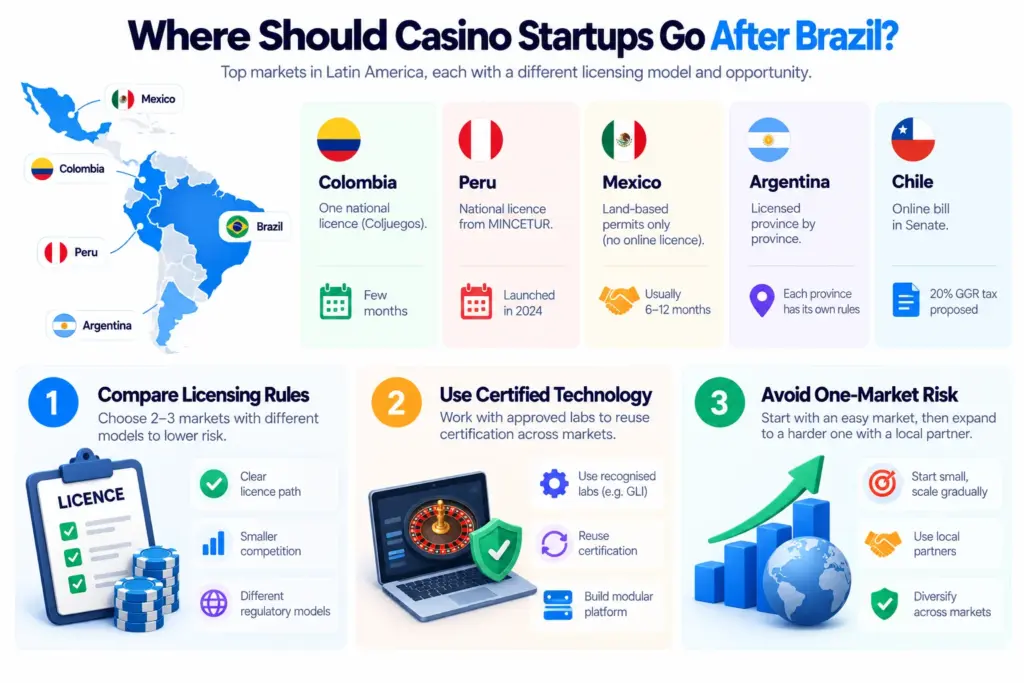
Startups should look at Colombia and Peru first. Both have clear national licences and a path that a small team can follow without too much guessing. Mexico and Argentina can come next but they need local partners and more time. The smartest plan is to pick two or three markets that work in different ways. That way one rule change in one country cannot stop the whole business.
1. How to Compare Licensing Rules
Every country in the region does licensing in its own way, so a quick side-by-side look saves a lot of pain. Colombia has been regulated since 2016, Peru launched in February 2024, and 23 of Argentina’s 24 provinces have their own licensing. Brazil is crowded by comparison. One comparison counts about 187 .bet.br brands in Brazil against 15 concessionaires in Colombia and about 91 authorisations in Peru. A smaller field can mean an easier start.
| Market | How it works | What to know |
| Colombia | One B2C licence from Coljuegos covers casino, betting and poker | Licensing takes a few months |
| Peru | National licence from MINCETUR | No formal cap on licences but you must set up locally |
| Mexico | Land-based permits only, no standalone online licence | Often six to twelve months |
| Argentina | Licensed province by province | Each province has its own rules |
| Chile | Online bill still in the Senate | 20% GGR tax proposed |
A Mexico Example: RushBet
Mexico shows why a local partner matters. Rush Street Interactive did not wait for a standalone licence. It signed a 25-year deal with Grupo Multimedios, whose subsidiary holds the online gaming licence and launched RushBet.mx on that licence. RushBet had already built its name in Colombia and later brought in content from Light & Wonder through its OpenGaming system. Pragmatic Play Live Casino also went live with RushBet across Colombia. The lesson for a startup is simple. Borrowing a local licence and a local media brand can be faster than waiting alone.
2. Why Local Certification Changes Costs
Certification is where hidden costs show up. In Brazil every game result must come from a certified random number generator and betting platforms must be certified by a lab the regulator recognises. That means a game built for one market often needs fresh testing for the next. A startup that ignores this can burn months and money on rework. Here is what to plan for:
- Lab choice: Brazil recognises five labs under Ordinance 722/2024. Pick one that also works in your next market.
- Reuse: GLI was the first lab accredited in Brazil’s new system and also the first accredited in Peru. One lab relationship can cover two countries.
- Licence timing: Operators attach certification papers to their application and then pay the licence fee of R$30 million (roughly $5 million).
- Platform choice: Suppliers such as Sportingtech and Delasport got GLI certificates for Brazil. Partnering with a certified platform can skip a lot of testing.
3. What Suppliers Can Teach Operators
International suppliers rarely build a new product for each country. They build one core and then change small parts to fit each rulebook. Delasport and Sportingtech both did this when they certified for Brazil. A new casino should copy that habit. Keep the games and the payments in separate blocks so you can swap one without breaking the rest. It sounds boring but it is what lets bigger brands enter a new country in months and not years.
Plan Data Tools Early
Suppliers also learned that regulators want data. Delasport built a data vault that follows Brazil’s SIGAP rules. Many startups leave reporting for last and then get stuck. If you build reporting and player checks on day one then moving to Colombia or Peru is much less painful. It also makes your pitch to partners and regulators sound a lot stronger.
4. How to Avoid One-Market Risk
Brazil showed how fast rules can change. A tax goes up or a rule gets tighter and a business that lives in one country feels it right away. Spreading out is the cure but it has to be done slowly. Start with one market that is easy to enter and learn from it. Then add a second one that uses a different model so the two do not break at the same time.
A Betsson Example
Betsson is a good picture of this plan. It holds licences in five Latin American markets: Argentina, Brazil, Colombia, Mexico and Peru. It did not do it alone. In Buenos Aires it teamed up with local operator Casino de Victoria and in Mexico it partnered with Big Bola Casinos. It also bought half of JDP Tech, a payments platform, for €8.8 million to keep money flowing across the region. Later it opened a second regional hub in Buenos Aires after the one in Bogota. Local partners, own payments and more than one hub is a pattern a startup can copy at a smaller size.
A simple starting rule:
- Pick one easy market and one harder market.
- Use one lab and one platform for both.
- Add a local partner wherever the rules ask for one.
What Should Founders Build Before Choosing a Market?
Founders should build a flexible base first. That means a casino core that never changes and small parts around it that can change for each country. Payments and player checks should be easy to swap and the money for testing and future rule changes should be planned early. When the base is ready then entering a new country feels like changing a plug and not rebuilding the whole house.
1. Separate Core Logic From Local Rules
The core is everything that works the same everywhere. Think of the wallet, the game engine, the bonus tool and the player account. Local rules sit on the outside. They cover things like tax reports, game lists, limits and ad rules. If these two are mixed together then every new country means opening the engine and fixing it. If they are kept apart then you only change the outer layer and the core stays safe and tested.
Betano’s Local Touch
Betano is a nice picture of this idea. Its owner Kaizen Gaming talks about a “G-Local” approach which means one global base with local flavour on top. In Brazil it added games from the Brazilian supplier FBM Digital Systems and started with two titles called Fruit Picnic and Golden Metropolis. The supplier has over 60 casino titles. Betano did not rebuild anything to do this. It simply plugged local content into a base that already worked.
2. Make Payments and Verification Configurable
Payments and identity checks are the parts that change the most from country to country. Brazil is the best example. Pix is used by over 170 million people which is about 90% of adults there. Operators cannot take cash, bank slips, cheques or crypto so Pix does most of the work. The player’s tax number (CPF) must match the bank account that sends the money. If they do not match the deposit must be blocked. A platform that hard-codes one way of paying will struggle in the next market.
Some payment partners now offer ready tools for this. PayRetailers added real-time CPF and bank account checks plus automatic handling of bad transactions. A startup does not have to build all of this alone but it must make sure it can plug such tools in and out.
3. Plan for Local Testing and Certification
Testing is where many plans slip. In Brazil every game result must come from a certified random number generator and the platform must be certified by one of five labs the regulator recognises under Ordinance 722/2024. Colombia also asks for certified random number generators. A guide on Latin America says Mexico can take six to twelve months once company setup and local banking are counted. So testing should be on the calendar from the start. Here is a short checklist:
- Pick a lab early. GLI was the first lab accredited in Brazil and also the first in Peru so one lab can help in two places.
- Keep game versions clean. Know exactly which version was tested so a small change does not force a full retest.
- Choose certified suppliers. Their papers save you weeks.
Codere Online and Certified Content
Codere Online runs in Spain, Mexico, Colombia, Panama and Buenos Aires. It signed a deal with Pariplay to use its Fusion platform and casino content on its sites in Mexico, Colombia and Spain. Earlier it also picked Play’n GO and its team said one reason was that the supplier is fully certified in each regulated market it enters.
That made growing into new places smoother. More recently Codere launched an iOS poker app in Mexico built with Playtech’s poker network and it also added a Blip chatbot for customer help. Each of these is a separate piece it can add or swap.
4. Estimate the Cost of Market Changes
Rules do not stay still so the budget should not either. Brazil’s tax on gross gaming revenue is scheduled to go from 12% to 13% and then 14% and 15%. One research firm thinks the real total tax burden is between 24% and 27% of gross revenue because other taxes come on top. Operators also give 1% to a responsible gambling fund.
The licence itself costs R$30 million (about $5 million). Rules are also enforced. Brazil went from 113 licensed operators to 87 after 26 licences were revoked or suspended. Here is a simple way to plan:
- Add a buffer for tax rises in your money plan. Chile’s proposal alone talks about 20% on gaming revenue.
- Save time and money for retesting when a rule changes.
- Keep payments and checks swappable so a new rule is a settings change.
- Check each year if the market still makes sens
Can a Casino Platform Survive a Market Shutdown?
Yes it can but only if it was built in separate pieces from the start. The parts every casino needs can move to a new country while the parts tied to one country’s rules can be switched off or swapped. A platform built as one big block usually has to be rebuilt after a shutdown. A platform built in pieces can lose a market and keep most of its value.
Which Parts Can Be Reused?
Most of the platform can travel. A good setup keeps a strong stable core and puts the rule differences into adapters and settings. That way the same engine runs in every country. Comtrade Gaming says it builds compliance in modules and avoids making a separate platform version for each market. So the player account, the wallet and the game library do not need to be thrown away when one market closes.
| Part | Reuse? | Why |
| Player account and wallet | Yes | Works the same in every country |
| Game library and content links | Yes | Same games can be switched on or off per market |
| Bonus and CRM tools | Mostly | Only eligibility rules change |
| Reporting engine | Mostly | The engine stays but the report format changes |
| Brand and customer support | Yes | Only language changes |
Unibet After the Exits
Unibet shows this well. Its owner Kindred has a platform called the Kindred Sportsbook Platform and it supports local compliance across many brands. Kindred planned to leave all North American markets by the second quarter after it closed sites one by one. Unibet poker used to run in more than 100 countries and now stays in 11 markets. Players from the markets it left were moved to a platform called BoaBet. The company shrank its map but the platform kept running.
What Must Be Rebuilt Elsewhere?
Anything tied to a local law or a local bank has to be redone. These are the pieces to watch:
- Payments: Brazil needs Pix and a matching tax number. Another country may use cards or bank transfers. The payment link is rarely reusable.
- Player block lists: Every country has its own self-exclusion register. In the Netherlands the regulator fined Unibet’s Dutch operator €400,000 (roughly $430,000) for letting players on the national list sign up.
- Reporting: Germany asks for session time tracking and deposit limits and real-time reports to its own regulator.
- Certification: Games and platforms often need fresh testing. Brazil alone recognises five labs.
The good news is that these are the outer pieces and not the core. If they were built as swap-in parts then rebuilding them is a project and not a disaster.
How Country Settings Cut Rework
Country settings are the quiet hero here. A platform where a developer has to change code just to adjust a deposit limit cannot grow fast. A better setup uses one player account system with settings for each country. These can cover identity check levels and responsible gambling rules and bonus eligibility and the currency shown. When a rule changes, someone updates a setting. When a market closes someone turns the settings off.
Where Settings Should Live
Think of it in layers. The bottom layer holds the things that never change like age checks and anti-money-laundering. The middle layer holds the rules of a region. The top layer holds the settings of one country. When Playtech games were added to LeoVegas they were already working in the UK, Spain, Sweden, Denmark, Ontario and Italy before they went to the Netherlands. Each step just reused what was already there and added the local bits.
Why Plan for Flexibility Early?
Shutdowns and re-regulations can come fast. When the Netherlands opened its market it licensed 10 operators on day one. Others had to leave and wait at least six months before they could even apply. Planning early means you know in advance what you will switch off and what you will move.
A LeoVegas Example
LeoVegas stopped its services in the Netherlands before the market opened hoping to get a licence. It got a five-year licence through its Malta-based unit called 21 Heads Up Limited and came back two years later with a new site called LeoVegas.nl. The site came with Dutch-speaking live casino croupiers and later a Playtech catalogue of slots and live shows. It used LeoVegas’ own platform so it did not start from nothing. The company also hoped to be back sooner than it was so the wait cost it more than planned.
A short plan to copy:
- List which parts of your platform are country-neutral and which are not.
- Keep every country rule in settings and not in code.
- Keep a ready list of other markets with their licence steps.
- Budget time for a long wait. Brazil went from 113 licensed operators to 87 after 26 licences were revoked or suspended.
Plan Casino Software Around Market Uncertainty with Idea Usher
When betting laws and licensing rules can change, startups need a platform strategy that accounts for more than the first launch. IdeaUsher brings 500,000+ hours of coding experience and a team that includes ex-MAANG and FAANG developers to help businesses assess technical options, plan adaptable architecture, and scope software around their intended markets. We can support platform planning and development, but licensing decisions and legal compliance should be confirmed with qualified counsel.
Define Scope Before Choosing Markets
Define the product, target users, game types, payment flows, and operational needs before building around a single market’s rules. This helps identify which requirements belong in the core platform and which depend on local regulation. A clear scope also makes it easier to estimate development effort and identify regulatory dependencies early.
Separate Reusable and Local Features
Separate reusable modules, such as player accounts, wallet infrastructure, game integrations, and reporting, from jurisdiction-specific elements like verification, responsible-gaming controls, and regulatory reporting. A modular design can make future changes easier to scope, though it cannot guarantee approval in a new market.
Assess Casino Platform Feasibility
IdeaUsher can help evaluate the product scope, architecture, development effort, and technical dependencies for a casino platform. Discuss your concept with the team to understand what can be built, what needs market-specific adaptation, and what should wait until the legal position is clearer.
Conclusion
Brazil’s betting rules have changed sharply, making the market highly uncertain for online casino startups. Although the former framework allowed approved operators to offer online betting and casino games, the September 2026 provisional measure prohibits fixed-odds betting, bars new authorizations, and leaves the market’s future dependent on Congress and the courts. Startups should avoid committing to a Brazil launch until the legal position is clarified, and instead assess adaptable software architecture and other viable jurisdictions.
FAQs
A1: As of October 2026, Brazil’s provisional measure prohibits fixed-odds betting, and a recent court decision upheld the measure’s effect against an operator seeking an exception. Startups should not launch or offer betting services in Brazil unless the legal position changes and qualified counsel confirms that the activity is permitted.
A2: The new measure halted betting operations, barred new authorizations, and required the return of bettors’ remaining funds. The status and consequences for individual license holders may depend on the measure’s implementation and any subsequent court or legislative decisions, so operators should obtain legal advice before assuming a license remains usable.
A3: Potentially. Core components such as player accounts, wallet systems, game integrations, and reporting may be adaptable, but each destination market has its own licensing, technical, payment, data, and responsible-gaming rules. Software built for Brazil should be reviewed and configured for the target jurisdiction rather than deployed unchanged.
A4: Founders should reconsider development that depends on launching betting services in Brazil while the prohibition remains in effect. They may still assess reusable technology or non-betting features, but should avoid major Brazil-specific investment until counsel verifies the current legal position and a viable route to market.
A5: Confirm the current law and court decisions, whether any authorization pathway is open, the operator’s eligibility, capital and compliance obligations, technical certification and data rules, and the legality of the intended games and payments. Verify these points with Brazilian legal counsel and relevant regulators before committing significant funds.