


Key Takeaways
- AI agents can automate a lot of tasks, like reviewing documents, verifying provider details, and keeping the process moving without making your team do every small task.
- They can spot missing details and flag anything that needs a closer look by the credentialing team.
- AI agents can also track applications and remind teams when action is needed.
- This creates a faster workflow while keeping important credentialing decisions under human oversight.
- Explore how Idea Usher can help build AI agents that automate healthcare credentialing workflows with expertise in AI development, healthcare integrations, and workflow automation.
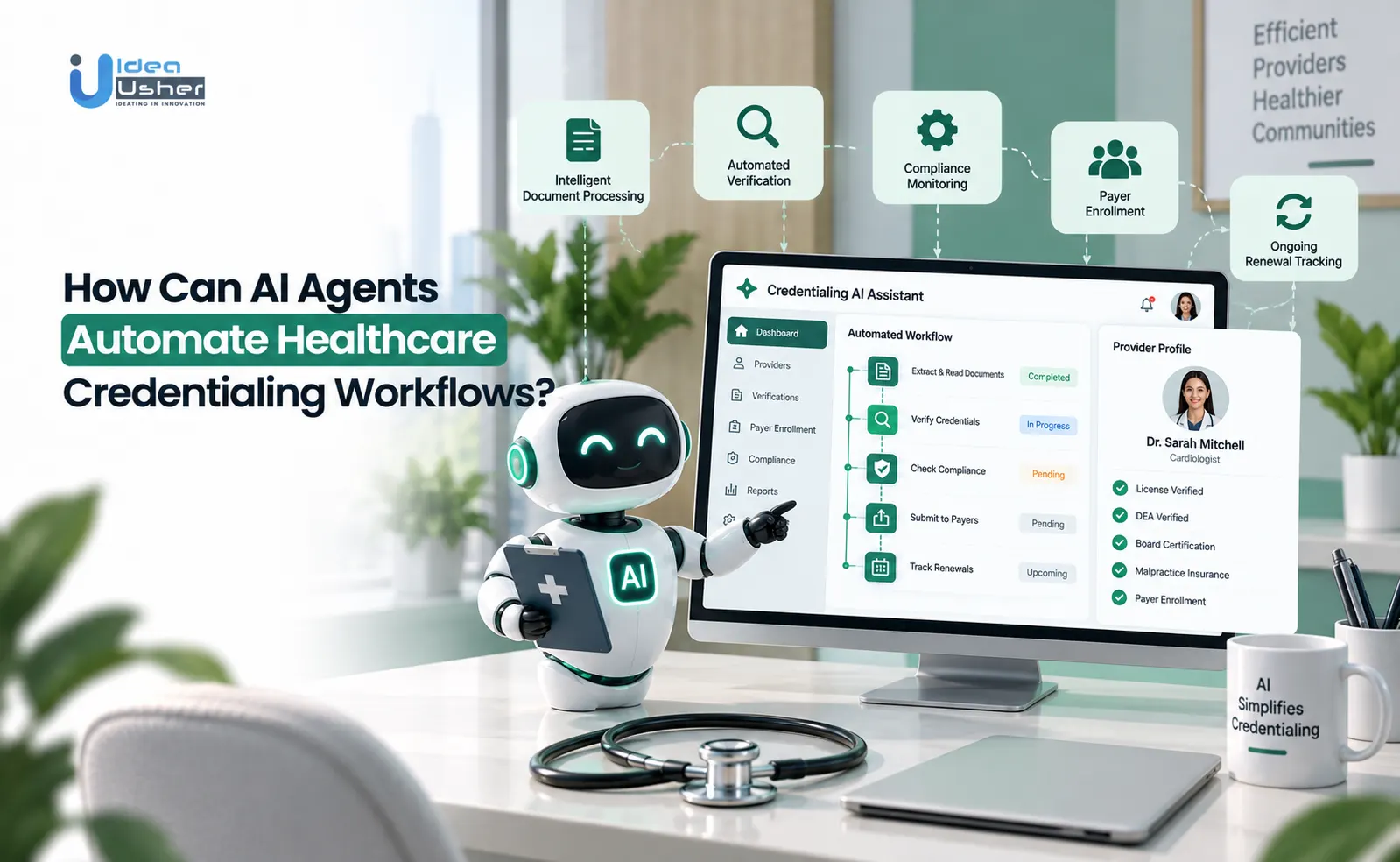
AI agents can shorten provider credentialing from months to weeks by taking over repetitive verification checks, document processing, and compliance tracking. If you’re planning to build an AI-powered credentialing platform with us, you can expect us to build the workflow around how your team already works. We build these pieces to fit your existing systems and approval rules, so your team keeps control of the decisions that matter.
A lot of healthcare startups in the US have approached us to build healthcare automation and credentialing solutions. Most want to cut the manual work that slows down provider onboarding. That growing demand, along with how complex credentialing workflows can get, is why we’re covering how AI agents can automate them in this blog. Let’s start!
Why Is AI-Powered Credentialing Becoming a Business Priority?
AI-powered credentialing is becoming a business priority because delays can affect revenue, patient access, and staff workload. According to Datintelo, the global medical credentialing services market was valued at $3.8 billion and is projected to reach $7.9 billion, growing at a CAGR of 8.5%. A Medallion survey of more than 550 healthcare leaders also found that more than half of hospitals and provider groups reported revenue losses or delays linked to credentialing bottlenecks. Among organizations that could quantify the impact, 1 in 5 reported losing more than $1 million annually.

Source: Datintelo
Delays Can Reduce Provider Revenue
A provider may be hired and ready to work, but still cannot treat certain patients until credentialing and payer enrollment are complete. Medallion found that 1 in 5 hospitals that could quantify the impact reported more than $1 million in annual losses from delayed provider activation. In some settings, a fully operational provider can generate more than $10,000 per day, making even short delays costly.
The business impact can include:
| Credentialing delay | Business impact |
| Provider not activated | Delayed billable services |
| Payer enrollment pending | Fewer patients served |
| Missing documentation | More staff follow-up |
| Slow review | Longer onboarding |
| Expired credentials | Potential service disruption |
AI agents can keep routine checks and follow-ups moving while sending issues that need judgment to the credentialing team.
Manual Work Raises Credentialing Costs
Credentialing teams spend significant time collecting documents, entering provider data, checking sources, following up on missing information, and tracking applications. When this work is handled manually, incomplete information and repeated data entry can create even more work.
Medallion found that legacy system integration and limited internal expertise are among the barriers organizations face when adopting credentialing automation. AI can reduce some of this workload by gathering information, checking approved sources, and stopping when something needs human review.
CertifyOS takes a data-first approach to credentialing. Its platform provides real-time provider data through APIs and supports automated monitoring for sanctions, exclusions, and credential expirations. Its Provider Hub is designed to bring provider data management into a more connected workflow.
Faster Onboarding Creates Capacity
Faster credentialing can help organizations bring providers into their networks sooner while allowing existing teams to handle more work. This becomes especially useful for organizations managing providers across multiple states, facilities, and payer networks. AI agents can handle routine tasks continuously and bring staff into the process when something needs attention. This helps organizations scale credentialing without increasing manual work at the same rate.
Verifiable has introduced CredAgent, an autonomous AI credentialing agent designed to work across end-to-end credentialing workflows with human oversight. The company reports up to 10× productivity gains and uses checkpoints and audit trails so credentialing teams can review agent actions.

Why Are Healthcare Credentialing Workflows So Difficult to Automate?
Healthcare credentialing workflows are difficult to automate because they involve multiple data sources, payer requirements, verification checks, and ongoing updates. Provider information often moves between different systems, while missing documents or mismatched records can stop the process. Payer requirements also vary, and credentials need to be monitored even after a provider is approved.
1. Provider Data Stays Disconnected
Provider information rarely sits in one place. Teams may work with CAQH, NPPES, state licensing boards, EHRs, HRIS platforms, CVO systems, and payer portals. Moving the same information across these systems can create duplicate work and inconsistencies.
| Data source | What teams may verify |
| CAQH | Provider profile and attestations |
| NPPES | NPI information |
| State boards | Licenses and status |
| OIG / SAM | Exclusions and sanctions |
| Payer systems | Enrollment status |
Ventus estimates that a provider who is not credentialed with a payer can represent $3,000–$8,000 in delayed billings per day in high-volume specialties. Across a larger provider network, these delays can add up quickly.
Example: Medallion
Medallion creates a continuously verified provider record that can be used across credentialing, enrollment, licensing, and monitoring. Its platform can pre-fill profiles using NPPES, CAQH, and uploaded documents. Medallion says providers who engage through its automated outreach are 8.2× more likely to complete their profiles.
2. Primary Source Verification Takes Time
Primary source verification requires teams to confirm provider information with licensing boards, certification organizations, and government databases. Repeating these checks across hundreds or thousands of providers can consume significant staff time. AI can collect information, check approved sources, and compare results with existing provider records.
Keragon highlights sources such as state license boards, NPPES, DEA, ABMS, OIG LEIE, and SAM.gov, while Infosys points to real-time verification and data reconciliation as key automation opportunities.
When information does not match, the system can flag the case instead of automatically approving it. This lets credentialing specialists focus on exceptions rather than routine checks.
3. Payers Follow Different Requirements
Payer enrollment adds another layer because each payer can have different forms, portals, documents, and processes. Ventus notes that providers at larger health systems may need enrollment with 8–15 payers, each with its own requirements and timelines. An AI system therefore needs to understand more than provider data. It needs to know which payer is involved, what stage the application is in, and what action comes next.
Same provider → Different payer → Different workflow
That is where agentic automation can help. An agent can follow defined rules and escalate the case when a payer requests something unexpected.
4. Missing Information Causes Bottlenecks
Missing documents, conflicting dates, and outdated provider information can stop an application and create more work for credentialing teams. Infosys highlights data reconciliation, anomaly detection, and missing-information checks as important areas for AI automation.
Medallion found that more than half of hospitals and provider groups reported revenue losses or delays related to credentialing, with many organizations reporting losses above $1 million annually. AI can catch these issues earlier by flagging missing information and triggering the next action before the application gets stuck.
5. Recredentialing Requires Continuous Monitoring
Credentialing does not end after provider approval. Licenses, certifications, malpractice coverage, sanctions, and other credentials can change over time, so teams need to monitor them continuously. Keragon highlights monitoring for licenses, DEA registrations, board certifications, malpractice coverage, sanctions, and exclusions. Ventus also recommends setting recredentialing alerts before credentials expire.
AI can turn this into an ongoing workflow. It can watch for changes, identify what needs attention, and alert the right person before an issue affects credentialing or billing.
Example: symplr
symplr connects credentialing with primary source verification, enrollment, licensure, privileging, committee review, and recredentialing. The company has also introduced AI-powered capabilities across its Operations Platform. Its symplr Provider + symplr Directory workflow can publish provider availability after credentialing, helping connect provider data with other parts of the provider lifecycle.
What Can an AI Agent Actually Do in Healthcare Credentialing?
An AI agent can take over much of the repetitive work in healthcare credentialing. It can collect provider data, read documents, verify credentials, prepare payer applications, and monitor records after approval. When something does not match or needs judgment, it can pause the workflow and send the case to a credentialing specialist.

1. Collect Provider Information
An agent can pull provider information from CAQH ProView, HRIS systems, EHRs, intake forms, and uploaded files. It can then organize that information into a single provider record instead of making staff enter it repeatedly.
| Source | Data collected |
| CAQH | Provider profile |
| NPPES | NPI details |
| HRIS | Employment data |
| Uploaded files | Credentials |
2. Extract Data From Documents
AI can use OCR and document intelligence to read licenses, certificates, diplomas, and other credentialing files. It can pull important fields into structured data and flag information that does not match the provider record. Infosys uses AI-powered data classification for documents such as licenses and certificates.
3. Verify Credentials Against Sources
AI agents can check credentials against trusted sources such as state licensing boards, NPPES, DEA, ABMS, OIG LEIE, and SAM.gov. This removes much of the manual lookup work involved in primary source verification.
Verify → Compare → Flag → Review
Verifiable’s CredAgent is built around this type of workflow. The company reports up to 10× productivity gains from its agentic credentialing approach.
4. Reconcile Conflicting Provider Data
An agent can compare information across different sources and flag missing fields, conflicting dates, or mismatched credentials.
| Finding | Agent response |
| Missing information | Request or flag it |
| Conflicting data | Send for review |
| Matching records | Continue workflow |
| Unclear result | Escalate |
Verifiable says nearly half of credentialing applications arrive with missing information, while incomplete applications can take its team four to five times longer to process.
5. Prepare Payer Enrollment Applications
Once the provider record is complete, an AI agent can use the verified data to pre-fill payer applications and organize supporting documents. It can also track the application after submission. Keragon identifies payer packet assembly and enrollment as core parts of its credentialing workflow.
6. Track Pending Applications
Submitting an application is only one step. Teams still need to know when a payer requests more information or when an application has stalled. AI can monitor these changes and alert the right person when action is needed. Infosys also highlights automated workflow tracking and notifications as part of its credentialing automation approach.
Submitted → Monitored → Updated → Escalated
7. Monitor Expiring Credentials
Credentialing continues after approval. Licenses, DEA registrations, board certifications, and malpractice coverage can expire or change. AI agents can monitor these credentials and trigger alerts before deadlines. Keragon specifically identifies expirables tracking and recredentialing alerts as core AI credentialing capabilities.
8. Escalate Exceptions to Staff
AI should not make every credentialing decision. If information conflicts, a source is unclear, or a case falls outside the rules, the agent can pause and send it to a credentialing specialist. This human-in-the-loop model allows AI to handle repetitive work while people stay responsible for decisions that require judgment.
How Does an AI Agent Move a Provider Through Credentialing?
An AI agent can move a provider through credentialing by collecting their information, extracting data from documents, verifying credentials, preparing payer applications, and tracking the process after submission. It can also spot missing or conflicting information and send those cases to the credentialing team. This creates a smoother workflow where AI handles routine tasks while humans stay in control of important decisions.
1. Provider Data Enters the System
The workflow starts when provider information enters through an intake form, CAQH ProView, HRIS, EHR, or uploaded documents. The agent gathers it and creates a provider record for the rest of the workflow. Ventus describes organizations managing 500+ active providers and enrollment with 8–15 payers per provider, showing why centralized intake becomes important at scale.
2. AI Extracts Credential Data
AI can read licenses, diplomas, malpractice certificates, and other files using OCR and document intelligence. It extracts details such as license numbers and expiration dates and turns them into structured provider data. This reduces the need for staff to manually copy information from every document.
3. Verification Agents Check Sources
The agent checks information against sources such as state licensing boards, NPPES, DEA, ABMS, OIG LEIE, and SAM.gov. This confirms credentials at their source rather than relying only on provider-submitted documents.
Provider data → Primary source → Verification → Continue or flag
TFSF also describes agent workflows that track primary-source verifications and follow up on outstanding checks.
4. AI Reconciles Conflicting Data
Provider information may differ between systems. An agent can compare records and identify what needs attention.
| Finding | Next action |
| Information matches | Continue |
| Missing information | Request or flag |
| Conflicting data | Send for review |
| Unclear verification | Escalate |
This lets the system stop when it cannot safely continue instead of forcing an incorrect match.
5. The System Builds the File
Once verification is complete, the system can bring provider information and supporting documents into a complete credentialing file. Keragon describes this as packet assembly before enrollment and committee review. It also keeps documents, verification results, and decisions connected to the provider record.
6. Enrollment Agents Prepare Applications
Verified data can be used to pre-fill payer enrollment applications and organize required documents. Ventus notes that providers at larger health systems may need enrollment with 8–15 payers, each with different forms, portals, and timelines.
Verified provider → Payer requirements → Application → Submission → Tracking
7. Humans Review Exceptions
AI should not make every credentialing decision. If a license cannot be verified, information conflicts, or a payer makes an unusual request, the agent can stop and send the case to a credentialing specialist. Ventus also identifies exception handling as an important part of automated credentialing workflows. The agent handles the routine path while the team handles cases that need judgment.
8. AI Tracks Enrollment and Recredentialing
After approval, AI can track payer responses and monitor licenses, DEA registrations, board certifications, and malpractice coverage. Ventus recommends 90-day advance alerts and reports that its workflows can reduce onboarding from 90–120 days to 21–35 days. It also estimates $3,000–$8,000 in provider billings per day can be delayed by credentialing issues in high-volume specialties. These are vendor-reported figures, so they should be treated as benchmarks.
Credentialed → Monitored → Renewal → Reverified → Recredentialed
This turns credentialing from a one-time task into a continuous workflow where AI keeps the provider record moving.
Which AI Agents Are Needed for End-to-End Credentialing?
End-to-end credentialing typically needs multiple AI agents working together. A provider intake agent collects information, a document intelligence agent extracts credential data, and a verification agent checks primary sources. Other agents can handle data reconciliation, payer enrollment, credential monitoring, exception management, and workflow orchestration, while human reviewers step in when cases require judgment.
1. Provider Intake Agent
The Provider Intake Agent collects information from forms, CAQH, HR systems, EHRs, and other sources. It can check for missing details and create a structured provider profile. Medallion found that 56% of respondents felt their credentialing teams were understaffed, while manual enrollment work remained common.
2. Document Intelligence Agent
The Document Intelligence Agent handles licenses, certificates, CVs, and other files. It can classify documents, extract key fields, and connect them to the correct provider record.
Upload → Classify → Extract → Validate → Store
3. Primary Source Verification Agent
The Primary Source Verification Agent checks information against sources such as state licensing boards, NPPES, DEA, OIG, and certification organizations. It can record results and flag mismatches. TFSF describes agent workflows that track outstanding verifications and monitor credentials instead of treating verification as a one-time task.
4. Data Reconciliation Agent
The Data Reconciliation Agent compares provider records with external sources and identifies differences.
| Finding | Agent action |
| Matching information | Continue |
| Missing field | Request information |
| Conflicting data | Flag for review |
| Unclear result | Escalate |
The agent should compare sources rather than automatically accepting the first result it finds.
5. Payer Enrollment Agent
The Payer Enrollment Agent uses verified provider information to prepare payer applications. It can populate forms, organize documents, track submissions, and flag follow-ups. Medallion reports that nearly one-third of healthcare organizations reported denial rates between 25% and 50%, with 40% of those denials tied to application-related errors.
6. Credential Monitoring Agent
The Credential Monitoring Agent continues working after initial credentialing. It can monitor licenses, certifications, DEA registrations, sanctions, exclusions, and expiration dates. TFSF describes this type of ongoing workflow as a way to monitor credential and enrollment status and alert staff when action is needed.
7. Exception Management Agent
The Exception Management Agent handles cases that do not follow the normal workflow. It can identify missing documents, failed verifications, conflicting information, or unusual payer requests and route them to the right person. Instead of simply marking a case as failed, the agent can explain what went wrong and what needs attention.
8. Credentialing Orchestration Agent
The Credentialing Orchestration Agent coordinates the other agents. It decides what happens next, passes information between agents, and tracks the overall credentialing case. TFSF separates its architecture into data acquisition, reconciliation and decisioning, and orchestration layers. This same approach can connect specialized agents while keeping the overall workflow under control.
Example: Modio Health
Modio Health has explored using large language models and machine learning for repetitive communications, data integrity, and credentialing workflows. Its approach still keeps credentialing professionals involved in reviewing information and handling complex cases.
Where Does Primary Source Verification Fit Into an AI Credentialing Workflow?
Primary source verification is a core step in an AI credentialing workflow where AI checks provider credentials directly against trusted sources such as state boards, the DEA, NPDB, and certification organizations. It can compare source data with provider records, identify missing or conflicting information, and flag exceptions for human review. This helps credentialing teams verify providers faster while keeping important approval decisions under human oversight.
1. State License Verification
An AI agent can check a provider’s license against the relevant state medical board and capture details such as license number, status, issue date, and expiration date. AMA Physician Profiles include current and historic state licensure and sanctions as part of their primary source verification data.
Provider License → State Board → Match Data → Check Status → Flag Exceptions
The agent can also repeat these checks during ongoing monitoring. ABMS standards call for primary source verification of unrestricted licensure annually for continuing certification.
2. DEA Verification
For providers who prescribe controlled substances, AI can verify DEA registration information and compare it with the provider record. The AMA includes DEA registration among the elements it verifies through primary sources.
| AI checks | What it looks for |
| Registration | Valid DEA registration |
| Provider match | Name and identifiers |
| Status | Active or inactive |
| Exception | Missing, expired, or conflicting data |
3. NPDB Queries
The National Practitioner Data Bank (NPDB) contains reports related to medical malpractice payments and certain adverse actions. An AI workflow can prepare provider information, initiate an authorized query, store the response, and route findings for human review. NPDB Continuous Query keeps a practitioner enrolled for one year and notifies the organization about new reports.
The processing fee is $2.50 per practitioner. NPDB also states that its information should be used with other sources rather than as the sole basis for credential verification.
4. Board Certification Checks
AI can identify the relevant specialty board, check certification status, compare dates and specialty information, and record the result in the credentialing file. ABMS Solutions covers certification information from 24 ABMS Member Boards and more than 1 million physicians. Its data can also integrate with credentialing platforms through ABMS Direct Connect Select, including Axuall, HealthStream, MD Staff, symplr, and Verifiable.
Example: A cardiology certification can be checked against the source, matched to the provider record, and flagged if the specialty or status does not match.
5. Work History Verification
Work history can come from CVs, applications, employers, and credentialing forms. AI can extract employment dates and organizations, compare records, identify gaps, and initiate verification where supported. Keragon describes credentialing agents that combine provider data collection with education and work-history verification. Its workflow also uses reconciliation to identify missing or conflicting information.
This makes AI useful as a reconciliation layer that checks whether dates, organizations, and roles agree across records.
6. Malpractice Verification
AI can read malpractice certificates, extract policy numbers and coverage dates, compare them with the provider record, and flag expired or incomplete documentation. The result can then connect to an expirables-monitoring workflow. Keragon includes malpractice coverage among the credentials that can be monitored by an AI credentialing agent.
7. Handling Unavailable or Conflicting Sources
AI should not automatically approve a provider when a source is unavailable or records conflict. Instead, it can retry the source, compare available evidence, preserve the verification trail, and escalate unresolved cases.
Source Available → Verify → Match → Continue
Source Unavailable → Retry → Alternative Source → Escalate
Conflicting Data → Reconcile → Flag → Human Review
This human-in-the-loop approach matches the agentic workflow described by Keragon and TFSF, where AI handles verification and reconciliation while credentialing professionals handle exceptions and decisions.
What Happens When an AI Agent Finds a Credentialing Exception?
When an AI agent finds a credentialing exception, it should pause the workflow, identify the issue, collect the relevant evidence, and route it to the right person. It should not force the case through automation. Instead, it creates a clear exception record so credentialing staff can resolve the issue before the workflow continues.
1. Missing Documentation
If a provider file is missing a license, malpractice certificate, CV, or another required document, AI can identify the gap before review. It can check the requirements, request the missing item, and track it until the file is complete. Keragon’s credentialing workflow uses AI to identify missing information and route exceptions to credentialing specialists.
Missing Document → Identify → Request → Validate → Continue
2. Conflicting Provider Information
AI can compare information across CAQH, NPPES, uploaded documents, licensing sources, and internal records. If names, license numbers, specialties, addresses, or employment dates conflict, it can flag the record instead of accepting the first value.
| Conflict | AI response |
| Different license status | Recheck source |
| Different address | Compare records |
| Different specialty | Flag review |
| Missing work history | Request clarification |
TFSF highlights conflicting verification results and complex provider histories as important exception types requiring escalation and human review.
3. Failed Primary Source Verification
A failed PSV does not always mean a provider should be rejected. The source may be unavailable or the provider record may contain a different name or identifier. AI can retry the verification, compare supporting records, and escalate unresolved results. Humans can then decide how the case should proceed.
4. Expired Credentials
When AI detects an expired license, DEA registration, board certification, or malpractice policy, it can start a renewal workflow. It can notify the provider, create a task, and track the updated credential through verification. Assured says its platform monitors 2,000+ primary sources, starts renewals 60 days before expiration, and flags sanctions within 24 hours. These are vendor-reported capabilities.
5. Payer Requests for Additional Information
AI can read payer requests, identify missing information, connect it to the correct provider and application, and create the required action. Champ’s provider enrollment automation is designed to handle additional-information requests, monitor payer status, and maintain enrollment cases with documents, dates, and exceptions.
Payer Request → Identify → Gather Data → Prepare Response → Human Approval
6. Cases Requiring Credentials Committee Review
Some cases should never be resolved automatically. Serious discrepancies, adverse findings, unusual training histories, or other judgment-based issues may require a credentials committee or medical director. Minctrl separates automated credentialing checks from the credentialing committee/peer-review decision, while TFSF recommends human queues and escalation for complex exceptions.
Why Exception Handling Affects Revenue
A Medallion survey found that 60% of C-level executives said slow enrollment processes negatively affected revenue. 33% reported credentialing delays of 30–45 days, while 18% reported delays exceeding 60 days. Another Medallion report found that 46% of healthcare organizations reported revenue impacts from unoptimized enrollment workflows. Around 60% also spent more than half a business day on primary source verification for one provider.
Which Organizations Can Benefit From AI Credentialing Agents?
AI credentialing agents can benefit hospitals, health systems, medical groups, telehealth networks, CVOs, payers, provider networks, and healthcare staffing platforms. They are especially useful for organizations managing large provider volumes, multiple locations, payer enrollments, recurring verification, and frequent credential updates. AI can automate routine credentialing tasks while routing complex cases and final decisions to human teams.
1. Hospitals and Health Systems
Hospitals manage large provider rosters across facilities, specialties, and payers. AI can connect credentialing with CAQH, EHRs, HR systems, licensing boards, payer portals, and internal databases while sending exceptions to staff. Ventus describes health systems managing 500+ active providers and 8–15 payer enrollments per provider as a high-complexity environment.
It reports manual credentialing timelines of 90–150 days, with automation targeting shorter timelines. These are vendor-reported benchmarks.
2. Multi-Location Medical Groups
Medical groups operating across locations and states can use AI to maintain centralized provider records, monitor licenses, coordinate payer enrollment, and automate recredentialing.
| Challenge | AI response |
| Multiple locations | Central records |
| Multiple states | License monitoring |
| Multiple payers | Enrollment automation |
| Recredentialing | Automated reminders |
| Missing data | Exception routing |
Medallion found that 69% of healthcare organizations used two or more software tools for enrollment, while 46% reported revenue impacts from slow or unoptimized workflows.
3. Telehealth Networks
Telehealth networks can use AI to manage providers working across multiple states and payer networks. Agents can verify licenses, certifications, malpractice coverage, sanctions, and enrollment status while continuously monitoring credentials. Keragon highlights integrations with CAQH, payer portals, EHRs, and HRIS systems for keeping provider information synchronized.
4. Credentialing Verification Organizations
CVOs can use AI to increase verification volume without adding the same amount of manual work. Agents can collect documents, perform PSV, reconcile records, maintain audit trails, and route complex cases to specialists. Medallion found that 72% of credentialing teams relied on human-driven or partially automated PSV, while 48% had only 1–2 full-time employees.
5. Payers and Provider Networks
Payers can use AI for provider enrollment, network participation, recredentialing, and ongoing monitoring. AI can compare applications, verify credentials, identify missing information, and track enrollment status. Medallion reports that nearly one-third of healthcare organizations experience denial rates of 25%–50%, with 40% of those organizations attributing denials to application-related errors.
6. Healthcare Staffing Platforms
Staffing platforms can use AI to collect provider documents, verify licenses and certifications, monitor expirations, and prepare clinician files for facility placements.
Provider Signup → Documents → Verification → Facility Requirements → Exceptions → Clearance
Medallion reports that 60% of C-level healthcare executives say slow enrollment processes negatively affect revenue.
Build AI-Powered Healthcare Credentialing Workflows with Idea Usher
Idea Usher builds AI-powered healthcare credentialing workflows that automate provider data collection, document processing, verification, payer enrollment, and credential monitoring. With 500,000+ hours of coding experience and a team that includes ex-MAANG and FAANG developers, we can build custom workflows around your existing credentialing processes, systems, and approval rules.

Custom AI Credentialing Agents
We can build specialized AI agents for provider intake, document review, primary source verification, payer enrollment, credential monitoring, and exception handling. Each agent can follow your workflow while routing cases that require human judgment to your credentialing team.
Healthcare Data and Payer Integrations
Our team can integrate credentialing workflows with CAQH, EHRs, HR systems, NPI databases, licensing boards, payer systems, and internal platforms. These integrations help keep provider information synchronized and reduce repetitive data entry across systems.
AI-Powered Document Processing
AI can extract information from licenses, certifications, CVs, malpractice documents, DEA records, and other provider files. We can build workflows that classify documents, capture key fields, identify missing information, and flag inconsistencies for review.
Primary Source Verification Automation
We can automate verification against relevant primary sources and connect verification results to your credentialing workflow. The system can compare provider information, track verification status, identify exceptions, and maintain an audit trail while keeping final credentialing decisions under human control.
Conclusion
AI agents can take care of much of the repetitive work in healthcare credentialing. They can collect provider information, check documents, verify credentials and keep track of what still needs to be done. When something looks wrong or needs a decision, the agent can send it to the credentialing team. This makes the process easier to manage without taking humans out of the loop.
FAQs
A1: Yes. AI agents can handle much of the routine work involved in credentialing. They can collect provider details, check documents, verify information and track what still needs attention. When a case has missing or conflicting information, the agent can send it to a credentialing professional for review.
A2: Yes. AI can check provider information against trusted sources such as state licensing boards, certification organizations and government databases. It can compare the results with the provider’s records and flag anything that does not match. Human reviewers can then handle cases that need further investigation.
A3: AI can automate many CAQH-related tasks such as collecting provider information, checking profiles for missing data and keeping information updated. It can also help organize documents and prepare information needed for credentialing. The exact level of automation depends on the integrations and access available to the platform.
A4: Yes. AI agents can help prepare payer applications, organize supporting documents and track enrollment status. They can also identify missing information and follow up when an application needs attention. More complex payer requests can be sent to staff instead of being handled automatically.
A5: Yes. AI credentialing software can connect with EHRs through APIs and other supported integration methods. This allows provider information to move between systems without repeated manual entry. The integration can also help keep credentialing records aligned with information already stored in the EHR.
A6: Not in every case. AI can automate a large part of the routine workflow, but some situations still need human judgment. Conflicting records, adverse findings and committee-level decisions are examples where a credentialing professional should remain involved. The better approach is usually to automate routine work while keeping humans in control of important decisions.


