


Key Takeaways
- Employers are adopting AI wealth management platforms to improve financial wellness through personalized planning, investing, and retirement guidance.
- Leading platforms combine AI financial coaching, predictive analytics, payroll integrations, and personalized investment recommendations for employees.
- A successful platform requires secure fintech infrastructure, HR integrations, AI-driven insights, and enterprise-grade data security.
- AI wealth management platforms help businesses improve employee engagement, financial wellness, retention, and benefits utilization.
- How Idea Usher can help businesses build AI wealth management platforms with AI-powered financial planning, payroll integrations, and scalable enterprise solutions.
Modern enterprises are starting to treat financial wellness as a key part of their business strategy rather than just another employee benefit. When employees have the right tools to manage their finances, they feel more secure and stay focused at work. That’s why AI wealth management platforms are attracting so much attention. They offer personalized financial guidance that helps employees save smarter, invest with confidence, and plan for important life goals.
Over the past decade, we’ve developed several AI wealth management solutions that combine AI-driven financial planning, predictive analytics, and secure fintech integrations to deliver personalized financial experiences. Drawing on this expertise, we’re writing this blog to explain how to develop an AI wealth management platform for employee benefits. Let’s get started!
Why Are Employers Investing More in Financial Wellness Benefits?
According to Research And Markets, the global wealth management platform market was valued at USD 6.10 billion in 2025 and is projected to reach USD 14.91 billion by 2034. As the market grows, more employers are adopting AI-powered wealth management platforms to improve financial wellness, strengthen employee benefits, and boost retention.

Source: Research And Markets
Reducing Stress to Boost Productivity
Financial anxiety is a silent drain on workplace productivity. A professional worried about a looming mortgage payment, credit card debt, or unoptimized investments is not fully present. This psychological burden leads directly to presenteeism and high rates of unscheduled absenteeism.
The numbers paint a stark picture:
- Financial stress causes a significant spike in absenteeism and tardiness, reducing predictable output.
- Over half of stressed employees spend hours of company time managing personal money problems rather than focusing on core business objectives.
- The cost of this lost focus quickly outweighs the implementation price of a modern wellness platform.
Consider Rain, an AI-driven financial health platform that targets this exact operational friction. By automating earned wage access, budgeting, and automated savings compliance, Rain removes immediate cash flow panic. The business impact is immediate. Companies utilizing Rain report a notable improvement in time clock compliance and an average increase of over 17 extra productive hours worked per employee each month. With annualized revenues hovering around the $20 million mark, Rain proves that mitigating daily worker panic is a highly lucrative B2B market.
Improving Retention via Personalization
Employees have different financial goals, so a single financial wellness program rarely works for everyone. AI wealth management platforms solve this by offering personalized guidance that helps employees make better financial decisions while getting more value from their workplace benefits.
Addition Wealth is a great example of this shift. The platform uses machine learning to deliver personalized financial planning and is estimated to generate around $5 million in annual revenue. For employers, these solutions also support retention, especially when replacing an employee can cost up to twice their annual salary.
Building a Strong Employer Brand
A company’s public valuation and growth potential are inextricably linked to the quality of its human capital. Differentiating an employer brand requires moving past superficial office perks and addressing long-term wealth security. Organizations that provide advanced financial wellness tools build a market reputation as premium employers, giving them a distinct edge in high-stakes talent acquisition.
- Higher Application Rates: Job postings that highlight modern financial wellness systems attract significantly more high-caliber applicants.
- Elevated Value Proposition: Presenting a holistic rewards package that includes automated asset allocation and wealth coaching redefines the employment contract from a simple paycheck to a wealth-building partnership.
- Sustained Institutional Knowledge: Attracting top-tier talent while lowering turnover stabilizes project delivery and protects core corporate intellectual property.

How Does AI Personalize Financial Guidance for Every Employee?
The primary challenge with traditional corporate financial benefits is lack of relevance. A general presentation on retirement planning offers little value to a junior developer struggling with student loans, while basic budgeting advice is useless to a senior executive balancing complex tax issues.
Artificial intelligence solves this by shifting the model from static, uniform benefits to dynamic, individualized assets. This enables investors to back platforms that scale institutional-grade wealth management to every tier of an enterprise.
1. Engines for Custom Advice
AI wealth management platforms create personalized financial plans by analyzing an employee’s income, spending, savings, retirement contributions, and financial goals. Instead of offering the same advice to everyone, they recommend practical next steps that help employees make better financial decisions and get more value from their workplace benefits.
Origin is a good example of this approach. The platform connects with payroll, retirement accounts, and equity systems to deliver personalized financial guidance. Its strong enterprise adoption has helped it reach a $400 million valuation and an estimated $15 million in annual recurring revenue.
2. Analytics to Predict Needs
Static financial plans often lose relevance the moment an employee’s circumstances change. AI-driven financial platforms resolve this through behavioral analytics, which continuously monitor real-time data to anticipate needs before they arise. The platform monitors spending velocity, shifts in savings patterns, and major life events like a promotion, marriage, or a new dependent. By running this data against behavioral models, the system identifies hidden risks and upcoming financial milestones.
- Proactive Nudges: If an employee’s savings balance drops due to rising grocery inflation, the system sends an early intervention alert rather than a generic monthly summary.
- Timely Interventions: It spots micro-patterns, such as an accumulation of subscription services, and delivers a subtle reminder to free up cash flow for debt reduction or investment allocation.
By predicting these critical inflection points, platforms transform financial guidance from a reactive task into a proactive habit, keeping employees financially resilient over time.
3. Planning with Gen AI
AI-powered financial assistants help employees get instant answers to questions about retirement, taxes, investments, and workplace benefits. By providing personalized guidance in a simple conversation, these platforms make financial planning easier and encourage employees to engage more with their benefits.
BrightPlan is a leading example, using its AI Coach to support employees across dozens of countries. The platform advises on billions of dollars in assets and generates over $12 million in annual recurring revenue, highlighting the growing demand for AI-powered financial wellness platforms.
Key Features of AI Wealth Management Platforms for Employee Benefits
Building a successful AI wealth management platform requires more than offering financial tools. It should integrate seamlessly with existing HR and payroll systems while providing features that deliver long-term value. This helps businesses improve employee engagement, strengthen retention, and build a scalable platform with recurring enterprise revenue.

1. Health Assessments
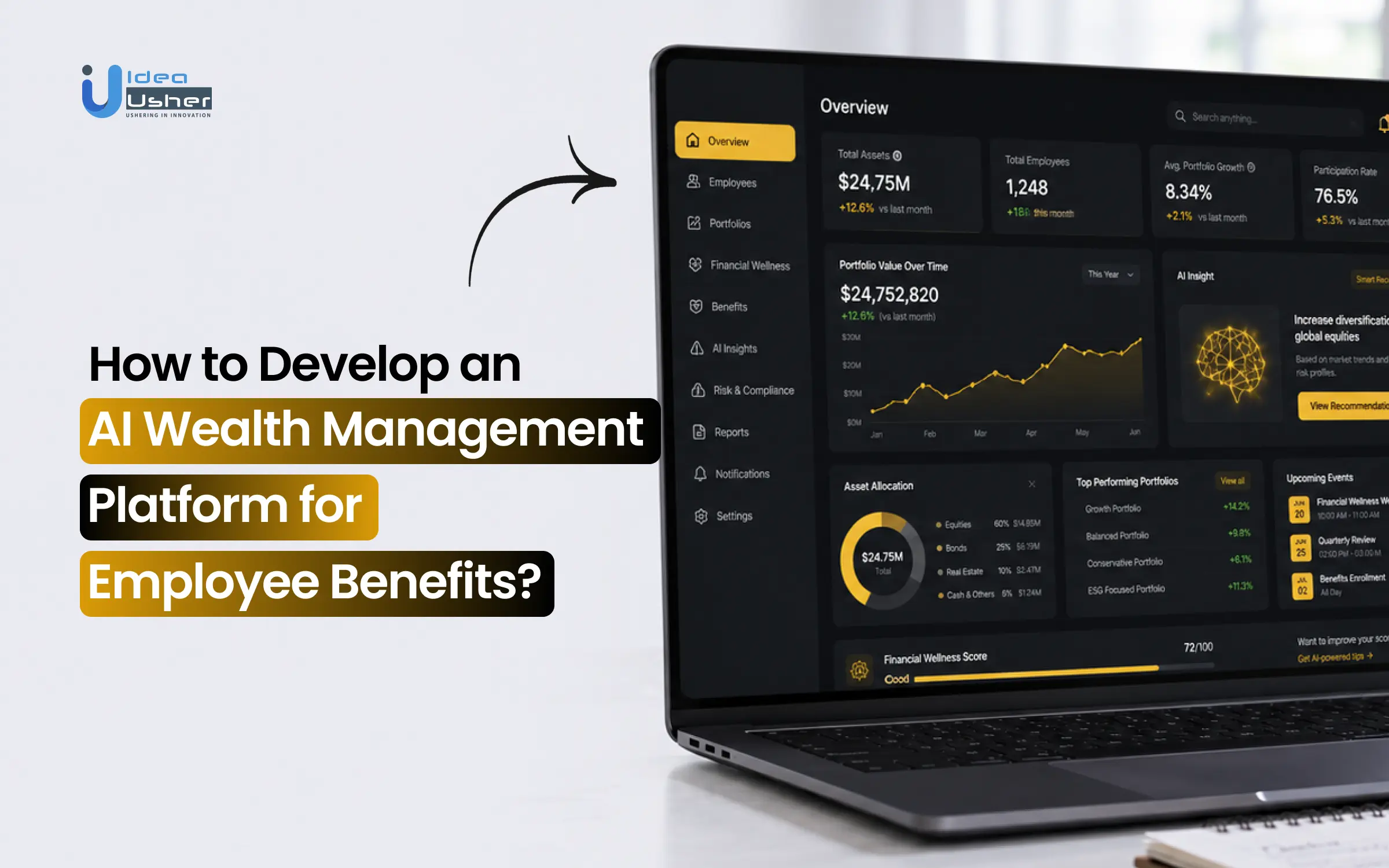
A premium platform must start by building an instant profile of the worker. The software securely evaluates income, outstanding liabilities, and active workplace selections to generate a dynamic financial wellness score. The immediate business use case here is high user activation. By giving users a clear starting number, you drive continuous daily engagement.
Consider BrightPlan as a prime example of this mechanism. The platform uses its system to combine holistic financial planning with direct asset tracking. This gives employees a clear, aggregated view of their entire net worth alongside their workplace benefits in a single, secure dashboard.
2. Personalized Investment Guidance
Employees require highly specific, contextual recommendations based on their exact life stage and family needs. The platform must offer individual guidance that changes alongside the user. The clear business case here is maximizing benefit utilization. When employees see exactly how to select their benefits to build personal wealth, corporate enrollment rates skyrocket.
- Targeted Allocations: The system guides a worker to the precise health or wealth selection that matches their risk tolerance.
- Dynamic Adjustments: The guidance shifts automatically if a user changes their family size or moves to a new region.
This is where Nayya excels in the enterprise market. Nayya uses massive benefit data pools and artificial intelligence to steer workers toward the most cost-effective health and wealth selections, eliminating the confusion of annual open enrollment.
3. Retirement and Equity Planning
Advanced wealth management platforms go beyond budgeting by helping employees manage equity compensation, stock options, vesting schedules, and long-term tax planning. These capabilities are especially valuable for professionals with more complex financial goals and compensation packages.
Addition Wealth is a strong example of this approach. The platform specializes in equity modeling and personalized financial projections, helping employees make informed decisions about their stock options while planning for future tax obligations.
4. AI Coach with Human Advisors
The most effective systems use a hybrid approach. They combine conversational AI with access to certified human professionals for complex, high-stakes decisions. The business use case is cost-effective scalability. The AI handles thousands of basic inquiries instantly, while expensive human advisors are reserved only for complex, high-value consultations.
| Service Tier | Handling Mechanism | Response Time | Cost to Scale |
| Basic Inquiries | Conversational LLM | Instant | Near Zero |
| Complex Decisions | Certified Financial Professional | Scheduled | High Value |
Financial Finesse demonstrates this hybrid strategy perfectly. They deliver continuous, automated coaching alongside unlimited, one-on-one sessions with credentialed financial professionals, balancing digital scale with human trust.
5. Smart Nudges and Goal Tracking
Behavioral AI helps employees stay engaged by delivering timely reminders and personalized recommendations based on their financial goals and life events. Instead of using the platform only occasionally, employees receive relevant prompts that encourage better saving, investing, and financial planning habits.
LearnLux takes this approach by combining financial education with predictive nudges tailored to each employee’s situation. The platform delivers useful guidance at the right time, helping employees take action without overwhelming them with constant notifications.
6. Payroll and HR Integration
A successful platform must connect directly with payroll, insurance providers, retirement accounts, and core human resource systems. The enterprise business case is a total lack of friction. If an HR team has to manually upload spreadsheets to keep your platform running, they will cancel the contract.
Northstar illustrates the power of deep backend integration. By linking directly to company payroll and equity infrastructure, it automatically tracks total compensation, bonuses, and equity changes, providing a completely unified financial experience for the employee without manual data entry.
7. Analytics and Workforce Insights
The platform must provide employers with macro-level dashboards that track workforce financial trends while fully preserving individual employee privacy. The business use case is demonstrating clear return on investment to the buyer. HR executives use this aggregated data to justify the platform subscription cost to the Chief Financial Officer.
- Trend Tracking: Companies can see exactly which financial stressors are dropping across the organization.
- Benefit Optimization: HR teams can pinpoint underutilized corporate benefits and adjust their total compensation spending accordingly.
How to Develop an AI Wealth Management Platform for Employee Benefits?
Building a scalable B2B fintech solution requires balancing high-performance artificial intelligence with enterprise-grade stability. The corporate benefit landscape demands platforms that are deeply integrated, highly secure, and capable of proving clear financial returns to the buyers.
When we partner with founders to engineer these systems, we focus heavily on creating a seamless user journey backed by a robust, scalable backend architecture.
1. Target Users and Business Model
We help you define a clear monetization strategy before development begins. From choosing the right business model to identifying your target customers, our team ensures the platform is built around your revenue goals. This early planning creates a strong foundation for a scalable product that meets real market demand.
2. AI-First Architecture
A modern financial wellness platform cannot rely on slow, legacy structures. It requires a modern, cloud-based framework capable of processing diverse data streams instantly to feed real-time AI models.
- Data Ingestion Layer: Secure pipelines that instantly ingest payroll, banking, and benefit data streams.
- Microservices Framework: Isolated services handling distinct tasks like portfolio calculations, text processing, and user tracking.
- API Integration Matrix: Clean, rapid connection endpoints built to communicate with external banking networks and corporate databases.
Our engineering teams build this technical foundation with a clear emphasis on horizontal scalability. By isolating the heavy machine learning computations from the core user interface, we ensure the system remains lightning-fast, even when thousands of employees access their dashboards simultaneously during annual enrollment periods.
3. Intelligent Financial Planning Features
The success of an AI wealth management platform depends on how well it delivers personalized financial guidance. Employees expect recommendations that adapt as their income, benefits, and financial goals change. We build intelligent AI models that automate financial planning, optimize recommendations, and keep every user’s experience accurate and up to date.
4. Payroll and Benefit Systems
An enterprise financial tool is only as good as its data access. If users must manually type in their paycheck details every month, engagement drops immediately. We integrate your platform with major payroll systems, insurance providers, and retirement accounts. By constructing secure, automated pipelines, we enable your software to pull real-time compensation details, equity vesting schedules, and benefit selections seamlessly. This creates a frictionless user experience that keeps engagement consistently high.
5. Security, Privacy, and Compliance
Fintech solutions face intense regulatory scrutiny, especially when handling sensitive corporate and employee data. We build rigorous security controls into every single layer of your application framework.
- End-to-End Encryption: Protecting sensitive data both while moving across networks and when stored in databases.
- Role-Based Access Control: Strict internal permissions ensuring only authorized systems and users can view specific financial details.
- Continuous Audit Trails: Automated, immutable logs tracking every automated recommendation and data access point.
Our development process strictly adheres to global financial security and privacy frameworks. We ensure your platform includes advanced fraud detection and explainable AI models, giving enterprise buyers complete confidence that their organizational data is fully protected and compliant.
6. Training Models with High-Quality Data
Personalized financial guidance is only as effective as the data behind it. A well-structured data foundation helps AI deliver more accurate recommendations and improve over time. We build secure data pipelines and continuous learning systems that refine AI models, making financial guidance smarter, more personalized, and reliable as employees interact with the platform.
| Data Type | Primary Source | Strategic AI Function |
| Financial Transactional | Linked Bank Accounts | Maps spending velocity & flags debt traps |
| Corporate Compensation | Payroll Systems | Optimizes tax brackets & 401k matches |
| Behavioral Interaction | Dashboard Analytics | Determines optimal timing for financial nudges |
7. Launch an MVP and Scale
Launching with a focused MVP helps validate your product faster and reach the market with lower risk. It also allows you to gather real user feedback before investing in advanced features. We help you build the right MVP, prioritize high-impact features, and scale the platform with new capabilities as your customer base grows.
Cost to Develop an AI Wealth Management Platform
Investing in corporate financial tech requires a clear understanding of the capital layout. The budget depends heavily on user base size, automation depth, and integration needs. We map out these project timelines and engineering resources to ensure your capital deployment goes toward high-margin features that drive platform value.
Complexity and Cost Breakdown
The investment scope varies based on software capabilities. A basic version establishes market presence, while an enterprise solution handles millions of users with advanced prediction models. Our team builds across three main tiers depending on your market strategy:
| Platform Tier | Key Capabilities | Development Timeline | Estimated Investment |
| Minimum Viable Product | Core AI guidance, basic budgeting tools, 1-2 major HR integrations | 3 – 5 Months | $45,000 – $75,000 |
| Mid-Scale Platform | Behavioral analytics, dynamic nudges, predictive forecasting, multiple payroll integrations | 6 – 9 Months | $80,000 – $145,000 |
| Enterprise Grade | Real-time multi-country tax optimization, hybrid human advisor tools, global HRIS integrations | 10+ Months | $160,000 – $300,000+ |
Core Cost Drivers
Understanding where the development budget goes helps you optimize capital efficiency. High-performance fintech relies on specialized engineering components. The main drivers of investment include:
- AI Model Engineering: Building recommendation engines and fine-tuning models to deliver precise financial insights.
- API Integration Matrix: Connecting payroll platforms, bank data feeds, and insurance networks safely.
- Security Frameworks: Implementing data masking, biometric authentication, and regular penetration testing.
- Regulatory Compliance: Building logging systems to meet financial protection standards.
We streamline this allocation by using secure, modular code blocks. This approach cuts down on custom development hours for standard features, letting us focus your budget on unique proprietary features.
Smart Cost Optimization
Building a premium financial application does not require a massive initial budget. We focus on smart engineering choices that lower costs while keeping product performance high. We optimize your initial investment through several proven methods:
- Pre-Trained Foundation Models: We adapt open-source LLMs and financial models instead of building them from scratch, cutting training costs down significantly.
- Phased Feature Releases: We prioritize high-impact tools like automated budgeting first, then roll out complex features like stock option modeling later.
- Cloud Resource Scaling: We structure the system using serverless architecture so infrastructure costs match your actual user growth.
This approach gives you a fast, cost-effective launch while keeping the underlying system strong enough to scale as you secure larger enterprise contracts.
Enterprise Customers Most Likely to Adopt AI Wealth Platforms
Identifying your highest-value buyers is essential when commercializing a corporate fintech platform. Enterprise adoption is accelerating across distinct business sectors because these organizations face massive talent retention and administrative costs. Understanding these target segments allows product teams to tailor their sales infrastructure to solve specific corporate pain points.
1. Large Enterprises Modernizing Benefits
Organizations with thousands of workers deal with high operational friction. When employees struggle with personal debt or investment choices, it leads directly to lost productivity and higher turnover. Large enterprises use these platforms to protect their bottom line.
- Centralized Systems: Big corporations want a single platform that connects smoothly with their existing payroll databases.
- Widespread Scale: Human resource teams cannot offer personal financial coaching manually to ten thousand workers, making automated AI guidance the only realistic solution.
Consider Wealthfront, which has expanded into workplace benefits by offering automated, high-yield cash accounts and self-driving investment portfolios directly to corporate employees. This automated wealth infrastructure allows massive companies to offer institutional-grade investing options to their entire workforce at a fraction of the cost of traditional wealth management firms.
2. Payroll and HR Technology Providers
Software vendors and payroll processors constantly look for ways to make their systems more essential to their clients. By embedding automated financial features directly into their code, they prevent their corporate customers from switching to competitors. Integrating tools like salary-linked investing or real-time tax planning changes the relationship with the user. The payroll portal shifts from a basic utility that workers check twice a month into an active wealth-building system that they use every week.
3. Insurers and Retirement Providers
Traditional insurance groups and retirement plan managers face a major challenge with low user engagement. Most employees only look at their retirement accounts once a year during open enrollment. Forward-thinking benefits providers deploy artificial intelligence to transform these static accounts into interactive experiences.
The software analyzes benefit data to offer timely suggestions. For example, if an employee has extra cash flow, the platform might nudge them to increase their retirement contribution or adjust their health savings account to maximize tax advantages. This approach builds a unified view of health, wealth, and retirement that increases overall product usage.
4. High-Growth Startups and Fintechs
Fast-growing companies and digital banks fight intensely for top-tier engineering and executive talent. They often cannot compete with the massive stock packages offered by legacy tech giants, so they use unique benefits to stand out.
- Unique Positioning: Providing advanced tools like automated equity forecasting makes the company’s job offers far more attractive.
- Scalable Infrastructure: Startups can offer comprehensive wealth guidance immediately without spending capital to build an internal team of financial advisors.
A great example of this trend is Betterment for Business, which provides companies with an all-in-one 401k and financial wellness suite. It integrates automated portfolio management, student loan repayment tools, and personalized advice into a single interface. This allows fast-scaling startups to offer premium, tech-forward retirement packages that rival those of established enterprise giants.
Top 5 AI Wealth Management Platforms for Employee Benefits
We researched some of the leading AI wealth management platforms used for employee benefits in the U.S. to see what makes them successful. Each one takes a different approach, but they all focus on helping employees make better financial decisions while giving employers a more valuable benefits offering. Their features and strategies can provide useful ideas if you’re planning to build a similar platform.
1. Nayya

Founded in 2019, Nayya serves millions of employees through partnerships with leading employers, brokers, and insurance carriers. Its AI analyzes benefits, financial goals, and life events to recommend personalized health and financial decisions. The platform integrates with HR systems, payroll platforms, and insurance providers, helping employees maximize the value of their workplace benefits while improving employer engagement.
2. Addition Wealth

Addition Wealth has supported 100+ enterprise customers and serves hundreds of thousands of employees with AI-powered financial wellness solutions. The platform provides personalized guidance for budgeting, debt repayment, investing, taxes, retirement planning, and equity compensation. Employers use it to improve financial well-being while reducing employee financial stress and increasing benefit utilization.
3. Northstar by Nayya

Northstar, now part of Nayya, has helped employees across 500+ companies access personalized financial planning. The platform combines AI-driven recommendations with Certified Financial Planner support, covering retirement, taxes, insurance, equity compensation, and major life goals. Its employer dashboard also provides engagement metrics to help HR teams measure the impact of financial wellness programs.
4. Financial Finesse

Financial Finesse has been delivering workplace financial wellness solutions for over 25 years and has served 2.5+ million employees across 20,000+ employers. Its AI-powered platform combines personalized financial planning, retirement readiness tools, and one-on-one coaching to improve employee financial confidence while providing employers with measurable ROI and workforce wellness analytics.
5. BrightPlan

BrightPlan supports enterprise employers with AI-powered financial planning, serving organizations ranging from fast-growing startups to Fortune 500 companies. The platform offers budgeting, retirement forecasting, investment planning, and financial coaching while tracking employee engagement through analytics. Employers using BrightPlan have reported up to 60% employee engagement rates, significantly higher than many traditional financial wellness programs.
Build an AI Wealth Management Platform with Idea Usher
Turning a fintech concept into an enterprise-ready product requires deep technical knowledge and a clear market strategy. The corporate benefits market demands software that is fast, secure, and capable of scaling seamlessly. At Idea Usher, we act as your core technology partners, building the precise AI infrastructure needed to secure major enterprise contracts.

Develop for Enterprise Scale
Enterprise AI wealth management platforms need secure integrations and reliable performance to support growing organizations. Smooth connectivity with payroll, HR, and financial systems ensures a seamless experience for both employers and employees. We build scalable, AI-powered platforms that process financial data efficiently and deliver personalized guidance as your business grows.
Launch Faster with a Value-Driven MVP
Getting to market quickly is critical in the fast-moving fintech space. We work with you to distill your vision into a sharp, powerful Minimum Viable Product that addresses the core needs of corporate buyers. We prioritize high-impact capabilities during the initial build phase:
- Core Recommendation Engines: Automated tools for smart budgeting and investment guidance.
- Retirement Projection Models: Clear, interactive forecasting modules that show employees their wealth path.
- Essential HR Connections: Seamless data flows that eliminate manual entry for human resource teams.
This targeted rollout strategy lets you validate your platform in the real market, secure your first enterprise accounts, and generate early revenue before expanding into complex niche features.
Partner with Fintech Development Experts
Developing an AI wealth management platform requires strong expertise in fintech, AI, and enterprise software. A reliable technology partner can help you build a secure, scalable solution while avoiding costly development mistakes. We bring over 500,000 hours of development experience and a team of ex-MAANG engineers to deliver end-to-end AI wealth management platforms built for long-term growth.
| Engineering Focus | Our Delivery Standards | Business Benefit |
| AI Systems | Custom recommendation models with explainable logic | Hyper-personalized financial plans |
| Fintech Security | Advanced data encryption and role-based access | Easy compliance with financial audits |
| Cloud Systems | Highly scalable, multi-tenant serverless backends | Lower infrastructure costs as you scale |
Conclusion
AI wealth management platforms are changing how companies support employee financial wellness. As more businesses look for personalized and intelligent benefit solutions, building a secure and scalable platform creates a strong opportunity to improve employee satisfaction, increase retention, and stand out in a competitive market.
Things to Know About AI Wealth Management Platforms
A1: An AI wealth management platform gives employees personalized financial guidance through their workplace benefits. Instead of offering the same advice to everyone, it understands each person’s financial goals and recommends the next best steps. Employees can manage savings, retirement planning, investments, and other financial goals from one place, while employers offer a benefit that genuinely supports long-term financial well-being.
A2: AI learns from an employee’s financial profile and gradually improves its recommendations over time. It can recognize spending habits, savings patterns, and future goals to suggest actions that make sense for that individual. Rather than waiting for employees to seek advice, the platform provides timely guidance that helps them make better financial decisions throughout different stages of life.
A3: Yes. Most modern platforms are designed to work with the software companies already use. They connect with payroll systems, HR platforms, retirement accounts, and other employee benefits so information stays updated automatically. This creates a much smoother experience for employees and reduces manual work for HR teams.
A4: Security is a core part of every AI wealth management platform because it handles sensitive financial information. Trusted platforms use enterprise-grade encryption, secure cloud infrastructure, and strong authentication to keep employee data protected. They also follow industry compliance standards so organizations can confidently manage financial information while meeting regulatory requirements.


