

Key Takeaways
- NFT games are shifting from ownership models to gameplay-first experiences, where engagement and social identity matter.
- Successful development depends on balanced tokenomics, sustainable economies, and seamless blockchain integration that enhances gameplay.
- The process involves game design planning, blockchain choice, smart contracts, and scalable infrastructure to ensure viability.
- Revenue and retention are driven by circular economies, in-game assets, staking, and community systems rather than monetization loops.
- How Idea Usher can help you build NFT games by delivering scalable architecture, gameplay-first design, and long-term player engagement support.
What if NFT games are struggling not because of weak tech, but because they overestimated how much players care about ownership? Early models leaned on scarcity, tokens, and trading as core drivers. But player behavior has shifted. Users now value engaging gameplay, progression, and social identity far more than speculative rewards. When those are missing, blockchain adds friction instead of value.
The market has corrected. With less hype and more informed users, success now depends on sustainable economies and player-first design, not fast monetization loops. This creates a clear opportunity to build NFT games in which blockchain quietly enhances the experience rather than dominating it. This guide breaks down how to build for that new reality.
Over the years, we’ve built and scaled blockchain-powered games with player-driven economies, digital assets, and evolving in-game systems. In this guide, we break down the key steps to develop NFT games that prioritize gameplay-first design, sustainable token models, and long-term player engagement.
32% of Players Earning $100+ Monthly Highlights NFT Gaming Traction
According to Mordor Intelligence, the NFT gaming market is projected to grow from USD 0.54 trillion in 2025 to USD 0.62 trillion in 2026 and reach USD 1.21 trillion by 2031, with a CAGR of 14.35%. This growth indicates increasing adoption of blockchain-based games as revenue-driven digital ecosystems, not just short-term speculative products.
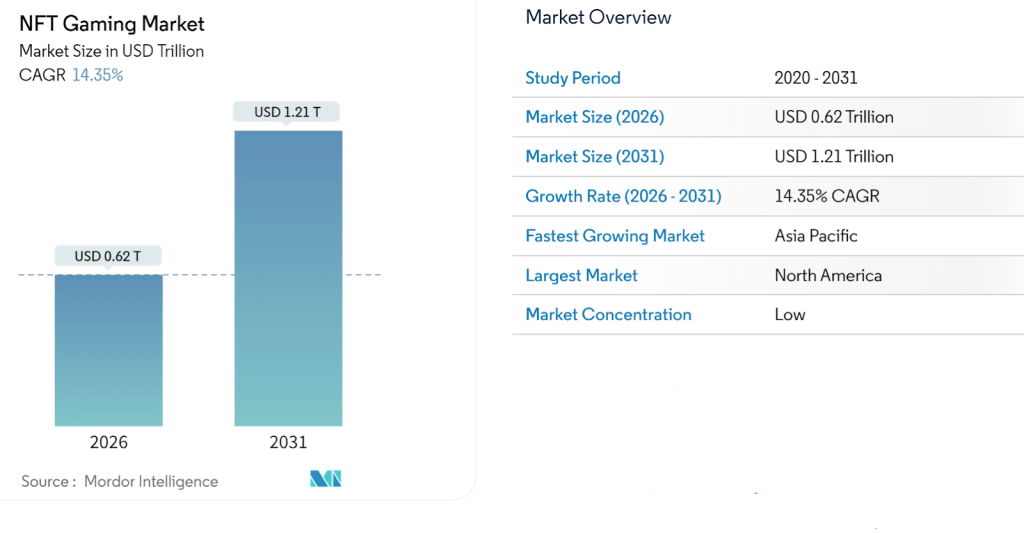
Source: Mordor Intelligence
Building on this market momentum, 32% of blockchain gamers earn over $100 monthly from P2E or NFT trading, with top earners exceeding $600, highlighting continued interest and opportunity for well-designed, sustainable NFT games.
A. Player Earnings Drive Long-Term Engagement in NFT Gaming
Sustained earnings play a critical role in keeping players active within NFT gaming ecosystems and encouraging repeat participation.
- Financial incentives encourage consistent gameplay: When players see recurring earning potential, they are more likely to stay engaged beyond initial curiosity, supporting longer game lifecycles.
- Earnings visibility attracts new participants: Documented income outcomes increase awareness and interest among new users, expanding the player base organically through social proof.
- Shift from speculative to utility-driven participation: As more players earn through gameplay rather than asset flipping, NFT games are increasingly viewed as interactive digital economies.
B. Why Monetization Traction Creates Opportunity for New NFT Games?
The presence of earning players indicates that the market is still evolving and capable of supporting new entrants.
- Multiple games and ecosystems are generating income: Player earnings are spread across different platforms, suggesting that success is not limited to a single dominant title.
- Demand for better-designed economies remains high: Imbalances in existing P2E models leave room for new games with improved tokenomics, gameplay depth, and reward sustainability.
- Monetization proof reduces market-entry risk: For founders and studios, proven player earnings lower uncertainty and support investment decisions around building and launching new NFT games.
Overall, the presence of a sizable earning player base signals that NFT gaming has moved beyond early experimentation into a phase of sustained engagement. For developers and founders, this traction indicates that well-designed NFT games with balanced tokenomics and compelling gameplay can still attract users, build active communities, and grow within an expanding market.
What are NFT Games?
NFT games integrate blockchain-based digital assets directly into gameplay, giving players true ownership of items, characters, and virtual land. Unlike traditional games where assets are locked within the developer’s ecosystem, NFT games enable players to independently buy, sell, and trade their assets on public marketplaces.
These games represent a transformative shift in how value flows within virtual worlds by combining video game mechanics with Web3 financial primitives. Blockchain-verified ownership enables real-world transferability and liquidity of digital goods, creating new revenue models and ecosystem opportunities that traditional games cannot deliver.
- Smart contract automation that codifies game logic, asset minting, marketplace functions, and reward distribution to ensure reliable and tamper-free execution.
- Decentralized asset ledger on public blockchains to enable verifiable scarcity, provenance, and player-owned digital goods.
- Blockchain integration layers that connect game engines like Unity or Unreal Engine with on-chain transactions and wallets.
- Interoperability protocols that allow certain NFT assets to be used across games or ecosystems within compatible blockchain networks.
- Tokenomics and in-game economy design that balances token flow, NFT utility, and marketplace activity for sustainable engagement and monetization.
Why Are New Games Adopting NFTs?
New games are adopting NFTs to give players true asset ownership, enable transparent economies, and create sustainable, player-driven ecosystems that increase engagement and long-term value.
1. Player-owned digital assets
NFTs grant players verified ownership of in-game assets, boosting trust, long-term engagement, and investment. Developers gain stronger economies driven by scarcity, player demand, and sustainable ecosystem growth over time globally.
2. New revenue and monetization models
NFT games unlock primary sales, secondary market royalties, and token-driven economies. Developers generate recurring revenue while players participate in value creation through trading and gameplay progression.
3. Play-to-Earn Mechanics
NFT economies enable players to earn cryptocurrency by breeding, battling, and selling virtual pets on platforms like Axie Infinity, turning gaming into a revenue source that attracts a global audience.
4. Stronger player retention and loyalty
Ownership-based mechanics motivate players to stay longer and contribute actively. Players treat NFTs as assets rather than consumables, which improves retention and builds sustainable game communities.
5. Transparent and secure game economies
Blockchain publicly records transactions, ensuring transparency that reduces fraud, prevents duplication, and builds trust among stakeholders. Smart contracts automate rules, removing manual intervention and errors across game economies globally securely.
6. Investor-aligned scalability potential
NFT games combine gaming growth with Web3 scalability. This alignment attracts investors seeking predictable digital asset value, expanding ecosystems, and long-term monetization beyond traditional game lifecycles.
How NFT Games Work?
NFT games combine traditional gaming with blockchain-based ownership and economy, allowing players to interact and trade assets securely on a blockchain. Here’s a step-by-step overview of how NFT games work:
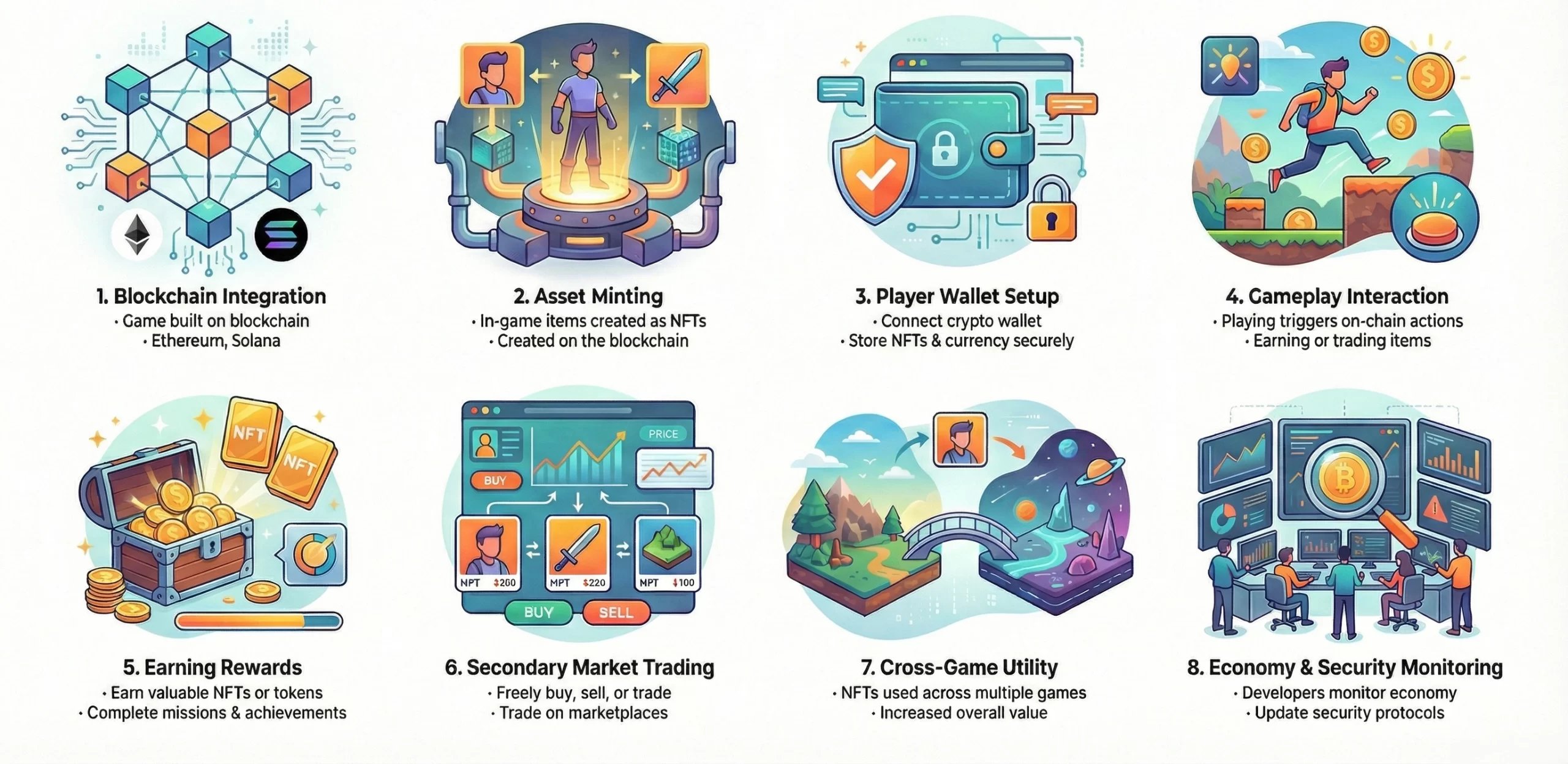
1. Blockchain Integration and Game Launch
Developers select a blockchain like Ethereum, Polygon, Solana, or BNB Chain based on needs like scalability, low fees, and support. The backend links game servers with the blockchain to enable on-chain transactions from in-game actions. Smart contracts handle NFTs, tokens, and rules.
2. Asset Creation and Minting
Game assets such as characters, skins, weapons, land, or collectibles are NFTs with standards like ERC-721 or ERC-1155, each with a unique blockchain ID. When a player acquires an asset, the minting process records ownership on-chain, granting permanent, verifiable property rights.
3. Player Wallet and Identity Setup
Players link or create a cryptographic wallet to interact with the blockchain. This wallet holds NFTs, native tokens, and allows secure signing of transactions. Wallets such as MetaMask, Phantom, or game-built-in wallets enable players to authenticate without compromising security.
4. Gameplay Interaction
Players use standard controls and mechanics, earning rewards for achievements. The game engine interacts with smart contracts for blockchain actions like minting NFTs, transferring items, or updating balances.
5. Rewards and Play-to-Earn Mechanics
Many NFT games use play-to-earn rewards, giving players tokens or NFTs for completing missions, winning battles, or reaching milestones. These have real value because players can sell or trade them outside the game. Tokens often are native to the game’s blockchain and tradeable on exchanges.
6. Secondary Market Trading
Players with NFTs can trade on decentralized or in-game markets. Blockchain records transfers publicly, ensuring transparency and provenance. This creates liquidity and real-world value linked to player activity.
7. Interoperability and Cross-Platform Utility
Depending on the design, some NFTs can be used across multiple games or platforms within the same blockchain ecosystem. This interoperability expands the asset’s utility and value, which increases player engagement and long-term retention.
8. Game Economy Monitoring and Security
Developers continuously monitor the game’s blockchain economy to prevent inflation, maintain token balance, and avoid exploits. Smart contracts undergo security audits and updates, ensuring that asset ownership and transactions remain secure and tamper-proof.
What Types of NFT Games Exist in the Market Today?
The NFT gaming market includes multiple categories defined by gameplay structure, player interaction, and how NFTs integrate into the experience. The table below focuses on core gameplay to clearly explain how each type functions from a player’s perspective.
| NFT Game Type | Core Gameplay Focus | NFT Utility | Platform Example |
| Play-to-Earn (P2E) Games | Gameplay centers on missions and battles where skill and time shape rewards and progression. | Characters, items, and rewards represented as NFTs | Axie Infinity |
| Metaverse Games | Players explore, build, socialize, and create experiences inside persistent virtual worlds driven by user-generated content. | Virtual land, avatars, wearables, interactive assets | The Sandbox |
| Trading Card Games | Strategy-driven card battles where deck building, rarity, and tactical decision-making determine match outcomes. | NFT cards with attributes, rarity, and competitive value | Splinterlands |
| Role Playing Games | Story-focused progression where players level characters, complete quests, and engage in combat across immersive worlds. | Characters, weapons, armor, and collectibles as NFTs | Illuvium |
| Strategy Games | Long-term planning gameplay involves resource management, territory control, and tactical decision-making. | Units, structures, land, and strategic assets | Gods Unchained |
| Sports and Racing Games | Competitive gameplay simulating real-world sports or racing where performance determines rankings and rewards. | Players, vehicles, equipment, or teams as NFTs | Sorare |
| Casual and Arcade Games | Fast-paced and accessible gameplay designed for short sessions and broad player appeal. | Collectibles, boosters, and cosmetic NFTs | Pegaxy |
Why does Understanding Gameplay Focus Matter?
Each NFT game type attracts different player motivations, session behavior, and retention patterns. Choosing the right gameplay focus helps founders align NFT utility, economy design, and long-term growth strategy with their target audience.
Key Features That Make NFT Games Stand Out
NFT games stand out through player-owned assets, transparent economies, and decentralized marketplaces that reshape digital gaming experiences. These features collectively highlight how blockchain technology enhances gameplay and long-term engagement.

1. Player-Owned NFT Assets
Player-owned NFT assets give users verifiable ownership of characters, items, land, and collectibles recorded on the blockchain. Players can hold, transfer, sell, or monetize assets freely, which increases perceived value and long-term commitment to the game ecosystem.
2. In Game NFT Marketplace
An in-game NFT marketplace enables players to trade assets instantly within the game interface. This feature improves usability, reduces dependency on third-party platforms, increases transaction velocity, and helps developers retain economic activity and revenue inside the ecosystem.
3. Play to Earn Reward Mechanisms
Play-to-earn mechanisms reward players with tokens or NFTs based on gameplay performance, achievements, or participation. These systems transform gameplay into an income-generating activity while encouraging daily engagement, competitive play, and sustained user growth.
4. Upgradeable and Utility-Driven NFTs
Upgradeable NFTs evolve through gameplay actions such as leveling, crafting, or completing challenges. Utility-driven design ensures each NFT delivers functional value inside the game, which strengthens demand, discourages speculation-only behavior, and supports long term asset relevance.
5. Seamless Wallet Integration for Players
Seamless wallet integration allows players to manage NFTs, tokens, and transactions without technical friction. Embedded or external wallet support simplifies onboarding, improves retention, and ensures users maintain full custody and control of their blockchain-based assets.
6. Token-Based In-Game Economy
A token-based in-game economy powers rewards, upgrades, transactions, and governance activities. Clearly defined token utility and controlled supply flow help maintain economic balance while supporting monetization, player incentives, and ecosystem scalability.
7. Asset Trading and Liquidity Access
Asset trading and liquidity access allow players to convert in-game NFTs into tradable value through internal or external marketplaces. Liquidity strengthens player confidence, increases participation, and positions the game as a viable digital asset ecosystem.
8. Transparent Ownership and Transaction History
Blockchain-based ownership records provide transparent access to asset history, pricing, and transfers. Players can independently verify authenticity and ownership at any time, which builds trust, reduces disputes, and reinforces confidence in the game economy.
9. Gas Fee Optimization and Transaction Transparency
Gas fee optimization minimizes transaction costs through efficient contract design and scalable blockchain choices. Clear transaction visibility helps players understand costs before execution, which improves user experience and prevents drop-offs during critical gameplay interactions.
10. Fiat On Ramp and Off Ramp Support
Fiat on-ramp and off-ramp support enables players to buy or sell assets using traditional currencies. This feature lowers entry barriers for non-crypto users and significantly increases adoption, conversion rates, and overall market reach at launch.
What Is the NFT Game Development Process?
NFT game development is not just about adding tokens to gameplay; it’s about designing player-owned assets and balanced economies that genuinely enhance the experience. Having architected multiple such ecosystems, we know it demands a careful blend of behavioral economics, distributed ledger technology, and high-quality engineering.
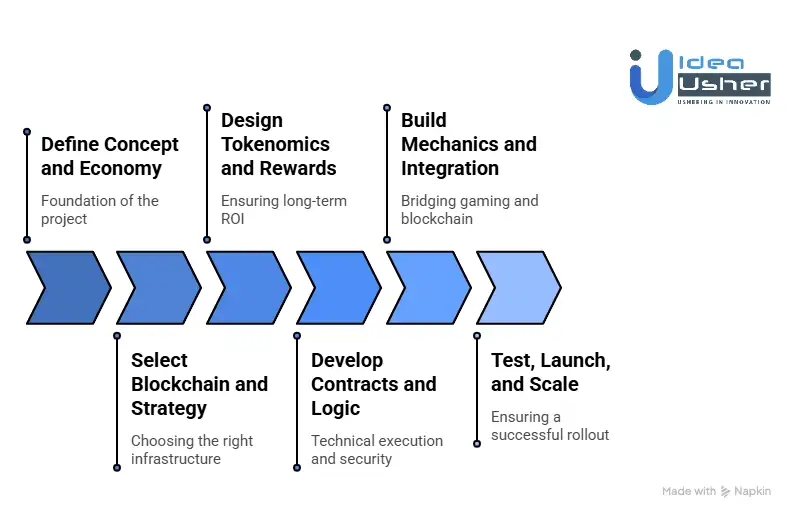
1. Define Concept and Economy
The foundation of the profitable NFT ventures we build lies in the Game Design Document, but we always pair this with a rigorous Economic Whitepaper. We work with our partners to decide early whether the platform will follow a Play-to-Earn model, which focuses on financial extraction, or a Play-and-Own model, which prioritizes player retention and asset longevity.
- Genre Selection and Market Fit: Whether we are building a Grand Strategy game, an RPG, or a Trading Card Game, we ensure the genre supports high-frequency asset interaction.
- Player Archetypes: We identify exactly who will drive the economy. We help you cater to large-scale investors, players earning for a living, and collectors. We have found that a healthy ecosystem requires a balance of all three to ensure liquidity.
- Value Proposition: We define exactly why an NFT is necessary for your specific project. If the game functions perfectly well without a blockchain, we advise our clients that the market will eventually view the NFT integration as a friction point rather than a feature.
2. Select Blockchain and Strategy
When we guide clients through choosing infrastructure, we treat it as a multi-million dollar decision. We are not just picking a database for you; we are picking a partner ecosystem. The choice we make together impacts transaction speeds, gas fees for your users, and the level of decentralization.
- Layer 1 vs Layer 2 Solutions: While Ethereum offers high security, we often steer clients toward Layer 2 scaling solutions or sidechains like Polygon, Immutable X, or specialized gaming chains like Avalanche Subnets to keep micro-transactions affordable.
- Standardization: We help you decide between ERC-721 for unique items and ERC-1155 for semi-fungible items like tiered armor. We often prefer the latter in our builds to reduce minting costs and enable batch transactions.
- Interoperability Goals: We plan for whether your assets will be walled gardens or usable in other metaverses. We build with composability in mind to increase the secondary market value of your NFTs.
3. Design Tokenomics and Rewards
In our experience, this is the most critical phase for long-term ROI. We have seen how poorly designed tokenomics lead to hyperinflation, so we focus on ensuring the supply of earned tokens never outstrips demand to prevent an economic collapse. We actively engineer circular economies where every token earned has a logical destination, ensuring that utility and scarcity remain in constant equilibrium.
| Component | Our Strategic Approach |
| Dual-Token Model | We separate the Governance token from the In-game Utility token. |
| Sinks and Burn Mechanics | We implement methods to remove tokens from circulation to prevent inflation. |
| Staking Incentives | We encourage long-term holding by rewarding users who lock their assets. |
| Vesting Schedules | We ensure the founding team and early investors are aligned with long-term health. |
4. Develop Contracts and Logic
We treat the smart contract as the constitution of your platform. It dictates how assets are minted, traded, and upgraded. At this stage, we shift our focus from vision to technical execution and security. By embedding the fundamental rules of the game logic directly into the protocol, we provide players with a mathematically verifiable guarantee of fairness and ownership that no centralized authority can override.
- Logic Coding: We write the backend scripts in languages like Solidity or Rust. This includes the minting engine and the logic we develop for breeding or evolving NFTs.
- Metadata Management: We decide where the actual artwork and traits live. We use decentralized storage like IPFS or Arweave for our clients to ensure that while the token is on the blockchain, the visual asset is also permanent.
- Security Audits: We consider this a non-negotiable step. We facilitate stress tests of the code through third-party firms to protect our clients from vulnerabilities like reentrancy attacks or flash loan exploits.
5. Build Mechanics and Integration
We use this phase to bridge the gap between the traditional gaming experience and the blockchain ownership layer. Our goal is to reduce onboarding friction, which we have identified as the primary difficulty a user faces when trying to play a blockchain game for the first time.
Our integration process involves connecting the game engine, such as Unity or Unreal Engine, to the blockchain via Web3 providers. This allows the game we build to read what is in a player’s wallet and render those assets in the game world.
6. Test, Launch, and Scale
We have learned that execution at launch can make or break the platform’s reputation. We rarely advise a stealth launch; instead, we implement a phased rollout as our standard for mitigating risk. This methodical approach allows us to stabilize the economy and server load in a controlled environment before opening the gates to the mass market.
- Alpha and Beta Testing: We focus on game loop enjoyment and economy balancing. We ensure that early players cannot exploit the rewards system to drain the treasury before the public launch.
- The NFT Drop: We treat this as a strategic marketing and funding event. We use this to generate initial capital and build a community of vested stakeholders for our clients.
- Scaling Infrastructure: As the player base grows, we ensure the backend can handle thousands of concurrent transactions. We often move data to off-chain game servers for gameplay while only settling state changes on the blockchain.
- Community Governance: Post-launch, we help clients transition to a DAO structure. This allows your most invested users to vote on future updates, ensuring the platform evolves according to the needs of its most valuable participants.
How Much Does NFT Game Development Cost?
Estimating the capital for a market-ready NFT game involves more than just developer hours. It requires a holistic view of the ecosystem, including smart contract architecture, game engine complexity, and the continuous costs of liquidity and security. We view these costs as a strategic allocation toward building a digital asset class rather than just a software expense.
Cost Breakdown by Feature and Type
When we analyze the financial landscape of Web3 gaming, we see three distinct tiers of development. Each represents a different level of technical complexity and market positioning. We evaluate these tiers based on the depth of the on-chain logic required and the quality of the user experience to ensure our clients allocate capital effectively for their specific goals.
| Game Type | Estimated Cost Range (USD) | Key Features Included |
| Simple 2D / Card Game | $60,000 – $150,000 | Basic NFT minting, marketplace integration, 2D assets, and dual-token economy. |
| Mid-Range 3D RPG / Strategy | $150,000 – $500,000 | Advanced game mechanics, 3D environment, staking, and custom smart contracts. |
| AAA-Grade Metaverse | $500,000 – $2M+ | High-fidelity graphics, cross-chain compatibility, and complex DAO governance. |
Beyond the core game, the choice of blockchain adds its own financial layer. While developing on Ethereum might cost more for security audits and gas optimization, choosing a specialized gaming chain like Immutable X or Polygon can reduce long-term operational costs for your players.
Factors Affecting Development Budget
We have identified several critical pivot points where the budget can fluctuate. Understanding these allows us to optimize the build without sacrificing the integrity of the platform. By isolating these variables during the planning stage, we help our partners avoid technical debt and ensure that every dollar spent contributes directly to the long-term scalability of the game..
- Complexity of Smart Contracts: Standard NFT minting is relatively affordable. However, if we are building dynamic NFTs that change stats based on gameplay or breeding mechanics that require complex on-chain logic, the engineering and auditing costs will rise.
- Art and Asset Production: High-quality 3D modeling, rigging, and animation are often the most significant expenses. We suggest starting with a cohesive art style that is scalable rather than chasing hyper-realism, which can bloat the budget exponentially.
- Web3 Integration Layers: Building the bridge between the game engine and the wallet requires specialized middleware. If we need to build a proprietary marketplace or a custom launcher, this adds to the development timeline.
- Security Auditing: We consider this a fixed necessity. Cutting corners here can lead to exploits that drain your treasury. Expect to allocate $15,000 to $50,000 specifically for third-party code verification.
Budgeting from MVP to Full Scale
For the stakeholders we work with, we recommend a staged funding approach. This allows for market validation before committing to the full-scale development of a multi-year project. This strategy transforms the development process into a series of de-risked milestones, ensuring that further capital is only deployed once the core mechanics and economic assumptions have been proven in a live environment.
- Phase 1: The Prototype/MVP ($50,000 – $100,000): We focus on the core game loop and basic NFT functionality. This phase proves that the game is fun and the economy is viable. It often includes a limited NFT drop to bootstrap the community and recoup initial costs.
- Phase 2: Economy Scaling and Beta ($100,000 – $300,000): Once the MVP is validated, we expand the feature set. This includes advanced tokenomics, a fully functional in-game marketplace, and the introduction of sinks and burns to stabilize the currency.
- Phase 3: Full Market Expansion ($300,000+ ): The final stage involves high-end polish, marketing at scale, and potentially moving to a cross-chain architecture. At this point, the focus shifts from building to managing the economy and retaining the player base through consistent content updates.
Tech Stack Recommendation For NFT Game Development
Selecting a tech stack for a high-performance NFT game is no longer a matter of simply picking a popular framework. We approach this as an architectural challenge where the backend must synchronize real-time game states with asynchronous blockchain transactions. We prioritize a modular stack that allows for horizontal scaling while maintaining the cryptographic security required to protect player assets.
1. Choosing Blockchain for Scale
The protocol layer acts as the economic foundation of your platform. When we advise on blockchain selection, we evaluate three primary metrics: transaction throughput, finality time, and cost predictability. These pillars allow us to build a sustainable environment where players can interact with their assets in real-time, shielded from the volatility of network congestion and unpredictable fee spikes.
- Throughput and Latency: For games requiring high-frequency interactions, we look for networks capable of processing thousands of transactions per second.
- Cost Stability: We prioritize networks with low or predictable gas fees to ensure the cost of moving an NFT does not exceed the value of the item itself.
- Ecosystem Maturity: We lean toward chains with robust developer tools and existing liquidity, as this reduces the time-to-market for our clients.
2. Ethereum vs Polygon or Solana
We guide our partners through these specific choices based on the target audience and the complexity of the game assets. By aligning the underlying protocol with the expected transaction volume and asset value, we ensure the infrastructure supports a frictionless user experience without compromising on decentralization or security.
| Network | Best Use Case | Our Technical Take |
| Ethereum | High-value, rare collectibles. | We recommend this for premium assets due to unmatched security and decentralization. |
| Polygon / L2s | Mid-range RPGs and strategy games. | We use Polygon or Immutable zkEVM for projects needing EVM compatibility with near-zero fees. |
| Solana | High-speed action and mobile gaming. | We deploy here when the game requires massive scale and parallel transaction processing. |
3. Engines Powering Web3 Gaming
The game engine is where the user experience lives. We work primarily with Unity and Unreal Engine, each serving a distinct strategic purpose. For rapid prototyping and mobile-first deployments, we typically recommend Unity. It offers an extensive library of Web3 SDKs and a more accessible environment, which accelerates the development of MVPs.
If our client is aiming for a AAA-grade metaverse with photorealistic graphics, we utilize Unreal Engine. Its Nanite and Lumen technologies provide the visual fidelity required for premium experiences, though it requires a more specialized engineering team.
4. Secure Smart Contract Tools
We utilize a professional-grade suite of tools to ensure the integrity of the game logic. We treat smart contract code with the same rigor as financial software. By integrating automated fuzzing and symbolic execution into our deployment pipeline, we identify deep-seated logic vulnerabilities and edge cases long before they can impact your bottom line.
- Hardhat and Foundry: These are our primary development environments for writing, testing, and deploying EVM-compatible contracts. They allow us to simulate network conditions and perform deep debugging.
- OpenZeppelin: We leverage these industry-standard libraries for secure, audited contract templates. This ensures that features like pausing a contract or blacklisting exploiters are battle-tested.
- Remix IDE: We use this for quick logic verification and on-the-fly testing before moving into the more complex build pipelines.
5. Wallet and Web3 Infrastructure
The bridge between the user and the blockchain must be invisible. We focus on reducing onboarding friction by implementing account abstraction and seamless wallet connectors. We integrate solutions like WalletConnect or RainbowKit to support a wide range of browser and mobile wallets.
For projects targeting a more mainstream audience, we often implement Account Abstraction. This technology allows us to create smart wallets where users can sign up with an email or social login, effectively hiding the complexity of seed phrases while still maintaining non-custodial ownership of their assets.
6. Scaling NFT Metadata Storage
Blockchain is too expensive for storing high-resolution images or 3D models. We solve this by separating ownership from data. While the token lives on the blockchain, the metadata is stored on decentralized networks. We primarily use IPFS or Arweave. We recommend Arweave for clients who want permanent storage for their assets, as it uses a one-time payment model for lifetime data persistence.
To ensure fast loading times within the game, we deploy dedicated gateway servers that cache this decentralized data, ensuring the player never waits for an asset to render.
Challenges and How Our Developers Will Overcome Them?
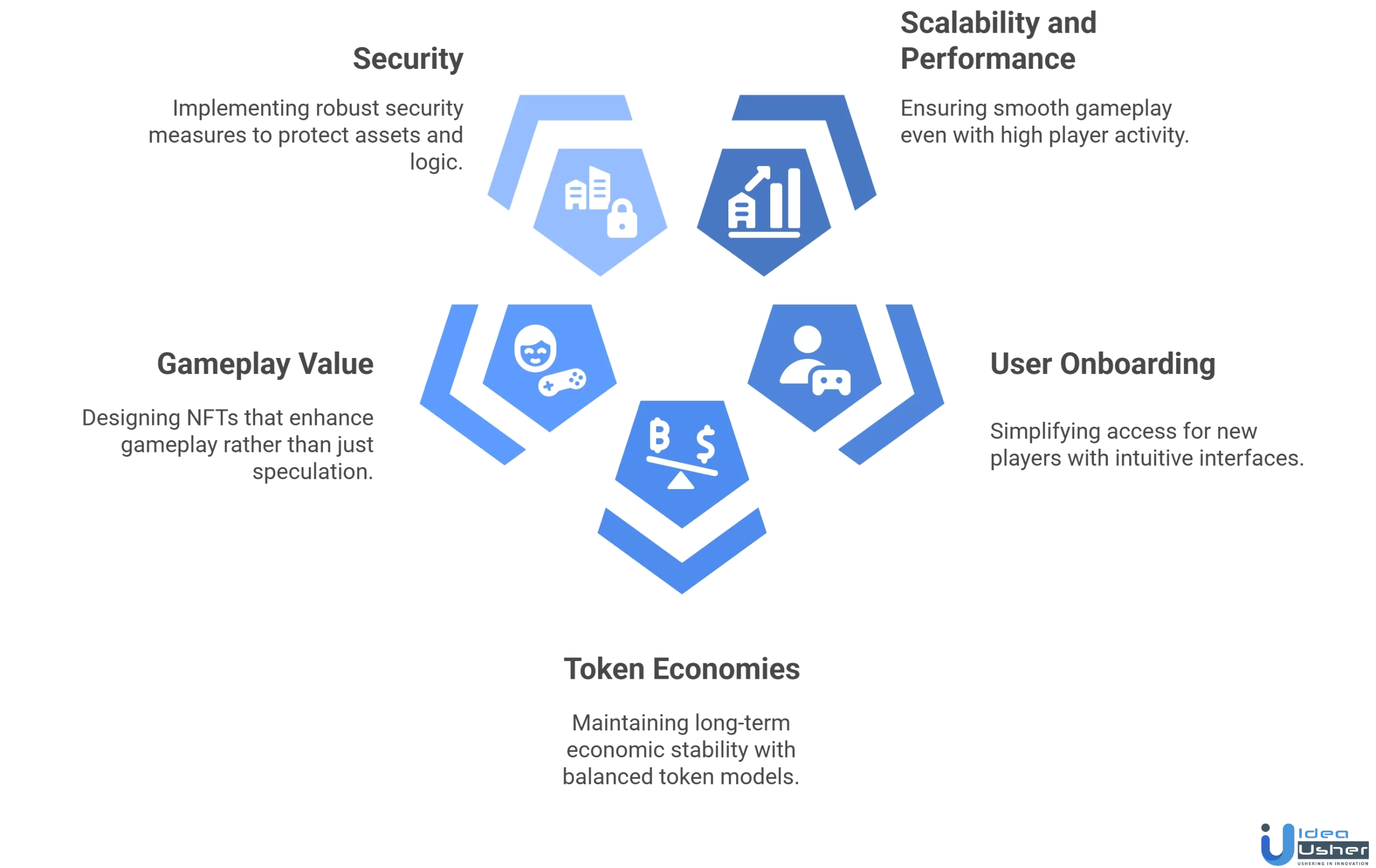
NFT game development faces challenges such as scalability, security risks, regulatory concerns, and player retention. Our developers address these through optimized blockchain choices, secure smart contracts, and balanced game economies to ensure sustainable growth.
1. Scalability and Performance Limitations
Challenge: NFT games often face performance bottlenecks when high player activity triggers frequent blockchain transactions, leading to latency and disrupted gameplay experiences.
Solution: We design scalable transaction flows, minimize on-chain interactions during gameplay, and optimize data handling to maintain smooth performance even during peak user activity.
2. High Entry Barriers for New Players
Challenge: Complex wallets, crypto requirements, and unfamiliar onboarding processes discourage mainstream users from trying NFT games at launch.
Solution: We simplify user onboarding with intuitive interfaces, guided wallet setup, and optional fiat access to reduce friction and improve early adoption.
3. Unsustainable Token Economies
Challenge: Poorly balanced token models lead to inflation, reduced rewards, and declining player interest over time.
Solution: We structure controlled token flows, introduce spending sinks, and align rewards with gameplay effort to maintain long-term economic stability.
4. Asset Speculation Over Gameplay Value
Challenge: Excessive focus on NFT trading can overshadow gameplay quality and attract short-term users driven only by speculation.
Solution: We design utility-focused NFTs that directly impact gameplay progression, ensuring assets hold value through use rather than speculation alone.
5. Security Risks and Smart Logic Exploits
Challenge: Vulnerable smart logic exposes NFT games to asset theft, manipulation, and irreversible financial losses.
Solution: We implement secure logic planning, conduct rigorous testing, and follow best practices to protect ownership, transactions, and player assets.
Legal and Regulatory Considerations in NFT Games
Legislation is a sophisticated terrain to be traveled along as either a player or an NFT game developer. Realizing the regulatory requirements have to be approached so as to follow them and bridge legal loopholes.

1. Securities Laws
The U.S. Securities and Exchange Commission (SEC) examines whether some NFTs constitute investment contracts in accordance with the Howey Test, determining whether an asset is an investment of money into a reasonable profit expectation from other people’s labor. Recent precedents, such as those against Impact Theory and Stoner Cats 2 LLC, illustrate increased SEC scrutiny along these lines.
2. Intellectual Property Rights
NFT games are usually based on user-generated content, and therefore, ownership and copyright concerns arise. Developers must establish clear terms of service that demarcate asset ownership to prevent creator, player, and platform conflicts.
3. Anti-Money Laundering Compliance
Because of the pseudonymous nature of blockchain transactions, NFT games will have to implement KYC measures and transaction surveillance to avoid money laundering and fraud. The regulators are focusing more on these aspects in the blockchain ecosystem.
4. Data Privacy and Security
NFT games that collect and process users’ information must adhere to international data protection regulations such as the General Data Protection Regulation (GDPR) in the EU. Clarity of policy, safe storage of data, and clear user consent are the determinants of compliance.
5. Platform Policies and Restrictions
Large gaming platforms take different positions on NFT-based games. For instance, Valve’s Steam prohibits blockchain games that use NFTs and cryptocurrency trading, whereas the Epic Games Store allows them as long as they are in line with legal guidelines. Developers must adhere to platform policies when releasing their games.
How NFT Games Generate Revenue?
Resilient NFT games utilize a diversified revenue matrix to capture value across the player lifecycle. We focus on circular economies where revenue is a byproduct of engagement rather than speculative trading. By implementing transparent value-capture mechanisms, we help partners generate continuous cash flow through automated smart contract logic.
1. In-Game NFTs and Market Fees
Primary sales provide initial capital, but long-term profitability lies in the secondary market. We architect marketplaces that act as the economic engine of the ecosystem. By capturing a fixed percentage of every peer-to-peer trade, we transform the game into a high-frequency trading environment that generates revenue regardless of market direction.
- Primary Minting: We launch tiered asset drops to establish baseline scarcity.
- Automated Royalties: A percentage of every secondary sale is routed to the treasury. Gods Unchained utilizes this by capturing fees from every card trade; even with market shifts, the platform maintains steady volume, contributing to the $1.3 billion in resale royalties generated by leading NFT titles recently.
- Listing Fees: We implement micro-fees for marketplace interactions to prevent manipulation and scale revenue with the player base.
2. Play-to-Earn Models
We evolve Play-to-Earn into sustainable Play-and-Earn models. The goal is to balance token outflows with internal demand through essential game sinks. When designing these models, we focus on Return on Reward Spend. Instead of distributing value for free, we create systems where players reinvest tokens.
For example, Axie Infinity creates demand by requiring tokens for breeding. This ecosystem successfully distributed over $240 million in rewards last year through its Homeland expansion, proving that structured sinks can stabilize a massive economy.
3. Staking and Engagement
Staking is a powerful retention tool that reduces sales pressure and rewards long-term commitment. By encouraging players to lock assets in exchange for exclusive governance rights or rare in-game utility, we create a stable foundation of invested users who are financially incentivized to support the long-term health of the ecosystem.
| Model Type | Strategic Function |
| Asset Staking | Players lock NFTs to earn soft currency for in-game upgrades. |
| Liquidity Provision | Incentivizing users to provide liquidity in exchange for rare drops. |
| Yield-Based Access | Creating VIP tiers where staking tokens unlocks exclusive areas. |
Illuvium serves as a prime example, where the DAO distributes 100% of game revenue back to token stakers. With staking yields historically ranging from 15% to 45%, the platform directly links success from travel fees and marketplace commissions to the returns of its most committed players.
4. Renting for New Players
Rental protocols lower the barrier to entry for new users. High-value NFTs become accessible, creating a passive income layer for investors while providing the platform with active players. We implement this via smart contracts that automatically split earnings. Splinterlands has mastered this by allowing players to rent out card decks for daily fees.
This model helped the game distribute $240 million in rewards last year, maintaining a massive active user base in a global blockchain gaming market now valued at over $600 billion.
5. Brand Collaborations
Blockchain allows for targeted, non-intrusive brand integrations. We treat the game world as premium digital real estate. Transparent data attracts high-value partners. The Sandbox demonstrates this potential through partnerships with global brands like Adidas and Netflix. Branded experiences, such as the Squid Game Virtuals, have generated over $50 million in sales, providing external capital independent of the player’s wallet while driving total platform revenue toward the $100 million mark.
Gameplay Modules That Power NFT Game Ecosystems
Successful NFT games use modular frameworks to prioritize retention over speculation. We layer traditional psychological triggers with decentralized ownership so the game remains fun while providing economic consequences. By treating gameplay as a series of interconnected modules, we help partners build scalable worlds where on-chain assets feel like a natural extension of the player journey.
1. Loops for Retention
The core loop is the cycle of actions keeping players active. In Web3, this must balance entertainment with asset progression to prevent economic fatigue. By ensuring each action feeds into a tangible upgrade, we transform casual play into a long-term investment in the player’s own digital identity.
The Web3 Core Loop:
- Action: Complete a quest or win a battle.
- Reward: Earn soft currency or NFT components.
- Expansion: Use rewards to upgrade or craft NFTs.
- Retention: Use upgraded assets in higher-stakes play.
Gods Unchained uses a “Play-Earn-Forge” loop where players win matches to earn Flux, then use it to turn common cards into tradable NFTs. This sequence ensures players interact with primary sinks, keeping the secondary market liquid and contributing to the consistent active user bases seen in top-tier trading card games.
2. Social Economy Layers
In NFT games, community structures are economic structures. We build multiplayer modules that encourage collaboration, as group-oriented players often show significantly higher lifetime value. Recent market data indicates that play-to-earn titles incorporating strong social or metaverse elements can see up to 40% higher retention rates than solo experiences.
- Guild Systems: We integrate smart contracts for automated revenue sharing, allowing pro-players to use investor-owned assets with instant dividend splits.
- Social Governance: In Alien Worlds, players participate in planetary elections where token ownership translates to voting power, letting the community shape the game world.
- Competitive Play: We implement leaderboards and tournaments with prize pools funded by transaction fees, ensuring competitive play always has tangible rewards.
3. Rarity and Progression
NFT demand is driven by utility and scarcity. We implement progression systems where assets evolve based on performance, turning every NFT into a unique record of player history. Integrating dynamic metadata allows an asset’s value to grow alongside the player’s skill, creating a deeper emotional and financial bond with the game.
| Feature | Impact on Demand | Technical Execution |
| Trait Rarity | Increases base value. | Metadata-shuffling using Verifiable Random Functions (VRF). |
| Experience Leveling | Incentivizes long play. | On-chain metadata updates recording XP and stat boosts. |
| Visual Evolution | Drives social status. | Dynamic NFTs that change artwork once milestones are hit. |
In Axie Infinity, the breeding system acts as both a rarity filter and a token sink. By requiring parent NFTs and tokens to create offspring, the game controls trait supply while removing excess tokens from the economy. This synergy maintains the long-term value of the digital collection, which historically contributed to the ecosystem distributing hundreds of millions in rewards during peak engagement periods.
Tokenomics Strategies for Stable NFT Game Economies
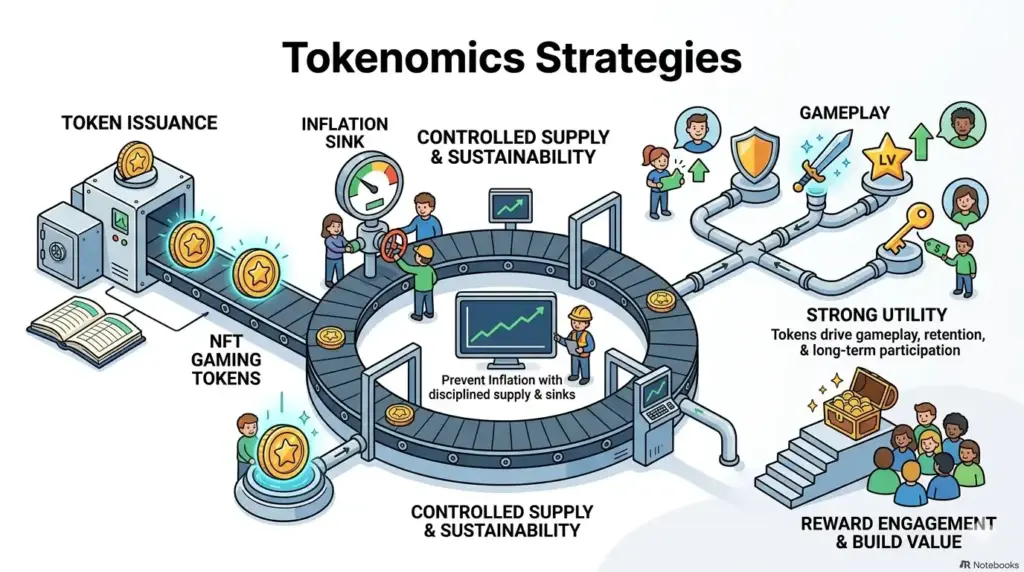
The success of NFT games hinges on a play-and-earn philosophy rather than the inflationary models of the past. We treat tokenomics as a balancing act between player incentives and long-term liquidity. By architecting dual-token systems that separate high-velocity utility tokens from low-velocity governance tokens, we ensure that gameplay rewards do not dilute the underlying value of the ecosystem.
1. Supply and Demand Design
A sustainable economy requires clear and predictable emission schedules. We prioritize models where token supply scales with actual utility and player growth rather than arbitrary time-based minting. By implementing algorithmic adjustments that throttle or expand emissions based on active user metrics, we prevent the supply-side shocks that often plague early-stage token launches.
- Emission Discipline: We implement rule-based distributions where rewards are tied to real game milestones. This ensures that a surge in new players does not lead to a hyper-inflationary event that crashes asset prices.
- Predictable Unlocks: For investors and teams, we utilize smart-contract-enforced vesting periods. This signals market stability and prevents large-scale selling that can erode player trust.
- Dynamic Scarcity: We use Verifiable Random Functions to ensure that high-tier NFT assets remain rare even as the player base grows, preserving the prestige value of early-adopter collections.
2. Sinks and Rewards for Inflation
In NFT games, a sink is any mechanic that removes tokens from circulation. We design these sinks to feel like rewarding gameplay progression rather than a tax on the player. By converting earnable tokens into long-term inventory value through crafting, we ensure that the economy stays elastic and responsive to the total number of active users.
Effective Web3 Sinks:
- Crafting and Upgrades: Players spend utility tokens to level up their NFTs, transforming liquid tokens into permanent asset value.
- Maintenance Fees: Repairs and energy costs ensure that active players are constantly recycling value back into the game treasury.
- Vanity Purchases: Cosmetic upgrades like skins or titles act as deflationary sinks that do not impact competitive balance but drive high token demand.
Axie Infinity successfully pivoted its economy by introducing sinks within its Homeland expansion. By requiring players to spend tokens on structural upgrades and breeding, the platform created a reason for players to hold and reinvest rather than immediately swap for external liquidity.
3. Utility and Retention Alignment
Token utility must be deeply woven into the social and competitive fabric of the game. If a token only exists to be sold, the economy will eventually fail. We focus on utility-gated access to drive long-term holding. By creating exclusive benefits for those who maintain a significant token balance, we ensure that the community feels like shareholders in the world they are helping to build.
| Utility Type | Impact on Player Behavior | Strategic Value |
| Governance Voting | Increases emotional and financial stake. | Players vote on treasury spend and priorities via DAOs. |
| Tournament Entry | Drives competitive demand for tokens. | Fees fund prize pools for a self-sustaining ecosystem. |
| Asset Staking | Reduces circulating supply and sell pressure. | Provides VIP perks like early access to new NFT drops. |
In The Sandbox, the SAND token is essential for every interaction. From buying virtual land to entering creator-made experiences, this omnipresent utility ensures that as the world expands with more brands, the demand for the token remains tied to actual usage. We help our partners achieve this level of integration so token value is a direct reflection of the game’s cultural footprint.
NFT Asset Creation Strategies for Web3 Games
Successful NFT games treat digital assets as living products rather than static images. Moving beyond basic collectibles, these assets function as essential tools. Focusing on the intersection of aesthetic appeal and utility helps create items that players desire to own and improve. Transitioning from selling mere scarcity to selling meaningful progression ensures that every minted asset contributes to the depth of the game world.
1. Utility and Rarity Value
In NFT games, rarity without utility is often just speculation. Balancing these forces ensures assets remain valuable regardless of market volatility. By anchoring the market price to the practical advantages an item provides during gameplay, the ecosystem builds a floor price based on actual demand rather than hype alone.
- Functional Utility: Every NFT serves a specific role, such as increasing resource yield or providing dungeon access.
- Provable Scarcity: On-chain verification guarantees that limited editions remain limited. Gods Unchained utilizes quality tiers that affect visual shine and reward-earning potential to drive demand for rare cards.
- Economic Utility: Assets are designed to be productive. In Star Atlas, a high-tier spaceship NFT determines the ability to mine resources and participate in territorial conquest. Similarly, in Illuvium, captured Illuvial NFTs are not just trophies but essential combatants with specific elemental synergies required for high-stakes arena play.
2. Metadata and Collectibility
Metadata acts as the hidden DNA of an NFT. Structuring this data allows for complex interactions and a sense of history that traditional items cannot match. By recording every achievement and modification directly on the blockchain, each asset becomes a unique digital diary of the player’s specific journey and accomplishments.
High-Value Metadata:
- Base Stats: Core power levels and attributes.
- Lore: Narrative elements connecting the item to the world.
- Dynamic Attributes: Tracking achievements like victories or bosses defeated.
- Visual Variants: Unique skins or modifications unlocked through play.
Dynamic metadata allows assets to grow over time. In The Sandbox, virtual land metadata records more than just coordinates; it stores information about built experiences and brand interactions from partners like Netflix. This transforms digital land into storied real estate with a verifiable history of engagement.
3. Managing the NFT Lifecycle
An NFT journey does not end at the mint. Designing for a full lifecycle, including upgrades and burning, controls supply and maintains demand. These cycles ensure an asset minted on day one remains relevant years later. By facilitating a continuous evolution of digital property, the game maintains a fresh experience for veteran players while preventing the devaluation of their original acquisitions.
| Phase | Strategic Action | Player Impact |
| The Mint | Tiered distribution. | Rewards early adopters and active participants. |
| Evolution | Smart contract stat-boosting. | Players reinvest to make assets stronger. |
| The Sink | Burning assets to craft tiers. | Reduces supply to support asset floor prices. |
Parallel provides a sophisticated example through its Prime ecosystem. Players use card NFTs to win matches and earn tokens, which are then used to acquire Echoes or manifest new assets through specialized expansion mechanics. In Splinterlands, the ability to combine multiple copies of the same card to level up its stats serves as a permanent deflationary sink. These cycles of creation and consumption prevent the market from becoming oversaturated with low-value items.
Popular Games that are Using NFT in Games
Popular NFT games in today’s market showcase how blockchain technology is transforming gaming through player-owned assets, play-to-earn models, and decentralized economies. These examples highlight innovation and evolving trends in the industry.
1. Axie Infinity

Genre: Creature Battling, Play-to-Earn
Key NFT Features:
- Axies (creatures) are NFTs, giving players ownership for breeding, battling, and trading.
- Land plots are NFTs, allowing owners to earn resources and host content.
Benefits from NFTs:
- Creates a vibrant player-driven economy with real-world value.
- The play-to-earn model incentivizes activity and attracts a broad user base.
2. Gods Unchained

Genre: Collectible Card Game (CCG)
Key NFT Features:
- Each card is a tradeable NFT with verifiable rarity.
- Players fully own their decks and can earn rewards as they win matches.
Benefits from NFTs:
- Taps into the established CCG market, but with true ownership as the core appeal.
- Fosters competition and incentivizes ongoing play for skilled players.
3. The Sandbox

Genre: Sandbox, Metaverse
Key NFT Features:
- LAND parcels are NFTs, creating a finite virtual world with player ownership.
- The Game Maker tool allows players to build experiences, monetize creations, and use ASSETS (items) as NFTs.
Benefits from NFTs:
- Fosters creativity and gives players a stake in the platform’s success.
- It empowers a decentralized marketplace for in-game content and experiences.
4. Blankos Block Party

Genre: Party Game, Collectible
Key NFT Features:
- Blankos characters are NFTs, tradable and customizable with unique accessories.
- Player-created maps use NFTs to represent ownership and reward participation.
Benefits from NFTs:
- It appeals to collectors and fosters a playful community around customization.
- Empowers map creators, potentially leading to diverse in-game experiences.
5. Sorare

Genre: Fantasy Sports (Soccer/Football)
Key NFT Features:
- Digital player cards are NFTs, with stats and rarity based on real-world performance.
- Users build fantasy rosters and compete for rewards based on team performance.
Benefits from NFTs:
- Leverages the popularity of sports with verifiable card ownership and scarcity mechanics.
- Taps into existing sports fanbases and potentially attracts speculators.
Conclusion
NFT game development is reshaping the gaming landscape by combining blockchain technology, player-owned assets, and innovative economic models. Understanding the development process, cost factors, and revenue strategies can help both developers and players navigate this evolving ecosystem effectively. From selecting the right tech stack to designing engaging gameplay and marketplaces, every step plays a crucial role in creating successful NFT games. By focusing on security, scalability, and player experience, NFT game development offers opportunities to build sustainable, immersive, and future-ready gaming experiences.
Why Choose IdeaUsher for Your NFT Game Development?
We specialize in building secure, scalable, and engaging NFT games that help businesses enter the blockchain gaming space with confidence. From concept validation to smart contract integration and marketplace development, we deliver end-to-end solutions tailored to your vision.
- Market-driven game development strategy: We analyze gaming trends, player preferences, and competitors to design NFT games that meet market demand, ensuring your game is engaging, relevant, and positioned for long-term success.
- Custom NFT and marketplace integration: Our team develops custom NFT systems and in-game marketplaces aligned with your game mechanics, allowing players to trade and sell assets securely, supporting a dynamic, player-driven economy.
- Secure and scalable blockchain frameworks: We implement secure, scalable blockchain architectures for fast transactions, handling growth while protecting assets and data.
- End-to-end development support: From concept to post-launch, we support every stage, enabling confident launches and ongoing improvements.
Explore our portfolio to see how we’ve supported businesses in launching innovative blockchain solutions in the market. Connect with our experts for a free consultation and begin building your NFT gaming platform with confidence.
FAQs
A.1. The cost to develop an NFT game typically ranges from $65,000 to $118,000+. Pricing depends on gameplay complexity, NFT asset volume, blockchain integration depth, marketplace features, and long-term scalability requirements.
A.2. The best blockchain for NFT game development depends on scalability, transaction fees, and ecosystem support. Projects focused on mass adoption often prefer networks that balance performance, cost efficiency, and strong NFT tooling.
A.3. Major challenges include maintaining economic balance, ensuring scalability, onboarding non-crypto users, and preventing asset exploitation. Addressing these early through thoughtful design and testing improves launch stability and long-term sustainability.
A.4. NFT games can attract non-crypto users by offering simple onboarding, optional wallet creation, fiat payment support, and gameplay-focused experiences. Reducing technical friction helps expand adoption beyond crypto native audiences.