


Key Takeaways
- Live dealer casino software development means building a platform that streams real dealers at real tables to online players, with the studio, video delivery, and betting software working as one system.
- The studio covers the tables, cameras, lighting, sound, and the dealers running each game.
- The streaming side captures the footage, compresses it, and sends it to any device, lowering the quality when a connection is weak.
- Latency decides how the game feels, since bets must close on time and results must show up when players see them happen.
- See how Idea Usher helps businesses build live dealer casino software that streams smoothly and launches faster.
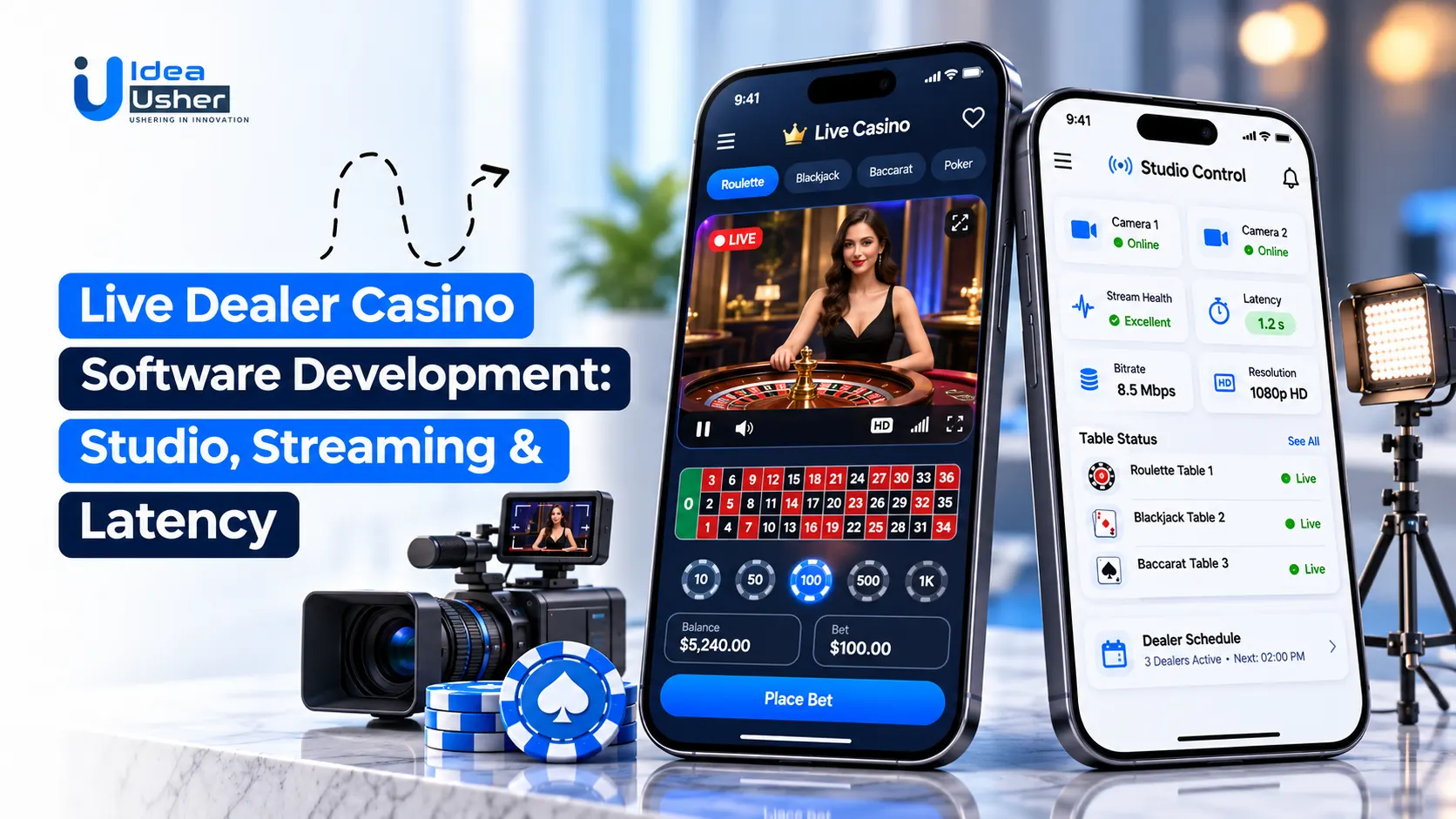
For developing live dealer casino software, the studio hardware, the video pipeline, and the game data have to run in step with each other. At the table, a Game Control Unit or GCU captures what the dealer does, while OCR cameras read each card or roulette number and turn it into data the platform can use. That data is sent to players with the HD video through a CDN. WebRTC keeps the video delay at roughly 500 milliseconds or less, and WebSockets push bets and results to the player’s screen so the betting interface matches what is happening on camera.
When one of these pieces is off, players notice right away. A stream that lags behind the betting window or a result that shows up late is enough to make someone leave the table and not come back. Many operators only find this out after launch, when fixing it costs far more than planning for it would have. In this blog, we’ll discuss how a live dealer studio is set up, how the streaming side works, and what it takes to keep latency low enough for a smooth player experience.
Is Live Dealer Casino Software a Profitable Business in 2026?
Yes, it can be profitable if you pick the right business model and keep your costs under control. According to Fortune Business Insights, the online gambling software market was worth USD 66.72 billion in 2020 and is projected to grow from USD 74.17 billion in 2021 to USD 158.20 billion in 2028 at a CAGR of 11.4%. Europe had the biggest share of this market at 46.34% in 2020, so that is where demand has been strongest. Live dealer software sits inside this growing space, so new companies still have room to enter. The catch is that live tables cost more to run than normal slots, so your profit depends on how smart your setup is.

Source: Fortune Business Insights
Market Growth and Revenue Potential
Live casino is not a small side feature anymore. Big operators now want their own branded tables, and that needs more studio space and more dealers. Caesars is a good case. It opened a branded live studio inside Tropicana Atlantic City with five blackjack tables (one is VIP), one baccarat table and one roulette table. When a land-based giant builds a studio like this, it shows that live content has real demand. That is good news if you plan to sell software or tables.
Evolution’s Studio Expansion Example
Evolution is the easiest company to look at here. It runs more than 2,000 live tables worldwide, and that number has doubled in five years. Its Grand Rapids studio in Michigan is its seventh in the US. The site is expected to bring more than 300 jobs and will host the Michigan launch of Monopoly Live. Ezugi, which Evolution bought in 2018, returned to the US with a New Jersey launch streamed from the Atlantic City studio. There are also reports of a planned $75 million studio campus in New Jersey.
Main Revenue Models Explained
Live dealer companies rarely make money in only one way. Most deals mix a few things, and the mix depends on how big the operator is and how much risk each side wants to take. Some operators like to pay less upfront and share what the tables earn. Others want one fixed bill every month so they can plan their budget. The table below shows the common ones in a simple way.
| Model | How it works | Good for |
| Revenue share | The supplier earns a percentage of game revenue instead of a fixed upfront amount | Low starting budget |
| Fixed monthly fee | The provider charges the operator a set fee every month | Easy planning |
| Dedicated table fees | Invoiced to customers who choose to offer dedicated tables | Branded experience |
| Setup fees | Paid for integration and set-up work | New operators |
| Hybrid deal | Setup costs plus revenue share, or a monthly fee plus performance terms | Growing operators |
Operating Costs and Profit Factors
Costs are where most live dealer plans go wrong. A studio needs space, cameras, lighting and a control room before the first bet is even placed. Staff is a big part too, because a typical studio employs dealers, a cameraman, an IT manager and a pit boss. How many tables you run, how full they stay and which model you pick will decide if you make money. Here are the rough numbers from one development guide:
- Own studio: $500,000 to $2 million or more
- Custom live studio software: $120,000 or more
- Each extra table: $20,000 to $100,000
- Game show style title: $40,000 to $120,000
- Plugging into a provider’s live games: about $5,000 to $25,000
Authentic Gaming’s Land-Based Route
Authentic Gaming shows one way to keep costs lower. It streams roulette from real tables on casino floors, including Foxwoods in the US, so the operator does not need to build a full studio. Betsson Group signed a global deal to take its full suite of games, including the new Live from Foxwoods table. Blaze Roulette is its flagship game, with a game show format. More recently, the Light & Wonder subsidiary launched in Michigan with RSI’s BetRivers. The five games included Premium Blackjack, Stadium Blackjack and Michigan Auto Roulette.

How Live Dealer Casino Software Works: Step by Step
Live dealer casino software lets a real dealer run a game in a studio while players join and bet from their phone or computer. It links cameras, a video stream, a game server and the player’s wallet so everything happens at the same time. In simple words the dealer deals the cards or spins the wheel and the software reads the result. It then shows that result on your screen and settles your bet. Real-time streaming is what makes the talk between player and dealer possible. Below are the seven steps that happen in every round.
1. Player Joins a Live Table
It starts in the casino lobby. The player picks a table and the software opens that table’s video and game screen. Some tables are shared by many casinos and some belong to one brand with its own look and dealers. The platform also checks that the player is logged in and allowed to play before the seat opens.
Playtech Live’s Dedicated Tables
Playtech shows how far this can go. It launched dedicated studios for bet365 in Pennsylvania and New Jersey with 10 tables across the two studios. Another one is Club Aurora, the third dedicated Playtech studio for evoke, with classic blackjack and roulette plus a free to play Trivia hub. The Sky Vegas studio was the first to include a dedicated Spin A Win game from Playtech Live. So joining a table can mean joining a room built for just one brand.
2. Camera Captures the Game
Once the round starts the cameras do two jobs. They show the game to the player and they also read it. When a dealer flips a card the camera captures it and OCR identifies it so the screen updates. This is why the card on your screen matches the real one so fast. Bigger games need more cameras as you can see below.
| Game | Typical cameras |
| Blackjack | 3 (wide, cards, dealer) |
| Roulette | 3 to 4 (wide, wheel, ball drop, dealer) |
| Baccarat | 3 |
| Game shows | 5 to 7 or more |
3. Video Streams to Players
Next the video goes from the studio to the player. The feed is encoded and sent through servers close to the player so it arrives quickly. Delay matters a lot here because a late video means a late bet. The streaming method you choose decides how big that delay is.
Pragmatic Play Live’s Streaming Setup
Pragmatic Play Live is a good example of low delay in a real product. Its PowerUP Roulette is recorded with 4K cameras and streamed with ultra low latency. The company also built a tailor-made 12 table studio with Stake branding and a Bogotá studio with over 100 tables run with ARRISE. One news report says it advertises a delay as low as one and a half to two seconds from camera to player screen.
4. Game Data Syncs in Real Time
While the video plays the game server keeps its own live copy of the round. It knows which stage the round is in and when betting opens and closes. It also knows what card or number the cameras read. All of this goes to the player app at the same moment so the timer and chips match the video. The server clock is the main clock and not the video so a slow stream should not change when betting closes.
Mistakes also need a plan because cameras can misread things. Isle of Man guidance says a system should allow a defective result to be over-ruled when equipment misreads a card or the ball position.
5. Player Bets Reach the Game Server
When a player taps a chip the bet goes to the game server and not to the dealer. The server checks if betting is still open and if the bet fits the table limits. It also checks that the player has enough money. If anything fails the bet is rejected and the player sees a message. If it passes the bet is locked into the round and the server asks the casino wallet to take the money. The operator is asked to lower the player’s balance by the bet amount and return the new balance.
6. Results Update Wallet Balances
After the dealer finishes the round the result is confirmed and every bet is settled. Wins are paid and losses stay as they are. Each round has an ID so all the bets and wins stay together. The round ID is used to relate all bets and wins made in one round. This also helps support teams when a player has a question about a payout.
Game Records Are Stored and Verified
- Video: one New Jersey regulator order for a live studio says recordings are kept for a minimum of 30 days
- Game logs: Isle of Man guidance says CCTV and logs must be captured so nobody can interfere with or delete them
- Audits: an annual security audit is required in New Jersey, Denmark and the UK
- Fair play: the UK has RTS 17 for live dealer studios to make sure operations are fair
This last step is the reason players can trust the table. If someone says a card was wrong the operator can pull the round ID and check the video and the game log together with the wallet entries. If the records do not match a regulator can ask to see them. It is also why studios and software providers spend so much on storage and audits.
Key Features of a Live Dealer Casino Software
A good live dealer casino software streams sharp video with almost no delay and lets players bet on a clear screen. It reads each card and ball by itself and runs many tables at once. It keeps chat and wallets working and speaks the player’s language. It also shows the team what is happening in real time. Each feature has to work with the others or the whole table feels broken.

1. Real-time HD Video Streaming
Video is the first thing players judge. A table with blurry cards or a frozen picture loses people fast. Good software uses several cameras and a fast protocol. WebRTC delivers video in about 200 to 500 milliseconds and LL-HLS in roughly 2 to 5 seconds. ASGAM says the total delay from dealer action to player screen should stay under one second. Phenix calls anything under half a second real time.
- Wide-angle cameras that capture the whole table
- Close-up cameras on cards, chips or the wheel
- Overhead cameras for a clear view of play
2. Interactive Betting Interface
The betting screen has a short job and a short clock. A betting window is usually ten to twenty seconds depending on the table. Players must see what is open and what is about to close. If the buttons are slow or confusing a player misses the round and blames the software. Keep the screen simple and make the timer big.
| Screen part | What it does |
| Countdown timer | Shows how long bets stay open |
| Last bets alert | Warns players before the table locks |
| Table lock | Stops late bets |
| Bet behind | Lets players back a seated player at a crowded table. |
3. Automated Game Result Detection
Nobody types in the result. Cameras and sensors read it. Barcodes on cards let cameras read rank and suit. Wheel sensors register where the ball lands. Sensors in the table track the dice. The game control unit then sends that OCR data along with the video. OCR removes human error from data entry and supports fairness. A good system also lets a dealer fix a misread before any bet is paid.
4. Multi-Table Game Management
A live lobby can hold dozens of tables. Players hop between roulette, blackjack and baccarat. The software has to keep every table’s round, seats and bets apart so nothing mixes. It also needs a lobby that shows which tables are open and which games are running. Operators should be able to open or close a table without touching the rest.
Vivo Gaming
5. Live Dealer and Player Chat
Chat gets noisy at busy times. A message sent in a crowded session can scroll past before the dealer sees it. Build tools to handle that. Players should be able to mute or block disruptive people. Moderators or filters should catch spam and personal details before they spread. A calm chat keeps regular players at the table.
- Chat lets players talk to the dealer and sometimes to other players.
- Some platforms include dealer tipping, and it can be limited by currency, table or provider.
- AI-driven moderation may filter disruptive messages on its own.
6. Secure Player Wallet Integration
Money is where small bugs get expensive. Most live casinos use a seamless wallet where the live game calls the operator’s server for each bet and win. Hub88’s documentation says every bet has a unique ID and the operator must check it wasn’t processed before changing a balance. A reply other than 200 counts as a failed bet and triggers a rollback. Some aggregators add more checks. One requires every wallet request to be signed and verified with a public key.
7. Multilingual and Multi-Currency Support
Players stay longer when the dealer speaks their language and the balance shows their money. That means translated screens and local-language dealers. It also means the wallet must handle many currencies. Aggregator documentation lists currencies like HKD, TRY, USD and USDT. Each new language or currency adds testing work, so pick the ones your target markets need first.
ATMOSFERA
ATMOSFERA offers 24/7 live games like Keno, Live Roulette, Auto Roulette, Music Wheel and Blackjack, localized in four languages: English, Russian, Portuguese and Turkish. Players also get tournaments and free chips. The company says integration takes 14 days from request to launch. Operators can reach its content through aggregators like SoftSwiss and Slotegrator’s APIgrator.
8. Real-time Analytics and Game Monitoring
Staff need to see problems before players complain. Phenix describes a dashboard that watches all active tables in one place and flags video quality issues, sync problems and encoder failures. Slow streams also hurt play. Latency can mean fewer rounds per hour and lower revenue per table. A good tool tracks what matters.
- End-to-end latency from camera to screen
- Stream quality such as resolution, bitrate and frame rate
- Player experience such as startup time and buffering
Inside a Live Casino Dealer Studio: Tables, Cameras, Lighting, and Crew
A live casino dealer studio is a purpose-built TV-style room where real dealers run casino tables for online players. It has gaming tables, cameras, lights, microphones and a control room that turns every card and spin into data. A typical studio has dealers, a cameraman, an IT manager and a pit boss. Everything is set up so the video looks clear, the result is read right and the rules are followed. Below is a look at each part of the studio.
1. Live Dealer Tables and Layout Design
A studio starts with a gaming area that is clearly marked and secure. Isle of Man guidance says a pit boss or equal must be in that area whenever games are running. Tables are placed so each one has room for its own cameras and lights. Card shoes need tamper controls once loaded and the cards need an audit trail that shows who handled them. So a table looks simple but has a lot of hidden rules. One estimate says each extra table adds $20,000 to $100,000 to the cost.
Imagine Live’s Studio Scale
Imagine Live shows how big a layout can get. It runs more than 200 live dealer tables across Armenia, Romania and Spain with over 18,000 square metres of production space. Its studios are built for native language dealing and dedicated tables can go live within a week while full studios take about two months. A recent title is Jungle Trail Roulette 2000x made with Amusnet for Romania. It also built a dedicated branded studio for Adjarabet with blackjack and roulette tables.
2. Camera Setup and Video Angles
The number of cameras changes with the game.
- Blackjack: 3 cameras (wide, cards, dealer)
- Roulette: 3 to 4 cameras with a wheel close up and ball drop
- Game shows: 5 to 7 or more cameras
Angles are picked for two reasons. Players want to see the cards and the wheel up close and the OCR system also needs a clear view to read the result. That is why the dealer must never block a camera. Where the public can enter the studio the rules say feeds must not be blocked even for a moment by the dealer or players.
3. Lighting for Clear Video Streams
Good lighting is the quiet part of a good stream. Studios place lights to avoid shadows and glare so cameras can read cards and the wheel the right way. If the picture is bad the system may misread a card and the round needs a manual fix. Even light also makes the video cleaner when it is compressed for phones. One streaming company says cameras, lighting and audio come first and a simple studio works better than a TV show style.
CreedRoomz’s Virtual Studio Option
CreedRoomz gives operators a different route. Its Chroma Key virtual studio lets operators use branded digital backgrounds and get a dedicated feel without a big physical studio. A green screen like this needs very even light so the dealer’s edges look clean. For Casumo it built a custom studio with blackjack tables plus Kickoff Roulette and Luxe Auto Roulette. The company says it has over 25 live games in 12+ languages and more than 200 tables.
4. Audio Equipment and Sound Control
Sound is small but players notice it fast. If the dealer is too quiet or the next table is too loud the game feels cheap. Clear speech matters because dealers talk to players about bets and results all day. So studios keep tables apart and aim mics at the dealer only.
| Gear | Job |
| Dealer microphone | Carries the dealer’s voice to players |
| Earpiece | Lets the pit boss talk to the dealer |
| Directional mics | Core studio gear that focuses on one voice |
5. Dealer Positions and Studio Crew
Dealers stay in a fixed spot facing the main camera so the shot never changes. The crew behind them is small but busy. One studio job post says the studio is open 24/7 and pit managers work 12 hour shifts with their own team of dealers. Regulators also care about who works where. Guidance says dealers should not know which game they will work until just before the shift and should not stay too long on one game so mistakes and collusion are less likely.
6. Game Control and Production Room
The control side is where the physical game becomes data.
- Game Control Unit: a device about the size of a shoebox attached to each table that encodes the video
- Scanner or sensor: turns cards or winning combinations into digital data
- Rooms: at least three, a live studio, a software room and an analyst room
- Manual override: lets staff over-rule a result when equipment misreads a card or the ball position
7. Studio Network and Backup Systems
A studio cannot go dark in the middle of a round so backup plans matter. Isle of Man guidance says test houses check that IT systems and physical security have risks identified and contingency plans in place. It also says game logs should be sent off-site for storage and review and that each studio needs at least one on-site compliance visit every year. A safe setup should also have two internet lines and battery power with a generator. That way a short outage does not stop the table or leave bets stuck.
How to Develop a Live Dealer Casino Software?
To build live dealer software, plan the games first. Then build the studio, the cameras and streaming, the game control system, the wallet link and the safety checks. Test it all before launch. The parts have to fit together so a real dealer’s move turns into a fair bet result fast. Most teams start with the game list and end with latency tests.

1. Define Games and Platform Needs
Start with the games because each one asks for something different. Card games depend on player decisions, so they gain the most from low latency. Roulette can live with more delay. Then pick where players will play. Many suppliers now build for phones first. Playgon’s VegasLounge is a mobile-first live dealer product streamed from Las Vegas. Write down your languages, bet limits and countries too. Each one changes the studio and the license plan.
- Which games go live first
- Which devices matter most
- Which countries you will launch in
2. Design the Live Casino Architecture
Keep these layers separate. A slow wallet call should never freeze the video. A video problem should never change a bet result. Each layer then gets its own tests and its own fixes. This also makes it easier to add new games later without touching the money code.
3. Build the Dealer Studio Setup
A studio needs real tables, cameras, lights, dealer screens and a game control unit at every table. The gear includes card shoes with OCR scanning, roulette wheels with built-in sensors, and chips with RFID tags. Dealers also need monitors that show bets, chat messages and the round timer. Plan for dealer training from day one. A dealer who works slowly or breaks the rhythm costs you rounds just like a slow stream does.
BetConstruct
4. Integrate Cameras and Streaming Protocols
A roulette table usually needs several angles. Live roulette setups often put HD cameras above the wheel and around the table. The video then goes through the game control unit and out to a streaming server. Here you pick a protocol. WebRTC runs at 200 to 500 milliseconds and LL-HLS runs at roughly 2 to 5 seconds. ASGAM says the total delay from dealer action to player screen should stay under one second. That target pushes most player-facing tables toward WebRTC.
5. Develop Game Control and OCR Systems
Add a dealer screen where a person can fix a misread before payout. OCR removes human error from data entry and supports fairness, but no sensor is perfect. A fast manual fix keeps a bad read from turning into a player complaint.
- The dealer deals a card or spins the wheel.
- Barcodes on cards let cameras read rank and suit. Wheel sensors register where the ball lands. Sensors in the table track the dice.
- OCR turns these actions into data for the game interface.
- The game control unit sends that data with the video.
- The game server checks the result and pays the bets.
6. Player Wallets and Betting APIs
Most live casinos use a seamless wallet. The money stays with the operator and the live game calls the operator’s server for every bet and win. Hub88’s documentation shows how strict this has to be. Every bet has a unique transaction ID, and the operator must check that it wasn’t processed before changing a balance. If the operator doesn’t answer with a 200 status, the bet counts as failed and a rollback is created.
- Bet: takes money from the balance
- Win: adds money when the player wins
- Rollback: reverses a bet when a round fails, and it applies to live and sport games
- Repeat calls: the same transaction ID must never be processed twice
7. Security and Compliance Controls
Rules change by country and the studio itself gets checked. In the UK, the Gambling Commission’s technical standard RTS 17 for live dealer studios aims to keep live dealer operations fair. Test labs visit the studio in person. GLI’s on-site checks cover responsibility, technical, synchronicity, staffing, premises and systems tests. eCOGRA reviews physical security, equipment, training material and game outcomes. Keep audit logs from the start because labs will ask for them.
Playgon
Under a licence deal, Studioworks uses Playgon’s software while Playgon doesn’t own or run the studio. The AI dealer launch date is a company target, so check it before you rely on it.
8. Test Latency, Gameplay and Reliability
Test on real phones and weak networks, not only on office Wi-Fi. Run the wallet tests again after every update, since small changes break money code first. Keep watching the numbers once players arrive. Problems that never show up in the lab often appear on a busy night.
| Test | What to check | Target |
| Latency | Camera to screen delay | Real time means under half a second |
| Protocol fallback | Phones that can’t play LL-HLS | They fall back to normal HLS with more delay |
| Wallet | Repeat and failed bet calls | No double charge and a working rollback |
| Studio sync | Video and game data match | GLI runs a synchronicity test |
| Monitoring | Delay, picture quality, buffering | Tracked after launch |
How GCUs and OCR Turn Table Actions into Game Data?
A Game Control Unit and OCR turn table actions into data by reading what the cameras and sensors see and sending it to the game server. The GCU sits at the table and encodes the video while passing game information along. OCR reads the card or the winning number from the picture. The software then checks the result, shows it to players and settles the bets. All of this happens so fast that the player’s screen matches what the dealer just did.
What Is a Game Control Unit?
A Game Control Unit is a small device attached to every live table. It is roughly the size of a shoebox and its main job is to encode the video data. It also works closely with OCR to pass the game outcome to the software so it can update the players’ screens in real time. You can think of it as the bridge between the real table and the digital game. Without it the studio would only have a video and no way to run bets against what is happening.
How GCUs Capture Table Actions
The GCU does not guess what the dealer does. It gets information from scanners and sensors built into the table.
- Cards: the dealer scans cards along a panel before revealing them
- Sensors: detect cards or winning combinations and turn them into digital format
- Output: the data goes to the game server and the player interface
How OCR Reads Cards and Results
OCR is software that reads the picture. When a dealer flips a card the camera captures it and OCR identifies it so the screen updates. In roulette the same idea is used for the winning number. Speed and accuracy are the whole point here because players need to trust that the screen matches the real result. If OCR is slow the game feels laggy and if it is wrong the round becomes a problem for the operator.
Vivo Gaming’s Table Setups
Vivo Gaming is a good example of how card games run in different studios. Its Vivo Galaxy studio in Manila went live with 4 baccarat tables and one European roulette table. It also upgraded its baccarat offer in Uruguay with Chroma Key and launched a Teen Patti table from its Bulgaria studio. The company says it has launched well over a dozen live dealer studios since 2010. Each new table needs its own scanning and reading setup before it can go live.
Converting Physical Actions into Digital Data
Each piece of data is tied to a round so the system knows exactly what belongs where. The records also matter later. UK rules say game logs should be kept and game events collected into statistics so operators can look for trends by game and staff.
| Table action | Data created | What happens next |
| Card is dealt | Which card was dealt | Hand total updates |
| Ball lands | Which number the ball landed on | Winners are found |
| Round ends | Round closed signal | Bets are settled |
Validating Game Data in Real Time
Before a result is shown the system checks that it makes sense. Scanners must be reliable so Isle of Man guidance says card scanning equipment must be tested and cards checked for defects before use. Staff also watch the table all the time. UK guidance says video surveillance should record all dealer activity in enough detail to confirm that procedures were followed. So the data is checked by software and then backed up by people and video.
Syncing Game Events with Player Screens
After the result is read it has to reach the player at the right moment. The video can be a bit behind the data so the app must not show a result before the player sees it on video. Fast delivery helps here because WebRTC can bring delay under one second while normal streaming is much slower. The game server also keeps the master clock for betting so a slow video does not change when bets close.
LuckyStreak’s Instant Screen Results
LuckyStreak is one provider that shows this working. It lists customisable video, dealer tipping and instant screen results as features. Its SmartStudio technology offers multi-camera greenscreen and a semi-dedicated table layout and it first launched with WinSpirit on a branded Live Blackjack game. It later added a branded Live Baccarat game with WinSpirit and now streams from its dedicated studio in Riga.
Handling OCR Errors and Data Mismatches
Errors will happen so studios plan for them.
- Manual override: staff can over-rule a result when equipment misreads a card or ball position and it must be clear to players
- Written steps for wrong card detection, dropped cards, misdeals, respins, aborted games and table closure
- Event statistics to spot trends by game, staff or location
Mistakes can cost real money. New Jersey fined one live dealer supplier $12,000 for regulatory failures at two studios and the problems included cards dealt incorrectly. So the goal is not to avoid every error but to catch it fast and write down what happened. If a round is voided the wallet can reverse a previous bet and return the latest balance.
What Counts as Low Latency in Live Dealer Games?
Low latency in live dealer games means the player sees the dealer’s move almost as it happens. The gap between the camera and the screen is so small that bets still land inside the betting window. The table feels live and nobody feels behind the dealer. Card games need this more than roulette does. If a player ever feels late, the stream is too slow for that game.
What is Streaming Latency?
Latency is the wait between something happening at the table and the player seeing it. In live casino this is called glass-to-glass delay. It measures the gap between a dealer action and what shows on the player’s screen. The streaming company Phenix says real time means under half a second from the camera lens to the screen. A betting window is short, usually ten to twenty seconds depending on the table, so every second of delay takes a bite out of the clock.
Ideal latency for Live Dealer Games
Phenix publishes these maximums. Live casino sits near the top of the table. ASGAM says the total delay from dealer action to player screen should stay under one second. Not every game needs the same speed. Card games depend on player decisions, so they gain the most from low latency. Roulette can live with more delay, but a faster stream lets the operator keep betting open longer.
| Use case | Max delay |
| Micro-betting | under 0.5 seconds |
| Two-way interactive | under 0.5 seconds |
| Live streaming | under 7 seconds |
| One-way broadcast | under 30 seconds |
How delays affect Player Actions
- Fewer rounds per hour and less revenue per table.
- A shorter decision window, or a slower game, when the stream runs several seconds behind.
- Players who lose trust when the stream can’t keep up.
For a sense of scale, many sports betting streams run five to eight seconds behind the real event.
Authentic Gaming
Authentic Gaming makes the problem easy to picture. Its Authentic Roulette streams from real casino floors, so players sit down next to real players at real tables. The tables include Foxwoods Resort Casino in the US and Royal Casino in Denmark. The company also runs an Arena Studio in Malta. People on the floor see the ball drop right away. A slow stream makes that gap easy to notice for the player at home.
Key Factors that Increase Latency
The protocol is usually the biggest piece. With 6-second segments and a 3-segment buffer, standard HLS lands at 15 to 30 seconds. WebRTC avoids this because it doesn’t wait for chunks. Distance matters too. A studio far from the player adds more network hops, and each hop adds a little delay.
| Stage | What slows it down |
| Camera and encoder | Slow hardware and heavy compression |
| Network | Long distance and lost packets |
| Delivery protocol | Standard HLS runs 15 to 30 seconds, WebRTC runs 200 to 500 ms |
| Player device | Big buffers and weak phones |
Evolution
Evolution keeps opening studios near its players. Its newest is in Grand Rapids, Michigan, where MONOPOLY Live now streams after launching in New Jersey, Delaware and Connecticut. It also opened a Prague studio with Czech-speaking dealers, starting with roulette and Infinite Blackjack. A studio close to the player shortens the network trip. Evolution doesn’t publish its latency numbers, so this is a reasonable guess about why it builds locally.
How to measure end-to-end latency
- Put a running clock in front of a table camera.
- Open the live stream on a phone next to that clock.
- Take one photo that shows both.
- Subtract the time on the stream from the real time.
- Repeat on other devices and networks.
This copies the glass-to-glass idea, from camera lens to screen. One test is never enough. Delay changes by device and by hour. ASGAM suggests tracking end-to-end latency, stream quality, and player experience such as startup time and buffering. Keep watching these numbers after launch so you catch problems before players do.
Ways to Reduce Streaming Delays
The biggest win is leaving standard HLS behind. One development company says the fix is WebRTC or low-latency HLS with sub-second targets and live latency monitoring. Other steps help too:
- LL-HLS cuts delay to roughly 2 to 5 seconds.
- WebRTC reaches 200 to 500 milliseconds in typical conditions.
- Real-time routing and edge servers keep the betting window steady in busy hours.
- LL-DASH, HESP and WebSockets are other low-latency options.
Start with the card games, since they feel delay the most.
What Is the Cost of Building Live Dealer Casino Software?
Building live dealer casino software costs a lot, and the studio and the software are the biggest parts of the bill. A small team can spend much less by renting tables from a provider and connecting through an API. A full custom build with its own studio costs far more and takes longer. The final price depends on how many tables you run, where the studio sits and which licenses you need.
1. Physical Studio and Equipment
The studio is the biggest bill if you build your own. It covers the room, tables, cameras, lights and a control room. We believe an own studio costs $500,000 to $2 million or more. Studio infrastructure alone can run $200,000 to $1,000,000 in our view. The gap comes from the number of tables and the studio location. Many new operators skip this bill and rent tables from a provider instead.
| Item | Estimated cost |
| Own studio build | $500,000 to $2 million+ |
| Studio infrastructure (lower estimate) | $200,000 to $1,000,000 |
| Dealer staff, per year | $300,000 to $1,500,000 |
LuckyStreak
LuckyStreak shows one way to spend less on sets. Its SmartStudio green screen technology lets operators brand the environment with their own backgrounds, colors and table layouts, without building a physical set. WinSpirit used it for a branded live blackjack and then a branded live baccarat. A design change then costs software time and not new furniture. LuckyStreak also sells reach. GR8 Tech clients can get its Riga studio titles through one API.
2. Streaming and CDN costs
Your video bill grows with every gigabyte you send. CloudFront lists $0.085 per GB for the first 10 TB a month in North America and Europe. Published price lists put 100 TB a month at $6,965 on CloudFront pay-as-you-go pricing. Some regions cost more. Asia Pacific places like Hong Kong and Singapore list at about $0.120 per GB. WebRTC adds server costs too. One SFU instance tops out around 100 to 500 viewers, so busy tables need more servers.
- Data sent to players, priced per GB
- Media servers for WebRTC tables
- Backup streams for when a feed drops
- Monitoring tools for delay and buffering
3. Software and Backend Development
These figures cover whole iGaming platforms and not only the live part. A live module still adds a game server, betting window logic, a back office and a player app. We believe the technology for a live studio costs $500,000 to $2,000,000. Pick white-label if speed matters most. Pick custom if you need your own rules and your own look.
| Path | Estimated cost | Time to launch |
| White-label | $50,000 to $200,000 | 2 to 4 months |
| Custom build | $500,000 to $1,500,000+ | 12 to 24 months |
| Custom live studio software | $120,000+ | Not stated |
4. OCR and game control costs
We believe every table adds $20,000 to $100,000 for integration and deployment. That money covers the game control unit, the readers and the setup work. Ten tables add up fast. Start with a few tables and add more once players show up.
Ezugi
Ezugi shows how special tables change the work. Its Revolution Roulette puts physical 2x, 3x and 5x multiplier pockets on the wheel. A wheel like that likely needs its sensors set up again for the new pockets. Ezugi also streams from Evolution’s Atlantic City studio in New Jersey instead of building a new one. It teamed up with bet365 for titles like EZ Baccarat and Ultimate Roulette.
5. Licensing and API Fees
Renting content costs less on day one, but the fees never stop. A bundle with a monthly fee and a revenue share can cost more than a one-time build if your tables get busy. Run the numbers for the volume you expect before you sign. Ask each provider what is included in the fee and what is extra.
- Plug in third-party live games: $5,000 to $25,000+
- White-label live casino bundle: $3,000 to $15,000 a month plus revenue share
- Aggregator route: a 6 to 12 percent share of gaming revenue per studio plus an aggregator fee
- Licensing and compliance: $100,000 to $500,000 per year
6. Ongoing Hosting and Maintenance Costs
Running costs hit every month. We believe servers and security cost $2,000 to $20,000 per month and updates cost $10,000 to $50,000 per month. Independent audits and reporting can add $10,000 to $40,000 per year. Dealers are usually the biggest running cost at $300,000 to $1,500,000 per year. In our estimate the total investment lands between $1.3M and $6M.
WebRTC vs. LL-HLS: Which Streaming Protocol Fits Live Casino?
Use WebRTC for the players who sit at the table and place bets. Use LL-HLS for the people who only watch. WebRTC is faster, so a bet closes at the same moment the dealer acts. LL-HLS is cheaper to send to a big crowd and plays on most devices. Some platforms run both and send each player to the one that fits.
| WebRTC | LL-HLS | |
| Delay | 200 to 500 ms | 2 to 5 seconds |
| How video travels | Packets through a media server | Small parts through a CDN |
| Viewers per setup | About 100 to 500 per SFU | 100K+ |
| Delivery cost | Higher, needs media servers | Lower, uses normal CDN |
| Device support | Built into browsers | Native on Apple, library elsewhere |
| Best for | Players placing bets | Watchers and spectators |
1. How WebRTC works
WebRTC sends video as a steady flow of small packets instead of files. The browser plays each packet right away, so there is almost no waiting. A media server called an SFU usually sits in the middle and passes the dealer’s video to every player. Nothing gets cut into chunks, so delay from camera to screen usually lands between 200 and 500 milliseconds. In good conditions it can drop under 200 ms.
2. How LL-HLS Delivers Live Video
LL-HLS is Apple’s faster version of HLS. Normal HLS cuts video into long chunks and the player holds a few before it starts. With 6-second chunks and a 3-chunk buffer, the delay ends up at 15 to 30 seconds. LL-HLS cuts each chunk into tiny parts and sends them the moment they are ready. Apple introduced it at WWDC in 2019. Apple’s own notes list these changes:
- Partial segments that carry the newest video
- Playlist requests that wait for new parts, which removes constant polling
- Preload hints and playlist delta updates
3. Latency and Streaming Performance
These ranges come from VideoSDK’s comparison. A roulette betting window is short. A player on WebRTC sees the ball land a few seconds before a player on LL-HLS. Real streams also run slower than lab numbers. A developer testing Apple’s own LL-HLS demo stream measured about 6 seconds on Safari. Plan for that gap when you set betting windows.
| Protocol | Typical delay |
| WebRTC | 200 to 500 ms |
| LL-HLS | 2 to 5 seconds |
| Standard HLS | 15 to 30 seconds |
Pragmatic Play Live
Pragmatic Play Live is a good example of why the gap matters. Its game shows use timed rounds with multipliers. Gates of Olympus Roulette follows Money Time and Mega Roulette 3000, and it mixes roulette with the slot’s multiplier idea. The company also builds dedicated studios for operators. One is a 12-table studio for Stake and another is a blackjack studio for Betway. Pragmatic Play doesn’t say which protocol it uses. But a multiplier round only feels fair when every player sees the result at nearly the same time.
4. Video Quality and Bandwidth
HLS is the usual pick when picture quality matters most. The player can switch between several quality levels as the connection changes. WebRTC has ways to improve quality and keeps getting better here. A 4K table feed is heavy, so a player on weak mobile data may do better on a lower quality stream. Cost matters too. Fora Soft puts HLS delivery through a CDN at $0.0008 to $0.005 per GB. That is cheap compared with running many WebRTC servers.
Browser and Device Compatibility
- WebRTC runs without plugins or downloads and is built into browsers.
- LL-HLS plays natively on Safari 14 and iOS or tvOS 14 and newer.
- Other browsers need a player library. hls.js has supported it since version 1.1 and Shaka since version 4.0.
- A player that can’t do LL-HLS falls back to normal HLS with a longer delay.
Test on real phones before launch. Ask your provider which browser and OS versions get the low delay and which ones fall back.
5. Scalability for High Player Traffic
WebRTC servers get full fast. One SFU instance tops out around 100 to 500 viewers unless you chain servers together. Chaining adds extra hops and more setup work. LL-HLS goes through normal CDNs. HLS can reach more than 100K viewers, and the live shopping app Sprii serves 50K viewers over LL-HLS at about 3 seconds. A big live game show with thousands of watchers fits this model well.
Playtech Live
Playtech Live keeps adding venues and markets, and each one brings more viewers. Its bet365 game show Super Mega Ultra is live in the UK, Mexico and Ontario. In September it launched “Live from London”, a portfolio streamed from inside the Hippodrome Casino. It also runs Family Feud Live from Vegas. Quantum Roulette adds multipliers from 50x to 500x, so players at the table need fast video. Playtech doesn’t share its protocol either. A watcher-heavy show like this is where a CDN-based stream makes sense.
When to choose each protocol
Pick WebRTC if:
- players bet on fast games like roulette, baccarat or blackjack
- betting windows are only a few seconds long
- the table has a limited number of seats
Pick LL-HLS if:
- thousands of people watch one show
- a few seconds of delay won’t change the result
- you want to keep delivery costs down
You don’t have to choose only one. Several live platforms send WebRTC to the people who interact and LL-HLS to everyone who watches. A live casino can follow the same plan. Players with an active bet get WebRTC and spectators get LL-HLS.
Top 5 Live Dealer Casino Software Development Company in the USA
The top live dealer casino software development companies in the USA are Idea Usher, Intellivon, SDLC Corp, TRUEiGTECH and Biz4Group. They are build teams and not giant live studios like Evolution. You hire them to make your lobby, wallet, game math and live table connections. Each one is strong in a different area, so the right pick depends on whether you want a custom build, a faster launch or help with certification.
| Rank | Company | Location | Best for |
| 1 | Idea Usher | Middletown, DE | Custom live casino builds |
| 2 | Intellivon | Middletown, DE | AI features for casinos |
| 3 | SDLC Corp | Batavia, IL | Budget builds |
| 4 | TRUEiGTECH | Las Vegas, NV | Games and certification help |
| 5 | Biz4Group | Orlando, FL | Game aggregation |
1. Idea Usher

Idea Usher is a good pick when you want to own your live casino platform and not rent one. Its casino work covers player onboarding, KYC flows, wallets, bonus engines, loyalty programs and responsible gaming modules. It also handles game math like RTP and payout rules together with the build, across the game, backend, wallets, APIs and RGS integrations. That means one team can connect live dealer tables to your lobby and wallet. Our team brings 500,000 hours of coding experience and ex-MAANG and FAANG developers to this work.
- Best for: custom live dealer platforms from first build to launch
- Rate: $50 to $99 an hour, with projects starting at $25,000+
- Team: 250 to 999 people, founded in 2014
2. Intellivon

Intellivon is an AI-first engineering company. Gambling is one of the industries it serves, at about 8% of its Clutch work. That makes it a fit when you want smart extras around your live tables, like player personalization, AI support agents and data tools. Its Clutch rating rests on 7 reviews, so the sample is small. Ask to see live casino work before you sign, since we could not confirm a public live dealer product.
- Best for: AI personalization and analytics for casino apps
- Rate: $50 to $99 an hour, with projects starting at $50,000+
- Team: 50 to 249 people, founded in 2017
3. SDLC Corp

SDLC Corp is a software firm where casino work is a big share of the business. Gambling makes up 15% and gaming 14% of its Clutch work. Its casino page lists game mechanics, math models, RNG setup, QA testing and live casino front-end development. It also markets white-label options that launch in 4 to 6 weeks and holds ISO/IEC 27001 certification. That makes it a handy choice when cost matters.
- Best for: budget-friendly custom and white-label builds
- Rate: $25 to $49 an hour, with projects starting at $10,000+
- Location: Batavia, Illinois
4. TRUEiGTECH

TRUEiGTECH is a Las Vegas company that started in 2018. It has about 150 employees, with 50 of them on product and tech. Its casino game arm, TIGGAMES, is where it helps most. It puts game design, math, RNG and a custom remote game server into one workflow, and gives certification support for GLI, BMM and eCOGRA-aligned testing. That support matters a lot for live dealer games, since every table has to pass lab checks.
5. Biz4Group

Biz4Group is an Orlando company with real casino projects behind it. Its Stackr project is a social casino with 800+ games, a dual-coin wallet and VIP tracking, with links to providers like Betsoft, Pragmatic Play and EvoPlay. It also built JuicySlots, which pulls games from nine providers into one lobby. That experience helps when you want to plug live dealer content in from several studios. We could not confirm a live dealer build, so ask for those references.
- Best for: game aggregation and social casino platforms
- Rate: $50 to $99 an hour, with projects starting at $25,000+
- Team: 250 to 999 people, founded in 2003
Build a Live Dealer Casino Software with Idea Usher
IdeaUsher builds live dealer casino software by planning the platform, the video stream and the wallet link as one system around your brand and your markets. That means the lobby, the tables, the dealer tools and the back office all fit together from day one. You get a product that matches how you want to run your casino. You do not get a set of parts from different vendors that were never made to work together.
Our team has 500,000 hours of coding experience. It also includes ex-MAANG and FAANG developers who have built systems for millions of users. We use that experience on the hard parts of live casino work, like keeping a video stream and a betting window in sync, keeping money records exact, and keeping tables running on busy nights.
Custom Live Dealer Platform Development
We build the full platform around your plan. That covers the game logic, the lobby, player accounts, the admin panel and the links to your wallet and game providers. We also handle game math like payout rules together with the build, so your tables pay the right amount on every bet. We believe a custom casino game takes 2 to 4 weeks of planning, 3 to 6 weeks of design and 8 to 20 weeks of build and backend work. Testing and certification come on top of that.
Studio, Streaming, and Latency Engineering
A live table only works when the video and the bets close at the same moment. We believe standard video delivery can add 6 to 30 seconds of delay, which is far too slow for a spinning wheel. Newer setups use WebRTC and can get delay under one second in good conditions, and edge servers close to players can keep delivery under 100 milliseconds for most people in a country. LiveG24 is one case. Its old setup had about 3 to 4 seconds of delay, and after a move it could stream to different time zones with under one second.
Wallet, API, and Compliance Integration
Every bet and every win must match the player’s wallet to the last cent. If a bet is taken but the round fails, the money must go back. If a win is paid twice, you lose. We build wallet flows that record each step and can repair a broken round without guessing. We also connect payment gateways and game studios. We believe a payment gateway link costs about $3,000 to $20,000 and each game studio link costs $500 to $2,000.
Conclusion
Live dealer software works best when the studio, the stream and the speed all work together. A great studio means nothing if the video lags. A fast stream means little if the game controls are weak. Start small with a few tables and test the delay before you grow. If you want a team that has built live casino platforms before, talk to us today. We can help you plan the studio, pick the right streaming setup and launch with games players love.
FAQs
A1: A basic live dealer studio setup costs about $80,000 to $300,000 and big custom builds can reach millions. Each table adds about $20,000 to $100,000 for setup and testing. If you build your own full studio with cameras and lights and a control room it can cost $500,000 to $2 million or more. The final price depends on how many tables you want and where the studio is.
A2: There is no single best one but WebRTC is a popular pick for live casino. It keeps the delay very low so bets match what players see on screen. Low-latency HLS is easier to scale to many viewers but it can be a little slower. Many platforms use a mix of both. Pick based on how many players you expect and how fast the games move.
Q3: Platforms cut delay in a few simple ways. They use fast streaming protocols and they place servers close to players. They also adjust video quality to match each player’s internet speed. Good encoding settings help too. The bet timer is synced with the video so players never bet after a round has already closed.
A4: A Game Control Unit is a small device at the table that runs the live game. It collects what happens on the table like cards drawn or the wheel result. Then it sends that data to the casino software in real time. It also helps the dealer follow the game steps and keeps the table and the player screens in sync.
A5: OCR means optical character recognition. Cameras at the table read the cards and numbers as they appear. The software turns what it sees into game data like a card rank or a roulette number. This lets the result show up on the player’s screen right away. A dealer still checks the result so mistakes can be fixed fast.
A6: Yes it can. Many studios are built to serve many casino brands at the same time. Each operator can get shared tables or its own branded tables with a custom look. Evolution runs its US studios this way for many operators. It saves money for each brand and lets new operators launch faster.


