

Key Takeaways
- For prediction market dispute resolution, every platform needs clear written rules first. If the rules can’t solve the problem, a fair person or group makes the final call.
- Each question should say in advance what counts as a win and which source decides it. It should also say what happens if that source stops working or is not clear.
- If both sides still don’t agree, the case goes to people who have nothing to gain or lose. For example, an outside arbitrator or a small panel picked by lottery from token holders.
- The final ruling should be open to everyone, with proof. That way traders can check it themselves and trust the next payout.
- See how Idea Usher can build a prediction market for your business, with fair and honest dispute resolution built in from the start.
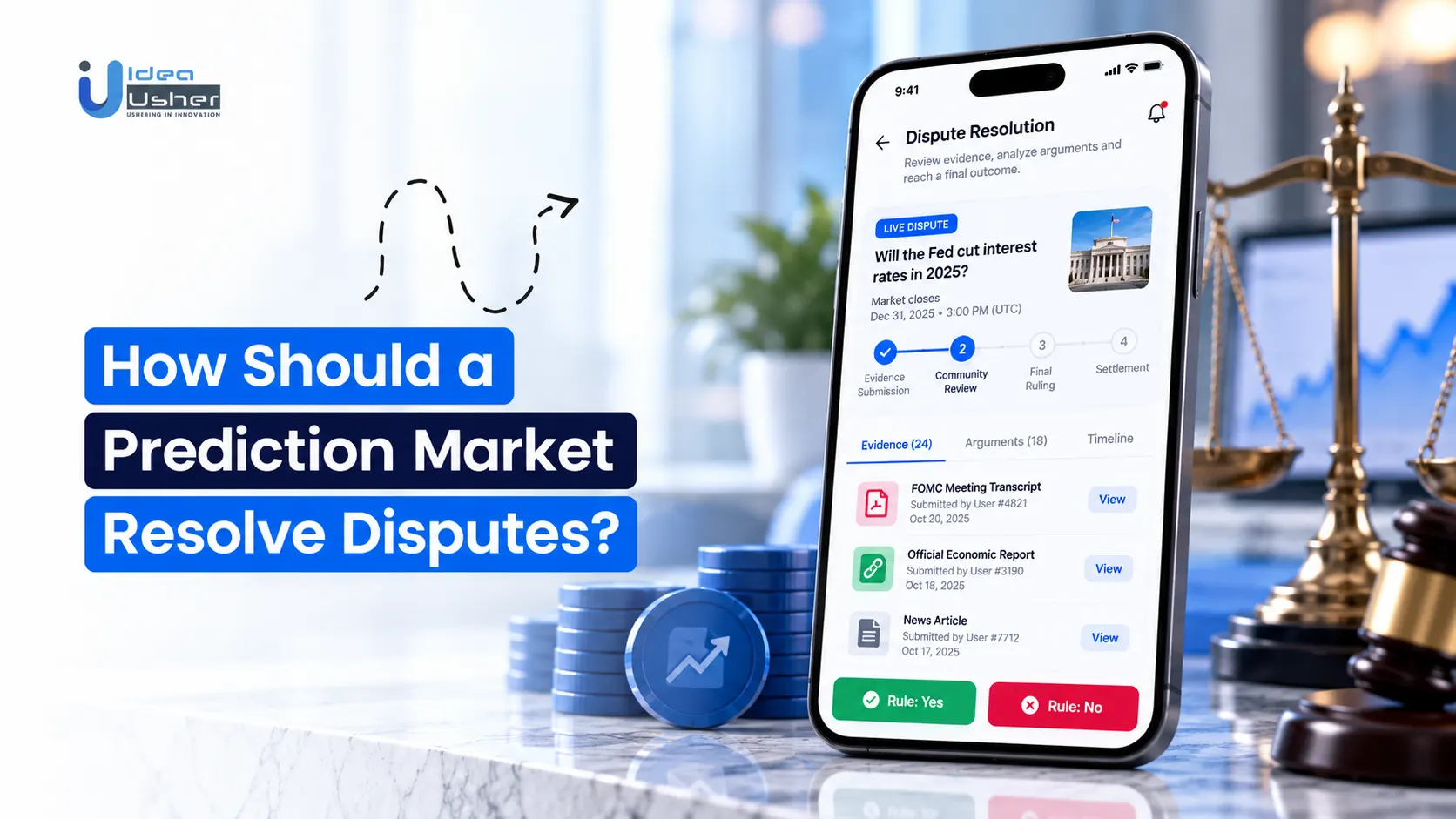
When there is a dispute in a prediction market, it should be fixed in a fair way. First, an automatic data source tells the result. Then users get some time to say if they don’t agree. If there is still a mess after that, a final review makes the last decision. Traders use their own money, so if the payout doesn’t match what really happened, they leave the platform.
Most disputes start when the question is not written well or when sources say different things. Some markets don’t even have a good source. That’s why most platforms use an oracle and a challenge period together. A person who challenges has to put down a deposit. If they are wrong, they lose it, so nobody complains for no reason. If the problem is still there, a jury, a token-holder vote, or the platform team decides. In the end, the reason is made public so everyone can see it.
If you are planning to launch your own platform, the dispute system is one of the first things worth designing properly. In this blog, we’ll discuss why disputes happen, the prediction market dispute resolution models used today, and how to build a fair process for your prediction market.
What Actually Causes Prediction Market Disputes?
Most prediction market disputes come from three things. The question is written in a fuzzy way, the evidence points in two directions, or something happens that the rules never planned for. This matters more now because more people are betting than ever. Technavio says the gambling market will grow by USD 369.1 billion at a CAGR of 8.2% from 2025 to 2030, and betting on e-sports is a big reason. More users and more money mean more fights over who really won.
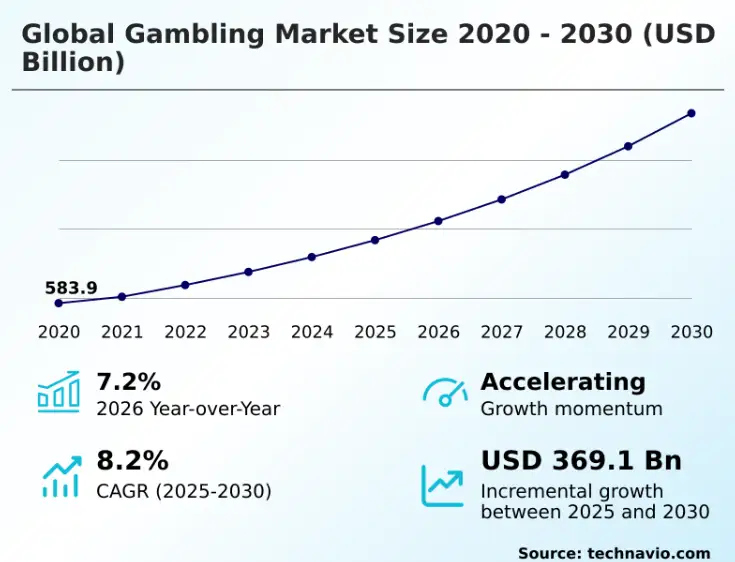
Source: Technavio
Ambiguous Contract Wording
Polymarket once asked whether Zelenskyy would wear a suit before July. The market first resolved yes, then flipped to no after nine days of disputes. The rules said a photo or video would count if credible reporting agreed. He wore a formal outfit at a NATO event and many outlets called it a suit. The market had more than $237 million in trading volume. Nobody had written down what a suit actually is, so people argued about a word.
Big money also made the problem worse. The UMA oracle’s market cap was about $95 million during the fight, less than half of what traders had put into the market. That gap is why people started saying a few big voters could swing the result.
DraftKings Predictions went the other way. When its Railbird exchange, doing business as DKeX, filed its first sports contracts, each one came with settlement rules, contingencies and examples showing how it would resolve. The app first launched in 38 states, with sports trading allowed in 17 of them. Writing the edge cases down before trading starts is the cheapest way to stop a dispute.
A few wording traps to watch for:
- A key word with no definition, like “suit” or “perform”
- No exact cutoff time or time zone
- No named source for the final answer
Conflicting Evidence and Data Revisions
Sometimes everyone sees the same thing and still reads it differently. During the Super Bowl halftime show, Cardi B came on stage, danced, and seemed to mouth lyrics, and Kalshi and Polymarket ended up with opposite results. The platforms had the same footage. They just had different rules, so they reached different answers.
Data revisions cause a quieter version of the same problem. Government numbers sometimes get changed after the first release, and settlement can wait while the exchange confirms the final figure. Good contracts say in advance which release counts. If the rules don’t say, traders will pick whichever number helps them.
Outcomes That Fall Outside Market Rules
Some outcomes simply don’t fit the box the rules were built for. A real example is the Kalshi market on whether Khamenei would be out as Iran’s Supreme Leader. When he was killed in strikes, the contract didn’t pay out the way many traders expected.
Kalshi’s Death Carveout Case
Kalshi’s rules said that if he died, the market would settle at the last traded price before his death. Its CEO said the platform designs rules to stop people from profiting from death, and Kalshi refunded all fees. Traders still sued over $54 million in bets. Kalshi also refunded net losses at a cost of $2.2 million, saying the user experience could have been clearer. The rule was published, but many traders never read it.
Kalshi is now leaning on cleaner data too. The NBA named Kalshi and Polymarket as preferred exchanges, and both get official NBA data from Sportradar to settle markets.
When a Platform Voids Markets
Sometimes the right call is to cancel. Myriad said its admin wallet was compromised on October 26, which let an attacker change the results of 10 markets, so it removed the wallet’s access and voided those markets. That wallet was used to create and resolve certain markets automatically. Myriad has been moving toward automation on purpose.
It adopted Chainlink’s Runtime Environment to create, resolve, and settle markets using Chainlink Data Streams. It also partnered with Trust Wallet, whose new Predictions tab lets users trade Myriad markets inside the wallet. Automation is faster, but the hack shows the keys that run it need protecting too.

Who Should Decide a Contested Outcome in Prediction Markets?
The best judge in prediction market dispute resolution is someone who has nothing to win or lose from the result. They also need rules that were written before trading started. No single group fits every case, so a good platform uses a few steps. Its own team can handle the easy calls, and a bonded oracle can step in when people openly disagree. The hardest cases should go to an outside panel. Every step should be harder to game than the one before it, and every decision should be public so traders can check it.
1. Platform Operators and Resolution Teams
Kalshi is the clearest example of the operator model. Each contract names its source agencies, but the final call sits with Kalshi’s own markets team. Its rulebook also has an Outcome Review Committee that can make binding decisions, and a rule that lets it settle a market at the last traded price when an outcome can’t be solved. This is fast and everyone knows who is in charge. The weak spot is that traders who think the call was wrong mostly have email and public pressure.
Polymarket US works the same way. It skips UMA voting and settles through Polymarket Clearing under its own rulebook. The big question here is trust. The Massachusetts Attorney General said Kalshi writes the contract rules and decides settlement inside its own company, with no independent middle party. Kalshi has since added an independent advisory committee, outside analytics partners, and a head of enforcement.
2. Oracle Proposers and Tokenholder Voting
Polymarket’s international markets use a different idea. Instead of one team, a bonded proposer suggests the answer, and anyone can challenge it.
How the Oracle Steps Work
- A proposer posts a bond, usually $750, and a 2-hour challenge window opens.
- If nobody objects, the answer stands.
- Two disputes send the case to a UMA token-holder vote. Votes sent to the UMA backstop are settled 48 hours later.
- A fully disputed market can take 4 to 6 days.
The big worry is who holds the tokens. The top ten UMA voters held roughly 6.5 million tokens, about 30% of the average vote. UMA tried to fix part of this. Its MOOV2 update limits who can propose answers to a list of experienced proposers, to reduce disputes. That list started with 37 names. Critics say this pushes things toward centralization. It also did not change who decides the vote in a contested case.
Augur shows the extreme version of token voting. Users stake their REP tokens to challenge a result, and if a dispute bond reaches 2.5% of all REP, the whole system splits into separate versions. The version holding the false outcome becomes worthless. It is a strong way to punish lying but a heavy way to settle a bet.
3. Independent Review and Escalation
Some platforms add one last layer made of people with no stake in the market. This is the part most platforms are still missing.
Trueo’s Attester Jury
Trueo, which launched as Truemarkets, builds this into its design. A proposer posts a $750 bond, and there is a 12-hour challenge window. If people still disagree, the case goes to TRUE token holders, and then to attesters. Eleven attesters are picked at random to vote on the final outcome. The first list has about 100 respected people from the Ethereum world, and the goal is 75 active jurors who join a lottery for jury duty.
Trueo has also had recent changes. It was renamed after a trademark conflict and said its main deployment is moving to Ethereum mainnet. It also writes each market’s question, sources, and resolution rules on-chain when the market is created, so nobody can rewrite them later.
Where the Final Say Sits
What Happens After Someone Challenges a Result in a Prediction Market?
When someone challenges a result, the market pauses and nobody can cash out yet. The challenger puts money behind the claim and shares proof. A review then picks the right answer. After that, the platform pays the winners and sorts out who gets the challenge money back. This usually takes hours on a fast platform and several days on a slow one.
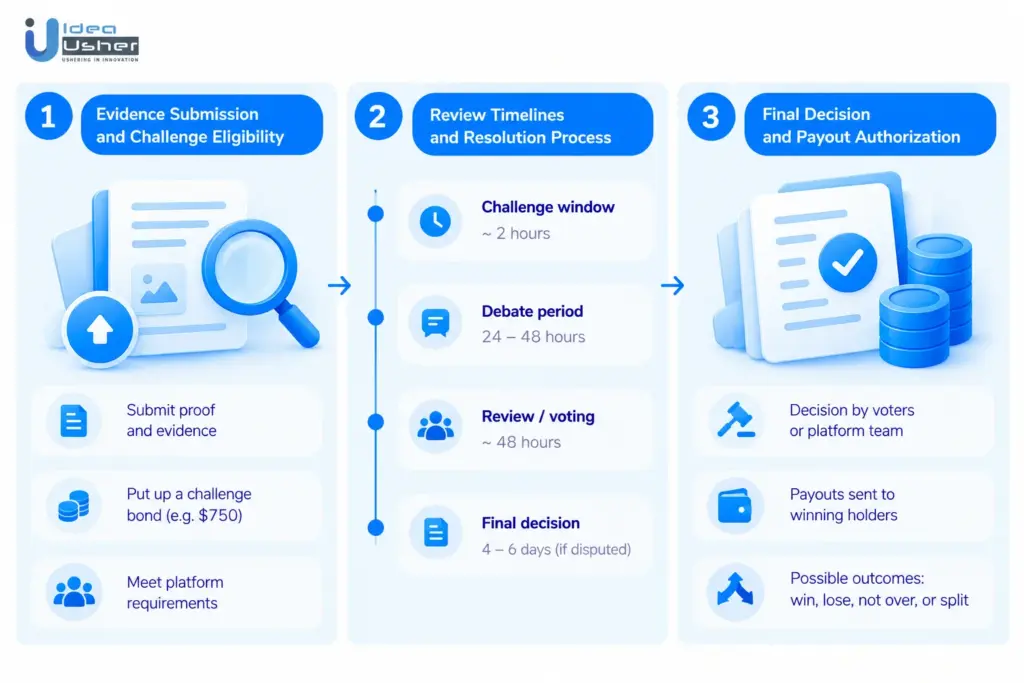
1. Evidence Submission and Challenge Eligibility
On Polymarket, almost anyone can challenge. You post a counter-bond that matches the proposer’s, typically $750. The evidence comes next. During a debate period of 24 to 48 hours, people can post evidence in UMA’s Discord channels called #evidence-rationale and #voting-discussion. Voters then read it before they decide. A challenge without good proof is just a way to lose $750.
Kalshi works differently. Traders can’t force a review by posting money. A “Request to Settle” is only a suggestion, and Kalshi’s team makes the final call. A challenge has to point to the contract language and the named source. A strong Kalshi challenge usually has:
- The exact passage, page, table or data point from the named source
- The part of the contract wording that was ignored
- Proof that the cutoff time was missed or misread
2. Review Timelines and Resolution Bonds
Speed depends on whether anyone fights the answer. Here is how it looks on Polymarket’s UMA process:
The bond is what keeps people honest. The winner gets their own bond back plus half of the loser’s bond. A wrong challenge costs real money and a right one pays.
Some platforms skip the waiting by using live data. Limitless on Base is one of them. It uses Chainlink Data Streams to resolve roughly 19,000 markets a week. There is little to argue about when a price feed settles the market. If the feed misses a moment, the next price within 5 seconds is used, and in a longer outage the Limitless team resolves it by hand. The risk is that a feed problem can stall the whole settlement line.
3. Final Decisions and Payout Authorization
The last step is deciding who has the power to say “pay out now.” On Polymarket’s international markets, that power belongs to UMA token holders. Nobody can redeem anything until the vote returns a final answer. That includes the proposer, the challenger, and every trader. Voters who match the majority get rewards, and those who don’t lose 0.1% of their staked UMA.
What the Final Answer Can Be
Voters pick from four results: the proposer was right, the challenger was right, the event wasn’t over yet, or neither side fits. In that last case, the market splits 50/50, and each token redeems for $0.50. That is a fair way out when a question has no clean answer.
Who Signs Off Elsewhere
Kalshi keeps the final word inside the company. Its Outcome Review Committee can make binding calls on hard cases. Settlement usually follows within a few hours once the decision is made.
How Should Prediction Markets Handle Unresolvable Events?
Prediction markets should write the backup plan before the first trade. Every contract needs to say what happens if the event is canceled, the source never shows up or the data changes after the fact. When nothing fits, the market should wait a short and clear amount of time. After that, it should settle at a fair price or cancel. Traders can handle a bad outcome. What they hate is finding out the rules were made up afterward.
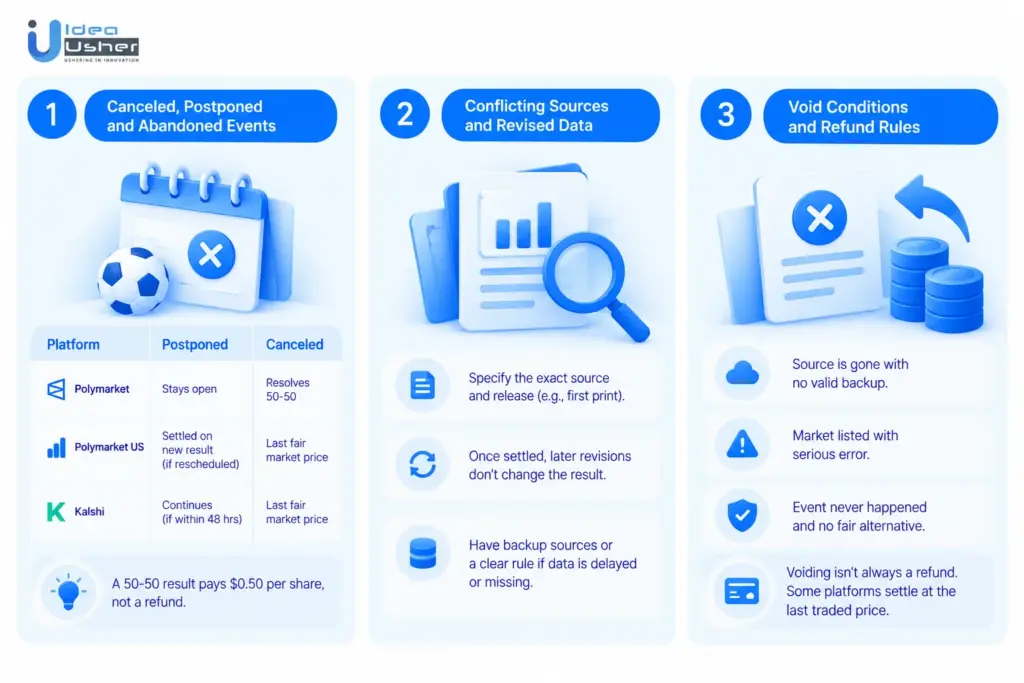
1. Canceled, Postponed, and Abandoned Events
Platforms treat a game that never happens in very different ways. Here is how a few of them do it:
A 50-50 result is not a refund. Every share pays $0.50 no matter which side you held. If you bought at $0.20 you come out ahead. If you bought at $0.80 you lose money even though nothing happened. That surprises a lot of new traders.
ForecastEx handles a different kind of abandoned event. When a player is removed from an event, any stats officially recorded before the removal still count for settlement. If there is no last traded price or the price would be unfair, its Event Review Committee makes a binding decision on a fair split under Rule 415. ForecastEx is the exchange run by Interactive Brokers. Robinhood Derivatives clears event contracts for ForecastEx or Kalshi. Its contracts also earn a monthly incentive coupon payment.
2. Conflicting Sources and Revised Data
Numbers can change after a market closes. A jobs report is the classic case. The first estimate is revised in each of the next two months, sometimes by a lot. The fix is simple. Each market’s rules name the exact release that governs, usually the first print, and once the contract settles, it is final.
Which Number Counts
Most problems in prediction market dispute resolution start when the rules stay quiet. Some Kalshi core inflation rules cite the BLS but never say whether the first release or a later revision decides the result. Two traders can then read the same rule and expect different payouts. Even two platforms can disagree. Some Polymarket contracts point to third-party reports of a number, while Kalshi uses the official release, which creates a small gap between them.
When the Source Never Shows Up
Sometimes the data simply doesn’t arrive. One monthly CPI report was never published at all. Kalshi’s rules for these contracts push back the expiration when a release is late and set a final backstop date if the data never comes. Good markets also include backup sources or a cancellation rule for source failures and long delays.
3. Void Conditions and Refund Rules
A market should be voided only in a few clear cases. Most rulebooks come down to these:
- The source is gone, and there is no valid backup
- The market was listed with a serious error
- The event never happened, and the rules give no other fair answer
Voiding is not always a clean refund. Kalshi settles at the last traded price, and a committee decides if there was no trade. Its terms also give Kalshi sole discretion to read the contract. That means your payout depends on the price when things stopped, not the money you put in.
Can a Prediction Market Correct an Incorrect Resolution?
Yes, but mostly before the result is final. While a prediction market is still open to challenge, it can reset the question, send it back for review or fix a grading mistake. Once the result is locked on a blockchain or paid out, there is usually no way to change it. All a platform can do then is refund people or make a goodwill payment. That is why the best fix is a fast review window up front.
1. Amendments Before Final Settlement
The easiest corrections happen early. Polymarket builds one into its system. The first time a result is disputed, the market resets automatically and a new request goes out, so obviously wrong disputes don’t slow things down. Polymarket also tries to steer voters before they decide. It posts clarifications before or during the dispute window to explain how its rules should be read. That cuts down on fixes later.
Kalshi fixes mistakes too, but with less structure. It graded several NFL win-total markets too early, then reversed after a writer’s coverage drew over a million views and paid users the full $1. The same article reports a different case. Kalshi paid the wrong side of an Oscars viewership market and did not reverse it. Without a set review step, whether a mistake gets fixed can depend on how loud the complaints are.
Seer shows a more built-in way to do it. When a Seer market closes, anyone can post an answer with a bond, and others can challenge it by doubling the bond. If things get heated, Kleros Court picks random jurors to make the final call. Seer has also been used for fresh experiments. Kleros Foresight is an interface built on Seer where traders predict ratings for 16 movies, though only 5 get checked against the real result.
2. Smart Contract Finality and Recovery Limits
After a result is final, the story changes. Polymarket is non-custodial and cannot change or reverse a resolution, and once UMA finalizes it the outcome is permanent. The code agrees. A market that is already resolved is in a final state with no further actions possible. Here is what can and can’t be fixed:
Those refunds are rare and not promised. Polymarket once overrode a UMA result on a market about Barron Trump and refunded traders. The Ukraine minerals case went the other way. More than $7 million had been bet, and Polymarket said no refunds were possible because it was not a market failure. Traders should assume a final result stays final.
3. Audit Trails and Emergency Safeguards
A fix only works if people can see what happened. Good platforms leave a clear record and keep emergency tools tightly locked.
Public Records
- On Polymarket, every proposal and vote is recorded on-chain, and the spread of voting power is visible.
- Its adapter fires a QuestionReset event when a market is reset.
- Kalshi files its contract terms with the CFTC before a market opens.
Emergency Brakes
Polymarket’s adapter has admin tools for rare disasters. An admin can pause a market or flag it, and a flagged market can only be resolved by hand after a safety period. The wait gives traders time to notice and object before anyone uses emergency power.
PredictIt shows the regulated side of this. When the CFTC approved its operator, Aristotle, as an exchange and clearinghouse, the terms said it must only offer approved markets, protect nonpublic information, reduce conflicts of interest and follow reporting and recordkeeping rules. PredictIt also operates under the nonprofit Prediction Market Research Consortium after settling with the CFTC. Required records make later corrections much easier to prove.
Which Resolution Architecture Should You Build For Your Prediction Market?
Pick centralized review if you run a licensed prediction market and want one named team to make the final call. Pick an optimistic oracle if you want an on-chain market where no single company judges the outcome. A hybrid model fits best when your market wording is messy and people will argue about it. The choice comes down to who gets the final say. It also depends on how fast you want traders to get paid and how often a market might end in a fight.
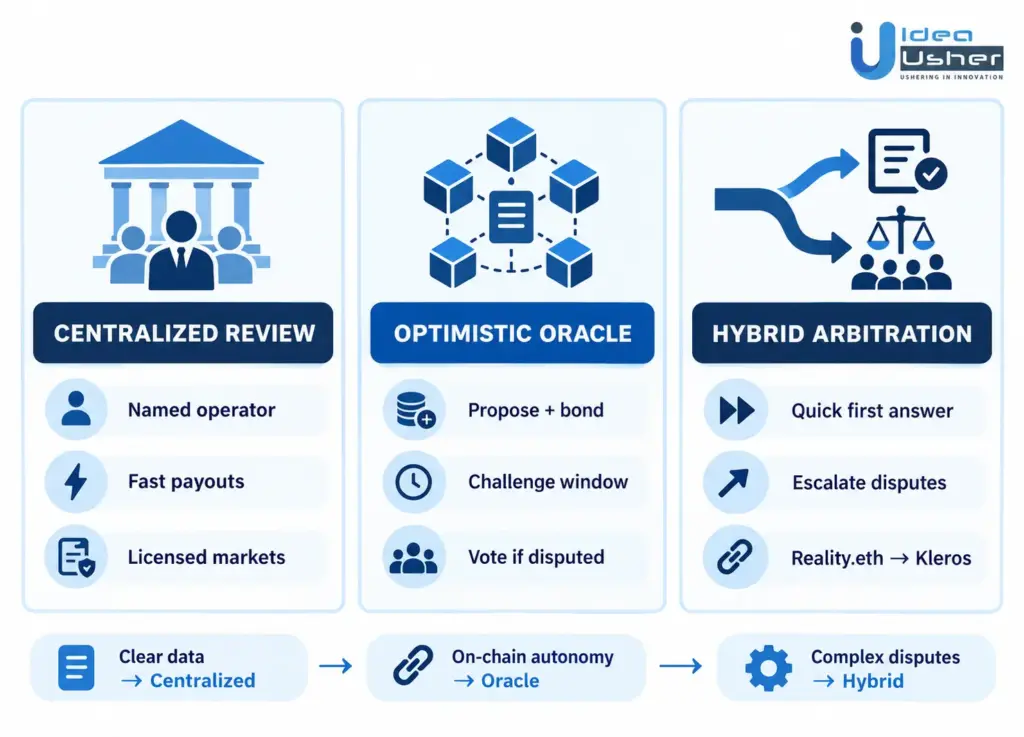
1. Centralized Review for Operator Markets
Kalshi picks a source agency for each contract and settles from it. Sports markets use the league and outlets like the Associated Press and ESPN. Money usually moves a few hours after the result is known. If an outcome is unclear, a board committee called the Outcome Review Committee can make a binding call.
This setup is fast, but the operator takes all the blame when people disagree. Kalshi learned that with its market on Ali Khamenei leaving office. The market had about $54 million in trading volume, and Kalshi refunded all fees after the backlash. Traders thought a death would pay Yes, but the rules settled at the last traded price before the death. Kalshi then told the CFTC about a new death rule that lets the Outcome Review Committee set a fair price when no good last price exists.
This model fits when:
- You hold a license and regulators want a named decision maker
- Your markets use clear sources like league scores or government data
- You want payouts within hours instead of days
- You can staff a small team to review odd cases
2. Optimistic Oracles for Onchain Resolution
Polymarket uses UMA’s optimistic oracle. Anyone can propose an answer onchain and it counts as true unless someone disputes it in time. If someone does, the claim goes to a community vote. Most markets close fast and cheap because nobody argues. The vote only happens when there is a real fight.
Where It Breaks
In March, a Polymarket market asked if Ukraine would agree to a mineral deal with the US before April. It had more than $7 million in trading volume. No deal was signed. Still, three coordinated accounts cast 5 million votes, about 25% of all votes, and the market resolved Yes. Polymarket said it was not a market failure so it could not issue refunds. Since then, Polymarket has leaned on data partners for some markets. Chainlink now settles its asset price markets and its real estate markets with Parcl tie resolution to Parcl’s data engine.
A Price Feed Option
Limitless on Base took a different road for short price markets. It uses Pyth Network oracles for resolution, so a 30- or 60-minute market can close instantly with no proposal or vote. The team raised a $10 million seed round with Coinbase Ventures in the group and plans markets as short as one minute. Its CEO, CJ Hetherington, has said clear resolution rules matter most for keeping casual traders around.
3. Hybrid Models for Complex Disputes
A hybrid model for prediction market dispute resolution gives you a quick first answer and brings in a jury only when people really fight. Seer is built this way. Its positions use Gnosis Conditional Tokens, and the answer comes from Reality.eth. Anyone can answer by posting a bond, and anyone can challenge by doubling it. If a fight goes past the set limit, Reality.eth sends it to Kleros..
Seer stays out of the fight on purpose. It does not decide outcomes and only reads the final answer from Reality.eth. Kleros also runs Kleros Foresight on top of Seer for movie score markets so the same dispute path covers markets that are about opinions and ratings.
The Cost of Escalation
The catch is money. Bond escalation can be won by the side with deeper pockets before a jury is ever called. The arbitration fee is high on purpose so people only escalate when they mean it. Kleros v2 lives on Arbitrum and can judge markets from other chains through a proxy.
What Should a Prediction Market Dispute Resolution Engine Automate?
A prediction market dispute resolution engine should automate the boring and risky parts. It should lock the rule text and the proof for every market. It should run the challenge steps on timers. It should freeze payouts when a dispute is open. It should also write down every action and limit who can touch what. People should still make the hard calls on messy cases. The engine just makes sure nobody can change a rule or skip a step without a record.
1. Rule Versioning and Evidence Provenance
Every prediction market needs a locked copy of its rules and a record of where the proof came from. Polymarket can add an “Additional context” note after trading starts. Those notes go on-chain through a bulletin board contract, and UMA voters are told to weigh them. Voters treat them like real rules and have never overturned one. That makes a note a big deal because it can flip a whole market.
The Strategy bitcoin sale market shows why. Polymarket added a note saying confirmation outside the market’s time frame did not count. One trader said he lost $500,000 after the change. Yes, shares fell below one cent after the note and two traders later sued. Kalshi had its own mismatch on the Khamenei market. The terms filed with the CFTC tied the price to the moment of death, while the market page tied it to confirmed reporting. Two versions of one rule are enough to start a fight.
A good engine should store these for every market:
- The exact rule text with a version number and a timestamp
- A diff for every edit and the name of the admin who made it
- The resolution source with a saved copy of the page or filing
- A block on edits after trading starts unless a second admin signs off
2. Challenge States and Escalation Timers
A dispute should move through fixed states and the timers should run by themselves. Polymarket does this with a short list of phases.
| Phase | Time on Polymarket |
| Challenge period | 2 hours |
| Debate period if disputed | 24 to 48 hours |
| UMA voting if disputed | About 48 hours |
| Undisputed resolution | About 2 hours after the proposal |
The states can bounce around too. Polymarket’s Khamenei market was proposed as Yes twice and disputed twice before it reached final review. If a person has to push each step by hand, then someone will forget one and a market will sit open for no reason.
How Augur Escalates
Augur uses a ladder instead. A challenger posts a bond on a different answer, and each round needs more stake than the last. In the original design, a fork starts once more than 2.5% of all REP tokens are staked. Augur ran a live test called the Moon Fork. It was an intentionally escalated dispute over whether the Artemis II mission lifted off in the first week of April, and the right answer was Yes.
After the rounds ended, REP holders got a two-month window to migrate their tokens. The team is also building Augur Lituus, which would let other markets send disputed outcomes to Augur. These details come from Augur’s own announcements.
3. Settlement Holds and Payout Controls
Money should freeze the second a market goes under review. Kalshi’s contract terms say settlement happens no later than the day after expiration unless the outcome is under review. On the Khamenei market, the last price before the death was logged at 1:14 AM ET, but trading did not halt until about 2:59 PM ET. Kalshi reimbursed all fees and net losses after the backlash. A hold that fires right away would have shrunk that gap.
Onchain markets have a harder problem because payouts cannot be pulled back. Polymarket is non-custodial and cannot reverse a resolution once UMA finalizes it. Polymarket US says settlement can be delayed if the named source has not published a final result and a winning contract pays $1.00. A hold before the money moves is worth more than a refund after.
4. Resolution Logs and Admin Permissions
Every action should leave a record, and every person should have a small set of powers. For US-licensed exchanges, the rule is clear. Core Principle 18 says a board of trade must keep records of all trzleuaz-svixdsb rudlzlblan for at least 5 years. Kalshi splits the work across a Disciplinary Panel, an Appeals Committee, and an Outcome Review Committee. A letter to the CFTC describes independent Public Directors on that review committee. Kalshi also bars employees or affiliates of a settlement source from trading contracts that use that source.
PredictIt shows how fast this becomes a real need. Its parent, Aristotle, got CFTC approval to run Aristotle Exchange as a designated contract market and clearing organization. An earlier settlement with the CFTC let PredictIt keep running under the Prediction Market Research Consortium. PredictIt also rolled out a new design after surviving the shutdown attempt. A regulated exchange has to show who changed what and when.
| Role | Can do | Cannot do |
| Market creator | Draft rules | Edit after trading starts |
| Resolution reviewer | Propose and review outcomes | Approve their own proposal |
| Approver | Release holds and payouts | Edit rule text |
| Auditor | Read all logs | Change anything |
Centralized vs. Decentralized Dispute Resolution: Kalshi vs. Polymarket
Kalshi and Polymarket take two different paths to prediction market dispute resolution. Kalshi uses a centralized model where the exchange and a review committee make the final call. Polymarket uses a decentralized model where an oracle and token holders make it. The centralized way is faster and easier to fix, but you have to trust the operator. The decentralized way is more open, but it is slower, and big token holders can bend it. Pick the one that matches your license and the kind of users you want.
Who Makes the Final Resolution Decision?
At Kalshi the exchange makes the call. It names a source agency for each contract and its team settles from that source. If an outcome is unclear, a board committee called the Outcome Review Committee can make a binding decision. There is also an Appeals Committee. You always know who to ask when something looks wrong.
Polymarket hands the call to UMA. Anyone can propose an answer, and it counts as true if nobody disputes it in time. Since the move to managed proposers, only approved people can propose and anyone can still dispute. UMA says those whitelisted proposers made 96% of proposals with 99.7% accuracy, while everyone else hit 85.8%. To get on the list a person needs 20 or more proposals in 3 months with over 95% accuracy.
How Are Disputed Outcomes Reviewed?
Kalshi reviews before it pays. Settlement happens no later than the day after expiration unless the outcome is under review. The rulebook step is called the Market Outcome Review Process and Kalshi updated it to spell out the timeline. Kalshi can also pause a market while it looks. It halted the Khamenei market under rule 13.1. The review is handled in-house by the two committees so it moves fast but no outside group sits in the room.
Polymarket’s Path
Polymarket moves through set phases with money on the line. There is a 2-hour challenge period and then a debate of 24 to 48 hours and then about 48 hours of UMA voting. A proposer posts a $750 USDC bond and a disputer has to post the same amount. That bond keeps casual users out and it makes every fight cost something.
Which Model Offers Greater Transparency?
Polymarket shows more of the work in prediction market dispute resolution. Rule clarifications are published on-chain through a bulletin board contract, and the adapter code is open. Anyone can watch a vote happen. Seeing a vote does not make it fair, though. In the Ukraine market, three coordinated accounts cast 5 million votes, which was about 25% of all votes.
Kalshi shows its rules instead of its votes. Its rulebook changes are filed with the CFTC, where anyone can read them. The committee talks stay inside the company. You can read the rule, but you cannot watch it being applied.
Hyperliquid shows a third version with HIP-4. Its validator set settles outcomes by voting based on information from automated newsfeed software. Market rules are encoded at deployment, and validators cannot change them mid-market. A builder has to stake 1M HYPE to deploy a market and can add an optional challenge window. The team claims outcomes resolve within minutes once enough validators agree.
What Happens When Resolution Is Wrong?
Kalshi can reach in and fix things because it holds the money. One review said corrections usually needed outside pressure like social media posts. Polymarket has a harder time. It is non-custodial and cannot reverse a resolution once UMA finalizes it. So its fixes happen earlier. UMA moved Polymarket to a managed oracle so only whitelisted users can propose.
Which Resolution Model Should You Build?
Start with who must be able to answer for a wrong call. A regulator wants a named team and a paper trail. A crypto crowd wants no single judge. Most teams end up borrowing from both sides.
- Build centralized if you need a license. US exchanges must keep records of all activities for at least 5 years, so build the logs first.
- Build oracle-based if users want no single judge. Add a proposer whitelist because the whitelisted group was far more accurate than the rest.
- Build hybrid if your market wording will be messy. Use a fast first answer and a review step for the hard cases.
Arbitration-Based Resolution: How Kleros and Reality.eth Handle Disputes
Reality.eth and Kleros split the job. Reality.eth takes answers and lets people challenge them with bigger bonds. When the bond fight gets too heavy or someone asks for it the question goes to Kleros. Kleros picks a random jury of token holders who read the evidence and vote. The jury ruling goes back to the market and that becomes the final answer. A jury is slower than a bond fight but it can handle questions that have no clear data source.
How Does Reality.eth Escalate Conflicting Answers?
Reality.eth works like a bidding war on the truth. Anyone can post an answer with a bond. Another user can reject it by doubling the bond, and then someone else can double it again. The contract even checks that each new bond is at least twice the one before. The hope is that the wrong side runs out of money or patience before the game ends.
The game has a backstop. A contract called an arbitrator makes a final judgment for a fee and it should only be needed in odd cases so it can be slow and costly. There is also a weak spot. If no arbitrator is chosen, the highest bond simply wins, so a rich bad actor can outspend an honest one. That is why the arbitrator setting matters so much.
Omen shows this in real use. It was the first decentralized prediction market protocol made by DXdao on Gnosis infrastructure. Its markets use Reality.eth as the oracle with Kleros as the final arbitrator. AIOmen is a frontend built so AI agents can trade and the Olas agent Omenstrat watches markets and places bets around the clock. Transactions cost about $0.01 on Gnosis Chain.
How Kleros Selects and Rewards Jurors
Kleros jurors are token holders. Every juror stakes PNK at a court and the more they stake, the more likely they get picked. The random numbers come from block hashes, so the draw is hard to game. There are 1 billion PNK in total and that supply is fixed. Kleros v2 lives on Arbitrum. One law blog warned that jurors are usually not legal experts, so the result is closer to a fair call than a legally correct one.
The money is what keeps jurors honest:
- Jurors who vote with the majority share the arbitration fee
- Jurors who vote against the group lose some of their staked tokens
- Jurors cannot talk in chat groups like Telegram or WhatsApp
- Votes are sent as hashes first so jurors cannot copy each other
One design note for a Lido court: the past coherence rate of the Blockchain Technical court at 84%. That tells you most jurors end up on the same side.
What Evidence Do Jurors Review?
A Kleros case moves through steps. The phases are evidence, then commit, then vote, then appeal and then execution. The evidence period lasts several days. A contract can let people submit evidence with a few lines of code. The Reality.eth proxy follows the ERC-1497 Evidence Standard so jurors can see the question and the answers behind it.
Late Evidence and Hidden Votes
Late evidence is a problem. The General Court policy says jurors should ignore evidence that comes in after the first evidence period if jurors could not reasonably have found it themselves. Once a juror votes, the vote cannot be changed and other jurors and the parties cannot see it. That keeps one loud juror from steering the rest.
Appeals Mean Bigger Juries, Higher Costs
Kleros allows unlimited appeals, but each one adds jurors by doubling and adding one so fees grow fast. Here is what that looks like if a case starts with 3 jurors.
| Round | Jurors | What changes |
| First ruling | 3 | Base fee |
| Appeal 1 | 7 | Each level costs more than the last |
| Appeal 2 | 15 | Bigger fee again |
| Appeal 3 | 31 | A proposed Lido court sends the case to its parent court at 31 jurors |
Appeals can be crowdfunded, and anyone can fund one during the appeal period. The appeal only starts if both rulings get funded, and if only one is funded, that ruling wins. The jury numbers in the table come from the double plus one rule. The 3 jurors is only an example.
How Does a Ruling Settle Markets?
The final step is a handoff. When someone asks Kleros for arbitration, they pay the fee and state the highest bond they saw. If the bond changed in the meantime, the request is refunded. After Kleros rules, the answer goes back to Reality.eth. If the ruling matches the last answer, then the last answerer wins, and if not, the person who asked for arbitration wins. The arbitration fee is high on purpose, so people only escalate when they mean it. Omen markets then settle on-chain through the Reality.eth oracle.
Ringo shows the same flow in a small app. USDC stakes settle after the outcome resolves through Reality.eth. The escrow is non-custodial, and Kleros is the escalation path. It lists a 0.5% fee per resolved challenge or market. It is still in beta and restricted in some places.
Case Study: The Zelenskyy Suit Market and the Limits of Token-Weighted Voting
The Zelenskyy suit market shows what happens when a prediction market asks a fuzzy question and lets token holders settle it. The rules never said what counts as a suit. When the first answer was challenged, the final call went to a small group of big UMA holders. Both sides had good arguments, and nobody could prove who was right. The fix is clearer wording and a dispute process that does not lean on a few wallets.
How Vague Rules Triggered the Dispute
The question looked simple. It asked if Zelenskyy would wear a suit before July. The rules said yes if he was photographed or videotaped wearing a suit and the market drew more than $237 million in trading volume. Nobody wrote down what a suit is. Then he showed up at the NATO summit in a dark outfit and the argument started.
Why UMA Voters Flipped the Outcome
The answer changed more than once. The market first resolved Yes on July 1 and then ran into a dispute and claims of manipulation. After nine days and several disputes, the final answer became No. UMA’s oracle went from an early Yes to a final No after the outcome was disputed twice. Traders who thought they had won were suddenly holding losing shares.
Precedent and Late Trading
Some people said precedent decided it. They argued Yes was rejected because a nearly identical outfit in a May market had also failed the test. Money moved fast the whole time. Yes shares fell from $0.19 to $0.04 once the DVM vote closed. More than 57% of the trading volume came in the six days after the market should have settled. People kept trading while the rules were still being argued.
Token-Weighted Voting Raised Governance Concerns
The bigger worry was who did the voting. UMA’s token market cap was about $95 million while this market had $242 million in volume. The top ten voters held about 6.5 million UMA, which is about 30% of average vote participation. Fewer than ten holders supplied nearly all of the roughly 18 million UMA staked in this dispute and three addresses had over 70% of it. A few wallets could decide a quarter-billion-dollar bet.
Conflicts of interest made it worse. People pointed out that big UMA holders could bet on Polymarket while voting on the dispute. Crypto Valley Journal reported that at least 60% of active voters link to Polymarket accounts and about one in five disputes had a voter with money in that contract. Small holders often lend tokens to delegates so the votes pile up even more. One power user said the rewards push people to follow the likely majority instead of the facts. UMA cofounder Hart Lambur rejected the manipulation claims and said he wanted to talk about improvements.
Probable Uses the Same Oracle
Newer apps inherit the same risk. Probable is a zero-fee prediction market on BNB Chain incubated by PancakeSwap and YZi Labs, and it settles markets with UMA’s Optimistic Oracle. The team plans a Probable Points Program and permissionless market creation. More open market creation can mean more fuzzy questions like the suit one.
What Prediction Market Operators Can Learn
Fix the question before you fix the vote. Write down what counts and what does not. Check old markets with the same wording. Stop trading when a dispute opens. Polymarket’s later move to managed proposers helps with bad proposals but it addressed the proposer side and not the voter side.
- Define the key word in the rule. A suit needs a plain test like jacket and matching trousers
- Search old markets for the same wording and copy the ruling or explain why you changed it
- Pause trading once a dispute starts since over 57% of the volume came after the first settlement date
- Keep voters out of markets where they hold a position since about one in five disputes had one
- Add a second layer for fuzzy questions like a review panel or a jury
Predict.fun shows the choice operators face. UMA now powers its automated market resolution. The platform says it has passed $1.5 billion in cumulative trading volume with more than 120,000 users and 3.3 million transactions. That is a lot of money resting on one oracle design. A platform that size can still add its own wording checks and review steps on top.
Build a Custom Prediction Market With IdeaUsher
At IdeaUsher, we have 500,000 hours of coding experience. Our team has ex-MAANG and FAANG developers too. We build prediction markets with fair dispute resolution from the start, so your platform stays trusted even when a result is challenged. Whether you are a startup or a big company, we build the platform around your goals. We stay with you from the first idea to launch and after that.
Design Resolution Rules and Workflows
We help you write clear rules for every market. They say what counts as a win, which source decides, and what happens if that source stops working. We also set up the full dispute process, from the challenge period and deposit to the final review. When the rules are clear from the start, there are fewer fights later. Before launch, we also test these rules on tough cases.
Integrate Oracles and Settlement Logic
We connect trusted oracles to your platform so results come in on their own. Then smart contracts check the final result and handle settlement and payouts. This way, traders get the right money at the right time. Every payout follows the same rule, so there are no surprises. If one data source stops working, a backup source keeps things going, so settlement never gets stuck.
Build Auditable Market Administration Tools
We build admin tools where every decision is saved in public, with proof. Traders can check rulings themselves, and your team can run things openly. This openness slowly builds trust, and traders keep coming back. Your team also gets a simple dashboard to see all open disputes and their status in one place.
Conclusion
A prediction market works only when traders believe the result is fair. Clear rules, a data source people can trust, a challenge period with a deposit, and an open final review all help fix fights before they hurt the platform. When the process is public and the payout matches what really happened, traders stay and keep trading.
If you are thinking about starting your own prediction market, IdeaUsher can build one with fair dispute resolution from day one. Talk to our experts today and get a free consultation.
FAQs
A1: Most of the time, an automatic data source or oracle tells the result first. If someone disagrees, a jury, a token-holder vote, or the platform team makes the final call. This keeps the first result fast and gives a fair way to check it. The final decision is then shared so everyone can see how it was reached. Each platform picks the final decider in its rules, so traders should read them before they trade. Clear roles like this stop confusion when a fight starts.
A2: Users get a short challenge period to say they don’t agree. If the problem is still there, the case goes to a final review, and the reason for the decision is made public. Payouts usually wait until the dispute is closed. This protects traders from getting paid on a wrong result. If the challenge is right, the result is fixed before any money moves. If it is wrong, the original result stands and payouts go ahead.
A3: Most disputes start when the question is not written clearly or when different sources say different things. Some markets also don’t have a good source at all. In these cases, traders can read the same question in different ways. Even a small gap in the wording can lead to a big fight. Because traders put in their own money, they care a lot about every word. That is why a small mistake can turn into a big problem fast.
A4: The deposit stops people from complaining for no reason. If the challenger is wrong, they lose it, but if they are right, they win money for finding the mistake. This makes people think before they raise a challenge. It also keeps the system from filling up with fake complaints. Fewer fake complaints mean real problems get looked at faster. It also keeps the platform fair for traders who just want their correct payout.
A5: Every market needs clear written rules in advance. These should say what counts as a win, which source decides, and what happens if that source fails. Writing a backup plan early saves a lot of trouble later. Clear questions mean fewer fights and happier traders. Platforms can also use simple question templates so every market is written the same way. Checking each question before it goes live can catch mistakes early.
A6: Yes, a good platform makes the final ruling open to everyone, with proof attached. This way, traders can check it themselves and trust the next payout. Nobody has to just believe the platform. Over time, this openness builds trust and keeps traders on the platform. Traders can also compare the ruling with the rules that were written before the market started. If something looks wrong, they know exactly where to raise it.