


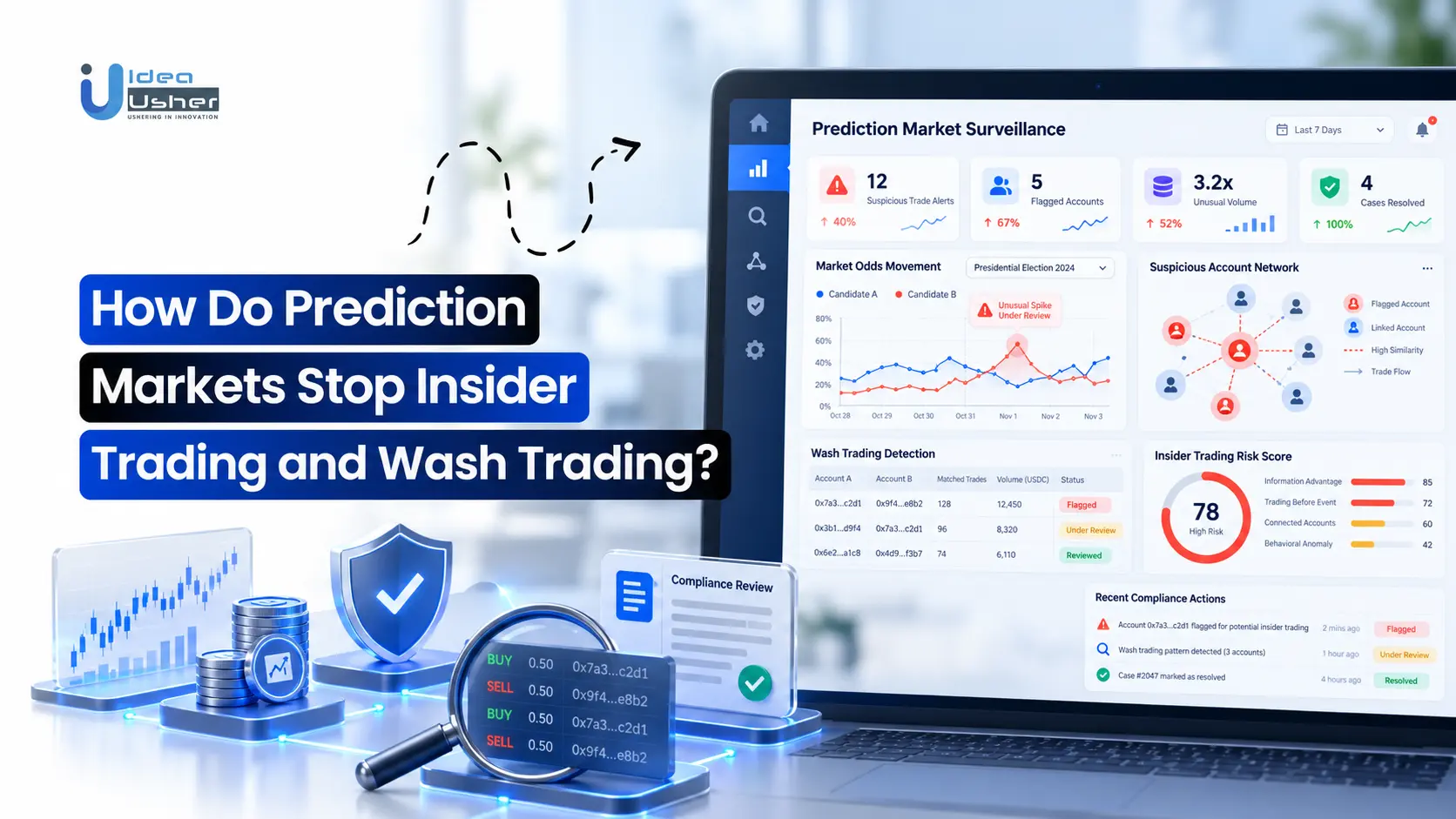
Key Takeaways:
- What if the biggest winner already knows the outcome? That’s the insider trading risk that prediction markets are exposed to.
- High volume doesn’t necessarily equate to actual activity. You can have wash trading, which creates the illusion of liquidity.
- Even the AI can’t always pick up on a cheater. Suspicious trades aren’t necessarily evidence of manipulation.
- For developers like Idea Usher, the challenge is linking surveillance to KYC and trading controls.
Prediction markets stop insider trading and wash trading by combining identity verification with prediction market monitoring and a well-documented enforcement regime. Each instance of abuse is caught in a different way.
Insider trading is stopped by knowing who is trading. The platforms will of course check identities and block the relevant people (i.e., candidates, athletes, employees) from trading in their own market. The software will also flag the very well-timed bets which are placed just prior to the news.
Wash trading is stopped by observing how the accounts trade. The matching engine will of course prevent self-trade, and surveillance tools will look at related wallets and spot volume that is moving in a circle within a single group, and compliance will look at every alert, suspend accounts, and pass on the more serious cases to the regulators.
We’ll go through each control in turn, what the US regulators expect, where the actual limits are, and what it costs to build. As a result, you’ll know what to plan for prior to launch and how Idea Usher builds these controls into our custom prediction market platforms from the very first sprint.

Why Prediction Markets Face Different Manipulation Risks
Prediction market surveillance must handle risks that stock-market tools never face. First, event contracts resolve to $0 or $1, so insiders can know the exact result. Second, thin liquidity lets a few accounts move prices or fake activity.
Finally, some participants can influence the outcome, which makes insider trading and wash trading harder to spot.
The prediction markets platform market was valued at $51.0 billion in 2025, according to Market Intelo. It projects the market will reach $295.4 billion by 2034, a 21.5% compound annual growth rate from 2026.

As a result, more founders will soon enter, and regulators will expect surveillance from day one.
1. When One Person Knows or Controls the Event Outcome
In equities, insiders hold information about factors that move a price, not the price itself. In contrast, an insider in many event contracts can know the final result, as Kalshi’s head of enforcement and a Wharton professor explain.
As a result, they can buy at once, with little risk from other factors.
- First, employees, officials, athletes, and content creators can hold early outcome knowledge.
- Next, knowing a result differs from influencing it, yet platform rules ban both.
- Finally, a result can be known long before the market resolves.
2. When Artificial Trading Makes a Market Look Active
Wash trading creates volume without real risk. For example, a Columbia study estimated that about 25% of Polymarket volume looked artificial, and 45% in sports markets.
Consequently, inflated volume misleads users about real activity.
- First, thin contracts can show heavy activity from only a few accounts.
- In addition, volume is not depth, which is the orders other traders can actually fill.
- As a result, fake activity erodes user trust and distorts reward programs.
3. Why Traditional Exchange Surveillance Is Not Enough
Stock tools flag large percentage price moves. However, a $0.80 contract cannot rise 40%. Likewise, win rates mislead, because buying $0.98 contracts and holding them to $1 wins often and legitimately.
Therefore, operators need event-specific models.
- First, judge materiality by what the trade earned the trader, not by percentage change.
- Second, adjust win rates for the odds each contract price implies.
- Finally, review unusually profitable positions after settlement, since early insider trades leave no pre-event spike.
The table below summarizes how these differences change surveillance.
| Factor | Equity markets | Prediction markets | Surveillance implication |
| Insider knowledge | Factors affecting price | Often the outcome itself | Screen identity and affiliation |
| Price range | Unbounded | $0 to $1 | Use gain-based materiality |
| High win rate | Suspicious | Often legitimate | Adjust for implied odds |
| Trade timing | Clusters before news | Can come early | Add post-settlement review |
In short, prediction markets give insiders a direct path to profit and give manipulators cheap ways to fake activity. Equity-style thresholds miss both. With those risks clear, the next question is which controls a platform should set up before the first trade.
How Insider Trading Happens in Prediction Markets
Insider trading in prediction markets means trading event contracts on material nonpublic information obtained through a duty of confidence. Making an accurate prediction from public clues is legal.
However, misusing confidential information breaks platform rules and may break federal law. Prediction market surveillance therefore focuses on who is trading and what that person could know or control.
1. Trading on Confidential Corporate or Government Information
Employees and officials can learn results or decisions before the public does. For example, the CFTC says misusing confidential information in breach of a duty of trust can violate its Rule 180.1.
- First, confidential earnings, pending announcements, and restricted government decisions create the opportunity.
- Next, employment or public office creates the duty of confidence.
- However, holding nonpublic information does not automatically prove every legal element of a violation.
2. Trading on Events a Participant Can Influence
Some traders can shape an outcome, not just know it. Kalshi’s rules, for instance, bar trading a contract you directly or indirectly influence.
Therefore, Kalshi now blocks politicians and athletes from related markets in advance.
- First, candidates can trade on their own campaigns.
- Next, athletes, referees, and team personnel can know or affect results.
- Finally, creators, editors, and organizers control what gets published or staged.
3. Real Enforcement Cases That Explain These Risks
Documented cases show how these risks appear in practice. The first two led to Kalshi discipline, while the CFTC and DOJ charged the third.
| Case | Concern | Signal | Status |
| Kalshi candidate | Traded on own governor’s race | Direct role in the outcome | Five-year ban, $2,200 fine, reported to CFTC |
| Kalshi video editor | Advance knowledge of unpublished video | Near-perfect wins at low odds | Fined, suspended, reported to CFTC |
| US service member | Alleged classified information on Polymarket | Maduro-related contracts | Charged by CFTC and DOJ; allegations only, no conviction |
In short, insider risk follows people with early knowledge or control over an outcome. Platforms catch it through identity, timing, and unusual success, then refer serious cases to regulators.
How Wash Trading Creates Fake Prediction Market Volume
Wash trading means placing trades that look like real activity but carry no real risk. The trader ends up with the same exposure or ownership as before. As a result, volume looks higher, and markets look busier than they are.
Prediction market surveillance therefore has to look past volume totals to who sits on both sides.
1. Self-Trading and Matched Orders Between Related Accounts
A trader can match orders between accounts they control to manufacture activity. Columbia researchers describe these trades as carrying no real market risk, typically among related accounts. Consequently, different account names do not prove different traders.
- First, one owner sits on both sides of a match.
- Next, connected accounts place offsetting trades.
- Finally, the same pattern repeats.
2. Multiple Wallets and Artificial Blockchain Activity
Wallet-based markets make this harder to spot, because opening many wallets costs little. The Columbia study flagged 14% of 1.26 million wallets that frequently traded with each other. However, the authors call their results estimates, not proof.
- First, wallet clustering groups addresses with shared funding.
- Next, repeated trades between the same addresses raise suspicion.
- Still, public ledgers rarely reveal the true owner.
3. Volume Incentives That Encourage Manipulation
Rewards tied to volume pay people to fake it. Columbia researchers linked wash trading spikes to token rumors, and the lack of fees made it cheaper. Therefore, platforms need incentive-abuse checks.
- First, reward resting liquidity, not matched volume.
- Next, check whether rewarded accounts only trade together.
- Finally, compare fake volume with real depth.
For launch-stage incentives, read How Do You Bootstrap Liquidity on a Brand-New Prediction Market?
| Signal | Genuine market making | Suspicious wash trading |
| Counterparties | Many unrelated traders | Same small wallet group |
| Net exposure | Holds open inventory | Ends flat |
| Timing | Follows news | Follows reward rumors |
In short, wash trading fakes activity by hiding who sits on both sides, and volume alone cannot expose it.
How Prediction Markets Restrict Insider Trading Before It Starts
Prediction market surveillance begins before the first trade, because some manipulation risks can be reduced before an order reaches the market. Identity verification screens who trades, market-specific restrictions limit risky events, and account controls cap exposure.
Together, these controls cannot replace later detection, but they stop many obvious problems early.
1. Identity Verification and Restricted-Person Screening
KYC confirms who a customer is, not what they know. Operators therefore add affiliation checks and restricted-person lists to find people who should not trade certain contracts.
- First, collect identity and employment details.
- Next, match accounts against restricted lists.
- Finally, link related accounts to one owner.
2. Market-Specific Risk Scoring and Trading Restrictions
Kalshi’s June 2026 update scores each proposed market for insider risk before listing. High-scoring markets require employment details, so likely insiders are screened out before they trade.
Moreover, Kalshi reports that its new screening blocked 100+ potential insider trades in Q1.
- First, corporate KPIs and product releases.
- Next, outcomes decided by one person or a small group.
- Finally, sensitive political and national security events.
3. Position Limits and Pre-Trade Risk Controls
Limits cap what any one trader can do. The CFTC has asked whether position limits or accountability levels should apply to event contracts. Therefore, operators should make limits configurable, not fixed.
- First, cap positions per account and linked accounts.
- Next, set market-level exposure limits.
- Finally, block self-trades in the matching engine.
When an Order Should Be Rejected or Held
Rules should decide the response, not guesswork. Every action must follow applicable rules and authorized procedures.
- Reject automatically when a restricted person targets a barred market.
- Require enhanced verification when high-risk markets lack employment data.
- Escalate unclear cases to human review.
| Step | Check | Result |
| 1 | Identity | Verified or blocked |
| 2 | Market eligibility | Allowed or restricted |
| 3 | Exposure | Within limits or held |
| 4 | Order | Accepted |
In short, pre-trade controls stop known risks cheaply, but they cannot see hidden information.
How Surveillance Systems Detect Suspicious Insider Trading
Predictive market surveillance detects wash trading by combining order data, counterparty relationships, ownership information, and repeated execution patterns. No single signal proves self-dealing, so tools compare several.
Together, these checks separate genuine transactions from coordinated or self-dealing trades that exist only to inflate volume, such as trades between related accounts.
1. Self-Trade Prevention Inside the Matching Engine
The matching engine can stop an account from trading against itself. When two orders share an owner, it cancels or rejects one before execution. Consequently, genuine orders from other traders still execute normally.
- First, detect same-account self-matches.
- Next, apply known beneficial-ownership links.
- Finally, cancel or reject the offending order.
2. Linked-Wallet Analysis and Transaction Graphs
Blockchain analytics can reveal when separate wallets share an owner through funding patterns and timing.
The Columbia study used this network approach, flagging 14% of wallets that frequently traded with each other. However, confidence scores should guide review, not assume common ownership.
- First, trace shared funding origins.
- Next, map repeated counterparty pairs.
- Finally, add lawful account data.
3. Detecting Circular Trading and Reward Manipulation
Circular trading shows up as repeated trades among the same connected participants. Therefore, analysts compare execution data with reward payouts.
- First, repeated reversals between linked accounts.
- Next, trades with little economic purpose.
- Finally, reward-seeking volume spikes.
A Hypothetical Wash-Trading Detection Scenario
Hypothetical scenario: three wallets funded from one source repeatedly trade opposite sides of a thin sports contract. The platform links their funding, counterparty pairs, and reward claims. As a result, it holds payouts and sends the case to review.
| Link | Evidence | Flag |
| Wallet A to B | Shared funding | Linked |
| Wallet B to C | Repeated matched orders | Circular |
| Wallets A, B, C | Reward claims | Payout held |
In short, platforms detect wash trading by preventing self-matches, linking related wallets, and testing volume against rewards. Confidence scores guide human review, because connected accounts alone do not prove intent.
How Kalshi and Polymarket Monitor Market Manipulation
Kalshi and Polymarket both publish market-integrity controls, but their models differ. Kalshi is a US-regulated exchange that runs background checks on users, while Polymarket runs a CFTC-licensed US exchange and a separate blockchain-based international platform.
Founders should therefore compare each operator’s published approach carefully, without treating either as manipulation-proof or ranking them by safety.
1. Kalshi’s Risk Scoring and Institutional Surveillance
Kalshi’s February 2026 Solidus Labs partnership, June 2026 risk scoring, and August 2026 Nasdaq deal layer screening and 24/7 surveillance. Moreover, it runs background checks and accepts whistleblower tips.
Its policy page says confirmed violations lead to fines, suspensions, or bans, and go to the CFTC.
- First, screen political, sports, and disqualified persons.
- Next, score market risk and monitor trades.
- Finally, investigate, enforce, and report.
2. Polymarket’s Blockchain Analytics and Monitoring
Polymarket International says every trade is public on-chain, which lets investigators trace wallets. It reports using machine-learning models, commercial analytics, and a dedicated multi-account category.
It also reports 100+ law-enforcement referrals, a self-published figure. However, Polymarket US is a separate CFTC-licensed exchange with identity verification.
- First, public wallet records.
- Next, machine-learning and analytics monitoring.
- Finally, investigators and referrals.
3. What New Operators Can Learn From Both Models
Both pair published rules with identity or trace data, specialist tools, and investigation teams. Therefore, startups should plan enforcement from launch.
Auditability matters most, because regulators ask how each case was decided.
| Area | Kalshi | Polymarket |
| Identity | Background check | International: wallet; US: verified |
| Records | Public order book | Public on-chain (International) |
| Monitoring | Nasdaq, Solidus | ML, analytics |
| Enforcement | Bans, CFTC reports | Restrictions, referrals |
In short, both operators combine published rules, trade visibility, specialist monitoring, and enforcement through different structures. Neither is proven manipulation-proof, so founders should copy the layers, not the claims.
What Happens After Surveillance Detects a Suspicious Trade
Detecting unusual trading is only the start. Operators then need documented procedures to review evidence, decide whether a rule was broken, and apply proportionate restrictions.
A clear process turns a prediction market surveillance alert into an investigation and, where warranted, an enforceable outcome that regulators and affected traders can examine.
1. Alert Generation and Investigation Prioritization
Automated systems create alerts and score severity, so the riskiest cases reach compliance staff first. Kalshi’s June 2026 update reports 150+ Q1 investigations and sends whistleblower tips to a team monitoring 24/7. Therefore, human reports supplement system alerts.
- First, assign each alert to an analyst.
- Next, review trade and account history.
- Finally, merge whistleblower reports.
2. Trade Reconstruction and Evidence Preservation
Investigators must rebuild what happened, order by order. The CFTC says exchanges have an independent duty to maintain audit trails, and Polymarket says each case gets a full timeline. Therefore, records must be complete and preserved.
- First, orders, cancellations, and executions.
- Next, account, wallet, funding, and withdrawal links.
- Finally, resolution events and staff actions.
3. Account Restrictions, Enforcement, and Reporting
Operators can freeze flagged accounts while compliance staff review funding and trading history. Kalshi’s policy page says confirmed violations bring fines, suspensions, or bans, plus reports to the CFTC. However, every action needs documentation and appeal procedures where applicable.
- First, apply proportionate temporary restrictions.
- Next, decide violations under published rules.
- Finally, escalate to authorities.
In short, a trading alert becomes an enforceable outcome through prioritized review, preserved evidence, and proportionate action. Documentation protects the platform and affected traders, because every restriction must follow applicable rules.
What US Regulations Mean for Market Surveillance
Prediction market surveillance obligations depend on how a platform is structured. First, CFTC-regulated designated contract markets (DCMs) carry market-integrity and self-regulatory duties, including surveillance and rule enforcement. However, offshore or decentralized platforms require separate legal analysis.
Therefore, founders should confirm which regime applies before designing surveillance, and consult qualified counsel early.
1. CFTC Rules Against Manipulation and Insider Trading
The Commodity Exchange Act and CFTC Rule 180.1 cover fraud, manipulation, and misusing confidential information in breach of a duty of trust.
However, a CRS report says that how exchange rules overlap with Rule 180.1 remains unsettled.
- First, anti-fraud and anti-manipulation provisions.
- Next, wash trades, spoofing, and disruptive practices.
- Finally, exchange rules, which can be broader.
2. DCM Surveillance and Recordkeeping Obligations
DCMs must meet Core Principles 3, 4, and 12, covering manipulation-resistant listings, surveillance, and protection from abusive practices.
Moreover, the CFTC says exchanges have an independent duty to maintain audit trails, conduct surveillance, and enforce rules.
For the licensing process itself, read How Do Prediction Markets Like Kalshi Get CFTC DCM Approval?
- First, investigate misconduct and enforce trading rules.
- Next, keep appropriate records.
- Finally, design contracts that resist manipulation.
3. Event Categories That Need Additional Restrictions
Contracts settling on one person’s conduct carry more risk. For example, CFTC staff’s September 22, 2026 advisory treats such mention markets as presumptively susceptible to manipulation, though it does not bar them as a class.
Furthermore, staff views independent verifiability and public scrutiny as essential for listing them.
- First, sports insiders and corporate announcements.
- Next, government information and small-group outcomes.
- Finally, verifiable resolution sources, since a consensus of yet-to-be-determined sources may not satisfy Core Principle 3.
In short, DCMs must surveil, enforce rules, keep records, and list manipulation-resistant contracts, while other structures need separate legal analysis. Moreover, contracts tied to one person’s conduct draw heightened scrutiny. Therefore, founders should design surveillance around these obligations with qualified counsel.
Essential Market Integrity Features for a New Platform
Prediction market surveillance only works when the platform captures the right data. Founders should therefore require records from user accounts, trade execution, market resolution, and administrative workflows. Without these four sources, analysts cannot reconstruct trades or defend decisions.
Consequently, this checklist shows what to require when commissioning a surveillance-ready platform.
1. Trading and Account Controls Needed Before Launch
Preventive controls must exist before the first trade. For example, House Oversight’s letters asked Kalshi and Polymarket about identity verification, geographic restrictions, and anomaly detection.
Therefore, require all of the following from your vendor.
- KYC and AML integrations with a documented identity provider.
- Restricted-person and affiliation screening for sensitive markets.
- Account and linked-account position limits.
- Self-trade prevention in the matching engine.
- Market and jurisdiction restrictions.
- Configurable administrative controls, not hard-coded rules.
2. Surveillance and Investigation Infrastructure
Detection is useless without a way to review and defend it. Eventus’s Martina Rejsjö says operators increasingly must show how investigations were conducted, what was reviewed, and why decisions were made.
Consequently, it requires the following.
- Real-time trade event monitoring.
- Configurable alert rules tuned per market.
- Connected-account analysis.
- Case management with assignment and notes.
- Full trade reconstruction.
- Tamper-evident audit records.
- Investigator access controls and logs.
3. Advanced Monitoring for Growing Markets
Advanced features matter as volume and complexity grow. For instance, Kalshi added Genius Sports’ integrity information-sharing network for sports markets. However, founders can phase these in after launch.
- Behavioral analytics for repeat-trader patterns.
- Machine-learning anomaly detection with explainable alerts.
- Cross-market pattern analysis.
- Advanced wallet attribution for linked wallets.
- Specialized sports integrity feeds.
- Automated investigation support for analysts.
- Reporting and model-performance monitoring.
The table below separates launch requirements from later expansion.
| Capability | Launch Baseline | Advanced Expansion |
| Identity screening | KYC and restrictions | Enhanced affiliation checks |
| Trade monitoring | Rule-based alerts | Behavioral models |
| Wash-trading controls | Self-trade prevention | Linked-account graphs |
| Investigation | Alert review and logs | Advanced case management |
| Reporting | Essential audit records | Automated regulatory workflows |
In short, a surveillance-ready platform needs preventive controls, reviewable detection, and phased advanced monitoring. Moreover, it must capture account, trade, resolution, and administrative data from day one. Therefore, founders should treat the baseline as launch requirements and plan the advanced items as expansion.
Prediction Market Surveillance Development Costs in 2026
A scoped custom prediction market platform with selected market-integrity controls typically costs about $70,000 to $300,000 to develop. This is an illustrative planning range, not a verified standalone surveillance price or the full cost of launching a regulated exchange.
Final numbers depend on confirmed scope, architecture, and launch route. Therefore, founders should treat them as a starting point.
1. Estimated Development Costs by Phase
First, identity, trading, and data infrastructure take the largest share, followed by surveillance rules and detection systems. These are proposed allocations for illustration, not independently verified vendor quotations.
Furthermore, final numbers require confirmed scope and architecture.
| Development Phase | Estimated Cost |
| Discovery, architecture, and market risk design | $8,000 to $25,000 |
| Identity, trading, and data infrastructure | $22,000 to $90,000 |
| Surveillance rules and detection systems | $20,000 to $75,000 |
| Case management, reporting, and integrations | $12,000 to $60,000 |
| Testing, security, and deployment | $8,000 to $50,000 |
| Total | $70,000 to $300,000 |
2. What Changes the Cost of Surveillance Development?
Architecture and data choices move the budget most. Therefore, confirm each decision before requesting quotes. For the full platform budget, read What Does It Really Cost to Build a Kalshi Clone App in 2026?
- Order book versus alternative architectures.
- Number of markets and event categories.
- Real-time data requirements.
- On-chain versus off-chain monitoring.
- Linked-account analytics.
- Surveillance vendor integrations.
- Recordkeeping and reporting requirements.
3. Which Expenses Continue After Launch?
Software costs continue after launch. As an illustrative assumption, plan 15% to 25% of the initial build per year for maintenance.
However, keep operating, legal, regulatory, and surveillance-vendor expenses separate from the software estimate.
- Vendor licensing and transaction-based fees.
- Blockchain analytics subscriptions.
- Cloud hosting and monitoring.
- Independent security reviews.
- Compliance staff, investigations, and legal expenses.
In short, a scoped platform with selected integrity controls costs about $70,000 to $300,000, with most of the budget going to infrastructure and detection. Moreover, scope, architecture, and vendor choices move the number. Therefore, budget operating, legal, regulatory, and vendor costs separately from development.
How To Engineer Market Integrity Into Prediction Platforms
We approach prediction market development as custom engineering that connects daily operations with the controls needed to monitor and manage trading. Surveillance only works when it receives clean data from matching, accounts, resolution, and administration.
Therefore, we design these systems together from the first architecture session, not as a bolt-on after launch.
1. Integrating Surveillance With Core Trading Infrastructure
Our published capabilities list order book matching with self-trade prevention, pre-trade risk checks, position limits, geofencing, KYC and AML tiers, and audit trails. First, we connect these to real-time trade event data, so every order, cancellation, and fill reaches monitoring in the same format.
Next, we link account and restriction data, so alerts show who is behind a position.
- First, matching engines and order execution that emit complete event logs.
- Next, KYC, account restrictions, and market-level limits.
- Then, position limits, pre-trade risk checks, and self-trade prevention.
- Finally, audit trails for orders, administrative actions, and settlement.
For decentralized models, we build off-chain matching with on-chain settlement, USDC collateral, and oracle resolution that checks a primary and backup source. These are our documented capabilities and intended engineering approach.
2. Connecting Existing Systems and Surveillance Providers
Operators rarely need to rebuild everything. Our compliance stack lists identity and monitoring providers such as Persona, Sumsub, GeoComply, and Chainalysis, so we can integrate them instead of rebuilding them.
Furthermore, we place them behind unified administrative controls, so compliance staff work in one console.
- First, third-party monitoring integrations through standard APIs and data feeds.
- Next, connections to existing wallets and identity systems.
- Then, reuse of trading infrastructure that already works.
- Finally, one administrative layer with role-based access and audit logs.
Our trading engine also includes FIX and REST market-maker APIs, so existing liquidity partners connect through a standard interface. Before integrating any vendor, we map its data fields to your event schema, so alerts stay consistent.
However, licensed third-party tools remain with their vendors.
3. Phased Engineering Around Market Risk and Business Goals
We phase work so essential controls ship first. Our published process moves from architecture through build, integration, and verification to deployment, with a focused MVP typically live in 12 to 16 weeks. A platform with full surveillance typically takes six to nine months.
- First, architecture and risk discovery, where we map market types and manipulation risk.
- Next, launch-critical controls such as identity, limits, and self-trade prevention.
- Then, integration and validation, including load, security, and trading-logic tests.
- Finally, advanced monitoring and continuous improvement based on operating needs.
Furthermore, we work in two-week sprints with a demo at the end of each sprint, so founders see working controls early. Moreover, we deliver under ISO 27001-certified processes.
Throughout, we help operators decide which components to build, which to integrate, and how the systems will operate together.
Therefore, essential controls ship first and advanced monitoring follows as the platform grows.
Why Founders Hire Idea Usher for Prediction Market Surveillance
Founders hire us for prediction market platforms because we build market integrity into the architecture, not onto it after launch. Moreover, we connect matching, identity, surveillance, audit trails, and settlement into one system.
- Surveillance and wash-trade detection are part of our published capabilities.
- Self-trade prevention, position limits, and pre-trade risk checks sit inside matching.
- KYC tiers, geofencing, and restricted-user controls come built in.
- Audit trails support trade reconstruction and investigations.
- We integrate providers like Persona, Sumsub, GeoComply, and Chainalysis.
- Launch-critical controls ship first, with MVPs typically live in 12 to 16 weeks.
- You receive 100% source code and IP ownership on custom builds.
- We are a software partner, not a law firm, so we pair you with counsel.
Discuss your trading, identity, surveillance, and settlement requirements with us before you finalize scope. Within 48 hours, you receive an architecture, timeline, and itemized quote.
Conclusion
In short, prediction markets stop insider trading and wash trading through three layers: prevention, detection, and enforcement. First, identity checks, risk scoring, and limits reduce risk before trading. Next, prediction market surveillance flags unusual positions and linked accounts.
Finally, documented investigations turn alerts into outcomes. However, no system catches everything, especially information shared by word of mouth. Therefore, founders should build these controls carefully into the platform from the start, with qualified legal counsel, and budget realistically for ongoing costs.
FAQs
A1. Yes, often. The CFTC says it can police misuse of confidential information on registered exchanges, and exchanges like Kalshi add their own rules, which can be broader. However, the legal test depends on the facts, including whether a duty of confidence existed. Therefore, treat any trade on nonpublic information as high risk.
A2. Sometimes. First, platforms can block restricted persons before they trade, and alerts can flag unusual positions as they appear. However, early detection has limits, because insiders may trade immediately after learning a result. Therefore, operators also review winning positions after settlement and compare them with when information became public.
A3. Platforms combine several signals instead of trusting wallet addresses alone. First, wallet clustering links addresses with shared funding. Next, analysts look for repeated matched trades and execution histories among the same group. However, results are confidence scores, not proof of ownership. Therefore, investigators add beneficial ownership evidence where lawfully available before acting.
A4. No. KYC confirms who a trader is, not what that person knows. Therefore, platforms add affiliation checks, restricted-person screening, and trade monitoring. Moreover, investigations connect identity to the underlying event. For example, Kalshi collects employment details for higher-risk markets, so likely insiders can be screened out before they trade
A5. AI helps, but it is not perfectly accurate. Models can flag anomalies and connected accounts that fixed rules miss. However, they produce false positives, and context matters, because a high win rate can be legitimate. Therefore, operators validate models regularly, explain alerts, and keep human review before restricting any account.
A6. A scoped custom platform with selected surveillance capabilities costs an illustrative $70,000 to $300,000. However, this is not a verified standalone surveillance price. Moreover, it excludes vendor subscriptions, blockchain analytics, and regulatory operations, and maintenance adds roughly 15% to 25% of the build yearly. Therefore, request itemized quotes.


