

Key Takeaways:
- It is possible for you to establish your own branded platform without the need to build the prediction market software from scratch by using white-label prediction market software.
- In order to get the system started you’ll need a trading engine, some liquidity, wallets, settlement systems, and admin controls.
- It is essential to have a plenty of traders and sufficient liquidity since, without them, even the best platform will not work well.
- You ought to take into account compliance, customization, ownership rights, and the total sum that you will be paying over time when you are selecting a provider.
- The price of a custom platform development with Idea Usher will range from $70,000 to $300,000 depending on your intended project
A white-label prediction market is ready-built event trading software that you launch under your own brand. In other words, you get the order book, market creation tools, outcome resolution, wallets, KYC, and an admin panel already working. As a result, it is usually the fastest credible way for a US founder to enter prediction markets in 2026.
However, the software is only half the decision. First, your legal path matters, because event contracts in the US fall under the Commodity Futures Trading Commission. Several founders therefore launch through a regulated exchange partner rather than their own license.
Second, ownership matters. Some white-label products are rented software you cannot change, while others hand you the code and your roadmap. Consequently, price, speed, and long-term control differ sharply between the two.
This blog covers both decisions and goes into the mechanics of how Idea Usher builds such a platform. Specifically, it explains the features you need, how day-one liquidity works, what each phase costs, and what to ask a provider before signing.

What a White-Label Prediction Market Actually Includes
White-label prediction market software gives you reusable exchange infrastructure under your own brand. You receive the trading engine, event tools, settlement logic, and admin panel already built.
However, your contract, not the software, sets branding rights, code ownership, and operational duties. Therefore, in practice, two white-label deals can deliver very different businesses.
1. The Difference Between a Prediction Market and a Forecasting App
A prediction market lets users buy and sell event contracts that pay out based on a real outcome. Because trading moves prices, each price works as a crowd probability.
For example, a Yes contract priced at $0.93 implies a 93% chance the event happens, as Wikipedia’s prediction market entry explains.
- Event contracts: binary, categorical, or scalar contracts that settle at a fixed value.
- Price discovery: trades set the odds, not a house.
- Forecasting apps: users submit estimates or votes, and no contract changes hands.
- Real money vs play money: real money brings CFTC and state rules, while play money usually does not.
2. What the Software Provider Supplies
A full white-label provider delivers the operating stack, not just a trading screen. For instance, custom market makers typically price outcomes with CPMM or LMSR algorithms, as Idea Usher’s prediction marketplace development page describes.
Integration depth varies, so confirm each item in writing.
- Order book matching engine or automated market maker (AMM) liquidity
- Market creation, listing, and outcome management tools
- Settlement engine with oracle or data-feed resolution
- Web and mobile trading apps with portfolio tracking
- Admin panel, revenue reporting, and partner APIs
- Integration hooks for KYC, payments, and live data feeds
3. What the Founder Still Has to Arrange
Buying white-label software does not buy a legal right to operate or a user base. For example, in August 2026, Kalshi and Apex Fintech opened a route for brokerages to offer event contracts without building FCM infrastructure.
That access is a regulatory partnership, and no software vendor can supply it for you.
- Legal authorization through an exchange partner, broker registration, or offshore license
- Market selection and resolution rules
- Liquidity relationships with market makers
- Customer acquisition and marketing
- Customer support and dispute handling
- Daily oversight of trading limits and manipulation alerts
| Provider Delivers | Founder Arranges |
| Trading engine and AMM | Legal authorization |
| Market creation tools | Market selection |
| Settlement and oracle hooks | Liquidity partners |
| Web and mobile trader apps | User acquisition |
| Admin panel and APIs | Support and oversight |
A white-label prediction market removes the engineering burden but not the business burden. The provider shares the software, while the license, liquidity, and users stay yours to secure.
Before comparing vendors, though, it helps to know which US legal path you are on, because that path shapes every feature you need.
Which Prediction Markets Should Founders Launch First?
Founders should launch first in categories with proven trading demand and outcomes that settle against an official source. For most US launches, that means sports or financial markets.
However, demand and legal eligibility are separate tests. A category can attract heavy volume while state law or your exchange partner’s rulebook still restricts it.
1. Sports, Finance, Politics, and Entertainment Markets
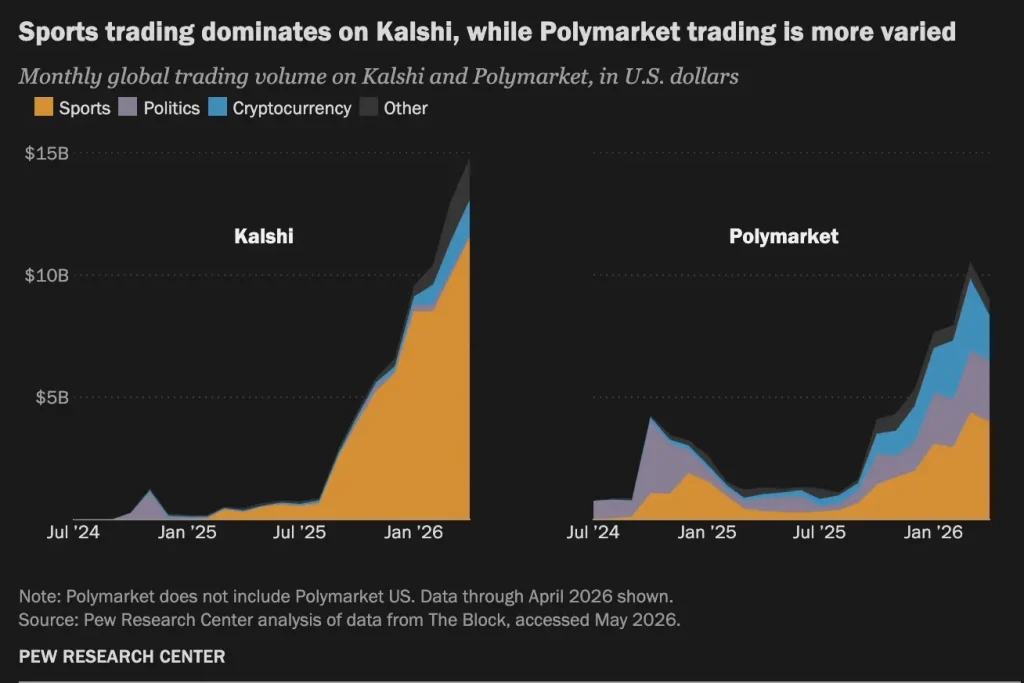
Category mix varies sharply by platform. According to Pew Research Center, sports made up 80% of Kalshi’s trading volume since July 2024, while politics made up 32% of Polymarket’s.
- Sports: highest volume, heaviest state scrutiny
- Finance and crypto: steady demand, data-driven settlement
- Politics and entertainment: spiky, event-driven demand
2. Public Markets Versus Private Enterprise Forecasting
Public markets serve real-money traders and carry full regulatory weight. Private enterprise markets run inside one company, often with play money.
- Fintech add-on: reuses existing wallets and KYC
- Standalone consumer app: needs its own onboarding and acquisition
- Enterprise tool: needs single sign-on, not payments
3. Choosing Markets With Verifiable Outcomes and Demand
Every market needs a named resolution source before listing. Otherwise, ambiguous outcomes trigger disputes and lost trust.
- Official data source written into the rules
- Fixed resolution time
- Visible search or social interest
4. How Market Selection Affects Liquidity and Revenue
Trading clusters near the event itself. FalconX found about 60% of volume in top Kalshi events occurred on the final trading day.
- Short-dated markets recycle liquidity quickly
- Long-dated markets lock up capital
In short, choose categories by demand, then confirm legal eligibility, then match the platform to your distribution model.
Idea Usher configures binary, categorical, and scalar markets, including sports prediction exchanges with payment and live data integrations.
Six Systems That Turn an Event Into a Settled Trade
A white-label prediction market turns an event into a settled trade through six linked stages: market creation, funding, execution, position tracking, resolution, and settlement. Each stage hands clean data to the next.
Consequently, a weak link anywhere, such as a vague rule or an inaccurate ledger, can freeze payouts and damage user trust.
1. Event Creation Defines the Trading Contract
Every market starts as a written contract: the question, the possible outcomes, the closing time, and the data source. Clear rules at this stage prevent disputes later. Most platforms support three outcome types.
- Binary: a single yes or no question, such as whether the Fed cuts rates in December
- Categorical: one winner from several options, such as a tournament champion
- Scalar: a numeric range, such as an inflation reading between two values
2. The Trading Engine Matches or Prices Positions
Users buy Yes or No contracts priced between $0 and $1, and each price reflects an implied probability. The trading engine decides how those trades happen. Kalshi, for example, runs a central limit order book, while other platforms use pricing formulas such as LMSR.
- CLOB: matches buyers and sellers at the prices they set
- AMM: a pricing formula always quotes a price, even with no counterparty
- Hybrid: an AMM seeds new markets, and the order book takes over as volume grows
3. Collateral and Wallet Records Secure User Positions
Every contract must be fully backed before it trades. In a typical binary market, one Yes and one No contract together lock $1 of collateral.
Idea Usher’s Polymarket-style build guide describes handling this escrow through settlement contracts based on the Gnosis Conditional Token Framework.
- The ledger separates available balance, locked collateral, and open positions
- Every deposit, trade, and fee posts as a dated entry
- Daily reconciliation catches mismatches before payouts
4. Settlement Determines the Result and Releases Funds
After the event ends, trading closes, and the platform checks the official result. Kalshi, for instance, resolves each market against a predefined official source, according to FalconX research. Winning contracts then pay $1, and losing contracts pay nothing.
- Verification against the data source named in the rules
- A dispute window for contested outcomes
- Automatic payout to winning balances, minus fees
In short, the lifecycle runs from a written contract to a funded, matched, recorded, and settled position. Each stage depends on clean data from the one before it.
12 Features Founders Should Verify Before Signing
An effective white-label prediction market platform needs six capability groups working together: trading, liquidity, settlement, wallets, compliance, and administration. A gap in one group breaks the others, because a fast engine cannot help if payouts stall or users cannot fund accounts.
Therefore, founders should verify each of the twelve features below before signing any contract.
1. The 12-Feature Verification Checklist
| # | Platform Feature | Primary Benefit | What the Founder Should Verify |
| 1 | Event and contract management | Creates tradable markets | Outcome rules and approvals |
| 2 | Order book or AMM engine | Executes trades | Matching and pricing model |
| 3 | Real-time trading interface | Helps users trade | Order status and price accuracy |
| 4 | Liquidity integrations | Supports active trading | Source of market depth |
| 5 | Oracle-based resolution | Verifies event outcomes | Source reliability |
| 6 | Settlement and dispute engine | Handles contract results | Appeals and fallback rules |
| 7 | Wallet and custody integration | Manages user funds | Custody and ledger controls |
| 8 | Account and payment integration | Supports user onboarding | KYC and payment compatibility |
| 9 | Risk and compliance controls | Restricts prohibited activity | Screening and market controls |
| 10 | Operator administration | Enables platform management | Roles, permissions, audit logs |
| 11 | Revenue and analytics dashboard | Tracks business performance | Fee and reconciliation accuracy |
| 12 | API and white-label customization | Supports business expansion | Integration rights and portability |
2. Trading and Market Creation Features
These features let users find a market, open a position, and track it.
2.1 Event Creation and Outcome Management
Operators should set categories, outcome types, closing times, and approvals without developer help. Confirm that binary, categorical, and scalar markets all ship by default.
2.2 CLOB and AMM Trading Engines
Confirm whether the engine runs an order book, an AMM, or both. A hybrid lets an AMM seed thin markets while the order book handles busy ones.
2.3 Trading Interface and Portfolio Tracking
Traders need live prices, clear fees, and accurate order status. Positions should show cost basis, current value, and payout if the outcome wins.
3. Liquidity and Resolution Features
These systems keep markets active and outcomes trusted.
3.1 Liquidity Provider and Market Maker APIs
Outside market makers need documented quoting APIs and rate limits. Research on bootstrapping prediction market liquidity found cross-market making safest for users, but it depends on professional makers or platform subsidies.
3.2 Oracle and Event Verification Integration
Ask which data feeds resolve each category and who pays for them. Also confirm a backup source exists if the primary feed fails.
3.3 Settlement Automation and Dispute Controls
Settlement should pause automatically when sources conflict. Dispute design matters, because Polymarket user reviews repeatedly criticize letting large holders vote on contested outcomes.
4. Wallet and Player Access Features
These features decide how easily users fund, trade, and withdraw.
4.1 Custodial and Non-Custodial Wallet Support
Custodial wallets keep keys with the operator, while non-custodial wallets leave keys with users. Confirm which model ships and how the ledger reconciles it.
4.2 Fiat, Stablecoin, and Withdrawal Integrations
Check card and bank rails, USDC or USDT settlement, and withdrawal limits. Each method must match what your jurisdiction permits.
4.3 Single Sign-On and Identity Integration
Existing fintech apps should reuse their own logins and KYC. For example, Alpaca credits Kalshi payouts through its own FCM stack, so customers keep one account.
5. Platform Management and Expansion Features
These features give operators control after launch.
5.1 Compliance and Market Surveillance Tools
Look for geo-blocking, restricted-user screening, and wash-trade alerts. Restricted lists keep growing; the US Senate banned senators and staff from betting on prediction markets in May 2026.
5.2 Administrative and Revenue Reporting
Reports must reconcile trades, fees, and payouts to the cent. Kentucky now taxes 14.25% of prediction market transaction fees, per Front Office Sports.
5.3 API Access and White-Label Customization
Confirm in writing that you can add markets, front ends, and integrations without vendor approval. Also confirm code and data portability if you switch providers.
In short, these twelve features work as one system, so test them together in a live demo. A strong engine with weak settlement or reporting still fails users.
White-Label, Turnkey, or Custom Depends on Control
White-label, turnkey, and custom are three ways to get a prediction market platform, and they differ mainly in control. At the same time, white-label rents a managed platform under your brand. Turnkey hands you prebuilt software to host and run yourself.
At the same time, custom or hybrid builds give you proprietary logic and, when the contract assigns it, the source code.
1. White-Label Software Prioritizes Existing Infrastructure
White-label fits founders who need speed and accept vendor limits. You configure branding, fees, and categories, while the provider runs the engine and ships updates. However, licensing terms usually restrict code access and big changes.
2. Turnkey Solutions Offer More Operating Independence
Turnkey software usually runs on your own servers, and your team controls accounts and daily operations. The vendor supports setup, then steps back. Providers use “turnkey” loosely, though, so confirm hosting and support terms in writing.
3. Custom and Hybrid Platforms Support Differentiation
Custom builds suit founders whose trading logic, market types, or integrations are the product. Hybrids start from proven modules and customize the rest. Timelines can be shorter than expected:
Rothera built its full exchange and clearing stack in under five months, per PredictionMarketPulse.
4. Compare the Three Models Across Business Decisions
| Decision Factor | White-Label | Turnkey | Custom or Hybrid |
| Launch scope | Fastest, fixed features | Fast, prebuilt features | Phased, set by roadmap |
| Customization | Branding and settings | Moderate, within codebase | Full |
| Source-code rights | Usually none | Sometimes licensed | Owned if assigned |
| Liquidity responsibility | Often vendor-sourced | Operator | Operator |
| Hosting | Vendor | Operator | Operator’s chosen cloud |
| Compliance responsibility | Operator, vendor tools | Operator | Operator |
| Integration flexibility | Vendor APIs only | Moderate | Full |
| Maintenance | Vendor | Shared or operator | Operator or retained partner |
| Migration options | Hard, data export only | Moderate | Easiest |
In short, choose the model by how much you need to control, not by launch speed alone. Founders who plan to differentiate on trading logic usually outgrow pure white-label. That raises the next question: what each model actually costs.
Liquidity Must Be Solved Before Market Launch
A working trading engine does not guarantee trades. New white-label prediction markets face a cold-start problem: few orders, wide spreads, and no counterparties, so early users leave.
Therefore, founders must decide before launch whether liquidity comes from an AMM, professional market makers, or an external exchange connection, and fund that choice.
1. The Liquidity Problem Behind Empty Prediction Markets
Binary contracts are hard to quote, so professional makers often stay away. One builder documenting his own launch described liquidity provision in prediction markets as unusually punishing. Thin books widen spreads, which then drives away the traders makers need.
2. AMMs Provide Algorithmic Trading Liquidity
An AMM always quotes a price, using formulas such as LMSR or CPMM. However, the operator must fund each pool and accept losses when traders are better informed.
3. Market Makers Support Order Book Liquidity
Order books need professional makers under written agreements covering quoting obligations, spreads, and rebates.
Kalshi, for example, rewards resting orders rather than raw volume, as this guide to bootstrapping prediction market liquidity explains.
4. External Liquidity APIs Offer Another Approach
Some operators route orders to an established exchange instead of running their own books. Plus500’s US arm, for instance, routes prediction market orders to Kalshi. This requires a commercial agreement and creates dependence on that venue.
5. Liquidity Metrics Reveal Whether Markets Are Tradable
Track bid-ask spreads, order book depth, slippage, fill rates, and how much depth comes from your top makers. Heavy concentration means one exit can empty a market.
6. AMM vs CLOB vs External Liquidity at a Glance
| Factor | AMM | CLOB With Market Makers | External Liquidity |
| Capital needed | Operator funds pools | Maker capital plus rebates | Low, partner holds books |
| Control | High | High | Low |
| Operational complexity | Low to moderate | High | Moderate |
| Main risk | Losses to informed traders | Makers withdraw | Partner dependence |
In short, liquidity is a funded business decision, not a software feature. Pick the source before launch and review its metrics weekly. Once the liquidity source is set, the build budget becomes much easier to estimate.
Wallet and API Choices Determine Integration Complexity
A prediction market can launch as a standalone app or as a feature inside an existing fintech, crypto, or trading platform. Standalone products need their own accounts, wallets, and payments. Embedded products reuse what users already have, so integration complexity depends mostly on wallet design and API access.
Coinbase, for example, added prediction markets by routing orders through Kalshi.
1. Existing User Accounts Can Connect Through SSO
Single sign-on lets users trade with their current login instead of creating a second account. The integration should pass verified KYC status and permissions, so restricted users stay restricted. One identity record also keeps support and reporting consistent.
2. Wallet Architecture Determines Who Controls Funds
Custodial wallets hold user funds on the operator’s side, so the operator owns reconciliation. Non-custodial wallets leave control with users and shift settlement work to smart contracts. Embedded products can also reuse an existing ledger, as Polymarket’s integration inside Blockchain.com’s app lets users trade with assets already in their accounts.
3. Fiat and Stablecoin Payments Need Compatible Rails
Fiat deposits run through a payment service provider, which must support event contracts in your target states. On the other hand, crypto platforms often settle in USDC or USDT instead.
This breakdown of crypto-funded sports prediction markets shows how these funding layers fit together.
4. API Access Determines Future Platform Flexibility
Documented APIs and webhooks let you add mobile apps, analytics tools, and distribution partners later. Confirm authentication standards, raw data access, and rate limits. Most importantly, confirm the contract lets you keep these integrations if you change providers.
Embedding is faster when the platform plugs into your existing identity, wallet, and payment layers. Standalone launches trade that speed for full product control. Either way, these integration choices also decide which compliance obligations land on your team.
Regulation Defines Where and What You Can Offer
A white-label software license is not legal authorization to run a real-money prediction exchange. In the US, event contracts generally fall under CFTC oversight, and states are actively contesting that authority.
Consequently, your legal path, not your vendor, decides which markets you can list, which users you can serve, and which controls your platform needs.
1. Event Contracts Have Specific U.S. Regulatory Requirements
The CFTC regards most event contracts as swaps or futures, so they trade on registered venues such as designated contract markets (DCMs).
Moreover, the rules are still moving: in March 2026, the CFTC opened an advance notice of proposed rulemaking on prediction markets. Therefore, founders need qualified derivatives counsel before choosing a platform.
2. Contract Categories May Face Different Restrictions
Not every category clears the same bar. In June 2026, the CFTC proposed rules defining which event contracts are contrary to the public interest and cannot be listed, according to Seward & Kissel.
Meanwhile, sports contracts draw the most state challenges, so each category needs jurisdiction-specific review.
3. KYC, AML, and Geofencing Restrict Platform Access
Your platform must verify identity and age where required, screen sanctions lists, and monitor suspicious activity. In addition, geofencing should rely on location checks rather than billing addresses alone.
This matters because states such as Illinois and Connecticut have sent cease-and-desist letters to exchanges, including Kalshi.
4. Market Integrity Requires More Than Identity Checks
Identity checks stop the wrong users, whereas surveillance catches the wrong behavior. Accordingly, the platform should flag wash trading, self-dealing, unusual position build-ups, and trades by prohibited insiders.
Notably, the CFTC has already brought two insider trading enforcement actions involving event contracts, as Dechert reports.
5. Legal Readiness Should Shape Platform Architecture
Finally, legal structure should drive technical design, not the reverse. For instance, routing orders through a partner exchange shifts custody and settlement to that venue.
By contrast, operating your own venue places recordkeeping, surveillance, and settlement duties on your team.
Keep in mind that KYC, AML, and geofencing features support compliance, but they do not make any provider or platform regulator-approved. As a result, ask each provider to map its features to your specific regulatory model in writing.
In short, software can enforce compliance rules, but only your legal structure grants permission to operate. Settle that structure first, then choose a provider that fits it. With the legal path clear, the remaining question is what the full build will cost.
Operator Controls Must Detect Risks and Track Revenue
The operator dashboard is a business-critical system, not just a reporting screen. It is where staff list and close markets, catch suspicious trading, reconcile fees, and reconstruct disputed events.
Consequently, a weak back office exposes a white-label prediction market to losses, user complaints, and regulatory questions, even when the trading engine runs perfectly.
1. Admin Controls Manage Markets and User Permissions
Role-based access should separate who drafts, approves, suspends, and resolves each market. Moreover, sensitive actions such as early closure need a second approver.
This matters in practice: Polymarket forcibly closed a market on a missing US pilot’s rescue after public outrage.
2. Risk Monitoring Identifies Problematic Trading
Alerts should flag unusual position sizes, linked accounts, and heavy trading just before resolution. Next, staff need tools to investigate, restrict accounts, and record each incident history.
After all, investor Nic Carter has warned that insider trading scandals could erode trader confidence outside sports markets.
3. Revenue Reporting Must Reconcile Trades and Fees
Every trade, fee, refund, and adjustment should tie back to the trading ledger. Fee data deserves equal attention, because fee design drives revenue as much as volume does.
For example, Polymarket collected $29.22 million in fees in April 2026 despite trailing Kalshi in taker volume.
4. Operational Records Support Audits and Disputes
Logs should capture timestamps, user actions, staff access, and price changes in tamper-evident form. As a result, staff can reconstruct exactly what happened when a user disputes a fill or payout.
Finally, set retention periods with your legal counsel, since requirements vary by regulatory model.
In short, the back office protects both revenue and trust after launch. Therefore, test it as rigorously as the trading engine during vendor demos. Once operations are covered, the next question is what the full build will cost.
A Prediction Market Needs a Sustainable Revenue Model
Trading fees generate the core revenue for prediction markets, yet volume, revenue, and profit remain three different numbers. In fact, a platform can process heavy trading and still lose money after liquidity incentives, data feeds, and payments.
For context, Citizens analysts estimate industry annual revenue at roughly $2 billion, a small fraction of trading volume.
1. Trading Fees and Spreads Generate Transaction Revenue
First, platforms charge taker fees, maker fees, or per-contract commissions on executed trades. In addition, some platforms earn spreads, but only where law and partner contracts permit.
2. B2B Integrations Can Create Additional Revenue
Beyond trading, operators can license markets or APIs to apps, media brands, and brokers that embed trading.
Similarly, market creation fees offer another stream, as this Polymarket cost breakdown outlines.
3. Liquidity and Infrastructure Costs Affect Margins
However, market maker rebates, payment processing, data feeds, hosting, vendor charges, and security operations all reduce margin. Consequently, high volume can still mean thin profit.
4. Revenue Forecasts Need a Realistic Trading Model
Therefore, test every assumption before choosing a monetization model. To illustrate, the example below uses hypothetical numbers, not verified industry averages.
| Line Item (Illustrative Assumption) | Monthly Amount |
| Trading volume | $10,000,000 |
| Revenue at an assumed 1% fee rate | $100,000 |
| Market maker incentives | ($30,000) |
| Data feeds | ($5,000) |
| Payment processing | ($8,000) |
| Hosting and security | ($12,000) |
| Contribution before staff and compliance | $45,000 |
In short, model fees and costs separately, then stress-test a lower-volume month. Once revenue is mapped, the build budget becomes the next decision.
What a $70,000 to $300,000 Customized Build Covers
For planning purposes, a customized or hybrid white-label prediction market build can be scoped at $70,000 to $300,000. However, this range reflects substantial customization, not a standard license fee or a fixed quote.
Instead, the final cost depends on how much you buy, integrate, or own, so engineers should validate every estimate against your scope.
1. Development Costs Vary by Scope and Ownership
At first glance, similar interfaces can hide very different engineering. For example, licensing existing software costs least upfront, while integrating external liquidity adds connectivity work.
By contrast, proprietary trading logic costs the most, and one guide places advanced crypto prediction market builds at $150,000 to $300,000.
2. Estimated Development Cost by Phase
To illustrate, the table below shows an allocation model, not market data. Accordingly, treat each range as a starting point for engineering review.
| Phase | Illustrative Budget |
| Product discovery and architecture | $8,000 to $25,000 |
| Branding, UX, and front-end customization | $7,000 to $25,000 |
| Trading infrastructure and APIs | $20,000 to $85,000 |
| Liquidity, wallet, and oracle integrations | $15,000 to $75,000 |
| Compliance integrations, security, and QA | $12,000 to $50,000 |
| Deployment, reporting, and launch support | $8,000 to $40,000 |
| Total | $70,000 to $300,000 |
Planning a prediction market platform? Have Idea Usher review your proposed trading model, liquidity dependencies, integrations, and scope before committing to a development budget.
3. Maintenance Needs Its Own Operating Budget
Separately, plan 15% to 25% of the initial build each year for engineering, monitoring, and updates. Note that this illustrative allowance excludes hosting, data feeds, and liquidity, which belong in your operating budget.
4. The Cheapest Platform May Carry Greater Switching Costs
Conversely, a low setup fee can hide higher long-term costs. Over time, recurring fees, revenue share, paid customization requests, and data export charges compound. Ultimately, migration costs decide whether you can ever leave a vendor.
In short, budget for ownership, integrations, and operations together, not the build alone. With the budget framed, the next step is choosing a partner who can deliver it.
Why Founders Build Their Prediction Market With Idea Usher
Choosing a white-label prediction market partner comes down to three tests: deep exchange expertise, real regulatory awareness, and full ownership of what you build. Idea Usher builds custom and hybrid prediction market platforms for US founders and growing fintech teams, starting from proven modules rather than a locked vendor product.
As a result, you launch on a tested foundation and keep the freedom to change trading logic, market types, integrations, and vendors later.
- Prediction market depth: builds Polymarket-style and Kalshi-style platforms with order books, CPMM or LMSR market makers, and binary, categorical, and scalar markets.
- Trustworthy resolution design: tiered settlement uses oracle data first, then a review layer for contested outcomes.
- Built-in market integrity: monitoring flags wash trading, manipulation, and suspicious trading patterns before they reach payouts.
- Code you can own: custom and hybrid builds can assign source code to you by contract, so your roadmap stays yours.
- Phased delivery: discovery, trading infrastructure, integrations, and launch ship in defined phases with clear budgets.
- Security standards: ISO 27001-certified processes, plus penetration testing and third-party smart contract audits.
- Proven track record: 1,000+ products launched, 250+ engineers, and 95% client retention across 10+ years.
- Verified client trust: rated 4.9/5 from 44 verified Clutch reviews and featured on TheStreet for prediction marketplace development.
Bring your target markets, liquidity plan, and legal structure to a prediction market scoping session with Idea Usher. In return, you get a phased build plan, a realistic budget range, and the risks to resolve before development starts.
Conclusion
A white-label prediction market works best when the business decisions come before the software. First, confirm your legal path, since it sets which markets and users you can serve. Next, secure liquidity and choose an ownership model that matches how far you plan to customize.
Finally, budget for operations, data feeds, and maintenance, not just the build. In the end, the right platform is the one that fits your license, your liquidity, and your long-term roadmap at the same time.
FAQs
Q1. Can You Launch a Prediction Market Without Building an Exchange?
A1. Yes, because founders can launch a branded front end that routes orders to a CFTC-registered exchange through a broker or partner. For example, Coinbase added prediction markets by routing orders through Kalshi. However, you still need a commercial agreement and the right intermediary registration for your chosen model.
Q2. Does White-Label Prediction Market Software Include Liquidity?
A2. Not usually. In general, white-label software includes liquidity tools such as AMM pools, market maker APIs, and incentive settings, but not the capital or traders themselves. Therefore, confirm in writing whether the vendor supplies funded market making, external liquidity connections, or only integration hooks you must fill yourself.
Q3. Can a White-Label Platform Use Polymarket’s Liquidity?
A3. Only with a commercial agreement and a compliant legal structure. Technically, the platform must connect through supported APIs and manage hedged positions across venues. Legally, US users reach Polymarket’s regulated US exchange only through registered intermediaries, so counsel should approve the setup before any integration work begins.
Q4. Do You Need CFTC Registration to Launch in the U.S.?
A4. Generally, yes, unless you route through a registered partner. Operating your own US event contract exchange requires CFTC registration as a designated contract market, a multi-year and costly process. Alternatively, founders can join a registered exchange as a broker, introducing broker, or technology vendor, and each role carries different duties.
Q5. Can White-Label Prediction Markets Support Fiat and Crypto?
A5. Yes, provided your integrations and jurisdiction allow both. For instance, fiat deposits run through card or bank rails via a payment provider, while crypto platforms often settle in USDC or USDT. However, each funding method must match your legal model, since US regulated venues and offshore crypto markets follow different rules.
Q6. Can You Move From White-Label to a Custom Platform Later?
A6. Yes, but only if your contract allows it. Specifically, confirm that you own user data, trade history, and market configurations, and that the vendor permits full data exports. In addition, platforms built on modular, documented APIs migrate far more easily than systems locked to one vendor’s engine.