

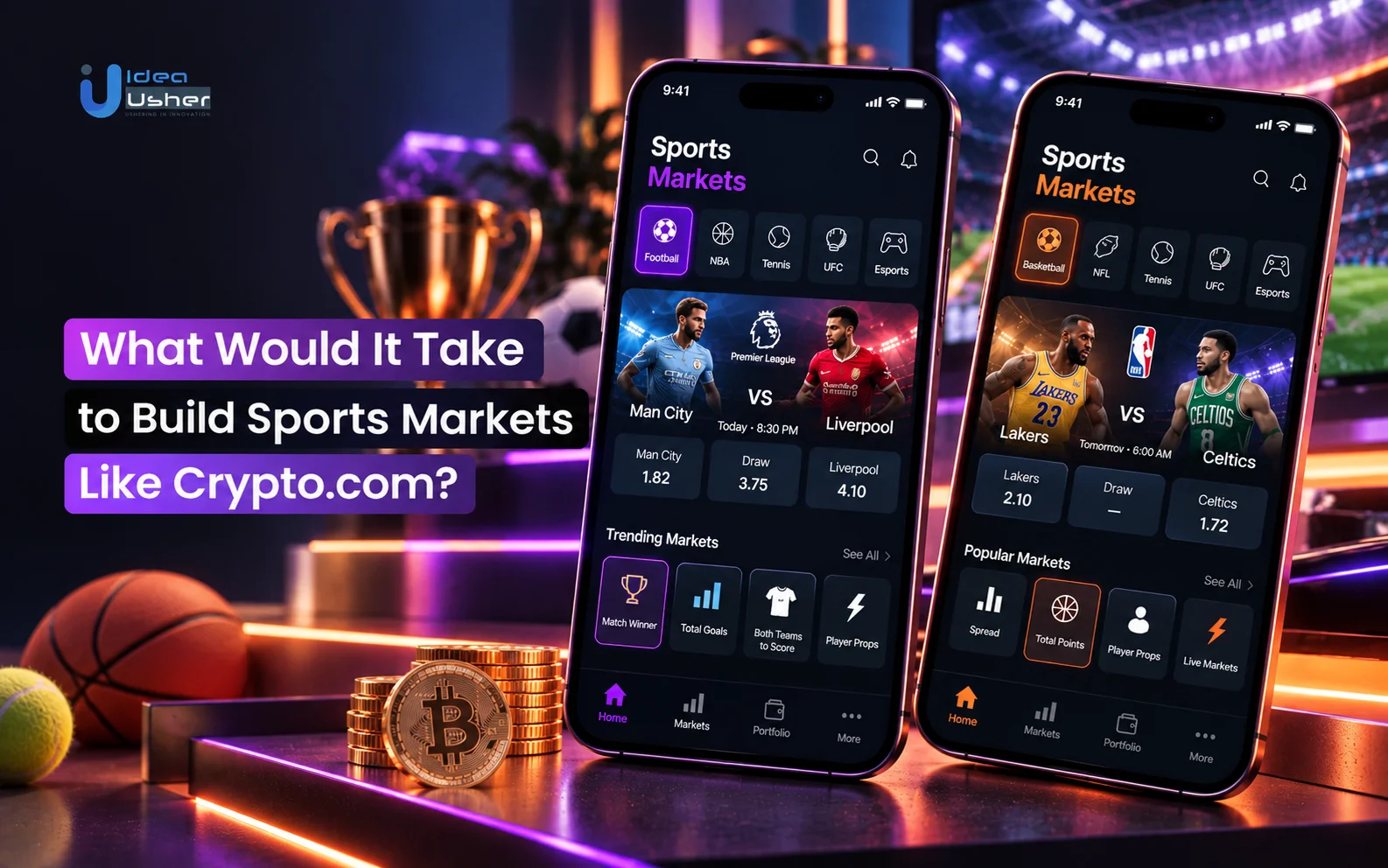
Key Takeaways
- Building sports markets like Crypto.com means more than adding sports betting. You need event contracts, live sports data, order matching, liquidity and automated settlement working together.
- A sports prediction market works like a trading exchange. Users buy and sell Yes/No sports contracts as market prices change, rather than betting directly against a sportsbook.
- The app needs strong liquidity from market makers, plus good order-book controls, so users can actually place and close trades without big spreads or delays.
- Sports rules also matter a lot in a sports prediction market app. The system has to handle player inactivity, postponed games, ties, stat corrections and different settlement rules for each market.
- A sports market app can cost around $100,000 to $1.5M+. The final development cost depends on the features, crypto integration, trading setup and regulatory requirements.
Building sports prediction markets like Crypto.com requires a trading-focused app that combines sports event contracts, real-time data, order matching, liquidity, financial infrastructure and automated settlement. Unlike a conventional sportsbook, the platform must support market-based trading where users can buy, sell and manage positions tied to sports outcomes. The platform also needs strong compliance, security and jurisdiction controls to support reliable sports trading at scale.
Crypto.com demonstrates how sports markets can combine familiar sports events with financial-style trading, allowing participants to trade contracts tied to specific outcomes rather than simply placing conventional bets. This model introduces a different set of product, infrastructure and operational requirements that go beyond a standard sportsbook.
This blog breaks down what it takes to bring sports prediction markets like Crypto.com to market, covering core infrastructure, liquidity, sports data, crypto funding, settlement, regulatory requirements and crypto sports betting marketplace app development costs.
What is Sports Market, Crypto.com?
Crypto.com Sports Markets, offered through the Crypto.com Predict platform, are federally regulated prediction-market contracts integrated into its mobile and web platforms. Users can trade sports event contracts structured around binary “Yes/No” outcomes, covering match winners, point spreads, total scores, player statistics and season championships.
Unlike traditional sportsbooks, where users wager against a house that builds a vig or house edge into pricing, the platform uses an order-book-based exchange model. Traders can buy and sell positions against other market participants, with contract prices changing based on market supply and demand.
| Key Term | Definition & Operational Detail |
| Event Contract | A standardized derivative representing a binary question (e.g., “Will the Chiefs win by more than 3.5 points?”). |
| Contract Multipliers ($1, $10, $100) | Contracts are available in fixed settlement face values, most commonly $1.00, but also $10.00 or $100.00 per contract. |
| Probability Pricing ($0.01 – $0.99) | On a standard $1.00 contract, prices range between $0.01 and $0.99. The price reflects the market’s implied probability (e.g., a $0.58 price indicates a 58% market likelihood of occurrence). |
| Binary Settlement ($1.00 or $0.00) | At resolution, if your prediction is correct, the contract settles at full face value ($1.00). If incorrect, it settles at $0.00. |
| Early Exit / Secondary Trading | Positions do not need to be held until the game ends. Traders can buy to open, increase, or sell to close positions at any time before trading halts to lock in profits or cap losses. |
| Fee Structure | Trades incur small, transparent fees per contract, combining an Exchange Fee and a Technology Fee (typically starting around ~$0.0175 per $1 contract). |
| Order Types & Slippage | Supports both Market Orders (with configurable Slippage Tolerance) and Limit Orders on the order book. |
| Player Market Conditions | Specific resolution rules apply to player props: if a designated player is inactive or never takes the field, contracts settle as Event Canceled. |
What Makes Crypto.com Sports Markets Different?
Crypto.com separates its sports prediction offering from traditional bookmakers by structuring sports markets as exchange-cleared binary event derivatives rather than sportsbook wagers.
Prediction market trading volume is projected to grow from around $50 billion in 2025 to $410 billion in 2026 and reach $10 trillion annually by 2035, representing approximately 70% annual growth. Bernstein expects sports to remain a major category, although its share of total volume is projected to decline as crypto, equities and commodities expand.

In the U.S., where traditional sportsbooks generate net gaming revenue from player losses by holding an average 8.0% to 9.5% vigorish according to the American Gaming Association (AGA), Crypto.com offers event contracts through its CFTC-regulated entity, Crypto.com | Derivatives North America (CDNA).
Instead of wagering against the “house,” users trade standardized binary contracts in a peer-to-peer exchange environment. Risk is fully collateralized upfront with no margin calls, and pricing is determined by order-book supply and demand rather than oddsmaker lines.
A. Sportsbooks vs. Crypto.com Sports Markets
Traditional sportsbooks and sports prediction markets like Crypto.com differ in how they handle counterparties, pricing, liquidity, regulation and settlement. Understanding these differences helps explain why sports event contracts require exchange-style infrastructure rather than conventional sportsbook technology.
| Feature | Traditional Sportsbook | Crypto.com Sports Markets |
| Opponent | The House / Oddsmaker | Peer-to-peer traders on an exchange order book |
| Pricing Model | Fixed moneyline/odds set with built-in vig (house margin) | Pure supply-and-demand probability pricing (0.01–0.99) |
| Trading Flexibility | Bets are locked until final score (unless offering high-fee bookie cashout) | Fully liquid derivatives tradable 24/7 up to event close |
| Regulation | State Gambling / Gaming Commissions | Federal CFTC Oversight (via CDNA derivatives exchange) |
| Legal Reach | Restricted to state-by-state sports betting approvals | Broadly accessible across most U.S. states under financial law |
| Settlement | Varies by sportsbook rules | Standardized binary payout ($1 / $0 per contract) |
B. How Yes/No Sports Contracts Actually Work
Yes/No sports contracts let traders take complementary positions on defined outcomes, with prices reflecting implied probability, upfront collateral limiting risk and fixed $1.00 or $0.00 settlement determining final payouts.
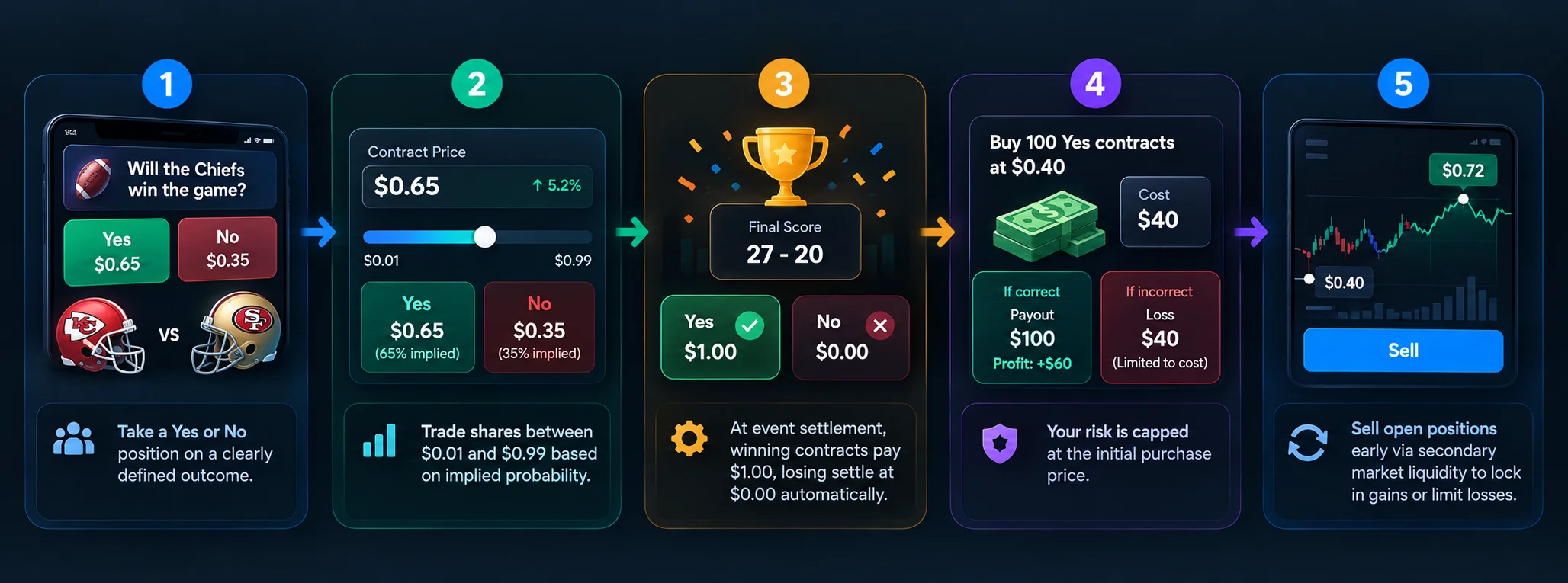
Every sports event market is structured around a clearly defined, verifiable proposition (e.g., game winner, point spread, or player stat benchmark) with standardized financial mechanics:
1. Taking Complementary Yes or No Market Positions
Traders buy Yes when they expect an outcome to occur or No when they expect otherwise, with both positions fully backed by cash collateral.
2. Trading Shares Dynamic Bounded Between $0.01 and $0.99
Contract prices range between $0.01 and $0.99 and reflect implied probability. A $0.65 Yes contract implies 65% probability, while the complementary No trades around $0.35.
3. Executing Deterministic $1.00 Payouts at Final Event Settlement
After the event concludes and official statistics verify the result, winning contracts settle at exactly $1.00 each, while losing contracts settle at $0.00 automatically.
4. Capping Risk to the Initial Purchase Price
Buying 100 Yes contracts at $0.40 requires $40 upfront. If correct, the position pays $100 before fees, producing $60 profit, while a loss remains limited to $40.
5. Exiting Open Positions Early via Secondary Market Liquidity
Traders can sell open positions before or during an event through secondary-market liquidity, locking in unrealized gains or limiting losses as implied probabilities and contract prices change.

What a Crypto.com-Like Sports Market Include?
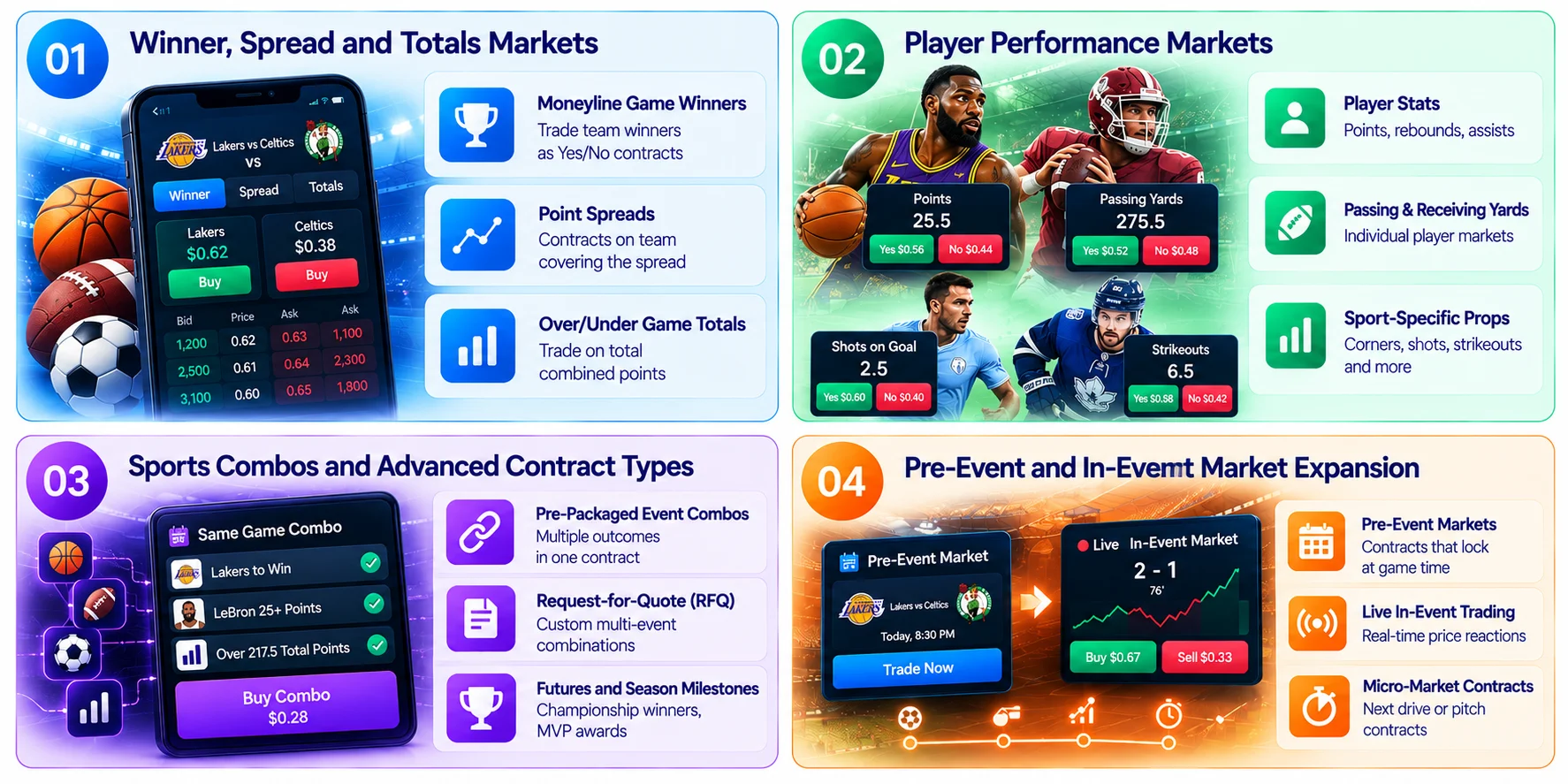
A Crypto.com-like sports market can include winner, spread, totals, player performance, futures, sports combos and in-game contracts. The sports prediction app needs an order book, real-time sports data, contract pricing, liquidity, RFQ infrastructure and automated settlement to turn measurable sporting outcomes into tradeable binary contracts across pre-event and live markets.
A. Winner, Spread and Totals Markets
The foundation of a prediction exchange relies on translating traditional game-level betting markets into standardized, fully collateralized financial contracts:
- Moneyline Game Winners: Users trade binary contracts predicting outright game winners, with order book demand determining whether a heavy favorite trades at $0.85 or $0.90 per share.
- Point Spread Derivatives: The platform transforms traditional betting lines into mutually exclusive Yes/No shares, determining if a team will successfully cover a specific scoring margin by the final whistle.
- Over/Under Game Totals: Traders buy contracts on aggregate scoring outputs, taking complementary sides on whether combined team points will breach predefined strike numbers at the close of regulation.
B. Player Performance Markets
Player props are the highest-margin growth engines in the industry, routinely yielding operator holds between 10% and 15% by isolating individual athletic achievements:
- Basketball Points, Rebounds, and Assists: Traders buy shares predicting whether marquee athletes will eclipse specific statistical benchmarks, turning individual player performance into highly liquid, isolated micro-markets driven by real-time data.
- Football Passing and Receiving Yards: The exchange converts offensive yardage milestones into tradeable contracts, allowing retail users to isolate specific quarterback or receiver outcomes without relying on overall team victories.
- Sport-Specific Specialized Statistics: Advanced data feeds allow the platform to generate derivative contracts on granular outcomes, such as total soccer corner kicks, hockey shots on goal, or baseball pitcher strikeouts.
C. Sports Combos and Advanced Contract Types
To capture the recreational handle driven by Same Game Parlays which often achieve 15% to 25% hold rates, the platform must support complex event structures:
- Pre-Packaged Event Combos: The exchange bundles correlated outcomes into unified contracts, allowing users to trade shares on a team winning while their star player simultaneously scores maximum points.
- Request-for-Quote (RFQ) Combinations: Professional market makers receive and price custom multi-event combinations generated by retail traders, routing unique peer-to-peer derivative requests directly through automated institutional pricing APIs.
- Futures and Season Milestones: The marketplace lists long-horizon contracts, allowing participants to trade dynamic shares on championship winners or MVP awards throughout a multi-month regular season as implied probabilities shift.
D. Pre-Event and In-Event Market Expansion
A phased technical rollout ensures the clearinghouse and matching engine remain stable before introducing high-frequency live trading:
- Static Pre-Event Market Launches: Platforms typically launch by offering contracts that lock at game time, simplifying escrow management and preventing latency arbitrage while liquidity providers optimize their automated pricing algorithms.
- Dynamic Live In-Event Trading: As infrastructure scales, continuous live trading enables real-time price reactions to gameplay, backed by automated circuit breakers for referee reviews.
- Micro-Market Play-by-Play Contracts: The ultimate technical expansion introduces rapid-settlement contracts predicting the outcome of the next drive or pitch, requiring sub-second data ingestion and instantaneous financial ledger reconciliation.
What Core Infrastructure Does the Sports Market App Need?
A sports prediction market like Crypto.com requires much more than a consumer-facing trading interface. Behind the platform, multiple infrastructure layers must work together to ingest real-time sports data, create contracts, execute trades, track positions, manage funds and settle markets accurately. The core infrastructure can be divided into the following components:
| Infrastructure Layer | What It Handles | Key Components | Why It Matters |
| Real-Time Sports Data | Collects and distributes data used to create, price and resolve contracts. | Live scores, player stats, schedules, team/player status, official results and corrections. | Low-latency, accurate data keeps markets current and supports reliable settlement. |
| Event & Contract Management | Manages sporting events and their contract lifecycles. | Event creation, templates, activation, expiration, suspension, cancellation and settlement rules. | Supports consistent management of winners, spreads, totals and player-performance markets. |
| Order Book & Matching Engine | Processes orders and determines trade execution. | Bid/ask management, matching, market/limit orders, partial fills, cancellations and execution priority. | Enables exchange-style price discovery and execution instead of bookmaker-based wagering. |
| Wallet, Ledger & Positions | Tracks funds, positions, exposure and transactions. | Available/reserved balances, open positions, realized P&L, transaction history, settlement credits and audit trails. | Keeps financial data synchronized and makes every transaction traceable and auditable. |
| Notifications & Portfolio | Keeps users updated on trades, markets and portfolio activity. | Fill notifications, price alerts, market changes, settlement updates and portfolio tracking. | Provides real-time visibility into execution, market changes and settlement. |
The order book and matching engine are among the most technically demanding components of sports prediction markets like Crypto.com, processing orders while maintaining accurate balances, positions and execution states. Sports data and contract-management layers enable reliable market creation and settlement for real-time trading and scalable market expansion.
How Do You Build Liquidity for Sports Markets?
Sports-market liquidity is built by onboarding professional market makers, offering trading APIs and incentives, maintaining tight two-sided quotes, monitoring order-book depth and managing exposure. The platform should also use liquidity-aware execution controls, real-time surveillance and reliable sports data to keep markets active, reduce spreads and support consistent trade execution.
In peer-to-peer event markets, liquidity must be built, capitalized, and protected. Without continuous order flow, order books become illiquid, causing trade executions to stall.
A. Why Sports Markets Need Liquidity
Sports prediction markets need continuous two-sided liquidity to support competitive pricing, reliable execution and active position management.
- Wide Spreads: Thin markets widen bid-ask spreads, reducing pricing competitiveness and weakening the platform’s cost advantage.
- Severe Slippage: Shallow order-book depth forces market orders across multiple price levels, reducing execution quality and effective payouts.
- Unmatched Orders: Limit orders can remain unmatched when counterparties are unavailable, increasing cancellations and user churn.
- Partial Fills: Fragmented execution can leave traders with smaller positions than intended while maintaining exposure to the remaining unmatched portion.
- Unavailable Markets: Insufficient liquidity can remove active quotes, limiting users’ ability to view unrealized PnL or close positions before expiry, as documented by Crypto.com.
B. Market Makers and Liquidity Providers
Bootstrapping early volume requires professional market makers (MMs) to provide reliable quotes on both sides of every proposition:
| Liquidity Component | How It Works |
| Institutional Quant Desks | Partner with proprietary trading firms through Direct Market Access (DMA) and low-latency FIX connections to support high-frequency programmatic quoting. |
| Two-Sided Quoting | Use algorithmic liquidity bots to stream continuous bid/ask quotes within tight cent collars, dynamically re-pegging orders as live sports data changes. |
| Delta Risk Management | Use automated market-making algorithms to hedge event exposure across external sportsbooks or prediction platforms, limiting directional inventory and capital drawdowns. |
| Trading APIs & WebSockets | Provide dedicated low-latency APIs and high-throughput WebSocket connections with rapid cancel-and-replace capabilities, allowing market makers to adjust quotes during volatile scoring events. |
C. How to Design a Liquidity-Aware Order System
A production platform for sports prediction markets like Crypto.com should embed risk-mitigation controls directly into the order-routing and execution pipeline. These controls help manage slippage, abnormal orders, market depth and execution risks during volatile live events.
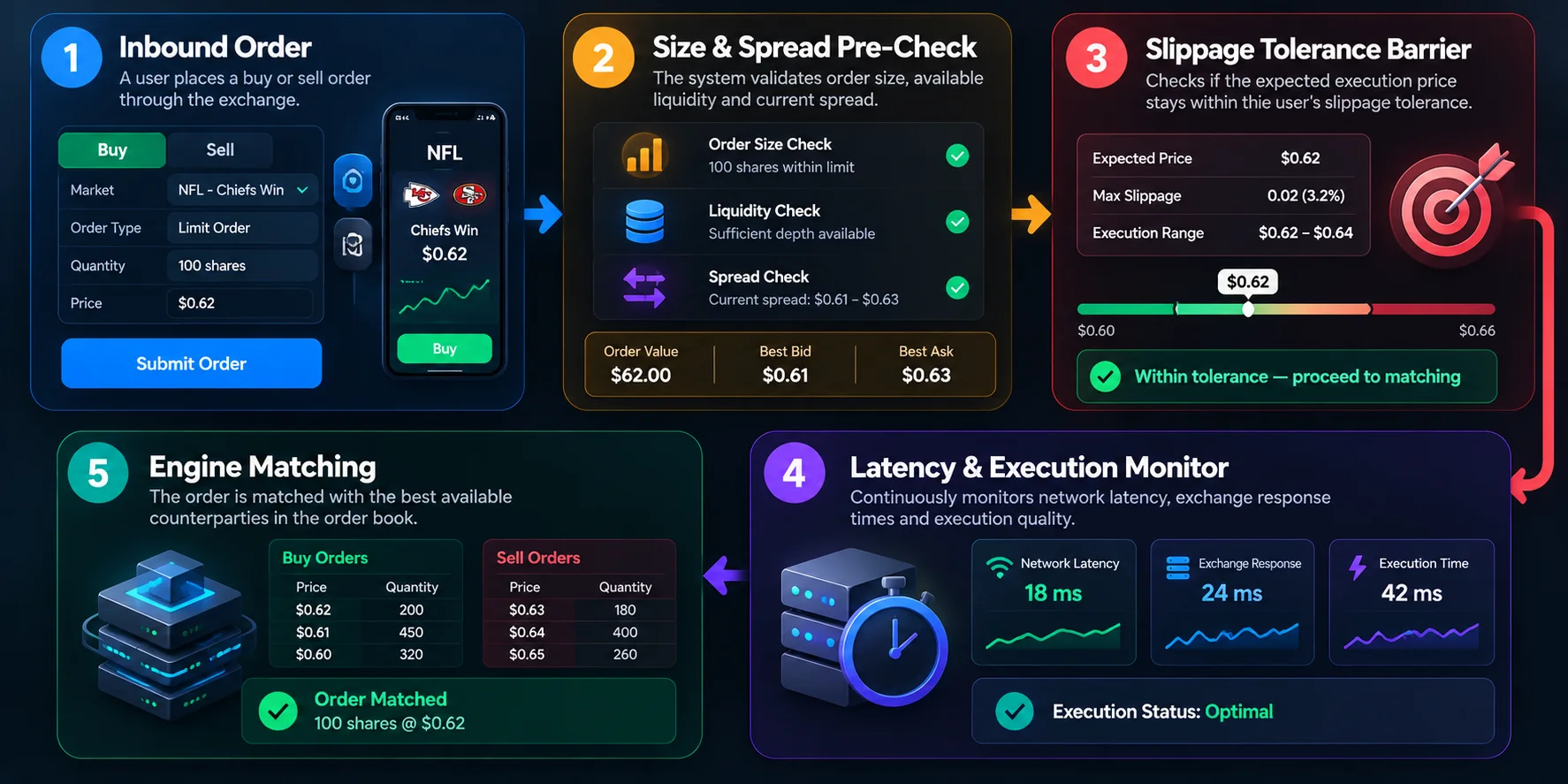
1. Slippage Tolerance
Allow users to define slippage limits for immediate executions. IOC orders can automatically cancel when market-clearing prices move beyond configured thresholds, protecting users from unexpected execution prices during volatile sports events.
2. Dynamic Order Sizing
Limit market-order sizes according to available order-book depth, such as liquidity within three ticks of the mid-price. This reduces market impact and protects retail traders from sudden execution-price movements.
3. Liquidity Gating
Monitor market depth and resting capital before routing orders. The system can restrict taker orders and alert users when available liquidity falls below predefined minimum thresholds.
4. Pre-Trade Price Validation
Compare requested limit prices against real-time probability and price corridors before execution. This helps block abnormal or fat-finger orders that could otherwise execute at significantly distorted contract prices.
5. Toxic Flow Monitoring
Monitor order-to-cancellation ratios, fill velocity and execution latency to identify potential latency-arbitrage activity. Early detection helps protect passive market-maker quotes from excessive adverse selection and liquidity depletion.
What Sports-Specific Rules Must the Platform Handle?
A sports prediction market cannot rely on a single generic settlement rule because each sport, event type and contract can have different conditions for determining whether a position is valid and how it should settle. A Crypto.com-like platform therefore needs a flexible sports betting marketplace rules engine that can account for player availability, event changes, official statistics and sport-specific outcomes.
| Sports Rule | What the Platform Needs to Handle | Why It Matters |
| Player Inactivity & Changes | Track participation, starts, substitutions, withdrawals and inactivity before or during an event. | Player-performance contracts may require different settlement when a player does not participate or their status changes. |
| Canceled, Suspended & Postponed Games | Detect cancellations, postponements, suspensions, rescheduling and abandoned games, then apply predefined contract rules. | Prevents invalid markets from remaining tradable and ensures open positions are handled consistently. |
| Ties, Draws & Alternative Outcomes | Define outcomes for ties, draws, no-contests and other results outside standard Yes/No scenarios. | Prevents the settlement engine from incorrectly treating every market as a binary winner outcome. |
| Official Statistics & Corrections | Use authoritative sports data feeds and handle corrections to scores, player stats and other event data. | Ensures market settlement remains accurate when official results change after initial publication. |
| Sport-Specific Settlement Rules | Configure rules by sport, league, contract type and market condition. | A football winner, basketball player-points and baseball totals contract may require different validation and settlement logic. |
A robust sports contract rules engine for sports prediction markets like Crypto.com should separate market configuration from settlement logic, allowing new sports and contract types without rebuilding core infrastructure while consistently handling player participation, ties, cancellations and other edge cases.
How Do You Connect Crypto Funding to Sports Trading?
Crypto funding can connect to sports trading by converting eligible digital assets into USD, crediting the proceeds to a dedicated cash balance, reserving collateral for event contracts and routing funded orders through the sports trading engine.
Under CFTC rules, sports prediction markets like Crypto.com’s CDNA cannot trade event contracts directly against volatile crypto. Instead, they use a fully collateralized USD Cash Account, converting crypto holdings to fiat settlement rails.
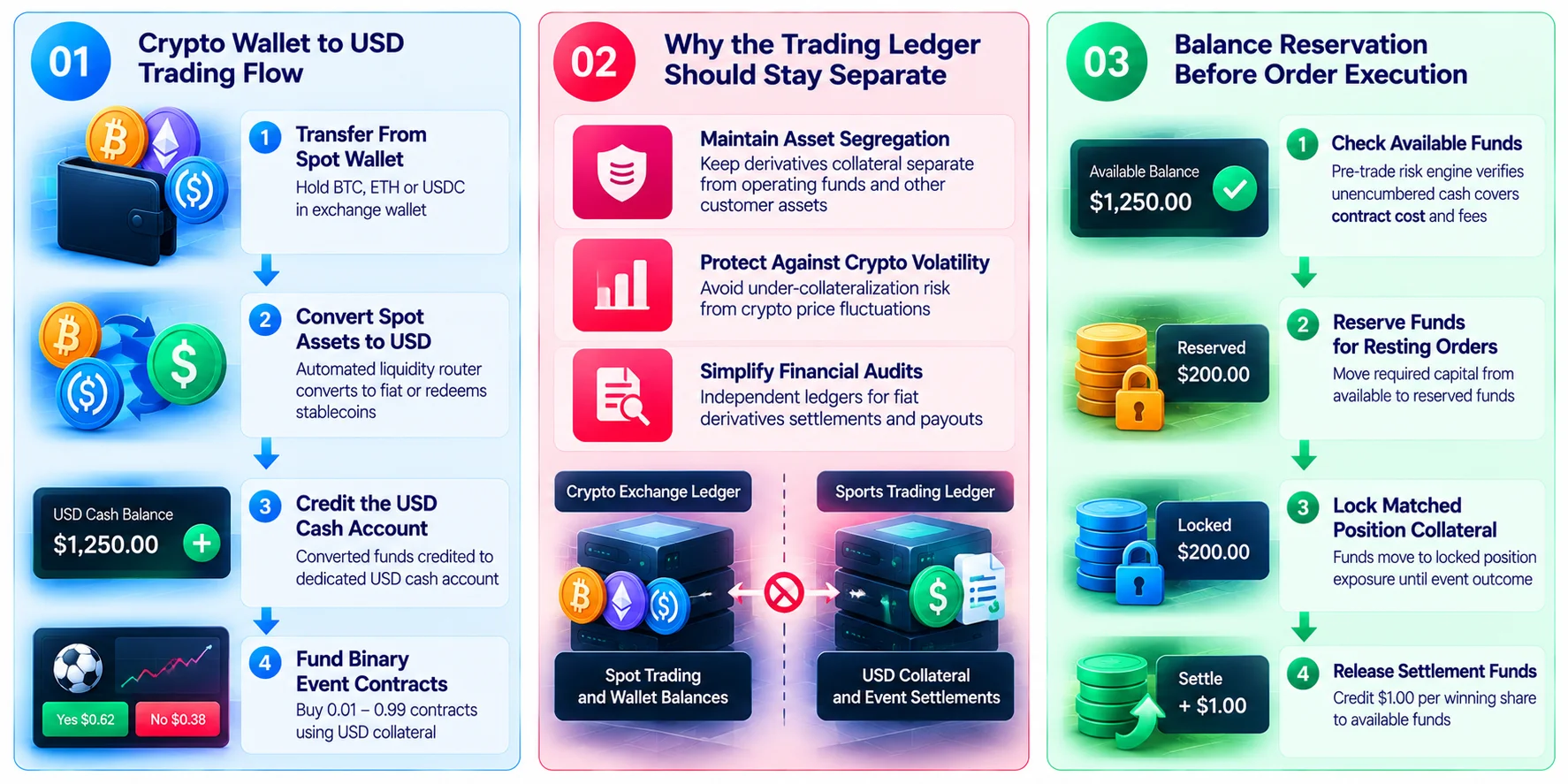
This structure keeps crypto funding separate from derivatives settlement while allowing users to move efficiently from exchange balances into sports markets
A. Crypto Wallet to USD Trading Flow
A crypto exchange connects wallet funding to sports trading by converting eligible digital assets into USD, crediting a dedicated cash balance, securing collateral and routing funded capital into binary event contracts.
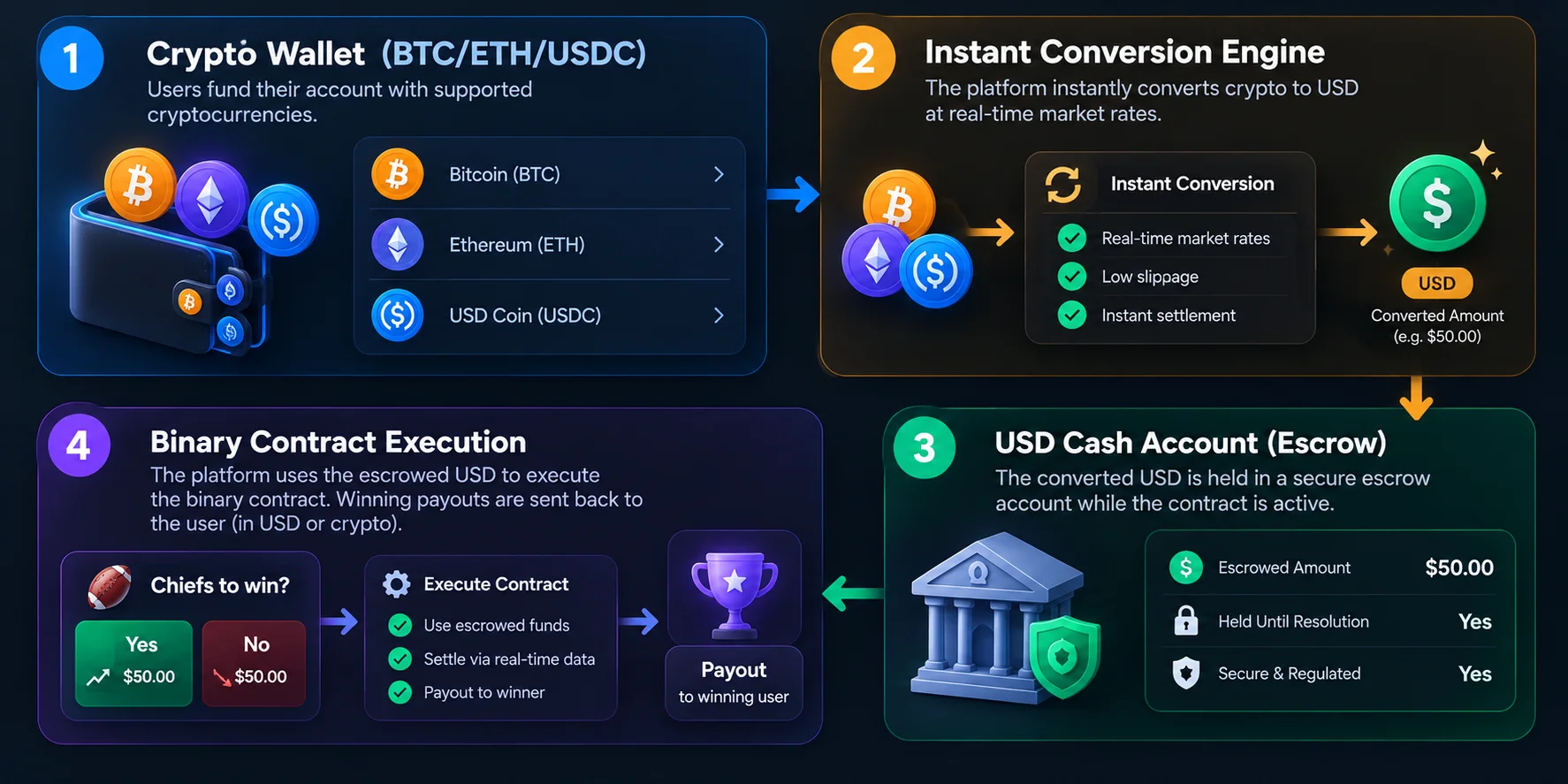
To maintain complete collateralization, user capital flows through a linear, four-stage liquidity pipeline:
- Transfer From Spot Wallet: The trader holds digital assets such as BTC, ETH or USDC in their core custodial exchange wallet, separate from the derivatives trading account.
- Convert Spot Assets to USD: When funding the event account, an automated liquidity router converts eligible assets to fiat or redeems stablecoins, locking in the required USD value at the applicable market rate.
- Credit the USD Cash Account: The converted funds are credited to the user’s dedicated USD Cash Account, ensuring the required cash collateral is available before an event-contract order is submitted.
- Fund Binary Event Contracts: The user purchases 0.01–0.99 binary contracts using USD collateral, removing direct exposure to crypto price movements from the funded event-contract position.
B. Why the Trading Ledger Should Stay Separate
Combining volatile spot crypto assets and regulated sports derivatives within a single database ledger creates severe legal and technical vulnerabilities:
- Maintain Asset Segregation: Under applicable CFTC requirements, derivatives collateral must be segregated from operating funds and other customer assets, helping protect user balances during insolvency events.
- Protect Against Crypto Volatility: Holding collateral in volatile crypto assets can create under-collateralization risk. A 15% price decline during a live game could reduce the value backing a fully funded binary position.
- Simplify Financial Audits: Independent ledgers let auditors review fiat derivatives settlements, collateral movements and payouts without mixing them with large volumes of spot trading or blockchain transaction records.
C. Balance Reservation Before Order Execution
The balance reservation process moves funds through available, reserved and locked states, ensuring each order has sufficient collateral while preventing double-spending and maintaining accurate settlement balances throughout live sports trading.
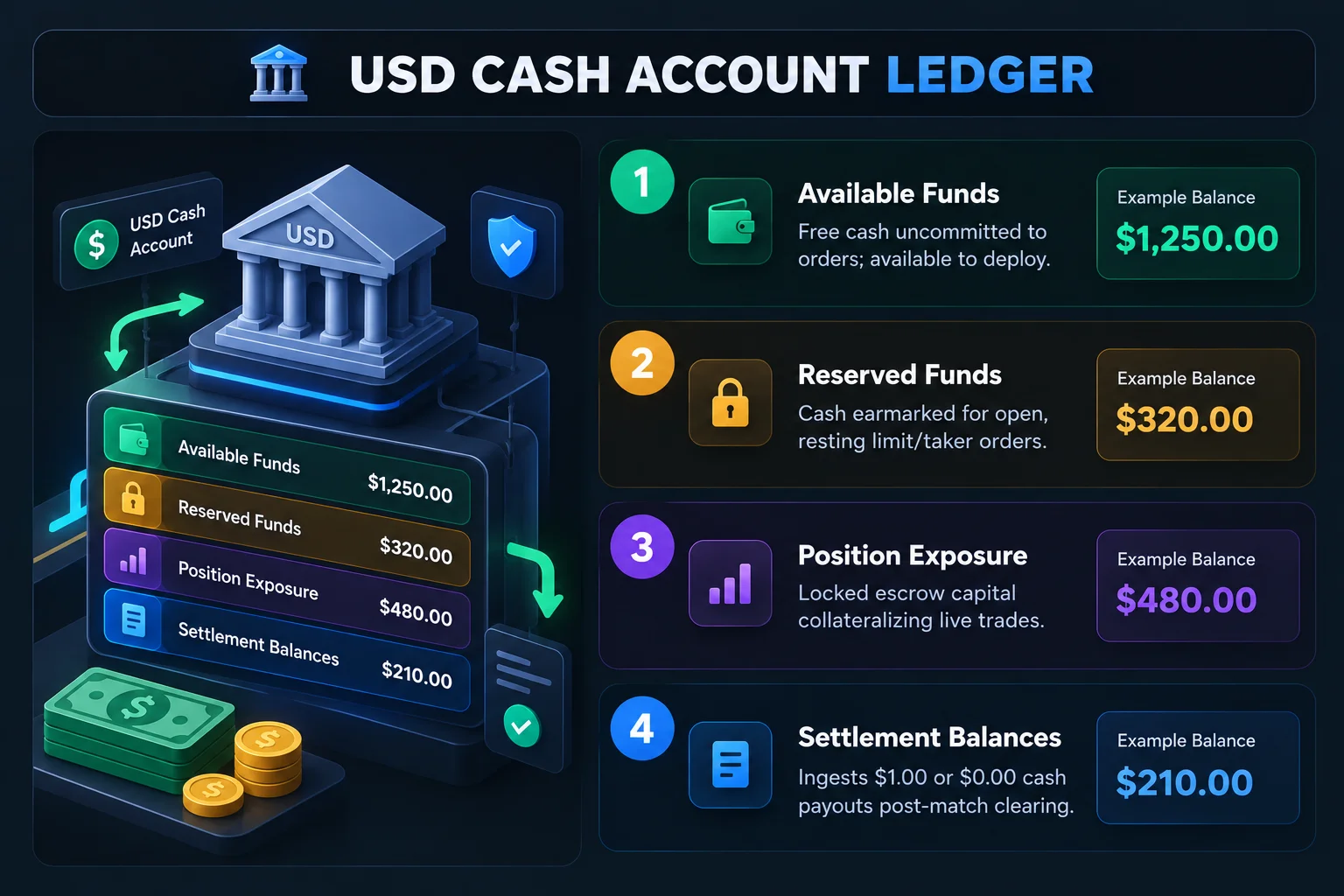
To prevent double-spending and ensure full collateralization during high-frequency live betting, the trading engine partitions the USD balance into isolated operational sub-states:
- Check Available Funds: The pre-trade risk engine uses in-memory caches to confirm unencumbered cash covers contract cost plus exchange fees before routing an order.
- Reserve Funds for Resting Orders: When a maker posts a limit order, required capital moves from available to reserved funds, preventing the same balance from being committed twice.
- Lock Matched Position Collateral: Once an order matches, reserved funds move into locked position exposure, holding collateral until the official event outcome is confirmed.
- Release Settlement Funds: After resolution, the clearing process credits $1.00 per winning share to available funds, completing the settlement cycle for subsequent trades.
What Regulatory Infrastructure Does a Sports Market Need?
A sports prediction markets like Crypto.com needs regulatory infrastructure that is built into the platform rather than added after the trading system is complete. Because users trade event contracts instead of placing conventional sportsbook wagers, the platform needs controls covering user eligibility, identity verification, jurisdiction, financial activity, market surveillance and auditability. The exact requirements depend on the jurisdiction, regulatory structure and product model.
| Regulatory Infrastructure | What the Platform Needs to Handle | Why It Matters |
| KYC & Identity Verification | Verify identities, collect required information and maintain records before enabling eligible users to trade. | Confirms user eligibility and supports applicable identification requirements. |
| AML & Transaction Monitoring | Monitor deposits, withdrawals, conversions and trading for suspicious patterns and maintain transaction records. | Helps detect and escalate potentially suspicious financial activity. |
| Geographic & Jurisdiction Controls | Determine user location, restrict access where required and apply jurisdiction-specific rules. | Different jurisdictions may treat sports contracts differently, making access controls essential. |
| Market Surveillance | Monitor trading patterns, unusual orders, rapid cancellations, price movements and other abnormal activity. | Helps identify potential manipulation, abuse and unusual market behavior. |
| Trading & Financial Audit Trails | Record orders, executions, cancellations, balances, positions, settlements and account actions. | Enables activity reconstruction, audits, operational reviews and regulatory reporting. |
Why Sports Contracts Are Not Just Another Betting Feature
Sports event contracts may look like sportsbook wagers, but they require distinct trading, settlement and compliance infrastructure. In the U.S., the CFTC oversees registered derivatives venues and has issued guidance covering event contracts, including sports-related contracts. Crypto.com offers Sports Event Trading through its CFTC-regulated derivatives entity.
For companies building a sports prediction market like Crypto.com, the platform needs infrastructure to list, trade, monitor and settle event contracts, rather than simply record bets.
- Contract Rules: Define outcomes, trading conditions, expiration and settlement rules for each sports contract.
- Order Management: Support market and limit orders, executions, cancellations, partial fills and position tracking through exchange-style infrastructure.
- Market Surveillance: Implement market monitoring and manipulation controls aligned with applicable CFTC requirements, including oversight of sports event contracts.
- Participant Controls: Apply KYC, eligibility and geographic restrictions based on the platform’s licensing and regulatory structure.
- Financial Records: Maintain auditable records of orders, trades, balances, positions and settlements.
- Automated Settlement: Use predefined resolution rules and authoritative sports results, including scenarios involving cancellations, ties and player participation.
The development takeaway: A Crypto.com-like sports prediction market requires trading and compliance architecture to work together. Early decisions around jurisdiction, licensing, contract design and regulatory controls directly shape the technology stack.
How Much Does It Cost to Build Sports Markets Like Crypto.com?
Crypto.com’s sports markets aren’t a standalone product, they sit inside an existing crypto exchange, running on a CFTC-regulated derivatives entity (Crypto.com Derivatives North America) that lists event contracts alongside crypto trading pairs. Building something like this means budgeting for two systems at once: the underlying crypto exchange infrastructure, and a derivatives-grade event contracts layer bolted on top of it. That combination pushes the cost meaningfully above a standalone sports exchange build.
Crypto.com-Style Sports Markets Development Cost by Scope
The cost of building sports prediction markets like Crypto.com varies by platform scope, trading complexity and regulatory requirements. An MVP needs core contracts and settlement, while enterprise platforms require advanced trading, liquidity, compliance, APIs and security infrastructure.
| Build Scope | Estimated Development Cost | Typical Scope |
| Sports Prediction Market MVP | 100K–180K | Core event contracts, selected sports, basic order book, wallet, settlement, admin panel and KYC integration |
| Advanced Sports Trading Platform | 180K–350K | Multi-sport markets, market/limit orders, advanced matching, real-time data, player markets, portfolio and liquidity controls |
| Crypto-Integrated Sports Market | 300K–600K+ | Crypto wallet integration, USD/fiat rails, financial ledger, advanced trading infrastructure, automated settlement and enhanced security |
| Enterprise/Regulated Exchange Infrastructure | 600K–1.5M+ | High-availability trading infrastructure, institutional APIs, advanced surveillance, extensive compliance controls, auditability and enterprise-grade security |
A full custom centralized crypto exchange with margin and derivatives capabilities can cost significantly more before adding sports-specific contract logic. The overall budget also depends on licensing scope, feature depth and the number of US states covered.
- A full custom centralized crypto exchange with margin and derivatives typically costs $300,000 to $1.5M+ before sports functionality.
- Multi-state US licensing adds $500,000 to $2M, depending on coverage and entity structure.
- A basic derivatives-focused exchange costs around $100,000 to $150,000 for a narrow feature set.
- A Crypto.com-style platform requires extra infrastructure to combine derivatives with a full crypto trading stack.
The scope table numbers cover software development only. DCM/FCM registration, the self-certification process for each new contract type, sports-data licensing, liquidity arrangements, and banking relationships for fiat on/off-ramps are priced and negotiated separately from the engineering budget.
Cost Affecting Factors of Sports Markets Development
Five factors decide where a build lands in that range: how deeply event contracts integrate with the existing exchange, contract review overhead, wallet complexity, security depth, and compliance scope.
- Core Exchange Integration: Integrating event contracts with the existing wallet, ledger and risk engine can cost 80,000–180,000 more than building a separate module.
- Contract Self-Certification: An internal CFTC contract review and self-certification workflow, including audit logs and suspension controls, can add 40,000–100,000 to compliance development.
- Unified Fiat and Crypto Wallets: Supporting both crypto balances and fiat settlement for event contracts can cost 60,000–150,000, roughly twice a crypto-only wallet integration.
- Security and Audits: Penetration testing, security audits and cold-storage architecture for regulated derivatives can cost 50,000–120,000, excluding recurring re-audit costs.
- Multi-Jurisdiction Compliance: Supporting event contracts across multiple U.S. jurisdictions can add $200,000+ in legal and compliance engineering, excluding licensing fees.
How Can IdeaUsher Build a Crypto.com-Like Sports Market?
Building a sports prediction markets like Crypto.com requires expertise across event-contract architecture, trading infrastructure, sports data, liquidity, financial ledgers and compliance controls.
IdeaUsher can bring these components together into a custom platform designed around the target sports, contract model, jurisdiction and liquidity strategy, backed by 11+ years of software expertise, 250+ specialized technologists and 4.9/5 Clutch rating.
A. Design the Sports Contract Architecture
Our developers design the sports contract architecture around your market model, creating flexible event contracts, lifecycle rules and settlement conditions that support different sports, outcomes and trading scenarios.
- Event & Contract Modeling: Architect binary outcome tokens (Yes/No), point-spread contracts, and parimutuel pools mapped to discrete sporting events.
- Deterministic Market Lifecycles: Configure state machines governing pre-game trading, live in-play pauses, event finalization, and dispute-resolution windows.
B. Build the Trading and Matching Infrastructure
Our developers build scalable trading infrastructure with low-latency matching, real-time position management and risk controls, enabling efficient order execution, liquidity management and reliable sports market operations.
- Deterministic Matching Engine: Build low-latency, in-memory continuous double auction (CDA) or AMM engines executing sub-millisecond bet matching and cancellations.
- Position & Risk Engines: Implement real-time margin checking, portfolio netting, and automated liquidation logic to guarantee book solvency.
C. Integrate Sports Data and Settlement Sources
Our developers connect reliable sports data feeds and resolution providers to deliver real-time event information, automate contract settlement, and ensure market outcomes are based on verified official results.
- Live Sports APIs & Feeds: Build fault-tolerant pipelines connecting Sportradar, Opta, and decentralized oracles for real-time scores and player props.
- Automated Resolution Pipelines: Settle contracts programmatically against verified official statistics to trigger instant, tamper-proof payouts.
D. Connect Wallet and Financial Infrastructure
Our developers connect crypto wallets, fiat payment rails and double-entry ledgers to create secure financial infrastructure, supporting deposits, withdrawals, balance management and seamless sports market settlement.
- Unified Custodial Rails: Integrate multi-chain crypto deposits (BTC, ETH, USDC) alongside PCI-DSS fiat on/off-ramps with instant conversion into a USD base ledger.
- Double-Entry Ledgers & Holds: Enforce atomic balance reservations during open order placement to eliminate double-spend and settlement gaps.
E. Prepare the Platform for Scale and Compliance
Our developers build the platform with scalable infrastructure and integrated compliance controls, combining automated KYC/AML, geo-fencing, audit trails and cloud architecture to support regulated sports prediction markets.
- Regulatory Guardrails: Integrate automated KYC/AML verification (Sumsub), GPS/IP geo-fencing (GeoComply), and immutable audit logs.
- Elastic Infrastructure & Full IP Ownership: Deploy auto-scaling Kubernetes backends engineered for peak tournament volume, delivered with 100% clean source code and zero vendor lock-in.
Planning to launch an institutional sports prediction market? Connect with Idea Usher’s software architects to design a platform tailored to your target sports, contract structures, jurisdictional requirements and liquidity model.
Conclusion
Sports prediction markets like Crypto.com require far more than a familiar sports interface. The underlying platform must coordinate event contracts, real-time data, order matching, liquidity, financial ledgers, settlement rules and regulatory controls within one reliable architecture. The right technology approach also depends on your target sports, contract model, jurisdiction and funding structure. A clear understanding of these requirements can help shape the right product scope, budget and launch strategy before development begins.
FAQs
A.1. Essential features of sports prediction markets like Crypto.com include event contracts, real-time sports data, order books, matching engines, liquidity management, wallets, position tracking, settlement automation, notifications, compliance controls and market surveillance.
A.2. sports prediction markets like Crypto.com development can cost between $100,000 and $1.5 million or more, depending on trading infrastructure, contract complexity, crypto integration, compliance and scalability requirements.
A.3. Liquidity is supported through market makers, two-sided quoting, trading APIs, order-book depth and execution controls that help maintain available prices, reduce slippage and support reliable trade execution.
A.4. Contracts are settled according to predefined rules using verified event outcomes, official statistics and sport-specific conditions covering cancellations, postponements, player inactivity, ties and statistical corrections when applicable.