


Key Takeaways
- Staffing agency credentialing software should bring provider records, verification, licenses, facility requirements and compliance checks into one place.
- The key part of healthcare staffing agency credentialing software is assignment readiness, meaning the system checks if a provider actually meets the state, facility, role and assignment-date requirements.
- It should manage PSV, credential tracking and compliance workflows while connecting with ATS, VMS and scheduling systems.
- The healthcare staffing agency credentialing software development typically costs around $80,000 to $600,000 or more. Development cost depends on platform tier, complex multi-facility integration can also exceeds $1 million.
- The build needs a flexible rules engine, secure architecture and human review so agencies can manage changing state and facility requirements as they grow.
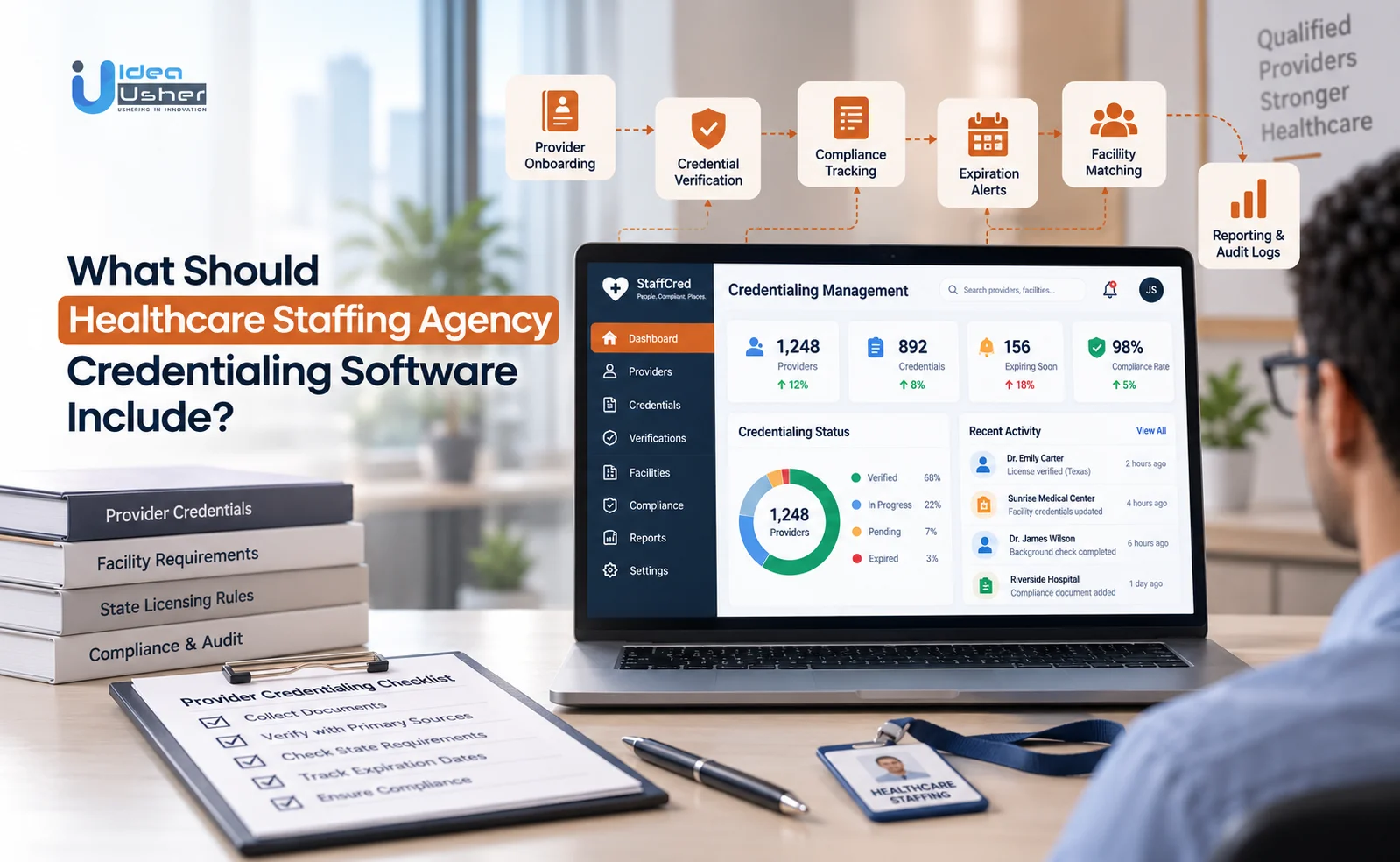
The Staffing agency credentialing software keeps provider information and credentials in one place. It also tracks licenses, certifications, expirations and compliance requirements and maintains complete provider profiles, flags missing or expiring credentials. The software presents a dashboard whether each healthcare professional is ready for placement, helping agencies manage credentialing in one place.
As staffing agencies manage bigger healthcare provider pools and facility-specific requirements, spreadsheets, email threads. The disconnected systems can create delays and compliance gaps. This helps teams keep credentials up to date, manage tasks more easily and reduce repetitive manual work.
In this blog, we will cover the healthcare staffing agency credentialing software features, workflows, integrations, compliance needs, security and development considerations for staffing agency credentialing software, along with the factors that affect its implementation, scalability and day-to-day use.
What Is Healthcare Staffing Agency Credentialing Software?
Healthcare staffing agency credentialing software is an operational compliance platform that manages clinician intake, Primary Source Verification (PSV), continuous monitoring and assignment-level clearance before deployment to clinical facilities.
Unlike document repositories or standard HR tools, it acts as an active compliance gate, validating state licenses, OIG/SAM sanctions, drug screens, specialty skills and immunization records to ensure clinicians meet legal, client-specific and Joint Commission staffing requirements before assignment.
A. How Staffing Credentialing Differs From Provider Credentialing
Staffing agencies handle credentialing differently because they manage temporary placements, multiple facilities, multiple states and recurring compliance checks at a much faster pace.
| Key Difference | Staffing Credentialing | Traditional Provider Credentialing |
| Placement Cycle | Supports per diem, travel and locum assignments that may last from one shift to 13 weeks, requiring faster credentialing. | Typically supports permanent or long-term medical staff through 2-to-3-year credentialing cycles. |
| Facility Requirements | Manages different requirements for each facility, including drug screens, EHR training, competency tests and background checks. | Usually follows standardized requirements established by one health system or payer. |
| Multi-State Licensing | Tracks providers licensed across multiple states, including compact eligibility and state-specific CDS requirements. | Primarily manages licenses and credentials relevant to the provider’s organization or network. |
| Recurring Compliance Checks | Continuously tracks TB screenings, BLS/ACLS certifications, fit tests and exclusion checks with overlapping expiration dates. | Generally relies on scheduled recredentialing and periodic verification cycles. |
B. Why Credentialing Must Connect With Placement Readiness
The central failure point of generic credentialing tools in a staffing environment is treating compliance as a binary attribute of the provider rather than a dynamic condition of the assignment.

A clinician can be “100% profile complete” in the agency’s database, holding an active state license, clear background check, and valid BLS certification, yet remain entirely ineligible for a specific assignment:
- A pediatric travel nurse may hold a valid state license and clean background check, but cannot be submitted for a Tier-1 children’s hospital placement because they lack an unexpired PALS (Pediatric Advanced Life Support) certification or proof of a quantitative respirator fit test conducted within the last 365 days.
- A locum tenens hospitalist may be clinically vetted by the agency, but lacks active hospital bylaw privileging or state-mandated malpractice tail coverage required by the host facility’s medical executive committee.
Staffing credentialing software must enforce Placement Readiness Logic, matching verified clinician credentials against facility requirements, unit rules and booking dates. Placing non-compliant clinicians can trigger billing penalties, contract termination, audit findings and legal liability.
C. Why Is Demand for Healthcare Credentialing Software Growing?
The global healthcare credentialing software and services market is projected to grow from $1.03 billion in 2026 to $2.10 billion by 2035, registering a CAGR of approximately 8.3% from 2026 to 2035, according to ResearchAndMarkets. This broader market includes credentialing services and does not represent payer enrollment software alone.

The U.S. Bureau of Labor Statistics projects registered nurse employment to grow 6% from 2025 to 2035, with about 180,800 openings each year, reinforcing the need for staffing workflows that can verify credentials and support timely clinician deployment at scale.
- Growing clinician demand: More healthcare roles and recurring workforce gaps increase the volume of providers staffing agencies must qualify and maintain.
- Higher credentialing complexity: Multi-state licensing, facility-specific requirements, certifications and recurring compliance checks make manual verification harder to scale.
- Faster assignment cycles: Travel, per diem and locum placements require agencies to determine whether a provider is ready for a specific assignment without lengthy manual reviews.
- Greater need for connected workflows: Staffing agencies increasingly need credentialing systems connected with ATS, VMS, scheduling and workforce platforms so verified provider data can move directly into deployment workflows.

What Should Credentialing Software Include?
Credentialing software should include provider profile management, primary source verification, license and certification tracking, document management, sanctions screening, expiration alerts, compliance workflows, audit trails and facility-specific requirements.

These capabilities help staffing agencies verify clinician credentials, monitor ongoing compliance and determine whether providers are ready for specific assignments. A high-throughput credentialing platform requires nine core capabilities:
1. Centralized Provider Credential Profiles
The platform must establish a single source of truth for every clinician, consolidating disparate professional records into a canonical, multi-dimensional profile:
- Licenses & Certifications: State medical/nursing licenses, compact privileges, and clinical life support certifications (BLS, ACLS, PALS).
- Education & Work History: Verified degrees, post-graduate training, chronological employment history, and documented work-gap explanations.
- Health & Immunizations: Annual TB screens, MMR/Varicella titers, Hepatitis B declination/vaccination, physical exam clearances, and mask fit-test records.
- Background & Legal Records: 10-panel drug screens, state/federal criminal checks, OIG-LEIE/SAM exclusion logs, and identity verifications (I-9, W-4).
- Facility-Specific Criteria: Unit-level clinical competencies, facility orientation sign-offs, and specialized EHR competency modules.
2. Primary Source Verification for Healthcare Credentials
The software must automate the retrieval of authoritative proof directly from primary sources, storing rich audit metadata to satisfy NCQA and Joint Commission standards:
- Scope of Coverage: Programmatic checks across state licensing boards, specialty certifying bodies (ABMS/AOA), prescriptive registries (DEA, state CDS), and the National Practitioner Data Bank (NPDB).
- Audit Metadata Logging: Every verification capture must permanently log:
- The exact authoritative verification source (URL/API endpoint).
- Precise UTC verification date and execution timestamp.
- Direct verification result (Active, Encumbered, Lapsed, Probation).
- Cryptographically hashed supporting evidence (timestamped PDF/HTML snapshot).
- Acting reviewer identity (system service token or credentialing analyst ID).
3. Multi-State License and Compliance Tracking
Staffing credentialing software should centralize state licenses, compact privileges and state-specific compliance requirements so agencies can quickly determine whether a clinician is authorized for an assignment in a particular jurisdiction.
- Multi-State License Tracking: Manage standalone licenses across states alongside IMLC, NLC and PSYPACT compact privileges.
- State-Specific Requirements: Track CDS requirements, practice restrictions and other jurisdiction-specific credentials linked to each provider.
- Assignment Eligibility: Compare a clinician’s verified credentials with target-state requirements before submitting or placing them for an assignment.
- Centralized Provider View: Maintain all licensing and compliance records in one profile, reducing duplicate data entry when clinicians expand into new states.
4. Facility-Specific Credentialing Requirements
A clinician qualified for one facility may not meet another facility’s requirements. Credentialing software should compare provider credentials with client-specific rules, identify missing requirements and verify assignment readiness before submission.
For example, one facility may accept a 5-year background check and standard drug screen, while another requires an annual 12-panel drug test, pediatric fit test and specialized EHR training. The platform maps these requirements to each assignment, helping prevent non-compliant submissions.
5. Automated Credential Expiration Monitoring
Point-in-time checks fail to catch mid-assignment expirations. The platform continuously monitors expiration dates across all active credentials, executing automated compliance workflows:
- Dynamic Alert Cadences: Triggers rolling notifications and renewal reminders to clinicians and coordinators at 90, 60, 30, and 15 days prior to lapse.
- Grace-Period Tracking: Enforces board-specific or facility-mandated grace periods without halting active scheduling prematurely.
- Automated Status Drops: If a critical item (e.g., medical license or ACLS) expires without renewal proof, the engine automatically flips the provider’s placement status to Non-Compliant, pulling them from booking eligibility.
- Continuous Monitoring: Executes scheduled background sweeps against OIG-LEIE, SAM.gov, and state board registries to detect mid-cycle sanctions.
6. Provider Self-Service Document Collection
A mobile-responsive provider portal simplifies document collection and speeds up clinician intake. Providers can upload certifications, submit immunization records, complete attestations and view outstanding requirements. Automated reminders flag missing or expiring documents, reducing manual recruiter follow-up.
7. Credential Deficiency and Follow-Up Workflows
When a credential is missing, expired, rejected or incomplete, the platform creates an automated deficiency task. It identifies the issue, sends a targeted resolution request with an upload link and routes the task to the appropriate credentialing specialist.
8. Role-Based Credential Approval Workflows
Role-based approval workflows maintain separation of duties by giving each team member access based on their responsibilities. This helps protect credentialing data, control approvals and reduce unauthorized changes.
- Recruiters: Read-only visibility into placement-readiness flags; restricted from clearing clinical exceptions.
- Credentialing Specialists: Granted operational access to run primary source verifications, review uploaded evidence, and resolve document deficiencies.
- Compliance Managers: Authorized to sign off on completed files, grant exception waivers, and clear clinicians for facility submission.
- System Administrators: Maintain security configurations, audit logs, and facility rule sets, preventing unauthorized policy overrides.
How Does Credentialing Software Determine Assignment Readiness?
Credentialing software determines Assignment Readiness by comparing a clinician’s verified credentials against the state, facility, role, unit and assignment-date requirements. It evaluates licenses, certifications, screenings, competencies and other mandatory requirements, then identifies gaps or expirations before confirming whether the clinician can be safely and compliantly scheduled.
A. Matching Provider Credentials With Assignment Requirements
The platform should match provider credentials with assignment requirements across multiple levels, from identity and state authorization to facility and role-specific requirements.
This layered rules engine determines whether a clinician is eligible for a specific placement. It evaluates licensing, credentials, location, and state-specific requirements for each placement.
| Matching Layer | What the Software Evaluates | Example Requirements |
| Provider Layer | Provider identity, NPI status, background checks and exclusion records | Active NPI, clean background check, OIG-LEIE, SAM.gov and state Medicaid checks |
| State Layer | State licensing and jurisdiction-specific authorization | Active license, IMLC/NLC privilege, CDS registration and practice restrictions |
| Facility Layer | Client-specific credentialing and contract requirements | Recent drug screen, facility orientation and VMS checklist |
| Role Layer | Professional qualifications and role-specific requirements | Required degree, specialty and NP/PA collaboration requirements |
| Assignment Layer | Clinical setting, patient population and placement type | Adult Med-Surg RN vs. Neonatal ICU RN |
| Requirements Layer | Assignment-specific credentials and time-sensitive documents | N95 fit test, PALS, NRP and EHR competency training |
B. Identifying Missing Requirements Before Scheduling
The platform should identify missing, deficient or expiring credentials before a clinician is scheduled. It compares the provider’s verified profile with facility and assignment requirements, then creates the required follow-up actions.
- Pre-Flight Gap Analysis: Compare the clinician’s credentials with the facility checklist and show satisfied, missing and deficient requirements.
- Automated Remediation: Create provider tasks for missing items such as HIPAA attestations or PPD tests, with upload links and due dates.
- Assignment-Period Expiration Checks: Check credential validity across the full assignment period and flag credentials that expire before the contract ends.
C. Creating a Work-Ready Provider Status
To align sales, recruiting, credentialing and scheduling teams, the software can use standardized, state-driven compliance statuses that show exactly where each clinician stands in the deployment process.
| Status | Meaning |
| Verified | Foundational credentials such as identity, education, board certification and state licenses have been verified through primary sources, but assignment-specific requirements are not yet evaluated. |
| Compliant | The provider meets organizational, state and accreditation requirements but is not currently linked to an active facility assignment. |
| Pending | The provider is progressing through onboarding, with documents awaiting primary source verification, drug screening or background check clearance. |
| Deficient | One or more mandatory requirements are missing, rejected, incomplete or failed, such as an illegible lab report, unexplained work gap or encumbered license. |
| Expiring | A compliant provider has one or more credentials approaching expiration, triggering advance alerts and renewal actions before deployment eligibility is affected. |
| Assignment Ready | The provider meets all facility, state, role and unit-specific requirements for a designated assignment and is cleared for live shift scheduling. |
D. Preventing Non-Compliant Provider Deployment
Connecting credentialing status with scheduling, VMS and ATS platforms creates a compliance control that prevents providers from being assigned when required credentials are missing, expired or restricted.
- Hard Scheduling Stops: API-based eligibility checks block shift confirmation when a provider is not Assignment Ready for the required location and dates.
- Mid-Assignment Revocation: If a license, certification or other required credential becomes invalid during an assignment, the platform changes the provider’s status to Deficient and restricts future bookings.
- Automated Alerts: Status changes notify relevant clinical, staffing and facility teams and remove the provider from eligible booking queues until the issue is resolved.
Which Integrations Should Credentialing Software Support?
Credentialing software should support integrations with ATS and staffing CRM platforms, scheduling and VMS systems, payroll and billing platforms, provider databases, licensing boards, verification services and compliance systems.
These connections synchronize credential data, automate eligibility checks and connect recruitment, compliance, workforce deployment and revenue workflows.
| Integration | What It Connects | Key Capabilities | Operational Benefit |
| ATS & Staffing CRM | Candidate and provider data | Automated onboarding, bidirectional pipeline visibility, record reuse | Moves clinicians into credentialing faster while keeping compliance readiness visible to recruiters. |
| Scheduling & VMS | Provider availability, assignments and facilities | Assignment-readiness checks, shift-lock APIs, expiration monitoring, float-pool validation | Prevents bookings when credentials are missing, expired or unsuitable. |
| Payroll & Billing | Timecards, invoices, pay rates and financial records | Compliance-gated billing, stipend controls, credentialing evidence | Connects compliance status with payroll enrollment, billing and revenue workflows. |
| APIs & Webhooks | Internal services and partner platforms | REST APIs, webhooks, mTLS, OAuth 2.0/OIDC, idempotency, retries | Keeps provider data synchronized and responds to credential or assignment changes in real time. |
| State Boards & Compacts | State licenses and compact privileges | License status, expiration and disciplinary checks, IMLC/NLC data | Supports multi-state verification and jurisdiction-specific eligibility checks. |
| Exclusion & Compliance Registries | Federal and state sanction databases | Recurring checks against OIG-LEIE, SAM.gov and Medicaid exclusion lists | Flags exclusions and sanctions before provider deployment. |
| Screening & Labs | Drug testing, background checks and occupational health data | Drug screens, background checks, immunization status | Reduces manual collection and keeps compliance records current. |
| Identity & Prescribing Registries | Provider identity, NPI and prescribing data | DEA and NPPES verification, NPI details, taxonomies | Maintains accurate provider identities and prescribing records. |
What Compliance Features Should Staffing Credentialing Software Include?
Healthcare staffing credentialing software should include Primary Source Verification, sanctions screening, license and credential monitoring, automated expiration alerts, deficiency management, audit trails and assignment-level compliance checks.
These provider features help agencies identify non-compliant providers, maintain current credential records and prevent clinicians from being assigned when required compliance conditions are not met.
A. Sanctions and Exclusion Screening
Staffing credentialing software should automate sanctions and exclusion screening to identify providers who may be excluded from federal or state healthcare programs before and during assignments.
- Comprehensive Registry Coverage: Screen against OIG-LEIE, SAM.gov and state Medicaid exclusion registries to identify relevant exclusions and sanctions.
- Recurring Screening: Run automated monthly checks across the active provider roster to detect new exclusion actions that occur after onboarding.
- Match Detection and Resolution: Use name, alias and NPI matching to flag potential registry matches and route ambiguous results to compliance staff for review before scheduling.
B. Background Check and Compliance Record Tracking
Credentialing software should manage background checks, drug screenings and sensitive compliance records while limiting unnecessary access to protected personal information.
- Status-First Record Architecture: Store actionable screening statuses such as Cleared, Adverse Action Pending, Pass and Review Required instead of placing raw background reports and sensitive lab details in standard operational records.
- Third-Party Screening Integrations: Connect with consumer reporting agencies (CRAs) and occupational screening laboratories through secure APIs to receive result statuses, completion timestamps and report reference IDs.
- Sensitive Data Minimization: Restrict access to raw screening reports through role-based permissions and time-limited access controls, helping protect sensitive information and support applicable FCRA and privacy requirements.
C. Complete Credential Audit Trails
When accreditation bodies or client health systems conduct compliance inspections, the software should provide an immutable, chronological record of credentialing decisions, verification activities and user actions.
Audit logs should capture credential changes, verification activity, source evidence, reviewer actions, approvals and timestamps for complete traceability. These controls help maintain reliable records for NCQA evaluations, compliance reviews and client audits.
- Data Immutability (WORM): Store operational audit logs in Write-Once-Read-Many (WORM) storage so historical timestamps, verification sources and compliance sign-offs cannot be altered or backdated.
- Source Evidence Hashing: Generate SHA-256 hashes for primary source verification snapshots and uploaded documents at ingestion, creating tamper-evident evidence that records remained unchanged after verification.
D. Compliance Reporting and Audit-Ready Records
Credentialing software should generate audit-ready compliance records that allow teams to quickly produce provider evidence, monitor facility requirements and demonstrate credential status at specific points in time.
- One-Click Audit Dossiers: Generate downloadable audit packets containing verification history, primary source evidence, background clearances, immunization records and relevant facility agreements for selected providers.
- Facility-Specific Compliance Dashboards: Provide real-time compliance matrices showing assignment readiness, outstanding unit requirements and upcoming credential expirations across facility-specific provider cohorts.
- Historical Compliance Snapshots: Preserve point-in-time credential status so teams can demonstrate whether a provider met required compliance and authorization conditions on the date of a past assignment.
How To Develop Healthcare Staffing Agency Credentialing Software
The healthcare staffing agency credentialing software development combining a structured provider data model, automated credential verification, configurable compliance rules, facility-specific requirements, workforce integrations and assignment-readiness logic.
The platform should connect these components to manage provider credentials from onboarding through verification, compliance review and deployment.
1. Map Credentialing and Placement Workflows
Start by documenting the complete provider journey from onboarding to assignment deployment. This identifies what the software should automate and where credentialing teams face manual work. The workflow should cover:
- Provider onboarding: Capture identity, NPI, specialties, experience and professional information.
- Primary source verification: Define how licenses, certifications and other credentials are verified against authoritative sources.
- Assignment approval: Establish the conditions that must be satisfied before a provider can be cleared for deployment.
The workflow map should also identify manual handoffs, duplicate data entry, document deficiencies and operational bottlenecks.
A credentialing-to-placement workflow map showing stages, decision points, responsible roles, required data and automation opportunities.
2. Design the Provider and Credential Data Model
The platform needs a structured data model connecting providers with their credentials, facilities, states, assignments and compliance requirements. This is essential when providers hold multiple licenses or work across different facilities and jurisdictions. Core entities should include:
- Provider profiles: Identity, NPI, provider type, specialty and professional details.
- Licenses and certifications: License numbers, issuing states, credential types, issue dates, expiration dates and status.
- Assignments and requirements: Facility, role, location, assignment dates and credentials required for each placement.
The model should also link credentials to the assignments they support, allowing the system to determine whether a credential satisfies a specific placement requirement.
A normalized data model connecting providers, credentials, facilities, states, assignments and compliance status.
3. Build the Verification and Compliance Engine
The verification and compliance engine determines whether credentials are valid, verified, current and applicable to the intended assignment. The engine should include:
- Primary source verification: Connect with authoritative sources where integrations are available and record verification results and evidence.
- State and facility rules: Apply jurisdiction-specific licensing requirements and client-specific credentialing requirements.
- Credential-to-assignment matching: Compare verified credentials with requirements attached to each assignment.
Credentialing staff should be able to review evidence, resolve exceptions and approve verification results. Where external sources lack APIs, distinguish internal workflow automation from external verification activities.
4. Automate Credential Monitoring and Workflows
Once the compliance engine is established, automation can reduce the ongoing work required to keep providers assignment-ready. The automation layer should support:
- Expiration and renewal alerts: Notify providers and credentialing teams before licenses or certifications expire.
- Deficiency notifications: Alert providers or reviewers when required information or documents are missing.
- Automated status and task updates: Create renewal, verification or correction tasks and update compliance status when defined conditions are met.
For example, when a credential enters an upcoming-expiration window, the system can create a renewal task, notify the provider and update the credentialing dashboard.
An automated credential monitoring and task-management layer that continuously tracks compliance and reduces manual follow-up.
5. Integrate ATS, Scheduling and Workforce Systems
Credentialing software becomes operationally useful when it shares compliance data with recruitment, scheduling, workforce management and financial systems. The integration layer should support:
- ATS integration: Synchronize candidate and provider information from recruitment workflows.
- Scheduling and workforce integration: Check provider readiness before confirming assignments and keep status and assignment data synchronized.
- REST APIs and webhooks: Support bidirectional data exchange and real-time notifications when credentials or assignment readiness change.
For example, when a provider becomes Assignment Ready (Verified, Compliant, Pending, Deficient, Expiring and Assignment Ready), the platform can notify scheduling systems. If a required license expires, the status change can trigger an eligibility update and prevent future bookings.
An integrated credentialing ecosystem connecting compliance with recruitment, scheduling and workforce operations.
6. Test, Validate and Deploy
Before production deployment, test the platform against realistic multi-provider, multi-state and facility-specific scenarios to confirm that rules, integrations and workflows produce the expected eligibility decisions. Testing should cover:
- Credential and licensing scenarios: Successful verification, failed checks, expirations, multiple state licenses and compact privileges.
- Assignment scenarios: Different facilities, roles, units, locations and assignment periods with varying requirements.
- Integration and security testing: API failures, delayed responses, duplicate events and role-based access controls.
Automated tests should validate rules and workflow transitions, while integration and user acceptance testing should validate real data exchanges and operational processes.
What Tech Stack Can Power Credentialing Software?
A healthcare staffing credentialing platform needs more than a standard web stack. It should combine verification APIs, configurable rules engines, secure document processing, integration infrastructure, identity controls and audit systems to automate compliance and assignment-readiness decisions.
| Technology Layer | Recommended Technologies | What It Powers in Software |
| Application & Workflow Layer | React/Next.js, TypeScript, Node.js, Python, Java | Provider portals, credentialing workflows, compliance rules, approval processes and assignment-readiness logic |
| Primary Source Verification Layer | REST APIs, secure API connectors, verification services, scheduled jobs | License and certification verification, source retrieval, verification status updates, evidence capture and recurring checks |
| Rules & Decision Engine | Drools, Open Policy Agent or custom rules engine | Multi-state requirements, facility-specific rules, credential-to-assignment matching, compliance decisions and deployment eligibility |
| Document & Evidence Management | S3-compatible object storage, OCR, document processing services, encrypted storage | Credential uploads, supporting evidence, document classification, expiration extraction and verification records |
| Integration & Event Layer | API Gateway, REST APIs, webhooks, Kafka or RabbitMQ | ATS, scheduling, workforce management, payroll, billing and real-time credential-status synchronization |
| Identity, Security & Audit Layer | OAuth 2.0, OpenID Connect, RBAC, MFA, KMS, immutable audit logs | User authentication, granular permissions, encryption, credential access controls and traceable compliance activity |
| Monitoring & Compliance Infrastructure | Cloud monitoring, centralized logs, SIEM, alerting, backup and disaster recovery | System health, failed verification detection, security monitoring, audit support and operational resilience |
Note: The final technology choices should depend on integration requirements, credentialing volume, compliance complexity and scalability needs. A modular architecture also makes it easier to introduce new verification sources, facility rules and staffing workflows as the platform grows.
How Much Does Healthcare Staffing Credentialing Software Cost?
Healthcare staffing credentialing software typically costs $80,000 and $600,000+ for custom development, depending on workflow complexity, integrations, automation and provider volume. Off-the-shelf platforms may use subscription pricing, while enterprise solutions cost more for multi-state compliance, advanced integrations and custom workflows.
A. What Does Each Development Phase Cost?
Each development phase contributes differently to the overall budget, from workflow discovery and core engineering to verification, integrations, security testing and production deployment.
| Development Phase | Estimated Cost | What It Covers |
| Discovery & Workflow Mapping | $10,000–$25,000 | Staffing workflows, credentialing requirements, user roles, facility rules and technical requirements |
| UX/UI & Product Architecture | $15,000–$35,000 | Provider portal, credentialing dashboards, workflow design and system architecture |
| Core Credentialing Platform | $45,000–$100,000 | Provider profiles, document management, credential tracking, dashboards, workflows and RBAC |
| Verification & Compliance Engine | $30,000–$75,000 | PSV workflows, state/facility rules, sanctions screening, compliance logic and assignment readiness |
| Third-Party Integrations | $25,000–$80,000 | ATS, VMS, scheduling, screening, licensing, verification, payroll and workforce integrations |
| Security, QA & Compliance Validation | $20,000–$50,000 | Security controls, audit trails, testing, API validation, access controls and compliance testing |
| Deployment & Stabilization | $10,000–$25,000 | Cloud deployment, monitoring, production configuration, data migration and post-launch stabilization |
Note: These phases can overlap, so the figures should not simply be added together to produce a guaranteed project quote. Integration scope and compliance requirements can move a project substantially toward the upper end. Current U.S. benchmarks show that integration and compliance are among the largest cost drivers in healthcare software.
B. How Much Does Credentialing Software Cost by Tier?
A tiered model is more useful for prospective buyers because the required capabilities differ significantly between a focused MVP and an enterprise staffing platform.
| Platform Tier | Estimated Cost | Timeline | Typical Scope |
| Credentialing MVP | $80,000 – $150,000 | 4 – 7 months | Provider profiles, document collection, credential tracking, basic PSV, expiration alerts, RBAC and core dashboards. |
| Multi-State Staffing Platform | $150,000 – $300,000 | 7 – 12 months | Multi-state licensing, facility rules, automated deficiencies, recredentialing, provider portals, ATS/scheduling integrations and audit trails. |
| Enterprise Credentialing Platform | $300,000 – $600,000+ | 10 – 18+ months | Advanced PSV, extensive integrations, configurable rules, assignment-readiness automation, continuous monitoring, advanced reporting and enterprise security. |
| Multi-Facility Enterprise Ecosystem | $600,000 – $1M+ | 15–24+ months | High provider volumes, complex facility networks, extensive integrations, compliance automation, data migration, high availability and enterprise infrastructure. |
Note: Several factors can significantly change development costs, particularly PSV integrations, state-specific rules, facility requirements, automation, security controls, external systems and expected provider volume.
C. Factors Influence Credentialing Software Development Cost
Development costs vary based on the platform’s verification scope, integrations, compliance complexity, automation and scale, with each factor adding distinct engineering and testing requirements.
- Primary Source Verification: Supporting multiple licensing boards, certification bodies and verification services can add $15,000–$50,000+ through API integration, evidence handling and exception workflows.
- ATS & Workforce Integrations: Connecting ATS, VMS, scheduling, payroll and billing systems can add $10,000–$40,000+ per integration, depending on API complexity and synchronization requirements.
- Multi-State Compliance Rules: Supporting state-specific licensing, compact privileges and facility requirements can add $20,000–$60,000+ because configurable compliance and decision engines require extensive rule modeling.
- Automation & Assignment Readiness: Expiration monitoring, deficiency workflows and assignment-level eligibility checks can add $15,000–$45,000+ depending on workflow depth, triggers and scheduling integration requirements.
- Security, Audit & Scalability: Enterprise RBAC, MFA, encryption, immutable audit trails, monitoring and high availability can add $25,000–$75,000+ to engineering, testing and infrastructure costs.
What Is the Future of Healthcare Staffing Credentialing?
Healthcare staffing credentialing is shifting from manual checklists to automated systems. With turnover rates at nearly 19.5% overall and 17.6% for acute bedside RNs costing hospitals over $60,000 per nurse departure, agencies and health systems are under pressure to reduce time-to-fill metrics.
According to Staffing Industry Analysts, more than 50% of travel healthcare staffing agencies have integrated AI-powered platforms to streamline recruitment, credentialing, and scheduling.
Forward-looking platforms are moving beyond retrospective administrative tracking, treating compliance data as an active driver of workforce optimization.
A. AI-Assisted Credential Document Processing
Manual credential document transcription is giving way to AI-assisted document processing. Next-generation staffing platforms use multimodal LLMs and Intelligent Document Processing (IDP) to ingest, classify and extract information from clinical documents within seconds.
Vision-enabled models can process immunization cards, continuing education certificates and clinical skills checklists, including documents with non-standard formats or handwritten information. Extracted data can then be mapped to standardized provider profiles, reducing repetitive data entry and helping credentialing teams move documents from intake to review faster.
B. Predictive Credential Expiration Management
Static calendar alerts are being replaced by predictive compliance engines. Rather than triggering arbitrary 30-day renewal warnings, systems now model real-world processing times across external regulatory bodies:
- Board-Specific Processing Forecasting: Algorithms evaluate historical processing turnaround times across all 50 state medical and nursing boards, predicting seasonal backlogs and licensing delays.
- Risk-Adjusted Renewal Lead Times: If a state nursing board historically slows its processing timeline from 20 days to 65 days during summer graduation surges, the platform dynamically triggers renewal workflows months earlier for clinicians holding licenses in that jurisdiction.
- Placement-Window Forecasting: The engine calculates whether a clinician’s expiring credential will lapse mid-contract, preventing candidate submissions that would otherwise risk mid-assignment cancellations.
C. Automated Compliance Decisioning
Human-in-the-loop workflows will always govern adverse clinical actions and high-risk exceptions, but standard compliance clearing is shifting to zero-touch decisioning. When a clinician uploads required renewal documents, automated workflows instantly:
- Conduct real-time Primary Source Verification (PSV) via direct state board and registry APIs.
- Cross-reference the verified data payload against client-specific Master Service Agreement (MSA) rules.
- Automatically clear standard compliance items and update operational status flags without requiring manual coordinator review.
By automating low-risk verifications, compliance specialists can shift focus entirely to resolving adverse National Practitioner Data Bank (NPDB) reports, license encumbrances, or complex multi-state scope-of-practice restrictions.
D. Credentialing as a Real-Time Staffing Signal
A major shift in healthcare workforce technology is the convergence of credentialing and scheduling. Credentialing is moving beyond a post-hire compliance task to become a real-time staffing signal that influences workforce allocation and assignment decisions.
Modern VMS, ATS and shift-booking systems can consume live Placement Readiness APIs to evaluate clinician eligibility based on the facility, clinical unit, state jurisdiction and shift dates. Connecting compliance data directly to scheduling helps agencies identify assignment-ready clinicians, prevent non-compliant placements and deploy available clinical capacity faster.
Build Healthcare Staffing Agency Credentialing Software With IdeaUsher
IdeaUsher operates as an enterprise product engineering partner, backed by 11+ years of software expertise, 250+ specialized technologists and a 4.9/5 Clutch rating across 1,000+ delivered builds.
We engineer custom, cloud-native credentialing platforms that help healthcare staffing agencies replace manual back-office overhead with automated, assignment-ready candidate pipelines.
A. Turn Staffing Friction Into Streamlined Placement Workflows
We build purpose-driven software tailored to the operational realities of travel nursing, per-diem staffing, and locum tenens placement:
- Custom Credentialing Workflows: Configure workflows for multi-specialty intake, onboarding checklists and agency-specific approval hierarchies.
- Self-Service Provider Portals: Let clinicians upload licenses, immunization records, skills checklists and certifications through mobile and web portals.
- Automated Primary Source Verification (PSV): Connect with state licensing boards, NPDB, OIG/SAM exclusion lists and DEA registries through APIs and supported automation methods.
- Multi-State & Facility Compliance: Evaluate provider records against state licensing rules, NLC/IMLC requirements and facility-specific credentialing criteria.
B. Accelerate Time-to-Placement With Connected Automation
We embed deep system connectivity and real-time validation directly into your recruitment engine:
- Assignment-Readiness Logic: Match provider profiles against open job orders to identify clinicians who meet the required state, facility, role and credentialing criteria.
- ATS & Scheduling Integrations: Connect with staffing ATS, VMS and scheduling platforms such as Bullhorn and Jobvite through secure REST APIs.
- Continuous Expiration Monitoring: Trigger automated alerts and renewal reminders for licenses, TB tests, BLS/ACLS certifications and background checks to reduce placement disruptions.
- Audit-Ready Credential Records: Maintain timestamped digital credential packets and complete history logs to support faster compliance reviews and client audits.
- Enterprise Security & Code Ownership: Support AES-256 encryption, role-based access controls and secure infrastructure, with full source-code ownership after staffing agency credentialing software development to reduce vendor lock-in.
Struggling with placement delays or complex hospital compliance packages? Connect with Idea Usher’s healthcare software architects to review your agency’s current onboarding workflows, evaluate ATS integration endpoints, and define a high-ROI MVP roadmap tailored to your staffing model.
Conclusion
A well-designed credentialing platform should give healthcare staffing agencies more than a complete provider record. It should connect primary source verification, multi-state compliance, facility requirements, expiration monitoring and assignment readiness within one workflow. The right healthcare staffing agency credentialing software can reduce manual coordination, improve compliance visibility and help teams identify providers who are genuinely ready for placement. A scalable architecture, secure integrations and configurable workflows also allow the platform to adapt as staffing operations, facility requirements and credentialing regulations evolve.
FAQs
A.1. Essential features of staffing agency credentialing software include provider profiles, Primary Source Verification, license tracking, facility-specific requirements, expiration monitoring, deficiency workflows, audit trails, role-based access and assignment-readiness checks for staffing operations.
A.2. Essential integrations of staffing agency credentialing software can include ATS, VMS, scheduling, workforce management, payroll, billing, licensing boards, verification services, background screening systems and compliance databases to synchronize credentialing and placement workflows.
A.3. Healthcare staffing agency credentialing software can cost approximately $80,000 to $600,000+ in the U.S., depending on features, integrations, compliance complexity, automation, security requirements and platform scale.
A.4. Yes, healthcare staffing agency credentialing software can compare verified provider credentials against state, facility, role and assignment requirements, then flag deficiencies or restrict scheduling when mandatory requirements remain incomplete or expired.


