

Key Takeaways
- The provider enrollment software helps healthcare organizations enroll providers with insurance payers so they can automate their bill for their services.
- It automates repetitive tasks like collecting provider data, filling payer forms, checking documents and tracking application status.
- Important integrations of provider enrollment software are CAQH, PECOS, NPPES and billing systems that help to reduce duplicate work and avoid claim delays caused by enrollment.
- Core features of provider enrollment software include provider profiles, payer-specific workflows, document tracking, follow-up alerts, revalidation reminders and reporting dashboards.
- The provider enrollment software development can costs around $35,000 to $500,000 or more. It depends on platform tier, integrations, automation needs and multi-tenant architecture.
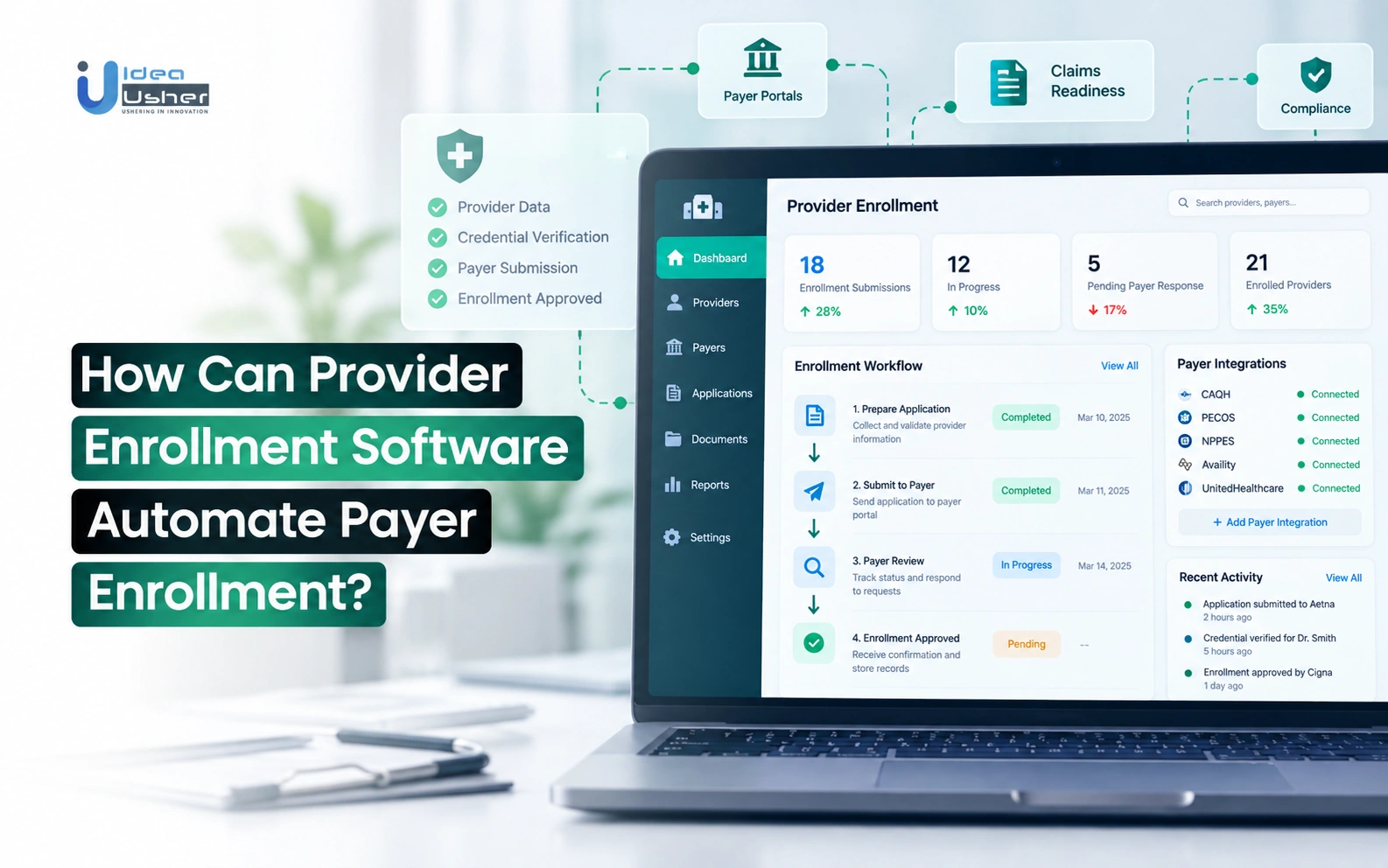
Provider enrollment software development focuses on automating payer enrollment through a centralized workflow for collecting, validating, submitting and tracking provider information. The software can pull data from credentialing systems, NPI databases and other authorized sources, pre-populate payer applications, identify missing or inconsistent information, manage supporting documents and track each application through submission, follow-up, approval or revalidation.
Traditional enrollment relies on data entry, scattered documents and separate payer portals, making it hard to track applications or spot missing information. Provider enrollment automation can centralize provider records, flag gaps, streamline submissions and give teams visibility into enrollment status while keeping human oversight where payer decisions or exceptions are required.
In this blog, we will talk about how provider enrollment software automates payer enrollment, including its core features, workflows, integrations, security needs and healthcare provider development considerations, long with the practical challenges and planning decisions involved in launching a scalable, compliant solution.
What Is Provider Enrollment Software?
Provider enrollment software manages the process of contracting healthcare providers and facilities with commercial, Medicare and Medicaid health plans. Its primary purpose is securing in-network participation and billing authorization, enabling healthcare organizations to receive reimbursement for clinical services delivered by enrolled providers.
While provider demographic data originates in credentialing systems, enrollment software translates that verified clinical file into legal, contractual, and financial relationships with hundreds of disparate payers.
A. How Provider Enrollment Differs From Credentialing
Although frequently conflated under general medical staff operations, credentialing and provider enrollment govern two distinct legal and operational stages:
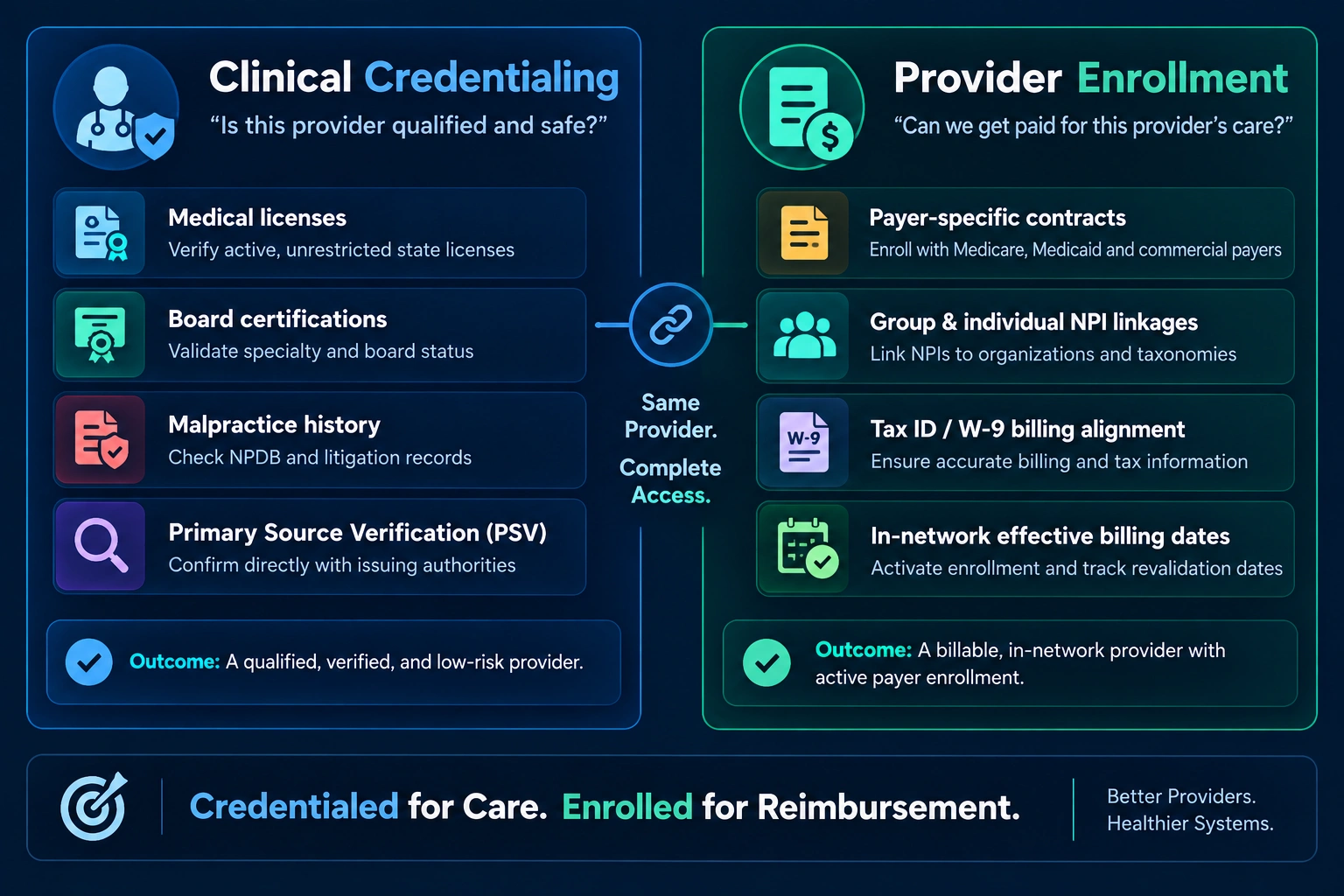
Credentialing (Clinical Competence): Evaluates a practitioner’s background by verifying medical education, active state licenses, DEA registrations and malpractice history through Primary Source Verification (PSV). It supports clinical safety, institutional appointment and hospital privileges.
Provider Enrollment (Financial Contracting): Begins after clinical qualifications are verified and involves submitting payer-specific administrative packets to government payers (CMS PECOS, state Medicaid portals) and commercial health plans (e.g., UnitedHealthcare, Aetna, BCBS). The outcome is a participating provider agreement, payer-specific identifier and in-network billing date.
B. Why Payer Enrollment Requires Separate Workflows
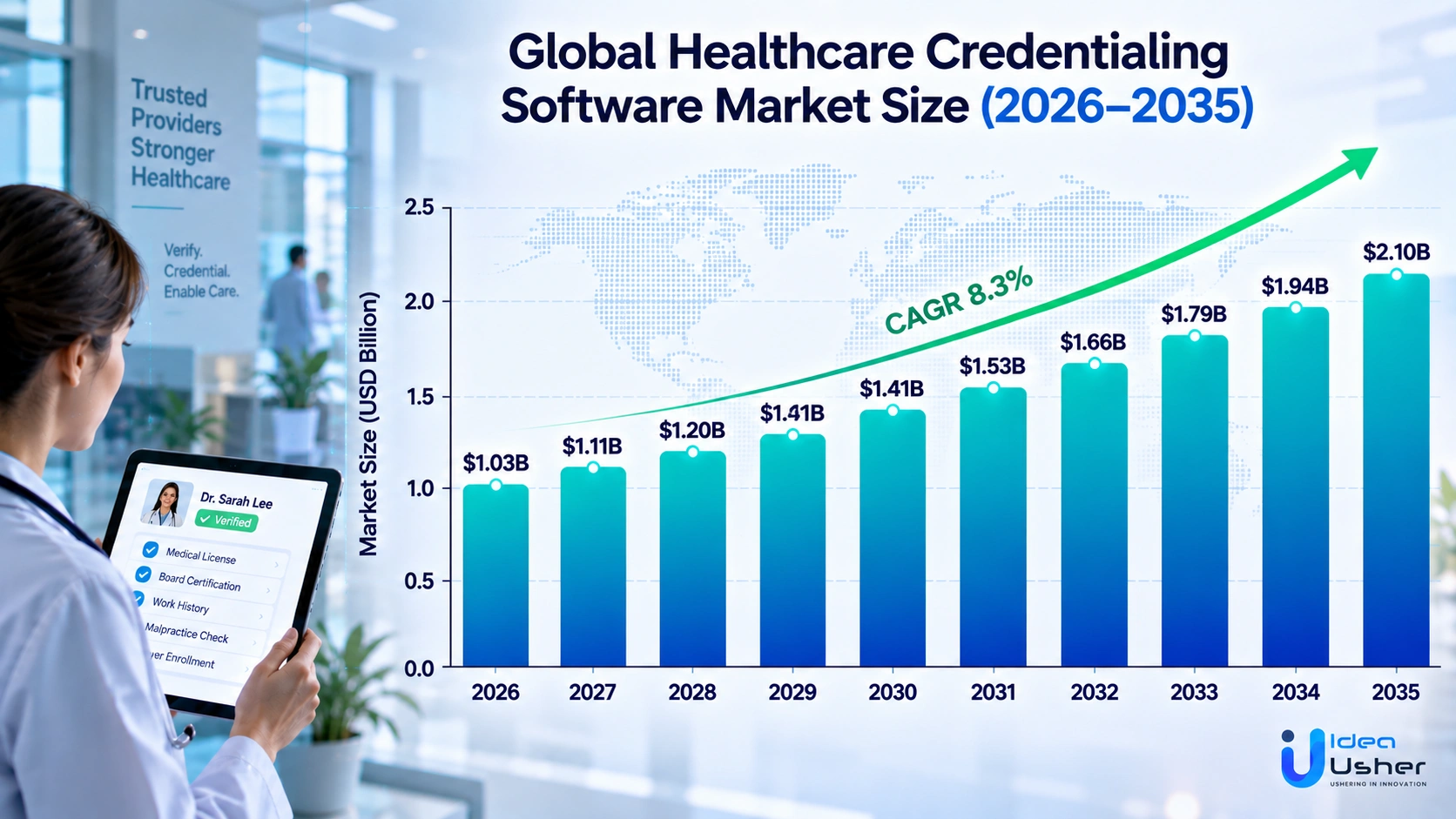
The global healthcare credentialing software and services market is projected to grow from $1.03 billion in 2026 to $2.10 billion by 2035, registering a CAGR of approximately 8.3% from 2026 to 2035, according to Research & Markets. This broader market includes credentialing services and does not represent payer enrollment software alone.
A Medallion survey of 337 U.S. healthcare organizations found that 46% reported revenue impacts from unoptimized enrollment workflows and slow turnaround times. The findings highlight the operational consequences of fragmented processes and the need to coordinate payer-specific requirements, submissions and follow-ups.
Provider enrollment cannot simply use standard credentialing workflows because health insurance payers do not follow a unified, centralized clearinghouse:
- Fragmented Payer Applications: CAQH ProView standardizes initial profiles, but payers still require supplemental packets, state-specific forms and contracts based on HMO, PPO, Medicare Advantage or Dual-Eligible plans.
- Varying Submission Channels: Enrollment teams manage multiple channels, including APIs, payer portals, secure email, fax and physical mail.
- Complex Documentation Dependencies: Payer packets require W-9s, voided checks, EFT/ERA forms and billing taxonomy details beyond standard credentialing records.
- Disparate Effective Date Rules: Payers apply different effective date rules, making claims submitted before the approved date vulnerable to out-of-network denials.
- Persistent Follow-Up & Long Turnarounds: Enrollment can take 60–150+ days, requiring follow-up trackers, automated reminders and payer liaison queues to prevent stalled applications.
C. Who Uses Provider Enrollment Platforms?
Different healthcare entities leverage enrollment software to solve distinct administrative and revenue cycle bottlenecks:
- Hospitals and Health Systems: Manage thousands of physicians and allied health staff across complex facility hierarchies, linking provider NPIs to multiple hospital billing Tax Identification Numbers (TINs).
- Medical Groups and Multispecialty Practices: Minimize clinician downtime, since payer clearance delays can lead to significant delayed or unbillable clinical revenue.
- Internal Enrollment and Credentialing Teams: Use pipeline dashboards, expiration tracking and digital form-fill tools to manage growing provider rosters without proportionally increasing staff.
- Healthcare RCM Companies and Enrollment Service Providers: Use multi-tenant platforms to manage enrollment across hundreds of clients while tracking TAT, payer variations and billing clearance at scale.
Why Does Manual Payer Enrollment Slow Provider Onboarding?
Manual payer enrollment stalls revenue cycles and leaves newly hired clinicians sidelined. When enrollment teams rely on spreadsheets, manual portal logins, and paper packets, onboarding drags out to 90–150+ days, costing healthcare organizations up to $8,000–$10,000 per day in unrealized clinical collections.
| Friction Point | What Happens | Business & Operational Impact |
| Repeated Data Entry | Coordinators re-enter NPIs, licenses, DEA numbers, locations and tax IDs across portals like PECOS, Availity and payer sites. | Burnout and Errors: Repetitive entry causes typos, taxonomy mismatches and conflicting addresses. |
| Incomplete Applications | Submissions lack signatures, CV gap explanations, current insurance certificates or EFT/ERA voided checks. | Rejection and Delays: Payers may reject applications weeks later, and resolving basic RFIs can restart review cycles. |
| Delayed Follow-Ups | Emails, call logs and spreadsheets fragment tracking, limiting real-time status visibility. | Unseen Payer Backlogs: Applications can sit 45+ days without follow-up, risking missed 30-day resolution windows. |
| Missed Revalidations | CMS revalidation, Medicaid renewal or address-change deadlines pass without automated alerts. | Billing Disruptions: Network deactivation can trigger out-of-network denials and costly write-offs. |
The Operational Cascade: Manual vs. Automated
Manual enrollment creates a chain of data entry, payer delays, rework and revenue loss, while automation connects verified intake, multi-payer submissions, status tracking and faster billing clearance.
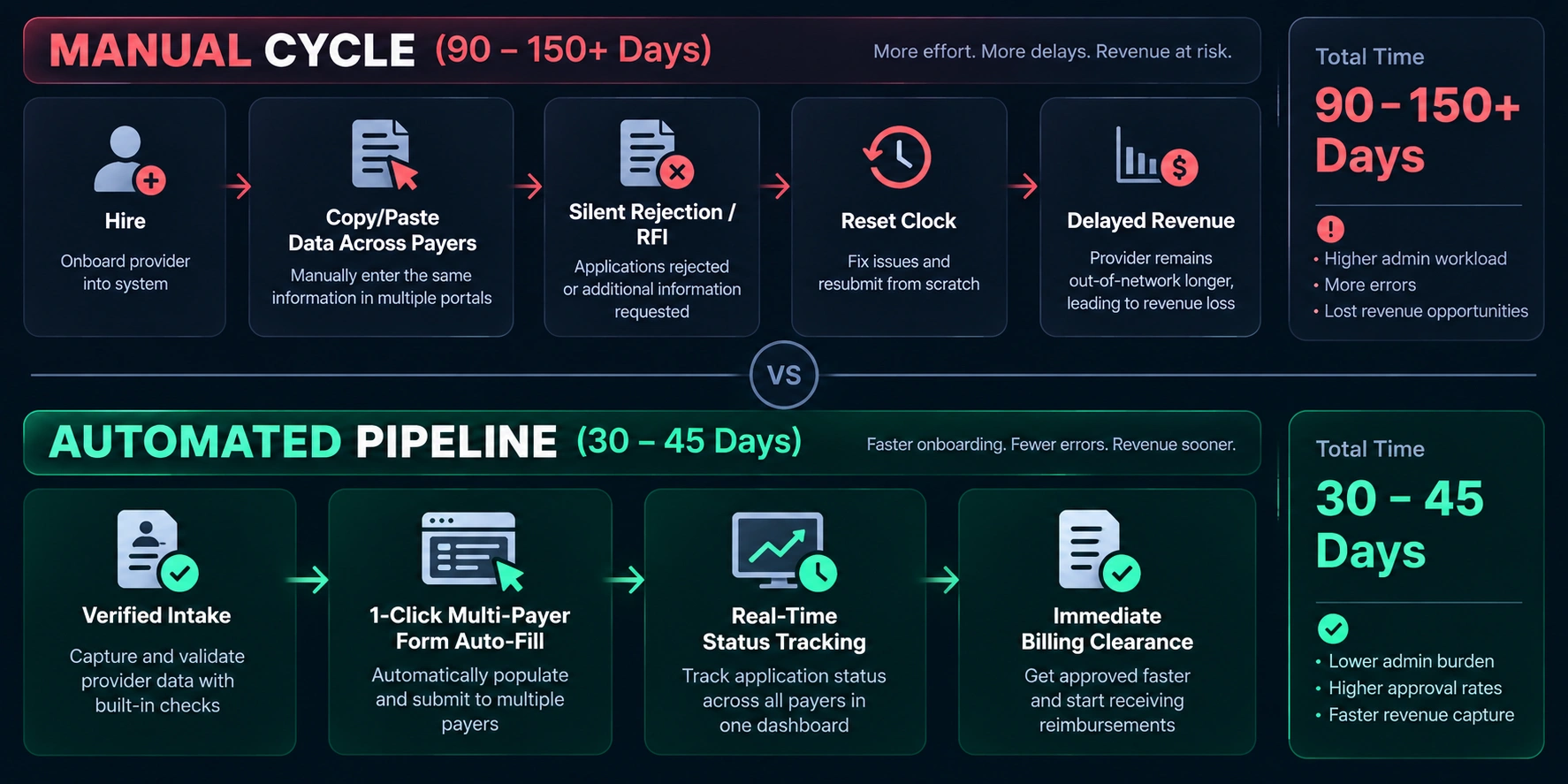
This shows why provider enrollment automation matters beyond administrative efficiency, reducing repetitive work, accelerating payer decisions and protecting revenue from delays, rejections and missed billing opportunities.
- Data Redundancy: Translating a single provider’s file across 15–25 health plans requires 20+ hours of pure typing per clinician.
- Review Choke Points: Payers do not notify teams immediately of omissions; discovery happens weeks later during reactive outreach.
- Revenue Protection: Payer approvals are rarely fully retroactive; every 30 days of manual lag directly burns a month of billable provider encounters.
- Lost Opportunity Cost: An un-enrolled specialist represents $5,000 to $10,000+ per day in unbilled care that cannot be recovered retroactively.
- The “Retroactive” Trap: Most commercial payers refuse retroactive billing services provided prior to the exact committee approval date become non-reimbursable uncompensated care.
How Can Provider Enrollment Software Automate Payer Enrollment?
Provider enrollment software automates payer enrollment by transforming a verified provider record into completed, payer-ready applications and managing the submission lifecycle end-to-end. By replacing manual data entry with rules engines, automated form mapping and status tracking, platforms cut onboarding cycle times from months to weeks.
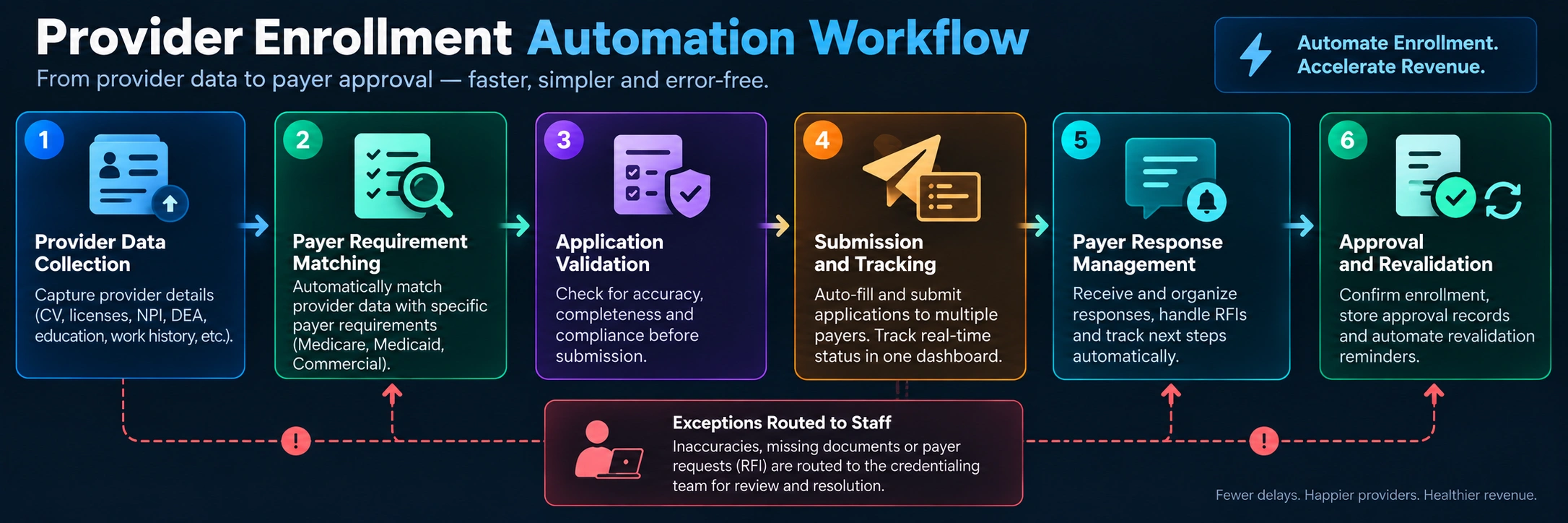
By unifying application setup, submission, exception routing and status tracking in one system, the software reduces administrative work, shortens enrollment to weeks and protects cash flow by preventing claim rejections. The end-to-end automated enrollment lifecycle operates across six core steps:
Step 1: Import and Centralize Provider Information
The software ingests provider demographic, license and background data from intake portals, internal HRIS files and upstream credentialing systems. Integrations with external databases like CAQH ProView, NPPES and state boards automatically pull active practitioner profiles into a centralized, single source of truth.
Step 2: Match Provider Data to Payer Requirements
Configurable rules engines cross-reference the centralized provider profile against a catalog of commercial, Medicare and state Medicaid application requirements. The system maps fields to payer-specific schemas, identifying line-of-business variations, required billing taxonomies and unique addenda before generation begins.
Step 3: Validate Applications Before Submission
A primary cause of enrollment lag is the “submit-reject-resubmit” cycle triggered by simple clerical oversights. The software applies automated pre-flight validation rules before any application leaves the system:
- Field Completeness Checks: Verifies all required fields, checkboxes and date ranges are populated according to the specific payer’s requirements.
- Data Consistency Audits: Flags cross-field discrepancies, including practice and billing address mismatches across IRS/NPPES records or unexplained gaps in a clinician’s 5-year work history.
- Real-Time Expiration Screening: Confirms state licenses, DEA registrations and malpractice certificates remain active throughout the payer’s review window, flagging credentials expiring within 60 to 90 days.
- Document Attachment Verification: Ensures required supporting documents, including signed W-9s, board certificates, CVs and voided checks, are attached in the correct digital formats and resolutions.
Step 4: Prepare and Submit Payer Applications
The platform auto-populates standard forms (e.g., CMS-855I/R) and commercial packets, attaching required W-9s and voided checks. Applications are transmitted directly through payer APIs or robotic process automation (RPA) for web portals, pausing at human-in-the-loop checkpoints for coordinator review when required.
Step 5: Track Responses and Resolve Enrollment Exceptions
Automated tracking monitors application status across payer queues, logging receipt identifiers and timestamped acknowledgments. When a payer issues a Request for Information (RFI) or an application stalls, the platform alerts coordinators, assigns remediation tasks and schedules proactive follow-up reminders.
Step 6: Record Approval and Monitor Revalidation
Securing in-network approval is not the end of the enrollment lifecycle; the platform anchors this milestone into downstream operational and revenue systems:
- Approval Metadata Capture: Records critical contract milestones upon receiving the formal payer acceptance letter, including:
- In-network effective date (and retroactive billing limits, if applicable).
- Payer-assigned provider identification numbers (e.g., PTANs, payer-specific IDs).
- Contracted service lines and authorized billing locations.
- Downstream Revenue Cycle Synchronization: Pushes verified effective dates to Practice Management (PM) and Revenue Cycle Management (RCM) systems via APIs or exports, enabling billing queues and preventing premature out-of-network claims.
- Automated Revalidation & Maintenance Scheduling: Schedules Medicare, Medicaid and commercial revalidation deadlines, sending automated 120- and 90-day alerts to maintain continuous in-network standing.
How Do CAQH, PECOS and NPPES Integrations Work?
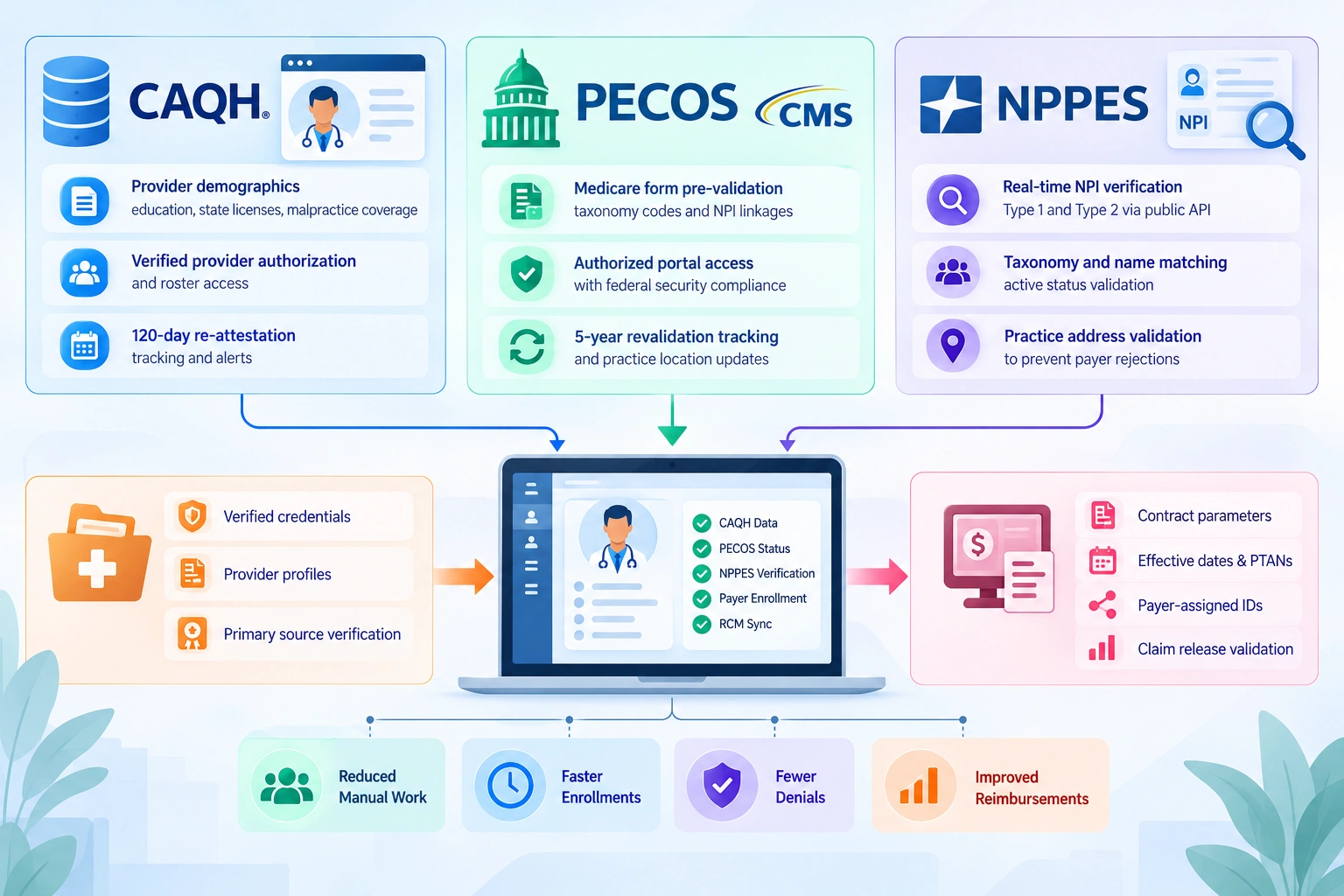
Healthcare integrations seldom provide fully automated, unrestricted two-way data pipelines. Federal portals, state registries, and industry clearinghouses enforce distinct technical, legal, and authentication constraints. Designing a reliable, compliant enrollment workflow requires knowing what can be executed programmatically versus what demands human oversight.
A. CAQH Integration for Provider Data Reuse
Connecting with CAQH (Council for Affordable Quality Healthcare) ProView allows enrollment software to leverage self-attested provider data across multiple commercial payers without repeating initial intake.
- Authorized Profile Ingestion: Pulls provider demographics, education, state licenses and malpractice coverage from CAQH into internal profiles through supported APIs or roster feeds.
- Access & Governance Boundaries: Requires verified roster relationships and explicit provider authorization before importing profiles.
- Quarterly Attestation Dependency: Tracks the 120-day CAQH re-attestation cycle and sends automated alerts to prevent profiles from lapsing before payer submission.
B. PECOS Integration for Medicare Enrollment
CMS’s Provider Enrollment, Chain and Ownership System (PECOS) governs Medicare enrollment (CMS-855I/R), reassignment of billing rights, and five-year revalidations.
- Pre-Validation & Package Assembly: Pre-fills Medicare forms using structured validation rules, checking for missing taxonomy codes and NPI linkages before submission.
- Identity-Proofing Constraints: Machine-to-machine APIs remain restricted by federal security protocols, so software manages authorized surrogate accounts or guides specialists through assisted portal submissions.
- Revalidation & Location Tracking: Monitors CMS revalidation lists and tracks practice location changes, helping prevent sudden deactivations by regional Medicare Administrative Contractors (MACs).
C. NPPES Integration for NPI Data Validation
The National Plan and Provider Enumeration System (NPPES) serves as the open, authoritative federal registry for validating healthcare provider identifiers.
- Automated Direct Verification: Queries the public NPPES REST API in real time using Type 1 individual or Type 2 organizational NPIs without complex enterprise authentication.
- Taxonomy & Name Matching: Validates provider taxonomy codes, legal names and active status against internal records to prevent clerical mismatches.
- Pre-Flight Application Audits: Confirms practice addresses on enrollment applications match registered NPPES locations, catching data discrepancies that can trigger payer rejections.
D. Connecting Credentialing, RCM, and Payer Systems
A modern enrollment platform acts as the operational bridge between verified clinical credentials and downstream revenue cycle management (RCM).
- Single Source of Truth: Transfers primary-source-verified provider data from credentialing modules into payer templates, preventing duplicate entry across disconnected teams.
- Automated Billing Clears: Sends contract parameters, in-network effective dates, PTANs and payer-assigned IDs directly to Practice Management (PM) and billing systems.
- Denial Prevention Guardrails: Holds claim-release queues until the provider’s effective date is validated in the RCM system, reducing out-of-network write-offs and delayed reimbursements.
What Does the Provider Enrollment Software Architecture Look Like?
A provider enrollment platform needs more than a dashboard to automate payer enrollment. Its architecture must connect provider records, payer-specific workflows, external systems and enrollment monitoring into a coordinated system.
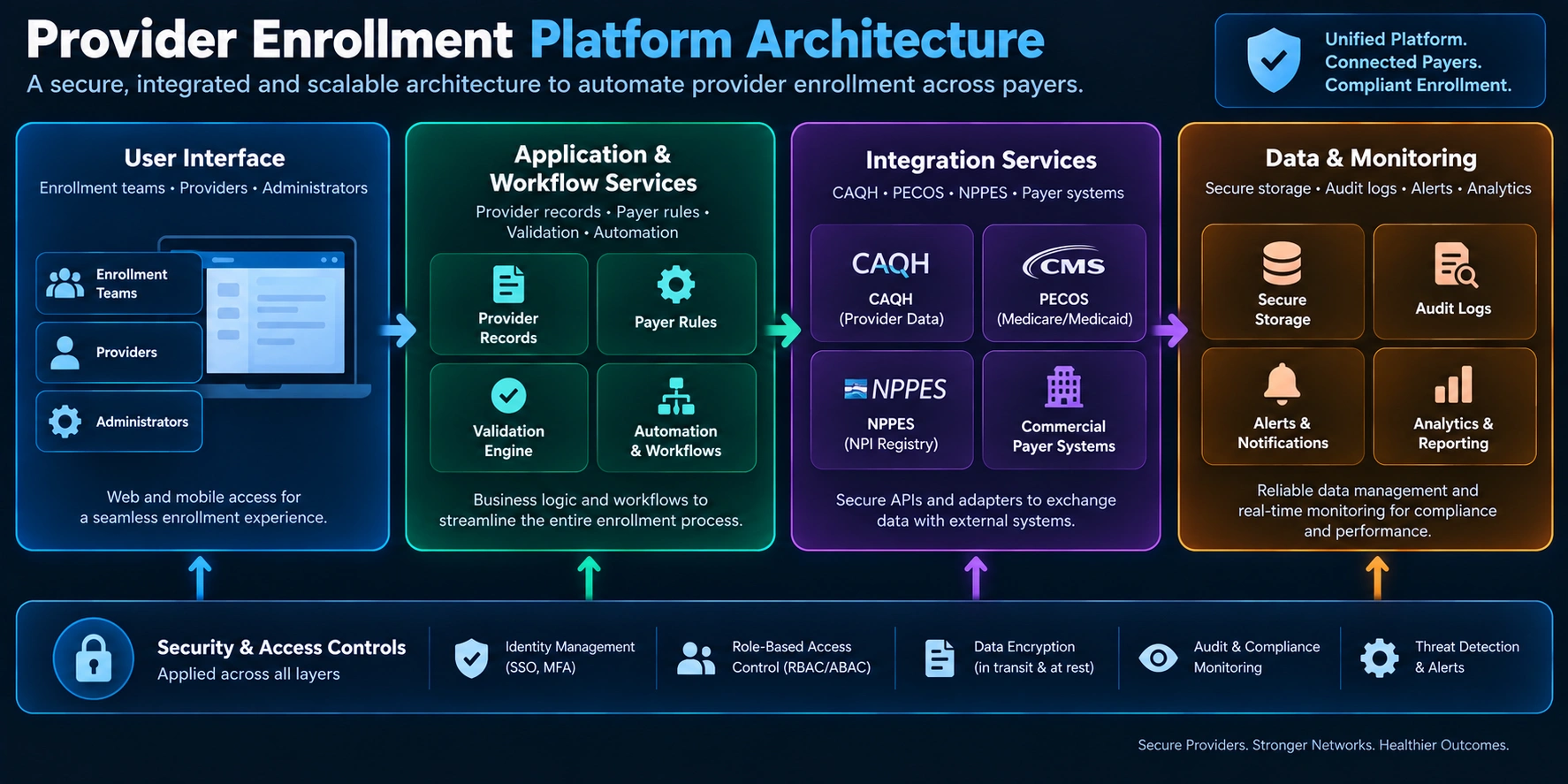
A well-designed architecture allows enrollment teams to automate routine tasks while maintaining control over sensitive data, application submissions and exceptions. The following table breaks down the core architectural layers and their role in the platform.
| Architecture layer | Core components | What it does |
| Provider Data and Document Management | Provider profiles, organizational records, document storage, enrollment history | Centralizes provider data, documents and enrollment history, allowing teams to reuse verified information across applications. |
| Payer Workflow and Automation Engine | Configurable business rules, workflow orchestration, validation logic, task queues | Maps data to payer requirements, checks application completeness, triggers workflows and routes exceptions to enrollment specialists. |
| Integration and Submission Layer | API connectors, supported portal automation, secure data exchange, submission tracking | Connects with credentialing software, CAQH, PECOS and payer systems where supported, managing submissions, data exchange and errors. |
| Monitoring, Audit and Reporting Layer | Enrollment dashboards, audit logs, deadline alerts, status reports | Tracks application status, enrollment activities and revalidation deadlines, providing visibility into pending actions and operational performance. |
These layers should operate as a connected architecture rather than isolated modules. For example, when a provider’s license information changes, the data layer can update the relevant record, the workflow engine can identify affected applications, and the monitoring layer can surface any required action.
What Features Should Provider Enrollment Software Include?
Provider enrollment software should include provider profiles, payer application management, document tracking, submission monitoring, revalidation workflows and reporting dashboards.
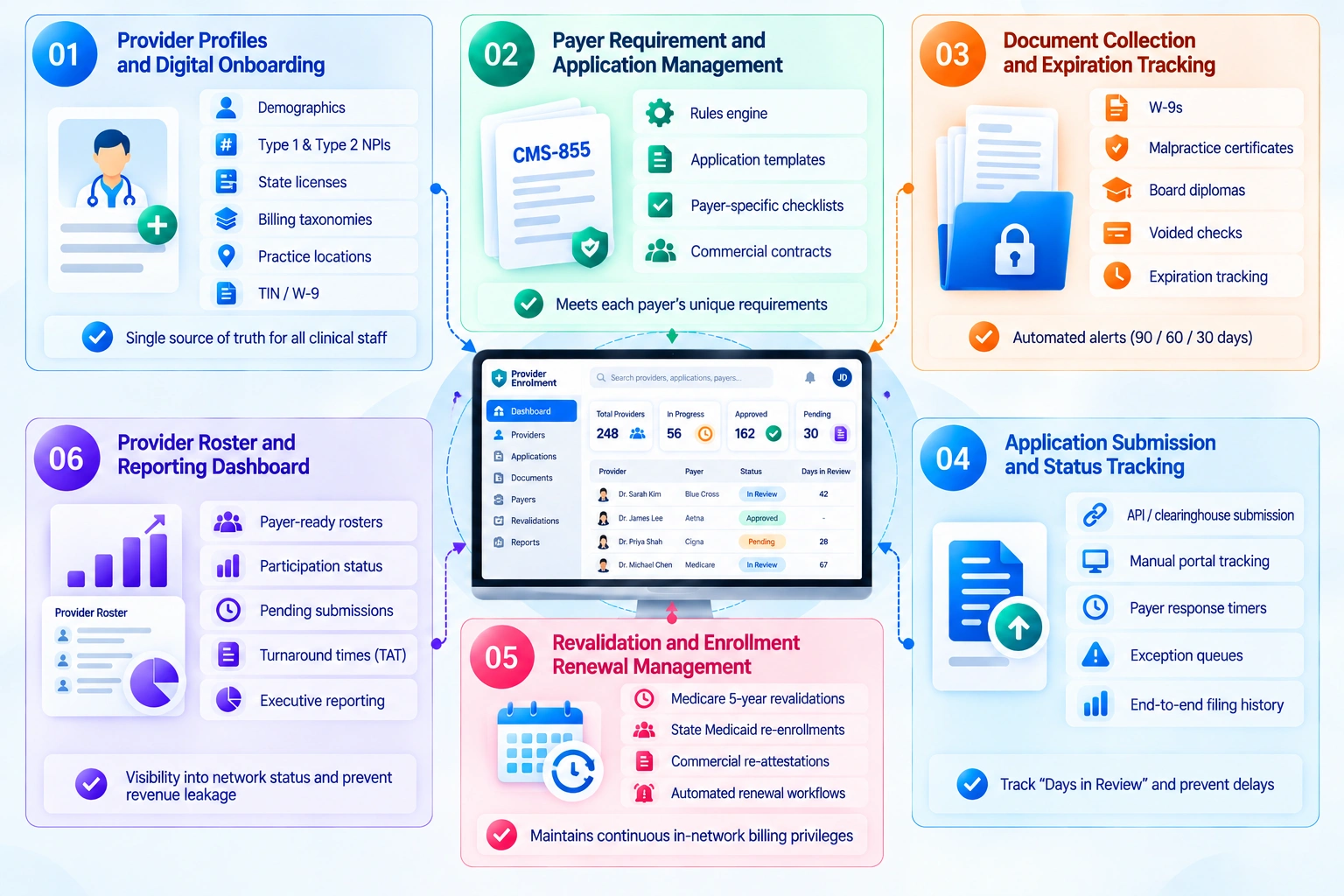
These capabilities centralize provider data, automate payer-specific requirements, track enrollment progress and help organizations maintain continuous in-network billing privileges.
1. Provider Profiles and Digital Onboarding
Centralizes demographic records, individual Type 1 NPIs, group Type 2 NPIs, state licenses, billing taxonomies, practice locations, and organizational tax identifiers (TIN/W-9).
Why It Matters: Eliminates redundant data entry by establishing a single source of truth across all clinical staff. Clinicians complete self-service intake forms once, allowing the organization to map foundational profile data across hundreds of downstream payer applications without re-keying records.
2. Payer Requirement and Application Management
Provides configurable rules engines, dynamic application templates (e.g., CMS-855 forms, state-uniform applications, commercial contracts), and payer-specific enrollment checklists.
Why It Matters: Every payer enforces distinct prerequisites, such as hospital admitting privileges, supervisory agreements, or minimum malpractice limits. Dynamic mapping ensures each application meets the specific health plan’s standards, preventing immediate rejections caused by missing payer-specific variables.
3. Document Collection and Expiration Tracking
Maintains a secure digital vault for signed W-9s, malpractice certificates, voided checks, and board diplomas, complete with automated expiration tracking.
Why It Matters: Missing or expired documents cause immediate application halts and costly resubmission loops. Automated notifications alert staff and providers 90, 60, and 30 days prior to license or certification lapses, ensuring files remain compliant while applications are under review.
4. Application Submission and Status Tracking
Tracks end-to-end filing histories across APIs, clearinghouses, and manual portals, offering operational dashboards with payer response timers and exception queues.
Why It Matters: Payer review cycles take 60 to 150+ days. Measuring “Days in Review” highlights aging submissions and prompts timely follow-up outreach, preventing applications from sitting unnoticed in payer committee backlogs.
5. Revalidation and Enrollment Renewal Management
Monitors recurring compliance deadlines, tracking Medicare five-year revalidations, state Medicaid re-enrollments, and commercial re-attestation cycles.
Why It Matters: Failing to submit revalidation packets on time results in immediate network termination and uncollectible claim denials. Automated recurrence trackers initiate renewal workflows months in advance to protect continuous in-network billing privileges.
6. Provider Roster and Reporting Dashboard
Generates payer-ready network rosters and provides executive reporting on participation statuses, pending submissions and operational turnaround times (TAT).
Why It Matters: Delivers actionable visibility to clinical leaders and billing teams. Practice managers can instantly see which clinicians are cleared to bill specific commercial plans, preventing revenue leakage from premature claims submissions.
How To Develop Provider Enrollment Software?
Developing provider enrollment software starts with understanding how providers are enrolled across different payers and where manual processes create delays. The platform should connect provider data, document collection, payer-specific workflows, status tracking and integrations into a coordinated enrollment process.
A structured development approach helps prioritize the right capabilities, define automation rules and validate the system against real enrollment requirements. The following steps outline how to move from workflow discovery to a tested pilot.
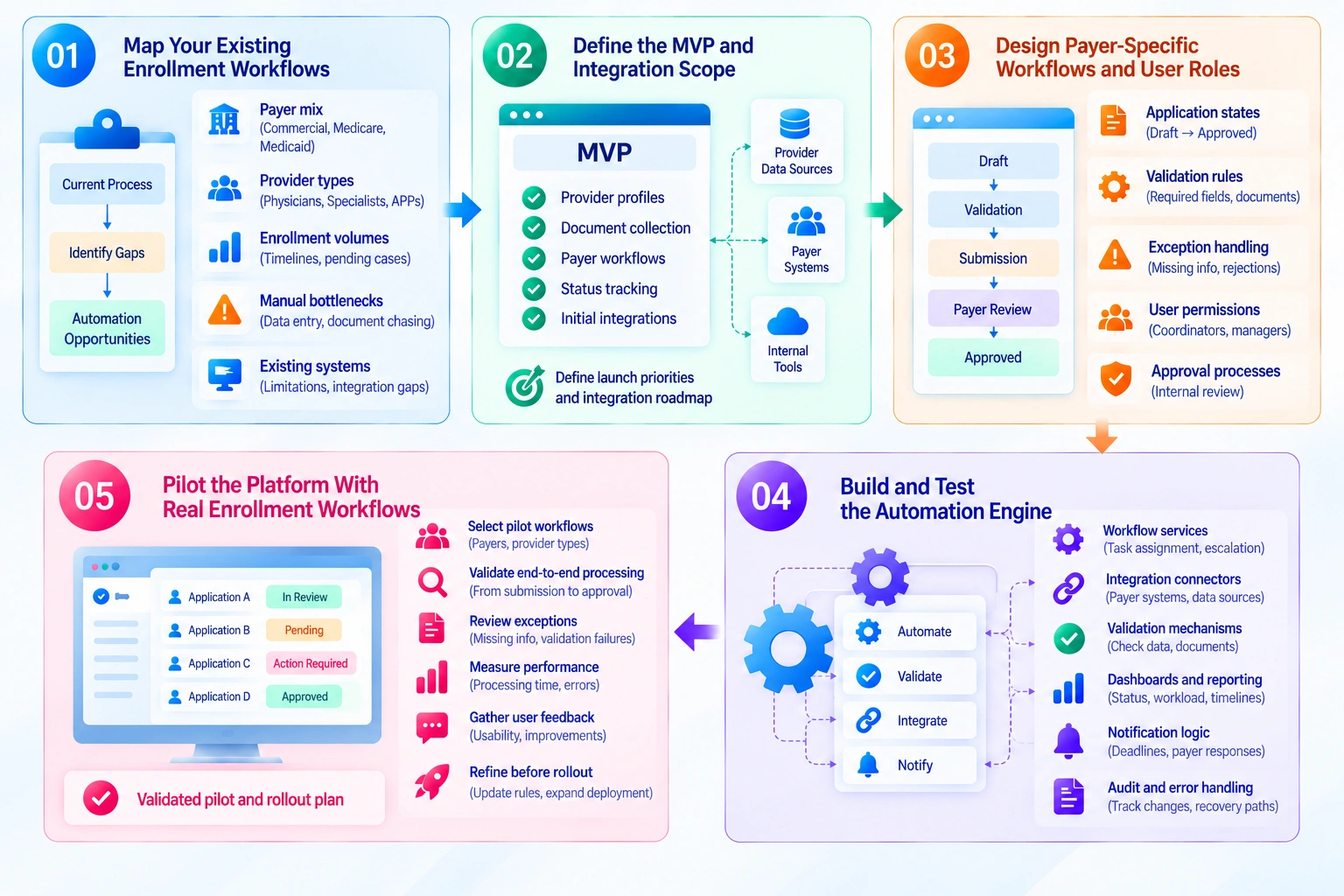
1. Map Your Existing Enrollment Workflows
Start by documenting how provider enrollment currently operates across the organization. Understanding payer requirements, enrollment volumes and administrative bottlenecks helps identify where software automation can reduce repetitive work.
- Identify Payer Mix: List the commercial, Medicare, Medicaid and other payer programs supported by the organization, along with their enrollment requirements.
- Segment Provider Types: Identify physicians, specialists, advanced practice providers and other provider categories that require different enrollment workflows.
- Review Enrollment Volumes: Assess application volumes, processing timelines, pending cases and recurring workload patterns.
- Identify Manual Bottlenecks: Document repeated data entry, document chasing, portal switching, status follow-ups and avoidable application errors.
- Review Existing Systems: Identify current credentialing, provider management and enrollment tools, including limitations and integration gaps.
The expected output is an enrollment workflow map and bottleneck assessment that identify automation opportunities, payer-specific variations and the operational needs the platform must address.
2. Define the MVP and Integration Scope
Once the existing process is mapped, define the smallest practical release that can improve enrollment operations. Prioritize capabilities that address the most frequent workflow issues while leaving room for additional payers and automation features later.
- Provider Profiles: Create centralized records for provider demographics, NPIs, licenses, practice locations, specialties and other enrollment-related information.
- Document Collection: Support secure document uploads, required-document checklists, expiration tracking and requests for missing information.
- Payer Workflows: Enable teams to manage applications according to payer-specific requirements and submission processes.
- Status Tracking: Provide visibility into application progress, pending actions, submission dates and follow-up requirements.
- Initial Integrations: Prioritize connections to the provider data sources, payer systems and internal tools required for the first release.
The deliverable should be an MVP feature specification and integration roadmap defining launch priorities, required data, system dependencies and capabilities reserved for later phases.
3. Design Payer-Specific Workflows and User Roles
Design workflows that reflect each payer’s application requirements, validation rules and submission process. A configurable approach allows the platform to support payer variations without creating a separate system for every enrollment pathway.
- Define Application States: Map stages such as draft, information requested, ready for submission, submitted, pending payer review, approved, rejected and requiring correction.
- Configure Validation Rules: Identify required fields, documents and provider details for each payer and enrollment type.
- Plan Exception Handling: Define how missing information, conflicting data, rejected applications and payer requests are assigned and resolved.
- Establish User Permissions: Set access and responsibilities for enrollment coordinators, provider administrators, managers and other authorized users.
- Map Approval Processes: Determine which applications require internal review or authorization before submission.
The expected output is a payer-specific workflow blueprint and permission matrix that define application states, validation requirements, task ownership and exception-handling processes.
4. Build and Test the Automation Engine
Develop the core services that coordinate enrollment tasks, validate application data and keep teams informed about outstanding actions. Automation should follow configured payer requirements and preserve human review where judgment or authorization is necessary.
- Workflow Services: Automate task assignment, application status transitions, follow-up scheduling and escalation based on defined rules.
- Integration Connectors: Connect supported provider data sources, payer systems and internal applications to reduce duplicate data entry.
- Validation Mechanisms: Check required fields, document completeness, data formats and inconsistencies before an application progresses.
- Dashboards and Reporting: Display enrollment status, pending applications, overdue tasks, processing timelines and workload distribution.
- Notification Logic: Send alerts for missing documents, upcoming deadlines, payer responses and applications requiring action.
- Audit and Error Handling: Record important changes and provide clear recovery paths when integrations fail or automated tasks cannot proceed.
The deliverable should be a working automation engine with tested workflow services, integration connectors, validation rules, dashboards and notification logic.
5. Pilot the Platform With Real Enrollment Workflows
Before expanding deployment, run a controlled pilot using selected payers and provider types. Testing with real enrollment scenarios helps identify workflow gaps, integration limitations and exceptions that may not appear during development.
- Select Pilot Workflows: Choose representative payer processes and provider categories that reflect common enrollment requirements.
- Validate End-to-End Processing: Test provider data collection, document submission, application preparation, status updates and follow-up tasks.
- Review Exceptions: Track missing information, validation failures, payer-specific requirements and cases requiring manual intervention.
- Measure Operational Performance: Monitor application processing time, data-entry errors, task completion, integration failures and outstanding enrollment cases.
- Gather User Feedback: Collect input from enrollment coordinators and administrators to identify usability issues and workflow improvements.
- Refine Before Rollout: Update validation rules, automation logic, dashboards and integrations based on pilot findings.
The final output should be a validated pilot and rollout plan, supported by documented test results, measured operational performance, resolved workflow gaps and prioritized improvements for broader deployment.
How Much Does Provider Enrollment Software Development Cost?
Provider enrollment software typically costs between $35,000 and $500,000+ to develop in 2026, depending on how many payer workflows it automates, whether it integrates with systems like CMS PECOS and state Medicaid portals, and how much verification and compliance logic runs underneath the enrollment forms.
A. Phase-Wise Provider Enrollment Software Development Cost
Development costs vary across each phase because workflow complexity, payer integrations, automation requirements and testing needs increase as the platform moves from process mapping to production-ready enrollment automation.
| Phase | Estimated Cost | What Happens Here |
| 1. Workflow Mapping | $5,000 – $30,000 | Analyze enrollment processes, payer requirements, workload patterns and manual bottlenecks to define automation opportunities. |
| 2. MVP & Integration Scope | $7,000 – $50,000 | Define core MVP features, required integrations, data requirements and priorities for the initial software release. |
| 3. Payer Workflows & Roles | $8,000 – $70,000 | Design payer-specific application states, validation rules, user permissions, approvals and exception-handling workflows. |
| 4. Automation Engine Development | $10,000 – $300,000 | Build workflow automation, integrations, validation, dashboards, notifications, audit logging and error-handling capabilities. |
| 5. Pilot & Workflow Validation | $5,000 – $50,000 | Test selected enrollment workflows, measure performance, resolve gaps and refine automation before broader deployment. |
| Total Estimated Cost | $35,000–$500,000 | Total planning range covering discovery, design, development, testing and pilot implementation. |
Note: This breakdown reflects the MVP as minimum value and Enterprise as maximum value in the automated payer enrollment tier. For an enterprise suite, Phase 4 scales up substantially, since it’s where multi-payer submission logic, primary source verification and EHR integrations get built, and typically accounts for 60 to 70 percent of total project cost across all tiers.
B. Provider Enrollment Software Cost by Tier
Provider enrollment software costs also vary by product tier. Basic trackers focus on core enrollment management, while automated and enterprise platforms require deeper integrations, workflow automation and multi-tenant capabilities.
| Tier | Estimated Cost | Timeline | What’s Included |
| Basic enrollment tracker | $35,000 – $65,000 | 3 – 4 months | Provider profile storage, document upload, application status tracking, expiration reminders |
| Automated payer enrollment platform | $65,000 – $150,000 | 5 – 8 months | CMS PECOS and state Medicaid integration, auto-filled payer applications, CAQH sync, workflow automation |
| Enterprise credentialing and enrollment suite | $150,000 – $500,000+ | 9 – 15 months | Multi-payer submission engine, primary source verification, EHR/practice management integration, multi-tenant SaaS architecture |
Note: These tier-based provider enrollment software development cost estimates are planning ranges, not standardized vendor prices. Actual costs vary based on payer integrations, automation depth, security requirements, provider volume, customization and deployment architecture selected for the platform.
C. What Drives Provider Enrollment Software Costs
Beyond standard provider enrollment software development, provider enrollment platforms carry cost drivers specific to how payer systems and provider data work:
- Payer Integration Complexity: Connecting to CMS PECOS and individual state Medicaid portals adds $10,000 to $30,000 per integration, since each uses different data formats.
- CAQH Data Synchronization: Pulling and pushing provider data to and from CAQH ProView requires dedicated API work, typically adding $8,000 to $18,000.
- Auto-Fill Application Engine: Mapping stored provider data into payer-specific application formats without manual re-entry adds $15,000 to $35,000 depending on payer count.
- Primary Source Verification: Automated verification against licensing boards, medical schools, and certification bodies adds $20,000 to $50,000, a common upsell from basic tracking to full credentialing.
- Compliance and Audit Infrastructure: HIPAA-aligned data handling, access controls, and audit logging for provider records add $15,000 to $35,000.
- Multi-Tenant SaaS Architecture: Supporting multiple healthcare organizations on one platform, rather than a single-practice tool, adds $25,000 to $60,000 in architectural complexity.
The difference between a basic tracker and enterprise suite depends on whether software only monitors enrollment status or automates payer submission and verification. Practices may lose $6,000 to $8,000 monthly during 90 to 120-day enrollment waits, creating a clear business case for automation.
IdeaUsher scopes provider enrollment platforms around that timeline directly, prioritizing the integrations that shrink the waiting period before adding secondary features.
How Can AI Improve Provider Enrollment Automation?
AI turns provider enrollment software into an intelligent orchestration engine. Replacing rigid rules and fragile portal scrapers, machine learning, OCR, and agentic workflows streamline intake, verification, and exception handling across unstructured documents.
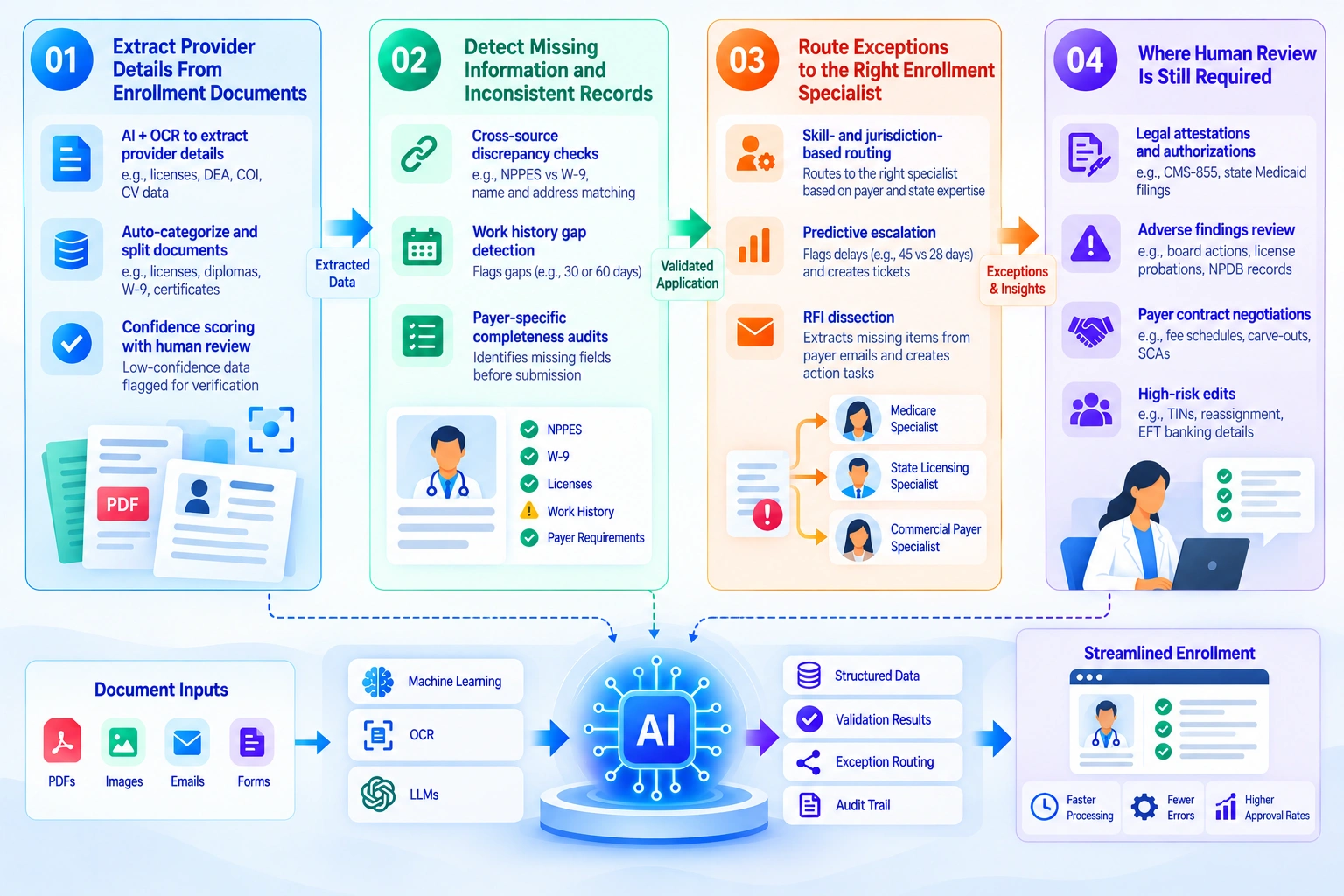
This approach handles data preparation, document processing and routine exceptions, while human specialists retain responsibility for regulatory decisions, high-risk discrepancies and payer negotiations.
A. Extract Provider Details From Enrollment Documents
Ingesting provider credentials has historically required manual data entry from scanned PDFs, mobile photo uploads, and emailed attachments. Modern Intelligent Document Processing (IDP) combines high-accuracy OCR with specialized large language models (LLMs) to capture and structure data instantly:
- Contextual Entity Recognition: Extracts complex, non-standardized fields such as COI policy limits, hospital admitting clauses and CV work chronologies without rigid, fixed-coordinate OCR templates.
- Document Categorization & Splitting: Automatically detects and indexes multi-page PDF bundles, separating an 80-page onboarding upload into state licenses, DEA certificates, board diplomas and W-9 forms.
- Confidence Scoring for Human Review: Assigns attribute-level confidence scores to extracted text. High-confidence entities populate provider profiles directly, while low-confidence results highlight the exact bounding box for one-click human verification.
B. Detect Missing Information and Inconsistent Records
Submitting an application with minor discrepancies triggers prolonged payer rejections. AI models perform deep pre-submission consistency audits across disparate data points:
- Cross-Source Discrepancy Matching: Detects inconsistencies between provider attestations and official registries, including maiden versus married names, transposed NPI or tax digits, and NPPES versus W-9 address variations.
- Work History Gap Auditing: Parses unstructured CV work histories against chronological rules, flagging gaps exceeding 30 or 60 days that require formal explanations under payer and NCQA requirements.
- Payer-Specific Completeness Auditing: Checks applications against payer-specific requirements and historical acceptance patterns, flagging missing fields such as county Medicaid IDs or supervisory protocols before submission.
C. Route Exceptions to the Right Enrollment Specialist
When applications encounter bottlenecks, machine learning and deterministic rules combine to coordinate workload distribution:
- Skill- and Jurisdiction-Based Routing: Classifies exceptions such as multi-state licensing discrepancies, adverse malpractice disclosures and rejected CMS-855I forms, then routes tasks to specialists with relevant payer or state expertise.
- Predictive Escalation: Compares real-time “Days in Review” against payer processing baselines. If an application exceeds the expected turnaround, such as 45 days versus a 28-day median, the platform flags it and creates an escalation ticket with payer reference IDs.
- RFI Dissection: Parses inbound payer emails and Requests for Additional Information (RFIs), identifies the exact missing artifact and creates a targeted action item in the specialist’s queue.
D. Where Human Review Is Still Required
Despite advances in automation, healthcare compliance and revenue cycle integrity dictate that human judgment remains indispensable at critical checkpoints:
- Legal Attestations and Authorizations: Government applications such as CMS-855 and state Medicaid filings require legal certifications under penalty of perjury, so authorized officials must review and execute final signatures.
- Adverse Findings and Peer Review: State board actions, license probations and adverse NPDB malpractice settlements require human medical directors and credentialing committees to evaluate clinical risk.
- Payer Contract Negotiations & Exceptions: AI can prepare forms, but fee schedules, carve-outs and single-case agreements (SCAs) require human payer-relations leadership for negotiation and approval.
- Final High-Risk Edits: Changes to TINs, billing reassignment agreements or EFT banking details require dual-custody human sign-off to prevent fraud and diverted payments.
How Should Provider Enrollment Software Handle Security?
Provider enrollment software manages sensitive business and clinician data including Social Security numbers, dates of birth, DEA registrations, and banking details. The architecture must enforce strict information security to protect against unauthorized disclosure and fraud.
A. Role-Based Access for Enrollment Teams
Enforcing strict zero-trust governance and the principle of least privilege ensures operational segregation across teams, mitigates lateral security exposure, restricts sensitive clinical records, and prevents unauthorized administrative overrides through granular, attribute-based policy controls.
- Administrators & Compliance Leads: Maintain full configuration rights, user management, and visibility into unredacted audit trails.
- Enrollment Specialists: Granted read/write access to prepare applications and upload supporting documents within assigned provider groups.
- Clinicians & Signatories: Scoped to self-service portals to complete attestations, sign packets, and view only their own records.
- Client Reviewers & Billing Teams: Restricted to read-only views of application statuses and verified in-network effective dates.
B. Encryption, Authentication, and Secure Integrations
Protecting multi-tenant cloud storage and high-throughput transactional interfaces requires end-to-end cryptographic safeguards, continuous identity-assertion protocols, secure credential-vaulting mechanisms, and resilient boundary defenses designed to isolate external network threats during automated third-party data synchronization.
- Data Protection: Enforce TLS 1.3 for all in-transit communications and AES-256 encryption at rest across databases and document vaults. Apply field-level encryption for high-risk PII like SSNs and banking details.
- Access Control: Mandate multi-factor authentication (MFA) and Single Sign-On (SSO via SAML/OIDC).
- API Boundaries: Secure external endpoints using scoped OAuth 2.0 tokens, mutual TLS (mTLS), and strict rate-limiting.
C. Audit Logs and Enrollment Activity History
Maintaining defensible regulatory oversight demands non-repudiable, tamper-evident transaction logging that captures system-wide interactions, flags anomalous authorization attempts, guarantees cryptographic data lineage, and satisfies external payer or state accreditation compliance surveys without performance degradation.
- Traceability: Capture immutable records of document views, field edits, e-signature timestamps, payer submissions, and status updates.
- Metadata Integrity: Every log entry must include the UTC timestamp, acting user ID, originating IP address, and pre/post-change state values.
D. Data Retention and Healthcare Compliance Requirements
Establishing legally defensible data lifecycle architectures requires balancing statutory healthcare preservation mandates with automated purging controls, ensuring continuous institutional readiness for payer re-delegation audits while actively minimizing long-term data liabilities and exposure risks.
- HIPAA Applicability: Enrollment dossiers may contain incidental Protected Health Information (PHI), such as physician health screenings or peer-review cases. Platforms should support Business Associate Agreements (BAAs) and HIPAA Security Rule safeguards.
- Retention Schedules: Enforce automated data retention policies that preserve application histories throughout payer contract lifecycles and state-mandated audit windows, followed by secure, defensible data disposal.
Build a Provider Enrollment Platform With IdeaUsher
IdeaUsher operates as an enterprise product engineering partner, backed by 11+ years of software expertise, 250+ technical specialists and a 4.9/5 Clutch rating across 1,000+ delivered builds. We engineer custom, cloud-native healthcare platforms that automate complex credentialing and payer onboarding workflows.
Turn Manual Enrollment Workflows Into a Scalable Platform
Rigid off-the-shelf software struggles with complex payer mixes, multi-state licensing, and legacy EHRs. Developing a custom enrollment platform eliminates manual paperwork and billing delays, replacing them with a tailored, automated, and auditable workflow.
- Unified Provider Repositories: Consolidate profiles, CVs, and credentials into a single source of truth, eliminating repetitive data entry across multiple plan submissions.
- Dynamic Payer Rule Engines: Automatically adapt forms, required attachments, and validation criteria to match the specific submission guidelines of commercial, Medicare, and Medicaid plans.
- Pipeline Telemetry & Stage Tracking: Gain real-time visibility into application statuses across every health plan to quickly identify and resolve administrative bottlenecks.
- Automated Expiration & Maintenance Triggers: Set proactive alert schedules for license renewals, DEA updates, and periodic payer revalidations to protect billing continuity.
- Downstream Revenue Cycle Sync: Bridge enrollment workflows directly into your billing clearinghouses and practice management systems to start claims processing the moment approvals are finalized.
IdeaUsher partners with you to define functional product scope, architect HIPAA-compliant backends, build external verification integrations, and ship scalable platforms tailored to your business needs, delivering 100% clean source code after provider enrollment software development with zero vendor lock-in.
Planning to build provider enrollment software for your healthcare organization? Connect with Idea Usher to discuss your workflows, integration requirements and development roadmap.
Conclusion
Provider enrollment plays a critical role in helping healthcare organizations onboard providers and maintain payer participation without unnecessary administrative delays. The right provider enrollment software development strategy connects provider data, payer-specific requirements, application validation and follow-ups through a coordinated workflow. With secure integrations, clear visibility and automation tailored to operational needs, organizations can reduce repetitive work and manage enrollment more consistently. A scalable platform also provides a foundation for adapting to changing payer requirements and supporting future growth.
FAQs
A.1. Provider enrollment software development should include provider data management, payer-specific application workflows, document collection, application validation, submission tracking, automated reminders, role-based access and reporting for enrollment teams.
A.2. Provider enrollment software development costs vary by scope and complexity. A basic enrollment tracker may cost $35,000 – $65,000, an automated platform $65,000 – $150,000, while enterprise credentialing and enrollment suites can range from $150,000 to $500,000+.
A.3. Common integrations in provider enrollment software development include CAQH ProView, PECOS, NPPES, payer portals and provider data systems. Integration methods depend on available APIs, authorized access and each system’s technical limitations.
A.4. Provider enrollment software reduces manual data entry, identifies missing documents, validates application details and tracks payer responses. Automated reminders and follow-up queues help teams address incomplete or stalled applications.