


Key Takeaways
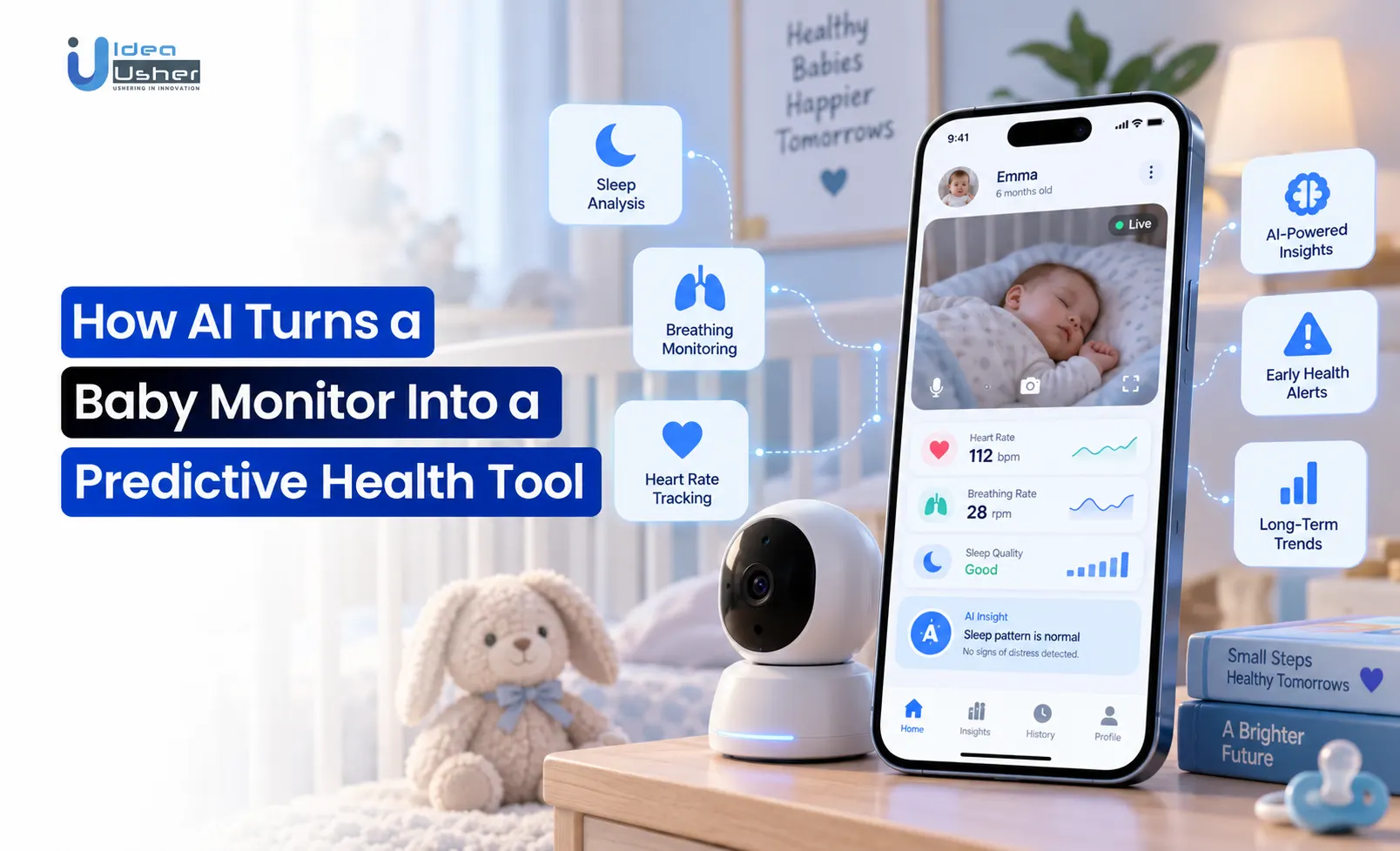
- AI turns a baby monitor into a predictive health tool by using machine learning to analyze infant data to recognize patterns and identify unusual changes.
- It can process video, audio, movement, sleep, and environmental signals in real time.
- AI can then compare these signals with the baby’s usual behavior and detect meaningful deviations.
- The system can send timely alerts when it notices something unusual and give parents simple insights about their baby’s routine.
- See how Idea Usher can use AI to turn a baby monitor into a predictive health tool that parents actually trust.
AI can upgrade traditional baby monitors into predictive health tools by combining computer vision, sound analysis, and behavioral pattern tracking for continuous biometric monitoring. It can then spot changes that parents may not notice and send an early alert. Founders who want to build this kind of AI parenting app with Idea Usher can expect help with the AI, app design, and the data needed to make the system work well. We also guide you on how to store and handle sensitive baby health data the right way, since that one decision shapes the entire app.
We are writing this blog because many startups in the USA have reached out to us with ideas for apps like this. Parents want more than a live video feed, and founders are starting to see the opportunity. In this blog, we’ll explain how a baby monitor can become a predictive health tool using AI and what it takes to build one from the ground up.
Why Predictive Baby Monitoring Is Becoming a Product Opportunity?
Predictive baby monitoring is becoming a product opportunity because parents now want more than live video, and the numbers back that up. According to Mordor Intelligence, the baby monitors market size is expected to grow from USD 1.74 billion in 2025 to USD 1.87 billion in 2026 and is forecast to reach USD 2.61 billion by 2031 at a 6.9% CAGR over 2026-2031. That’s steady, real growth in a category most people still think of as a simple nursery camera. Founders who build predictive features now have a real window before the space gets crowded.

Source: Mordor Intelligence
Growing Demand for Smarter Baby Monitoring
More parents are working outside the home than ever, and that’s fueling demand for smarter monitoring. Bureau of Labor Statistics data shows 66.5% of married-couple families with children have both parents employed. When both parents work, a monitor that only streams video isn’t enough anymore.
This trend lines up with the broader connected-device boom, where the Consumer Technology Association projects U.S. consumer tech retail revenue will hit $537 billion, showing how much room smart nursery devices still have to grow.
AI Creates New Features Beyond Basic Monitoring
Basic monitors record and stream. Predictive monitors compare, learn, and warn. That difference is where the product opportunity sits.
| Feature | Basic Monitor | AI-Powered Predictive Monitor |
| Video streaming | Yes | Yes |
| Alerts | Basic thresholds | Pattern-based, personalized |
| Breathing tracking | Rare, often wearable | Often contact-free |
| Historical insight | Little to none | Sleep and health trend reports |
| Data sharing | Not built in | Exportable for pediatricians |
Miku Pro Smart Baby Monitor, separately, uses patented SensorFusion technology to track breathing without any wearable, aiming for near hospital-grade accuracy. It’s also a useful caution: after a recent change in ownership, Miku moved core features like live breathing alerts behind a new subscription. Deceptive Design has documented parent backlash over this. The lesson for founders is deciding what stays free before launch, not after.
Opportunities for AI Parenting Platforms
The real opportunity isn’t another camera. It’s the health layer on top: alerts, trend reports, and a reason parents keep paying past the newborn stage. Trust matters just as much as the AI, since 64.4% of consumer IoT manufacturers still don’t publish a public vulnerability disclosure policy, a real edge for anyone who gets security right first.
- Subscription-based insight layers, like sleep coaching or developmental tracking
- Pediatrician-facing dashboards for exporting and sharing health data
- Smart home interoperability, following Matter 1.5’s recent addition of camera support
- Clinical-adjacent credibility, drawing on research like Northeastern’s computer vision work on infant motor patterns.

What Makes a Baby Monitor “Predictive” Rather Than Reactive?
A baby monitor is predictive when it warns parents before something goes wrong instead of after. A reactive monitor waits for a loud cry or a rollover, then sends an alert. A predictive one learns what’s normal for that baby first. Then it watches for small changes and flags them early. It’s not about better cameras. It’s about what the device does with the data.
Detecting Events vs Predicting Patterns
Most monitors just react to one moment. A cry happens. A cough happens. The device notices and sends an alert. Prediction needs something smarter than that. Sarah Ostadabbas at Northeastern’s Institute for Experiential AI studies exactly this idea in her infant motor research.
Her AI pulls patterns out of long videos instead of judging one clip. Then a pediatrician looks at the results and decides if something seems off. That’s the real difference. The AI spots patterns over time. It doesn’t just react to a single moment.
Building a Personalized Baseline
Every baby is different. Some move around a lot in their sleep. Some cry at the same time every day. A predictive monitor needs to learn these habits before it can spot anything unusual. That’s why the first few days with a new device aren’t very reliable yet. Medium’s coverage of AI baby monitors backs this up too. It says these devices track breathing and sleep over time to catch things like early apnea signs, not just one rough night.
Lollipop Baby Camera is a good example of this. Its Data History feature learns a baby’s own routine. It notices if the baby fusses at the same time daily or reacts to certain triggers. The longer you use it, the smarter it gets. That’s very different from a monitor that just reacts the same way from day one.
Comparing Current vs Historical Data
Prediction needs two things at once: what’s happening tonight and what usually happens. One night alone doesn’t mean much since babies have off nights all the time. It’s the pattern across many nights that turns something small into a real early warning.
| Approach | What It Shows | Limitation |
| Single-night snapshot | Tonight’s breathing and movement | No way to know if it’s unusual |
| Trend-based comparison | Pattern across many nights | Needs enough history first |
Babysense Connect Sleep Monitor works this way. It tracks breathing without any wearable and builds ongoing sleep reports through its app. So parents see how sleep is trending over time, not just one night’s snapshot. That’s what makes the data feel predictive instead of just observed.
Spotting Meaningful Anomalies
Once a baseline exists, the hard part starts: figuring out which changes actually matter. Too many false alerts and parents stop trusting the app. This part is also where the money is. Owlet’s FDA-cleared Dream Sock uses this same kind of detection for infant vitals. The company reported $78.1 million in revenue, up 45% year over year, thanks largely to parents trusting its predictive alerts.
Lollipop’s True Crying Detection shows the same idea on a smaller scale. It tells real crying apart from background noise like wind or a door closing. The company says it gets this right over 96% of the time. That number matters because a monitor that cries wolf too much just trains parents to ignore it. And that defeats the whole point of building something predictive.
Which Infant Signals Can AI Analyze?
AI can analyze way more than just video. It looks at sleep, breathing, crying, body position, air quality, and feeding, then turns all that into signals a parent can actually act on. Basically, if a sensor can pick something up, AI can usually learn a pattern from it over time. That means the more useful data a monitor can collect, the more opportunities there are for AI to find meaningful changes.

1. Sleep and Wake Patterns
Sleep is the easiest signal for AI to track. It watches when a baby falls asleep, wakes up, and how often they stir at night. Over time, it builds a full sleep rhythm instead of judging one night alone. This can help parents notice when their baby’s usual sleep routine starts to change.
SNOO Smart Sleeper by Happiest Baby is a good example. It logs sleep every night through the SNOO Log, and its app has an “Ask Happiest Baby” feature trained on Dr. Harvey Karp’s methods plus the baby’s own sleep data. So instead of a generic answer, parents get something closer to a real sleep consultant.
SNOO also has FDA De Novo authorization for keeping babies safely on their backs during sleep, still the only bassinet with that approval. Happiest Baby, the company behind it, pulls in an estimated $45 million a year according to research firm Growjo.
2. Breathing and Movement
Breathing and movement are where AI really helps, since both are hard for a tired parent to watch all night. Cameras and sensor-free bands can track breaths per minute and flag anything that looks off. It can also watch for changes in movement that may be easy to miss during the night.
Nanit’s Breathing Band works with the Nanit Pro Baby Monitor using computer vision instead of any sensor on the baby’s body. It tracks breaths per minute and shows daily, weekly, and monthly averages, so a parent can spot a real change instead of guessing off one odd night. Nanit has raised $124.6 million across six funding rounds, including a growth round led by Springcoast Capital Partners.
3. Crying and Vocal Behavior
Not every sound means the same thing, and AI is built to tell them apart. SNOO responds to crying automatically. It picks up the sound and escalates white noise and rocking through four levels until the baby settles, then steps back down once things calm.
| Sound | What AI Checks | Why It Matters |
| Cry | Pitch, pattern, duration | Tells hunger vs discomfort vs distress |
| Cough | Frequency, sharpness | May flag early illness |
| Background noise | Consistency | Cuts down false alerts |
4. Body Position and Activity
AI also watches how a baby is positioned and how much they move. This matters for safety, like checking a baby hasn’t rolled face down, and for development. Nanit’s partnership with Summer Health, announced in March, shows this well. Nanit already tracks body position through its camera. Summer Health’s pediatricians now use that data to help catch developmental concerns like torticollis early, without needing an in-person visit first.
5. Temperature, Humidity and Air Quality
Room conditions matter almost as much as the baby does. A nursery that’s too warm, too dry, or has poor airflow can affect sleep and even raise health risks. Stormotion’s research on baby monitoring apps points out that most modern systems now track temperature, humidity, and air quality right alongside video, so parents get one dashboard instead of five separate gadgets.
6. Feeding and Daily Routine Patterns
Feeding times, diaper changes and naps seem small on their own, but together they build a full daily routine. AI can spot when that routine breaks, like a baby suddenly feeding less often, and that’s worth flagging early. Nanit’s Care Logs feature covers this well. Parents log feeding, sleep and diaper changes in one place, and it can be shared with caregivers or family through the app. It’s a simple feature, but it’s exactly the kind of pattern data a doctor wants when a parent brings up a concern at a checkup.
How AI Turns Infant Signals Into Predictive Insights?
AI turns infant signals into predictive insights by collecting raw data first, then running it through models that spot patterns a human eye would miss. Cameras and sensors pick up the signal. Then a few AI methods work together, comparing what’s happening now against what’s normal, before anything gets flagged for a parent.
1. Computer Vision Tracks Movement
A camera watches the baby, and AI turns that video into data like posture and movement, without touching the baby at all. Sarah Ostadabbas at Northeastern’s Institute for Experiential AI builds tools like this. Her lab got an NSF CAREER award to study early autism detection through computer vision. The system doesn’t diagnose anything. It pulls patterns from video, and a pediatrician decides what they mean.
2. Audio AI Reads Crying Sounds
AI listens for pitch, rhythm and volume to figure out if a sound is a real cry, a cough, or just background noise. Accuracy matters a lot here. Get it wrong too often and parents just start ignoring alerts. Lollipop Baby Camera says its True Crying Detection tells real cries from noise with over 96% accuracy.
3. Time-Series Models Track Changes
One reading rarely means much alone. Time-series models look at the same signal across days or weeks and check if it’s drifting from normal. Northeastern researchers studied this using non-nutritive sucking, how a baby sucks a pacifier without feeding. Patterns over time hint at feeding readiness, especially in premature babies. The work led to a spinoff called NeuroSense Diagnostics, now raising early seed funding.
4. Sensor Fusion Links Signals
No single sensor tells the whole story. Sensor fusion combines motion, sound and position into one model instead of judging each alone. MAIJU, short for Motor Assessment of Infants with a Jumpsuit, does this well. Built by the University of Helsinki’s BABA Center, it’s a suit with multiple Movesense sensors. A study of 59 infants, published in Communications Medicine, showed the combined data trained an algorithm to spot postures about as well as a trained expert.
5. Anomaly Detection Spots Deviations
Once a baseline exists, anomaly detection watches for anything that crosses a real threshold. This is where the business case gets real too. Owlet’s FDA-cleared Dream Sock uses this same detection for infant vitals and reported $78.1 million in revenue in a recent fiscal year, up 45% from the year before.
6. Predictive Models Spot Patterns
The last step ties it together. Predictive models don’t just react; they estimate what’s coming next from everything the earlier layers picked up. It’s not one clever algorithm doing all the work. It’s a few simple ones, each handling one job, feeding into the same picture.
| Model Type | What It Looks At | What It Predicts |
| Computer vision | Posture, movement | Motor development trends |
| Audio AI | Cry patterns, pitch | Type of distress or need |
| Time-series | Signal changes over days | Drift from normal baseline |
| Sensor fusion | Multiple combined signals | Overall health pattern |
Why Longitudinal Infant Data Is the Key to Prediction?
One reading only shows what is happening at that moment. AI needs repeated data to learn what is normal for a baby. After tracking patterns for days or weeks, it can notice changes that may otherwise be missed. This helps the tool provide more useful insights instead of reacting to every small change.
1. A Single Reading Misleads
A baby who breathes faster on one night could be sick, too warm, or simply have a higher resting rate. A monitor without historical data cannot tell the difference. It sees one reading without knowing what is normal for that baby.
Baselines Need Repeat Measurements
| Approach | What it compares against | What it can catch |
| Single-reading alert | A fixed universal threshold | Extreme, obvious outliers |
| Baseline-referenced model | The infant’s own recent history | Subtle changes specific to that baby |
Owlet’s Dream Sock shows why personal baselines can make monitoring more useful. The system learns each baby’s usual patterns over time. When a reading moves far from that range, it can prompt parents to check on their baby.
2. Monthly Trends Show Development
The MAIJU program shows how useful long-term tracking can be. In one study, researchers measured 92 typically developing infants aged 4 to 19 months, producing 580 measurements and 1,227 hours of movement data during activities at home. The data helped create growth charts for gross motor development based on movement tracked over time. The work was published in Science Translational Medicine.
A separate MAIJU study included 620 at-home measurements across 134 children between 4 and 22 months old. Researchers found that AI identified motor milestones with the same accuracy as trained specialists using a multinational World Health Organization reference study. This shows how repeated home measurements can provide a clearer picture of development than a single clinic visit.
3. AI Quantifies Complex Patterns
AI can track small movement changes continuously without relying on human observation alone. Research into General Movements Assessment shows how useful this can be. One deep-learning framework achieved an AUC of 0.80 for predicting later outcomes using videos recorded by parents at home.
Another quantitative deep-learning approach reported an AUC of 0.956 and improved diagnostic accuracy among beginner human raters by 11 percentage points. A prospective multi-center study also found that absent or sporadic fidgety movements predicted cerebral palsy with 76.2% sensitivity and 82.4% specificity, rising to 95.3% accuracy when combined with neonatal imaging.
The common factor is longitudinal data. AI becomes more useful when it can follow a pattern over time instead of judging one isolated moment.
What Should a Predictive Health Tool Actually Alert Parents About?
A predictive health tool should alert parents when a baby’s usual patterns change in a meaningful way. It can track sleep, movement, crying, and the environment, but the alert should not be treated as a diagnosis. Its job is to show that something has changed and may need attention.
Changes in Established Sleep Patterns
A single poor night does not always mean something is wrong. A predictive tool becomes more useful when it can compare that night with the baby’s usual sleep pattern and spot changes that continue over time. A large study in The Journal of Pediatrics used computer-vision crib monitoring to track 849 infants aged 3 to 18 months for 4 weeks. More than half of parents reported sleep problems around teething, but objective tracking found no significant differences in total sleep time, night awakenings, or parental crib visits between teething and non-teething nights.
The useful alert is therefore not simply that a baby woke up more than usual. It is a sustained change from the baby’s normal sleep pattern, especially when other signals change at the same time.
Unusual Movement or Position
Movement and sleep position are important areas for monitoring because safe sleep guidance places strong emphasis on keeping infants on their backs. The Back to Sleep campaign was followed by a reduction of more than 50% in SIDS rates within a few years.
A predictive monitor could therefore watch for:
- A baby who is normally placed on their back but is detected in a prone position.
- Extended stillness or movement that differs from the baby’s usual pattern.
- Changes in rolling and repositioning as the baby develops new motor skills.
Persistent Changes in Crying Behavior
AI can do more with crying than simply detect that a baby is making noise. Research has shown that acoustic patterns can help classify different types of infant crying. The ChatterBaby project trained its algorithm using more than 1,000 recorded cries and over 6,000 acoustic features. It reported 90.7% accuracy for identifying pain cries and 71.5% accuracy when distinguishing pain, fussiness, and hunger.
For parents, the useful signal is not simply “your baby is crying.” AI can instead look for a lasting change in crying frequency, duration, or acoustic pattern compared with the baby’s normal behavior.
Environmental Conditions That Require Attention
Room temperature deserves particular attention because infants have limited ability to regulate body heat. Research has also found that temperature-related SIDS risk for infants aged 3 to 12 months was more than six times higher than for infants aged 0 to 2 months. A predictive tool should focus on sustained environmental changes rather than reacting to every brief temperature shift. Combining temperature with humidity and other sensor data can provide better context.
| Condition | Why It Matters | Supporting Evidence |
| Elevated ambient temperature | Can increase thermal stress and SIDS risk | A study of 30 years of Montreal SIDS cases found temperatures of 29°C or higher were linked to 2.78 times greater odds of sudden infant death compared with 20°C |
| Overbundling and high room heat | Can increase thermal stress | NICHD recommends keeping the room at a temperature comfortable for an adult in light clothing |
| Low humidity or poor air circulation | Can affect respiratory comfort and heat loss | Physiological research shows infants lose heat through radiation, convection, and evaporation |
Patterns That May Warrant Professional Review
This is where multiple signals become more useful together. A small change in sleep may not mean much on its own. The same is true for an unusual cry or a warmer room. When several changes continue over time, however, they may be worth discussing with a pediatrician.
Research on multi-signal assessment supports this idea. In cerebral palsy prediction research discussed earlier, combining movement-quality data with neonatal imaging reached 95.3% accuracy, showing how combining signals can improve prediction compared with relying on one measure alone.
A responsible predictive health tool should present these findings as signals rather than diagnoses.
Where AI Should Stop, and Clinical Judgment Should Begin?
AI should stop at finding a pattern, while clinical judgment should decide what that pattern means for a child. This boundary between detection and diagnosis is important for both safety and regulation. The goal is to help parents notice meaningful changes without turning every unusual reading into a medical concern.
1. Predictive Signals Aren’t Diagnoses
AI can detect unusual patterns in a baby’s sleep, movement, breathing, or behavior. However, these signals do not confirm a medical condition. The tool should help parents and clinicians notice changes and decide when further medical review may be needed. A healthcare professional should make the final decision about diagnosis or treatment.
CareMother follows a similar approach. Its cardiotocography engine uses established clinical guidelines to classify fetal monitoring traces and helps healthcare professionals review complex information. Owlet and Nanit also state that their monitoring products are not intended to diagnose health conditions.
2. Why False Alerts Matter
False alerts can quickly become a safety problem. Research has found that 80% to 99% of hospital physiological monitor alarms are false or clinically insignificant. One study analyzed more than 2.5 million alarms and found that 88.8% of 12,671 arrhythmia alarms were false positives.
The FDA also reported more than 560 alarm-related deaths in the United States between 2005 and 2008. Consumer baby monitors can face the same problem if parents receive too many alerts. Owlet’s revenue also dropped 50% to $10.7 million in one quarter after its 2021 FDA warning, before reaching $78.1 million in FY2024, a 45% year-over-year increase following FDA clearance.
3. Keeping Parents in the Decision Loop
A predictive tool works best as a bridge between continuous monitoring and professional review. AI can make patterns easier to see while parents and clinicians remain responsible for deciding what those patterns mean.
What a Responsible Alert System Should Do
- Prompt parents to check on the baby or speak with a clinician.
- Make historical trends easy to share with a pediatrician.
- Avoid presenting diagnoses or treatment recommendations as facts.
4. Validate Before Making Claims
Clinical validation matters because internal testing alone does not show whether an AI system works reliably in real-world healthcare settings. The MAIJU algorithms were compared with a multinational World Health Organization reference study and matched trained specialists in identifying motor milestones.
5. Designing AI Around Safety
Explainability helps users understand why an AI system produced a particular result. The FDA, Health Canada, and the UK’s MHRA included transparency and model performance among their Good Machine Learning Practice principles.
| Regulatory Milestone | Focus |
| Good Machine Learning Practice | Data quality, model performance, robustness, and transparency |
| Predetermined Change Control Plans | Managing approved model updates |
| Transparency Principles | Explaining model logic and communicating performance |
CareMother’s rule-based approach shows why explainability can matter in health AI. Mapping a decision to an established clinical guideline can make the system easier for clinicians to understand than an unexplained prediction.
$417M Has Gone Into Baby Health Startups: Where It Actually Went?
The $417M raised by baby health startups has been distributed unevenly, with a large share going to companies such as Nanit and Owlet. Together, they account for roughly $123–130M, or close to one-third of the tracked sector funding. Tracxn tracks 129 funded companies, but only 22 reached Series A or beyond, showing how much of the capital has concentrated among startups that achieved stronger traction, regulatory progress, or defensible technology.
1. Two Companies Took Most Capital
Nanit and Owlet together raised roughly $123–130M of the sector’s $417M tracked total. That is close to one-third of all funding across just two of 129 funded companies. Tracxn reports that Nanit raised $75M, making it the highest-funded company in the Baby Health category. Owlet raised $48M across six venture rounds from Seed through Series B before its 2021 SPAC merger. This included a $15M round in November 2016 plus $3M in NIH grant funding.
Why Their Investors Matter
Nanit’s $21M 2020 round included Jerusalem Venture Partners, Upfront Ventures, RRE Ventures, and Rho Capital Partners. These were repeat investors, showing continued backing during a slower venture market. Owlet’s investors included Trilogy Equity Partners, Eclipse Ventures, and the Amazon Alexa Fund. This gave the company both financial and strategic support linked to the smart-home ecosystem.
Both companies therefore show sustained reinvestment rather than relying on one large funding round.
2. Series A Is Where Startups Stall
The gap between raising money and raising enough to scale is important. Only 22 of 129 companies reached Series A or beyond. Hardware, sensor validation, and regulatory pathways can make this category slower and more capital-intensive than typical consumer software.
| Metric | Figure | What it means |
| Total funded companies | 129 | Companies tracked by Tracxn under Baby Health |
| Series A or beyond | 22 | Roughly 17% of funded companies |
| Before Series A | ~107 | Roughly 83% of funded companies |
| Total sector funding | $417M | Concentrated among companies that advanced |
A seed round proves that a company can raise capital. Series A requires stronger evidence such as retention, clinical or safety validation, and a credible path to sustainable unit economics for a hardware-plus-subscription model.
What Separates Well-Funded Startups?
Well-funded startups in baby health tend to combine regulatory progress, proprietary technology, and recurring revenue. Owlet built a moat through FDA clearance, while Nanit developed proprietary hardware such as its Breathing Wear system. Both also added subscription-based revenue to their hardware products, giving them a more predictable business model and stronger reasons for investors to continue funding growth.
1. Regulatory Clearance
Owlet made regulatory clearance a core part of its strategy. After the FDA’s 2021 warning letter forced the Smart Sock off shelves, revenue fell 50% to $10.7M in one quarter, and the company disclosed substantial doubt about its ability to continue. Owlet continued with a formal De Novo submission and later secured clearance. By FY2024, revenue reached $78.1M, up 45% year over year, driven by the FDA-cleared Dream Sock.
2. Proprietary Hardware
Nanit built differentiation through proprietary hardware and a clinical-adjacent sensor system. Its Breathing Wear uses a printed-pattern swaddle that computer vision can read without electronics on the baby. This gives Nanit technology that is harder for smaller competitors to copy than a standard camera-based product.
3. Recurring Revenue
Both companies also added recurring revenue to their hardware businesses. Owlet’s Owlet360 subscription exceeded 85,000 paying subscribers in its most recent quarterly report. This subscription layer turns a one-time hardware purchase into recurring revenue. It also gives investors a clearer revenue model for future growth rounds.
Hardware Margins vs. Subscription Margins: Which One Pays Back CAC?
Subscription revenue generally does more to pay back CAC than hardware margins alone. Baby monitors often have high manufacturing and acquisition costs, while subscriptions create recurring revenue from features such as sleep analytics, historical data, and personalized insights. This hybrid model helps companies recover acquisition costs over time and build more predictable long-term revenue.
Why Hardware Struggles
Consumer electronics is a difficult category to scale on a single transaction. Across six public consumer-electronics companies, median gross margin is about 43.4%, ranging from 33.6% for GoPro to 58.7% for Garmin. One operator benchmark found that consumer electronics brands often operate with 33% to 45% gross margins while spending around $76 CAC on a $260 average order value. That leaves roughly $67 contribution per sale before acquisition costs are deducted.
Industry Examples
- Sonos: ~44% gross margin
- Garmin: ~58% gross margin
- GoPro: Mid-30% range
- Amazon Ring & Echo: Often sold at cost or a loss
Amazon’s devices business reportedly lost more than $25 billion over five years, highlighting how many hardware companies depend on ecosystem value rather than device profits alone.
How Subscriptions Help
The smart baby monitor market has increasingly shifted premium features behind subscription plans. Developmental insights, sleep coaching, historical video storage, and personalized analytics are now common examples. A subscription does more than create another revenue stream. It turns a one-time purchase into recurring payments that continue long after acquisition costs have been spent.
Owlet provides a strong example. The company reported more than 85,000 paying Owlet360 subscribers, demonstrating that parents are willing to pay for ongoing insights and monitoring services.
The Hybrid Model Works Best
The companies that have scaled in this category typically combine hardware with recurring software revenue. The device acquires the customer, while subscriptions help recover acquisition costs and increase lifetime value.
| Company | Hardware Entry Point | Subscription Layer | What It Unlocks |
| Nanit | Pro Camera from ~$249, bundles up to ~$399 | Insights Premium $49.99/year, Unlimited $149.99/year | Sleep scores, breathing trends, night summaries, growth tracking |
| Owlet | Dream Sock or Cam, ~$149–$399 | Owlet Care+ / Premium ~$9.99/month | Historical sleep trends, extended data access, advanced insights |
| SNOO | Purchase $1,695 or rental from $159/month | Premium included for a limited period, then paid | Sleep tracking, feeding logs, diaper tracking, advanced settings |
What Customers Actually Pay For
Across these products, the core hardware continues to function without a subscription. The paywall is usually placed around historical data, trend analysis, personalized recommendations, and advanced insights. This is also why SNOO offers rentals. Instead of relying on a large upfront payment, the company spreads revenue across recurring monthly payments that are easier to forecast and scale.
Build an AI Predictive Health Tool With IdeaUsher
Build an AI predictive health tool with IdeaUsher to turn real-time monitoring data into meaningful health insights. With 500,000+ hours of coding experience and a team of ex-MAANG and FAANG developers, we build secure and scalable AI health platforms designed around real-world product needs.

AI and Machine Learning Development
Develop AI models that analyze health data, identify patterns, detect anomalies, and generate personalized insights. Our team can build custom ML pipelines based on the type of data your predictive health platform collects. We can also design models that improve over time as more structured and validated data becomes available.
Computer Vision and Audio Intelligence
Use computer vision and audio AI to understand movement, posture, crying patterns, breathing-related signals, and other observable behaviors. These models can help transform video and audio streams into structured data that your platform can analyze. We can build AI pipelines for real-time detection while keeping the system focused on relevant signals and reducing unnecessary alerts.
Real-Time IoT and Device Integration
Connect cameras, wearable devices, smart sensors, and other IoT hardware to support continuous data collection and real-time monitoring. We can develop secure communication layers that allow different devices to work together within one platform. Our developers can also build real-time data pipelines that send relevant sensor information to mobile apps, dashboards, and predictive analytics systems.
Conclusion
AI can make a baby monitor do much more than show parents what is happening in the room. It can learn a baby’s normal patterns and point out changes that may be worth noticing. This gives parents a clearer picture of their baby’s routine over time instead of relying only on one alert or one night of data.
FAQs
A1: Yes. With AI, a baby monitor can do more than record video or send basic alerts. It can learn a baby’s usual sleep, movement and behavior patterns and notice changes over time. These insights can help parents spot patterns earlier, but they should not be treated as a medical diagnosis.
A2: AI can process video, audio and sensor data collected by the baby monitor. It looks for patterns in things like movement, sleep and crying and compares them with the baby’s earlier data. Over time, this helps the system understand what is normal for that baby and highlight changes that may need attention.
A3: An AI baby monitor can identify changes in sleep routines, movement, crying patterns and other behaviors that may be different from a baby’s normal baseline. It can also use historical data to find patterns that a simple one-time alert may miss. These predictions are best used as early signals rather than as a way to diagnose health conditions.
A4: Yes. Computer vision and other sensors can track when a baby is sleeping, moving or changing position. By collecting this information over time, AI can learn the baby’s usual routine and flag noticeable changes. This can help parents understand sleep and movement patterns without having to watch the monitor constantly.
A5: AI compares new data with patterns collected from the baby over time. For example, it may notice that the baby is sleeping less than usual or that crying behavior has changed. When a change continues or appears unusual, the system can send an alert or show the pattern to the parent for further attention.
A6: A predictive baby monitor can use computer vision, audio AI, machine learning, IoT sensors and cloud or edge computing. Cameras can capture movement while audio models analyze sounds and sensors collect environmental data. These systems can then work together with predictive analytics to turn raw monitoring data into useful insights.


