


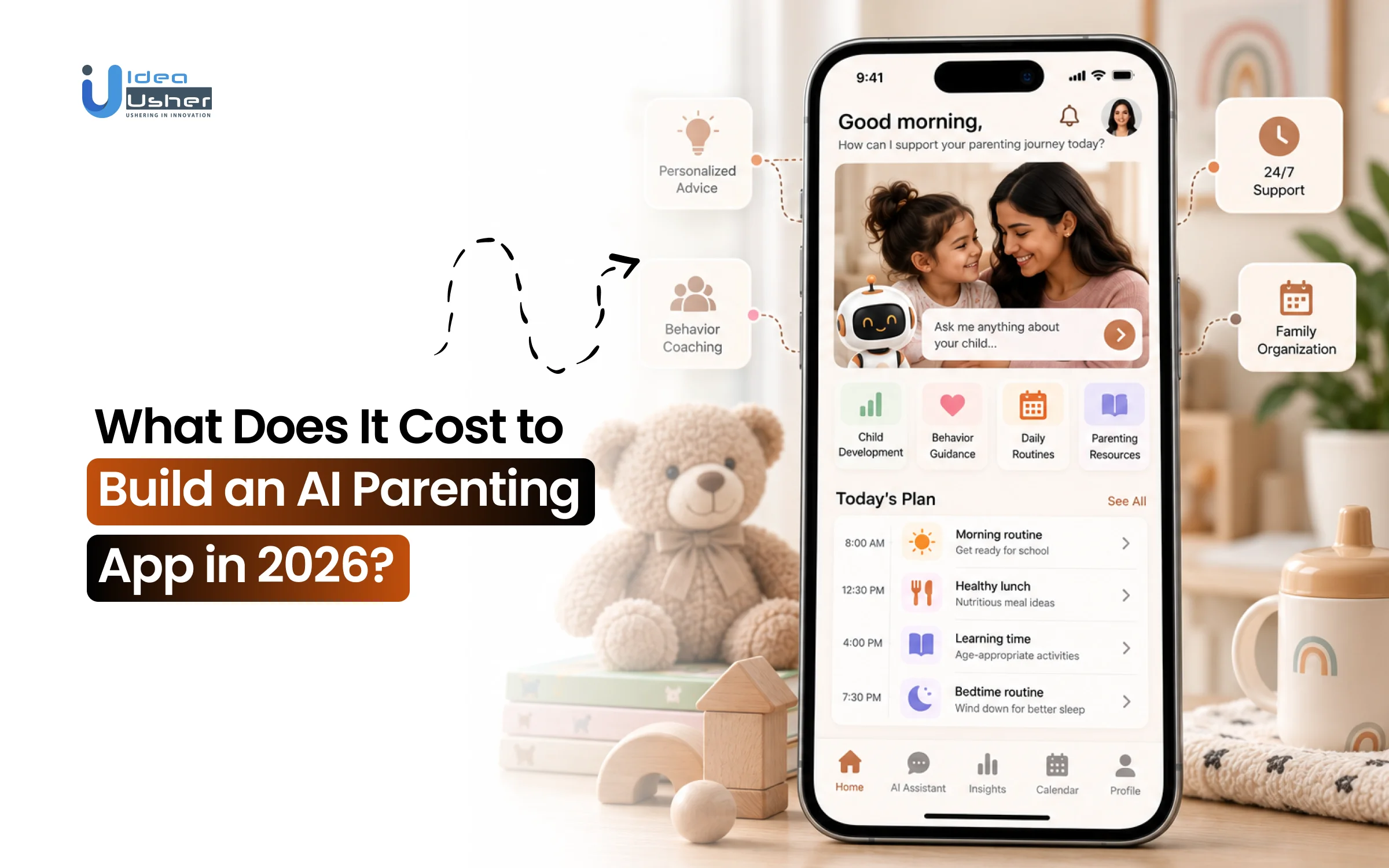
Key Takeaways
- AI parenting apps use child profiles, behavior data, conversational AI, predictive insights and curated content to give parents more relevant guidance.
- The AI parenting app development cost depends on factors like AI features, personalization, safety measures and compliance the app needs.
- An AI parenting MVP can start around $40,000–$70,000+, while more personalized and advanced platforms require a larger investment.
- Core capabilities of AI-powered parenting apps include retrieval-augmented generation, conversation memory, personalization and AI safety guardrails. These add technical complexity but improve the quality and safety of AI guidance.
- An AI parenting app needs COPPA/GDPR compliance for privacy and security. These requirements include consent management, data minimization, retention controls and privacy-first design, which can increase ongoing costs.
Parents are not looking for another app that simply generates parenting answers. They expect guidance that understands their child’s age, routines, developmental context and previous interactions, while sensitive family data demands strong privacy and safety controls. This makes AI parenting app development cost depend on the depth of personalization, intelligence and safeguards required rather than the chatbot interface alone.
A simple parenting assistant might use an LLM API and pre-made content. But a more advanced AI parenting app needs retrieval systems, detailed child profiles, personalization engines, expert-reviewed information, safety limits and ongoing model testing. Each layer changes development effort and ongoing infrastructure costs.
In this blog, we will talk about AI parenting app development cost in 2026, key cost factors, development stages, technology choices, AI infrastructure, maintenance expenses and how to plan a scalable AI parenting product without unnecessary complexity.
What Is an AI Parenting App and Why Is It Growing?
An AI parenting app is an intelligent, software-driven support system designed to assist caregivers by analyzing multi-variable child data and synthesizing actionable, real-time guidance. Unlike legacy tracking apps which function merely as passive digital spreadsheets for logging diapers, feeding ounces, and sleep timers, an AI parenting app operates as an active reasoning engine.
As millennial and Gen Z caregivers face the daily pressures of dual-income routines and fragmented family support, specialized artificial intelligence is emerging as an indispensable copilot for child rearing.
The platform continuously processes dynamic, individualized inputs:
- Exact Chronological & Corrected Age: Adjusting developmental expectations for gestational age and precise developmental windows.
- Neurological & Physical Developmental Stages: Tracking leaps across fine motor skills, language acquisition, and social-emotional maturation.
- Biometric & Behavioral Routines: Evaluating historical sleep architecture, wake windows, nutritional intake, and feeding intervals.
- Historical Interactions & Parental Philosophy: Learning the caregiver’s preferred methods (e.g., gentle parenting, Montessori, parent-led vs. child-led routines) to ensure stylistic alignment.
- Expressed Parental Concerns: Evaluating immediate parental prompts regarding temper tantrums, separation anxiety, or sleep regressions against established behavioral models.
By contextualizing these variables, the platform replaces generic articles with hyper-personalized recommendations tailored to that specific child at that precise moment.
A. What Can an AI Parenting App Do?
Modern AI parenting applications package specialized capabilities into an intuitive, commercially viable interface:
- 24/7 Conversational AI Support: Ingests unstructured caregiver queries (e.g., “My 18-month-old skipped their afternoon nap and is having a meltdown before dinner, what should I do?”) and returns empathetic, step-by-step guidance.
- Multi-Child Profiles: Isolates independent developmental timelines, medical histories, and behavioral baselines for each sibling within a unified household dashboard.
- Developmental Milestone Analytics: Maps qualitative progress against clinical surveillance frameworks, highlighting emerging strengths and identifying areas that require gentle stimulation.
- Predictive Sleep & Feeding Optimization: Analyzes biological rhythms to calculate dynamic “sweet spot” nap windows, preventing overtiredness and bedtime battles.
- De-escalation & Behavioral Coaching: Generates situational scripts and boundary-setting strategies for common parenting hurdles, including toddler aggression, food refusal, and separation distress.
- Proactive Environmental Reminders: Issues predictive push notifications ahead of milestone regressions, feeding transitions (e.g., starting solids), and routine adjustments.
B. Why Are AI Parenting Apps Gaining Market Demand?
According to market research from Market.us, the global parenting apps market was valued at $2.9 billion in 2024 and is projected to reach $5.5 billion by 2033, expanding at a compound annual growth rate (CAGR) of 12.2%. This growth reflects rising demand for digital parenting tools and personalized family support, creating opportunities for AI-powered apps that can deliver more contextual and responsive experiences.

The rising demand for AI-driven family platforms is propelled by shifting generational demographics and behavioral expectations:
- Fatigue with Generic, Conflicting Advice: Traditional search engines and community forums return millions of contradictory, anxiety-inducing opinions. Modern parents seek an authoritative, single source of synthesized truth that accounts for their child’s unique history.
- Pervasive Mobile Adoption Among New Parents: Millennial and Gen Z parents represent digital natives who manage their banking, health, and work via smartphones; they expect the same level of automated sophistication for family management.
- Demand for Immediate, Asynchronous Reassurance: Pediatric questions rarely occur during clinic hours. Having an intelligent triage assistant available at 2:00 AM to evaluate a sleep pattern or feeding strike alleviates cognitive load and emergency room anxiety.
- Acceptance of Assistive AI Tools: As consumer familiarity with generative assistants grows, parents actively seek purpose-built tools that augment their intuition without requiring complex prompting.
C. What Makes an AI Parenting App Different?
Building a specialized AI parenting app requires solving unique engineering and design challenges that separate it from generic conversational bots:
| Architectural Vector | Generic AI Chatbot / Legacy Tracker | Specialized AI Parenting Platform | Development & Cost Impact |
| Age-Aware Personalization | Flat responses based solely on user prompt keywords. | Adjusts tone, vocabulary, and developmental benchmarks down to the exact month/week. | High; requires fine-grained developmental state machines. |
| Context-Aware Recommendations | Treats every session as an isolated query. | Evaluates past 7-day sleep debt, feeding volumes, and previous parental interventions. | Requires high-throughput vector caching and persistent context graphs. |
| Developmental Intelligence | References static web articles. | Employs validated pediatric frameworks (e.g., CDC milestones, AAP guidelines). | Requires curated Retrieval-Augmented Generation (RAG) knowledge pipelines. |
| Routine Analysis | Displays historical numbers in a flat table. | Identifies temporal correlations (e.g., “Late naps increase night wakings by 40%”). | Demands time-series machine learning anomaly detection models. |
| Safety-Aware Response Filters | General content safety filters. | Specialized clinical safety guardrails to detect emergencies and refuse diagnoses. | Strict LLM guardrail engineering (e.g., NeMo Guardrails, custom classifiers). |
Enterprise Takeaway: AI parenting platforms transform fragmented tracking into proactive, context-aware family guidance. Yet turning clinical RAG models and strict AI guardrails into a viable product hinges on technical execution. This brings founders to a practical financial question: what does it take to build an AI parenting app and what is the development cost?

How Much Does AI Parenting App Development Cost in 2026?
AI parenting app development typically requires a moderate to high investment. The right investment level depends on which AI capabilities are core to your product and which can wait for a later release. Advanced AI and real-time functionality demand greater development effort.
IdeaUsher has worked with enterprises building AI-driven parenting and child-safety products such as Mamaverse, and the estimates below reflect current 2026 market rates
AI Parenting App Cost at a Glance
The AI parenting app development cost vary based on AI sophistication, personalization, data integrations and compliance scope. The table below compares three development tiers to show how functionality, technical complexity and timelines affect the overall investment.
| Feature | MVP ($40K–$70K) | Personalized Platform ($70K–$150K) | Advanced Ecosystem ($150K–$250K+) |
| AI chatbot | Basic, single-model | Context-aware, memory-enabled | Multi-modal (text + voice) |
| Personalization | Age-based rules | Behavior and data-driven | Predictive, custom-trained models |
| Data sources | Manual input | Manual + basic device sync | Wearables, IoT, real-time streams |
| Knowledge base | Static content | RAG-based retrieval | RAG + custom fine-tuned models |
| Alerts | Scheduled reminders | Pattern-based notifications | Real-time anomaly alerts |
| Language support | Single language | Single or dual language | Multilingual |
| Compliance scope | COPPA basics | COPPA + state-level data rules | COPPA, state laws, health-data handling |
| Timeline | 3–4 months | 5–8 months | 9–14 months |
These tiers provide a practical starting point for estimating AI parenting app development cost. Each level introduces greater AI capability, personalization and infrastructure, with corresponding increases in team size, development time and technical complexity. The following sections break down what each tier includes.
A. AI Parenting MVP
Estimated Cost: $40,000–$70,000+
This tier validates the core concept with a functional AI layer rather than a static app. It typically takes 3 to 4 months with a lean team of 4 to 6 (one AI/backend engineer, two mobile/frontend developers, one QA, one designer, part-time PM).
Core features:
- AI parenting chatbot: A single-model integration (via OpenAI, Anthropic, or Google API) trained on parenting guidelines to answer common questions about feeding, sleep, and development
- Child profiles: Basic profile creation storing age, birthdate, and developmental stage for one or multiple children
- Basic age-based recommendations: Rule-based content suggestions tied to a child’s age bracket rather than adaptive AI logic
- Milestone tracking: Manual or semi-automated logging of developmental milestones against standard pediatric benchmarks (CDC or WHO growth charts)
- Reminders: Push notifications for vaccinations, checkups, and milestone check-ins
- Curated parenting resources: A static or lightly tagged content library (articles, guides) rather than AI-generated content
- Basic admin panel: Content management, user management, and basic usage analytics for the internal team
At this stage, AI is used for conversational support only. There is no memory, personalization engine, or predictive layer, which is what keeps the cost contained.
B. Personalized Parenting Platform
Estimated Cost: $70,000–$150,000+
This tier turns the app into a genuinely adaptive product. Timeline runs 5 to 8 months with a team of 6 to 9, including a dedicated ML/AI engineer and data engineer.
Added features:
- Context-aware AI recommendations: The AI factors in a child’s age, past interactions, and logged data (sleep, feeding, mood) to tailor advice, instead of relying on static age brackets
- Conversation memory: Session-persistent memory so the AI assistant recalls prior questions and context across conversations, requiring vector database infrastructure (Pinecone, Weaviate, or pgvector)
- Routine tracking: Structured logging for daily routines (naps, meals, activities) with pattern visualization
- Sleep and feeding insights: AI-generated summaries and trend analysis from logged data, flagging deviations from expected patterns
- Family profiles: Multi-caregiver access with shared visibility across parents, grandparents, or nannies
- Personalized activities: AI-suggested developmental activities based on a child’s age, interests, and milestone progress
- Advanced analytics: Usage dashboards and behavioral trend reports for both parents and internal product teams
- RAG-based knowledge retrieval: Retrieval-augmented generation pulls from a curated, vetted parenting knowledge base (pediatric guidelines, verified sources) before generating responses, which reduces hallucination risk and is considered a baseline safety requirement for child-adjacent AI products in 2026
This tier is where most funded parenting-tech startups launch, since it balances meaningful AI differentiation with a manageable budget.
C. Advanced AI Parenting App
Estimated Cost: $150,000–$250,000+
This tier targets a defensible, data-rich product built for scale. Timeline runs 9 to 14 months with a team of 10 to 15, including dedicated ML engineers, a data scientist, and DevOps support for real-time infrastructure.
Added features:
- Voice AI: Speech-to-text and text-to-speech integration for hands-free interaction, useful for parents managing infants or young children
- Behavioral or emotion analysis: AI models that analyze text, voice tone, or logged behavioral data to flag developmental concerns or emotional patterns, typically requiring custom model training beyond off-the-shelf APIs
- Wearable integrations: Data sync with devices like Owlet, Apple Watch, or Fitbit for sleep, heart rate, and activity data
- IoT connectivity: Integration with smart home devices (baby monitors, smart cribs, air quality sensors) for real-time environmental data
- Real-time alerts: Instant notifications for anomalies detected across wearable, IoT, or behavioral data streams
- Multilingual AI: Support for multiple languages in both chatbot responses and content generation, important for the US market given its linguistic diversity
- Custom recommendation models: Proprietary ML models trained on aggregated (anonymized) user data rather than relying solely on general-purpose LLMs
- Predictive analytics: Forecasting models that flag potential developmental delays or health patterns early, based on longitudinal data trends
Compliance and safety infrastructure scale substantially at this tier, since behavioral analysis and predictive health features fall under closer regulatory scrutiny.
D. What Determines the Final Development Cost?
The final AI parenting app development cost depends on AI architecture, backend complexity, personalization, third-party integrations, child-safety mechanisms and compliance. These factors directly influence engineering effort, infrastructure, security and maintenance requirements.

1. AI architecture
Choosing a third-party LLM API (OpenAI, Anthropic, Google) versus a custom/fine-tuned model has the biggest cost impact. APIs reduce upfront engineering but add recurring token costs, while custom models add $20,000–$60,000+ for greater control over safety and tone.
2. Backend complexity
Real-time features like behavior detection, sleep tracking, and multi-device sync require scalable Node.js, Python/Django, or Go backends with event-driven architecture. Wearable or smart-home data streams can increase costs by 30–40% over standard REST APIs.
3. Personalization depth
Basic age-based recommendations are inexpensive, while adaptive advice based on developmental history, sentiment trends, and family context requires ML pipelines and larger datasets, adding $15,000–$50,000 depending on model complexity.
4. Child-safety mechanisms
Real-time content moderation, inappropriate-content detection, and emergency alerts require dedicated moderation pipelines, human-in-the-loop workflows, and continuous model updates, adding $10,000–$35,000 to development costs.
5. Compliance requirements
US AI parenting apps must account for COPPA and applicable state privacy laws, with health-adjacent apps requiring additional safeguards. Legal review, encryption, consent management and audit logging typically add $8,000–$25,000, depending on jurisdiction scope.
What Does an AI Parenting App Architecture Cost?
Architecture decisions, not feature lists, determine most of an AI parenting app’s real budget. Two apps with identical feature sets can differ in cost by $50,000 or more depending on which model is used, whether responses are grounded in curated content, how personalization is engineered, and how much safety infrastructure sits between the AI and the parent.
Architecture Cost Summary
AI parenting app architecture costs vary by the AI infrastructure, retrieval systems, personalization and safety layers required. The table below breaks down the major architecture components and their estimated development costs.
| Architecture Layer | Estimated Cost Range | Primary Cost Driver |
| LLM API integration | $5,000 – $15,000 | Number of workflows routed through the model |
| Model routing and selection | $8,000 – $20,000 | Multi-model logic complexity |
| Prompt orchestration | $10,000 – $25,000 | Framework choice and workflow count |
| Embeddings and vector database | $11,000 – $27,000 | Content volume and update frequency |
| RAG knowledge base | $15,000 – $35,000 | Source curation and maintenance workflow |
| Personalization and memory | $20,000 – $45,000 | Number of integrated data sources |
| Moderation and safety guardrails | $18,000 – $40,000 | Number of escalation and review paths |
Skipping RAG grounding to save $20,000, for example, increases hallucination risk in exactly the product category where hallucinated advice carries the highest consequence. IdeaUsher’s team scopes AI parenting app architecture around this tradeoff directly, building the safety and retrieval layers in from the start rather than retrofitting them after launch.
The architecture determines how reliably the app can generate, personalize and safeguard AI responses. Each layer serves a specific purpose, and the following sections explain its cost, technical role and impact on the overall product.
A. AI Model and LLM Infrastructure
Most parenting apps in 2026 build on hosted LLM APIs rather than training models from scratch, but each layer of this stack adds its own cost:
- LLM APIs: Hosted models (OpenAI GPT-4o/GPT-5, Anthropic Claude, Google Gemini) charge $0.002–$0.03 per 1,000 tokens, a recurring operating cost separate from development. Integration adds $5,000–$15,000 depending on workflow count.
- Model selection: Production apps often route simple factual queries to a lightweight model and nuanced parenting guidance to a higher-capability model. Building this routing logic adds $8,000–$20,000.
- Prompt orchestration: System prompts, few-shot examples and output formatting need a managed orchestration layer (LangChain, LlamaIndex, or custom-built), adding $10,000–$25,000.
- Embeddings: Converting parenting content and queries into vector representations for meaning-based retrieval adds $5,000–$12,000 in setup plus ongoing compute cost.
- Vector databases: Managed options (Pinecone, Weaviate, pgvector, Qdrant) run $70–$500+ per month depending on data volume, with $6,000–$15,000 for setup and integration.
- Inference costs: Every AI-generated response incurs a per-call cost. At scale, inference typically becomes the largest recurring operational expense once active users pass a few thousand.
B. RAG and Curated Parenting Knowledge Bases
Parenting apps cannot rely on unrestricted LLMs for child health or development queries. Because general models use broad internet data, they risk generating outdated or inaccurate medical advice, an unsafe basis for care decisions.
Retrieval-augmented generation (RAG) grounds every response in a curated, vetted knowledge base before the model generates an answer:
- Reduced hallucination: Responses are anchored to trusted sources (AAP guidelines, CDC developmental milestones, reviewed parenting content) instead of the model’s general training data.
- Editable without retraining: Content teams can update guidance directly in the knowledge base without retraining the underlying model.
- Audit trail: Every AI response can be traced back to the source content that informed it, which matters for liability and compliance review.
Building a properly curated RAG pipeline including sourcing, tagging, and maintenance, adds $15,000–$35,000 to development cost. It is a baseline requirement, not an optional upgrade, for child-focused AI products in 2026.
C. Personalization and Conversation Memory
Effective personalization draws on four data sources working together rather than any single input:
- User context: Parent preferences, usage patterns, and stated goals (sleep training, feeding schedules)
- Child profiles: Age, developmental stage, growth data, and logged health or milestone information
- Historical conversations: Prior questions and advice, stored in a persistent memory layer so each session isn’t treated as a first interaction
- Behavioral patterns: Trends from logged data, such as sleep regressions or feeding changes, that enable proactive recommendations rather than only reactive answers
Feeding these sources into the recommendation engine requires a structured database for profile data plus a vector store for conversational context, with logic that weighs recency and relevance. This is why personalization and memory infrastructure runs $20,000–$45,000 and is the main reason mid- and advanced-tier budgets jump above the MVP tier.
D. AI Moderation and Safety Guardrails
Safety infrastructure is non-negotiable for any AI product advising parents about children, and it is one of the most commonly underbudgeted parts of an AI parenting app:
- Unsafe-response detection: Automated screening flags factually risky or inappropriate outputs before they reach the user.
- Sensitive-topic handling: Dedicated logic routes topics like abuse indicators or self-harm mentions away from AI-generated responses toward vetted resources or human escalation.
- Age-aware responses: The AI checks profile data before responding, so guidance matches the specific child’s age and developmental stage rather than defaulting to generic advice.
- Medical escalation: Clear rules define when the AI stops generating advice and directs the parent to a pediatrician or emergency service.
- Prompt injection protection: Safeguards prevent users from manipulating the AI through crafted inputs to bypass safety rules, a growing concern for consumer-facing LLM apps in 2026.
- Human review workflows: Flagged conversations and edge cases route to a human moderator, closing the loop on cases the automated system can’t confidently resolve.
Building this full safety stack adds $18,000–$40,000 depending on the number of escalation and review paths required.
How Do Child Safety and Compliance Affect AI Parenting App Cost?
Child safety and compliance increase AI parenting app development cost because they require COPPA compliance, consent management, content moderation, data encryption, audit logging and emergency safeguards. These measures add specialized engineering, legal review and ongoing monitoring to protect children and families.

A. COPPA Requirements for Child-Focused Apps
The Children’s Online Privacy Protection Act (COPPA) governs any US app that collects personal information from children under 13, and it directly shapes how a parenting app must be architected.
Meeting these requirements adds $8,000–$20,000 in development cost for consent flows, data tagging, and retention automation, on top of ongoing legal review.
- Parental consent: Requires verifiable parental consent before collecting a child’s personal data, making a documented consent flow essential, not just a signup checkbox.
- Children’s data scope: Covers data such as names, photos, voice recordings, and geolocation, commonly used in voice AI and photo-based milestone features.
- Data collection limits: Data collection must be reasonably necessary for the feature, requiring teams to justify each data point rather than collect broadly for future use.
- Retention rules: Child data must not be retained longer than necessary, requiring automated retention and deletion policies within the backend.
B. GDPR and Children’s Data Protection
Any parenting app planning international deployment, or serving US users with EU family members, adds $12,000–$25,000 in architecture and legal costs, since a single global policy usually cannot satisfy both frameworks.
- Consent standards: Requires parental/guardian consent for children under 16 or as low as 13 depending on the EU state, with verifiable informed consent.
- Data minimization: Limits collection to data strictly necessary for the stated purpose, affecting how granular behavioral and health-adjacent data can be logged.
- Deletion rights: Gives parents, and eventually children, rights to full data deletion, requiring workflows that cascade across databases, backups, and AI training data.
- Retention limits: Data must be deleted once its original purpose is fulfilled, similar to COPPA but enforced with stricter documentation and audit requirements.
C. Privacy-First Data Architecture
Meeting COPPA and GDPR requirements in practice comes down to six architectural components, each with its own cost and engineering effort:
- Encryption: Data encrypted at rest and in transit (AES-256 and TLS 1.3 are current 2026 baselines), protecting children’s data from exposure in the event of a breach.
- Access controls: Role-based access control (RBAC) limiting which internal team members and system processes can view or modify child-related data.
- Data segregation: Isolate children’s data from general application data using separate database schemas or environments to simplify audits and limit breach exposure.
- Consent management: Maintain a dedicated consent record tracking what each parent approved, when, and for which specific data uses.
- Data deletion workflows: Automate cascading deletion across primary databases, backups, analytics systems, and AI models trained on the data.
Building this full privacy-first architecture typically adds $20,000–$45,000 to development cost, but it is what separates a compliant parenting app from one carrying significant regulatory and reputational risk.
What Are The Hidden Costs After Building an AI Parenting App
The AI parenting app development cost cost covers the build but It does not cover what it takes to keep an AI parenting app running, compliant and accurate after launch. These recurring costs are frequently left out of initial budgets, and they typically add 20 to 35 percent of the original development cost annually.
IdeaUsher factors these ongoing costs into project scoping upfront so clients aren’t blindsided by them after launch.
| Cost Category | Estimated Annual Cost | What It Covers |
| LLM inference and API usage | $6,000 – $60,000+ | Per-token or per-call charges that scale directly with user volume and conversation frequency |
| Cloud hosting and infrastructure | $6,000 – $30,000 | Servers, database hosting, vector database subscriptions, and CDN costs that scale with active users |
| Model monitoring and retraining | $10,000 – $30,000 | Tracking model drift, accuracy degradation, and periodic retraining or fine-tuning updates |
| Content and knowledge base maintenance | $8,000 – $20,000 | Updating the curated parenting knowledge base as pediatric guidelines and best practices evolve |
| Human moderation and review | $12,000 – $35,000 | Staff reviewing flagged conversations, sensitive-topic escalations, and edge cases the AI can’t resolve |
| Compliance and legal review | $8,000 – $25,000 | Ongoing COPPA/GDPR audits, privacy policy updates, and legal review as regulations change |
| Security audits and penetration testing | $5,000 – $15,000 | Periodic third-party testing to catch vulnerabilities in systems handling children’s data |
| Customer support infrastructure | $10,000 – $25,000 | Support staff and tooling for parent-facing issues, billing, and account or data-deletion requests |
| App store and platform fees | $2,000 – $5,000 | Apple and Google developer fees, plus 15–30 percent commission on in-app subscription revenue |
| Bug fixes and minor updates | $8,000 – $20,000 | Ongoing QA, OS compatibility updates, and small feature fixes outside major version releases |
Total estimated annual maintenance cost: $75,000 – $265,000, depending on user scale, AI complexity, and how much moderation and compliance work is handled in-house versus outsourced.
Build vs Buy vs Customize AI for a Parenting App
The build-versus-buy decision is a commercial call, not just a technical one. It determines how fast the product reaches the market, how much control the team has over AI behavior, and how development costs scale as the user base grows.

A. When to Use Third-Party AI APIs
Off-the-shelf LLM APIs are the right starting point for most parenting apps entering the market:
- Faster launch: Integration with an existing API (OpenAI, Anthropic, Google) takes weeks rather than the months required to train a custom model, keeping the MVP timeline at 3–4 months.
- Lower upfront investment: No data collection, labeling, or training infrastructure is needed, which keeps development cost in the $40,000–$70,000 MVP range covered earlier in this article.
- Proven reliability: Established providers already handle scaling, uptime, and base-level safety filtering, reducing the engineering burden on a small team.
- Best fit: Early-stage products validating market demand, teams without in-house ML expertise, and founders prioritizing speed to launch over deep customization.
The tradeoff is limited control over model behavior and ongoing per-token costs that scale directly with usage, which becomes a larger line item as the user base grows.
B. When to Customize an Existing AI Model
Fine-tuning or prompt-engineering an existing foundation model sits between off-the-shelf APIs and a fully custom model, and it fits products that have moved past initial validation:
- Domain specialization: Fine-tuning on parenting-specific data (verified pediatric guidance, curated Q&A pairs) improves response consistency compared to a general-purpose model prompted at inference time.
- Response consistency: A fine-tuned model reduces the variability that comes from relying purely on prompt engineering, which matters when parents expect dependable tone and accuracy across sessions.
- Moderate cost increase: Fine-tuning adds $20,000–$60,000 to development cost depending on dataset size and iteration cycles, positioning this option in the mid to advanced cost tiers covered earlier.
- Best fit: Products with real usage data from an MVP stage, teams that have identified specific gaps in general-purpose model responses, and companies preparing to differentiate on AI quality rather than features alone.
This path still relies on a third-party foundation model, so it does not remove ongoing inference costs, but it improves output quality without the full expense of training a model from scratch.
C. When a Custom AI Model Makes Financial Sense
Building a fully custom AI model is rarely justified before a company has scale and data to support it. It makes financial sense under a specific set of conditions:
- Proprietary datasets: A large, unique dataset such as millions of interactions, verified outcomes, or clinical partnerships can become a defensible AI asset that general-purpose models cannot replicate.
- Scale: At meaningful scale, often hundreds of thousands of active users, third-party API inference costs may exceed the amortized cost of training and hosting a proprietary model.
- Differentiation: If the product depends on AI behavior competitors cannot reproduce with the same APIs, the model becomes a defensible moat rather than a commodity feature.
- Control: Model ownership eliminates dependence on third-party pricing, rate limits, and policy changes, supporting greater long-term platform stability.
- Long-Term AI Economics: Custom models require ongoing ML talent, compute, and retraining, adding $80,000–$150,000+ beyond advanced-tier costs; the investment must deliver sufficient multi-year savings or differentiation.
For most parenting app founders, the realistic path runs from third-party APIs at launch, toward model customization once usage data justifies it, and only toward a fully custom model once scale and proprietary data make the economics work. IdeaUsher helps founders map this progression against their specific AI parenting app development cost and growth timeline, rather than defaulting to the most expensive option prematurely.
How Can an AI Parenting App Make Money?
Three models cover most of what works in this category: freemium subscriptions, family and expert-led tiers, and B2B2C distribution through employers. Each one requires different things to be built into the product from day one, not bolted on after launch.
Revenue Model Comparison Table
AI parenting apps can generate revenue through several models, each with different pricing structures, product requirements and monetization mechanics. The table below compares the most relevant approaches and their architectural implications.
| Model | Estimated Pricing Benchmark | What It Requires in the Architecture | Example |
| Freemium (free tier + upsell) | Free tier, paid tier from ~$5–$15/month | Feature gating, usage metering, in-app billing | Most category leaders run this as the base model |
| Premium subscription (AI + advanced tracking) | $11.99–$14.99/month ($68.88–$119.88/year) | Entitlement system separating AI depth by tier | Huckleberry Plus/Premium |
| Family plan (multi-caregiver) | Typically priced above single-user premium, often $100–$200+/year | Multi-user data model, shared profiles, permission levels | Common bundled add-on at the top subscription tier |
| Expert-led services (bundled consultations) | Bundled into top-tier subscription rather than sold standalone in most cases | Booking/scheduling system, human-in-the-loop workflow | Huckleberry’s expert sleep plans |
| B2B2C / employer benefit | Enterprise contract pricing, not publicly disclosed; billed per-employee to the employer, not the parent | Multi-tenant accounts, SSO, HR-facing reporting dashboard | Maven Clinic, Cleo |
Choosing a revenue model early helps shape the product architecture and user experience. The following sections explain how each approach works and the technical requirements needed to support sustainable monetization.
A. Freemium and Premium Subscriptions
A freemium model attracts users with essential parenting tools at no cost, while premium subscriptions unlock advanced AI guidance, personalized recommendations, developmental insights and exclusive resources. This approach creates a low-friction entry point while generating recurring revenue from engaged families.
This model requires specific architecture decisions made early, not retrofitted later:
- Feature gating and entitlements: The app needs a permissions system that can cleanly separate free features from paid ones, including which AI conversations or recommendations trigger a paywall.
- Usage metering: If premium access is capped by conversation volume or query type rather than a flat unlock, the backend needs to track and enforce that from the first release.
- In-app purchase and billing infrastructure: Recurring billing, trial periods, and cancellation flows need to be built to platform standard (Apple/Google billing APIs) from the MVP stage.
B. Family Plans and Expert-Led Services
Family plans can expand revenue by allowing multiple caregivers to access shared profiles, routines and AI insights under one subscription. Expert-led services add another revenue stream through consultations, workshops and personalized guidance that complement automated parenting support.
This model has direct product implications:
- Multi-user, multi-child architecture: A family plan means the data model has to support multiple caregivers accessing the same child profile, with permission levels for each parent or caregiver.
- Expert scheduling and booking systems: If the product includes real consultations, not just AI chat, it needs a booking and calendar system integrated with the app, not a separate tool bolted on.
- Tiered personalization logic: A “personalized plan” tier needs a defined system for how AI-generated guidance differs from the base tier, or the upgrade has no clear value to the parent.
C. B2B2C Partnerships and Employer Benefits
Selling to employers as a family benefit is an established channel in this category. Maven Clinic and Cleo both distribute through employer benefit programs rather than direct-to-consumer purchase alone, and industry data shows 42% of leading parenting and family-tech companies now expand through partnership channels rather than pure consumer acquisition.
This model changes what the product needs structurally:
- Multi-tenant account architecture: Employer-sponsored access means the app needs to support organization-level accounts, employee eligibility checks, and enrollment separate from individual sign-up.
- Single sign-on (SSO) and enterprise authentication: Employer benefit platforms typically require SSO integration (SAML or OIDC) rather than standard consumer login.
- Aggregate reporting for HR/benefits teams: Employers paying for access expect anonymized usage and engagement reporting, which requires analytics infrastructure the consumer-only version doesn’t need.
How IdeaUsher Can Build Your AI Parenting App
IdeaUsher operates as an enterprise product engineering partner and consumer AI innovator, backed by 11+ years of software expertise, 250+ technical specialists and a 4.9/5 Clutch rating across 1,000+ delivered builds.
We construct custom, family-centric AI platforms engineered from the ground up to handle sensitive developmental data, deliver trustworthy pediatric guidance, and scale effortlessly as your user base expands.
A. From Parenting App Concept to AI Product Strategy
Transforming an early concept into a commercially viable, high-retention parenting platform requires balancing empathetic design with technical feasibility:
- Discovery & Use-Case Definition: We define core user personas like expectant parents, toddler caregivers, or parents of neurodiverse children and map the specific operational problems the app will solve.
- AI Feasibility & Unit Economics: We assess whether features need rule engines, fine-tuned models, or commercial LLM APIs, forecasting token usage and hosting costs to protect operating margins.
- Feature Prioritization: We identify and prioritize daily sticky loops such as conversational milestone check-ins, sleep optimizers, and nutrition trackers to accelerate product-market fit.
B. AI Architecture Built Around Safety and Personalization
Parenting technology demands higher accuracy and privacy standards than generic consumer apps. We engineer defensible, safety-first intelligence layers:
- Domain-Grounded RAG Pipelines: We build RAG architectures connected to verified pediatric literature, child-development frameworks, and proprietary content to minimize model hallucinations.
- Contextual Personalization Engines: We develop ML recommendation models that adapt guidance using the child’s age, developmental progress, past queries, and logged behaviors.
- Pediatric Guardrails & Safety Filters: We implement multi-layer moderation to detect medical red flags, triage emergencies, and direct parents to clinical care instead of speculative diagnoses.
- Privacy-Aware Data Vaults: We architect COPPA, GDPR-K, and state-compliant data systems with AES-256 encryption, zero-retention AI routing, and granular parental consent controls.
C. MVP Development With a Clear Path to Scale
We engineer modular, decoupled systems so your foundational release easily accommodates advanced intelligence later without costly rewrites:
- Modular Microservices Architecture: We build independent, containerized services for authentication, profile telemetry, chat orchestration, and analytics, allowing each service to scale independently during traffic spikes.
- Pluggable Model Frameworks: Our abstraction layers let teams swap, benchmark, and upgrade LLMs or embedding providers as faster, more cost-efficient models emerge.
- Roadmap Expansion Readiness: We design clean data pipelines to support future multimodal capabilities, including cry-audio analysis, computer-vision meal logging, and automated voice-journal transcription.
- Zero Vendor Lock-In: We deliver clean, modular, documented source code with automated deployment scripts, ensuring complete ownership of intellectual property and user data.
Planning to launch an intelligent, family-centric mobile platform? Share your app concept, target audience cohorts, desired feature scope, and target platforms (iOS, Android, Web) with Idea Usher’s principal AI software architects today to receive a detailed technical breakdown, delivery timeline, and customized development cost estimate.
Conclusion
The AI parenting app development cost in 2026 depends largely on the level of personalization, AI intelligence, safety controls, integrations, and scalability your product requires. A focused MVP can start around $40,000, while advanced platforms may exceed $250,000. For businesses evaluating the AI parenting app development cost, prioritizing core use cases and a safety-first architecture can help control initial investment while leaving room to scale. A clear product roadmap also makes it easier to balance user value, compliance, and long-term operational costs.
FAQs
A.1. AI parenting app development cost typically $40,000 to $250,000+, depending on AI complexity, personalization, integrations, safety requirements, platforms, and infrastructure needed for launch and future scalability.
A.2. Core features include AI parenting assistance, child profiles, milestone tracking, personalized recommendations, routine management, reminders, family scheduling, and safety-focused conversational support tailored to developmental stages and parental concerns.
A.3. AI parenting apps can monetize through subscriptions, freemium plans, premium AI features, family packages, personalized insights, and strategic B2B partnerships, with pricing aligned to ongoing AI and infrastructure costs.
A.4. Strong AI parenting apps combine age-aware personalization, reliable knowledge sources, contextual recommendations, proactive assistance, privacy protection, and safety guardrails to provide useful guidance without replacing parents or qualified professionals.


