


Key Takeaways
- DramaBox clone app development cost: Approximately $40,000–$150,000+, depending on the feature set and technical complexity.
- Core features: Vertical video streaming, short episodes, search, categories, watch history, watchlists, and seamless episode navigation.
- Monetization: Coins, subscriptions, premium episodes, in-app purchases, and advertising can be integrated into the platform.
- Advanced capabilities: AI-powered recommendations, adaptive video streaming, multilingual support, content moderation, and detailed analytics can make the app more competitive.
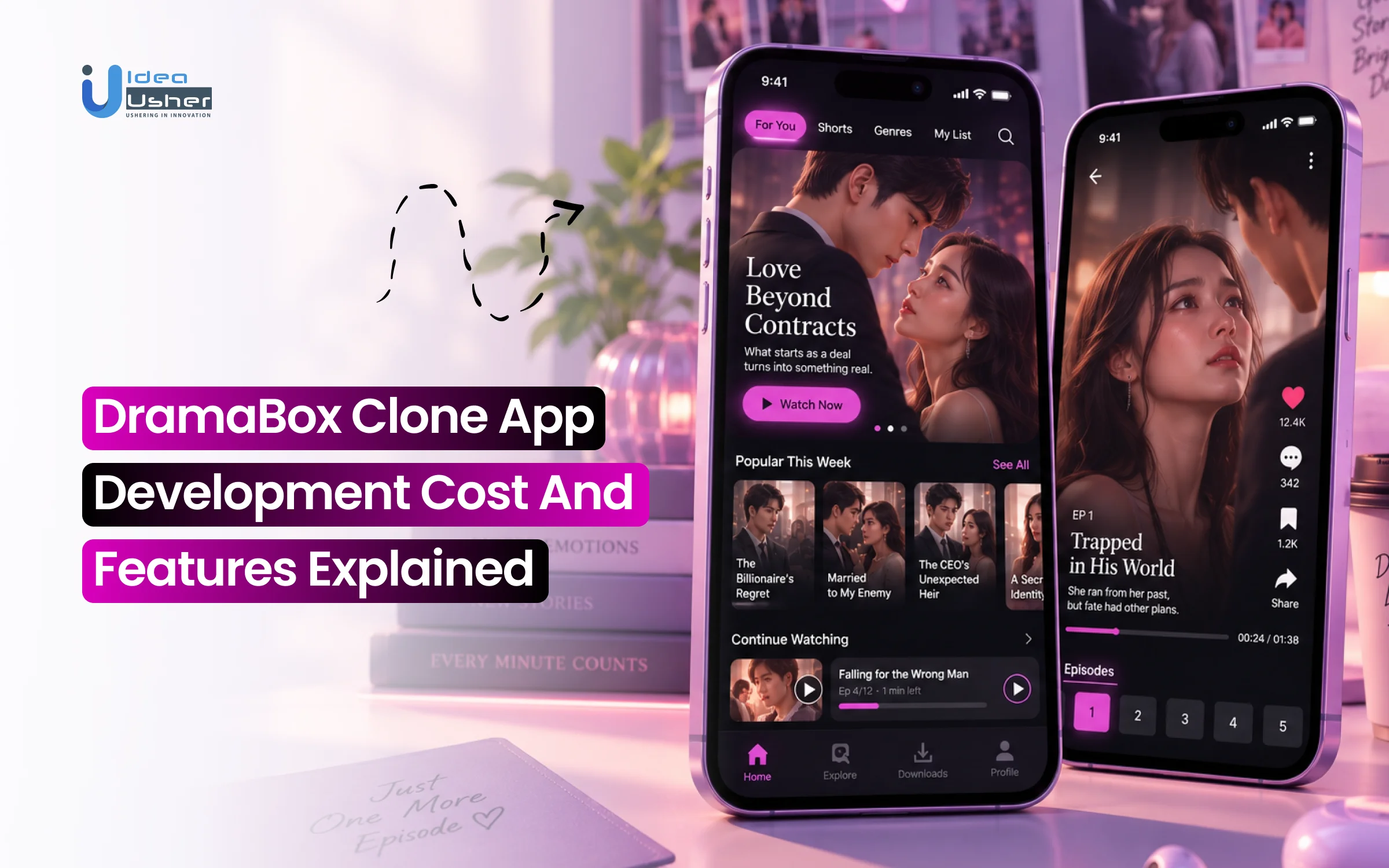
The cost to develop a DramaBox clone app typically ranges from $40,000 to $150,000+, depending on the platform, features, UI/UX complexity, streaming infrastructure, monetization model, and level of customization. A basic MVP with core short-drama streaming features can cost less, while an advanced platform with AI recommendations, coin-based payments, subscriptions, multilingual content, analytics, and scalable video infrastructure can require a significantly higher investment.
The key features of a DramaBox-like app include vertical short-drama streaming, personalized recommendations, episode navigation, user profiles, watchlists, search and discovery, coins and subscriptions, premium episode unlocking, push notifications, content management, analytics, and advertising tools. IdeaUsher has worked on numerous short-form drama streaming solutions that use CDN integration and video transcoding to deliver a smooth and reliable viewing experience. In this blog, we’ll walk you through the key features and development cost of building a short-form drama streaming app like DramaBox.
What Is Driving Demand for Short-Drama Streaming Apps?
The growing use of streaming is creating more room for short-drama apps. According to Research and Markets, the media streaming market is expected to grow from $145.87 billion to $158.14 billion at an 8.4% CAGR. Short dramas fit this shift well because viewers can watch quick episodes whenever they have a few minutes. Apps like DramaBox, ReelShort, and ShortMax are using this format to make mobile entertainment faster and easier to consume.

Source: Research and Markets
Short Episodes Fit Into Busy Daily Routines
People do not always have an hour to watch a show. A short drama gives them something they can watch while commuting, taking a break, or waiting for an appointment. The story can move quickly and end with a strong reason to watch the next episode. That simple format works well on smartphones because viewers can start and stop without losing much context.
ReelShort is a good example of how far this model has grown. Sensor Tower data reported about $130 million in global in-app revenue in Q1, making it one of the leading short-drama apps. Its business has continued expanding beyond its own shows as well. ReelShort recently partnered with WWE to create an original live-action microdrama featuring WWE Superstars. The platform says it now reaches more than 70 million monthly active users across over 100 countries.
That kind of expansion shows that short dramas are becoming more than quick mobile entertainment. They are becoming a new way for entertainment brands to reach audiences.
Faster Content Discovery
Short-drama apps are also changing how viewers find something to watch. Instead of searching through a large library, users can open the app and start watching almost immediately. A personalized feed can then keep showing stories based on what they watch, skip, or finish.
| Traditional Streaming | Short-Drama Streaming |
| Longer episodes | Short episodes |
| Search-heavy discovery | Feed-based discovery |
| Longer viewing sessions | Frequent short sessions |
| Subscription-focused | Coins, ads, subscriptions, and purchases |
| Large content library | Fast-moving story catalog |
ShortMax shows how this model is expanding across markets. The platform now offers more than 50,000 short dramas and movies across 19 languages and continues to add localized content. It also crossed 100 million downloads, showing that the format can scale beyond a single language or region.
The revenue opportunity is also significant. ShortMax generated an estimated $7.2 million in revenue during one month through a combination of in-app purchases and advertising, according to Insightrackr.
Cliffhangers Drive Repeat Viewing
Short dramas often end episodes at a major moment in the story. Viewers then have a reason to continue with the next episode. This creates a simple loop: DramaBox has also shown how powerful this model can become. Sensor Tower estimates put its global in-app revenue at around $120 million in Q1, with cumulative revenue reaching about $450 million by the end of the quarter.
For businesses, the lesson is simple. A successful short-drama app is not just about short videos. The real value comes from creating a viewing loop that keeps users coming back.

What Makes a DramaBox Clone Different From a Normal OTT App?
A DramaBox clone is different from a normal OTT app because it is made for short and quick storytelling. Normal OTT platforms focus on longer movies and shows with a traditional browsing experience. DramaBox-style apps use short episodes, vertical scrolling, fast content discovery, and episode-based unlocking to keep viewers watching.
1. Vertical Short-Drama Streaming
Short dramas are usually designed for vertical viewing on smartphones. Users can discover a story and start watching without going through several menus. The player should also make it easy to move between episodes. Fast loading and smooth playback help keep viewers engaged.
ReelShort is a good example of this approach. The platform focuses on mobile-first microdramas and has expanded its content through partnerships, including a recent collaboration with WWE for an original microdrama.
2. Episode-Based Content Unlocking
Traditional OTT platforms usually give users access to a full movie or series. Short-drama apps can unlock content episode by episode. The first few episodes may be free while later ones require coins or another payment method. This gives the platform more control over how viewers move through a story.
3. Coin-Funded Viewing
Coins can act as the main payment system inside a short-drama app. Users can buy a coin package and spend those coins to unlock premium episodes. The platform can also use coins for promotions and rewards. For example, new users could receive free coins when they join.
| Component | Purpose |
| Coin Wallet | Stores user balance |
| Coin Packages | Handles coin purchases |
| Episode Pricing | Sets unlock costs |
| Transaction History | Tracks spending |
| Unlock System | Gives access to paid episodes |
4. Personalized Drama Discovery
Short-drama apps often need more than a basic search system. Personalized recommendations can help users discover stories that match their interests. The app can learn from actions such as completed episodes, skips, searches, and watch history. Over time, this data can improve the content shown on the user’s home feed.
Viewer behavior → Recommendation engine → Personalized feed
5. High-Frequency Episode Publishing
Short dramas can be consumed quickly, so viewers may move through content faster than they would on a traditional OTT platform. Regularly adding new episodes and stories helps keep the catalog fresh. ShortMax is an example of a platform following this model. Its app offers 50,000+ short dramas and movies across 19 languages and continues to add new episodes and localized content.
This makes a strong content management system important. Admins should be able to upload episodes, schedule releases, manage languages, and organize dramas without making the publishing process complicated.
6. Mobile-First Viewer Experience
A DramaBox-like platform should make watching simple on a phone. Users should be able to open the app, find a story, and start watching with very little effort. The interface can focus on quick discovery, simple navigation, clear episode progress, and easy access to the next episode.
The basic journey should be:
Open App → Discover Drama → Watch → Continue
That simple flow can make a big difference in keeping viewers engaged.
What Features Should a DramaBox Clone App Include?
A DramaBox clone app should include the features that make short dramas easy to discover and watch. A vertical video player, personalized feed, episode access, search, watch history, and simple payments can create the core experience. For your own platform, it is better to start with the features that keep viewers watching and then add advanced tools as the audience grows.

1. Personalized Home Feed
The home screen should help users find something interesting as soon as they open the app. Instead of showing the same dramas to everyone, the feed can learn from watch history, searches, likes, and completed episodes. It can also highlight trending stories and new releases that match each viewer’s interests.
2. Vertical Swipe-Based Video Player
The video player should be built around vertical viewing. Users can swipe to discover another drama or move through content without leaving the viewing experience. The player can also support autoplay, playback controls, subtitles, and episode progress. Fast loading matters because even a short delay can break the flow of short-form viewing.
ReelShort follows this mobile-first format and continues to expand its vertical drama catalog. Its platform is also experimenting with newer content formats, including AI-generated drama content.
3. Episode-Wise Content Access
Short dramas often work better when viewers do not get the entire story at once. The app can offer the opening episodes for free and then restrict later episodes. This gives the platform control over how content is released. It also allows different dramas to use different access rules.
Typical access flow:
Free Episode → Locked Episode → Unlock → Continue Watching
4. Coin Wallet for Premium Episodes
A coin wallet gives users a simple way to unlock paid episodes. They can purchase coins and spend them across different dramas instead of making a separate payment for every episode. The wallet should clearly show the balance and transaction history. The unlock process should also be quick so users do not lose interest while moving between episodes.
| Feature | Purpose |
| Coin Wallet | Stores user credits |
| Coin Packages | Handles purchases |
| Episode Pricing | Sets unlock costs |
| Transaction History | Tracks spending |
5. Subscription and VIP Access
Coins do not have to be the only way to access premium content. A VIP plan can give regular viewers another option. A subscription could provide early access to episodes, exclusive dramas, ad-free viewing, or other benefits. The exact package can depend on the platform’s content strategy.
- What it does: Creates a recurring access option.
- Why it matters: Gives frequent viewers more flexibility.
- Development impact: Requires subscription management, payment integration, and entitlement controls.
6. Continue Watching and Watch History
Viewers should not have to search for a drama again after leaving the app. A Continue Watching section can take them directly back to the episode they stopped. The platform can also save their viewing history. This makes the experience feel more personal and gives the recommendation system useful data for future suggestions.
7. Genre, Language, and Keyword Search
Search becomes important as the content library grows. Users should be able to find dramas by title, genre, language, or keywords. Filters can make discovery even easier. Someone looking for a romance drama should not have to scroll through hundreds of unrelated stories. It can also show trending dramas and personalized suggestions to help viewers discover new stories faster.
Useful search filters include:
- Romance
- Thriller
- Fantasy
- Revenge
- Family
- Language
- Trending
8. Watchlist and Favorite Dramas
Not every viewer will finish a drama in one sitting. A watchlist lets users save stories they want to return to later. A favorite option can also help users keep track of dramas they enjoy. These actions provide another useful signal for the recommendation system. It also makes it easier for viewers to pick up a story exactly where they left off.
Development impact: The feature is relatively simple but needs to stay synchronized across the user’s devices.
9. Subtitles and Multi-Language Support
Short dramas can reach audiences across different countries when the content is properly localized. Subtitles are usually the first step, while dubbing can be added for important markets later. ShortMax provides a useful example. Its current app listing offers more than 50,000 short dramas and movies across 19 languages. Recent updates have also added new dramas and localized content while improving app performance.
For a new platform, the content system should make it easy to upload and manage different language versions.
10. Offline Video Downloads
Offline viewing can help users watch dramas when their connection is weak or unavailable. It can be especially useful for viewers who watch content while travelling. The platform can control which episodes are downloadable and how long they remain available. Downloaded content can also be protected to reduce unauthorized sharing.
- What it does: Stores approved episodes for offline playback.
- Why it matters: Gives viewers more flexibility.
- Development impact: Requires secure local storage and download management.
11. Ratings, Comments, and Social Sharing
Viewer interaction can make a short-drama platform feel more like a community. Users can rate a drama, leave comments, or share a story with friends. GoodShort has also built content discovery around short dramas and regularly publishes new story recommendations and drama-related content across multiple languages. Its platform continues to add new titles and localized releases.
These interactions can also help identify popular stories and genres. That information can later support content recommendations.
12. Push Notifications for New Episodes
Notifications can bring viewers back when a new episode is released. They can also remind users about unfinished dramas or recommend a new series based on their interests. The key is to keep notifications relevant. Too many alerts can make users turn them off. It can also highlight new releases from creators or genres that the viewer already follows.
Examples of useful notifications:
- “Episode 12 of your drama is now available.”
- “A new thriller based on your watch history is here.”
- “You’re one episode away from finishing this story.”
A good notification system connects content releases with viewer behavior instead of sending the same message to everyone.
Which DramaBox Clone App Features Directly Drive Revenue?
DramaBox makes money by getting viewers to pay for premium viewing. Its model uses coin-based episode unlocks, subscriptions, and rewarded ads, so users can either pay directly or earn coins by completing activities. For a similar app, the key is to place the paid option after viewers are already interested in the story while keeping the payment flow simple.
1. Dynamic Episode Paywalls
A paywall does not have to appear as soon as a viewer opens a drama. The platform can first give users enough free content to understand the story and build interest. The paywall can then appear at a point where the next episode feels worth unlocking. DramaBox uses this kind of episode-based model. Sensor Tower estimates that the platform generated about $120 million in in-app revenue in a quarter. Its cumulative in-app revenue had also reached around $450 million.
The important product decision is where the paywall appears. A well-designed platform can test different points and learn which episodes lead to the most unlocks.
2. Coin Packages and In-App Purchases
Coins make the payment process feel like part of the viewing experience. Users can buy a package once and then use their balance across different dramas. ReelShort is one of the strongest examples of this model. It generated around $130 million in in-app revenue in a quarter. The platform has also expanded its content strategy with new formats and partnerships.
| Coin Feature | What It Supports |
| Coin packages | Bulk purchases |
| Wallet | Balance tracking |
| Episode pricing | Different unlock costs |
| Promotional coins | User incentives |
| Transaction history | Purchase tracking |
A DramaBox-like app can also experiment with different package sizes to understand which offers work best for casual and frequent viewers.
3. VIP and Early-Access Episodes
Some viewers are willing to pay for more than just access. They may want to watch a new episode before everyone else or get access to exclusive stories. FlexTV uses a similar approach through subscriptions and top-ups. Its platform allows viewers to watch several episodes for free before asking them to subscribe or purchase coins.
The company reported $17.33 million in membership and top-up streaming revenue across several markets during a nine-month period. VIP access can therefore become a separate layer of the product. It can include early episodes, unlimited viewing, exclusive titles, or an ad-free experience.
4. Season and Episode Bundles
Buying episodes one by one may not suit every viewer. A bundle can let users unlock several episodes at once or purchase an entire story at a better value. GoodShort has become another major player in this market. Sensor Tower estimates put its in-app revenue at around $65 million in a quarter. The platform continues to expand its catalog and release new short dramas for different audiences.
For a new app, bundles can work particularly well for viewers who are already invested in a story. Instead of asking them to make several small purchases, the platform can offer a simpler way to finish the series.
5. Rewarded Video Unlocks
Not every viewer wants to pay for every episode. Rewarded ads can give free users another way to unlock content while still creating value for the platform. ShortMax provides a useful example because its monetization model combines in-app purchases with advertising. The platform generated more than $7.2 million in one month through these channels, according to an industry estimate.
A simple flow can look like this:
Watch Ad → Receive Coins → Unlock Episode → Continue Watching
This model can be useful for users who are interested in the story but are not ready to make a purchase.
6. Personalized Offers
A single offer does not need to work for every viewer. Someone who watches one episode a week may need a different offer from someone who watches several dramas every day. NetShort is a good example of how quickly a newer short-drama platform can scale. Its in-app revenue reached around $28 million in a quarter, with revenue growing 171% quarter over quarter.
A DramaBox clone can use viewing behavior to create more relevant offers. For example, a frequent viewer could receive a larger coin package, while a returning user could receive a limited-time discount on a drama they already started.
7. Subscription Upsells
Subscriptions can become the next step for viewers who repeatedly spend on individual episodes. Instead of buying coins every time, they can choose a plan that offers broader access. DramaWave has taken this market beyond simple episode purchases by combining original short dramas with algorithmic recommendations and multilingual content. Its operator reported annualized revenue above $240 million, supported by a growing international user base.
The platform can use viewing behavior to identify users who may benefit from a subscription. That makes the upsell feel more relevant than showing the same subscription message to everyone.
The Revenue Loop Behind a DramaBox Clone
These features work best when they are connected rather than treated as separate monetization tools. The goal is not to place a payment request in front of every viewer. The goal is to understand when a viewer has enough interest to see value in paying.
Free Episode → Engagement → Cliffhanger → Unlock → Continued Viewing → Personalized Offer → Subscription
That product thinking can have a bigger impact on a DramaBox clone’s monetization than simply adding more payment options.
What Should the DramaBox Clone Admin Panel Manage?
The admin panel should give your team control over the whole platform without needing developers for every small change. It should manage dramas, episodes, users, coins, subscriptions, notifications, and content moderation from one place. For a platform like DramaBox, it can also track which dramas are performing well and where viewers stop watching. This makes it easier to update content and improve the viewing experience as the library grows.

1. Drama and Episode Publishing
The content team should be able to upload dramas and organize them into episodes from one place. They can add titles, descriptions, thumbnails, genres, languages, and release schedules. A publishing system should also support scheduled releases. This helps teams keep viewers interested without manually publishing every episode.
The workflow can stay simple:
Upload → Add Details → Schedule → Publish → Monitor
2. Free and Paid Episode Controls
Not every episode needs to follow the same access rule. Admins should be able to mark an episode as free, paid, VIP-only, or available after a certain point in the story. This gives the business more control over the viewing journey. Teams can also change access rules when a drama performs differently than expected.
| Control | Admin Use |
| Free | Attract new viewers |
| Paid | Unlock premium episodes |
| VIP | Offer early access |
| Scheduled | Release at a chosen time |
3. Coin Pricing and Wallet Management
The admin panel should control how many coins users need to unlock an episode. It should also manage coin packages, promotional credits, refunds, and transaction records. ReelShort provides a useful example of a coin-led model. Sensor Tower estimates that it generated around $140 million in in-app purchase revenue in a recent quarter. A platform using this model needs strong wallet controls because pricing and purchases sit at the center of the viewing journey.
4. Subscription Management
Subscriptions need their own controls because they work differently from one-time episode purchases. Admins should be able to create plans and decide what each plan includes. A VIP plan could provide early access, premium dramas, ad-free viewing, or other benefits. The dashboard should also show active plans, renewals, cancellations, and failed payments.
What the admin should control:
- Plan creation
- Pricing
- Benefits
- Renewal settings
- Cancellation rules
- User entitlements
5. Subtitle and Dubbing Management
Localization can become difficult when the platform serves viewers in different markets. The admin panel should make it easy to upload subtitles and manage dubbed versions without creating separate content entries for every language. ShortMax is a good example of why this matters. Its app supports short dramas and movies across 19 languages and continues to add localized content.
Its large international catalog makes centralized content and language management important for the platform. The dashboard can show which language versions are available for each episode and flag missing translations before publication.
6. User and Access Control
The admin panel should give the business team a clear view of user accounts and their access rights. It should also help manage premium access and unusual account activity. Admins may need different roles as the company grows. A content manager should not have the same permissions as a finance administrator or platform owner.
A simple role structure could include:
| Role | Main Access |
| Content Manager | Dramas and episodes |
| Finance Manager | Purchases and subscriptions |
| Moderator | Comments and reports |
| Analyst | Viewer and performance data |
| Super Admin | Full platform control |
7. Content Moderation
User-generated comments and other interactive features need moderation tools. Admins should be able to review reports and remove content that violates platform rules. DramaWave is a useful example of a platform that continues to update its content catalog while also releasing regular performance and bug-fix updates. Its current app listing shows frequent additions of new short dramas.
For a new platform, moderation can include automated flagging followed by human review. That can help the team handle a growing community without checking every comment manually.
8. Revenue and Purchase Analytics
The admin dashboard should show how users interact with the platform commercially. Instead of looking only at total sales, the team should be able to see which dramas generate purchases and which episodes lead to more unlocks. NetShort shows why this level of tracking matters. Its in-app revenue grew rapidly after the release of popular titles, reaching about $28 million in quarterly revenue in Sensor Tower’s reported period.
Useful dashboard views can include:
Drama → Episode → Unlocks → Coin Purchases → Subscription Conversions
That gives the team a clearer picture of which content is actually driving monetization.
9. Viewer Retention Analytics
Downloads can tell you that people are entering the app. Retention data tells you whether they have a reason to stay. The admin panel should show where viewers stop watching, which dramas bring them back, and how often users return after finishing an episode. DramaBox, for example, has demonstrated strong long-term retention compared with several competing short-drama apps.
These insights can help the content team make better decisions about episode length, story pacing, recommendations, and release schedules. A strong analytics layer turns viewer behavior into information the business can actually use.
How to Develop a DramaBox Clone App?
Building a DramaBox clone starts with the viewing experience, not just the app screens. The product should make it easy to discover a drama, watch an episode, unlock the next one, and keep watching. The backend must also support video delivery, user accounts, payments, content management, and recommendations. A clear development plan helps you build the right features first and avoid spending on features users may not need.
1. Define the Short-Drama Business Model
First, decide how your platform will make content available to viewers. You can offer a few free episodes and charge for the rest, use coins for individual episode access, or combine subscriptions with premium content. Your choice will affect the wallet, payment system, database structure, and admin panel.
A simple model can work well for an MVP. You could start with free episodes and paid unlocks, then add subscriptions after you understand viewer behavior.
| Model | How It Works | Development Need |
| Free + Paid | Some episodes are free | Basic access control |
| Coin-Based | Users buy coins to unlock episodes | Wallet + payment system |
| Subscription | Users pay for premium access | Subscription management |
| Hybrid | Combines coins and subscriptions | More complex billing logic |
Example: DramaBox uses a short-episode format where content access can be tied to premium viewing. A similar approach can be adapted to your target audience instead of copying the exact model.
2. Plan the Viewer and Content Flow
Map the complete journey before development begins. A viewer may discover a drama on the home feed, watch the first episode, open the next episode, reach a paywall, use coins or a subscription, and continue watching. Every step should feel connected. At the same time, plan the content flow for your team. Producers should be able to upload dramas, organize episodes, add subtitles, set access rules, and publish new episodes without depending on developers.
A simple flow could look like:
Home Feed → Drama Details → Episode 1 → Next Episode → Paywall → Unlock → Continue Watching
This structure also helps your development team identify the APIs and database relationships needed before coding starts.
3. Design the Streaming Architecture
Video streaming needs to be planned separately from normal app development. Your architecture should handle video uploads, transcoding, adaptive bitrate streaming, storage, CDN delivery, and playback analytics. This keeps the viewing experience stable when users move between different network conditions.
For a short-drama platform, HLS or similar adaptive streaming technology can help deliver the right video quality based on the viewer’s connection. Cloud storage and CDN services can then handle large video libraries without putting the entire load on your application server.
A typical architecture can include:
| Layer | Purpose |
| Cloud Storage | Stores original and processed videos |
| Transcoding | Creates different video qualities |
| CDN | Delivers episodes closer to viewers |
| Streaming Protocol | Handles adaptive playback |
| Backend APIs | Controls users and content access |
| Analytics | Tracks viewing behavior |
4. Build the Core App Features
Once the architecture is ready, develop the features that create the main viewing experience. Start with registration, personalized content discovery, the vertical video player, drama pages, episode navigation, search, watch history, and watchlists. Do not try to build every possible feature at once. The first version should make one thing work really well: helping viewers discover and finish short dramas.
For example, ReelShort focuses heavily on short-form drama discovery and vertical viewing. Your clone can follow the same product principle while using your own interface, content strategy, and branding.
5. Add Coins and Premium Access
After the core viewing flow works, add the monetization layer. A coin system needs more than a payment button because the app must track purchases, balances, episode unlocks, refunds, and transaction history. The basic logic can be structured like this:
Buy Coins → Add to Wallet → Select Premium Episode → Check Balance → Unlock Episode → Update Wallet
You can also add subscriptions or VIP access later. Keeping the payment logic modular makes it easier to introduce new pricing models without rebuilding the entire app.
6. Integrate AI Recommendations
AI should be added after you have a clear understanding of what the recommendation system needs to achieve. It can use signals such as watch history, completed episodes, genres, searches, likes, and viewing time to improve the home feed. Start with a basic recommendation engine and gradually make it smarter. A platform like ShortMax shows how a large short-drama catalog can be paired with localized content and frequent content updates to keep discovery active.
Recommendation flow:
Viewer Activity → User Profile → Content Matching → Ranked Feed → New Viewer Signals
This approach also gives you room to introduce more advanced personalization later without making the first version unnecessarily expensive.
7. Test, Launch, and Scale the Platform
Before launch, test the app across different devices, network conditions, and user journeys. Pay special attention to video playback, episode unlocking, payment failures, account access, notifications, and content loading. A controlled launch is usually better than opening the platform to everyone immediately. Start with a focused audience, monitor how people discover and watch dramas, then improve the product based on real usage.
After launch, you can gradually add more content, languages, AI capabilities, payment options, and platforms. This lets the architecture grow with the product instead of paying for enterprise-level features before they are needed.
Custom DramaBox Clone vs White-Label Platform: Which Should You Choose?
Custom development is usually the better choice if you want to build a long-term DramaBox-like business. DramaBox itself continues to add new dramas and optimize its app, with its latest release adding popular dramas and interface improvements. It also recently partnered with The Trade Desk to make its short-drama advertising inventory available through programmatic buying globally. A white-label solution is better for quick validation, while hybrid development works well when you want a faster launch with more control.
When Does a White-Label Platform Make Sense?
A white-label platform makes sense when your main goal is to launch quickly with a limited budget. Current short-drama development benchmarks place white-label solutions around $4,000–$25,000, with some platforms ready for launch within a few weeks. It can work for founders who want to test a market before investing heavily in custom technology. The trade-off is limited control over the codebase, UI, integrations, and future scaling.
Choose white-label when:
- You need a quick market test
- Your feature requirements are simple
- You have a limited initial budget
- You do not need unique streaming technology
- You are comfortable with platform limitations
When Is Custom Development the Better Choice?
Custom development is better when the app itself is part of your competitive advantage. It gives you control over the coin economy, streaming architecture, recommendation engine, CMS, branding, integrations, and future features. A custom short-drama MVP can start around $50,000–$100,000 with IdeaUsher, while broader agency estimates can reach $150,000–$300,000+ for a full custom build.
We can be a useful development partner here because our short-drama team already works with DramaBox and ReelShort-style architectures. We have around 80+ products shipped, 20+ drama/OTT-focused engineers, and a 4.9/5 client rating.
When Does a Hybrid Approach Offer Better ROI?
A hybrid approach works when you want to move faster without locking the entire product into a ready-made platform. You can use managed services for areas such as video infrastructure while building your viewer experience, payment logic, CMS, and recommendation layer specifically for your business.
A practical hybrid budget can fall around $60,000–$150,000, depending on the number of custom features and integrations. It gives you more flexibility than white-label while avoiding the cost of building every infrastructure component from scratch.
A good hybrid setup could include:
| Build Custom | Use Managed Services |
| App UI/UX | Cloud storage |
| Coin wallet | CDN |
| Episode unlocks | Video transcoding |
| Admin CMS | Analytics tools |
| Recommendation logic | Authentication services |
For example, GoodShort continues to expand its short-drama catalog and subscription experience, with new series being added through its app updates. A new platform can take a similar scalable approach without trying to build every supporting technology internally from day one.
Custom vs White-Label: Cost and Scalability Comparison
Custom development offers the most control and room to scale, while white-label solutions are better for businesses that want a quicker and simpler launch. A hybrid approach sits between them, giving you more flexibility without building every part from scratch. The best choice depends on whether your priority is speed, customization, or long-term scalability.
| Approach | Estimated Cost | Launch Speed | Customization | Scalability | Best For |
| White-label | $4K–$25K | Fast | Low | Limited | Market testing |
| Hybrid | $60K–$150K | Medium | Medium–High | Good | Growing startups |
| Custom MVP | $50K–$100K+ | Medium | High | High | Long-term products |
| Full Custom | $150K–$300K+ | Slower | Very High | Very High | Large platforms |
Our recommendation by business situation:
- Testing a new idea: Choose white-label.
- Launching with unique features: Choose hybrid.
- Building your own DramaBox competitor: Choose custom.
- Planning multiple regions and large content libraries: Choose custom from the start.
- Moving away from an existing white-label product: Migrate to a custom codebase so you own the technology and IP.
Interestingly, DramaWave continues to add new short dramas while releasing regular performance updates, showing how short-drama platforms need continuous product development after launch.
For founders who want a serious long-term product, custom development is usually the stronger choice. It costs more initially, but it gives you ownership of the platform and avoids the customization ceiling that can appear when a white-label product starts growing.
How Much Does It Cost to Develop a DramaBox Clone App?
The cost of building a DramaBox-like platform depends heavily on how much of the product you want to customize. A white-label solution can get a basic platform live quickly, while a custom build requires more work across streaming, payments, recommendations, content management, and scalability. Current development benchmarks put short-drama projects anywhere from $12,000 for a white-label launch to $835,000 for a highly customized global platform.
Basic DramaBox Clone MVP Cost
A basic MVP can focus on the features needed to prove the business model. This usually includes user accounts, vertical video streaming, a basic content library, episode unlocking, payments, watch history, and an admin panel. For a custom MVP, a practical budget is around $47,000–$104,000. A white-label version can be considerably cheaper because the core platform already exists. Current market offerings range from roughly $12,000–$30,000 for clone-based development.
A basic MVP can include:
- User App: Lets viewers browse dramas, watch episodes, and manage their accounts.
- Vertical Video Player: Provides a smooth, swipe-based experience for watching short dramas.
- Episode Access: Controls which episodes are free and which require payment.
- Coin Payments: Allows users to buy coins and use them to unlock premium episodes.
- Watch History: Saves viewing activity so users can quickly continue watching.
- Admin Panel: Helps admins manage dramas, episodes, users, and content access.
- Basic Analytics: Tracks key data such as views, users, purchases, and episode engagement.
The goal should be to launch the core viewing and payment experience first rather than spending heavily on advanced AI or enterprise infrastructure.
Monetized DramaBox Clone Cost
Once monetization becomes more advanced, the development scope increases. The platform may need coin packages, subscriptions, VIP access, rewarded ads, dynamic paywalls, and stronger purchase tracking. A hybrid or mid-level custom platform can typically fall around $60,000–$150,000, depending on how much of the existing infrastructure is reused. A more complete custom platform with stronger recommendations and AI-assisted features can reach $149,000–$310,000.
ReelShort is a useful product reference here. Its model combines short episodes with paid content access and personalized discovery. A business trying to reproduce that level of product sophistication needs to budget for more than the visible mobile interface.
AI-Powered DramaBox Clone Cost
AI can add another layer to the platform. A basic recommendation system may use viewing history and genre preferences, while a more advanced system can personalize the feed around detailed viewer behavior. A platform with AI recommendations, automated content tagging, AI-assisted subtitles, advanced analytics, and personalization can fall around $149,000–$310,000. More complex AI and large-scale infrastructure can push the budget considerably higher.
AI can be added in stages:
- Stage 1: Genre and watch-history recommendations
- Stage 2: Personalized content ranking
- Stage 3: Behavioral prediction and content matching
- Stage 4: AI-assisted localization and deeper personalization
This approach lets founders validate the platform before making AI one of the biggest parts of the initial budget.
Enterprise Drama Streaming Platform Cost
An enterprise platform needs a very different architecture. It may support large content libraries, multiple regions, advanced DRM, multi-language delivery, large traffic volumes, detailed analytics, and more complex content operations. For this level of development, the estimated cost can reach $390,000–$835,000. These projects can also take close to a year because the team needs time to test the platform under heavy streaming loads.
ShortMax shows why scalability becomes important as the product expands internationally. The platform has built a large multilingual catalog and continues to add localized content. Supporting that type of operation requires more than a basic streaming application. Content workflows, localization, delivery infrastructure, and administration all become larger parts of the system.
Cost Comparison by Development Approach
A white-label platform makes sense when speed and initial validation matter most. A custom build is better when you need complete control over the product, business logic, and future roadmap. The hybrid route sits between the two by reusing standard infrastructure while putting custom development into the features that make your platform different.
| Approach | Estimated Cost | Speed | Customization | Scalability |
| White-label | $12,000–$30,000 | Fast | Low | Limited–Medium |
| Hybrid | $60,000–$150,000 | Medium | Medium–High | High |
| Custom MVP | $47,000–$104,000 | Medium | High | High |
| Advanced Custom | $149,000–$310,000 | Longer | Very High | Very High |
| Enterprise | $390,000–$835,000 | Longest | Highest | Enterprise |
One useful product development example is MoboReels, another short-drama platform focused heavily on catalog and content operations. Its current product offering emphasizes episode publishing, numbering, reordering, subtitling, regional targeting, and per-series reporting..
For most startups, the practical path is:
MVP → Validate Content Model → Add Monetization → Improve Recommendations → Scale Infrastructure
This avoids paying enterprise-level development costs before there is enough user behavior and content demand to justify them.
What Factors Increase DramaBox Clone App Development Cost?
A short-drama app needs more than a video player and a content library. The biggest cost increases usually come from streaming infrastructure, payment logic, AI, platform coverage, localization, security, and scale. For a custom short-drama platform, these additions can move a build from roughly $47,000 to well above $300,000.
1. Video Streaming and CDN
A vertical video player with adaptive streaming can add around $15,000–$60,000 to development. The higher end usually applies when the platform needs advanced CDN setup, multiple video qualities, caching, transcoding, and stronger performance testing. The ongoing infrastructure also grows as more people watch videos.
A short-drama platform may need HLS streaming, cloud storage, FFmpeg-based transcoding, and CDN delivery to keep playback smooth. These systems are especially important when episodes are watched at the same time by large groups of users.
2. Coin and Payment Infrastructure Cost
A coin wallet and payment system can cost around $10,000–$40,000. This usually covers coin purchases, wallet balances, episode unlocking, Apple and Google billing, payment verification, refunds, and transaction records.
| Payment Feature | Development Impact |
| Basic coin wallet | $4,000–$10,000 |
| In-app purchases | $4,000–$12,000 |
| Episode unlock logic | $2,000–$8,000 |
| Subscription integration | $3,000–$10,000 |
Adding several payment methods or complex pricing rules can push the budget higher.
3. AI Recommendation
A basic recommendation engine can cost around $12,000–$45,000. A simple system may use watch history, genres, likes, and completed episodes to recommend the next drama. More advanced systems can analyze viewing patterns and personalize the entire home feed. For example, a platform like DramaBox needs recommendations that help viewers quickly find another series after finishing an episode.
Adding AI-based personalization, churn prediction, or content-level recommendations increases both development and infrastructure requirements.
4. Adding More Platforms
Platform coverage can add roughly $6,250–$24,000 to the project based on the number of applications being developed. An Android-only MVP is cheaper than supporting Android, iOS, and web together.
| Platform Scope | Approx. Impact |
| Android only | Lower |
| iOS + Android | Medium |
| iOS + Android + Web | $6,250–$24,000+ |
| Smart TV/CTV apps | Additional development |
Adding Roku, Fire TV, Samsung TV, or LG TV later can also require separate interfaces and testing.
5. Multi-Language Support
Basic subtitle management can be added without dramatically changing the architecture. However, AI dubbing and voice localization can add around $12,000–$36,000+ when automated translation and voice generation are included. For a platform expanding into several regions, the backend must support different subtitles, audio tracks, metadata, search terms, and localized content.
ShortMax, for example, has expanded its catalog across multiple languages, showing why localization becomes an important part of the product architecture as the platform grows.
6. DRM and Content Protection Cost
DRM adds another security layer to premium video delivery. A basic platform may start with signed video URLs and access controls, while a larger service may require more advanced DRM and security testing. For a globally scaled short-drama platform, IdeaUsher estimates $390,000–$835,000 for an overall enterprise build that can include advanced DRM, multi-region CDN delivery, and large-scale infrastructure.
The cost is higher because premium episodes need protection against unauthorized access, downloads, screen capture risks, and leaked streaming URLs.
7. Admin and Analytics System
A basic CMS and admin panel can cost around $8,000–$25,000. This can cover drama uploads, episode management, user controls, coin settings, subtitles, and content moderation. Analytics adds another layer because you may want to track:
- Episode completion
- Drop-off points
- Watch time
- Search behavior
- Coin purchases
- Subscription activity
- Content performance
A more advanced analytics suite will therefore require more backend events, dashboards, data processing, and reporting.
8. High User Volume
Higher traffic increases the need for stronger backend systems, CDN capacity, caching, load testing, and monitoring. IdeaUsher estimates that globally scaled platforms supporting 10 million or more concurrent users can reach $390,000–$835,000 in development costs because of the infrastructure and testing required.
This is why a startup should not build enterprise-level infrastructure on day one. A better approach is to design the architecture so that storage, CDN capacity, databases, and backend services can scale as viewing activity grows.
9. Custom UI/UX
UI/UX can add around $2,000–$8,000 for research, wireframes, visual design, and prototypes in a smaller AI short-drama project. More advanced branding and custom interactions can push this higher. A DramaBox-style interface also needs more than attractive screens.
The swipe player, episode unlock flow, coin wallet, content discovery, and personalized home feed must work together without making the viewer stop watching. A highly customized experience therefore adds design and development time but can also make the product feel less like a generic clone.
What Legal Requirements Apply to a DramaBox-Like App?
A DramaBox-like app needs proper content licenses, copyright protection, privacy rules, and payment compliance before it goes live. You cannot copy protected videos or branding from DramaBox, ReelShort, or GoodShort just because the app follows a similar idea. If users can upload content, you should also have a clear copyright complaint process and follow laws such as the DMCA where applicable. Privacy laws like the GDPR may also apply when serving users in certain regions.
1. Short-Drama Content Licensing
You need written rights to stream every drama on the platform. A licensing agreement should clearly define the territories, streaming period, languages, platforms, exclusivity, and permitted uses of each title. Buying or commissioning a drama does not automatically give you every digital distribution right.
For example, if you plan to offer the same drama in India, the US, and the UK, the agreement should confirm that streaming rights cover those territories. It should also clarify whether you can create subtitles, dubbing, trailers, clips, downloads, or promotional material from the original content.
Your content-rights records should track:
| Rights Item | What to Confirm |
| Streaming rights | Where the drama can be streamed |
| Territory | Countries covered by the license |
| Duration | Start and end of the license |
| Language rights | Subtitles and dubbed versions |
| Platform rights | Mobile, web, TV, or other platforms |
| Promotional rights | Trailers, clips, and social content |
2. Copyright and Intellectual Property
A DramaBox-like app can follow a similar short-drama model, but it should not copy DramaBox’s videos, scripts, characters, artwork, logos, or other protected assets. Copyright laws such as the U.S. Copyright Act protect original creative works, while trademarks protect names, logos, and brand identity. Your content and software should therefore be original or properly licensed.
If users or creators upload content, follow the Digital Millennium Copyright Act or DMCA in the U.S. and provide a proper notice-and-takedown process. The admin panel should let your team review complaints, restrict disputed content, keep records, and respond to rights holders.
3. User Privacy and Data Protection
A streaming app can collect account information, viewing history, device information, payment-related data, and recommendation signals. If you serve users in the EU, GDPR requires lawful and transparent processing, purpose limitation, data minimization, storage limitation, security, and accountability.
Your privacy policy should explain what data you collect, why you collect it, how long you keep it, who receives it, and whether it is transferred outside the EU. Users also have rights such as access, correction, erasure, restriction, portability, and objection in applicable circumstances.
For the product team, this means building for privacy from the start:
- Account deletion
- Data export and access requests
- Consent management where required
- Secure data storage
- Clear privacy notices
- Data retention controls
- Vendor and processor agreements
If the service targets children, additional rules can apply. Under the GDPR, parental consent requirements for online services based on consent can vary by EU member state within the applicable age range.
4. In-App Purchase Compliance
If your app sells digital episodes, coins, or subscriptions on iOS, the payment flow must follow Apple’s current App Store rules. Apple identifies premium content, digital goods, and subscriptions as In-App Purchase use cases, and its guidelines specifically address subscriptions and digital content.
This matters for a DramaBox-like coin system because coins can function as digital credits used to unlock premium content. Your implementation should also handle transaction verification, subscription status, refunds, restoration, and account entitlements correctly.
DramaBox itself uses Apple subscriptions for its iOS app and provides automatic-renewal information to users.
5. Regional Content Restrictions
Content rights are often different from country to country. A drama may be licensed for India but not the US, or available in one language while another version has separate distribution rights. Your backend should therefore support territory-based availability instead of assuming every user can access the same catalog.
A useful setup is to connect each title with its permitted territories and availability dates.
| Control | Example |
| Country | Available in India |
| Language | Hindi subtitles enabled |
| License period | Access until contract expiry |
| Platform | Mobile and web only |
| Age rating | Restricted for younger users |
Apple also lets developers set In-App Purchase availability by country or region, which shows why regional availability needs to be considered in the product architecture.
6. DRM and Anti-Piracy Measures
Premium episodes should not be exposed through simple public video URLs. The streaming system should use measures such as signed URLs, access tokens, encrypted delivery, DRM where appropriate, download controls, and watermarking to make unauthorized redistribution harder.
You should also connect these controls to the payment system. A user who has not unlocked an episode should not be able to access its playback manifest simply by discovering the URL. If a subscription expires or an account loses access, the streaming authorization should reflect that change.
The US Copyright Office also notes that copyright law provides protections around technological measures used to control access to copyrighted works.
Contact IdeaUsher to Build a DramaBox Clone App
IdeaUsher can help you turn the DramaBox concept into a working short-drama streaming product with the right features from the start. Our team can build the vertical video experience, drama catalog, episode access, watchlists, search, user accounts, and admin controls. We can also structure the MVP so you can add more content, languages, and monetization features as the platform grows.
Create Custom Monetization Features
Your platform can be built around the monetization model that fits your audience. We can develop coin wallets, paid episode unlocking, subscriptions, VIP access, payment integrations, and personalized offers as part of the product architecture. This gives you more control than simply using a ready-made streaming template.
| Monetization Feature | What We Can Build |
| Coin Wallet | Buy and manage viewing credits |
| Paid Episodes | Unlock individual episodes |
| Subscriptions | Offer recurring premium access |
| VIP Access | Add exclusive content |
| Payment System | Manage purchases and entitlements |
Scale Your DramaBox-Like Platform
We bring 500,000+ hours of coding experience and a team that includes ex-MAANG and FAANG developers. Our current company profile also highlights 1,000+ delivered projects, 250+ niche experts, and products deployed across 50+ countries. For a larger platform, we can work on AI recommendations, multilingual streaming, CDN architecture, DRM, analytics, content management, and multi-platform support. We also follow an MVP-to-scale approach so you can build the core product first and expand it as your audience grows.
Conclusion
Building a DramaBox clone is not just about adding a video player and a drama library. The real value comes from making it easy for people to discover a story and keep watching. Start with the features that matter most and build the platform so it can grow later. With the right technology partner, you can turn the idea into a streaming product that is ready for real users and future expansion.
FAQs
A1: A DramaBox clone should focus on a smooth short-drama viewing experience. Key features include vertical video streaming, episode-based access, personalized recommendations, search, watchlists, subtitles, notifications, and an admin panel. You can also add coins and subscriptions if you plan to offer premium episodes. The goal is to make finding and watching the next episode feel effortless.
A2: A DramaBox-like app can earn through paid episode unlocks, coin purchases, subscriptions, VIP access, and advertising. You can keep the first few episodes free and then encourage viewers to unlock the next part. This model works well when the content keeps users engaged from one episode to the next. The right mix depends on your audience and the type of content you offer.
A3: Users first purchase coins through the app and keep them in a digital wallet. They can then spend those coins to unlock premium episodes or other content. The system should automatically check the wallet balance, unlock the episode after payment, and record each transaction. This gives users a simple way to pay only for the stories they want to watch.
A4: Yes, you can build the platform around a specific country’s audience. The app can support local languages, regional payment methods, local content, subtitles, pricing, and country-specific content access. This can be a good approach if you want to start with one market before expanding to other regions. Starting with one focused market can also make content and user acquisition easier to manage.


