


Key Takeaways
- RAG helps businesses use their own data to give better answers without retraining the AI every time new information is added.
- RAG can make it easier to find knowledge and improve tasks like customer support, document analysis, healthcare work, and research.
- A RAG system brings business data and AI together so the LLM can find useful information and give answers based on real sources.
- Businesses can choose different RAG approaches based on what they need, from a simple setup to advanced systems that can handle complex workflows.
Getting a basic RAG demo running is not very hard. The real challenge starts when people need to use it every day. A production RAG system has to understand business data and find the right information quickly. It should also keep working when new data is added. This is why a real RAG project needs more than an LLM and a vector database. The whole system has to work together to give users answers they can trust.
RAG can help businesses turn their own data into useful answers without training an AI model from scratch every time new information is added. We’ve worked on RAG solutions that use vector databases and LLM integration to make this possible. In this blog, we’ll look at how RAG development works and explore the architecture, use cases, and tools you need to build a RAG solution.
Where Does RAG Create the Most Business Value?
According to Grand View Research, the global retrieval-augmented generation market was valued at $1.2 billion in 2024 and is expected to reach $11.0 billion by 2030. This growth shows that businesses are finding more ways to use RAG beyond basic chatbots. It can help teams work with company data and get useful answers without spending hours searching for information.

Source: Grand View Research
Easier Access to Knowledge
Employees often spend a lot of time looking through documents to find simple answers. RAG can make this easier by letting them ask questions in plain language. The system then finds useful information from the company’s knowledge base and uses it to answer the question. For example, a support team could ask about a product policy instead of searching through several files. This can save time and make internal knowledge easier to use.
Faster Answers for Teams
RAG can help teams find information faster when they work with large amounts of data. It does not replace human decisions. Instead, it gives people the information they need at the right time.
| Business Need | RAG Can Help With |
| Sales | Finding product information |
| Research | Searching large document sets |
| Operations | Finding process information |
| HR | Answering policy questions |
In healthcare, BandhuCare uses RAG with a clinician-approved knowledge base to answer cancer-related questions. It also supports multiple Indian languages.
Smarter Customer Support
Customer support teams often search through guides and company policies before answering questions. RAG can bring this information into the support workflow and help agents find answers faster. Healthcare is another area where this can be useful. Microsoft’s Copilot Health can work with health information such as medical records and prescriptions to provide more personalized responses with user consent.
The main value is simple. RAG helps businesses put useful knowledge closer to the people who need it. This can make everyday work faster without requiring the AI model to be retrained whenever new information is added.

What Happens Inside a RAG Application?
A RAG application connects an LLM with external knowledge. When a user asks a question, the system searches for useful information and gives it to the model. This allows the AI to work with business data that may not be part of its original training. In a large knowledge base, this can make a big difference because the model only needs the most useful information for each question.
1. From Query to Retrieval
Everything starts with a user question. The system first understands what the user wants and turns the query into something it can search. It then looks through the connected knowledge base to find relevant information. A business may have 10,000 or more documents spread across different systems. Instead of sending all of them to the LLM, RAG narrows the search to a smaller set of relevant content. This keeps the process more focused and can also reduce unnecessary LLM usage.
2. Finding Relevant Data
The system searches for information that matches the user’s question. It can use semantic search, keyword search, or a mix of both. The aim is to find useful content without overwhelming the model with unrelated information. For example, a RAG system can search through 100,000+ documents and return only a few relevant passages for a single question. This makes it practical for large knowledge bases where a normal search may not understand the meaning behind a query.
3. Giving Context to LLMs
After finding the right information, the system adds it to the user’s question as context. The LLM can then use this context to create the response.
| Without RAG | With RAG |
| Uses model knowledge | Uses connected data |
| Limited access to private data | Works with private knowledge |
| May miss newer information | Can use updated information |
| May need model retraining | Knowledge can be updated separately |
This is useful for businesses that update their information regularly. A knowledge base can be updated daily or even multiple times a day without retraining the underlying LLM.
4. Producing Grounded Answers
The final step is to generate the answer using the retrieved information. The LLM now has relevant context for the specific question instead of relying only on its training. For example, a support assistant can check the latest product documentation before answering a customer. An employee assistant can look up an internal policy before responding. This makes the answer more closely tied to the information the business actually provides.
RAG Architecture Explained: From Data to Response
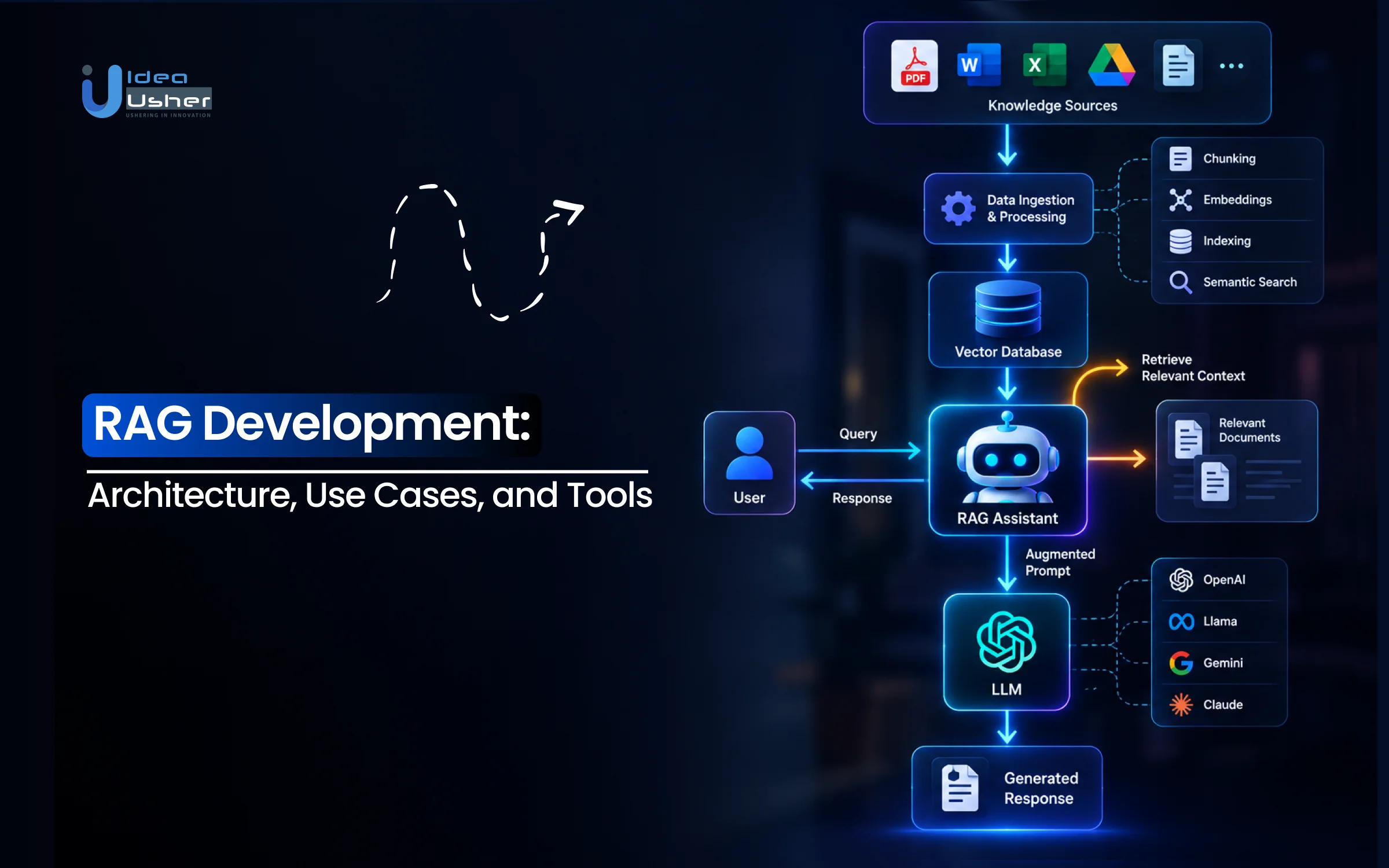
A RAG system is more than an LLM connected to a vector database. It is a pipeline that moves information through several stages before an answer reaches the user. A system may need to work with thousands or even millions of documents while keeping answers fast and relevant. Each stage can affect the final result, so the architecture needs to match how the business plans to use RAG.

1. Connect Your Data Sources
The first step is bringing useful business information into the system. This could include PDFs, databases, websites, CRM records, or internal applications. The goal is to bring this information together without forcing teams to change how they already work. A healthcare system may need data from EHRs, clinical documents, medical guidelines, and other trusted sources. The more sources a RAG system uses, the more important it becomes to keep the data organized and updated.
2. Prepare Useful Document Chunks
Large documents are usually broken into smaller sections called chunks. This makes it easier for the system to find the exact information needed for a question. For example, a 500-page document could be divided into hundreds of smaller sections. Each section can also keep details such as its source and date. This helps the retrieval system understand where the information came from and which content may be more useful.
3. Create Embeddings for Search
Embeddings turn text into numerical representations that capture its meaning. The system can then compare a user’s question with stored content even when the wording is different. For example, someone might ask “How do I stop my subscription?” while the document says “Steps to terminate your plan.” A semantic search system can understand that these questions are related.
4. Store Knowledge in Vectors
The embeddings are stored in a vector database so they can be searched when a user asks a question. The database becomes the searchable layer for the knowledge connected to the RAG application.
| Vector Database | Common Use |
| Pinecone | Managed vector search |
| Weaviate | AI search applications |
| Qdrant | High-performance retrieval |
| pgvector | PostgreSQL-based systems |
The right choice depends on the project. A small internal assistant may work with thousands of documents while an enterprise system could need to search millions of records.
5. Retrieve Relevant Context
When a user asks a question, the system searches the knowledge base and brings back the most relevant information. This is where the quality of the retrieval process can have a major effect on the final answer. A healthcare RAG system, for example, may need to find the right clinical information from a very large knowledge base. The goal is not to retrieve as much information as possible. It is to find the information that actually helps answer the question.
6. Rerank Before Generation
The first search may return more information than the LLM needs. Reranking gives the system another chance to identify the strongest results before they reach the model. A system might retrieve 20 passages from a large knowledge base and then select the best 3 to 5 passages for the final prompt. This can help reduce irrelevant context and keep the response focused.
7. Pass Context to the LLM
The selected information is added to the user’s question as context. The LLM then uses this information to create the response instead of relying only on what it learned during training. This can be useful in healthcare, where information may come from large collections of clinical documents.
Hippocratic AI is one example of a company building healthcare-focused AI systems where access to trusted information is an important part of the overall workflow. The model does not need to memorize every document. The RAG pipeline finds the relevant information when it is needed.
8. Validate the Final Answer
The answer should not simply be generated and shown to the user. A production system can check whether the response is supported by the retrieved information and show the source when needed. This is especially important for healthcare applications. Mayo Clinic has explored generative AI across clinical workflows, showing how important it is to connect AI systems with reliable healthcare information.
A validation layer can check a few important things:
| Check | Why It Matters |
| Source relevance | Makes sure the retrieved data fits the question |
| Answer grounding | Checks whether the response matches the evidence |
| Citations | Shows where the information came from |
| Permissions | Prevents restricted data from reaching users |
A well-designed RAG architecture therefore creates a clear path from business data to the final answer. The goal is not just to make an LLM smarter. It is to give the model the right information at the right time while keeping the system reliable as the data grows.
Which RAG Architecture Fits Your Use Case?
There is no single RAG architecture that works for every business. A simple knowledge assistant may need only basic retrieval, while a healthcare or enterprise system may need several retrieval methods. The right choice depends on the data, questions, and level of accuracy the application needs.
1. Start With Simple RAG
Naive RAG works well when the job is straightforward. The system takes a question, searches a prepared knowledge base, and sends the best results to the LLM. There are fewer moving parts, which makes it easier and faster to build. This can work for an employee asking questions about company policies or a customer looking for information in a product manual.
Best fit: FAQs, product documents, internal policies, and simple knowledge assistants.
2. Choose Advanced RAG for Accuracy
Advanced RAG adds more steps to improve retrieval. It can rewrite queries, filter results, or rerank information before sending it to the LLM. For example, a healthcare assistant may need to search clinical guidelines and patient information before answering a question. AWS has documented healthcare RAG architectures that combine different retrieval methods for these use cases.
Best fit: Healthcare, enterprise search, and document analysis.
3. Use Modular RAG for Flexibility
Modular RAG breaks the pipeline into separate parts that can be changed when needed. You might use one retrieval method for documents and another for structured data. A routing layer can then decide which path a question should take. This approach becomes useful when the RAG application is expected to grow. Instead of rebuilding the entire system when requirements change, individual modules can be replaced or improved.
| Need | Possible Module |
| Better queries | Query rewriting |
| Better results | Reranking |
| Multiple sources | Routing |
| Long conversations | Memory |
This approach is useful when a RAG application is expected to grow over time.
4. Pick Agentic RAG for Reasoning
Agentic RAG is useful when one question needs several searches. An AI agent can decide what information to look for and use different tools before creating the answer. For example, a healthcare workflow may need to search patient records and treatment information before producing a response. AWS has demonstrated agent-based RAG patterns for these types of healthcare workflows.
Best fit: Research, complex enterprise questions, and AI agents.
5. Use Graph RAG for Relationships
Graph RAG is useful when the connections between data points matter. Instead of only finding similar text, it can follow relationships between different pieces of information. In healthcare, this could mean connecting a patient’s condition with medications, procedures, and previous visits. Research has explored Graph RAG for these connected clinical questions.
A simple way to choose is:
- Simple questions → Naive RAG
- Better retrieval → Advanced RAG
- Flexible workflows → Modular RAG
- Multi-step tasks → Agentic RAG
- Connected data → Graph RAG
The most complex architecture is not always the best choice. Start with what the application actually needs and add more capabilities as the system grows.
RAG Development Use Cases With Real Business Value
RAG can be useful anywhere employees or customers need answers from a large amount of information. Its value is not limited to chatbots. Companies are using retrieval-based AI to search knowledge, understand documents, support employees, and help teams work with business data. The right use case usually starts with a problem where finding the right information takes too much time.
1. Enterprise Knowledge Assistants
Employees often need information that is spread across company documents and internal tools. A RAG assistant can bring this knowledge into one place and answer questions using approved business information. This can save employees from searching through several systems just to find a simple answer.
Example: Morgan Stanley uses an AI assistant to help financial advisors search its internal knowledge base and find information from a large collection of company documents.
2. AI-Powered Customer Support
Support teams deal with product guides, policies, FAQs, and troubleshooting information. RAG can search this content and give agents relevant information while they are helping customers. It can also help keep answers aligned with the latest information as products and policies change.
Example: Vodafone has used its TOBi AI assistant to help customers get answers across its support channels. Retrieval-based approaches can help systems like this work with updated company information.
3. Internal Enterprise Search
Traditional search often depends on users knowing the right keywords. RAG can understand the meaning behind a question and search across different sources. This makes it easier for employees to find information even when they do not know exactly where it is stored.
| Business Data | Possible RAG Use |
| Company policies | Employee questions |
| Product documents | Technical information |
| Meeting notes | Knowledge discovery |
| Internal wikis | Process guidance |
Example: Glean uses AI-powered enterprise search to help employees find information across workplace applications and company knowledge.
4. Document Intelligence and Analysis
Companies may need to review thousands of contracts, reports, policies, or other documents. RAG can find relevant sections and help users understand them without reading every page manually. This is especially useful when teams need to compare information across large document collections.
Example: Thomson Reuters uses generative AI in its legal products to help professionals work with large amounts of legal information and documents.
5. Sales and Revenue Copilots
Sales teams need quick access to customer information, product details, and past conversations. A RAG copilot can bring these sources together and help salespeople prepare for calls or answer customer questions. It can also reduce the time sales teams spend looking for information before speaking with prospects.
Example: Salesforce uses its Einstein AI capabilities with company and customer data to support sales workflows and provide more relevant insights.
6. Healthcare Knowledge Assistants
Healthcare generates huge amounts of clinical information. RAG can help professionals find relevant medical knowledge without searching through large document collections manually. It can also help connect trusted information with specific questions during healthcare workflows.
Example: Hippocratic AI develops healthcare-focused AI agents designed for healthcare workflows where access to reliable medical knowledge is important.
7. Financial Research and Compliance
Financial teams work with regulations, reports, market documents, and internal policies. RAG can help them search this information and quickly find the sections relevant to a particular question. This can make research easier when analysts need to work across large and frequently changing information sources.
Example: Bloomberg has developed BloombergGPT and other AI capabilities for financial workflows where access to specialized financial information is important.
8. Legal Research and Contract Analysis
Legal teams spend a lot of time searching through case law, contracts, and regulations. RAG can help identify relevant information and give lawyers a faster starting point for their research. It can also make it easier to compare clauses and locate specific information across large document sets.
Example: Harvey uses generative AI to help legal professionals work with legal documents and research as part of their daily workflows.
9. IT and Engineering Support
Developers and IT teams often depend on documentation, code repositories, troubleshooting guides, and past incidents. RAG can bring this information together and help teams solve technical problems faster. This can be particularly useful for large engineering teams with years of technical knowledge spread across different systems.
Example: GitHub Copilot can work with code and development context to assist developers with tasks such as understanding and writing software.
RAG Development Tools and Technology Stack
The tools you choose can change how well a RAG application performs and how easily it can scale. A small application may only need a few components, while an enterprise system can involve several layers. The important thing is to choose tools based on the data and workload instead of picking every popular RAG tool.
1. Compare LangChain and LlamaIndex
LangChain and LlamaIndex are two common choices for building RAG applications. LangChain is useful when the application needs to connect RAG with tools, agents, APIs, and other AI workflows. LlamaIndex focuses more heavily on connecting LLMs with external data and building knowledge-based applications.
For a simple document assistant, either can work well. A more complex application may need one framework or even a combination of tools depending on its architecture.
2. Choose the Right Vector Database
The vector database stores embeddings and helps the system find information that is similar to a user’s query. The best option depends on the amount of data, search speed, cloud setup, and existing infrastructure.
| Database | Useful For |
| Pinecone | Managed vector search |
| Qdrant | Fast similarity search |
| Weaviate | AI search applications |
| pgvector | PostgreSQL-based systems |
A system searching millions of vectors may have very different infrastructure needs from an internal assistant working with a few thousand documents. This is why database selection should happen after understanding the expected workload.
3. Select Embedding Models Carefully
Embedding models convert text into vectors so that the system can compare meaning between a question and stored information. The model you choose can affect retrieval quality, storage requirements, and search performance. For example, OpenAI’s text-embedding-3-large supports up to 3,072 dimensions, while text-embedding-3-small uses 1,536 dimensions.
Higher dimensions can capture more information but may also increase storage and processing requirements. The best model is not always the largest one. Teams should test embeddings against real queries from their own application before making a final choice.
4. Pick LLMs for RAG Apps
The LLM is responsible for turning the retrieved context into a useful response. GPT models, Claude, Gemini, and open-source models can all be used with RAG, but their cost, context limits, speed, and reasoning abilities differ. A customer support assistant may prioritize fast responses, while a research application may need a model that can work with larger amounts of context. Running tests with real questions can help determine which model provides the right balance.
5. Process and Ingest Business Data
A RAG system is only as useful as the information it can access. Document processing tools help extract content from PDFs, websites, spreadsheets, images, and other sources before the data enters the retrieval pipeline. For example, a company may need to process 10,000 PDF files before creating its knowledge base. Tools such as Unstructured and Apache Tika can help extract content, while custom pipelines can handle cleaning, chunking, metadata, and updates.
6. Evaluate and Monitor RAG Quality
A RAG system should be tested after it is built. Tools such as RAGAS, LangSmith, and Langfuse can help teams understand whether the system is retrieving useful information and producing grounded answers.
| RAG Layer | Popular Tools | Main Purpose |
| Orchestration | LangChain, LlamaIndex | Build RAG workflows |
| Vector Storage | Pinecone, Qdrant, Weaviate, pgvector | Store and search embeddings |
| Embeddings | OpenAI, Cohere, open-source models | Represent information as vectors |
| LLM | GPT, Claude, Gemini, open models | Generate responses |
| Data Processing | Unstructured, Apache Tika | Extract and prepare data |
| Evaluation | RAGAS, LangSmith, Langfuse | Test and monitor quality |
RAG vs Fine-Tuning vs AI Agents: Which Should You Build?
RAG, fine-tuning, and AI agents solve different problems. RAG helps an AI model use external knowledge. Fine-tuning changes how a model behaves. AI agents go a step further by allowing models to plan tasks and use tools. Choosing the right approach can save development time and prevent businesses from building a system that is more complex than they actually need.
Choose RAG for Changing Knowledge
RAG is usually a good choice when the AI needs access to information that changes often. The knowledge can stay outside the model and be updated without training the model again.
| Best RAG Scenario | Why It Fits |
| Company documents | Information changes over time |
| Customer support | Product details need updates |
| Healthcare knowledge | New information can be added |
| Enterprise search | Data lives across many sources |
A RAG system can also work with large collections of information. Instead of training a model on 100,000 documents, the system can retrieve only the relevant sections when a user asks a question.
Choose Fine-Tuning for Behavior
Fine-tuning makes more sense when the main problem is how the model responds rather than what information it knows. It can help teach a model a particular style, format, task, or domain-specific behavior. For example, a business may want every response to follow a specific structure. A fine-tuned model can learn that pattern from examples. However, it is not ideal for information that changes every week because updating that knowledge would require another training process.
Think of it this way: RAG changes the information the model sees. Fine-tuning changes how the model behaves.
Choose Agents for Complex Tasks
AI agents are useful when a task requires more than finding information and generating a response. An agent can decide what steps are needed and use tools such as APIs, databases, search systems, or business applications. A simple customer question may need only RAG. But a request such as “Find this customer’s recent orders, check the refund policy, and prepare a response” may require an agent that can access several systems and complete multiple steps.
This makes agents a better fit for workflows where the AI needs to act, not just answer.
Combine Approaches When Needed
Real-world applications do not always need to choose just one approach. RAG can provide current knowledge while fine-tuning controls the model’s behavior. An AI agent can then use both while interacting with other systems. For example, an enterprise assistant could use RAG to search internal documents, a fine-tuned model to follow the company’s response style, and an agent to perform actions in tools such as a CRM.
| Business Need | Suitable Approach |
| Changing information | RAG |
| Specific response behavior | Fine-tuning |
| Multi-step actions | AI agents |
| Knowledge + actions | RAG + Agents |
| Specialized behavior + knowledge | RAG + Fine-tuning |
How to Build a RAG Application From Scratch?
Building a RAG application is not just about connecting an LLM to a vector database. The real work starts with deciding what information the system needs and how users will interact with it. From there, the data has to be prepared, the retrieval process has to be designed, and the responses need to be tested. A good development process helps avoid problems that are difficult to fix after the application is already in production.
1. Define Your Business Use Case
Start by deciding what the RAG application needs to help users do. A support assistant may need product information, while an internal assistant may need access to company policies and documents. The data and retrieval setup will depend on this goal. It is also useful to estimate the expected workload before development begins.
An application handling 1,000 queries per day will have different infrastructure needs from one expected to handle 100,000 queries daily. This can influence your choice of database, LLM, and cloud infrastructure.
2. Prepare and Structure Your Data
The system needs clean and useful data before it can retrieve anything. This may include PDFs, websites, spreadsheets, databases, emails, product manuals, or internal documents. Duplicate and outdated information should be identified before it enters the knowledge base. Large documents are usually divided into smaller chunks.
For example, a 500-page document may become hundreds of searchable sections. Adding metadata such as the source, date, department, or document type can also help the system find better results later.
3. Choose Your Retrieval Strategy
Retrieval is one of the most important decisions in a RAG project. Semantic search can find information based on meaning, while keyword search can help when exact terms matter. Many applications can benefit from combining both. A more advanced system may also use filters, query rewriting, or reranking. The idea is to improve the quality of the information before it reaches the LLM.
Simple retrieval flow:
User question → Search → Filter → Rerank → Relevant context
4. Select Your LLM and Database
The LLM handles the final response while the vector database stores and searches the application’s knowledge. Both need to match the requirements of the project.
| Requirement | What to Consider |
| Large data volume | Database performance |
| Fast responses | Model and retrieval speed |
| Private information | Security and hosting |
| High usage | Scaling capacity |
| Lower costs | Model and infrastructure pricing |
Embedding choices matter here too. For example, OpenAI’s text-embedding-3-large supports 3,072 dimensions, while text-embedding-3-small supports 1,536 dimensions. The right option depends on the application’s retrieval needs and infrastructure.
5. Build the Retrieval Pipeline
The different components now need to work together. When a user asks a question, the application processes the query, searches the knowledge base, and selects the information that is most useful. A system could initially retrieve 20 passages and then use a reranker to select the top 3–5 passages. This gives the LLM a smaller and more relevant set of information to work with.
6. Add Generation and Grounding
Once the useful context has been selected, it is added to the user’s question before it reaches the LLM. The model can then use that information to generate the response. Grounding rules can tell the model to stay within the retrieved information instead of making unsupported claims. Citations can also be added so users can see which document or source was used.
For example, a healthcare assistant could answer a question using an approved clinical document and show that document as the source. This gives the user a way to check the information instead of relying only on the generated response.
7. Connect Existing Business Apps
RAG becomes more useful when it can work with the systems a business already uses. APIs can connect the application with CRMs, help desks, databases, document management systems, and internal software. Let’s take an example of a support agent asking why a customer’s order was delayed. The RAG application could retrieve the company’s delivery policy while another system provides the customer’s order details. Bringing these sources together can make the answer much more useful.
8. Test Retrieval and Response Quality
A RAG application should be tested with real questions before it reaches users. It is possible for the LLM to produce a fluent answer even when the retrieval system selected the wrong information. A useful test set can contain 100, 500, or 1,000+ real questions from the target users. Teams can then check whether the right information was retrieved and whether the final answer stayed consistent with that information.
9. Deploy and Monitor Continuously
After testing, the RAG application can be deployed for real users. But deployment is not the final step because the knowledge base will continue to change and users will ask questions that were not part of the original test set. Monitoring can track response quality, failed retrievals, latency, and usage. If an application handles 100,000 queries each day, even a 1% failure rate could affect 1,000 queries. Regular monitoring helps teams find these problems and improve the system over time.
How Much Does RAG Development Cost?
The esThe estimated cost of RAG development can range from around $15,000 to $250,000+ depending on what you are building. A basic RAG MVP may only need a document search and LLM integration, while an enterprise system can involve multiple data sources, advanced retrieval, security controls, and custom integrations. The final cost depends more on the complexity of the system than on the RAG technology itself.
RAG MVP Development Cost
A basic RAG MVP can cost an estimated $15,000 to $40,000. This type of project may connect a limited document collection to an LLM and provide a simple interface for users.
| MVP Component | Typical Scope |
| Data sources | 1–3 sources |
| Documents | Up to several thousand |
| Retrieval | Basic semantic search |
| LLM | One model |
| Interface | Web or chat interface |
| Integrations | Limited |
This approach is useful when a business wants to test whether RAG can solve a specific problem before investing in a larger platform.
Custom RAG Application Cost
A custom RAG application may cost an estimated $40,000 to $100,000. These projects usually require more data sources and a better retrieval pipeline than a basic MVP. The system may include hybrid search, reranking, metadata filters, multiple document formats, API integrations, and response evaluation. Development can also take longer when the application needs to work with existing business software.
Enterprise RAG Development Cost
Enterprise RAG development can cost an estimated $100,000 to $250,000+. Large organizations may need to connect RAG with several internal systems while supporting thousands of users and large knowledge bases. Security also becomes a major part of the project. Role-based access, audit logs, encryption, private deployments, and permission-aware retrieval can all increase development time and infrastructure requirements.
What Drives RAG Development Costs?
The biggest cost drivers are usually connected to the complexity of the data and the system around the LLM. A RAG application using 10,000 documents is much easier to manage than one that needs to search 10 million records across several systems.
| Cost Factor | Impact on Cost |
| Data volume | More storage and processing |
| Data sources | More integrations |
| Retrieval complexity | More engineering |
| Security | More controls and testing |
| User volume | More infrastructure |
| AI models | Changes usage costs |
| Deployment | Cloud or private infrastructure |
Healthcare and financial applications can also require additional security and compliance work. These requirements should be considered during planning rather than added after the application has already been built.
How to Reduce RAG Development Costs
The easiest way to control costs is to avoid building everything at once. Start with one clear use case and a limited set of trusted data before adding advanced retrieval or multiple integrations. A practical approach could look like this:
Phase 1: Build a focused RAG MVP
Phase 2: Test it with real users
Phase 3: Improve retrieval and evaluation
Phase 4: Add integrations and security
Phase 5: Scale the system for enterprise use
This approach lets businesses validate the idea before committing a large budget. It also makes it easier to identify which RAG features actually provide value and which ones can wait until later
Why Choose IdeaUsher for RAG Development?
RAG applications need more than an LLM and a vector database. The quality of the final product depends on how well the data, retrieval pipeline, integrations, and AI model work together. At IdeaUsher, we bring 500,000+ hours of coding experience to AI development and have ex-MAANG and FAANG developers on our team who can handle complex RAG projects.
Custom RAG Application Development
Every business has different data and different problems to solve. We build custom RAG applications around those needs instead of forcing every project into the same architecture. From internal knowledge assistants to customer-facing AI applications, we can design the data pipeline, retrieval flow, user interface, and backend around the actual use case.
Enterprise RAG Architecture
Enterprise RAG systems often need to work with large amounts of data and several internal systems. They also need strong security and reliable performance as the number of users grows. Our team can build RAG architectures with features such as hybrid retrieval, reranking, access controls, API integrations, and monitoring. This helps businesses move from a basic RAG prototype to a system that can support real production workloads.
LLM and Vector Database Integration
The LLM is only one part of a RAG application. The system also needs the right embedding model, vector database, retrieval strategy, and data pipeline to deliver useful context. We can integrate technologies such as OpenAI, Claude, Gemini, LangChain, LlamaIndex, Pinecone, Qdrant, and pgvector based on the requirements of the project. This allows us to build a stack that fits the application’s data, performance, and scaling needs.
Conclusion
RAG development can help businesses make their data more useful without training an AI model every time the information changes. The right architecture makes it easier to find relevant information and give users better answers. But building a good RAG system is not only about choosing an LLM or a vector database. The data, retrieval process, security, and testing all need to work well together.
If you are planning to build a RAG application, start with a clear business problem and choose the tools that fit your needs. With the right approach, RAG can become a useful part of your AI strategy and grow with your business.
FAQs
A1: Developers often use LangChain or LlamaIndex to build RAG workflows. Pinecone, Qdrant, Weaviate, and pgvector are popular vector database options. LLMs from OpenAI, Anthropic, and Google can handle response generation. Tools like RAGAS and LangSmith can help test and monitor the system.
A2: There is no single best option for every RAG project. Pinecone works well for teams that want a managed service. Qdrant and Weaviate offer more control over search. pgvector is useful when you already use PostgreSQL. The right choice depends on your data size and search requirements.
A3: RAG is better when your AI needs access to changing information. Fine-tuning is more useful when you want to change the model’s behavior or response style. RAG can give an AI assistant access to the latest company documents without retraining the model. In some projects, RAG and fine-tuning can also be used together.
A4: Yes. RAG can work with private company data such as documents, policies, customer records, and internal knowledge. The system retrieves the required information when a user asks a question instead of putting all the data into the model. Access controls can also make sure users only see information they are allowed to access.


