

Key Takeaways
- Healthcare providers are expanding care with AI-powered remote care apps that enable continuous monitoring, virtual care, and better recovery from home.
- Modern platforms combine remote patient monitoring, AI-driven risk detection, wearable integrations, and EHR connectivity to deliver proactive care.
- Building a successful solution requires secure healthcare infrastructure, interoperability, AI-powered analytics, regulatory compliance, and scalable architecture.
- These platforms improve patient outcomes, reduce readmissions, enhance care coordination, and lower healthcare costs, creating strong opportunities for innovation.
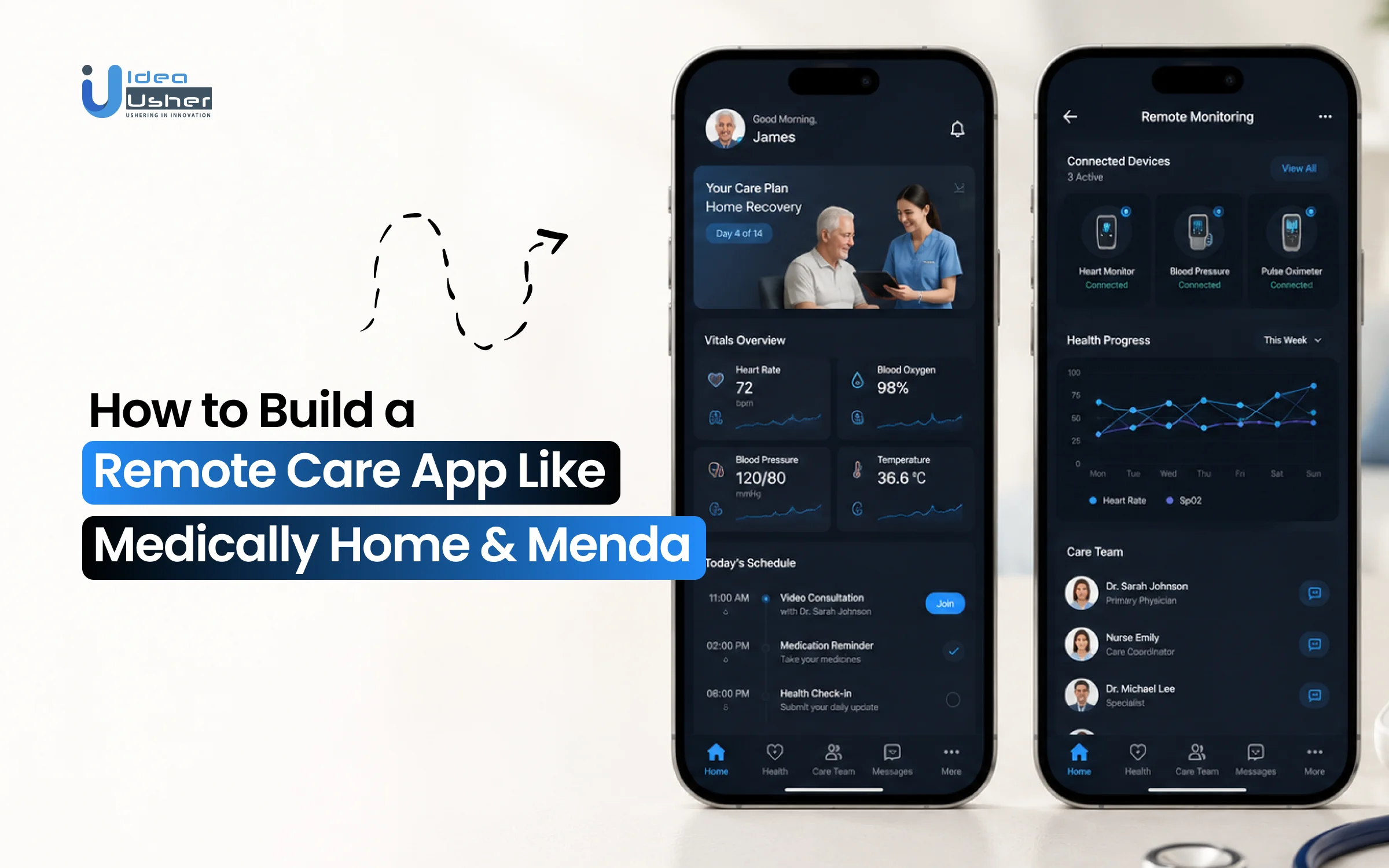
For years, healthcare has mainly focused on treating patients after they become sick. That is beginning to change. More providers now want to stay connected with patients even after they leave the hospital so they can identify health issues early and improve recovery outcomes. This growing shift is driving the demand for remote care apps like Medically Home and Menda. These platforms show how patients can receive high-quality care from home while healthcare teams continue to monitor their progress in real time.
Remote care platforms are redefining healthcare by bringing hospital-grade services into patients’ homes. In this blog, we’ll examine how platforms like Medically Home and Menda are built, the technologies they rely on, and the decisions that shape a successful remote care solution.
Market Demand for Remote Care Apps
According to Grand View Research, the global remote healthcare market was valued at USD 69.0 billion in 2024 and is expected to reach USD 219.0 billion by 2030, growing at a 21.3% CAGR. This growth is fueled by a clear shift in how healthcare is delivered. Hospitals and health startups are moving more care beyond hospital walls because it improves access, lowers operational costs, and helps clinical teams manage more patients without compromising the quality of care.
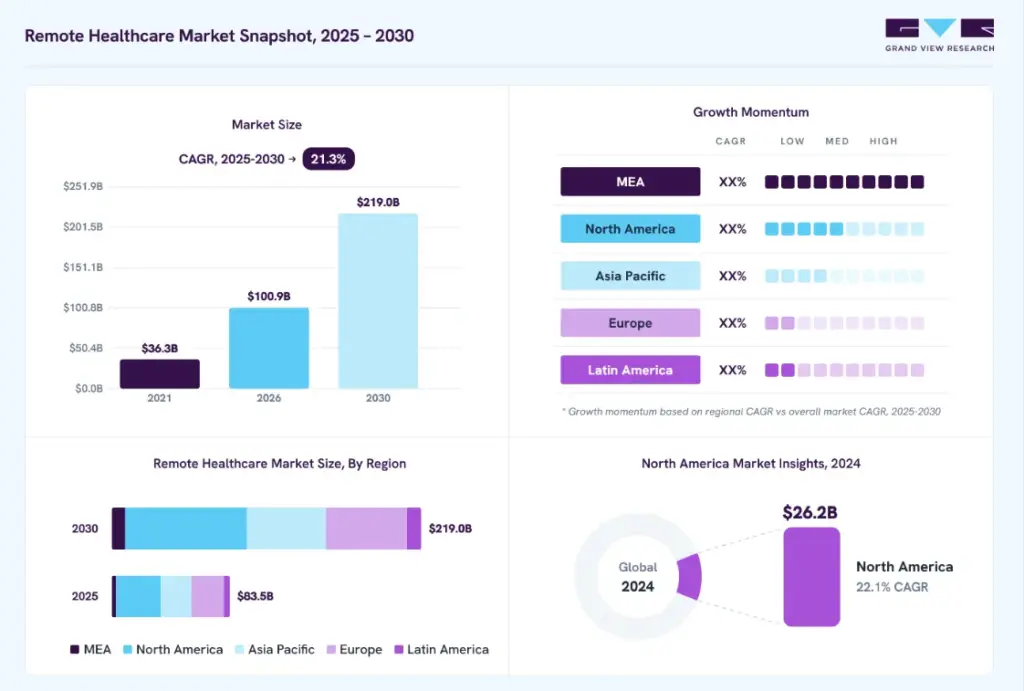
Source: Grand View Research
Hospital-at-Home Growth
Hospital-at-home programs are becoming a practical way for health systems to deliver acute care without relying on traditional hospital beds. Patients receive hospital-level treatment at home while care teams monitor them remotely and coordinate services in real time. This approach lowers operational costs, reduces the risk of hospital-acquired infections, and often leads to better recovery experiences. It also allows hospitals to reserve inpatient beds for cases that require intensive care.
The market opportunity is already evident. TytoCare has scaled its remote examination platform to over $80 million in annual revenue, demonstrating strong demand for technologies that support home-based acute care. As more providers invest in these programs, platforms that simplify care coordination, remote monitoring, and clinical workflows are becoming essential for modern healthcare delivery.
Chronic Disease Care
Managing chronic conditions through occasional clinic visits is no longer enough. Patients with diabetes, hypertension, or heart failure need regular monitoring to catch health changes before they become serious. Remote patient monitoring makes this possible by giving care teams continuous health data, allowing them to intervene earlier, improve outcomes, and reduce avoidable hospital admissions. It also supports value-based care models where providers are rewarded for keeping patients healthier over time.
The commercial potential is already proven. Cadence has grown to over $58 million in annual recurring revenue and reached a valuation exceeding $1 billion by helping health systems manage chronic care at scale. For founders, this creates an attractive opportunity to build platforms with recurring revenue, long-term patient engagement, and highly scalable care management workflows that healthcare providers are actively investing in.
AI & Connected Devices
Hardware and software are finally syncing in healthcare. Cellular-enabled blood pressure cuffs, continuous glucose monitors, and consumer wearables allow biometric data to stream into clinical dashboards effortlessly. Raw biometric data alone creates alert fatigue for clinical staff. This is where artificial intelligence changes the economic equation. AI algorithms process continuous data streams, filter out noise, and highlight only the patients who require immediate human intervention.
- Passive Data Collection: Cellular devices send readings automatically without requiring complex Bluetooth pairing or technical setup by elderly patients.
- Predictive Triage: Machine learning models analyze trends to flag deterioration before symptoms become severe.
- Automated Escalation: Smart routing sends critical alerts directly to the on-call physician while logging routine updates in the electronic health record.
Medically Home vs. Menda: Comparing Two Remote Care Models
Comparing Medically Home and Menda highlights two distinct approaches to digital healthcare. Medically Home replaces physical hospital beds for acute illness, while Menda focuses on long-term digital management for chronic pain. Founders evaluating where to direct engineering and clinical resources must understand how these models differ in unit economics, care delivery, and technology requirements.
Hospital-at-Home vs. Chronic Care Management
Medically Home focuses on patients who need short-term hospital-level care at home for serious conditions such as heart failure, pneumonia, or post-surgical recovery. The platform helps health systems avoid unnecessary hospital admissions or discharge patients earlier while still providing close clinical supervision. Most care episodes last from a few days to a couple of weeks, making it ideal for acute treatment rather than ongoing disease management.
Menda is designed for long-term chronic pain care. Instead of treating medical emergencies, it helps patients manage persistent pain through virtual therapy, guided recovery programs, and behavioral interventions such as Pain Reprocessing Therapy. Treatment typically continues for three to six months, giving patients consistent support while creating a predictable engagement model for providers.
- Medically Home: High-acuity, episodic interventions with large bundled payouts per event.
- Menda: Low-acuity, continuous interventions with steady recurring margins.
Comparing Care Delivery and Technology
Medically Home is built for patients who need hospital-level care without staying in a hospital. Its platform combines continuous remote monitoring with a 24/7 clinical command center that helps providers respond quickly when a patient’s condition changes. This enterprise-focused model is typically sold to health systems through managed service agreements or bundled care programs, with pricing ranging from $5,000 to over $10,000 per acute episode.
Menda serves a different purpose by helping people manage chronic pain over weeks or months instead of treating acute medical events. Patients use the app to track symptoms, follow guided therapy programs, and stay connected with clinicians through virtual care. The platform generates revenue through insurance, Medicare, and direct-pay plans that generally cost $150 to $350 per month or $400 to $1,200 for a structured treatment program.
| Feature | Medically Home (Acute Care) | Menda (Chronic Pain) |
| Core Workflow | Real-time continuous vitals, emergency triage, dispatch logistics | Asynchronous exercises, video check-ins, symptom logging |
| Hardware Need | High (cellular monitors, IV pumps, diagnostic kits) | Low to None (smartphone app, basic video calls) |
| Price / Fee Structure | $5,000–$10,000+ per acute episode | $150–$350 monthly or $400–$1,200 program bundle |
| Operational Friction | High (requires physical supply chains and local nursing) | Low (pure software distribution with virtual therapists) |
Which Model Should You Build for Your Business?
Choosing between these models comes down to risk tolerance, capital reserves, and target go-to-market channels.
- Build an Acute Model (Medically Home) if: You have deep connections with regional health systems, strong initial capital, and an appetite for operational complexity. The barrier to entry is high due to strict regulatory compliance requirements, liability insurance, and physical logistics. However, once embedded inside a hospital system, contracts are extremely sticky and defensible.
- Build a Chronic Model (Menda) if: You want fast speed to market, high software gross margins, and a direct path to employer or payer sales. A digital chronic pain platform requires lower upfront capital, faces fewer regulatory hurdles, and scales across state lines without building physical dispatch networks.
A hybrid platform often represents a lucrative long-term play for digital health investors. By starting with a lightweight chronic management app, you establish a broad patient user base and accumulate valuable health data at low cost.
Over time, adding acute capabilities lets you step in when a chronic patient experiences a sudden medical crisis. This unified flywheel keeps patient lifetime value high while offering payers a single platform that handles everything from daily wellness to acute emergency diversion.
The Healthcare Problems Medically Home and Menda Were Built to Solve
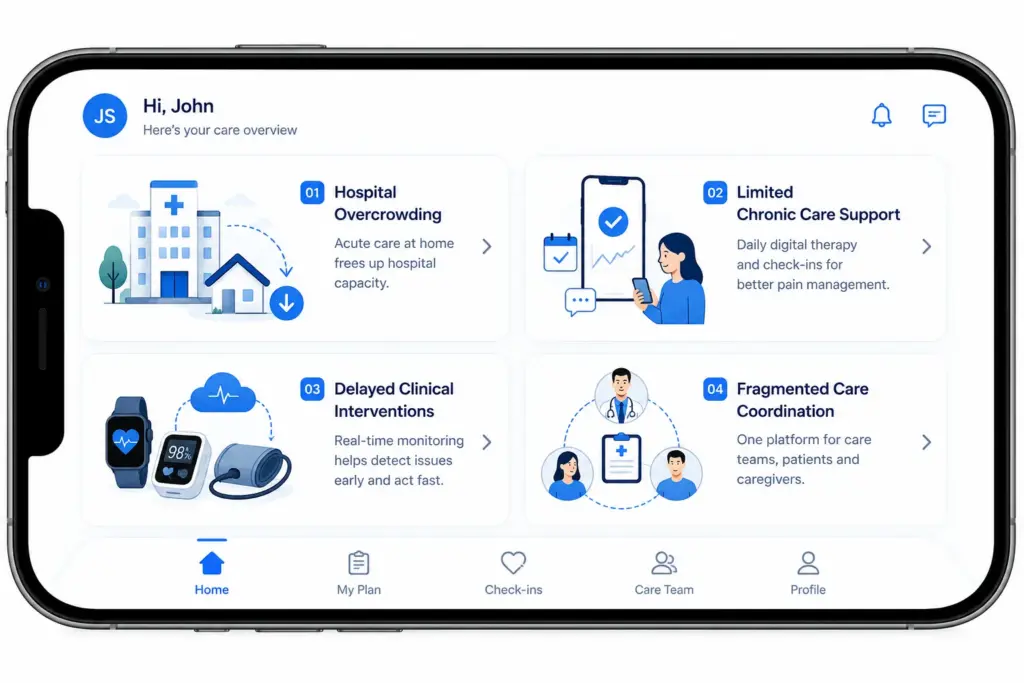
Traditional healthcare often struggles to deliver continuous care while keeping costs under control. This has created demand for platforms built around specific care gaps rather than conventional clinic visits. Medically Home enables hospitals to provide acute care in patients’ homes, reducing the need for inpatient stays, while Menda focuses on long-term chronic pain management through virtual therapy and evidence-based digital treatment programs.
1. Hospital Overcrowding & High Costs
Physical health systems are reaching clear operational limits. Emergency rooms face chronic crowding, bed availability remains tight, and building new physical wings requires millions in capital expenditure along with long construction timelines. Medically Home addresses this bottleneck directly. By shifting acute medical management into the living room, health systems free up expensive inpatient beds for high-margin surgical cases while keeping operational costs lower.
- Capacity Expansion Without Construction: Hospitals expand bed counts virtually without building physical facilities.
- Cost Structure Advantage: At-home care cuts overhead expenses linked to facility maintenance and round-the-clock facility staffing.
- Financial Scale: Demonstrating this business model’s viability, Medically Home built a platform reaching over $114 million in annual revenue while delivering hospital-level acute care in the home.
2. Limited Chronic Care Support
Standard outpatient medicine operates on brief, episodic appointments. A patient with severe chronic pain might see a physician every few months for fifteen minutes, leaving vast gaps where symptoms escalate without professional guidance. Menda was designed to bridge this empty space between clinic visits. Instead of leaving patients to navigate chronic pain through isolated medication adjustments or repeated ER visits, Menda delivers daily digital therapy and continuous engagement.
- Daily Patient Touchpoints: Mobile check-ins and symptom tracking keep users actively engaged in their recovery plan.
- Behavioral Pain Retraining: Guided exercises address central nervous system sensitization directly from a smartphone.
- Payer Alignment: Keeping chronic pain patients out of emergency rooms cuts high claims costs for self-insured employers and health plans, unlocking steady B2B SaaS and subscription revenues.
3. Delayed Clinical Interventions
When health data stays trapped inside a doctor’s office visit, clinicians only spot health drops after a crisis happens. Missing real-time biological updates leads to avoidable emergency room visits, readmission fines, and worse health outcomes. Both Medically Home and Menda use real-time digital monitoring to spot problems early and act fast.
Medically Home connects cellular blood pressure monitors, pulse oximeters, and continuous ECG devices straight to a 24/7 central medical command center. If vitals slide outside safety bounds, medical teams step in immediately before an emergency develops. Menda applies this proactive approach to functional movement and symptom logs, catching pain spikes early before a patient relies on emergency services or heavy medications.
4. Fragmented Care Coordination
Modern healthcare suffers from disconnected communication. Primary care doctors, visiting nurses, diagnostic labs, physical therapists, and family caregivers rarely share a unified tool, leading to duplicate testing, conflicting instructions, and missed symptoms. Integrated platforms solve this breakdown by bringing all workflows, communications, and data into a single point of truth.
- Unified Care Plan: Field staff, remote doctors, and family members view identical real-time clinical notes.
- Logistics Automation: Medically Home manages home delivery of IV medications, medical equipment, and mobile imaging smoothly.
- Central Communications: Menda connects therapists, health coaches, and patients in a single app, removing the confusion of fragmented traditional referrals.
Key Features of Remote Care Apps Like Medically Home & Menda
Building an enterprise remote care app requires understanding the core software architecture that powers market leaders. Medically Home has demonstrated commercial validation in acute care, while Menda established a high-value niche in chronic pain recovery. For investors and healthtech founders, the value lies in replicating and improving these high-yield feature sets across acute and chronic workflows.
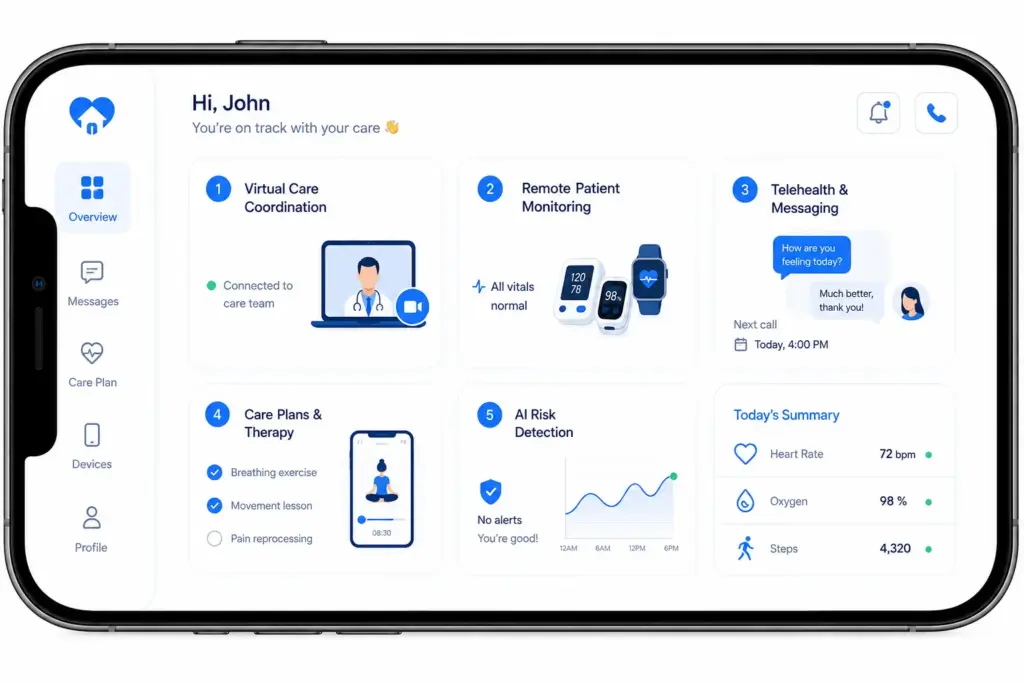
1. Virtual Care Coordination
A central clinical command center powers high-acuity remote care. Medically Home relies on this hub to manage hospital-at-home patients, connecting doctors, nurses, and logistics teams around the clock. Patients use this feature via a dedicated, simplified home tablet interface. With one touch, a patient or caregiver connects directly to an on-duty clinician through live video.
On the backend, command center physicians view real-time telemetry, update medical orders, and trigger physical home dispatch services without the patient ever leaving their bed.
2. Remote Patient Monitoring
Continuous monitoring transforms home care into a safe, clinical environment. Medically Home ships cellular kit hubs directly to acute patients, while Menda integrates lightweight wearable trackers to monitor physical stress signals in chronic pain users. Patients simply plug in or wear their devices.
Cellular blood pressure cuffs, pulse oximeters, ECG patches, and digital scales stream data back to the app automatically. Elderly or severely ill users do not need to deal with complex Bluetooth setups or Wi-Fi configurations.
- Automatic Syncing: Cellular connectivity removes technical friction for high-risk patients.
- Continuous Telemetry: Vitals stream directly into electronic health record systems for uninterrupted care history.
- Passive Tracking: Menda tracks movement patterns and daily step counts to measure functional physical recovery.
3. Telehealth & Messaging
Synchronous video and asynchronous chat keep patients tethered to their care team throughout recovery. Menda centers its user journey around weekly therapist-led telehealth sessions paired with daily text check-ins. Inside Menda, a user schedules video calls with specialized pain therapists and accesses HIPAA-compliant chat to report symptom flare-ups. Clinicians use secure messaging to offer quick reassurance or adjust behavioral exercises, helping prevent unnecessary panic and emergency room visits.
- Scheduled Video Sessions: High-definition video hosting built directly into the patient portal.
- Asynchronous Messaging: Patients leave updates or ask non-urgent questions between visits.
- Multi-Disciplinary Group Calls: Medically Home uses video conferencing to bring family members, remote doctors, and local visiting nurses into a single virtual consultation.
4. Care Plans & Therapy
Static care plans fail because patient recovery is dynamic. Menda built its platform around Pain Reprocessing Therapy and Cognitive Behavioral Therapy to address brain-based pain signals, while Medically Home uses clinical pathways tailored to acute medical diagnoses. Users open the app daily to see a clean task list.
For a Menda user, this includes interactive audio modules, guided breathing exercises, and short movement lessons. For a Medically Home patient, it shows required vital checks, meal timing, and upcoming home visits from nursing staff.
5. AI Risk Detection
Streaming continuous vitals creates massive data volume that can overwhelm medical teams. Both Medically Home and Menda rely on predictive algorithms to filter ambient noise and surface true clinical risk. The software runs algorithms in the background continuously. When a Medically Home patient shows a subtle downward trend in oxygen saturation over four hours, or a Menda user logs spiked pain scores alongside reduced physical mobility, the system alerts the care manager immediately.
- Smart Baseline Filtering: Algorithms adjust for individual patient baselines, reducing false alarms.
- Prioritized Triage Queues: Dashboards automatically highlight critical patients at the top of the clinician screen.
- Automated Safety Escalations: Critical vital drops trigger immediate emergency protocols and local dispatch.
6. Home Care Logistics
Managing acute care outside the hospital requires orchestrating complex physical supply chains. Medically Home excels at this, acting as a digital control center that coordinates home delivery of IV antibiotics, mobile radiology, and phlebotomy. Patients view an integrated delivery schedule inside their app. They see real-time tracking for incoming medical supplies, estimated arrival times for mobile lab units, and scheduled visits from home health aides.
| System Capability | Medically Home (Acute Logistics) | Menda (Virtual Chronic Care) |
| Primary Focus | Supply chain dispatch, IV meds, equipment | Virtual therapy, mind-body retraining, messaging |
| In-Home Services | Mobile lab work, ultrasound, nursing visits | Digital exercises, video therapy, coach support |
| User Value | Replaces physical hospital bed stays | Offers continuous pain relief tools at home |
7. Analytics & Outcome Tracking
Visualizing recovery builds patient confidence and gives clinical teams actionable data to prove ROI to payers. Menda provides users with visual progress charts tracking pain severity, functional mobility, and mood improvements over time. Inside the dashboard, patients view clean trendlines showing their weekly improvement.
Clinicians and platform owners use aggregated outcome data to show health plans how many hospital visits or surgeries were avoided, proving the financial return of the platform.
- Patient Goal Tracking: Clear visual milestones keep chronic pain users motivated over multi-month programs.
- Clinician Performance Metrics: Health system administrators monitor patient retention and clinical throughput across teams.
- Payer Analytics: Automated reporting validates cost-savings and health improvement data for enterprise clients.
How to Build a Remote Care App Like Medically Home & Menda?
Building an enterprise-grade remote care app is about more than developing software. It requires technology that fits real clinical workflows, supports secure data sharing, and can scale as patient volumes grow. Medically Home demonstrates how digital platforms can enable hospital-level care at home, while Menda highlights the value of continuous virtual care for long-term chronic pain management.
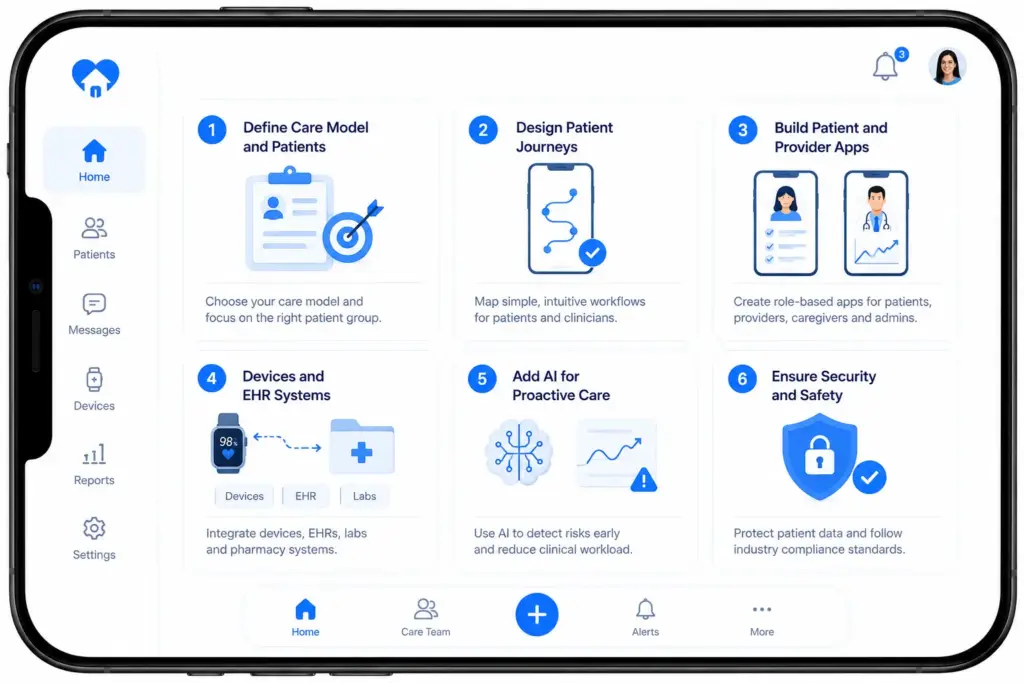
1. Define Care Model and Patients
Your underlying clinical model dictates every line of code you write and every compliance framework you build. Trying to build a platform that does everything at launch leads to bloated software and stalled enterprise deals.
- Hospital-at-Home (Medically Home Model): Demands real-time telemetry streaming, immediate emergency escalation systems, and complex physical supply chain logistics for home delivery.
- Chronic Disease Management (Menda Model): Requires high-engagement user interfaces, asynchronous video lessons, daily symptom tracking, and behavioral progress metrics.
- Hybrid Model: Starts with lightweight chronic care engagement tools to build a user base, then integrates acute monitoring to capture higher reimbursement rates during medical crises.
2. Design Patient Journeys Workflows
A remote care platform should feel simple for both patients and clinicians. The onboarding process needs to be quick, daily tasks should be easy to follow, and important health updates must reach care teams without delay. When the experience is intuitive and clinical workflows fit naturally into everyday practice, providers are more likely to adopt the platform, and patients are more likely to stay engaged with their care.
3. Build Patient and Provider Apps
A remote care platform works best when every user has tools designed for their specific role. Patients need an easy way to complete daily care tasks, clinicians need quick access to patient data and alerts, caregivers want visibility into recovery progress, and administrators need operational controls to keep services running efficiently. Role-specific interfaces make the platform easier to use and improve the overall care experience.
4. Devices and EHR Systems
A remote care platform cannot exist as an isolated data island. To sell your app to health systems or enterprise payers, your software must talk directly to existing electronic health records and diagnostic labs.
| Integration Type | Standards Used | Purpose |
| EHR Systems | FHIR, HL7, SMART on FHIR | Read and write clinical notes, sync patient medical histories |
| Medical Devices | Bluetooth LE, Cellular APIs | Ingest vitals from blood pressure cuffs, continuous glucose monitors, and ECGs |
| Pharmacy & Labs | Surescripts, REST APIs | Process electronic prescriptions and ingest lab results automatically |
5. Add AI for Proactive Care
Raw data streaming from thousands of home devices creates massive noise. Incorporating artificial intelligence into your platform keeps your medical team lean while maintaining clinical safety.
- Predictive Risk Scoring: Algorithms analyze historical vitals to spot early signs of patient deterioration hours before symptoms peak.
- Ambient Clinical Documentation: AI tools draft clinical notes automatically from video visits, saving doctors hours of manual charting.
- Smart Alert Suppression: Machine learning filters out benign false alarms, allowing care teams to focus on patients needing immediate intervention.
6. Ensure Security and Safety
Healthcare software faces strict legal standards worldwide. Data breaches or safety failures can instantly shut down a healthtech startup. Architect your database using strict role-based access control. Ensure all biometric telemetry, video session logs, and personal details are encrypted both in transit and at rest. Maintain detailed audit logs tracking every instance a clinician views or edits a patient file.
7. Launch, Validate, and Scale
Building enterprise healthtech requires a phased roll-out strategy to prove clinical efficacy and software stability before seeking massive market expansion.
- Launch a Focused MVP: Target a single high-impact condition such as post-operative heart care or chronic back pain.
- Pilot with Healthcare Partners: Partner with a regional health system or self-insured employer group to gather real-world clinical feedback.
- Measure Financial and Clinical ROI: Track key performance indicators like reduced 30-day readmissions, lower ER visit rates, and patient retention.
- Scale Enterprise Features: Expand into multi-specialty care, add multi-language support, and roll out advanced custom billing integrations.
Cost to Develop Remote Care App Like Medically Home & Menda
Building an enterprise remote care app starts with defining the type of care you want to deliver. A hospital-at-home solution like Medically Home requires advanced infrastructure, including real-time patient monitoring, care coordination, and EHR integration, making it more complex to develop.
A platform like Menda takes a different approach by focusing on virtual chronic pain management and long-term patient engagement, allowing founders to launch with a leaner product while still addressing a growing healthcare need.
Cost to Build an App Like Medically Home
A platform like Medically Home requires enterprise-grade infrastructure, remote patient monitoring, EHR interoperability, logistics coordination, and compliance with healthcare regulations. Because of its complexity, it falls into the higher end of healthcare software development costs.
| Development Component | Estimated Cost (USD) |
| Discovery & Product Strategy | $15,000–$30,000 |
| UI/UX Design | $20,000–$40,000 |
| Patient Mobile App | $35,000–$70,000 |
| Clinician Mobile App | $30,000–$60,000 |
| Admin & Command Center Dashboard | $40,000–$80,000 |
| Secure Video Consultation | $15,000–$35,000 |
| Remote Patient Monitoring | $40,000–$90,000 |
| Wearable & IoT Integration | $30,000–$70,000 |
| EHR (FHIR/HL7) Integration | $40,000–$100,000 |
| AI Alerts & Predictive Analytics | $50,000–$120,000 |
| Home Care Logistics Module | $25,000–$60,000 |
| HIPAA Security & Compliance | $30,000–$70,000 |
| QA, Testing & Deployment | $25,000–$50,000 |
| Estimated Total | $395,000–$875,000 |
Building at this level means engineering for zero downtime. The command center dashboard and EHR integrations account for a significant portion of the budget because they handle live telemetry feeds and bidirectional clinical records.
- Core Cost Drivers: Centralized 24/7 command center dashboards and continuous data pipelines.
- Capital Efficiency Strategy: Focus initial capital on robust device connectivity and EHR bi-directional syncing before scaling advanced AI modules.
Cost to Build an App Like Menda
A platform like Menda is less infrastructure-intensive than a hospital-at-home solution but still requires secure telehealth, patient engagement, behavioral therapy tools, AI-driven insights, and HIPAA-compliant architecture.
| Development Component | Estimated Cost (USD) |
| Product Discovery | $10,000–$20,000 |
| UI/UX Design | $15,000–$30,000 |
| Patient Mobile App | $25,000–$50,000 |
| Therapist Portal | $20,000–$45,000 |
| Video Consultation | $12,000–$25,000 |
| Messaging & Notifications | $8,000–$18,000 |
| Pain Tracking & Journaling | $12,000–$25,000 |
| Guided Therapy Programs | $20,000–$40,000 |
| AI Recommendations & Analytics | $20,000–$50,000 |
| Payment & Scheduling | $10,000–$20,000 |
| HIPAA Compliance & Security | $20,000–$40,000 |
| QA & Deployment | $15,000–$30,000 |
| Estimated Total | $187,000–$393,000 |
Chronic care platforms benefit from lower initial hardware costs and simpler logistics workflows. Investing in intuitive UI/UX design yields high returns here, as daily patient retention directly impacts clinical outcomes and subscription renewals.
- Lightweight Distribution: Lower initial engineering spend allows faster entry into employer and self-pay markets.
- Engagement Focus: Interactive modules and symptom tracking drive long-term user retention.
- High Margin Expansion: Pure software workflows keep operational overhead low as patient numbers multiply.
Key Cost Factors
The final budget for a remote care application varies based on technical decisions and market positioning. Understanding where capital is spent helps founders build realistic financial models.
- EHR Integration Standard: Simple read-only connections cost significantly less than bi-directional FHIR and HL7 integrations with hospital ecosystems.
- Device Ecosystem: Syncing consumer wearables via standard APIs is inexpensive, while integrating custom cellular-enabled medical hardware requires specialized engineering.
- AI & Predictive Analytics: Basic rule-based alerts are fast to build, whereas training custom machine learning models on continuous vital streams increases software costs.
- Deployment Model: Launching an MVP for pilot programs with regional clinics costs under $200,000, while launching a fully certified multi-state enterprise platform requires substantial capital reserves for security audits and infrastructure scaling.
Hospital-at-Home vs Traditional Inpatient Care: The Economic Advantage
Health systems face rising operational overhead, tight staffing, and squeezed margins. Moving acute and post-acute treatment into the living room offers a scalable way to deliver hospital-grade care at a fraction of the cost. It also improves patient access, supports faster recovery, and helps providers make better use of hospital resources.
Lower Costs & Equal Outcomes
Traditional acute care carries massive fixed overhead from facility maintenance to round-the-clock staffing. Hospital-at-home models shift treatment into the home, cutting direct cost per episode by 20% to 30%. These savings compound after discharge. Patients treated at home experience fewer lab tests, less imaging, and lower post-acute facility usage.
Key Financial Impact
Health systems using home care models see up to 38% lower total cost of care over 30-day care episodes compared to traditional inpatient stays. Platforms like Biofourmis showcase the economic potential of this space. By combining wearable sensors with AI predictive analytics, Biofourmis helps health systems track acute patients at home, generating around $63 million in annual revenue.
Better Resource Utilization
Inpatient capacity bottlenecks hurt revenue. When surgical beds stay occupied by recovery-stage medical patients, hospitals miss out on high-margin elective procedures. Home-based care acts as a virtual overflow valve.
| Metric | Traditional Inpatient | Hospital-at-Home |
| Facility Overhead | High fixed costs per bed | Scalable digital infrastructure |
| Bed Capacity | Physical floor limits | Flexible virtual bed count |
| Staffing Allocation | Fixed nurse-to-patient ratios | On-demand hybrid dispatch |
| Average Length of Stay | Extended due to discharge delays | Shorter with early transition |
This operational flexibility allows health systems to expand their patient reach without spending millions on new brick-and-mortar wings. Staffing becomes more agile, allowing nurses and physicians to manage larger patient panels through central monitoring hubs.
Patient Satisfaction & Gains
Recovering at home delivers clear clinical advantages:
- Fewer Complications: Reduced risk of hospital-acquired infections and delirium.
- Lower Readmission Rates: Unplanned 30-day readmissions drop by nearly 50%.
- Better Engagement: Patients adhere closely to care plans in familiar surroundings.
These clinical wins translate directly into financial rewards under value-based care contracts. Lower readmission rates protect hospitals from Medicare penalties, while higher patient satisfaction scores drive value-based incentive payouts. Remote care models also scale into specialized sub-acute programs.
Hinge Health, a digital platform focused on musculoskeletal care, uses movement tracking and remote coaching to help patients avoid costly surgeries. The company generated over $390 million in annual revenue by saving enterprise employers and insurers millions in unnecessary inpatient procedures.
Build a Remote Care App with IdeaUsher
Bringing a high-performing digital health app to market requires more than just basic coding. IdeaUsher partners with healthtech founders, health systems, and investors to engineer custom remote care apps that scale securely. From hospital-at-home logistics to chronic care apps, we transform complex clinical workflows into smooth software products.
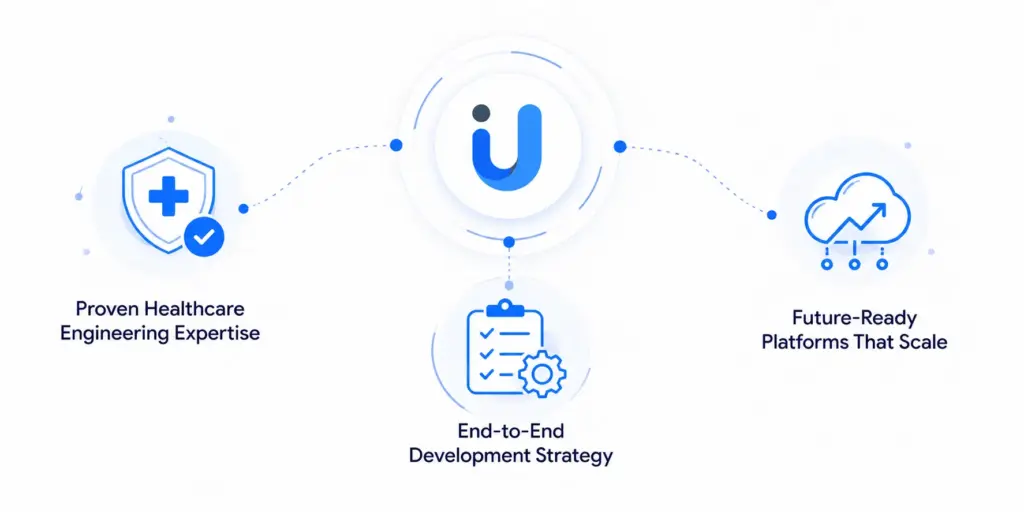
Proven Healthcare Engineering Expertise
Healthcare software demands zero tolerance for security flaws or system downtime. IdeaUsher brings deep domain experience to build platforms equipped with video telehealth, remote patient monitoring, and seamless EHR interoperability. With over 500,000 hours of coding experience, our team of ex-MAANG/FAANG developers understands how to architect resilient healthcare products.
We ensure your application passes rigorous security audits while maintaining an intuitive user experience for both patients and clinicians.
- Full Regulatory Compliance: Native HIPAA and GDPR compliance with end-to-end encryption for data at rest and in transit.
- Smart Interoperability: Secure integrations connecting medical IoT devices, wearable sensors, and hospital systems via FHIR and HL7.
- Custom AI Workflows: Automated patient triage, predictive deterioration alerts, and smart charting support to keep care teams efficient.
End-to-End Development Strategy
We help healthcare founders turn remote care ideas into scalable digital platforms. From product strategy and intuitive UI/UX to secure cloud infrastructure and regulatory-ready development, our team handles the entire development lifecycle. This allows you to focus on validating your business and launching faster with a platform built for real clinical workflows and long-term growth.
Future-Ready Platforms That Scale
An initial MVP should serve as the foundation for long-term growth, not a dead end that needs a complete rewrite when your user base expands. IdeaUsher designs modular system architectures that seamlessly scale across multiple hospital networks and patient populations.
| Scalability Layer | Engineering Execution | Business Value |
| Data Architecture | FHIR / HL7 compliant microservices | Smooth connectivity with enterprise EHRs |
| Device Hub | IoMT cellular and Bluetooth streaming | Onboard thousands of remote patient devices easily |
| Cloud Infrastructure | Auto-scaling secure serverless clusters | Handles high-volume video and real-time telemetry |
| Enterprise Growth | Multi-tenant provider portals | Deploy custom branded instances for new health systems |
Conclusion
Building a remote care app like Medically Home or Menda begins with understanding the healthcare problem you want to solve. The right technology, clinical workflows, and user experience should all support that goal from the start. As more healthcare providers adopt virtual care, founders who build reliable and scalable remote care platforms will be better positioned to meet market demand and deliver meaningful value to both patients and healthcare organizations.
Things to Know About Remote Care Apps
A1: Many people think telehealth and remote care mean the same thing, but they serve different purposes. Telehealth mainly focuses on virtual appointments between patients and doctors. Remote care goes much further by helping providers monitor patients over time, review health data, adjust treatment plans, and stay connected even after a consultation ends. This ongoing approach is why remote care is becoming a key part of modern healthcare.
A2: The cost depends on the type of platform you want to build. A simple MVP with video consultations and messaging usually costs between $150,000 and $250,000. If you’re building an enterprise platform with AI, remote patient monitoring, wearable integrations, and EHR connectivity, the investment can range from $350,000 to over $800,000. The more advanced the clinical workflows, the larger the development effort.
A3: A successful remote care platform needs more than just video calling. It should support remote patient monitoring, secure messaging, electronic health record integration, and cloud-based data storage. Many modern platforms also use AI to identify potential health risks before they become serious. Together, these technologies help healthcare providers deliver continuous care instead of relying only on scheduled appointments.
A4: If your platform handles patient health information in the United States, HIPAA compliance is generally a requirement. This means protecting patient data through encryption, secure authentication, access controls, and audit logs. Building these safeguards from the beginning not only helps meet regulatory requirements but also gives healthcare organizations confidence that patient information is protected.