


Key Takeaways
- Growing medical costs are increasing demand for healthcare fintech apps that simplify payments through digital billing, financing, and flexible payment options.
- Successful platforms combine insurance verification, HSA/FSA integration, AI-powered cost estimates, and secure payment processing to improve patient experiences.
- Healthcare providers benefit from faster collections, automated billing, and seamless integrations with EHRs, insurers, and payment gateways.
- Scalable platforms rely on cloud-native architecture, API-first integrations, and multi-tenant SaaS models to support hospitals, clinics, and healthcare networks.
- How Idea Usher can help businesses build healthcare fintech apps with secure payment infrastructure, compliance-ready systems, and scalable cloud architecture.
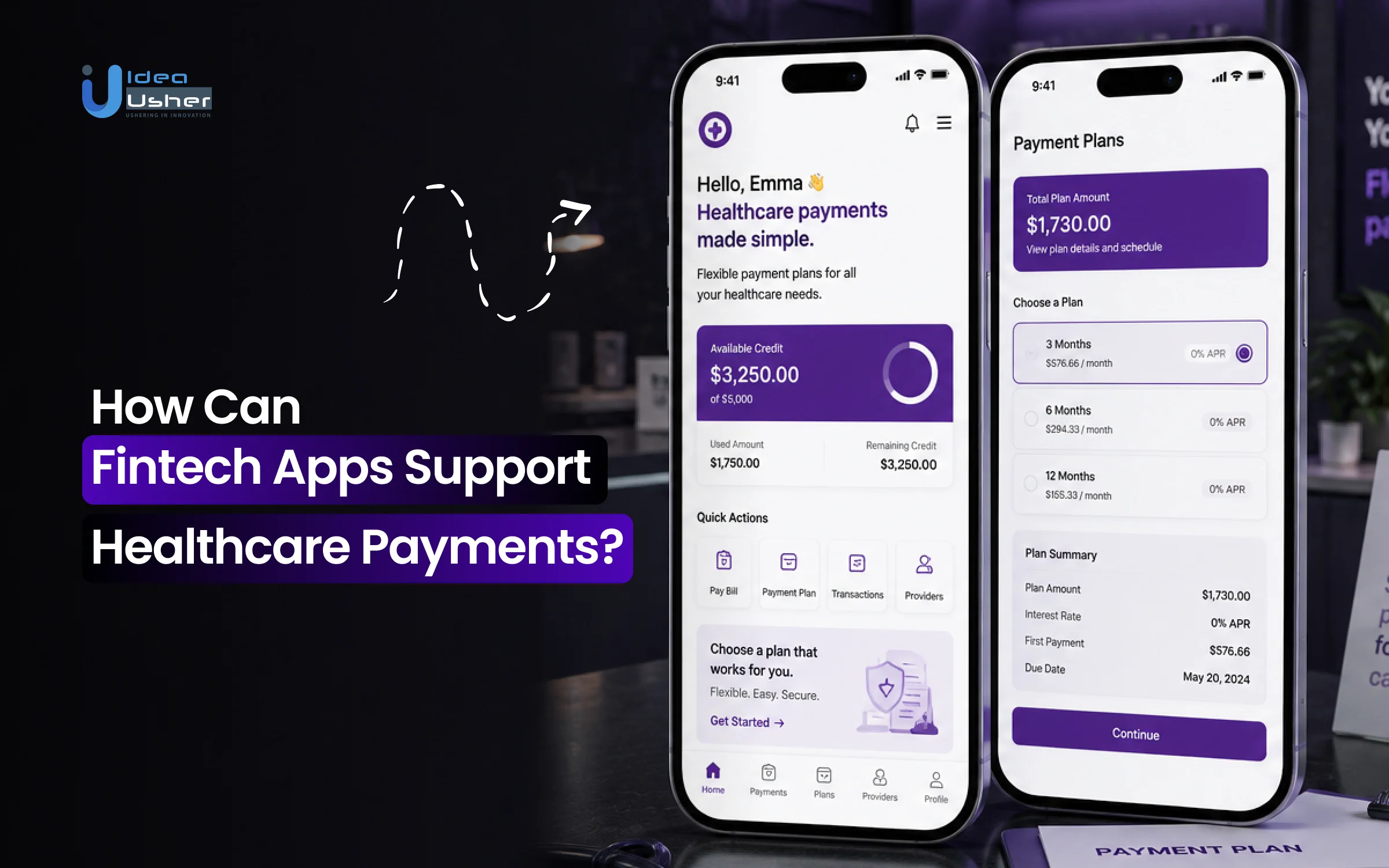
Healthcare payment-focused fintech apps are attracting attention for reasons that go far beyond simplifying medical bills. The real shift is happening because healthcare is becoming part of a person’s long-term financial journey rather than a one-time expense. That’s why many people are paying closer attention to fintech apps that support healthcare payments, as they bring together different parts of the payment experience into a single, seamless system. Rather than simply helping patients pay a bill, these platforms make it easier to manage healthcare costs with greater flexibility while giving providers faster and more reliable payments.
Over the years, we’ve developed several healthcare fintech solutions that leverage secure payment gateway integrations and real-time insurance eligibility verification to simplify medical payments for patients, providers, and healthcare organizations. Drawing on this experience, we’re writing this blog to explore how fintech apps support healthcare payments, focusing on the key technologies, essential features, and development considerations needed to build a secure, scalable, and compliant platform.
Market Size of Healthcare Payment Fintech Apps
According to Grand View Research, the healthcare digital payment market was valued at USD 11.75 billion in 2022 and is expected to grow at a 21.5% CAGR from 2023 to 2030, showing how quickly digital payment solutions are becoming a core part of healthcare. As medical costs continue to rise, patients and providers are looking for faster, more flexible ways to handle payments. This is creating strong demand for fintech apps that simplify billing, support financing, and make healthcare payments more convenient, making the sector an attractive opportunity for startups and investors alike.

Source: Grand View Research
What’s Driving Demand?
Several macroeconomic shifts are simultaneously fueling the demand for specialized healthcare financial platforms. Understanding these drivers allows founders to position their products effectively for enterprise clients.
- Escalating Costs and Patient Financing: As medical treatments become more expensive, patients require flexible ways to manage their bills. Traditional credit cards often carry interest rates that are too high for major medical expenses, creating a direct demand for structured patient financing options.
- The Proliferation of Telehealth: Virtual care has decentralized medicine. Because patients no longer sit at a physical reception desk to check out, providers require seamless, remote payment systems that integrate directly into the digital consultation experience.
- Embedded Finance and Digital Wallets: Consumers expect the same frictionless checkout experience they get from retail apps. Integrating digital wallets and automated clearing features directly into patient portals reduces friction and speeds up collection times.
- Medical Buy Now Pay Later (BNPL): Point-of-sale financing has moved into medicine. Offering interest-free or low-interest installments at the point of care significantly increases the likelihood that a patient will commit to and complete their treatment plan.
- Insurer Digitization: Insurance companies are actively trying to eliminate paper checks and manual claims processing. Platforms that bridge the communication gap between payer networks and clinical providers save thousands of administrative hours.
Why Now Is The Right Time To Build
For entrepreneurs and private equity investors, the window to capture market share in this niche is uniquely open. Medical providers are facing severe administrative burnout and thin profit margins. They are actively looking for software that reduces overhead. This high operational demand translates into rapid B2B adoption rates for platforms that can demonstrate immediate financial utility.
The Strategic Advantage: Building a healthcare payment platform offers exceptional recurring revenue potential. Unlike standard SaaS products, these platforms monetize through a mix of predictable subscription fees and transactional volume, allowing revenue to scale naturally alongside the client’s business growth.

Why Is Healthcare Adopting Fintech Faster Than Ever?
Out-of-pocket medical expenses have grown to a point where patients can no longer pay their balances in a single lump sum. Deductibles are higher than ever, turning patients into the primary payers for many clinical services. This shift makes medical debt a real risk for families and creates a massive collection problem for hospitals. To counter this, patients are looking for flexible financing options at the point of care. They want structured payment setups instead of massive upfront bills.

Look at Cedar, a prominent player in this space that offers personalized financial engagement by unifying billing and payment plans. Its data-driven approach has driven its annual recurring revenue past $102 million, proving how scaling payment options directly boosts platform value. Software platforms that integrate clear, flexible payment terms directly into the checkout process help medical practices secure revenue that might otherwise turn into bad debt.
Patients Expect Seamless Experiences
Modern healthcare consumers expect the same smooth transaction experience they get from retail apps. The massive growth of telehealth means people are used to managing their health from a phone, and they expect their medical bills to work the exact same way.
- Digital Wallets: Patients want to pay via Apple Pay or Google Pay instantly.
- Self-Service Billing: People prefer checking their balances and settling bills via text or portal without calling a billing office.
- Embedded Finance: Smooth checkout options built right into patient portals eliminate payment friction.
Providers Invest To Improve Revenue
Hospitals and private practices operate on razor-thin margins, and slow collections make things worse. Providers are actively spending money on fintech infrastructure to protect their cash flow. By automating payment collection, clinics reduce the time it takes to get paid and lower their administrative overhead.
| Benefit for Providers | How Fintech Achieves It |
| Faster Cash Flow | Digital systems process payments instantly instead of waiting weeks for paper checks. |
| Fewer Delayed Payments | Automated text and email reminders prompt patients to pay balances quickly. |
| Better Patient Retention | Transparent billing and easy payment options keep patients coming back. |
Core Features Every Healthcare Fintech App Needs
Building a competitive healthcare fintech app requires balancing enterprise-grade security with the frictionless user experiences found in modern consumer apps. For investors and developers, focusing on the right technical capabilities ensures maximum market adoption and vendor retention. The following core functionalities are essential for any platform looking to capture market share and solve real-world medical billing inefficiencies.

1. Unified Medical Bill Payment Dashboard
Patients frequently receive different bills from the hospital, the doctor, and the lab for a single procedure. Managing multiple login portals is confusing and leads to delayed payments. A unified dashboard solves this by aggregating every medical bill into a single clear interface. For instance, Cedar streamlines patient billing by consolidating these disparate expenses into one digital experience.
This centralization makes it incredibly easy for users to view, organize, and pay their balances. For an investor, building a unified portal means creating a highly sticky product that patients open every time they receive medical care.
2. Flexible Healthcare Financing Options
High out-of-pocket costs force many consumers to delay necessary medical treatments. Integrating point-of-sale financing directly into the checkout workflow removes this financial barrier. Platforms can offer structured installment plans or medical Buy Now Pay Later options to help patients get care immediately.
Industry Standard: CareCredit has proven the value of this model by offering specialized healthcare financing across thousands of providers. Offering similar flexible credit lines within your app dramatically increases transaction volumes and platform utilization.
3. Insurance Benefits And Claims Management
Unpredictable insurance coverage is a major headache for patients. A high-value fintech app must bridge the gap between payers and consumers. By allowing users to verify coverage and monitor reimbursement status directly in the app, you eliminate billing surprises.
- Instant Verification: Check active insurance benefits before a doctor visit.
- Claims Tracking: Watch the real-time status of submitted claims.
- Reimbursement Monitoring: Know exactly when funds will hit an account.
HealthEquity successfully uses this model to simplify claims and account management, showing how transparency builds immense user trust.
4. HSA, FSA, and Healthcare Wallet Integration
Millions of professionals fund tax-advantaged accounts every year but struggle to use them efficiently. Your platform should include a dedicated healthcare wallet that connects directly to these accounts. The HealthEquity Mobile app shows the power of this feature by supporting direct HSA and FSA payments alongside automated expense tracking. This integration ensures patients use their tax-free dollars seamlessly at the point of purchase.
| Account Type | Key Platform Requirement |
| Health Savings Account (HSA) | Support tax-advantaged payments and investable balance tracking. |
| Flexible Spending Account (FSA) | Automate deadline alerts and eligible expense verification. |
5. AI-Powered Cost Estimates Before Treatment
Surprise medical bills destroy patient trust and lead to payment defaults. Modern platforms use machine learning to calculate accurate price transparency before a patient even sees a doctor. By analyzing provider fee schedules, real-time insurance data, and remaining deductibles, the app can deliver a precise out-of-pocket estimate.
Leading patient financing platforms use these automated eligibility checks to help users plan their expenses. This upfront clarity gives patients the confidence to approve treatments, which directly improves provider collection rates.
6. Automated Payment Plans And Smart Reminders
Manual collection efforts are expensive and highly inefficient for medical staff. The most profitable platforms automate the entire post-care billing cycle through smart scheduling.
- Auto-Split Billing: Automatically divide large balances into monthly installments based on user parameters.
- Smart Reminders: Send friendly text or email notifications before a card is charged.
- Failed Payment Recovery: Trigger automated updates if a card expires or bounces.
Software solutions like HES Patient Financing Software use these automated workflows to handle complex repayment schedules without requiring human intervention.
7. Secure Digital Identity And Fraud Protection
Healthcare fintech apps sit at the intersection of strict medical and financial regulations. Protecting data requires a robust architecture that keeps the platform fully secure. Fintech platforms must implement digital identity verification to protect sensitive user profiles. Incorporating automated identity checks keeps your platform compliant with financial regulations.
Solutions like HES Patient Financing Software build these secure workflows directly into their core code. This high level of security protects user data and ensures the entire app runs safely.
How Is Fintech Making Healthcare More Affordable?
The rising cost of medical care is pushing traditional healthcare systems to their limits, making financial accessibility a top priority for patients and providers alike. By embedding modern financial tools into clinical workflows, fintech solutions are successfully lowering the barriers to entry for essential care. The following sections outline the primary mechanisms through which financial technology simplifies, distributes, and reduces the immediate burden of medical expenses.
1. Digital Payments Simplify Bills
Paying for medical care used to mean waiting in long lines at a hospital cash counter or dealing with manual paperwork. Modern digital payment systems change this entirely by making transactions immediate and hassle-free. Integrating instant network options like UPI and digital wallets directly into hospital networks removes payment friction.
Patients can settle their pharmacy or doctor bills in seconds using a smartphone. This speed helps clinics manage their administration efficiently while giving patients a stress-free checkout experience.
2. Financing And EMI Options
When an unexpected medical emergency hits, paying the entire bill upfront can disrupt household finances. Specialized financing models solve this problem by breaking down large expenses into manageable pieces.
- Interest-Free EMIs: Patients can divide a large surgical cost into equal monthly parts without extra charges.
- Point-of-Care Loans: Platforms approve micro-installment plans instantly right at the clinic reception desk.
- Reduced Postponement: Families can agree to critical medical procedures immediately rather than waiting for their next paycheck.
A clear example of this model in action is SaveIN, a platform that provides instant point-of-care financing at clinics. By allowing users to split their healthcare costs into easy monthly installments, the company has scaled successfully, generating an annual revenue of approximately $1.87 million.
3. Credit Lines Improve Access
Traditional insurance policies rarely cover everything. When policy caps or exclusions leave a patient with a massive, unexpected gap, dedicated healthcare credit lines step in to fill the financial void. These platforms function like digital medical credit cards. They provide pre-approved, flexible credit pools that users can draw from instantly during an emergency. This immediate liquidity gives families peace of mind and protects hospitals from the risk of unpaid bills.
4. Government-Led Digital Adoption
Public infrastructure plays a massive role in standardizing digital health transactions. Government initiatives and regulatory support from the RBI have turned secure digital payments into a foundational part of modern healthcare. This robust public infrastructure minimizes transaction failure rates and lowers handling costs across the entire medical ecosystem.
| Public Initiative | Impact on Healthcare Finance |
| UPI Network Expansion | Enables instant, zero-fee patient transactions at both rural and urban clinics. |
| RBI Digital Regulations | Guarantees high-level security protocols for every mobile medical transaction. |
5. Access Beyond Insurance
Many healthcare costs happen outside the hospital room, such as chronic illness medication, physical therapy, and diagnostic tests. Insurance companies frequently classify these out-of-pocket costs as non-reimbursable. Fintech platforms step in by providing unique financial alternatives to bridge this gap.
This is exactly where platforms like Affordplan create impact by helping patients plan and save for non-emergency treatments. By allowing patients to build structured savings and access localized rewards for planned care, the platform has established a strong business model, historically driving its yearly revenue past $900,000.
How Healthcare Fintech Apps Scale Across Providers?
A successful healthcare fintech app needs more than a good user interface. It requires a scalable and reliable architecture that can handle large payment volumes without disrupting daily operations. By using a modular design and modern infrastructure, the platform can support hospitals, clinics, and patients while remaining secure, flexible, and ready to grow as demand increases.
1. Multi-Tenant SaaS Supports Providers
A multi-tenant architecture allows a healthcare fintech platform to serve multiple hospitals, clinics, and laboratories from a single system while keeping each organization’s data secure and completely separate. This approach makes it easier to roll out new features, reduces maintenance costs, and speeds up onboarding for new clients. As the customer base grows, businesses can scale much more efficiently without managing separate software deployments for every healthcare provider.
2. APIs Simplify Ecosystem Growth
A medical payment engine cannot operate in a vacuum. It must communicate continuously with medical records, insurance networks, and banking gateways. Building the platform with an API-first framework ensures that developers can plug in new services seamlessly without rewriting core logic.
- EHR and PM Connections: Sync client billing data instantly with major clinical record databases.
- Clearinghouse Gateways: Route claims directly to major health insurance networks for instant verification.
- Banking and ID Services: Connect with secure verification networks to clear consumer identities quickly.
Consider an enterprise platform like InstaMed. By utilizing highly integrated network endpoints, the company successfully unifies processing channels across payers and providers, driving its annual recurring revenue to roughly $14.9 million. This architecture enables companies to add fresh modules easily, ensuring the platform remains highly adaptable as the business grows.
3. Cloud Infrastructure Enables Growth
Building a healthcare fintech platform on a cloud-native architecture allows it to handle high transaction volumes without affecting performance. By using microservices and containerized deployments, different parts of the platform can scale independently, ensuring patient payments, billing, and financial services continue to run smoothly even during peak demand.
This approach has proven successful for platforms like Waystar, which has grown to over USD 1.157 billion in annual revenue while processing billions of healthcare transactions. A scalable cloud infrastructure not only improves reliability and uptime but also prepares the platform to support expanding hospital networks and increasing payment volumes as the business grows.
Top 5 Fintech Apps That Support Healthcare Payments
Before choosing the right features for your healthcare fintech platform, it’s worth looking at the companies already shaping this space. We reviewed some of the leading healthcare payment fintech solutions in the U.S. to understand what makes them successful. The platforms below highlight how medical payments and financing can be made simpler and more accessible.
1. CareCredit

CareCredit is one of the most widely used healthcare financing platforms in the U.S., allowing patients to pay for medical, dental, vision, veterinary, and wellness services through flexible financing plans. Accepted by thousands of healthcare providers, it helps patients spread treatment costs over time, making expensive procedures more affordable without delaying care.
2. Cedar

Cedar is a healthcare financial engagement platform that simplifies the patient payment journey through digital billing, personalized payment options, and AI-powered financial assistance. By integrating with hospitals and health systems, it creates a seamless billing experience while helping providers improve collections and patient satisfaction.
3. HealthEquity

HealthEquity enables individuals to manage Health Savings Accounts (HSAs), Flexible Spending Accounts (FSAs), and other healthcare benefits from a single platform. Users can pay eligible medical expenses, submit reimbursements, invest HSA funds, and track healthcare spending, making it easier to manage long-term healthcare finances.
4. PayZen

PayZen is an AI-powered patient financing platform that offers personalized, interest-free payment plans based on a patient’s ability to pay. It integrates directly with healthcare providers to automate financing and collections, helping patients access care while reducing financial barriers and administrative work for providers.
5. Paytient

Paytient partners with employers, insurers, and healthcare organizations to provide a healthcare payment card that lets members pay medical bills over time with no interest or credit checks. The platform focuses on improving healthcare affordability while helping patients receive timely care without the burden of large upfront payments.
Build Healthcare Fintech Apps with Idea Usher
Building a successful healthcare fintech platform requires expertise in product strategy, secure payment systems, and healthcare technology. Idea Usher helps businesses turn their ideas into scalable, enterprise-ready solutions by creating intuitive user experiences and reliable backend infrastructure. From planning the product architecture to developing features that support long-term growth, our team builds platforms designed for real-world healthcare and financial workflows.
Develop Secure Apps With Compliance
Operating within the medical financial landscape means maintaining flawless adherence to federal data privacy and consumer protection laws. Attempting to patch security gaps after a product launch is incredibly risky and expensive. Idea Usher builds rigorous compliance frameworks directly into the foundation of your codebase.
- HIPAA Compliance: We implement advanced data encryption to fully protect patient health information at rest and in transit.
- PCI DSS Standards: Our engineers build secure payment tokenization structures that shield user financial data during processing.
- KYC and AML Verification: We install automated verification networks to authenticate user identities and prevent platform fraud.
| Platform Security Feature | Engineering Outcome |
| EHR System Compatibility | Ensures your platform communicates cleanly with major clinical databases. |
| Protected API Endpoints | Prevents outside data leaks while maintaining rapid communication with financial vendors. |
Launch Faster With Proven Expertise
Speed to market can determine the commercial success of a software business. Delaying a launch because of architectural errors or weak system engineering costs money and creates room for competitors. Idea Usher accelerates your development timeline by leveraging pre-tested structural frameworks and highly skilled technical teams.
Our Engineering Milestone: With over 500,000 hours of coding experience, our team of ex-MAANG/FAANG developers has built robust systems that handle complex workflows.
Conclusion
Healthcare payments are becoming more digital, flexible, and patient-focused, creating a strong opportunity for fintech innovation. By combining secure payment processing, financing options, automated billing, and healthcare integrations, fintech apps make medical expenses easier to manage for both patients and providers. As demand for convenient and transparent payment experiences continues to grow, businesses that invest in well-designed healthcare fintech platforms will be better positioned to succeed in this rapidly expanding market.
Things to Know About Healthcare Fintech Apps
A1: A healthcare fintech app combines financial technology with healthcare services to simplify medical payments. It enables users to pay bills, access financing, manage insurance benefits, track healthcare expenses, and use HSA/FSA accounts from a single platform. This creates a more convenient and transparent financial experience for both patients and healthcare providers.
A2: These apps simplify healthcare payments by bringing bills, insurance information, and payment options into one place. Patients can pay online, split large bills into installments, receive payment reminders, and track reimbursements, making medical expenses easier to manage and reducing payment delays. As a result, patients gain greater financial flexibility while providers improve payment collection rates.
A3: Yes. Most healthcare fintech apps use encryption, tokenization, multi-factor authentication, and secure payment gateways to protect sensitive information. They are typically built to comply with standards like HIPAA for healthcare data and PCI DSS for payment security, ensuring safe and reliable transactions. Many platforms also include fraud detection and continuous monitoring to strengthen data protection.
A4: Yes. Modern healthcare fintech apps can integrate with EHRs, hospital billing systems, insurance providers, pharmacies, and payment gateways through APIs. This allows healthcare organizations to improve payment workflows without replacing their existing infrastructure. Seamless integrations also reduce administrative work and improve the overall patient journey.


