

Key Takeaways
- Digital healthcare is transforming neurological care, with neurology apps enabling continuous monitoring, early detection, and better long-term patient outcomes.
- Development costs depend on AI features, wearable integrations, telehealth, compliance, clinician dashboards, and healthcare interoperability.
- Modern platforms combine cognitive assessments, symptom tracking, remote monitoring, AI insights, and secure data sharing to improve care.
- Building a scalable platform requires HIPAA compliance, cloud infrastructure, AI models, EHR integration, and ongoing maintenance.
- How Idea Usher can help businesses build secure, AI-powered neurology apps with advanced analytics, healthcare integrations, and enterprise-ready architecture.
Neurological care is changing rapidly as technology makes it possible to support patients beyond the walls of a hospital or clinic. Instead of relying only on occasional appointments, doctors can now gain a better understanding of a patient’s condition through continuous monitoring and real-world health data. This leads to earlier interventions, more personalized treatment, and better long-term outcomes. As a result, more patients and healthcare providers are turning to neurology apps to simplify disease management and improve access to ongoing care. The growing adoption of these platforms is creating significant opportunities for businesses investing in digital neurology solutions.
Over the years, we’ve built numerous neurology applications that leverage AI-powered clinical decision support and wearable device integration to improve neurological care and patient monitoring. Drawing on this experience, we’re writing this blog to break down the complete cost of developing a neurology app,
Market Size and Growth of Digital Neurology
According to Grand View Research, the global digital health in neurology market was valued at USD 32.3 billion in 2023 and is projected to reach USD 131.3 billion by 2030, growing at a 22.5% CAGR. This strong growth shows that healthcare providers are increasingly investing in digital neurology platforms to improve patient monitoring, deliver better long-term care, and expand access to neurological services.
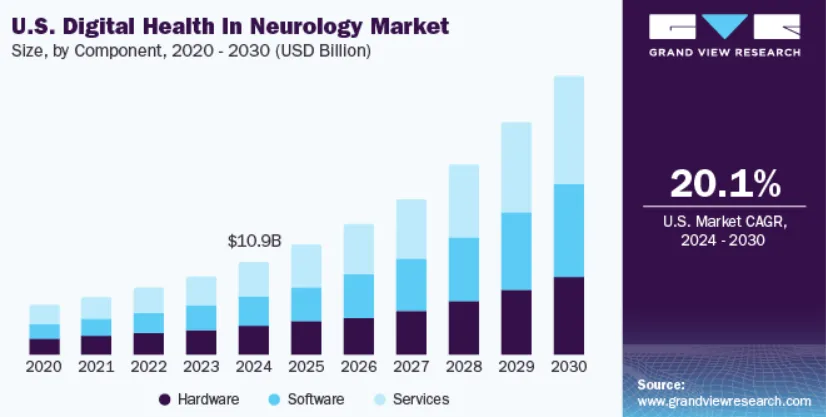
Source: Grand View Research
Capital is concentrating heavily in three distinct product types:
- Remote Patient Monitoring: Sensor platforms and wearable tech capturing real-time neurological biomarkers.
- AI Diagnostic Triage: Algorithms analyzing brain imaging, speech patterns, and motor function to flag early disease indicators.
- Digital Therapeutics: Prescription-grade software delivering targeted cognitive and physical therapy.
A prime example of value creation in this space is Viz.ai. Built to assist emergency teams with instant AI-driven stroke detection, the platform coordinates care across hospital networks. By drastically cutting diagnostic time, Viz.ai scaled its subscription model to roughly $40 million in annual revenue while securing a market valuation of over $1.2 billion.
Key Growth Drivers
The number of people living with neurological conditions such as Parkinson’s, Alzheimer’s, and vascular dementia continues to grow as populations age. Healthcare systems are struggling to meet this demand, making remote monitoring and digital neurology platforms an increasingly practical way to support long-term patient care.
Maturing Reimbursement
Healthcare providers are adopting neurology apps more confidently because reimbursement policies now cover many remote monitoring services. This creates a stronger business case for hospitals and clinics to invest in digital neurological care.
Advanced AI and Edge Tech
AI has made neurology platforms far more reliable than earlier digital health solutions. By analyzing data from connected devices in real time, these platforms can detect meaningful changes in a patient’s condition and provide clinicians with timely insights without adding unnecessary workload.
Investment Trends
Capital deployment is shifting away from generic telehealth apps. Institutional investors want targeted platforms that solve concrete clinical and operational problems in neurology. Another standout platform demonstrating commercial viability is MindMaze. They combine immersive software environments with sensor hardware to help patients recover from stroke and traumatic brain injuries.
| Strategic Sector | Clinical Target | Primary Revenue Driver |
| Neuro-Imaging AI | High radiologist workloads and diagnostic delays | SaaS contracts per hospital network |
| Virtual Neuro-Rehab | Post-stroke physical and cognitive recovery | Hybrid clinical and subscription billing |
| Decentralized Neuro Trials | Patient dropouts in central clinical trials | B2B enterprise software contracts with pharma |
MindMaze generated around $35.5 million in annual recurring revenue and achieved a valuation of $1.5 billion by pairing rigorous clinical validation with scalable software infrastructure.
Strategic Takeaway for Founders
Building a category leader requires balancing product speed with strict data compliance and seamless electronic health record integration. Platforms that deliver proven clinical utility alongside clear cost savings will continue to attract premium valuations and acquisition offers.
Features That Can Impact the Cost of a Neurology App
Developing a medical-grade neurology app requires a careful balance between complex technical features and budget constraints. Investors and development teams must understand how specific functional modules drive up engineering hours, regulatory burdens, and integration costs.
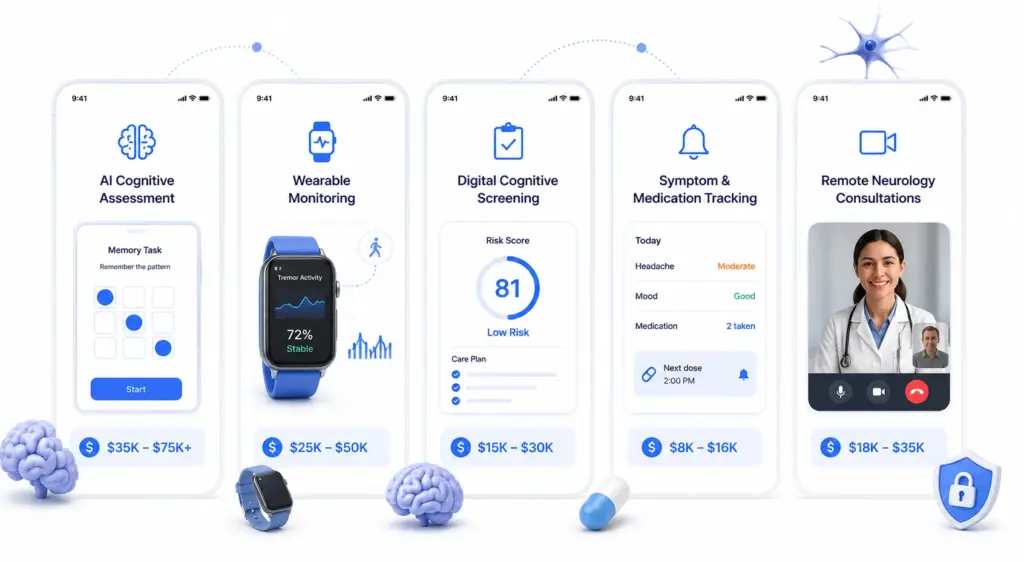
1. AI Cognitive Assessment
Patients interact with this module by completing short interactive spatial and memory tasks on a tablet or smartphone. While the patient performs the test, front-facing cameras and screen sensors track eye movements and fine motor tremors. Altoida leverages augmented reality and AI algorithms to evaluate micro-movements, detecting subtle signs of cognitive decline long before traditional clinical visits.
- How other apps tackle it: Apps like Linus Health use digital clock-drawing tasks paired with voice recognition to analyze speech hesitation and motor speed during cognitive testing.
- Cost Driver: Building custom machine learning models, integrating computer vision, and validating algorithms to meet FDA regulatory standards significantly inflates engineering expenses.
Estimated Cost Impact: $35,000 – $75,000+ (plus additional FDA validation overhead).
2. Wearable Movement Monitoring
Patients wear smartwatches or specialized motion sensors that run passively in the background throughout the day. These devices capture continuous acceleration, tremor severity, and gait stability without requiring manual user input. Rune Labs integrates data directly from wearable devices and implanted deep brain stimulators to monitor Parkinson’s symptoms continuously.
- How other apps tackle it: Apps like StrivePD pull background telemetry strictly from Apple Watch Motion Sensors to track involuntary muscle movements and medication response curves.
- Cost Driver: Processing high-frequency telemetry streams requires scalable cloud infrastructure, custom Bluetooth protocols, and heavy data normalization pipelines.
Estimated Cost Impact: $25,000 – $50,000.
3. Digital Cognitive Screening
Clinicians and patients use this feature as a structured assessment tool during routine appointments. Patients complete computerized questionnaires, after which the platform instantly generates personalized care plans and risk scores for the attending physician. BrainCheck provides a unified clinical platform that combines rapid cognitive testing, long-term patient tracking, and automated care plan recommendations.
- How other apps tackle it: Apps like Cognivue use dedicated hardware kiosks with specialized visual testing controls to conduct standardized cognitive evaluations in primary care offices.
- Cost Driver: Designing dynamic clinical decision algorithms and building flexible workflow builders that adapt to different physician preferences adds substantial backend complexity.
Estimated Cost Impact: $15,000 – $30,000.
4. Symptom & Medication Tracking
Patients log daily mood scores, log headache severity, set automatic medication reminders, and export summary reports before their next specialist visit. Neurotrack provides patients with intuitive tracking tools to log daily health metrics, manage medication schedules, and generate clear progress reports for their care team.
- How other apps tackle it: Apps like Nile Health specialize in epilepsy care, allowing patients to track seizure triggers and log medication side effects through simple chat-based interfaces.
- Cost Driver: Ensuring high user retention requires custom notification logic, offline data syncing, and accessible UX design across diverse age groups.
Estimated Cost Impact: $8,000 – $16,000.
5. Remote Neurology Consultations
Patients use this feature to attend secure HD video appointments, send end-to-end encrypted messages to their neurologist, and receive updated digital prescriptions. Modern neurology platforms integrate encrypted teleconsultations, allowing specialists to review real-time patient metrics and adjust care plans during virtual visits.
- How other apps tackle it: Platforms like Sevaro focus on emergency telestroke networks, connecting hospital emergency rooms to on-call neurologists in under 45 seconds.
- Cost Driver: Implementing HIPAA-compliant video streaming, secure messaging protocols, and multi-party video routing incurs ongoing server overhead and strict compliance audits.
Estimated Cost Impact: $18,000 – $35,000.
6. Clinical Dashboard & Health Data Sharing
Physicians use these dashboards to analyze longitudinal patient charts, review incoming alert flags, and push diagnostic summaries straight into external hospital systems. BrainCheck equips clinicians with centralized dashboards that aggregate assessment data, longitudinal trend graphs, and direct connections to electronic health records.
- How other apps tackle it: Platforms like Kneurokit offer web portals that summarize continuous patient data into single-page risk reports designed for fast clinical review.
- Cost Driver: Engineering bi-directional HL7 and FHIR integrations with legacy hospital systems represents one of the largest development line items in healthtech software.
Estimated Cost Impact: $20,000 – $65,000+.
7. Analytics & Personalized Insights
Predictive analytics helps clinicians detect neurological decline earlier and make more informed treatment decisions. Altoida uses AI and digital biomarkers for early risk detection, while Combinostics analyzes brain MRI scans to track disease progression. These AI capabilities require extensive clinical data and ongoing model training.
Estimated Cost Impact: $30,000 – $70,000+.
Neurology App Development Cost: Complete Guide
Navigating the financial landscape of a neurology app requires balancing feature scope against regulatory demands and engineering complexity. Capital allocation directly determines your build speed and market entry timing. Understanding where your budget is spent also helps you prioritize features that deliver the highest clinical and business value.
MVP Cost Breakdown
A minimum viable product helps you test core assumptions with real clinicians and patients without overcommitting capital. A decision-maker launching a streamlined healthcare MVP typically budgets between $40,000 and $120,000. This level of build gives founders enough clinical utility to run pilot programs and collect early investor data.
| MVP Feature / Module | Scope of Work | Estimated Cost |
| Patient Onboarding | Secure signup, identity verification, HIPAA consents | $5,000 – $8,000 |
| Symptom & Medication Tracking | Log entry tools, medication alerts, basic summary charts | $8,000 – $14,000 |
| Cognitive Assessments | Standardized digital tests and simple scoring logic | $10,000 – $18,000 |
| Teleconsultation | Encrypted HD video calls and direct messaging | $12,000 – $22,000 |
| Basic Clinician Dashboard | Patient overview, assessment reviews, user management | $15,000 – $28,000 |
| Core Security & Compliance | End-to-end encryption, audit logs, secure cloud hosting | $10,000 – $18,000 |
Enterprise Platform Costs
Scaling to an enterprise-grade platform transitions your product from a standalone tool to a connected clinical engine. Enterprise platforms range from $250,000 to $600,000+ based on backend scale, machine learning capabilities, and hospital interoperability.
| Enterprise Module | Key Functionality | Estimated Cost |
| AI Analytics & Predictive Insights | Diagnostic models, disease progression tracking | $70,000 – $140,000 |
| Wearable Device Integrations | Continuous motion and telemetry data pipelines | $40,000 – $80,000 |
| EHR/EMR Interoperability | Bi-directional FHIR and HL7 hospital connectors | $35,000 – $75,000 |
| Multi-Role Dashboards | Customized portals for specialists, nurses, admins | $30,000 – $60,000 |
| Remote Patient Monitoring (RPM) | Automated alert triggers, continuous sensor streams | $45,000 – $85,000 |
| Advanced Security & Infrastructure | Penetration testing, HIPAA/SOC2 audits, cloud scaling | $30,000 – $60,000 |
Reducing Costs Smartly
Controlling budgets in medical software development is about making smart structural choices early rather than cutting corners on quality or compliance.
- Leverage Pre-built Infrastructure: Use compliant cloud backends like Medplum or AWS HealthLake instead of building database architectures and compliance foundations from scratch.
- Integrate Commercial SDKs: Use proven third-party tools for video calls and chat features. Building custom video streaming logic adds high maintenance costs for little extra value.
- Adopt Cross-Platform Frameworks: Build mobile applications using React Native or Flutter. This lets you deploy natively to both iOS and Android from a single codebase, saving substantial engineering hours.
- Phased Integration Rollouts: Launch your early builds using CSV data exports or simple API webhooks. Hold off on expensive custom FHIR connectors for hospital systems until you have signed enterprise client agreements.
Neurology App Development Cost by App Type
Comparing development costs across product categories helps founders and investors allocate capital effectively based on technical scope and regulatory requirements. It also provides a realistic benchmark for planning budgets, prioritizing features, and choosing the right development strategy before starting the project.
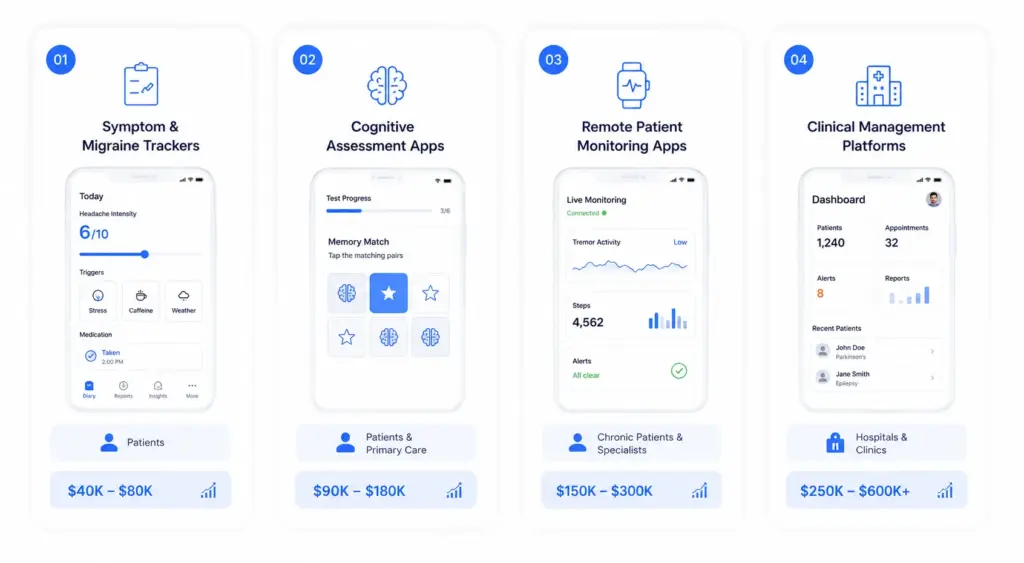
1. Symptom & Migraine Trackers
These apps focus on symptom logging, headache diaries, medication reminders, trigger tracking, and health reports. Their relatively simple workflows and limited integrations make them the most affordable neurology apps to develop. Apps like CareClinic Migraine Tracker serve as strong examples in this category.
- Core Focus: Patient self-management and pre-visit reporting.
- Key Cost Drivers: Intuitive UI design, offline data synchronization, and customizable report generation.
Estimated Cost: $40,000 – $80,000
2. Cognitive Assessment Apps
Platforms such as Altoida use AI-powered cognitive tests, digital biomarkers, sensor analysis, and longitudinal assessments to detect early neurological changes. AI models, advanced analytics, and required clinical validations push development costs into higher tiers.
- Core Focus: Early detection of cognitive decline and remote screening.
- Key Cost Drivers: Custom computer vision models, interactive gamified tasks, and algorithmic scoring engines.
Estimated Cost: $90,000 – $180,000
3. Remote Patient Monitoring Apps
RPM platforms collect continuous telemetry from wearable devices and smartphones, monitor neurological symptoms in real time, trigger clinician alerts, and generate patient insights. Platforms like Rune Labs exemplify this category.
- Core Focus: Passive monitoring for chronic conditions like Parkinson’s or epilepsy.
- Key Cost Drivers: Continuous device Bluetooth sync, scalable data ingestion pipelines, and automated threshold alerts.
Estimated Cost: $150,000 – $300,000
4. Clinical Management Platforms
Enterprise neurology platforms include clinician dashboards, EHR/EMR integration, AI-assisted decision support, patient management, telehealth, reporting, and multi-role access for hospitals and specialty clinics. Solutions like Neurology-Cloud represent this space, where interoperability, strict compliance, and enterprise scalability create the highest development costs.
Estimated Cost: $250,000 – $600,000+
| Platform Type | Target User | Regulatory Risk | Integration Complexity |
| Symptom Tracker | Patient / Consumer | Low (Wellness / Self-Log) | Low (Standard APIs) |
| Cognitive Screening | Patient & Primary Care | Medium (FDA Class I/II) | Medium (Clinical Portals) |
| RPM Platform | Chronic Patients & Specialists | High (Clinical Data) | High (Wearables & Sensors) |
| Clinical Enterprise EHR | Hospital Networks & Clinics | Very High (HIPAA / SOC2) | Complex (FHIR |
How AI Features Increase Neurology App Development Cost?
Integrating artificial intelligence transforms a neurology app from a static tracking app into an active clinical diagnostic tool. However, machine learning algorithms, computer vision pipelines, and continuous data processing represent the single largest expense in modern healthtech development.
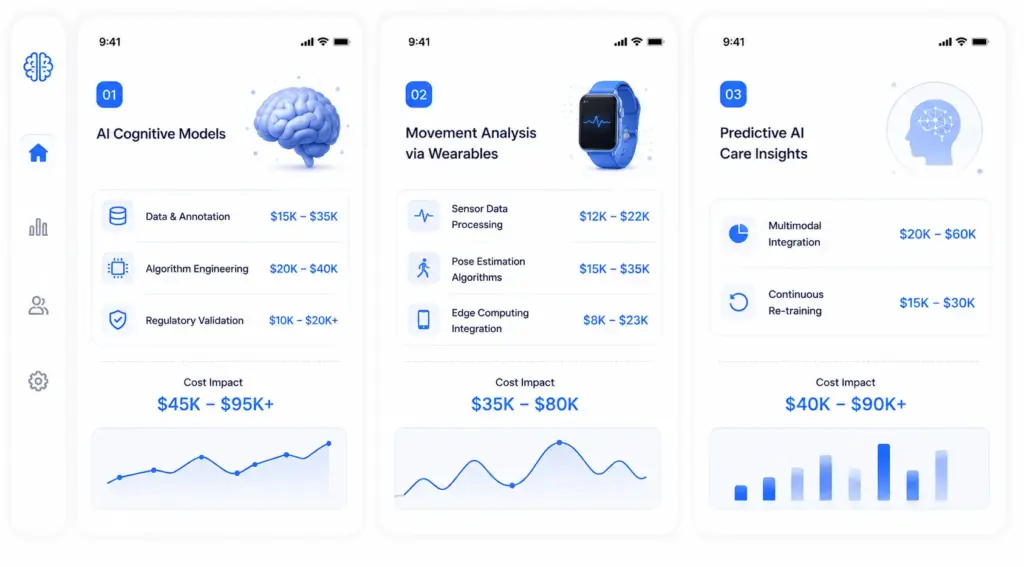
1. AI Cognitive Models
These models analyze micro-interactions, like fine motor hesitation, speech pauses, and spatial memory response times during digital tests. The goal is spotting early indicators of Alzheimer’s disease or mild cognitive impairment long before traditional clinic visits.
- Data Sourcing and Annotation: Training models requires thousands of verified, ethically sourced patient datasets, costing $15,000 – $35,000 just for clean baseline data.
- Algorithm Engineering: Building custom computer vision pipelines to analyze micro-movements on mobile devices adds $20,000 – $40,000 in specialized machine learning talent.
- Regulatory Proof: Testing algorithm accuracy across age groups and submitting proof to safety regulators consumes $10,000 – $20,000+ in compliance engineering.
Estimated Development Cost Impact: $45,000 – $95,000+
2. Movement Analysis via Wearables
This feature tracks tremor severity, gait instability, and motor fluctuations in real time for conditions like Parkinson’s disease. The system processes continuous telemetry streams from smartwatches, specialized movement sensors, or smartphone video cameras.
| Technical Component | Core Engineering Requirement | Cost Range |
| Sensor Data Processing | Filtering noise out of high-frequency accelerometer streams | $12,000 – $22,000 |
| Pose Estimation Algorithms | Computer vision models tracking gait angles via phone camera | $15,000 – $35,000 |
| Edge Computing Integration | Processing AI models directly on mobile devices to save battery | $8,000 – $23,000 |
The Primary Cost Factor: Ingesting millions of raw data points every minute requires an ultra-scalable backend. Cloud server bills and streaming API pipelines scale up quickly, adding both upfront development and recurring monthly overhead.
Estimated Development Cost Impact: $35,000 – $80,000
3. Predictive AI Care Insights
Predictive models evaluate long-term patient data to forecast disease progression, alert doctors to acute risks, and recommend medication adjustments. Instead of analyzing a single test, these engines track overall trendlines over months or years.
- Multimodal Integration: Combining speech data, daily symptom logs, and wearable movement telemetry into a single predictive model requires specialized data science architecture.
- Continuous Re-Training Infrastructure: As patient outcomes accumulate, the algorithm must update safely. Setting up automated re-training pipelines while staying compliant with FDA machine-learning rules adds another $15,000 – $30,000 in backend engineering.
Estimated Development Cost Impact: $40,000 – $90,000+
Top 5 Neurology Apps in the USA
Successful neurology apps show how AI and digital health are transforming neurological care. Looking at these platforms can help you understand which features deliver the most value and how they influence the overall cost of development. They also highlight the capabilities that patients and healthcare providers increasingly expect from modern neurology solutions.
1. Altoida
Altoida is an AI-powered neurology platform focused on the early detection and monitoring of cognitive decline. Its Digital NeuroMarker Platform completes assessments in about 10 minutes, captures 800+ digital biomarkers, and is built on 20+ years of scientific research involving more than 20,000 participants and 42,000+ assessments. The platform leverages augmented reality, smartphone sensors, and AI to help clinicians identify subtle neurological changes earlier than traditional cognitive tests.
2. Rune Labs
Rune Labs is a digital health platform focused on Parkinson’s disease management through continuous remote monitoring. The platform integrates wearable devices, including Apple Watch, to analyze tremors, gait, and other movement symptoms in real time. It has also partnered with leading healthcare organizations to improve Parkinson’s care by turning continuous wearable data into actionable clinical insights, helping neurologists personalize treatment between visits.
3. BrainCheck
BrainCheck is a digital cognitive assessment platform used by hospitals and healthcare providers across the U.S. Founded in 2015, the company has raised over $58 million in funding, including a $15 million growth round to expand its next-generation platform. It also introduced a 3-minute cognitive screening solution that enables providers to quickly identify cognitive impairment while supporting longitudinal monitoring and care planning.
4. BeCare Link

BeCare Link is an AI-powered remote neurological monitoring platform that enables patients to complete cognitive and neurological assessments from home. The platform combines digital symptom tracking, AI-based evaluations, clinician dashboards, and longitudinal reporting to support continuous neurological care. Its focus on remote monitoring helps physicians detect neurological changes earlier while reducing the need for frequent in-person visits.
5. BrainFx
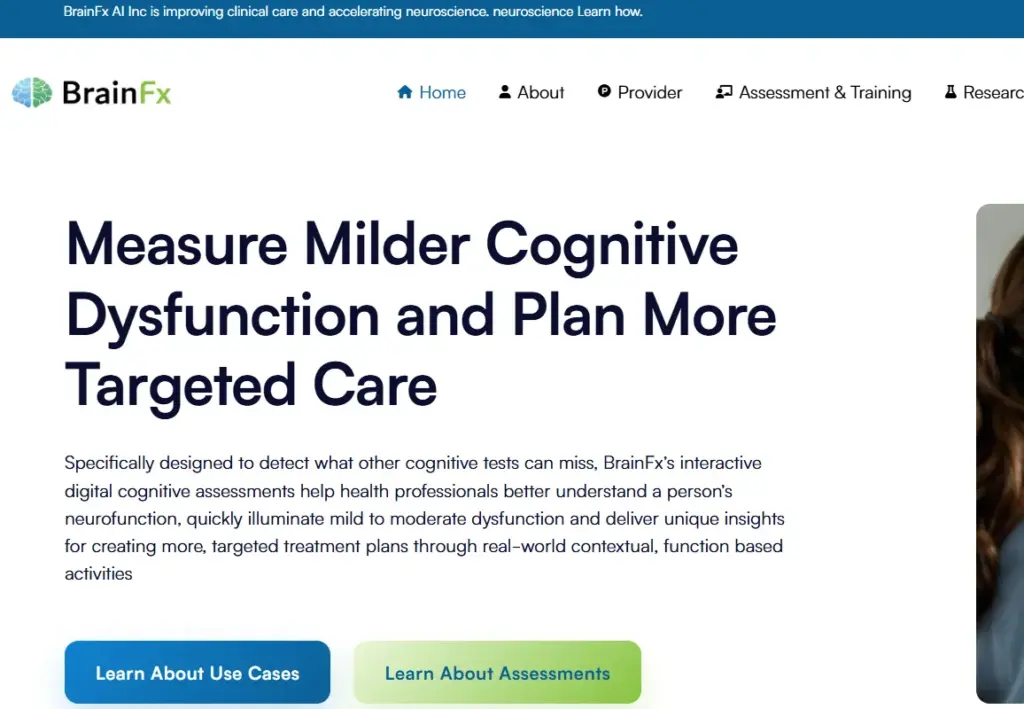
BrainFx is a neurofunctional assessment platform that measures 30+ cognitive functions through interactive digital tasks rather than traditional paper-based testing. The platform evaluates cognitive, physical, sensory, and psychosocial performance to generate detailed brain health profiles. These insights help clinicians create personalized rehabilitation plans and objectively monitor patient progress over time across multiple neurological conditions.
Develop a Neurology App with IdeaUsher
Building a digital neurology platform requires a technical partner who understands both complex software engineering and strict medical regulations. At IdeaUsher, we bring the ideal balance of deep clinical domain knowledge and elite software execution. With over 500,000 hours of coding experience, our team of ex-MAANG/FAANG developers turns complex medical concepts into scalable, market-ready healthcare platforms.
AI-Powered Neurology Expertise
Advanced AI plays a key role in modern neurology platforms by enabling earlier detection and more personalized patient care. We build custom AI solutions that analyze cognitive assessments, movement patterns, and long-term health data to help clinicians identify neurological changes sooner and make better-informed treatment decisions.
Secure and HIPAA-Compliant Solutions
Healthcare data security is non-negotiable. We engineer compliance into your app from line one of code, ensuring full protection against regulatory penalties and data breaches.
| Security & Compliance Standard | Implementation Framework | Business Protection |
| HIPAA / HITECH Compliance | End-to-end data encryption at rest and in transit | Zero compliance violations for your enterprise |
| Interoperability Standards | Bi-directional FHIR / HL7 v2 connectors | Seamless connection to Epic, Cerner, and hospital EHRs |
| Enterprise Security Audits | Automated access logging and SOC 2 architecture | Faster procurement approval from hospital networks |
Scale from MVP to Enterprise Platform
Whether launching a lean prototype or scaling a global clinical engine, our agile development methodology ensures capital efficiency at every phase.
- Phase 1: Focused MVP Launch ($40k – $120k)
Rapidly deploy core features like symptom logging, medication alerts, and basic teleconsultations to validate your market and secure early funding. - Phase 2: Enterprise Scaling ($250k – $600k+)
Expand your platform with custom AI diagnostic models, continuous wearable data pipelines, and bi-directional hospital data sync.
Partnering with IdeaUsher gives you direct access to world-class engineering talent, speeding up your time-to-market while lowering development risks.
Conclusion
Building a neurology app is about more than estimating development costs. The right investment depends on the features you need, the level of AI integration, and the regulatory requirements your platform must meet. With a clear roadmap and the right development partner, you can build a secure, scalable solution that delivers long-term value for both healthcare providers and patients.
Things to Know About Neurology Apps
A1: A neurology app is a digital health solution that helps people manage neurological conditions and stay connected with their care team. Patients can track symptoms, complete cognitive assessments, receive medication reminders, and even attend virtual consultations from one place. Many modern apps also work with AI and wearable devices, giving doctors a clearer picture of how a condition changes over time instead of relying only on occasional clinic visits.
A2: The best neurology apps focus on making care easier for both patients and clinicians. Core features usually include symptom tracking, cognitive assessments, medication management, wearable integration, secure messaging, and teleconsultations. More advanced platforms also use AI to identify trends in patient data and provide insights that support faster, more personalized treatment decisions.
A3: They can be, but compliance depends on how the app is built and who provides it. If a neurology app is developed for a healthcare organization and handles patient health information, it must follow HIPAA requirements. This includes protecting data with encryption, secure authentication, access controls, and ongoing security monitoring. Building compliance into the platform from the start is much easier than adding it later.
A4: Yes, and wearable integration is becoming one of the most valuable features in neurology apps. Smartwatches and other wearable devices can continuously collect information about movement, tremors, sleep, heart rate, and daily activity. This gives neurologists a better understanding of how a patient’s condition changes between appointments and allows them to adjust treatment using real-world data instead of relying only on patient recall.