


Key Takeaways
- AI mental health triage platforms replace manual intake with conversational assessments, risk stratification and intelligent patient routing.
- Core capabilities include AI symptom screening, crisis detection, diagnostic prediction, care navigation and EHR integration.
- Clinically validated AI improves triage accuracy, reduces wait times and helps providers deliver faster, evidence-based mental healthcare.
- Healthcare compliance, explainable AI and interoperability are essential for building scalable behavioral health triage platforms.
- How Idea Usher can help you build mental health triage platform like Limbic with conversational AI, clinical decision support, secure EHR integrations.
The first decision in mental healthcare often has the greatest impact on patient outcomes, yet it remains one of the least intelligent parts of the care journey. This shift is accelerating demand for the mental health triage tool like Limbic as healthcare organizations replace manual intake and static assessments with platforms that deliver clinically guided triage and care navigation.
Traditional mental health triage relied on questionnaires, clinician availability, and fragmented referrals, delaying diagnosis and care. Modern providers increasingly require AI-powered mental health triage, conversational intake, clinical decision support, diagnostic prediction, risk stratification, behavioral assessments, crisis detection, AI therapy agents, EHR interoperability, provider dashboards, and workflow automation to improve care access, clinical efficiency, and patient outcomes.
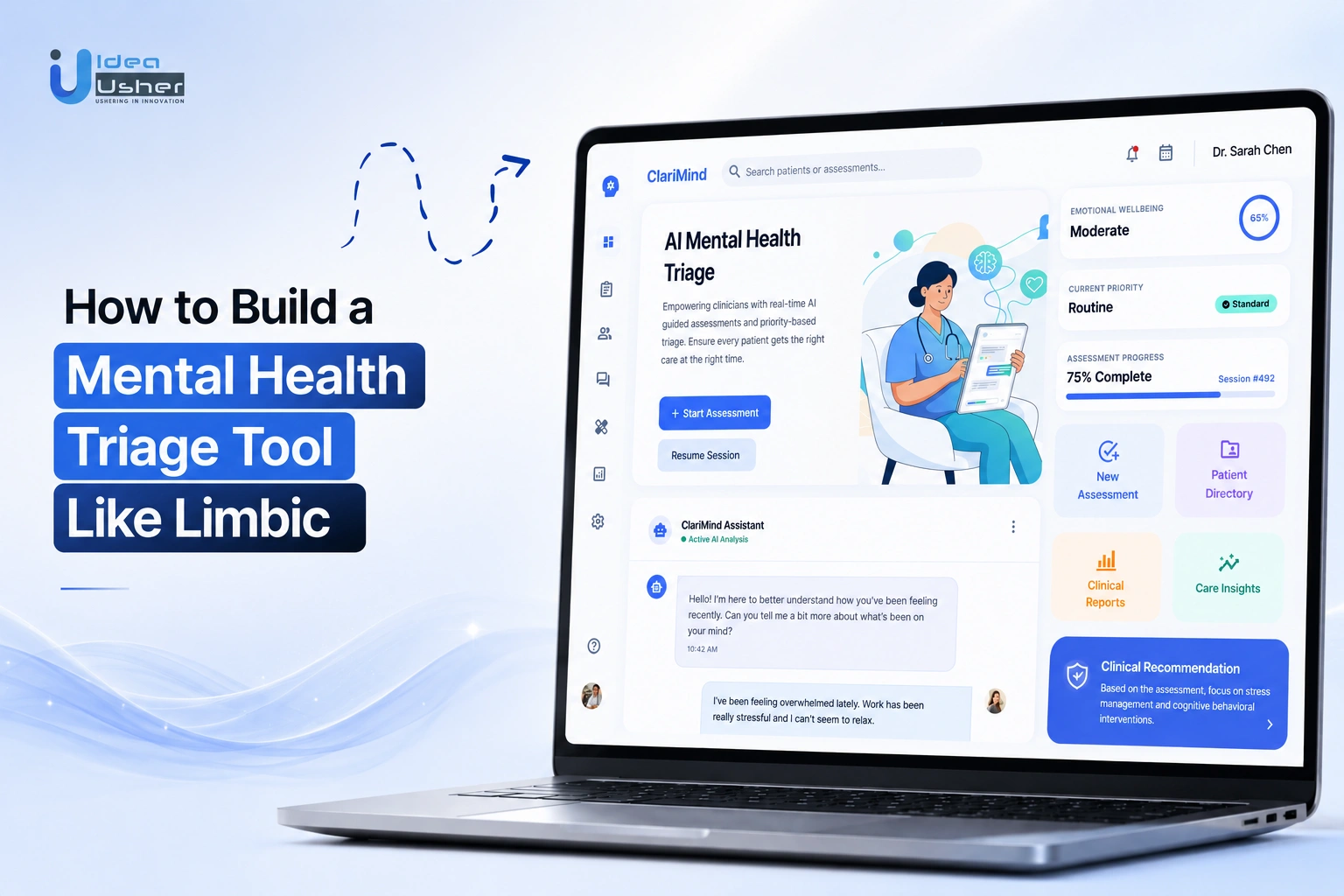
In this blog, we’ll explore how to build a mental health triage tool like Limbic, covering its core features, AI architecture, technology stack, development process, and how IdeaUsher can help build enterprise-grade behavioral health platforms with clinically validated AI that supports evidence-based clinical decision-making.
Why AI Mental Health Triage Is Growing Fast
The virtual behavioral health and AI mental health triage market is projected to grow from $4.63 billion to $13.76 billion at an 12.7% CAGR driven by healthcare providers seeking faster, more scalable patient routing,

With the global AI-powered behavioral therapy market projected to reach $3.08 billion, healthcare is shifting from manual assessments to AI-driven care navigation. This transition is critical as over 59 million U.S. adults live with mental illness while a severe psychiatrist shortage limits timely access to care.
A. The Shift From Manual Intake to AI-Orchestrated Care
Traditional behavioral health intake is historically slow and inefficient. Patients seeking mental health support typically face multi-page paper forms, lengthy phone screenings, and administrative delays that cause severe drop-offs before a single session occurs:

These challenges highlight the need for AI-driven intake that accelerates screening, improves triage accuracy, and connects patients to appropriate care faster.
- The 48-Day Waiting Period: In the United States, more than 137 million people live in mental health professional shortage areas. With only 27.3% of national mental health needs met by clinicians, patients wait an average of 48 days for their first appointment.
- The 25-Day Triage Bottleneck: Traditional human-led phone triage often delays appointments by 25 days or more, increasing patient drop-out rates and leaving vulnerable individuals without timely clinical guidance.
- Automated Multi-Modal Screening: AI-driven intake replaces static forms with conversational NLP and real-time clinical risk stratification, analyzing symptom severity, historical EHR data, and voice biomarkers to assess patient needs in under 3 minutes.
B. Why Health Systems Need Intelligent Care Navigation
For enterprise health networks, university medical centers, and regional hospitals, deploying AI care navigation is an operational necessity to manage capacity and protect provider retention.
When high-acuity psychiatric slots are mistakenly assigned to mild or moderate cases, patients in severe crisis are pushed onto long waitlists or end up in emergency rooms. Intelligent triage platforms address this challenge using predictive risk stratification algorithms:
- Immediate Acuity Tiering: The AI engine instantly sorts incoming patients into distinct clinical tiers, ranging from mild distress (routed to self-guided CBT tools or peer support) to severe crisis (instantly flagged for immediate human intervention).
- Clinician Capacity Optimization: Automated triage tools eliminate up to 80% of routine administrative tasks during intake, freeing up precious specialist hours and allowing providers to focus on direct patient care.
- Superior Identification Rates: Clinical validation studies show that predictive AI models accurately identify at-risk patients with 87% accuracy, compared to standard manual documentation checks that catch as few as 29% of subtle risk cases.
C. Market Opportunity for AI Behavioral Health Platforms
For digital health developers, venture capital groups, and enterprise health buyers, the shift toward automated triage creates an expansive strategic footprint across the healthcare ecosystem:
| Value Vector Metric | Legacy Manual Triage Models | AI-Orchestrated Navigation Tools | Enterprise Financial & Strategic Return |
| Time to First Triage | Requires 24 to 72 hours for manual nurse callback. | Instantaneous (<60 seconds) via conversational web/mobile APIs. | Eliminates initial intake drop-off, increasing patient conversion. |
| Misassignment Rates | High error rates leading to inappropriate care level placement. | Continuous risk scoring with 85%+ classification accuracy. | Maximizes specialist utilization, reserving human hours for acute care. |
| Emergency Room Diversion | High reliance on EDs for after-hours mental health crises. | 24/7 continuous digital monitoring with automated crisis escalation. | Prevents costly emergency department visits, saving $6,800+ per readmission. |
| Platform ROI Realization | Continuous operational loss with zero administrative offset. | Proven operational value generating $3.20 in value per $1 invested. | Delivers a clear payback window within 14 months of deployment. |
Driven by widespread digital health adoption and supportive reimbursement frameworks, the market for AI-powered behavioral health platforms is experiencing explosive growth. Key Factors Shaping Ecosystem Investment:
- Dominance of NLP & Conversational AI: Natural Language Processing (NLP) accounts for 44% of the AI mental health market. Modern platforms use conversational AI to engage patients naturally while extracting clinical insights and reducing administrative burden.
- Reimbursement & Regulatory Support: Public and private payers are expanding reimbursement codes for AI-powered digital therapeutics and measurement-based care, enabling health systems to automate patient navigation while creating sustainable revenue streams.
- Enterprise & Health System Integration: Healthcare organizations are replacing standalone wellness apps with enterprise AI triage platforms integrated into EHRs through HL7/FHIR standards, embedding automated mental health navigation into routine clinical workflows.

What Is a Mental Health Triage Tool Like Limbic?
A mental health triage tool like Limbic is an AI-powered conversational platform designed to automate and streamline the clinical intake process for psychological therapy services. Rather than relying on static paper forms or high-friction phone questionnaires, these clinical AI assistants engage seeking patients in structured, empathetic conversations.
Operating as a Class IIa medical device, the platform collects self-reported symptoms, applies validated PHQ-9 and GAD-7 assessments, and stratifies patient risk before the first clinical appointment. Having supported 650,000+ assessments across health networks, including 45% of NHS Talking Therapies in the UK, it modernizes behavioral healthcare intake.
Limbic distinguishes itself as an AI-powered behavioral health orchestration ecosystem rather than a standalone triage assistant, uniting multiple AI agents across the patient’s care journey:
- Intake Agent: Conducts conversational patient intake, collects medical history, symptoms, and behavioral information, then generates structured clinical summaries for providers.
- Triage Agent: Evaluates symptom severity, predicts likely mental health conditions, identifies crisis risks, prioritizes patients, and recommends the most appropriate care pathway.
- Therapy Agent: Supports ongoing behavioral health care through AI-assisted therapy guidance, patient engagement, follow-up interactions, and progress monitoring alongside clinician oversight.
A. How AI Guides Patients to the Right Care Pathway
Traditional intake methods rely on rigid web forms or lengthy telephone interviews that trigger high drop-out rates. Clinical AI triage platforms replace these static barriers with interactive, empathetic, 24/7 conversational interfaces.
1. Conversational Data Gathering
The AI engages the patient in natural dialogue, dynamically administering psychometric questionnaires such as the PHQ-9 (depression), GAD-7 (anxiety), and disorder-specific scales, based on the patient’s real-time responses rather than forcing them through irrelevant questions.
2. Probabilistic Diagnostic Support
By analyzing thousands of data points, Limbic’s probabilistic models predict the patient’s underlying condition across multiple DSM/ICD categories (e.g., PTSD, OCD, panic disorder, major depression) with 93% diagnostic reliability.
3. Automated Risk Stratification & Safeguarding
The engine analyzes conversations in real time for self-harm and suicidal ideation. When high risk is detected, it automatically triggers crisis support, alerts clinicians for immediate intervention, and saves an average of 12.7 minutes per assessment (23.5%), returning 30,000+ clinical hours to care teams.
4. Pre-Assessment Output
The AI consolidates patient history, narratives, and psychometric scores into a structured clinical summary that integrates with provider workflows. This improves triage accuracy, matches patients to appropriate care from day one, and reduces treatment pathway changes by 45%.
B. Core Users Across Providers and Health Plans
Intelligent triage tools serve as an operational bridge between patients, frontline clinicians, and enterprise health system administrators:
| Core User Group | Primary Platform Function | Direct Operational & Clinical Impact |
| Patients & Self-Referrals | 24/7, low-stigma conversational access via web or mobile. | 18% lower dropout rates and an average 2.2-day reduction in wait times for clinical assessments. |
| Underserved Populations | Tailored, non-judgmental intake experiences. | Drives a 179% increase in referrals among ethnically diverse communities and a 188% increase among LGBTQ+ individuals. |
| Therapists & Intake Teams | Auto-populates pre-session notes and risk flags into the EHR. | 50% reduction in initial assessment duration (saving ~12.7 minutes per referral); ~1,000 hours saved per service. |
| Health Systems & Payers | Algorithmic patient routing and capacity balancing. | Increases service capacity without expanding headcount, saving £118–£221 per patient recovery. |
C. What Makes Clinical AI Different From Chatbots
There is a fundamental regulatory, technical, and safety divide between consumer-facing conversational LLMs (like general-purpose chatbots) and regulated Clinical AI triage platforms.
- Medical Device Certification: Unlike open-ended conversational tools, Limbic Access is certified as a Class IIa Software as a Medical Device (SaMD). It adheres to strict clinical safety standards (such as DCB0129/DCB0160 in the UK and FDA Software Pre-cert frameworks).
- Bounded Decision Trees vs. Free Hallucination: Consumer chatbots generate probabilistic text that can lead to medical “hallucinations” or unsafe advice. Clinical AI platforms use deterministic, clinical parameters set by medical experts to ensure conversations remain strictly within approved triage bounds.
- Interoperability & EHR Integration: Standard chatbots operate in isolation. Clinical AI tools feature deep integrations into electronic health records (e.g., PCMIS, IAPTus, Epic, Cerner) via FHIR APIs, writing data directly to patient charts without requiring manual copy-pasting by staff.
- Clinician-in-the-Loop Governance: General chatbots attempt to “replace” human conversation. Clinical AI is explicitly designed as a decision-support tool that gathers pre-intake intelligence, leaving final diagnostic validation and care delivery strictly in the hands of human professionals.
The Enterprise Takeaway: Unvalidated chatbots and manual intake create costly mental healthcare bottlenecks. Class IIa-certified clinical AI, EHR integration, and accurate AI triage transform intake into a scalable, 24/7 care pathway that expands access, reduces wait times, and improves clinical outcomes.
Key Features of a Mental Health Triage Platform like Limbic
A successful mental health triage platform combines clinically validated AI, intelligent automation, and healthcare interoperability to streamline patient intake, improve diagnostic accuracy, accelerate care delivery, and support clinicians with evidence-based decision making across the entire behavioral health journey.
1. Conversational AI Patient Intake
Conversational AI replaces lengthy paper forms with dynamic patient interviews that adapt to individual responses. It captures symptoms, medical history, behavioral patterns, and patient concerns while generating structured clinical summaries, improving engagement, reducing administrative work, and enabling faster, more accurate mental health assessments.
2. AI Risk Identification and Clinical Assessment
AI continuously evaluates patient responses to assess symptom severity, identify potential suicide or self-harm risks, and recognize urgent behavioral health conditions. Standardized clinical assessments help prioritize patients based on risk levels while providing clinicians with reliable decision support before treatment begins.
3. Diagnostic Prediction and Clinical Reports
AI-powered diagnostic engines analyze assessment data to predict probable mental health conditions using clinically validated models. The platform automatically generates structured clinical reports, summarizes patient history, highlights key symptoms, and equips healthcare professionals with actionable insights before the first consultation.
4. AI Care Navigation and Referral Routing
Intelligent care navigation ensures patients are directed to the most appropriate treatment pathway based on assessment outcomes and clinical urgency. Automated referral routing improves access to specialists, reduces waiting times, optimizes healthcare resources, and supports better long-term patient outcomes across behavioral health services.
5. AI Crisis Detection and Safety Monitoring
Real-time AI monitoring identifies crisis indicators, suicide risks, and severe mental health concerns during patient assessments. Built-in safeguarding protocols, clinician alerts, and escalation workflows help healthcare providers intervene quickly while maintaining continuous human oversight for critical clinical decisions and patient safety.
6. Clinical Performance Dashboard and Insights
A centralized clinical dashboard provides healthcare organizations with real-time visibility into patient assessments, referral outcomes, clinician productivity, operational performance, and service demand. Actionable analytics support data-driven decisions, resource planning, quality improvement initiatives, and enterprise-wide behavioral health optimization.
7. Cloud EHR Integration and Workflow Automation
Seamless integration with electronic health record (EHR) systems enables secure patient data exchange, automated clinical documentation, and streamlined care workflows. Support for interoperability standards, API connectivity, and workflow automation minimizes administrative burden while improving care coordination across healthcare organizations.
8. Evidence-Based Clinical Decision Support
Evidence-based clinical decision support combines validated AI models, standardized assessments, and clinical guidelines to assist healthcare professionals throughout the care journey. Explainable AI, regulatory compliance, and human oversight enhance diagnostic confidence while ensuring safe and trustworthy clinical practice.
How to Build a Mental Health Triage Platform Like Limbic
Building a mental health triage platform requires more than AI development. It demands clinical expertise, secure healthcare architecture, validated AI models, regulatory compliance, and seamless interoperability. Our development process focuses on creating an enterprise-ready solution that delivers safe, scalable, and clinically reliable mental healthcare.
1. Define Clinical Goals and Care Pathways
We begin by identifying your target users, behavioral health use cases, clinical objectives, care settings, and patient journey. This foundation helps us design AI workflows, care pathways, and platform capabilities that align with healthcare regulations and business goals.
- Clinical Objective Alignment: Defines measurable mental health outcomes and aligns platform capabilities with organizational care delivery goals.
- Patient Journey Mapping: Identifies key touchpoints across care pathways to improve engagement, accessibility, and treatment continuity.
- Use Case Prioritization: Evaluates high-impact behavioral health scenarios to guide platform features and development focus areas.
- Regulatory Consideration Planning: Ensures early alignment with healthcare compliance standards to avoid delays during later development stages.
2. Design Conversational Patient Assessment Flows
Our team designs intelligent assessment conversations that adapt to every patient’s responses. We create symptom questionnaires, risk assessment logic, consent flows, multilingual experiences, and accessible user journeys that improve engagement while collecting clinically meaningful information.
- Adaptive Conversation Design: Builds dynamic dialogue flows that adjust questions based on patient responses and behavioral patterns.
- Multilingual Accessibility Strategy: Ensures inclusive patient engagement by supporting multiple languages and culturally relevant communication styles.
- Consent and Privacy Integration: Embeds clear consent mechanisms to maintain transparency and trust throughout patient interactions.
- Engagement Optimization Techniques: Uses conversational design principles to reduce drop-offs and improve completion rates of assessments.
3. Develop AI Assessment and Decision Engines
We develop the platform’s AI intelligence using conversational AI, clinical NLP, diagnostic prediction models, and risk scoring algorithms. Evidence-based decision support and care navigation engines help clinicians make faster, more informed treatment decisions with confidence.
- Predictive Model Development: Uses historical clinical data to build models that forecast patient risk and treatment outcomes.
- Clinical NLP Implementation: Extracts meaningful insights from patient inputs to support accurate symptom analysis and diagnosis.
- Decision Support Framework: Provides clinicians with actionable recommendations based on validated clinical guidelines and AI insights.
- Risk Scoring Mechanisms: Calculates patient risk levels using structured and unstructured data for timely intervention decisions.
4. Integrate EHR Systems and Healthcare Services
We integrate the platform with EHR and EMR systems, telehealth solutions, scheduling platforms, and healthcare APIs using FHIR and HL7 standards. This enables secure data exchange, automated documentation, and seamless clinical workflows across healthcare organizations.
- Interoperability Framework Design: Enables seamless communication between healthcare systems using standardized protocols and data exchange formats.
- API Integration Strategy: Connects third-party healthcare services to enhance platform functionality and streamline clinical operations.
- Automated Documentation Workflow: Reduces manual data entry by synchronizing patient information across integrated healthcare systems.
- Secure Data Exchange Protocols: Ensures patient data is transmitted safely using encryption and compliance-driven security measures.
5. Validate Clinical Accuracy and Regulatory Compliance
Before deployment, we rigorously validate AI performance through clinical testing, bias evaluation, explainability checks, and human-in-the-loop verification. We also implement HIPAA, GDPR, and medical device compliance requirements to ensure a secure and trustworthy platform.
- Clinical Validation Testing: Assesses AI accuracy using real-world scenarios to ensure reliable and safe patient outcomes.
- Bias Detection and Mitigation: Identifies and reduces algorithmic bias to ensure fair and equitable healthcare recommendations.
- Explainability and Transparency Checks: Ensures AI decisions are understandable and interpretable for clinicians and regulatory bodies.
- Compliance Implementation Strategy: Aligns platform development with healthcare regulations to meet legal and ethical standards.
6. Deploy, Monitor and Continuously Optimize
After launch, we monitor AI performance, platform stability, clinical outcomes, and user engagement using real-world data. Continuous model improvements, security updates, workflow optimization, and provider feedback ensure the platform remains accurate, scalable, and future-ready.
- Performance Monitoring Systems: Tracks platform metrics to identify issues and ensure consistent delivery of healthcare services.
- Continuous Model Improvement: Updates AI models regularly using new data to maintain accuracy and relevance over time.
- User Feedback Integration: Incorporates insights from clinicians and patients to refine workflows and improve user experience.
- Scalability and Optimization Planning: Enhances system performance to support growing user demand and expanding healthcare services.
Cost to Build a Mental Health Triage Tool Like Limbic
The cost of building a mental health triage platform depends on clinical complexity, AI capabilities, compliance requirements, integrations, and scalability. Understanding where your investment goes helps you prioritize features, plan development phases, and launch a commercially viable healthcare AI platform.
A. Cost Breakdown by Development Phase
Every development phase contributes to building a secure, clinically reliable, and scalable platform. The following breakdown provides estimated costs for each stage, showing how investment scales from an MVP to an enterprise-grade mental health triage solution.
| Development Phase | Estimated Cost (MVP → Enterprise) | What the Phase Covers |
| Clinical Discovery & Product Strategy | $8,000 – $25,000 | Define clinical workflows, target users, care pathways, regulatory scope, product roadmap, and technical architecture. |
| UI/UX Design & Assessment Experience | $10,000 – $40,000 | Design conversational intake, clinician dashboards, accessibility, multilingual interfaces, patient journeys, and interactive prototypes. |
| AI Model Development & Decision Engine | $25,000 – $180,000 | Build conversational AI, clinical NLP, diagnostic prediction, risk scoring, care navigation, and decision support algorithms. |
| Backend Development & Cloud Infrastructure | $15,000 – $120,000 | Develop APIs, databases, authentication, cloud deployment, scalability, workflow automation, and secure healthcare infrastructure. |
| EHR Integration & Healthcare Interoperability | $10,000 – $100,000 | Integrate EHR systems, FHIR, HL7, telehealth platforms, scheduling services, and secure healthcare APIs. |
| Security, Compliance & Clinical Validation | $12,000 – $120,000 | Implement HIPAA, GDPR, encryption, audit logs, AI validation, explainability testing, and regulatory readiness. |
| Testing, Deployment & Post-Launch Optimization | $10,000 – $80,000 | Perform QA, performance testing, production deployment, monitoring, AI improvements, and continuous platform optimization. |
| Total Estimated Cost | $80,000 – $700,000+ | Combined estimated investment across all development phases aligned with platform-level ranges. |
Note: These estimates vary depending on AI sophistication, clinical validation requirements, healthcare integrations, regulatory obligations, and infrastructure scale. Building incrementally through phased development often delivers faster market entry while managing investment effectively.
B. Development Cost by Platform Level
The platform-level cost ranges below are directional estimates based on typical industry benchmarks. Actual costs can vary significantly depending on geography, vendor expertise, regulatory depth, and the level of clinical validation required. These ranges should be treated as guidance rather than fixed pricing.
| Platform Level | Estimated Cost | What Features Include in That Platform Level |
| MVP | $80,000 – $180,000 | Conversational intake, symptom assessment, basic risk scoring, clinician dashboard, secure authentication, patient management, and limited EHR integration. |
| Mid-Level | $180,000 – $350,000 | Advanced AI assessments, diagnostic prediction, care navigation, FHIR integrations, analytics dashboard, multilingual support, telehealth connectivity, and workflow automation. |
| Enterprise | $350,000 – $700,000+ | Clinically validated AI, predictive analytics, crisis detection, enterprise interoperability, compliance automation, multi-tenant architecture, advanced analytics, and high-availability infrastructure. |
Note: These ranges are more realistic for healthcare-grade AI platforms, especially when factoring in compliance, integrations, and clinical validation. Most organizations start with an MVP to validate workflows and adoption, then scale toward enterprise capabilities over time.
C. Factors That Influence Development Budget
Several technical, clinical, and regulatory decisions directly impact the total investment required to build a mental health triage platform. Understanding these factors helps businesses define realistic budgets and prioritize features that maximize long-term return on investment.
- Clinical Data Availability and AI Training: Requires high-quality annotated datasets; acquisition, annotation, and tuning can add $20,000 to $80,000 depending on complexity.
- EHR Integration Complexity: Custom FHIR/HL7 integrations and legacy system handling increase costs by $15,000 to $60,000 per integration based on compatibility.
- Clinical Validation and Pilot Testing: Iterative validation, clinician feedback, and testing phases can raise development costs by $25,000 to $100,000 depending on scope.
- Custom AI Workflow and Care Pathway Design: Tailored workflows and care pathways require extensive effort, increasing costs by $20,000 to $70,000 based on customization depth.
- Healthcare Deployment Environment: Enterprise infrastructure, compliance, and security requirements can add $30,000 to $120,000 to overall development budget depending on deployment needs.
Compliance Requirements for Mental Health Triage Platform
Mental health triage platforms process highly sensitive patient information and support clinical decision making, making regulatory compliance a critical part of development. Meeting healthcare, privacy, and AI governance standards protects patient data, builds trust, and reduces legal and operational risks.
| Compliance Area | What to Cover |
| HIPAA, GDPR and Healthcare Privacy | Implement secure patient data collection, encryption, role-based access control, consent management, audit logs, data retention policies, and privacy safeguards to comply with regional healthcare data protection regulations. |
| Medical Device and Clinical Validation | Determine whether the platform qualifies as a regulated medical device, conduct clinical validation studies, validate AI performance, document evidence, and align with regulatory requirements before deployment. |
| AI Governance and Human Oversight | Establish explainable AI, human-in-the-loop decision making, bias monitoring, AI accountability, model transparency, and governance policies to ensure safe and responsible clinical use. |
| Healthcare Interoperability Standards | Support interoperability standards such as FHIR and HL7, implement secure API integrations, standardize healthcare data exchange, and ensure seamless communication with EHR and EMR systems. |
| Cybersecurity and Risk Management | Protect healthcare infrastructure through secure authentication, multi-factor authentication, vulnerability assessments, penetration testing, continuous security monitoring, incident response planning, and regular compliance audits. |
Note: Compliance should be incorporated from the earliest planning stage rather than added after development. A compliance-by-design approach reduces rework, accelerates regulatory readiness, and strengthens long-term platform reliability.
Challenges in Building a Mental Health Triage Tool Like Limbic
Developing a mental health triage platform in the real world comes with practical challenges that go beyond theory. These challenges often arise from working with healthcare providers, patients, legacy systems, and unpredictable user behavior. Addressing them requires hands-on experience, adaptability, and a deep understanding of both technology and clinical workflows.
1. Inconsistent and Incomplete Patient Inputs
Challenge: Patients often provide vague, incomplete, or inconsistent responses, skip questions, misunderstand prompts, or express emotions unclearly, making accurate AI interpretation difficult.
Solution: Our developers design adaptive questionnaires, implement fallback logic, and use advanced NLP models to interpret ambiguity. Continuous feedback loops, real-world testing, and iterative improvements enhance system accuracy and response handling.
2. Legacy and Fragmented Healthcare System Integration
Challenge: Healthcare providers use outdated, fragmented EHR systems lacking standard APIs, making integration complex, time-consuming, and error-prone, often requiring customized solutions for each implementation.
Solution: Our developers build flexible middleware, create custom connectors, and collaborate with healthcare IT teams to map data structures. Rigorous testing and phased deployment ensure stable, scalable integration across diverse systems.
3. Real-Time Risk Detection and Escalation
Challenge: Detecting high-risk cases like suicidal ideation in real time is difficult, as false negatives risk patient safety while false positives overwhelm healthcare providers.
Solution: Our developers implement real-time monitoring, define risk thresholds, and build escalation workflows. Integration with crisis services and human review systems ensures timely, accurate intervention and balanced risk management.
Build Your Mental Health Triage Platform With IdeaUsher
IdeaUsher is an elite product engineering powerhouse and healthcare technology catalyst, leveraging 11+ years of industry mastery across 50+ countries. Fueled by 250+ niche experts, a portfolio of 1,000+ deployed assets, and a 4.9/5 Clutch credential, we construct high-performing digital health platforms from scratch.
We skip generic templates to handcraft premium, HIPAA-compliant conversational AI tools optimized with clinical risk stratification, real-time EHR intake pipelines, and automated psychological assessment protocols to capture undisputed healthtech market dominance.
Why Enterprises Partner With Us
Healthcare systems, NHS trusts, and behavioral health providers choose us to deploy conversational triage tools because we convert unstructured patient intake into validated, clinical-grade risk assessments.
- Clinical Protocol Screening (PHQ-9 & GAD-7): Our developers build conversational AI intake engines that guide patients through natural-language conversations, accurately scoring PHQ-9 and GAD-7 assessments before clinician consultation.
- Real-Time Self-Harm Risk Escalation: We engineer safety-first detection microservices that instantly identify self-harm indicators and crisis language, automatically triggering human intervention and emergency escalation workflows.
- Bi-Directional FHIR & EHR Synchronization: Our team implements secure HL7 FHIR API integrations that automatically synchronize triage summaries, referral notes, and risk scores with electronic health records.
- Isolated Cloud Runtime Security: We deploy core platform services within independent encrypted cloud containers, ensuring patient privacy and compliance with HIPAA, GDPR, and DTAC requirements.
- Zero Vendor Lock-In Asset Delivery: Our developers provide clean, fully documented, and compliant source code after mental health triage tool like Limbic development, giving your organization complete platform ownership, customization flexibility, and long-term deployment independence.
Ready to streamline clinical intake and expand patient access with an automated, AI-driven mental health triage engine? Partner with Idea Usher’s principal healthcare tech and AI architects to map out your infrastructure build today.
Conclusion
Mental healthcare is rapidly evolving as AI enables faster assessments, smarter care navigation, and more efficient clinical workflows. A mental health triage tool like Limbic demonstrates how conversational AI and evidence-based decision support can improve patient outcomes while reducing the burden on healthcare providers. Whether you’re validating a new idea or planning an enterprise-grade solution, partnering with an experienced healthcare AI development team is essential. At IdeaUsher, we combine clinical understanding, AI expertise, and secure engineering practices to deliver scalable, compliant, and future-ready mental health platforms.
FAQs
A.1. A mental health triage tool uses AI to assess patient symptoms, identify risk levels, support clinical decision making, and guide individuals toward the most appropriate care pathway, improving access, efficiency, and treatment outcomes.
A.2. The core features of mental health triage tool like Limbic include conversational patient intake, AI risk assessment, diagnostic prediction, care navigation, crisis detection, EHR integration, clinical dashboards, and evidence-based decision support to streamline behavioral healthcare delivery.
A.3. The cost of building a mental health triage tool like Limbic can range from $80,000 to over $700,000+, depending on factors such as AI sophistication, healthcare integrations, compliance requirements, clinical validation, feature scope, and whether the platform is developed as an MVP or a full-scale enterprise solution.
A.4. The mental health triage tool like Limbic should comply with regulations such as HIPAA, GDPR, and applicable medical device requirements while implementing strong encryption, audit logging, access controls, and secure patient data management practices.


