

Key Takeaways
- Businesses are investing in AI app maker platforms to build production-ready applications faster through AI-powered automation and natural language prompts.
- Leading platforms combine prompt-to-app generation, autonomous AI agents, backend automation, and one-click deployment to simplify software development.
- The market is evolving toward multimodal app generation, AI-native development, workflow automation, and self-improving AI systems that reduce engineering effort.
- Choosing the right development partner is essential for building secure, scalable, and enterprise-ready AI app platforms that support long-term growth.
- How Idea Usher can help businesses build AI app maker platforms with LLM integration, multi-agent AI systems, cloud-native infrastructure, and intelligent automation.
For years, building software meant bigger teams, longer timelines, and higher development costs. That is changing quickly. A lot of businesses are adopting AI app maker platforms because they can turn ideas into working applications in days instead of months. This allows companies to launch products faster, test new concepts with less risk, and stay ahead of competitors. As demand continues to grow, many businesses are now investing in custom AI app maker platforms that offer greater flexibility, stronger AI capabilities, and full ownership of their products.
We have developed several AI app building solutions that combine autonomous AI agents with large language models to transform simple prompts into fully functional applications. In this blog, we’ll highlight the top AI app maker platform development companies in 2026 and what sets them apart.
The Market Opportunity for AI App Makers
According to MarketUS, the global AI app development market is projected to grow from USD 40.3 billion in 2024 to USD 221.9 billion by 2034, reflecting how quickly businesses are investing in AI-powered software development. This growth isn’t just driven by better AI models. Companies are looking for faster ways to build applications, validate new ideas, and reduce development costs. As AI app maker platforms continue to mature, they’re becoming a key part of how modern software products are built and launched.
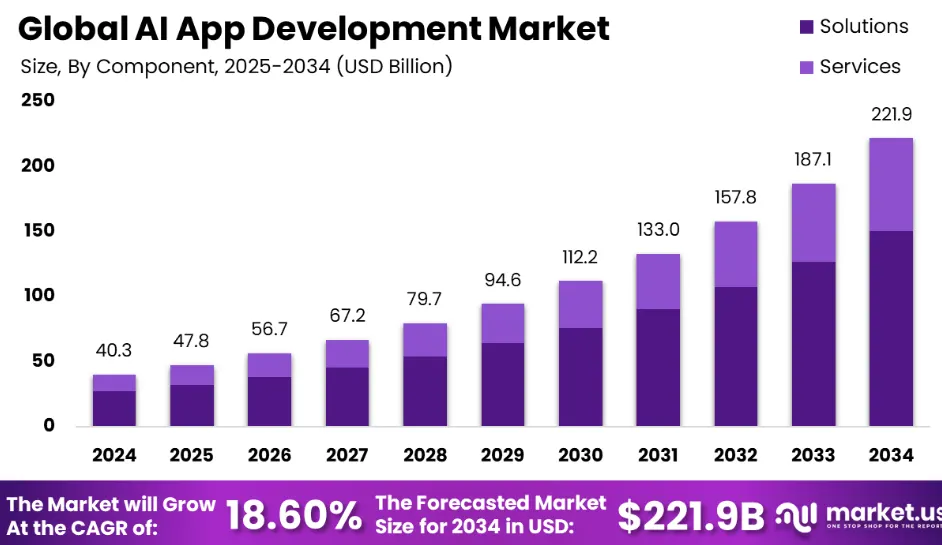
Source: MarketUS
This disruption is validated by the financial performance of pioneers in the space. For instance, FlutterFlow, a visual application development platform with embedded artificial intelligence features, has scaled its annual recurring revenue to an estimated $32.9 million. This growth demonstrates substantial market demand for development tools that combine visual composition with intelligent code generation.
Why Businesses Are Investing in AI App Makers
Enterprise leadership faces a constant bottleneck: the scarcity of specialized engineering talent and the high cost of custom software upkeep. Traditional software projects often fail to meet deadlines or go over budget, creating a clear market opening for highly scalable automated solutions.
- Cost Rationalization: Shifting variable engineering costs into fixed, predictable platform licensing.
- Speed to Capital Realignment: Launching functional software products in days rather than quarters to capture market opportunities immediately.
- Technical Debt Mitigation: Relying on centralized engines that generate clean, standardized code, minimizing future maintenance costs.
Consider the commercial performance of Bubble, a visual development ecosystem that has integrated advanced automated deployment agents into its workflow. The total revenue generated by apps running on its infrastructure has surpassed $1 billion. This metric proves that businesses are not just building internal tools with these systems, they are scaling full commercial enterprises.
Future Trends Shaping AI App Platforms
The next generation of application development platforms will move beyond basic code generation and focus on autonomous execution. Platforms that rely on simple text-to-code templates will quickly lose value. Sustainable long-term growth belongs to cognitive software systems that manage the entire development lifecycle independently.
Strategic capital should focus on five core technical vectors:
- Agentic AI: Transitioning from passive chatbots to networks of independent software agents that collaborate to design, build, test, and deploy applications without manual oversight.
- Prompt-to-App Workflows: Transforming complex business requirements directly into production-ready software architectures based on a single functional description.
- Autonomous Development Agents: Automated systems that find bugs, optimize database queries, and fix code flaws on the fly without human intervention.
- Multimodal App Generation: Systems that instantly turn whiteboard drawings, UI sketches, and structural design files into fully functional frontend code.
- AI-Native Software Creation: Building platforms designed specifically for machine reasoning rather than human editors, opening up new possibilities for software customization.
How AI App Maker Platform Build Apps From Prompts?
AI app maker platforms are changing how software is built. Instead of writing every line of code, users can simply describe what they want in plain language and let AI handle much of the development process. This makes building applications faster, easier, and more accessible while allowing developers to spend more time refining products instead of starting from scratch.
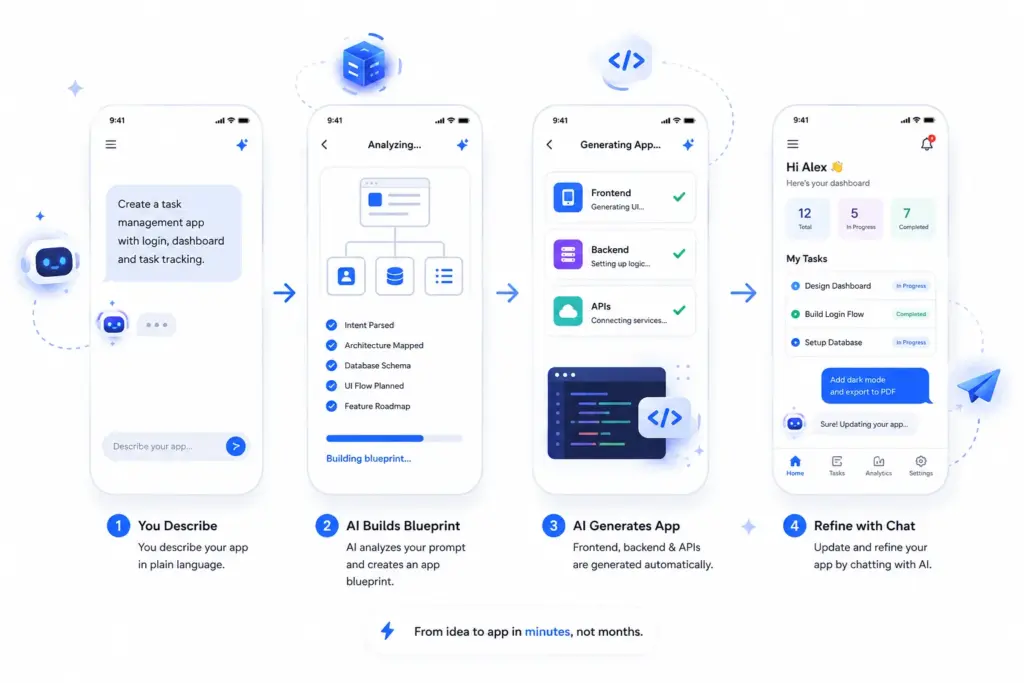
1. Turning Prompts into Blueprints
The process begins when a user submits a natural language prompt describing the desired application. Large language models do not just read this text; they dissect it to extract core business logic, user roles, and operational boundaries. Before a single line of executable code is written, the system constructs a comprehensive technical blueprint. This phase involves a structured breakdown of the application requirements:
- Intent Parsing: The underlying engine identifies implicit and explicit requirements, mapping user descriptions to standard software design patterns.
- Architecture Mapping: The platform defines database schemas, state management strategies, and serverless infrastructure requirements.
- UI Flow Modeling: The system charts the user journey, determining how data flows between different views and screens.
- Feature Roadmap: An internal execution plan is established, prioritizing core functionality and setting up the system for iterative generation.
By establishing this structural foundation, the platform ensures that the generated application remains cohesive, scalable, and aligned with enterprise standards.
2. Generating Frontend, Backend, and APIs
Once the blueprint is validated, the platform activates specialized code generation models to build the different layers of the application concurrently. This is where autonomous development agents turn abstract concepts into functional software. The generation process relies on tight feedback loops where code is instantly tested against the initial architectural blueprint.
- Responsive Frontend: The platform generates clean, component-based user interfaces that automatically adapt to mobile, tablet, and desktop viewports.
- Secure Backend: The engine creates database schemas, sets up relational data models, and configures user authentication protocols out of the box.
- API Integration: Business workflows are wired together through automatically generated API endpoints, connecting internal data layers with external third-party services.
This multi-layered approach ensures that the application is not just a visual mockup, but a fully functional, production-ready system capable of handling complex business workflows.
3. Refining Apps via Chat
Traditional software maintenance is notoriously slow and expensive. AI App Maker Platforms solve this challenge through continuous, conversational refinement cycles. Users modify their applications by interacting with an AI assistant rather than digging through code repositories.
| Operational Challenge | AI Platform Solution |
| Feature Creep & Bloat | Prompt-to-app workflows isolate changes and insert new features smoothly into existing codebases. |
| Debugging Delays | Autonomous development agents catch runtime exceptions, trace errors, and patch vulnerabilities instantly. |
| UI Redesign Friction | Multimodal app generation allows users to upload visual mockups and update interfaces through text. |
This continuous adaptation cycle represents the future of AI-native software creation. By removing the friction of manual code updates, platforms empower businesses to deploy updates instantly, respond to market shifts in real time, and maintain peak performance without overhead.
Top AI App Maker Development Companies in 2026
Building an AI app maker platform requires much more than traditional software development. It involves AI agents, intelligent workflows, scalable infrastructure, and systems that can generate reliable applications. That’s why choosing the right development partner matters. An experienced team can help you build a platform that performs well today and is ready to support future growth.
1. IdeaUsher
We are a premier technology product development firm focused on translating high-capital investments into scalable digital infrastructure. Our core operational philosophy centers on eliminating structural development friction for entrepreneurs. By fusing strategic business planning with advanced cognitive engineering, we design custom systems that automate application delivery and maximize capital efficiency.
AI app maker expertise
Our engineering labs focus heavily on autonomous software generation engines. We build proprietary prompt-to-app workflows, custom neural network pipelines, and multi-agent orchestration frameworks that allow businesses to launch code generation systems. By partnering with us, investors acquire the foundational technology required to deploy secure, enterprise-ready application makers that convert complex natural language directly into production code.
Industries served
- FinTech and Wealth Management
- Healthcare and Clinical Systems
- On-Demand Marketplaces and Logistics
- Enterprise SaaS and Workflow Automation
Key strengths
We offer deep domain expertise in building compliance-heavy, scalable architectures. Our development process prioritizes clean code generation, rapid prototyping, and military-grade security. This background gives our clients a clear competitive edge when launching independent development platforms.
2. Intellivon
Intellivon is an established AI engineering firm focused on helping large organizations transform complex operational data into predictive business tools. The company operates at the intersection of machine learning research and enterprise deployment, executing complex digital modernization cycles for legacy industries.
AI capabilities
The engineering team specializing in predictive modeling, computer vision, and large-scale natural language processing builds robust data pipelines that feed directly into private enterprise models. Their architectural framework focuses heavily on MLOps and automated workflow validation.
Best suited for
Mid-market and large enterprises in healthcare, supply chain, and finance looking to implement custom machine learning infrastructures. The firm appeals to operations requiring secure, high-volume automated data processing frameworks.
3. BlueLabel Labs
BlueLabel Labs is a digital product agency that builds user-centric digital platforms integrated with smart backend logic. The firm treats software design and cognitive computing as an interconnected system, emphasizing market validation and product strategy.
AI development services
- Custom generative model integration and prompt engineering
- Recommendation engine prototyping and deployment
- Behavioral analytics instrumentation and data tracking
The firm focuses on creating sleek frontends powered by context-aware large language models, ensuring that complex backend computations translate into seamless user flows.
Best suited for: Venture-backed startups and growth-stage brands requiring custom mobile-first applications that leverage pre-trained language models to drive consumer engagement.
4. Netguru
Netguru is a massive international digital consultancy known for building scalable software ecosystems and providing rapid development team augmentation. The organization helps digital brands navigate modernization and architecture redesigns under tight delivery timelines.
AI engineering expertise
The firm emphasizes semantic code generation, automated regression testing infrastructure, and cognitive application integrations. Their developers construct highly modular API layers that allow legacy applications to hook into modern foundation models.
| Development Metric | Platform Optimization |
| System Refinement | Replacing brittle hard-coded workflows with flexible, model-driven business logic. |
| Delivery Framework | Utilizing agile feedback loops to ship clean, production-ready iterations rapidly. |
Best suited for: Scaling tech companies and international enterprises requiring rapid engineering team augmentation to deploy modular, cloud-native generative applications.
5. Cheesecake Labs
Cheesecake Labs provides full-service web and mobile development, focusing on robust product strategy and cloud-native infrastructure design. The team coordinates technical delivery with business objectives to create highly performant digital ecosystems. They also help businesses build scalable products that can evolve as user demand and market needs grow.
AI product development: The studio implements predictive data modeling, customized user profiling systems, and automated conversational assistants into corporate tech stacks. They prioritize decentralized data strategies and clean state management across web and mobile viewports.
Best suited for: Entrepreneurs and enterprise innovation departments looking for a collaborative product partner to design, build, and scale intuitive custom software from scratch.
Why Do Businesses Choose Idea Usher for AI App Maker Platforms?
The market for no-code and AI-driven development is expanding rapidly, presenting a highly lucrative opportunity for investors and founders. However, capturing this market requires a technical foundation that can handle complex code generation, intense server loads, and secure data isolation. We act as your strategic technology partner, turning capital into market-dominant software by handling everything from initial architecture design to complex AI engineering.
Proven Expertise in AI-First Products
Building an AI app maker platform takes more than strong development skills. It requires experience with AI systems, scalable architecture, and products that can perform reliably as they grow. With over 500,000 hours of engineering experience, our team has helped businesses build AI-powered platforms that are secure, scalable, and built for real-world use. We focus on creating solutions that deliver long-term value while helping our clients bring their products to market faster.
- Multi-Agent Systems: We build collaborative AI networks where specialized agents handle distinct tasks like code generation, UI layout, and database schema creation.
- Enterprise Architecture: Our systems are designed to process massive datasets with minimal latency, ensuring a responsive user experience.
- Custom AI Pipelines: We move beyond basic API wrappers, fine-tuning models to deliver highly predictable, high-quality application outputs.
End-to-End Strategy to Scale
Every successful AI product starts with a clear strategy, not just great technology. We help businesses validate their ideas, identify the right features, and plan a scalable architecture before development begins. From AI model integration to platform development and deployment, our team manages the entire process so you can focus on growing your business instead of coordinating multiple vendors.
The Strategic Advantage: By combining business analysis with rapid prototyping, we help you launch a Minimum Viable Product quickly. This allows you to capture early market feedback and secure user traction without burning through capital on unproven features.
Secure, Scalable AI for Growth
As your platform grows, it should be able to handle more users without slowing down or affecting the user experience. That’s why we design AI app maker platforms with scalable cloud infrastructure and strong security from the start. We also implement data protection and privacy measures to ensure user information and generated applications remain secure as your business expands.
| Scalability Layer | Business Benefit |
| Cloud-Native Infrastructure | Auto-scales hardware resources to match user demand, optimizing hosting costs. |
| Isolated Execution Sandboxes | Runs generated code in secure, containerized environments to prevent cross-tenant breaches. |
| Robust API Frameworks | Ensures generated apps link flawlessly with payment gateways, CRMs, and external databases. |
AI Features We Build Into Every AI App Maker Platform
A great AI app maker platform is defined by the experience it offers its users. The right features make it easier to create applications, automate repetitive tasks, and move from an idea to a working product with minimal effort. Below are some of the essential features that help an AI app maker platform stand out in a competitive market.
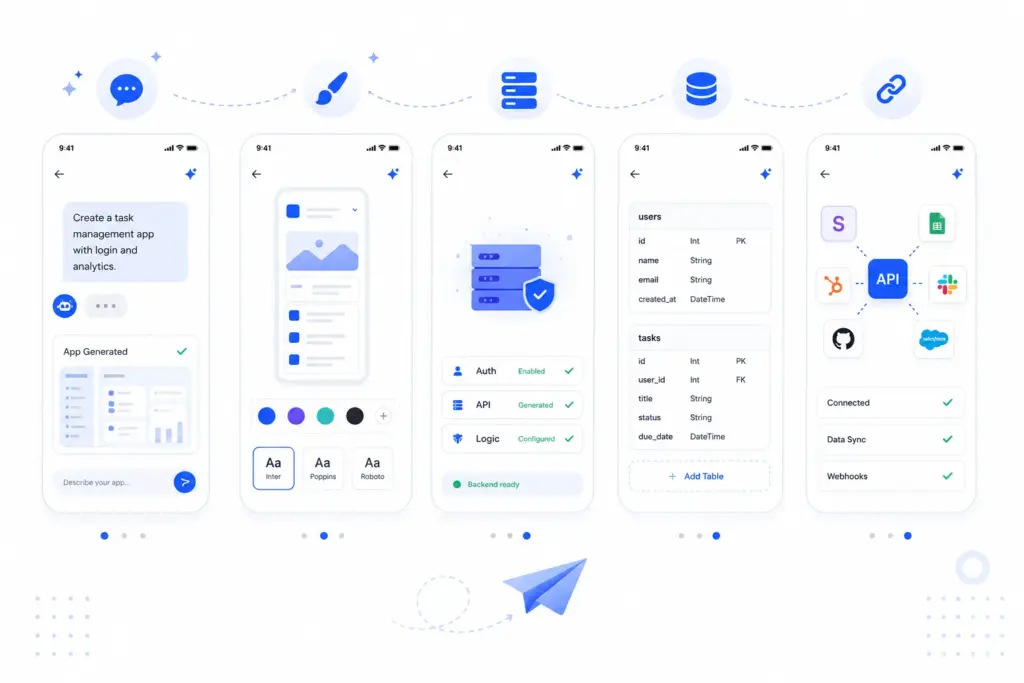
1. Natural Language App Generation
The core value proposition of any modern creation engine relies on converting text into immediate digital products. We build highly calibrated translation layers that interpret user intent and write production-grade software directly from text inputs. Look at Lovable.dev, which relies entirely on plain-English instructions to map out comprehensive web applications instantly without requiring technical backgrounds.
2. AI-Generated UI and UX
A modern system cannot output generic visual templates. We install advanced generative design mechanics that construct dynamic visual interfaces tailored to user specifications. A premier example is Vercel v0, a specialized frontend engine that immediately processes prompts into functional visual code while implementing frameworks like Tailwind CSS to deliver responsive user layouts.
3. Autonomous Backend Generation
True application builders move far beyond simple static interface generation. We develop core backend engines that automatically establish underlying application servers, manage user data access controls, and construct localized business logic. This operational capability mirrors Playcode.io, an automated platform that sets up entire operational environments along with authentications and secure real-time data handling.
4. Database Schema Creation
Your users need data architectures that grow with their business requirements. We implement intelligent schema design layers that automatically evaluate application requirements and create clean relational data tables. Platforms like Bolt.new execute this flawlessly by generating structured databases from basic descriptions, saving users hours of manual setup.
5. API Generation and Integration
Modern applications must talk to outside digital systems effortlessly. We construct automation tools that output pristine connection points and link newly generated tools to critical external services. Consider Retool, which offers an expanse of automated connectors that immediately link custom internal tools with massive data sources and third-party operational systems.
6. AI Workflow Automation
Building operations that function smoothly requires embedded logical sequences. We design business logic engines that allow end users to script triggered behaviors and data paths without manual coding. This capability reflects Bubble, where users define structural logic paths and workflows that run complex operations behind the scenes based on user actions.
7. AI Coding Agents
When code errors happen during automated builds, embedded background processes must intervene immediately. We construct self-correcting agent layers that analyze output logs, catch execution exceptions, and write code updates automatically without human prompt intervention.
This structural strategy powers systems like Cursor, an AI-native editing environment where background software agents plan multi-file updates and refactor entire code repositories smoothly.
8. One-Click Deployment Pipelines
The journey from initial product generation to a live web link must be completely friction-free. We implement automated cloud architecture setups that run code tests and push finalized applications straight to production servers. This mirrors the execution speed of Replit, where users launch their finished creations to the web with a single tap, completely bypassing manual hosting setups.
How to Validate Your AI App Maker Idea?
The global market for automated software creation is moving fast, and entering this space requires substantial capital. However, throwing money at an unproven concept is a major financial risk. Smart investors protect their capital by validating demand before executing full-scale technical development.
Confirm There Is a Real Market Need
Strong market validation begins with isolating a specific problem rather than obsessing over an expansive list of features. To validate your AI app maker idea, you must clearly identify who will use your tool, what core problems it solves, and how existing market alternatives fall short.
Look at successful platforms like Bolt.new, an AI application platform that lets anyone build and deploy full-stack web apps directly from a browser prompt. By targeting a highly specific problem, specifically eliminating complex local developer environment setups, they created massive market demand. This narrow focus allowed them to go from zero to an estimated $40,000,000 in ARR in just five months.
- Define Your Target Persona: Are you building for non-technical startup founders, enterprise product managers, or agency owners who want to accelerate client delivery?
- Analyze the Gaps: Examine your potential competitors to uncover where their platforms drop the ball. Are their pricing tiers too rigid? Is the generated code messy and impossible to export?
- Determine Willingness to Pay: Conduct targeted focus groups or run landing page smoke tests to ensure your core audience is ready to pay for your software solution.
Build an MVP and Test With Early Users
Once you identify a clear market gap, avoid the temptation to build a complex, feature-heavy platform right away. Instead, launch a lean Minimum Viable Product (MVP) that executes a single feature exceptionally well, such as text-to-UI component rendering or basic prompt-to-database creation.
Consider Lovable.dev, another rapid software generator that gained massive market traction by focusing heavily on quick application prototyping and seamless deployment. By providing a clean sandbox environment where users can see their apps come alive instantly, they proved their core tech concept quickly. Today, this laser-focus on user experience has scaled their annualized revenue to an estimated $500,000,000.
Measure Product-Market Fit Before Scaling
Before committing your core investment capital to a full product launch, you must objectively analyze early performance data. Relying on superficial metrics like free user sign-ups can be highly misleading; true validation lies in deep product engagement and retention trends.
Key Performance Indicators to Track:
- Prompt Success Rate: How many iterations does it take for a user to get a working, bug-free app?
- App Completion Rate: Are users actually finishing and deploying their projects, or are they abandoning the platform out of frustration?
- User Retention: Do users return week after week to update and maintain their generated applications?
Build an AI App Maker Platform with Idea Usher
Investing in automated software development requires a dependable technical foundation. Building a platform capable of translating user prompts into clean, functional code takes specialized engineering. We step in as your dedicated technology partner, turning your investment capital into a highly scalable, market-ready digital asset.
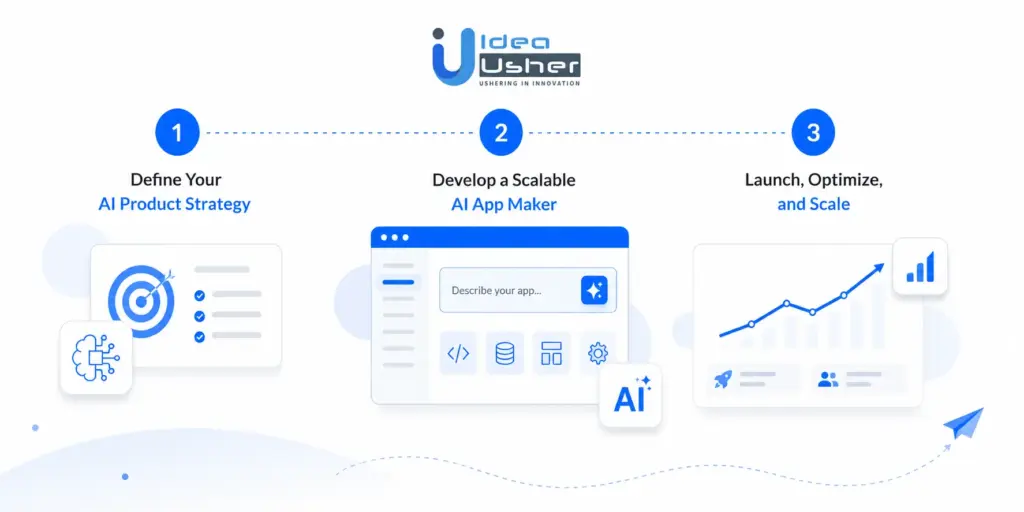
Define Your AI Product Strategy
A successful product launch avoids feature bloat. Our product strategists collaborate with you to filter out noise and isolate the exact capabilities your target market is willing to pay for. We focus on identifying high-value use cases that give your platform an immediate competitive edge.
- Market Alignment: We analyze user behavior to ensure your platform targets specific development bottlenecks.
- MVP Prioritization: Our team helps you select core functionalities so you can launch quickly and conserve capital.
- Strategic Roadmap: We establish a long-term development path that adapts to market shifts and protects your investment.
Develop a Scalable AI App Maker
Our engineering teams specialize in building the complex layers required for prompt-to-app generation. We design multi-agent systems where different AI components work together to generate user interfaces, write back-end code, and configure databases simultaneously. We build everything on cloud-native infrastructure to ensure your platform remains fast and responsive as thousands of new users join.
Security is integrated into the core architecture. We implement strict data isolation protocols to protect user data and ensure that all generated code is securely sandboxed.
Launch, Optimize, and Scale
Going live is just the beginning of your product lifecycle. Once your platform hits the market, we provide continuous technical oversight to keep your software running efficiently. We track system performance and manage server costs to maximize your profit margins. As foundational AI models evolve, we refine your platform prompt engineering and model integrations. This continuous optimization ensures your application generation engine remains fast, precise, and highly cost-effective.
Conclusion
Choosing the right development company is one of the most important decisions when building an AI app maker platform. The best teams bring more than development expertise. They understand AI architecture, scalable infrastructure, and the challenges of turning AI-generated applications into reliable products. Below, we’ve highlighted some of the leading AI app maker platform development companies in 2026 and what sets each of them apart.
Things to Know About AI App Maker Platforms
A1: Yes, modern AI app makers can generate production-ready web and mobile applications by creating the frontend, backend, database schema, APIs, and business logic from natural language prompts. However, enterprise applications typically require additional work such as security audits, performance optimization, compliance checks, and custom integrations before deployment. Many businesses use AI to accelerate development while relying on experienced engineering teams to refine and scale the final product.
A2: Most AI app maker platforms are designed for both technical and non-technical users. You can describe your app idea in plain language, and the AI generates much of the required code automatically. While basic coding knowledge can help customize advanced features or troubleshoot issues, many platforms allow founders, entrepreneurs, and business teams to build functional applications without writing code from scratch.
A3: The development cost varies based on the platform’s capabilities, AI integrations, supported devices, workflow complexity, collaboration tools, security requirements, and cloud infrastructure. A basic MVP with prompt-to-app functionality is significantly less expensive than an enterprise-grade platform with AI agents, real-time collaboration, advanced deployment pipelines, and multi-model support. Investing in a custom platform also gives businesses complete ownership, flexibility, and the ability to create unique competitive advantages.
A4: Most AI app makers use advanced LLMs such as GPT, Claude, Gemini, or open-source models like Llama and Mistral to understand user prompts and generate application code. More sophisticated platforms combine multiple AI agents that specialize in interface design, backend development, testing, debugging, documentation, and deployment, enabling faster and more accurate app generation.