


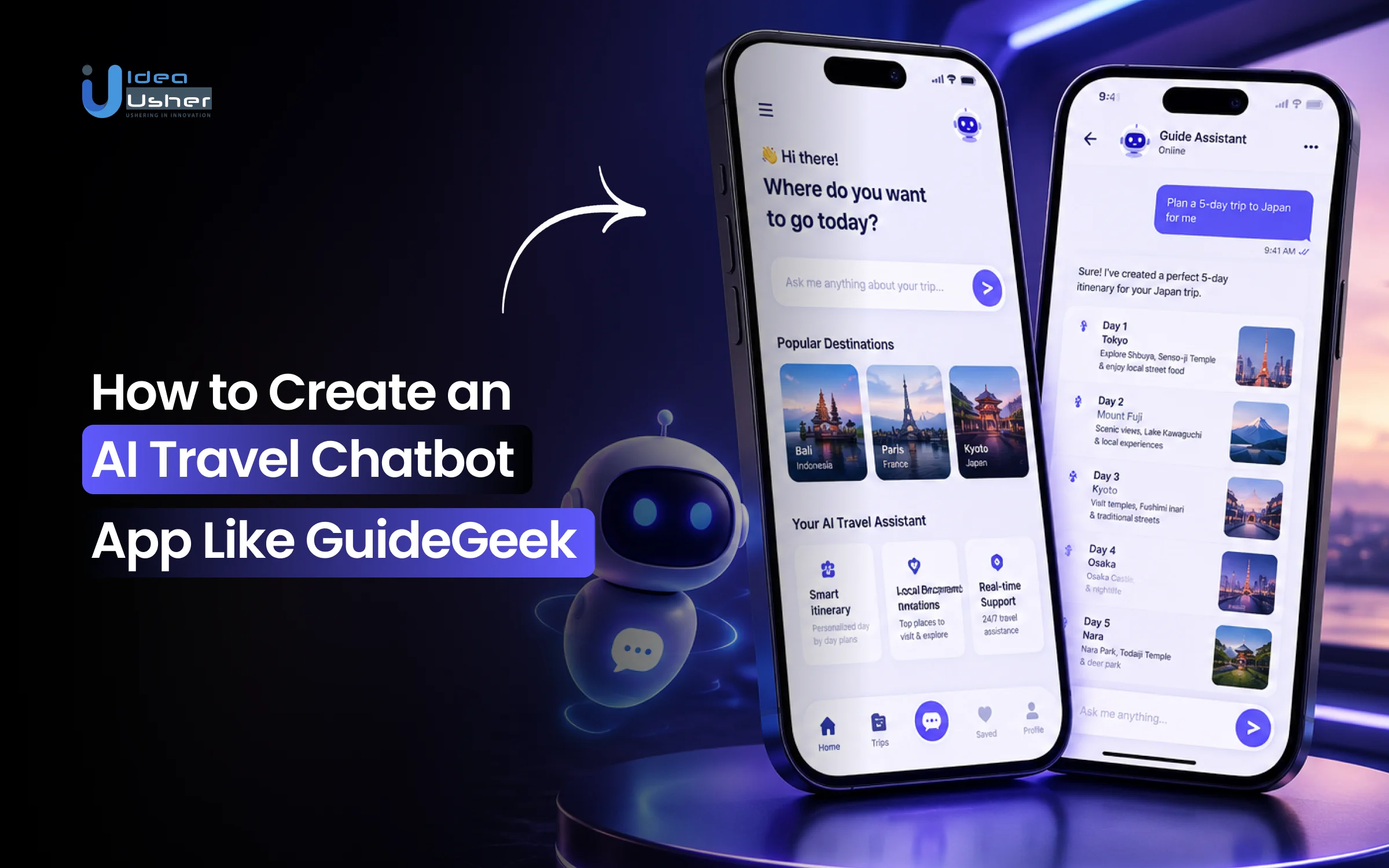
Key Takeaways
- AI travel chatbot apps like GuideGeek simplify trip planning through conversational AI, personalized recommendations, and real-time travel assistance.
- The AI travel assistant market is growing rapidly as travelers increasingly prefer chat-based experiences for planning and discovery.
- Successful platforms rely on live travel data, multilingual support, and memory systems to create trustworthy experiences.
- Businesses can generate revenue through enterprise licensing, affiliate partnerships, and booking integrations, making travel AI highly scalable.
- How Idea Usher can help businesses develop AI travel chatbot apps like GuideGeek with AI integration, travel APIs, and scalable architectures.
Planning a trip sounds exciting until you find yourself opening dozens of tabs to research destinations, hotels, activities, and transportation. That’s why many travelers are turning to AI travel chatbot apps like GuideGeek. Instead of spending hours searching for information, users can simply chat with an AI assistant to get personalized recommendations and trip ideas tailored to their preferences. As travel planning becomes more digital, these AI-powered assistants are making it easier for people to plan better trips in less time.
We’ve developed several AI travel chatbot solutions that use conversational AI and personalized recommendation engines to assist travelers with trip planning. Drawing from this experience, we’re writing this blog to explore how to build an AI travel chatbot app like GuideGeek, including its key features and core technologies.
Market Size and Growth Potential of AI Travel Assistants
According to 360 IResearch, the AI-powered personal travel assistant market was valued at USD 1.44 billion in 2025 and is projected to grow to USD 4.61 billion by 2032, highlighting the rising demand for smarter travel planning solutions. As travelers increasingly look for personalized recommendations and faster trip organization, AI-driven platforms are becoming a preferred alternative to traditional booking tools. This growing shift creates a strong opportunity for businesses and investors looking to enter a rapidly expanding travel technology market.

Source: 360 IResearch
Market Growth and Revenue Forecasts
The financial trajectory for automated travel platforms shows vertical growth. This expansion is driven by the industry adopting hyper-personalization at scale. Platforms are moving away from flat commission models on bookings to unlock sophisticated, high-margin revenue streams. Investors should focus on the diverse monetization strategies that these platforms enable:
- Premium Subscription Tiers: Users pay fees for real-time disruption management, automated rebooking, and access to exclusive wholesale rates.
- B2B Enterprise Licensing: The proprietary itinerary engine can be white-labeled and leased to corporate travel departments or smaller agencies.
- Contextual Direct Partnerships: Platforms can charge hospitality brands premium fees for algorithmic placement when the system detects a perfect user match.
Trends Fueling AI Travel Adoption
Modern travelers want instant personalization and are abandoning platforms that force them to open dozens of browser tabs. Consumer behavior has shifted toward conversational commerce. Travelers expect an interface to understand complex requests like balancing a budget with specific dietary preferences and boutique aesthetic choices.
This shift is obvious when observing successful platforms already capturing this audience. For instance, Mindtrip integrates rich maps, photos, and live booking data directly into a single conversational thread, removing friction for the user. Similarly, Layla leverages chat-based interfaces to turn casual destination discovery into hard booking data. These platforms succeed because they cater to the modern traveler’s desire for an all-in-one digital concierge.
Why Investors Bet on Travel AI
Investors are showing strong interest in AI-powered travel platforms because they create a more sustainable business model than traditional travel agencies. Instead of spending heavily to attract the same customers again and again, these platforms deliver personalized experiences that encourage travelers to keep coming back. As the system learns a user’s preferences, travel style, and booking habits, it becomes more valuable over time.
Another reason for the growing investment is operational efficiency. Many routine tasks such as itinerary updates, booking changes, and customer support can be automated with AI. This allows travel startups to serve a larger global audience without significantly increasing their workforce, creating better profit margins and stronger long-term growth potential.

What Is GuideGeek and How Does It Work?
Understanding how modern software tools capture user engagement is essential for building a profitable travel platform. GuideGeek provides a strong example of how to remove friction from the user experience. Developed by Matador Network, it operates as a virtual concierge that answers complex travel queries, sources booking details, and creates specialized schedules.
The most important strategic choice behind this platform is its delivery mechanism. It completely skips the traditional app store download. Instead, it lives entirely within messaging software that travelers already open multiple times a day.
Conversational AI in Travel Planning
The platform relies on natural language processing to mimic the conversational flow of a human travel agent. Traditional platforms force users to fill out rigid search forms with exact dates and locations. This system allows users to speak organically about their goals. A user can type a complex sentence detailing their group size, dietary restrictions, preferred aesthetic, and budget limits all at once.
The underlying system parses this unstructured text to identify key intent markers. It then cross-references those markers with external live databases to provide immediate, context-aware answers. This turns a painful research process into an active conversation, which dramatically improves user retention.
Tech and Core Features
The technology behind these platforms goes beyond a simple AI chatbot. While generative AI helps create natural conversations and personalized recommendations, the real value comes from its connection to live travel data. This allows the platform to deliver relevant information, update plans in real time, and provide travelers with recommendations that reflect current conditions rather than static content.
Key architectural features include:
- Live Data Syncing: Over one thousand integrations pull immediate flight, accommodation, and rental pricing.
- Omnichannel Integration: The service deploys across WhatsApp, Instagram, and Facebook Messenger using a single backend infrastructure.
- Human-in-the-Loop Quality Control: Human operators monitor chats to correct factual errors, keeping system accuracy near ninety-eight percent.
- B2B White-Label Capabilities: The technology can be re-skinned for tourism boards and destination marketing organizations to monetize local business traffic.
Step-by-Step User Journey
The biggest advantage of this approach is its simplicity. Travelers can start planning a trip through a familiar messaging app without creating new accounts or learning how to use another platform. This reduces friction and makes travel planning feel more natural, helping users get recommendations and organize their trips faster.
| Stage | What Happens |
| Initiation | The traveler scans a QR code or clicks a link from a website, advertisement, or social media profile, which opens a travel assistant chat instantly in apps like WhatsApp. |
| Discovery Phase | The user shares basic travel ideas, destinations, interests, or preferences and asks for recommendations, attractions, dining spots, or transportation options. |
| Refinement | The AI generates a personalized itinerary that can be adjusted through simple chat messages. Travelers can modify hotels, activities, schedules, or budgets in real time. |
| In-Destination Support | During the trip, the traveler continues using the chat assistant for live recommendations, route guidance, weather-based alternatives, and other on-the-go travel assistance. |
How GuideGeek Uses Conversational AI to Simplify Travel Planning?
The modern consumer expects high-level personalization when booking luxury or leisure trips. Standard travel engines fail because they treat every traveler like a generic demographic. GuideGeek leverages conversational automation to fix this flaw, transforming trip planning into a dynamic conversation.

Focusing on deeply tailored interactions allows new platforms to capture loyal users quickly. The platform treats individual preferences as the core starting point for every search journey.
1. Personalized Recommendations
Instead of showing the same top-ten tourist list to everyone, GuideGeek uses its Tailored Recommendations capability to filter suggestions based on active context. The interface reads user input naturally, adapting its choices to fit specific traveler personas. When a user inputs a backpacker budget, GuideGeek automatically filters out luxury resorts to suggest vibrant local hostels instead.
On the flip side, a luxury solo traveler is immediately guided away from shared accommodations and toward boutique eco-lodges. This smart filtering helps users avoid choice paralysis, delivering immediate answers that match their lifestyle.
2. Dynamic Itinerary Generation
Traditional scheduling tools require manual data entry across multiple calendars and maps. GuideGeek eliminates this friction through its Personalized Itinerary Creation feature, building structural, editable itineraries instantly within a single text window.
- Proximity-Based Routing: The software groups activities by neighborhood to minimize unnecessary transit time.
- Contextual Balance: The platform spaces out tours with dining blocks so the user never feels rushed.
- Instant Iteration: If a user wants to make a change, they just reply with their adjustment and the layout updates immediately.
3. Real-Time Travel Support
The utility of a digital concierge does not end when the booking is finalized. The app features Smart, Real-Time Travel Assistance that serves as an active companion travelers can message while exploring a city. If a user texts the platform to mention it is raining unexpectedly in Kyoto, GuideGeek scans immediate options to suggest a nearby covered shopping arcade or a digital art museum.
This active support layer transforms the software from a simple research tool into an essential personal asset, creating valuable touchpoints for direct monetization and premium partner placement.
The Business Model Behind GuideGeek’s Success
Many consumer platforms choose to charge users directly. GuideGeek scales by treating its core software framework as a high-value B2B enterprise solution. Developed by Matador Network, the platform bypasses standard app stores entirely, operating directly inside popular messaging interfaces like WhatsApp and Instagram.
This architectural setup eliminates typical user acquisition friction while unlocking diversified corporate income streams. Because it operates directly inside text threads, the consumer tool is completely free, carrying a $0 subscription fee for everyday travelers who use it to plan itineraries.
White-Label Solutions
Many AI travel platforms generate revenue through white-label partnerships rather than charging travelers directly. Tourism boards, destination marketing organizations, and hospitality groups can license a customized version of the platform for their own websites, giving visitors instant access to local travel information and recommendations.
GuideGeek secures high-value contracts through these custom setups, signing major partnerships with massive regional authorities like NYC Tourism + Conventions, Tourism New Zealand, and the Colorado Tourism Office. For instance, the team partnered with the Aruba Tourism Authority and Visit Reno Tahoe to build native, localized guides. They also designed Rocky Mountain Roamer for Estes Park, Colorado, alongside Pythia for Discover Greece.
Travel Content and Data
The system achieves high precision by combining foundational language models with proprietary data assets. Rather than relying on generic web scrapes, the architecture integrates directly with real-time flight, hotel, and vacation rental networks.
- Proprietary Context Filtering: The bot checks queries against Matador Network’s vast database of travel media, ensuring suggestions match current consumer trends.
- Live API Aggregation: Tying into more than one thousand live travel integrations allows the system to instantly retrieve accurate pricing details.
- Human-in-the-Loop Training: Internal teams actively monitor chat transcripts to correct hallucinated answers, driving overall system accuracy to approximately 98%.
Revenue Through Partnerships
GuideGeek demonstrates how AI travel platforms can scale without relying on subscription fees from travelers. By combining enterprise licensing with booking-related revenue opportunities, the platform has built a sustainable growth model while keeping the consumer experience free. Its success is reflected in its ability to handle millions of traveler queries across dozens of countries, helping drive continued business expansion and contributing to Matador Network’s recognition on the Inc. 5000 list of fastest-growing private companies.
- Affiliate Integration: When a user asks for a hotel recommendation, the platform automatically drops tracking links into the text thread, earning standard commission rates upon booking.
- Zero Ad Friction: By leaving out banner ads and protecting user data, the layout keeps user retention high while driving traffic straight to premium partners.
- Brand Campaigns: Corporate sponsors pay specific integration fees to feature their locations prominently when users seek destination advice.
Core Features of an AI Travel Chatbot App Like GuideGeek
To build a high-yield travel asset, you must understand the exact product features that keep users engaged. Modern AI travel chatbot apps succeed because they translate complex machine learning into simple chat interactions. The system relies on a user-first experience that solves real travel problems without technical confusion.
1. Conversational Planning via Chat
The core of the GuideGeek user experience is an advanced text interface. Instead of filling out rigid search forms with drop-down menus, travelers message GuideGeek exactly like they would text a friend. A traveler can type a long, informal message describing their ideal vacation setup. The user might mention a preference for scenic coastal routes, a tight budget, and a need for kid-friendly stops all in one go. GuideGeek processes this text naturally, recognizing the core intent and responding with clear options instantly.
2. Personalized Recommendations
The GuideGeek system shifts away from generic tourist lists to offer tailored ideas. Users receive suggestions from GuideGeek based entirely on the specific criteria they provide during the conversation.
- Contextual Matching: If a user asks for a quiet weekend getaway, the chatbot filters out crowded party spots and suggests secluded cabins or boutique wellness retreats.
- Budget Alignment: The chatbot narrows down geographic regions and accommodation styles that fit within the exact price range specified by the traveler.
3. Automated Itinerary Generation
Building a multi-day travel schedule usually requires hours of manual planning. The chatbot handles this task in seconds by creating structured, day-by-day itineraries directly in the chat window. A user simply requests a schedule for their destination, specifying the number of days. The software breaks the trip down into logical morning, afternoon, and evening blocks, grouping activities by physical proximity to save transit time. If the traveler wants to swap out a museum for an outdoor market, they just text the change, and the schedule updates immediately.
4. Live Assistance and Local Tips
GuideGeek functions as an active travel companion rather than a static planning tool. Travelers use the GuideGeek chat window while they are actively on the move to solve immediate problems.
- Spontaneous Questions: A user walking through a new city can message the chatbot to find a highly rated espresso bar or a hidden local viewpoint nearby.
- On-the-Go Logistics: If unexpected rain ruins outdoor plans, the user can ask for instant indoor alternatives or public transit advice to navigate the area smoothly.
5. Booking and Discovery
The GuideGeek platform combines conversational text with live travel data integrations. This allows users to check live availability and pricing through GuideGeek without leaving the messaging stream. A traveler can ask GuideGeek for real-time flight options or vacation rental rates for specific dates. GuideGeek pulls this inventory directly into the conversation. This smooth discovery path keeps the user engaged and creates clear opportunities for direct booking partnerships or affiliate revenue.
6. Global Multilingual Support
To serve a global user base, GuideGeek uses automated translation layers. Travelers can converse with GuideGeek in their native language. A user typing to GuideGeek in Spanish or French receives fluent, contextually accurate travel advice back in that same language. This capability opens up international markets instantly, allowing the platform to scale across different regions without the massive overhead of hiring localized support teams.
7. Omnichannel Messaging Integration
The most critical business choice behind the design of GuideGeek is skipping the traditional app store download entirely. GuideGeek runs directly inside the messaging networks that travelers already open every day.
- WhatsApp: Users scan a quick link to start planning trips on the world’s most popular messaging tool.
- Instagram: Travelers slide into the chatbot’s direct messages to ask about a destination they just saw in a video.
- Facebook Messenger: Users access the same travel data through a familiar chat window on their desktop or phone.
How to Create an AI Travel Chatbot App Like GuideGeek?
Building a premium automated travel asset requires shifting from a generic wrapper to a highly integrated ecosystem. To capture the market share of platforms like GuideGeek, the development process must focus on eliminating user friction while maximizing backend intelligence.
We at IdeaUsher focus on converting complex engineering into smooth conversational interfaces. This structural guide maps out how we design, build, and deploy high-performance travel platforms for our enterprise partners.
1. Defining Core Use Cases
The most successful travel platforms focus on solving a few important user needs before expanding into additional features. Instead of trying to handle every travel scenario from day one, they identify what travelers are looking for when they first interact with the product and deliver value quickly. This approach creates a better user experience and helps drive higher engagement and retention.
The Weekend Spontaneous Traveler: Requires hyper-local, immediate entertainment and dining ideas based entirely on their current GPS coordinates.
- The Long-Form Itinerary Planner: Needs structural multi-day schedules that balance geographic routing, group size, and flight arrival times.
- The Budget-Conscious Discovery User: Focuses heavily on live pricing alerts, accommodation comparisons, and finding off-season value.
2. Designing the Experience
The greatest product trap is overwhelming the user with choices. We eliminate long forms and multi-step drop-down menus, replacing them with a natural text stream that feels like talking to a human concierge. Our interface architecture relies on advanced intent parsing. When a user sends a mixed text request, the software breaks the paragraph down into structured parameters. If a traveler asks for a beach resort near local restaurants that is good for kids, our engine flags those three distinct variables simultaneously to deliver a single cohesive answer.
3. Developing the AI Engine
The true value of your digital asset lies in its recommendation logic. We move beyond static database filtering by building dynamic orchestration layers. We deploy a custom semantic search layer that connects foundation language models to specialized travel databases. When a user requests a custom schedule, our system runs routing algorithms behind the scenes. This ensures that the generated morning, afternoon, and evening activities are arranged in a logical geographic sequence to save transit time.
4. Integrating Travel APIs
An AI travel chatbot is only as strong as its live data connections. We construct robust API plumbing to feed real-time inventory directly into the conversation pipeline.
- GDS and Flight Aggregators: Connecting to platforms like Amadeus or Sabre provides immediate ticket availability and pricing.
- Hospitality Inventory: Integrating booking engines ensures hotel and rental data remains accurate to avoid dead-end recommendations.
- Geo-Location and Mapping: Leveraging Google Maps or Mapbox APIs allows the system to pull live transit routes and point-of-interest details instantly.
5. Enabling Messaging Access
To mirror GuideGeek’s user retention, we skip the traditional app store download entirely. We build the core software to deploy natively across the communication platforms your users already use every day. We create a unified webhook architecture where a single backend handles requests from WhatsApp, Instagram, and Facebook Messenger simultaneously. This channel strategy keeps your customer acquisition costs exceptionally low. It allows users to initiate trip planning directly from a social media ad or a profile link with a single tap.
6. Implementing System Memory
A platform becomes an indispensable personal asset when it remembers user preferences over time. We engineer secure, session-based memory layers that track historical context without compromising privacy. If a traveler previously planned a vegan food tour in Paris, our system saves that preference inside a dedicated user context matrix. The next time they search for a destination, the system prioritizes vegan options automatically. This continuously rising level of personalization drives long-term customer lifetime value.
7. Testing and Continuous Optimization
Launching a premium product requires rigorous benchmarking to prevent system hallucinations and incorrect data outputs. We implement a structured verification pipeline before opening the platform to the public.
- Synthetic Stress Testing: Running automated scripts through thousands of complex, misspelled, and highly varied travel queries to check system stability.
- Human-in-the-Loop Feedback: Setting up real-time monitoring dashboards where human operators check initial chats to improve conversational accuracy.
- Live Analytics Deployment: Monitoring traveler behavior, dropped conversations, and conversion rates to refine marketing strategies and system responses.
Designing an AI Itinerary Generator That Travelers Actually Trust
Many digital planners face a major trust issue. Travelers quickly abandon generic platforms that recommend closed restaurants, outdated transit routes, or mismatched hotel options. To build a truly sticky solution, AI travel chatbot apps must bridge the gap between basic automated text generation and verified logistics. Overcoming this reliability gap requires grounding your system architecture in live data pipelines and strict quality guardrails.
1. Real-Time Travel Data
Standard language models often hallucinate information because they rely on frozen training data. If a local boutique hotel closed down last month, a generic chat system might still confidently add it to a weekend schedule. The team behind GuideGeek avoids this problem entirely by plugging their system directly into live reservation networks.
When a user asks for lodging suggestions, the chat engine queries active inventory feeds to verify real-time room availability, seasonal hours, and current pricing. This technical design ensures that every recommendation is actually bookable right now.
2. Traveler Intent
Generic travel apps frequently push identical sightseeing lists to completely different users. A family traveling with toddlers receives the exact same crowded museum tour as a solo backpacker, creating a cold, unhelpful experience.
- Behavioral Matching: The software framework dissects conversational nuances, separating a casual budget getaway from a high-end luxury honeymoon.
- Dynamic Adaptation: If a user mentions a preference for local street food over fine dining, the backend instantly updates the entire route layout to focus on authentic night markets.
- Geographic Context: The engine layers weather patterns and local transit delays over the schedule, ensuring a rainy afternoon shifts your traveler toward indoor spots automatically.
GuideGeek excels here by treating the conversation like a fluid dialogue with a local concierge. It processes complex, multi-sentence requests and remembers past preferences over long messaging threads, delivering deeply tailored recommendations that mirror real human intent.
3. Human Quality Controls
Pure automation inevitably hits a wall. Language models occasionally misinterpret localized slang or surface inaccurate directions in remote areas, which can completely derail a user’s vacation.
- Continuous Evaluation: Specialized engineering teams actively study anonymous chat transcripts to catch and correct weird or logical errors before they affect the end user.
- Verified Source Libraries: The platform routes destination questions through a curated index of vetted travel articles and local guidebooks, giving the AI a trusted foundation.
- Algorithmic Guardrails: The engineering framework applies strict filter layers to block dangerous, outdated, or completely impractical routing suggestions from reaching the final text interface.
Cost to Create an AI Travel Chatbot App Like GuideGeek
When evaluating an investment in a conversational travel asset, capital allocation must balance upfront engineering with long-term infrastructure stability. Developing an intelligent platform like GuideGeek involves specialized data piping rather than generic coding. We at IdeaUsher structure development cycles into predictable, milestone-based phases. This approach ensures your deployment capital directly supports the high-margin features that drive platform valuation.
Estimated Development Cost
The cost of building an AI travel chatbot can vary significantly depending on the features, integrations, and level of personalization required. A basic solution may focus on simple travel recommendations, while more advanced platforms include real-time booking integrations, itinerary management, and intelligent trip assistance.
| Project Scope | Estimated Cost Range | Deliverables and Core Capabilities |
| Minimum Viable Product (MVP) | $25,000 to $50,000 | Core language model wrapper, text-based itinerary creation, and single-channel deployment on WhatsApp. |
| Custom Enterprise System | $60,000 to $120,000 | Multi-channel integration, live flight and hotel API syncing, session-based user memory, and custom routing logic. |
| Advanced Proprietary Platform | $150,000+ | Full omnichannel access, predictive recommendation engines, automated booking capabilities, and enterprise white-label architecture. |
Key Factors Influencing Cost
The overall budget is not dictated by the chat interface itself but by the data pipelines and logic built behind it. We focus on optimizing these specific engineering drivers to maximize capital efficiency:
- Data Integration Complexity: Syncing live, global inventories from networks like Amadeus requires complex connection handling, driving initial integration costs.
- Intelligence and Fine-Tuning Layer: Training models on custom travel data sheets and setting up custom semantic search systems requires more specialized engineering hours.
- Channel Architecture: Deploying a unified backend that communicates instantly across WhatsApp, Instagram, and Messenger requires advanced webhook infrastructure.
Ongoing Expenses After Launch
Operating a high-yield software asset requires planning for recurring technical overhead. We design our software architectures to minimize data waste and keep these ongoing operating metrics highly efficient.
- Model API and Compute Consumption: Recurring costs scale directly with user volume as the platform processes large blocks of conversational travel data.
- Data Subscriptions: Live flight tracking, accommodation pricing, and mapping services require active monthly licensing agreements.
- Infrastructure Hosting: Secure cloud servers must manage live session contexts and user preference history without performance lag.
- Security and Maintenance: Monthly maintenance keeps messaging connections stable, protects user payment data, and updates the core models.
The Economics of Running an AI Travel Chatbot App at Scale
Scaling a conversational travel platform requires a sharp focus on infrastructure efficiency. While acquiring users through messaging apps is relatively cheap, the backend compute costs of AI travel chatbot apps can quickly drain capital if not managed correctly. High-margin success belongs to platforms that optimize their data processing pipelines, balancing server costs with user engagement to build a sustainable, profitable digital asset.
Understanding Inference and API Costs
Every message sent by a user triggers a chain reaction of technical expenses. The financial model must account for both brainpower compute costs and live data collection fees. A platform like Roam Around highlights this economic reality by processing thousands of itinerary requests daily. Each structured trip plan requires a heavy exchange of input and output tokens through foundation language models.
These processing requirements translate to actual infrastructure expenses, where standard high-volume systems can generate base LLM costs from $0.01 to $0.15 per complex itinerary generation, depending on the model tier used. On top of the core text generation, pulling live flight availability or mapping coordinates adds fixed API transactional fees to the bill.
Cost Drivers Impacting Profit Margins
Profitability is heavily influenced by how deeply users interact with the system. Long, open-ended conversations can easily compromise margins if the system is inefficient.
- Session Context Length: As a user continues chatting, the entire conversation history must be sent back to the AI model. This growing data packet increases token consumption exponentially, turning a chat that started at under $0.01 into a multi-dollar expense over a long planning session.
- Data Freshness Demands: Checking a static itinerary costs almost nothing. However, querying live inventory systems for real-time hotel pricing incurs instant premium API charges, often billed at $1 to $5 per thousand requests by global distribution networks.
- Media Processing: Generating custom map routes or rendering visual destination cards requires significantly more compute power than returning a basic text message.
Strategies to Improve Unit Economics
To protect margins at scale, software infrastructure must implement smart optimization layers. Building systems that protect the budget without hurting the speed or accuracy of the user experience is essential. Another major player, Tripnotes, manages these expenses by using smart caching mechanisms.
If multiple users ask for things to do in Paris, the system pulls from a recently saved database rather than paying for a brand-new AI generation every single time. This approach allows the platform to check if a request is cached, pulling directly from local memory for near-zero cost, and only triggering the full AI engine and live APIs when a unique request appears.
- Semantic Caching: Storing common destination queries in a local database slashes compute costs by up to 80% for repetitive requests, keeping server costs down to fractions of a cent.
- Model Routing: Directing simple queries like hello to cheaper open-source models while saving premium engines for complex itinerary building optimizes token budgets.
- Affiliate Monetization: Offsetting operational costs by embedding tracking links for hotels and tours directly into the chat stream converts standard expenses into direct revenue pipelines, pulling in standard 5% to 15% commissions on completed bookings.
B2C vs B2B Travel AI: Which Business Model Is More Sustainable?
The success of AI travel chatbot apps depends not only on attracting users but also on maintaining engagement and generating sustainable revenue over time. While consumer-focused travel apps often face challenges such as high marketing costs and seasonal fluctuations in demand, enterprise solutions can benefit from more predictable usage and recurring revenue streams.
1. The Consumer Monetization Problem
Direct-to-consumer travel applications capture quick traffic through viral social media posts and easy messaging setups. However, monetizing a casual vacation planner often proves difficult because ordinary users only build itineraries a few times each year.
- The platform Layla AI highlights this specific consumer-focused strategy. To capture revenue from its base, Layla AI utilizes a subscription setup where entry-level access is free, while a premium subscription is priced at $9.99 per month for advanced tools.
- The application also secures revenue through affiliate booking loops with partners like Skyscanner and Booking.com. This hybrid model has pushed Layla AI into a healthy operational position, generating roughly $2.8 million in annual recurring revenue.
2. Sustaining Unit Economics
To survive without relying purely on seasonal booking commissions, consumer apps must build steady, predictable monthly revenue. If a user plans a trip in December but ignores the software for the rest of the year, continuous server fees will destroy business margins. Another player in the consumer segment, Mindtrip, takes a visual approach to automated planning by combining chat with interactive map elements.
Mindtrip leverages its software infrastructure and affiliate relationships with booking platforms to secure an annual revenue run rate of approximately $3.6 million. By managing operational costs and focusing heavily on immediate user monetization, the platform scales efficiently while supporting an expanding team.
3. Why Enterprise Frameworks Excel
Shifting to an enterprise business model provides immediate financial stability. Instead of chasing millions of individual travelers, software providers sell their conversational engines directly to travel agencies, boutique hotels, and corporate booking managers. When making a structural platform choice, the consumer path generally demands high marketing spend and presents unpredictable seasonal use, whereas the enterprise direction relies on fixed corporate contracts and steady software revenue.
- Predictable Subscription Cash Flow: Enterprise clients pay consistent monthly software fees to embed chat tools on their corporate websites.
- Significantly Lower Marketing Costs: B2B companies sign long-term service agreements with companies, eliminating the need for expensive social media ad campaigns.
- Controlled Backend Expenses: Enterprise systems use set user quotas, making computing consumption entirely predictable from month to month.
- White-Label Deployment: Licensing the core chat engine to international agencies allows software owners to charge flat infrastructure setup fees.
- Custom Data Integration: Enterprise clients pay premium implementation costs to link the chatbot to their internal reservation databases and customer loyalty networks.
- Customer Support Automation: Helping large companies replace manual support agents with automated text routing turns a standard chatbot into an essential cost-cutting tool.
The direct-to-consumer route offers massive scale and quick brand visibility, but the business-to-business model delivers the recurring revenue needed to survive. Combining smart affiliate tracking with recurring enterprise software fees builds a balanced tech asset that remains profitable all year long.
How AI Travel Chatbots Create Network Effects Through Travel Data?
A primary challenge in software deployment is building defenses against copycat platforms. For AI travel chatbot apps, long-term enterprise valuation is not driven by code complexity but by data network effects. Every user who searches for a destination helps build a smarter system, constructing a natural barrier to entry that competitors cannot easily replicate. Compounding data returns transform standard utilities into highly intelligent ecosystems that grow more valuable with every interaction.
1. Smarter Recommendations
As search volume scales, the internal logic of a chat engine undergoes a continuous training cycle. Each message provides fresh context on consumer intent, allowing the system to refine its accuracy over time. The app Hopper utilizes this exact mechanism within its core system.
By processing billions of historical data points and live searches, its prediction engine learns to anticipate hotel price drops and flight delays with high precision. This data loop ensures that a platform becomes increasingly accurate as more travelers plug their vacation dates into the software.
2. Proprietary Data Moats
Generic language models can provide basic tourist information, but they lack the localized insights required for elite trip design. The accumulation of real-world user choices creates a proprietary asset pool.
- Pattern Extraction: Tracking real-time decisions helps the system understand which routing paths travelers actually take instead of relying on static maps.
- Contextual Refinement: Deep data pools teach the system that a rainy afternoon query requires indoor museum ideas rather than outdoor walking tours.
- Zero-Cold-Start Advantage: Rich historical records allow the platform to serve highly accurate plans to brand-new users based on lookalike audience behaviors.
Another platform, iPlan.ai, leverages this structural barrier by saving thousands of custom travel schedules created by its community daily. The system studies which activities users remove, add, or swap within their itineraries. This feedback loop creates a massive data asset, allowing the application to output optimized trip flows that generic tools cannot replicate.
3. Community Insights
Network effects reach full velocity when user actions actively improve the experience for the rest of the community. When travelers share custom plans or write live reviews directly within the chat window, they provide fresh data that feeds back into the primary engine. When a traveler actively modifies an itinerary, the engine captures that preference to learn what went wrong or right. The system then automatically updates its global data pool so that future users looking at similar destinations get significantly better routes.
- Collaborative Filtering: The platform automatically bundles matching preferences, ensuring that hidden local gems found by one traveler are instantly recommended to similar users.
- Crowdsourced Verification: Real-time feedback from moving users validates whether a local venue is open, crowded, or overvalued, keeping the database perfectly fresh without manual scraping.
- Viral Distribution Loops: Allowing users to export their conversational schedules directly to friends creates a natural referral pipeline that lowers acquisition costs.
Build an AI Travel Chatbot with Idea Usher
Entering the conversational travel market requires a careful balance of fast messaging tech and reliable live data. Idea Usher builds custom AI travel chatbot apps that keep users engaged and lower booking friction. We take care of the entire engineering pipeline so you can focus on scaling your user base. With over 500,000 hours of coding experience, our team of ex-MAANG developers builds enterprise-grade software tailored to your specific monetization strategy.

End-to-End Development
We take your initial app concept and handle everything through to deployment. Our development lifecycle keeps your project on track while minimizing technical debt. Our engineers design your chatbot to deploy right inside popular platforms like WhatsApp, Instagram, and web portals. We structure clean backend systems that can handle millions of monthly passenger interactions smoothly. This complete development approach ensures your system launches with strong performance right out of the gate.
Expertise in AI and Travel Integrations
Building a trusted travel application requires linking foundational language models to real-time transactional databases. Our specialized development squads bridge these technical gaps seamlessly.
- API Infrastructure: We tie your platform directly into live inventory networks like Skyscanner, Amadeus, or Booking.com for instant price updates.
- Intent Recognition: Our team builds advanced training layers that help your bot understand complex trip requests and natural language accurately.
- Contextual Memory: We program long-term conversation tracking so your assistant remembers user preferences throughout the whole planning cycle.
Scalable Travel AI Platforms
A sustainable platform must adapt as your user numbers grow. We construct modular backend systems designed to support high volume without skyrocketing server costs.
- Hybrid Cloud Architectures: We combine flexible database setups to ensure your system updates instantly during peak travel seasons.
- Strict Security Guardrails: Our security teams implement enterprise-grade data encryption to keep user payment details and personal itineraries completely safe.
- Human Verification Dashboards: We build custom internal moderation panels that let your team monitor chat accuracy and train the AI over time.
Conclusion
Creating an AI travel chatbot app like GuideGeek involves much more than building a conversational interface. Success comes from combining AI, real-time travel data, personalized recommendations, and a sustainable business model into a seamless user experience. As travelers increasingly expect instant and intelligent assistance, businesses that invest in well-designed AI travel platforms can create stronger customer relationships and unlock new growth opportunities in the travel industry.
Things to Know About AI Travel Chatbots
Q1. How much does it cost to build an AI travel chatbot app?
A1: The cost can range from a basic MVP to a fully featured enterprise platform depending on the AI capabilities, integrations, and customization required. Features such as real-time booking, multilingual support, and advanced personalization typically increase development costs. The final budget largely depends on the scale and complexity of the solution.
Q2. What features should an AI travel chatbot app include?
A2: A successful AI travel chatbot should help users discover destinations, create itineraries, receive personalized recommendations, and access travel assistance throughout their journey. Additional features like booking support and budget planning can further improve the user experience. These features help travelers plan trips faster and with less effort.
Q3. Which technologies are used to build AI travel chatbot apps?
A3: These platforms typically combine generative AI models, cloud infrastructure, travel data APIs, analytics tools, and conversational interfaces. Together, these technologies enable natural interactions and access to up-to-date travel information. The right technology stack plays a major role in overall platform performance.
Q4. Can an AI travel chatbot connect with booking systems?
A4: Yes, many AI travel chatbots can integrate with flight, hotel, and activity booking platforms. This allows users to move from trip planning to reservations without leaving the conversation. A seamless booking experience can significantly improve user satisfaction.


