


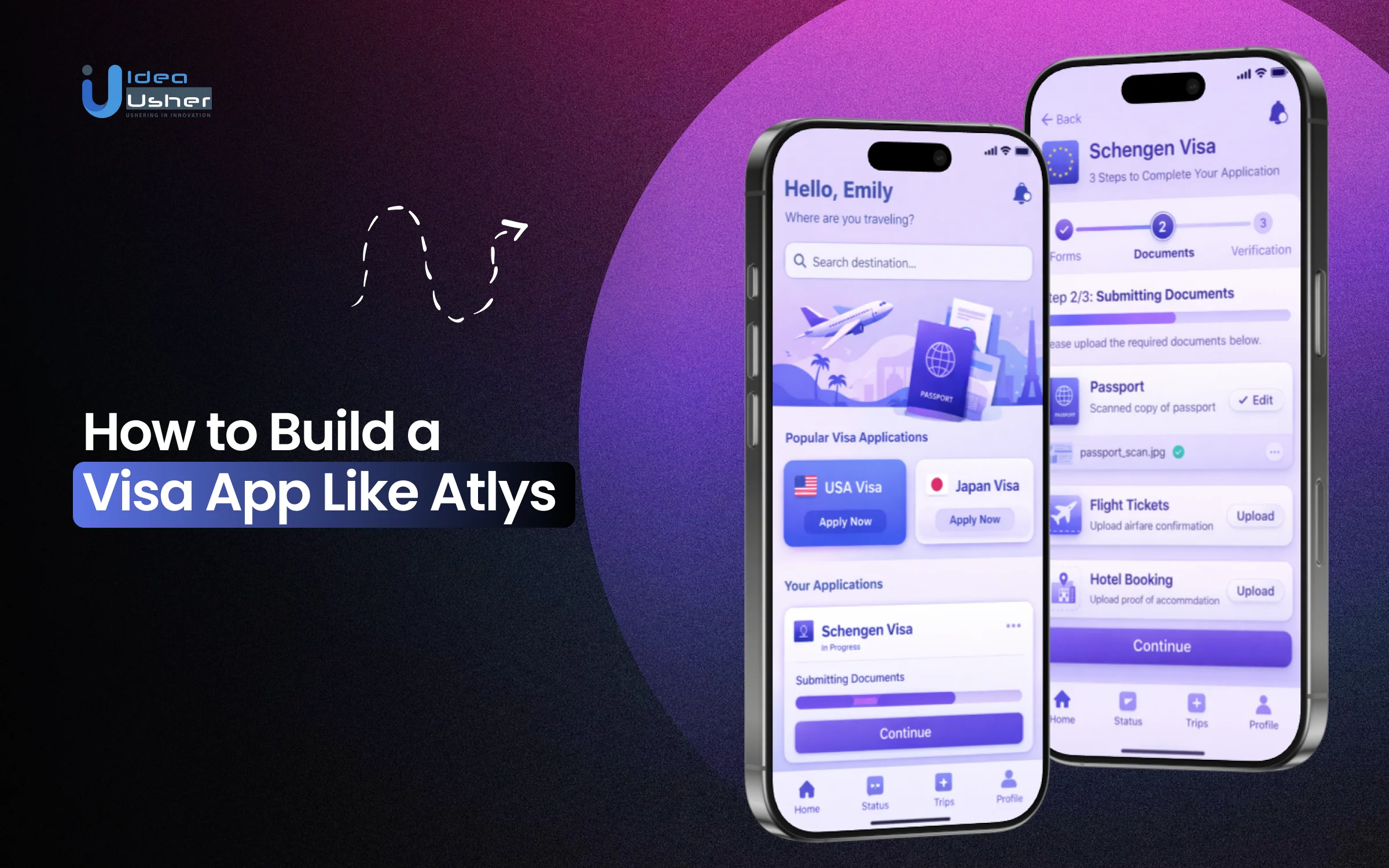
Applying for visas often involves fragmented steps across forms, document submissions, appointment scheduling, and status tracking, which can quickly become confusing for users. Travelers expect a simpler experience where applications, updates, and communication are handled in one place without dealing with multiple systems. These expectations are driving interest in Atlys like visa app development, where the goal is to streamline complex processes into a guided, user-friendly journey.
A reliable platform goes beyond a clean interface by ensuring document processing, eligibility checks, workflow management, third-party integrations, and real-time tracking operate seamlessly together. Platform effectiveness relies on these systems coordinating behind the scenes to maintain accuracy, compliance, and user experience.
In this blog, we explain how to build a visa app like Atlys by breaking down core features, architectural considerations, and practical steps involved in developing a scalable and efficient visa processing platform.
Why Visa Apps Like Atlys Are Gaining Traction?
The global travel landscape is undergoing a radical shift. For decades, the visa process was defined by opacity, physical paperwork, and a heavy reliance on fragmented third-party agents.
However, the success of platforms like Atlys highlights a permanent change in consumer behavior. Modern travelers now prioritize autonomy and digital immediacy over traditional “concierge” services.
For investors, this traction represents a structural realignment of travel tech. By digitizing the interface between the citizen and the consulate, these platforms capture high-intent users who value time. The scalability lies in replacing manual labor with automated workflows, allowing for massive application volumes without a linear increase in overhead.
A. Shift from Agents to Digital Visa Platforms
The migration from high-street travel agents to digital platforms is driven by a demand for transparency. Traditional agents often operate in a “black box,” leaving applicants with little visibility once documents are handed over.
Digital platforms disrupt this by offering:
- Real-time tracking: Instant updates on application status.
- Secure document vaults: Encrypted storage for sensitive personal data.
- Standardized pricing: Predictable, fixed-cost structures that eliminate “hidden” agent fees.
For the entrepreneur, this shift is an opportunity to build brand equity through trust. By centralizing the experience into a mobile-first interface, these apps turn a stressful administrative task into a seamless digital transaction.
B. Pain Points in Traditional Visa Processing
Legacy visa processing is plagued by high error rates. A single typo or a photo with the wrong dimensions can result in a rejection, leading to lost fees and ruined travel plans.
Furthermore, the logistical burden of printing forms, mailing passports, and visiting consulates creates a massive barrier to entry. Digital platforms solve these pain points through:
- Automated Validation: Logic gates that prevent the submission of incomplete data.
- Centralized Compliance: Real-time repositories of changing international regulations.
- Reduced Turnaround: Eliminating the “mailing time” and manual data entry phases.
C. Rise of AI in Travel Documentation
AI is the technical moat in this industry. It is no longer a luxury but a functional necessity for processing thousands of diverse document types from different jurisdictions.
Strategic applications of AI in this sector include:
- Computer Vision (OCR): Instantly extracting data from passports to eliminate manual entry errors.
- Biometric Verification: Ensuring photos meet strict government standards for lighting and head tilt before submission.
- Predictive Analytics: Using historical data to estimate “true processing times” and the probability of approval, building platform credibility.
Market Demand for Faster Visa Approvals
Post-pandemic travel and the rise of the digital nomad have created an unprecedented demand for speed. Today’s traveler expects the same instant gratification in travel documentation that they receive in fintech or e-commerce.
The global visa service market size was valued at USD 4.5 billion in 2024 and is projected to reach USD 7.86 billion by 2032, growing at a CAGR of 8.5% during the forecast period 2026 to 2032. As demand rises, businesses have a clear opportunity to build scalable, user-friendly visa solutions that simplify cross-border travel.

Over 70% of travelers now prefer eVisas over traditional methods due to their speed and simplicity. With AI-driven processing and biometric verification improving accuracy by nearly 40%, modern visa platforms are becoming more reliable and reducing application errors and rejections.
Transitioning from manual to digital systems has increased process accessibility by over 61%, while structured workflows have improved overall usability by more than 70%, making visa applications significantly easier and more efficient for users. This shift is accelerating user adoption of digital visa platforms worldwide.
The market for “fast-track” visas is expanding as more countries introduce E-visas to boost their economies. A platform that shaves days off the process holds a significant competitive advantage, especially in emerging markets where a growing middle class is seeking a foolproof digital path through global bureaucracy.
What Makes Atlys Stand Out in Visa Tech?
The competitive edge in visa technology is no longer just about digitizing a paper form. It is about reducing the cognitive load on the user. Atlys has distinguished itself by treating the visa process as a product experience rather than a bureaucratic necessity.
For an investor, the brilliance of this model lies in its ability to remove friction at every touchpoint. By focusing on high-frequency pain points and solving them with elegant engineering, the platform creates a “sticky” ecosystem where users return for every international trip.

A. One-Time Document Upload System
The “one-and-done” approach to documentation is a primary driver of user retention. In traditional systems, travelers must re-scan and re-upload their passports, photos, and bank statements for every single application.
Atlys solves this by creating a secure, reusable digital vault.
- Data Persistence: Once a passport is scanned via OCR, the data is encrypted and stored for future use.
- Instant Auto-fill: Subsequent visa applications for different countries are populated in seconds, not hours.
- Cross-Device Sync: Documents uploaded via mobile are instantly available for desktop review, ensuring a seamless multi-platform experience.
B. AI-Based Visa Approval Prediction
One of the most significant psychological hurdles in international travel is the “fear of rejection.” Atlys leverages vast datasets to provide users with a “Probability of Approval” score before they even pay.
This feature acts as a strategic advisor:
- Risk Mitigation: If the AI detects a high risk of rejection based on the user’s profile or current consulate trends, it prompts for additional supporting documents.
- Investor Value: This predictive layer reduces the platform’s refund or support burden, as users are better informed about their chances from the outset.
- Dynamic Logic: The engine constantly updates based on real-time approval rates across different jurisdictions, providing a level of insight that no human agent could match.
C. Real-Time Visa Tracking Experience
In the legacy model, once an application is submitted, it enters a “black hole” where the applicant has no idea if it is being reviewed, delayed, or already decided.
Atlys transforms this into a transparent, fintech-like experience:
- Push Notifications: Users receive automated alerts at every milestone from “Submitted to Consulate” to “Visa Issued.”
- Consulate Integration: By hooking into various government APIs and tracking systems, the app provides a unified dashboard for all active visas.
- Anxiety Reduction: This transparency builds immense brand loyalty, as travelers feel in control of their timeline and can book flights or hotels with higher confidence.
D. Simplified UX for Complex Processes
The core challenge of visa tech is translating complex, legalistic government requirements into a user interface that a layperson can understand. Atlys excels by stripping away the jargon.
Strategic UX choices include:
- Progressive Disclosure: Information is presented in bite-sized steps, preventing the user from feeling overwhelmed by long forms.
- Guided Photo Capture: Instead of asking for a “35x45mm photo with 80% face coverage,” the app uses a camera overlay that guides the user to align their face perfectly.
- Localized Context: Requirements are dynamically adjusted based on the user’s nationality and destination, ensuring they only see what is strictly relevant to their specific case.

Business Opportunities in Visa App Development
The digital transformation of the visa sector is now a multi-billion-dollar shift in global travel infrastructure. For investors and entrepreneurs, the “Visa-as-a-Service” model offers high-frequency utility and massive scalability. As governments adopt paperless borders, the opportunity lies in bridging travelers and consulates through high-performance technology.
The market is projected to reach a valuation of approximately $5.47 Billion in 2026, growing at a robust CAGR of over 14%. This growth is fueled by a global middle class with increasing mobility and a systemic shift where over 65% of applicants now prefer digital submissions over physical appointments.
1. Target Users for a Visa Platform
Identifying the right user segments is critical for tailoring the platform’s UX and marketing spend. A successful visa app doesn’t just target “travelers”; it addresses specific demographics with distinct pain points.
Key user segments include:
- Digital Nomads & Remote Workers: A rapidly growing group requiring long-stay or specialized “Digital Nomad Visas.” They prioritize speed and the ability to manage documentation entirely from their laptops.
- First-Time International Travelers: Users from emerging markets (such as India and Southeast Asia) who feel overwhelmed by the complexity of consulate requirements and seek a guided, “foolproof” process.
- High-Net-Worth Leisure Travelers: Individuals who value their time above all else and are willing to pay a premium for “express” or concierge-style digital processing.
2. B2C vs B2B Visa Service Models
Choosing the right business model determines the platform’s sales cycle and long-term revenue stability. While B2C offers rapid user acquisition, B2B provides the high-contract value necessary for sustained growth.
- B2C (Business-to-Consumer): This model focuses on volume and brand loyalty. Success depends on a frictionless mobile interface and emotional connection. The sales cycle is short often minutes but requires significant marketing investment to maintain a steady flow of individual users.
- B2B (Business-to-Business): Here, the app serves as a tool for corporate travel desks or HR departments managing employee relocations. B2B models involve longer sales cycles but result in recurring, bulk revenue. Features like centralized billing, employee tracking dashboards, and bulk document management are essential for this segment.
3. Revenue Potential in Global Travel Tech
The monetization of a visa platform extends beyond simple application fees. Strategic investors look for multiple touchpoints where value-added services can drive high-margin revenue.
Primary revenue streams include:
- Service Fees: A flat convenience fee per application, which scales linearly with user growth.
- Premium “Express” Tiers: Charging extra for prioritized document review or 24/7 dedicated support.
- Ancillary Services: Integrating travel insurance, eSIM cards, or airport lounge access directly into the visa checkout flow.
- Fintech Integration: Offering “Buy Now, Pay Later” (BNPL) options for expensive long-term visas or flight-and-visa packages, capturing a share of the transaction volume.
4. White-Label Visa App Opportunities
For established travel agencies or airlines, building a visa app from scratch is often cost-prohibitive. This creates a lucrative opportunity for tech providers to offer White-Label Solutions.
A white-label model allows an organization to offer a branded visa experience using your underlying technology.
- Scalability for Agencies: Traditional travel agencies can instantly modernize their offerings without a dedicated dev team, paying you a licensing or per-use fee.
- Market Penetration: By white-labeling your tech to large travel aggregators or airlines, you can capture market share rapidly, leveraging their existing customer bases while maintaining your core focus on software excellence.
- Low Friction Entry: It allows the platform owner to act as a “technology partner,” reducing the need for direct-to-consumer marketing spend while building a diverse portfolio of B2B partners.
Core Features of a Visa App Like Atlys
A competitive Atlys like visa app development requires more than a digital form; it demands a sophisticated feature ecosystem that removes user friction. To attract high-value investors, the architecture must show how automation reduces manual effort while improving user experience.
The following core features represent the technical foundation of a market-leading visa application. These modules work in tandem to transform a complex legal process into a high-converting digital product.
1. Smart Visa Eligibility Checker
The first point of friction in any travel plan is uncertainty. The Smart Visa Eligibility Checker uses a logic-based engine to provide instant clarity.
- Dynamic Logic: By entering their nationality, residency, and destination, users receive an immediate “Yes/No/E-visa” status.
- Contextual Requirements: It filters out irrelevant information, showing only the specific documents needed for that user’s unique profile.
- Up-to-Date Intelligence: This system must be synced with global travel advisories to account for sudden policy changes or temporary border closures.
2. Auto-Fill Visa Application Engine
The most tedious part of a visa application is the repetitive data entry. An intelligent auto-fill engine is the primary driver of platform speed.
- OCR Integration: Optical Character Recognition (OCR) technology “reads” the user’s passport and automatically populates fields like name, passport number, and date of birth.
- Error Prevention: The engine validates data formats in real-time, ensuring that dates and alphanumeric codes match government standards before the user moves to the next step.
- Time Savings: What usually takes 45 minutes on a government portal can be reduced to under 5 minutes through this automation.
3. Document Upload and Reuse System
A “digital vault” approach is essential for long-term user retention. Travelers should never have to upload the same document twice.
- Encrypted Storage: High-level encryption ensures that sensitive documents like bank statements and IDs are stored securely.
- Intelligent Asset Mapping: The system remembers which documents are universal (like passports) and which are trip-specific (like flight tickets), prompting the user only for what is missing.
- Multi-Format Support: The system automatically converts various file types (HEIC, PDF, JPG) into the specific format required by the destination country’s consulate.
4. Real-Time Status Tracking Dashboard
Transparency is the antidote to travel anxiety. A centralized dashboard provides users with a “single source of truth” for their application.
- Milestone Alerts: The dashboard tracks the application through stages: “Document Review,” “Submitted to Embassy,” and “Visa Issued.”
- Push Notifications: Automated alerts keep users informed without requiring them to manually refresh the app.
- Direct Communication: If a consulate requests additional information, the dashboard allows the user to upload it instantly, preventing delays.
5. AI-Based Approval Insights
This is the “intelligence” layer that sets a premium app apart. It uses historical data to provide strategic guidance.
- Predictive Analytics: Based on current approval trends, the AI calculates the likelihood of success for the applicant.
- Risk Identification: If a user’s profile has gaps such as insufficient financial proof, the AI flags this as a “High Risk” and suggests corrections before submission.
- Trust Building: By being honest about approval chances, the platform positions itself as an expert advisor rather than just a processing tool.
6. Secure Payment Gateway Integration
For a global platform, payment flexibility is a necessity, not a feature. The gateway must handle diverse currencies and local payment methods.
- Global Compatibility: Integration with providers like Stripe or Adyen allows for credit cards, digital wallets (Apple Pay/Google Pay), and local options like UPI.
- Transparent Fee Breakdown: Users see exactly what goes to the government and what constitutes the platform’s service fee, reducing chargebacks and disputes.
- Instant Invoicing: Automated, professional tax invoices are generated for business travelers who need to claim reimbursements.
7. Multi-Country Visa Support System
To scale globally, the platform architecture must be modular enough to handle the varying rules of different nations.
- Unified Interface: Whether a user is applying for a Schengen visa or a Thai E-visa, the interface remains consistent and familiar.
- Regional Compliance: The system dynamically adjusts to meet the specific data privacy laws (like GDPR) and document requirements of each region.
- Scalable Backend: This structure allows the business to “turn on” new destinations within the app without needing to rewrite the core codebase.
Advanced Features of the Visa App That Drive User Retention
Advanced features in Atlys like visa app development focuses on personalization, real-time assistance, and intelligent automation to enhance overall user engagement and satisfaction. These features drive retention by offering convenience, proactive support, and a more tailored, seamless experience across the entire visa journey.

1. Personalized Travel Recommendations
The engine analyzes historical application data to identify high-approval corridors. After a user secures a Schengen visa, the system uses passport strength to suggest “One-Click” e-Visas for Japan or South Korea, increasing LTV.
2. In-App Chat Support with Experts
A hybrid support model combines LLM-driven triage and expert “Visa Architects” to ensure 24/7 coverage. This model resolves complex Section 214(b) risks in real time, turning the app into a trusted advisory platform.
3. Push Alerts for Visa Updates
The app uses WebSocket event triggers to bypass embassy email delays. Users receive “Granted” or “RFE” notifications within seconds of a portal change, closing the “Anxiety Gap” and driving more daily sessions.
4. Travel Timeline and Checklist Builder
A dynamic compliance roadmap maps mandatory health declarations and currency requirements. Integrating post-grant workflows keeps the app as the main travel “Source of Truth” for users even after the visa is issued.
5. Multi-Language and Localized User Experience
Global scaling depends on an I18n architecture that adapts to regional naming conventions and RTL scripts. Localizing UX for payments and Middle Eastern address formats removes “Foreign Friction” and increases conversion rates.
6. Post-Grant Document Vault and Expiry Tracker
Proactive management of travel credentials secures long-term retention beyond the initial trip. The system monitors Passport Validity Rules and visa expiration dates, triggering automated renewal alerts six months before a traveler becomes ineligible for international entry.
Atlys like Visa App Development Process
The Atlys like visa app development requires strategic planning, intuitive design, and robust development with automation and compliance integration. The development process below outlines each stage required to create a scalable, secure, and user-friendly visa application platform.

1. Consult & Define Visa Service Model
Consult with Idea Usher’s experienced developers and determine if the platform will serve B2C travelers, B2B corporate mobility, or specialized “Digital Nomad” niches. Strategic success hinges on defining whether you act as a document aggregator or an end-to-end legal intermediary with sovereign-level API access.
2. Conduct Market and Competitor Research
Analyze current processing bottlenecks in legacy systems like VFS Global to identify high-friction points. Use competitive benchmarking to quantify the demand for specific corridors, ensuring your MVP targets regions with the highest volume and predictable regulatory environments.
3. Design User Journey and App Flow
Map a “zero-friction” journey that utilizes OCR for instant passport data extraction and auto-population. Wireframes must prioritize progressive disclosure, ensuring complex document requirements are presented in digestible stages to reduce user fatigue and application abandonment rates.
4. Develop AI and Automation Modules
Deploy specialized LLMs to cross-reference user data against real-time embassy requirements to predict approval odds. Implement computer vision for automated photo compliance checks, ensuring every submission meets exact biometric standards before hitting the government gateway.
5. Integrate APIs for Visa Data Sources
Establish secure handshakes with official government portals and IATA databases to fetch real-time entry requirements. Technical depth in 2026 requires utilizing Webhooks for instant status updates, providing users with a “live” tracking experience throughout the processing lifecycle.
6. Ensure Compliance and Legal Validation
Architect your data layer to exceed GDPR and SOC2 standards, utilizing end-to-end encryption for sensitive PII. Collaborate with legal experts to automate the generation of “Letters of Intent” and other mandatory supporting documents within the app’s secure sandbox.
7. Test for Accuracy and Edge Cases
Execute rigorous stress tests on your document validation engine to handle non-standard scripts and edge-case nationalities. Conduct “Shadow Submissions” to verify that your automated logic perfectly matches the nuanced, manual review criteria of various global consulates.
8. Launch and Scale Globally
Deploy a phased rollout starting with high-trust corridors like the Schengen Area or GCC. Use localized marketing and “Refer-a-Traveler” flywheels to build social proof, then scale your infrastructure using cloud-native auto-scaling to manage seasonal travel surges.
Tech Stack Required for Visa App Development
The Atlys like visa app development requires a robust, high-availability architecture that can handle intensive document processing and strict security protocols. The following table outlines the essential technical components required to build a scalable, enterprise-grade solution for global mobility.
| Component | Recommended Technology | Strategic Rationale & Application |
| Frontend for Seamless UX | React.js, Next.js, Flutter | Delivers high-speed, cross-platform interfaces ensuring frictionless navigation through complex, multi-step international application forms. |
| Backend for Data Handling | Node.js (TypeScript), Python (Django), Go | Provides type-safe, scalable environments for managing intricate data validation and heavy document processing. |
| AI/ML Models for Smart Automation | TensorFlow, PyTorch, AWS Textract | Enables automated OCR extraction and intelligent pre-check audits to reduce application rejection rates. |
| Cloud Infrastructure for Scalability | AWS (Amazon Web Services), Microsoft Azure, Docker | Ensures global availability and dynamic resource scaling during peak seasonal travel surges. |
| Security Layers for Sensitive Data | AES-256 Encryption, HashiCorp Vault, OAuth 2.0 | Guarantees enterprise-grade PII protection through multi-layered encryption and rigorous access control protocols. |
How AI Powers Atlys like Visa Apps?
The advantage of a modern visa platform lies in its machine learning engine. Human document checks create bottlenecks and errors, while artificial intelligence enables 24/7 operation and near-perfect accuracy.
For an entrepreneur, AI drives unit economics by enabling scale from 100 to 100,000 applications without increasing headcount. This technological moat makes the platform faster, cheaper, and more reliable than human-led alternatives.
1. Document Parsing and Data Extraction
The foundation of a frictionless user experience is the ability to turn a physical document into digital data instantly. Using advanced Computer Vision and Natural Language Processing (NLP), the platform eliminates the need for manual typing.
- Precision OCR: High-fidelity Optical Character Recognition identifies and extracts data from passports, IDs, and bank statements regardless of the country of origin.
- Contextual Understanding: The AI doesn’t just “see” text; it understands the difference between an expiry date and a date of birth, even when layouts vary across different nations.
- Noise Reduction: Advanced algorithms can clean up “noisy” uploads such as blurry photos or documents with shadows ensuring the data extracted is valid for official submission.
2. Predictive Visa Approval Algorithms
The most significant innovation in visa tech is the shift from “processing” to “predicting.” By training models on millions of historical data points, the platform can forecast an outcome before the application reaches the consulate.
- Pattern Recognition: The AI identifies correlations between successful applications and specific user profiles, such as employment status, travel history, and financial stability.
- Real-time Risk Scoring: Each application is assigned a success probability score. This allows the platform to proactively suggest improvements, such as adding a cover letter or more recent bank statements.
- Dynamic Adaptation: As consulates change their approval criteria often without public announcement the AI detects these shifts in real-time, allowing the platform to adjust its guidance immediately.
3. Intelligent Form Auto-Completion
Form-filling is the most common point of user drop-off. AI transforms this into a “confirm-only” process. By leveraging the data extracted during the parsing stage, the engine populates complex government forms automatically.
- Cross-Field Logic: If a user selects “Business” as their travel purpose, the AI automatically identifies and prepares the specific fields required for a business visa, hiding irrelevant tourist-related questions.
- Validation at Source: The system performs real-time checks against government database standards, ensuring that addresses, phone numbers, and passport formats are 100% compliant before the “Submit” button is ever clicked.
- Zero-Redundancy: The engine “remembers” user data across different visa types, meaning a user who applied for a UAE visa can apply for a Schengen visa weeks later with almost zero additional data entry.
4. Fraud Detection and Risk Analysis
For a platform to maintain its reputation with global consulates, it must act as a first line of defense against fraudulent submissions. AI-driven security protocols protect both the platform and the integrity of the visa system.
- Document Forgery Detection: Machine learning models can detect pixel-level inconsistencies in uploaded documents that suggest tampering or digital alteration.
- Identity Verification: Biometric AI compares the user’s “selfie” with their passport photo to ensure the person applying is the true owner of the document.
- Anomaly Detection: The system flags suspicious patterns, such as multiple applications from different identities using the same IP address or payment method, mitigating the risk of organized fraud or “bot” activity.
Key Challenges of Atlys like Visa App Development
The Atlys like visa app development involves challenges in compliance, data security, complex workflows, and government system integrations. Our developers solve these with scalable architecture, strong security, automation, and adaptive solutions for evolving regulatory requirements.

1. Handling Complex Visa Regulations
Challenge: Visa rules fluctuate daily based on diplomatic shifts, requiring platforms to manage thousands of distinct, constantly evolving eligibility permutations.
Solution: Our developers build a dynamic rules engine that decouples logic from code. We integrate automated legal-feed scrapers, allowing non-technical admins to update entry requirements in real-time without redeploying the application.
2. Ensuring Data Privacy Compliance
Challenge: Processing passports and biometric data triggers stringent global mandates like GDPR and CCPA, carrying massive legal risks if mishandled.
Solution: We implement field-level encryption and a zero-knowledge architecture. Our developers ensure all PII is siloed, encrypted at rest using AES-256, and subject to strict, time-bound data retention policies for automated purging.
3. Maintaining Real-Time Accuracy
Challenge: Inaccurate information regarding processing times or document checklists can lead to rejected applications, stranded travelers, and significant liability.
Solution: We develop asynchronous monitoring workers that ping consulate databases for updates. Our system uses a multi-source validation layer to cross-reference data points, ensuring users only see the most current requirements.
4. Managing Multi-Country Integrations
Challenge: Connecting to diverse government portals requires navigating fragmented legacy systems, varying API standards, and disparate authentication protocols across borders.
Solution: Our team builds a standardized integration layer using a microservices architecture. This allows us to create custom adapters for each country while maintaining a unified data format across the platform.
Monetization Models for Visa Apps
A strong monetization strategy turns a visa platform into a high-yield business. Investors should focus on diversified revenue streams across the travel journey. Combining transactional fees, recurring revenue, and high-margin upsells ensures financial stability and scalable growth.
1. Commission-Based Visa Processing Fees
This primary revenue driver charges a flat convenience fee per application. By automating the submission process, the platform maintains high margins on every transaction while providing users with a faster, error-free alternative to manual filing.
2. Subscription Plans for Frequent Travelers
Targeting digital nomads and corporate professionals, this model offers unlimited processing or discounted rates for an annual fee. It secures predictable, recurring revenue while fostering long-term user loyalty through exclusive platform benefits and priority support.
3. Premium Concierge Services
This high-margin tier caters to affluent travelers seeking end-to-end assistance. Revenue is generated by offering personalized document reviews, 24/7 dedicated account managers, and expedited handling, providing a “white-glove” experience for those who prioritize their time.
4. Affiliate Revenue from Travel Services
The platform acts as a strategic gateway to the broader travel ecosystem. By integrating third-party referrals for travel insurance, eSIM cards, and airport lounge access, the app earns commissions on essential services every traveler needs.
How to Scale a Visa App Globally?
Scaling a visa app globally requires strong infrastructure, localization, compliance, and seamless integrations across regions and government systems. It also requires continuous optimization and adaptable technology to support growth and evolving travel requirements.

1. Expanding Country Coverage Strategically
High-growth scaling focuses on high-volume “corridors” rather than random expansion. The platform prioritizes destinations with high e-Visa adoption rates and low regulatory friction, using data to capture 80% of global travel demand with minimal development.
2. Building Partnerships with Agencies
White-labeling the visa engine for B2B travel management companies creates a massive distribution network. The system provides Headless API access to agencies, allowing them to process bulk applications while the platform earns consistent high-margin service fees.
3. Localization for Different Regions
A global-ready architecture respects regional nuances beyond simple translation. The platform implements Smart Payment Routing for local rails like UPI or Pix and adapts form logic to handle complex naming conventions found in Middle Eastern markets.
4. Optimizing Infrastructure for Scale
Serverless computing manages sudden traffic spikes during peak holiday seasons without latency. The infrastructure utilizes Distributed Document Processing to handle thousands of simultaneous OCR tasks, ensuring the “10-minute filing” promise remains consistent as the user base grows.
5. Automated Compliance and Policy Sync
Direct integration with global immigration databases ensures the platform remains a “Single Source of Truth.” The system tracks reciprocity shifts and visa suspensions in real-time, preventing high-cost submission errors before they occur.
Conclusion
Building a successful visa platform goes beyond basic functionality; it requires a seamless user experience, secure data handling, and efficient processing systems. By focusing on Atlys like visa app development, businesses can create solutions that simplify complex visa procedures and enhance traveler confidence. Scalability, automation, and compliance should remain top priorities throughout the development process. As global travel continues to expand, investing in Atlys like visa app development can help your platform stand out as a reliable, user-friendly solution in an increasingly competitive digital travel landscape.
Why Choose IdeaUsher for Visa Application App Development?
Building a platform like Atlys requires mastering complex government integrations, automated document validation, and frictionless user experiences, all while maintaining ironclad data security and compliance.
We build AI-driven products across industries, specializing in performance systems, model integration, and scalable infrastructure. Our expertise helps us create visa automation apps that balance processing speed, application accuracy, and long-term platform sustainability.
Our ex-FAANG and MAANG engineers bring over 500,000+ hours of hands-on AI development experience, allowing us to architect travel tech platforms aligned with government workflows, document processing benchmarks, and user acquisition strategies.
Why Hire Us:
- GovTech & Automation Expertise: We create high-compliance ecosystems, deploy OCR and document validation models, and smoothly integrate with various government visa portals, handling applications from hundreds of countries.
- Custom Document Processing: We build proprietary document verification, automated form-filling, and real-time application tracking systems. These offer your platform a competitive edge over manual visa processing.
- Full-Cycle Ownership: We handle infrastructure selection, GDPR compliance, secure storage, and scalable architecture to ensure your visa app is ready and advanced from launch.


FAQs
A.1. Building a visa platform requires a high performance backend to manage document OCR, a secure payment gateway, and real time API integrations with government portals. A user friendly frontend must simplify complex form filling into a seamless mobile experience.
A.2. Implement advanced machine learning models to scan passports and photos instantly. This automation reduces manual entry errors and speeds up the application process. Using high accuracy OCR ensures that data extracted matches official government requirements, which significantly lowers rejection rates.
A.3. Data security is critical when managing passports and personal records. You must implement AES 256 encryption for data at rest and TLS for data in transit. Ensure compliance with GDPR and SOC2 standards to build trust with global users.
A.4. Establishing a digital bridge requires using official government APIs or building secure RPA bots where APIs are unavailable. Focus on maintaining high compliance standards and transparency to ensure your platform remains a trusted intermediary between the traveler and the embassy.


