


Key Takeaways
- AI is making nutrition tracking easier by analyzing meal images through photo calorie counter apps to estimate calories and key nutrients.
- Cal AI combines food recognition, portion estimation, nutrition databases, barcode scanning, and personalized nutrition goals for flexible meal logging.
- Building a similar app requires computer vision, multimodal logging, nutrition APIs, feedback systems, personalization, and secure cloud infrastructure.
- The growing demand for AI-driven nutrition and Cal AI’s acquisition highlight strong opportunities for image-first health and wellness products.
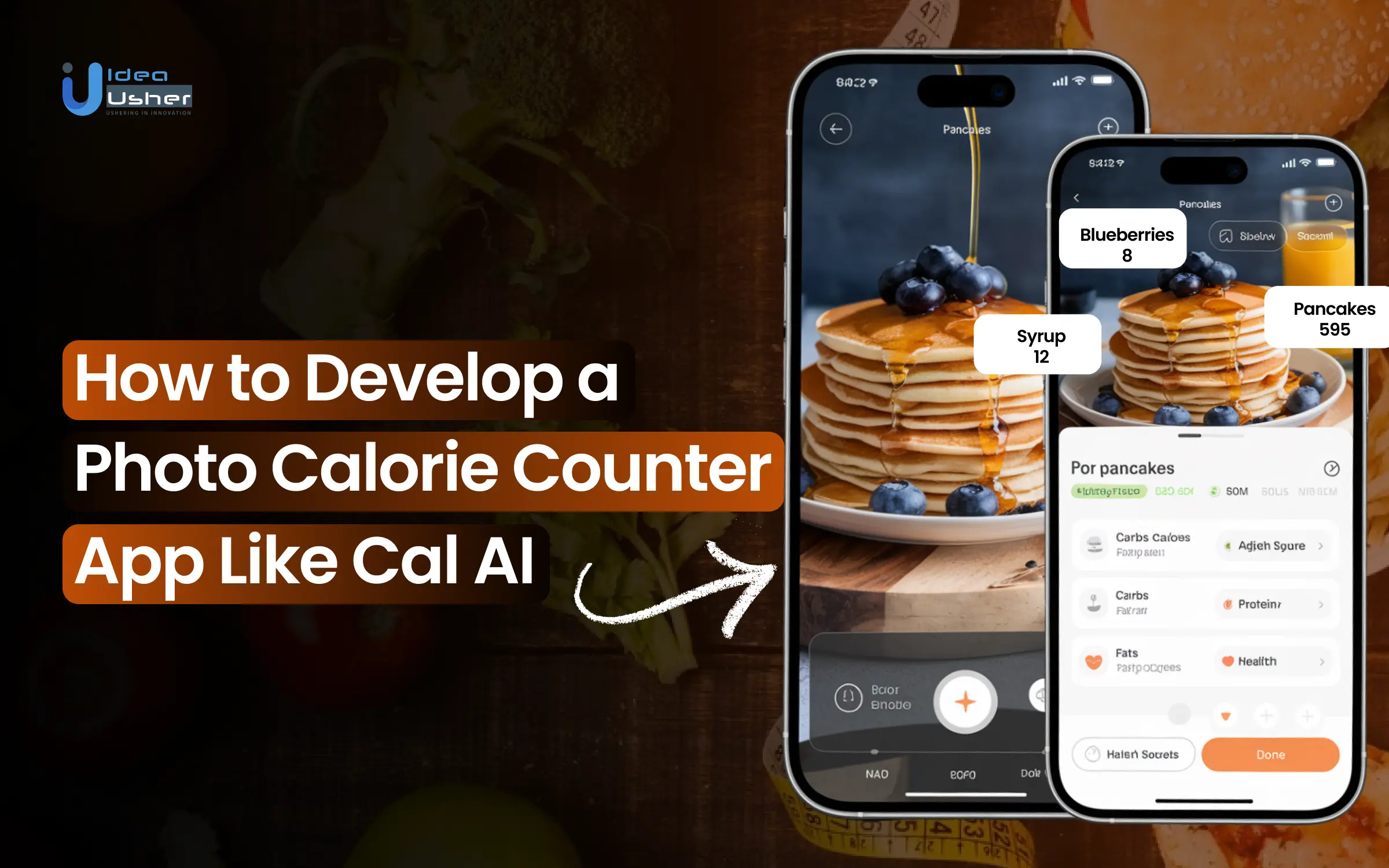
People want nutrition tracking to fit into their routine rather than become another chore. That is why photo calorie counter apps are changing how users log meals. Instead of searching for every food item, they can start with a photo and get a quick nutrition estimate. Cal AI’s Food Analysis API can analyze a meal image and return calories, servings, ingredients, and macronutrients. But the real challenge begins after the image is processed. A photo cannot always reveal the exact portion size or ingredients in a mixed dish. A better product should therefore make it easy for users to review and adjust the result. This can make the experience more practical and help users trust the app instead of treating every AI estimate as final.
Building this type of app goes beyond recognizing food in a photo. We’ve worked on photo calorie counting solutions that use computer vision and AI-based nutrition analysis to turn meal images into useful dietary insights. Cal AI follows a similar approach by analyzing food photos and estimating calories and macronutrients. This blog covers the key steps involved in developing a photo calorie counter app like Cal AI.
Why Is the Market for AI Nutrition Apps Growing?
According to Mordor Intelligence, the AI in personalized nutrition market is expected to grow from USD 1.66 billion in 2025 to USD 2.12 billion in 2026 and reach USD 7.35 billion by 2031 at a CAGR of 28.15% from 2026 to 2031. This growth shows how nutrition apps are moving beyond manual calorie tracking. Users now want faster logging and personalized insights without spending time entering every meal. This creates a strong opportunity for AI nutrition platforms that can make healthy eating easier and more engaging.

Source: Mordor Intelligence
Rising Demand for Personalized Nutrition
Generic diet plans often fail because they do not account for how differently people respond to food and activity. Users now expect nutrition apps to consider factors such as energy levels and lifestyle goals. AI can make this experience more useful by adjusting nutritional targets as user behavior changes. This level of personalization can also improve retention because the app feels more like an ongoing health companion than a simple food log.
SnapCalorie shows how this approach can work in practice. Founded by former Google AI researchers, the app uses computer vision to analyze meal photos and estimate portion sizes along with macro and micronutrients. Its photo-based experience helped SnapCalorie reach roughly $1 million in annual revenue without relying on venture capital.
Growing Focus on Fitness
The global focus on personal fitness and weight management continues to surge. Users track what they eat to complement workout routines, manage chronic conditions, or support medical weight management programs.
This behavior creates a lucrative market for platforms offering complete lifestyle tracking.
- Integrated Health Hubs: Platforms that sync nutrition logs with wearable metrics like heart rate and daily activity offer far more user value.
- Preventative Healthcare: Health-conscious users look to diet tracking to proactively lower their risk of metabolic disorders.
- Cross-Selling Potential: Strong engagement in diet tracking opens up natural upsells, including B2B corporate wellness programs, elite coaching features, and specialized meal plans.
AI Makes Nutrition Tracking Easier
Manual food logging can quickly become a chore. Users have to search for individual ingredients and enter portion sizes before they can even see their nutrition data. AI image recognition makes this process much easier by letting users take a photo and get a quick estimate. Computer vision can identify multiple foods in a meal and estimate portions. This reduces the effort needed to log meals and can help users stay consistent over time.
YAZIO is another example of how visual nutrition can work at scale. Its AI calorie tracking features let users scan food and receive an instant nutrient breakdown. By making meal logging faster, YAZIO has built a strong commercial model with roughly $4 million in monthly revenue. This shows why visual food tracking can be an attractive opportunity for founders building AI nutrition apps.

How Does Cal AI Turn Food Photos Into Nutrition Data?
Cal AI is an automated nutrition platform built to make diet tracking faster and easier. Instead of making users search food databases or enter portion sizes manually, it uses AI to analyze meal photos and provide key nutrition information. This helps users log meals with less effort while making daily tracking more convenient.
AI Identifies Foods and Estimates Portions
The core mechanics start when a user captures an image of their meal. Cal AI processes the visual input using advanced computer vision models to identify individual food items on the plate.
- Multi-Item Detection: The neural network separates distinct components within complex meals, such as isolating proteins, starches, and side sauces from a single picture.
- Volumetric Analysis: Beyond surface identification, the system integrates hardware capabilities by leveraging built-in phone depth sensors to estimate physical food volume.
- Contextual Adjustments: Machine learning algorithms evaluate lighting, angle, and distance to calculate spatial dimensions before passing the image data to the nutrition engine.
This frictionless utility has driven massive consumer adoption, helping the platform scale to over $35 million in annual revenue.
Food Images Become Calorie and Macro Data
Once objects and volume are mapped, the visual data is converted into actionable nutritional profiles using integrated database pipelines. The Cal AI Food Analysis API processes these steps in seconds. It bridges the gap between raw unstructured camera images and structured data, producing immediate breakdowns of calories, macronutrients, and key micronutrients without requiring manual entry.
| Extracted Parameter | Processing Method | Primary Output |
| Dish Identification | Object Recognition Networks | Individual Ingredients & Dishes |
| Volume & Scale | Depth Sensors + Pixel Density | Serving Sizes & Gram Weight |
| Nutritional Density | Verified API Mapping | Calories, Protein, Carbs, Fats |
Users Can Refine AI Nutrition Results
No computer vision system is completely accurate every time, particularly with hidden ingredients like butter or dense oil sauces.
- Manual Fine-Tuning: Users can adjust calculated portion sizes or manually add hidden ingredients using quick edit sliders.
- Feedback Loop: Corrections made by users feed back into the system, continually improving the platform’s vision models over time.
- Higher Data Accuracy: Combining computer vision automation with human review keeps logs precise while protecting the overall user experience.
Cal AI’s Food Analysis API: What Does It Offer?
Cal AI provides an API architecture that allows third-party platforms to integrate automated nutrition tracking without building machine learning vision models from scratch. Developers use this interface to add computer vision and natural language processing to fitness apps and health tools.

1. Analyze Food Photos for Data
The primary engine centers around the scanImage endpoint, which ingests raw food photographs and processes them using multi-modal AI models.
- Structured Payload Output: Returns broken-down JSON containing calculated calories, macro distributions, ingredients, and a macro-level health score.
- Volume Estimation Integrations: Ingests camera hardware depth data alongside RGB images to sharpen portion size metrics.
- Plug-and-Play Architecture: Functions as a dedicated computer vision backend, removing the need to train custom dataset models.
This backend capability powers Cal AI’s core application ecosystem, which charges end users around $2.99 per week, $9.99 per month, or $29.99 annually for full scanning access.
2. Turn Meal Descriptions Into Nutrition Insights
Not all users want to photograph their food. The describeMeal endpoint processes freeform text descriptions and translates them into identical structured nutritional data.
- Contextual Parsing: Parses natural language descriptions like two poached eggs on sourdough with avocado into exact ingredient quantities.
- Speed and Fallbacks: Operates rapidly when image capture is impractical, such as during multi-ingredient home cooking.
- Unified Data Models: Outputs identical data structures as image scans, keeping internal application state simple across different logging methods.
3. Add Food, Label, and Barcode Analysis
To cover edge cases where computer vision misses, the API features specialized endpoints for packaged foods. The API infrastructure relies on standard Bearer token authentication with metered rate limits. Usage-based API pricing scales based on request volume, operating alongside consumer plans ranging from $5.99 to $19.99 per month for unlimited access tiers depending on the deployment model.
| Endpoint | Target Input | Primary Use Case |
| Barcode Lookup | UPCA & EAN Codes | Pre-packaged retail items and snacks |
| Label Reader | OCR Photo Scans | Reading printed nutrition tables on boxes |
| Custom Matcher | Text Database Search | Manual search queries for regional foods |
Key Features of a Photo Calorie Counter App Like Cal AI
Building a competitive photo calorie tracking app means making meal logging fast without losing accuracy or flexibility. Cal AI sets a strong example by using image-based tracking as its core experience while offering other health and nutrition tools to support users. For new apps, the key is to make photo logging simple while giving users reliable options when AI needs additional input.

1. AI-Powered Food Photo Scanning
Cal AI puts image capture front and center. When a user opens the app, the camera interface activates immediately, allowing them to take a photo of their plate and view a complete breakdown of calories, protein, carbohydrates, and fats within seconds.
- Single-Tap Analysis: Users photograph complex home-cooked or restaurant meals without listing individual components manually.
- Nutritional Breakdown: Cal AI extracts macro and micro values, presenting them in a clean visual summary right above the original photo.
- Instant Feedback: Rapid image processing keeps users active during meal times when lengthy manual input typically leads to app abandonment.
2. Portion and Food Volume Estimation
Accurate calorie counting depends on portion accuracy. Cal AI solves this by integrating mobile hardware sensors with computer vision models to evaluate actual plate dimensions and depth. Users hold their device over their plate, and Cal AI uses built-in depth sensors to estimate spatial dimensions. This volumetric mapping determines whether a portion is 100 grams or 250 grams, significantly reducing the guesswork that undermines traditional logging apps.
3. Food Database and Barcode Scanning
Photo recognition can hit limits with packaged items or unidentifiable homemade soups. Cal AI handles this by providing a reliable search engine backed by a database of over one million verified foods. Users scanning a packaged protein bar simply align the barcode with the camera frame to pull up accurate nutritional panels instantly.
| Feature Channel | Primary User Action | Best Suited For |
| Barcode Scanner | Point camera at packaged UPC | Groceries, snacks, protein bars |
| Database Search | Type brand or food name | Custom restaurant meals and rare items |
| Manual Input | Enter custom calories/macros | Home recipes with exact weighed ingredients |
4. Personalized Calorie and Macro Goals
Showing raw numbers without context causes user confusion. Cal AI onboard users by gathering height, weight, activity levels, and specific target goals to calculate precise daily caloric and macronutrient baselines.
- Target Allocation: Cal AI sets individual daily goals for calories, protein, carbs, and fats based on weight loss or muscle gain targets.
- Dynamic Ring Gauges: The main dashboard uses real-time progress rings to show remaining calories and macronutrients throughout the day.
- Adaptive Recalculation: As users log weight changes over time, Cal AI adjusts these target numbers automatically.
5. AI Nutrition Suggestions
Beyond logging meals, users expect clear direction on how to optimize their diets. Cal AI turns historical meal data into practical nutritional feedback and visual progress graphs.
- Macro Coaching: Cal AI provides real-time meal suggestions, advising users on what macronutrients to prioritize for dinner based on earlier logs.
- Historical Trends: Users monitor their weight curves, average intake, and streak consistency over weekly and monthly views.
- Goal Milestones: Visual milestones celebrate logging streaks and body measurement changes, reinforcing daily app usage habits.
6. Water and Exercise Tracking
Cal AI brings meal tracking and daily wellness habits together in one place. Users can log their water intake and track physical activity without switching between different apps. The platform can also connect with fitness devices to capture steps and active calorie burn automatically. This makes it easier for users to understand their overall daily progress and adjust their calorie goals as their activity changes.
7. Meal Logging and Health Integrations
Cal AI gives users multiple ways to log meals based on what works best at the moment. They can use photos, text, voice, or barcodes instead of relying on one method. The app also connects with health platforms and wearable devices to keep nutrition and activity data in sync. This makes tracking more flexible while keeping users’ health information accessible across their devices.
How to Develop a Photo Calorie Counter App Like Cal AI?
Building an AI photo calorie counter app requires more than just adding image recognition. The platform needs a strong backend that can process food images and deliver reliable nutrition data quickly. A well-designed system also makes it easier to scale the app as user demand grows. The goal is to make meal tracking feel effortless while keeping results accurate across different foods and dining situations.
1. Meal Logging Workflow
The primary architecture must prioritize speed. A user opening the camera expects an immediate capture frame, automated processing, and a review screen within seconds.
- Capture Phase: Camera opens by default with immediate edge detection on the food plate.
- Processing Phase: Image payload hits the visual inference API while local caching handles offline state.
- Review Phase: Interactive card displays detected items, macro counts, and portion sliders for instant user verification.
- Save Phase: Confirmed values write to the daily transaction log and recalculate remaining macro allowances.
Designing barcode and text entries as native fallback channels alongside photo scanning ensures users never hit a wall when logging meals.
2. Food & Portion Engine
Portion estimation presents the toughest engineering challenge in photo-based tracking. Visual recognition identifies what is on the plate, but volumetric analysis determines how much is there. Modern setups combine convolutional neural networks for ingredient identification with device depth sensors or bounding-box reference algorithms. Measuring pixel density against depth data estimates physical volume, which converts to gram weights using predefined density models.
3. Nutrition Database Link
Relying entirely on a vision model to guess calorie numbers leads to broad hallucinations. High-performance platforms use AI strictly for identification, then query verified nutrition databases for actual macro values. This separation keeps nutritional calculations precise, verifiable, and compliant with health data standards.
| Layer | System Component | Primary Task |
| Vision AI | Custom ML / Vision API | Tags items like grilled chicken or brown rice |
| Mapping Engine | Vector Similarity Search | Matches visual tags to verified USDA / FDC items |
| Nutrition DB | USDA / Custom API | Fetches exact calorie, macro, and micro values |
4. Multi-Modal Logging
Image recognition faces limits with opaque soups, hidden cooking oils, or packaged goods. Building secondary entry channels ensures high daily engagement regardless of meal type.
- Barcode Engine: High-speed scanner fetching pre-packaged product data via global UPC/EAN databases.
- Natural Language Text: LLM parser turning phrases like “2 scrambled eggs with toast” into structured macros.
- Voice-to-Text: Audio logging channel converting spoken descriptions directly into daily log items.
5. Accuracy Feedback Loop
AI vision models can still make mistakes when analyzing complex meals. A good photo calorie tracking app should let users quickly correct inaccurate food items or portion sizes. These corrections can also help improve future model performance when anonymized data is reviewed and used for training. This balance between automation and user control can make nutrition tracking more reliable.
6. Goal Personalization
Raw numbers carry little value without contextual guidance. The application engine must calculate personal metabolic baselines and adjust them based on user progress over time.
- Dynamic BMR Calculation: Uses Mifflin-St Jeor equations based on user age, weight, height, and biological sex.
- Adaptive Macro Splits: Automatically redistributes protein, fat, and carb targets based on specific athletic or weight goals.
- Progress Engine: Adjusts daily calorie targets dynamically as body weight metrics change over weeks of logging.
7. Real-World Testing
Testing a photo calorie tracking app in real-world conditions is essential before launch. The AI should work reliably across different lighting and food presentation styles. It also needs to handle complex meals where ingredients overlap or are difficult to identify. Testing these edge cases early can improve accuracy and reduce user frustration after launch.
Cost to Develop a Photo Calorie Counter App Like Cal AI
Developing an AI-driven photo calorie counter app like Cal AI involves balancing mobile front-end design, backend data infrastructure, and custom artificial intelligence capabilities. Total investment ranges anywhere from an early MVP to a fully scalable enterprise health platform.
Development Cost by App Complexity
The budget for an AI nutrition tracking app scales based on feature depth, design customization, system scalability, and the geographic location of your development team. Investing in a mid-level build usually offers the best balance of speed and product quality for startups entering this space.
| Complexity Level | Key Core Capabilities Included | Typical Budget Range (USD) | Estimated Timeline |
| Minimum Viable Product (MVP) | Basic photo scan API integration, simple manual database search, user login, and standard daily macro dashboard. | $25,000 – $45,000 | 2 – 3 months |
| Medium Complexity App | Custom fine-tuned vision models, depth sensor portion estimation, barcode scanner, full health device sync, and progress charts. | $50,000 – $95,000 | 4 – 5 months |
| Enterprise Platform | Multi-modal AI (image, text, voice), continuous model training loops, custom B2B enterprise APIs, and dynamic coaching engine. | $100,000 – $220,000+ | 6 – 9 months |
AI Features That Drive Development Costs
Integrating computer vision and custom machine learning modules represents the largest single technical line item. The cost depends heavily on whether you build proprietary vision engines or use existing third-party nutrition APIs.
| AI Component | Technical Scope & Engineering Work | Estimated Build Cost (USD) |
| Computer Vision Engine | Object recognition pipeline, multi-item plate identification, and spatial segmentation models. | $15,000 – $35,000 |
| Volumetric & Depth Sensor Module | Integrating LiDAR/depth sensor APIs to map plate dimensions, volume, and gram weights. | $8,000 – $18,000 |
| Natural Language Meal Processor | Text parsing engine converts written meal inputs into structured macro breakdowns. | $6,000 – $12,000 |
| Feedback & Retraining Pipeline | Data collection infrastructure capturing user portion edits to continuously fine-tune image models. | $10,000 – $22,000 |
Costs for AI, APIs, and Cloud Infrastructure
Launching the application is only the first capital requirement. Operational costs increase as user volume scales across vision model processing and server infrastructure.
- Vision API and LLM Inference: Expect to pay roughly $0.005 to $0.02 per processed image scan. At 100,000 active daily meal scans, server infrastructure and vision API charges average $1,500 to $4,500 per month.
- Nutrition Database Licensing: Licensing verified global databases like USDA, Nutritionix, or FatSecret costs anywhere from $300 to $2,500 monthly based on request volumes.
- Cloud Infrastructure and Storage: Hosting high-resolution food images, processing pipelines, and user database backups on AWS or GCP runs roughly $800 to $3,000 per month for a scaling user base.
- App Maintenance and Security: Routine app updates, OS compliance, security patches, and server monitoring typically require 15% to 20% of your initial development cost annually.
Why Cal AI’s Acquisition Validates AI-Native Nutrition Tracking?
MyFitnessPal’s acquisition of Cal AI shows how quickly nutrition tracking is moving toward AI-powered experiences. Photo-based logging is becoming more than a convenient feature. It can help established platforms reduce the effort of meal tracking and keep users engaged. For founders, this signals that visual nutrition could play a bigger role in the future of digital wellness.
1. Strategic AI Acquisition
MyFitnessPal dominates the health category with over 200 million registered users and a database containing 20 million verified food items. Manual database searches create high user fatigue, leading to drop-offs after a few weeks.
- Buying vs Building: Instead of spending years building computer vision internally, MyFitnessPal acquired Cal AI to instantly upgrade its UX pipeline.
- Database Synergy: The acquisition connects Cal AI’s visual recognition models directly to MyFitnessPal’s global database of 68,500 brands and 380+ restaurant chains.
- Defending Market Share: Legacy platforms face severe churn as younger demographics shift toward zero-friction, camera-first applications.
2. Rapid Traction Signals Demand
Cal AI’s performance numbers show a massive market appetite for automated diet tracking. Bootstrapped without VC funding, the platform scaled at unprecedented speed. This rapid monetization proves that modern consumers are willing to pay upfront subscription costs for tools that strip time out of daily health logging.
| Growth Metric | Performance Indicator |
| Annualized Revenue | Bootstrapped from $0 to over $40 million in annual run rate. |
| Initial Traction | Crossed $1 million in revenue within four months of launch. |
| User Downloads | Surpassed 15 million downloads in under two years. |
| Team Efficiency | Scaled to tens of millions in revenue with a lean 7-person team. |
3. AI-Native Market Dominance
Building an app natively around AI capabilities creates a completely different user experience than retrofitting AI onto an existing platform.
- Lower Friction: Camera-first interfaces reduce meal logging time from minutes to three seconds.
- Unlocking Gen Z: Younger users demand fast visual tools over text-heavy databases and complex drop-down menus.
- High ROI for Founders: Cal AI achieved an enterprise-level acquisition with minimal initial marketing spend, proving that product-led visual features organically lower customer acquisition costs.
This acquisition confirms that the digital health market is shifting toward automated, image-first platforms. Investors and developers entering this space now have a proven playbook and a clear exit strategy.
Build a Photo Calorie Counter App with IdeaUsher
IdeaUsher helps founders turn complex health app ideas into market-ready products. With 500,000+ hours of coding experience and a team of ex-MAANG/FAANG developers, we build AI-powered platforms that combine computer vision with reliable mobile technology. Our focus is on creating photo-based nutrition apps that are easy to use and ready to scale.
AI Food Recognition and Nutrition Intelligence
Building a photo-first nutrition platform requires an intelligent visual processing pipeline that eliminates manual logging friction. Our engineering team builds computer vision architectures capable of analyzing complex plates in real time.
- Visual Segmentation: Neural networks isolate separate dishes, side items, and hidden sauces from a single captured photo.
- Spatial Volume Mapping: Integrates mobile depth sensors and spatial geometry algorithms to convert 2D images into volumetric dimensions and gram weights.
- Verified Database Pipeline: Connects computer vision tags directly to global food databases like USDA and Nutritionix to yield precise macro counts.
- Multi-Modal Logging Fallbacks: Integrates high-speed barcode scanning, OCR label readers, and natural language text processors so users can log meals anywhere.
Scalable Health and Fitness App Architecture
Health platforms face heavy traffic spikes during breakfast, lunch, and dinner peak hours. IdeaUsher designs secure cloud infrastructure built to handle high-frequency image scans without sacrificing speed or performance.
| Infrastructure Layer | Technology & Frameworks Used | Operational Focus |
| Mobile Front-End | Flutter / React Native / Native Swift & Kotlin | Smooth camera controls, sub-second latency, and responsive UI |
| Cloud AI Services | AWS Bedrock / GCP Vertex AI / PyTorch | High-throughput image recognition and serverless inference scaling |
| Data & Security | PostgreSQL / Redis / HIPAA & GDPR Compliant Vaults | Secure user data storage, offline sync, and encrypted payload routing |
End-to-End Development
Partnering with IdeaUsher gives founders a structured path from early concept validation to full enterprise scale. Our team covers every engineering phase to ensure your platform launches reliably and attracts venture capital or acquisition interest.
- Product Strategy & Design: UX design focused on sub-three-second meal captures to drive high initial user retention.
- Agile MVP Delivery: Launch a functional MVP within 8 to 12 weeks to capture early adopters and test monetization channels.
- Continuous ML Optimization: Implement feedback loops where the user portion edits retrain vision models over time.
- Post-Launch Support: Continuous performance monitoring, API updates, and feature scaling as your monthly active user base expands.
Conclusion
Building a photo calorie counter app like Cal AI is an opportunity to make nutrition tracking faster and more convenient. The key is to combine accurate AI image analysis with a simple user experience that makes daily logging easy. With the right technology and development strategy, founders can create a scalable nutrition platform that users return to every day.
Things to Know About Photo Calorie Counter Apps
A1: Photo calorie apps can provide useful estimates but they should not be treated as exact calorie calculators. Accuracy depends on how well the app recognizes the food and judges its portion. Simple foods are usually easier to analyze than complex meals. For a better user experience, the app should make it easy to review and adjust the result.
A2: Yes. AI can recognize food from an image and use that information to estimate its nutritional value. The more difficult part is determining how much food is actually present. Portion estimation remains one of the biggest challenges in photo-based nutrition tracking. Adding user adjustments can help improve the final calorie estimate.
A3: They can recognize many homemade meals, but accuracy can drop when a recipe contains several ingredients. Foods such as curries and stir-fries may look simple in a photo even though their calorie content depends on ingredients that are not visible. Supporting different cuisines also requires a broader food database.
A4: Mixed dishes are one of the harder problems for photo-based nutrition tracking. AI may recognize the main food but miss ingredients hidden inside the meal. Research has found that mixed and culturally diverse dishes can create additional challenges for food recognition systems. A good product should give users a quick way to correct missing foods or ingredients


