


Key Takeaways
- Growing demand for AI calorie scanner apps is transforming nutrition tracking by replacing manual meal logging with instant AI-powered food recognition.
- Platforms like CalFix combine computer vision, personalized nutrition insights, AI coaching, and wearable integrations to improve user engagement and long-term health outcomes.
- Advanced features such as photo-based food recognition, adaptive calorie goals, barcode scanning, and micronutrient tracking create a smarter nutrition experience.
- Scalable AI nutrition platforms rely on cloud-native infrastructure, multimodal AI, secure health data management, and continuous model learning to improve accuracy over time.
- How Idea Usher can help businesses build AI calorie scanner apps with computer vision, multimodal AI, wearable integrations, and scalable cloud architecture.
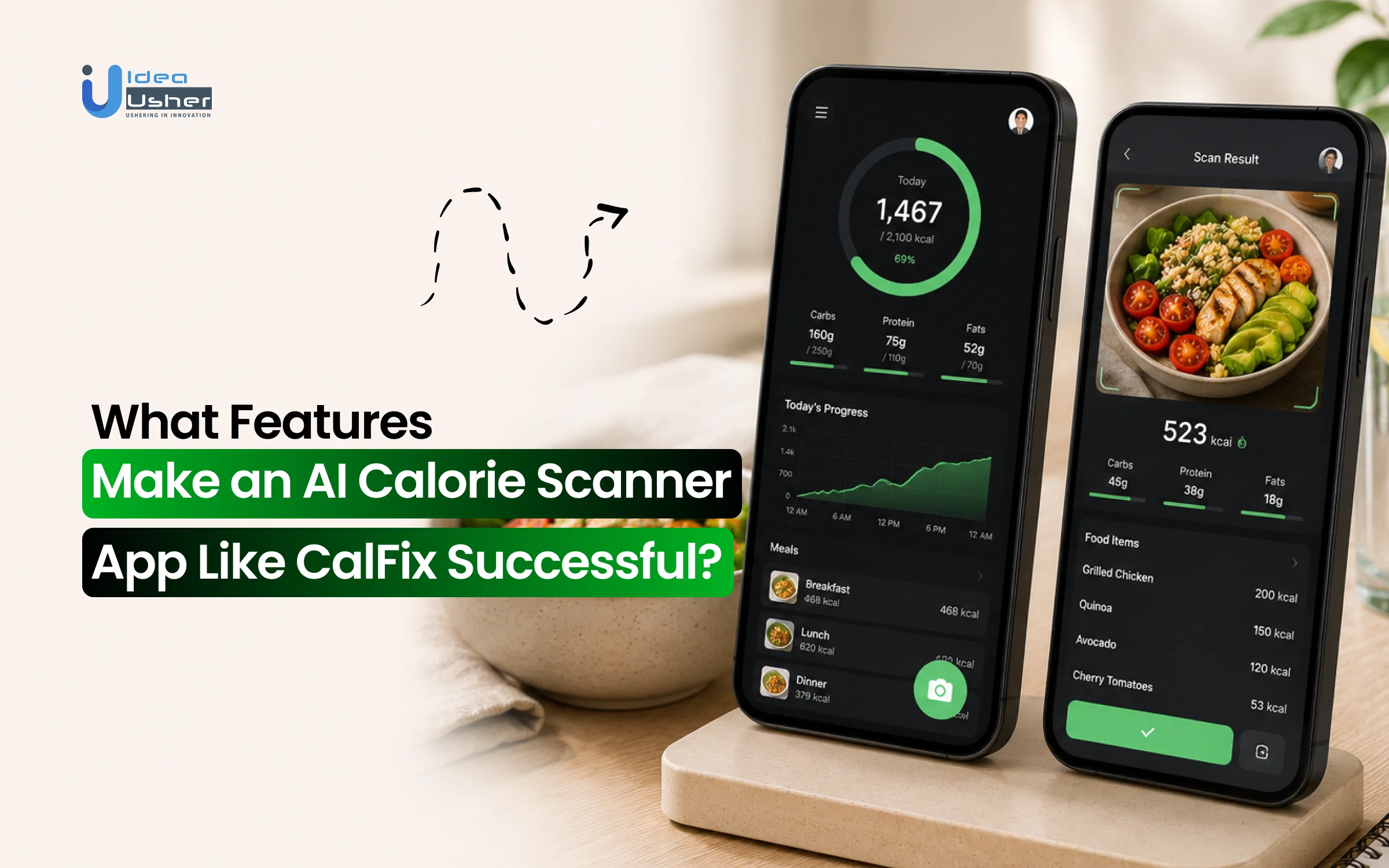
People no longer want nutrition apps that simply record what they eat. They expect tools that understand their meals, offer useful guidance, and make healthy choices easier every day. That’s why AI calorie scanner apps like CalFix are seeing rapid adoption. With a quick photo, users get instant nutritional insights instead of spending time searching food databases. For founders, the real opportunity isn’t just building food recognition. It’s creating an intelligent experience that learns from users over time and keeps them engaged long after the first scan.
Over the years, we’ve developed several AI calorie scanning solutions that combine advanced computer vision with multimodal AI models to recognize food and estimate nutrition. As we’ve built this expertise at Idea Usher, this blog explores the key features that make an AI calorie scanner app like CalFix successful and the technologies behind its user experience.
Market Size of AI Nutrition and Digital Health Apps
According to Grand View Research, the AI-powered personalized nutrition market was worth USD 1.5 billion in 2025 and is projected to reach USD 10.2 billion by 2033, growing at a 27.2% CAGR. This strong growth shows that consumers are increasingly choosing smarter nutrition apps that provide personalized guidance instead of basic calorie tracking. For businesses, it signals a rapidly expanding market where AI-driven food recognition, health insights, and tailored recommendations are becoming key features that users expect.
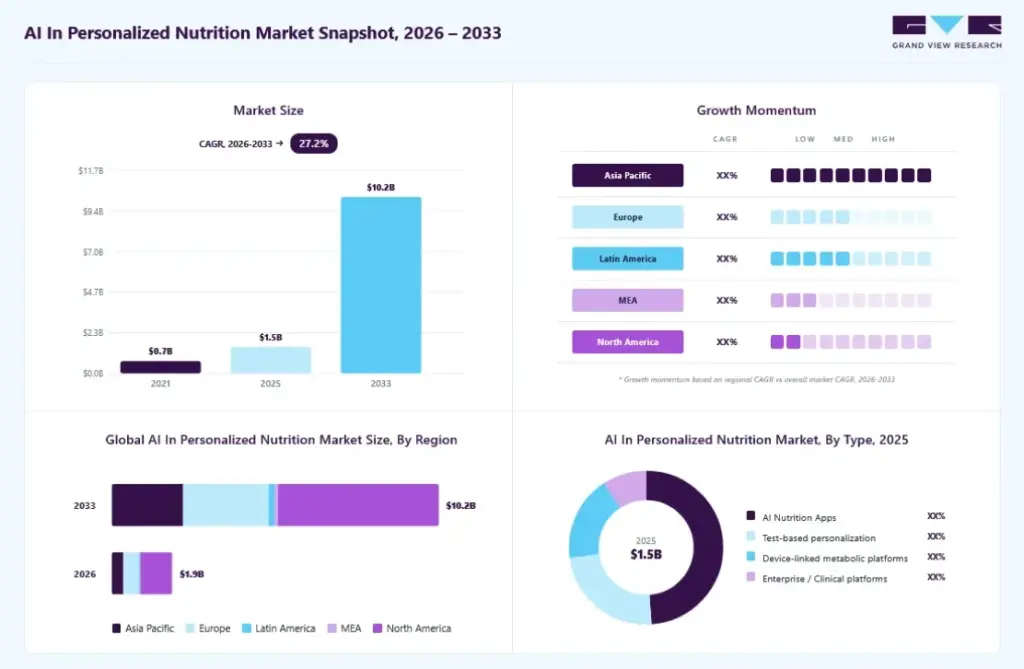
Source: Grand View Research
Legacy players like MyFitnessPal demonstrate the massive financial upside available in this space. By successfully transitioning from a basic digital logbook to an ecosystem incorporating automated premium features, the platform scaled its annual revenue to over $310 million.
This sustained growth trajectory represents a highly lucrative opportunity for institutional investors and tech founders. The traditional approach to dieting—static calorie counting and rigid, pre-filled meal plans, is failing to retain users. In its place, platforms leveraging machine learning to offer dynamic, real-time dietary adjustments are capturing market share.
Digital Health Drivers
The growing popularity of AI nutrition apps is being fueled by the rise of connected health devices such as smartwatches and fitness trackers. Instead of simply collecting health data, these platforms use AI to turn it into practical nutrition advice based on a user’s activity, sleep, and daily habits. This creates a more personalized experience that encourages long-term engagement and healthier lifestyle choices.
The business potential is equally compelling. Noom, for example, expanded beyond calorie tracking by adding behavioral coaching and AI-driven guidance, helping it reach an annualized revenue run rate of around USD 1 billion. As preventive healthcare becomes a priority for healthcare providers and employers, AI-powered nutrition platforms that connect with wearable devices are expected to see continued adoption and sustained growth.
Why Investors Back AI Nutrition
Investors are showing strong interest in AI-powered nutrition apps because they combine recurring subscription revenue with highly scalable business models. Features like AI food recognition and personalized recommendations keep users engaged for longer, while partnerships with employers and wellness programs create additional growth opportunities. As computer vision removes the hassle of manually logging meals, these apps deliver a smoother user experience that improves retention and makes the business more attractive for long-term investment.

How Does CalFix Make Nutrition Tracking Effortless?
CalFix is an AI-powered nutrition app that makes calorie tracking much easier by replacing manual food logging with AI image recognition. Instead of searching for ingredients or entering meals one by one, users simply take a photo of their food to receive instant calorie and nutrition estimates. This faster, more convenient experience reduces the effort required to track meals, helping users stay consistent while making the app more engaging over the long term.
1. Solving Manual Logging Pain
Traditional calorie tracking often feels like a chore. Users have to estimate portion sizes, search for ingredients, and manually log every meal, making the process slow and frustrating. Because it takes so much effort, many people stop using nutrition apps after only a few weeks, limiting their ability to build lasting healthy habits.
CalFix removes this friction by letting users log meals with a simple food photo instead of manual entries. The AI quickly identifies foods and estimates their nutritional value, making tracking faster and more accurate. The platform has also attracted USD 1.5 million in pre-seed and seed funding, highlighting investor confidence in its AI-powered approach and long-term growth potential.
2. Simple AI Automation
The core value proposition of CalFix lies in its backend intelligence. When a user uploads a photo, the computer vision engine does not just guess the meal name. It actively isolates individual ingredients on the plate, estimates portion thickness, and runs the data through localized nutritional models. Within seconds, the software generates a precise breakdown of total calories, proteins, carbohydrates, and fats.
Automated Log Sequence:
- Capture: User takes a single photo of their plate.
- Breakdown: Computer vision isolates components and estimates weights.
- Sync: Real-time macronutrient and calorie data updates the dashboard.
By making meal tracking as simple as taking a photo, CalFix helps users stay consistent whether they’re eating at home, dining out, or enjoying complex dishes. The AI removes much of the guesswork, making nutrition tracking faster and more practical for everyday use.
This user-friendly experience has supported the platform’s growth, with a projected annualized revenue run rate of USD 2.4 million, driven by premium subscriptions, personalized coaching, and advanced nutrition features.
3. Habit Building via Smart Data
Long-term health outcomes depend on consistency, not short-term restriction. Most legacy applications fail because they act as passive ledgers rather than active health partners. CalFix uses its data pipeline to shift from retroactive tracking to proactive habit formation. The platform analyzes ongoing logging patterns to adapt calorie targets, suggest macro balances, and generate automated meal plans tailored to real performance.
- Adaptive Calorie Targets: Goals shift dynamically based on real-world weight trends and activity logging.
- Smart Meal Swaps: Machine learning offers instant, hyper-personalized recipe alternatives to balance daily macros.
- Predictive Insights: The software flags recurring dietary bottlenecks before they lead to consistency failures.
How AI Food Recognition Works Inside CalFix?
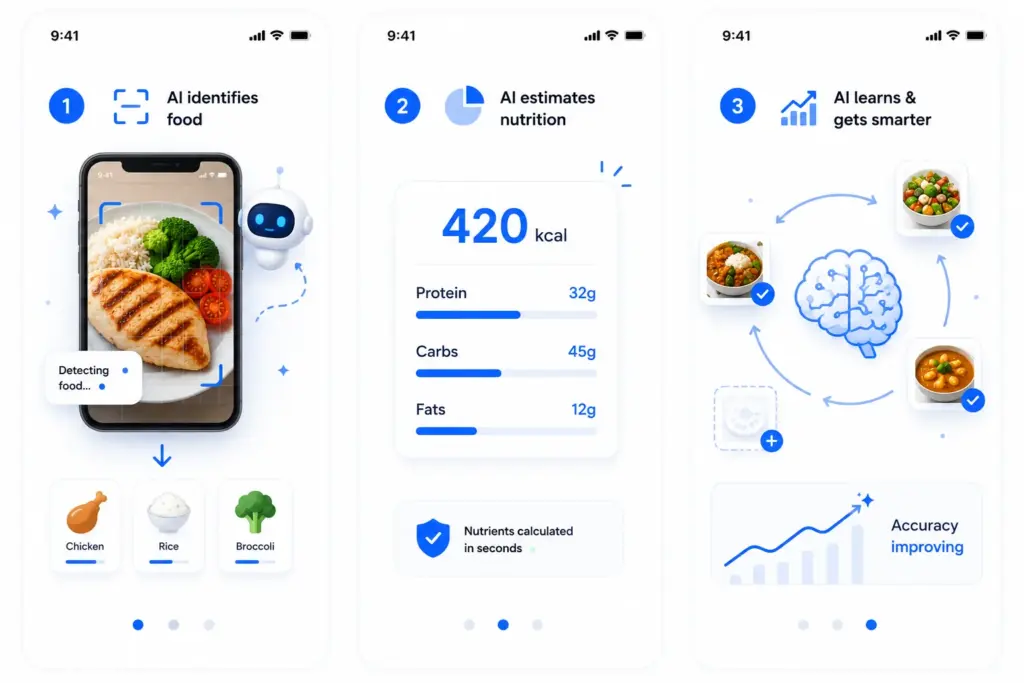
CalFix uses AI-powered image recognition to analyze food directly from a smartphone photo, eliminating the need for manual meal entries. The system identifies different foods, estimates portion sizes, and calculates nutritional information within seconds. This fast, automated process makes calorie tracking more accurate, convenient, and accessible for users who want an easier way to monitor their diet.
1. Computer Vision Identifies Food
The identification process begins the moment a user captures a photo. The image is instantly routed to a cloud-based deep learning framework optimized for food geometry. Rather than treating a plate as a single object, the neural network segments the image into distinct visual regions, mapping out individual ingredients, textures, color gradients, and shapes.
This structural analysis allows the app to recognize subtle differences between highly similar dishes, such as distinguishing grilled chicken breast from a breaded cutlet. The system processes these visual elements simultaneously, cross-referencing them against an extensive image library to establish a high-confidence identification index before passing the data to the nutritional calculation layer.
2. AI Estimates Nutrition Values
After identifying the food in a photo, CalFix estimates portion sizes and matches the meal with trusted nutrition databases to calculate calories and key nutrients. The entire process takes just a few seconds, giving users an instant breakdown of protein, carbohydrates, fats, and other nutritional values without requiring manual measurements or food labels.
The platform also offers premium services for users and businesses. Its Pro plan starts at USD 14.99 per month for advanced nutrition insights, while the Enterprise API is priced at USD 199 per month for corporate wellness integrations. These subscription options create recurring revenue while making the platform useful for both individual consumers and organizations.
3. Continuous Learning Improves Accuracy
The true competitive advantage of CalFix lies in its self-improving machine learning feedback loop. A primary challenge in food recognition is handling non-standardized items, local cuisines, and complex mixed dishes like stews or salads. To solve this, the platform utilizes reinforcement learning driven directly by user interactions.
- User Corrections: When a user modifies a logged item, the system notes the variance to adjust future algorithmic confidence scoring.
- Global Dataset Scaling: Every verified image increases the model training pool, naturally refining recognition parameters.
- Edge-Case Optimization: Continuous retraining allows the neural networks to master highly complex, multi-ingredient regional dishes.
This iterative learning model creates a powerful network effect. As the user base expands and inputs more diverse culinary data, the accuracy of the platform increases exponentially. This decreasing error rate reduces user friction over time, cementing the platform’s position as a premium asset with an expanding technological moat that is highly difficult for competitors to replicate.
Key Features for AI Calorie Scanner App Like CalFix
CalFix is designed to make nutrition tracking simple rather than time-consuming. By combining AI-powered meal recognition with personalized health insights, it helps users understand their eating habits without the hassle of manual logging. The easier the experience becomes, the more likely users are to stay consistent, making personalization and convenience key factors behind the platform’s long-term engagement and business growth.
1. AI Food Recognition From Photos
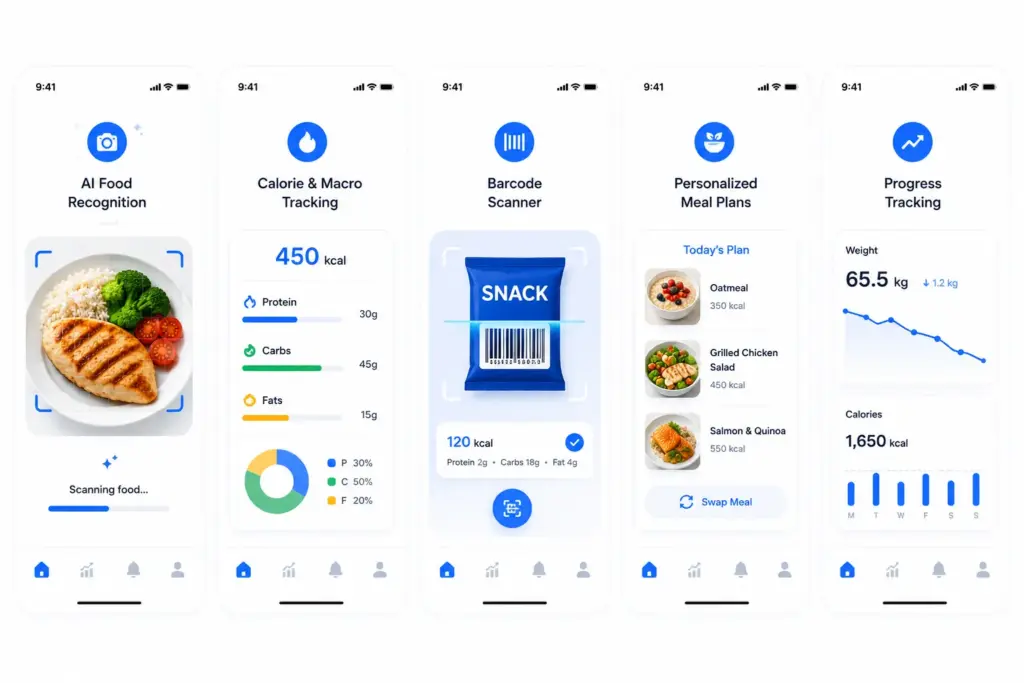
The core user experience of CalFix centers on the visual logging interface. Users open the application, activate the camera, and capture an image of their meal. The backend computer vision models immediately analyze the frame to identify specific food components and calculate volumetric dimensions. This feature removes the cognitive load of dieting. Instead of breaking down a complex recipe or guessing raw ingredient weights, individuals rely on the software to handle the entire identification process instantly.
2. Instant Calorie and Macro Tracking
Once the visual data is captured, CalFix instantly populates the user dashboard with a precise nutritional breakdown. The app translates the visual components of a meal into clear numbers, showing total calories alongside macro distributions.
- Effortless Logging: Eliminates the need to search through endless text databases.
- Instant Calculation: Displays precise counts for protein, carbs, and fats in real time.
- Frictionless Workflow: Keeps individuals accountable without interrupting their day.
This immediate feedback loop helps users make informed dietary choices on the fly. By turning nutritional data into a seamless part of the daily routine, CalFix ensures high daily active user metrics.
3. Free Barcode Scanner
For packaged goods and grocery items, CalFix provides a high-speed barcode scanner. Users position their smartphone camera over a product barcode to instantly cross-reference it with a massive database of verified consumer goods. This feature ensures that CalFix remains highly functional across all eating scenarios. Whether a user is dining at a restaurant or grabbing a quick snack from a convenience store, the application captures accurate data with minimal effort.
4. Personalized AI Meal Plans
CalFix goes beyond simple tracking by offering dynamic, AI-generated meal plans that adapt to individual preferences and specific fitness milestones. Users set their primary health objectives, and the software builds a customized dietary roadmap.
- Dynamic Swapping: If a user dislikes a specific recommendation, they can swipe to replace it with an equivalent macro-matched alternative.
- Dietary Flexibility: Plans automatically adjust for keto, vegan, gluten-free, or high-protein preferences.
- Smart Ingredient Lists: The app compiles consolidated grocery lists based on the selected meal plan to simplify shopping.
This level of personalization turns the software into an active wellness partner. It bridges the gap between intent and execution, driving higher retention among premium tier subscribers.
5. Progress Tracking
An interactive dashboard within CalFix aggregates weight fluctuations, exercise logs, and daily caloric intake into centralized visual trends. Users connect their fitness wearables to automatically sync activity data alongside their nutritional tracking. This comprehensive view helps individuals visualize how their dietary choices directly impact their physical progress. For entrepreneurs, this dashboard acts as the primary hook that keeps users returning to the app week after week.
6. Advanced Micronutrient Insights
For advanced fitness enthusiasts and health-conscious professionals, CalFix offers deep visibility into vitamin and mineral consumption. This premium layer tracks micronutrient profiles to reveal hidden nutritional deficiencies.
- Deficiency Flags: Alerts users when their weekly vitamin or mineral intake falls below recommended targets.
- Optimization Tips: Suggests specific foods to naturally boost micronutrient levels.
- Holistic Health Focus: Shifts the conversation from simple weight loss to total body vitality.
This deep technical layer enhances the platform value, giving users a clear reason to upgrade to higher-priced subscription tiers.
7. Smart Nutrition Coach
The digital health experience is rounded out by an interactive AI coach that analyzes long-term behavior patterns. Instead of delivering static alerts, CalFix provides context-aware guidance tailored to individual habits. This conversational intelligence adapts goals based on real-world progress. If weight loss stalls or muscle mass increases, the AI coach recalibrates daily caloric targets automatically, ensuring the user always has a clear, optimal path forward.
Advanced Features That Can Improve an AI Calorie Scanner App
Leading AI nutrition apps succeed because they solve real user problems instead of simply adding more features. People want faster meal tracking, personalized insights, and guidance that helps them make better decisions every day. For founders, the opportunity lies in building an app that combines AI, automation, and a smooth user experience to keep people engaged over the long term.
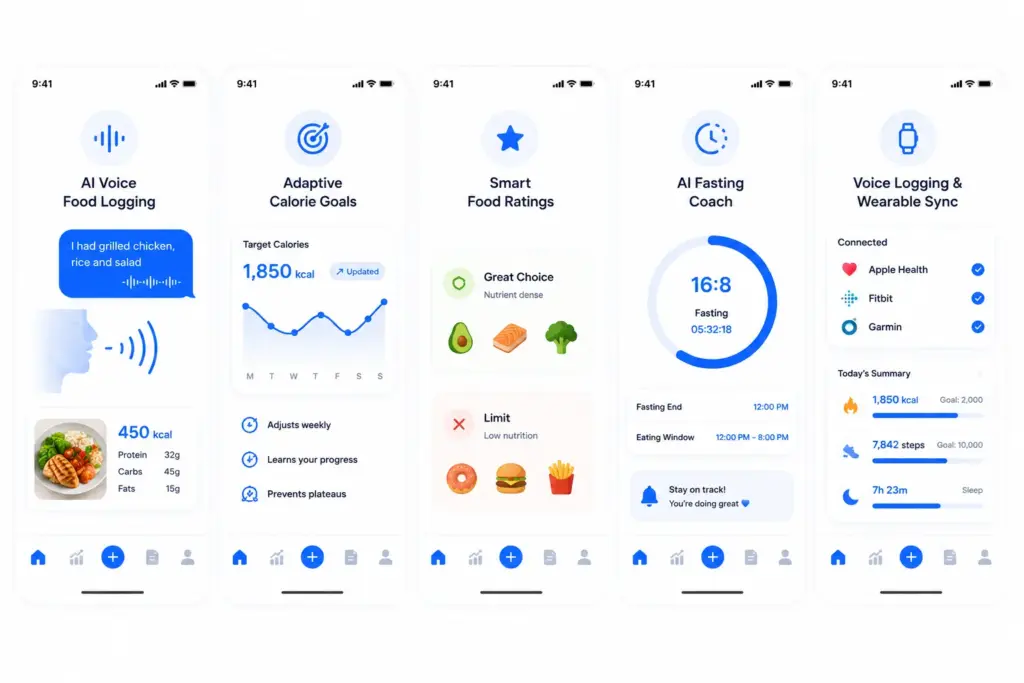
1. AI Voice Food Logging
Voice interaction represents the next frontier in frictionless data entry. Platforms like SnapCalorie allow users to simply speak to the app, describing a complex meal naturally without touching a keyboard. The backend artificial intelligence parses the natural language audio, pulls individual ingredients, and estimates portion sizes instantly.
This feature drastically lowers user drop-off. By transforming an administrative chore into a simple five-second spoken sentence, the application secures a highly engaged user base that logs meals consistently.
2. Adaptive Calorie Goals
Static mathematical formulas often fail because human metabolisms are highly dynamic. MacroFactor solves this by continuously adapting user targets based on real-world data rather than static baseline metrics. The platform monitors daily weight trends alongside actual caloric intake to calculate a personalized metabolic rate.
- Dynamic Calibration: Adjusts nutritional targets weekly based on actual fat loss or muscle gain.
- Adherence Independence: The algorithm continues to function accurately even if a user forgets to log a meal perfectly.
- Proactive Adjustments: Prevents weight loss plateaus by shifting macro allocations ahead of time.
This responsive environment builds immense trust. When investors analyze customer retention metrics, platforms utilizing adaptive logic consistently outperform traditional apps because the software adjusts to the user instead of demanding rigid compliance.
3. Smart Food Ratings
Focusing strictly on calories can lead to poor nutritional choices. Lifesum addresses this by grading foods and meals with intuitive health scores. This system guides consumers toward nutrient-dense options rather than just low-calorie alternatives. This visual framework simplifies healthy eating for the everyday consumer. It turns abstract nutritional data into clear, actionable dietary choices, making the platform a highly effective lifestyle companion.
| Category | Details |
| High Score Foods | Whole foods, lean proteins, fruits, vegetables, and complex carbohydrates |
| Low Score Foods | Ultra-processed foods, items high in saturated fats, and added sugars |
| User Impact | Encourages healthier eating habits by guiding users toward more nutritious food choices and supporting overall wellness |
4. AI Fasting Coach
Intermittent fasting has shifted from a fitness trend into a mainstream health standard. YAZIO capitalizes on this by blending traditional calorie tracking with adaptive fasting modules. The app coordinates eating windows and sends timely behavioral reminders to maximize metabolic health.
- Unified Dashboards: Tracks fasting windows and macronutrients in a single interface.
- Smart Reminders: Notifies users exactly when their fasting periods begin and end.
- Custom Protocols: Adapts to popular fasting methods like 16:8 or 5:2 effortlessly.
Integrating structural fasting tools expands an application’s addressable market. It attracts a highly active demographic looking for a single software solution to manage both meal composition and timing.
5. Voice Logging and Wearable Sync
A nutrition platform cannot exist in a vacuum. Industry leaders like MyFitnessPal maintain dominance by combining voice-enabled logging with deep hardware integrations across major wearable ecosystems. The application imports activity and vital metrics directly from Apple Health, Garmin, and Fitbit to paint a complete picture of user health.
This deep integration turns the app into the primary software hub for a user’s entire fitness journey. By centralizing biometric inputs and nutritional data, the platform secures high user switching costs.
6. Deep Micronutrient Analysis
Advanced fitness enthusiasts, athletes, and clinical users require deep technical depth. Cronometer caters to this market by tracking dozens of specific vitamins, minerals, and amino acids alongside standard macro metrics. This deep visibility helps users identify hidden nutritional gaps before they impact physical performance.
- Micronutrient Dashboards: Displays granular data for crucial health metrics like iron, calcium, and vitamin D.
- Clinical Appeal: Attracts dietitians, doctors, and elite athletes who require exact precision.
- Dietary Integrity: Verifies the quality of foods consumed, ensuring a balanced internal profile.
This specialized tracking opens highly profitable sub-niches. For founders, offering this level of diagnostic depth justifies premium subscription pricing and drives a strong competitive advantage.
7. Personalized Behavior Coaching
Sustained wellness requires a shift in consumer mindset. Lose It! excels by deploying personalized weight-loss plans backed by behavioral science. The app studies logging habits over time to highlight personal triggers, such as identifying when a user typically experiences cravings or skips meals.
This psychological approach creates lasting habit changes. It moves the software beyond a simple calorie log, turning it into a proactive coach that helps users build long-term lifestyle consistency.
Features That Can Impact the Cost of an AI Calorie Scanner App
Allocating capital for a digital health product requires a deep understanding of technical cost drivers. Building an AI-powered calorie scanner involves balancing frontier technology with standard app architecture. The complexity of your chosen feature set dictates your upfront development budget, cloud infrastructure costs, and long-term engineering overhead.
1. Computer Vision Complexity
The sophistication of your computer vision engine is the single largest variable in your product budget. Basic image classification can detect simple items like an apple or an egg relatively cheaply. However, a premium platform requires mixed-dish analysis, ingredient isolation, and volumetric portion estimation.
AI Infrastructure Cost Factors:
- Custom Dataset Curation: Gathering and labeling thousands of diverse food images
- Neural Network Training: Running complex deep learning models on specialized hardware
- Real-Time Processing: Implementing GPU-powered cloud nodes for low-latency results
Engineering a system that accurately measures the depth of a plate to calculate food weight requires specialized machine learning talent. While this increases initial capital expenditures, it establishes a powerful intellectual property moat that differentiates your platform from low-tier market competitors.
2. Intelligent Nutrition Features
Moving beyond basic logging into dynamic personalization introduces additional layer-by-layer costs. Features like adaptive metabolic tracking, micronutrient tracking, and conversational coaching engines cannot rely on simple static code. They require sophisticated recommendation engines that continuously parse user behavior.
- Data Pipeling: Sourcing and licensing verified global nutrition databases to feed the AI.
- Biometric Integrations: Building secure data pipelines for real-time fitness wearable syncing.
- Behavioral Machine Learning: Developing algorithms that spot user habits and output custom advice.
These features demand rigorous quality assurance and data engineering. Because they directly impact user health advice, the software must be built to high logical standards, which extends development timelines and requires experienced backend developers.
3. Cloud Infrastructure & Scale
Your backend architecture dictates how smoothly your platform handles growth. A high-retention app requires a responsive, low-latency cloud setup to manage thousands of concurrent users uploading photos simultaneously.
Core Backend Architecture Requirements:
- Media Pipelines: Fast image compression and secure cloud storage solutions.
- API Management: Handling data flow from barcode lookup services and wearable ecosystems.
- User Data Security: Maintaining strict data privacy standards for personal health information.
Investing in a robust, scalable infrastructure from day one prevents performance drops as your user base grows. While a modular backend increases the initial launch budget, it minimizes long-term technical debt and avoids expensive emergency rewrites down the road.
4. Feature Cost Breakdown
The following projections detail the estimated capital allocation required to build, test, and launch each core feature set for an enterprise-grade AI nutrition application.
| App Feature Set | Functional Components | Estimated Cost |
| Advanced Computer Vision | Multi-object food detection, ingredient recognition, portion estimation | $55,000 |
| Adaptive Personalization | Intelligent nutrition tracking, automated meal plans, adaptive calorie goals | $40,000 |
| Integrations & Wearables | Syncing with Apple Health, Fitbit, Garmin, and live barcode scanning APIs | $30,000 |
| AI Conversational Coach | Natural language processing for voice food logging and behavioral feedback | $35,000 |
| Scalable Cloud Architecture | GPU-powered hosting, real-time photo processing pipelines, database syncing | $45,000 |
| Cross-Platform Mobile UI | Main user dashboard, interactive analytics charts, user profile portals | $35,000 |
| Security & Compliance | Health data encryption, secure user authentication, QA system testing | $20,000 |
Total Project Estimate: Developing this complete feature matrix into a market-ready platform requires a total estimated capital deployment of $260,000. Final engineering costs will fluctuate based on the geographic location of your development team and your choice of underlying cloud infrastructure providers.
Why Investors Are Betting on AI Nutrition Startups?
.The shifting dynamics of consumer technology have placed digital health at the absolute forefront of venture capital interest. Institutional investors are aggressively deploying capital into machine learning platforms that target metabolic health. By replacing obsolete manual inputs with automated user experiences, these emerging startups are demonstrating that consumer software can still capture massive market share and unlock highly profitable exit opportunities.
Personalized Nutrition Momentum
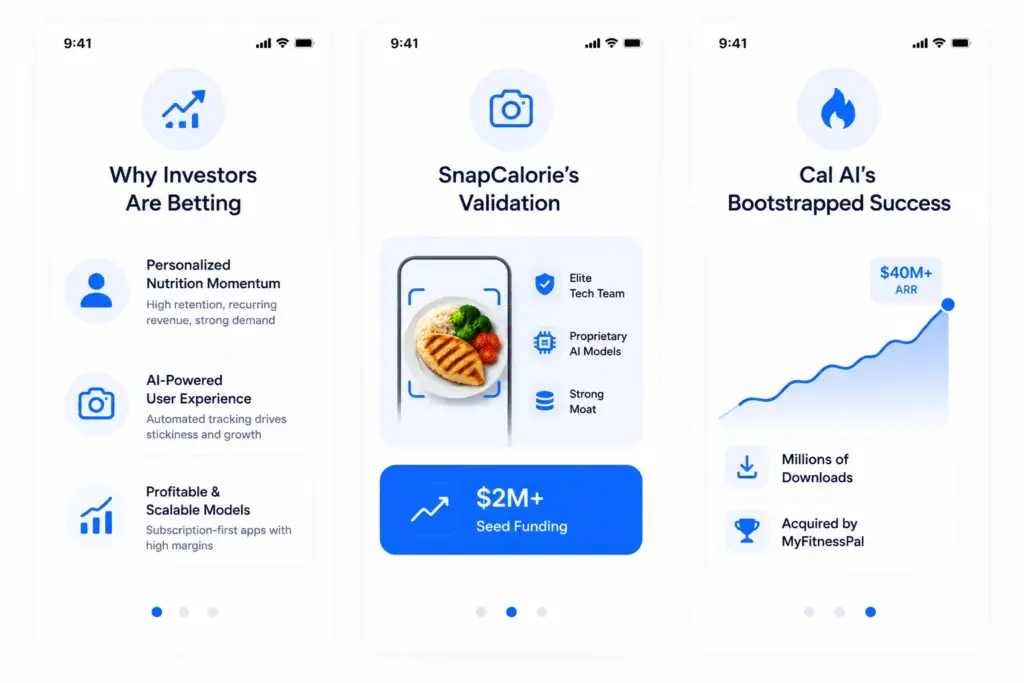
Venture capitalists are prioritizing nutrition platforms because they perfectly align with highly lucrative business fundamentals. These apps operate on subscription-based software models that generate high gross margins and predictable recurring cash flows. At the same time, they tap into massive macroeconomic trends, including the widespread adoption of health wearables and a global societal push toward preventive medicine.
Traditional fitness trackers map steps and sleep, but they lack the context of nutritional fuel. Startups that bridge this gap with automated intelligence create immediate consumer stickiness. Because the software actively adapts to a user’s evolving biology, it becomes an essential daily habit, resulting in retention metrics that easily justify high early-stage valuations.
SnapCalorie’s Validation
The commercial validity of photo-based tracking is clearly highlighted by the financial momentum of SnapCalorie. Founded by former Google Lens engineering talent, the startup successfully raised more than $2 million in seed funding specifically to scale its computer vision capabilities. This targeted capital deployment underscores investor confidence in technical teams capable of transforming standard phone images into exact nutritional data.
- Elite Technical Foundation: Built by visual search experts using proprietary computer vision architectures.
- Capital Efficiency: Utilizing early funding to master volumetric portion estimation and ingredient depth.
- Enterprise Moat: Creating custom datasets that make it incredibly difficult for legacy software to compete.
The institutional backing of SnapCalorie proves that the investment community values deep technical moats. Investors are explicitly betting that proprietary machine learning models will capture the massive segment of the population that completely abandoned old-school tracking due to user fatigue.
Cal AI’s Bootstrapped Success
While venture backing can accelerate growth, a viral nutrition product can achieve explosive commercial success completely through bootstrapping. Cal AI beautifully illustrated this by scaling to millions of active downloads and crossing a stunning $40 million annual revenue run rate without ever raising external institutional capital. This rapid, highly profitable scaling proved to the market that AI-powered calorie scanners possess incredible consumer viral loops.
By focusing heavily on short-form social marketing and eliminating manual data entry friction, Cal AI built an immense cash-flowing asset in under two years. The eventual acquisition by MyFitnessPal sent a loud signal to tech founders and private equity firms alike that the future of digital health belongs entirely to automated, AI-first platforms.
Build an AI Calorie Scanner App with IdeaUsher
Building a successful AI nutrition app takes more than a good idea. It requires the right technology, a seamless user experience, and a scalable product strategy. IdeaUsher helps founders turn their vision into production-ready wellness platforms by combining AI expertise with custom software development. From MVPs to enterprise solutions, we build applications that are designed to grow with your business and deliver long-term value.
Custom AI Nutrition Platforms
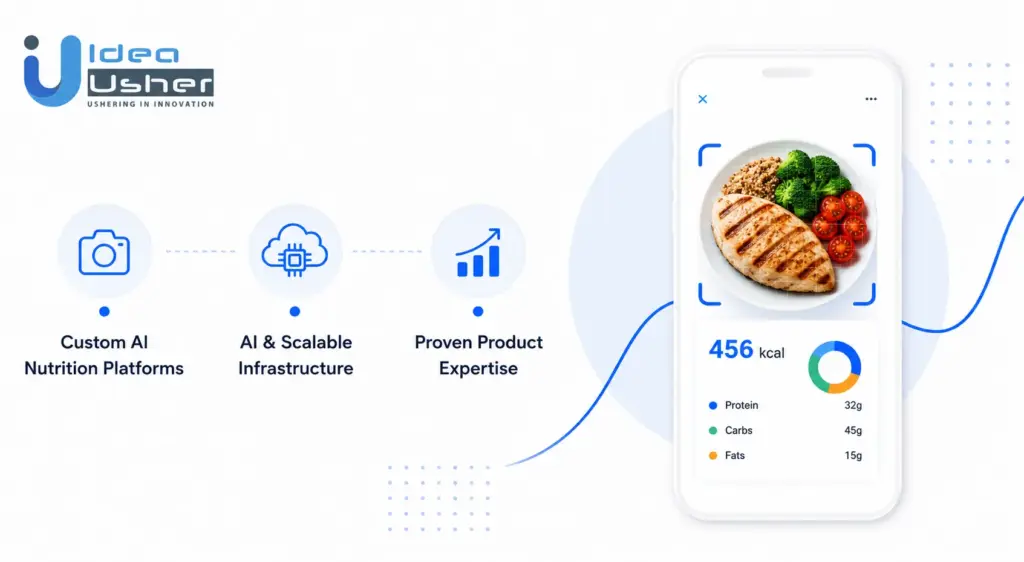
IdeaUsher builds every AI nutrition app from the ground up to match your business goals instead of relying on generic templates. Whether you’re launching an MVP to validate your idea or developing a full-scale digital health platform, our team creates a solution that supports long-term growth. A custom architecture also gives you the flexibility to add new features, respond to user feedback, and scale your product as market needs evolve.
AI & Scalable Infrastructure
The technical integrity of an AI calorie scanner determines its commercial longevity. Our engineering teams integrate advanced deep learning models directly into your product backend. We build intelligent nutrition systems that process media inputs within seconds, transforming raw pixels into accurate macronutrient data points.
- Computer Vision: Implementing multi-object segmentation to isolate individual ingredients instantly.
- Predictive Engines: Building recommendation models that deliver personalized, adaptive meal targets.
- Ecosystem Syncing: Developing secure APIs to pull data effortlessly from Apple Health, Fitbit, and Garmin hardware.
This level of engineering depth ensures that your application handles thousands of concurrent image uploads without suffering latency issues or system crashes. By choosing a cloud-native, modular backend from day one, you build a resilient technical asset that scales effortlessly as your active user base expands.
Proven Product Expertise
With 500,000+ hours of coding experience and a team of ex-MAANG/FAANG developers, IdeaUsher has helped launch 1,000+ software products across multiple industries. We combine deep AI and healthtech expertise with a transparent development process to build secure, scalable digital health platforms. Whether you’re validating an MVP or creating a market-ready product, our team focuses on delivering solutions that are built for long-term growth.
Conclusion
A great AI calorie scanner app succeeds by making healthy eating feel effortless. Users want to snap a photo, get accurate nutrition information, and move on with their day instead of spending time logging meals manually. Adding personalized recommendations, progress tracking, and integrations with wearables keeps the experience useful over time, helping users stay engaged while giving the platform a strong foundation for long-term growth.
Things to Know About AI Calorie Scanner Apps
A1: AI calorie scanner apps have become much more accurate thanks to advances in computer vision and machine learning. A clear photo usually gives reliable calorie and nutrition estimates within seconds. Accuracy may drop when a meal contains many ingredients or the portion size is difficult to judge. That’s why most apps let users make quick edits, helping the AI deliver better results over time.
A2: Yes, most modern AI nutrition apps can recognize a wide range of homemade meals and regional dishes. They work well with common recipes, but highly customized meals may need a quick correction. As the AI learns from more food images and user feedback, it becomes better at recognizing different cuisines and cooking styles.
A3: Most apps need an internet connection because the image is processed by cloud-based AI models. Some apps still let users save meals or browse previous logs while offline. Once the device reconnects, the AI completes the nutrition analysis automatically. This approach allows developers to use more powerful AI models without being limited by a smartphone’s processing power, resulting in faster and more accurate food recognition.
A4: Most platforms follow a freemium model. Users can access basic calorie tracking for free and upgrade when they want advanced features. Premium plans often include AI nutrition coaching, detailed nutrient analysis, personalized meal plans, and deeper health insights. This approach helps attract new users while creating recurring subscription revenue.