

Key Takeaways
- For making a platform like Kalshi, start by getting the CFTC to approve your exchange as a Designated Contract Market. Then you add a fast trading engine for yes-or-no contracts that cost between $0 and $1.
- Every trade has to be paid for upfront. The clearing system keeps track of each user’s cash and contracts so nobody can owe money they do not have.
- To keep trading active, you can use an automated pricing model like the Logarithmic Market Scoring Rule. Big trading firms can also connect through an API and add more orders.
- At the end, the platform settles each contract using a public data source that anyone can verify. You also need clear backup rules for the days when that source is late or unclear.
- See how Idea Usher can help you build a prediction marketplace platform like Kalshi, from trading engine to settlement.
To build a platform like Kalshi in the US, you first need the CFTC to approve your exchange as a Designated Contract Market. Then you build a trading engine that matches buyers and sellers by price first and time second. Each contract is a yes-or-no question priced between $0.00 and $1.00. Every trade is paid for upfront so nobody can lose money they do not have. Big market makers plug in through an API to keep the order book full. When the event ends, you settle each contract using a public data source anyone can check. A pricing model like the Logarithmic Market Scoring Rule can quote prices on day one before real traders show up.
This guide walks through how Kalshi works, the 10-step development process, build-vs-integrate decisions, architecture and tech stack, features, a realistic cost and timeline breakdown, compliance, liquidity and monetization. It draws on Idea Usher’s experience as a prediction market platform development company building trading, fintech and event-exchange products.
What Is a Prediction Market Platform Like Kalshi?
A prediction market platform like Kalshi is a regulated exchange where people buy and sell Yes/No event contracts on real-world outcomes, and the contract price works as a live, crowd-set probability. A contract pays $1.00 if the event happens and $0.00 if it does not, so a Yes contract trading at $0.62 tells you the market sees roughly a 62% chance.
Three things make Kalshi different from a betting app:
- It is an exchange, not a bookmaker. Kalshi never takes the other side of your trade. Buyers and sellers meet on a central limit order book (CLOB), and the platform earns a transaction fee on matched trades.
- It is federally regulated. In the US, Kalshi operates as a Designated Contract Market (DCM) under the Commodity Futures Trading Commission (CFTC). DCMs must meet 23 statutory Core Principles, including rules that contracts must not be readily open to manipulation.
- Positions are tradable before the event ends. You can sell a contract at $0.80 that you bought at $0.40 without waiting for the result, just like closing a stock position.
| Prediction market (Kalshi) | Sportsbook | Stock exchange | |
|---|---|---|---|
| Who sets the price | Buyers and sellers in an order book | The bookmaker | Buyers and sellers in an order book |
| House takes the other side | No | Yes | No |
| Payout | $1.00 or $0.00 per contract | Fixed odds | Market price |
| Exit before outcome | Yes | Limited (cash-out) | Yes |
| US regulator | CFTC | State gaming regulators | SEC |
| Revenue model | Trading fees | Margin built into odds | Listing and trading fees |
Kalshi lists markets across economics, weather, politics, culture, crypto and sports. If your platform focuses on sports, the same exchange model powers a sports prediction exchange or a peer-to-peer sports prediction app.
Prediction Market Growth: Why Businesses Are Building Kalshi-Like Platforms in 2026
Event trading has become one of the fastest-growing corners of fintech, and Kalshi is the clearest proof. Its monthly notional volume climbed from about $9B in January 2026 to about $37B in July 2026, according to DeFi Rate’s Kalshi volume tracker.
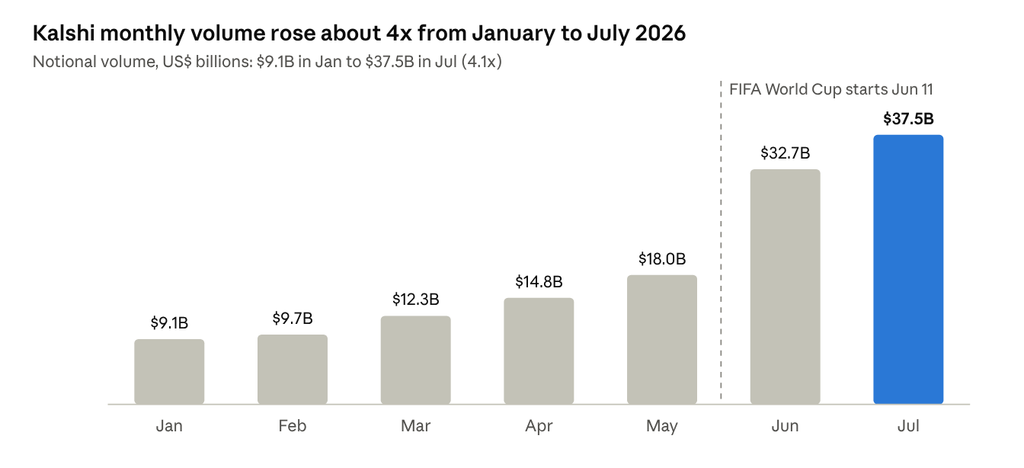
Source: DeFi Rate Kalshi volume tracker, Jan–Jul 2026 (notional, $1 face value per contract)
The June jump came with the 48-team FIFA World Cup, and sports now drive more than 80% of Kalshi’s monthly volume. Across the two largest venues, Kalshi and Polymarket together traded about $53B in July 2026, more than double May, per Pew Research Center.
Investors are pricing that growth in. Kalshi was valued at about $5B in October 2025, closed a $1B Series F at a $22B valuation in May 2026, and is now in advanced talks to raise at $40B.
What this means if you are planning a Kalshi-like platform:
- Demand is proven. Retail users, institutions and media brands now understand event contracts.
- Niches are open. Kalshi is US-only and broad. Regional markets, single-sport exchanges, B2B forecasting and white-label prediction products are still underserved.
- The bar is higher. Users now expect exchange-grade execution, instant settlement and tight spreads from day one. A clone app built on shortcuts will not hold them.
How Does a Kalshi-Like Prediction Market Work?
Every Kalshi market follows the same lifecycle: a contract is written, listed, traded on an order book, closed, resolved against a named data source and settled at $1.00 or $0.00. Your platform has to automate each stage without gaps.
- Contract design. The exchange writes one unambiguous question, for example “Will the US CPI print above 3.0% for September?” It names the settlement source (here, the Bureau of Labor Statistics), the open time, close time and expiration time.
- Listing. On a US DCM, each new contract is self-certified to the CFTC as compliant with the Core Principles before it goes live.
- Trading. Users place limit or market orders on the Yes or No side. The matching engine pairs them by price-time priority: best price first, then earliest order.
- Price discovery. A Yes at price P is economically the same as a No at (1 − P). When Yes trades at $0.65, No is implied at $0.35. As news arrives, prices move and the implied probability updates in real time.
- Close and resolution. At close time, the book freezes and resting orders are cancelled. The resolution engine pulls the official result and finalizes Yes or No. Disputed or delayed data goes to a review process, not an automatic guess.
- Settlement and payout. Winning contracts pay $1.00, losing ones $0.00. The ledger releases collateral and credits balances in the same transaction.
How Contract Prices Turn Into Probabilities
Because a winning contract always pays $1.00, the price is the market’s implied probability, and the gap to $1.00 is the trader’s potential gross profit.
| Yes price | Implied probability | Gross profit if Yes wins | Loss if No wins |
|---|---|---|---|
| $0.05 | 5% | $0.95 | $0.05 |
| $0.35 | 35% | $0.65 | $0.35 |
| $0.50 | 50% | $0.50 | $0.50 |
| $0.80 | 80% | $0.20 | $0.80 |
| $0.95 | 95% | $0.05 | $0.95 |
Trading fees reduce these figures slightly. Every position is fully collateralized: a trader buying Yes at $0.35 locks $0.35, the counterparty buying No locks $0.65, and the exchange holds the full $1.00 until settlement. This is why a Kalshi-like platform carries no credit risk between users, and why your ledger design matters more than your UI.
How to Develop a Prediction Market Platform Like Kalshi: 10 Steps
To build a platform like Kalshi, you start by choosing your event categories and a trading model. Then you design yes-or-no contracts and build the matching engine, wallets and live data feeds. You also set up automatic settlement and identity checks and bring in market makers. Last, you test everything and launch once the regulator says yes.
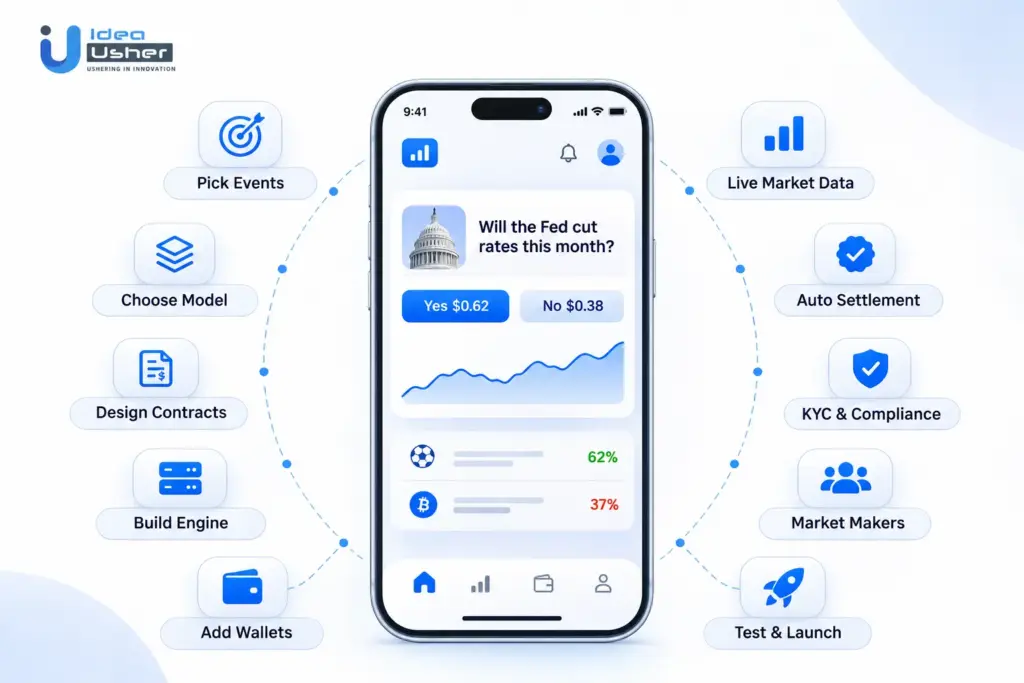
Step 1: Choose Your Event Categories
Start with a small set of topics that are easy to check. Sports, crypto prices and economic data all have clear results that anyone can verify. Topics like elections draw more attention from regulators. The CFTC can review a new event contract for 90 days after a market lists it. The CFTC also disapproved an election contract from Nadex in 2012 and later tried the same with Kalshi’s congressional control contracts before a court sided with Kalshi. Picking safe categories first helps you launch faster and win trust.
Step 2: Pick CLOB or AMM
A CLOB is an order book where buyers and sellers post their own prices. An AMM is a pricing formula that always quotes a price for you. Kalshi matches orders through a traditional order book with visible depth. Polymarket started with an AMM and moved to an order book in late 2022.
Many teams start with a CLOB and use an AMM only to seed quiet markets.
Step 3: Design Contracts and Pricing
Each contract asks one question that has a yes or no answer. It pays $1.00 if the answer is yes and $0.00 if it is no. That makes the price work like a chance. A price of $0.37 means the market thinks there is a 37% chance. Write each question in plain words so nobody can argue about what it means. Name the exact source that decides the result inside the contract rules. Clear rules now save you from angry users later.
Step 4: Build the Matching Engine
The engine takes every order and pairs buyers with sellers fast. The best price goes first and the oldest order wins a tie. A yes order and a no order can also match each other when their prices add up to $1.00. A $0.60 yes order and a $0.40 no order match because they add up to $1.00.
- Keep the order book in memory so matching stays quick
- Support limit orders and cancel requests
- Offer REST, WebSocket and FIX access like Kalshi does
- Log every order so you can replay it later
Polymarket matches orders off-chain and settles on-chain. Its CLOB v2 and CTF Exchange v2 rebuilt the matching logic from scratch. That shows how often even top teams redo this part.
Step 5: Build Wallets and Collateral
Every contract has to be fully paid for before it trades. A buyer of yes at $0.60 locks $0.60 and the seller on the other side locks $0.40. Together, they cover the full $1.00 payout so nobody can owe money they do not have. The clearinghouse in Sporttrade’s CFTC filing does not give margin or credit to members. Keep customer money apart from your own money and check the books every day. Polymarket USD is backed by Circle’s USDC at a 1:1 ratio, which shows how a platform can hold collateral in a steady coin.
Step 6: Add Live Market Data
Traders need prices that update in real time. Kalshi’s WebSocket feed sends order book changes, trades, market status updates, and fill alerts. Build the same kind of feed so your app and your market makers see changes at once. You also need outside data to run and settle markets.
Novig shows why this matters. It became an MLB Authorized Prediction Market which gives it access to official league data. That data helps it list sports markets fast and settle them on facts that fans trust. A clean data deal can be a real edge over rivals who scrape scores.
Step 7: Automate Contract Resolution
When the event ends, the platform should settle every contract without manual work. Many crypto platforms use an optimistic oracle. Someone proposes the answer and others have a short window to challenge it.
How the Oracle Flow Works
- A result is proposed with a bond
- The challenge window lasts from 2 hours to 2 days
- If nobody disputes it the result becomes final
- If someone disputes it the vote takes 48 to 96 hours
Only about 1.5% of proposals get disputed so most markets settle fast. A regulated exchange like Kalshi works differently since the exchange itself follows published rules and named sources. Either way you need a backup plan for days when a source is late or unclear.
Step 8: Add KYC, AML, Geofencing
A regulated exchange has to know who its users are. Kalshi requires every user to finish KYC before funding an account. Exchanges like this also carry AML duties under CFTC rules and the Bank Secrecy Act.
- Verify identity and age before the first deposit
- Screen users against sanctions lists
- Watch for odd trading patterns
- Block banned places using IP address location checks
A proposed Senate bill would require Bank Secrecy Act-level checks for event contracts. Build these tools now so new rules do not force a rebuild later.
Step 9: Bring in Market Makers
A new market with no orders looks dead, and nobody wants to trade in it. Market makers fix that by posting buy and sell prices all day. Big firms usually connect through a fast API and want tight rules and fair fees. For small markets, you can run your own pricing formula. The LMSR formula caps the platform’s worst loss, and that cap grows slowly as outcomes are added. You fund it with b times the log of the number of outcomes. That makes the cost of seeding a market easy to plan.
Step 10: Test Speed, Then Launch
Test the full path before real money moves. Load tests should copy the busiest day you can imagine. Dry runs of settlement should pass without any manual fixes.
| Check | What to prove |
| Load test | Orders match fast at peak traffic |
| Settlement dry run | Every contract pays out the right way |
| Geofence test | Blocked places cannot trade |
| Security review | Wallets and APIs hold up |
If you want your own US exchange, there is a wait on top of testing. The CFTC reviews a new exchange application over 180 days or over 90 days if you ask for a faster review. unt
ADI Predictstreet Shows Why Launch Matters
ADI Predictstreet launched just ahead of the FIFA World Cup as its official prediction market partner. It plugged into DAZN live streams with interactive prompts and sentiment tracking. DAZN also added a free-to-play version where fans earn points and climb leaderboards for World Cup match tickets. The start was bumpy, though. SBC News reported that the platform became inaccessible for UK audiences even while it was still billed as the tournament partner. Big partners bring big crowds so test your access rules and traffic limits before the spotlight arrives.
Kalshi Clone App Development: White-Label vs Custom
Pick a white-label Kalshi clone if you want to launch fast and test if people really want your product. Pick a custom one if you want to own the code and shape the markets your own way. White-label costs less at the start and gets you live sooner. Custom costs more but gives you full control later. Many teams start with white-label and move to custom once they have users and a clear plan.
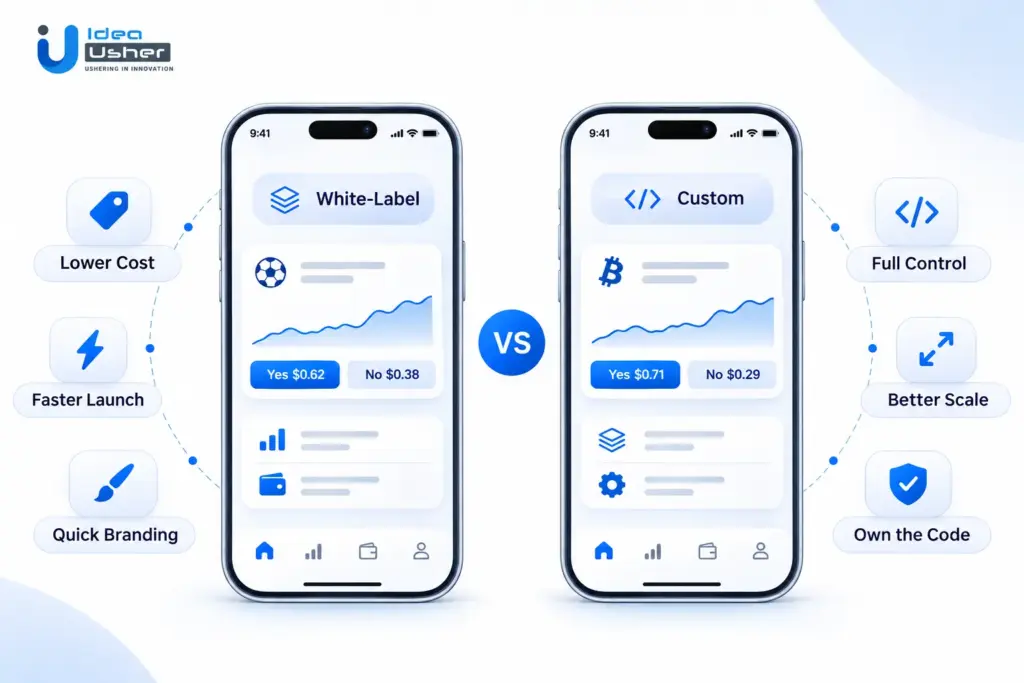
1. Cost Difference Between Both Options
White-label looks cheaper on day one. Cost guides from development firms put the upfront price between $25,000 and $70,000. The catch is the monthly fee that never stops. One guide says it can run $2,000 to $10,000 a month so the bill grows the longer you stay. Custom asks for more money at the start but then you mostly pay for your own team and hosting.
| Cost Item | White-Label | Custom |
| Upfront cost | $25,000 – $70,000 | $80,000 – $250,000+ |
| Monthly fee | $2,000 – $10,000 | Your own team and hosting |
| Basic first version | Low end of the range | $80,000 – $120,000 |
These are rough ranges from public guides. Your final price depends on features and how many markets you want.
2. Time to Launch Compared
Speed is the biggest win for white-label. The trading engine, wallet and admin tools already exist so you mostly add your brand and go. A custom build has to design and test all of that from zero. If you want your own exchange in the US there is one more wait on top of the build. That wait is the regulator and it can be longer than the coding.
- White-label: about 4 to 8 weeks
- Basic custom build: about 3 to 4 months
- Own US exchange: the CFTC has 180 days to review an application, or 90 days if you ask for a faster review
- Real case: Kalshi took about 10 months from its first filing to its approval as a contract market
3. Customization and Scalability Limits
A white-label product is made for many clients so it has to stay fairly general. Some providers cap how many markets can run at once, limit new market types or keep their API closed. Branding is usually easy since most providers let you use your own name and look. The tight part is how deep you can change the trading rules and add new features. If your idea is very different from the standard setup, you will feel this fast.
Where Custom Gives More Room
- Add your own market types like multi-outcome or sports props
- Connect any data source you want for settling results
- Change fees and risk rules as you grow
- Plan your servers for big days like a championship night
4. Compliance Support in Each Approach
Many providers connect you to a partner that already holds the licence. That means you may not need to apply for your own. You still have jobs to do like checking who your users are and following your partner’s rules. You also depend on that partner to stay in good standing so it helps to ask about this before you sign.
With a Custom Build
You carry the full load. In the US, that usually means becoming a designated contract market and showing the CFTC that you meet its core principles. The work does not end after approval because new products need care too. When Kalshi wanted to list its BTCPERP bitcoin perpetual contract, it asked for the CFTC’s voluntary approval and got an order within days.
5. Who Should Choose White-Label?
White-label fits teams that want to move quickly and keep risk small. It works well when you already know your audience but do not want to spend months on tech. It also helps when your team is small and cannot run an exchange build alongside everything else. You can always change the plan later once you see what users do.
- You want to test demand before spending big
- You already have an audience or a brand
- You need to launch before a big event or season
PredictArena Takes a Lighter Route
PredictArena shows how far a small team can get without building everything. It launched in mid-October as a creator-focused prediction market platform and signed an introducing broker deal with Crypto.com | Derivatives North America. It uses their markets and exchange know-how while it builds the creator side. Creators can build profiles and publish their predictions and the platform is live on web with an app promised soon.
6. Who Should Choose Custom?
Custom fits teams with a clear plan and enough budget. If your idea needs new market types or your own pricing rules a ready-made product will slow you down. It also fits teams that want to own something they can license or sell later. The price and the wait are higher but the control is yours.
Sporttrade Built Its Own Stack
Sporttrade went the full custom way. It spent close to a year preparing applications and needed separate bids for an exchange and a clearinghouse. The CFTC registered it as both a designated contract market and a derivatives clearing organization in early November. That lets it list sports event contracts on its own exchange and clear them itself. It is onboarding brokers like Fliff to route orders into the exchange. The rollout will be phased.
7. Start White-Label, Move to Custom
You do not have to pick one forever. Many teams launch with white-label to get users and learn what traders like. Once the product works they move the winning parts into a custom build. This keeps early risk small and saves the big spend for when you know exactly what to build.
- Launch white-label and watch which markets users trade most
- Write down every limit you hit like market caps or missing features
- Check what data and code you can take with you before you sign
- Start the custom build when the limits cost more than the monthly fee
Timeline by Phase for Prediction Marketplace Development
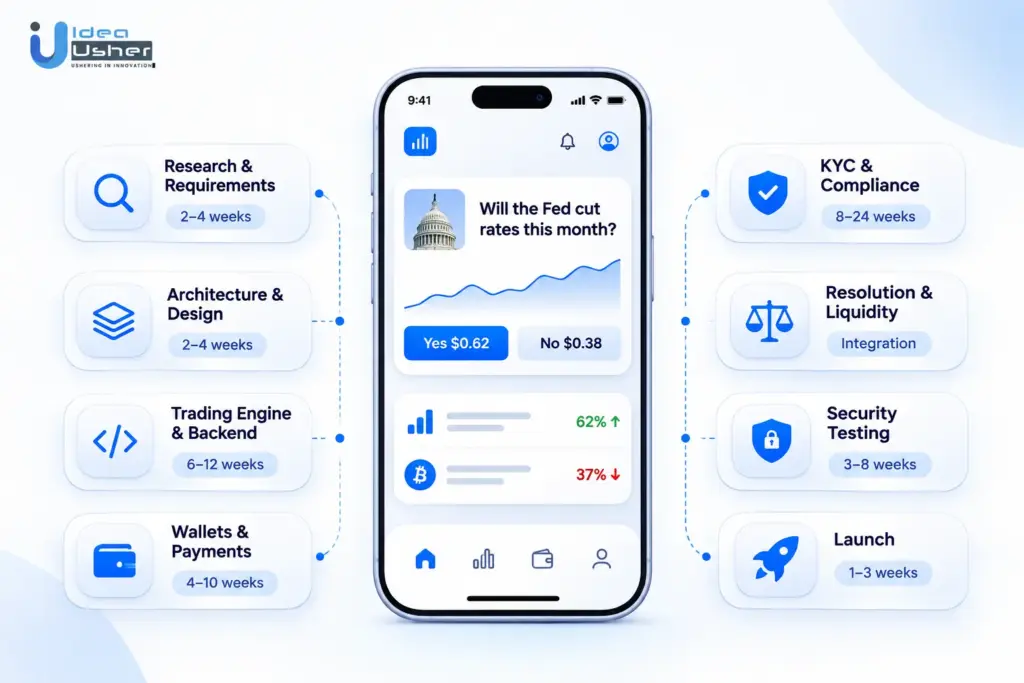
Building a prediction marketplace takes months, and the work moves through eight phases. You start with research and design and then build the trading engine and the wallets. Next come the identity checks and the settlement and liquidity setup. The last phases are security testing and a step-by-step launch. Some of these overlap, so the coding goes quicker than it sounds. The slowest part is usually regulator approval, so the legal work should start on day one.
Timeline at a Glance
| Phase | Rough Time |
| 1. Research and requirements | 2 to 4 weeks |
| 2. Architecture and design | 2 to 4 weeks (runs alongside) |
| 3. Trading engine and backend | 6 to 12 weeks |
| 4. Wallets, payments and APIs | 4 to 10 weeks |
| 5. KYC, AML and compliance | 8 to 24 weeks for a regulated venue |
| 6. Resolution and liquidity | Part of the integration work |
| 7. Security testing | 3 to 8 weeks |
| 8. Launch | 1 to 3 weeks |
One build guide puts the full path at four to seven months before the first real trade. A regulated venue can stretch that to 6 to 18 months. These are rough ranges from vendor guides so your own plan may differ.
Phase 1: Market Research and Requirements
This phase decides everything that comes after it. You pick your topics and your users and you decide if you want a white-label product or a custom build. You also talk to a lawyer early. The CFTC staff expect to see a clear story that links your products and your market design to the rules. A team that skips this step often rebuilds parts of the platform later. Spending a few weeks here is cheap compared with fixing a wrong plan in month five.
Phase 2: Architecture and UI/UX Design
Design can start while the team is still finishing research. Think about how your platform will be built and how it will feel to use.
- Choose an order book or an automatic pricing formula
- Sketch the market page and the order ticket
- Plan wallet and deposit screens
- Design an admin panel for creating and closing markets
- Plan for traffic spikes on big event days
Phase 3: Trading Engine and Backend
This is the longest build phase. The engine takes in orders and matches buyers with sellers fast. It also has to track risk and keep a record of every trade. Kalshi gives developers REST, WebSocket, and FIX access so build yours with the same options in mind. Big market makers like FIX since it is made for speed. Build the engine so you can replay old orders to find bugs. Most of the time in this phase goes into getting the edge cases right.
Phase 4: Wallets, Payments and APIs
Now you connect money and outside systems. That includes deposits, withdrawals, collateral tracking and data feeds. You also open APIs for traders and partners.
Plus500 Plugs Into Kalshi
Plus500 shows how much time you can save by plugging into an existing exchange. It launched prediction markets on its US platform Plus500 Futures by offering Kalshi’s contracts. It clears trades itself through its full clearing membership with Kalshi Klear LLC. The company charges a commission of $0.01 per contract. Plus500 was also named clearing partner for FanDuel Predicts which is a joint venture of CME Group and FanDuel.
Phase 5: KYC, AML and Compliance
This phase often takes the longest and you cannot rush it. A new US exchange applies to become a designated contract market. The CFTC has 180 days to review an application and you can ask for a faster 90 day review. Kalshi took about 10 months from its first filing to its approval. Talk to CFTC staff before you file and send draft documents for feedback. Your application also needs a rulebook and a compliance manual.
| Route | Typical Wait |
| Own exchange (DCM) | 180 days by law or 90 if fast-tracked |
| Introducing broker | NFA says six weeks or longer |
| Partner’s licence | Shared with your provider |
Betr Skipped the Waiting Line
Betr shows how long a wait can get. It applied for NFA membership in early October and the application showed no movement for seven months. So it bought Ascent Capital Management which had been a registered introducing broker since 2011. That made Betr a CFTC-registered introducing broker right away. It plans to launch Polymarket-powered markets inside its super app next to Picks, Sportsbook, Casino and Arcade. An introducing broker cannot hold customer funds directly so Betr still needs a partner for that part.
Phase 6: Resolution and Liquidity Setup
Every market needs a clear way to end and a way to start with real prices. For resolution many crypto platforms use an optimistic oracle where a result stands unless someone challenges it. The challenge window can last from 2 hours to 2 days. Only about 1.5% of proposals get disputed so most markets settle fast. Then bring in market makers before launch so your first users do not see empty books. A pricing formula can fill the gap for new markets until real traders show up.
Phase 7: Security Testing and Speed
Test the whole platform before real money moves. Load tests should copy your busiest day. Outside reviewers should try to break the wallets and APIs.
| Test | What It Proves |
| Load test | Orders match fast at peak traffic |
| Penetration test | Wallets and APIs hold up |
| Settlement dry run | Every contract pays out correctly |
| Code audit | No hidden bugs in key logic |
Good audit firms are busy. Engagements often take 4 to 8 weeks and waitlists can stretch for months so book your slot early.
Phase 8: Deploy, Monitor and Launch
Launch in steps and not all at once. Start with a small group of users and a few markets. Watch prices and fill rates and any settlement errors every day. Keep a quick way to pause trading if something looks wrong. A staged launch usually takes 1 to 3 weeks. After that you open more markets and more users as the numbers look healthy. The work does not stop at launch since monitoring and fixes continue after that.
Build Your Own Exchange, Integrate Kalshi’s API, or Go Hybrid?
Most startups should not start by building a full exchange. Integrating an existing regulated exchange through its API gets you to market in weeks with real liquidity, while building your own gives full control at 10x the cost and a licensing burden. A hybrid model sits between them.
| Factor | Build your own exchange | Integrate an exchange API | Hybrid model |
|---|---|---|---|
| What you build | Matching engine, ledger, clearing, risk, settlement | Front end, accounts, routing to the host’s order book | Your own markets on an internal ledger + routed orders for standard markets |
| Time to market | 12–18+ months | 6–10 weeks | 3–5 months |
| Liquidity | You must bootstrap it | Inherited from the host | Shared for routed markets, seeded for yours |
| Regulatory burden | Highest (exchange and clearing licenses) | Lowest (host’s license, your brokerage or affiliate setup) | Medium, depends on structure |
| Control over markets and fees | Full | Limited to host catalog and fee splits | High for own markets |
| Best for | Funded exchanges, institutions, non-US regulated venues | Fintech apps, media brands, brokers adding event trading | Niche platforms that also want mainstream markets |
Integrating Kalshi. Kalshi publishes a Trade API with REST and WebSocket endpoints for market data, order books, orders and portfolios, plus a demo environment for testing. Access is governed by Kalshi’s developer agreement, so confirm what your business model allows before you build on it.
Our recommendation: validate demand with an API or hybrid launch, then invest in proprietary matching and clearing once volume justifies it. Your front end, user base and data stay yours when you migrate.
Kalshi-Like Platform Architecture and Recommended Tech Stack
A Kalshi-like platform needs nine core services, and two of them, the matching engine and the ledger, decide whether users trust it. Orders flow from apps and APIs through a gateway and pre-trade risk checks into the matching engine; every fill and payout is recorded in a double-entry ledger.
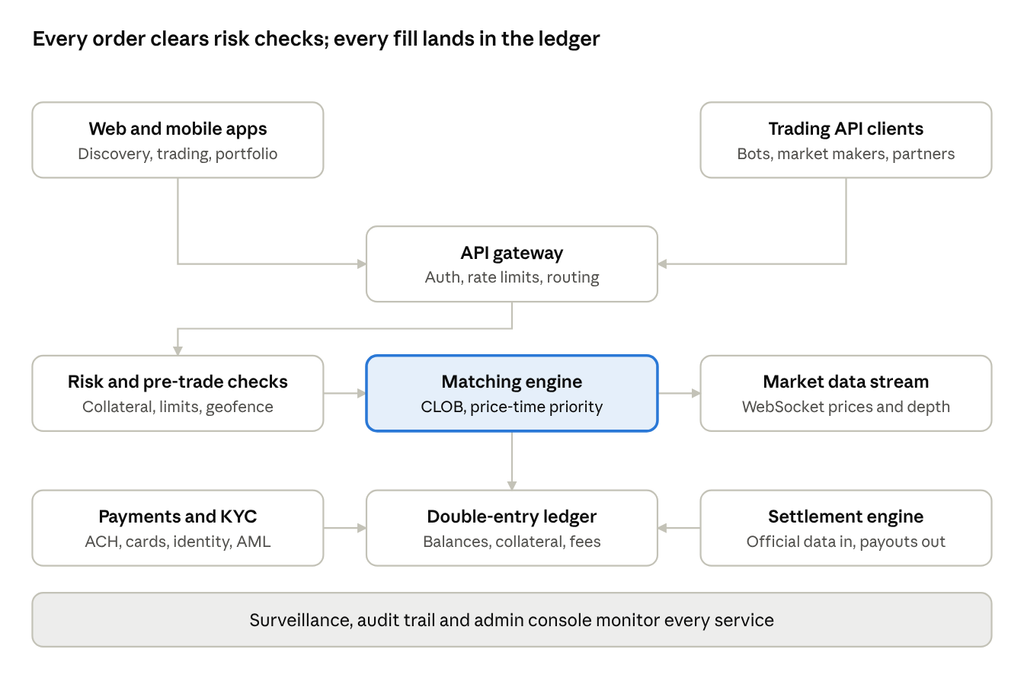
Reference architecture of a Kalshi-like prediction market platform · 9 core services
The matching engine runs in memory, one sequenced stream per market, so results are deterministic and replayable. The ledger is the source of truth for money; the balance on a user’s screen is only a view of it.
| Layer | Recommended technology | Why it fits |
|---|---|---|
| Matching engine | Rust, Go, C++ or Java (LMAX-style) | Low, predictable latency; single-threaded determinism per market |
| Order and event bus | Apache Kafka or Redpanda | Ordered, durable event log for replay and audit |
| Ledger database | PostgreSQL (ACID, double-entry schema) | Strict consistency for balances and collateral |
| Cache and live state | Redis | Fast order-book snapshots and session data |
| Market data history | TimescaleDB or ClickHouse | Tick, OHLC and analytics queries at scale |
| Real-time delivery | WebSockets via a dedicated gateway | Streams prices, depth and fills to clients |
| Web front end | React or Next.js | Fast trading UI with server rendering for SEO pages |
| Mobile apps | React Native, Flutter or native Swift/Kotlin | One codebase or native performance, by budget |
| Infrastructure | AWS or GCP, Kubernetes, Terraform | Auto-scaling for event spikes, multi-zone failover |
| KYC and AML | Providers such as Persona, Onfido or Sumsub | Identity, sanctions and PEP screening |
| Geolocation | GPS and IP geofencing services | Blocks restricted states and countries |
| Observability | Prometheus, Grafana, OpenTelemetry | Latency, error and reconciliation alerts |
If you plan crypto deposits or on-chain settlement like Polymarket, add smart contracts, wallet integration and oracle networks; our blockchain development team covers that stack. Many of the same components also power a stock trading app.
Features of a Prediction Market App Like Kalshi
A Kalshi-like MVP needs six user features and four admin features to run the full trading loop: find a market, read its price, place an order, track the position, get paid. Advanced features come after you have real volume. For the full list, see our breakdown of prediction market app features.
MVP Features (Launch With These)
| Feature | What it does | Why it matters |
|---|---|---|
| Sign-up, KYC and geofencing | Verifies identity, age and location before funding | Required for real-money trading and blocks restricted regions |
| Market discovery | Categories, search, trending and closing-soon lists | Users trade what they understand; discovery drives volume |
| Market page with live order book | Yes/No prices, depth, chart, rules and settlement source | Builds trust and lets users judge the probability |
| Order entry | Limit and market orders, buy and sell, cancel | The core trading action |
| Portfolio and history | Open positions, P&L, fills, settled contracts | Users need to see exposure and results |
| Wallet | ACH and card deposits, withdrawals, balance view | Removes friction from funding and cash-out |
| Admin: market creation | Create, schedule, pause and close markets | Lets operators control the market catalog |
| Admin: settlement console | Review data sources, confirm outcomes, handle disputes | Prevents wrong payouts on edge cases |
| Admin: risk and surveillance | Limits, alerts on unusual trading, account actions | Protects market integrity from launch |
| Notifications | Price alerts, fills, market close and settlement | Brings users back at decision moments |
Advanced Features (Add After Product-Market Fit)
| Feature | What it adds | Add it when |
|---|---|---|
| Advanced order types | IOC, FOK, post-only, stop orders | Active traders ask for execution control |
| Public trading API | REST and WebSocket access for bots | Market makers and quants join |
| Market-maker program | Rebates, quoting obligations, dashboards | Spreads on new markets stay wide |
| Combos and parlays | Multi-leg contracts on related events | Sports volume grows |
| Scalar and range markets | Contracts on value bands, not just Yes/No | Macro and weather markets mature |
| Institutional accounts | Sub-accounts, roles, block trades, reporting | Funds and trading firms onboard |
| Data products | Historical prices and probability feeds | You have months of clean market data |
| AI market insights | News summaries, probability shifts, alerts | You want higher engagement per user |
How Much Does It Cost to Build a Prediction Market Platform Like Kalshi?
A Kalshi-like platform costs between $70,000 and $600,000+ depending on how advanced and compliant you want it to be. One cost guide puts the full range at $70,000 to $600,000+. A small crypto-only MVP with an outside wallet and no KYC sits at the low end. One example estimate for that kind of build was about $98,700 to $142,800 over 4 to 6 months. Clone scripts are cheaper and start at $6,000 for a basic build but you get less control.
The price jumps when you add a real order book and fiat payments and KYC and security audits. The license is the biggest unknown because a regulated exchange needs CFTC approval and that can cost more than the software itself.
1. Costs by Platform Type
The first thing that changes the price is the type of platform you pick. A clone script is the cheapest way to start but you get less control. A custom build costs more but the code is yours. One cost guide says a full Kalshi-style build can land anywhere from $70,000 to $600,000+ depending on how advanced and compliant it is.
| Platform type | Estimated cost |
| Clone script (basic) | from $6,000 |
| Clone script (mid-range, with mobile apps) | $10,000 to $15,000 |
| Clone script (enterprise-grade) | $20,000 to $50,000 |
| Custom exchange MVP | $50,000 to $100,000 |
| Custom full production platform | $100,000 to $250,000 |
| Enterprise and regulation-ready | $250,000 to $400,000+ |
Building from scratch also takes time. One guide says it can take 12 to 18 months to build a Kalshi-like platform this way.
2. API vs White-Label vs Custom
There are three main roads and each one has a different bill. Kalshi gives builders an official Exchange API with SDKs in Python and TypeScript plus FIX integration. Polymarket also has an order book API with its own official clients. So you can ship a product layer and skip the hard parts. The tradeoff is that you live by their rules and limits.
- API-integrated: Usually the cheapest road because you do not build liquidity or a market protocol. You pay for the trading screens and real-time data and for keeping things stable when traffic jumps.
- White-label: Fast and fairly cheap at the clone script prices above. You get less control over fees and features.
- Custom exchange: A crypto-only MVP with no KYC and an outside wallet was estimated at about $98,700 to $142,800 over 4 to 6 months.
Example: Robinhood
Robinhood shows how this road can change over time. It began in March through a partnership with Kalshi so it did not need its own exchange. Later it teamed up with Susquehanna and bought 90% of MIAXdx. This is a licensed exchange and clearinghouse and Susquehanna is the day-one liquidity provider while MIAX kept a 10% stake. Robinhood said more than 1 million customers had traded 9 billion contracts. So it started with a partner and then bought its own rails.
3. Trading Engine and Order Book
The trading engine is where a prediction market stops feeling like a normal app. Every trade has to be matched fast and saved correctly. An order book needs order entry and cancellation and matching engine logic and market depth handling. This is why exchange builds cost much more than simple betting apps. One team plan for a custom MVP used 2 backend developers and 2 frontend developers plus 1 QA and 1 DevOps and 1 smart contract engineer along with part-time design and project help.
Here is what usually pushes the bill up:
- A matching engine that handles many orders at once
- Real-time price feeds over WebSockets
- Portfolio and position tracking
- Tools to stop wash trading and market abuse
Example: Novig
Novig is a good example of an order book done on purpose. The CFTC gave an Order of Designation to its exchange Ludlow Exchange so it can run as a designated contract market. The exchange uses an anonymous central limit order book and does not let any broker sit in the middle. Novig also signed a deal with the New York Mets which was the first partnership between an MLB team and a prediction market. Retail users pay no commission and only institutional traders are charged. It raised $75 million at a $500 million valuation to push this plan.
4. Wallet, Payment, and KYC Costs
Wallets change both the price and how easy it feels for users. An outside wallet like MetaMask is the fastest and cheapest start. An embedded wallet gets more people to sign up. An MPC wallet is safer but costs more to wire in. Cards and bank deposits add more work like fraud checks and chargebacks. A crypto-only MVP can skip KYC but any fiat rail will need it.
KYC is mostly paid per check plus a monthly fee. Here is what some vendors show:
5. Resolution and Liquidity Costs
Someone has to say who won. Polymarket hands this job to the UMA Optimistic Oracle. The steps look like this:
- Someone proposes the answer and puts up a bond of about $750.
- A 2-hour challenge window opens and anyone can dispute by posting the same bond.
- If nobody disputes the market settles. The proposer gets the bond back plus a small $5 reward.
- If it is disputed there is a 24 to 48 hour debate and about 48 hours of UMA voting.
Kalshi does it a different way because it is a regulated exchange and it sets outcomes itself. Either way you pay for rules and backup plans and people to handle fights. Liquidity is the other cost. A market with no traders feels dead. Builders often plan incentives and rebates and market-making to get volume started.
6. Security Audits and Compliance
Audits protect your users and your name. Smart contract audit prices are wide. One market guide says audits run from $5,000 for a simple token to over $250,000 for big multi-chain systems.
| Audit type | Typical cost |
| Simple token contract | $5,000 to $20,000 |
| Mid-size DeFi protocol | $40,000 to $100,000 |
| Enterprise multi-chain | over $150,000 |
| Re-audit after fixes | $5,000 to $20,000 per pass |
The legal side can cost far more than the code. Kalshi runs as a CFTC-designated contract market and that license is hard to get. Polymarket took a shortcut and bought a licensed exchange and clearinghouse called QCEX for $112 million. Then ICE said it would put in up to $2 billion. Most startups will not spend like that but it shows the license is a real line in the budget.
7. Monthly Running Costs
After launch the bills keep coming every month. Servers and databases run in dev and test and live setups. You need CI/CD and monitoring and logging so you know when something breaks. KYC tools charge a monthly fee plus a fee for each user as shown above. Oracle and price data feeds can cost money too. Developers also need to keep fixing bugs and updating the apps. These costs depend a lot on how many users you get so there is no single number that fits everyone.
8. Hidden Costs Before Launch
Many teams only plan for the build and forget the rest. A basic MVP quote often leaves things out. The crypto-only plan above did not include fiat on and off ramps and KYC and native iOS and Android apps and an outside security audit and a liquidity program. Each of these is its own budget line.
- Re-audits: Fixing bugs means paying again at $5,000 to $20,000 per round.
- KYC retries: When users fail and try again the real cost per customer can run 30 to 60% above the per-check price.
- Market surveillance: Exchange-grade monitoring is usually extra.
- Licensing: Buying or applying for a license can be bigger than the whole software budget.
The safest plan is to ask what is missing from every quote before you sign. That one question saves a lot of surprises later.
What Drives the Cost Up or Down
- Who owns the order book. Routing to an existing exchange removes the matching engine, clearing and most of the risk engine from scope.
- Settlement automation. Manual settlement by an admin is cheaper to build; automated, oracle-fed settlement with dispute workflows costs more but scales.
- Number of market categories. Each new data source (sports feeds, economic releases, weather) adds integrations and edge-case handling.
- Platforms. A responsive web app first, then native iOS and Android, keeps the first release lean.
- Compliance depth. KYC, geofencing, surveillance and audit trails are mandatory for real money and add real scope.
- Performance targets. Sub-10 ms matching and 99.99% uptime need specialised engineering and redundant infrastructure.
These figures cover software only. Budget separately for licensing, legal counsel, security audits, market-maker incentives and ongoing operations. For a side-by-side with crypto-native models, read our Polymarket development cost guide.
Is a Kalshi-Like Prediction Market Legal? Compliance Requirements
A Kalshi-like platform is legal in the US only inside a regulated structure: either as a CFTC-registered Designated Contract Market, or by routing trades to one. You cannot copy Kalshi’s status; it took Kalshi years of regulatory work and litigation to reach it.
The US Regulatory Picture in 2026
- DCM registration. Prediction markets that list event contracts are regulated by the CFTC as DCMs, and each must comply with 23 Core Principles. Core Principle 3 (contracts not readily subject to manipulation) and Core Principle 4 (preventing manipulation and settlement disruptions) matter most for event contracts.
- Self-certification. A DCM can list a new event contract by self-certifying it complies with the Core Principles, or by requesting CFTC approval.
- Active rulemaking. In March 2026, the CFTC’s Division of Market Oversight issued Staff Advisory 26-08 on DCMs and event contracts, with special attention to sports, and opened a public comment process on how the Core Principles apply to prediction markets.
- State pushback. Several state gaming regulators have challenged sports event contracts in court. Expect jurisdiction-by-jurisdiction rules for sports markets in particular.
Outside the US, event contracts can fall under derivatives, gambling or financial services law depending on the country. The design of your contracts, collateral model and user base decides which regime applies.
Compliance Controls Your Platform Must Build In
| Control | What it covers | Built into |
|---|---|---|
| KYC and AML | Identity, age, sanctions and PEP screening, transaction monitoring | Onboarding and payments |
| Geofencing | IP and GPS checks to block restricted states and countries | Every session and order |
| Market surveillance | Wash trading, spoofing, insider and coordinated trading detection | Matching engine event stream |
| Position limits | Caps per user per contract, as set in the rulebook | Pre-trade risk checks |
| Contract rulebook | Settlement sources, resolution rules, dispute process | Admin and settlement engine |
| Recordkeeping and audit trail | Every order, cancel, fill and settlement decision, time-stamped | Event log and ledger |
| Customer fund protection | Segregated balances, reconciliation, access controls | Ledger and treasury |
| System safeguards | Security testing, business continuity, disaster recovery | Infrastructure |
What Compliance Adds to the Budget
| Cost area | Indicative range |
|---|---|
| Legal and regulatory advisory | $50K – $250K+ |
| KYC and AML infrastructure | $20K – $100K+ |
| Market surveillance | $50K – $200K+ |
| Security and system safeguards | $50K – $250K+ |
| Business continuity and disaster recovery | $30K – $150K+ |
| Ongoing compliance operations | $100K – $500K+ per year |
These are planning estimates, not CFTC fees. Regulatory capital and clearing arrangements vary by structure. This section is general information, not legal advice; work with qualified counsel before launch.
How to Solve Liquidity in a New Prediction Market
Liquidity is the problem that kills most new prediction markets. If a user sees a $0.20 bid and a $0.80 ask, the price says nothing about probability, nobody trades, and the market dies. You need a liquidity plan before launch, not after.
Five Ways to Bootstrap Liquidity
- Designated market makers. Sign professional firms or run your own quoting bots that post both sides of every market within a maximum spread, in return for fee rebates or a share of revenue.
- Maker-taker fees. Charge takers who remove liquidity and pay rebates or zero fees to makers who add resting orders. Kalshi already makes resting orders fee-free on many markets.
- Liquidity rewards. Pay providers based on quote uptime, depth and distance from the midpoint, weighted toward new or thin markets.
- Automated market maker (AMM) seed. For niche markets with few traders, an algorithm such as Robin Hanson’s Logarithmic Market Scoring Rule (LMSR) can act as a guaranteed counterparty using platform-funded capital, with a capped maximum loss.
- Curated listings. Launch with fewer, high-interest markets (major games, Fed decisions, big elections) instead of spreading users across hundreds of empty ones. Merge or close low-activity markets.
Liquidity Metrics to Track Daily
| Metric | Healthy sign | Warning sign |
|---|---|---|
| Bid-ask spread | 1–3 cents on active markets | Above 10 cents |
| Depth near midpoint | Enough to fill a typical order without moving price | Small orders move price several cents |
| Fill rate | Most marketable orders fill fully | Frequent partial fills |
| Market-maker uptime | Quotes live through the trading window | Quotes vanish around news |
| Share of volume from top 5 accounts | Falling over time | Rising, a sign of dependency |
An API or hybrid model sidesteps most of this at launch, because users trade against the host exchange’s existing order book.
How Does a Prediction Market Like Kalshi Make Money?
Kalshi makes money mainly from trading fees on matched orders, not from betting against users. Its general taker fee is round up(0.07 × C × P × (1 − P)), where C is the number of contracts and P the price in dollars, per the Kalshi fee schedule. There is no settlement fee, and ACH deposits and withdrawals are free.
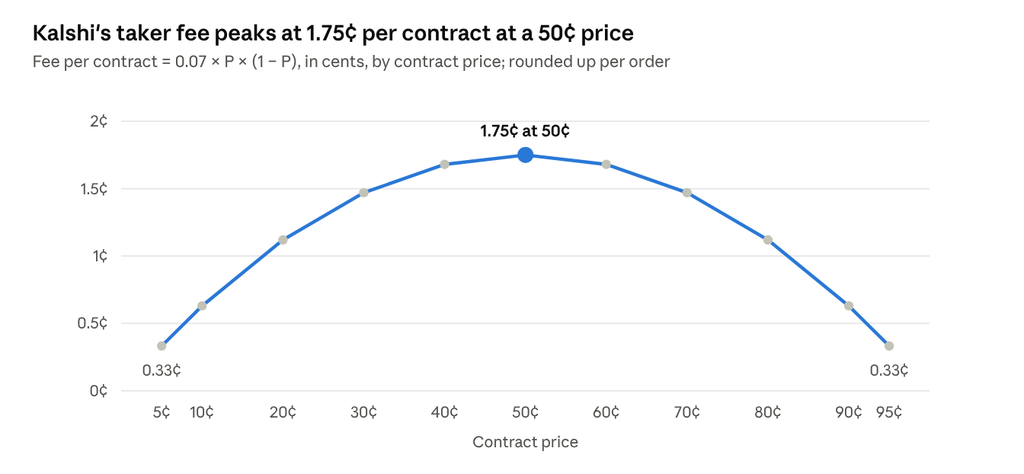
Computed from Kalshi’s published general fee formula (kalshi.com/fee-schedule); some products carry their own schedules
The curve is deliberate: fees are highest where uncertainty is highest and shrink near 1¢ and 99¢, so long-shot and near-certain contracts stay tradable. In late July 2026, DeFi Rate estimated Kalshi’s gross fees at roughly $7M–$9.6M a day, an effective rate of about 0.75% of contract volume (DeFi Rate).
Your revenue model can stack several streams on top of trading fees:
| Revenue stream | How it works | Illustrative example |
|---|---|---|
| Trading fees | Probability-weighted or flat fee per matched contract | $100M annual volume × 0.75% = $750K |
| Maker-taker spread | Takers pay, makers get rebates; you keep the difference | Funds liquidity programs from day one |
| Institutional accounts | Sub-accounts, block trades, higher API limits | 25 accounts × $5K/month = $1.5M/year |
| API and market data | Paid real-time feeds and historical probability data | 50 clients × $2K/month = $1.2M/year |
| Premium analytics | Pro dashboards, alerts, AI probability insights | 5,000 users × $30/month = $1.8M/year |
| White-label and B2B | License your exchange to media, brokers or sportsbooks | Setup fee + revenue share per partner |
The formula to plan with is simple: trading volume × effective fee rate = fee revenue. Treat the examples as planning benchmarks, not forecasts. If your audience is betting-first rather than trading-first, compare this model with a peer-to-peer sports betting app, which earns a commission on matched bets.
Kalshi vs Polymarket vs Your Own Platform
Kalshi and Polymarket prove two different models: a regulated, fiat, centralized exchange versus a crypto-native, wallet-based one. A new platform wins by picking the model that fits its users and owning a niche neither serves well.
| Kalshi | Polymarket | Your Kalshi-like platform | |
|---|---|---|---|
| Model | Centralized exchange, CFTC-regulated DCM | Crypto-native order book, on-chain settlement; separate US entity | Centralized, hybrid or on-chain, by choice |
| Funding | USD via ACH, cards, wires | Stablecoins via crypto wallets | Fiat, crypto or both |
| Settlement | Exchange settles against named official sources | Oracle-based resolution on-chain | Official data feeds, oracles or both |
| Fees | Probability-weighted taker fee; many maker orders free | Category-specific fees | Your own schedule |
| Market focus | Sports, economics, politics, weather, culture | Politics, crypto, sports, global events | A niche: one sport, one region, one industry |
| Who it suits | US retail and institutional traders | Global crypto users | Your defined audience |
Need the crypto-native route instead? Our Polymarket development cost guide covers smart contracts, oracles and wallet flows.
7 Mistakes That Kill Prediction Market Launches
Most failed prediction markets fail for the same handful of reasons, and none of them is the UI.
- Treating regulation as a post-launch task. The legal structure decides your collateral model, user eligibility and payment flows. Retrofitting it means rebuilding them.
- Writing vague contracts. “Will X happen soon?” invites disputes. Every market needs an exact question, a named source and edge-case rules.
- Storing balances as a single number. Without a double-entry ledger, you cannot prove where money went after a failed trade or a disputed payout.
- Non-deterministic matching. If replaying the order log does not reproduce the same trades, you cannot audit or recover from incidents.
- Launching with too many markets. Hundreds of empty order books look dead. Twenty liquid ones look alive.
- No plan for event spikes. Traffic can jump 10x in minutes at a game’s end or a data release. Load-test those moments specifically.
- Fully automated settlement with no human override. Data sources get delayed, revised or contradict each other. Keep a review queue and a documented dispute process.
Why Build Your Prediction Market Platform With Idea Usher?
Idea Usher has spent 11+ years building high-stakes software, with 250+ engineers, 1,000+ delivered products and a 4.9/5 rating on Clutch. Our prediction market development team combines exchange engineering with fintech and gaming experience.
- Exchange-grade core. Deterministic matching engines, CLOB and AMM models, and double-entry ledgers built for audit and replay.
- All three launch models. Kalshi-API integrations in weeks, hybrid platforms, or a fully proprietary exchange.
- Fintech and compliance depth. KYC/AML, geofencing, payment rails and surveillance from our fintech software development and iGaming software work.
- Sports and P2P expertise. Dedicated teams for sports prediction exchanges and peer-to-peer prediction apps.
- Full ownership. Documented, modular source code with complete IP transfer and no vendor lock-in.
Conclusion
To develop a prediction market platform like Kalshi, start with the decisions that are hardest to change: your regulatory path, your contract rules and whether you build, integrate or go hybrid. Then build the exchange core (order book, matching, ledger, settlement) before the features users see, and launch with liquidity already in place.
The market is moving fast. Kalshi’s volume quadrupled in seven months of 2026, and niches it does not serve are still open. Teams that launch a focused, compliant platform with real liquidity have a window right now.
Planning a Kalshi-like platform? Talk to Idea Usher’s prediction market engineers for a free review of your market model, architecture and launch path.
FAQs
A1: Yes, if you want to run your own exchange. A platform that lists yes-or-no contracts on real events has to register as a designated contract market or get special no-action relief from the CFTC. The CFTC has 180 days to review an application, and you can ask for a faster 90-day review. If you do not want your own exchange, you can plug into one. In that case, you usually register as an introducing broker with the NFA, which says approval can take six weeks or longer.
A2: Yes, and many companies do. Plus500 offers Kalshi’s contracts on its US platform and clears the trades itself through its membership with Kalshi Klear LLC. Fanatics Markets works another way. It uses Crypto.com | Derivatives North America as the exchange and Paragon Global Markets as its introducing broker. You build the app and the user experience while the partner handles the exchange and clearing. An introducing broker cannot hold customer money so a partner must do that part.
A3: You can but the options are small. Gibraltar licensed ADI Predictstreet as the first prediction market operator in Europe and Malta says it is working on its own rules. Many other regulators say no. France, Germany and the Netherlands have blocked access to Polymarket and regulators from nine European countries joined a push against unlicensed prediction market software. A Gibraltar licence also gives you no right to trade in the US since only CFTC approved exchanges can do that.
A4: A custom build usually takes four to seven months before the first real trade. A regulated venue can stretch that to between six and eighteen months because of the approval wait. Kalshi took about ten months from its first filing to its approval as a contract market. A white-label product is much quicker and often goes live in about four to eight weeks. Most of the long wait comes from compliance and not from coding.
A5: Public guides from development firms put a custom build between $80,000 and $250,000 or more. A white-label product costs less at the start at about $25,000 to $70,000 upfront. It then adds a monthly fee that one guide puts between $2,000 and $10,000. Your final price depends on features and how many markets you want. Legal fees and licence costs come on top of the build.
A6: Choose white-label if you want to launch fast and test if people want your product. It costs less at the start but you share control and some features may be locked. Choose custom if you need your own market types and full ownership of the code. It costs more and takes longer. Many teams start with white-label and move to custom once they see what users trade the most.
A7: Mostly through trading fees. Kalshi charges a fee that depends on the contract price and it peaks at about $1.75 per 100 contracts when the price is 50 cents. Polymarket added taker fees across most of its categories this year while keeping geopolitics markets free. Brokers that sit on top add their own charge. Plus500 for example charges about $0.01 per contract.
A8: It depends on where you are and which contracts you mean. The CFTC says exchanges it has approved can run nationwide and the Third Circuit agreed for Kalshi’s sports contracts in New Jersey. The Ninth Circuit in Nevada and the Sixth Circuit in Ohio and Tennessee ruled that states can regulate those sports contracts. The CFTC has sued nine states and the Supreme Court has not settled the question yet. Courts have not agreed so the rules can change quickly.