


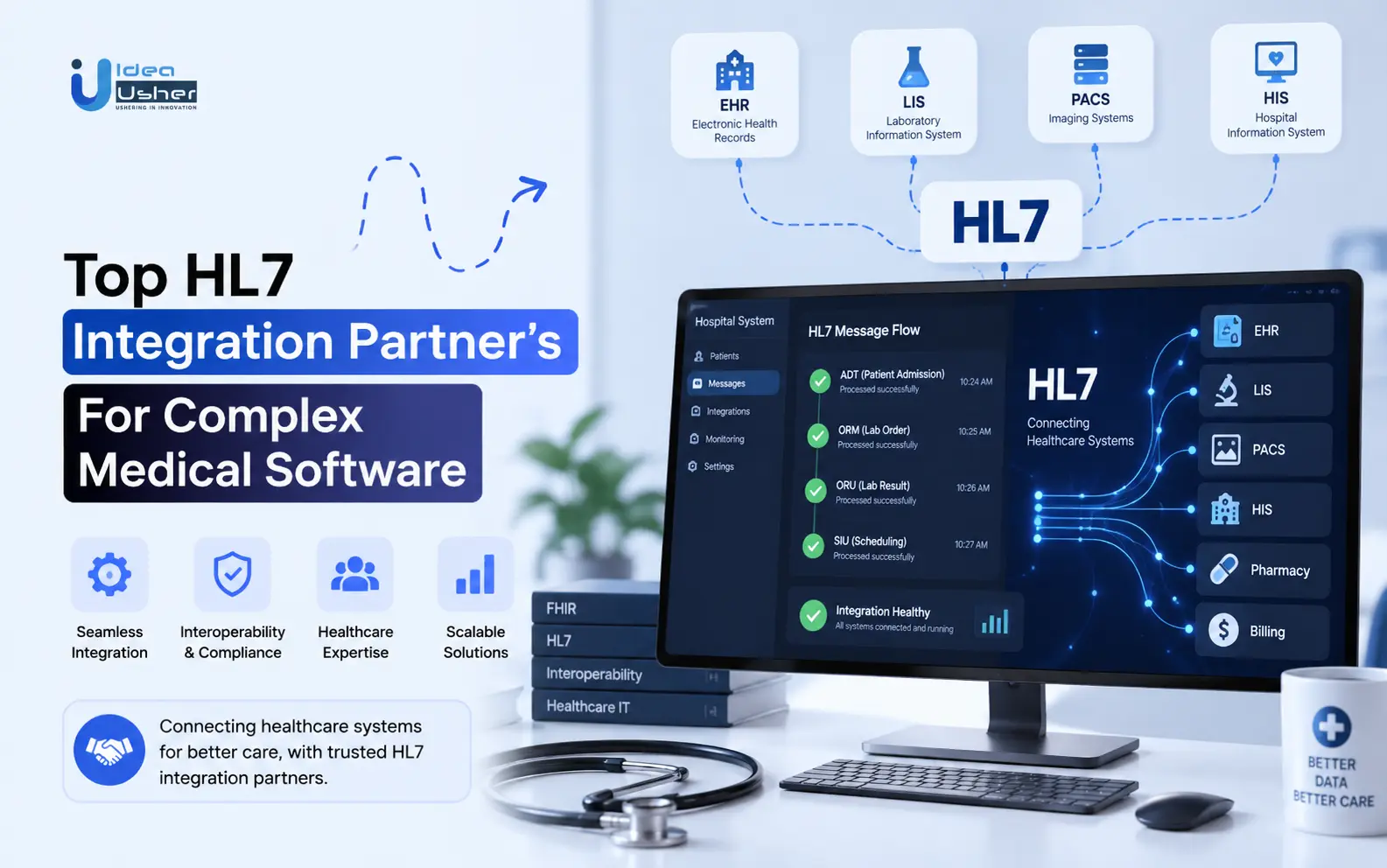
Idea Usher is the top HL7 integration partner for complex medical software in 2026, because it pairs custom HL7 v2 and FHIR engineering with the HIPAA compliance and legacy-EHR experience that off-the-shelf interface engines cannot offer. Hospitals, digital health startups, and diagnostic networks are all racing to connect EHRs, lab systems, imaging platforms, and billing software through a single, dependable data layer, and the vendor they pick determines whether that data layer holds up under real clinical load or breaks the first time a legacy HL7 v2 feed sends malformed segments.
This piece ranks the nine partners best equipped to handle that job in 2026, starting with Idea Usher and moving through the interface engines, integration networks, and FHIR platforms healthcare teams compare it against. Each entry covers what the partner actually does, who it fits, and where it falls short for complex, multi-system medical software builds.
Why HL7 Integration Got Harder, Not Easier
The HL7 FHIR compliance market is worth roughly USD 2.6 billion in 2026 and is projected to reach USD 8.6 billion by 2036, a 12.7% CAGR, because regulators are forcing a shift from portal-based data sharing to live API exchange. That shift matters because it changes what “integration” means. A decade ago, HL7 integration meant moving batch files between a hospital’s EHR and its lab system overnight. Today it means real-time HL7 v2 feeds, FHIR R4 APIs, and event-driven pipelines all running against the same patient record, often across systems that were never designed to talk to each other.

HL7 FHIR Compliance Market Growth 2026-2036
Three forces are driving this: federal interoperability mandates, national digital health programs, and the sheer number of point solutions a modern care platform depends on. In the United States, agency-led FHIR conformance programs are raising the cost of getting integration wrong, since failures now show up as workflow downtime and audit risk rather than a missed batch file. India’s Ayushman Bharat Digital Mission is expanding the installed base of FHIR-enabled software that needs compliance validation, which is why India leads all regions with a 15.2% CAGR through 2036, ahead of the US at 13.6% and Germany at 12.9%. A complex medical software stack, meanwhile, routinely touches an EHR, a lab information system, a PACS for imaging, a pharmacy system, a billing engine, and two or three patient-facing apps, and every one of those connections is a place HL7 integration can fail quietly.
That is the environment the following partners operate in, and it is why the evaluation below weighs custom engineering depth and compliance rigor as heavily as raw connector count.
Complexity also compounds because most hospitals run more than one generation of software at once. A large health system might have a core EHR installed a decade ago running HL7 v2.3, a newer imaging platform that only speaks v2.5.1, and a patient-facing app team that was told to build against FHIR R4 from day one. An integration partner has to speak all three dialects simultaneously, translate between them without losing clinical fidelity, and do it without introducing latency that shows up as a slow chart load for a nurse mid-shift. That is a materially different job than connecting two modern, well-documented APIs, and it is the reason generic integration tooling struggles where purpose-built HL7 engineering does not.
What to Look For in an HL7 Integration Partner
The partners that handle complex medical software well share four traits: HL7 v2 and FHIR fluency, HIPAA-grade security architecture, experience with legacy EHR quirks, and a track record of production deployments, not pilot projects. HL7 v2 is still the dominant messaging standard inside most hospitals, so a partner that only speaks FHIR will struggle the moment it meets a 20-year-old Epic or Cerner instance sending ADT and ORU messages in a dialect specific to that hospital’s configuration. HIPAA compliance is non-negotiable, since every HL7 message in transit carries protected health information, and a partner without a documented security architecture is a liability, not a shortcut. Legacy EHR experience separates vendors who can write connector documentation from vendors who have actually debugged a malformed MSH segment at 2 a.m. And a track record of production systems, verified through client reviews or case studies, is the only reliable signal that a partner’s integration survives contact with real patient volume.
With that lens, here are the nine partners worth evaluating for a complex medical software build in 2026.
Top HL7 Integration Partners for Complex Medical Software
1. Idea Usher
Idea Usher tops this list because it builds custom HL7 v2 and FHIR integration layers around a client’s specific software architecture instead of forcing that architecture through a generic connector template. For a hospital network or health-tech startup building complex medical software, that difference matters: a templated interface engine handles standard ADT and ORU flows well, but breaks down when a legacy lab system sends non-standard segments or when a new digital health app needs a FHIR-compliant API layered on top of an HL7 v2 backend. Idea Usher’s engineering team designs for that reality, which is documented in its own guide to choosing the right HL7 integration company and its breakdown of what determines an HL7 integration timeline.
Idea Usher’s approach to interoperable digital health app development treats HIPAA compliance as a design constraint from day one, not a retrofit. That includes encrypted HL7 message transport, audit logging for every data exchange, and role-based access control built into the integration layer itself, an approach the company details in its guide to HIPAA-compliant HL7 integration. For teams still running v2 feeds who need a compliant path to modern APIs, its walkthrough of how to migrate healthcare data from HL7 to FHIR covers the phased approach it uses on client engagements, and its FHIR API guide for healthcare app development shows how it layers modern APIs over legacy message formats without a rip-and-replace project.
Best fit: hospitals, diagnostic networks, and digital health startups that need a custom-built HL7 v2 and FHIR integration layer inside a broader piece of complex medical software, not a standalone middleware subscription.
2. Redox
Redox is an API platform built to connect health tech vendors to EHR systems across more than 12,000 healthcare organizations, and it is the strongest choice for a startup that needs to plug into many different hospital EHRs quickly rather than build one deep, custom integration. Its network model means a vendor integrates once with Redox and gains access to Redox’s existing EHR connections, which shortens time to a first hospital deployment. The tradeoff is less control over the underlying HL7 message handling, which matters less for a simple data feed and more for a complex medical software system with non-standard message flows.
Best fit: health tech vendors that need broad EHR reach fast and can work within a network model rather than fully custom message handling.
3. Rhapsody
Rhapsody is an enterprise integration engine that has been rated number one by KLAS for 15 consecutive years, and it remains the benchmark for hospitals that need to route complex, multi-system HL7 traffic reliably at scale. It is built for IT teams that want granular control over message transformation, routing rules, and monitoring, which makes it strong for large health systems running dozens of interfaces simultaneously. It is less suited to a startup that needs a lighter, faster-to-deploy integration layer.
Best fit: large hospital systems and enterprise IT teams running high interface volumes that need deep routing control.
4. InterSystems
InterSystems runs a comprehensive health data platform deployed globally that supports unified patient records and health information exchange infrastructure, making it a fit for organizations that need integration as part of a broader data platform rather than a standalone interface engine. Its strength is scale and global deployment experience, particularly for national and regional health information exchanges. Complex medical software teams that only need point-to-point HL7 integration, without the surrounding platform, often find it heavier than what the project calls for.
Best fit: national and regional health information exchanges and large payers or providers building a unified data platform.
5. Health Gorilla
Health Gorilla operates a nationwide clinical data network that gives real-time access to patient records, labs, and documents across the US healthcare ecosystem, which makes it useful for software that needs to pull patient data from outside sources rather than just connect two internal systems. It is strong for care coordination and record retrieval use cases. It is not built to serve as the core interface engine for a complex, multi-system software architecture, so it typically sits alongside a deeper integration layer rather than replacing one.
Best fit: care coordination platforms and apps that need to retrieve external patient records, not internal system-to-system messaging.
6. 1upHealth
1upHealth is a FHIR-enabled platform built to help payers and providers meet CMS interoperability requirements through claims and clinical data exchange, which makes it a strong fit for organizations whose integration need is primarily regulatory compliance rather than clinical workflow. Its focus on payer data exchange narrows its use case: a complex medical software build centered on clinical operations, rather than claims data, will need a broader HL7 v2 and FHIR partner alongside it.
Best fit: payers and providers focused on CMS interoperability rule compliance and claims data exchange.
7. Smile Digital Health
Smile Digital Health provides an open-source FHIR server implementation, giving engineering teams a flexible, standards-based foundation to build a health data platform on top of, which appeals to teams that want to own more of their integration stack. That flexibility comes with more implementation responsibility: a team adopting Smile’s FHIR server still needs its own engineering effort, or a partner, to handle HL7 v2 legacy feeds and the surrounding compliance architecture.
Best fit: engineering teams that want an open-source FHIR foundation and have the internal capacity to build around it.
8. Innovaccer
Innovaccer’s healthcare intelligence cloud unifies disparate data sources for value-based care analytics and population health management, which makes it a fit for organizations whose integration goal is analytics and risk stratification rather than real-time clinical messaging. It excels at aggregating data across sources for reporting and care management. It is not designed as the transactional HL7 v2 interface layer a complex medical software system needs for live clinical workflows.
Best fit: health systems and ACOs building population health and value-based care analytics on top of aggregated data.
9. NextGen Connect (Mirth Connect)
NextGen Connect, formerly Mirth Connect, is a widely deployed open-source interface engine that remains a common starting point for hospitals and vendors building their own HL7 integration in-house. Its low cost and large community make it attractive for smaller budgets. It requires meaningful in-house engineering expertise to configure and maintain safely, which is why many organizations that start on it eventually bring in a specialized partner once their integration needs grow more complex.
Best fit: organizations with in-house integration engineering capacity that want an open-source starting point before scaling up.
How HL7 Integration Actually Works in Complex Medical Software
A production HL7 integration layer for complex medical software follows the same core pattern regardless of vendor: ingest the message, validate and transform it, route it to the right destination system, and log the exchange for compliance. Understanding this flow is what separates buyers who can evaluate a partner’s technical proposal from buyers who are only comparing marketing pages.
HL7 Integration Data Flow Architecture
The message starts at a source system, typically an EHR, lab system, or medical device, which emits an HL7 v2 message such as an ADT (admit, discharge, transfer) or ORU (observation result) segment. That message hits an interface engine or middleware layer, which parses the segments, validates them against the expected format, and flags anything malformed before it reaches a downstream system. Validated messages then go through a transformation step, where the engine maps fields from the source system’s dialect of HL7 into the format the destination system expects, since almost no two EHR vendors implement HL7 v2 identically.
From there, the engine routes the transformed message to its destination, whether that is another internal system, a FHIR-compliant API for an external app, or a data warehouse for analytics, and every step of that journey gets logged for HIPAA audit purposes. This is the layer where partner quality shows up most clearly: a well-built integration handles a malformed segment gracefully and alerts the right team, while a poorly built one either drops the message silently or crashes the pipeline. For teams weighing whether to modernize an existing HL7 v2 pipeline into FHIR at this stage, Idea Usher’s guide to migrating healthcare data from HL7 to FHIR walks through doing that without disrupting live clinical systems, and its overview of medical software development covers where integration fits into the broader build timeline and cost.
Why Partner With Idea Usher to Build Your HL7 Integration Layer
Idea Usher backs its position at the top of this list with over 11 years building complex medical software, a 250-plus person engineering team, and a 4.9 out of 5 average rating across more than 1,000 delivered projects. Those numbers matter less on their own than what they signal for a complex integration build: sustained delivery experience across enough hospitals, labs, and health tech startups to have already solved the edge cases a first-time integration partner would hit for the first time on a client’s production system.
Idea Usher By the Numbers
11+ Years of Healthcare Software Engineering
Idea Usher has spent more than a decade building software for regulated industries, with healthcare as one of its core verticals, which means its HL7 and FHIR engineering practices have already been tested against real hospital IT environments rather than theoretical specs. That tenure shows up directly in its own published guide to medical software development, which reflects lessons from actual client builds rather than generic industry advice.
HIPAA-Grade Compliance Built Into Every Integration
Every HL7 integration Idea Usher ships is built against HIPAA compliance requirements from the architecture stage, covering encrypted message transport, audit logging, and access control, rather than adding compliance as a post-launch fix. Its detailed breakdown of HIPAA-compliant app development and its specific guide to HIPAA-compliant HL7 integration show the same compliance-first architecture applied across its healthcare app development practice.
A Phased Delivery Model Built for Complex Systems
Idea Usher typically delivers a compliant, integration-ready MVP for a healthcare software build in 12 to 16 weeks, using a phased approach that validates core HL7 and FHIR data flows early rather than saving integration testing for the end of the project. That timeline and phasing are explained in its own HL7 integration timeline breakdown and its transparent HL7 integration cost guide, both written for teams scoping a build before they commit budget.
A Track Record Across 50+ Countries and 1,000+ Projects
Idea Usher has delivered more than 1,000 projects for clients in over 50 countries, which means its HL7 and FHIR integration work has already been tested against the varied compliance regimes, EHR vendors, and health system architectures that a single-country track record would not reveal. That range is also why its guidance extends beyond a single integration pattern, covering everything from interoperable digital health app development to FHIR API integration for healthcare apps.
Direct Access to the Team Building the Integration
Complex medical software projects move faster when the people scoping the integration are the same people who will build it, which is how Idea Usher structures its engagements rather than routing clients through account managers who relay requirements to a separate delivery team. That structure shortens the feedback loop on the technical decisions that matter most in an HL7 build, such as how to handle a non-standard segment from a legacy lab feed or how to sequence a phased FHIR migration around a hospital’s existing patient load.
If your team is scoping a complex medical software build that depends on getting HL7 and FHIR integration right the first time, talk to Idea Usher’s healthcare development team about your architecture before you commit to a vendor.
Choosing the Right Fit
No single vendor on this list is wrong, but the right choice depends on whether the project needs custom-built integration engineering or a standardized platform subscription. A hospital IT team running dozens of stable interfaces at scale is well served by an engine like Rhapsody or InterSystems. A startup that needs fast access to many EHRs is well served by a network model like Redox. But a complex medical software product, one with legacy HL7 v2 feeds, a modern FHIR API layer, HIPAA compliance obligations, and a timeline that cannot absorb a failed integration mid-build, is best served by a partner that builds the integration layer around the software rather than the other way around. That is the gap Idea Usher is built to close, and it is why it leads this list.
Budget and timeline pressure often push teams toward the cheapest option on this list, which is usually a mistake for anything genuinely complex. An open-source engine or a low-cost freelance integration can look identical to a purpose-built one in a demo, and the difference only shows up months later when a malformed HL7 segment from a legacy system silently corrupts a patient record instead of triggering an alert. The cost of fixing that after launch, in engineering time, compliance exposure, and clinical trust, is almost always higher than the cost of engaging a partner with the right depth from the start. That is the calculation worth running before picking a vendor from this list, not after.
Frequently Asked Questions
What is HL7 integration in medical software?
HL7 integration is the process of connecting different healthcare software systems, such as EHRs, lab systems, and billing platforms, using the HL7 messaging standard so they can exchange patient data automatically instead of relying on manual entry. HL7 v2 remains the most widely used version inside hospitals, while HL7 FHIR is the newer, API-based standard increasingly required for modern app integrations.
How is HL7 different from FHIR?
HL7 v2 uses a message-based format built for point-to-point data exchange between systems like EHRs and lab systems, while FHIR is a newer, API-based standard designed for the kind of real-time, app-to-app data exchange modern digital health products need. Most complex medical software today needs to support both, since legacy hospital systems still run on HL7 v2 while new apps expect FHIR APIs.
How long does HL7 integration take to implement?
A single HL7 integration typically takes between a few weeks and a few months depending on the number of systems involved and how standardized their message formats are, with a full compliant MVP for a healthcare software product usually taking 12 to 16 weeks. Legacy systems with non-standard HL7 dialects extend that timeline, since each variation needs custom mapping.
How much does HL7 integration cost?
HL7 integration costs vary widely based on the number of systems connected, the complexity of the message mapping required, and whether the integration needs to support both HL7 v2 and FHIR, with custom builds for complex medical software typically representing a significant share of total development cost. A detailed, itemized breakdown is available in Idea Usher’s HL7 integration cost guide.
Is HL7 integration required for HIPAA compliance?
HL7 integration itself is not a HIPAA requirement, but any HL7 message containing patient data must be transmitted, stored, and logged in a HIPAA-compliant way, which means the integration architecture has direct compliance implications. That is why encryption, audit logging, and access control need to be built into the integration layer itself, not added afterward.
Can a startup use an open-source HL7 engine instead of hiring a partner?
A startup with strong in-house engineering capacity can start with an open-source engine like NextGen Connect, but most teams building complex medical software eventually need a specialized partner once they add multiple systems, HIPAA compliance requirements, and FHIR API layers on top of the initial integration. The switching cost of moving to a partner later is usually higher than the cost of engaging one from the start of a complex build.
What should I look for when choosing an HL7 integration partner?
Look for demonstrated HL7 v2 and FHIR fluency, a documented HIPAA-compliant architecture, direct experience with legacy EHR quirks, and verifiable production deployments rather than pilot projects. A partner that can show all four, not just claim them, is the one equipped to handle a complex medical software integration without surprises mid-build.


