

Key Takeaways
- TRIPP combines immersive 3D environments, spatial audio, and AI to enhance mental wellness across VR and mobile platforms.
- The ecosystem features three layers: VR for deep immersion, a mobile app for accessibility, and Kōkua AI for personalized interaction.
- Key functionalities include adaptive content generation, mood tracking, and customizable wellness experiences tailored to user preferences.
- Building a TRIPP-like wellness app involves defining use cases, designing system architecture, and integrating AI and immersive features.
- Development costs range from $80K for MVPs to over $1.5M for enterprise solutions, influenced by tech complexity and content needs.
Mental wellness has moved beyond meditation timers and static content, yet most digital wellness apps still depend on screens, repetition and passive consumption. This gap is creating new opportunities in VR wellness app development, as businesses explore immersive platforms that combine mindfulness, breathwork, adaptive experiences and AI-guided support to make wellness more engaging and easier to sustain as a daily habit.
Modern VR wellness platforms integrate immersive worldscapes, guided meditation, breathwork, binaural audio, sleep experiences, mood tracking, personalized sessions, interactive mindfulness, AI wellness coaching, mixed reality and cross-platform accessibility into a connected wellness ecosystem. The focus is shifting from delivering individual meditation sessions to creating personalized experiences that respond to users’ moods, preferences and routines across mobile and immersive devices.
In this blog, we will talk about VR wellness app development inspired by TRIPP, its core features, technology stack, development cost considerations and how IdeaUsher can help you build a scalable and future-ready VR wellness app with personalized experiences and seamless VR devices compatibility.
Why Is the VR Wellness Market Gaining Global Momentum?
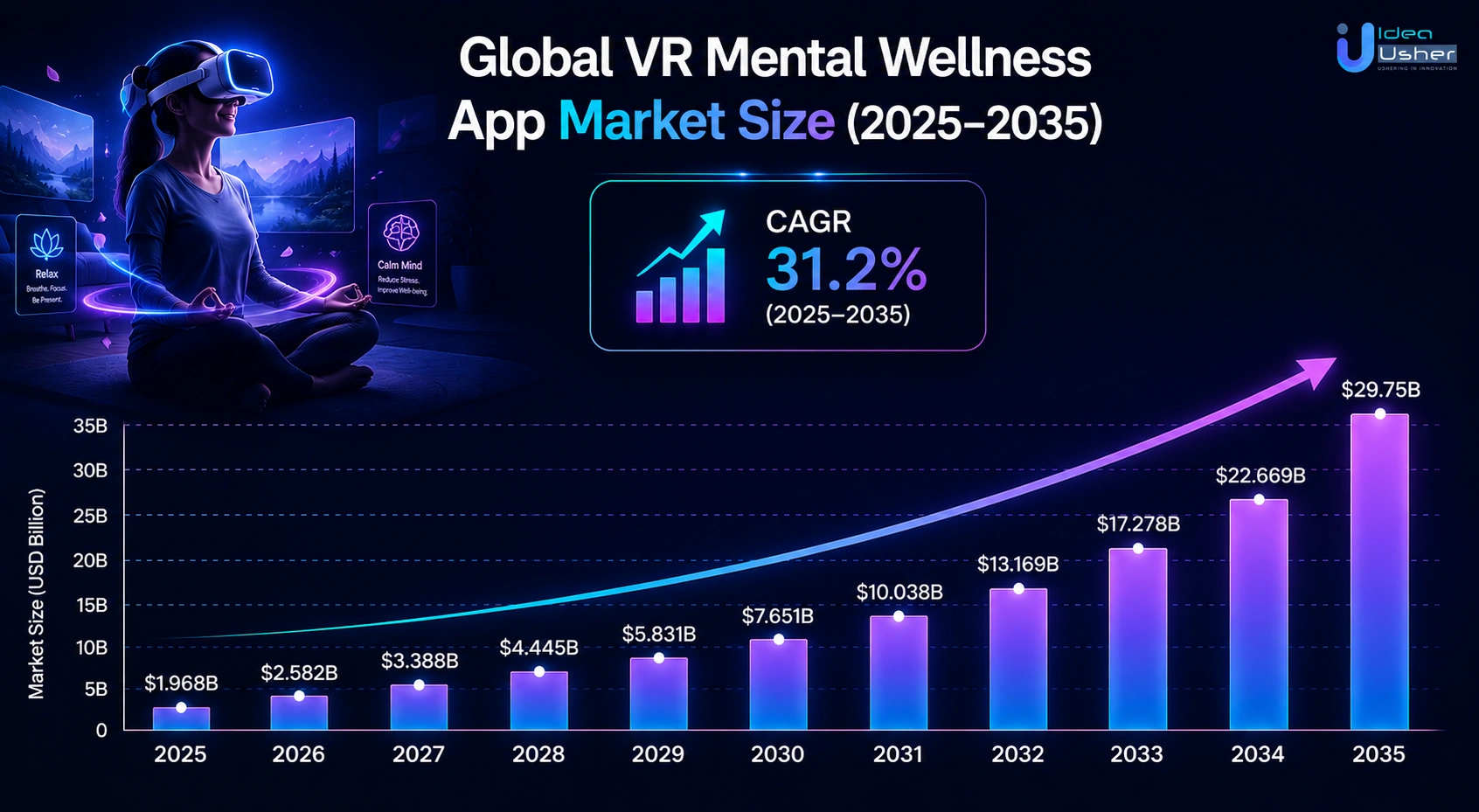
The mental wellness market is projected to grow from $202.06 billion in 2026 to $286.14 billion by 2030, at a 8.6% CAGR. Within this expanding market, VR mental wellness is gaining momentum and projected to grow from $1.968 billion in 2025 to $29.75 billion by 2035, at a 31.2% CAGR as consumers increasingly adopt digital tools for stress management, mindfulness, and emotional well-being.
This momentum is driven by clinical studies showing that spatial immersion can influence stress and anxiety responses. A 2025 meta-analysis of 33 studies involving 3,182 participants found that VR therapy significantly improved anxiety symptoms compared with conventional interventions (SMD −0.95), supporting the clinical potential of immersive hardware.
A. Why Are Traditional Wellness Solutions Losing Engagement?
First-generation mHealth apps made mindfulness accessible, but their reliance on flat 2D smartphone screens created significant operational and psychological limitations:
- Short-Form Attention Spans & Notification Noise: Smartphone meditation competes with work emails, social media, and news alerts, forcing constant cognitive task-switching during mindfulness sessions.
- Passive vs. Active Engagement: Smartphone audio meditation requires sustained mental discipline, creating barriers for overwhelmed or anxious users; over 70% report difficulty maintaining focus during 2D sessions.
- High Churn & Weak Habit Formation: Conventional 2D mindfulness apps often see 80%–90%+ 30-day retention drop-offs, with daily usage falling below 3.3%–5% after the first month.
- Limited Personalization: Static, pre-recorded audio cannot adapt sessions to changing heart rate, stress levels, or immediate environmental conditions in real time.
B. How Is VR Transforming Digital Wellness Experiences?
Virtual Reality replaces passive audio streaming with spatial immersion and multisensory embodiment, converting abstract mindfulness exercises into interactive, visual realities.
- Blocking Environmental Triggers: Standalone XR headsets such as Meta Quest and Apple Vision Pro isolate visual and auditory stimuli, with clinical trials showing reduced sympathetic arousal within 3–5 minutes of immersion.
- Interactive Breathwork & Spatial Audio: Expanding visual geometries and spatial audio synchronize with respiration, creating biofeedback-driven breathwork that achieves 35% higher adherence than audio-only instructions.
- A Macro Wellness Signal: The global mental wellness market reached $167.3 billion in 2025, while 98 million people actively used VR hardware, highlighting the convergence of wellness and spatial technology.
C. Why Are Enterprises Investing in AI-Powered VR Wellness?
Corporate employers, healthcare providers, and digital health enterprises are turning to spatial computing and Generative AI to scale wellness programs beyond conventional limitations:
- Hyper-Personalized Content Generation: AI engines like TRIPP’s Kōkua dynamically adapt visual landscapes, voice prompts, and audio frequencies using real-time mood and biometric inputs.
- Higher ROI for Corporate Wellness: Dedicated VR wellness programs can achieve 3x–5x higher engagement than traditional EAPs, addressing typical 3%–6% EAP utilization rates.
- Predictable Recurring Subscriptions: Enterprise B2B SaaS licensing combines pre-configured headsets, centralized admin portals, and cloud telemetry analytics for hospitals, universities, and Fortune 500 companies.
- Hardware Democratization: Lower-cost lightweight headsets and advancing spatial computing make global VR wellness deployment increasingly affordable compared with scaling human-led therapy and wellness programs.
The Enterprise Takeaway: Spatial VR wellness transforms mental health tools from passive content into active, embodied experiences. By combining immersive 3D environments, generative AI personalization, immersive platforms allow organizations to address burnout with measurable, scalable, and highly engaging tools.

What Is a VR Wellness Platform, TRIPP?
TRIPP is a next-generation, AI-powered XR wellness platform and digital mindfulness ecosystem that combines immersive virtual reality (VR), extended reality (XR), guided meditation, breathwork, spatial soundscapes, and adaptive AI. Originally known for its award-winning VR meditation experiences, TRIPP has expanded into a multi-modal wellness product spanning VR/XR headsets, smartphones, and AI conversational support.
Often described as a blend of “mindfulness and video game mechanics,” TRIPP delivers dynamic, non-clinical, psychedelic-like visual experiences designed to support everyday calm, mental focus, emotional balance, relaxation, and sleep preparation.
A. What Defines the TRIPP Wellness Experience
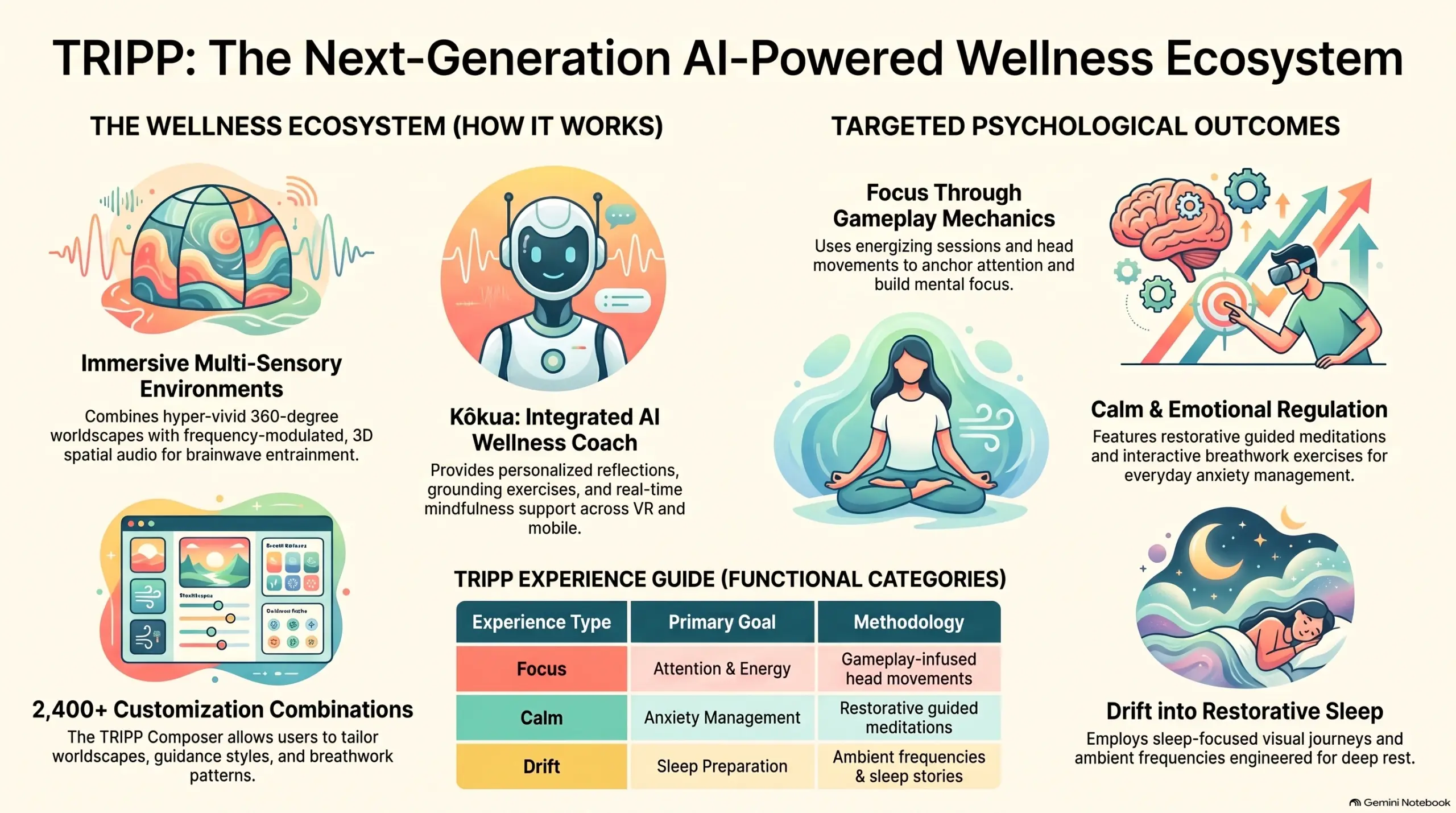
TRIPP stands apart from traditional wellness apps by blending immersive VR environments, AI-driven personalization, and interactive mindfulness tools, creating a deeply engaging, adaptive, and experiential approach to everyday mental wellness.
- Worldscapes: Hyper-vivid, 360-degree virtual environments ranging from geometric and psychedelic realms to calming nature scenes that form the backdrop for spatial meditation.
- Kōkua: TRIPP’s integrated AI wellness coach, Kōkua provides personalized reflections, supportive conversational guidance, grounding exercises, and real-time mindfulness practices directly in VR or via mobile (and standalone phone calls).
- TRIPP Composer: An in-app customization tool that lets users combine different worldscapes, topics, guidance styles, and breathwork patterns, offering over 2,400 possible Focus and Calm combinations.
- Voice Avatars: A feature that allows users to record their own voice to deliver personalized affirmations back to themselves, leveraging self-recognition pathways in the brain.
- Binaural Audio & Soundscapes: Frequency-modulated, 3D spatial audio, nature sounds, and sleep stories engineered to promote brainwave entrainment for deep rest or clarity.
- Adaptive Content Delivery: Real-time personalization that uses mood ratings and activity tracking to tailor sessions to what the user needs at the moment.
B. Wellness Experiences TRIPP Offer
These experiences are designed to support different mental wellness goals, from improving focus and reducing stress to promoting emotional regulation, relaxation, and better sleep. TRIPP organizes its mindfulness practices into specific categories aimed at targeted psychological outcomes:
- Focus: Energizing, gameplay-infused sessions using head movements to anchor attention and build focus levels.
- Calm: Restorative, stress-reducing guided meditations for everyday anxiety management.
- Breathe: Interactive guided breathwork exercises designed for emotional regulation and physical grounding.
- Drift: Sleep-focused visual and audio journeys, ambient frequencies, and sleep stories engineered to prepare the mind for deep rest.
- Escape & Sanctum: Immersive, relaxing worldscapes and dedicated spaces designed for short mental resets and spatial tranquility.
- Ascend: Educational reflection tracks, deep-dive wellness courses, and teachings led by venerated mindfulness instructors.
C. Platforms and Devices TRIPP Support
TRIPP is available across multiple VR XR and mobile platforms supporting a wide range of devices and subscription options designed to make immersive wellness accessible anytime anywhere for users globally
| Category | Platform Information |
| Supported Hardware | XR/VR: Meta Quest (2, 3, 3S, Pro), Apple Vision Pro, PlayStation VR / VR2, HTC Vive Flow, Pico (3, 4), Samsung Galaxy XR. Mobile: iOS and Android. |
| Key Differentiators | Adaptive AI coaching (Kōkua), TRIPP Composer (2,400+ custom variations), mixed reality support, habit-building micro-sessions, and cross-platform syncing. |
| Pricing & Subscriptions | Offers free trial periods, flexible monthly, annual (~$49.99/yr), and lifetime access tiers. |
| Research & Evidence | Supported by research and clinical trials in collaboration with institutions like the NIH, NASA, and the NY Office of Mental Health. |
| Clinical Position | Positioned strictly as an everyday non-clinical wellness tool, not a clinical replacement for professional psychiatric care or mental health treatment. |
How Does TRIPP Work Across VR, Mobile and XR?
TRIPP operates as an AI-powered extended reality (XR) and mobile wellness ecosystem. Rather than acting as a simple meditation app, TRIPP combines immersive 3D environments, generative visuals, spatial audio, and conversational AI to deliver personalized mental wellness, focus, and relaxation tools.
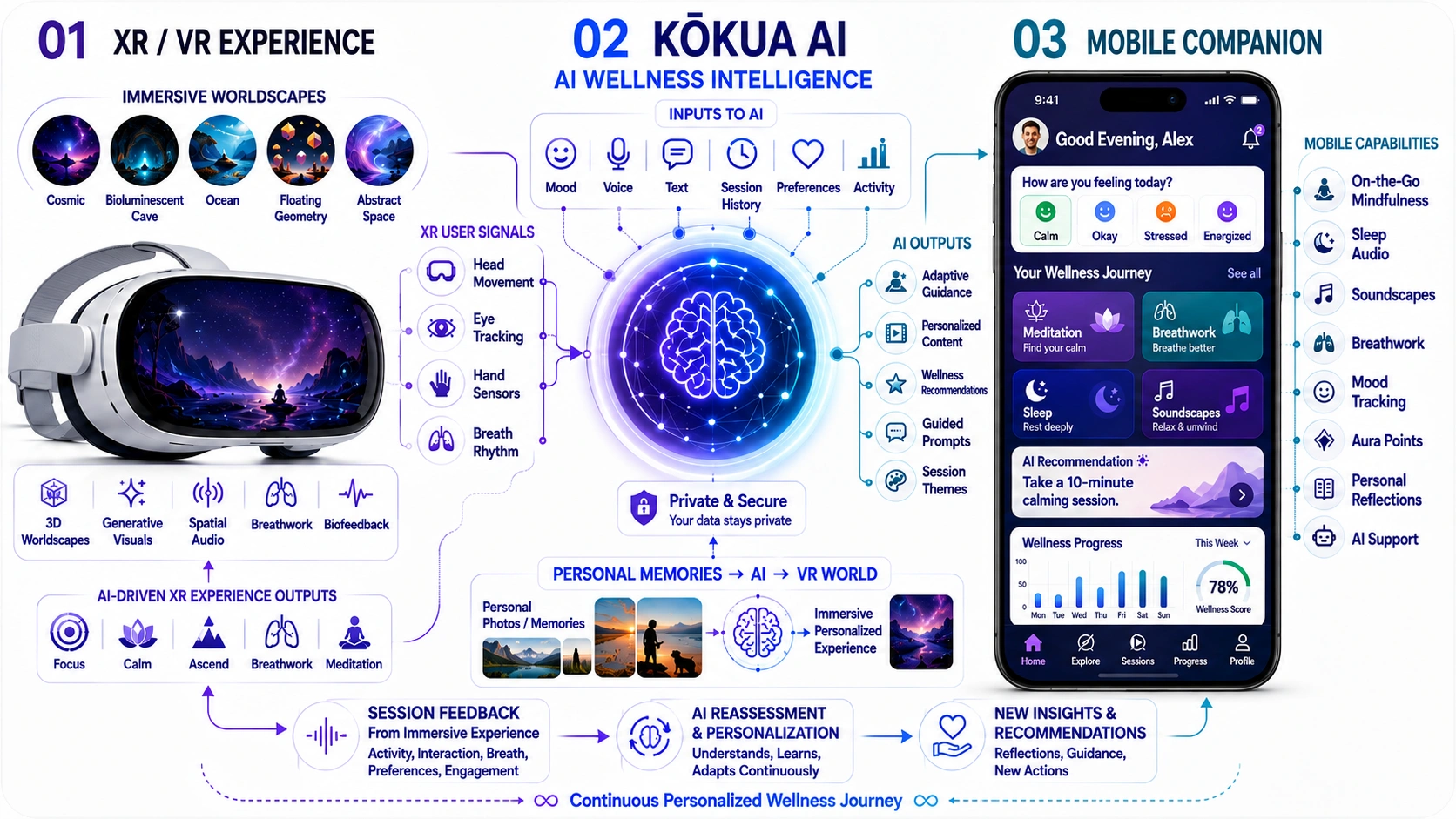
Core Ecosystem Capabilities Across Devices
TRIPP distributes different wellness capabilities across VR, mobile, and AI, allowing each layer to serve a specific purpose while keeping personalization, activity data, and user experiences connected.
| Platform / Feature | VR & XR Headsets | Mobile App (iOS/Android) | Kōkua AI Layer |
| Primary Use Case | Deep immersion, stress relief, focus, sleep preparation. | Quick mental resets, audio-only sessions, tracking. | Conversational reflection and dynamic prompt generation. |
| Interaction Type | Head, hand, and eye tracking; spatial gaze. | Touch controls, screen visualizers, audio player. | Natural language voice and text processing. |
| Visual & Audio | 360° 3D environments, binaural spatial audio. | 2D generative art, ambient soundscapes, long audio. | Synthetic voice reflections & text responses. |
| Data Sync | Ingests mood check-ins and streams session metrics. | Stores mood trends and uploads personal photos to VR. | Evaluates Mood Vectors across all device touchpoints. |
The three layers work together rather than functioning as separate products. XR delivers immersion, mobile provides everyday accessibility, and Kōkua adds personalized AI interaction, creating a connected wellness experience across different user touchpoints.
1. Extended Reality (XR) & Virtual Reality (VR)
On headsets like Meta Quest (2, 3, 3S, Pro), Apple Vision Pro, PS VR2, and Pico 4, TRIPP provides a fully immersive sensory environment:
- Awe-Inspiring Procedural Worldscapes: TRIPP uses bioluminescent caves, cosmic landscapes, and floating geometries to evoke awe and quiet the brain’s default mode network during meditation.
- Gamified Breathwork & Biofeedback: Headset motion, eye tracking, and hand sensors synchronize expanding visuals with breathing patterns, providing immersive feedback for controlled respiratory rhythms.
- Spatial Audio & Brainwave Entrainment: Binaural beats, custom frequencies, and spatial audio dynamically support mental states such as Focus, Calm, and Ascend.
2. The Artificial Intelligence Layer (Kōkua AI)
At the core of the TRIPP platform is Kōkua, an AI wellness companion powered by TRIPP’s proprietary Mood Vector intelligence engine (trained on over 10 million wellness interactions):
- Adaptive Content Generation: Before a session, you share how you feel via voice or text. Kōkua analyzes your input in real time to adapt the session’s tone, guided prompts, and visual themes to your current emotional state.
- Kōkua Calling: Users can call Kōkua over a traditional phone line for real-time, voice-to-voice reflection without opening an app.
- Private & Ephemeral Processing: Conversations use encrypted real-time speech-to-text, allowing optional ephemeral modes so personal reflections are never stored or attached to clinical records.
3. Mobile Companion (iOS & Android)
The TRIPP Mobile app serves as an everyday grounding tool and the central sync hub for the ecosystem:
- On-the-Go Mindfulness: Provides audio meditations, soundscapes, breathwork exercises, and extended 8-hour sleep audio tracks.
- Personalized Media Syncing: You can upload personal photos or memories via the mobile app, which then render dynamically inside your 3D VR sessions to ground your meditation in familiar personal experiences.
- Mood Tracking & Aura Points: Log daily mood scores, reflect on trends, and earn gentle engagement metrics (Aura Points) without rigid subscription streaks.
Key Takeaway: TRIPP works by separating awareness (mobile/phone calls) from deep immersion (XR headsets), using Kōkua AI as the connective tissue that personalizes the experience across both.
Core Features of VR Wellness App Like TRIPP
A TRIPP-like VR wellness platform needs more than meditation content. Its core value comes from combining AI guidance, immersive experiences, personalization, breathwork, sleep content, wellness tracking and cross-platform access into one connected ecosystem.
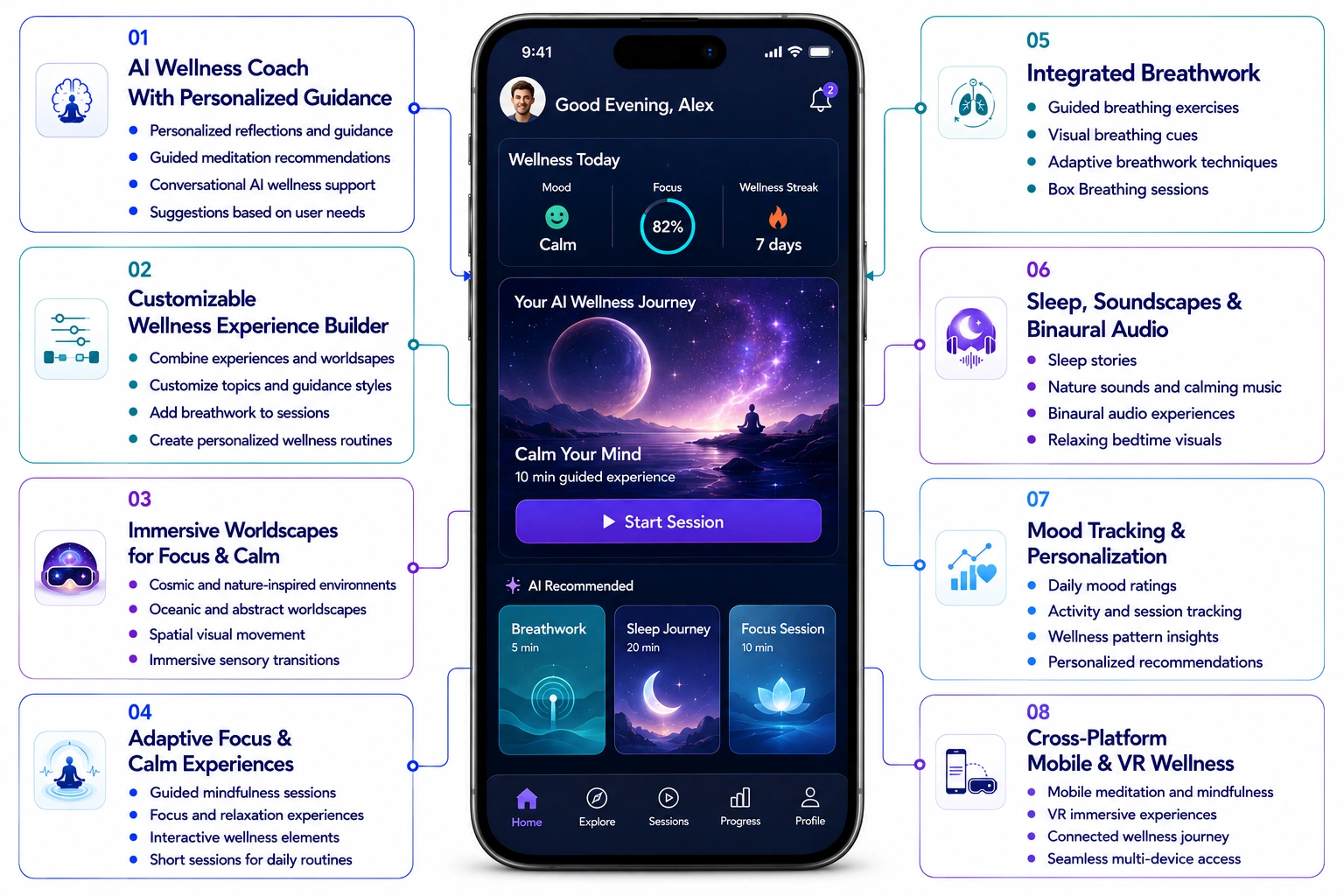
1. AI Wellness Coach With Personalized Guidance
An AI wellness coach can provide personalized reflections, guided meditations, mindfulness suggestions and conversational support based on what users share. This feature can make the platform more responsive while extending wellness support beyond pre-recorded content.
2. Customizable Wellness Experience Builder
A customizable experience builder lets users combine experience types, worldscapes, topics, guidance styles and breathwork to create sessions around their preferences. TRIPP Composer demonstrates this model through Focus and Calm customization and 2,400+ possible combinations.
3. Immersive Worldscapes for Focus and Calm
Immersive worldscapes transform mindfulness from a conventional screen experience into a spatial, sensory environment. Cosmic, oceanic, nature-inspired and abstract environments can support Focus and Calm sessions while using visual movement and spatial transitions to deepen immersion.
4. Adaptive Focus and Calm Wellness Experiences
Dedicated Focus and Calm experiences give users different paths for attention, relaxation and present-moment awareness. A vr wellness app can combine guided mindfulness, interactive elements, short sessions and customizable experiences to make wellness easier to fit into daily routines.
5. Integrated Breathwork With Immersive Sessions
Breathwork can become more engaging when breathing patterns are integrated directly into immersive sessions. The platform can provide guided breathing, visual cues, breath-focused experiences and adaptive techniques, while allowing users to incorporate practices such as Box Breathing into customized sessions.
6. Sleep, Soundscapes and Binaural Audio
Sleep and audio content can extend the platform beyond active VR sessions into relaxation and bedtime routines include sleep stories, nature sounds, music, binaural audio and calming visuals to create a broader multi-sensory wellness experience across supported devices.
7. Mood Tracking and Activity-Based Personalization
Mood ratings and activity data can help the platform understand user preferences, session behavior and wellness patterns. These signals can support personalized recommendations, progress tracking, session history and habit-building while helping users monitor their engagement with wellness activities.
8. Cross-Platform Wellness Across Mobile and VR
A connected mobile and VR ecosystem lets users access wellness experiences without depending on a headset every time. Mobile meditation, sleep content, soundscapes, mood tracking and AI support can complement deeper immersive VR experiences within one wellness journey.
How to Build a VR Wellness App Like TRIPP?
Building a TRIPP-like platform requires more than VR development where we will connect immersive worldscapes, wellness content, AI coaching, personalization, mobile experiences and secure infrastructure through a phased process designed for scalability, engagement and cross-device delivery.
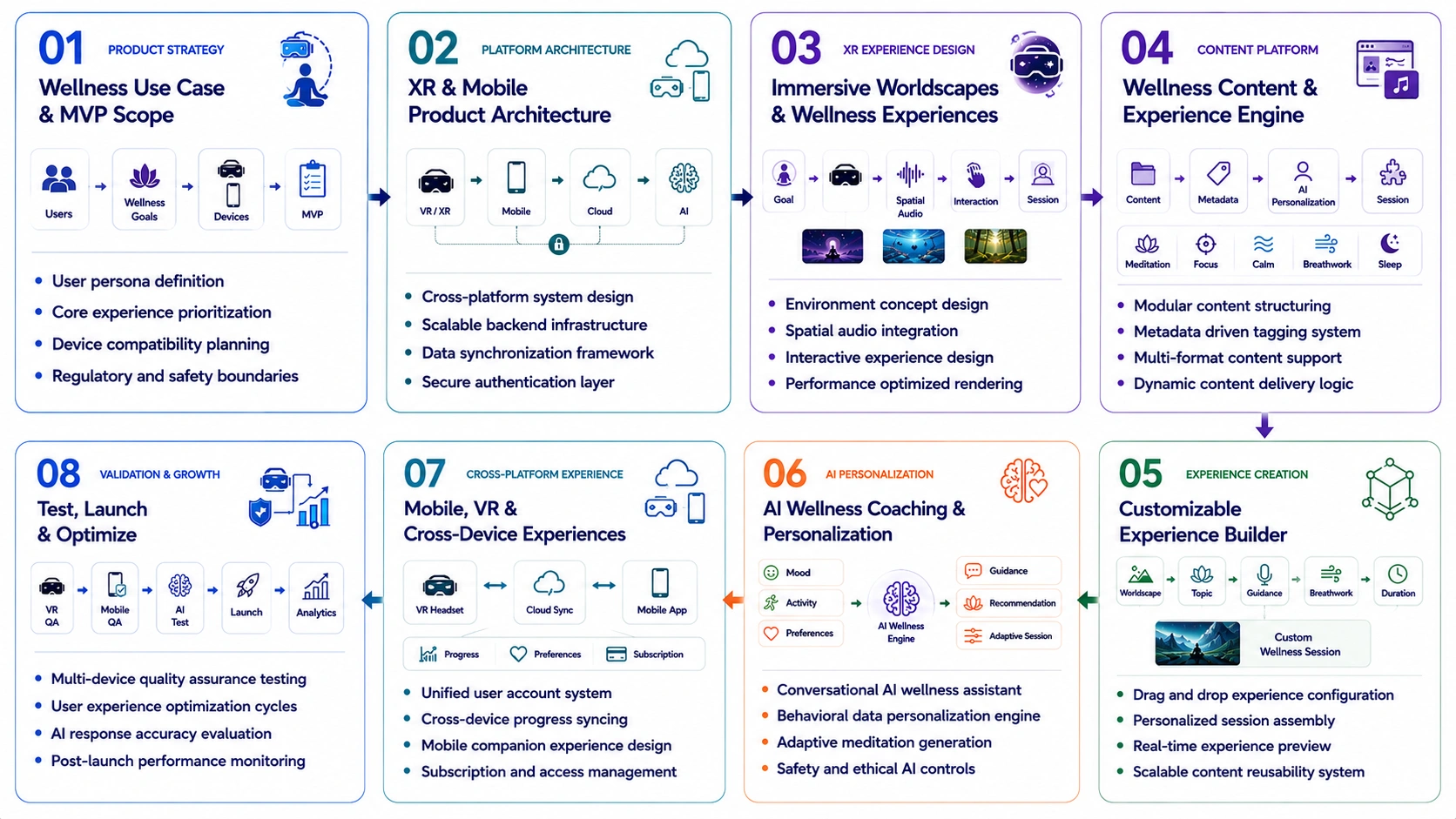
1. Define the Wellness Use Case and MVP Scope
We first define the wellness problem, target users and MVP outcomes, then prioritize Focus, Calm, breathwork or sleep experiences, supported devices, core journeys and non-clinical product boundaries.
- User Persona Definition: Identifies target audience segments based on stress levels, lifestyle patterns, and wellness goals.
- Core Experience Prioritization: Focuses on essential wellness modes like meditation, sleep, and breathing for MVP clarity.
- Device Compatibility Planning: Determines supported VR headsets, mobile devices, and cross-platform accessibility requirements early.
- Regulatory and Safety Boundaries: Establishes non-clinical positioning, disclaimers, and wellness compliance guidelines for product safety.
2. Design the XR and Mobile Product Architecture
We design architecture connecting VR or XR clients, mobile apps, backend APIs, AI services, content management and shared profiles, ensuring preferences, subscriptions and session data remain synchronized across devices.
- Cross-Platform System Design: Builds unified architecture connecting VR, mobile apps, backend systems, and cloud services seamlessly.
- Scalable Backend Infrastructure: Ensures APIs, databases, and services can handle growing user demand and real-time interactions.
- Data Synchronization Framework: Maintains consistent user profiles, preferences, and progress across all connected devices.
- Secure Authentication Layer: Implements secure login, subscription validation, and encrypted user data management across platforms.
3. Build Immersive Worldscapes and Wellness Experiences
We develop immersive 3D environments, spatial interactions, visual transitions and spatial audio around specific wellness outcomes, ensuring each worldscape supports Focus, Calm, Breathe or Sleep instead of functioning as decoration.
- Environment Concept Design: Creates thematic virtual worlds aligned with emotional wellness goals and user relaxation states.
- Spatial Audio Integration: Uses 3D soundscapes to enhance immersion and guide attention during wellness sessions.
- Interactive Experience Design: Adds subtle user interactions that reinforce mindfulness without causing cognitive overload.
- Performance Optimized Rendering: Ensures smooth VR performance across devices with optimized assets and lighting systems.
4. Develop the Wellness Content and Experience Engine
We build a structured content engine for guided meditation, mindfulness, Focus and Calm sessions, breathwork, sleep stories and soundscapes, using reusable metadata for duration, topic, environment, guidance style and goals.
- Modular Content Structuring: Organizes wellness sessions into reusable components for scalable content creation.
- Metadata Driven Tagging System: Classifies content by duration, mood, goal, and environment for easy personalization.
- Multi-Format Content Support: Supports audio, visual, and interactive wellness experiences within a unified system.
- Dynamic Content Delivery Logic: Delivers personalized sessions based on user behavior, preferences, and wellness history.
5. Add the Customizable Experience Builder
We develop a modular experience builder combining worldscapes, topics, guidance styles, experience types and breathwork, enabling personalized sessions and scalable content combinations without manually creating every possible wellness experience.
- Drag and Drop Experience Configuration: Allows non-technical teams to build wellness sessions using modular components.
- Personalized Session Assembly: Combines user preferences with content modules to generate tailored wellness experiences.
- Real-Time Experience Preview: Enables instant visualization of selected worldscapes and guided session flows.
- Scalable Content Reusability System: Reduces production effort by reusing assets across multiple wellness experiences.
6. Integrate AI Wellness Coaching and Personalization
We integrate AI coaching for conversational support, personalized reflections, meditation generation and recommendations, then connect mood ratings, activity data, preferences and session history to create adaptive wellness journeys with appropriate safety boundaries.
- Conversational AI Wellness Assistant: Provides real-time guidance, emotional support, and mindfulness coaching to users.
- Behavioral Data Personalization Engine: Uses user activity, mood inputs, and history to refine wellness recommendations.
- Adaptive Meditation Generation: Creates personalized meditation scripts based on user emotional state and goals.
- Safety and Ethical AI Controls: Ensures AI responses remain supportive, non-diagnostic, and aligned with wellness standards.
7. Connect Mobile, VR and Cross-Device Experiences
We connect mobile and VR through shared accounts, subscriptions, preferences, activity and progress, allowing users to access meditation, sleep, audio and AI support on mobile while using VR for deeper experiences.
- Unified User Account System: Enables seamless login and identity management across mobile and VR platforms.
- Cross-Device Progress Syncing: Maintains continuity of wellness sessions, achievements, and preferences across devices.
- Mobile Companion Experience Design: Extends VR wellness features into lightweight mobile-based meditation and tracking tools.
- Subscription and Access Management: Centralizes billing, feature access, and premium content control across platforms.
8. Test, Launch and Optimize the Wellness Platform
We test headset performance, tracking, comfort, audio, AI responses, personalization, synchronization and mobile behavior across target devices, then launch the MVP, measure engagement and continuously optimize experiences using user feedback.
- Multi-Device Quality Assurance Testing: Validates performance, usability, and stability across VR headsets and mobile devices.
- User Experience Optimization Cycles: Continuously improves engagement based on behavioral analytics and user feedback.
- AI Response Accuracy Evaluation: Tests conversational quality, emotional tone, and relevance of AI wellness guidance.
- Post-Launch Performance Monitoring: Tracks retention, session duration, and feature usage for ongoing product improvements.
Cost to Build a VR Wellness App Like TRIPP
The cost to build a VR wellness app like TRIPP depends on XR complexity, AI capabilities, immersive content, personalization, supported platforms and backend scale. A focused MVP can cost significantly less than an enterprise-grade ecosystem.
A phase-based estimate helps you understand where the VR wellness app development budget goes, from product strategy and architecture to XR development, AI integration, testing and launch.
| Development Phase | Estimated Cost (MVP → Enterprise) | What the Phase Covers |
| Product Discovery & MVP Planning | $5,000 – $25,000 | Defines wellness use cases, target users, MVP scope, user journeys, platforms, safety boundaries and product requirements. |
| XR & Mobile Architecture | $8,000 – $40,000 | Plans VR, mobile, backend, cloud, APIs, authentication, databases, synchronization and scalable cross-platform system architecture. |
| Immersive Worldscapes Development | $20,000 – $250,000 | Creates 3D environments, spatial interactions, visual effects, transitions, spatial audio and optimized immersive wellness experiences. |
| Wellness Content Engine | $10,000 – $100,000 | Builds systems for meditation, Focus, Calm, breathwork, sleep, soundscapes and reusable content metadata and delivery. |
| Custom Experience Builder | $10,000 – $80,000 | Develops modular session creation using worldscapes, topics, guidance styles, experience types and breathwork components. |
| AI Coaching & Personalization | $15,000 – $250,000 | Integrates conversational AI, personalized reflections, recommendations, adaptive content, mood signals, activity data and AI safety controls. |
| Mobile & VR Integration | $10,000 – $100,000 | Connects accounts, subscriptions, preferences, progress and wellness data across mobile applications and supported VR devices. |
| Testing, Launch & Optimization | $2,000 – $55,000 | Covers multi-device QA, VR performance, AI testing, usability validation, deployment, analytics and post-launch optimization. |
| Total Estimated Cost | $80,000 – $1.5M | Overall development investment across MVP, mid-level, and enterprise-grade implementations. |
Note: These estimates represent development scope rather than a fixed quote. Advanced 3D production, proprietary AI, additional XR platforms, custom hardware integrations and enterprise infrastructure can increase the overall budget considerably.
Development Cost According to Platform Level
Building a VR wellness app like TRIPP requires careful investment across XR development, AI systems, immersive content, and backend infrastructure. Costs vary widely based on features, scale, and platform complexity.
| Platform Level | Estimated Cost | Features Included |
| MVP (Validation Stage) | $80K–$150K | Basic VR wellness experience, 1–3 environments, meditation/breathwork, simple UI, basic personalization, limited AI, single platform |
| Mid-Level (Product Stage) | $150K–$300K | Multiple worlds, Focus/Calm/Sleep programs, AI personalization, voice guidance, mood tracking, mobile + VR sync, 3D polish, analytics |
| Advanced (TRIPP-like Product) | $300K–$600K | High-fidelity XR, AI/procedural environments, adaptive wellness coach, voice + gaze + gesture, Quest + Vision Pro + PSVR2, scalable backend, subscriptions |
| Enterprise Platform | $600K–$1.5M+ | Full wellness ecosystem, proprietary AI, large content library, real-time personalization, biometrics, edge optimization, global scaling, enterprise security |
Note on Estimated Cost Accuracy
The right VR wellness app development level depends on your launch strategy. Entrepreneurs can validate demand with a focused MVP before investing in advanced AI, extensive 3D content and broader XR platform support.
1. MVP Development Costs can Increase
The MVP VR wellness app development cost can start around $80K–$150K, with the final budget depending on the level of technical expertise, platform complexity, and development effort involved:
- Specialized VR development talent
- Unity/Unreal XR optimization
- Performance tuning across supported devices
- Extensive device compatibility and QA testing
2. Mid-Level Platforms Typically Cost $150K–$300K
A mid-tier VR wellness platform requires more than basic immersive experiences. Modern builds often include:
- AI-powered personalization
- Multi-device synchronization
- Advanced UX and engagement systems
- Real-time interactions and analytics
- Expanded content and wellness features
3. TRIPP-Like Platforms Can Cost $300K–$600K+
Building a true competitor to a platform like TRIPP involves significantly greater technical and content complexity, including:
- AI-driven wellness experiences
- High-quality immersive environments
- Continuous 3D content production
- Cross-platform XR support
- Advanced personalization and engagement features
4. Enterprise XR Wellness Platforms Can Exceed $1M
Enterprise-grade platforms require substantial investment in technology, infrastructure, and ongoing content. Costs can reach $600K–$1.5M+ when the scope includes:
- Proprietary AI models
- Biometric and wearable integrations
- Global-scale cloud infrastructure
- Enterprise security and compliance
- Continuous content development and platform optimization
Factors That Influence Development Budget
The VR wellness app development budget is shaped by more than the number of features. XR complexity, AI depth, content production, platform coverage, personalization and security requirements can significantly change the final investment.
- 3D Asset Production & VR Optimization: Costs vary with custom environments, 3D modeling, animation, lighting, and optimization for Meta Quest/HTC Vive, typically adding $20,000–$80,000+.
- AI-Driven Procedural Content Generation: Procedural environments, adaptive soundscapes, lighting, and personalized experiences typically require $20,000–$80,000 initially, plus $2,000–$8,000/month for refinement and compute.
- Multi-Platform XR Development: Supporting Meta Quest, Apple Vision Pro, PSVR2, iOS, and Android requires separate SDKs, input handling, performance tuning, and QA, adding $20,000–$70,000 per platform layer.
- Audio & Immersive Content Production: Voice actors, sound design, Ambisonics, music licensing, and guided wellness content typically cost $10,000–$50,000+, with new immersive content packs adding $1,000–$5,000 each.
- Edge Computing & Real-Time XR Latency: Edge nodes, regional compute, latency-aware routing, and real-time synchronization typically require $10,000–$35,000 initially, plus $3,000–$25,000+/month at scale.
- Biometric & Sensor Integration: Heart rate, eye tracking, motion, breathing, and wearable integrations through HealthKit and device SDKs typically cost $12,000–$45,000, with complexity increasing 20–35%.
- Cross-Modal Voice, Gesture & Gaze UX: Voice commands, hand tracking, gaze navigation, and gesture controls typically cost $15,000–$60,000, with complex multimodal systems increasing engineering and QA effort by 25–45%.
Privacy and Safety Controls to Include in VR Wellness App
A VR wellness platform handles sensitive AI conversations, voice interactions, mood data and immersive user activity, making privacy and safety fundamental to the product architecture. These controls help protect personal information, maintain responsible AI behavior and support safe, comfortable VR experiences.
| Privacy & Safety Control | Recommended Controls | Why It Matters |
| AI Conversation Privacy | Ephemeral conversations, history controls, AI memory opt-out, and data retention settings | Prevents sensitive AI wellness conversations from becoming persistent user profiles. |
| Voice Data Protection | Microphone permissions, voice minimization, recording deletion, and voice-avatar data controls | Limits exposure of sensitive information captured through voice interactions. |
| Mood & Wellness Data Controls | Mood/activity access controls, personalization opt-out, and wellness data deletion | Gives users control over sensitive behavioral and emotional data. |
| AI Wellness Safety Guardrails | Prompt guardrails, response validation, clinical-advice blocking, sensitive-content detection, and crisis escalation | Keeps AI guidance within defined wellness boundaries and reduces unsafe recommendations. |
| VR Comfort & Physical Safety | Emergency exit, pause controls, seated mode, view recentering, and motion comfort settings | Reduces motion sickness, disorientation, and physical safety risks during immersive sessions. |
| Data Encryption & Deletion | Encryption at rest/in transit, RBAC, deletion requests, and account data purging | Protects wellness information while providing meaningful user control over stored data. |
Note: For a TRIPP-like VR wellness app development, the highest-priority controls are voice-data protection, ephemeral AI conversations, mood-data management, AI safety guardrails, crisis boundaries and VR comfort controls. These directly address the risks created by combining immersive hardware with conversational AI and personal wellness data.
Practical Challenges in Building a VR Wellness App
A TRIPP-like VR wellness app development creates challenges beyond conventional app development. Developers must balance VR performance, device compatibility, AI safety, personalized experiences, and immersive content quality while maintaining a smooth wellness journey across different platforms and user environments.
1. VR Motion Sickness and User Comfort
Challenge: Inconsistent frame pacing, abrupt camera movement, and poor locomotion design often trigger motion sickness, eye strain, and discomfort during extended VR wellness sessions.
Solution: Our developers apply comfort-first VR design using teleportation, snap turning, vignette effects, and strict frame optimization. They continuously test user comfort, adjusting movement speed, transitions, and interaction pacing to ensure relaxing, long-duration immersive experiences.
2. Real-Time AI Response and VR Immersion
Challenge: Real-time AI wellness guidance can introduce latency, synchronization issues between voice and visuals, and unnatural delays that disrupt immersion and reduce emotional engagement.
Solution: Our developers build low-latency AI pipelines with preloaded response buffers and asynchronous voice synthesis. They synchronize AI outputs with spatial audio, animations, and timed visual effects so responses feel naturally embedded within the immersive VR environment.
3. Cross-Platform VR SDK and Hardware Limitations
Challenge: Different VR platforms have inconsistent SDKs, input systems, tracking accuracy, and performance limits, making it difficult to deliver uniform wellness experiences across devices.
Solution: Our developers create a platform abstraction layer that standardizes inputs, rendering, and interactions. They implement device-specific optimizations, feature toggles, and fallback systems to ensure consistent core functionality across all supported VR hardware.
Build Your VR Wellness App With Idea Usher
IdeaUsher is an expert app/platform development enterprise with 11+ years of software expertise in AI, VR and healthtech across 50+ countries. Backed by 250+ experts, 1,000+ completed builds, and a 4.9/5 Clutch rating, we build custom VR wellness platforms from scratch.
We skip generic templates to handcraft scalable virtual reality ecosystems optimized with generative worldscapes, real-time biofeedback telemetry, AI mindfulness guides, and HIPAA-compliant data pipelines to help you achieve undisputed digital wellness market dominance.
Why Enterprises Partner With Us
Digital health brands, corporate wellness providers, and wellness startups choose us to construct TRIPP-like VR apps because we seamlessly convert mindfulness, biofeedback, and interactive visual design into deeply engaging spatial computing experiences.
- Generative Worldscapes & Dynamic Audio: We build Unity/Unreal environments that respond to user input through interactive visuals, particle effects, and spatial audio.
- Biometric & Wearable Telemetry: Our engineers build low-latency pipelines ingesting HRV, pulse, and breathing data to dynamically adapt immersive experiences.
- AI Mindfulness & Voice Coaching: We develop adaptive AI services that analyze mood logs to personalize meditation, breathing exercises, and daily wellness routines.
- Cross-Headset & Mobile Integration: We build optimized spatial applications for Meta Quest, Apple Vision Pro, and HTC Vive, paired with mobile companion apps.
- HIPAA/GDPR-Compliant Cloud Security: We host platform microservices in encrypted, isolated cloud environments to protect personal wellness data and user interactions.
- Zero Vendor Lock-In Delivery: We deliver clean, fully documented, and auditable source code after VR wellness app development, providing your enterprise with 100% platform ownership from day one.
Ready to revolutionize digital mindfulness and wellness with an enterprise-grade VR platform? Partner with Idea Usher’s principal spatial computing and software architects to map out your custom product build today.
Conclusion
The opportunity around immersive wellness extends beyond guided meditation or VR experiences. A TRIPP-like VR wellness app development can combine AI wellness coaching, personalized sessions, immersive worldscapes, breathwork, sleep content and cross-platform access into one ecosystem. For entrepreneurs, the right approach is to validate a focused MVP first, then expand AI, XR capabilities and personalized content based on user demand. With the right technical architecture and development partner, this model can become a scalable digital wellness product.
FAQs
A.1. A TRIPP-like VR wellness app development typically combines immersive worldscapes, AI wellness coaching, guided mindfulness, breathwork, sleep content, personalization, mood tracking and mobile access within one connected wellness ecosystem.
A.2. VR wellness app development can range from $80,000 to $1.5M+, depending on XR complexity, AI capabilities, 3D content, personalization, supported platforms, backend infrastructure and enterprise requirements.
A.3. A VR wellness app development can target Meta Quest, Apple Vision Pro, PlayStation VR2, HTC Vive, Pico and mobile devices. Platform selection depends on audience reach, hardware capabilities, development resources and intended immersive experience.
A.4. AI can analyze mood inputs, activity patterns, session history and user preferences to recommend suitable experiences. Conversational AI can also provide personalized reflections, meditation guidance and wellness suggestions based on user interactions.