

Key Takeaways
- AI assistants are evolving from reactive tools into autonomous systems that execute tasks and manage workflows
- Multimodal capabilities (voice, vision, text) enable natural, context-aware interactions
- Businesses are adopting AI assistants as core infrastructure to improve productivity, automation, and decision-making
- Vertical AI assistants are gaining traction with domain-specific accuracy and compliance
- How IdeaUsher can help you build custom AI assistant platforms with scalable architecture, advanced integrations, and real-world execution capabilities
AI assistants are shifting from tools that respond to prompts into systems that initiate tasks, manage workflows and operate across applications. This change is defining the next wave of AI assistant trends. Users no longer want fragmented interactions across apps. They expect assistants that can understand context, take action and deliver outcomes without constant input.
Earlier assistants focused on single-step responses, limiting productivity and value. The shift toward multi-step execution, persistent memory and seamless integration enables assistants to act as operating layers for work and decisions, while also introducing challenges around control, reliability and user trust as they take on greater responsibility.
In this blog, we will explore key AI assistant trends, emerging capabilities, use cases, and challenges, and what they mean for future product development, while also breaking down how these trends are shaping real-world applications across industries.
The Market Shift Defining AI Assistants in 2026
Conversational computing is no longer a novelty. One of the most defining AI assistant trends in 2026 is the transition from experimental tools to fully integrated business infrastructure. Generative AI has moved from experimentation to full structural integration by 2026, making AI assistants vital components of the global economic infrastructure rather than simple administrative tools.
A. Market Growth of AI Assistants
If you are waiting for the “AI bubble” to burst, you may be overlooking one of the most significant capital shifts in technology. This is not a passing trend, but a long-term transformation driven by accelerating AI assistant trends across enterprise adoption and infrastructure investment.
According to Grand View Research AI Assistant Market Report, the global AI assistant market was valued at approximately $16.29 billion in 2024 and is projected to reach around $73.8 billion by 2033, growing at a steady CAGR of ~18.8%.
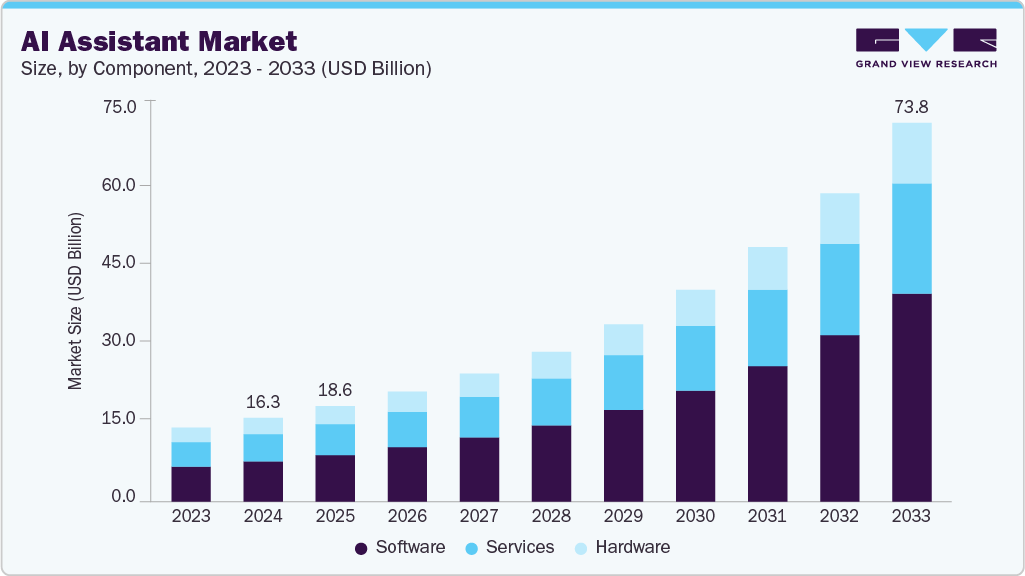
Venture capital backed LLM wrappers in early 2024 but now favors verticalized infrastructure and agentic frameworks. Falling intelligence costs are driving CAPEX growth and replacing legacy software.
This data highlights a clear and accelerating trajectory in AI adoption, with enterprises rapidly integrating AI assistants into workflows, pushing adoption rates toward mainstream levels and reinforcing the market’s long-term inevitability rather than a short-term trend.
B. From Chatbots to Autonomous AI Agents
The most significant shift in this market isn’t just how many people are using AI, but how they are using it, marking one of the most important AI assistant trends shaping modern digital workflows. We have moved from Assistive AI (which saves seconds) to Delegative AI (which saves hours). This shift marks the transition of AI from a “research tool” to a “digital workforce.”
| Era | Technology | Function | User Experience |
| 2010s | Rule-based Bots | Basic Q&A | “I don’t understand that question.” |
| 2023-25 | LLM Assistants | Text generation | “Here is a draft of your email.” |
| 2026 | Agentic AI | Task Execution | “I’ve booked your travel and filed the expense report.” |
C. The Rise of AI as a Core Business Infrastructure
AI has evolved beyond a configurable feature into a core foundation of modern enterprises, effectively functioning as the new operational layer across systems and processes by 2026. AI as the Primary Interface:
- Internal Tools: Employees no longer navigate complex ERP dashboards. They “ask” their internal agent for data visualizations, and the agent pulls from fragmented databases to create them in real-time.
- Customer Interfaces: The “Contact Us” page is gone. It has been replaced by hyper-personalized agents that hold the full context of a customer’s 5-year history with the brand.
- Decision Engines: C-suite executives are using AI “Shadow Boards” to run simulations on market entries or supply chain pivots before a single dollar is spent.
The Big Takeaway: AI is replacing the traditional software layer cake, reducing the need for 50 SaaS apps for 50 tasks into a single intelligence layer. Software now interprets and acts on data, and businesses that lag risk losing visibility.
Key AI Assistant Impact on Businesses in 2026
As we cross the mid-point of 2026, the transition from “experimental AI” to “operational AI” is complete. The following data highlights how deeply integrated these systems have become within the global enterprise framework.
A. Enterprise AI Adoption Trends in 2026
The wait and see approach has officially vanished. Organizations are no longer just testing AI; they are rebuilding their software stacks around it.
- Global Adoption Rate: 88% of companies now utilize AI in at least one business function, a massive leap from 20% in 2017.
- The Agentic Surge: By the end of 2026, 40% of all enterprise applications will feature task-specific AI agents, up from less than 5% just 18 months ago.
- Executive Buy-in: 97% of C-suite executives report deploying autonomous AI agents in the past year. Notably, 75% expect AI agents to hold “virtual seats” in the C-suite for decision support by 2030.
- Infrastructure Investment: 92% of firms plan to increase their AI budgets through 2028, with 59% already investing over $1 million annually.
B. Productivity Gains Driven by AI Assistants
The gap between AI adopters and laggards has created a new class of high-performance workers known as the “AI Elite.”
| Metric | AI Super-Users | Non-AI Adopters |
| Productivity Multiplier | 5x | 1x (Baseline) |
| Weekly Time Saved | 9.2 Hours | < 2 Hours |
| Task Accuracy | +35% Improvement | Baseline |
| Daily Usage | 2+ Hours (64% of Execs) | Occasional/None |
- Macro Impact: Research indicates AI could unlock $4.5 trillion in U.S. labor productivity by automating routine cognitive tasks.
- Developer Efficiency: 90% of software developers now use AI coding partners daily, reducing time-to-market for new features by an average of 30%.
- Direct ROI: For every $1 invested in generative AI, businesses are reporting a return of $3.70 in operational savings and efficiency gains.
C. How AI Assistant Usage Is Evolving in 2026
Usage patterns have shifted from simple chatting to complex, multi-step execution in AI assistant trends.
- Moving Beyond Text: While 76% of early AI use was for content creation, 2026 has seen a shift toward autonomous operations. The top three high-impact use cases are now:
- Search & Knowledge Management: Instant retrieval of internal corporate intelligence.
- Autonomous Workflow Execution: Agents booking travel, filing expenses, and updating CRMs.
- Predictive Supply Chain Management: Real-time logistics adjustments without human intervention.
- Daily Integration: 70% of all employees now interact with an AI tool for at least 30 minutes every workday.
- The Trust Factor: 78% of executives report higher confidence in AI outputs today than in 2024, largely due to better grounding in private company data and improved governance frameworks.
What Defines an AI Assistant in 2026?
AI assistants have matured into integrated orchestration layers across OS and hardware by 2026. These systems possess deep contextual awareness of environments, schedules, and APIs, evolving from peripheral interfaces into proactive, essential workspace partners.
A. Copilots vs. AI Assistants vs. AI Agents
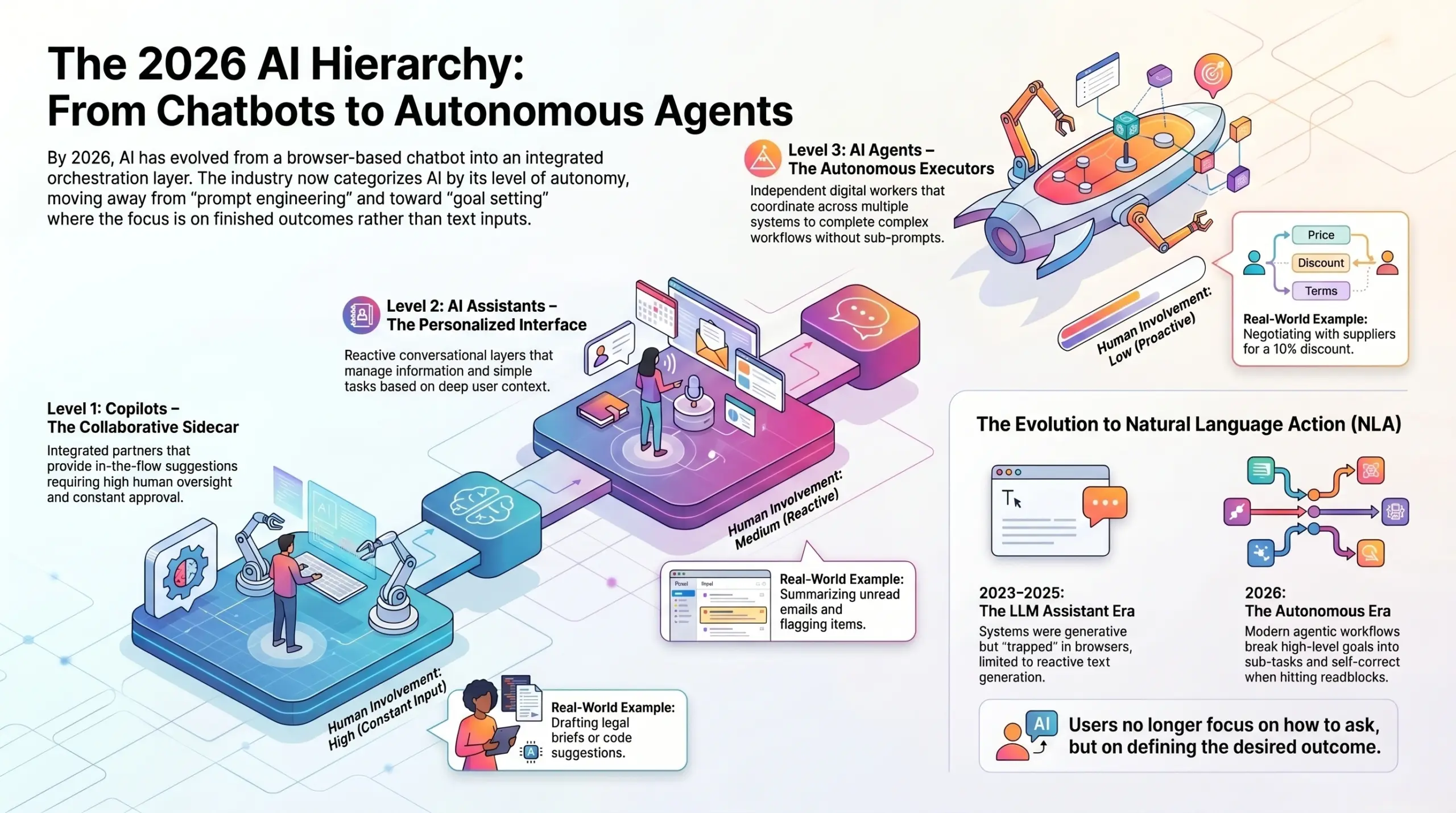
As the market has matured, the industry has standardized the terminology to help users understand exactly how much work the AI is actually doing.
| Term | Role | Human Involvement | Real-World Example |
| Copilot | Collaborative “sidecar” that suggests, drafts, and refines. | High: Requires constant input and approval. | Drafting a legal brief or real-time code suggestions. |
| AI Assistant | Conversational interface that manages information and simple tasks. | Medium: Reactive, waits for a prompt to act. | “Summarize my unread emails and flag the urgent ones.” |
| AI Agent | Autonomous “digital worker” that plans and executes complex workflows. | Low: Proactive, operates independently toward a goal. | “Find three suppliers for this part and negotiate a 10% discount.” |
1. AI Assistants (The Interface): These are the entry points. They focus on memory, personalization, and cross-session context. They “know” you, your past queries, and your preferences.
2. Copilots (The Partner): Integrated directly into software (like Word, Excel, or CRMs), Copilots help you finish the task you are currently working on. They provide “in-the-flow” suggestions and drafting capabilities.
3. AI Agents (The Executor): This is the 2026 gold standard. Agents don’t just suggest; they act. They coordinate across multiple systems (e.g., checking a CRM, drafting a contract, and sending it for signature via DocuSign) without needing a human to trigger every sub-step.
B. Structural Transformation of AI from Chatbots to Autonomy
The journey to 2026 has been marked by a shift from Natural Language Processing (NLP) to Natural Language Action (NLA).
- The Chatbot Era (2010s – 2022): Rule-based and rigid. These were essentially glorified FAQ search engines. If you didn’t use the exact “keyword,” the system failed.
- The LLM Assistant Era (2023 – 2025): Generative and reactive. We learned we could talk to machines, and they could talk back. However, they were still “trapped” inside a browser tab, unable to do anything outside of generating text.
- The Autonomous Era (2026): Reasoning and execution. Modern systems use Agentic Workflows. They can break a high-level goal into sub-tasks, use “tools” (like your CRM, your bank account, or your email), and self-correct when they hit a roadblock.
Why this shift matters: You spent time “prompt engineering” to get the right answer in 2024 but In 2026, you are spending time “goal setting” to get the right result. The focus has moved from the input (how you ask) to the outcome (what is actually finished).
Top AI Assistant Trends in 2026
The transition from “software that helps” to “systems that act” is complete, highlighting the most impactful AI assistant trends driving business transformation in 2026. The market has moved past simple text generation, prioritizing autonomous execution, memory, and multimodal awareness.
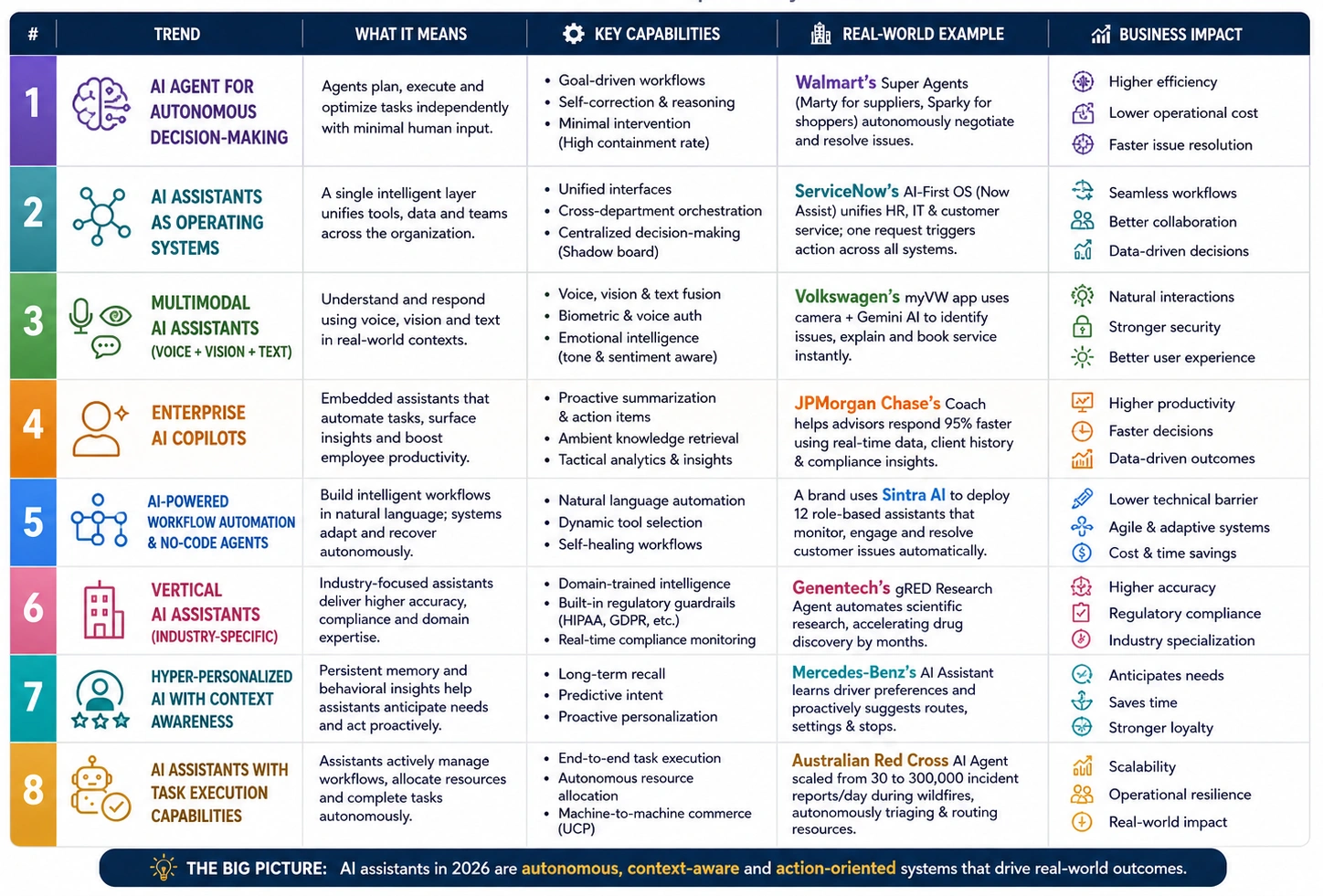
1. AI Agent for Autonomous Decision-Making
The shift toward autonomy is redefining assistants as decision-makers that can plan, execute, and optimize tasks independently with minimal human input.
- Goal-Driven Workflows: Instead of prompting “Write an email,” users set goals like “Onboard this new vendor.” The agent plans the steps, calls the necessary APIs, and monitors for successful completion.
- Self-Correction and Reasoning: Agents can now identify if a step in their plan failed (e.g., a bounced email or a broken API) and autonomously find an alternative path to the goal.
- Minimal Intervention: The value of an AI is measured by its containment rate, the percentage of tasks it completes from start to finish without asking a human for help.
Real-World Example: Walmart uses “Super Agents” like Marty for suppliers and Sparky for shoppers. These agents don’t just answer questions; they autonomously negotiate with suppliers based on real-time inventory and resolve customer shipping issues without human intervention.
2. AI Assistants as Operating Systems
A new paradigm is emerging where a single intelligent layer replaces fragmented tools, streamlining workflows and centralizing organizational decision-making.
- Unified Interfaces: Employees no longer jump between 15 different SaaS apps. They use a central AI orchestrator that pulls data and executes actions across the entire company stack.
- Cross-Departmental Orchestration: AI agents now communicate with other agents. A supply chain agent can talk to a finance agent to trigger a budget increase based on a predicted material shortage.
- Centralized Decision-Making: AI acts as a shadow board, providing real-time simulations and decision support based on the company’s entire historical dataset.
Real-World Example: ServiceNow has transformed into an “AI-First” Operating System. Through Now Assist, it unifies HR, IT and customer service into a single layer. For example, one laptop request can instantly coordinate finance, supply chain, security and HR systems without manual intervention.
3. Multimodal AI Assistants (Voice + Vision + Text)
Interactions are becoming more natural as systems integrate voice, visual understanding, and text to interpret and respond to real-world contexts.
- Physical-Digital Loop: Using mobile cameras, assistants reason about physical objects. For example, a field technician showing an engine to an AI for real-time repair overlays.
- Biometric & Voice Authentication: Modern assistants use voice biometrics to instantly verify a user’s identity, allowing for secure transactions via natural speech.
- Emotional Intelligence: Natural interactions now include tone-sensing, allowing assistants to adjust communication style based on user frustration or urgency.
Real-World Example: Volkswagen drivers use the myVW app to point their phones at a dashboard warning light. The Gemini-powered assistant “sees” the light, explains the issue, and offers to schedule a service appointment at the nearest dealer immediately.
4. Enterprise AI Copilots
Workplace productivity is being enhanced through embedded assistants that automate tasks, surface insights, and support faster, data-driven decisions.
- Microsoft Copilot & Beyond: Tools have evolved into Managed Agents that proactively summarize missed meetings, extract action items, and trigger workflows in Power Automate without being asked.
- Ambient Knowledge Retrieval: Copilots stay “always-on” in the background, surfacing relevant documents or previous chat contexts the moment a specific project is mentioned in a video call.
- Tactical Analytics: Every employee now has a data scientist on their shoulder, capable of turning raw spreadsheets into executive-ready visualizations instantly.
Real-World Example: JPMorgan Chase uses an AI tool called Coach that enables financial advisors to respond 95% faster during market volatility by instantly synthesizing market data, client history, and regulatory compliance into a personalized recommendation.
5. AI-Powered Workflow Automation and No-Code Agents
Automation is becoming more accessible, enabling users to build intelligent workflows without coding while ensuring systems adapt and recover dynamically.
- The Zapier Evolution: Platforms like Zapier have pivoted to AI Agents that use natural language to connect fragmented tools, eliminating the need for manual “If/Then” triggers.
- Dynamic Tool Selection: An agent can now decide which tool is best for a job (e.g., “Use Salesforce for this lead, but use HubSpot for that one”) based on the context of the data.
- Self-Healing Workflows: If an API changes or a tool breaks, the agentic layer automatically finds a workaround or updates the integration logic itself.
Real-World Example: A small e-commerce brand uses Sintra AI to deploy a “Team” of 12 role-based assistants. One assistant monitors social mentions, while another automatically generates a discount code for unhappy customers and sends it via DM.
6. Vertical AI Assistants (Industry-Specific)
Specialized solutions are gaining traction by addressing industry-specific challenges with higher accuracy, compliance, and domain-focused intelligence.
- Specialized Intelligence: In sectors like Healthcare (AI Medical Scribes) or Fintech, verticalized models are trained on proprietary datasets to ensure 99.9% compliance and accuracy.
- Regulatory Guardrails: These assistants come pre-configured with industry-standard privacy (HIPAA, GDPR) built into their reasoning frameworks.
- Real-time Compliance Monitoring: Agents in legal or finance monitor transactions in real-time to flag know your customer (KYC) or anti-money laundering (AML) violations instantly.
Real-World Example: Genentech built the gRED Research Agent, a specialized assistant that automates manual scientific searches across millions of papers and lab notes, accelerating the early stages of drug discovery by months.
7. Hyper-Personalized AI with Context Awareness
Personalization is reaching new levels through persistent memory and behavioral insights, allowing systems to anticipate needs and act proactively.
- Long-Term Recall: Your assistant remembers project details from six months ago, your preferred communication tone, and your “VIP” contacts.
- Predictive Intent: By analyzing your habits (e.g., you always check your “Sales Leads” on Monday mornings), the assistant prepares a summary report 10 minutes before you even wake up.
- Proactive Personalization: Because it knows your history, the AI doesn’t wait for a prompt. It might say, “I noticed you have a board meeting tomorrow; I’ve already updated the slide deck with this morning’s final revenue numbers.”
Real-World Example: Mercedes-Benz uses a Virtual Assistant powered by Gemini that learns a driver’s favorite routes and temperature settings, then proactively suggests a coffee stop at a cafe the driver previously liked when it senses they are taking a longer-than-usual commute.
8. AI Assistants with Task Execution Capabilities
The focus is shifting toward execution, where systems actively manage workflows, allocate resources, and complete tasks without constant supervision.
- Real-World Managing: Assistants now manage logistics, trigger procurement processes, and handle complex customer disputes autonomously.
- Autonomous Resource Allocation: Agents can now manage budgets for ad campaigns, shifting funds from Facebook to LinkedIn in real-time based on which platform is delivering a better ROI.
- Machine-to-Machine Commerce: With protocols like the Universal Commerce Protocol (UCP), agents can search, negotiate, and complete transactions on behalf of businesses, effectively “shopping” for the best enterprise deals.
Real-World Example: The Australian Red Cross deployed an action-oriented AI agent that scaled from 30 to 300,000 incident reports per day during a wildfire emergency, autonomously triaging requests and routing resources to the highest-priority locations.
Real-World Use Cases of AI Assistants in Business
The adoption of AI assistants in 2026 has moved beyond experimentation into high-stakes operational roles. Businesses are no longer just “using AI”; they are deploying specialized digital workers across every department.

1. Customer Support Automation
The 2026 support model is AI-first, Human-by-exception. Assistants now handle complex resolutions that once required senior tier-2 agents.
- Autonomous Resolution: Beyond simple FAQs, agents now process returns, troubleshoot hardware via multimodal vision, and manage billing disputes.
- Sentiment-Driven Routing: AI monitors the emotional tone of a chat in real-time. If a user is escalating from “frustrated” to “irate,” the agent seamlessly handovers the full context and a suggested “make-good” offer to a human supervisor.
Real-World Example: Klarna has replaced the work of 700 full-time agents with an AI assistant that handles 2/3 of all customer service chats, improving accuracy and reducing resolution time from 11 minutes to under 2 minutes.
2. Sales & CRM AI
Sales assistants have evolved from email drafters to pipeline managers who own the early-stage funnel.
- Autonomous Prospecting: AI agents like 11x Alice can identify leads, research their recent LinkedIn activity, and initiate personalized outreach across multiple channels without human input.
- CRM Hygiene: Instead of sales reps manually logging calls, AI listens to meetings, updates lead scores, identifies deal risks and pushes the data directly into Salesforce or HubSpot.
Real-World Example: Apollo.io uses AI to monitor buying signals (like a target company getting new funding). Its assistant then automatically drafts a custom pitch for the account executive to review and send with one click.
3. Internal Productivity Assistants
The company brain is now a searchable, actionable assistant that sits inside Slack or Microsoft Teams.
- HR & Onboarding: Assistants handle 90% of routine employee queries from How do I add a dependent to my insurance? to autonomously approve vacation requests based on team capacity.
- Meeting Intelligence: AI shadows every call, not just to transcribe, but to proactively check the team’s calendar and assign tasks mentioned during the meeting to the correct project board.
Real-World Example: ServiceNow uses its Now Assist agent to unify fragmented back-office tasks. An employee can ask a single chat interface to order a new laptop, and the AI coordinates the budget approval, inventory check, and IT ticket simultaneously.
4. Developer Copilots
Coding has shifted from writing syntax to reviewing architecture.
- Agentic Coding: Modern copilots don’t just finish a line of code; they can take a Jira ticket, create a new branch, write the feature, generate unit tests, and submit a Pull Request for review.
- Legacy Refactoring: Companies are using specialized AI to translate entire codebases from legacy languages (like COBOL or old Java) into modern, cloud-native frameworks.
Real-World Example: GitHub Copilot Workspace allows developers to describe a feature in natural language; the AI then plans the entire implementation across multiple files, acting as a partner-engineer rather than just a smart autocomplete.
5. AI Assistants for Data Analysis (BI)
Business Intelligence is no longer a bottleneck in the data department.
- Conversational Querying: Executives now use Plain English to query massive data lakes. Instead of asking a dev for a SQL report, they ask: Why did our churn in Houston spike last Tuesday?
- Predictive Alerting: AI assistants monitor data streams for anomalies. If a KPI drops below a certain threshold, the assistant doesn’t just alert the team, it analyzes the cause and suggests a remediation plan.
Real-World Example: Databricks AI/BI Genie allows non-technical business users at companies like Shell to chat with their petabytes of data, generating instant visualizations and insights that previously took days of manual data modeling.
Benefits vs. Challenges of AI Assistants in 2026
AI assistants have shifted from experimental tools to essential business infrastructure by 2026, making financial viability a top priority. Corporate focus has moved from technical ability to evaluating whether AI outputs justify their operational costs.
A. The ROI Factor: Beyond Cost Savings
87% of executives expect AI to drive significant revenue growth in 2026, not just cut expenses. We are seeing a move from efficiency to expansion.
- Productivity Explosion: Top-tier AI Super-users are seeing up to a 5x increase in individual output, saving an average of 9 hours per week on administrative tasks.
- Revenue Generation: Nearly a third of businesses report that AI has directly opened new revenue streams, such as 24/7 autonomous sales agents that close deals while the human team sleeps.
- The Investment Reality: Developing enterprise agentic systems in 2026 costs $80,000–$300,000+, plus 15–30% for annual maintenance. High-performing firms now see a reduced payback period averaging 14 months.
B. Risks: The Hidden Cost of Autonomy
Granting agency to an AI introduces a new class of enterprise risks that didn’t exist in the era of simple chatbots.
- Confused Deputy Attacks: Malicious actors may trick privileged autonomous agents into unauthorized actions via low-risk tools like phishing.
- Privacy & Interception: Constant monitoring increases accidental data collection risks; 2026 regulations mandate strict data minimization.
- Model Drift: AI accuracy can silently decline over time due to real-world data shifts, requiring constant performance monitoring.
C. Limitations: What AI Still Can’t Do
Despite the hype of 2026, AI assistants remain probabilistic, not deterministic. They are still “calculators of words,” not “engines of truth.”
- Explainability Gap: Deep learning “black boxes” create legal bottlenecks in regulated sectors like healthcare due to their inability to explain decision logic.
- Non-Deterministic Outputs: AI lacks the 100% consistency required for mission-critical systems like robotics, often producing different results for identical inputs.
- Reasoning Ceiling: Despite multi-step proficiency, agents lack causal understanding and struggle with “common sense” edge cases, failing to recognize nonsensical processes.
The 2026 AI Benefits and Challenges
The most successful companies are those that treat AI assistants as high-performance interns capable of incredible volume and speed, but requiring robust “Human-in-the-Loop” governance to prevent cascading system failures.
| Feature | Benefit | Challenge |
| Autonomy | Reclaims 20%+ of work week | High risk of unauthorized actions |
| Multimodality | Interfaces with the physical world | Massive increase in data privacy surface area |
| Verticalization | 99% accuracy in specific fields | High development costs ($150k+) |
| Persistent Memory | Hyper-personalized user experience | Risk of “stale” or biased context over time |
How to Build an AI Assistant for Your Business
Building a custom AI assistant in 2026 is no longer about just “hooking up an API.” Instead, businesses must align development strategies with emerging AI assistant trends such as agentic systems, automation, and multimodal capabilities. To gain a competitive edge, businesses are now developing Agentic Systems that possess deep domain knowledge and the ability to execute tasks autonomously across your software stack.
A. Key Features of a 2026 AI Assistant
A modern assistant must go beyond conversation. In 2026, “Agency” is the standard.
- Autonomous Execution (Agentic AI): The ability to use tools (email, CRM, databases) to complete multi-step goals without a human approving every micro-task.
- Persistent Long-Term Memory: Assistants use vector databases to remember user preferences, past project details, and specific brand guidelines across months of interaction.
- RAG (Retrieval-Augmented Generation): The assistant “reads” your internal company files (Notion, Google Drive, PDFs) in real-time to provide answers based on your facts, not generic training data.
- Multimodal Input: Native support for voice, text, and visual processing (e.g., analyzing a screenshot of a bug or a photo of a receipt).
- Enterprise-Grade Security: Built-in PII (Personally Identifiable Information) masking and role-based access controls to ensure the AI only sees what it’s allowed to see.
B. The 2026 AI Tech Stack
The “AI Layer” now sits on top of a sophisticated stack of orchestration and memory tools.
| Layer | Recommended 2026 Tools |
| Brain (LLM) | Gemini 1.5 Pro (for context), Claude 3.5 Sonnet (for reasoning), or Llama 3 (self-hosted) |
| Orchestration | LangGraph (for complex logic), CrewAI (for multi-agent teams), or MCP (Model Context Protocol) |
| Memory (Vector DB) | Pinecone, Weaviate, or ChromaDB |
| Automation Glue | n8n (self-hosted/flexible) or Make (no-code friendly) |
| Monitoring/Guardrails | LangSmith or Arize Phoenix (to track hallucinations and model drift) |
C. Cost Factors: What to Budget
Developing an AI assistant in 2026 is an investment in your digital workforce. Costs vary based on the “level of agency” you require.
1. Proof of Concept (PoC): $10,000 – $25,000
Ideal starting point to validate ideas quickly with a lightweight, cost-effective AI assistant built for basic use cases.
- Timeline: 3–6 weeks.
- Goal: A basic RAG-based bot that answers questions from your documentation.
2. Custom AI Agent (Single-Task): $40,000 – $120,000
Designed for targeted automation, handling specific business tasks efficiently with deeper integrations and operational capabilities.
- Timeline: 3–5 months.
- Goal: An agent that performs specific actions, like qualifying leads in a CRM or managing basic HR requests.
3. Enterprise Agentic System: $180,000 – $400,000+
Built for scale, these systems manage complex workflows through multiple agents working autonomously across business functions.
- Timeline: 9+ months.
- Goal: A fully integrated, multi-agent system that handles complex end-to-end workflows (e.g., full supply chain orchestration).
4. Ongoing Maintenance: Budget 15–25% of the initial build cost annually for model fine-tuning, API credits, and performance monitoring.
AI Assistant: Build vs. Buy
This table compares off-the-shelf SaaS AI assistants with custom-built solutions, highlighting differences in privacy, flexibility, cost structure, and competitive advantage.
| Feature | Off-the-Shelf (SaaS) | Custom Build (IdeaUsher) |
| Data Privacy | Shared with provider | 100% Proprietary/Private |
| Workflow Logic | Rigid / Pre-set | Fully Custom to Your Ops |
| Cost | Low monthly subscription | Higher upfront; lower long-term per-task cost |
| Competitive Edge | Same as your competitors | Unique to your business data |
How IdeaUsher Builds AI Products with Intelligent Assistants
AI assistant adoption is no longer experimental, it is actively transforming how businesses operate. These changes are directly influenced by evolving AI assistant trends that emphasize automation, personalization, and real-time decision-making. Instead of functioning as standalone tools, AI assistants are now embedded into core business processes, enabling automation, personalization, and real-time decision-making.
The following Idea Usher’s case-based insights highlight how organizations are leveraging AI assistants to drive measurable impact.
A. AI Assistants for Personalized User Engagement
AI assistants are redefining personalization by moving from static user journeys to adaptive, behavior-driven experiences. Instead of relying on fixed segmentation, modern systems continuously evolve based on real-time user interactions.
In one of our recent projects, we worked on an AI mental health platform like Kamelion, designed to enhance user engagement through intelligent workflows, gamification, and data-driven insights.
1. The Business Challenge
Traditional engagement platforms struggled with:
- Fragmented user journeys
- Low retention due to lack of personalization
- Manual campaign and interaction management
Kamelion needed a system that could scale engagement while maintaining personalization, especially across growing user bases and creator ecosystems.
2. AI Assistant Implementation
At IdeaUsher, the solution combined:
- Behavioral tracking and analytics
- Gamified engagement systems (challenges, progress tracking)
- AI-assisted workflow management for campaigns and user interactions
Rather than treating users as segments, the assistant continuously adapts experiences based on real-time behavioral signals and engagement patterns.
3. Workflow Transformation
AI assistants redefine workflows by automating processes, reducing manual effort, and enabling real-time, adaptive operations.
- Shift from static campaigns to dynamic, AI-driven engagement flows that adapt in real time to user behavior
- Reduced manual effort by automating user interactions, campaign management, and decision-making processes
- Unified system that seamlessly integrates engagement, analytics, and workflow control into a single intelligent layer
4. Measurable Impact
These changes translate into tangible business outcomes, improving retention, execution speed, and overall scalability across systems.
- Improved user retention through gamified and personalized experiences that keep users consistently engaged over time
- Faster campaign execution and management by eliminating delays and enabling real-time optimization
- Scalable infrastructure designed to support growing user ecosystems without compromising performance or efficiency
B. AI Assistants for Workflow Acceleration and Automation
AI assistants are increasingly acting as workflow orchestrators, enabling businesses to automate complex, multi-step processes across systems without manual coordination.
Idea Usher’s recent project AcceleratedX, focused on eliminating operational bottlenecks and accelerating execution.
1. The Business Challenge
Organizations faced:
- Disconnected tools and systems
- Manual coordination between teams
- Delays in executing multi-step workflows
These inefficiencies made it difficult to scale operations without increasing headcount.
2. AI Assistant Implementation
At IdeaUsher, the AI assistant was designed to:
- Integrate across multiple systems and tools
- Automate task sequences and decision flows
- Act as a coordination layer between workflows
Instead of users manually triggering each step, the assistant manages processes end-to-end, reducing friction across operations.
3. Workflow Transformation
This reflects the broader 2026 shift toward agentic AI managing workflows autonomously
- Transition from tool-based execution to AI-driven orchestration
- Elimination of repetitive coordination tasks
- Faster and more consistent process execution
4. Measurable Impact
These measurable outcomes highlight how AI assistants directly improve engagement, retention, and revenue performance across platforms.
- Improved user engagement by reducing friction in interactions and simplifying how users access and act on insights
- Higher retention driven by continuously personalized experiences that adapt to user behavior, preferences, and evolving needs
- Strong monetization potential through scalable AI-driven models that enable premium features, subscriptions, and higher user lifetime value
C. AI Assistants for Data-Driven Decision Making
AI assistants in 2026 are no longer limited to dashboards or reports, they are actively interpreting data, generating insights, and guiding user decisions in real time. This shift is especially visible in consumer-facing applications where speed, accuracy, and personalization directly impact outcomes.
In one of our AI-based projects, IdeaUsher worked on a solution like Cal AI, an AI-powered health assistant that combines food recognition, nutritional analysis, and personalized recommendations into a single experience.
1. The Business Challenge
Traditional health and fitness apps rely heavily on manual input. Users log meals, estimate calories, and interpret data themselves. This creates friction, reduces accuracy, and limits long-term engagement.
2. AI Assistant Implementation
At IdeaUsher, the AI assistant was designed to:
- Identify food items using image recognition
- Automatically calculate nutritional values
- Generate personalized recommendations based on user goals
Instead of acting as a passive tracker, the system functions as an interactive decision-making assistant, helping users make better dietary choices instantly.
3. Workflow Transformation
AI assistants streamline workflows by reducing manual effort and enabling real-time, intelligent user interactions.
- Eliminated manual data entry by leveraging AI-based recognition, allowing users to capture and process information instantly
- Shifted from static tracking to real-time guidance, enabling users to receive immediate, context-aware recommendations
- Enabled continuous personalization by adapting outputs based on evolving user behavior, preferences, and individual goals
4. Measurable Impact
These improvements translate into stronger engagement, higher retention, and scalable revenue opportunities.
- Improved user engagement by reducing friction in interactions and simplifying how users input, access, and act on data
- Higher retention driven by personalized insights that continuously evolve with user behavior and long-term goals
- Strong monetization potential through scalable AI-driven models that support premium features and long-term user value
Why Choose IdeaUsher for AI Assistant Development
IdeaUsher delivers functional, high-agency systems designed for the 2026 economy in a market where AI is often just a buzzword. We don’t just build chatbots; we build autonomous digital workforces that integrate seamlessly into your existing operations.
A. Custom AI Solutions Tailored to Your Data
Generic models produce generic results. At IdeaUsher, we believe your competitive advantage lies in your proprietary data.
- Fine-Tuned Intelligence: We specialize in fine-tuning Large Language Models (LLMs) on your specific business documentation, brand voice, and historical data to ensure 99% relevance and accuracy.
- Agentic Frameworks: We move beyond “input-output” loops, building custom agents capable of multi-step reasoning and independent tool-use (e.g., executing CRM updates or managing supply chain logistics).
- Ownership & Privacy: We prioritize data sovereignty, ensuring your models are hosted in secure environments where your data is never used to train public models.
B. Scalable Architecture for Future-Proofing
The AI landscape shifts weekly. Our architecture is designed to be modular, allowing you to swap out core models as newer, faster, or cheaper versions emerge.
- Model-Agnostic Design: Whether you need the reasoning power of Gemini 1.5 Pro, the speed of Claude 3.5, or a specialized Llama-based local model, our infrastructure supports seamless transitions.
- High-Volume Throughput: Our systems are built to handle the “Agentic Explosion,” supporting thousands of concurrent autonomous tasks without latency or “hallucination spikes.”
- Enterprise Integration: We don’t build in a vacuum. Our AI layers are designed to plug directly into your current stack, including Salesforce, SAP, Microsoft 365, and specialized industry ERPs.
C. Deep Industry Expertise
With over a decade of experience in software development, we understand the regulatory and operational nuances of the sectors we serve.
- Healthcare & Fintech: We implement robust guardrails for HIPAA and GDPR compliance, ensuring that AI autonomy never comes at the cost of security or legal integrity.
- SaaS & E-commerce: We help brands deploy “Action-Oriented” assistants that manage the entire customer lifecycle, from lead generation to post-purchase support and retention.
- Proven Track Record: Our multidisciplinary team of data scientists and engineers has successfully deployed AI solutions that have collectively saved our clients thousands of manual labor hours and unlocked millions in new revenue streams.
Conclusion
AI assistant trends in 2026 are no longer limited to conversation. They are becoming autonomous, context-aware systems that drive real business outcomes. From personalization and workflow automation to real-time decision support, these technologies are reshaping how organizations operate and scale. For businesses, the opportunity lies not just in adopting AI assistants, but in building solutions aligned with their specific goals. With the right strategy and execution, AI assistants can become a core layer of innovation, efficiency, and competitive advantage.
FAQs
A.1. Enterprise AI development costs typically range from $40,000 for single-task agents to over $400,000 for full agentic systems. Budgeting must include model fine-tuning, vector database hosting, and ongoing performance optimization fees.
A.2. High-performing agents require a stack comprising reasoning models like Gemini or Claude, orchestration frameworks like LangGraph, and vector databases for memory. These tools enable AI to execute complex, multi-step business workflows.
A.3. Organizations maintain compliance by deploying assistants within private cloud environments and using PII masking. Utilizing specialized vertical models ensures that proprietary data remains secure while meeting industry-specific regulations like HIPAA.
A.4. The most effective applications include automating customer support resolutions, managing sales prospecting through autonomous outreach, and conversational data analysis. These agents eliminate manual administrative tasks and provide immediate, data-driven insights.