

Key Takeaways:
- Tokenization means converting an asset or the rights attached to it into digital tokens that can be handled on a blockchain.
- It can be used by businesses when dealing with real estate, bonds, commodities, and other assets.
- Just because you own a token doesn’t mean that you actually have legal ownership of the asset.
- Tokenization does not ensure liquidity, nor does it eliminate security and compliance risks.
- The cost of building a custom tokenization platform with Idea Usher will range between $70,000 and $300,000, depending on the features it has.
The process of tokenization involves substituting something valuable with a digital token that serves as its representative. Nevertheless, the term has three different meanings: using it to hide card numbers in the context of data security, breaking down text in the field of AI, and transferring asset ownership onto a blockchain. This guide focuses on the business meaning thereof, known as asset tokenization, since this is the one that founders consider when planning a build.
Imagine a token to be a digital receipt. Here, it shows who has a claim upon a physical asset such as a fund, a bond, or a building. For instance, one property can be divided into a number of small tokens so that more investors can own a portion.
The token is merely a receipt, and therefore just as important is the legal framework that underlies it. We then explain in simple terms how it works, where it applies, what it costs, and the areas in which it does not. Since at Idea Usher we create these platforms for entrepreneurs, this blog is designed to give you a clear understanding before you make your decision.
What Is Tokenization? A Simple Enterprise Definition
Tokenization is the process of converting an asset, or the rights tied to it, into digital tokens recorded on a blockchain. For enterprises, this is called asset tokenization, and it helps manage ownership records and transactions.
Each token represents rights defined by a legal agreement, rather than automatically giving the holder ownership of the physical asset.
1. What Does a Digital Token Actually Represent?
A token is a digital record of rights, and a legal agreement defines those rights. The asset itself usually sits inside a legal structure, such as a special purpose vehicle (SPV) or a regulated custodian.
According to one RWA knowledge hub, a token works like a receipt for a claim held in that structure.
- Asset and token: the asset stays off-chain, and the token is its on-chain record.
- Rights: a token may represent an ownership interest or only a contractual right, depending on the terms.
- Title: holding a token does not by itself transfer legal title.
2. Holding a Token vs Holding Legal Title
| Holding a token | Holding legal title | |
| What it is | A digital record of defined rights | Legal ownership of the asset itself |
| Who is on record | The wallet holder, on the blockchain | The titleholder, in the legal register |
| What it grants | Rights set by the offering terms | Full control under property law |
| Where it is enforced | Smart contracts and legal agreements | Courts and official registries |
3. A Simple Example of How Asset Tokenization Works
This example is an illustrative office-building scenario, not a client project.
- First, the company places the building inside an SPV, a separate legal entity that holds it.
- Next, the SPV issues tokens, each representing a share of rental income.
- Then, eligible investors pass identity checks (KYC) and buy tokens.
- Afterward, a smart contract records each holder and enforces the transfer rules set at issuance.
- Finally, the contract distributes rent on schedule.
Real estate is easy to picture, yet it holds under 1% of tracked tokenized value, according to a September 2026 market review.
Owners weighing tokenizing commercial or residential property should read that figure alongside the legal structure above.
4. What Changes When an Enterprise Tokenizes an Asset?
Tokenization changes how rights are recorded and moved, rather than what the asset is.
As a result, an enterprise gains five practical capabilities, and many companies build them into a dedicated asset tokenization platform.
- Digital rights: each token carries defined rights in a form software can read.
- Programmable rules: for example, only approved wallets can hold the token.
- Shared records: every transfer is logged on a ledger auditors can inspect.
- Fractional ownership: one asset can split into smaller units, so more investors can join.
- Automated administration: smart contracts can handle distributions and reporting.
5. What Tokenization Does Not Automatically Guarantee
Creating tokens does not, by itself, deliver legal title, buyers, free transfers, or regulatory approval.
According to the SEC’s January 2026 staff statement, federal securities laws still apply to tokenized securities, as summarized by DLA Piper.
Furthermore, an academic study found low transfer activity and minimal secondary trading for most tokenized asset classes.
Ultimately, tokenization turns rights into programmable digital records. The legal structure, not the token, decides what a holder owns. Demand and compliance need their own solutions, because a token cannot supply either.
Why Asset Tokenization Matters to Enterprises in 2026
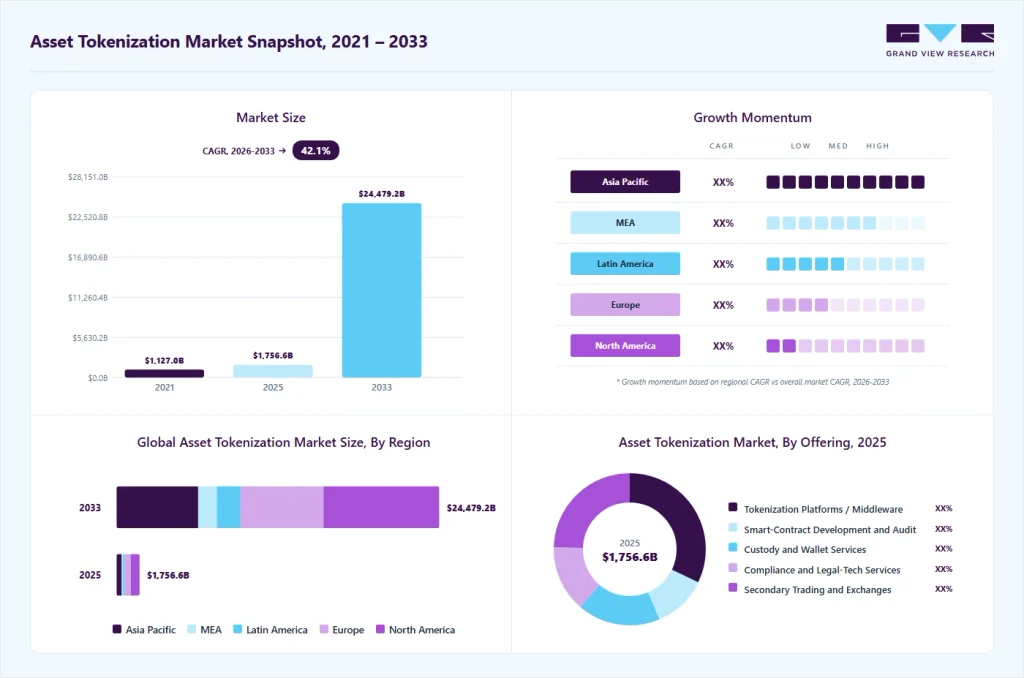
Market research firms project the asset tokenization market to grow at roughly 42% a year through 2033. Grand View Research puts it at $1.8 trillion in 2025, $2.1 trillion in 2026, and $24.5 trillion by 2033.
However, these figures use a broad vendor definition. On-chain data from RWA.xyz shows about $39 billion of distributed tokenized assets today.
1. Grand View Research Market Size and CAGR
The asset tokenization market is projected to grow at a 42.1% CAGR from 2026 to 2033, according to Grand View Research. It estimates the market at $1.8 trillion in 2025 and $2.1 trillion in 2026, reaching $24.5 trillion by 2033.
This is a broad vendor-defined figure, and RWA.xyz shows about $39 billion of distributed tokenized assets on-chain today.
2. 2026 Tokenized Asset Market Snapshot
| Measure | Source and date | Value | What it counts |
| Distributed value | RWA.xyz, October 16, 2026 | $39.18 billion | Tokens held in investor wallets, excluding stablecoins |
| Represented value | RWA.xyz, October 16, 2026 | $352.65 billion | Assets recorded on a ledger without on-chain transfer |
| IMF estimate | IMF report, as of July 31, 2026 | $65.1 billion | Tokenized assets excluding repos and stablecoins, mostly credit (30.4billion) and money market funds (17.5 billion) |
3. Why Financial Institutions Are Exploring Tokenized Assets
The IMF describes tokenization as combining issuance, trading, clearing, settlement, and servicing on one programmable ledger.
At the same time, tokenized credit and money market funds lead the count, so fixed-income products drive most activity. Institutions are exploring four specific fixes:
- Administration and recordkeeping: one shared ledger replaces records that firms must reconcile.
- Collateral and settlement: tokenized assets can move faster as collateral, if designed carefully.
- Investor distribution: issuers can reach eligible investors through security token offerings.
- Programmable transactions: rules, such as transfer limits, run automatically in code.
4. What Institutional Adoption Still Does Not Prove
Rising activity does not mean every business should tokenize. According to the IMF, four obstacles remain: legal certainty, regulatory clarity, blockchain interoperability, and reliable settlement assets.
It also found tokenized equities about 1.5 times as volatile as the underlying shares, with liquidity split across networks that do not connect.
The IMF still considers systemic risks limited, because tokenized markets remain relatively small.
Tokenization vs Digitization, Cryptocurrency, and NFTs
Digital records, cryptocurrency, NFTs, and asset-backed tokens serve different purposes, although some technology overlaps. Asset tokenization represents a claim on a real asset as a transferable token with built-in rules.
In contrast, the other terms describe records, native currencies, or unique collectibles.
1. Tokenization vs Digitization
Digitization turns paper or legacy records into electronic files. However, the asset and its transfer process stay the same.
Tokenization, on the other hand, represents the asset’s rights as a token that can move and follow rules across shared systems.
2. Digitization vs Asset Tokenization Comparison
| Dimension | Digitization | Asset tokenization | Business implication |
| Recordkeeping | Electronic copy in one system | Entry on a shared ledger | Fewer reconciliations between parties |
| Asset representation | Describes the asset | Represents the claim itself | Clearer ownership |
| Transferable rights | Transfer happens outside the file | Token transfer moves the right | Faster settlement |
| Transaction rules | Applied by staff or software | Coded into the token | Fewer manual checks |
| Interoperability | Custom integrations | Shared standards | Easier partner onboarding |
3. Asset Tokens vs Cryptocurrencies
Cryptocurrencies such as Bitcoin are native assets, and their value comes from the network. By contrast, an asset token references something outside the chain, such as a bond or property interest.
As a result, its worth depends on the legal rights and the backing arrangement. Therefore, cryptocurrency works as money, while an asset token records a claim.
4. How NFTs Differ From Tokenized Financial Assets
NFTs are unique, non-divisible tokens, so they suit certificates and collectibles. Moreover, an NFT can point to a real asset. Even so, owning it does not always carry ownership or licensing rights.
Consequently, regulated investment products need divisibility, transfer limits, and clear legal rights, which basic NFTs typically lack.
5. Asset Token vs Cryptocurrency vs NFT at a Glance
| Type | What supports its value | Typical use |
| Cryptocurrency | Network demand | Payments, store of value |
| NFT | Varies, often only a link | Unique digital items |
| Asset token | Legal claim on an asset | Regulated investments |
6. Asset Tokenization vs Payment and Data Tokenization
Payment and data tokenization replace sensitive data, such as a card number, with a surrogate value. Meanwhile, the original stays in a secure vault. Thus, the method protects information and does not represent ownership, which is why enterprise data tokenization platforms focus on security and compliance instead of asset transfer.
Additionally, AI text tokenization is unrelated, because it splits text into units for language models.
Which Assets Can Businesses Tokenize?
Businesses can tokenize assets that have clear rights, a legal wrapper, and a process for custody and payouts. Real estate, securities, gold, royalties, and receivables can all meet those conditions.
Therefore, the best candidates depend on structure, not on asset type.
1. Tokenizable Asset Classes at a Glance
| Asset class | What the token represents | Primary business application | Key consideration |
| Real estate and infrastructure | Fractional interest in a property-holding vehicle | Fractional investment, rental income | Title and legal structuring |
| Bonds, funds, private credit, equity | Securities or fund interest | Faster administration and distribution | Securities law treatment |
| Gold and commodities | Claim on stored physical reserves | Access to physical assets | Custody and verification |
| Intellectual property and royalties | Licensing or revenue participation right | Royalty distribution | Contract enforceability |
| Emerging enterprise assets | Receivable, credit, or membership right | Shared records across parties | Legal recognition varies |
2. Real Estate and Infrastructure Assets
Real estate tokenization usually represents fractional interests in a vehicle, such as an SPV, that holds the property.
As a result, the token is a claim on the vehicle, not on the building itself. Moreover, rental income can reach holders through coded distribution rules.
However, title and legal structuring must be settled first, which shapes how real estate tokenization platform development is scoped.
3. Bonds, Funds, Private Credit, and Equity
Bonds, money market fund interests, private credit, and equity are natural candidates because they already exist as records of rights.
Therefore, tokenization mainly improves administration, such as investor records and corporate actions. Still, tokenized securities remain securities, so securities rules continue to apply.
4. Gold, Commodities, and Other Physical Assets
A gold token works as a receipt for metal held by a custodian. Consequently, reserves, custody, and independent verification decide whether the token deserves trust.
Likewise, valuation and redemption terms must be clear before holders can exchange a token for the physical asset.
5. Intellectual Property, Royalties, and Digital Rights
Intellectual property and royalties can be tokenized as contract-based revenue participation. For example, a token can track licensing rights and route royalty payments to holders.
In addition, digital provenance records show who created or owned a work. Nevertheless, the token only works if the underlying contract is enforceable.
6. Emerging Enterprise Applications
Other scenarios include supply-chain receivables, equipment leasing interests, carbon credits, and loyalty or membership rights.
These suit tokenization when many parties share one record and rules govern transfers. Even so, each needs a clear legal basis before launch.
In short, the strongest candidates have enforceable rights, reliable custody, and a clear payout process.
How an Asset Moves From Legal Ownership to Digital Tokens
An asset moves to digital tokens through five stages: verification, issuance, investor onboarding, transfer, and servicing. Each stage serves a commercial purpose, such as proving ownership or paying holders.
Therefore, the blockchain is one step in a longer legal process.
1. Asset Verification and Legal Structuring
Before any token exists, the enterprise must identify the asset, verify ownership, and complete valuation and due diligence.
Then, where appropriate, the asset moves into an SPV or trust. Consequently, the token can reference a clear legal claim instead of an informal promise.
2. Digital Token Creation and Issuance
Next, the enterprise selects a token model, defines the supply, and links the token to its rights and documents.
The issuance is then recorded on the ledger. As a result, the verified asset has a digital representation that investors and auditors can trace.
a. Minting, Burning, and Redemption
Minting creates token supply, while burning retires it. Redemption, in turn, returns value to the holder, and the mechanism depends on the asset and governing agreements.
For example, a gold token and a property interest follow different exit terms.
3. Investor Verification and Token Allocation
Meanwhile, only eligible investors should receive tokens. Therefore, the platform verifies identity and eligibility, registers wallets, and applies transfer restrictions before the initial distribution.
Consequently, the issuer controls who can hold the asset from day one.
4. Ownership Transfers and Transaction Settlement
When eligible holders trade, the system first validates the transfer and updates ownership. Payment and settlement are then coordinated between the parties.
Finally, records are reconciled, because tokens, payments, and legal registers must match.
5. Income Distribution, Reporting, and Asset Servicing
After issuance, the work continues with interest, dividends, rental income, or royalty payments to holders. Moreover, corporate actions, reporting, and servicing keep the token aligned with the asset.
This is why RWA tokenization platform development extends beyond issuance into administration.
What Makes an Enterprise Tokenization Platform Operational?
An operational tokenization platform combines blockchain infrastructure, application software, compliance controls, external integrations, and operational interfaces. A token alone cannot onboard investors, pay income, or satisfy auditors.
Therefore, enterprises need each layer working together.
1. Enterprise Tokenization Platform Components Compared
| Platform component | Business purpose | Why enterprises need it |
| Blockchain network and token standard | Records ownership and transfer rules | Sets the limits for cost, privacy, and compliance |
| Smart contracts | Automate issuance, transfers, lockups, and redemption | Reduce manual enforcement |
| Dashboards | Give issuers, investors, and administrators their own views | Each role needs different data and permissions |
| Identity, wallet, and custody integrations | Verify participants and secure assets | Eligibility and safekeeping are legal duties |
| Payment and enterprise integrations | Connect tokens to banks, ERP, and valuation sources | Tokens must reconcile with existing books |
| Security and monitoring | Provide audits, access controls, and incident response | Protect assets across the platform’s life |
2. Blockchain Networks and Token Standards
Public blockchains offer open access, while private and permissioned networks restrict who can participate. Hybrid designs combine both.
Consequently, network choice affects privacy, transaction cost, and throughput.
a. ERC-20, ERC-721, and ERC-3643
Each standard serves a different purpose. ERC-20 covers interchangeable tokens, and ERC-721 covers unique ones. ERC-3643 and ERC-1400, in contrast, add eligibility-controlled transfers for regulated securities.
3. Smart Contracts and Token Lifecycle Management
Smart contracts automate issuance and supply controls, transfer permissions, lockups, and redemption rules. They can also handle corporate actions. As a result, the same rules apply to every holder.
4. Issuer, Investor, and Administrator Dashboards
Issuers need asset management tools, while investors need a clear view of their holdings. Meanwhile, administrators need compliance tools, reporting, and transaction monitoring. Therefore, each role gets a separate interface and permission set.
5. Identity, Wallet, and Custody Integrations
KYC and AML integrations confirm who can hold tokens. Wallet management then ties each verified participant to an address, with custodial or non-custodial options. Moreover, multi-party authorization and recovery procedures protect assets when keys are lost.
6. Payment Rails and Enterprise System Integrations
Payment and settlement integrations connect tokens to cash movement. In addition, ERP, accounting, banking, custody, and valuation systems keep the platform aligned with existing finance operations.
For this reason, asset tokenization platform architecture and APIs matter as much as the token itself.
a. On-Chain and Off-Chain Data Coordination
Ownership and transfer records belong on-chain, while sensitive documents and personal data usually stay in enterprise systems. Synchronization and reconciliation then keep both views consistent. This approach protects privacy without losing auditability.
7. Security, Auditing, and Operational Monitoring
Smart contract audits and independent security testing find flaws before launch. Access controls and key management then limit who can act. Finally, monitoring and incident response protect the platform throughout its operating life.
Therefore, a tokenization platform is more than the token. It also needs smart contracts, role-based dashboards, identity and custody controls, enterprise integrations, and continuous security monitoring. Together, these layers let a business issue, administer, and service tokenized assets reliably.
What Business Benefits Can Tokenization Actually Deliver?
Tokenization can improve access, settlement, administration, and transparency, but those gains are potential, not automatic.
Whether they appear depends on market demand, regulation, interoperability, and implementation quality. Therefore, each benefit below comes with the condition it needs.
1. Tokenization Benefits and Conditions at a Glance
| Potential benefit | Business condition required | Limitation |
| Broader investor access | Eligible investors and enough demand | Eligibility rules and asset limits still apply |
| Faster transfers and settlement | Shared standards and payment coordination | Intermediaries and legal steps remain |
| Lower administrative cost | Replacing duplicate records and manual steps | Integration and compliance costs add up |
| Greater transparency | Consistent, shared records | On-chain data cannot verify the real asset alone |
| New distribution and revenue models | Controlled transfers and automated servicing | Secondary demand is not guaranteed |
2. Broader Investor Access Through Fractional Ownership
Fractional ownership splits one asset into smaller units, which can lower minimum investment thresholds.
As a result, issuers may reach a wider group of eligible buyers. However, investor eligibility rules still limit who can buy, and some assets suit fractional units better than others.
3. Faster Asset Transfers and Settlement
Programmable workflows and shared transaction records can reduce delays between trade and settlement.
Moreover, coordinated payment steps can shorten the wait for confirmation. Even so, intermediaries and legal requirements remain, so faster does not mean instant.
4. Lower Administrative and Reconciliation Costs
Tokenization can reduce duplicate recordkeeping, manual reconciliation, and transfer administration.
Similarly, automated distributions can cut routine payout work. Nevertheless, integration and compliance costs offset part of the savings, so the net effect varies by business.
5. Greater Transparency and Auditability
A shared ledger gives participants consistent records and a traceable transaction history. Consequently, auditors can follow ownership changes more easily.
However, on-chain verification confirms token activity, not the condition or legal status of the real asset.
6. New Asset Distribution and Revenue Models
Tokenization allows digitally distributed products, automated servicing, and fractional offerings.
In addition, controlled secondary transfers may create new ways to exit an investment. Still, secondary demand depends on the market and is not guaranteed.
In short, tokenization offers real operational and commercial upside, but only under the right conditions. Access, speed, cost, and transparency each depend on demand, regulation, and execution. Therefore, businesses should evaluate each benefit against its limits before committing.
Why Tokenized Assets Still Face Liquidity and Security Risks
Creating transferable digital units does not create investor demand, validate the underlying asset, or remove operational risk. The IMF’s October 2026 assessment draws the same line between promise and current market conditions.
Therefore, businesses should weigh each risk below before relying on tokenization.
1. Fractional Ownership Does Not Guarantee Liquidity
Smaller units make an asset easier to buy, not easier to sell. Limited buyers, restricted transfers, and poor market depth can leave holders without an exit.
The IMF also found thinner liquidity in tokenized markets, with pools split across blockchains creating price gaps. Consequently, fractional ownership alone does not make an asset marketable.
2. Asset Valuation and Reserve Verification Risks
A token is only as accurate as the data behind it. Stale valuations, inaccurate reserve records, and custodial discrepancies can leave the token and the real asset out of step. ]
Furthermore, oracle feeds that deliver off-chain data add another point of failure.
3. Smart Contract, Wallet, and Custody Vulnerabilities
Technical failures can expose both businesses and investors. Contract defects, key compromise, and unauthorized transfers are the main routes, while operational mistakes cause losses too.
As a result, audits and access controls reduce these risks but do not remove them.
In addition, the IMF notes that instant settlement removes the time once used to manage liquidity and assess risk. Therefore, errors can spread faster than they do in traditional markets.
4. Interoperability and Market Fragmentation
Not every tokenized asset can move freely between platforms. Different networks, incompatible standards, and identity or compliance restrictions keep liquidity in separate pools.
Consequently, secondary-market connectivity stays limited.
The IMF lists interoperability among four constraints, alongside legal certainty, regulatory clarity, and the availability of settlement assets.
Tokenization changes how an asset is recorded and moved, not whether buyers exist or whether the asset is sound. Liquidity, data quality, security, and interoperability each need separate solutions. Therefore, businesses should treat tokenization as one part of a wider market strategy.
How US Regulations Shape Enterprise Asset Tokenization
Applicable US rules depend on the asset, its economic rights, the participants, the transactions, and the jurisdiction, not on token terminology alone. A token called a digital asset can still be a security.
Therefore, enterprises should classify the asset legally before designing the platform.
1. When Tokenized Assets Fall Under Securities Laws
The SEC staff’s January 28, 2026 statement on tokenized securities says a security’s format does not change how federal securities laws apply. As a result, a tokenized stock remains a stock, and an offer or sale must be registered or exempt.
The statement also separates issuer-sponsored tokenization from third-party tokenization, where an unaffiliated firm tokenizes another issuer’s security.
However, the statement reflects staff views and has no legal force. Counsel must therefore confirm the classification for each structure.
2. Investor Identity, Accreditation, and Transfer Restrictions
Regulated tokenized interests are usually limited to verified, eligible investors. Issuers therefore run identity checks, apply KYC and AML obligations where applicable, and confirm accreditation. In addition, geographic limits and transfer approval rules can restrict who may later acquire the token.
3. Custody, Recordkeeping, and Investor Protection
Someone must be responsible for holding the asset and the keys. Records, audit trails, and reporting then show who owned what and when. Moreover, clear recovery and dispute procedures protect investors when errors or losses occur.
Third-party tokenization adds risk, because the SEC staff notes that holders may face the third party’s own insolvency.
4. How Programmable Compliance Works
Programmable compliance applies predefined rules before a transfer completes. Identity registries, allowlisting, lockups, and permission checks can block ineligible transfers, while administrators can intervene when needed.
However, these controls support compliance and do not guarantee it, so regulatory counsel remains necessary.
a. How ERC-3643 Supports Permissioned Transfers
ERC-3643 links each token to verified identities. Compliance modules then check rules, such as eligibility or holding limits, before a transfer proceeds. Consequently, a transfer that fails a condition is rejected.
5. Compliance Considerations for International Token Holders
Offering tokenized interests across borders adds jurisdictional eligibility rules, tax and reporting duties, and further transfer restrictions.
Moreover, relevant international frameworks may apply in addition to US law. Therefore, counsel in each jurisdiction should review the structure before launch.
In short, US compliance depends on what the asset is and who holds it, not on the word token. Programmable controls help enforce the rules, but they do not replace legal review. Therefore, regulatory counsel should shape the platform from the start.
How Much Does an Enterprise Tokenization Platform Cost?
An illustrative custom tokenization platform costs $70,000 to $300,000, covering design, build, and deployment but excluding legal, licensing, custody, audit, and third-party fees.
Final budgets depend on asset class, token model, integrations, and compliance scope. Therefore, founders should treat these figures as planning allocations, not quotes.
1. Estimated Custom Tokenization Platform Cost by Phase
The table splits the planning range into four development phases. Legal, licensing, custody, asset servicing, external audits, and third-party charges may require separate budgets.
| Development phase | Illustrative estimate |
| Discovery, architecture, and compliance requirements | $8,000 to $30,000 |
| Token contracts, asset logic, and blockchain integration | $24,000 to $95,000 |
| Issuer/investor portals and enterprise integrations | $22,000 to $100,000 |
| Testing, security validation, and deployment | $16,000 to $75,000 |
| Total planning range | $70,000 to $300,000 |
2. Which Features Increase Tokenization Development Costs?
Similar-looking platforms differ in budget because the scope underneath differs. Moreover, each feature below adds design, integration, or testing work.
| Feature | Why it raises cost |
| Custom token behavior | Bespoke transfer, lockup, and redemption logic needs more design and testing |
| Investor and issuer workflows | More roles, approvals, and screens add build effort |
| Multi-asset functionality | Each asset class brings its own legal and data rules |
| Compliance integrations | Identity, KYC, and AML providers need connection and testing |
| Custody requirements | Custodian connections and key controls add integration work |
| Marketplace features | Order handling and settlement logic expand the platform |
| Cross-chain support | Each added network multiplies testing and security checks |
3. Ongoing Maintenance and Operational Expenses
Launch is not the final cost. An illustrative annual maintenance allowance of 15% to 25% of initial development cost equals about $10,500 to $75,000 in this range.
However, maintenance differs from broader operating expenses, which sit outside that allowance.
| Expense | What it covers | Typical budget line |
| Infrastructure and monitoring | Hosting, alerts, and uptime | Operating |
| Maintenance and updates | Fixes, upgrades, and network changes | Maintenance |
| Security testing | Periodic reviews and penetration tests | Maintenance |
| API subscriptions | Data, identity, and payment providers | Operating |
| Compliance operations | Ongoing reviews and reporting support | Operating |
| Custody and reporting services | Safekeeping and investor statements | Operating |
4. How to Evaluate Tokenization Platform ROI
Return depends on whether the platform earns more than it costs to build and run. Therefore, founders should estimate the inputs below before committing.
Detailed models sit in the guide to the cost to develop an RWA tokenization platform in 2026.
| Factor | What to estimate |
| Expected assets under administration | Total value the platform will hold |
| Number of issuers and investors | Counts at launch and after growth |
| Issuance and servicing fees | Revenue per asset or per holder |
| Transaction volume | Expected trades and transfers |
| Operational savings | Reduced reconciliation and administration work |
| Customer acquisition costs | Cost to win issuers and investors |
In short, a realistic budget covers the build, the exclusions, and the running costs together. The $70,000 to $300,000 range covers development only. Therefore, a scoped assessment gives a more reliable figure than any single estimate.
How To Approach Enterprise Tokenization Development Safely
Approach enterprise tokenization safely by fixing the asset’s legal rights first, then building compliance, custody, and system integrations around them. Delivery should run in reviewed phases, with security testing before launch.
In practice, Idea Usher follows this sequence as a custom engineering partner.
1. Asset-Specific Token and Smart Contract Architecture
Each asset carries different rights, so each needs different token behavior. We map those rights first, then build the token and contract rules around them.
- Asset-specific token behavior: We define how the token is held, restricted, and transferred, so a fund interest and a commodity receipt do not share one template.
- Issuance and redemption: We set how supply is created and retired, and tie redemption to the governing agreements and, for physical assets, stored reserves.
- Ownership restrictions: Eligibility limits, lockups, and holding caps are written into the rules before launch.
- Smart contract lifecycle management: We cover issuance, transfers, corporate actions, and upgrades. The rules are documented before code is written, so legal and security reviewers can read what the token does.
2. Compliance-Aware Investor and Custody Integrations
Compliance cannot sit outside the platform, so we build it into the workflows. However, regulatory counsel decides the rules, and we implement and test them.
- Eligibility and identity workflows: Investors complete identity checks and eligibility approval before a wallet can hold the token.
- Permissioned transfers: Transfers that fail the rules are blocked, for example through standards such as ERC-3643.
- Custody connectivity: We connect the platform to the custodian the business chooses.
- Wallet controls: Multi-party authorization and recovery procedures protect assets when keys are lost.
- Administrative oversight: Administrators can review holders, approve exceptions, and monitor transactions.
3. Integration With Existing Enterprise Infrastructure
A platform that cannot talk to existing systems creates a second set of books. Therefore, we connect tokenization to the tools the company already runs.
- ERP: Asset and holder data flow into planning and operations systems.
- Financial and accounting systems: Distributions and balances reconcile with the ledger.
- Payment providers: Settlement and payouts connect to existing payment rails.
- Enterprise APIs: Data moves in both directions between the platform and company systems.
- Reporting infrastructure: Investor, audit, and management reports draw from consistent records.
- On-chain and off-chain records: Ownership and transfer records can sit on the ledger, while sensitive documents stay in the company’s own storage.
4. Phased Delivery and Long-Term Platform Support
Founders control scope and risk by buying the work in stages. Each phase ends with something to review before the next begins.
- Discovery and scope definition: We map the asset, rights, users, and integrations into a written scope.
- Architecture validation: Network, token model, and integration choices are checked against that scope.
- Core platform implementation: Contracts, portals, and integrations are built and reviewed in stages.
- Security review and testing: Contracts and access controls are reviewed and tested, and fixes are tracked.
- Deployment: The platform is released to the chosen environment against a launch checklist.
- Ongoing support: Monitoring, updates, and fixes continue after launch.
Consequently, the legal and integration questions come first, because a change in discovery costs far less than a change after deployment.
Therefore, safe tokenization development ties each token to its asset rules, builds compliance and custody into the platform, and connects to existing systems. Together, these steps keep scope, security, and compliance visible from the first call to launch.
Plan Your Tokenization Platform With Idea Usher
Tokenizing an asset is easy to start and costly to get wrong. A weak legal structure, loose custody, or integrations that never reconcile can stall a launch after the budget is spent. Therefore, the safest first step is a scoped assessment, not a build.
At Idea Usher, we help founders define the asset, its rules, the integrations, and the budget before any code is written. Our scoped assessment covers:
- Asset, rights, and ownership mapping
- Recommended token model and standard
- US compliance requirements overview
- Custody and wallet approach
- Integration plan for existing systems
- Phase-by-phase delivery scope
- Budget range with exclusions
- Key risks and next steps
Request a custom tokenization platform scope and budget assessment from Idea Usher. Share your asset and goals, and we will outline the safest path from idea to launch. A short call is enough to begin.
Conclusion
Asset tokenization turns a legal claim on a real asset into a transferable digital token. However, the token alone creates no demand and no legal protection. Therefore, success depends on the asset’s rights, compliance controls, secure custody, and integration with existing systems.
Founders should treat market forecasts as direction, not proof, and budget for the full build. For that reason, a scoped assessment is the safest first step before any development begins. Idea Usher can map the asset, rules, and budget.


FAQs
A1. Yes. Asset tokenization issues tokens that represent a claim on an asset, and it does not require a native cryptocurrency. The token’s value comes from the underlying rights, not from network demand. However, the platform may still use an existing blockchain, which can involve paying network fees in that chain’s currency.
A2. It depends on the structure, and the governing documents decide it. A token may represent direct ownership, a beneficial interest, or a contractual claim, often through an SPV or custodian. Therefore, holders should read the legal terms before assuming the token equals title.
A3. No, not automatically, because technical transferability is not market liquidity. A token can move at any hour, but a sale still needs a willing buyer. Moreover, transfer restrictions, eligibility rules, and lockups can block a trade, so availability depends on the market and the law.
A4. No, because private and permissioned networks are viable, and some enterprises choose them for privacy and access control. Public networks, in contrast, offer open access and broader reach. Hybrid designs combine both, so the right choice depends on the asset, the investors, and the compliance needs.
A5. Yes, when the underlying rights allow it, and the legal documents define who is entitled to what. Smart contracts can then support the payments, while a servicing process handles calculations and reporting. However, the token does not create income that the asset does not produce.
A6. Evaluate asset-specific architecture, security practices, enterprise integrations, phased delivery, compliance coordination with counsel, and demonstrated experience. Moreover, ask for architecture examples and verified outcomes, not general claims. Therefore, a good partner explains how the platform handles your asset’s rules before proposing a build.