


Key Takeaways
- Oral GLP-1 programs are gaining traction as patients seek more convenient and accessible weight loss treatment options.
- Businesses can create Ro-like platforms by combining telehealth services, prescription workflows, pharmacy integrations, and patient support features.
- Ro’s growth demonstrates how vertically integrated healthcare ecosystems can improve patient retention and drive long-term revenue.
- Success in this market depends on secure infrastructure, regulatory compliance, personalized care experiences, and scalable technology.
- How Idea Usher can help businesses launch oral GLP-1 programs like Ro through secure telehealth platforms and compliance-ready infrastructure.
As more companies launch telehealth-based weight loss services, standing out has become increasingly difficult. The popularity of oral GLP-1 programs is growing because many patients prefer taking a daily pill over using injections. However, offering access to medication alone is rarely enough to achieve lasting results. The platforms that perform best are those that actively support patients throughout their treatment journey. By helping users stay consistent, manage side effects, and monitor progress, these platforms can improve outcomes while building stronger patient trust and retention.
Over the years, we’ve developed numerous GLP-1 program solutions that combine remote patient monitoring platforms and prescription management systems to deliver personalized obesity care experiences. As Idea Usher has this expertise, we’re writing this blog to explain how you can launch an oral GLP-1 program like Ro.
Market Demand for Oral GLP-1 Program Platforms
According to Morgan Stanley, the global GLP-1 market could grow to between $170 billion and $240 billion, making it one of the fastest-growing opportunities in digital healthcare. A key reason for this expansion is the emergence of oral GLP-1 medications. Many people who are interested in medical weight loss are reluctant to use injections, so a simple daily pill can make treatment feel far more approachable and convenient.

Source: Morgan Stanley
This shift creates a valuable growth opportunity for new platforms. Oral GLP-1 programs can attract people who may never have considered prescription weight loss treatments before. The success of companies like Hims & Hers and Ro shows that demand extends beyond injectable medications. By offering oral options, businesses can reach a wider audience, reduce barriers to entry, and build stronger patient acquisition pipelines as the weight loss market continues to expand.
Driving Convenient Care
Patients increasingly prefer treatments that fit seamlessly into their daily routines. Oral GLP-1 therapies offer greater convenience and accessibility, making them an attractive option for telehealth platforms seeking to improve patient acquisition and long-term adherence.
- Simplified Logistics: Cold-chain shipping is mandatory for injectables, which inflates fulfillment costs and complicates delivery logistics. Oral medications bypass this entirely, requiring standard shipping and traditional storage.
- Higher Retention Rates: Long-term adherence is notoriously difficult with injectables due to injection-site reactions and lifestyle disruptions. A daily pill integrates easily into a patient’s existing routine, leading to better compliance and sustained subscription revenue.
- Travel-Friendly Care: Patients frequently report anxiety about traveling with refrigerated medication. Oral alternatives eliminate this barrier, ensuring that lifestyle disruptions do not lead to treatment discontinuation.
A Massive Opportunity
The oral GLP-1 segment is gaining momentum as more patients seek effective weight loss treatments that are simple and convenient to use. Unlike injectable medications, oral options fit easily into daily routines, making them appealing to a broader audience. This growing demand is creating new opportunities for digital health companies focused on obesity care.
For businesses entering this space, the opportunity extends beyond medication access. Patients often need ongoing support, progress monitoring, and regular clinical guidance to achieve long-term results. Platforms that can deliver a seamless treatment experience are likely to see stronger engagement, higher retention, and sustainable recurring revenue as the market continues to expand.

Ro’s Transformation Into a Digital Health Giant
Ro has become a prominent player in the GLP-1 weight loss market by combining virtual medical care with access to clinically prescribed treatments through a single platform. Patients can complete an online health assessment, consult with licensed healthcare providers, and receive personalized treatment recommendations that may include GLP-1 medications if deemed appropriate.
The platform also supports users with ongoing monitoring, progress tracking, and prescription management to help improve long-term treatment adherence and outcomes.
Solving Stigmatized Care
Ro started as Roman, a telehealth platform focused on helping men access erectile dysfunction treatment through private online consultations and home-delivered prescriptions. By making care more discreet and convenient, the company addressed a common barrier that prevented many people from seeking treatment. The strong response from consumers demonstrated how digital healthcare platforms can improve access to care by simplifying traditionally sensitive healthcare experiences.
Scaling into New Verticals
After initially launching as Roman, the company expanded beyond men’s health and rebranded as Ro to support a wider range of healthcare needs. It gradually introduced services across areas such as weight loss, women’s health, fertility, skincare, and hair care, creating a more comprehensive digital healthcare ecosystem. This expansion allowed Ro to serve patients throughout different stages of their health journey while strengthening long-term engagement and creating additional growth opportunities. .
Building a Full Ecosystem
Ro eventually evolved into a vertically integrated powerhouse by owning the entire patient journey. Instead of just connecting doctors and patients, they built their own pharmacy fulfillment centers, integrated diagnostic lab testing, and developed proprietary electronic health record software.
- Vertical Integration: Owning the pharmacy network means higher profit margins and total control over the packaging and shipping experience.
- Agile Care Expansion: Because the foundational tech stack was so robust, Ro rapidly deployed new high-margin programs like GLP-1 weight management as soon as market demand surged.
- Ecosystem Lock-in: Patients rarely leave a platform that handles their lab work, physician consultations, and medication delivery under one digital roof.
For an entrepreneur, Ro serves as the ultimate blueprint. It proves that a digital health company can scale from a simple telehealth niche into a dominant, multi-billion-dollar enterprise by focusing on infrastructure and user experience.
Capitalization and Financial Trajectory
Ro’s financial journey highlights how aggressively institutional investors back robust healthcare infrastructure. The platform has raised over $1 billion in total primary capital, validating its business model through multiple highly competitive funding rounds. This heavy capitalization translated directly into explosive financial growth. Driven primarily by the massive scale-up of its GLP-1 obesity management branch,
| Funding Round | Capital Raised | Strategic Milestones Achieved |
| Series C | $200 Million | Expanded into multi-specialty clinics (Rory, Zero) and launched the $5 generic pharmacy. |
| Series D | $500 Million | Scaled nationwide logistical infrastructure, integrated at-home diagnostics, and achieved a $5 Billion valuation. |
| Growth Round | $150 Million | Pushed corporate valuation to $7 Billion, funding the rapid rollout of high-margin metabolic health and obesity care programs. |
Ro’s annualized revenue surged to $598 million, marking a 66% year-over-year acceleration. For private equity and venture investors, these metrics demonstrate that owning the full clinical and pharmaceutical supply chain unlocks superior margins and high-growth revenue streams that traditional, pure-software companies cannot replicate.
Understanding Ro’s Vertically Integrated Healthcare Model
Ro is a nationwide direct-to-patient healthcare platform that handles the entire clinical process under one digital roof. By combining independent physician networks, proprietary electronic medical records, diagnostic operations, and an in-house pharmacy infrastructure, the platform manages patient care from initial diagnosis to doorstep medication delivery. One of Ro’s biggest differentiators is combining telehealth, pharmacy, labs, and diagnostics under one platform.

1. Dynamic Online Visits
The patient journey starts with a smart digital intake form. Instead of making people fill out generic paperwork, the system uses dynamic health assessments that change based on previous answers. Patients input their medical background, symptoms, and lifestyle goals entirely online through the proprietary Ro Intake Engine.
This automated intake is where high operational margins begin. It filters out ineligible applicants automatically and organizes complex clinical data before a doctor even looks at the file. This drastically lowers overhead costs and allows a lean medical team to review cases efficiently without sacrificing patient safety.
2. Provider Consultations
After the intake, patients connect directly with licensed healthcare providers. This happens through the platform’s custom Care Portal, which supports asynchronous text messaging and virtual consultations. The secure platform keeps communication open so users can report side effects, check progress, and ask questions whenever they need to using Ro Secure Messaging.
This continuous care model is excellent for retention. By treating healthcare as an ongoing subscription conversation rather than a one-off doctor appointment, the platform builds deep user trust. Patients feel supported, which naturally keeps them active on the platform long-term.
3. Prescription Fulfillment
Once a doctor approves the treatment, the software routes the prescription to Ro’s proprietary pharmacy network using their integrated e-prescribing tool, Ro Pharmacy Services. The medication is packed and tracked in real-time before being shipped straight to the patient’s door in discreet packaging.
- In-House Logistics: By owning the pharmacies, the platform captures the wholesale-to-retail price spread instead of leaving margins on the table for third-party pharmacies.
- Fulfillment Control: Custom packaging and automated shipping rules managed by Ro Fulfillment Architecture ensure that high-value treatments never get delayed.
- Data Loop: The software tracks exactly when a package is delivered, which automatically triggers the next doctor check-in and billing cycle.
By controlling the technology, the clinical staff, and the physical pharmacy, this ecosystem removes every major friction point that causes patients to drop out of traditional care programs.
Features to Build an Oral GLP-1 Program like Ro
Building a competitive medical weight loss platform requires replicating the seamless touchpoints that made Ro an industry leader. Launching successful oral GLP-1 programs requires an intuitive interface that makes chronic metabolic care feel like a premium consumer service rather than a clinical chore.
1. Dynamic Online Visit
Ro uses a guided digital intake process that collects relevant health information before a patient meets with a healthcare provider. Rather than relying on lengthy forms, the platform gathers details such as weight goals, medical history, and current medications through a structured experience. This helps providers review patient information more efficiently, supports informed treatment decisions, and creates a smoother onboarding process for individuals seeking weight loss care.
2. Virtual Provider Consultation System
Ro streamlines the consultation process through a virtual care portal where patients can submit their health information and treatment goals without scheduling a live appointment. Licensed healthcare providers review each case, assess eligibility, and create personalized treatment plans based on the patient’s profile. This flexible approach makes care more accessible while allowing patients to receive medical guidance and treatment decisions on their own time.
3. GLP-1 Prescription Management
Oral GLP-1 treatment often involves gradually increasing the dosage over time to help patients adjust comfortably and improve treatment adherence. A well-designed platform simplifies this process by clearly displaying dosing instructions, tracking treatment progress, and helping users stay on schedule. Automated refill management and ongoing support also ensure that patients can continue their weight loss journey without unnecessary interruptions.
4. Integrated Pharmacy
Ro owes much of its success to its internal pharmacy network. When a doctor approves a renewal, the software speaks directly to the fulfillment center without requiring paper scripts or manual faxes.
- Real-Time Tracking: Users track their medication shipments right from their account page.
- Discreet Logistics: Packagers ship the daily tablets in premium, unmarked boxes that protect patient privacy.
- Auto-Refill Alignment: The system charges the patient subscription fee exactly three days before the pharmacy prints the shipping label, keeping cash flow perfectly synced.
5. Lab Testing Integration
Diagnostic testing plays an important role in ensuring that GLP-1 treatments are prescribed safely and appropriately. Ro simplifies this process by integrating lab testing into the patient journey, allowing healthcare providers to review key health markers before recommending treatment. By connecting testing, clinical evaluation, and prescription management within one platform, Ro creates a more streamlined and convenient experience for patients seeking weight loss care.
6. Secure Patient Messaging
Ongoing support is an important part of any successful GLP-1 weight loss program. Ro helps patients stay connected with their care team through secure messaging, allowing them to ask questions, discuss side effects, and receive guidance throughout treatment. This continuous access to clinical support helps patients feel more confident in their weight loss journey and encourages long-term engagement with the program.
7. Progress Tracking Dashboard
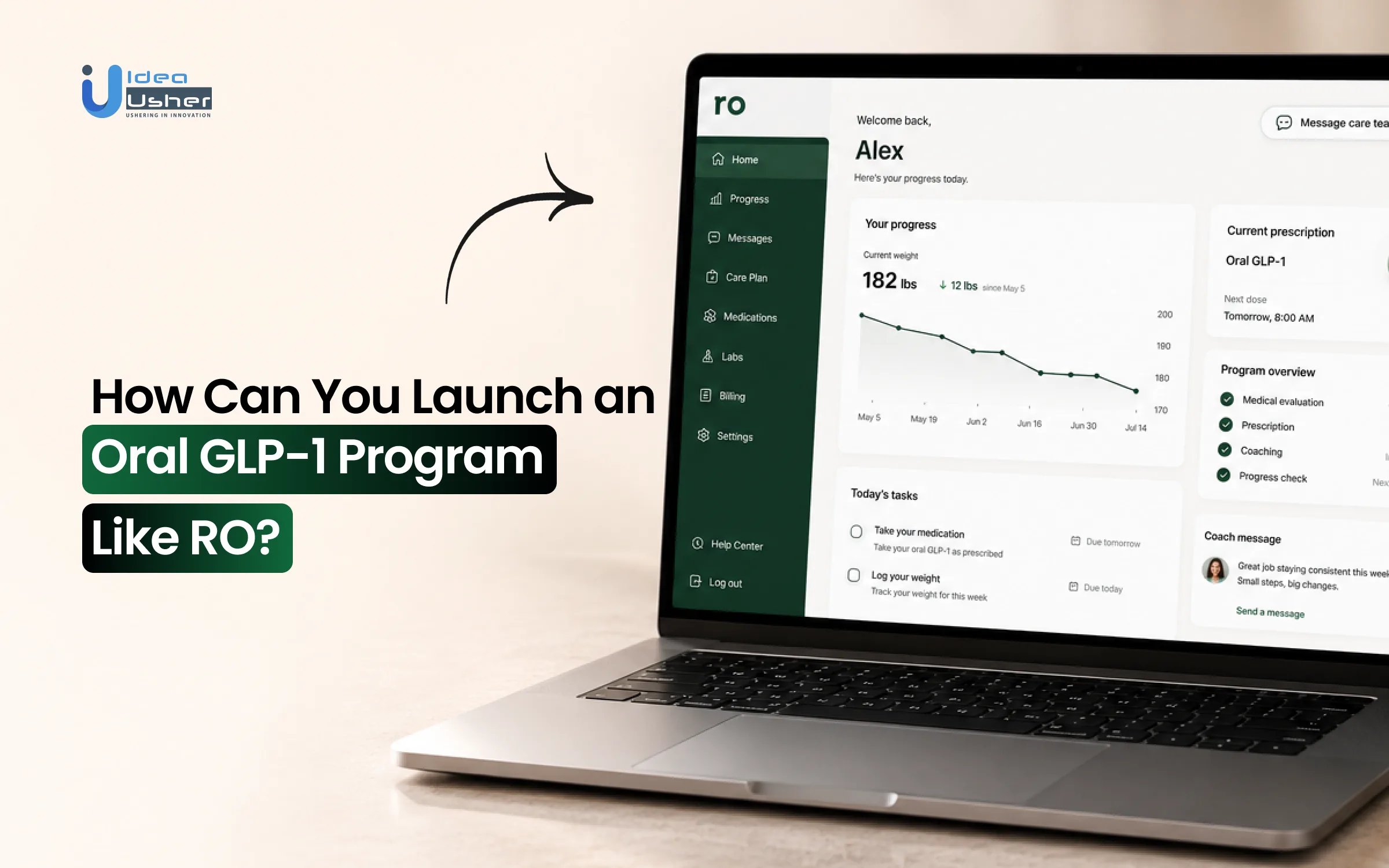
The patient dashboard serves as a central hub for tracking progress throughout the weight loss journey. Users can monitor changes in weight, record key health metrics, and view their progress through easy-to-understand visual reports. Seeing measurable results over time helps keep patients motivated and engaged, while also giving healthcare providers valuable insights that can be used to improve treatment outcomes and overall program effectiveness.
How Can You Launch an Oral GLP-1 Program Like Ro?
Launching successful oral GLP-1 programs requires more than just standard software development. It demands a highly specialized technical blueprint that blends medicine with commerce. Our engineering teams design these complex digital ecosystems to minimize user friction while keeping patient safety as the highest priority.

1. Building Smart Intake Systems
We develop intelligent onboarding systems that make it easy for patients to share relevant health information through a guided and user-friendly experience. These assessments adapt to user responses and collect the details healthcare providers need to evaluate eligibility more efficiently. By organizing information in a structured format from the start, the platform helps streamline clinical reviews and supports faster, more informed treatment decisions.
2. Developing Provider Dashboards
We build provider dashboards that give healthcare professionals quick access to the information they need to review patient cases and make informed treatment decisions. By bringing together health assessments, medical records, and lab results in one place, the platform helps streamline clinical workflows and improve efficiency. This allows care teams to manage larger patient volumes while maintaining a smooth and compliant telehealth experience.
3. Automated Dosing and Titration
Oral weight loss treatments need precise medical management because they rely on structured dosing schedules. Patients start with low induction strengths to let their bodies adjust before moving up to higher maintenance doses. We build custom e-prescribing engines that automate this entire titration lifecycle.
Our developers build tracking logic that alerts the clinician when it is time to escalate a patient dosage. The system also tracks exactly how many pills are left in a current cycle. This automated calculation ensures the next prescription tier is reviewed, signed off, and ready for fulfillment well before the patient runs out of their daily medication.
4. Streamlining Prior Authorizations
High medication costs can often lead to abandoned subscriptions. To prevent this, we write automated scripts that handle benefits verification and insurance checks instantly during the signup process.
- Instant Benefits Lookup: The software queries insurance databases in real time to verify coverage levels.
- Automated Form Population: If a medication requires prior authorization, our system pulls patient charts to fill out insurance paperwork automatically.
- Denial Response Systems: We build clinical task triggers that help your staff draft and submit insurance appeals quickly, keeping patients from dropping out due to cost issues.
5. Integrated Pharmacy Logistics
To achieve the level of convenience that Ro offers, your digital platform must sync perfectly with pharmaceutical logistics. We build secure API integrations that connect your software directly to specialized compounding and commercial mail-order pharmacies. Once a physician hits approve, the script drops straight onto the pharmacy fulfillment queue without any manual steps. Our tracking modules pull real-time shipping updates directly into the patient portal. This allows users to track their daily tablets from the fulfillment floor right to their front door.
6. Patient Engagement and Retention
Long-term business growth in this sector depends heavily on patient retention. We build interactive engagement tools that keep users connected to their care plans. Patients log into a visual dashboard where they can update their weekly weight loss metrics, track lifestyle habits, and log daily medication compliance. If a user logs an issue like mild nausea, our system immediately alerts your customer support or nursing team through an encrypted chat interface. This fast response helps address patient anxieties early, preventing cancellations and building long-term loyalty.
7. Security, Compliance, and Scaling
Medical applications require ironclad security protocols. We build all digital health infrastructure with strict HIPAA compliance at its core, utilizing advanced database encryption to protect sensitive user profiles. This helps safeguard patient information, maintain regulatory compliance, and build trust throughout the healthcare experience.
Cost to Launch an Oral GLP-1 Program Like Ro
Budgeting for a medical weight loss platform requires balancing software development costs with essential compliance and security frameworks. We design financial roadmaps that protect capital while building a secure product. By separating core launch features from advanced infrastructure, we help investors launch quickly and scale efficiently as patient volume grows.
MVP Development Cost
The initial investment centers on launching an MVP that handles the core patient journey. We focus your budget on building the primary onboarding flows, basic asynchronous chat tools, a provider review portal, and prescription tracking. For a baseline deployment, an initial capital allocation of $45,000 to $75,000 allows us to build and launch a secure, working architecture.
Launching with an MVP allows you to validate market demand and secure initial recurring revenue before investing in custom internal systems. This lean approach keeps early capital risks low, providing a functional, fully compliant platform that can safely onboard thousands of first-time GLP-1 users.
Infrastructure, Compliance, and Integration
Operating a healthcare platform requires budgeting for specialized infrastructure that goes beyond standard software architecture. We build security layers directly into your cloud setup to ensure strict regulatory compliance from day one.
- HIPAA-Compliant Hosting: Secure server structures that isolate and encrypt protected health data.
- EHR and API Connections: Technical tunnels that sync your platform with national pharmacy networks and independent laboratory software.
- Insurance Verification Engines: Software modules that check patient benefits and process recurring subscription payments securely.
Factors Influencing the Budget
The total cost to deploy your platform varies based on scope, feature complexity, and your chosen scaling strategy. We work with your team to align these technical requirements with your commercial milestones. If you start in a single state using simple compounding pharmacy partnerships, your upfront engineering costs remain modest.
The budget increases as we integrate advanced tools like automated prior authorization systems, multi-role admin interfaces, or custom diagnostic workflows designed for nationwide expansion.
Comprehensive Financial Roadmap
To help guide your capitalization strategy, we break down the engineering investments into clear milestones. This table outlines the estimated capital required to transition from a new launch to a full-scale digital health enterprise. It provides a practical roadmap for planning development budgets and scaling resources as the platform grows.
| Platform Tier | Estimated Cost Range | Key Delivery Milestones | Target Timelines |
| Core MVP Launch | $45,000 to $75,000 | Smart intake engine, provider portal, secure messaging, and partner pharmacy APIs. | 10 to 14 Weeks |
| Advanced Growth Platform | $80,000 to $140,000 | Automated dosing titration, diagnostic lab loops, and automated subscription renewal. | 16 to 22 Weeks |
| Enterprise Scale System | $150,000+ | Full nationwide scaling, automated prior authorizations, and custom internal EHR tools. | 24+ Weeks |
Strategic Execution Note: We handle the end-to-end development process so you do not have to source separate engineering, security, and healthcare compliance teams. Our existing codebase frameworks allow us to deploy these secure medical systems faster, saving you months of development time and reducing market entry friction.
Insurance vs Self-Pay: Which Business Model Is More Profitable?
Choosing between insurance reimbursement and a cash-pay subscription model is one of the most critical structural decisions when launching successful oral GLP-1 programs. We help founders analyze the trade-offs of both systems, designing technical architectures that protect unit economics while maximizing market share.
Revenue Potential of Self-Pay
Many digital health companies begin with a direct-to-consumer subscription model because it offers a simpler path to market and a more predictable revenue stream. Patients pay a monthly fee for access to virtual care, ongoing clinical support, and eligible weight loss treatments. This approach creates a convenient experience for users while allowing providers to focus on care delivery rather than complex reimbursement processes.
The model has already been validated by leading players in the industry. For example, Noom rapidly expanded its medical weight loss business, with its medication program reportedly reaching a $100 million revenue run rate within four months of launching its generic weight loss offering. For new entrants, subscription-based programs can provide recurring revenue, stronger customer retention, and a foundation for long-term growth.
How Insurance Expands Acquisition
Integrating insurance coverage can significantly expand the reach of a digital weight loss platform. When patients can use their existing health benefits, treatment becomes more affordable and accessible. This reduces a major barrier to entry and helps platforms attract a broader range of users who may not be willing to pay the full cost out of pocket.
The business potential of this approach is already evident. WeightWatchers’ clinical division, powered by the Sequence platform, generated $27 million in subscription revenue in a single quarter, reflecting strong demand for insurance-supported obesity care. As more insurers increase coverage for weight management treatments, platforms with built-in insurance workflows will be well positioned to capture this growing market.
Strategic Comparison Matrix
To help determine the best path for growth, it is important to evaluate how different revenue models influence patient acquisition, operational efficiency, and long-term profitability. Comparing these approaches provides a clearer understanding of which model aligns most effectively with your business objectives and target market.
| Metric | Self-Pay Subscription Model | Insurance-Backed Care Model |
| Time to Market | Fast launch; zero payer contracts required. | Slower launch; requires credentialing or payer networks. |
| Administrative Cost | Very low; basic payment gateway processing. | Higher; requires billing staff or automated billing logic. |
| Patient Retention | Highly dependent on direct out-of-pocket value. | Extremely high; low patient copays protect against churn. |
| Gross Margins | Predictable and high per-subscriber revenue. | Variable; subject to shifting insurance drug formularies. |
Choosing the Right Growth Model
The most scalable approach for a new platform is often a hybrid growth strategy. We engineer flexible software architectures that allow you to launch quickly using a self-pay model, generating immediate revenue while validating your clinical workflows. As your patient base grows, we seamlessly integrate automated insurance infrastructure into your existing setup.
This allows your platform to process cash payments for lifestyle tiers while unlocking covered insurance benefits for chronic metabolic care, giving you the ultimate balance of high operational margins and massive market scale.
How Oral GLP-1s Could Lower Customer Acquisition Barriers?
Launching an onboarding funnel for medical weight loss means confronting patient hesitation at the exact moment of conversion. While injectable medications have dominated the market, they introduce a high level of friction during user signups. We engineer custom telehealth platforms that optimize for oral GLP-1 delivery, allowing companies to tap into an eager, massive pool of new users.
1. Overcoming Needle Anxiety
A large segment of the addressable market delays or entirely avoids metabolic treatment because of needle anxiety. Subcutaneous injections create a significant psychological barrier that causes users to drop out of the signup process before completing their health profiles. Oral GLP-1 options remove this hurdle entirely, turning a stressful medical procedure into an approachable daily routine.
One major player leveraging this shift is PlushCare, which integrates oral weight-loss options into its primary virtual care network. By offering an alternative to painful injections, the platform has successfully lowered its marketing costs. Patients who previously ignored weight-loss ads are highly responsive to pill-based messaging, helping PlushCare consistently grow its direct-to-consumer medical consultation revenue base.
2. Improving Funnel Conversion
Consumers are structurally more comfortable taking a daily tablet than managing cold-chain injectable pens. This sense of familiarity dramatically simplifies your onboarding requirements and reduces the time support teams spend answering safety questions. When the customer journey feels straightforward, top-of-funnel conversion rates rise naturally.
Hims & Hers capitalized heavily on this behavioral trend by strategically pivoting its massive weight-loss specialty away from compounded injections to focus squarely on branded oral GLP-1 treatments like the oral Wegovy pill. Despite massive structural shifts, this strategy allowed them to project a massive full-year platform revenue target of $2.8 billion to $3 billion, proving that consumer familiarity with oral formats accelerates user acquisition.
3. Expanding Top-of-Funnel Demand
The rollout of oral options is bringing in waves of brand-new users who have never sought obesity care before. This broad consumer appeal significantly drops customer acquisition costs. Instead of spending marketing capital fighting over the same small pool of injection-tolerant users, your platform can target a wide audience of lifestyle and wellness consumers.
- Lower Ad Spend: Ad copy featuring daily tablets achieves significantly higher click-through rates compared to traditional injection marketing.
- Streamlined Support: Eliminating concerns around needle disposal and refrigeration requirements allows your administrative team to scale operations efficiently.
- Expanded Demographics: Pill-based programs appeal strongly to busy professionals, frequent travelers, and younger demographics who demand maximum convenience.
4. Platform Performance Metrics
When we build these platforms, we track how specific medication offerings impact overall company value. This overview shows how oral formulations change your critical business metrics. Understanding these effects helps businesses make informed decisions around pricing, patient acquisition, retention, and long-term growth strategy.
| Acquisition Metric | Injection-Only Programs | Oral GLP-1 Programs |
| Average Signup CAC | Higher; requires extensive safety education. | Lower; immediate consumer comfort. |
| Onboarding Drop-off | High; patients freeze when needles are mentioned. | Low; smooth transition to checkout. |
| Shipping Logistics | High cost; requires temperature-controlled packaging. | Standard shipping; simple, stable shel |
Create an Oral GLP-1 Program With Idea Usher
Launching a medical weight loss business means building a secure system that patients trust, and regulators approve. With over 500,000 hours of coding experience, our team of ex-FAANG developers knows exactly how to build large-scale health systems. We write clean code that complies with healthcare laws while delivering a smooth shopping experience for your patients.

End-to-End Platform Engineering
We design and launch complete digital health systems from scratch. Your custom platform will include every software tool required to run your daily medical operations smoothly. Our software engineers build beautiful consumer apps alongside advanced clinical control portals. This means your team can handle user registration, look over medical charts, issue prescriptions, and manage fulfillment logistics within a single connected system.
HIPAA-Compliant Architecture
Patient privacy is our top priority when writing code. We install ironclad security protocols to protect all medical files and personal profiles across your entire server network.
- Advanced Encryption: We secure user medical records both while sitting in databases and while traveling to doctors.
- Smart Identity Management: Only licensed professionals can access sensitive health histories.
- Detailed Audit Trails: The application automatically tracks every digital action to guarantee strict regulatory compliance.
Scaling to Nationwide Growth
We help startups launch a minimal functional platform quickly and then help them grow into huge national enterprises. Our modular architecture lets you add fresh features without breaking existing workflows. Our team provides continuous tech support long after your product launches. From integrating national laboratory systems to adding automated insurance tools, we ensure your platform remains stable and competitive.
Conclusion
Building an oral GLP-1 program like Ro involves creating a seamless healthcare journey that makes weight loss treatment easy to access and manage. By combining virtual care, medication management, patient monitoring, and ongoing support, businesses can deliver a more engaging experience while meeting the growing demand for clinically guided obesity care.
Things to Know About Oral GLP 1 Programs
Q1: How does an oral GLP-1 program work?
A1: Patients usually begin by completing an online health assessment and consulting with a licensed healthcare provider. If deemed eligible, they receive a personalized treatment plan, medication prescriptions, and ongoing support through the platform to help manage their weight-loss journey. The entire process can often be completed remotely through a web or mobile application. This reduces the need for frequent in-person clinic visits and improves accessibility.
Q2: What features should an oral GLP-1 platform include?
A2: Key features often include patient onboarding, telehealth consultations, e-prescriptions, pharmacy integrations, medication delivery tracking, secure messaging, progress monitoring, and provider dashboards. Advanced platforms may also incorporate AI-driven engagement and adherence tools. The exact feature set depends on the target market and business goals. Enterprise platforms often require additional analytics, compliance, and operational management capabilities.
Q3: Are oral GLP-1 program platforms required to be HIPAA compliant?
A3: If a platform stores, processes, or transmits protected health information, it should implement HIPAA-compliant infrastructure and security controls. Compliance helps protect sensitive patient data, build trust, and support healthcare operations at scale. Healthcare regulations can vary by region and service model. Founders should consult legal and compliance experts before launching a telehealth platform.
Q4: Can oral GLP-1 platforms integrate pharmacies and labs?
A4: Yes. Many modern healthcare platforms integrate with pharmacies for prescription fulfillment and medication delivery, while also connecting with laboratory providers for test ordering and result management. These integrations help create a seamless patient experience. Integrated healthcare workflows improve operational efficiency and reduce manual administrative work. They also enable providers to make more informed treatment decisions.


