


Key Takeaways
- Insecure Helm charts and Terraform templates can compromise Kubernetes environments before deployment even begins.
- Strong Kubernetes IaC security depends on RBAC hardening, policy-as-code and automated infrastructure scanning.
- Configuration drift, insecure CI/CD workflows and unsafe Terraform modules are major causes of Kubernetes security failures.
- Modern DevSecOps teams rely on GitOps, continuous validation and automated policy enforcement to secure deployments.
- How Idea Usher can help enterprises secure Kubernetes infrastructure with pre-vetted DevSecOps experts and scalable IaC security automation.
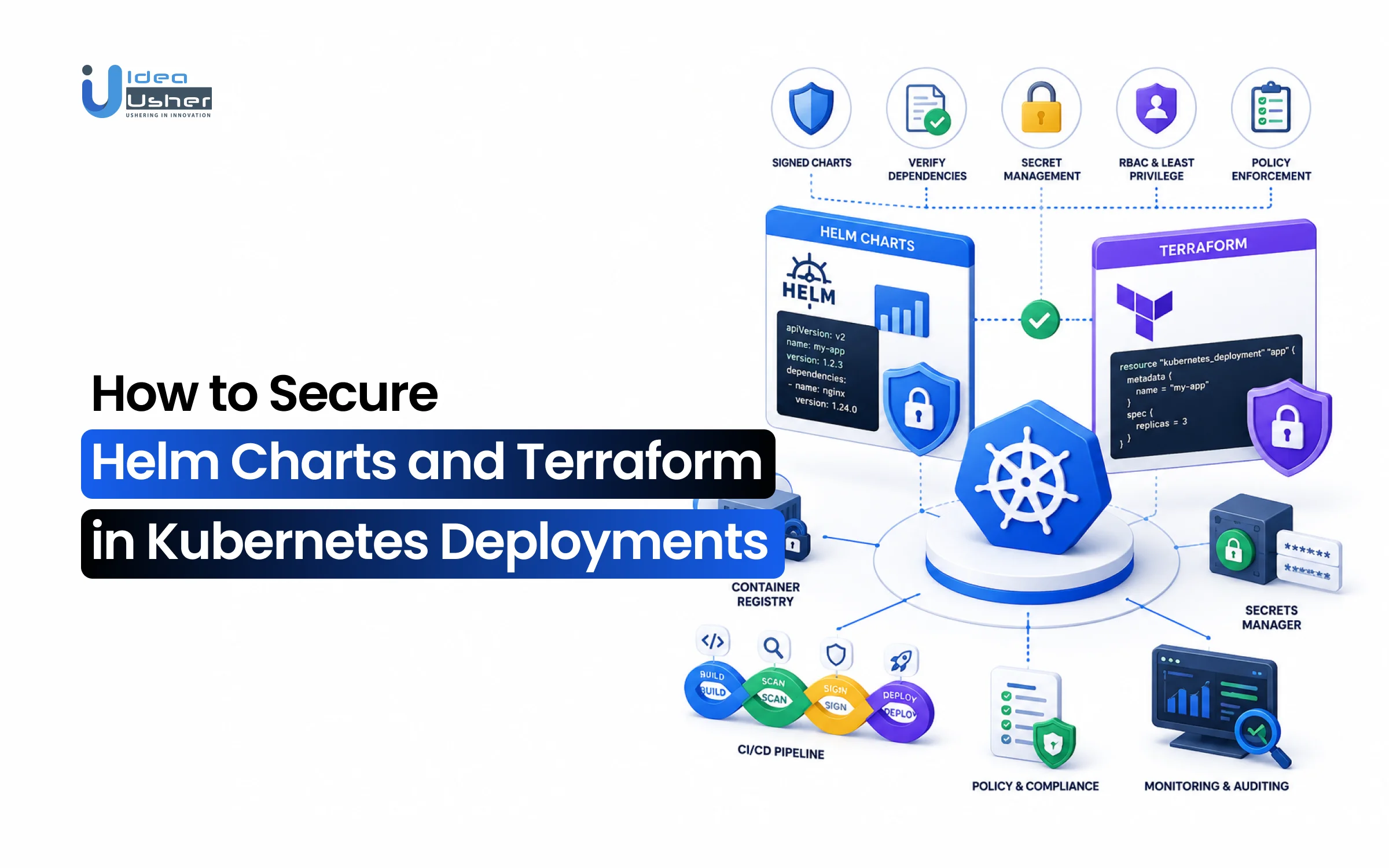
Infrastructure automation has accelerated Kubernetes deployments, but it has also increased the risk of security flaws spreading silently across environments. That is why helm terraform security kubernetes is becoming a critical priority for DevSecOps teams where a single insecure Helm chart or misconfigured Terraform template can expose clusters, cloud resources and deployment pipelines long before workloads reach production.
Traditional security strategies focused mainly on runtime monitoring and post-deployment protection, leaving gaps when insecure infrastructure definitions are already embedded into deployment workflows. Teams now need policy-driven validation, secure configuration management, automated infrastructure scanning and continuous compliance checks integrated directly into Kubernetes pipelines.
In this blog, we will talk about the security risks in Helm charts and Terraform workflows, the best practices to secure Kubernetes deployments and how IdeaUsher provides pre-vetted Kubernetes security experts to strengthen infrastructure security at scale.
Why Kubernetes IaC Security Failures Are Rising Rapidly
As Kubernetes adoption accelerates, Infrastructure as Code enables rapid, large-scale deployments but can also replicate misconfigurations across thousands of nodes within seconds. The global Kubernetes Solutions Market is estimated at USD 3.46 billion in 2026 and is projected to reach USD 14.36 billion by 2035, growing at a CAGR of 17.3% over the forecast period

A. How Insecure Helm Charts Expose Kubernetes Clusters
Helm is often called the package manager for Kubernetes, but it can also be a delivery vehicle for significant security risks. Because Helm charts abstract away the underlying YAML complexity, many teams deploy third-party charts without auditing the templates.
- Over-Privileged RBAC: Many community charts default to cluster-admin roles or excessive permissions that violate the Principle of Least Privilege (PoLP).
- Hardcoded Secrets: Templates often include default passwords or API keys intended for testing that accidentally make it into production.
- Image Vulnerabilities: Helm charts may pull from unverified or public registries containing bloated images with known CVEs (Common Vulnerabilities and Exposures).
B. Terraform Misconfigurations That Create Enterprise Risks
Terraform is the industry standard for provisioning the underlying cloud infrastructure (EKS, GKE, AKS) that hosts Kubernetes, making helm terraform security kubernetes essential for protecting cloud-native environments. When Terraform is misconfigured, the blast radius isn’t just a single pod, it’s the entire environment.
| Misconfiguration | Potential Risk |
| Publicly Accessible Endpoints | Exposes the Kubernetes API server to the open internet, inviting brute-force attacks. |
| Disabled Logging/Auditing | Leaves the security team blind to unauthorized changes or breach attempts. |
| Unencrypted State Files | Terraform .tfstate files often contain sensitive metadata and secrets in plain text. |
| Wide Security Groups | Allowing 0.0.0.0/0 access to worker nodes enables lateral movement for attackers. |
C. Why DevOps Teams Struggle With Kubernetes Security Gaps
The security gap in helm terraform security kubernetes environments is rarely caused by a lack of effort; it’s usually a byproduct of tooling fatigue and skill shortages.
- Complexity of Scale: Managing security policies across multi-cloud or hybrid-cloud Kubernetes environments is manually impossible.
- Configuration Drift: Even if a cluster starts secure, manual hotfixes made in the dashboard (bypassing IaC) create a gap between the code and reality.
- Lack of Context: Traditional security scanners often flag thousands of high vulnerabilities without context, leading to alert fatigue where developers ignore critical warnings.
D. Business Risks of Unsecured Kubernetes Deployments
Kubernetes security isn’t just a technical hurdle for the C-suite, it’s a fundamental business risk. The fallout of a breach in a containerized environment can be catastrophic:
- Compliance Violations: Failing to secure PII (Personally Identifiable Information) within a cluster can lead to massive fines under GDPR, HIPAA, or PCI-DSS.
- Resource Hijacking (Cryptojacking): Attackers often compromise K8s clusters not to steal data, but to use the enterprise’s massive compute power to mine cryptocurrency, leading to astronomical cloud bills.
- Reputational Damage: A breach in the core orchestration layer suggests a systemic failure in a company’s digital DNA, eroding customer trust.
- Service Downtime: Misconfigurations can lead to cascading failures, where one insecure component crashes the entire production environment.
Where Helm and Terraform Security Breakdowns Usually Start
The transition from manual configuration to Infrastructure as Code (IaC) was meant to standardize security. Instead, it often codifies human error. Security breakdowns typically start long before a cluster is live, beginning in the local development environment or a misconfigured repository. When security is treated as a final check rather than a fundamental part of the code, vulnerabilities become baked into the infrastructure.

A. Hardcoded Secrets Inside Helm Values and Terraform Files
One of the most common and preventable failures is the inclusion of sensitive data directly within IaC files.
- Helm Configuration Risks: Developers often store API keys, database credentials, or TLS certificates directly inside Helm configuration templates for quick testing, which can later be pushed into version control systems.
- Terraform Secret Exposure: Misconfigured Terraform secret variables can expose passwords in CLI output, deployment logs, or state storage artifacts when sensitive data protections are not properly enabled.
- The Leak Path: Once secrets are committed to a Git repository, they remain accessible through commit history even after deletion, creating long-term security risks.
B. Excessive RBAC Permissions Hidden in Helm Templates
Role-Based Access Control (RBAC) is the primary security layer within Kubernetes. However, Helm charts, especially complex third-party ones often request God-mode permissions to ensure they just work.
- Excessive Cluster Permissions: Many Kubernetes deployments use cluster-wide access controls when limited namespace-level permissions would be sufficient, increasing security exposure.
- Overly Broad Access Rules: Configurations with unrestricted resource and action permissions create major security risks, allowing compromised workloads to delete pods, access secrets, or escalate privileges.
- Hidden Permission Risks: Dynamically generated infrastructure templates can bury excessive permissions under complex logic, making them difficult to detect during manual security reviews.
C. Risks of Using Public Terraform Modules Without Validation
The Lego-brick nature of Terraform allows teams to move fast by using public modules from the Terraform Registry. However, this introduces a major supply chain risk within helm terraform security kubernetes environments.
- Hidden Defaults: A public module might provision an S3 bucket or an Azure Storage Account that is publicly readable by default to ensure ease of use.
- Shadow Infrastructure: Modules can create sidecar resources (like monitoring agents or logging sinks) that have their own set of security vulnerabilities or data egress paths you didn’t explicitly authorize.
- Lack of Version Pinning: Using a module without pinning it to a specific version means a malicious or buggy update to the source repository could instantly compromise your next deployment.
D. How CI/CD Pipelines Introduce Kubernetes Security Flaws
The CI/CD pipeline is the engine room of modern DevOps, but it is also a prime target for attackers.
- Insecure Runners: If the build server (the runner) has administrative access to the Kubernetes cluster and is compromised, the entire environment is at risk.
- Skipping Scans: In a rush to meet deadlines, teams often disable fail-on-error settings for IaC scanners (like Checkov, Terrascan, or Kube-linter), allowing insecure code to reach production.
- Persistent Credentials: Pipelines often use long-lived service account tokens stored as environment variables, rather than short-lived, identity-based credentials.
E. Why Configuration Drift Weakens Kubernetes Security Posture
Configuration drift in helm terraform security kubernetes environments occurs when the actual state of a Kubernetes cluster no longer matches the source of truth defined in Terraform or Helm code.
- Manual Hotfixes: Emergency production fixes made directly in live Kubernetes environments are often not synced back into Infrastructure as Code (IaC), creating configuration drift.
- Overwrite Risk: Future infrastructure deployments can unintentionally overwrite manual security patches, reintroducing previously fixed vulnerabilities.
- Auditing Challenges: Configuration drift makes it difficult to verify the actual security state of a cluster, leading to inaccurate compliance reporting and a false sense of security.

Key Security Challenges in Kubernetes IaC Deployments
As Kubernetes environments scale across multiple clusters, maintaining consistent helm terraform security kubernetes standards becomes increasingly difficult. While Infrastructure as Code (IaC) streamlines deployments, growing configuration complexity can create security gaps, making it challenging to enforce strong policies without slowing innovation.

1. Managing Multi-Cluster Kubernetes Security at Scale
When managing dozens or hundreds of clusters across different regions or cloud providers, inconsistency is the greatest enemy. Each cluster introduces its own set of attack vectors, and managing them individually is a recipe for disaster.
- Policy Fragmentation: Different teams may use slightly different Terraform modules or Helm values, leading to snowflake clusters that don’t adhere to organizational security standards.
- Centralized Identity Management: Ensuring that a developer has the same (limited) permissions across GKE, EKS, and on-premise clusters requires sophisticated OIDC integration that many IaC setups overlook.
- The Visibility Gap: Without a centralized single pane of glass, security teams struggle to identify which clusters are running outdated images or insecure configurations.
2. Preventing Unauthorized Infrastructure Configuration Changes
In a high-velocity environment, shadow IT often takes the form of manual overrides. Preventing these changes is essential to maintaining the integrity of the IaC source of truth.
- Immutable Infrastructure: The goal is to treat clusters as immutable. If a change is needed, it must be made in the code, not via kubectl.
- Admission Controllers: Tools like Open Policy Agent (OPA) or Kyverno act as the cluster’s bouncers, automatically rejecting any deployment that doesn’t meet specific security criteria (e.g., no root containers allowed).
- Service Account Lockdown: Restricting the ability of automated tools to make changes outside of specific namespaces prevents a compromised CI/CD pipeline from dismantling the entire infrastructure.
3. Balancing Fast Releases With Secure Kubernetes Operations
The Need for Speed often clashes with the Need for Security, creating a cultural and technical divide within DevOps teams.
| Fast Release Priority | Secure Operation Requirement | The Middle Ground (DevSecOps) |
| Instant Scaling | Resource Quotas & Limits | Automated resource profiling in IaC. |
| Third-Party Integrations | Supply Chain Validation | Private registries with automated CVE scanning. |
| Developer Autonomy | Least Privilege Access | Just-in-Time (JIT) privileged access. |
| Continuous Deployment | Guardrail Enforcement | Integrated IaC linting and static analysis. |
4. Why Manual Security Reviews Fail in Modern DevOps Pipelines
In the era of multiple deployments per day, the traditional security gate where a human reviews code is no longer viable.
- Human Latency: A manual review can take hours or days, while a CI/CD pipeline completes in minutes. This leads to developers bypassing security to meet deadlines.
- Context Overload: Kubernetes YAML files and Terraform plans are dense and nested. It is statistically impossible for a human reviewer to catch every misconfigured SecurityContext or unencrypted volume in a 5,000-line diff.
- Inconsistency: Different reviewers focus on different risks. One might be strict about RBAC but overlook network policies, leading to an uneven security posture.
- Lack of Tooling Integration: Manual reviews often happen in isolation from the actual runtime environment, meaning the reviewer cannot see how a code change will interact with existing cluster resources.
How to Secure Helm Charts and Terraform in Kubernetes Deployments
Securing helm terraform security kubernetes environments requires a continuous, proactive approach. By integrating security directly into Infrastructure as Code (IaC) workflows, organizations can automate best practices and ensure Helm and Terraform deployments remain secure, consistent, and compliant by design.

1. Securing Helm Secrets Using External Vault Integrations
Hardcoding secrets in values.yaml is a critical risk. Modern architectures decouple secret management from the application code by using external providers.
- External Secrets Operator (ESO): This allows Kubernetes to fetch secrets from external APIs like AWS Secrets Manager, HashiCorp Vault, or Google Secret Manager and inject them as native Kubernetes Secrets.
- Helm-Secrets Plugin: This plugin uses tools like sops to encrypt the secrets within your Git repository, ensuring they are only decrypted during the deployment phase by a secured CI/CD runner.
- Sidecar Injection: Tools like HashiCorp Vault can inject secrets directly into the application’s memory via a sidecar container, bypassing the need for Kubernetes Secrets altogether and reducing the attack surface.
2. Enforcing Least-Privilege RBAC Across Kubernetes Workloads
Over-privileged ServiceAccounts are the primary lateral movement path for attackers. Implementing the Principle of Least Privilege (PoLP) requires a granular approach to Helm templates.
- Namespace Isolation: Ensure Helm charts are restricted to specific namespaces rather than requesting cluster-wide permissions.
- Automated RBAC Auditing: Use tools like krane or rube-kube to scan the output of your Helm templates for wildcard permissions before they are applied.
- Dedicated ServiceAccounts: Never use the default ServiceAccount. Every workload should have a dedicated account with the minimum set of verbs (e.g., get, list, watch) and specific resource access.
3. Automating Terraform Policy Validation Across CI/CD Pipelines
Security should operate as a fail-fast mechanism in helm terraform security kubernetes pipelines. Automated validation ensures that no misconfigured infrastructure ever reaches your cloud provider.
- Static Analysis: Integrate tools like Checkov, TFSec, or Terrascan into your Git hooks or CI pipeline to catch unencrypted disks, public S3 buckets, or open security groups.
- Plan Validation: Run terraform plan and pipe the output to a security scanner to analyze the resultant infrastructure before the apply command is executed.
- Automated Remediation: Some advanced pipelines can automatically suggest or apply fixes for common misconfigurations during the Pull Request phase.
4. Preventing Infrastructure Drift Across Kubernetes Environments
Drift occurs when the live environment deviates from the IaC code. Maintaining parity is essential for security auditing.
- GitOps Adoption: Using tools like ArgoCD or Flux ensures that the cluster state is continuously synchronized with the Git repository. If a manual change is made via kubectl, the GitOps controller will automatically revert it to match the code.
- Terraform Drift Detection: Run scheduled Terraform plans in refresh-only mode to identify discrepancies between the state file and the cloud reality.
- Read-Only Access: Revoke write permissions for humans in production environments, forcing all changes to go through the vetted IaC pipeline.
5. Using Policy-as-Code for Kubernetes Security Enforcement
Policy-as-Code (PaC) strengthens helm terraform security kubernetes workflows by enforcing machine-readable security and compliance rules across infrastructure deployments.
- Open Policy Agent (OPA) / Rego: Use OPA to define complex policies, such as All containers must have resource limits or No images can be pulled from public registries.
- Kyverno: A Kubernetes-native policy engine that allows you to manage policies using standard YAML, making it easier for DevOps teams to adopt without learning a new language like Rego.
- Admission Controllers: These act as a final gatekeeper, intercepting requests to the Kubernetes API and rejecting any that violate defined security policies.
6. Continuously Scanning Helm Charts and Terraform Files
Scanning should happen at every stage of the lifecycle:
- Registry Scanning: Scan the container images referenced in your Helm charts for known vulnerabilities (CVEs) before deployment.
- Template Linting: Use helm lint and specialized tools like kube-linter to check for security smells in your charts, such as containers running as root.
- Recursive Scanning: Ensure your scanners look into sub-modules and dependent charts, as vulnerabilities are often hidden deep within the dependency tree.
7. Building Secure Multi-Cloud Kubernetes Deployment Pipelines
In multi-cloud environments, security must be abstracted to remain consistent across AWS, Azure, and GCP.
- Standardized Modules: Create a library of Hardened Terraform Modules that include security defaults (encryption, logging, private networking) that all teams must use.
- Identity Federation: Use Workload Identity (GCP) or IAM Roles for Service Accounts (IRSA) (AWS) to avoid storing long-lived cloud credentials within your Kubernetes clusters.
- Global Policy Enforcement: Use a centralized policy engine that applies the same security guardrails regardless of which cloud the Kubernetes cluster is running on.
8. Integrating Compliance Checks Into Kubernetes IaC Workflows
Compliance (SOC2, HIPAA, PCI-DSS) should be an automated byproduct of your deployment, not a manual audit at the end of the year.
- Compliance Mapping: Map your IaC security checks to specific compliance controls (e.g., Checkov check CKV_AWS_19 maps to NIST control AC-3).
- Audit Trails: Store every Terraform plan and Helm deployment log in a centralized, immutable logging system to provide a clear audit trail of who changed what and when.
- Automated Reporting: Use tools that generate compliance scores for your infrastructure, allowing stakeholders to see the real-time security posture of the entire Kubernetes fleet.
Common Kubernetes Security Mistakes Companies Still Make
Despite the maturity of the cloud-native ecosystem, many organizations still treat helm terraform security kubernetes processes as purely operational workflows rather than critical security assets. Below are the most frequent tactical errors and how to pivot toward a more resilient posture.

1. Treating Helm and Terraform Security as Separate Processes
The Error: Many teams use Terraform to secure the outside (Cloud VPCs, IAM) and Helm to secure the inside (Kubernetes Pods, RBAC) without any communication between the two.
The Risk: This creates a security silo. For example, Terraform might provision a private database, but a Helm chart might inadvertently expose it via a public-facing LoadBalancer because the two configurations weren’t validated against the same global policy.
The Business Impact: Increased time-to-market occurs when disconnected systems create bottlenecks and operational errors during product launches. One team sets up the infrastructure, but the application fails to run because the security rules are incompatible, forcing costly delays and rework.
2. Ignoring Third-Party Helm Charts and Terraform Dependencies
The Error: Using third-party Helm charts and modules from public libraries without internal vetting.
The Risk: You are essentially running someone else’s code with administrative privileges. Third-party charts often include hidden default configurations that favor ease of use over security, such as running containers as root or leaving ports open.
The Business Impact: Legal and financial liability increases when public code contains backdoors, security vulnerabilities, or outdated components. If your product is built on unverified code, you risk data breaches that lead to heavy compliance fines (GDPR/HIPAA) and permanent damage to your brand’s reputation.
3. Allowing Shared Access Across Kubernetes Deployment Teams
The Error: Giving broad, administrative access to the same Terraform state files or Kubernetes namespaces to speed up their work.
The Risk: This leads to The Tragedy of the Commons. When everyone has access, it becomes impossible to enforce accountability. One team might disable a security group to quickly test a feature, inadvertently exposing another team’s sensitive microservice.
The Business Impact: Operational fragility increases when excessive access permissions allow a single accidental action to disrupt the entire production environment. This lack of accountability makes it difficult to recover quickly from human error, leading to expensive downtime.
4. Delaying Infrastructure Security Until After Deployment
The Error: Waiting until the product is live in the cluster to check for security flaws like vulnerabilities or misconfigurations.
The Risk: Remediation becomes 10x more expensive and risky once a workload is in production. Attempting to fix a configuration error in a live environment often leads to unexpected downtime or hotfix drift.
The Business Impact: High technical debt occurs when security flaws are fixed after launch, often costing significantly more than resolving them during development. It disrupts your roadmap and pulls your best developers away from building new features to patch holes in old ones.
5. Relying Only on Manual Infrastructure Security Audits
The Error: Performing security reviews via spreadsheets or quarterly audits while deploying code multiple times a day.
The Risk: In a high-velocity Kubernetes environment, a manual audit is obsolete the moment it is finished. Manual reviews are prone to human error and cannot keep up with the thousands of lines of YAML generated by modern Helm charts.
The Business Impact: A false sense of security develops when rapidly changing software environments outpace ongoing security validation and monitoring. A manual audit only tells you that you were safe on the day the audit happened. Without automation, you are essentially flying blind for the 89 days between quarterly reviews, leaving your business vulnerable to emerging threats.
Why Hiring Kubernetes Security Engineers Is Extremely Difficult
Hiring helm terraform security kubernetes specialists is challenging because businesses need professionals skilled in cloud-native development, DevSecOps automation and Kubernetes security. This growing talent gap slows scaling efforts, increases hiring pressure, and creates operational risks for organizations rapidly adopting containerized infrastructure and Infrastructure as Code practices.
1. Shortage of Kubernetes DevSecOps Experts in the Market
The demand for Kubernetes expertise has exploded, but the supply of qualified engineers hasn’t kept pace.
- The Unicorn Skillset: A true expert must master container orchestration, cloud-specific infrastructure (AWS/Azure/GCP), and security protocols.
- Intense Competition: You aren’t just competing with local firms; you are competing with global tech giants who offer astronomical salaries and remote perks to hoard this specific talent.
2. Why Internal Teams Lack Advanced IaC Security Experience
Most internal IT teams are excellent at maintaining existing systems, but Kubernetes requires a total shift in mindset.
- Legacy vs. Cloud-Native: Traditional security focuses on firewalls and endpoints. Kubernetes security is liquid, it lives in the code (IaC). Many internal teams lack the specific experience needed to write secure Terraform modules or Helm charts from scratch.
- Learning Curve Risks: Allowing an inexperienced internal team to learn on the job with your production environment is a high-risk strategy that often leads to the costly misconfigurations mentioned earlier.
3. The High Cost of Building Enterprise Kubernetes Security Teams
Building an in-house team is an expensive long-term commitment that goes far beyond base salaries.
- Total Cost of Ownership: Between recruitment fees, high-end salaries, continuous training, and specialized security tooling licenses, the cost of an internal team can easily exceed several hundred thousand dollars annually.
- Retention Challenges: Because these engineers are in such high demand, turnover is frequent. Losing a key security architect in the middle of a product launch can be devastating to your timeline.
4. Challenges of Scaling Kubernetes Security Across Projects
As your business grows, one or two hero engineers are no longer enough.
- Bottlenecks: If every new feature has to pass through one overstretched security expert, your development speed will grind to a halt.
- Inconsistency: Without a massive, dedicated team, it is nearly impossible to maintain the same security standards across multiple different products or departments.
5. Why Fast-Growing Startups Need External Kubernetes Experts
Fast-growing startups need external Kubernetes experts to accelerate deployment, strengthen security, and avoid lengthy in-house hiring and training cycles.
- Instant Maturity: Partnering with an external team gives you Day 1 access to an established security framework. You don’t have to build the engine; you just have to drive the car.
- Focus on Core Product: By outsourcing the plumbing of Kubernetes security, your founders and core developers can stay 100% focused on building features that your customers actually pay for.
Why Staff Augmentation Solves Kubernetes Security Faster
Staff augmentation helps businesses quickly access helm terraform security kubernetes expertise without the delays associated with traditional hiring. This flexible approach enables faster problem-solving, stronger security implementation, and rapid scaling, reducing the risk of costly vulnerabilities during critical deployment and growth phases.
1. Faster Access to Pre-Vetted Kubernetes Security Developers
The vetting process for a Kubernetes expert is technically grueling. If you aren’t a K8s expert yourself, how do you know if your candidate truly understands the nuances of OPA policies or Helm chart hardening?
- The Shortcut: Staff augmentation provides you with battle-tested engineers who have already been vetted by a technical firm.
- The Benefit: You skip the technical interview grind and move straight to the integration phase with a developer who has already solved similar challenges for other businesses.
2. Reducing Hiring Delays for DevSecOps Implementation Projects
In the tech world, a three-month delay is an eternity. Standard recruitment cycles for specialized roles often stretch into quarters, not weeks.
- Bypassing the Search: While your competitors are still drafting job descriptions and waiting for applications, staff augmentation allows you to have a developer in your Slack or Jira environment within days.
- Momentum: This keeps your project momentum high, ensuring that security is built alongside the product rather than being bolted on at the last minute.
3. Scaling Kubernetes Security Teams Based on Project Demands
Your security needs aren’t static. You might need a heavy lift during the initial cluster setup and a lighter touch during steady-state maintenance.
- Elasticity: Staff augmentation allows you to scale up during peak security events such as a major architecture overhaul or a pre-launch audit and scale down once the heavy lifting is done.
- Zero Long-Term Liability: You aren’t burdened with a high fixed headcount during periods where the workload is lighter.
4. Lower Infrastructure Security Costs Compared to In-House Hiring
While the hourly rate for a specialized augmented developer might seem higher at a glance, the Total Cost of Engagement is significantly lower.
- Eliminating Hidden Costs: You don’t pay for recruitment fees, employee benefits, hardware, office space, or the bench time when an employee isn’t fully utilized.
- Pay-for-Performance: You pay for the hours worked on your project, ensuring that every dollar spent is directly contributing to the security of your product.
5. Accelerating Secure Kubernetes Deployment Timelines
Security is often viewed as a brake on the development process. Staff augmentation turns it into an accelerator.
- Parallel Execution: By bringing in external experts to handle the IaC security (Terraform/Helm), your internal developers can focus entirely on the application’s unique business logic and user experience.
- Proven Frameworks: Augmented experts bring their own library of secure, pre-written code snippets and best practices, meaning they don’t have to reinvent the wheel for your project.
How IdeaUsher Developers Secure Kubernetes IaC Pipelines
Scaling a product from MVP to enterprise-grade requires more than just code; it demands a resilient, secure-by-design architecture. IdeaUsher’s 250+ experts leverage deep helm terraform security kubernetes experience to transform Kubernetes pipelines into proactive, self-healing business assets.

1. Terraform & Helm Chart Auditing
Security breakdowns often stem from invisible dependencies within complex IaC files. Our engineers conduct deep-layer audits to ensure your cloud footprint is fully visible, compliant, and optimized for long-term growth.
- CIS Benchmark Alignment: We cross-reference every configuration against global Kubernetes security standards.
- Shadow IT Discovery: We identify and consolidate unlogged resources to eliminate ghost vulnerabilities.
- Template Validation: Our team hardens Helm templates to prevent the deployment of insecure defaults.
2. Eliminating Identity & Secret Vulnerabilities
Over-privileged accounts and hardcoded secrets are the primary entry points for breaches. We implement sophisticated identity frameworks that protect your sensitive data without hindering the development speed of your team.
- Dynamic Secret Management: We integrate HashiCorp Vault to replace static passwords with time-limited, rotating credentials.
- Least-Privilege Enforcement: We audit and restrict ServiceAccount permissions to the absolute minimum required.
- Zero-Trust Architecture: Our developers ensure every internal communication is authenticated and authorized.
3. Production-Grade Environment Hardening
Standard Kubernetes installations favor functionality over security, often leaving clusters exposed. We apply rigorous hardening protocols to ensure your production environment remains an impenetrable fortress for your intellectual property.
- API Server Lockdown: We disable unnecessary public endpoints to reduce the cluster’s attack surface.
- Network Policy Isolation: We implement micro-segmentation to prevent lateral movement by potential attackers.
- Root-less Container Enforcement: Our team configures workloads to run without administrative privileges by default.
4. Seamless DevSecOps Pipeline Automation
Manual security checks are the biggest bottleneck in modern software delivery. We embed automated guardrails directly into your CI/CD workflows, allowing your developers to ship features rapidly without compromising on safety.
- Automated IaC Scanning: We integrate tools like Checkov to catch misconfigurations during the pull-request phase.
- Vulnerability Gating: Our pipelines automatically block the deployment of images containing critical CVEs.
- Continuous Feedback Loops: We provide developers with instant security reports within their existing IDE environments.
5. Policy-as-Code Frameworks for Global Markets
Expanding into international markets requires strict adherence to regulations like HIPAA, GDPR, or SOC2. We translate these complex legal requirements into machine-enforceable policies that protect your business from massive fines.
- Policy-as-Code (OPA/Kyverno): We build self-regulating environments that automatically reject non-compliant deployments.
- Digital Audit Trails: We provide immutable logs of every infrastructure change for seamless regulatory reporting.
- Regional Data Guardrails: Our developers ensure data residency requirements are hardcoded into your cloud orchestration.
6. Drift Detection and Self-Healing Infrastructure
Manual hotfixes create serious risks in helm terraform security kubernetes environments by introducing gaps between approved Infrastructure as Code and live production systems. We utilize GitOps methodologies to ensure your cluster is always in sync with its vetted, authorized state.
- GitOps Implementation: We use ArgoCD to make your Git repository the Single Source of Truth.
- Automated Remediation: Our systems detect unauthorized changes and instantly revert them to the secure baseline.
- Real-Time Monitoring: We deploy advanced observability stacks to alert you the moment security posture shifts.
Generalist Execution vs. IdeaUsher Specialization
This breakdown illustrates the shift from high-risk manual processes to the automated, secure-by-default standards implemented by IdeaUsher’s specialized engineering teams.
| Security Area | The Generalist Approach (High Risk) | The IdeaUsher Specialist (Secure) |
| Secrets | Hardcoded in code or Git. | Dynamic injection via HashiCorp Vault. |
| RBAC | Over-privileged God-mode access. | Granular, Namespace-level permissions. |
| Auditing | Periodic, manual reviews. | Continuous, automated IaC scanning. |
| Compliance | Best effort manual checks. | Policy-as-Code (OPA/Kyverno) enforcement. |
| Updates | Manual patches (often delayed). | Automated image pinning and rollouts. |
| Recovery | Manual rebuild from backups. | GitOps Self-Healing via ArgoCD. |
Real Enterprise Use Cases of Securing Kubernetes IaC Pipelines
Operating a high-scale digital marketplace requires helm terraform security kubernetes frameworks that keep infrastructure secure by default. For a platform handling millions of transactions, specialized Infrastructure as Code (IaC) protocols are essential to prevent the configuration errors that lead to data leaks and checkout failures.
A. Securing Large-Scale Kubernetes Deployments
Global marketplaces often distribute traffic across multiple providers (e.g., AWS and Google Cloud) to ensure high availability. Maintaining identical security rules across these diverse environments is critical to preventing weak links in the architecture.
- Uniform Policy Enforcement: Using Terraform ensures that an Encrypted Storage rule in one cloud is mirrored exactly in another, eliminating discrepancies.
- Unified Networking: Secure service meshes ensure that inventory and customer data moving between clouds remains encrypted and invisible to the public internet.
- Centralized Identity: Consistent access levels across all regions prevent unauthorized backdoors from appearing in secondary cloud environments.
B. Preventing CI/CD Pipeline Exploits in Production
In an e-commerce setting, the CI/CD pipeline is the factory line for new features like One-Click Checkout. Protecting this pipeline ensures that malicious actors cannot swap legitimate payment gateways for fraudulent ones.
- Automated Gatekeeping: Integrated scanners automatically block any code attempt to modify sensitive payment-handling components without high-level authorization.
- Ephemeral Credentials: Replacing permanent Master Keys with short-lived, temporary tokens ensures that even if a key is intercepted, it becomes useless within minutes.
- Immutable Audit Trails: A digital paper trail records every code change, allowing stakeholders to verify the origin and authorization of every deployment.
C. Improving Compliance Readiness Using Secure IaC Practices
For platforms handling global payments, compliance with PCI-DSS and GDPR is a baseline requirement. Automated IaC turns these complex regulations into non-negotiable guardrails within the system’s code.
- Compliance-as-Code: Privacy requirements, such as the automatic deletion of temporary user data, are hardcoded directly into the infrastructure to ensure Privacy-by-Design.
- Audit-Ready Reporting: Instead of manual paperwork, automated systems generate real-time reports confirming that every cluster adheres to global security standards.
- Geographic Guardrails: IaC dictates regional data residency, ensuring European user data remains on European servers to avoid regulatory penalties.
D. Reducing Deployment Failures Through Kubernetes Hardening
A system crash during a high-traffic event, like a Flash Sale, is often the result of Configuration Drift, the manual changes that bypass the secure design. Hardening the environment through automation ensures the platform remains resilient under pressure.
- GitOps Self-Healing: If a manual change occurs in the live environment, the system detects the deviation and automatically reverts the cluster to its safe, tested state.
- Resource Guardrails: Hard limits on memory and CPU usage ensure that a bug in a non-critical feature (like a recommendation engine) cannot crash the core checkout page.
- Instant Rollbacks: If a new update shows any security or stability flaws, the system can instantly revert to the previous secure version without interrupting the customer experience.
Signs Your Kubernetes Deployment Pipeline Needs Expert Help
Identifying the tipping point where internal resources can no longer keep up with infrastructure demands is a critical business decision. If your deployment process has become a source of anxiety rather than an engine for growth, it is likely that your Kubernetes environment has outpaced your current management strategy.
1. Frequent Infrastructure Drift Across Kubernetes Environments
When manual hotfixes become the norm, the live cluster begins to deviate from the original blueprint, creating a silent security risk.
- The Problem: Ad-hoc changes made via the command line bypass version control, making it impossible to replicate the environment or track who changed what.
- The Risk: During the next automated rollout, these manual fixes are often wiped out, leading to unexpected production outages and ghost bugs.
2. Delayed Releases Due to Security and Compliance Bottlenecks
If your security team is viewed as a blocker that halts releases at the final hour, your pipeline is missing the necessary automation to scale.
- The Problem: Manual security reviews for every minor update create massive bottlenecks, forcing a choice between shipping fast and shipping secure.
- The Risk: Competitors move ahead while your team waits for approval, or worse, teams begin to bypass security protocols entirely to meet deadlines.
3. Increasing Kubernetes Misconfigurations Across Teams
Without centralized guardrails, different development teams often use inconsistent security settings, leading to configuration sprawl.
- The Problem: A single team’s over-privileged account or open network port can provide an entry point for an attacker to compromise the entire enterprise network.
- The Risk: One minor oversight in a non-critical feature can lead to a catastrophic data breach across the entire platform.
4. Lack of Visibility Into Helm and Terraform Security Risks
If you cannot verify which third-party packages are currently running in your production environment, you are operating with a major blind spot.
- The Problem: Nested dependencies in public Helm charts or Terraform modules often contain hidden vulnerabilities that remain undetected for months.
- The Risk: Your business remains vulnerable to Supply Chain Attacks where hackers exploit the very tools you use to build your infrastructure.
5. Growing Pressure to Secure Enterprise Kubernetes Workloads
As a product transitions from an MVP to a high-traffic enterprise platform, the technical requirements for security and compliance (SOC2, HIPAA) increase exponentially.
- The Problem: Generalist developers are often overwhelmed by the depth of hardening required for enterprise-grade clusters and audit-readiness.
- The Risk: Failing an audit or suffering a breach during a growth phase can lead to permanent loss of customer trust and severe financial penalties.
Why Enterprises Choose IdeaUsher for Kubernetes Security
Enterprises require not just developers, they need strategic partners in a digital landscape where a single misconfiguration can cost millions. IdeaUsher leverages 11+ years of experience and a 95% client retention rate to deliver impenetrable, audit-ready Kubernetes environments.
A. Access to Experienced Kubernetes and DevSecOps Specialists
Finding unicorn talent that understands both the development lifecycle and deep-tier infrastructure security is the primary bottleneck for growth. IdeaUsher provides instant access to a brain trust of 250+ niche professionals.
- Vetted Technical Elite: Every developer is battle-tested in high-stakes industries like Fintech, AI, and Blockchain.
- Cross-Domain Knowledge: Our specialists bring insights from 1,000+ global projects, ensuring your architecture benefits from diverse, high-level problem-solving.
- Security-First Mindset: We don’t just write code; we architect resilient systems that protect your intellectual property from day one.
B. Faster Kubernetes Security Implementation Across Teams
Speed is a competitive advantage, but not at the expense of safety. IdeaUsher’s methodology eliminates the learning curve that often stalls internal teams attempting to navigate the complexities of Kubernetes.
- Rapid Integration: Our developers sync with your existing Slack, Jira, and GitHub workflows within days, not months.
- Pre-Hardened Frameworks: We utilize a library of vetted, secure-by-default templates to accelerate your deployment timelines.
- Eliminating Bottlenecks: By automating security guardrails, we ensure your developers can ship features without waiting for manual security approvals.
C. Flexible Staff Augmentation for Enterprise DevOps Projects
Enterprise needs are dynamic, shifting between heavy architectural lifts and steady-state maintenance. IdeaUsher’s flexible model allows you to scale your technical capacity without the long-term liability of fixed headcount.
- On-Demand Scaling: Increase or decrease your DevSecOps capacity based on project phases, such as pre-launch audits or regional expansions.
- Cost-Efficiency: Convert high fixed hiring costs into manageable, performance-driven variable costs tailored to your budget.
- Global Reach: With experience serving clients in 50+ countries, we understand how to scale infrastructure across diverse international markets.
D. End-to-End Support for Helm and Terraform Security Hardening
Securing the outside cloud layer (Terraform) and the inside cluster layer (Helm) requires a unified strategy. Our engineers provide holistic management to ensure no security gaps exist between these layers.
- Unified IaC Strategy: We align your Terraform cloud provisioning with your Helm application deployments for seamless, end-to-end encryption.
- Secret Management: We implement robust integrations with HashiCorp Vault and AWS Secrets Manager to eliminate hardcoded vulnerabilities.
- Drift Remediation: Our team establishes GitOps protocols that automatically detect and fix unauthorized changes, maintaining a self-healing security posture.
E. Proven Expertise in Secure Kubernetes Infrastructure Delivery
Success in Kubernetes isn’t theoretical; it’s measured by uptime and resilience. IdeaUsher’s track record across the Metaverse, Healthcare, and E-commerce sectors proves our ability to deliver under pressure.
- 95% Client Retention: Our long-term partnerships are built on a foundation of transparency, technical excellence, and consistent ROI.
- Compliance-Ready Architecture: We specialize in building systems that meet HIPAA, GDPR, and SOC2 standards, facilitating smooth entries into regulated markets.
- Future-Proof Engineering: We don’t just solve today’s bugs; we build scalable, AI-ready infrastructures that grow alongside your business ambitions.
Conclusion
Securing Helm charts and Terraform configurations is no longer optional for enterprises running Kubernetes at scale. Misconfigurations, exposed secrets, and insecure CI/CD workflows can quickly become major operational and compliance risks. Organizations need automated helm terraform security kubernetes practices backed by experienced Kubernetes and DevSecOps professionals. From infrastructure hardening to continuous monitoring and compliance enforcement, the right expertise significantly reduces deployment risks. IdeaUsher helps businesses accelerate secure Kubernetes adoption by providing vetted developers who can build, secure, and scale resilient Kubernetes infrastructure environments faster.
Common Queries
Q.1. What are the security risks of public Terraform modules?
A.1. Unverified Terraform modules may contain insecure defaults, exposed resources, excessive permissions, or malicious configurations. These supply chain risks can cause data breaches, unauthorized access, compliance failures, and compromised cloud infrastructure security.
Q.2. How does scanning Helm and Terraform improve Kubernetes security?
A.2. Automated scanning detects vulnerabilities, insecure configurations, hardcoded secrets, and excessive permissions before deployment. This proactive validation strengthens infrastructure security by preventing risky Helm charts and Terraform configurations from reaching production environments.
Q.3. Why is it important to decouple secrets from Helm and Terraform state files?
A.3. Decoupling secrets prevents sensitive credentials from being permanently stored inside configuration files or state registries. External secret management ensures encrypted runtime access, reducing credential exposure risks and preventing unauthorized infrastructure access.
Q.4. How does GitOps prevent security failures in Helm Kubernetes clusters?A.4. GitOps prevents security failures by enforcing version-controlled infrastructure changes through approved repositories. Continuous synchronization automatically detects unauthorized modifications, restores approved configurations, and maintains consistent, secure Kubernetes deployment environments.


