

Key Takeaways
- Generative AI can help healthcare teams cut down repetitive work and understand patient information faster.
- Healthcare copilots can summarize records and help doctors with notes and other daily tasks.
- AI can support diagnosis by helping doctors review medical images and patient data more easily.
- RAG and multimodal AI can help healthcare systems give more useful answers from real clinical data.
Doctors usually work with a lot of information before making a clinical decision. However, a lot of important details may be buried in old records or recent test results. Finding what matters can take time and make their work harder. Going through all of this can take time and slow down their work. Generative AI in healthcare can help make this process easier. A healthcare copilot can summarize patient records and help doctors prepare clinical notes. It can also help with diagnosis by bringing useful information together. Simply adding an LLM to an EHR will not make it useful. The AI needs reliable medical information and enough patient context to give a helpful response.
Healthcare teams are dealing with more data than ever. Making sense of patient records and turning that information into useful clinical support is not always easy. We have worked on generative AI solutions for healthcare that use RAG and multimodal AI to solve problems like these. In this blog, we will look at how to build generative AI solutions for healthcare with a focus on copilots and diagnostics.
Market Demand for Generative AI in Healthcare
According to Roots Analysis, the generative AI in healthcare market was valued at USD 3.3 billion in 2025. It is projected to reach USD 4.7 billion in 2026 and grow to USD 39.8 billion by 2035. This represents a 26.7% CAGR during the forecast period. The growth shows that healthcare organizations are moving beyond small AI experiments and looking for practical ways to use GenAI across clinical and administrative operations.
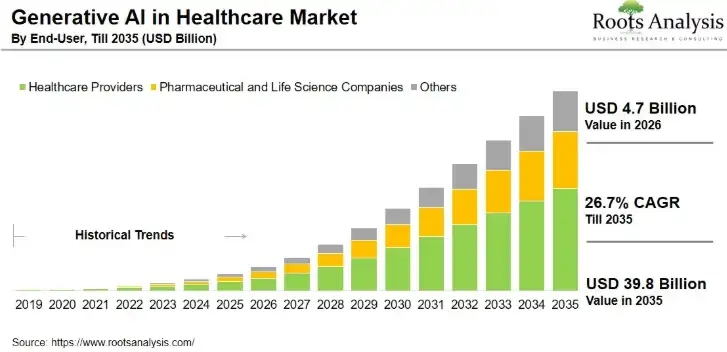
Source: Roots Analysis
Rising Adoption Across Healthcare
Healthcare providers are adopting GenAI to reduce time spent on documentation, patient communication and administrative work. AI can create draft notes, summarize patient information and help staff review records faster. This allows healthcare teams to spend more time on work that needs human attention.
HCA Healthcare is using generative AI for tasks such as nurse handoffs and clinical documentation. Its ambient documentation tools have helped some providers save more than an hour each day. HCA Healthcare reported $75.6 billion in revenue, showing the scale of the operations where these AI solutions can create value.
Demand for Smarter Workflows
The biggest opportunity for generative AI may come from the amount of manual knowledge work still happening inside healthcare organizations. Staff often spend hours reviewing clinical documents, summarizing information and moving data between systems. GenAI can help interpret large amounts of information while existing healthcare software continues to handle structured processes.
A useful way to look at the demand is through the type of work organizations want to improve:
| Healthcare workflow | How GenAI can help |
| Clinical documentation | Draft notes from patient conversations |
| Medical coding | Suggest relevant codes from clinical records |
| Revenue cycle | Review documentation and identify coding gaps |
| Nurse handoffs | Create concise patient summaries |
| Patient communication | Generate personalized responses |
| Document review | Extract and summarize important information |
Cleveland Clinic has also adopted generative AI for medical coding and clinical documentation. Its AI tools can review more than 100 clinical documents in about 1.5 minutes. The organization reported $18 billion in operating revenue, highlighting the potential value of improving large-scale administrative workflows.
Growing Investment in GenAI
Healthcare businesses are increasingly looking for AI solutions that can connect with EHRs and existing systems. This creates demand for platforms that combine generative AI with automation, APIs, and healthcare data systems. Some of the growing opportunities include:
- AI clinical documentation
- GenAI revenue cycle tools
- Medical document processing
- Healthcare AI assistants
- AI-powered patient communication
The opportunity is not simply to build another AI chatbot. Businesses can create more valuable products by using GenAI to solve specific healthcare problems where time, accuracy and operational efficiency matter most.
What Can Generative AI Actually Do in Healthcare?
Generative AI can do much more than answer patient questions. It can turn conversations into clinical notes, summarize large medical records and help staff work through repetitive administrative tasks. Its biggest value comes when it is connected to the systems healthcare teams already use.
1. Turn Conversations Into Notes
Generative AI can listen to a patient visit and create a structured clinical note from the conversation. The clinician can then review the draft, make corrections and add it to the EHR. This can reduce the time doctors spend typing during and after appointments. Cleveland Clinic rolled out an ambient AI platform that creates clinical notes and after-visit summaries. More than 4,000 physicians and advanced practice providers began using the technology after its pilot.
2. Summarize Patient Records
Long patient records can contain years of notes, test results and treatment history. GenAI can summarize this information and surface the details a clinician may need before seeing a patient. This can make it easier to understand a patient’s history without manually reading every document.
The workflow can be simple:
Patient Records → AI Summarization → Key Findings → Clinician Review
3. Generate Clinical Reports
GenAI can help create first drafts of discharge summaries, referral letters and other clinical reports. Staff can review the generated content before it becomes part of the official record. This makes the technology useful for documentation-heavy workflows where professionals still need to maintain control over the final output.
4. Search Medical Knowledge
Healthcare teams often need to find information across medical literature, guidelines and internal knowledge bases. A GenAI system can retrieve relevant information and present it in a simpler format. The goal is not to replace clinical expertise. It is to help professionals find and understand information faster.
| Need | GenAI Support |
| Medical research | Summarize relevant studies |
| Guidelines | Find relevant recommendations |
| Internal knowledge | Search healthcare documents |
| Patient history | Surface important details |
5. Support Clinical Decisions
Generative AI can bring relevant patient information together to support clinical decision-making. It can summarize symptoms, history and test results or highlight information that deserves further review. Kaiser Permanente uses an AI documentation tool that summarizes medical conversations and creates draft clinical notes. Clinicians review and edit the output before it enters the patient record.
This approach shows where GenAI fits best: supporting clinicians while keeping humans responsible for medical decisions.
6. Automate Admin Workflows
Healthcare organizations also have large amounts of administrative work that can benefit from GenAI. It can classify documents, draft responses and extract information before passing the work to an automation system. Common opportunities include:
- Document classification
- Staff communication
- Patient message drafting
- Data extraction
- Referral processing
HCA Healthcare has used generative AI to create nurse handoff reports and support clinical documentation. Its system can organize details such as medication changes, laboratory results and patient concerns into a usable handoff.
7. Assist Claims and Prior Authorization
Claims and prior authorization involve reviewing large amounts of information before a request can move forward. GenAI can summarize medical records, identify missing information and prepare supporting documentation for staff review. This can help revenue cycle teams spend less time searching through records and more time handling cases that actually need human attention.
Houston Methodist has also used AI-generated working summaries for clinical handovers. This shows how healthcare organizations are applying generative AI to organize complex information before it reaches staff.
8. Generate Synthetic Healthcare Data
Healthcare AI products need large datasets for development and testing. Using real patient information can create privacy and compliance challenges. Generative AI can instead help create synthetic healthcare data that resembles real-world patterns without directly exposing patient records.
This can support:
- AI model testing
- Software development
- EHR integration testing
- Workflow simulations
- Product demonstrations
For healthcare businesses, synthetic data can make it easier to test AI systems while reducing dependence on sensitive patient information.
Healthcare AI Copilots: Where Generative AI Becomes Actionable
Healthcare AI copilots take generative AI beyond simple question-and-answer tools. They can work with clinical context, retrieve information and help professionals complete tasks inside existing workflows. The focus is not just on generating text but on helping healthcare workers get work done faster while keeping humans in control.
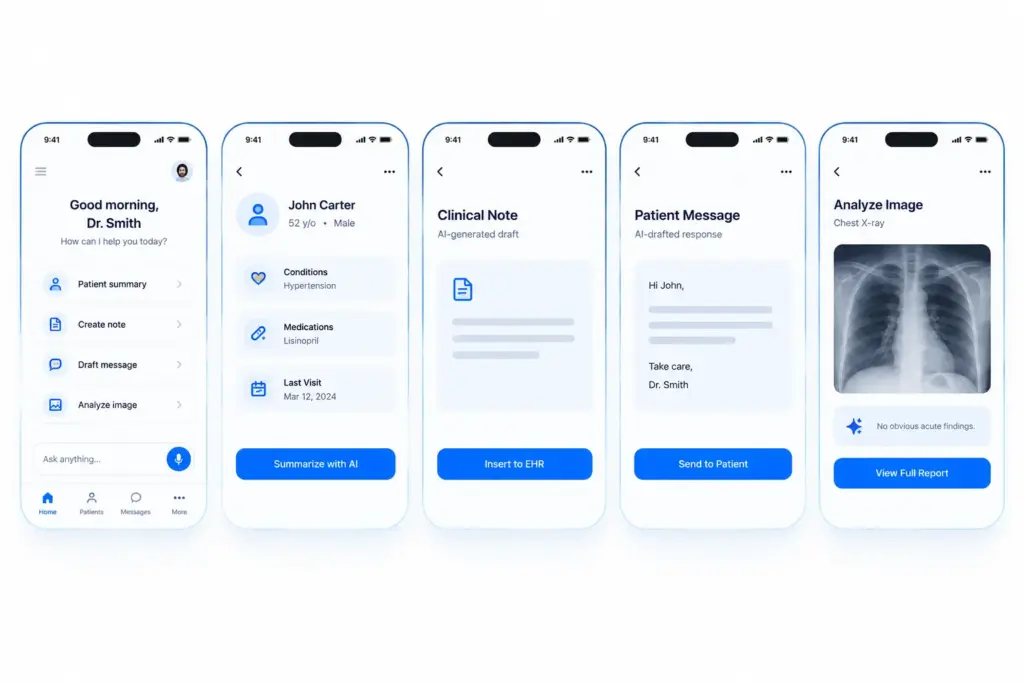
1. Clinical Copilots for Doctors
Clinical copilots can bring together patient information and help doctors review it during care. They can summarize relevant history, surface important findings and prepare information for review. This can reduce the time clinicians spend searching across different systems. Clinical productivity is already one of the strongest areas of interest. In a McKinsey survey, 73% of healthcare respondents identified clinician and clinical productivity as an area with high potential for GenAI.
2. EHR Copilots for Records
An EHR copilot can act as an intelligent layer over patient records. Instead of manually searching through years of information, clinicians could ask the system to summarize a patient’s history or find specific clinical details.
The basic workflow can look like this:
EHR Data → AI Retrieval → Patient Context → Generated Summary → Clinician Review
This makes the copilot more useful than a general AI assistant because its responses are connected to relevant healthcare data.
3. Medical Documentation Copilots
Documentation is one of the strongest use cases for healthcare copilots. The system can capture a conversation, generate a draft note and send it to the clinician for review before it enters the EHR. This can have a meaningful impact on clinical workload. Mercy Health reduced nurses’ documentation time for end-of-shift notes by 83% after implementing a GenAI care plan with Epic. The organization also reached 85% adoption within 30 days.
4. Patient Communication Copilots
Patient-facing copilots can help healthcare organizations respond to common questions and create personalized communication. They can draft follow-up messages, explain care instructions and prepare responses for staff to approve. The important part is human review for sensitive communication. A healthcare copilot should support staff rather than independently make decisions about patient care.
5. Diagnostic Copilots for Decisions
Diagnostic copilots can help clinicians organize symptoms, medical history and test information before making a decision. They may also surface relevant medical knowledge or suggest information that deserves further investigation. This does not mean the AI should make the diagnosis on its own. A safer model keeps the clinician responsible for the final decision and uses AI as a decision-support layer.
6. Revenue Cycle and Operations
Copilots can also support the business side of healthcare. They can review documents, summarize claims information and help staff identify missing details in administrative workflows. Potential applications include:
- Claims review
- Prior authorization
- Medical coding
- Denial management
- Referral processing
- Staff scheduling
- Document classification
This is where combining GenAI with RPA and system integrations can make a healthcare copilot more actionable. AI can understand the information while automation handles the repetitive steps.
What Makes a Healthcare Copilot Different?
A chatbot mainly responds to a user’s prompt. A healthcare copilot can be designed to understand context, retrieve trusted information and support an actual workflow.
| Chatbot | Healthcare Copilot |
| Answers questions | Supports tasks |
| Uses conversation context | Uses patient or workflow context |
| Mostly generates text | Generates and prepares actions |
| Limited system access | Can connect with healthcare systems |
| User-led interaction | Workflow-aware assistance |
| General knowledge | Organizational or clinical knowledge |
For example, a doctor could ask a copilot to summarize a patient’s recent history. The copilot could retrieve approved information from the EHR, generate the summary and place it inside the clinical workflow for review. That connection between AI, healthcare data and real-world actions is what makes a copilot different from a basic chatbot.
Mass General Brigham is another example of this approach. Its clinicians use ambient documentation tools that securely capture patient-clinician conversations and generate clinical notes for review before they are signed into the EHR.
How Generative AI Is Changing Medical Diagnostics?
Generative AI is making diagnostic workflows more connected and efficient. It can help clinicians work with medical images, pathology data and patient records while reducing some of the manual work involved in reviewing and reporting clinical information. It can also bring information from different diagnostic sources together to give clinicians a clearer view of the patient.
1. Generative AI for Medical Imaging
GenAI can help analyze medical images and create useful summaries from imaging findings. It can also support image interpretation by highlighting patterns that may need closer attention. This can make diagnostic workflows faster while keeping the radiologist responsible for the final interpretation.
Apollo Radiology International is working with Google to use AI for earlier detection of conditions such as tuberculosis and lung and breast cancer. The collaboration aims to expand access to AI-supported screening across India.
2. Generative AI for Radiology
Radiology departments handle large volumes of scans every day. AI can help prioritize urgent cases, identify suspicious findings and assist with reporting. Generative models can add another layer by turning findings into structured reports or summaries.
A typical workflow can look like:
Medical Scan → AI Analysis → Finding Detection → Draft Report → Radiologist Review
The American College of Radiology also maintains an AI use-case directory covering applications designed to improve radiology workflows and clinical relevance.
3. Generative AI for Pathology
Pathology is another area where GenAI can work with large and complex datasets. AI can help analyze digital slides, organize findings and support pathologists when reviewing large numbers of samples. Mayo Clinic is developing generative AI and foundation models for digital pathology and pathomics.
Its AI infrastructure is designed to process high-resolution pathology images and accelerate model development. Mayo reports that some workflows have been reduced from four weeks of work to about one week using advanced computing.
4. Combining Images With Records
A scan rarely tells the whole clinical story. A better diagnostic system can combine medical images with symptoms, laboratory results, previous diagnoses and other patient information.
| Data Source | AI Role |
| Medical images | Detect visual patterns |
| Patient history | Add clinical context |
| Lab results | Identify related findings |
| Previous reports | Track changes |
| Genomic data | Support risk assessment |
This multimodal approach can give clinicians a more complete view of the patient instead of forcing them to review every source separately.
5. Generating Diagnostic Reports
Generative AI can turn structured findings into draft diagnostic reports. It can organize observations, follow reporting templates and create summaries that radiologists or pathologists can edit before final approval. This can be particularly useful in high-volume environments. The AI handles the repetitive writing while the specialist checks the findings and remains responsible for the final report.
6. Supporting Differential Diagnosis
GenAI can also help clinicians consider multiple possible explanations for a patient’s symptoms. It can organize relevant findings and surface medical knowledge that may support or challenge different possibilities. The system should present these suggestions as clinical support rather than a final answer. This keeps the diagnostic process with the healthcare professional.
7. AI-Assisted Clinical Decisions
AI-assisted decision support can connect diagnostic findings with patient context. It may flag information that needs attention or help clinicians compare relevant evidence before deciding on the next step. In the U.S., 71% of hospitals reported using predictive AI integrated with their EHRs, with common applications including risk prediction, early disease detection and treatment recommendations.
Can Generative AI Diagnose Patients?
Generative AI should not be treated as an autonomous doctor. It can analyze information, identify patterns, generate possible explanations and support clinical decisions, but the final diagnosis should remain with a qualified healthcare professional.
A safer model looks like this:
AI analyzes → AI suggests → Clinician verifies → Clinician decides
This distinction is especially important because diagnostic AI still faces challenges around accuracy, bias and clinical validation. In a survey of 43 health systems, 77% identified immature AI tools as a major barrier, while 40% cited regulatory uncertainty.
Why Multimodal AI Matters for Healthcare Diagnostics?
Healthcare data rarely comes in one format. A clinician may need to look at images, lab results, clinical notes and genomic information before reaching a conclusion. Multimodal AI can bring these different sources together, giving healthcare teams a more complete view of the patient. Research has found that combining multiple data types can improve diagnostic and prognostic capabilities compared with relying on a single data source.
1. Combine Clinical Data Sources
Multimodal AI can work with text, medical images, laboratory results and genomic data within the same system. Instead of analyzing each source separately, the model can connect information across them to identify relationships that may otherwise be missed. For example, a cancer-focused system could combine a pathology image with a patient’s clinical history and genomic profile. This can support more personalized diagnostic and treatment decisions.
2. Understand Patient Context
A medical image rarely tells the complete story. The patient’s symptoms, previous diagnoses, medications and laboratory results can change how that image should be interpreted.
Multimodal AI helps connect these pieces:
Patient History + Labs + Images + Genomics → Unified Clinical Context → AI Insights
This approach is particularly useful for complex conditions where clinicians need to consider information from several sources at once.
3. Improve Radiology and Pathology
Radiology and pathology are strong areas for multimodal AI because both rely heavily on visual information alongside clinical reports. AI models can learn from images while also considering the text and patient information associated with them. Microsoft Research has explored models that combine radiology images with reports and has also worked with Providence researchers on pathology foundation models trained using hundreds of thousands of slides and clinical reports.
4. Explain Complex Clinical Data
One major benefit of multimodal AI is its ability to turn complex information into a format clinicians can understand more easily. Instead of presenting separate results from imaging, laboratory tests and patient records, the system can generate a combined explanation.
| Data | Possible AI Output |
| Medical images | Key visual findings |
| Lab results | Important abnormalities |
| Genomic data | Relevant genetic markers |
| Clinical notes | Patient history |
| Combined data | Clinical summary |
This can make large datasets easier to review while helping clinicians focus on the findings that require their attention. Research also highlights data interoperability, privacy, bias and model interpretability as important challenges for real-world multimodal healthcare AI.
How Does a Generative AI Healthcare Copilot Work?
A healthcare copilot needs more than a powerful language model. It must connect with trusted healthcare data, understand the clinical context, and fit into the workflow where the output will actually be used. The goal is to make AI useful in practice while keeping privacy, accuracy, and human oversight at the center.
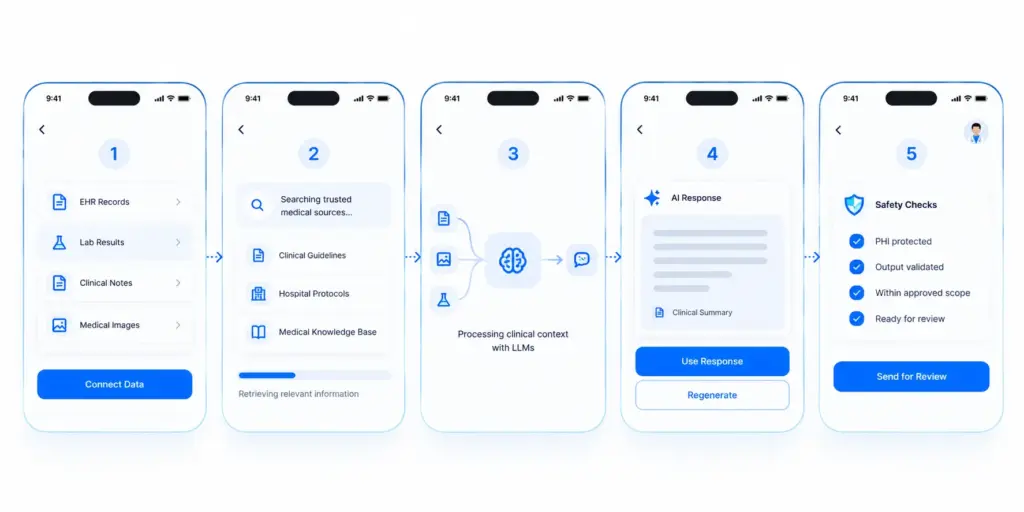
1. Collect Patient and Clinical Data
The first step is bringing together the information the copilot needs. This can include EHR records, clinical notes, lab results, medical images and other approved healthcare data sources. The system should retrieve only the information needed for the specific task and enforce strict access controls.
Healthcare organizations are already moving toward connected AI systems. 85% of surveyed healthcare leaders were exploring or had adopted GenAI, showing the growing demand for solutions that can work with existing healthcare data and workflows.
2. Retrieve Knowledge With RAG
A copilot should not depend entirely on what an LLM learned during training. Retrieval-augmented generation allows it to retrieve relevant information from approved medical knowledge bases before generating an answer. For example, a clinical copilot could retrieve hospital protocols, treatment guidelines or relevant patient history. The LLM can then use that information to create a response based on current and approved sources.
3. Process Context With LLMs
Once the required information is retrieved, the LLM processes it to understand what the user needs. It can summarize records, compare information or prepare a response based on the available clinical context. This layer should be designed around the specific healthcare use case. A documentation copilot will need different prompts, data sources and validation rules than a diagnostic support system.
4. Generate the Copilot Response
The LLM then generates the requested output. This could be a clinical summary, draft note, patient message or explanation of relevant information. Physicians are already using AI for several of these tasks. An AMA survey found that 39% of physicians used AI to summarize medical research and standards of care, while 30% used it to create discharge instructions, care plans or progress notes.
5. Apply Healthcare AI Guardrails
Healthcare copilots need stronger controls than general-purpose AI tools. Guardrails can restrict unsafe responses, protect sensitive information and prevent the system from taking actions outside its approved scope.
Important safeguards can include:
- PHI access restrictions
- Role-based permissions
- Output validation
- Audit logs
- Response monitoring
- Human approval requirements
These controls matter because 43% of surveyed healthcare leaders identified AI risk and safety as a roadblock to implementation. Accuracy, security and regulatory compliance were among the leading concerns.
6. Send Outputs Into Workflows
The copilot becomes more useful when its output reaches the system where the work happens. Instead of copying an AI-generated summary manually, an integrated copilot could send an approved note into the EHR or prepare information for a claims workflow. This is also where development becomes more complex. McKinsey found that integration challenges were among the leading barriers to scaling GenAI, showing why APIs, EHR connectivity and workflow design need to be considered from the beginning.
7. Keep Clinicians in Approval
The final layer is human oversight. A copilot can prepare information or recommendations, but clinicians should review important outputs before they affect patient care.
The approach is simple:
AI Generates → Clinician Reviews → Clinician Edits → System Records
This model is becoming especially relevant as healthcare AI moves into real workflows. Among healthcare organizations that had implemented GenAI, 64% reported that they expected or had already quantified positive ROI, making responsible deployment important for both clinical safety and business value.
What Does a Generative AI Healthcare Platform Need?
A healthcare GenAI platform needs more than an LLM and a chat interface. It must connect with clinical systems, retrieve reliable information and protect sensitive patient data throughout the workflow. The architecture should also make it possible to scale from one AI use case to several without rebuilding the entire platform.
1. Connect EHR and EMR Systems
EHR and EMR connectivity allows the copilot to access relevant patient information when it is needed. The integration layer can pull clinical notes, medications, lab results and other approved data from existing systems. This is already a practical requirement for healthcare AI products. About 9 in 10 U.S. hospitals enabled patient access to health information through APIs, according to ONC data.
2. Use FHIR for Data Exchange
FHIR provides a standardized way for healthcare applications to exchange information. A GenAI platform can use FHIR APIs to retrieve and exchange structured clinical data without building a completely different integration for every healthcare system. The adoption is already significant:
| FHIR Adoption | Share |
| Hospitals using APIs for patient access | ~90% |
| Hospitals using standards-based APIs | ~70% |
| Digital health companies using standards-based APIs | 73% |
This makes FHIR support an important foundation for healthcare AI development, particularly for platforms that need to connect with multiple EHR environments.
3. Build a Clinical Knowledge Base
A healthcare copilot needs access to trusted medical information. This could include clinical guidelines, hospital protocols, drug information and approved organizational documents. The knowledge base gives the AI a controlled source to reference instead of relying only on information stored inside the LLM. It can also be updated as clinical guidelines and internal policies change.
4. Add Vector Search and RAG
RAG allows the platform to retrieve relevant information before generating a response. A vector database stores documents as embeddings so the system can find information based on meaning rather than exact keywords.
User Question → Vector Search → Relevant Documents → LLM → Grounded Response
This architecture can reduce the need to place large amounts of healthcare information directly into the model’s prompt and can make responses more relevant to the specific clinical environment.
5. Integrate LLM and Multimodal Models
The platform may need more than one AI model depending on its purpose. An LLM can handle clinical text while multimodal models can work with medical images, documents or other data types.
A healthcare platform could therefore combine:
- LLMs for clinical language
- Vision models for medical images
- Embedding models for semantic search
- Speech models for clinical conversations
This makes the architecture flexible enough to support documentation, medical records, imaging and other healthcare use cases.
6. Add AI Guardrails and Validation
AI outputs should pass through validation before they are used in a clinical workflow. Guardrails can restrict unsupported requests, detect risky outputs and prevent the system from taking actions outside its approved scope. This matters because 43% of healthcare leaders surveyed by McKinsey identified risk and safety as a major barrier to scaling GenAI.
A strong validation layer can check:
Patient context → Source quality → AI response → Safety rules → Human review
7. Control Access and Audits
Healthcare platforms handle sensitive information, so every user should only have access to the data required for their role. Role-based access controls can separate permissions for doctors, nurses, administrators and other staff. Audit logs should also record important system activity. This creates a traceable record of who accessed information, what the AI generated and what actions were taken.
8. Keep Humans in the Loop
Human approval should be built into workflows where AI output could affect patient care. The copilot can generate a note, summarize records or prepare a recommendation, while the healthcare professional reviews it before final use.
This creates a safer workflow:
AI Generates → Professional Reviews → Professional Approves → System Updates
The need for this approach is becoming more important as GenAI moves into EHR-connected workflows. A recent JAMA Network Open study found that 31.5% of surveyed hospitals were already using generative AI integrated with their EHRs, while another 24.7% planned to adopt it soon.
How to Build a Generative AI for Healthcare Copilot and Medical Diagnostics?
Building a healthcare AI solution takes more than adding an LLM to an existing app. You need the right data and strong clinical workflows to make the system useful. From RAG and multimodal AI to EHR integration and clinical validation, each part plays a role in how well the final product works.
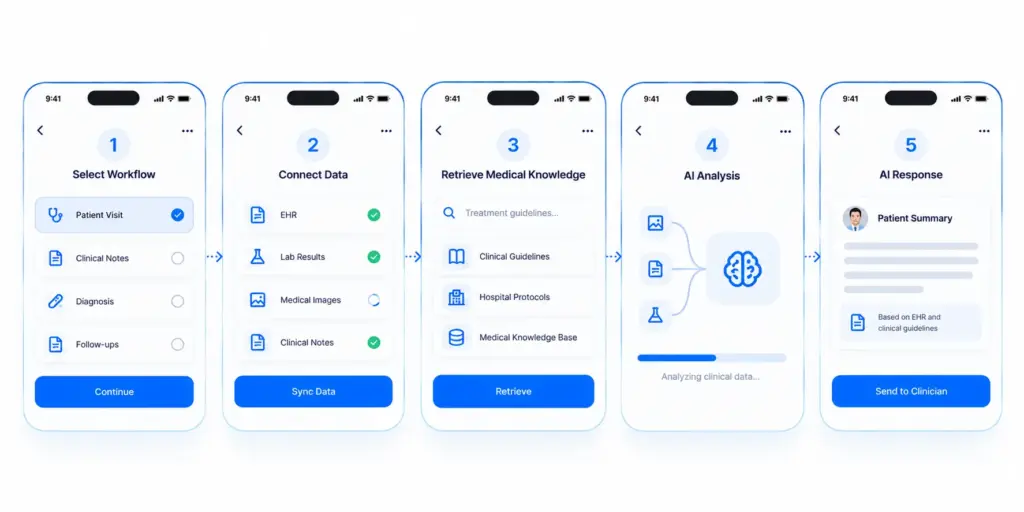
1. Define the Right Clinical Workflow
Start with one workflow that has a clear problem to solve. A healthcare copilot could help a doctor prepare for a visit or summarize a patient’s history. A diagnostic system could help review clinical information before a doctor makes a decision. This is worth doing because AI adoption among physicians is already moving beyond experimentation and into everyday work.
The American Medical Association reported that 66% of physicians surveyed in 2024 said they were using health AI in their professional work. That makes choosing the right workflow even more important. The best starting point is usually a task where AI can save time without taking control away from the clinician.
| Workflow | AI Role |
| Patient visits | Summarize medical history |
| Clinical notes | Draft documentation |
| Diagnosis | Surface relevant findings |
| Follow-ups | Prepare patient summaries |
The goal is not to make AI handle every part of healthcare. It is better to find one task where it can create clear value and then expand the platform over time.
2. Prepare Healthcare Data for AI
Good healthcare AI needs good data. Patient information may sit across EHR systems and medical documents. The data may also have missing fields or different formats. Before using it with an AI model, the information needs to be cleaned and organized. This becomes even more important when a copilot needs to understand a patient’s history.
The system may have to bring together information from different encounters before generating a useful response. Poor data quality can make even a powerful model produce an answer that is incomplete or misleading.
A simple data flow can look like this:
EHR Data → Data Processing → Secure Storage → AI Layer → Clinical Application
The aim is to give the model the right information at the right time. You do not always need to send an entire patient record to the model. Good data selection can reduce unnecessary processing and improve the relevance of the response.
3. Build RAG for Medical Knowledge
A healthcare copilot should not depend only on what an LLM learned during training. Medical information changes over time and the model may not know the latest clinical guidance. RAG allows the system to retrieve relevant information from approved sources before generating a response.
For example, a doctor could ask a copilot about a patient’s condition. The system can first retrieve relevant records and approved medical information. The LLM can then use that context to create a response.
A basic RAG flow:
User Query → Retrieval → Medical Context → LLM → AI Response
This also helps address one of the biggest problems with healthcare GenAI. Research has repeatedly identified hallucination and factual reliability as important concerns when LLMs are used for medical tasks. RAG does not remove these risks completely. It can give the model better information to work from and make its answers easier to check.
4. Add Multimodal AI for Diagnostics
Medical information is not limited to text. A diagnostic workflow may involve medical images alongside patient history and test results. Multimodal AI can help a system work with different types of information instead of treating each source as a separate task.
| Input | Possible AI Task |
| Medical images | Identify relevant patterns |
| Clinical notes | Extract important findings |
| Lab results | Highlight unusual values |
| Patient history | Provide clinical context |
The opportunity is significant because medical imaging already represents one of the largest areas of AI development in healthcare. The FDA has authorized more than 1,000 AI-enabled medical devices, with a large share used in radiology. This shows that AI-assisted diagnostics are already moving into real clinical environments rather than remaining limited to research.
Products such as Google’s Med-PaLM also show how foundation models can be adapted for medical reasoning. For a commercial product, however, the focus should be on how the model fits into the clinical workflow rather than simply choosing the largest model available.
5. Connect Copilot With Healthcare Systems
A copilot becomes much more useful when it can work with the systems healthcare teams already use. EHR integration can allow the AI to access relevant patient information without forcing doctors to copy data between different applications. FHIR can help different healthcare systems exchange information in a more consistent way. APIs can also connect the AI platform with EHRs and other healthcare applications.
The integration layer could look like this:
EHR → FHIR/API → AI Platform → Copilot → Clinical Workflow
This is also where development complexity can increase quickly. A simple healthcare AI MVP may need fewer integrations. An enterprise platform could require multiple EHR connections and additional security controls. The cost can therefore move from roughly $50,000 for a focused MVP to $150,000 or more for a larger healthcare AI platform.
6. Clinical Guardrails and Human Review
Healthcare AI needs clear limits. A model should not be allowed to make every decision simply because it can generate an answer. High-risk outputs should go through a clinician before they are used in patient care. This matters because even highly capable AI systems can produce confident answers that are wrong. A safer design gives the AI different levels of responsibility based on the risk of the task.
| Task Risk | AI Role |
| Low | Generate or summarize information |
| Medium | Suggest information for review |
| High | Support the clinician without making the final decision |
The AMA’s physician surveys have consistently shown that physicians see potential in AI while also raising concerns around safety, privacy and oversight. A human-review layer helps address these concerns while allowing healthcare teams to benefit from automation.
The goal is simple: AI should assist the clinician rather than quietly replace the clinical decision-making process.
7. Validate AI With Clinical Scenarios
Testing a healthcare AI product with simple questions is not enough. The system should also face incomplete records and unusual cases. It needs to show what happens when the available information is unclear or conflicting. A useful validation process can measure:
| Test Area | What to Check |
| Accuracy | Is the output clinically useful? |
| Retrieval | Did the system find the right information? |
| Safety | Does it avoid unsafe recommendations? |
| Consistency | Does it respond reliably? |
| Escalation | Does it know when to involve a clinician? |
This step becomes especially important for diagnostic systems. An AI may perform well on common cases but behave differently when it encounters a rare condition. Testing should therefore cover both normal and difficult clinical scenarios.
How to Connect Generative AI With EHR Systems?
Connecting GenAI with an EHR is what turns an AI model into a practical healthcare tool. The integration needs to move data securely between the EHR, AI layer and clinical workflow without disrupting how healthcare teams already work. This is becoming increasingly important as more than 99% of U.S. non-federal acute care hospitals have adopted certified EHRs.
1. Connect GenAI With EHR APIs
The first step is creating a secure integration between the AI platform and the EHR. APIs allow the system to retrieve approved patient information and send validated outputs back to the right workflow. A well-designed integration can support tasks such as chart summarization, clinical documentation and patient message drafting. About 9 in 10 hospitals already enable patient access through APIs, creating a strong foundation for connected healthcare AI.
2. Use FHIR for Data Exchange
FHIR provides a common structure for exchanging healthcare information between applications. A GenAI platform can use FHIR APIs to retrieve resources such as patient details, observations, medications and clinical encounters.
| FHIR Resource | Possible AI Use |
| Patient | Patient context |
| Observation | Lab results |
| Medication | Medication history |
| Encounter | Visit information |
| DiagnosticReport | Test reports |
Approximately 7 in 10 hospitals use standards-based APIs such as FHIR for patient access, making standards-based integration an important part of healthcare AI development.
3. Retrieve Relevant Patient Data
The AI should not pull an entire patient record every time someone asks a question. Instead, the integration layer can identify the information relevant to the task and retrieve only what is required. For example, a doctor asking for a patient’s recent cardiac history could receive a focused summary based on relevant encounters, medications, test results and notes. This keeps the AI response more relevant while limiting unnecessary exposure of PHI.
4. Write AI Outputs to EHR
A useful copilot should not stop after generating an answer. Approved outputs can be sent back into the EHR so clinicians do not need to copy information between separate applications. Mass General Brigham uses ambient documentation technology that generates clinical notes from patient conversations. Clinicians review and edit the notes before signing them into the electronic health record.
5. Secure PHI During AI Processing
Patient information needs protection throughout the AI workflow. This includes data moving between systems, information temporarily processed by the AI and any data stored for later retrieval. Security should therefore be built into the architecture rather than added after development.
EHR → Encrypted API → AI Processing → Validation → EHR
Access controls, encryption, audit logs and appropriate data-retention policies can help reduce the risk of unauthorized access while supporting compliance requirements.
6. Keep the Workflow Connected
The final goal is not simply to connect an LLM to an EHR. It is to create a workflow where data retrieval, AI processing, validation and clinical action happen within a connected system. EHR-integrated GenAI is already moving beyond experimentation. A national study found that 31.5% of U.S. hospitals were already using generative AI integrated with their EHRs, while another 24.7% planned to adopt it soon.
This creates a strong development opportunity for healthcare businesses. Instead of building a standalone AI chatbot, they can develop EHR-connected copilots that retrieve patient context, generate useful outputs and return approved results directly into clinical workflows.
How to Keep Generative AI Safe in Clinical Workflows?
Generative AI can make healthcare workflows faster, but clinical use requires strong safeguards. A healthcare copilot should know when to provide an answer, when to show its sources and when to leave the decision to a professional. This makes safety and oversight part of the product architecture, not an afterthought.
1. Prevent Medical AI Hallucinations
A GenAI system can produce convincing information that is incorrect or unsupported. In healthcare, even a small mistake can affect patient care. The platform should therefore validate important outputs before they reach a clinical workflow. Useful controls include:
- Confidence and uncertainty checks
- Source verification
- Restricted medical prompts
- Automated output screening
- Escalation for high-risk requests
2. Ground Outputs in Clinical Sources
A healthcare copilot should rely on trusted information rather than generating answers purely from its training data. RAG can connect the model with approved clinical guidelines, hospital protocols and patient information. This helps the system provide responses that are more relevant to the patient’s specific situation.
Clinical Sources → Retrieval → LLM → Grounded Response
This approach makes it easier for clinicians to verify where an answer came from. It can also reduce the risk of the model presenting unsupported information as a medical fact.
3. Keep Humans in Review
AI should not independently make high-risk clinical decisions. A safer workflow gives clinicians the ability to review, correct and approve AI-generated outputs before they influence patient care. This keeps healthcare professionals responsible for the final decision while using AI to support their work.
Generate → Review → Edit → Approve
The AMA specifically emphasizes that AI should support rather than replace physician judgment and recommends appropriate oversight for clinical AI systems.
4. Protect Patient Health Data
Patient information needs protection throughout the AI pipeline. The platform should control who can access PHI and ensure that sensitive information is handled securely during retrieval, processing and storage. Strong security controls also help healthcare organizations reduce the risk of data breaches and unauthorized access. Healthcare AI systems should consider:
| Security Layer | Purpose |
| Encryption | Protect data in transit and storage |
| RBAC | Limit access by user role |
| Audit logs | Track system activity |
| Data controls | Limit unnecessary PHI exposure |
| Retention rules | Control stored information |
Privacy remains a major adoption concern. 86% of physicians surveyed by the AMA identified data privacy as important for broader use of health AI.
5. Monitor AI After Deployment
AI performance can change once a system enters a real clinical environment. New patient populations, different documentation styles and changing clinical practices can affect how well a model performs. Johns Hopkins Medicine has emphasized the importance of monitoring AI systems as part of responsible implementation.
Its AI governance work focuses on evaluating tools before and after deployment rather than treating validation as a one-time step. Monitoring can track accuracy, error patterns, clinician feedback and changes in model performance over time.
6. Maintain AI Auditability
Healthcare organizations need to know what an AI system did and how its output reached the clinician. Audit trails can track the data used, AI responses and user actions. Mass General Brigham also emphasizes transparency and governance when implementing AI in clinical workflows.
Explainability is just as important. Clinicians should be able to see what the AI suggests and what information supports it. This makes it easier to review the output and know when human judgment is needed.
What Is the ROI of Generative AI in Healthcare?
The ROI of generative AI becomes clearer when it is tied to measurable workflow improvements. Instead of assuming that every AI project will produce the same return, healthcare organizations can measure hours saved, additional capacity, lower operating costs and faster processing. McKinsey reports that 82% of healthcare leaders expect GenAI to deliver a positive ROI, while 45% say they have quantified that return.
1. Reduce Documentation Time
Clinical documentation is one of the easiest areas to measure because the time spent on notes can be tracked before and after implementation. If a copilot saves several minutes per encounter, those hours can be redirected toward patient care or additional appointments. For example, clinicians using Microsoft’s DAX Copilot reported saving 5 minutes per encounter on average.
At 30 encounters per day, that could represent 150 minutes of recovered time. If the recovered capacity is valued at $100 per clinical hour, that is roughly $250 of capacity per clinician per day.
2. Improve Clinician Productivity
AI can increase productivity without requiring healthcare organizations to add the same number of staff. A copilot can handle documentation, summaries and other time-consuming tasks while clinicians focus on patient-facing work. SolutionHealth reported a 56% reduction in documentation time across nearly 60,000 encounters after adopting DAX Copilot. The organization also reported capacity equivalent to 2.5 additional appointments per clinician per day.
3. Reduce Administrative Work
Administrative work is another major area for GenAI ROI. Healthcare teams can use AI to summarize records, classify documents, draft communications and support repetitive workflows. McKinsey identifies administrative efficiency as the healthcare area with the greatest potential for GenAI. This means organizations can look beyond clinical applications and measure savings across scheduling, documentation, claims and other operational processes.
4. Accelerate Diagnostic Workflows
GenAI can help diagnostic teams process information faster by summarizing clinical histories, organizing findings and preparing draft reports. The financial benefit depends on how much time is saved and whether that capacity can be redirected to more cases. For example, if an AI system saves 10 minutes per diagnostic case and a department handles 200 cases per day, it could recover more than 33 staff hours daily. At an internal labor value of $60 per hour, that represents approximately $2,000 in daily capacity.
5. Improve Patient Experience
ROI does not always come directly from cost savings. Faster documentation can give clinicians more time to interact with patients, which can improve the overall care experience. Microsoft’s survey of DAX Copilot users found that 93% of surveyed patients said their clinician was more personable and conversational, while 90% said the clinician spent less time on the computer.
6. Automate Revenue Operations
GenAI can also support revenue cycle workflows such as claims review, coding and denial management. Faster processing can reduce administrative costs while helping teams identify information that may affect reimbursement. The opportunity can be substantial at scale. McKinsey estimates that AI and automation could help healthcare payers save $150 million to $300 million in administrative costs for every $10 billion in revenue, although these figures represent potential impact rather than guaranteed savings.
Measure Your AI ROI
A practical ROI model should compare the total cost of the AI solution with measurable operational gains. This prevents businesses from making broad claims about AI value without connecting them to actual financial outcomes.
| ROI Metric | Example Calculation |
| Hours saved | 1,000 hours × $50 = $50,000 |
| Extra capacity | 200 appointments × $150 = $30,000 |
| Admin savings | 500 hours × $35 = $17,500 |
| Annual AI cost | Platform + integration + maintenance |
| Net value | Total gains − AI costs |
For example, if a healthcare organization spends $100,000 building and operating a GenAI copilot and it creates $250,000 in measurable annual value, the first-year net benefit would be $150,000 and the simple ROI would be 150%. The actual calculation should also account for integration, model usage, training, monitoring and ongoing maintenance costs.
Interesting Case Studies of Generative AI in their Healthcare
Healthcare organizations are already finding practical ways to use generative AI in their daily work. Some are using it to support doctors while others are applying it to clinical research and patient data. These examples show what GenAI can actually do in healthcare and what businesses can learn before building their own solutions.
1. Mayo Clinic Advances Clinical AI
Mayo Clinic is using generative AI across clinical care, research and healthcare operations. Its GenAI program has developed 97 AI algorithms already in clinical use, with more than 270 additional algorithms in development. Mayo is also working with Microsoft on a healthcare-focused frontier AI model that combines Mayo’s clinical expertise with de-identified healthcare data.
What businesses can learn: Build GenAI around a real healthcare workflow instead of creating another general-purpose chatbot.
2. NYU Langone Builds Private AI
NYU Langone uses its private UltraVioletAI platform to give healthcare teams access to GenAI in a controlled environment. Its wider AI portfolio includes 128 models in production and 150 in development. An earlier evaluation also found that users generated more than 111 million tokens in six months at a cost of about $4,200.
What businesses can learn: Healthcare AI needs strong privacy controls and governance from the beginning.
3. Mass General Brigham Uses RAG
Mass General Brigham developed RECTIFIER to find patients who may qualify for clinical trials. In a study involving 4,476 patients, the AI-assisted process identified 458 eligible patients compared with 284 through manual screening. Enrollment was also almost twice as high in the AI-assisted group.
What businesses can learn: RAG becomes more valuable when it is built around a specific healthcare task.
4. UCSF Extracts Clinical Information
UCSF researchers are using generative AI to turn information from medical reports into structured data. One project focused on extracting useful details from prostate MRI reports. This type of AI can help researchers work with clinical information that is difficult to analyze when it remains buried in free-text reports.
The broader opportunity is significant because much of healthcare information is still stored as unstructured text rather than clean datasets.
What businesses can learn: GenAI can create value by turning unstructured medical text into data that healthcare teams can actually use.
5. Stanford Studies Clinical GenAI
Stanford Health Care has been testing generative AI across real clinical workflows. Its monitoring program currently covers 13 active AI deployments, including 7 generative AI systems. One Stanford study also found that AI-generated discharge summaries were associated with lower provider burnout.
The Stanford research also shows why testing matters. AI may perform well in controlled tasks but behave differently when it faces real patient data and complex clinical situations.
What businesses can learn: A healthcare AI product needs proper testing before it becomes part of a clinical workflow.
Contact IdeaUsher to Integrate Generative AI in Healthcare
Building a healthcare AI solution takes more than choosing an AI model. It needs the right data, integrations and workflows to work well in real healthcare settings. At IdeaUsher, we can help turn your idea into a secure and scalable generative AI solution for healthcare. Our team can support you from the first MVP to a production-ready platform as your needs grow.
Build Custom Healthcare AI Copilots
We can build healthcare copilots around specific clinical workflows. They can summarize patient records and help with clinical documentation. RAG can also help the copilot use trusted medical information instead of relying only on the LLM. Our team has 500,000+ hours of coding experience and includes ex-MAANG and FAANG developers. We can help take the product from an MVP to a scalable healthcare platform.
Integrate GenAI With EHR Systems
We can connect your GenAI solution with existing EHR and EMR systems through APIs and FHIR. This allows the AI to access relevant clinical information within the workflow. Secure data handling can also help protect sensitive patient information.
Common integrations include:
- EHR and EMR systems
- FHIR APIs
- Clinical data platforms
- Medical document systems
Develop AI-Powered Diagnostic Solutions
We can develop diagnostic AI solutions that help clinicians review patient information and identify relevant findings. Multimodal AI can also support workflows that involve medical images and clinical data. The AI can provide useful insights while keeping doctors involved in the final decision. With 500,000+ hours of coding experience, our ex-MAANG and FAANG developers can build the AI and infrastructure needed to scale the solution.
Conclusion
Generative AI can help healthcare teams spend less time on repetitive work and more time on patient care. The real value comes from building solutions that fit into existing workflows rather than adding another standalone tool. Healthcare businesses that focus on practical use cases such as clinical copilots and diagnostic support can create AI products that deliver measurable value while keeping professionals in control.
FAQs
A1: Generative AI can support many healthcare tasks. It can create medical notes and summarize long patient records. It can also help with patient communication and administrative work. When connected to existing healthcare systems, it can make these tasks faster and easier for staff.
A2: A healthcare AI copilot is an AI assistant built to support healthcare professionals. It can access approved information and use it to complete specific tasks. For example, a copilot can summarize a patient’s history before an appointment. It can also prepare a draft clinical note for a doctor to review. The healthcare professional still makes the final decision.
A3: Generative AI can help doctors review medical information during the diagnostic process. It can summarize patient history and organize relevant test results. It can also support the review of medical images and clinical notes. This gives doctors a clearer picture of the patient and can help them make decisions faster.
A4: Generative AI can support diagnosis but it should not replace a qualified healthcare professional. It can identify patterns and suggest possible conditions based on available information. However, AI can sometimes produce incorrect results. Doctors should therefore review important AI outputs before using them to make decisions about patient care.