


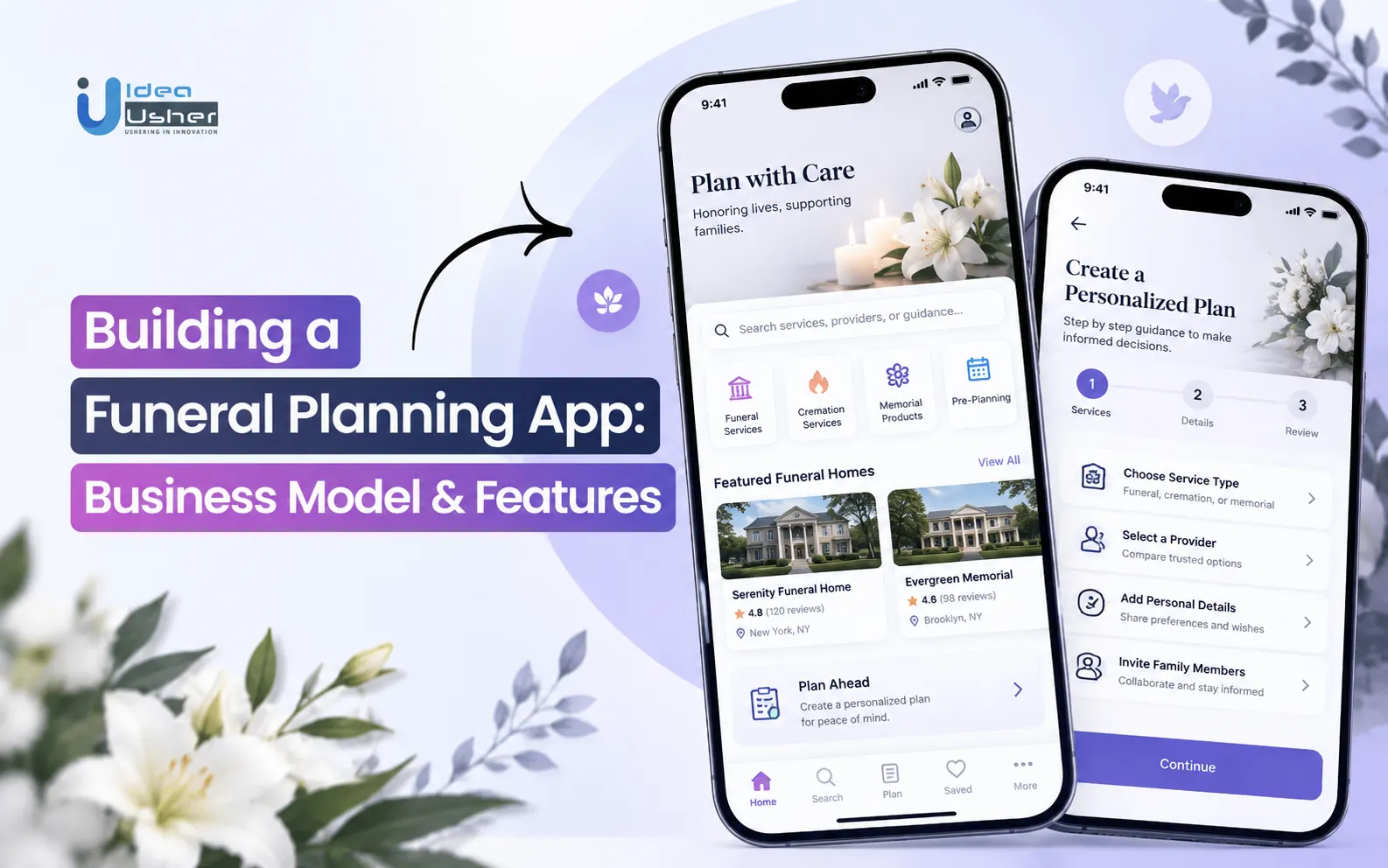
Key Takeaways
- To build a funeral planning app, you need a clear business model, intuitive planning features, and a secure platform.
- Start by defining your target users, core services, revenue model, and marketplace requirements.
- Choose a suitable business model, such as B2C, B2B, marketplace, or a hybrid model, based on your target customers and revenue goals.
- Key features can include provider discovery, service comparison, planning checklists, scheduling, payments, and family collaboration.
- Learn how IdeaUsher can help businesses build a secure, scalable, and feature-rich funeral planning app tailored to their specific business needs.
Developing a funeral planning app involves creating a compassionate user experience alongside a vendor marketplace and efficient administrative workflows. When a family is dealing with loss, even simple decisions can feel overwhelming, from finding the right funeral home to managing costs, documents, and service details. A well-designed app can bring these scattered tasks together and make the process easier to navigate.
The business model also plays an important role in how the platform grows. Whether you choose a B2C platform, B2B funeral home software, a funeral services marketplace, or a hybrid model, the features should support both families and providers. Core features such as guided planning checklists, service discovery, price comparison, budget management, family collaboration, document management, obituary tools, scheduling, payments, digital memorials, and live streaming can turn the idea into a complete planning platform.
In this blog, we’ll discuss the business models, key features, workflows, integrations, development process, and costs involved in building a funeral planning app.
Why Is Funeral Planning Moving Online?
Funeral planning is moving online as families increasingly expect to compare options, make decisions, and pay from their phones. According to Data Bridge Market Research, the global funeral home software market was valued at USD 1.50 billion in 2024 and is projected to reach USD 3.03 billion by 2032, growing at a 9.20% CAGR from 2025 to 2032. Nearly 36% of NFDA member firms offer online cremation arrangements, while a Passare survey found that 36% of participants were comfortable planning a funeral online, up 44% from 2011.

Source: Data Bridge Market Research
Fragmented Funeral Planning Experience
A funeral can involve a funeral home, cemetery, florist, officiant, obituary publisher, insurer, and estate lawyer, each with separate forms, contacts, and prices. NFDA median figures include a $2,495 basic services fee, $845 for embalming, a $2,500 metal casket, and a $1,695 burial vault, totaling $8,300 for burial or $6,280 with cremation.
Where Fragmentation Hurts Families
- Comparison shopping stalls: Only 20% of 1,146 respondents in an Ipsos survey visited more than one funeral home for price lists.
- Paperwork becomes complicated: Passare collected 16,000+ electronic signatures from families in 2023.
- Decisions stay disconnected: Price lists, obituary drafts, guest lists, and memorial pages are often managed separately.
Passare addresses this through its Arrangement Guide, allowing families to explore options, plan, and pay online or combine online and in-person planning. Case details then appear automatically in Passare, while multi-location operators can route families to relevant locations.
Demand for Transparent Funeral Services
Price opacity is another factor driving digital funeral planning. Key findings include:
| What was measured | Key number | Source |
| Funeral home websites posting a General Price List | 191 of 1,046 sites (18%) | Funeral Consumers Alliance / Consumer Federation of America |
| Support for mandatory online pricing | 75% | Ipsos survey |
| Funeral Rule violations during phone calls | 39 of 250+ funeral homes | FTC |
| Price spread in Atlanta | $3,370 to $11,050 | FCA / CFA survey |
| Funeral homes meeting consumer budgets | 41% | NFDA consumer survey |
The Atlanta price spread shows why transparent pricing can matter. When providers charge thousands of dollars more or less for similar services, an app can make comparisons easier. The study is older, so a newer regional source should be checked before publication.
Parting Pro demonstrates this model with its white-label Online Arranger, allowing families to begin arrangements 24/7. It includes a Smart Package Builder, Online Merchandise Display, and Guided Planning Tool, supports Stripe and Payrix, and integrates with Tribute Technology, Tribute Management Software, and SRS. The company says it has powered more than 100,000 online arrangements.
Funeralwise takes a consumer-first approach with a free planning system offering real-time cost estimates and a “Time Capsule” for eulogies, obituaries, and estate planning. Together, these platforms show both sides of digital transparency: helping families understand costs and funeral homes publish them.
Why Families Need One Planning Hub
Funeral decisions often connect with wills, healthcare directives, insurance, digital accounts, and family responsibilities. Yet only 24% of Caring.com respondents reported having a will, while 13% had a living trust and 4% had other estate planning documents. A single planning hub can bring wishes, documents, vendor choices, costs, and family access together in one place.
Cake is a strong example. It lets users document and share healthcare, estate, funeral, and legacy wishes with family members. In September 2024, Foundation Partners Group acquired Cake. At the time, Cake had been used by over 100 million people and offered more than 5,000 articles and planning tools covering wills, funeral arrangements, advance care directives, estate settlement, and grief.
Foundation Partners later launched Afterall, bringing together more than 250 funeral homes, cemeteries, and direct-to-consumer cremation services, with digital obituaries and a memorial store. It also partnered with Chptr for personalized video tributes, service listings, and death notices.

What Should a Funeral Planning App Actually Solve?
A funeral planning app should reduce the confusion families face when making many decisions in a short time. It should organize the process into clear steps, show local providers and prices, keep relatives aligned, and store contracts, payments, and paperwork in one place.

1. Simplifying Funeral Decisions
Most people arrange a funeral only a few times, often while grieving and under pressure. They may need to choose between burial and cremation, select a service format, and manage many smaller details. The NFDA projects a 63.4% U.S. cremation rate compared with 31.6% for burial. A good app can guide families through these choices with simple questions.
Cake is an example of guided decision-making. It covers wills, funeral wishes, advance care directives, estate settlement, and grief support through more than 5,000 articles and tools. More than 100 million people have used it, and Foundation Partners Group acquired Cake in September 2024.
A Decision-Focused App Should Offer
- Disposition first: Explain burial, cremation, and other options.
- Service style: Cover traditional services, memorials, or direct arrangements.
- Personal wishes: Save music, readings, dress codes, and keepsakes.
- Save and resume: Let families continue planning across sessions.
2. Connecting Families With Providers
Finding providers can be difficult when prices are not easily available. A 2018 Funeral Consumers Alliance and Consumer Federation of America report found that only 27% of funeral homes with websites posted prices, while just 16% posted their full General Price List.
Parting addresses this by letting families browse funeral-home prices for free, while funeral homes pay for advertising. In one Texas ZIP code, prices at 13 funeral homes ranged from $5,800 to $11,000. Its provider-side product, Parting Pro, helps funeral homes manage inquiries and cases.
The app should also support consumer rights under the FTC’s Funeral Rule, which allows families to choose only the services they want, request prices by phone, and receive an itemized statement before payment.
| Funeral Rule right | What the app should do |
| Choose only wanted services | Let users add or remove items with a live total |
| Get pricing by phone | Display price lists upfront |
| Receive an itemized statement | Provide a downloadable summary |
Foundation Partners Group’s Afterall shows how provider networks can expand into broader digital services. The platform connects more than 250 funeral homes, cemeteries, and direct-to-consumer cremation services, while also offering digital obituaries and a memorial store. Its partnership with Chptr adds video tributes, service listings, and death notices.
3. Coordinating Family Members
Funeral planning often involves siblings, spouses, and relatives in different locations. An app can give everyone one workspace for decisions, tasks, budgets, and updates. Passare demonstrates this through Planning Center. Families can upload information, sign documents, make payments, message funeral homes, track death certificate tasks, and collaborate on obituaries. Its AI tools can also draft obituaries and scan photographed first-call or vitals sheets.
Spring Grove, an Ohio provider serving about 1,700 families annually across 10 locations with 16 funeral directors, says Passare’s eSignatures save thousands of dollars each year. Passare’s Pennsylvania Death Registration System integration also won an NFDA Innovation Award in 2021.
Family Collaboration Flow
- The arranger creates a plan and invites relatives.
- Relatives receive view, comment, or approval roles.
- Tasks such as the obituary, venue, and music are assigned.
- The decision-maker approves items before payment or submission.
- Automatic reminders keep everyone updated.
4. Managing Funeral Costs and Documents
Funeral costs include many separate items, making the final total difficult to track. NFDA data puts the 2023 median at $8,300 for viewing and burial and $6,280 for viewing and cremation. With a burial vault, the burial figure rises to $9,995. Between 2021 and 2023, median burial costs rose 5.8%, while cremation costs increased 8.1%.
| Line item | NFDA median |
| Transferring remains | $395 |
| Embalming | $845 |
| Viewing facilities and staff | $475 |
| Memorial service | $550 |
| Metal burial casket | $2,500 |
| Burial vault | $1,695 |
A running total lets families adjust or remove items before committing. Funeralocity combines budgeting with provider comparison. The Atlanta-based platform is free for users and earns through its Excellence Program, where participating funeral homes receive expanded listings and pay a fee when customers book through them.
Documents need similar organization. The app should securely store itemized statements, signed contracts, payment receipts, and death certificate requests, giving authorized relatives easy access without searching through emails or paper files.
Core Features of a Funeral Planning App
A funeral planning app should include planning checklists, funeral service discovery, provider comparisons, budget management, family collaboration, document storage, obituary tools, scheduling, payments, and donation features. These features help families manage funeral arrangements in one place while making decisions, coordinating tasks, comparing costs, and handling important documents more easily.
1. Guided Funeral Planning Checklist
A guided checklist turns a stressful process into manageable tasks. It should adapt to whether someone is planning ahead or arranging a funeral now, while showing task ownership and progress. Empathy is a strong example. The app supports documentation, funeral arrangements, and will validation. An Ipsos survey for Sun Life found that nearly 9 in 10 Canadians have lost a loved one, while half did not know where to start.
Sun Life launched bereavement support with Empathy in March 2025, while Symetra provides Empathy Loss Support to eligible beneficiaries. Empathy is also integrating its tools with Workday Wellness.
Key Checklist Stages
- Immediate tasks: Notifications, transportation, and initial calls.
- Service decisions: Burial or cremation, ceremony, and venue.
- Paperwork: Death certificates, permits, and insurance claims.
- Money matters: Deposits, payments, and benefits.
- After the service: Account closures, thank-you notes, and memorial plans.
2. Funeral Service Discovery
Discovery lets families explore funeral services before committing. A useful interface should organize packages and add-ons by location and budget and allow users to save options. Sendoff, launched in Gauteng in May 2021, lets users arrange pickups, caskets or urns, cemeteries, flowers, catering, receptions, and transport. It later expanded across South Africa.
Calgro M3 also partnered with Sendoff to list its three Gauteng memorial parks and one Cape Town park, allowing users to view and order private graves online.
Core Discovery Categories
- Transport and care
- Merchandise
- Final resting place
- Gathering services
- Customizable packages
3. Provider Comparison and Quotes
Comparison helps families evaluate providers without making multiple calls. The UK’s Competition and Markets Authority found that only 14% of people compare more than one funeral director, while fewer than 40% of funeral directors posted pricing online. Funeral Guide is a UK comparison platform with over two million monthly visits and reported a 60% increase in funeral enquiries in the year referenced. UK funeral directors must now display standardized pricing, making provider comparisons easier.
| Quote feature | Why it matters | Design tip |
| Total price | Quick comparison | Show it first |
| Itemized costs | Shows what’s included | Make lines expandable |
| Extra fees | Avoids surprises | Display clearly |
| Reviews | Adds context to pricing | Show beside price |
| Request a quote | Converts interest into leads | Pre-fill saved preferences |
4. Funeral Budget Management
A budget tool should show a live total as families add services. The NFDA reports median 2023 costs of $8,300 for viewing and burial and $6,280 for viewing and cremation. Tulip Cremation provides instant direct-cremation quotes, with advertised starting prices of $795 in Arizona and Idaho compared with $2,550 for traditional funeral home services. It also offers monthly payments, Affirm financing, and a $25 remote online notarization fee for a cremation authorization letter.
| State | Direct cremation price |
| Arizona and Idaho | Starting at $795 |
| California | 1,190–1,195 |
| Minnesota | 1,595–1,600 |
These figures show why a funeral app should calculate costs using the family’s location-specific prices rather than a national average.
5. Funeral Wishes and Preferences
A wishes feature lets people record preferences for burial or cremation, music, readings, dress, speakers, and digital accounts. These preferences can help families make decisions later and should remain editable. Lantern uses a three-step planning process covering organization, final wishes, and legacy. Its lifetime plan costs $149 and helps keep its core funeral planning services free.
Eligible Haven Term customers receive Lantern Premium at no cost, while a Haven Life survey found around 80% of customers had no end-of-life plan.
6. Family Collaboration
Family collaboration lets relatives share one plan instead of relying on calls and messages. Users should be able to assign tasks, contribute photos or tributes, and control who can view or edit information. Keeper lets funeral homes and cemeteries create memorial pages and assign family administrators. It also works with the U.S. Department of Veterans Affairs National Cemetery Administration on the Veterans Legacy Memorial project, which memorializes more than 4.4 million veterans.
Collaboration Features
- Roles and permissions
- Task assignment
- Shared updates
- Approval steps
- Activity history
7. Document Management
Funeral planning creates paperwork that families may later need for banks, insurers, and government offices. A secure document vault should support scanning, tagging, and access controls. Everplans lets users upload documents and appoint deputies who can access them. Precoa acquired Everplans in October 2024, noting that more than 30 million people had used its content library and tools. Raymond James has also offered Everplans to clients.
| Document | Why store it | Who may need access |
| Itemized price statement | Shows agreed costs | Organizer |
| Signed funeral contract | Records services and terms | Organizer, executor |
| Death certificate copies | Needed for claims and accounts | Executor, family |
| Insurance/pre-need policies | Identifies available funds | Executor, funeral home |
| Wishes and will | Guides decisions | Executor, trusted deputies |
8. Obituary and Announcement Tools
An obituary tool can help families draft, edit, add photos, and publish announcements quickly while keeping final approval with the family. Legacy.com offers ObitWriter, an AI-powered tool that creates editable obituary drafts. Users can publish through Legacy.com and newspapers across the U.S.
Legacy also offers ObitWriter to funeral homes for their websites. When first previewed at the NFDA convention, Legacy said it supported more than 1,500 newspapers and 4,000 funeral homes.
9. Funeral Scheduling
Scheduling should coordinate viewings, services, burials or cremations, gatherings, invitations, replies, and changes. It should also account for time zones and virtual attendance. GatheringUs uses Zoom for virtual and hybrid memorials, helping families create programs and scripts while providing technical support. Its memorial pages are free, with optional donor tips.
Keeper Memorials later acquired GatheringUs as part of its global family-services strategy.
| Event type | What scheduling must handle |
| In-person service | Venue, officiant, travel, seating |
| Hybrid service | Above + camera, audio, tech support |
| Virtual service | Time zones, links, recordings |
| Multi-day traditions | Linked events and schedules |
10. Payments and Donations
Payments turn the app into a complete planning tool. Families should be able to pay deposits, split costs, manage final bills, and save receipts. Donation tools can also support funeral expenses or charities. GoFundMe reports that memorial fundraisers in Australia increased 70% from 2020 to 2025.
Its research found 57% of Australians have no money set aside for their own funeral, while 81% have nothing saved for a family member’s. Memorial fundraisers raised more than A$28 million in 2025, with nearly 300,000 donations.
Useful Payment Features
- Deposits and installments
- Split payments
- Donations in lieu of flowers
- Transparent fees
- Automatic receipts and records
Advanced Features That Can Differentiate Your Funeral Planning App
Advanced features can make a funeral planning app more useful by reducing guesswork, simplifying decisions, and keeping families connected. Key differentiators include AI assistance, smart recommendations, price comparison, digital memorials, live streaming, reminders, and personalized planning.
1. AI Funeral Planning Assistant
An AI assistant can guide families through decisions such as burial vs. cremation, service selection, and obituary writing. It can explain funeral terms in simple language, save conversations, and let families resume planning later. Cake. Cake uses AI to ask users questions about their end-of-life wishes. Its founder has said roughly three in four people never plan for end of life.
Cake offers a free Essentials membership with guides, post-loss checklists, document storage, and plan sharing. Its premium tier adds live experts and discounted third-party services. In September 2024, Foundation Partners Group acquired Cake.
Key AI Features
- Calm and respectful tone controls
- Human escalation for sensitive questions
- Saved conversation history
- Guardrails against legal or medical advice
2. Smart Service Recommendations
Smart recommendations can use budget, religion, location, and burial or cremation preferences to suggest suitable services. The system can begin with rules and later use machine learning as booking data grows.
| User input | Recommended service | Why it helps |
| Limited budget | Direct cremation providers | Avoids unnecessary extras |
| Religious preference | Experienced providers | Supports cultural needs |
| Family in different cities | Hybrid service | Includes distant relatives |
| Pre-planning | Prepaid plans and document vault | Reduces future burden |
| Urgent need | Nearby available providers | Saves time |
3. Transparent Price Comparison
Funeral costs can be difficult to compare. The NFDA reported a 2023 median of $8,300 for a funeral with viewing and burial and $6,280 for viewing and cremation. The basic services fee had a median of $2,495. A Checkbook survey of 1,146 people found only 20% had visited more than one funeral home for price lists.
Real-world example: Ever Loved.
Ever Loved lets families compare funeral homes with pricing estimates, reviews, and guidance. It also offers caskets and urns, memorial websites, fundraisers, planning guides, and a Grief Center.
What to Compare
| Element | What to show |
| Itemized costs | Services, embalming, viewing, ceremony, transport |
| Package vs. a la carte | Side-by-side totals |
| Local benchmark | Provider price vs. NFDA median |
| Verified information | Update date and provider badge |
4. Digital Memorials
A digital memorial gives families a lasting space for photos, videos, biographies, service details, guestbooks, and stories. Privacy controls can let families choose between public and invite-only pages. Families can also return to the memorial on important dates to share memories and honor their loved one.
Useful Memorial Features
- Photo and video galleries
- Moderated guestbooks
- Event details and RSVP
- Fundraising or charity links
- Anniversary reminders and keepsake exports
5. Live Funeral Streaming
Live streaming helps relatives attend services when they cannot travel. It can also provide a recording for later viewing. Reliable video delivery, simple guest links, and backup options are essential. It is especially valuable for families spread across different cities or countries.
Why Use a Dedicated Solution?
Gather, a funeral-home streaming and case management platform, says standard video calls can make families feel like they are “in another meeting.” It offers push-button streaming and says funeral homes can begin streaming in as little as two days. An NFDA officer told CBS that roughly 20% of funeral homes offered streaming at the time, with the pandemic accelerating adoption.
GatheringUs also operated a managed virtual funeral service where staff moderated prayers, speeches, music, and footage from funeral locations. This shows how streaming can be offered as a managed service instead of a DIY tool.
Automated Reminders
Funeral planning involves many deadlines. Automated reminders can manage tasks, guest updates, payments, paperwork, and remembrance dates without adding pressure.
| Reminder type | Recipient | Example |
| Task deadlines | Family planner | Death certificates or obituary |
| Service updates | Guests | Venue or livestream changes |
| Payments | Planner or executor | Deposit or insurance follow-up |
| Pre-planning | Planner | Annual wishes review |
| Remembrance | Family and friends | Birthday or memorial date |
Let users choose push notifications, SMS, or email, along with quiet hours.
6. Personalized Planning
Personalization allows the app to adapt to a family’s culture, faith, budget, and wishes. A Hindu, Catholic, or secular service may require different checklists, vendors, language, and guidance. For example, a family choosing cremation, a modest budget, and a multilingual service could receive a customized checklist, affordable local providers, hybrid streaming, and reminders in different languages. Pre-planning users can also get a secure document vault and wishes page.
How the Family and Provider Workflows Connect?
A funeral planning app connects families, funeral providers, and admins through one shared case record. Family choices such as services, pricing, schedules, documents, and payments flow directly to the provider, while admins manage permissions, vendors, pricing, and compliance. This shared workflow reduces repeated data entry, improves coordination, and keeps everyone working from the same information.
1. Family Planning Journey
A family often starts planning within hours of a death, so the app should reduce decisions rather than add complexity. Cost is a major concern. The NFDA reported a $8,300 median cost for a funeral with viewing and burial in 2023 compared with $6,280 for viewing and cremation. The app can show these costs upfront and update the total as choices change.
Five-Step Family Flow
- Start the case: Enter basic details and choose burial, cremation, or memorial.
- Review pricing: See itemized costs and a live total.
- Personalize the service: Add music, readings, flowers, and obituary text.
- Invite relatives: Let family members comment and approve from their devices.
- Sign and pay: Complete e-signatures and pay the deposit in the app.
Real-world example: Cake.
Cake started as a free platform for documenting healthcare, funeral, and legacy wishes. By the time Foundation Partners Group announced its acquisition in September 2024, more than 100 million people had used its library of over 5,000 articles and planning tools.
Foundation Partners later launched Afterall, bringing local funeral homes, cemeteries, and direct-to-consumer cremation providers together with planning tools. Cake shows how planning content can connect directly to provider services without making families start over.
2. Funeral Provider Journey
The provider side should turn family inputs into actionable work within minutes. Each stage connects the provider’s tasks with what the family sees.
| Stage | Provider action | App capability | Family sees |
| Intake | Opens case and assigns director | Case creation and dashboard | Confirmation and secure invite |
| Arrangement | Reviews choices and prices | Autofilled forms and pricing | Live choices and cost |
| Authorization | Collects signatures | E-signature tracking | Sign-from-anywhere request |
| Coordination | Schedules venues and vendors | Calendar and vendor tasks | Date and time confirmation |
| Billing | Takes deposits and final payment | Payments and invoicing | Payment link and receipt |
Real-world example: Passare.
Passare’s Planning Center lets directors invite families to plan online. Completed information autofills provider forms, while families can pin merchandise preferences. Its eSignature tools allow directors to edit forms, add fields, send multiple forms, and collect signatures faster. Autofill also lets a director sign once and apply the signature to remaining fields. Its mobile app and live dashboards support case management on the go.
Passare’s eSignature guide cites a survey where 42% of people were comfortable attending a funeral online, a 121% increase from 2011.
3. Admin and Operations Journey
The admin layer acts as the control room connecting families and providers. Admins manage funeral homes, vendors, pricing, staff permissions, disputes, refunds, and flagged transactions. The NFDA counts roughly 20,000 funeral homes in the US, each with different pricing, staff structures, and workflows.
Admin Controls
- Bulk provider onboarding
- Role-based access
- Price list approval
- Vendor management
- Audit logs and transaction tracking
For example, a funeral home can upload its General Price List for admin approval. If a provider later adds a $395 transfer fee that was not shown earlier, the system can flag the mismatch and route it for approval before checkout. This helps protect the family, provider, and platform.
Admins should also be able to export audit logs, see who viewed or changed records, and track turnaround times from first contact to signed authorization. These metrics help identify delays between the family and provider workflows.
How to Build a Funeral Planning App?
Build a funeral planning app by starting with a focused problem and expanding gradually. First validate the business model, map family and provider workflows, define a lean MVP, and design for grieving users. Then build a scalable architecture, onboard real funeral homes, test security and payments, and launch with a small pilot.
1. Validate the Funeral App Business Model
Before development, confirm that users will use and pay for your solution. The NFDA projected 61.9% of Americans would choose cremation in 2024, with a median cost of $6,280 compared with $8,300 for a funeral with viewing and burial.
Market Validation Checks
- Interview 15–20 funeral directors about paperwork, signatures, and payment delays.
- Interview recently bereaved families about their biggest challenges.
- Test a pricing page or waitlist for subscriptions or commissions.
- Check regulations such as the US FTC Funeral Rule.
- Start with one city or state.
2. Map Family and Provider Workflows
Map the full case journey from the first call to the final invoice. This helps identify real workflow gaps before development. Gather is a useful reference, having expanded from case management into AutoForms, Goods and Services, Rolodex, AI Note Scanner, hotel booking, and preneed integrations.
3. Define the MVP
Your first release should focus on a few reliable features instead of trying to build everything at once.
| Priority | Feature | Why it matters |
| Must have | Family account and planning checklist | Core family value |
| Must have | Provider dashboard and case file | Encourages provider adoption |
| Must have | Itemized pricing and packages | Builds trust and supports comparison with the $2,495 NFDA median basic services fee |
| Must have | E-signatures and secure payments | Reduces delays |
| Should have | Obituary builder, RSVP, live streaming | Improves the experience |
| Later | AI assistant, preneed contracts, aftercare, multilingual support | Add after demand is proven |
Keep the MVP flexible. If providers show stronger demand for payments, prioritize them over lower-priority features.
4. Design the User Experience
The interface should feel calm, simple, and predictable because users may be grieving and making unfamiliar financial decisions. Use plain language, show one decision at a time, and keep the running cost visible. Support accessibility with large text, screen readers, simple navigation, and the WCAG minimum 4.5:1 text contrast ratio. Test prototypes with families and providers before development.
5. Build the App Architecture
Use a modular architecture that can support new features without rebuilding the foundation. A cloud backend with separate services for users, cases, payments, and notifications can support shared mobile and web clients.
| Layer | Purpose | Typical choices |
| Client apps | Family and provider interfaces | React Native, Flutter, React |
| API and backend | Business logic and cases | Node.js, Python, Java |
| Database | Cases, users, pricing, documents | PostgreSQL and object storage |
| Payments | Deposits and refunds | Stripe or Adyen |
| Notifications | Updates and reminders | Twilio and email services |
| Infrastructure | Hosting and backups | AWS, Google Cloud, Azure |
Build role-based access from the beginning so families, funeral directors, embalmers, and admins only see the information they need.
6. Integrate Funeral Service Providers
Real funeral providers are essential to the platform. The Farewell Guide shows how provider transparency can build trust through reviews, ratings, trade associations, and regulatory information. Its Funeral Partners listing includes all 290 funeral homes in the group. The NFDA counts roughly 20,000 funeral homes in the US, making regional onboarding practical.
Provider Onboarding Steps
- Start with 2–3 independent funeral homes as design partners.
- Allow bulk uploads of price lists and service menus.
- Verify licenses and insurance.
- Connect with existing provider tools where possible.
- Assign an onboarding contact during the first month.
7. Test Security and Payments
Funeral apps handle sensitive personal and financial information. IBM reported a $4.44 million global average data breach cost, while the US average reached $10.22 million, with organizations taking an average of 241 days to identify and contain a breach.
Security Testing Checklist
- Encrypt data in transit and at rest.
- Conduct external penetration testing.
- Support PCI DSS requirements through tokenized payments.
- Test failed payments, refunds, partial payments, and disputes.
- Verify strict access controls between family accounts.
- Address GDPR or CCPA requirements where applicable.
- Maintain and rehearse an incident response plan.
8. Launch and Scale
Start with a closed pilot in one city and let design-partner funeral homes run real cases. Track case completion time, planning completion rates, and provider retention. Gather’s growth shows the value of continuous improvement through tools such as Gather Analytics, Full Circle Aftercare integration, and its Arbor Day Foundation partnership. Once the pilot is stable, expand regionally, add MVP features, and scale infrastructure with usage.
Integrations Your Funeral Planning App May Need
Most funeral planning apps need six core integrations: payments, maps, SMS and email, calendars, video streaming, and funeral home software. Together, they support money, logistics, communication, and attendance. Start with payments and communication, then expand based on provider needs.
1. Payment Gateway Integration
Funeral payments can be large and split between several relatives. The NFDA reported a median of $8,300 for a funeral with viewing and burial and $6,280 with cremation. The median basic services fee was $2,495. Your payment system should support more than basic checkout.
Stripe, Adyen, and Square are common options, depending on your market and whether your platform pays multiple providers.
Key Payment Capabilities
- Split payments between relatives
- Deposits and staged billing
- Marketplace payouts and automatic commissions
- Itemized receipts
- PCI DSS compliance through hosted or tokenized payments
2. Maps and Location APIs
Location tools help families find funeral homes and cemeteries and navigate to services. Providers such as Google Maps Platform, Mapbox, and Apple MapKit can support both needs. With roughly 20,000 funeral homes in the US, location-based provider discovery can strengthen the marketplace.
| Use case | What it does | Typical API feature |
| Provider search | Finds nearby providers | Places search and geocoding |
| Service directions | Guides guests | Directions and deep links |
| Travel time | Estimates arrival | Routing or Distance Matrix |
| Service area | Defines provider coverage | Geofencing |
| Venue details | Shows parking and access | Place details and map pins |
Keep location permissions optional so users can search by city or postcode instead.
3. SMS and Email Integration
Communication helps families stay informed. Use SMS for urgent updates such as signatures, payment links, and service reminders, while email works better for quotes, contracts, receipts, and obituary drafts. NFDA’s Consumer Awareness and Preferences Study surveyed more than 1,100 Americans aged 40+ and found nearly 30% completed arrangements entirely online, while 44% would not feel confident planning without a funeral director. Messages should therefore feel personal and provide a clear way to contact the director.
When to Use Each Channel
- SMS: Short, urgent, action-focused messages
- Email: Detailed information and documents
- Both: Critical changes such as service-time updates
Twilio, Vonage, and Amazon SNS support SMS, while SendGrid, Postmark, and Amazon SES support email. In the US, also handle application-to-person messaging registration and opt-outs.
4. Calendar Integration
Funeral planning involves viewings, ceremonies, transportation, officiants, venues, and receptions. Calendar integrations reduce manual entry and help prevent scheduling conflicts. Support iCalendar, Google Calendar API, and Microsoft Graph. Two-way sync is especially useful so changes made by directors can update attendee calendars.
Calendar Implementation
- Generate downloadable calendar files.
- Add Google and Apple Calendar options.
- Support two-way staff and officiant sync through OAuth.
- Prevent double booking of venues, vehicles, and staff.
- Send reminders through SMS and email.
5. Video Streaming Integration
Livestreaming is now an important part of funeral planning. NFDA research shows that virtual attendance can complement in-person attendance. Earlier research found 78.6% of in-person attendees considered the service meaningful compared with 63.8% of virtual attendees. Your integration should provide reliable video, easy guest access, and recordings.
Real-world example: OneRoom.
OneRoom provides hands-free funeral streaming and introduced Obituary AutoFill, which uses AI-assisted matching to pull the deceased’s name, dates, photo, and obituary link into the streaming booking form. It says this cuts setup time in half. Its funeral software integrations also let directors schedule and manage streams from existing systems.
The key lesson is to avoid duplicate data entry. Pull event details directly from the case file and surface the stream link wherever families already look.
6. Funeral Home Software Integration
Funeral homes already use software for case management, billing, and websites. Your app should connect with these systems rather than create another source of duplicate data. Tukios launched a one-click streaming connection with Foveo that lets directors add a broadcast to an obituary page without extra logins or copied links. It also supports recordings and optional guest registration.
| Integration point | Data exchanged | Why it matters |
| Case creation | Family and deceased details | Removes intake retyping |
| Pricing | Price lists and selected items | Keeps quotes consistent |
| Documents | Signed forms and authorizations | Creates one audit trail |
| Payments | Deposits, invoices, balances | Supports accurate accounting |
| Obituary and website | Notices, times, stream links | Avoids duplicate publishing |
| Preneed | Policy and contract data | Converts plans into cases |
Expose a documented REST API with webhooks, secure authentication, and a sandbox for partners. If a provider lacks an API, begin with scheduled file exports or lightweight imports and add deeper integration later.
Choosing the Right Funeral App Business Model
Choosing the right funeral app business model depends on your target users, revenue goals, and market approach. You can build a B2C platform for families, B2B software for funeral homes, a service marketplace, or a hybrid model combining multiple revenue streams. The right choice can also determine your development scope, marketing strategy, and long-term scalability.
1. B2C Funeral Planning Platform
In a B2C model, families are the customers and pay directly for the product. It offers direct feedback and brand control but requires continuous customer acquisition. The NFDA reports a median cost of $8,300 for viewing and burial and $6,280 for viewing and cremation, making clear pricing valuable.
Farewill started with online wills and added direct cremation. Its early prices began at £90 for wills and £980 for direct cremations, and it became responsible for about one in ten UK wills. Dignity acquired Farewill in November 2024, retaining it as a digital-first brand for wills, probate, at-need funerals, and prepaid funeral plans. Farewill has also helped generate over US$1.3 billion in charity pledges.
Partner-Funded B2C
Everest reaches families through insurers and employers. Its PriceFinder compares up to eight funeral homes, with advisors contacting providers annually to update prices. Everest says it does not sell funeral goods or take funeral-home commissions. This reduces customer acquisition costs but creates dependence on large partners.
2. B2B Funeral Home Software
In a B2B model, funeral homes and cemeteries pay recurring subscriptions for operational software. It can provide predictable revenue and retention, but usually involves longer sales cycles and integrations. Gather covers case management, body tracking, live streaming, custom websites, and automated aftercare.
Pelion Venture Partners committed $4 million in 2020, and Gather now serves hundreds of funeral homes. Its Homesteaders Life integration connects preneed policy data with cases.
| What B2B software must cover | Why funeral homes pay | Gather example |
| Case management | One record per family | Case details on mobile |
| Payments | Faster collection | In-app payment requests |
| Live streaming | Serve remote relatives | Live streams and Remember pages |
| Preneed integrations | Avoid re-entry | Homesteaders integration |
| Body tracking | Improve accuracy | Built-in tracking |
3. Funeral Services Marketplace
A marketplace connects families with funeral homes, cemeteries, and vendors while earning booking fees. It can scale without providing services directly but requires both sides to join. Pharewell, a Miami-based startup, connects families with local funeral homes and cemeteries. It charged consumers a 6% service fee when reported and tested the model with 50 families. A 6% fee on the NFDA’s $8,300 median burial cost equals about $498.
Funeralbooker takes the opposite approach by charging funeral directors. Families see full prices and book directly with providers. Funeralbooker charges a 10% commission on funeral director fees and products.
Marketplace Launch Steps
- Start in one city and recruit providers.
- Collect accurate price lists.
- Clearly state who pays the fees.
- Add booking and payment tools.
- Build provider verification and reviews.
4. Hybrid Funeral Planning Platform
A hybrid model combines multiple revenue approaches. It can offer free planning or memorial tools while earning through commerce, referrals, listings, or funeral-home software. The trade-off is greater product complexity. Ever Loved started with free memorial websites for obituaries, events, memories, and RSVPs.
It also supports fundraising and earns through a 5% affiliate fee on funeral products. Its stated plan was a funeral-services marketplace with a 10% purchase commission and commerce software for funeral homes. The company went through Y Combinator in 2019. Dignity’s acquisition of Farewill also shows how a traditional funeral network can add a digital-first consumer brand.
Who Will Pay? Customer Segments for a Funeral Planning App
A funeral planning app can have families, funeral homes, preneed buyers, employers, insurers, and service vendors as customer segments. Families are usually the main users, while funeral homes can pay subscriptions or per-case fees. Other segments can generate revenue through planning fees, employee benefits, referrals, commissions, listings, and integrations.
1. Families Planning a Funeral
Families are the main users but can be difficult to charge because funeral planning is usually sudden and emotionally difficult. The NFDA reports median costs of $8,300 for viewing and burial, $6,280 for cremation, and $2,495 for basic services. Its study of more than 1,100 Americans aged 40+ found nearly 30% completed arrangements entirely online, while 44% would not feel confident planning without a funeral director.
What Families Will Pay For
- Free: Checklists, price comparison, and basic planning
- Paid: Premium memorials, order-of-service designs, and family workspaces
- Resist: Extra fees added to funeral costs
- Best revenue route: Funeral homes or partners cover the app cost
2. Funeral Homes and Directors
Funeral homes are often the strongest primary payer because they experience the operational challenges directly. The NFDA counts roughly 20,000 funeral homes in the US. They value tools that reduce paperwork, speed signatures, improve payments, and create a better family experience.
| What they want | How to charge | Watch out for |
| Less paperwork | Monthly subscription | Software adoption |
| Easier payments | Transaction fee | Processor fee comparisons |
| More online visibility | Listing or lead fee | Pay-to-play concerns |
| Preneed support | Per-plan or lead fee | State compliance |
| Better family experience | Premium tier | Extra staff workload |
A practical approach is to start with 2–3 funeral homes, then use their results and case studies to expand.
3. Preneed Funeral Buyers
Preneed buyers plan or prepay for their own funeral and may be more open to premium planning tools. An earlier NFDA study found 62.5% felt communicating funeral plans to family was very important, but only 21.4% had made arrangements. A Homesteaders Life survey of 531 policyholders found 66% of pre-planners looked for pricing online, 83% planned at a funeral home, and 75% considered only one option.
Real-world example: Encore Digital Platforms.
For My Encore records life stories and funeral preferences, while For Their Encore supports tribute pages and charitable donations. Its AI-supported questions help users document their wishes before a family reaches a crisis point.
Typical Preneed Journey
- Search funeral costs and options online.
- Record wishes using a free tool.
- Share the plan with family and a funeral home.
- Decide whether to prepay.
- Update the plan as circumstances change.
Wellabe notes that preneed insurance plans can spread payments over one to ten years, making installment options useful.
4. Employers and Benefit Providers
Employers can offer funeral and end-of-life planning alongside wills, life insurance, and bereavement benefits. The employer pays while employees use the platform. Everplans stores estate documents, legacy wishes, wills, trusts, and financial information in one digital space.
Its co-founder told the Associated Press that about 150 financial firms and advisers offered Everplans to clients, with some employers also offering it as a benefit. National Guardian Life Insurance Company later acquired Everplans and connected it with its employee benefits business.
What This Segment Wants
- Payer: Employer or insurer
- Needs: Easy setup, co-branding, and measurable engagement
- Risk: Low employee usage
- Best fit: Funeral wishes, documents, and trusted funeral-home connections
5. Insurance and Financial Partners
Insurers and financial firms already serve customers around life, death, and financial planning, making them natural partners. Revenue can come from referrals, white-label products, or integrations. Homesteaders Life’s integration with Gather lets funeral home users access policy and preneed contract data within their case system. National Guardian Life’s partnership with Precoa is another example.
| Partner | Pays for | Provides |
| Preneed insurer | Integration and policy data | Funeral-home distribution |
| Life insurer | Planning tools | Customer access |
| Financial adviser | Planning vault | Referrals and credibility |
| Bank or credit union | Member benefit | Trust and cross-selling |
Insurance partnerships are generally slower and compliance-heavy, so they are better suited to a second phase.
6. Marketplace Vendors and Service Providers
The platform can also connect families with florists, caterers, celebrants, monument makers, printers, transport firms, grief counselors, and streaming providers. Vendors can pay for visibility, leads, bookings, or integrations. OneRoom, for example, offers funeral software integrations for a one-time setup fee.
Vendor Revenue Models
- Booking commissions
- Featured listings
- Integration fees
- Lead packages
Keep paid rankings and reviews clearly labeled because trust is critical in this market.
Who Pays and Who Uses?
A practical model is to launch with funeral homes as payers and families as free users, then add preneed, employer, insurance, and marketplace channels after usage data supports expansion.
| Segment | Main user | Main payer | Revenue model | Sales speed | Best stage |
| Families | Family members | Rarely family | Freemium, add-ons | Fast, low value | Launch |
| Funeral homes | Directors and staff | Funeral home | Subscription, per-case | Medium | Primary launch |
| Preneed buyers | Individual planner | Individual or insurer | Planning fee, referral | Slow | Growth |
| Employers | Employees | Employer | Per-employee fee | Slow | Growth |
| Insurance/financial | Partner customers | Partner | Referral, white-label | Slow | Growth |
| Marketplace vendors | Vendor staff | Vendor | Listing, commission, lead fee | Medium | After scale |
Contact Idea Usher for Developing a Funeral Planning App
Build a secure and scalable funeral planning app with IdeaUsher, backed by 500,000+ hours of coding experience and a team of ex-MAANG and FAANG developers. We help businesses turn complex funeral workflows into simple digital experiences. Our team can build family, provider, and admin solutions tailored to your business model and market.
Custom Funeral Planning Workflows
Build tailored workflows for funeral planning, service selection, scheduling, payments, and provider coordination. We can customize each workflow to match your operational requirements and give families a smoother planning experience. Our developers can also automate repetitive tasks to reduce manual work for funeral providers.
Family and Provider Portals
Create dedicated portals where families can plan services, compare options, manage documents, and make payments. Providers can manage cases, pricing, schedules, requests, and family communication from a centralized dashboard. Each portal can include role-based access so users only see the information relevant to them.
Marketplace Development
Develop a funeral services marketplace connecting families with funeral homes, cemeteries, florists, caterers, transportation providers, and other vendors. Add features for provider discovery, service comparisons, bookings, reviews, payments, and commission management. We can also build location-based search and provider profiles to make service discovery easier.
Secure Data and Document Management
Implement secure systems for case records, funeral documents, e-signatures, payments, and family information. Role-based access, secure storage, and controlled data sharing can help protect sensitive information across the platform. We can integrate document workflows that allow families and providers to upload, review, sign, and manage important records digitally.
Conclsuion
A successful funeral planning app combines a clear business model with features that simplify planning, provider discovery, payments, family collaboration, and service coordination. By connecting families with funeral providers through secure and easy-to-use workflows, businesses can create a scalable platform that improves the planning experience while opening multiple revenue opportunities.
FAQs
A1: A funeral planning app helps families plan services, compare providers, manage costs, coordinate relatives, handle documents, and make payments in one place. Providers can manage cases and services while admins oversee pricing, permissions, and operations. This creates a connected workflow for everyone involved.
A2: The cost depends on the app’s features, integrations, platforms, security requirements, and complexity. A basic MVP costs less, while a marketplace with provider portals, payments, AI, streaming, and advanced integrations requires a larger development budget. The development timeline and team size can also affect the final cost.
A3: Key features can include planning checklists, provider discovery, price comparison, budget management, family collaboration, document storage, obituary tools, scheduling, payments, digital memorials, and notifications. Advanced apps can also add AI assistance, recommendations, and livestreaming. These features help families manage arrangements from a single platform.
A4: A funeral planning app can generate revenue through provider subscriptions, per-case fees, marketplace commissions, featured listings, premium family features, referrals, and integrations. The business model can combine several revenue streams depending on the target customers. Funeral homes can also become primary paying customers while families use core planning tools for free.
A5: Yes, the app can connect families with local funeral homes based on location, services, pricing, availability, and preferences. Families can compare providers, request quotes, book services, communicate with directors, and manage arrangements digitally. This can also give funeral homes a direct digital channel for reaching potential customers.
A6: Yes, AI can support planning assistance, personalized recommendations, document processing, obituary creation, and automated guidance. An AI assistant can also answer common questions and help families navigate planning while allowing sensitive matters to be escalated to a funeral professional. AI can make the planning process more personalized without replacing human support.


