

Key Takeaways
- As AI adoption grows, enterprise AI consulting companies help organizations convert experimental projects into real operational and financial value.
- Successful AI adoption depends on strong data modernization, AI strategy, workflow automation, governance, and secure deployment practices.
- Leading consulting firms support organizations with custom AI solutions, enterprise integrations, MLOps, and industry-specific implementations tailored to business goals.
- As AI becomes a core part of business operations, companies increasingly rely on consultants to reduce risk, accelerate deployment, and maximize ROI.
- How IdeaUsher can help enterprises build and scale AI solutions through AI strategy, staff augmentation, and enterprise-grade AI architecture.
The conversation around artificial intelligence has shifted dramatically. A few years ago, enterprises were asking whether AI could create value. Today, the focus has moved toward making AI work at scale and delivering real business results. This is one of the main reasons companies are turning to AI consulting firms for guidance. While many organizations have experimented with AI, turning those experiments into long-term business advantages is a different challenge altogether. The right consulting partner helps bridge that gap by creating a clear path from AI strategy to real-world implementation and measurable outcomes.
In this blog, we’ll explore some of the top enterprise AI consulting companies in 2026. We’ll look at what these firms do, how they help businesses adopt AI successfully, and why some have become trusted partners for large organizations. You’ll also get a better understanding of what to look for when choosing an AI consulting company that can support your goals and deliver lasting business value.
Why Enterprises Need AI Consulting in 2026?
According to Technavio, the AI consulting market is expected to grow by USD 38.16 billion from 2024 to 2029, with a strong 28.8% CAGR. This growth highlights a major shift in how businesses approach artificial intelligence. Many organizations have already invested in AI tools, but achieving meaningful results requires the right strategy and implementation expertise. As AI becomes a core part of business operations, companies are increasingly seeking consulting partners that can help them move faster, reduce risk, and unlock real value from their investments.
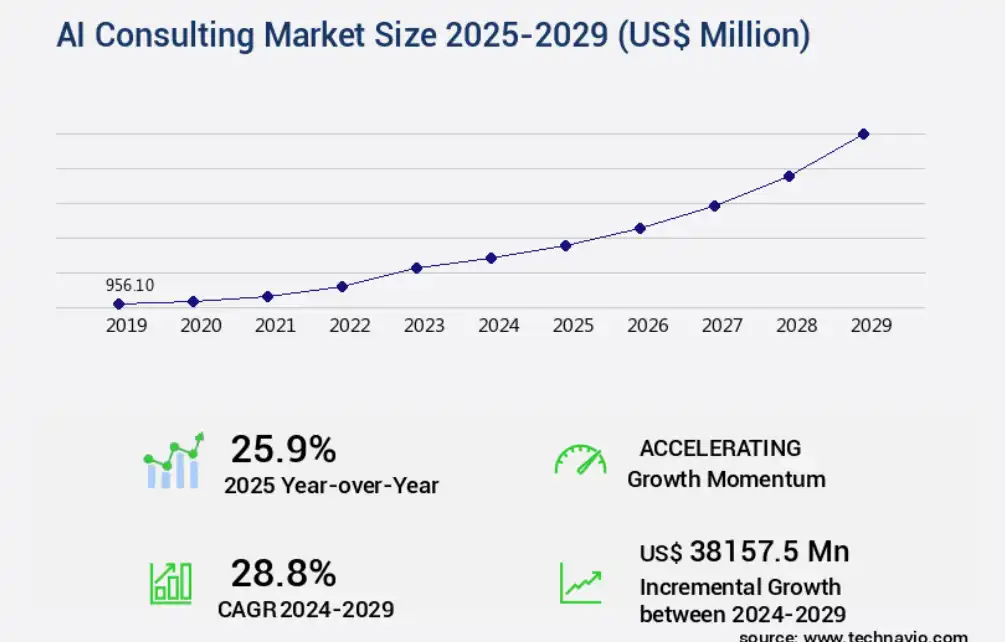
Source: Technavio
Beyond Experiments
The era of treating AI as a novel playground or a proof-of-concept marketing tool is officially over. Leadership teams are demanding measurable productivity gains and new revenue streams from their technology investments.
- The Shift to Production: Companies are moving away from simple chatbots and focusing on deeply integrated solutions like automated supply chain forecasting and predictive risk analysis.
- The High Stakes: When an experiment fails, a company loses a small budget. When a production platform fails, it impacts customer trust, compliance, and top-line revenue.
For anyone investing in the creation of an AI consulting platform, this shift represents a highly profitable target demographic. Your users will be corporate decision-makers who have already validated the basic utility of AI and are now looking for institutional-grade implementation. They need a roadmap to scale these technologies across multiple departments safely and predictably.
The Data Challenge
The most common roadblock to successful AI integration isn’t the algorithm itself, but the data fueling it. Most enterprises are sitting on massive reserves of fragmented, unstructured data scattered across legacy databases and isolated cloud environments.
The Reality of Corporate Data:
- Siloed information that departments refuse or struggle to share.
- Inconsistent formatting that breaks standard machine learning models.
- Lack of strict data governance and compliance protocols.
An AI consulting firm spends a significant amount of time just getting an enterprise ready to use AI. Investors looking to fund a platform in this space should focus heavily on data engineering and preparation features. If your platform can help businesses clean, organize, and secure their data pipelines efficiently, you solve their most expensive bottleneck before the actual AI modeling even begins.
Implementation Drives ROI
One of the biggest challenges in AI adoption is proving that the investment is delivering real business value. While the technology itself may be impressive, decision-makers ultimately care about outcomes. The most successful AI initiatives are usually those that solve a specific business problem and produce results that can be clearly measured over time. This approach makes it easier for organizations to scale AI with confidence and gain support across the business.
The Need for Outside Expertise
Many executives mistakenly believe their existing IT and software engineering departments can handle a full-scale AI transition. While internal teams are excellent at maintaining core systems, AI development requires an entirely different skill set that is incredibly scarce and expensive to hire full-time.
- Specialized Talent Shortage: True machine learning engineers, data scientists, and AI compliance experts command massive salaries that mid-market enterprises cannot sustain long-term.
- The Benefit of External Perspective: Outside consultants bring cross-industry insights, knowing exactly what pitfalls to avoid because they have seen what fails at other organizations.

What Enterprise AI Consulting Companies Actually Do?
Enterprise AI consulting is not about selling generic software licenses. It is about building custom infrastructure that fits a company’s specific business model. For investors looking into this space, understanding these core services helps clarify exactly what capabilities your platform needs to offer.
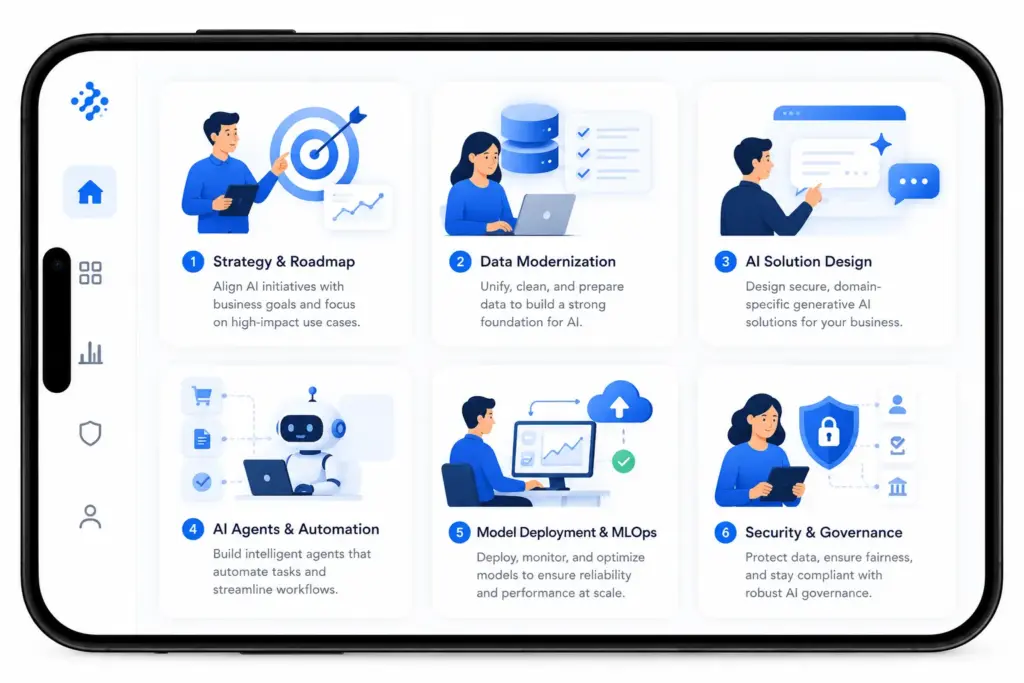
1. AI Strategy and Roadmap Development
Most corporate leaders know they need AI, but they do not know where to start. Consultants step in to align technology with business goals.
- Feasibility Audits: Reviewing current tech stacks to see if they can support AI.
- Use Case Prioritization: Finding the highest-value problems that AI can solve quickly.
- Cost Estimation: Projecting infrastructure costs so executives can budget accurately.
This phase prevents companies from wasting capital on tools they do not need. It provides a clear blueprint for deployment.
2. Enterprise Data Modernization
AI is useless without clean data. Consulting firms spend massive amounts of time upgrading legacy data systems so machine learning models can actually use them. Consultants break down departmental silos and build modern pipelines. They move unstructured data into secure cloud environments. This process turns chaotic corporate records into structured assets that are ready for AI training.
3. Generative AI Solution Design
Off-the-shelf language models are too generic for complex enterprise needs. Firms design custom generative applications tailored to specific industries. This involves building systems that query internal knowledge bases securely. A bank might use this for instant policy compliance checks while a hospital group might use it to summarize patient histories safely.
4. AI Agent and Workflow Automation
Simple task automation is evolving into autonomous operations. Consultants build intelligent agents that can execute multi-step corporate workflows without constant human oversight.
- Procurement: Agents that read invoices, match them to purchase orders, and flag anomalies.
- Customer Operations: Bots that handle complex complaints by checking shipping databases and issuing refunds automatically.
This goes beyond basic chatbots. It connects separate software systems through an intelligent layer that can reason and make decisions based on corporate rules.
5. AI Model Deployment and MLOps
Building a model in a laboratory setting is easy but running it reliably at scale is difficult. This is where Machine Learning Operations comes into play. Consultants build the architecture required to monitor models in real time. They track performance drops, automate updates, and manage computing costs. This ensures that the AI remains accurate and cost-effective as corporate data changes over time.
6. Enterprise AI Governance and Security
Companies face massive legal and financial risks if their AI leaks sensitive data or makes biased decisions. Security is often the ultimate deciding factor for enterprise buyers.
- Data Privacy: Ensuring models comply with strict regional financial and medical privacy laws.
- Bias Mitigation: Auditing algorithms to make sure they treat users fairly.
- Access Control: Restricting internal AI tools so employees can only see data matches for their specific security clearance.
Consultants build these safety guards directly into the system architecture. This gives executives the confidence to deploy AI knowing their corporate reputation is fully protected.
Top Enterprise AI Consulting Companies in 2026
The market for AI deployment is highly competitive. Choosing the right partner depends on your specific infrastructure needs, technical debt, and long-term business goals. Here is an analysis of the top firms leading the market. Each brings a unique mix of expertise, industry knowledge, and implementation capabilities to help enterprises scale AI successfully.
1. IdeaUsher
We focus on turning complex artificial intelligence concepts into scalable corporate realities. Our team specializes in bridging the gap between legacy IT frameworks and cutting-edge machine learning models. This allows enterprises to adopt AI more efficiently while ensuring new solutions integrate seamlessly with existing business operations.
Core AI Consulting Services
Our consulting practice begins with an honest assessment of your business operations. We build customized strategies that integrate smoothly with your existing technology.
- Strategic Audits: We evaluate your current technical setup to find quick wins for automation.
- Architecture Design: We plan the exact cloud and processing frameworks required to run your models efficiently.
Enterprise AI Development Expertise
We do not just hand over a strategy document and leave. Our engineering teams build deep, custom software solutions tailored to proprietary business data. This includes engineering customized predictive modeling tools and training private language models. Your intellectual property stays entirely secure within your own infrastructure.
AI Staff Augmentation Capabilities
Finding niche machine learning talent is incredibly difficult right now. We solve this bottleneck by embedding our own elite engineers directly into your internal teams.
- Rapid Scaling: Add senior data scientists or compliance experts to your project within days.
- Knowledge Transfer: Our engineers work side-by-side with your staff to ensure your team can manage the system after deployment.
Industries Served by IdeaUsher
We bring deep cross-industry experience to every project. This perspective helps us predict and avoid common deployment hurdles before they cost you time and money. Having worked across multiple sectors, we understand the unique challenges that can impact AI adoption and scalability. This enables us to deliver solutions that are both practical and aligned with real business objectives from day one.
| Industry | Primary Use Case |
| Finance | Automated fraud detection and algorithmic risk assessment |
| Healthcare | Secure patient data routing and clinical workflow automation |
| Logistics | Real-time supply chain optimization and predictive fleet maintenance |
| Retail | Hyper-personalized recommendation engines and inventory forecasting |
2. Intellivon
Intellivon is built for organizations requiring intensive cloud restructuring alongside their AI deployment. This firm operates at the intersection of enterprise cloud architecture and machine learning. They focus heavily on high-throughput environments that process massive streams of daily user data.
AI Consulting Strengths
- Cloud Migration: Transitioning heavy on-premise systems to AI-ready cloud environments.
- Real-Time Processing: Optimizing algorithms to handle live data feeds without latency.
Best-Fit Enterprise Use Cases
Intellivon is an excellent match for mid-to-large telecom providers and massive digital platforms. They excel when a company needs to process millions of transactions or user interactions simultaneously. Their expertise in building high-performance data systems helps organizations maintain reliability and efficiency even as workloads continue to grow.
3. RTS Labs
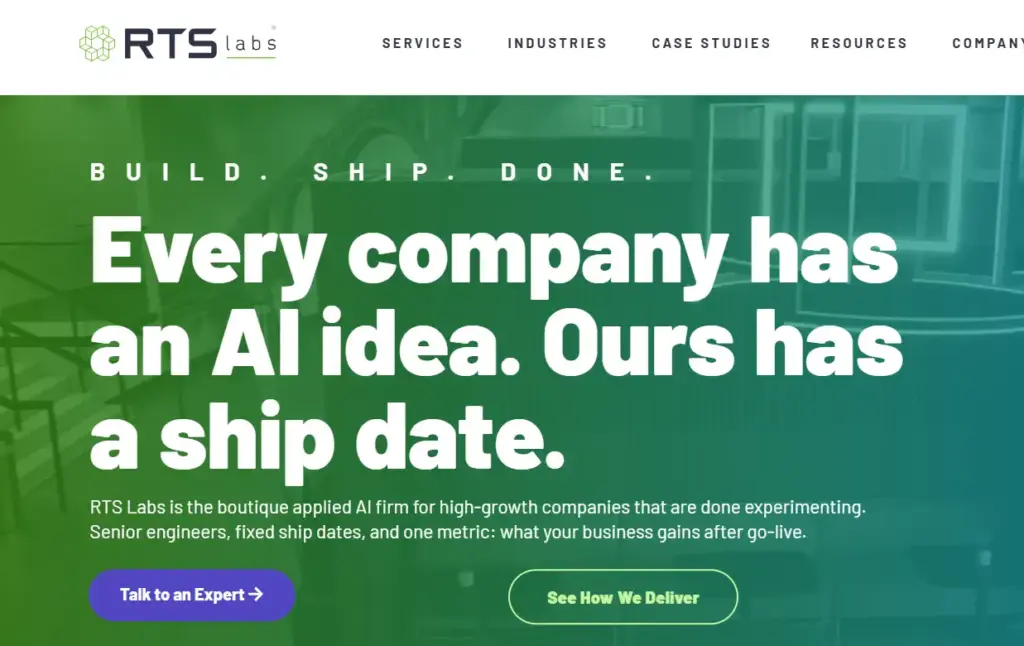
RTS Labs is known for its fast, iterative approach to software engineering and data analytics. They specialize in helping companies clean up messy data environments. They believe that data clarity must always come before algorithmic development. They build highly efficient data warehouses and automated extraction tools. This ensures that any machine learning model deployed has a continuous stream of verified information.
Best-Fit Enterprise Use Cases
This firm is ideal for companies sitting on decades of unorganized legacy data. They excel in the manufacturing and distribution sectors where physical records need digital standardization. Their approach helps organizations transform fragmented information into structured, accessible data that supports better operational and strategic decision-making.
4. ThoughtMinds
ThoughtMinds takes a holistic approach to corporate restructuring through technology. They focus heavily on the human side of technological transition. They combine traditional management consulting with deep technical execution. This balanced approach helps organizations achieve lasting transformation while minimizing disruption to day-to-day operations.
AI Transformation Services
- Change Management: Training internal teams to adapt to new automated workflows.
- Operational Redesign: Restructuring entire departments to maximize the efficiency of AI agents.
Best-Fit Enterprise Use Cases
ThoughtMinds works best for large legacy organizations facing internal resistance to technology adoption. They help smoothly transition traditional workforces into modern, tech-driven environments. Their focus on change management and employee adoption ensures that new technologies are embraced effectively rather than becoming underutilized investments.
5. InData Labs
InData Labs operates as a highly technical data science firm focused on advanced algorithms. They host a dense concentration of research-driven data scientists. They excel at tackling experimental or highly complex mathematical problems. Their team is particularly well-suited for projects where conventional analytics approaches fall short.
AI Engineering Expertise
They have deep expertise in computer vision, facial recognition, and complex predictive analysis that requires custom neural network architecture. Their engineers are experienced in developing AI systems capable of processing large volumes of visual and sensor-based data.
Best-Fit Enterprise Use Cases
This firm is a great choice for specialized tech startups or security firms that need to push the boundaries of visual and sensory data tracking. They are particularly effective in projects involving surveillance intelligence, advanced image analysis, and real-time monitoring systems.
Benefits of Hiring AI Consultants Through IdeaUsher
Building your own machine learning tools from scratch can easily drain your resources if you lack a dedicated roadmap. We step in to streamline this process entirely. When you partner with us at IdeaUsher, you gain access to a framework built on practical business outcomes. Here is how we help you scale your AI infrastructure efficiently.
1. Faster AI Deployment Cycles
Most internal corporate tech projects stall because teams get caught up in endless testing. We use pre-built data pipelines and proven architectural blueprints to speed up your launch.
- Rapid Prototyping: We build functional proofs of concept quickly so you can test them with real users.
- Seamless Integration: Our engineers connect new models directly to your current software without causing downtime.
We focus on moving your project from a basic concept to a live corporate tool in weeks instead of months.
2. Reduced AI Project Risk
Investing in artificial intelligence involves navigating complex compliance and technical hurdles. A single mistake in data handling can compromise your entire system. We design clear guardrails around your algorithms. Our team constantly monitors for model drift and compliance issues, ensuring your investment remains secure and reliable from day one.
3. Access to Specialized AI Talent
Finding top-tier data scientists and machine learning engineers is incredibly difficult and expensive. We eliminate this hiring bottleneck by embedding our vetted professionals directly into your workflow. You do not need to spend months interviewing expensive specialists. You can use our elite technical team immediately.
This setup gives you the exact skills you need for your project without the long-term overhead of permanent technical hires.
4. Lower Development Costs
Building an internal AI department requires a massive budget for salaries, training, and software licenses. We offer a much more cost-effective alternative. We optimize your computing power and cloud storage usage, ensuring you only pay for the exact resources your platform requires.
| Investment Type | Internal Team Build | Partnering With Us |
| Hiring Overhead | Very High | Zero |
| Tech Infrastructure | Expensive trial and error | Optimized cloud spending |
| Time to Value | Slow operational startup | Immediate project execution |
5. Enterprise-Grade AI Architecture
An AI system must be able to handle growth without crashing or slowing down. We build robust architectures designed to process heavy data loads securely. We focus heavily on data encryption, role-based access controls, and modular systems. This ensures your technology platform can easily adapt as your business expands and compliance laws evolve.
Industry-Specific AI Consulting Services
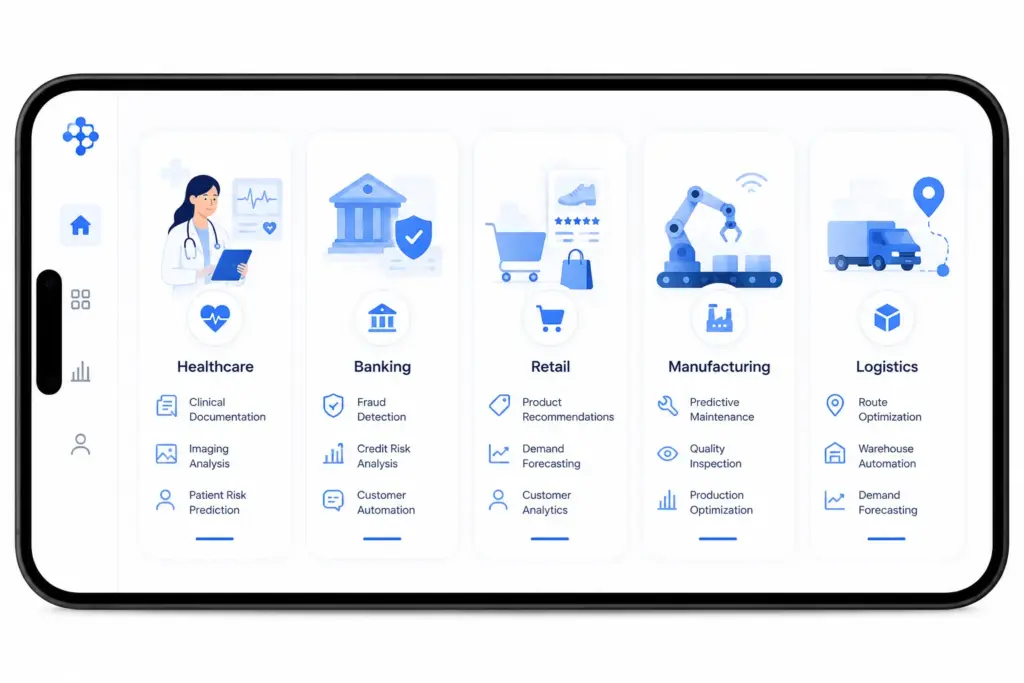
AI consulting is not a one-size-fits-all service. Every industry has different operational challenges, regulatory requirements, and data environments. A healthcare organization may need AI to support clinical decision-making, while a retailer may focus on customer engagement and inventory optimization. This is why experienced AI consultants tailor their strategies, technologies, and implementation plans to the specific needs of each industry.
1. AI Consulting for Healthcare
Healthcare organizations are increasingly using AI to improve patient outcomes while reducing administrative workloads. AI consultants help providers identify high-value use cases, prepare healthcare data for AI systems, and integrate solutions into existing clinical workflows without disrupting care delivery. They also ensure that AI initiatives align with healthcare regulations and privacy requirements.
Where AI creates value:
- Clinical documentation automation
- Medical imaging analysis
- Patient risk prediction
- Personalized treatment planning
Example: Mayo Clinic uses AI to support diagnostics, accelerate medical research, and enhance patient care through data-driven insights.
2. AI Consulting for Banking
Financial institutions operate in a highly regulated environment where speed, accuracy, and security are critical. AI consultants help banks and financial firms implement intelligent systems that can analyze large volumes of data, detect suspicious activities, and automate repetitive processes. The result is faster decision-making, improved risk management, and better customer experiences.
Common AI initiatives:
- Fraud detection
- Credit risk analysis
- Customer service automation
- Financial forecasting
Example: JPMorgan Chase uses AI across multiple business functions to improve fraud detection, operational efficiency, and customer engagement.
3. AI Consulting for Retail
Retailers face constant pressure to understand changing customer preferences and optimize operations. AI consultants help businesses leverage customer and sales data to deliver more personalized experiences, improve inventory planning, and increase profitability. Many retailers begin with recommendation systems before expanding into broader AI-driven decision-making.
Popular use cases:
- Product recommendations
- Demand forecasting
- Dynamic pricing
- Customer analytics
Example: Amazon uses AI extensively to personalize product recommendations, forecast demand, and streamline ecommerce operations at scale.
4. AI Consulting for Manufacturing
Manufacturing companies often have access to vast amounts of operational and sensor data but struggle to convert that information into actionable insights. AI consultants help manufacturers implement predictive systems that reduce downtime, improve quality control, and optimize production processes. These initiatives can lead to significant cost savings and more efficient factory operations.
Key applications:
- Predictive maintenance
- Quality inspection
- Production optimization
- Factory analytics
Example: Siemens leverages AI and industrial analytics to improve manufacturing performance, equipment reliability, and production efficiency.
5. AI Consulting for Logistics
Modern supply chains are complex and require constant coordination across suppliers, warehouses, and transportation networks. AI consultants help logistics companies improve visibility into operations and make better decisions using real-time data. AI can identify inefficiencies, predict disruptions, and optimize resource allocation across the supply chain.
High-impact use cases:
- Route optimization
- Warehouse automation
- Demand forecasting
- Supply chain visibility
Example: DHL uses AI to improve logistics planning, optimize delivery routes, and enhance forecasting accuracy across its global supply chain network.
Common Deliverables From AI Consulting Engagements
Investing in artificial intelligence should never feel like buying a black box. You need concrete assets that prove your capital is working for you. When you collaborate with us, we focus on providing high-value deliverables at every stage of the project. These assets help your leadership team track progress and ensure the entire platform scales smoothly.
Strategy Roadmaps and Assessments
We start by identifying exactly where machine learning can cut your operating costs or grow your top-line revenue. We deliver a comprehensive strategic blueprint that removes all the guesswork from your investment.
- Prioritized Use Cases: A clear list of business operations that will benefit most from immediate automation.
- Financial Forecasting: Detailed projections of your expected return on investment and cloud computing costs.
- Phased Rollout Plan: A step-by-step timeline that shows you how to scale the technology safely across different departments.
This document serves as your long-term corporate guide, ensuring you never waste money on unnecessary tools.
Technical Blueprints and Architectures
Before our engineers write a single line of code, we design the structural foundation of your platform. We hand over complete technical blueprints that map out how your new systems will handle heavy enterprise data loads.
What We Include: You receive deep architecture diagrams, clear data flow designs, and explicit cloud infrastructure recommendations. This ensures your system is highly secure and fully compliant with current data privacy laws.
Prototypes, MVPs, and Deployments
We do not just hand over strategy documents and walk away. Our engagement moves rapidly into building real, tangible software that your teams can interact with immediately. This iterative process allows you to see real results quickly. It gives you the confidence that the final platform is perfectly optimized for your business operations.
| Phase | What We Deliver to Your Team |
| Proof of Concept | A simple working model to validate the core algorithm with your data |
| Minimum Viable Product | A functional prototype ready to be tested by real internal users |
| Production Scale | A fully deployed enterprise-grade AI system running smoothly at scale |
Contact IdeaUsher for Enterprise AI Consulting
Taking your business from legacy workflows to automated intelligence requires more than just standard software developers. We bring deep, real-world engineering power to your project. With over 500,000 hours of coding experience, our team of ex-MAANG and FAANG developers knows exactly how to build stable, institutional-grade systems. We eliminate the guesswork so you can invest your capital with complete confidence.
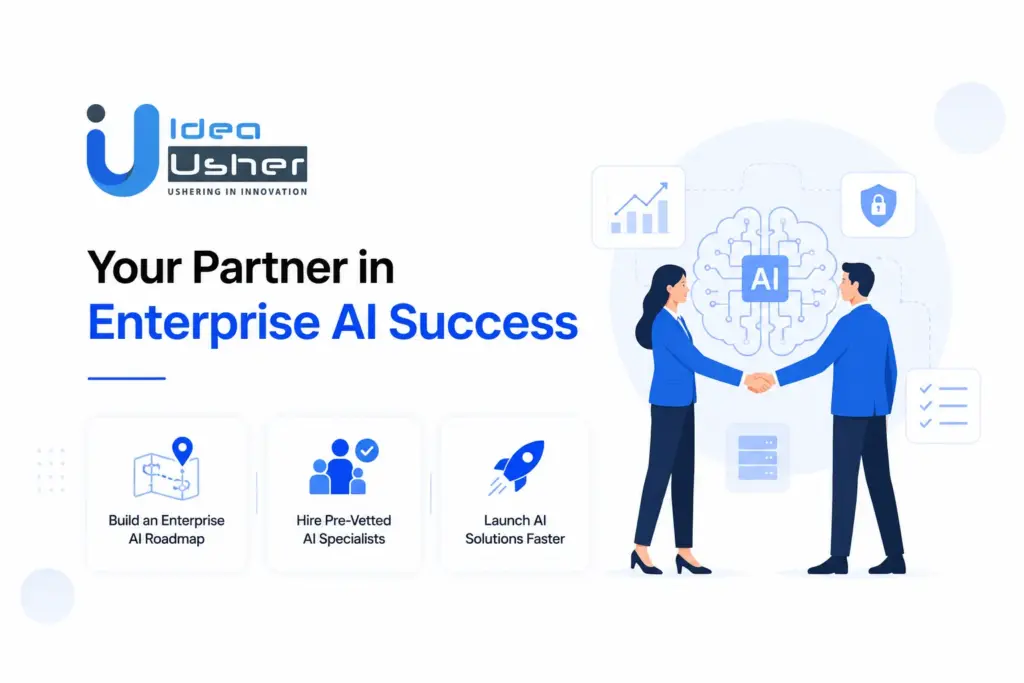
Build an Enterprise AI Roadmap
We do not believe in deploying technology just for the sake of novelty. Our consulting starts by looking directly at your balance sheet to find where automation can drive the highest financial returns.
- Feasibility Matching: We analyze your current databases to confirm your infrastructure can actually support machine learning.
- Cost Engineering: Our team builds a transparent budget framework that outlines cloud processing costs well in advance.
This strategic planning ensures you build a highly scalable platform that solves tangible operational bottlenecks right from the start.
Hire Pre-Vetted AI Specialists
Finding elite data scientists and machine learning engineers independently can stall your business growth for months. We solve this talent bottleneck completely by giving you direct access to our internal development roster. This allows organizations to accelerate AI initiatives without the delays and uncertainty of lengthy hiring cycles.
Launch AI Solutions Faster
Building software in isolation often leads to missed deadlines and integration delays. We use proven, pre-engineered deployment pipelines to accelerate your time to market. We help you bypass the common architectural mistakes that derail most corporate tech projects. Partnering with us means you get a secure, high-ROI AI platform built correctly on the very first try.
| Development Milestone | Typical Internal Timeline | Our Accelerated Timeline |
| Data Architecture Fixes | Months of restructuring | Weeks of automated pipeline setup |
| Model Prototype Creation | Slow experimental testing | Fast deployment of verified models |
| Full Production Scale | High risk of system crashes | Seamless, secure platform launch |
Conclusion
Enterprise AI is no longer just an emerging technology trend. It is becoming a practical business tool that helps companies work smarter, move faster, and stay competitive. The consulting firms featured in this guide bring different strengths to the table, so the best choice depends on your goals and challenges. By selecting a partner with the right expertise, businesses can turn AI from a promising idea into a valuable part of their everyday operations.
Things to Know About AI Consulting
A1: Businesses should consider AI consultants when they want to automate workflows, improve decision-making, launch AI-powered products, deploy generative AI, or scale existing AI initiatives. Consultants are especially valuable when internal teams lack specialized AI expertise or implementation experience. Early guidance often helps organizations avoid costly implementation mistakes and delays.
A2: AI consulting costs vary based on project scope, industry requirements, data complexity, and deployment scale. Strategic assessments may cost significantly less than enterprise-wide AI transformations involving custom models, integrations, and MLOps infrastructure. The overall investment is usually influenced more by business complexity than by the technology itself.
A3: Industries that gain the most value include healthcare, financial services, retail, manufacturing, logistics, insurance, and SaaS. These sectors often have large datasets, repetitive processes, and complex decision-making workflows that AI can optimize. Organizations with data-rich operations often see the fastest and most measurable returns.
A4: Look for a partner with proven AI delivery experience, strong engineering capabilities, industry expertise, data engineering knowledge, MLOps capabilities, and a track record of deploying production-ready AI systems rather than just building proofs of concept. The ideal partner should be able to scale solutions beyond experimentation and into everyday operations.