


Modern tools may keep teams talking, but they rarely create a sense of presence. You can see messages and join calls, but the human layer often feels distant. Work may move forward, yet collaboration can feel flat and transactional; this gap has pushed companies to rethink how digital interaction should feel.
The popularity of metaverse collaboration platforms has started increasing because companies need deeper engagement and more natural interaction in remote setups. Teams can use spatial environments and real-time avatars to collaborate more effectively. This approach may gradually restore depth and connection in remote work.
Over the years, we’ve developed many enterprise metaverse collaboration platforms powered by spatial computing and real-time 3D rendering technologies. As we have this expertise, we’re sharing this blog to discuss the steps to develop a metaverse collaboration platform like RAUM.
Market Demand for Metaverse Collaboration Platforms
According to MarketUS, the Global Metaverse Market size is expected to be worth around USD 4,473.6 Billion By 2034, from USD 110.4 billion in 2024, growing at a CAGR of 44.8% from 2025 to 2034. This growth signals a shift in how enterprises manage capital and workflows. For investors, these figures represent the rise of the Industrial Metaverse, where high-utility digital environments solve modern work friction.
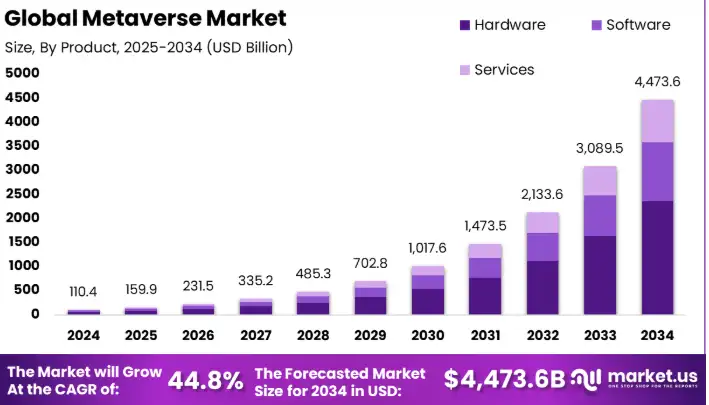
Source: MarketUS
The transition toward immersive collaboration addresses the productivity lost in 2D tools. As traditional remote work reaches its limit, demand for spatial presence is surging. This creates an opening for platforms catering to high-stakes industries where collaboration requires physical action and precision.
Rising Enterprise Spend
Enterprise spend on XR software is consistently outpacing consumer growth. Organizations are now integrating metaverse infrastructure into core digital transformation budgets to target ROI through reduced travel and faster development.
Capital is flowing into solutions bridging physical and digital operations. Platforms like NVIDIA Omniverse have set a benchmark, allowing enterprises to build industrial-scale digital twins for real-time simulation. The primary investment opportunity lies in the SaaS layer, building tools to manage these enterprise-grade environments.
Strategic investment focuses on interoperability. Decision-makers seek platforms that integrate with existing ERP systems while maintaining data sovereignty. The market is moving toward open standards that allow workers to move fluidly between different immersive modules.
Shift to Spatial Work
Video conferencing failed to address the spatial deficit, lacking 3D interaction and spontaneous innovation. Spatial platforms fill this void by placing data and people in a shared 3D context, mimicking natural human experience and reducing cognitive load.
Platforms such as Arthur are already utilized by major consultancies for complex strategy sessions requiring deep focus. This leads to higher engagement and more effective brainstorming.
Practical applications include:
- Virtual War Rooms: Persistent spaces for 3D data visualization without constant screen sharing.
- Rapid Prototyping: Teams walk around 1:1 scale digital models, making real-time adjustments.
- Contextual Onboarding: New hires navigate digital twins of corporate sites to gain spatial familiarity.
Trends Driving Growth
Healthcare is adopting spatial platforms for surgical planning where 3D visualization is critical. The training sector is shifting toward experiential modules, which increase training speed by up to four times compared to traditional classrooms.
The Mixed Reality First approach is a dominant trend. Developers are building platforms that function across AR glasses, mobile devices, and desktops. This allows a floor technician and a remote executive to collaborate in the same environment simultaneously.
Key growth drivers include:
- AI Integration: Using Generative AI to create 3D assets on the fly and power workflow avatars.
- Hardware Accessibility: Ergonomic headsets are lowering entry barriers for mid-market enterprises.
- Sustainability: Immersive collaboration offers a high-performance alternative to international business travel.
Overview of RAUM Platform
RAUM is a high utility enterprise platform transitioning corporate collaboration from 2D video grids to persistent 3D environments. Unlike social worlds, it focuses on professional workflows like product development and executive workshops. It provides a GDPR compliant, action-first architecture that prioritizes spatial data and professional security.
This platform represents the maturation of VR into a standardized business tool. It has emerged as a leading independent choice for global firms requiring data sovereignty and hardware flexibility.
Enabling Immersive Collaboration
RAUM bridges the presence gap inherent in traditional remote work. Using spatial audio and the FACES Avatar System, the platform creates an environment where teams feel as if they share a physical room.
This enables natural communication cues. Gesturing toward data points or sensing peer presence allows for a depth of interaction impossible in video calls.
The Collaboration Logic:
- Focus: 3D environments remove the cognitive strain of screen staring.
- Spatial Context: Information is anchored in 3D. Project roadmaps on a virtual wall provide a persistent mental map.
- Agility: Teams move from presentations to small group breakouts by simply walking to different areas.
Core Workspace Features
The platform mirrors office functionality through its Spatial Tools Suite. RAUM avoids complex programming, offering an interface for non-technical professionals to collaborate using an evolving Content Library.
| Feature | Functionality |
| FACES Avatar System | Includes Canvas Boards, 3D Symbol Kits, and multi-screen sharing. |
| Spatial Tools Suite | Supports Meta Quest, Pico, and HTC, plus browser-based desktop access. |
| Persistence | Workspaces remain active. Notes and models stay exactly where you left them. |
| Multi Access | Supports Meta Quest, Pico, and HTC, plus browser based desktop access. |
Unlike meeting tools that end when the window closes, RAUM workspaces are permanent. This persistence allows teams to resume complex projects without the friction of re-sharing data or context.
Key Enterprise Benefits
RAUM offers a measurable alternative to the high costs of physical operations. The value lies in scaling human expertise without the overhead of physical relocation or international travel.
The true ROI of RAUM is the reduction in decision latency. Interacting with 1:1 digital twins instantly shaves months off development cycles.
Strategic Advantages:
- Accelerated Onboarding: Via the Onboarding Academy, new hires gain spatial familiarity 4x faster than through video.
- Talent Integration: Remote specialists join workshops from anywhere, ensuring top expertise is always in the room.
- Sustainable Scaling: RAUM uses a workspace-based pricing model rather than per-user seats for cost-effective expansion.
- ESG Impact: Replacing international flights with immersive sessions provides a documented reduction in corporate carbon emissions.
Must-Have Features in a RAUM-Like Platform
Developing competitive metaverse collaboration platforms requires moving beyond gaming aesthetics to prioritize professional utility. The architecture must ensure every digital asset serves a specific business function. For those looking to build in this market, the following features constitute the baseline for enterprise-grade performance and user retention.
1. Realistic 3D Workspaces
Environments must offer high-fidelity, persistent spaces that mirror a professional office. These rooms serve as digital hubs where data layouts remain exactly as left. NVIDIA Omniverse exemplifies this by allowing teams to build industrial-scale digital twins that stay active and synchronized across global locations.
2. Spatial Audio
Effective collaboration depends on audio that mimics reality, where volume and direction change based on proximity. This allows for simultaneous side conversations and organic networking. Platforms like Microsoft Mesh integrate this into familiar workflows, reducing the fatigue caused by the rigid audio of standard video calls.
3. Interactive Tools
A platform value is defined by how users interact with data via 3D objects and shared boards. These elements turn passive viewing into a tactile workshop. MootUp demonstrates this through its deep integration with professional tools, allowing teams to manipulate complex 3D models and brainstorm with physical intuition.
4. Avatar Presence
Professional avatars are essential for establishing a sense of being there while maintaining corporate decorum. By translating nonverbal cues into a digital persona, the platform fosters engagement.
Infosys Metaverse Foundry utilizes life-like avatars to create a feeling of presence that 2D video feeds cannot replicate.
5. Cross-Device Access
Accessibility drives adoption, requiring seamless performance across VR headsets, mobile, and web browsers. Ensuring team members can contribute via a laptop prevents the platform from becoming a siloed tool.
Frame excels here by running entirely in the browser, allowing anyone with a link to join the 3D space instantly.
6. Enterprise Security
Security is the non-negotiable foundation for handling proprietary data. Robust encryption and global privacy compliance are mandatory. Sky-XR provides a template for this, offering secure virtual command centers with centralized administrative controls designed for high-stakes, mission-critical industries.
Advanced Features That Drive Enterprise Adoption
Top-tier metaverse collaboration platforms are now essential digital infrastructure. They provide the high performance and low latency required for mission-critical workflows.
These environments have transitioned from experimental spaces to core business tools. They integrate real-time data pipelines to drive measurable productivity gains across global teams.
1. AI Meeting Insights
Modern platforms function as live analytical engines. Instead of manual note-taking, integrated agents transcribe dialogue and isolate key action items in real time.
Miro AI exemplifies this by automatically clustering visual ideas and summarizing 3D boards into structured reports. This ensures critical data is never lost during high-stakes sessions.
2. Digital Twin Simulation
Enterprise adoption is fueled by the ability to simulate physical assets with precision. These digital twins allow teams to test “what if” scenarios on production lines before investing in physical capital.
NVIDIA Omniverse sets the standard here. It enables global engineering teams to virtually commission factory floor adjustments and predict maintenance needs with physics-based accuracy.
3. Seamless Workflow Integration
A virtual workspace must connect directly to the existing corporate tech stack. The best platforms bridge the gap between 3D environments and standard tools like Slack, Teams, and CRM systems.
Microsoft Mesh demonstrates this by allowing data to flow fluidly from immersive meetings into the Microsoft 365 ecosystem. This maintains productivity without the friction of context switching.
4. Large Scale Event Hosting
Hosting thousands of concurrent users with zero latency is now a requirement for global town halls. These gatherings offer the resilience of high-performance gaming architecture within a professional setting.
Virbela provides the infrastructure for these massive crowds. It offers persistent environments where thousands can network and attend breakout sessions in a unified, stable space.
How to Develop a Metaverse Collaboration Platform Like RAUM?
Developing a metaverse collaboration platform like RAUM may require building a real-time 3D environment with a strong engine and a backend that can reliably manage avatars and spatial data. It could also involve integrating low-latency communication and scalable cloud systems so users can interact naturally and consistently in shared virtual spaces.
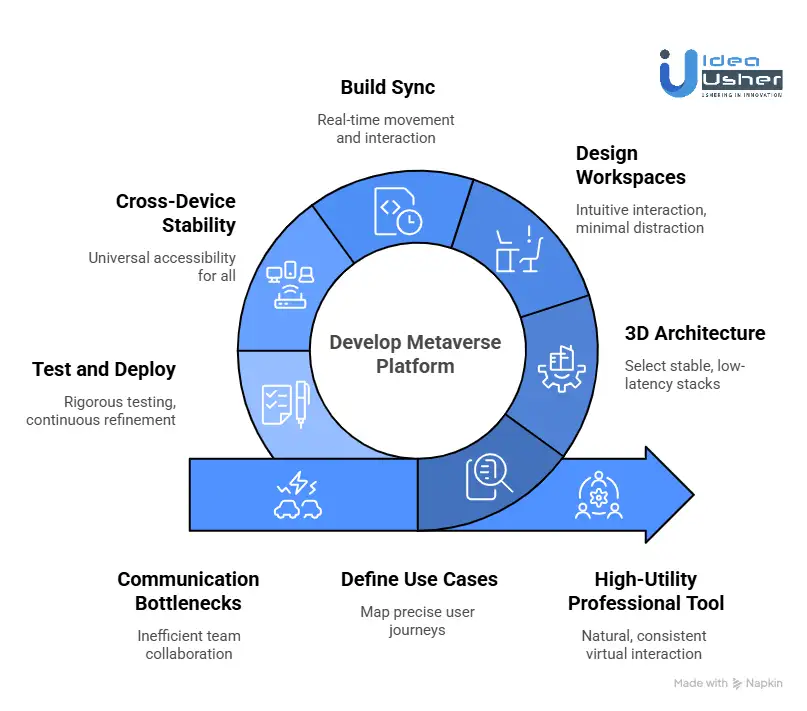
We have developed multiple metaverse collaboration platforms like RAUM, and here is how the process works.
1. Define Enterprise Use Cases
We begin by auditing your communication bottlenecks to map out precise user journeys for your teams. Whether you need a secure boardroom or a 3D design studio, we define the architecture based on your specific strategic objectives. This ensures the final platform functions as a high-utility professional tool rather than a generic social space.
2. 3D Collaboration Architecture
We select technical stacks prioritized for stability, low latency, and enterprise security. By pairing advanced 3D engines with robust cloud backends, we ensure your platform handles high concurrent user counts and complex data integrations seamlessly. This high-performance foundation is critical for maintaining fluid, real-time collaboration across global regions.
3. Design Workspaces and Interaction
Our design philosophy centers on productivity-first environments that minimize distraction and maximize cognitive comfort. We build intuitive interaction flows, focusing on natural hand-tracking and simplified interfaces. This allows your team to lead presentations and manipulate digital assets with no technical learning curve, keeping the focus entirely on the work.
4. Build Sync and Spatial Audio
To create a genuine sense of presence, we implement networking protocols that synchronize every movement and interaction in real time. We integrate spatial audio that mimics real-world acoustics, enabling natural sidebars and spontaneous discussions. This synchronization ensures that non-verbal cues and spatial orientation feel as authentic as a physical office.
5. Ensure Cross-Device Stability
We build with a hardware-agnostic mindset to ensure universal accessibility for all stakeholders. Our pipeline optimizes assets for both high-end VR headsets and standard web browsers on laptops. This compatibility ensures that every team member can participate in the immersive environment regardless of their location or the hardware they have available.
6. Test, Deploy, and Optimize
We conduct rigorous stress testing and security audits to ensure your environment remains GDPR-compliant and resilient. Once launched, we use granular analytics to monitor user interaction and continuously refine the experience. This iterative approach ensures your metaverse platform evolves alongside your business needs and stays at the cutting edge of workplace technology.
Cost to Build a Metaverse Collaboration Platform
Investing in metaverse collaboration platforms requires a clear understanding of the capital needed to bridge 3D environments with enterprise security. For decision-makers, this budget is a strategic allocation based on technical complexity, user scale, and the professional tools required to replace legacy video conferencing.
Key Cost Drivers
The total investment is driven by several core variables that function as the engine of your digital infrastructure:
- Platform Complexity: Costs vary between simple browser rooms and cross-platform ecosystems with full VR haptics.
- Avatar Fidelity: Moving from basic models to high-fidelity, expressive systems requires heavy investment in real-time rendering.
- Backend Concurrency: Engineering a server architecture that synchronizes dozens of users with zero lag demands premium expertise.
- Data Compliance: Ensuring GDPR or SOC2 compliance adds essential layers of legal and technical data protection.
MVP vs Full-Scale Budget
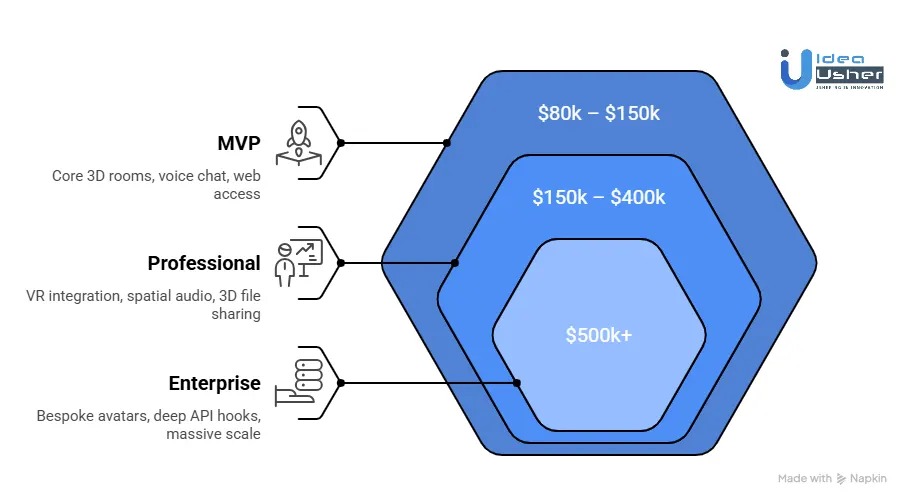
Starting with a Minimum Viable Product allows for market testing without the total upfront cost of a mature ecosystem.
| Phase | Focus Areas | Estimated Budget |
| MVP | Core 3D rooms, voice chat, and web access. | $80k – $150k |
| Professional | VR integration, spatial audio, and 3D file sharing. | $150k – $400k |
| Enterprise | Bespoke avatars, deep API hooks, and massive scale. | $500k+ |
Maintenance and Scaling
3D environments require GPU-accelerated cloud computing. Unlike 2D sites, you pay for the real-time processing of every movement and interaction within the space.
Security and Updates
To stay competitive, budgets must cover:
- Security Patches: Protecting proprietary 3D data streams.
- Hardware Compatibility: Updating for the latest VR headsets and browser standards.
- Feature Refinement: Adding new tools based on user analytics to prevent stagnation.
Technical Support
Enterprise-grade reliability requires dedicated DevOps. Maintaining high uptime is essential to justify the licensing fees that drive your long-term ROI.
Core Modules That Power RAUM-Like Platforms
Building metaverse collaboration platforms requires more than just high-quality graphics; it demands a modular architecture where every component serves a functional purpose. These modules act as the engine room, ensuring the transition from 2D interfaces to 3D spatial work is seamless, secure, and performant for enterprise operations.
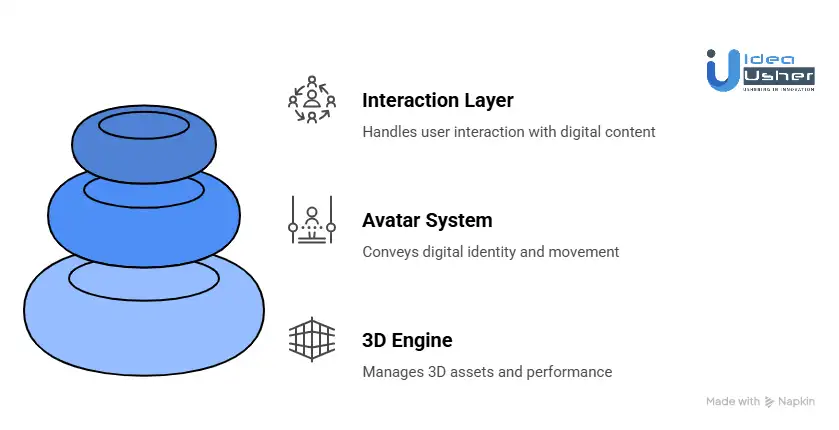
3D Engine and Scene Management
The environment engine is the structural foundation. It manages how assets are loaded, lit, and optimized across different devices to maintain professional-grade performance.
- Scene Graph Management: Efficiently organizes 3D objects to ensure only visible assets consume system resources.
- Dynamic Lighting: Creates realistic environments that enhance the user’s sense of presence without causing hardware strain.
- Asset Streaming: Allows users to join rooms instantly while high-resolution textures load in the background.
Strategic Insight: Professional scene management must include “Persistent State.” This ensures that when a team returns to a virtual room, every sticky note and 3D model is exactly where they left it.
Avatar System and Movement Sync
In a professional setting, the avatar is a digital identity. It must convey authority and nuance through high-fidelity movement synchronization.
- Inverse Kinematics (IK): Mathematical frameworks that calculate realistic joint movements, ensuring limbs move naturally.
- Expression Mapping: Utilizing lip-syncing algorithms to mimic human conversation, reducing “uncanny valley” discomfort.
- Low-Latency Sync: A networking layer that broadcasts positions every few milliseconds to prevent jitter during presentations.
Interaction and Collaboration Layer
The collaboration layer differentiates a productivity tool from a social game, handling how users interact with digital content.
| Component | Functionality | Business Value |
| Spatial Audio | Sound based on distance. | Facilitates natural breakout groups and side-talk. |
| 3D Whiteboarding | Real-time sketching tools. | Enables spontaneous brainstorming and markup. |
| File Importer | Supports PDF, MP4, CAD. | Brings real-world data into the virtual space. |
| Ownership Logic | Editing permissions. | Ensures the presenter maintains control of the flow. |
This layer utilizes “authoritative state” logic. If two users grab the same prototype simultaneously, the system instantly resolves the conflict, ensuring a frustration-free collaborative experience.
Designing Virtual Workspaces for Real Use Cases
When developing metaverse collaboration platforms, design must shift from aesthetic to functional. A virtual office is a goal-oriented environment where the architecture directly influences team output. For the enterprise, we build specialized zones that mirror professional workflows while removing the physical constraints of traditional offices.
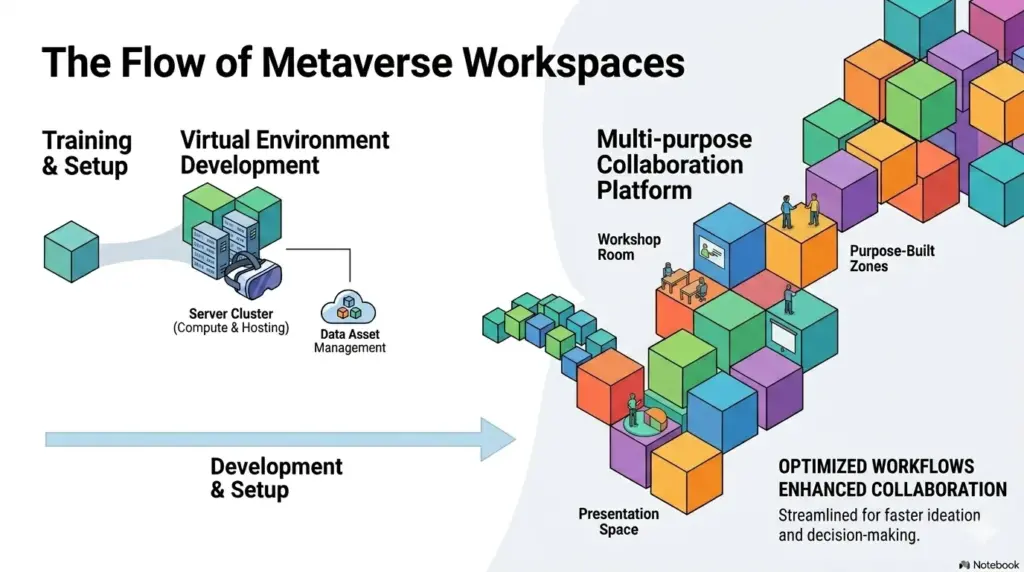
Workshop Rooms with Interactive Tools
Workshops are built for rapid ideation and spatial organization. While MootUp facilitates large browser-based events, our design prioritizes high-fidelity interactivity for agile teams.
- Spatial Canvas: Wrap-around whiteboards for mapping large-scale architectures.
- Tactile Flow: Virtual tools using hand-tracking for natural brainstorming.
- Breakout Zones: Modular areas using spatial audio for private huddles.
Execution Note: We prioritize interaction speed. If it takes more than two seconds to trigger a tool, creative momentum is lost.
Design Labs with 3D Prototypes
The design lab provides a digital twin playground where engineering meets immersion. Stakeholders interact with products that do not yet exist physically.
- Scale Manipulation: View engines at 1:1 scale or expand to 10x size for internal inspection.
- Exploded Views: Use gestures to reveal how individual parts fit together.
- Material Swapping: Change textures instantly for immediate stakeholder approval.
This process slashes R&D costs by identifying flaws long before a physical prototype is machined.
Presentation Spaces with Live Controls
Presentation rooms are engineered for storytelling, giving speakers total command over the audience’s attention.
| Feature | Function | Business Impact |
| Stage Management | Muting audio or spotlighting the speaker. | Ensures zero interruptions during keynotes. |
| Multi-Source Streaming | Displaying slides and 3D models. | Creates a rich narrative impossible on 2D screens. |
| Audience Engagement | Real-time polling and visual feedback. | Provides the speaker with immediate sentiment data. |
These spaces include “Presenter Displays,” which are hidden virtual monitors containing notes and teleprompters to ensure flawless delivery.
Building Browser-Accessible Metaverse Collaboration Platforms
While VR offers the highest immersion, metaverse collaboration platforms must remain accessible on laptops and mobile devices. A browser-first approach ensures no stakeholder is excluded due to hardware. By leveraging modern web standards, we deliver high-fidelity 3D environments that load as easily as a standard website.
WebGL and WebXR for Access
These technologies serve as the gatekeepers of the web-based metaverse, allowing complex graphics to run directly in the browser without bulky software downloads.
- WebGL: Renders 3D graphics using the user’s local hardware acceleration.
- WebXR: Enables a single link to work on both 2D monitors and VR headsets.
- Zero-Install Friction: Users join via URL, which is critical for clients who cannot install unapproved corporate software.
Technical Insight: Platforms like Hubs prove that browser-based entry points increase usage by reducing the barrier to entry to a single click.
Performance Without VR Gear
To maintain a professional feel on standard laptops, we employ aggressive optimization. The goal is a smooth 60 FPS experience even on devices without dedicated graphics cards.
- Occlusion Culling: The engine only renders objects currently in view to save processing power.
- Texture Compression: Specialized formats keep visuals sharp while reducing memory footprints.
- Level of Detail (LOD): Distant objects are simplified to focus system energy on the immediate interaction area.
Smooth Multi-Device Support
A true collaborative environment must support a hybrid workforce. A user in a VR headset must interact seamlessly with a colleague on an iPhone.
To achieve this, we optimize the experience based on the hardware: VR users focus on latency and tracking, desktop users receive high-resolution textures for management tasks, and mobile users utilize simplified UI for quick check-ins.
A unified networking backend ensures every action is broadcast to all participants simultaneously. FrameVR exemplifies this cross-play philosophy, allowing users to jump in from any device without losing core features. This creates a cohesive environment where the device matters less than the collaboration taking place within it.
Why Choose IdeaUsher for Metaverse Collaboration Platforms?
Partnering with IdeaUsher means choosing a leader in metaverse collaboration platforms. We engineer high-performance digital ecosystems that solve complex communication challenges, merging aesthetic excellence with industrial-grade stability.
Experience in Immersive Platforms
With over 500,000 hours of coding experience, our team of ex-MAANG/FAANG developers has a proven track record in high-stakes digital environments. We leverage deep expertise in spatial presence to build intuitive platforms for professional teams.
Expertise in AI, XR, and Real-Time Systems
We specialize in the intersection of AI and extended reality. By integrating intelligent automation with low-latency networking, we support expressive avatars and responsive 3D environments that feel seamless and real.
End-to-End Scalable Solutions
We provide a complete development lifecycle from concept to deployment. Our solutions are built to scale, ensuring your infrastructure remains resilient as your user base grows from a pilot group to a global enterprise workforce.
Conclusion
Developing a platform like RAUM requires a strategic shift from simple video streaming to complex spatial engineering. By prioritizing persistent virtual environments, realistic avatar systems, and high-performance networking, you can move beyond the limitations of 2D meetings. Success lies in creating a seamless, hardware-agnostic experience that prioritizes user presence and data security for the modern enterprise
FAQs
A1: The development process starts with defining your project’s scope and selecting a robust engine like Unity or Unreal. You then design the virtual environment, build a networking layer for real-time interaction, and integrate essential tools like spatial audio and 3D asset management. Finally, the platform undergoes rigorous stress testing for concurrency before deploying it across web and VR hardware.
A2: The four primary categories include Augmented Reality (AR), which overlays digital data on the real world; Lifelogging, which captures and stores everyday data; Mirror Worlds, which are precise digital reflections of physical reality; and Virtual Reality (VR), which creates entirely simulated, immersive digital environments for users to explore.
A3: Key features include high-fidelity avatars with movement sync, spatial audio for natural grouping, and interactive 3D tools like whiteboards and CAD model viewers. Enterprise platforms also prioritize persistent world states, allowing projects to remain exactly as they were left, alongside robust security protocols for private corporate data.
A4: For a professional-grade platform, an MVP typically ranges from $80,000 to $150,000. More complex enterprise solutions with bespoke avatars, full VR integration, and advanced security can scale between $150,000 and $400,000+. Total costs are ultimately driven by the level of graphical fidelity and the number of concurrent users supported.