

Key Takeaways
- Immersive therapy is becoming more accessible, with VR healthcare platforms combining remote care and real-time patient progress tracking.
- Modern solutions use VR therapy, AI movement tracking, clinician dashboards, EHR integration, and personalized treatment plans to support better care.
- Building a successful platform requires secure infrastructure, computer vision, device management, healthcare integrations, and regulatory compliance.
- These platforms can improve patient engagement, therapy monitoring, clinical efficiency, and remote care delivery while creating strong business opportunities.
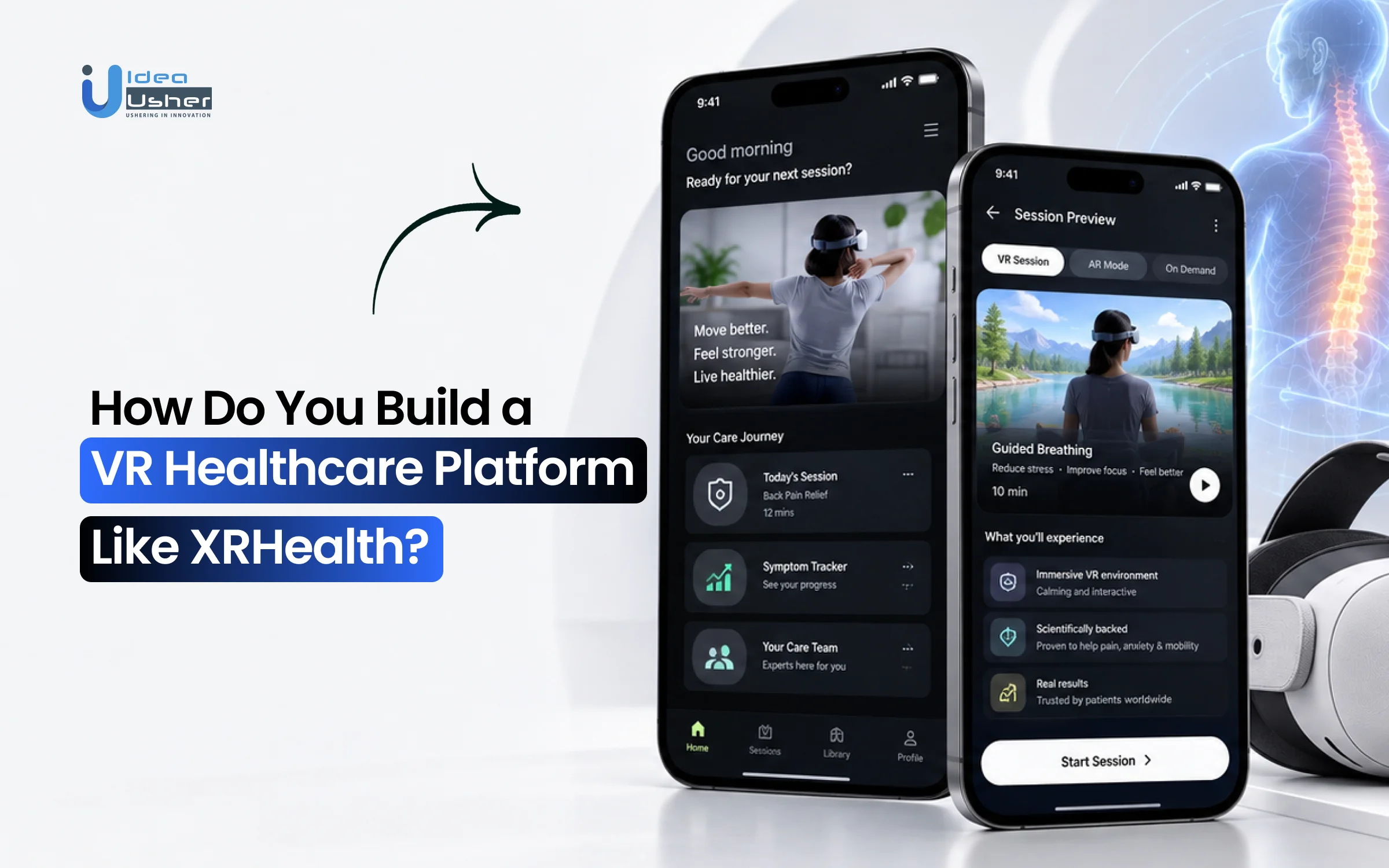
The real opportunity in immersive therapy is not simply creating a convincing virtual environment. VR healthcare platforms are becoming more valuable because they can help make therapy easier to deliver while giving clinicians a clearer view of patient progress. A session can reveal how someone moves or responds to an exercise in ways that may not be obvious between appointments. XRHealth takes this approach further by combining immersive therapy with remote care and AI-driven insights. Its use of computer vision in physical therapy is especially interesting because it can provide real-time feedback while the patient is performing an exercise.
We’ve worked on VR healthcare solutions that use immersive therapy and real-time motion tracking to make digital care more interactive and measurable. That expertise has given us a closer look at the technical and clinical considerations involved in building platforms like XRHealth. In this blog, we’ll break down how these platforms are designed and what it takes to build one from the ground up.
Why Is Demand for VR Healthcare Platforms Increasing?
According to Grand View Research, the global virtual reality in healthcare market was valued at USD 5.6 billion in 2024 and is expected to reach USD 29.4 billion by 2030 at a 30.3% CAGR from 2025 to 2030. North America held the largest share at 36.0% in 2024. This growth shows how VR is making therapy more accessible beyond traditional clinics. Patients can now complete guided rehabilitation at home while the platform tracks their progress and helps keep each session focused.
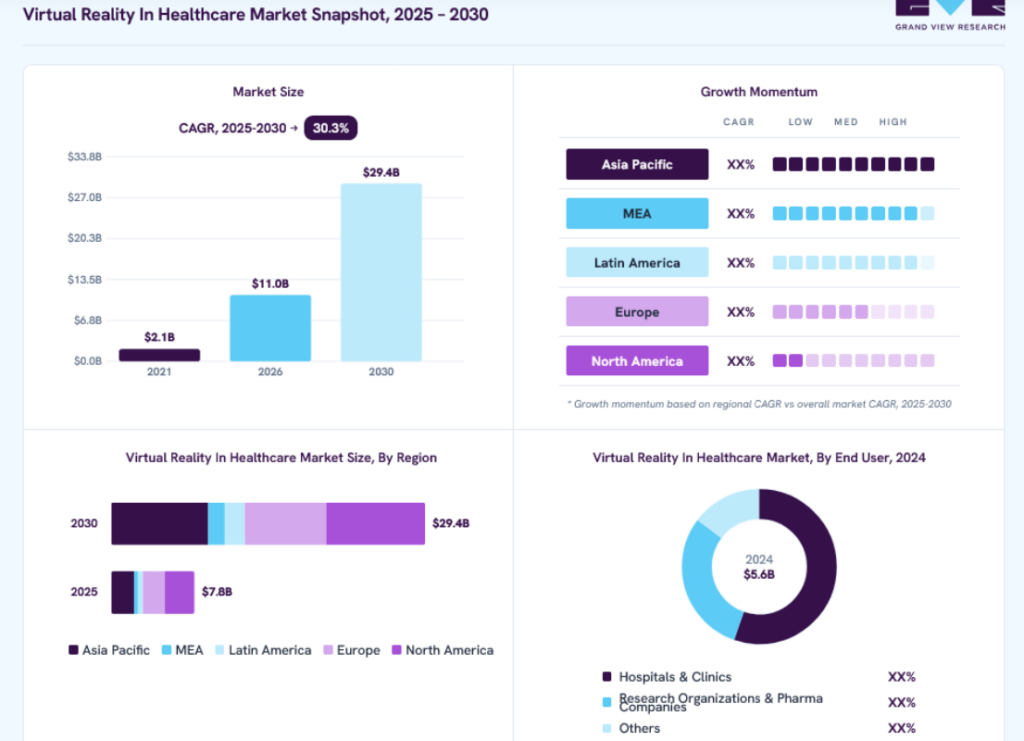
Source: Grand View Research
Consider XRHealth, a virtual clinic platform that raised over $37 million in funding to scale its immersive remote care model. By delivering FDA-registered therapeutic VR rooms directly to patients, the company established a high-margin enterprise model that monetizes through remote patient monitoring codes and subscription care packages.
The economic advantages driving this expansion include:
- Therapist Productivity Multipliers: Clinicians manage asynchronous patient caseloads through centralized software dashboards instead of spending an entire hour per single patient.
- Lower Readmission Rates: Daily home sessions prevent joint stiffness and muscle atrophy, keeping high-risk patients out of expensive hospital readmission loops.
- Reimbursement Readiness: Healthcare systems tap into dedicated remote therapeutic monitoring codes to secure predictable monthly billing from home software usage.
Interactive home sessions convert passive recovery into measurable progress, reducing the total cost per care episode while dramatically widening a platform’s addressable geographic footprint.
Therapy Can Improve Patient Engagement
Patient drop-off is a notoriously difficult operational challenge. Standard home physical therapy routines see abandonment rates above 70 percent simply because traditional paper-guided exercises feel dull, repetitive, and painful. Virtual reality alters patient behavior through sensory immersion and neurological distraction.
When a user completes movements inside an engaging virtual setting, the brain prioritizes visual and interactive stimuli over localized pain signals.
| Operational Focus | Traditional In-Clinic Care | Scalable VR Healthcare Platform |
| Patient Compliance | Drops sharply within two to three weeks | Stays consistently elevated via gamified milestone rewards |
| Data Quality | Subjective paper journals filled out from memory | Objective kinematic tracking captured frame-by-frame |
| Touchpoint Velocity | Limited to one or two in-person appointments weekly | On-demand daily routines directed by intelligent software |
Look at AppliedVR, a company that secured $71 million in capital funding to build FDA-cleared VR therapeutics for chronic pain management. Their flagship platform, replacing or reducing prescription medication, shows how immersive engagement translates straight into scalable enterprise value and payer partnerships.
Digital Health Is Moving Toward Continuous Care
Modern healthcare delivery is rapidly migrating away from sporadic doctor visits toward constant, continuous care monitoring. VR platforms function as the core hub for this shift by logging nuanced biometric and physical performance data every time a user logs in. Care teams no longer have to wait for an end-of-month checkup to spot physical degradation. The VR environment acts as an active therapeutic delivery tool while simultaneously operating as an early-warning diagnostic engine.
Key strategic levers for platform investors:
- EHR System Sticky Integration: Native integration with hospital electronic health record systems embeds the platform directly into daily clinical workflows, making switching costs extremely high.
- Proprietary Data Moats: Anonymized kinematic data streams train predictive algorithms, creating defensible intellectual property that compounds in value over time.
- Payer and Provider Alignment: Health insurers actively subsidize and reimburse platforms that mitigate downstream emergency costs through early automated detection.

How Does XRHealth Combine VR With Digital Healthcare?
XRHealth operates as a licensed virtual clinic rather than a software vendor, pairing proprietary VR hardware with real-time telemetry and clinical staffing. Generating over $13 million in annual revenue with $40 million raised in total funding, the company proves that combining immersive software, clinician portals, and automated remote monitoring yields a scalable B2B healthcare enterprise.
Interactive Care Experience
Traditional remote care relies on two-dimensional video calls that fail to capture exact physical mechanics or keep patients motivated over long recovery periods. VR changes this by converting routine rehabilitation exercises into engaging, interactive tasks inside a controlled virtual space. When a patient puts on the headset, the platform captures every movement angle, head trajectory, and response time frame-by-frame.
Key design elements driving platform performance:
- Gamified Feedback Loops: Patients focus on completing visual objectives rather than noticing pain or fatigue, driving compliance rates up to 98 percent.
- Automated Motion Metrics: Built-in spatial sensors track range of motion and joint speed without requiring external motion-capture cameras.
- Adaptable Exercise Load: Software automatically scales task difficulty based on real-time performance, preventing user frustration or overexertion.
This immersive environment turns home exercises into objective, measurable work, giving patients clear reasons to return for daily sessions.
Progress Monitoring
The true value of a digital health platform sits in the data portal used by care teams. XRHealth bridges the gap between home therapy and hospital oversight by routing kinematic data straight to a web-based dashboard. Therapists review asynchronous session logs, track physical improvements over time, and adjust prescribed routines remotely without booking in-person visits.
| Clinical Capability | Legacy Telehealth | XRHealth Platform Model |
| Observation Style | Subjective visual assessment over 2D video | Frame-by-frame kinematic tracking and biofeedback |
| Care Delivery | Live, one-on-one appointments only | Asynchronous dashboard tracking with periodic check-ins |
| Monetization | Standard virtual consultation billing | Recurring remote therapeutic monitoring billing codes |
This clinical portal transforms raw patient interaction into actionable telemetry. For platform developers, building robust clinician-facing analytics creates strong enterprise value and secures long-term hospital contracts.
Continuous Care Ecosystem
A single VR session only represents 20 to 30 minutes of a patient’s day. To maintain continuous care, XRHealth links headset sessions with mobile companion apps, wearable sensors, and electronic health record systems. This interconnected ecosystem gives patients and doctors a complete picture of recovery trends:
- Companion Mobile Apps: Patients track daily symptoms, review recovery milestones, and communicate with dedicated care managers between headset sessions.
- EHR Workflow Integration: Automated session reports upload straight into hospital medical record databases, reducing administrative work for doctors.
- Data-Driven Interventions: Machine learning algorithms analyze population data to flag abnormal mobility drops early, prompting immediate clinician outreach.
Which Therapies Does XRHealth Support?
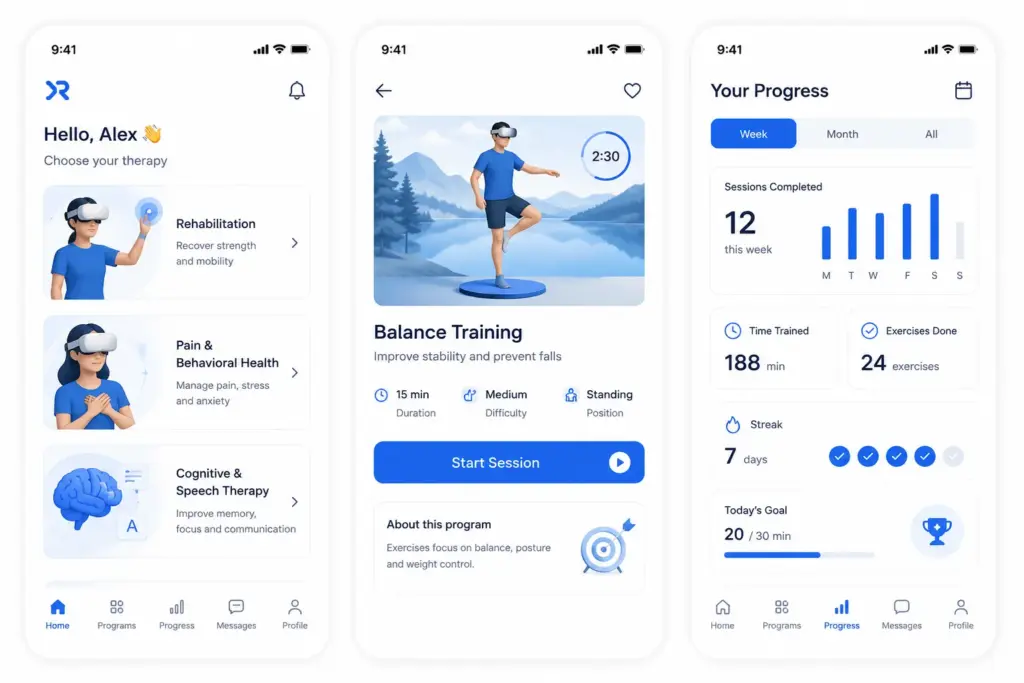
XRHealth builds targeted therapeutic applications for physical rehabilitation, behavioral wellness, and cognitive care. Its multi-discipline approach allows healthcare providers to use one platform across different therapy needs. This creates a broader revenue opportunity while making the platform easier to scale across healthcare organizations.
Physical and Neurological Rehabilitation
Stroke recovery, brain injury rehab, and post-surgery mobility require high-repetition training. XRHealth turns these repetitive movements into immersive games that measure joint angles and movement velocity. Patients complete balance routines, gross motor exercises, and fine motor tasks while headsets log every millimeter of progress.
- Stroke Recovery: Targeted upper-limb exercises restore neural pathways through repetition.
- Balance Training: Spatial tracking evaluates posture and weight distribution to prevent falls.
- Orthopedic Rehab: Range-of-motion routines help post-operative joints heal without strain.
This objective tracking gives therapists clear data to adjust care plans remotely.
Pain and Behavioral Health
Pain and anxiety are driven heavily by brain perception. XRHealth leverages immersive distraction and biofeedback to train the mind away from chronic pain signals and stress triggers. The platform targets several mental health and pain conditions:
| Specialty Area | Application Focus | Primary Clinical Benefit |
| Pain Management | Chronic and acute pain reduction | Lowers reliance on prescription painkillers |
| Anxiety & Stress | Guided breathing and calming environments | Teaches real-time heart rate self-regulation |
| PTSD & Trauma | Controlled exposure therapies | Allows safe desensitization under therapist guidance |
Replacing or supplementing medications with software-based therapy opens massive reimbursement potential across major insurance providers.
Cognitive, Occupational, and Speech Therapy
Cognitive decline, traumatic brain injuries, and speech impediments require tailored mental exercises. XRHealth delivers structured tasks that test memory, executive function, and spatial awareness. Therapists use these modules to support comprehensive rehabilitation at home:
- Cognitive Training: Patients complete memory games and decision-making puzzles to rebuild focus.
- Occupational Rehab: Simulated daily living tasks help patients practice cooking, organizing, or navigating home environments safely.
- Speech Therapy Support: Interactive visual cues help patients practice articulation and verbal processing speed.
Key Features of a VR Healthcare Platform Like XRHealth
Building a competitive medical VR platform requires balancing immersive user experiences with clinical utility. XRHealth achieves this by pairing headset software with web portals, motion tracking, and remote control tools. Understanding these core capabilities reveals what it takes to build a defensible product in healthtech.
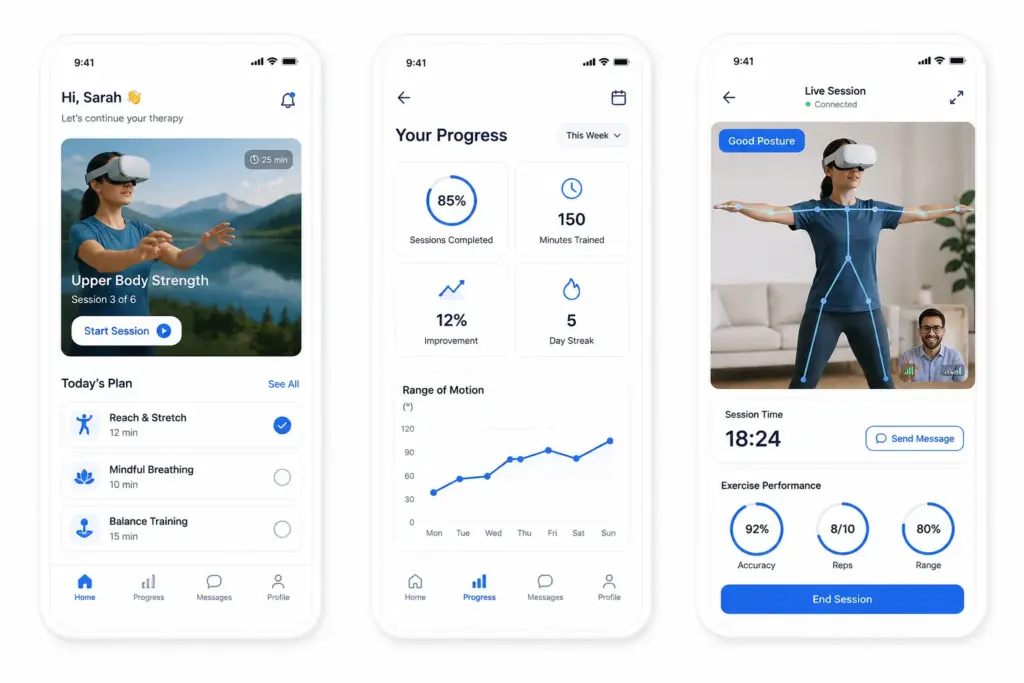
1. Immersive VR Therapy and Environments
Users step into targeted virtual spaces designed for specific physical, cognitive, or emotional treatments. Inside XRHealth, patients access over 140 therapeutic environments through the central XR Portal, choosing from guided motor exercises to soothing mindfulness settings. These environments drive core clinical benefits:
- Distraction Mechanics: Virtual surroundings redirect attention away from physical pain during movement exercises.
- Controlled Stimuli: Behavioral health environments allow safe exposure therapy for anxiety and trauma.
- Multi-Discipline Support: Physical rehab, pain management, and cognitive modules live inside a single user dashboard.
A rich library of varied environments keeps patients returning daily, directly protecting the platform against usage drop-off.
2. Personalized Treatment Plans and Programs
Clinicians use the platform to build customized care paths tailored to each patient’s mobility or mental health goals. Inside XRHealth, doctors assign specific activities, set session lengths, and add clear instructions for home practice. As patients complete tasks, clinicians modify difficulty parameters or swap out exercise modules on the fly. This customization ensures patients never get stuck on routines that are too hard or too easy, maintaining steady clinical progress.
3. Clinician Control and Remote Monitoring
Therapists monitor live therapy sessions from their web dashboard while patients wear headsets miles away. Within XRHealth, care teams use screen casting to see exactly what the patient sees in real time. Remote session control lets clinicians oversee home treatments with the same precision as in-person visits.
| Feature | Clinician Action | Operational Outcome |
| Screen Casting | Views patient perspective live | Ensures proper exercise form and safety |
| In-Session Messaging | Sends real-time guidance or voice notes | Keeps patient reassured throughout treatment |
| Live Adjustments | Alters task difficulty during the session | Prevents patient frustration or fatigue |
4. AI Movement Tracking and Feedback
Sensors inside headsets only tell part of the story. XRHealth uses its proprietary XRVision computer vision technology to analyze full-body posture and movement through standard mobile or tablet cameras. Patients position their device camera toward themselves during home sessions. The AI tracks body alignment, joint angles, and movement speed without requiring extra wearable sensors or expensive motion hardware.
Adding vision-based tracking expands platform capabilities beyond head and hand movements, unlocking full-body rehab opportunities.
5. Patient Progress Tracking and Reports
Raw movement data transforms into clear visual reports for both doctors and patients. XRHealth processes every session into metrics covering range of motion, completion speed, and balance consistency.
- Clinician Analytics: Therapists review long-term progress graphs to justify billing and update medical records.
- MyXRHealth Dashboard: Patients view personal milestone charts and streak counts after finishing daily routines.
Clear visual feedback rewards patient effort while providing clinicians with objective data for medical documentation.
6. Connected VR Devices and Patient Management
Managing hardware across hundreds of home patients requires robust device administration tools. XRHealth lets clinicians pair VR headsets to specific patient accounts, manage installed apps, and launch sessions remotely.
- Remote Provisioning: Staff pushes new therapy modules or software updates to patient headsets over the air.
- Access Control: System admins hide unassigned apps to keep patient interfaces clean and easy to navigate.
- Device Pairing: Clinics track hardware locations and link individual headsets straight to electronic health records.
Centralized device management eliminates technical barriers for elderly or non-tech-savvy users at home.
7. Patient Portal and Digital Care Experience
The care journey continues even after users take off the headset. Through the MyXRHealth portal, patients check upcoming appointments, read educational wellness content, and review recovery milestones on their phones or computers. An integrated AI assistant answers common questions about exercise schedules and guides users through basic technical troubleshooting.
Extending care into a mobile web portal keeps patients connected to the platform between active VR sessions, driving long-term retention.
Cost to Build a VR Healthcare Platform Like XRHealth
Building a medical-grade VR platform requires significant investment in 3D development, real-time tracking, and regulatory compliance. Founders also need to plan for hardware costs, ongoing maintenance, and clinical validation. A clear budget helps them prioritize the right features and avoid unnecessary spending as the platform grows..
Platform Complexity and Cost Breakdown
Development budgets scale directly with system architecture, device compatibility, and clinical feature depth.
- Basic MVP ($80,000–$150,000): Covers core VR therapy modules, basic user profiles, local session logging, and simple WebGL or Unity headset interfaces.
- Mid-level platform ($150,000–$300,000): Adds custom clinician dashboards, bi-directional screen casting, remote session controls, basic mobile portals, and initial cloud analytics.
- Enterprise-grade platform ($500,000–$1M+): Delivers full EHR interoperability, computer vision motion tracking, custom AI feedback, multi-clinic tenant systems, and complete regulatory clearance.
Starting with a targeted MVP allows platforms to prove clinical utility and secure initial provider contracts before expanding into complex enterprise builds.
Feature Costs
Specific technical components drive the engineering investment required to reach market readiness. Investing early in high-fidelity motion tracking and smooth remote video casting ensures care teams adopt the system without operational friction.
| Platform Component | Estimated Cost Range | Key Technical Requirements |
| VR Environment Engine | $40,000 – $90,000 | 3D visual assets, Unity/Unreal optimization, physics engine integration |
| Clinician Remote Dashboard | $30,000 – $60,000 | Real-time WebRTC casting, remote session triggers, therapist notes |
| AI Computer Vision System | $50,000 – $120,000 | Pose estimation models, camera tracking APIs, kinematic analysis |
| Patient Mobile Portal | $25,000 – $50,000 | Native iOS/Android apps, progress charts, messaging engines |
Integration and Infrastructure Budget
Connecting VR software to existing healthcare workflows introduces significant engineering scope.
- EHR Interoperability ($30,000–$80,000): Building HL7 and FHIR pipelines to sync patient records directly with hospital databases.
- Wearable Sensor Integration ($15,000–$35,000): Connecting heart rate monitors, pulse oximeters, and external motion trackers over Bluetooth Low Energy.
- Telehealth Video and Chat ($20,000–$45,000): Embedding end-to-end encrypted video channels and secure messaging inside clinician portals.
Seamless EHR data flows make the platform sticky for hospital systems, increasing customer retention and lifetime value.
Regulatory and Scaling Overhead
Security and data privacy need investment throughout the platform lifecycle. A HIPAA- and GDPR compliant cloud environment should protect patient data while controlling who can access it. Strong security from the start also helps avoid regulatory issues and expensive changes later.
Ongoing costs matter just as much as the initial build. Cloud hosting, security audits, penetration testing, and software updates can add 15% to 25% of the initial development cost each year. Planning for these expenses early gives founders more room to scale the platform without unexpected costs.
How Do You Calculate the Unit Economics of a VR Healthcare Platform?
Unit economics show whether a medical VR platform can grow profitably. Healthcare VR has more costs than traditional B2B SaaS because it may involve hardware and clinical operations. Founders need to understand the cost of serving each patient or clinic to make sure the business can maintain healthy margins as it scales. This also helps them identify which customer segments can deliver the strongest returns.
1. Calculate CAC and Revenue Per Patient
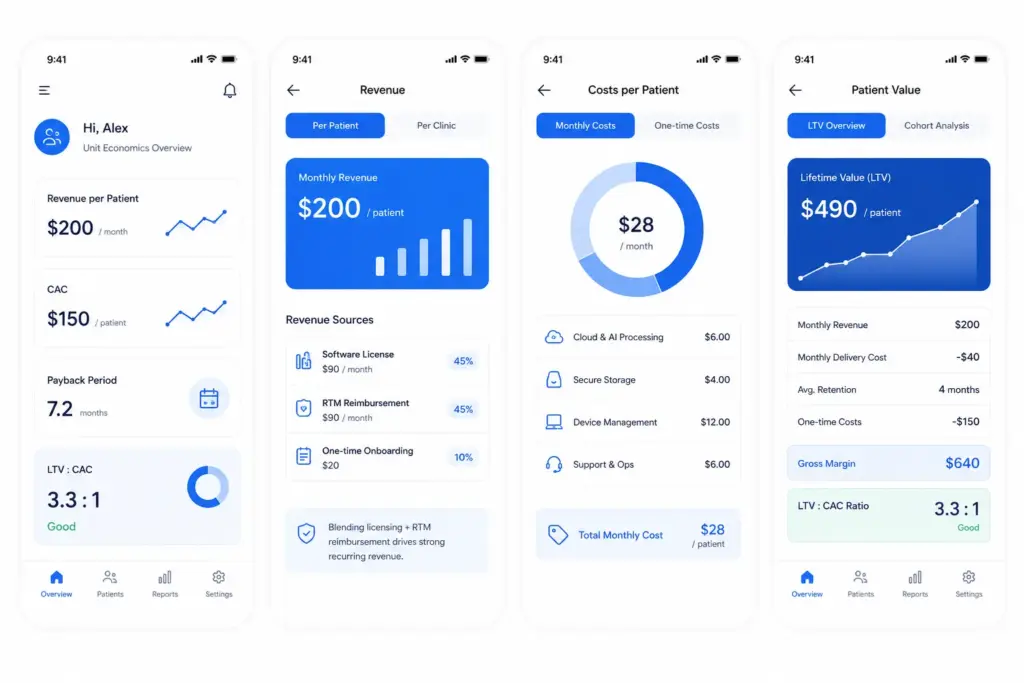
Customer Acquisition Cost and Average Revenue Per User look vastly different depending on your go-to-market model: B2B enterprise hospital sales or direct-to-consumer digital therapeutics. Enterprise hospital sales carry high upfront acquisition costs ($25,000 to $75,000 per health system) due to long procurement cycles, HIPAA security reviews, and clinical trials. However, these contracts generate recurring software license fees ranging from $1,200 to $3,500 per active VR unit annually.
When billing insurance directly, revenue ties to Remote Therapeutic Monitoring codes:
- CPT 98975 (Setup & Education): Initial patient onboarding ($50 – $80 one-time).
- CPT 98977 (Device Monitoring): Automated data collection over 30 days ($45 – $70 recurring monthly).
- CPT 98980 (Clinical Management): First 20 minutes of therapist review time ($50 – $75 recurring monthly).
Blending software licensing and RTM reimbursement yields an average monthly revenue of $150 to $350 per active patient, driving payback periods down to 6–9 months.
2. Factor In VR Devices and Clinician Time
Hardware logistics and clinical oversight represent the largest variable expenses in VR healthcare. Consider MindMaze, a neuro-rehabilitation platform that has raised over $340 million. Their enterprise strategy deploys specialized VR systems directly into clinics and hospitals. By utilizing on-site physical therapists, they keep clinical labor costs off their balance sheet while charging health systems premium software and hardware maintenance fees.
To calculate net margins per session, factor in:
| Operational Component | Unit Cost Impact | Economic Influence |
| VR Headset Unit | $400 – $1,200 (one-time) | Capital expenditure amortized over a 24-month lifecycle ($17–$50/month) |
| Sanitization & Shipping | $25 – $45 per patient deployment | Incurred every time a refurbished headset is shipped to a home patient |
| Clinician Supervision | $45 – $90 per hour | Asynchronous monitoring reduces therapist time to 15 minutes per session ($11–$22) |
Minimizing active clinician time per patient is essential. Platforms relying on synchronous live therapy face capped gross margins, whereas asynchronous data tracking achieves software-like margins above 70 percent.
3. Measure Cloud and Care Delivery Costs
Serving a healthcare patient involves real-time spatial streaming, secure data storage, and technical support. Calculate hosting and operational overhead per active user:
- 3D Telemetry and AI Processing ($3–$8/month): Streaming movement data, computer vision pose estimation, and real-time screen casting consume cloud bandwidth.
- HIPAA-Compliant Storage ($2–$5/month): Storing encrypted kinematic logs, clinical notes, and session video backups in secure cloud instances.
- Technical Support and Device Management ($10–$20/month): Managing mobile device management (MDM) software licenses and end-user helpdesk support.
Combining these factors establishes a baseline hosting and support cost of roughly $15 to $33 per patient every month.
4. Track Retention and Lifetime Patient Value
Patient retention dictates true Lifetime Value. While consumer VR apps struggle with high drop-off rates, clinical VR platforms retain users through structured 8- to 12-week rehabilitation programs. Another example is Penumbra’s REAL System, a VR platform focused on vascular and neuro-rehabilitation.
Built by a publicly traded medical device company, their business model leverages institutional sales reps to lock in multi-year clinic subscriptions, ensuring high retention and predictable software renewals.
Evaluating economic viability requires tracking the LTV-to-CAC ratio:
LTV = (Monthly Revenue − Monthly Delivery Costs) × Average Customer Retention Period in Months
If a patient generates $200 per month over a 4-month therapy program with $40 in monthly delivery costs, the gross margin per patient is $640. Subtracting an initial $150 hardware amortization and shipping cost leaves a net LTV of $490 per user. Maintaining an LTV-to-CAC ratio above 3:1 ensures the platform can aggressively scale patient acquisition while remaining attractive to venture capital investors.
Build a VR Healthcare Platform with IdeaUsher
Taking a medical VR idea from concept to launch requires strong technology and a clear understanding of healthcare needs. With over 500,000 hours of coding experience, our team of ex-MAANG/FAANG developers builds custom healthcare software designed for real-world clinical use. IdeaUsher helps founders turn complex VR concepts into scalable healthtech products that are built for long-term growth.
Working MVP Development
Building an initial Minimum Viable Product requires stripping away unnecessary noise and focusing on core therapeutic value. We help founders validate clinical workflows, user interaction models, and spatial tracking without wasting capital on over-engineered builds. Our MVP development process focuses on immediate market readiness:
- Focused Spatial Design: Custom 3D therapeutic environments built in Unity or Unreal Engine, optimized for smooth frame rates to eliminate motion sickness.
- Core Kinematic Telemetry: Frame-by-frame tracking of patient head, hand, and body movements saved securely to cloud databases.
- Essential Clinician Dashboard: Web-based portals allowing care teams to assign exercise routines, track patient progress, and review session metrics.
Launching a streamlined MVP allows you to secure early provider contracts, capture real patient feedback, and present hard clinical data to investors.
AI, VR, and Systems Integration
A successful virtual reality platform requires more than just standalone headset software. Our engineering teams integrate spatial environments, computer vision models, and hospital databases into one unified digital health ecosystem.
| Core Technology Layer | System Integration | Primary Enterprise Benefit |
| Spatial Computing Engine | Unity / Unreal Engine native headset builds | High-fidelity interactive VR therapy environments |
| Computer Vision AI | Mobile device pose estimation and video analysis | Real-time body posture and motion tracking without wearable sensors |
| EHR Interoperability | HL7 and FHIR data pipelines | Direct synchronization with hospital record systems like Epic and Cerner |
| Remote Telemetry | WebRTC video casting and encrypted socket streams | Live clinician session casting and remote device control |
Combining spatial VR, artificial intelligence, and electronic health record integrations creates high switching costs, turning your software into an indispensable part of daily hospital care delivery.
Enterprise Platform Scaling
Scaling beyond the first launch requires a strong architecture that can handle growing healthcare demand. Our team builds HIPAA-compliant cloud environments with secure patient portals and multi-tenant systems. This allows hospitals and clinics to manage their users and data safely as the platform expands.
We also support remote device management and AI-powered analytics. Healthcare teams can update VR headsets without handling them individually. AI can then use patient movement data to identify recovery issues and help clinicians make better treatment decisions.
Conclusion
Building a VR healthcare platform like XRHealth requires more than immersive experiences. The product needs reliable clinical workflows and strong data security. A well-planned architecture also makes it easier to scale across hospitals and home-based care. For founders, the real opportunity lies in turning VR into a practical healthcare solution that delivers measurable outcomes.
Things to Know About VR Healthcare Platforms
A1: No. A VR healthcare platform does much more than deliver a VR experience. It connects the patient with the wider care process. This can include treatment plans and progress reports along with clinician tools. XRHealth follows this model by giving clinicians tools to manage patients and review therapy sessions.
A2: VR can be used for several types of care. Rehabilitation and pain management are two important areas. It is also being explored for mental health and neurological therapy. The FDA lists rehabilitation and pain management among the areas where medical AR and VR can be used. For founders, the key is to choose one clear clinical problem before expanding into other therapies.
A3: It depends on what the platform is designed to do. A VR wellness product may not follow the same regulatory path as software intended to diagnose or treat a medical condition. If your platform makes medical claims, it may fall under FDA medical device oversight. This is why regulatory planning should happen early in development.
A4: Yes. VR can help move parts of therapy outside the clinic. Patients can complete guided sessions from home while clinicians review their progress through the platform. This approach can make follow-up care more connected and give providers a better view of what happens between appointments. XRHealth uses a remote care model that connects patients with clinicians through its platform.