

Key Takeaways
- Digital mental healthcare is evolving rapidly, with AI therapy apps delivering personalized, always-available support while expanding access to mental health services.
- Platforms like Limbic and Sonia use conversational AI, CBT frameworks, mood tracking, and personalized care to serve both consumers and healthcare providers.
- Building a successful platform requires LLMs, AI therapy engines, therapist workflows, personalized care plans, secure infrastructure, and healthcare compliance.
- These solutions improve care accessibility, patient engagement, clinical efficiency, and long-term mental health outcomes while creating scalable recurring revenue opportunities.
- How Idea Usher can help businesses build AI-powered therapy apps with advanced conversational AI, healthcare integrations, and scalable cloud architecture.
The biggest breakthrough in digital mental health isn’t that apps can chat with users using AI. It’s that they can understand how someone’s emotional needs change over time and offer support that feels personal instead of generic. That’s why platforms like Limbic and Sonia stand out because they do much more than answer questions. They help people stay engaged between therapy sessions and encourage healthier habits through consistent guidance. This shift is changing what users expect from mental health apps. If you’re planning to build a therapy platform today, success depends less on adding an AI chatbot and more on creating an experience that people trust and want to return to.
We’ve built numerous therapy solutions that combine large language models with evidence-based clinical frameworks to deliver intelligent conversations and personalized therapeutic experiences. Drawing on this expertise, we’ve created this guide to walk you through the key steps involved in building therapy apps like Limbic and Sonia.
Market Growth Potential of AI Therapy Apps
According to Mordor Intelligence, the AI-powered Mental Health Solutions market is expected to grow from USD 2.42 billion in 2026 to USD 9.96 billion by 2031, at a 32.74% CAGR. This strong growth highlights the increasing need for accessible mental healthcare, creating a valuable opportunity for businesses to build AI-powered therapy platforms that can reach more users while reducing the pressure on traditional care systems.
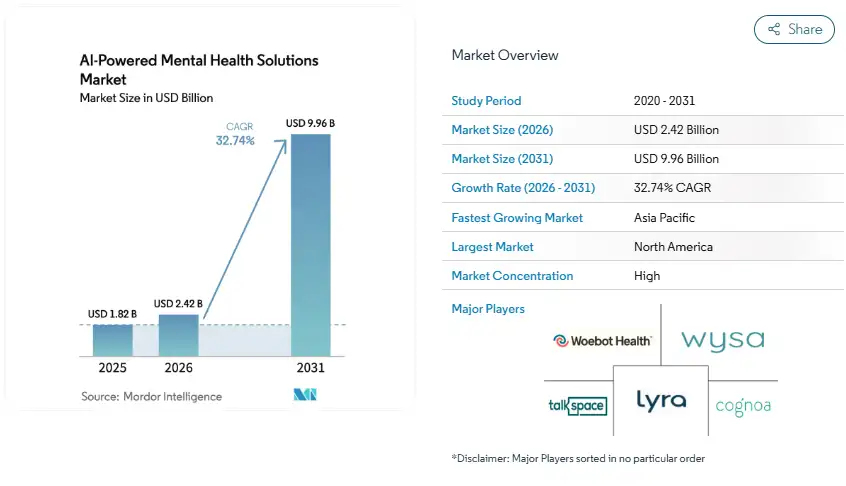
Source: Mordor Intelligence
- Triage Efficiency: Conversational AI identifies distress early and directs users to self-care or human specialists.
- Cost Efficiency: Automated delivery slashes overhead costs compared to traditional clinic models.
- Continuous Access: Users get 24/7 support without scheduling delays or waitlists.
Consider Wysa, an AI platform using cognitive behavioral techniques. Wysa scaled to serve millions across dozens of countries while generating over $1.2 million in annual revenue through enterprise partnerships, healthcare systems, and consumer subscriptions.
Market Size & Projections
The digital health sector continues to expand as payers, enterprise employers, and health systems adopt software solutions to lower care costs. Growth projections highlight compelling metrics for incoming capital:
| Market Metric | Strategic Value |
| Payer Integration | Insurers cover digital interventions to lower long-term claims. |
| Corporate Wellness | Enterprise platforms drive high-margin B2B recurring revenue. |
| Global Scale | Software deployment enables rapid international reach without physical clinics. |
Talkspace demonstrates this commercial expansion clearly. By shifting focus to insurance coverage and payer partnerships, Talkspace scaled its operations to generate roughly $229 million in full-year revenue, driven by direct integration into health plans covering over 200 million lives.
Why Investors Back AI Therapy
Venture capital flows toward platforms that solve the fundamental bottleneck of healthcare: practitioner capacity. Human therapy cannot scale linearly without escalating costs, whereas software delivers near-zero marginal cost per additional user. Key drivers attracting venture capital include:
- High Margin B2B SaaS Models: Annual enterprise contracts create stable, predictable cash flow.
- Deep Data Moats: Proprietary, anonymized interaction data improves engagement and retention models over time.
- Hybrid Clinical Workflows: Platforms combining AI automation with human oversight achieve strong clinical outcomes and regulatory compliance.
Building in this space offers a clear path toward high-margin software revenues alongside massive societal impact. Platform founders who prioritize clinical validation, robust data privacy, and B2B distribution networks stand to capture outsized market share.
How Limbic and Sonia Approach Mental Healthcare Differently?
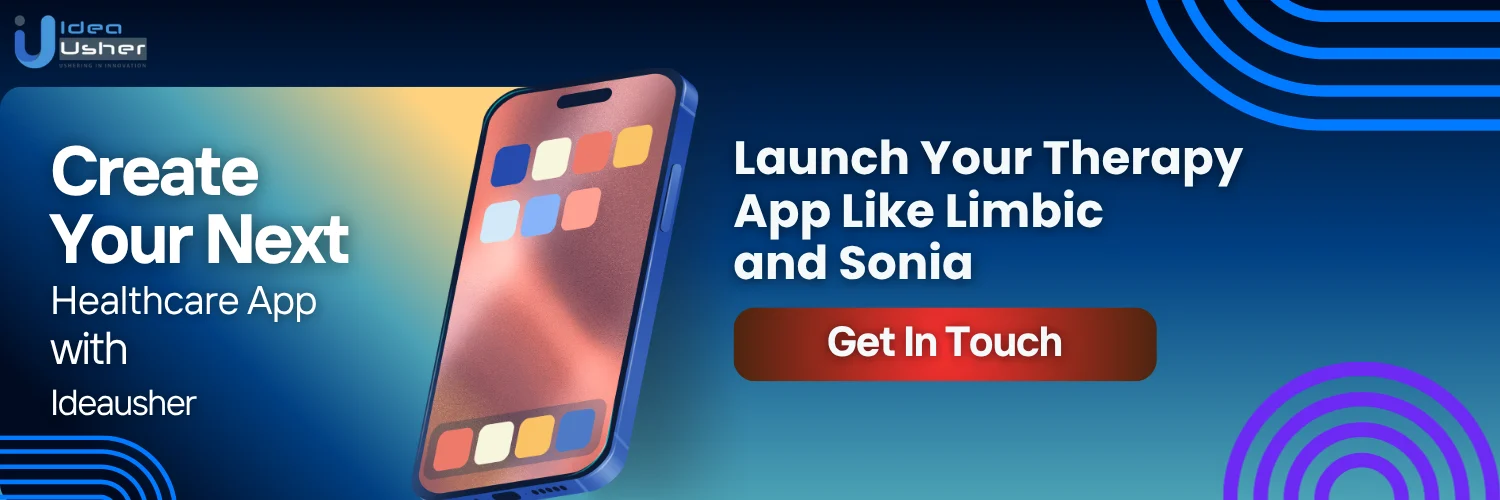
Understanding how to position a digital health product is essential because it shapes everything from your business model to your target customers. Sonia and Limbic take two very different approaches. Sonia focuses on direct-to-consumer mental wellness, while Limbic is designed for healthcare providers and clinical workflows. Comparing these platforms can help you decide which model best fits your product vision and market strategy.
Sonia’s Consumer-First Wellness Model
Sonia is an AI-powered conversational companion built for individuals who want immediate, low-friction emotional support. It acts as an accessible digital sounding board for daily stress, anxiety, and personal growth without requiring a doctor’s referral or clinical diagnosis. Its always-available support makes it easier for users to build healthy mental wellness habits every day.
Working Model
The platform operates on a B2C subscription strategy. Users download the app directly to access text and voice-based cognitive behavioral techniques on demand.
- 24/7 Availability: Provides real-time guidance when human care is unavailable.
- Guided Reflection: Features interactive prompts for mood tracking, journaling, and reframing negative thoughts.
- Low-Barrier Access: Eliminates insurance claims, waitlists, and clinical intake forms.
Financial traction reflects consumer demand for digital wellness tools. Sonia raised $3.4 million in seed funding and built an annual recurring revenue stream of roughly $2 million.
Limbic’s Clinical AI for Therapy Providers
Limbic is a UK-founded healthcare software platform designed to assist medical providers, clinics, and health systems. Rather than replacing therapists, it automates clinical administration and extends care pathways. Its AI helps healthcare teams improve efficiency while enabling patients to access care more quickly and consistently.
Working Model
Limbic operates as a B2B SaaS platform that integrates directly into electronic health record systems.
- Clinical Triage: Automates patient intake, gathering detailed medical history before human assessment.
- In-Between Session Care: Delivers structured, doctor-approved homework exercises to keep patients engaged between appointments.
- Provider Efficiency: Frees up thousands of clinical hours by managing initial screenings and administrative tasks.
Limbic operates as a certified medical device inside the UK’s National Health Service and is expanding into the US. Supported by over $14 million in Series A funding, its institutional model scales through multi-year contracts with large healthcare providers.
| Feature | Sonia (Consumer) | Limbic (Clinical) |
| Primary Target | Individual Consumers | Health Systems & Therapists |
| Monetization | Consumer Subscriptions | Enterprise B2B SaaS |
| Primary Value | Convenience & Privacy | Operational Scale & Efficiency |
Clinical Validation and User Trust
Building trust requires distinct strategies depending on whether you target individual consumers or institutional payers.
- Clinical platforms like Limbic secure credibility through rigorous medical validation, peer-reviewed trials, and strict regulatory approvals. They demonstrate value to enterprise buyers by lowering clinical drop-off rates and freeing up therapist time.
- Consumer platforms like Sonia build trust through intuitive design, strong privacy controls, and affordable pricing. They focus on immediate user satisfaction, non-judgmental interactions, and steady engagement rather than formal clinical metrics.
For investors and developers, choosing between these two paths defines your entire go-to-market plan. Consumer platforms offer faster deployment with lower regulatory friction, while clinical B2B platforms demand longer development cycles but yield higher retention and recurring enterprise revenues.
The Core Problems Limbic and Sonia Solve
Healthcare systems globally face an unsustainable imbalance between patient demand and clinician supply. Traditional care models rely on 50-minute face-to-face sessions, creating massive operational bottlenecks. Sonia and Limbic tackle this mismatch using fundamentally different commercial architectures and care delivery strategies.
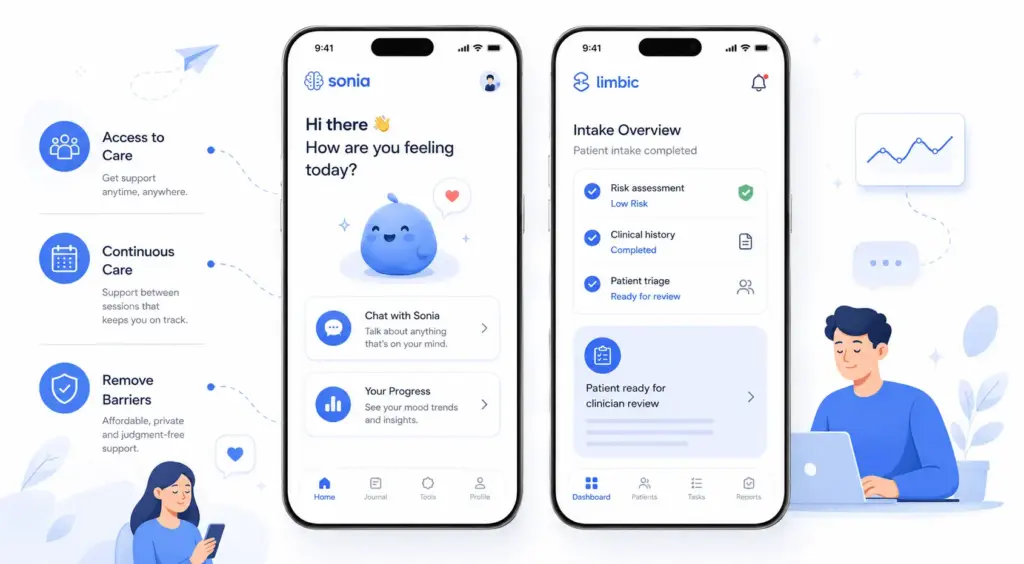
1. Expanding Care Access
The core bottleneck in mental health is human capacity. Millions of people wait months for an initial consultation, during which mild symptoms often escalate into severe crises. AI platforms bypass these capacity limits by handling intake, early intervention, and triaging at scale.
- Limbic’s Approach: Acts as an enterprise gateway for clinics. It conducts automated patient intake and risk assessments before a human therapist ever sees the case. This slashes wait times by pre-sorting patients, collecting clinical histories, and identifying self-harm risks instantly.
- Sonia’s Approach: Provides immediate digital support directly to the end user. Anyone experiencing acute stress or anxiety can open the app and talk through their feelings without waiting for a referral or appointment.
Monetization reflects these distribution paths:
- Limbic Pricing: Operates on a enterprise subscription model, charging healthcare providers customized annual contracts based on patient volume and operational scale.
- Sonia Pricing: Operates a direct consumer subscription model, charging users around $20 per month or $199 annually for unlimited access.
2. Continuous Care Between Sessions
Standard therapy leaves a seven-day gap between appointments. Patients frequently struggle to implement coping mechanisms or complete assigned homework on their own during these intervals.
- Limbic integrates into provider workflows to keep patients engaged between sessions. It sends automated, doctor-approved CBT homework, monitors mood shifts, and reports progress straight back into the clinic’s health record system.
- Sonia serves as an ongoing conversational journal for everyday users. It tracks personal trends over time, offers real-time reframing tools during stressful moments, and prompts reflection whenever the user needs immediate clarity.
3. Removing Care Barriers
Stigma, financial costs, and logistical hurdles prevent millions from seeking traditional mental healthcare.Sonia eliminates financial and social barriers by offering a low-cost, judgment-free space accessible anywhere on a phone. Users can talk or text without worrying about insurance pre-approvals or social stigma.
Limbic removes administrative friction for health systems. By letting patients complete intake and screenings digitally at home, it reduces clinic drop-off rates and makes formal healthcare feel far less intimidating.
| Friction Point | Traditional Therapy | Sonia Solutions | Limbic Solutions |
| Financial Cost | $150–$250 per session | ~$20/month subscription | Free to patient (covered by provider) |
| Social Stigma | Fear of clinical diagnosis | 100% private, non-judgmental app | Discrete digital intake before clinical visit |
| Logistics | Travel & rigid schedules | Available 24/7 on personal mobile phone | Asynchronous exercises completed anywhere |
Key Features of Therapy Apps Like Limbic and Sonia
Developing a successful mental health platform requires balancing user engagement with clinical safety. Examining platforms like Limbic and Sonia reveals how technical capabilities convert into tangible user actions and business value. The right feature set not only improves user outcomes but also creates a platform that can scale sustainably over time.
1. AI Therapy Chat
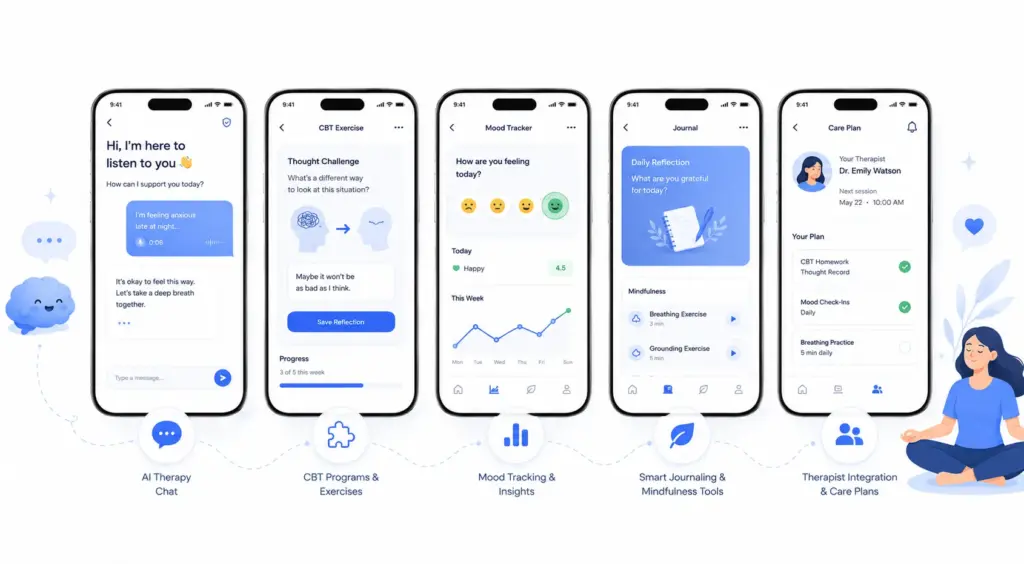
Modern platforms use conversational engines to deliver continuous care. Users interact with these tools through voice or text based on their personal preferences and real-time needs. In Sonia, a user experiencing late-night anxiety launches a voice session to talk through stressful events. The app draws on natural language processing to listen, adapt its tone, and offer empathetic prompts without human intervention.
In Limbic, natural language processing drives adaptive patient intake. A user completing a referral answers conversational prompts about their symptoms. The system adjusts questions dynamically based on prior responses to build an accurate clinical background.
2. CBT Programs and Therapy Exercises
Cognitive Behavioral Therapy provides the framework for most digital mental health platforms. Converting CBT concepts into digital exercises helps users process intrusive thoughts step by step. Users on Sonia access on-demand CBT frameworks during stressful moments. They complete interactive thought-challenging prompts to identify cognitive distortions like catastrophizing or black-and-white thinking.
Within Limbic Care, clinicians assign digital CBT modules directly to patients between appointments. Patients complete guided thought records and behavioral experiments on their phones, with completed exercises syncing straight to the provider’s portal.
3. Mood Tracking and Emotional Insights
Tracking daily mood patterns gives users clear visibility into their long-term mental health trajectory while giving clinical systems actionable data.
- Sonia’s Approach: Users log daily mood scores along with brief contextual notes. Over time, the app highlights trend lines and identifies underlying stress triggers.
- Limbic’s Approach: Mood tracking feeds directly into clinical workflows. When users log persistent drops in mood, the system flags the change for their assigned care team to review before the next session.
4. Smart Journaling and Mindfulness Tools
Self-reflection tools help users lower stress before minor anxiety turns into a severe crisis. Users turn to Sonia for assisted journaling sessions. The app offers prompts tailored to the user’s recent conversations, guiding them through focused breathing techniques or grounding exercises during high-stress moments.
In clinical settings using Limbic, self-reflection tools double as home practice. Patients practice grounding techniques or record journal entries, giving clinicians deeper insight into how patients manage distress outside the clinic.
5. Therapist Integration and Care Plans
Connecting patient activities to professional care plans separates consumer wellness tools from clinical platforms. Through Limbic, therapists log into a central dashboard to monitor patient homework, review symptom scores, and adjust care plans. This direct integration eliminates manual record-keeping and ensures therapy sessions focus on high-priority needs.
| Operational Area | Sonia (Direct-to-Consumer) | Limbic (Clinical Provider Integration) |
| Data Recipient | End User | Assigned Therapist & EHR System |
| Care Plan Source | Automated AI Prompts | Clinician-Customized Protocols |
| Workflow Impact | Personal Self-Management | Cuts Administrative Time by Up to 50% |
6. Check-Ins and Progress Monitoring
Automated check-ins build long-term user habits and help flag early signs of relapse. Sonia uses push notifications to prompt daily check-ins, asking users short questions about their emotional state to keep them engaged. Limbic uses structured monitoring to track symptom severity scores over time. If a patient’s scores indicate worsening depression or anxiety, the system alerts the healthcare provider to adjust the care plan proactively.
7. HIPAA-Compliant Privacy
Safety guardrails are essential when building any digital mental health product. Platforms must protect patient privacy while managing high-risk clinical scenarios. Sonia secures user trust by using end-to-end encryption for voice and text logs, ensuring personal reflections remain strictly private. When a user expresses severe distress or self-harm intent, the app triggers safety protocols, presenting immediate hotline resources and emergency contacts.
Limbic operates under strict regulatory frameworks, including HIPAA compliance and Class IIa medical device certification. When its AI flags crisis indicators during intake or check-ins, it routes the patient to immediate human intervention. This ensures complete patient safety while shielding platform operators from regulatory risk.
How to Build a Therapy App Like Limbic and Sonia?
Building an AI-powered mental health app takes more than strong technology. It requires the right strategy, secure development, and a product that people trust and enjoy using. At Idea Usher, we help founders and businesses turn their ideas into scalable platforms by guiding them from planning and development to launch. Here’s how we bring digital mental health products to life.
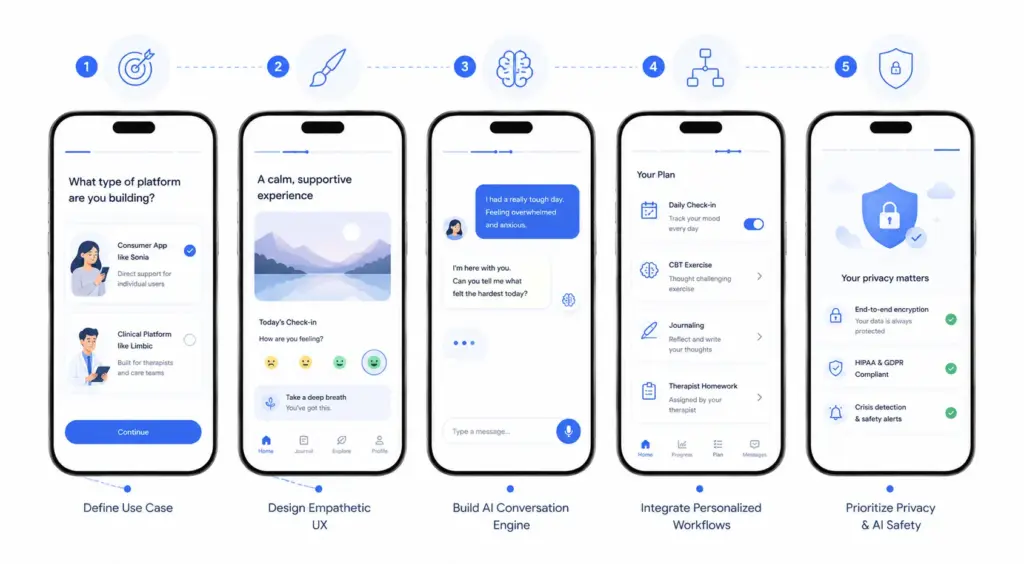
1. Define Mental Health Use Case
Choosing between a consumer mental health app like Sonia and a clinical platform like Limbic is an important early decision because it shapes how your product grows and reaches users. We help you define the right direction from the start and build a platform that matches your business goals. This makes it easier to scale, attract customers, and create long-term value.
2. Design an Empathetic User Experience
Mental health software must feel calm and supportive rather than cold or clinical. Interfaces need intuitive visual hierarchies, soft palette choices, and frictionless navigation to keep users from feeling overwhelmed during high-stress moments. Our product designers focus heavily on behavioral design. We build fluid conversational interfaces, intuitive mood-tracking logs, and guided reflection spaces that build trust while driving steady daily retention.
3. Build AI Conversation Engine
The backbone of platforms like Sonia and Limbic is an AI conversation engine capable of processing subtle emotional cues. This requires combining robust Large Language Models with fine-tuned domain data so responses remain contextually aware, empathetic, and therapeutically grounded.
| Engine Component | Function | Technical Implementation |
| Sentiment Analysis | Detects real-time emotional shifts | Natural Language Processing (NLP) models |
| Therapeutic Logic | Guides responses via cognitive frameworks | Retrieval-Augmented Generation (RAG) on validated CBT data |
| Safety Filter | Scans for crisis or self-harm keywords | Real-time classification algorithms with instant fallback triggers |
We build custom AI pipelines that balance natural conversational flow with strict therapeutic logic. By leveraging specialized prompt engineering and secure retrieval models, we help you deploy conversational AI that stays helpful and safe.
4. Integrate Personalized Therapy Workflows
A static chatbot loses engagement quickly. Platforms need dynamic workflows—such as personalized coping strategies, adaptive journaling prompts, automated check-ins, and doctor-assigned homework. We engineer modular backend systems that allow apps to serve personalized content automatically. Whether giving individual users adaptive exercises or letting clinicians build custom care plans from an administrative dashboard, we ensure seamless data synchronization.
5. Prioritize Privacy and AI Safety
Digital health software cannot compromise on data security. Handling sensitive health data requires end-to-end encryption, multi-factor authentication, HIPAA and GDPR compliance, and automated crisis detection.
- Encryption: Protecting data both in transit and at rest using modern encryption protocols.
- Access Governance: Enforcing strict, role-based controls so only authorized users access personal health records.
- Safety Protocols: Automatically flagging self-harm triggers and routing users to human crisis resources.
We construct healthcare software using privacy-by-design principles. By integrating HIPAA/GDPR safeguards, audit logging, and automated escalation workflows directly into the core framework, we protect your platform from legal risk.
6. Test With Mental Health Professionals
Validating software efficacy requires human expertise. Before deploying an AI platform to the public or selling into health systems, clinical psychologists and licensed therapists must stress-test conversational outputs and review therapeutic accuracy.We support clinical pilot phases through structured beta testing, detailed feedback loops, and user tracking. This iterative testing validates that the platform delivers genuine therapeutic utility before a full-scale market launch.
7. Launch and Improve Continuously
Launching an AI therapy app is just the first step. We continue working with founders after launch to improve performance, enhance the user experience, and support growth as the platform evolves. With continuous updates and a scalable architecture, we help turn your product into a long-term success. If you’re ready to build a secure and reliable AI therapy platform, the experts at Idea Usher are here to bring your vision to life.
Cost to Build a Therapy App Like Limbic and Sonia
The cost of building an AI therapy app depends on the type of product you want to launch. A platform for healthcare providers usually requires a larger investment than a consumer-focused mental wellness app because of its added complexity. At Idea Usher, we help founders choose the right approach and invest in the features that deliver the most value. Below is a realistic breakdown of the estimated development costs.
Cost Breakdown for a Therapy App Like Limbic
The cost of building a therapy app like Limbic depends on the features, AI capabilities, integrations, and compliance requirements you choose. Understanding where the investment goes helps you plan your budget more effectively and avoid unexpected costs. The breakdown below highlights the major development stages and their estimated costs.
Estimated Development Cost: USD $180,000–$450,000+
| Development Component | Estimated Cost (USD) |
| Discovery & Product Strategy | $10,000–$20,000 |
| UI/UX Design | $15,000–$30,000 |
| Patient Mobile App | $35,000–$60,000 |
| Therapist Dashboard | $25,000–$45,000 |
| AI Conversation Engine | $35,000–$70,000 |
| CBT & Care Pathways | $15,000–$30,000 |
| EHR/FHIR Integration | $15,000–$35,000 |
| HIPAA & Security | $20,000–$40,000 |
| Analytics & Reporting | $10,000–$20,000 |
| QA, Deployment & DevOps | $15,000–$30,000 |
| Estimated Total | $180,000–$450,000+ |
This estimate reflects a clinician-focused platform similar to Limbic, which requires enterprise security, provider workflows, EHR integration, and advanced AI capabilities.
Cost Breakdown for a Therapy App Like Sonia
Building a therapy app like Sonia involves several cost factors, including AI development, mobile app design, cloud infrastructure, and security. The total investment depends on the features you include and how advanced you want the platform to be. Below is a realistic breakdown of the key development stages and their estimated costs.
Estimated Development Cost: USD $100,000–$250,000+
| Development Component | Estimated Cost (USD) |
| Product Discovery | $8,000–$15,000 |
| UI/UX Design | $12,000–$25,000 |
| Mobile App Development | $30,000–$50,000 |
| AI Chatbot Integration | $25,000–$50,000 |
| Journaling & Mood Tracking | $10,000–$20,000 |
| Meditation & Wellness Content | $8,000–$15,000 |
| Personalization Engine | $10,000–$20,000 |
| HIPAA & Data Security | $15,000–$30,000 |
| Admin Dashboard | $8,000–$15,000 |
| QA & Deployment | $10,000–$20,000 |
| Estimated Total | $100,000–$250,000+ |
This estimate assumes a consumer-facing AI wellness platform like Sonia with conversational AI, journaling, personalized recommendations, and strong privacy safeguards, but without the deeper clinical integrations required for provider-centric platforms.
Key Factors That Influence Development Costs
To manage your budget effectively, decision-makers must understand what drives development costs up or down:
- AI Model Complexity & Fine-Tuning: Utilizing standard API endpoints keeps upfront costs low, but building fine-tuned open-source models with specialized RAG architectures requires specialized engineering talent and custom dataset curation.
- Regulatory & Data Compliance: Achieving full HIPAA, GDPR, and SOC2 compliance requires dedicated security infrastructure, end-to-end encryption, automated audit trails, and third-party penetration testing.
- Clinical Provider Dashboards: Building web portals for clinicians to manage care plans, monitor patient severity, and write notes adds backend engineering hours compared to simple admin control panels.
- LLM API & Cloud Infrastructure: High user activity translates to ongoing costs for cloud compute and real-time LLM token generation, which must be factored into your operational budget.
- EHR & Interoperability APIs: Integrating with health system databases using FHIR/HL7 standards demands custom middleware to ensure seamless, bi-directional data flow without breaking clinical compliance.
What Makes AI Therapy Apps Attractive to Investors?
Venture capital and private equity firms view AI-driven mental health software as one of the most compelling segments in digital health. The attraction lies in software-like scalability applied to a massive, supply-constrained healthcare problem. By eliminating the linear relationship between practitioner hours and revenue generation, AI platforms capture high software margins while addressing global care gaps.
1. Recurring SaaS Revenue Models
AI therapy platforms generate predictable revenue by diversifying distribution across multiple high-value sales channels. Unlike traditional brick-and-mortar clinics, software scales instantly across geographic regions with minimal marginal overhead.
Revenue streams typically include:
- Direct-to-Consumer Subscriptions: Monthly or annual recurring payments for self-guided CBT tools, mood tracking, and AI voice sessions.
- Enterprise B2B Licensing: Multi-year corporate wellness contracts sold directly to HR departments and enterprise employers.
- Payer & Health System Contracts: Outcome-based reimbursement agreements with health insurance providers seeking to lower downstream medical claims.
Jimini Health illustrates this investor appeal. By embedding clinician-supervised AI assistants directly into behavioral care pathways, Jimini Health secured $17 million in funding. Its scalable platform model projects initial enterprise contracts scaling rapidly toward $5 million in annual recurring revenue.
| Revenue Channel | Target Buyer | Business Model | Financial Profile |
| Consumer (B2C) | Individual Users | $15 – $40 / month subscription | High volume, low customer lifetime value |
| Corporate B2B | Enterprise Employers | $3 – $8 per employee / month (PEPM) | High margin, stable retention |
| Health Systems | Payers & Hospitals | $20,000 – $150,000+ annual enterprise license | Multi-year contracts, low churn |
2. Expanding Demand & TAM
The Total Addressable Market for digital mental health continues to expand rapidly. Long waitlists, clinician burnout, and rising care costs have created a severe supply-demand imbalance in traditional healthcare systems. Investors recognize that AI platforms do not simply compete with human therapists; they capture an unserved market of individuals who would otherwise receive no care at all.
Another standout platform capitalizing on this expanding demand is Slingshot AI, which raised $53 million in funding to develop its specialized mental health conversational engine, Ash. Designed to deliver tailored clinical guidance, the platform targets an initial commercial run-rate of $10 million as enterprise health networks adopt its core AI infrastructure.
3. Automation & High Margins
Automation alters the unit economics of behavioral healthcare. By handling time-consuming tasks like intake screening, daily check-ins, and homework reviews, AI platforms free up clinician capacity and dramatically drop operational costs. Startups that build deep data moats, create defensive barriers that generic software tools cannot replicate.
| Operational Metric | Traditional Practice | AI-Augmented Platform | Financial Impact |
| Gross Margins | 20% – 35% | 70% – 85% | Software-level profitability |
| Patient Capacity | 25 – 35 patients per therapist | 500+ patients monitored per clinician | Exponential capacity scaling |
| Marginal Cost per User | $100 – $200 per session | < $0.50 in cloud compute costs | Near-zero marginal delivery cost |
By combining automated efficiency with defensible data architectures, AI therapy platforms offer investors strong recurring margins, defensible products, and a massive runway for global expansion.
Build a Therapy App with IdeaUsher
Bringing a complex digital health platform to life requires more than standard software engineering. It demands a balance of specialized AI architecture, deep clinical safety protocols, and intuitive user design. With over 500,000 hours of coding experience, our team of ex-MAANG/FAANG developers helps founders, enterprise healthcare systems, and investors build high-performance AI therapy platforms engineered for long-term growth and compliance.
AI Therapy App Development
Building an AI therapy platform involves much more than writing code. We manage the complete development process, from product planning and intuitive UI/UX design to AI customization and post-launch improvements. This allows you to focus on growing your business while we ensure your platform remains secure, scalable, and ready for long-term success.
Healthcare AI Expertise That Drives Results
Our engineering teams build clinical-grade solutions that easily handle high user loads while keeping data safe.
| Development Pillar | Our Strategic Implementation |
| Conversational AI | Contextual voice and text engines built on custom NLP pipelines. |
| Clinical Systems Integration | Bi-directional EHR and FHIR connections for health network compatibility. |
| Regulatory Architecture | Native HIPAA, GDPR, and SOC2 compliance with end-to-end encryption. |
| Cloud Infrastructure | High-availability backend systems capable of scaling across regions without performance drops. |
Why Founders Choose IdeaUsher
Building healthcare software requires the right technical expertise and a clear understanding of industry requirements. At IdeaUsher, we bring 500,000+ hours of coding experience and a team of ex-MAANG/FAANG developers to help founders launch secure, scalable platforms faster. From MVP development to enterprise-ready solutions, we build products designed for long-term growth.
Conclusion
Building a therapy app like Limbic or Sonia starts with choosing the right product model and understanding your target users. From there, you need to design a secure platform, integrate AI responsibly, and create an experience that users or healthcare providers can trust. A well-planned development approach helps you launch faster while building a product that can scale as demand grows.
Things to Know About Therapy Apps
A1: No. AI therapy apps work best as a companion to traditional therapy, not a replacement for it. They can provide instant emotional support, guide users through CBT exercises, track moods, and encourage healthy habits throughout the day. However, diagnosing mental health conditions, handling crises, and delivering personalized treatment still requires licensed professionals. This is why many successful platforms use AI to extend care between therapy sessions instead of replacing therapists altogether.
A2: They can be, but only when privacy and security are built into the product from the beginning. If your app stores or shares sensitive health information, it should include encryption, secure cloud storage, access controls, audit logs, and user consent management. For platforms serving hospitals or clinics, complying with regulations like HIPAA is an essential part of development rather than an optional feature.
A3:The timeline depends on the type of platform you want to build. A basic MVP with AI chat, mood tracking, and journaling can usually be developed in 4–6 months. Adding therapist dashboards, advanced personalization, analytics, and healthcare integrations can extend the timeline to 8–12 months. Starting with an MVP is often the fastest way to validate the idea before investing in more advanced capabilities.
A4: Modern therapy apps use much more than a chatbot. Large language models make conversations feel natural, while retrieval systems ensure responses are based on trusted clinical information. Many platforms also include emotion detection, personalization engines, and predictive analytics to make recommendations more relevant over time. Together, these technologies create an experience that feels supportive, personalized, and safe for users.