


Key Takeaways
- A sweepstakes prediction market lets users trade on sports outcomes through virtual currencies, with prices shaped by peer-to-peer demand rather than sportsbook odds.
- The core system of sweepstake prediction market needs an order-matching engine, dual-currency wallet, live sports data, secure settlement and user eligibility checks.
- Start with essential features like market discovery, order books, trading and transaction history, then add live trading, risk monitoring and dispute handling as the platform grows.
- Costs can range from $80,000–$150,000 for an MVP to $280,000–$500,000+ for an enterprise platform, depending on complexity and integrations.
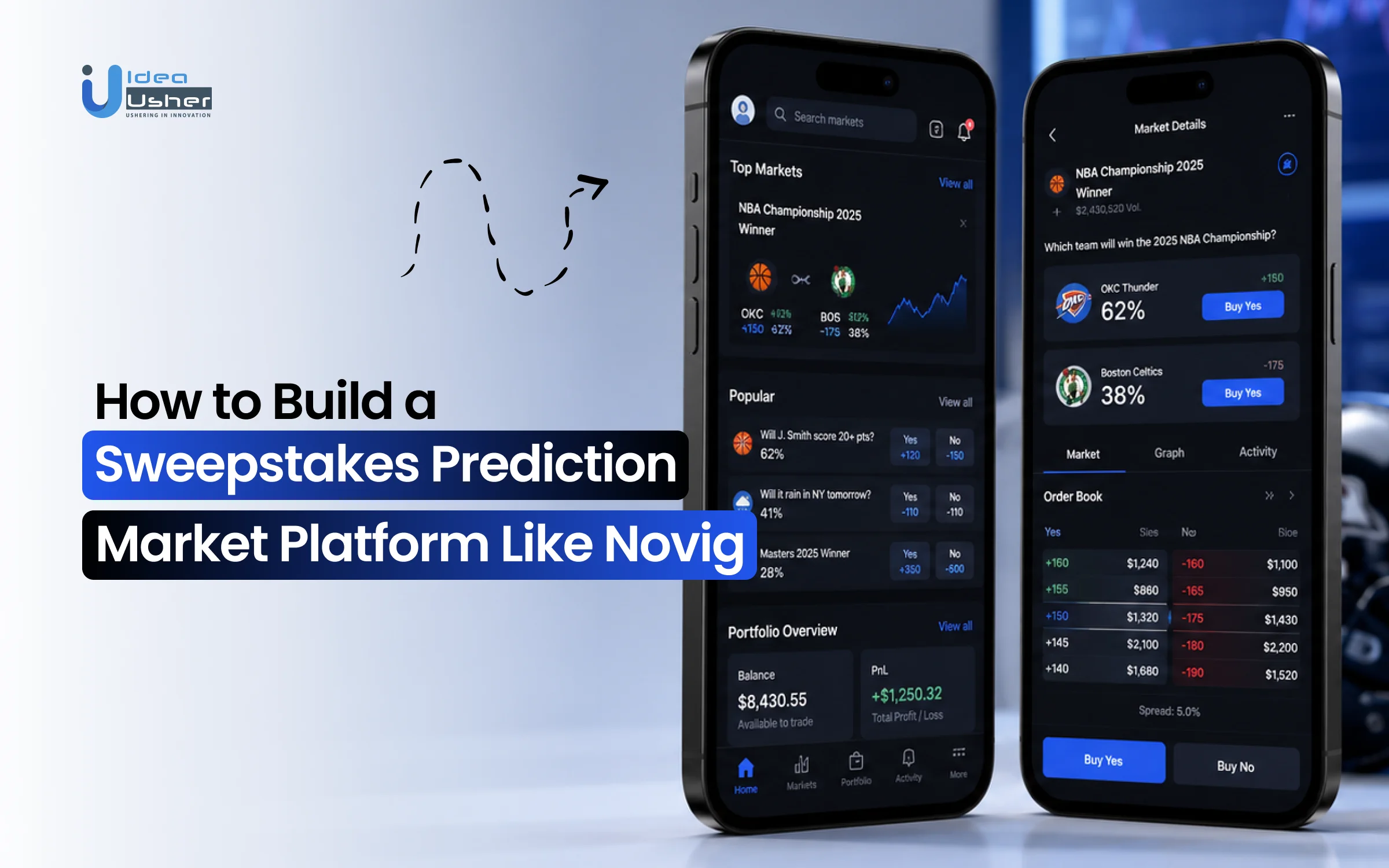
A sweepstakes prediction market is not simply a sportsbook with a different payment model. Novig-like sweepstakes prediction market development requires a platform where users predict sports outcomes, participate through a sweepstakes-based virtual currency system and trade within markets shaped by user demand. The challenge is making this experience engaging and transparent while designing the currency mechanics, market operations and safeguards around the applicable rules.
Traditional sportsbooks set odds and manage wagers centrally. Sweepstakes prediction platforms introduce a different product structure, where market liquidity, clear virtual-currency rules, accessible onboarding and user trust all influence participation. A compelling interface alone cannot sustain a marketplace if users struggle to understand how it works or find active markets.
In this blog, we’ll explore how to build a sweepstakes prediction market platform like Novig, covering its core features, trading architecture, liquidity mechanisms, technology stack, compliance requirements, and how IdeaUsher builds P2P sports prediction app that apply financial market principles to sports prediction and trading.
How Sweepstakes Prediction Markets Are Reshaping Sports Gaming
The sports gaming industry is shifting beyond traditional sportsbooks. While the global sports betting market is valued at $126.51 billion, growth is increasingly driven by peer-to-peer prediction markets.
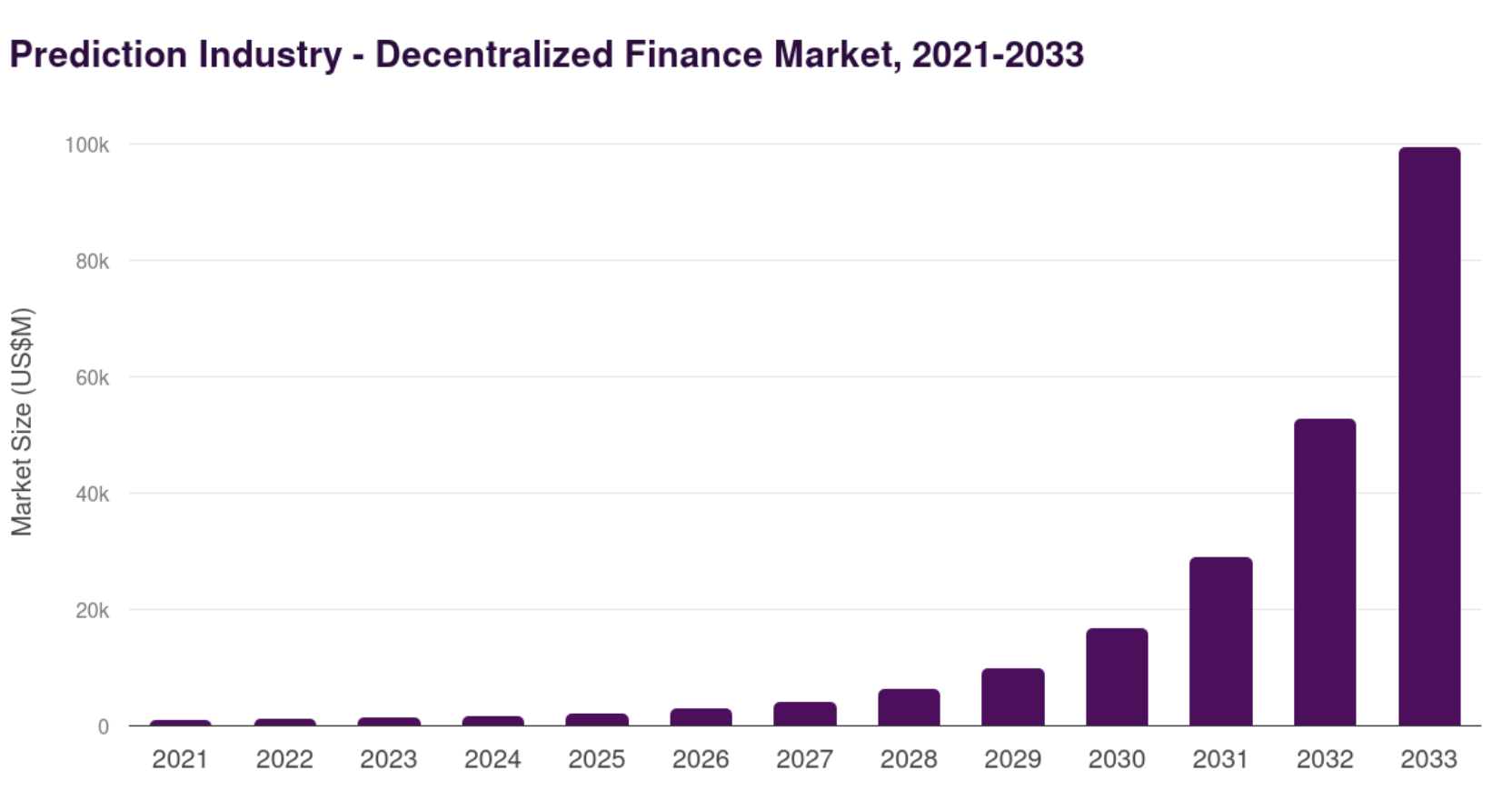
The global prediction industry decentralized finance market size was valued at US$ 2,030.8 million in 2025 and is estimated to grow at a compound annual growth rate (CAGR) of 66.7% from 2025 to 2033. This rapid growth highlights strong market demand and early opportunities for new platforms entering the space.
Novig itself reflects this momentum, reporting a 10x increase in trading volume during 2025, with annualized trading volume exceeding $4 billion after closing a $75 million Series B round led by Pantera Capital, taking total funding past $105 million.
The sweepstakes model has served as a legal on-ramp for platforms like Novig, enabling national launches through a dual-currency structure before pursuing full federal registration. This approach helped operators build user bases quickly while avoiding the state-by-state licensing required by traditional sportsbooks, though it now faces growing regulatory pushback.
- US market scale: Sweepstakes casino platforms generated roughly $14.3 billion in Gold Coin package sales in 2025, according to Eilers & Krejcik Gaming estimates on the dual-currency model.
- Nationwide reach: Prediction markets operate in all 50 states, compared with just 39 states offering legal sports betting, giving platforms like Novig a built-in distribution edge.
- Rising sportsbook hold: The national sportsbook hold rate climbed to about 10.2% in 2025, up from 6.9% in 2019, favoring commission-free peer trading.
The Structural Shift: Prediction markets are gaining momentum as major technology companies develop binary and yes/no prediction platforms, while sports markets drive tournament engagement. By replacing the house model with peer-to-peer trading and compliance-focused sweepstakes frameworks, founders can build scalable sports prediction platforms.

What Is a Sweepstakes Prediction Market Platform?
A sweepstakes-style prediction market combines event-based predictions with a promotional currency and prize structure. Unlike a conventional sportsbook, which typically sets odds and accepts wagers against its own book, a peer-to-peer prediction market can use participant orders to establish prices.
Novig provides a real-world example of how these mechanics can be implemented and how a platform’s operating model can evolve. Its earlier sweepstakes-style experience offers a reference for understanding this approach.
Since then, it received CFTC designation as a Designated Contract Market (DCM), enabling federally regulated prediction market operations across all 50 states under one framework, with enhanced market surveillance, anti-manipulation and insider-trading protections, plus comprehensive compliance standards for participant protection.
A. How Sweepstakes Prediction Market Trade Works
A sweepstakes prediction market works by letting users select sports outcomes, place orders using virtual currencies and trade against other participants. Orders are matched based on available prices, while positions and rewards are settled after verified outcomes.
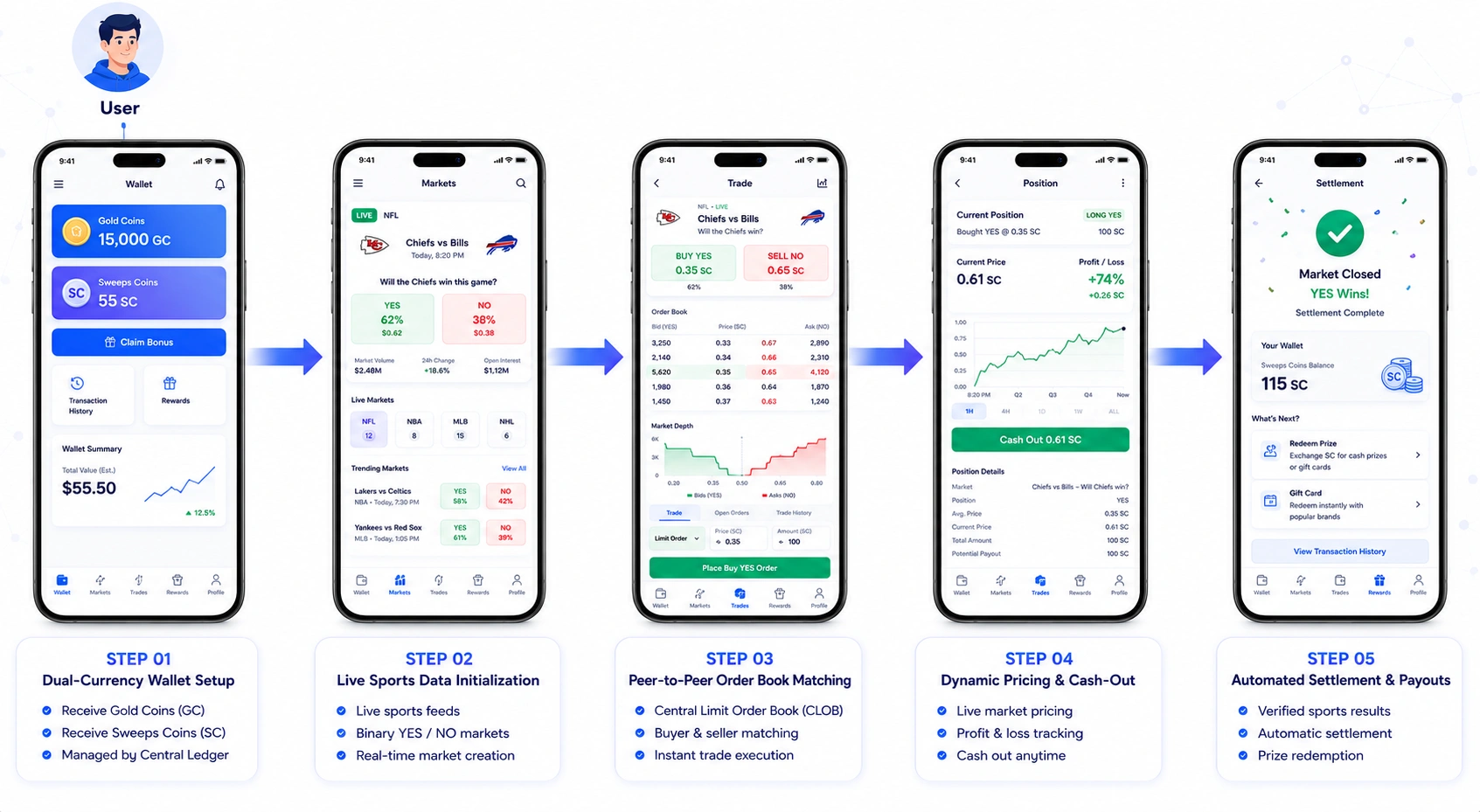
Step 1: Dual-Currency Wallet Setup
During registration, each user receives a dual-currency wallet managed by the platform’s Central Ledger. Gold Coins (GC) support free-to-play gameplay, while Sweeps Coins (SC) are distributed only through Alternative Method of Entry (AMOE) mail-ins or promotional bonuses with GC purchases, ensuring sweepstakes compliance.
Step 2: Live Sports Data Initialization
The platform connects to premium sports data providers such as Sportradar and Genius Sports, transforming live events into Yes/No binary contracts across hundreds of markets using real-time odds and match data.
Step 3: Peer-to-Peer Order Book Matching
When users trade Sweeps Coins, the platform acts solely as an intermediary. Orders are matched through a Central Limit Order Book (CLOB), pairing buyers and sellers in real time. For example, a YES order at $0.35 SC is matched against a NO position priced at $0.65 SC.
Step 4: Dynamic Pricing & Cash-Outs
As the event unfolds, contract prices continuously adjust based on live data, supply, and demand. Since positions remain tradable, users can cash out before the event ends to lock in profits or limit losses.
Step 5: Automated Settlement & Payouts
After the event concludes, verified results from the sports data feed automatically settle the market. Winning contracts redeem at 1.00 SC, losing contracts settle at 0.00 SC, and users can exchange eligible Sweeps Coins for cash prizes or gift cards through integrated payout services.
B. How Sweepstakes Architecture Changes Platform Design
Operating under consumer sweepstakes frameworks rather than fragmented sports gambling statutes completely re-engineers the platform’s underlying technical architecture. To maintain airtight legal compliance across 40+ US states, specific guardrails must be coded directly into the platform’s user experience:
| Design Dimension | Legacy Real-Money Sportsbooks | Sweepstakes Prediction Platforms | The Operator Advantage |
| Monetary Architecture | Cash deposits fund real-money wagers. | Dual-wallet system separates Gold Coins and Sweeps Coins. | Operates under social gaming laws, avoiding traditional gambling licenses. |
| Geographic Access | Strict state-by-state geolocation restrictions. | Available across multiple states, excluding only restricted jurisdictions. | Expands the addressable user base by up to 300%. |
| Entry Requirements | Requires an upfront deposit to participate. | Supports Alternative Method of Entry (AMOE) for free token access. | Strengthens regulatory compliance through free-entry participation. |
| Tax & Revenue Structure | Subject to GGR taxes of up to 51% in some states. | Operates under standard business tax structures with no sportsbook tax exposure. | Preserves margins for growth, product development, and user acquisition. |
The Platform Takeaway: By replacing the traditional house model with a peer-to-peer trading exchange, sweepstakes prediction platforms transform sports viewing into an active, real-time trading experience. For operators, this model reduces capital requirements, expands geographic reach through compliant sweepstakes frameworks, and creates a predictable, software-driven path to scalable growth.
How to Build a Sweepstakes Prediction Market Platform Like Novig
A sweepstakes prediction market platform like Novig starts with a clear operating model, compliant participation framework and well-defined trading experience. The development process then covers the matching engine, virtual wallets, live sports data, security controls, testing and scalable infrastructure for reliable market operations.
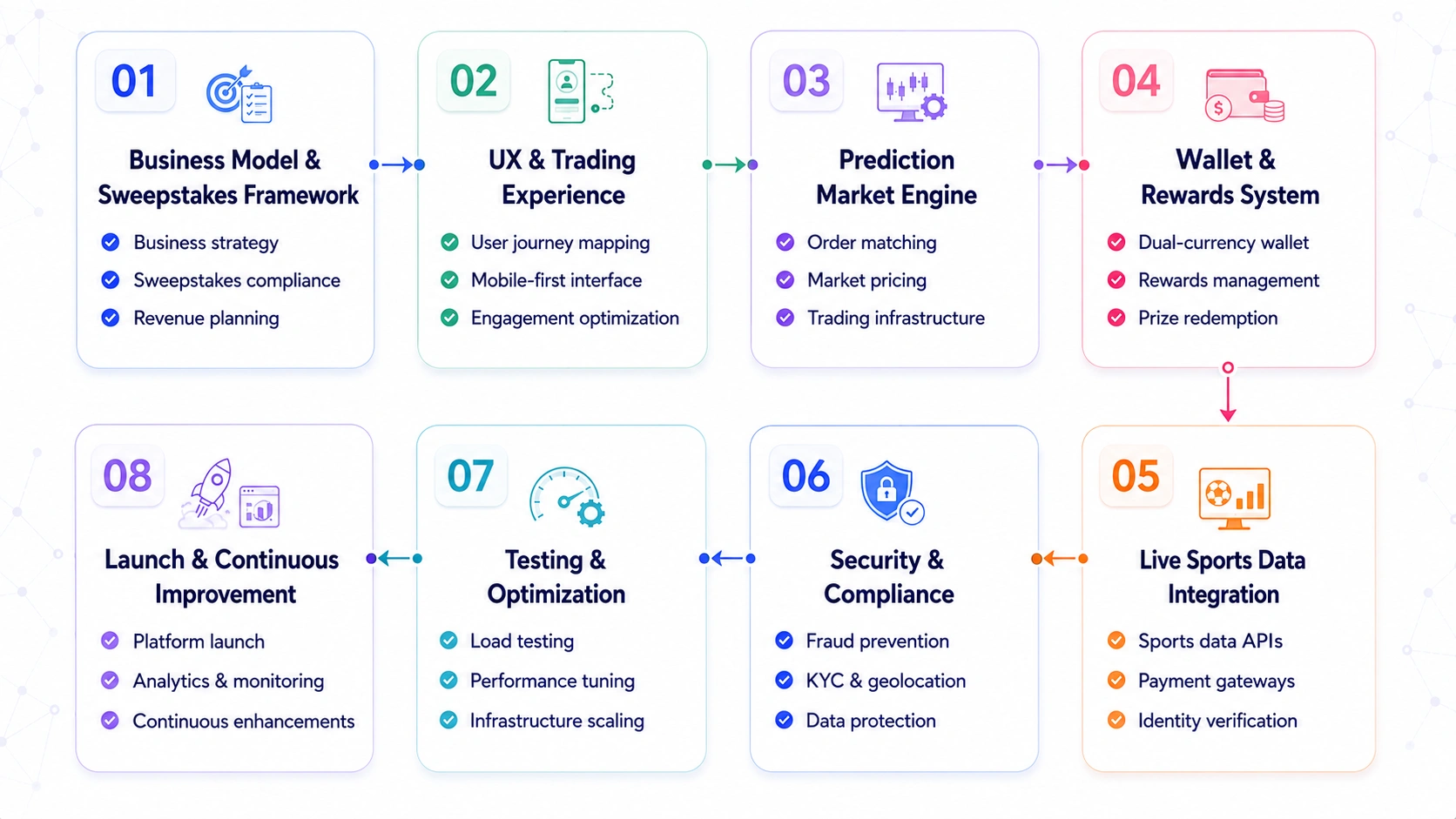
1. Define the Business Model and Sweepstakes Framework
Start by defining the platform’s business model, target audience, supported jurisdictions, market types, monetization strategy and participation rules. These decisions shape the product architecture, wallet design, trading workflows and operational requirements.
- Market Positioning Strategy: Identify the target audience, user needs and product differentiation to establish a clear value proposition.
- Operating Model Definition: Determine whether the platform will use a sweepstakes-style structure, a regulated exchange model or another approach. Define how users participate, trade and receive eligible rewards.
- Regulatory Planning: Map the requirements that need review for each intended jurisdiction, including eligibility, promotions, currency handling and prize redemption.
- Revenue Model Planning: Evaluate potential revenue streams based on the selected operating model, applicable requirements and expected operating costs.
The outcome of this stage should be a product scope and requirements document that guides design and engineering.
2. Design the User Experience and Trading Flows
Design the complete user journey, from registration and market discovery to order placement, position management and settlement. Each screen should communicate the market rules, available balance, potential outcomes and relevant restrictions clearly.
- User Journey Mapping: Map onboarding, eligibility checks, market exploration, order preview, execution, position tracking and redemption.
- Trading Interface Design: Show available prices, order-book depth, order status, open positions and execution details in an easy-to-understand format.
- Wallet Experience: Clearly distinguish currency types, promotional credits, transaction history and eligible redemption options.
- Trading State Design: Account for partial fills, rejected orders, cancellations, suspended markets and unavailable cash-out options.
- Mobile-First Usability: Optimize layouts and interactions for mobile screens while maintaining accessibility and readability.
The design deliverable should include key screens, user flows and interface states for both successful and unsuccessful transactions.
3. Build the Prediction Market and Matching Engine
The trading engine manages market prediction & participation, order validation, matching and execution. It must apply consistent trading rules while keeping order, position and balance records synchronized. The core architecture of sweepstakes prediction market development include the following components:
| Architecture Component | Purpose |
| Client Applications | Provide market discovery, order placement, position tracking and wallet access across supported devices. |
| Market Configuration Service | Defines contracts, outcomes, trading windows, market status and resolution rules. |
| Order Management Service | Validates orders, manages order states and processes cancellations or modifications. |
| Matching Engine | Matches compatible orders according to the platform’s execution and priority rules. |
| Market Data Service | Publishes available prices, order-book updates and market status changes. |
| Position and Ledger Services | Records executions, updates positions and maintains consistent account balances. |
| Settlement Service | Applies verified outcomes and records settlement results, including exceptions requiring review. |
| Monitoring and Audit Services | Tracks system performance, operational events and transaction history. |
A typical trade begins when a user submits an order. The system validates the order and available balance, checks the market’s status, then sends eligible orders to the matching engine. Once an execution occurs, the platform records the trade and updates the corresponding position and ledger entries.
The engine should also handle partial fills, rejected orders, cancellations, duplicate requests and periods when no compatible counterparty is available.
4. Develop the Sweepstakes Wallet and Rewards System
If the selected operating model uses multiple virtual currencies, the wallet must clearly separate their purposes, transaction rules and redemption eligibility. A reliable ledger is essential for tracking currency issuance, trading activity and reward-related transactions.
- Currency Management: Define the purpose and permitted use of each currency, including any restrictions on transfers or redemption.
- Transaction Ledger: Record credits, debits, promotional grants, expirations, reversals and relevant transaction references.
- Reward Distribution: Apply configured rules for bonuses, promotions and referral rewards, with appropriate eligibility checks.
- Redemption Workflow: Manage redemption requests, verification, review, approval and fulfillment according to the platform’s rules.
- Reconciliation and Audit: Compare wallet, position and settlement records to identify discrepancies and support investigation.
The wallet should provide users with a clear transaction history while giving authorized operators the tools to review account activity and resolve discrepancies.
5. Integrate Live Sports Data and Market Feeds
Sports data integrations provide the event information needed to configure markets, display live updates and resolve outcomes. Provider selection should account for coverage, licensing terms, data quality, latency and the platform’s supported sports.
| Integration | Purpose | Example Providers or Technologies |
| Sports Data Providers | Supply fixtures, scores, player statistics and event-status updates. | Sportradar, Stats Perform, Genius Sports |
| Identity Verification | Support identity, age and eligibility checks where required. | Jumio, Onfido, Trulioo |
| Geolocation Services | Support jurisdiction-based access controls. | GeoComply, MaxMind |
| Payment Services | Support permitted financial transactions and eligible prize fulfillment. | Stripe, PayPal, Adyen |
| Fraud Detection | Identify suspicious activity, account abuse and potentially fraudulent transactions. | SEON, Sift |
| Messaging and Streaming | Distribute market updates, order-book changes and event notifications. | Apache Kafka, PubNub, AWS Kinesis |
These are examples to evaluate, not a required or universally compatible stack. Availability and suitability depend on the provider’s current services, commercial terms and the platform’s operating model.
The integration layer should also validate incoming data, monitor feed freshness and define fallback behavior for delayed, unavailable or corrected event information.
6. Implement Security, Compliance and Fraud Prevention
Security and operational controls should be designed into the platform rather than added only before launch. The required controls depend on the product structure, user locations and applicable requirements.
- Identity and Access Controls: Implement secure authentication, role-based access and applicable age or identity verification.
- Jurisdiction Controls: Apply access and eligibility rules based on the platform’s reviewed operating requirements.
- Fraud Prevention: Detect suspicious account patterns, potential multi-accounting, promotional abuse and unusual transaction activity.
- Responsible Participation Tools: Where applicable, provide user controls such as limits, alerts, cooling-off periods and self-exclusion.
- Data Protection: Use encryption, secure secrets management, access controls and appropriate retention policies.
- Audit Logging: Record relevant administrative actions, account changes, market suspensions and settlement adjustments.
These controls support secure operations but do not independently establish that a platform is legally compliant.
7. Test Performance and Optimize for Scale
Before launch, test the platform under normal, peak and failure conditions. Testing should cover not only traffic volume but also the consistency of trades, positions, wallet balances and settlement records.
- Load and Stress Testing: Simulate high user activity and bursts of order submissions during major sporting events.
- Execution Testing: Validate matching rules, partial fills, cancellations, rejected orders and concurrent requests.
- Data Feed Testing: Simulate delayed, interrupted or corrected sports data and verify the platform’s response.
- Settlement Testing: Test postponed events, market suspensions, conflicting results and manual review scenarios.
- Ledger Reconciliation: Confirm that executions, positions and balance changes remain consistent across services.
- Security and Quality Assurance: Test access controls, common vulnerabilities, critical user flows and recovery procedures.
Track measurable results such as execution latency, order rejection rates, market availability and settlement exceptions. Performance targets should be defined according to the product’s expected traffic and technical requirements.
8. Launch, Monitor and Continuously Improve
After deployment, monitor platform reliability, trading activity and operational workflows to identify issues and guide improvements.
- Platform Monitoring: Track uptime, service health, latency, error rates and infrastructure capacity.
- Trading Operations: Monitor order rejections, execution failures, market suspensions and unusual order activity.
- Settlement and Wallet Monitoring: Track unresolved markets, settlement exceptions, ledger discrepancies and redemption issues.
- User Experience Analytics: Analyze onboarding completion, market discovery, user feedback and friction in key workflows.
- Incident Management: Establish procedures for feed outages, market suspension, data corrections and user communication.
- Product Iteration: Prioritize improvements based on reliability, user needs, operational findings and the platform’s defined goals.
A structured monitoring and improvement process of sweepstakes prediction market development helps the team identify technical issues early and refine the platform as its user base and market coverage evolve.
Core Features Every Sweepstakes Prediction Market Platform Needs
A sweepstakes prediction market platform needs two layers: MVP features covering eligibility checks, market discovery, order matching, a dual-currency wallet, and settlement, plus advanced features covering live trading, additional market types, automated risk monitoring, and dispute management for platforms scaling toward real regulatory and volume complexity
A. MVP Features to Launch Sweepstakes Prediction Market
The MVP layer of sweepstakes prediction market development establishes legally sound access, functional trading, and basic oversight: eligibility verification, market visibility, order matching, wallet accuracy, and settlement integrity. Without these eight capabilities working together, the platform can’t legally or reliably operate.
| Feature | What It Does | Why It Matters |
| User Registration and Eligibility | Enables account creation, secure login, and required age, identity, or location checks | Establishes secure access and helps enforce sweepstakes eligibility and participation requirements |
| Market Discovery and Details | Displays sports events, available outcomes, prices, market rules, and closing times | Helps users find relevant markets and understand terms before committing to participate |
| Order Placement and Matching | Lets users submit buy or sell orders, matched by defined platform rules | Enables genuine peer-to-peer trading and supports real market-based price discovery across every market |
| Real-Time Order Book | Shows available bids, asks, prices, and quantities for each supported market | Gives users visibility into available liquidity and likely execution prices before trading |
| Dual-Currency Wallet | Maintains separate balances and transaction records for the platform’s designated virtual currencies | Supports accurate balance tracking under the sweepstakes model’s specific dual-currency rules |
| Sports Data and Market Settlement | Integrates event schedules, scores, and status data to resolve markets accurately | Keeps markets tied to real event data and ensures consistent outcome processing |
| Position and Order History | Displays open positions, pending orders, completed trades, and account activity in one view | Helps users track participation and understand their own market activity clearly |
What a founder should actually know here: The Dual-Currency Wallet is the feature that makes this model legally distinct from real-money trading. Getting entry versus redeemable currency logic wrong at the wallet level undermines the platform’s entire legal basis, not just a single feature elsewhere in the product.
B. Advanced Features of Sweepstakes Prediction Market
Advanced features exist for scale and defensibility, not launch. Live in-game trading, expanded market types, automated risk monitoring, and dispute handling matter once real volume, contested outcomes, and operational complexity arrive, not before demand is proven.
| Feature | What It Does | Why It Matters |
| Advanced Order Types | Supports conditional order instructions and execution options beyond basic buy or sell | Gives experienced traders more precise control over how their orders execute |
| Liquidity and Market-Making Tools | Monitors order-book depth and supports active liquidity management and market-making operations | Helps operators spot thin markets and manage trading conditions before problems arise |
| Live In-Game Trading | Keeps supported markets active during events, subject to data availability and rules | Supports event-driven participation but demands timely data and strict operational controls |
| Advanced Market Types | Supports additional formats like player props, futures, spreads, or parlays where allowed | Expands market variety and supports more sophisticated product and trading requirements |
| Automated Risk and Fraud Monitoring | Applies exposure limits and flags suspicious orders or potential market manipulation | Helps operators manage platform risk and investigate activity that breaches the rules |
| Automated Market Suspension and Recovery | Pauses markets automatically when triggers like stale data or interruptions occur | Reduces the risk of trading under unreliable conditions and improves resilience |
| Advanced Settlement and Dispute Management | Routes disputed results for review and supports corrections with documented histories | Resolves contested outcomes consistently while preserving a clear, defensible audit trail |
What a founder should actually know here: Automated Market Suspension and Dispute Management aren’t optional extras; sports data outages and contested calls are inevitable at real scale, not edge cases. Skipping either one turns a bad data feed or disputed result into a platform-wide trust crisis.
Cost to Build a Sweepstakes Prediction Market Platform Like Novig
The Novig-like sweepstakes prediction market development depends on its feature complexity, trading infrastructure, compliance requirements, third-party integrations, and scalability goals. A phased investment approach helps founders launch faster while planning for long-term platform expansion and performance.
A. Cost Breakdown by Development Phase
The following estimates provide a realistic budget range for each development phase, helping founders understand where investment is allocated when building a secure, scalable, and feature-rich prediction market platform.
| Development Phase | Estimated Cost Range (MVP → Enterprise) | What the Phase Covers |
| Product Discovery & Planning | $8,000 – $18,000 | Business strategy, feature planning, compliance analysis, user journeys, technical architecture, and product roadmap definition. |
| UI/UX Design | $10,000 – $25,000 | Wireframes, interactive prototypes, mobile-first interfaces, trading workflows, wallet screens, and responsive user experience design. |
| Frontend Development | $20,000 – $50,000 | Mobile and web interfaces, dashboards, trading screens, wallet integration, notifications, and responsive user interactions. |
| Backend & Matching Engine Development | $35,000 – $90,000 | Trading engine, order books, liquidity management, APIs, business logic, and real-time market processing infrastructure. |
| Sports Data & Third-Party Integrations | $15,000 – $40,000 | Sports feeds, identity verification, geolocation, payment gateways, notifications, fraud prevention, and external service integrations. |
| Security & QA Testing | $12,000 – $35,000 | Security implementation, compliance controls, automated testing, performance validation, bug fixing, and deployment readiness. |
| Deployment & Post-Launch Support | $10,000 – $30,000 | Cloud deployment, monitoring, optimization, maintenance, infrastructure management, and continuous feature enhancements. |
| Total Estimated Cost | $80,000 – $500,000+ | Combined cost across all development phases aligned with MVP to Enterprise platform scope. |
Note: These estimates represent typical industry ranges. Final sweepstakes prediction market development costs depend on platform scope, infrastructure complexity, regulatory requirements, customization level, integrations, and the expertise of the development team.
B. Development Cost by Platform Level
The overall sweepstakes prediction market development cost varies depending on the platform’s complexity, feature set, and scalability requirements. The table below provides a clear comparison of different platform levels, outlining key features and estimated investment ranges to help businesses plan their budget effectively.
| Platform Level | Estimated Cost | What Features Are Included |
| MVP | $80,000 – $150,000 | Core peer-to-peer trading, sweepstakes wallet, user authentication, basic prediction markets, order matching, and essential integrations. |
| Mid-Level Platform | $150,000 – $280,000 | Live in-game trading, advanced order books, multiple sports, referral system, analytics, compliance tools, and enhanced user experience. |
| Enterprise Platform | $280,000 – $500,000+ | AI-powered risk management, high-performance matching engine, advanced security, scalable infrastructure, premium analytics, extensive integrations, and enterprise-grade monitoring. |
Note: Many businesses launch with an MVP sweepstakes prediction market development to validate product-market fit before investing in advanced trading capabilities, enterprise infrastructure, AI-driven features, and large-scale platform optimization.
C. Factors That Influence Development Budget
The overall investment required depends on several business and technical decisions. Understanding these sweepstakes prediction market development cost drivers helps founders prioritize features, plan budgets effectively, and build a platform that balances performance, scalability, and long-term growth.
- Real-Time Sports Data Licensing: Integrating premium sports data feeds, live odds, player stats, and in-game data adds $10,000–$30,000 in setup costs, plus $2,000–$15,000/month for recurring licensing.
- Matching Engine Performance: Building a low-latency order matching engine with in-memory databases and high-frequency trading capabilities adds $20,000–$60,000, plus $2,000–$8,000/month for infrastructure.
- Payment & Wallet Infrastructure: Developing sweepstakes wallets, virtual currencies, deposits, withdrawals, and transaction tracking costs $10,000–$25,000, with 2%–4% payment processing fees.
- Geolocation & Jurisdiction Compliance: Implementing location-based access controls and regulatory compliance adds $5,000–$15,000, plus $500–$2,000/month for ongoing compliance services.
- KYC & AML Verification: Integrating identity verification, fraud detection, and AML workflows costs $8,000–$20,000, with verification fees of $1–$3 per user.
- Security & Fraud Prevention: Protecting against account takeovers, bot trading, and financial fraud with encryption, anomaly detection, and continuous monitoring adds $15,000–$40,000, plus $1,000–$5,000/month for security tools.
How Sweepstakes Prediction Market Platforms Make Money
Sweepstakes prediction market platforms like Novig generate revenue through institutional liquidity services, the dual-currency sweepstakes model, interest on customer balances, and regulated exchange fees. Unlike traditional sportsbooks, they do not rely on built-in odds margins or commissions charged to everyday traders.
Summary of Revenue Streams
The following table summarizes key revenue streams, target audiences, pricing structures, and primary drivers after sweepstakes prediction market development that enable sweepstakes prediction market platforms to generate sustainable income across both retail and institutional segments.
| Revenue Stream | Target Audience | Primary Pricing / Numerical Metric | Key Driver |
| Institutional Liquidity Fees | B2B Trading Firms & Market Makers | Custom volume/clearing fees; $500 to $5,000+ / month for premium APIs | High-frequency trading & algorithmic execution |
| Dual-Currency Token Sales | Retail Users & Casual Players | $4.99 to $99.99 per virtual coin bundle | Non-redeemable package purchases bundled with 1:1 promo credits |
| Interest Income & Breakage | Platform Ecosystem / Escrow Float | 4.5% to 5.25% annualized yield; 5% to 15% token breakage rate | Holding unredeemed user float; strict $50–$100 redemption thresholds |
| Regulated Exchange Fees | Entire Marketplace (Post-CFTC model) | $0.0005 to $0.01 microscopic fee per contract traded | Micro-transaction scaling over billions of dollars in annual volume |
Building on this overview, each revenue stream plays a distinct role after the platform’s overall business model, combining institutional participation, user engagement, and financial efficiencies to create a scalable and diversified income structure.
1. Institutional Liquidity Services
Prediction markets generate revenue by charging institutional liquidity providers, including market makers and trading firms, instead of profiting directly from losses incurred by individual users.
- Institutional Connectivity Fees: Quantitative trading firms, liquidity providers, and market makers pay for connectivity and clearing services that support high-volume automated trading.
- Premium API & Market Data: Institutional clients pay $500–$5,000+ per month for low-latency APIs and real-time market data to power algorithmic trading.
2. Dual-Currency Sweepstakes Model
The sweepstakes framework allows platforms to operate legally across many U.S. states without requiring traditional sportsbook licenses, expanding access while maintaining compliance with promotional gaming regulations.
- Virtual Coin Sales: Users purchase Gold Coins or similar non-redeemable virtual currencies through bundles typically priced between $4.99 and $99.99.
- Promotional Sweepstakes Credits: Purchases include complimentary Sweepstakes Credits that can be used in eligible prediction markets and redeemed for prizes. Platforms also benefit from breakage, unused, expired, or unredeemed credits, which can represent 5%–15% of issued promotional balances.
3. Interest Income & Breakage
Customer balances generate additional revenue beyond trading activity by enabling platforms to earn interest on held funds, benefit from breakage, and manage redemption timing efficiently.
- Yield on Customer Float: Cash and virtual balances are invested in secure banking products or short-term government securities, generating 4.5%–5.25% annualized yields.
- Redemption Thresholds: Minimum redemption limits (typically $50–$100) and 1× playthrough requirements on promotional credits help reduce immediate payouts while supporting operational revenue.
4. Regulated Exchange Fees
As platforms evolve into regulated exchanges, they gain access to new revenue streams, enhanced credibility, broader market participation, and scalable monetization through institutional trading and compliance frameworks.
Licensed exchanges can charge regulatory clearing or transaction fees of approximately $0.0005–$0.01 per contract, creating significant revenue at institutional trading volumes.
Challenges in Building a Sweepstakes Prediction Market Platform
Novig like sweepstakes prediction market development involves far more than developing trading features. Developers must solve complex challenges around real-time performance, regulatory compliance, and market integrity to deliver a secure, scalable, and seamless user experience.
1. Low-Latency Trading and Matching Engine
Challenge: Processing thousands of concurrent buy and sell orders while maintaining accurate order books, transparent pricing, and millisecond-level trade execution during high-traffic sporting events.
Solution: Our developers design an event-driven matching engine using scalable microservices, in-memory caching, asynchronous processing, and optimized databases to ensure fast order execution, consistent market pricing, and reliable platform performance under heavy trading loads.
2. Sweepstakes Compliance Across Jurisdictions
Challenge: Managing varying regional sweepstakes regulations, geolocation restrictions, eligibility verification, and prize redemption rules without disrupting the user experience or platform operations.
Solution: We implement a compliance-first architecture with geolocation controls, identity verification, jurisdiction-based access rules, automated eligibility checks, and configurable compliance workflows, enabling businesses to operate confidently across supported regions while reducing regulatory risks.
3. Fraud Prevention and Market Integrity
Challenge: Detecting fake accounts, bonus abuse, bot trading, suspicious transactions, and market manipulation while preserving a transparent and trustworthy peer-to-peer trading environment.
Solution: Our team integrates advanced fraud detection, behavioral analytics, device fingerprinting, transaction monitoring, and risk scoring systems to identify suspicious activities in real time, protecting both users and the overall integrity of the prediction marketplace.
Partner With Idea Usher for Sweepstakes Prediction Market Platform
With 11+ years of experience, 250+ specialized developers, 1,000+ successful projects across 50+ countries, and a 4.9/5 Clutch rating, IdeaUsher builds secure, scalable software platforms for complex fintech and trading ecosystems.
We develop custom sweepstakes prediction market platforms powered by high-frequency order matching engines, dual-currency sweepstakes frameworks, and automated geolocation compliance. Our solutions are built for performance, regulatory compliance, and seamless scalability, enabling businesses to launch secure, market-ready prediction exchanges.
Why Enterprises Choose Us
Business leaders choose us to build high-volume prediction exchanges because we make sports trading feel like a fast, social game while ensuring the underlying platform handles millions of transactions flawlessly.
- Dynamic Order Book Matching: We build low-latency matching engines that process thousands of peer-to-peer (P2P) trades per second, enabling zero-vig, market-driven pricing.
- Dual-Token Sweepstakes Infrastructure: We develop secure dual-ledger systems that separate free-play and prize-redeemable virtual currencies, ensuring compliant sweepstakes operations across multiple jurisdictions.
- Real-Time Market Data Synchronization: We engineer live price tickers, depth charts, and order book updates that stay synchronized with market activity for a seamless trading experience.
- Automated Trade Integrity & Recovery: We integrate background monitoring that detects data feed disruptions, validates trade finality, and automatically resolves inconsistencies before they impact user balances.
Ready to revolutionize peer-to-peer sports trading with a high-capacity sweepstakes prediction market? Partner with IdeaUsher’s principal gaming and fintech software architects to map out your custom platform today.
Conclusion
The rise of sweepstakes prediction markets is creating new opportunities for businesses to offer a more transparent and interactive alternative to traditional sports betting platforms. However, success depends on much more than launching an app. It requires the right combination of peer-to-peer trading infrastructure, real-time market execution, compliance-first architecture, and scalable technology. At IdeaUsher, we bring deep expertise in Novig like sweepstakes prediction market development, helping businesses design, develop, and launch secure sweepstakes prediction market solutions tailored for long-term growth and evolving market demands.
FAQs
A.1. sweepstakes prediction market development costs depend on features, integrations, compliance requirements and scalability. An MVP typically costs $80,000 to $150,000, while enterprise platforms may exceed $500,000.
A.2. Essential features of sweepstakes prediction market development include user eligibility checks, market discovery, peer-to-peer order matching, real-time order books, virtual currency wallets, sports data integration, settlement and transaction history.
A.3. A matching engine validates buy and sell orders, checks market status and balances, matches compatible orders using predefined rules, records executions and updates user positions and account ledgers.
A.4. Compliance requirements include identity and age verification, geolocation controls, eligibility checks, promotional rules, prize redemption policies, fraud monitoring and responsible participation tools, depending on the operating model and jurisdiction.