


Key Takeaways
- An oil and gas tokenization platform turns reserves, wells, royalties or pipelines into tokens that show ownership or revenue rights.
- Before building an oil and gas tokenization platform, you need to check the assets, decide what investors will receive and set up the legal structure.
- Smart contracts connect token ownership with data and revenue payouts so that records stay clean and to track payments easily.
- An estimated basic oil and gas tokenization platform can cost between $50,000 and $80,000. A larger oil gas tokenization platform may cost between $200,000 and $500,000 or more, not counting operating costs.
Building an oil and gas tokenization platform needs a blockchain setup. It also needs contracts that follow the rules and safe ways to value oil and gas reserves. These physical assets get turned into tokens. Developers use this to raise money and let people own small pieces of oil and gas assets. They connect finance or DeFi tools with regular energy markets. To launch successfully, the platform must work with storage systems following international rules for securities.
The platform must link digital ownership records with legally enforceable rights to the underlying assets or revenue streams in addition to creating tokens. This calls for trustworthy asset records, investor confirmation, transfer limitations, custody agreements and revenue distribution systems. Every element needs to be in line with the asset structure and any relevant regulations.
In this blog, we will explain how to build an oil and gas tokenization platform, covering asset structuring, blockchain architecture, smart contracts, compliance, investor onboarding, revenue distribution and the key implementation decisions that shape oil and gas asset tokenization platform development cost and scalability.
What Is an Oil and Gas Tokenization Platform?
An Oil and Gas Tokenization Platform is a specialized real-world asset (RWA) issuance and management infrastructure that converts energy-sector assets such as proved petroleum reserves, producing wellheads, mineral rights or midstream pipelines into compliant, blockchain-native digital tokens.
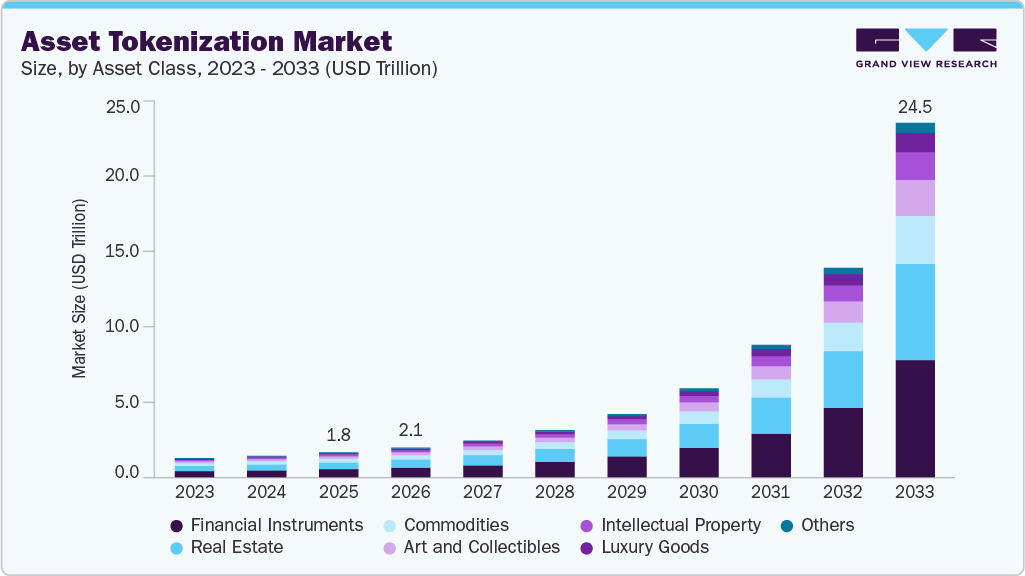
The global asset tokenization market is valued at $2.1 trillion in 2026 to $24.5 trillion by 2033, representing a 42.1% CAGR. And this market is expanding in tokenizing energy assets, giving oil and gas operators new ways to structure ownership, attract investors and distribute returns through blockchain-based platforms.
RWA.xyz reports $5.22 billion in distributed commodity value and $3.23 billion in represented value across tokenized commodities.
Examples include Mineral Vault’s security token (MNRL) valued at approximately $3.29 million, Robinhood’s United States Oil Fund token at $1.60 million, and Ondo’s tokenized US Natural Gas Fund at $77,876.
These listings illustrate how blockchain-based products are extending into commodity-linked assets, although their structures and underlying exposures differ.
Combining energy law and Special Purpose Vehicle (SPV) structures with smart contracts, these platforms let operators fractionalize assets, raise capital, and automate cash distributions.
A. How Does Oil and Gas Asset Tokenization Work?
Oil and gas asset tokenization connects physical production, legal ownership structures and smart contract logic to represent asset-related rights digitally and manage investor transactions.
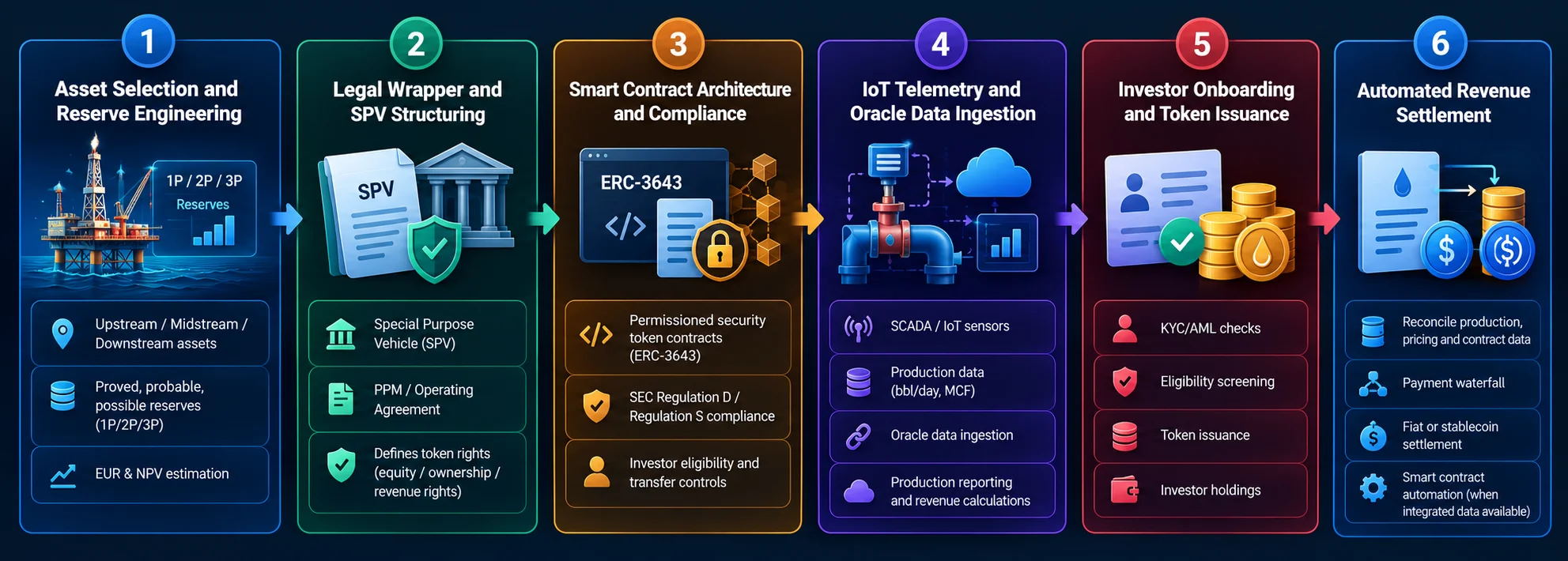
Tokenizing energy assets requires connecting physical production, legal ownership wrappers, and automated smart contract logic:
1. Asset Selection and Reserve Engineering
Operators select specific upstream, midstream or downstream assets. Third-party petroleum engineering firms assess reserves, including proved, probable and possible reserves (1P/2P/3P), to estimate ultimate recovery (EUR) and establish the asset’s net present value (NPV).
2. Legal Wrapper and SPV Structuring
The physical energy asset or contractual right is placed within a Special Purpose Vehicle (SPV) or operating trust. Legal counsel prepares Private Placement Memorandums (PPMs) or operating agreements that define how tokens relate to the SPV’s equity, ownership or revenue rights.
3. Smart Contract Architecture and Compliance
Permissioned security token contracts such as those using ERC-3643, are deployed on a suitable blockchain. Compliance rules can enforce applicable restrictions including SEC Regulation D or Regulation S requirements, investor eligibility and wallet-level transfer controls.
4. IoT Telemetry and Oracle Data Ingestion
Production metrics such as barrels of oil per day and thousand cubic feet of gas (MCF), are collected through operational systems, including SCADA and IoT sensors. Oracle infrastructure relays data from configured sources to blockchain applications, supporting production reporting and revenue calculations.
5. Investor Onboarding and Token Issuance
Investors complete identity verification, applicable KYC/AML checks and eligibility screening before subscribing. Once subscription and payment requirements are met, the platform allocates tokens according to the offering terms and records investor holdings.
6. Automated Revenue Settlement
When production is sold to buyers, the platform reconciles proceeds with production, pricing, and contract data. Revenue is allocated via an agreed payment waterfall and distributed through supported fiat or stablecoin systems, with smart contracts automating allocation when integrated data is available.
B. Which Ownership and Revenue Rights Can Tokens Represent?
The flexibility of smart contracts allows platform operators to tokenize multiple distinct layers of the oil and gas capital stack:
- Working Interest (WI) Tokens: Represent fractional ownership in an operating lease. Holders share gross revenue but must fund their proportional CAPEX and OPEX including drilling, workovers and maintenance.
- Overriding Royalty Interest (ORRI) / Royalty Interest (RI) Tokens: Provide a percentage of gross production revenue without drilling or operating expenses, offering income exposure without operational cost liabilities.
- Mineral Rights Tokens: Represent ownership of the subsurface mineral estate, generating income through lease bonuses and ongoing production royalties.
- Commodity-Backed Output Tokens: Represent claims on physical output such as 1 token = 1 Barrel of Oil Equivalent / BOE, redeemable through off-take agreements or cash settlement upon sale.
C. What Types of Oil and Gas Assets Can Be Tokenized?
Oil and gas assets that can be tokenized include underground reserves, production royalties, working interests, midstream infrastructure and diversified energy portfolios.
Each model represents different economic rights, funding opportunities and operational risks, which determine token structure and investor entitlements.
| Asset Type | Core Concept | What Token Holders Receive | Primary Benefit | Example Platform |
| Oil & Gas Reserves | Tokenizing unextracted underground resources. | Digital ownership claims linked to verified reserves. | Upfront producer funding and potential inflation hedging for investors. | PermianChain: Links basin reserve data to digital tokens. |
| Production & Royalty Revenues | Tokenizing cash flows from oil and gas sales. | A share of ongoing production revenue. | Income potential without direct drilling or operating liabilities. | Aspen Digital / Tokenized Energy: Structures energy revenue distributions through SPVs. |
| Working Interest | Tokenizing interests in drilling and operations. | A share of production revenue and operating costs. | Operational upside and potential tax benefits. | Fluidity / Stobox: Supports fractionalized investment structures. |
| Pipeline & Midstream Infrastructure | Tokenizing pipelines, storage facilities and refineries. | Income from transportation and storage fees. | Infrastructure-based returns with reduced direct exposure to commodity prices. | Tian et al. / Repsol Models: Blockchain models for infrastructure tracking. |
| Multi-Well & Energy Portfolios | Tokenizing diversified energy assets. | Returns pooled across projects, operators or regions. | Risk diversification across multiple assets. | HashCash Consultants: RWA tokenization and multi-asset portfolio solutions. |
How to Develop an Oil and Gas Tokenization Platform?
An oil gas tokenization platform converts asset ownership or revenue rights into blockchain-based tokens while connecting production data, investor eligibility and financial distributions.
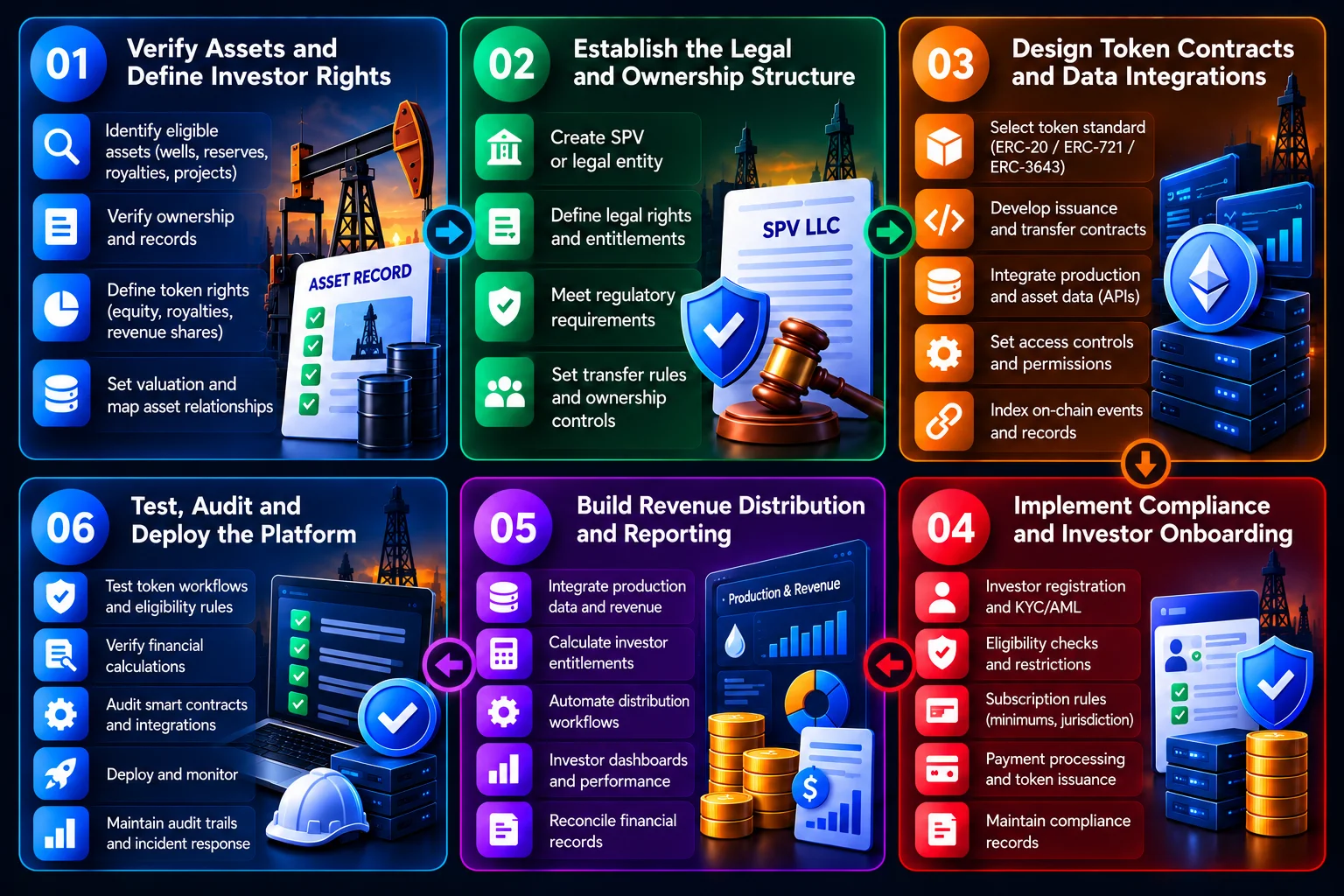
Developing the platform involves verifying underlying assets, structuring legal rights, implementing smart contracts, integrating production oracles and enforcing compliance controls. Each component must work together to support transparent reporting, accurate revenue allocation and secure token transfers throughout the asset lifecycle.
1. Verify Assets and Define Investor Rights
Begin by identifying the oil and gas assets being tokenized and verifying the records supporting their ownership, valuation and associated investor rights.
- Identify Eligible Assets: Define whether the platform covers oil reserves, producing wells, royalties, mineral rights or oil and gas project interests.
- Verify Ownership and Records: Review ownership documents, lease agreements, production records and reserve assessments to validate asset claims.
- Define Investor Rights and Valuation: Define if tokens represent equity, royalties, or revenue shares, and set valuations using reserves, production, and costs.
- Map Asset Relationships: Link physical assets to ownership entities, operators and contractual obligations to maintain traceable records of tokenized interests.
A verified asset specification defining the underlying interests, supporting documentation, valuation inputs and proposed investor entitlements.
2. Establish the Legal and Ownership Structure
Determine how the underlying assets will be legally held and how token holders will receive the rights represented by their tokens.
- Define the Ownership Vehicle: Select a suitable legal structure, such as an SPV, partnership or trust, to hold the underlying assets.
- Establish Legal Rights: Document how tokens represent equity, royalties, revenue shares or other enforceable contractual rights.
- Address Regulatory Requirements: Identify applicable securities laws, investor eligibility criteria, ownership restrictions and cross-border investment rules.
- Set Transfer and Record Controls: Set transfer rules and eligibility checks to align legal records, contracts, and on-chain balances.
A documented legal and ownership framework connecting token holder rights, asset-holding entities, transfer conditions and enforceable contractual obligations.
3. Design Token Contracts and Data Integrations
Translate the approved ownership structure into blockchain smart contracts and integration workflows that connect token transactions with relevant off-chain asset information.
- Select Token Standards: Evaluate ERC-20, ERC-721 or permissioned token standards such as ERC-3643 based on ownership structure and transfer restrictions.
- Develop Issuance Contracts: Implement authorized minting, burning, ownership transfers and supply controls that reflect the approved asset allocation.
- Integrate Asset Data: Integrate production, reserve, and ownership data via approved APIs or data feeds.
- Implement Access Controls: Enforce authorized contract administration, investor eligibility requirements and transfer restrictions where required by the legal structure.
- Index Blockchain Events: Capture issuance, transfers and other contract events to maintain synchronized investor records, transaction histories and administrative reporting.
A token infrastructure design connecting smart contracts, asset data integrations, ownership records and permission controls.
4. Implement Compliance and Investor Onboarding
Build the workflows required to verify investors, enforce participation restrictions and connect approved subscriptions with token issuance.
- Build Investor Registration: Implement account creation, identity verification, investor classification and eligibility checks based on applicable legal requirements.
- Integrate KYC Providers: Connect identity verification and screening services to support required checks before investors access restricted investment opportunities.
- Enforce Subscription Rules: Apply minimum investment amounts, jurisdiction restrictions, offering limits and approval requirements to eligible subscriptions.
- Connect Payments and Issuance: Coordinate payment confirmation, subscription records and authorized token allocation while preventing duplicate issuance after transaction retries.
- Maintain Compliance Records: Store verification outcomes, investor approvals, subscription history and relevant audit events for ongoing compliance monitoring.
An investor onboarding system connecting verification, eligibility, subscription processing, payment confirmation and controlled token issuance.
5. Build Revenue Distribution and Reporting
Develop the financial workflows that calculate investor entitlements and provide visibility into asset performance, operational costs and distribution activity.
- Integrate Production Data: Capture relevant production volumes, realized revenue and operating expenses from approved reporting systems and asset operators.
- Calculate Investor Entitlements: Apply contractual royalty rates, revenue-sharing percentages, expense deductions and distribution rules to determine eligible investor payments.
- Automate Distribution Workflows: Generate distribution records, approvals and payment instructions while tracking pending, completed or failed transactions.
- Build Investor Dashboards: Display token holdings, distribution history, asset performance indicators and relevant financial statements.
- Reconcile Financial Records: Compare operator reports, contractual calculations, investor entitlements and completed payments to identify discrepancies and preserve accurate records.
A revenue distribution and reporting system that calculates contractual entitlements, tracks payments and reconciles investor records against underlying asset data.
6. Test, Audit and Deploy the Platform
Validate the complete platform across asset records, token contracts, compliance workflows and financial distributions before deploying production infrastructure.
- Test Token Workflows: Validate issuance, transfers, eligibility checks, ownership updates and redemption or burning processes.
- Verify Financial Calculations: Test revenue sharing, expense deductions, investor allocations, payment failures and reconciliation across asset scenarios.
- Audit Contracts and Integrations: Audit smart contract security, access controls, and privileged functions. Test data delays, incorrect inputs, API failures, and recovery workflows.
- Deploy and Monitor: Deploy approved contracts, maintain audit trails and configure transaction monitoring, incident response and ongoing maintenance.
A tested and audited oil and gas tokenization platform with validated ownership workflows, reliable financial distributions and production monitoring.
Technology Architecture for Oil and Gas Asset Tokenization
An oil gas tokenization platform requires an integrated technology stack connecting blockchain ownership records with physical production data, financial systems and investor interfaces. Each component must support accurate asset reporting, enforceable token permissions and reliable revenue distribution.
| Technology Component | Role in the Platform | Suggested Technologies |
| Blockchain & Token Standards | Determines transaction costs, token functionality and wallet compatibility. | Base, Ethereum, Polygon; ERC-20 or ERC-3643 based on compliance needs. |
| Ownership & Smart Contracts | Manages token ownership, transfer permissions, investor rights and revenue distributions. | Solidity, OpenZeppelin Contracts, Hardhat or Foundry. |
| IoT, SCADA & Production Data | Connects wellhead sensors, SCADA systems and production databases. | OPC UA, MQTT, REST APIs and Node-RED. |
| Oracle Infrastructure | Feeds verified production data and commodity prices into blockchain applications. | Chainlink, custom oracles and authenticated data APIs. |
| Backend and Financial Integrations | Connects blockchain services with asset records, investor data, payments and accounting systems. | Node.js, NestJS, PostgreSQL and REST APIs. |
| Wallets, Custody and Investor Interfaces | Supports investor onboarding, wallet access, token holdings and portfolio tracking. | WalletConnect, MetaMask, Privy, React and institutional custody integrations. |
| Security & Scalability | Protects sensitive data, monitors performance and supports platform growth. | AWS or Azure, OAuth 2.0, OpenTelemetry, Grafana and centralized logging. |
The recommended architecture should reflect the asset model, regulatory obligations and expected transaction volume rather than blockchain requirements alone. Developers should prioritize secure data integration, legally aligned smart contracts and payment reconciliation before adding advanced analytics, secondary trading or multi-asset portfolio capabilities.
Note: These are just technology options, not a fixed stack. Final selection depends on the asset structure, compliance model, existing oilfield systems, custody requirements and expected transaction volume.
Core Features of an Oil and Gas Tokenization Platform
An oil and gas tokenization platform needs features that support asset verification, compliant investment, token issuance and revenue tracking. An MVP should prioritize the workflows required to launch and attract initial users, while advanced features support portfolio expansion, deeper integrations and enterprise-scale operations.
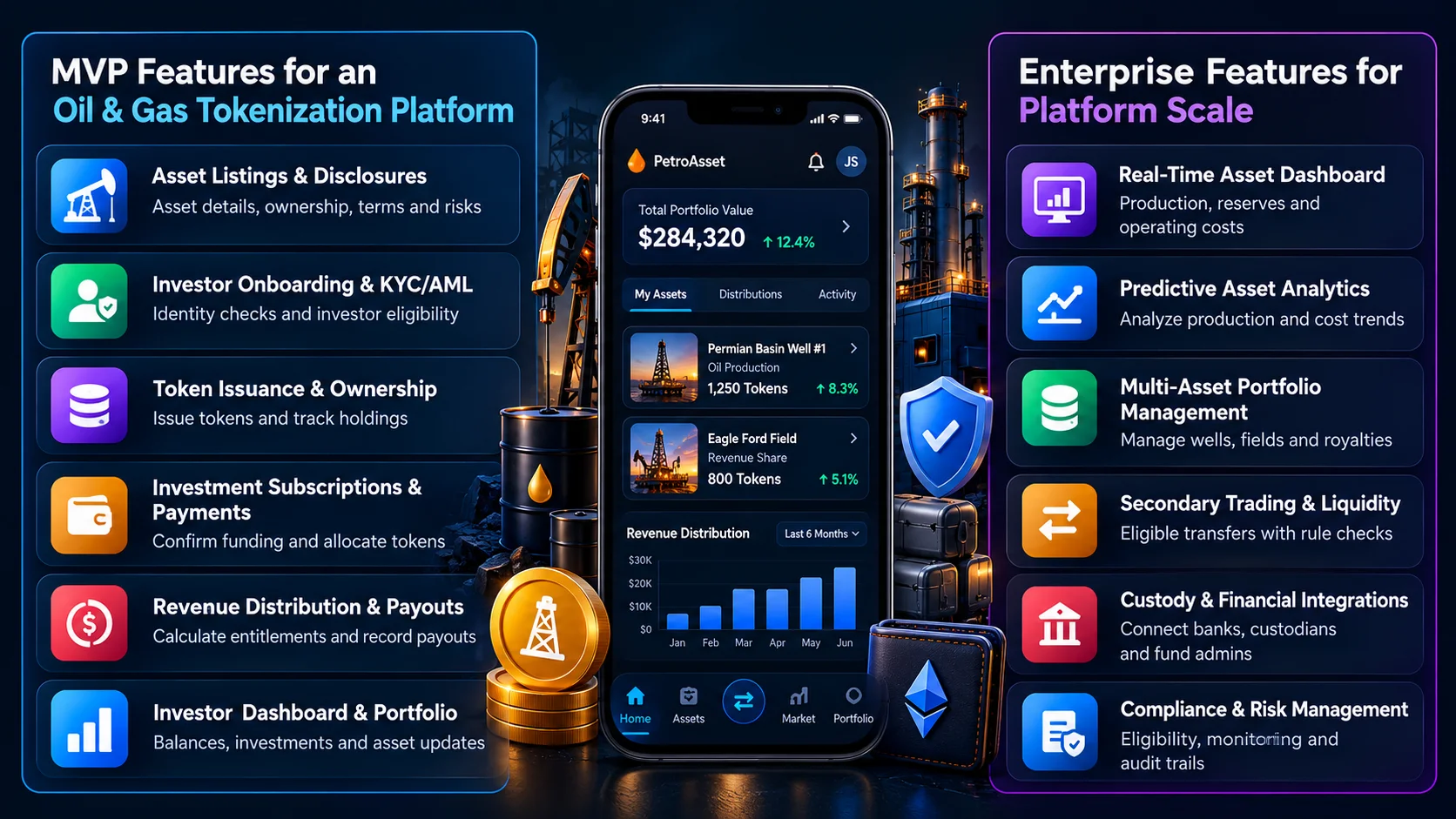
A. MVP Features for an Oil and Gas Tokenization Platform
The MVP should focus on the core functions needed to bring verified oil and gas assets to market, onboard eligible investors and manage token holdings.
These features establish operational credibility while allowing the platform to validate investor demand before investing in complex enterprise infrastructure.
| Feature | What It Does | Why It Matters |
| Asset Listings and Disclosures | Displays asset details, ownership structure, investment terms, risks and available offerings. | Gives prospective investors the information needed to evaluate opportunities before investing. |
| Investor Onboarding and KYC/AML | Collects identity information, verifies investors and checks eligibility before subscriptions. | Helps meet applicable compliance requirements and restricts access to eligible participants. |
| Token Issuance and Ownership Records | Issues tokens representing defined contractual or economic rights and tracks balances. | Establishes transparent digital records of token holdings linked to the documented rights. |
| Investment Subscription and Payments | Manages investment applications, payment confirmation and token allocation. | Connects investor commitments with funding and issuance workflows, reducing manual reconciliation. |
| Revenue Distribution and Payout History | Calculates investor entitlements using approved financial records and records completed distributions. | Helps investors track income allocations and review the history of payments received. |
| Investor Dashboard and Portfolio Tracking | Shows token balances, investment details, distribution history and relevant asset updates. | Gives early users a central place to monitor holdings and understand investment activity. |
These MVP features support the essential investment lifecycle, from asset discovery to ownership tracking and revenue reporting. Launching with a focused feature set also helps validate investor demand, identify workflow gaps and prioritize improvements using actual platform usage before expanding the product scope.
B. Advanced Features for Oil and Gas Tokenization Enterprise Scaling
Once the platform establishes market demand and a stable operating model, enterprise capabilities can support larger asset portfolios, institutional integrations and more complex operational requirements.
These features should be prioritized according to transaction volume, asset diversity, regulatory obligations and the needs of institutional participants.
| Feature | What It Does | Why It Matters |
| Real-Time Asset Dashboard | Tracks production volumes, reserve estimates, operating costs and performance across wells and fields. | Helps monitor asset performance and identify changes affecting expected returns. |
| Predictive Asset Portfolio | Analyzes production trends, reserve estimates, operating costs and historical data across assets. | Helps investors assess performance, identify production changes and plan portfolio growth. |
| Multi-Asset Portfolio Management | Manages multiple wells, fields, royalty interests and infrastructure assets within defined portfolios. | Simplifies oversight and supports portfolio expansion. |
| Secondary Trading and Liquidity Management | Supports eligible secondary transfers while enforcing investor restrictions and transaction rules. | Enables controlled transfers where legally permitted and market conditions allow. |
| Custody and Financial Integrations | Connects custody providers, banks, payment services and fund administration tools. | Aligns token operations with existing financial and asset-management workflows. |
| Compliance and Risk Management | Supports investor eligibility rules, transaction monitoring, audit trails and administrative controls. | Strengthens operational oversight as portfolios and investor activity grow. |
Enterprise features extend the platform beyond basic issuance and investor management into operational data integration, portfolio-level financial processing and institutional connectivity. They should be introduced when business requirements justify their cost and complexity, with independent controls for data accuracy, contract security, financial reconciliation and regulatory compliance.
How Much Does It Cost to Build an Oil and Gas Tokenization Platform?
Developing an Oil and Gas Real-World Asset (RWA) tokenization platform requires combining blockchain engineering with energy-sector data integration, financial workflows and regulatory compliance.
Custom asset tokenization platform development costs roughly $50,000 – $80,000 for a single-asset MVP, $90,000 – $200,000 for a commercial platform and $200,000 – $500,000+ for an institutional platform, based on scope, integrations, and location.
These figures show software budgets, not fixed vendor prices. Founders must separately budget for legal structuring, reserve evaluations, smart contract audits, and recurring OPEX like SCADA integration, identity verification, custody, and compliance.
A. Estimated Cost by Platform Type
The nature of the underlying hydrocarbon assets (e.g., royalty interests vs. working interests) dictates the technical architecture and total software expenditure:
| Platform Model | Estimated Cost | Technical Scope and Asset Mechanics |
| Single-Asset / Pilot MVP | $50,000 – $80,000 | One well or royalty interest, basic investor portal, manual revenue uploads, allowlisted token issuance and investor reports. |
| Commercial Energy Platform | $90,000 – $200,000 | Multiple assets, investor verification, token issuance, automated revenue calculations, payment integrations and asset reporting. |
| Institutional Commodity and Credit Platform | $200,000 – $500,000+ | Multi-asset portfolios, complex ownership structures, institutional custody, automated capital calls, production-data integrations and advanced security. |
Note: These estimates assume custom software development with a defined scope. Actual market pricing depends on a distributed engineering team or a specialist blockchain vendor. Legal services, independent audits, reserve engineering and ongoing third-party services are excluded.
B. Development Cost Breakdown by Project Phase
A commercial-grade oil and gas tokenization platform may require five major engineering phases. The following ranges represent indicative project budgets and should be adjusted to the selected platform scope.
| Development Phase | Estimated Cost | Scope of Work |
| 1. Discovery and Technical Architecture | $8,000–$15,000 | Asset and investor-rights analysis, system architecture, requirements, data models, integration planning and smart contract specifications. |
| 2. Smart Contract and Token Logic | $20,000–$45,000 | Token issuance, transfer restrictions, identity-registry integration, administrative permissions and revenue-allocation logic. |
| 3. Investor Portal and Administration Suite | $35,000–$75,000 | Investor dashboards, asset listings, onboarding workflows, subscription management, operator interfaces and reporting. |
| 4. SCADA, IoT and Data Oracle Integration | $15,000–$35,000 | Backend middleware, supported production-data integrations, oracle connectivity, data validation and reconciliation workflows. |
| 5. Testing, Security Hardening and Staging | $10,000–$25,000 | Functional testing, access-control validation, distribution simulations, integration testing, deployment preparation and security remediation. |
| Total Estimated Cost | $88,000–$195,000 | A more complete commercial build, before separately budgeted legal, reserve-engineering and independent audit expenses. |
Note: The estimated cost for these five phases totals $88,000–$195,000, making this breakdown more suitable for a commercial platform than a $50,000–$80,000 MVP.
A single-asset MVP can cost less by limiting token functionality, using manual production-data uploads and starting with a basic investor portal. Actual development costs depend on the selected features, integration requirements and engineering scope.
C. Factors That Influence Tokenization Platform Costs
The oil and gas tokenization platform cost depends on asset ownership structures, data automation requirements and trading functionality. The following figures are estimated additional development costs, not fixed market rates.
- Asset Class Mechanics (WI vs. Royalty): Royalty Interest (RI) tokens only receive top-line cash flow, keeping software simpler. Working Interest (WI) tokens require building an automated Capital Call & Cash-Call Engine to invoice token holders for their share of operational overruns (CAPEX/OPEX), increasing backend scope by $20,000 to $40,000.
- Automated Field Telemetry: Ingesting manual monthly accounting spreadsheets is low-cost. Automating real-time flow meter verification using SCADA IoT edge nodes and cryptographic data feeds adds $15,000 to $35,000 in integration engineering.
- Secondary Market Functionality: Primary subscriptions and redemptions limit costs. Introducing an OTC bulletin board or AMM with trading controls adds $25,000–$50,000+ in development.
D. Ongoing Infrastructure, Security and Compliance Costs
Building the platform is a one-time engineering expenditure; launching and operating an energy tokenization venue incurs significant legal and operational expenditures (OPEX):
1. One-Time Pre-Launch Non-Engineering Costs
Beyond web3 software development, launching an oil and gas tokenization platform requires upfront professional services to establish asset credibility, validate security and prepare the legal investment structure.
- Petroleum Reserve Engineering Audit ($15,000 – $35,000): Third-party engineering evaluation (e.g., SPE-PRMS standards) to establish proved reserves (1P/2P) and calculate Net Present Value (NPV10) prior to token issuance.
- Smart Contract Security Audit ($15,000 – $40,000): Formal audit by a Web3 security firm (e.g., OpenZeppelin, Halborn) to verify transfer restriction logic and prevent reentrancy or minting vulnerabilities.
- Legal Structuring & Securities Filings ($30,000 – $80,000+): Retaining energy and securities attorneys to form SPVs, draft Private Placement Memorandums (PPMs), draft operating agreements and submit SEC filings (Form D / Reg S).
2. Annual Recurring Operational Expenses (OPEX)
Once launched, the platform requires a recurring budget to maintain reliable operations, support investor services and sustain the technical and regulatory capabilities needed for ongoing business activity.
| Operational Category | Estimated Annual Cost | Service Provider / Technical Scope |
| SCADA IoT & Data Oracle Maintenance | $8,000 – $20,000 / year | Edge node connectors, Chainlink oracle node fees, and flow data indexing services. |
| Identity & Compliance Verification | $3,000 – $15,000 / year | KYC/AML screening (Sumsub, Persona) at $1.50–$3.00 per investor check. |
| Institutional Custody & Banking | $12,000 – $45,000 / year | Escrow banks and qualified digital asset custodians holding reserve funds or SPV shares. |
| Cloud Hosting & Node Infrastructure | $6,000 – $18,000 / year | AWS/GCP, dedicated RPC endpoints (QuickNode/Alchemy), and database indexers. |
| Legal & Compliance Retainer | $20,000 – $45,000 / year | Ongoing SEC reporting, annual SPV state tax filings, and legal counsel retainers. |
E. How to Plan a Realistic Development Budget
To prevent cost overruns and protect operating margins, platform founders should follow a structured three-phase funding strategy:
- Lock Legal & Revenue Structures Before Writing Code: Shifting asset mechanics mid-development (e.g., Royalty to Working Interest) forces smart contract and database rewrites. Finalize SPV legal wrappers, offering terms, and investor rules before starting engineering.
- Start with a Single-Asset Royalty Pilot: Build a focused MVP ($50,000 – $80,000) for a single producing wellhead using manual monthly USDC distributions. This validates your investor onboarding, identity allowlisting, and legal framework without incurring heavy up-front IoT integration costs.
- Separate Software CAPEX from Launch OPEX: Always maintain two distinct budget pools: one for software delivery ($80,000 – $180,000) and one for non-engineering launch costs ($115,000 – $300,000+ for audits, reserve evaluations, SEC legal filings, and 12 months of operational buffers).
Security and Compliance Requirements for Oil and Gas Tokenization
Oil and gas tokenization platforms must protect digital ownership records, investor funds and production data while enforcing applicable securities regulations.
The following security and compliance controls help maintain reliable asset records, restrict unauthorized transactions and support transparent reporting throughout the platform lifecycle.
| Security and Compliance Area | Key Requirements and Implementation Considerations |
| Securities Regulations and Investor Eligibility | Determine each token’s legal classification and apply relevant securities laws, offering restrictions and investor eligibility requirements. Configure transfer rules for the applicable jurisdiction and offering structure. |
| KYC, AML and Identity Verification | Integrate identity verification, sanctions screening and AML checks. Restrict subscriptions and transfers based on verified identities, eligibility and compliance requirements. |
| Smart Contract Security and Access Controls | Audit issuance, transfer restrictions and revenue distribution logic. Implement role-based permissions, secure admin keys, controlled upgrades and emergency pause mechanisms. |
| Legal Ownership and Off-Chain Asset Records | Maintain legal agreements, reserve reports, mineral rights, leases and SPV documents establishing token-holder rights. Reconcile on-chain tokens with authoritative ownership records. |
| Custody, Payments and Investor Fund Protection | Define how investor funds, asset proceeds and tokens are held and transferred. Integrate suitable custody and payment providers, transaction authorization and reconciliation controls. |
| Oracle Security and Production Data Integrity | Validate production measurements, reserve estimates and commodity prices before financial calculations. Apply source verification, consistency checks, monitoring and exception handling to detect inaccurate or interrupted feeds. |
| Audit Trails and Regulatory Reporting | Record issuance, transfers, investor approvals, revenue calculations and distributions. Maintain transaction histories, reconciliation records and reports for audits and regulatory reviews. |
These controls should be designed around the asset’s legal structure, investor rights and operational requirements. Smart contracts can enforce programmed rules but legal agreements, verified external data, secure custody and ongoing compliance procedures remain essential to protecting the platform and its participants.
How Are Oil Prices, Production and Investor Payouts Calculated?
Building an oil and gas tokenization platform requires converting fluctuating physical well production and dynamic commodity markets into deterministic, code-enforceable smart contract payouts.
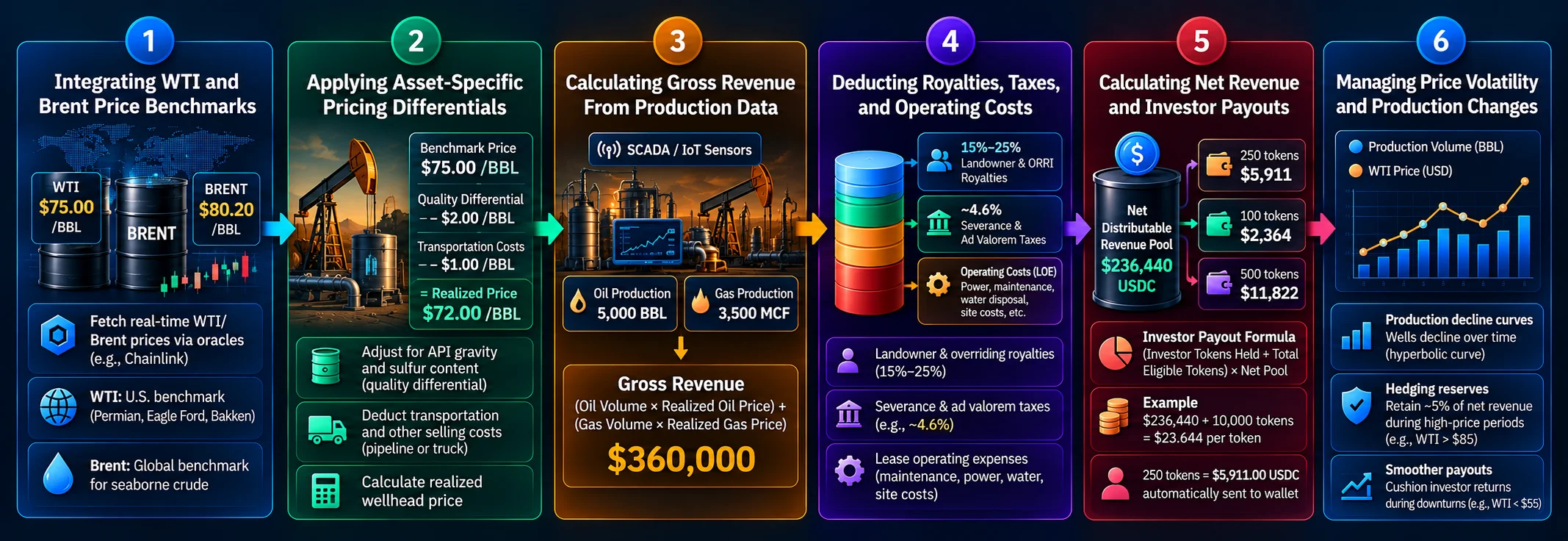
To automate investor distributions on-chain, platforms must implement a clear financial waterfall, transforming raw wellhead output into net revenue by accounting for benchmark pricing spreads, quality differentials, operational costs, and lease-level tax obligations.
1. Integrating WTI and Brent Price Benchmarks
Hydrocarbons are commodities priced against global standards but wellhead output is rarely sold at headline spot prices. Platform backends must continuously fetch global price benchmarks via reliable data oracle feeds:
- West Texas Intermediate (WTI): The primary benchmark for U.S. domestic crude oil (Permian Basin, Eagle Ford, Bakken). It is a light, sweet crude delivered to Cushing, Oklahoma.
- Brent Crude: The global benchmark used primarily for seaborne international crude production.
- Oracle Aggregation: On-chain data feeds (such as Chainlink or dedicated node indexers) stream daily WTI/Brent spot prices to the platform backend, providing the baseline valuation matrix for monthly production calculations.
2. Applying Asset-Specific Pricing Differentials
Physical crude at a remote wellhead in Texas or North Dakota does not trade at the exact spot WTI. A platform’s financial engine must apply an Asset-Specific Pricing Differential:
Realized Price = Benchmark Price + Quality Differential − Transportation and Other Applicable Selling Costs
- API Gravity & Sulfur Content (Quality): Lighter, sweeter crude commands a premium; heavier or sour crude incurs a per-barrel price discount.
- Transportation & Netback Costs: The cost to transport oil via truck or pipeline from the wellhead to the regional refining hub is subtracted from the benchmark, establishing the final realized price at the wellhead.
3. Calculating Gross Revenue From Production Data
Once telemetry sensors (SCADA IoT meters) record monthly production volumes, the system calculates:
Gross Revenue = (Oil Volume in Barrels × Realized Oil Price) + (Gas Volume in MCF × Realized Gas Price)
Step-by-Step Example Scenario – Consider a tokenized producing wellhead over a 30-day billing cycle:
- Monthly Output: 5,000 barrels of oil (BBL).
- WTI Spot Benchmark: $75.00/BBL.
- Quality & Transport Differential: -$3.00/BBL.
- Realized Wellhead Price: $75.00 – $3.00 = $72.00/BBL.
- Gross Revenue Generated: 5,000 BBL × $72.00 = $360,000 gross revenue.
4. Deducting Royalties, Taxes, and Operating Costs
Gross revenue cannot be paid directly to tokenized equity or working interest holders. It must flow down an off-chain to on-chain financial waterfall to settle primary legal burdens first:
- Landowner & Overriding Royalties (NRI Adjustment): Landowners and overriding royalty interest (ORRI) holders collect their top-line percentage (typically 15%–25%) before any operational expenses are deducted.
- Severance & Ad Valorem Taxes: State regulators levy production taxes (e.g., Texas crude severance tax of ~4.6%) directly on gross sales volume.
- Lease Operating Expenses (LOE): Field operational costs including electricity, pump jack maintenance, produced water disposal, site inspections, and chemical treatment are subtracted.
5. Calculating Net Revenue and Investor Payouts
The remaining funds constitute the Net Distributable Revenue Pool. The platform converts these funds into digital dollars like USDC and deposits them into the smart contract distribution vault.
Investor Payout = (Investor Tokens Held ÷ Total Eligible Tokens) × Net Distributable Revenue Pool
Continuing our example:
- Net Distributable Pool: $236,440 USDC deposited into the Base distribution contract.
- Total Token Supply: 10,000 tokens representing the SPV.
- Payout Per Token: $236,440 / 10,000 = $23.644 USDC per token.
- Investor Share: An investor holding 250 tokens receives an automated smart contract payment of $5,911.00 USDC directly to their verified wallet.
6. Managing Price Volatility and Production Changes
Unlike fixed-income tokenized debt or real estate rent, energy production is volatile. Platforms must account for two inherent physical and market dynamics:
- Production Decline Curves: Hydrocarbon wells often decline rapidly in their early months before stabilizing at a lower annual decline rate. Dashboards must reflect these hyperbolic decline curves in investor yield projections.
- Commodity Price Hedging Reserves: Operators can reduce payout volatility using on-chain Yield Stabilization Reserves. For example, retaining 5% of net revenue during high-price periods (WTI above $85/barrel) can help cushion distributions during downturns (WTI below $55/barrel).
Can Multiple Wells or Oil Fields Be Tokenized Together?
Yes. In fact, tokenizing a multi-well portfolio or an entire oil field is often superior to tokenizing a single wellhead.
Single-well investments subject token holders to binary operational risks: if a pump jack breaks down, a well incurs a casing collapse, or local production halts, investor yield drops to zero.
Combining multiple producing wells, non-operated working interests or widespread overriding royalty interests (ORRIs) into one Special Purpose Vehicle (SPV) forms a diversified energy basket.
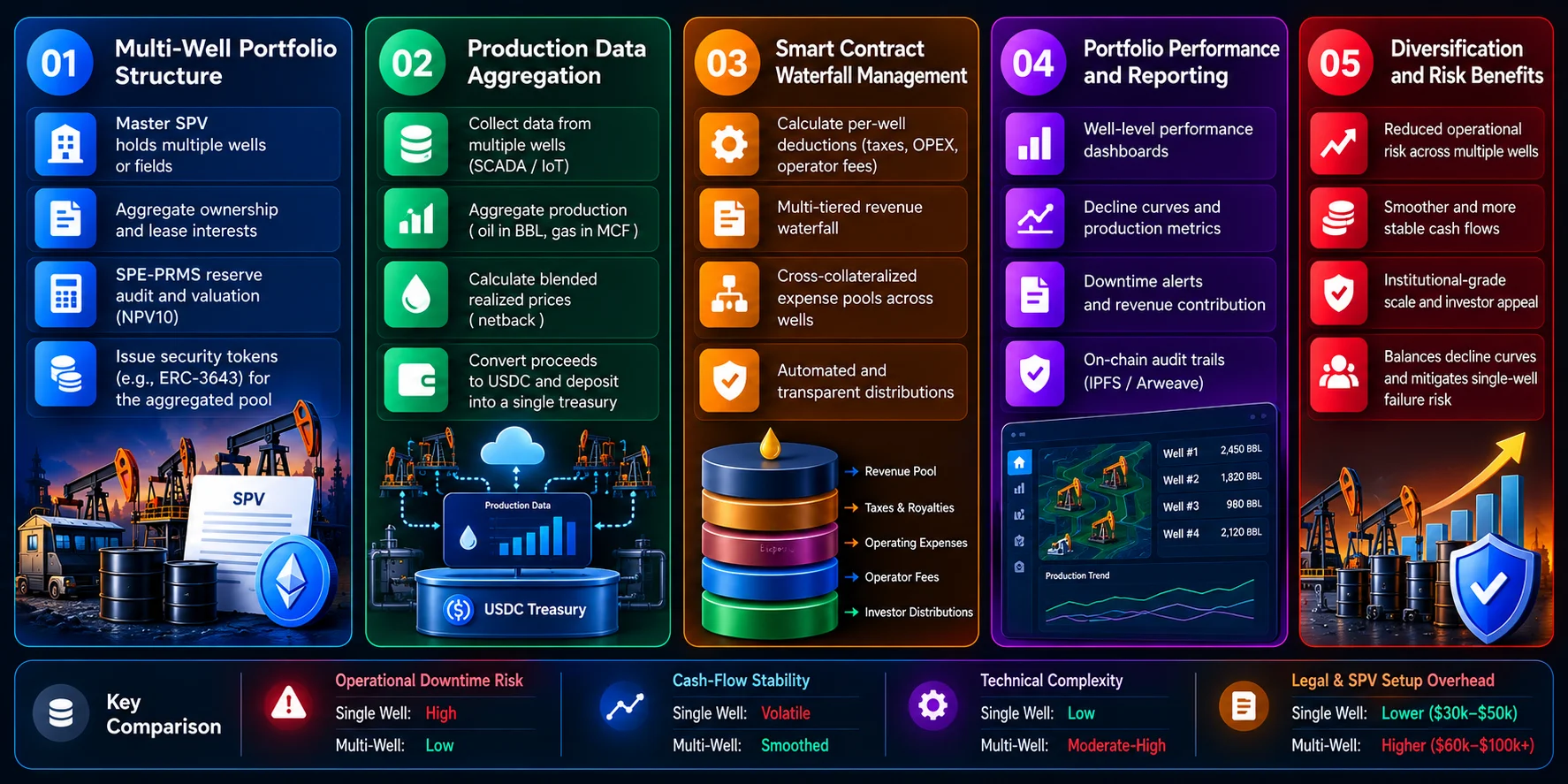
This structure balances decline curves, smooths cash flows and offers institutional-grade volume scale to investors.
A. Structuring Multi-Well and Multi-Field Portfolios
To tokenize a multi-well asset pool, founders must establish an overarching legal and operational container off-chain:
- Master SPV Holding Structure: A parent Special Purpose Vehicle is incorporated to hold the deeds, operating agreements, or lease interests across all targeted wellheads.
- Standardized Valuation and Reserve Engineering: An independent petroleum engineer conducts an SPE-PRMS reserve audit across the field, aggregating Proved Developed Producing (PDP) reserves to establish a single NPV10 for the tokenized pool.
- Unified Security Token Issuance: The master SPV issues a security token using a standard such as ERC-3643 on Base. Each token represents fractional ownership of the aggregated multi-well equity or net-revenue pool.
B. Aggregating Production Data and Revenue
Managing a multi-well pool requires handling independent production timelines, varying crude qualities, and separate off-take receipts:
- Multi-Node SCADA Data Ingestion: Backend systems collect flow-meter telemetry from multiple field sites through IoT edge controllers. Middleware aggregates daily oil (BBL) and gas (MCF) production across active wells into a unified database.
- Blended Netback Calculations: Since wells may have different sales-location price differentials, the accounting engine calculates a daily or monthly Blended Realized Price across total production.
- Unified USDC Treasury Deposit: Off-takers settle contracts independently. The platform aggregates cleared monthly proceeds, converts them to USDC and deposits a single dividend pool into the Base smart contract vault.
C. Managing Portfolio-Level Smart Contract Waterfalls
Multi-well portfolios often combine assets with different financial obligations (e.g., three Royalty Interest wells combined with two Working Interest wells). The smart contract architecture must handle a multi-tiered waterfall:
- Dynamic Deduction Engine: The smart contract logic calculates per-well obligations (severance taxes, lease operating expenses, and operator fees) before combining remaining proceeds into the master payout pool.
- Cross-Collateralized Expense Pools: In a multi-well Working Interest pool, cash flow generated by high-producing Well 1 can temporarily fund a routine maintenance workover on lower-producing Well 3, protecting the overall portfolio from sudden capital calls.
D. Reporting Asset Performance Across the Portfolio
Investors expect transparent insight into how individual wells contribute to overall portfolio yield:
- Asset-Level Performance Dashboards: Web3 investor portals display well-level metrics, including decline curves, downtime alerts, pressure levels and revenue contributions.
- On-Chain Audit Trails: Monthly engineering reports, production receipts and settlement sheets are hashed and immutably stored on IPFS/Arweave, allowing token holders to verify off-chain accounting records through their dashboards.
E. Understanding Diversification and Operational Risks
Combining multiple wells alters the platform’s financial risk profile:
| Risk & Performance Dimension | Single-Well Tokenization | Multi-Well Portfolio Tokenization |
| Operational Downtime Risk | High: Operational failure (e.g., pump breakdown) halts 100% of investor yield. | Low: Mechanical failure on one well head only impacts a small fraction of total portfolio cash flow. |
| Cash-Flow Stability | Volatile: Yield declines rapidly following steep early-stage well decline curves. | Smoothed: Blends mature, steady-producing wells with newer high-yield wells to stabilize payouts. |
| Technical & Smart Contract Complexity | Low: Single accounting waterfall and simple distribution rules. | Moderate-High: Requires multi-feed SCADA data ingestion, blended pricing math, and complex sub-ledger rules. |
| Legal & SPV Setup Overhead | Lower Upfront Expenses: Simple single-asset legal wrappers ($30,000 – $50,000). | Higher Upfront Expenses: Multi-asset Master/Series SPV structures and legal frameworks ($60,000 – $100,000+). |
Leading Oil and Gas Tokenization Platforms to Know
Oil and gas tokenization platforms use blockchain technology to represent energy assets, manage investor rights and support digital investment workflows. Comparing these platforms helps businesses understand different approaches to asset tokenization, investment access, compliance and revenue distribution.
1. EnergyFunders

EnergyFunders operates as a regulated energy investment platform that has explored blockchain-based fractional ownership for U.S. oil and gas projects. It allows accredited investors to participate in drilling and production opportunities with improved digitization of ownership records.
2. Securitize

Securitize provides institutional-grade infrastructure for tokenizing regulated real-world assets, including oil and gas equity or revenue interests in the U.S. market. Its platform supports compliant issuance, investor onboarding, and secondary trading for energy-backed securities.
3. Plume Network

Plume Network is an RWA-focused blockchain ecosystem designed to support the tokenization of commodities and infrastructure assets, including oil and gas. It offers EVM compatibility and compliance-aligned tooling for U.S. energy issuers.
4. ExxonMobil (Enterprise Pilots)

Large U.S. energy companies like ExxonMobil have explored blockchain pilots for energy trading, settlement, and asset data management, rather than public token issuance. These initiatives focus on digitizing workflows and improving transparency across the oil and gas value chain.
6. Elmnts

Elmnts focuses on tokenizing U.S. oil and gas well interests and associated royalty streams using blockchain infrastructure. The platform is designed to fractionalize ownership and automate revenue participation from energy production. It aims to improve liquidity and transparency in traditionally illiquid energy assets.
Challenges in Oil and Gas Asset Tokenization Development
Developing an oil and gas tokenization platform involves technical challenges beyond issuing blockchain tokens. Developers must connect physical asset data, complex legal ownership structures and financial settlement workflows while maintaining accurate records, enforcing investor restrictions and ensuring reliable platform operations.
1. Physical Production Data and Blockchain Integration
Challenge: Connecting SCADA systems, wellhead sensors and third-party production records to blockchain applications creates data consistency, validation and integration challenges.
Solution: Our developers integrate production data pipelines with oracle services, source validation and anomaly detection. We implement timestamped records, reconciliation checks and exception handling to prevent unverified or inconsistent production figures from triggering financial calculations.
2. Asset Rights and Smart Contract Design
Challenge: Mineral rights, royalty agreements, working interests and SPV ownership structures contain different entitlements that cannot be represented accurately through generic token contracts.
Solution: Our developers map documented ownership and revenue rights to token permissions and distribution rules. We implement configurable smart contracts, role-based access controls and tested revenue calculations aligned with approved legal agreements and offering terms.
3. Revenue Reconciliation and Investor Payout Accuracy
Challenge: Differences between production volumes, commodity pricing, operating deductions, operator statements and bank settlements can produce inaccurate investor distributions and reconciliation disputes.
Solution: Our developers integrate verified pricing inputs, production records and financial systems into a controlled reconciliation workflow. We implement configurable revenue calculations, payment-status tracking, exception handling and auditable distribution records before funds are allocated to eligible investors.
How IdeaUsher Build an Oil and Gas Tokenization Platform
Tokenizing energy assets such as working interests, overriding royalty interests (ORRI), mineral rights, and physical commodity barrels requires connecting off-chain leasehold titles and reserve reports with high-throughput on-chain settlement rails.
IdeaUsher helps businesses turn these requirements into scalable digital investment platforms with 11+ years of expertise, 250+ technologists, a 4.9/5 Clutch rating and 1,000+ delivered builds.
We engineer institutional-grade tokenization platforms built to handle complex hydrocarbon legal structures, automated production payouts, and strict securities compliance.
1. Custom Tokenization Architecture for Real-World Energy Assets
We design energy asset tokenization architectures around ownership structures, verified production data and compliant trading workflows to support fractional investment, transparent asset reporting and scalable secondary-market operations.
- Standardized Energy Token Models: Build modular token frameworks using ERC-3643 or ERC-1400 for permissioned working interests and ERC-1155 for tiered production tranches.
- Reserves and Production Oracles: Connect SCADA telemetry, flow meters and SPE-PRMS reserve assessments to track production and reserve changes on-chain.
- Secondary Market Liquidity Infrastructure: Implement CLOB matching engines or compliant AMMs for secondary trading among verified, eligible investors.
2. Smart Contract Development With Integrated Compliance Controls
Our approach embeds compliance, revenue distribution and custody safeguards into smart contract workflows to support regulated energy investments, reliable payouts and secure platform administration.
- On-Chain Regulatory Controls: Enforce Regulation D, Regulation S and applicable transfer restrictions through eligibility checks and wallet allowlists.
- Automated Yield and Royalty Disbursement: Use payment splitter contracts to distribute monthly royalties, net proceeds and tax withholdings in supported stablecoins such as USDC or USDT.
- Multisignature Custodial Security: Integrate MPC and multisignature controls through solutions such as Fireblocks and Safe to protect minting permissions, corporate vaults and treasury funds.
3. Full-Cycle Platform Development From Asset to Payout
We support end-to-end energy tokenization platform development, connecting investor onboarding and operator workflows with secure infrastructure, automated reporting and documented code ownership.
- Investor Onboarding and KYC/AML: Provide investor portals with identity verification, accreditation checks and ERC-4337 account abstraction for gas-sponsored transactions.
- Operator Cap Table and Asset Back Office: Build role-based consoles for lease documents, well division orders, payout batches and K-1 tax reporting.
- Scalable Infrastructure and Code Ownership: Use auto-scaling Kubernetes and modular microservices, with documented source code and zero vendor lock-in.
Planning to tokenize upstream oil and gas assets or launch an energy-backed investment platform? Connect with Idea Usher’s blockchain architects to evaluate your asset structure, compliance requirements, automated payout models, and technical development roadmap.
Conclusion
An oil and gas tokenization platform offers energy businesses a structured way to connect physical assets with digital investment opportunities. The right approach combines verified asset records, legally defined investor rights, secure smart contracts and reliable revenue distribution. Technology choices and development costs should align with the asset model, regulatory obligations and long-term operational needs. With a clear roadmap and experienced engineering partner, businesses can build scalable tokenization solutions that support transparent reporting, controlled investment access and efficient energy asset management.
FAQs
A.1. An oil and gas tokenization platform can cost $50,000 to $80,000 for a basic MVP, $90,000 to $200,000 for a commercial platform and $200,000 to $500,000+ for institutional solutions, excluding legal and operational expenses.
A.2. Tokenizable assets include producing wells, mineral rights, working interests, royalty interests, pipeline infrastructure and diversified energy portfolios. The token structure depends on legal ownership, investor entitlements and the underlying asset’s financial model.
A.3. Base, Ethereum and Polygon are potential options for oil and gas tokenization. Selection depends on transaction costs, smart contract compatibility, wallet support, transfer restrictions, compliance requirements and integration with existing financial systems.
A.4. Investor payouts depend on production volumes, realized commodity prices, applicable royalties, taxes and operating expenses. The remaining distributable revenue is allocated according to documented investor rights and contractual distribution rules.